

 Back
Back
It’s not an easy moment for renewable energy in the U.S., but the sector is still setting new records.
Just look at what happened last month: Over the course of March, the nation got more electricity from renewables than it did from natural gas, which is typically the single-largest source of energy on the U.S. grid.
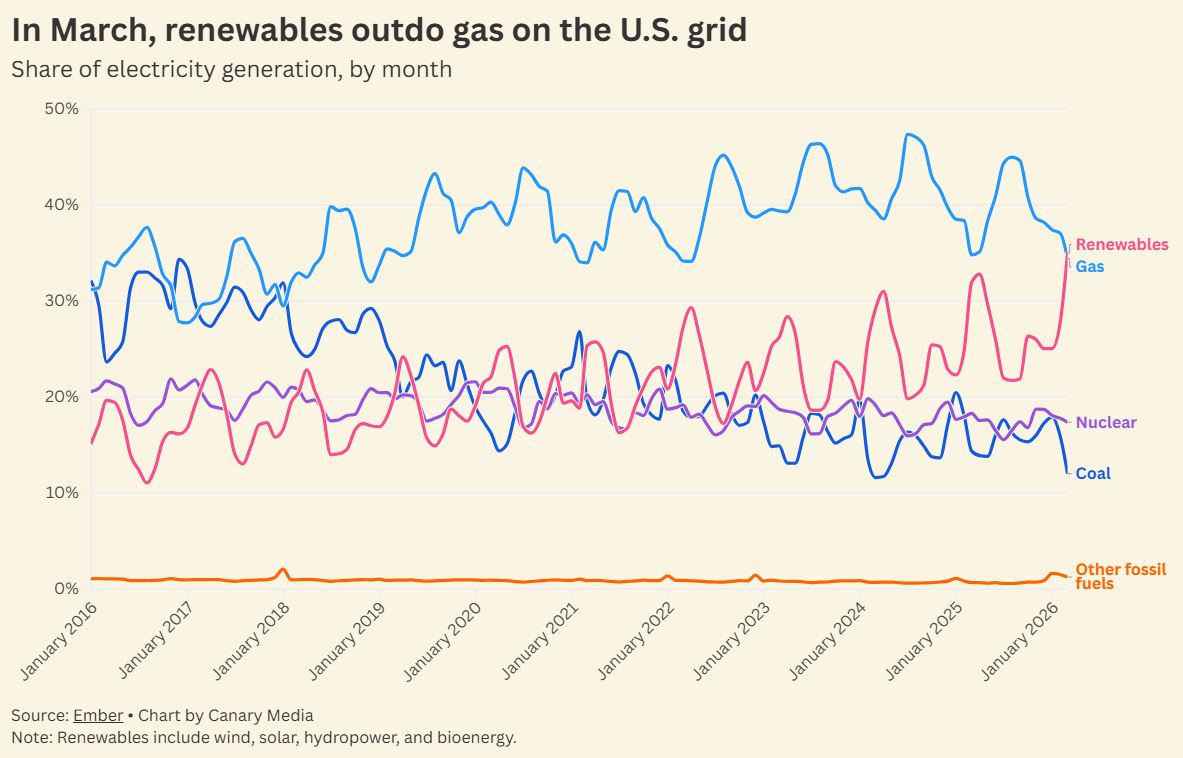
It’s the first time renewables have bested the fossil fuel in the U.S. across an entire month, per data pulled from the think tank Ember. Meanwhile, emissions-free sources, a category that includes both renewables and nuclear, produced more than half of the nation’s electricity. It’s just the third time that’s happened across an entire month, the first instance being last March.
Sure, renewables only beat gas across a short time frame. And, yes, March is the start of the spring shoulder season, when electricity demand falls a bit from its winter highs and renewables tend to outperform.
But it’s a major milestone despite these caveats. Just five years ago, the gap between gas and even the best months for renewables was yawning. Since then, that gap has narrowed, thanks in large part to the rapid expansion of solar and the steady growth of wind power. Hydropower, bioenergy, and other sources of renewable energy have seen their combined share of electricity production slowly decline over the same time period.
Renewables have crossed this threshold amid serious political pushback. The Trump administration has relentlessly attacked the sector — especially wind — over the last year and change. Its policy shifts are likely to result in fewer new solar and wind farms over the medium term, but in the short term, they haven’t really derailed the growth of clean energy. In fact, March was the best-ever month for wind in terms of electricity output.
But perhaps more impressive is that renewables are growing their market share while overall electricity demand climbs. Put simply, clean energy is taking a bigger slice of a growing pie.
Gas power plants, for their part, remain difficult to build due to supply chain bottlenecks. Meanwhile, solar, batteries, and wind together will once again make up the overwhelming majority of new energy capacity added to the grid this year. The same was true last year. And the year before. And the year before that…
Even as the Trump administration creates obstacles to building renewables, a key pair of facts will hold: The U.S. needs more electricity, and renewables are the easiest way to get it. In other words, don’t expect this to be the last month in which renewables conquer gas.
There’s nothing like a common enemy to bring people together. This midterm election year, that enemy may be data centers.
As AI grows more powerful and more popular, tech companies are rushing to build facilities that house all that computing capability — and to secure tons of power to run them. But no one knows exactly how many of those data centers will get constructed, and how much electricity they’ll need. That’s a problem for utility customers, who may be saddled with the costs and climate impacts of an unnecessary gas power and grid infrastructure buildout.
Some states are tackling the problem with what are known as large-load tariffs: essentially, special rates and requirements that force big power users to shoulder the costs of grid buildouts. But this week, a small city in Wisconsin put its foot down. Port Washington, a suburb of Milwaukee, voted by a roughly 2-to-1 margin to require that city leaders get voter approval before awarding tax breaks to data centers and other large development projects. It’s a clear response to the $15 billion OpenAI and Oracle megaproject that’s being built in the city, though this newly approved measure comes too late to affect that project.
At the federal level, Democrats have spearheaded most of the campaigns against data centers, with Sen. Bernie Sanders (I-Vt.) and Rep. Alexandria Ocasio-Cortez (D-N.Y.) even proposing a nationwide moratorium. But Port Washington is part of Ozaukee County, which has voted for Republicans over the past 20-plus years of elections.
Also this week, residents in Festus, Missouri, voted to oust every incumbent on their City Council, in large part because the decision-makers had approved a controversial $6 billion data center in the area. Jefferson County, where the city is situated, voted overwhelmingly for Republicans in the 2024 elections.
Indianapolis, meanwhile, saw a more violent reaction: Someone fired over a dozen bullets at City Council member Ron Gibson’s home on Monday, and left a note reading “No Data Centers” on the legislator’s doorstep. Gibson is a Democrat who has publicly supported a data center project in the city.
Across the U.S., more data center questions are on the ballot. Residents in Monterey Park, California, will determine in June whether to completely ban construction of the facilities. In the fall, Boulder City, Nevada, will vote on whether a municipally owned plot should host a data center, and residents in Janesville, Wisconsin, will decide whether to add more hurdles to a project turning a former General Motors plant into a data center.
At least 11 states are also considering legislation that would pause new data center construction, with a bill in Maine likely to be the first to become law.
City-level data center restrictions like Port Washington’s certainly don’t have the heft of state-level bans or even a nationwide moratorium, as far-fetched as its passage may be. But they do show that data center opposition is on the rise in every nook and cranny of the country — and it may have a massive influence on more than just local elections this November.
Clean Energy Team dominates Arizona utility election
Arizona voters this week selected a slate of candidates known as the Clean Energy Team to run the state’s largest public utility, the Salt River Project.
The winners may have Turning Point USA, the Charlie Kirk–founded conservative organization, to thank. The SRP delivers power and water to more than 1 million customers in the Phoenix area, and its leaders are chosen through an unusual election in which the number of acres a customer owns determines how many votes they can cast. These races typically don’t get much turnout, but this year, Turning Point stepped in to endorse candidates who supported converting retiring coal plants to gas. That prompted clean energy advocates, including the Sierra Club and actor and advocate Jane Fonda, to get involved.
All that attention definitely juiced turnout: This year’s election saw four times as many ballots as 2024’s, The New York Times reports. Two Turning Point–backed candidates did win races for SRP’s board presidency and vice presidency. But candidates who support clean energy swept the remaining races to take majority control of the board and double their representation on SRP’s advisory council.
Here’s where balcony solar is taking off
You’ve probably noticed that electricity bills are on the rise. If only curbing them were as easy as buying a portable solar panel and plugging it into your wall to generate your own clean power.
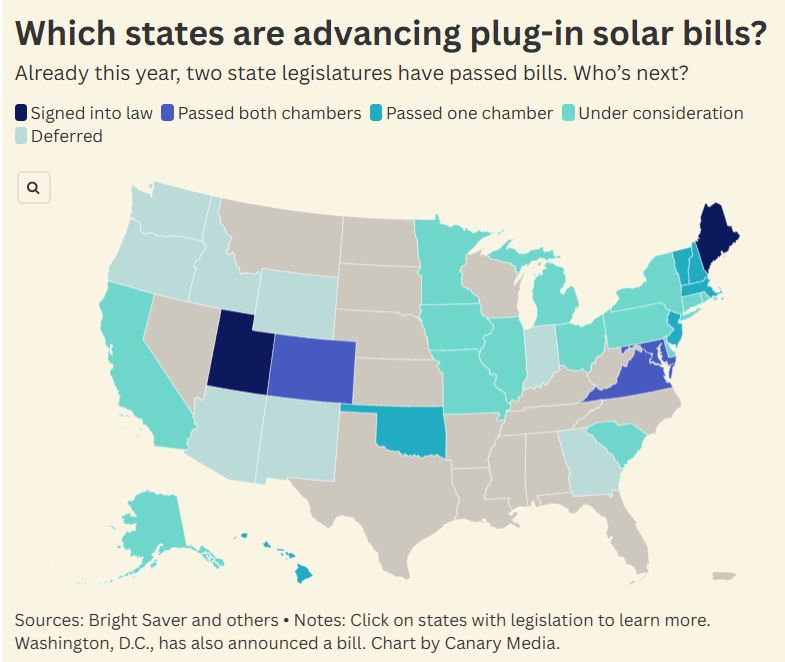
In two states, it pretty much is. This week, Maine joined Utah to become the second state to legalize the use of “balcony solar” panels, which can be plugged into standard outlets to help offset homeowners’ power usage. Other states may soon join them: Canary Media’s Sarah Shemkus has put together a map showing where bills to legalize balcony solar are in the works, with some needing only a governor’s signature to become law.
Whale, whale, whale: The Trump administration struck down Endangered Species Act protections for whales to unleash oil and gas development in the Gulf of Mexico — even though it has used unfounded claims about offshore wind’s risks to the creatures as an excuse to undermine that industry. (Canary Media)
Ceasefire’s energy impacts: Oil prices have fallen since the announcement of a two-week ceasefire between the U.S. and Iran, which analysts say may quickly translate into gasoline price relief for Americans. (The Hill, Axios)
New Jersey goes nuclear: New Jersey lifts its de facto ban on nuclear power construction, becoming the sixth state to reauthorize reactor development in the past decade and the second, after Illinois, to do so this year. (Canary Media)
Winds of change: The U.S. Interior Department quietly fails to appeal court decisions that allowed work to restart on offshore wind projects halted by the administration, an omission that experts say could be an early sign of hope for the industry. (Grist)
Digging clean heat: A geothermal heat pump system that’s heating and cooling a church just outside New York City could pave the way for similar projects in dense urban areas. (Inside Climate News)
Solar soars: A federal report shows rooftop solar now accounts for 20% of Puerto Rico’s energy production, surpassing natural gas to become the island’s second-largest generation source, behind petroleum liquids. (Utility Dive)
Renewables reign: In March, renewables generated more power than gas across a whole month, marking a first for the U.S. grid. (Canary Media)
Fervo Energy, the leading next-generation geothermal startup, is ramping up plans to build out new power plants.
The Houston-based company has signed a three-year binding agreement with Turboden America, which will supply 1.75 gigawatts of organic Rankine cycle turbine capacity for Fervo’s forthcoming geothermal projects in the United States. The startup will use the equipment to convert heat pulled from deep underground into carbon-free electricity for data centers and the grid.
Fervo, which is reportedly preparing for an IPO, is currently building the first 100 megawatts of its 500-MW Cape Station in Beaver County, Utah. The project, which will be the world’s largest enhanced geothermal system, is slated to start producing power later this year.
Turboden America is already supplying over half of Cape Station’s total turbine capacity. The company, a subsidiary of the Italian manufacturer Turboden, says it will expand its U.S. operations to fulfill the deal, which calls for nearly three dozen 50-MW power-plant units.
The agreement, announced Tuesday, sheds more light on Fervo’s development plans beyond Cape Station, which broke ground about two and half years ago.
Fervo declined to share specific details about where and when it intends to deploy the new units. However, the company has “multiple projects in various stages of progress” and is pursuing “multi-year, multi-gigawatt offtake partnerships with both utilities and hyperscalers,” Sarah Jewett, Fervo’s senior vice president of strategy, told Canary Media in an email.
She added that the Cape Station site has an estimated 4.3 GW of capacity potential, based on internal and independent estimates. Fervo is also developing an enhanced geothermal system in Nevada, called Corsac Station, which is set to supply 115 MW of electricity to Google and the utility NV Energy.
This week’s development with Turboden “helps streamline project execution and accelerate deployment as our project pipeline advances,” Jewett said.
Together, Cape Station and the new turbines represent over 2.2 GW in geothermal power capacity. If completed and brought online, that amount would be equal to more than 50% of the current installed capacity of U.S. geothermal plants — which provide less than 1% of the country’s total electricity generation. Virtually all those existing plants rely on conventional hydrothermal resources, such as geysers and hot springs.
“Geothermal energy will be essential in stabilizing a strained power grid with clean, firm energy, and Fervo has shown strong leadership in advancing the sector,” Paolo Bertuzzi, president of Turboden America and CEO of Turboden, said in a statement. “With this announcement, we are prepared to scale delivery in the U.S. market and add megawatts of new generation wherever and however they are required.”
In signing the deal, Fervo and Turboden are aiming to avoid a potential bottleneck that threatens to slow the larger buildout of next-generation geothermal: the power-plant supply chain.
Today, the global market for organic Rankine cycle systems, heat exchangers, and other components is concentrated among a small set of manufacturers based in Israel, Turkey, and parts of Europe. Until very recently, those companies had little reason to scale production or revamp designs, given the sector’s limited growth. Most geothermal equipment is highly customized, and it can take over 18 months to bring it stateside.
“The ORC market has always been a very niche market and quite stable in the past,” Bertuzzi told Canary Media in an earlier interview.
But recent U.S. innovations in geothermal technology are making it possible to harness Earth’s heat from a wider range of places than conventional geothermal plants can reach. For instance, Fervo’s Cape Station uses horizontal drilling techniques and fiber-optic sensing tools to fracture hard, impermeable rocks and create artificial reservoirs. The startups Sage Geosystems and Quaise Energy are taking a similar approach, while companies like Rodatherm Energy and XGS Energy are building novel closed-loop systems deep underground.
Turboden, which is owned by Mitsubishi Heavy Industries, said it can presently deliver about 20 of its 50-MW turbine units per year. Nearly half of its global business is from the geothermal industry. The rest is from biomass-burning power plants as well as industrial facilities that use waste heat to generate electricity, such as data centers and gas-compressor stations.
The manufacturer is now set to scale production in both Italy and the United States in order to meet the growing demand from next-generation geothermal developers like Fervo. In an email, Turboden said it is adopting “multiple business and procurement models … to ensure larger volumes and faster delivery times, including domestic content to support tax credit mechanisms for American customers.”
A community north of San Diego has blocked a major grid battery that a developer had hoped to build in a residential area near a major hospital.
Independent power producer AES Corp. withdrew its application to develop the Seguro battery system in Escondido, 30 miles from San Diego. The company had intended to fill a former horse ranch with 320 megawatts of battery containers, which would have been one of the most powerful stand-alone energy storage facilities in the country. The facility would have strengthened the Southern California grid late in the day, when solar generation fades and home consumption surges, pushing the state forward on its quest to produce 100% clean electricity by 2045.
But the development ran into a barrage of local opposition, as residents decried adding large-scale power infrastructure so close to homes and 1,600 feet from Palomar Medical Center Escondido, especially given the multiday, high-octane fires at other large batteries in the state. The outcome was a high-profile win for local battery opponents, and a warning sign to developers in famously pro-battery California.
AES said in a statement that it would prioritize other development efforts, but remained “committed to advancing projects that can provide the safe, reliable, and affordable power needed to strengthen the region’s electric grid and generate meaningful economic benefits locally.”
JP Theberge, a board member of the Elfin Forest Harmony Grove Town Council who rallied resistance to the battery, framed his neighbors as a victorious David smiting a corporate Goliath.
“The forces of greed are very powerful in this world. The only way to stop them is to be united and determined and forceful,” he wrote in a post on the Stop Seguro Facebook group. “This was a great win and we should all be proud of our efforts.”
AES is, to be sure, a profit-driven company, but the vast majority of U.S. energy infrastructure is built and operated by for-profit entities. What AES hoped to profit from was delivering a large amount of emissions-free grid capacity at a time when California desperately needs more of it — and when the nation as a whole is grasping for more power.
Opponents also called out the risks of large agglomerations of lithium-ion batteries, which have in certain circumstances gone into “thermal runaway,” when cells heat up and kick off ferocious blazes that spread to all the batteries within reach.
Escondido has experience with batteries. AES built a large-scale lithium-ion battery in 2017 that utility San Diego Gas & Electric owns and operates on its substation property. One battery container at that site caught fire in 2024 and prompted local evacuation orders that were lifted two days later. Two other California batteries loom even larger in the minds of the Stop Seguro advocates: An Otay Mesa battery, also in San Diego County, caught fire and then smoldered for 17 days in 2024, destroying one section of a larger facility. A Moss Landing project had a string of small fires, followed by catastrophic one in January 2025, which forced the evacuation of the surrounding community.
Crucially, those two fires involved older models of battery cells, and a now-outdated design that packed them into buildings, which was like piling dry timber ahead of lighting a spark. Since then, battery cell technology has improved, and the industry has abandoned storing batteries in large buildings in favor of compartmentalized containers spread across a site. These designs are tested to make sure that a fire in one unit cannot reach surrounding units. Thus, a really bad failure could burn up one container but not produce the kind of dayslong conflagration seen in the highest-profile battery fires.
That’s where separating fact from fearmongering can get tricky. Otay Mesa and Moss Landing were approved by the necessary authorities, and then combusted in catastrophic fashion. Any community would be justified in wanting to prevent something like that from happening. At the same time, the physical causes of those massive blazes simply don’t exist in the battery projects that are getting built today.
Even so, Seguro would have pushed the boundaries in terms of proximity to homes and to the hospital. If one container started smoking, that could be enough to force the hospital’s patients and staff to either evacuate or shelter in place. This fact became pertinent to the case, because AES needed the hospital to sign off on running high-voltage wires through its property, which the hospital board voted down in 2024.
Generally speaking, though, recent battery failures have not put a stop to new battery construction.
Elsewhere in California, developer Arevon broke ground this year on a 250-megawatt battery in Daly City, just south of San Francisco. The battery fires in other parts of the state did not stop the company from securing permits and easements to connect to a nearby substation. That project will inject $73 million dollars into the local tax base, and give San Francisco a major new source of on-demand power to carry it through heat waves and other moments of stress for the grid.
Indeed, batteries continue to set records for participation in California’s energy system. On a given spring day, they show up in force in the evening hours, displacing expensive, more polluting gas plants by shifting the day’s solar production to meet the hours of highest demand. On March 29 at 7 p.m., for instance, batteries delivered a record 44% of total electricity demand, with more than 12 gigawatts injected into the grid.
A clarification was made on April 9, 2026: This story was updated to clarify that the battery AES built at the utility substation has been owned and operated by San Diego Gas & Electric since 2017.
Xcel Energy in Minnesota is poised to become the first utility in the nation to build and operate its own virtual power plant.
For the past six months, fans and foes have debated the novel plan, which will see Xcel deploy hundreds of megawatts of small-scale batteries at customer sites across its territory. The Minnesota Public Utilities Commission ultimately approved a version of Xcel’s plan last week.
Under the new program, known as Capacity*Connect, Xcel will spend up to $430 million to deploy up to 200 megawatts of batteries, in 1-megawatt to 3-megawatt increments, over the next two years. It’s a rare arrangement: Almost every other virtual power plant program in the U.S. is organized around third-party companies, like solar and battery vendors or specialized “aggregators,” that tap into energy resources installed and owned by customers.
VPPs, which aggregate distributed energy resources to mimic the output of a traditional power plant, are seen as a key way to get more energy onto the existing grid. By using customer-owned energy resources or small-scale batteries, VPPs can help utilities reduce the need to build or dispatch expensive power plants.
But utilities have been slow to embrace VPPs. In particular, they’ve struggled to use VPPs to avoid grid investments, which have become a key driver of rising electricity costs. Utilities are leery of relying on technologies in customers’ homes instead of equipment they control. And utilities earn guaranteed profits for investments in their grids, giving them an incentive to resist examining cheaper alternatives.
Supporters of Xcel’s VPP program say it could finally provide a durable model for utilities to use distributed energy resources to defer costly grid investments and to more fully utilize the existing grid.
For one, the structure gives Xcel an economic incentive to recoup its investment. But more important, it requires Xcel to establish a metric to assess the value that distributed energy resources bring to the grid — something utilities have historically struggled to measure. If Xcel can create a template, then it will have removed a major stumbling block for broad adoption of VPPs.
“Putting a value on DERs of different types and capabilities to avoid or defer distribution upgrades is a real opportunity — and it’s really hard,” said Will Kenworthy, Midwest regulatory director for the nonprofit Vote Solar. “Xcel has said, ‘We need to put a value on this.’ And the way this program is set up, they have an interest in getting that right in a way they never have before.”
That’s not to say supporters think Xcel’s Capacity*Connect program should be the only VPP option in Minnesota. Many, including Vote Solar, have pushed for the utility to allow third-party companies to participate in the program. Some have expressed disappointment that the commission failed to do so, and there’s still no way for solar installers, battery vendors, and demand-response aggregators to enlist their own customers to help the grid in Xcel’s Minnesota territory.
And plenty of industry groups were outright opposed to the commission’s decision last week. The Minnesota Solar Energy Industries Association, Solar Energy Industries Association, and Coalition for Community Solar Access all criticized the plan and the lack of a third-party program.
As Andrew Linhares, Midwest director of state affairs at the Solar Energy Industries Association, said in a statement, “Competitive markets for energy storage deployment ensure that ratepayers get the best, most affordable deal possible. The Capacity*Connect program takes the exact opposite approach.”
The genesis of Xcel’s Capacity*Connect program is a bit unusual.
It didn’t originate in a broader policy push for VPPs but instead came out of Xcel’s integrated distribution planning. Minnesota’s Public Utilities Commission created that regulatory structure in 2018 with the goal of getting investor-owned utilities to “maintain and enhance the safety, security, reliability, and resilience of the electricity grid, at fair and reasonable costs.” Integrating DERs into the grid is one way to do just that.
But integrating DERs into utility planning processes is a whole new territory. Utilities, Xcel included, have not factored these technologies into how they plan out and spend money on their power grids. This means VPPs can’t yet specifically help offset distribution grid investments.
Instead, almost all existing VPPs target reducing peak electricity demand across utilities’ or grid operators’ entire service territories, as “bulk system” assets, Kenworthy said. That can — and does — save money by replacing the energy that would otherwise come from costly “peaker” power plants. That’s helpful, but it’s solving a different problem than distribution grid costs.
Using batteries and other DERs to relieve local grid constraints is a lot more technically challenging than relying on them to shave power demand during peaks. Utilities need to know exactly what stresses are happening at individual substations and distribution grid circuits from minute to minute. And they need far more confidence that the DERs will respond reliably and consistently to relieve those constraints in order to prevent overloads or blackouts.
Beyond a handful of pilot projects in California, Connecticut, Massachusetts, and New York, very few utilities have begun to experiment with using customer-sited DERs to relieve these kinds of pinpoint grid challenges. “We don’t have a way to do third-party substations,” Kenworthy said.
Xcel Energy spokesperson Kevin Coss said that the utility will work with local businesses, commercial and industrial sites, and nonprofits to install batteries “at strategic locations on the grid” to begin to test how each battery can mitigate local grid constraints. “These batteries will help meet increasing demand for electricity, maintain reliable service for our customers, maximize the efficiency of existing infrastructure, and support local jobs.”
Xcel Energy’s plan for paying for those batteries blurs the distinction between bulk-system and distribution-level values, as the utility’s batteries will serve both functions.
Xcel’s Capacity*Connect batteries will earn revenues for the bulk-system energy and capacity services they provide for the Midcontinent Independent System Operator (MISO), the entity that manages the transmission grid and wholesale energy markets across Minnesota and all or part of 14 other Midwestern states.
Those revenues will allow Xcel to pay back almost the entire cost of deploying the batteries, said Will Nissen, director of policy at the Minnesota-based Center for Energy and Environment, a nonprofit that’s in favor of the program. The utility has estimated that the batteries’ deployment and associated software development to manage them will add from 67 cents to $1.50 per year to a typical residential customer’s utility bill through 2030.
That’s key to the longer-term vision of using these batteries to avoid grid investment. Xcel has said it can’t start calculating the distribution-grid value of its batteries until it has had a few years to study them — the MISO revenues will fund this research.
Capacity*Connect will also get a $50 million investment from Google, as part of the tech giant’s broader deal with the utility to cover the energy needs of its new data center in the state.
“The beauty of this pilot is [that] it pays for itself with MISO revenues, while we learn about all the potential distribution value,” Nissen said. “It’s getting those bulk-system benefits while also studying how to use the distribution system as efficiently as possible.”
The commission ordered Xcel to establish specific estimates of the benefits that its batteries could provide to its grid by November 2027, when its next integrated grid plan is due, Kenworthy said. The commission also instructed Xcel to provide quarterly progress reports.
Vote Solar hopes that these provisions will drive the utility to “put a number on what avoided or deferred distribution investment is worth,” he said. “And we can take that to other forums where we’re trying to value DER and say, ‘This is what this device is worth, if we can do that thing.’”
Not all the stakeholders who have weighed in on the Capacity*Connect proceedings are as confident in that outcome, however.
“We really see this decision as a missed opportunity,” said Shannon Anderson, policy director at the nonprofit Solar United Neighbors, which is part of a coalition sponsoring VPP legislation in multiple states. “There’s no reason you can’t do ‘both and’ here — do what Xcel proposed and do a behind-the-meter VPP program.”
In fact, Public Service Co. of Colorado, Xcel Energy’s utility in that state, is currently rolling out a VPP program that will pay third-party companies that equip customers with batteries, smart thermostats, smart water heaters, smart heat pumps, and EV chargers, Anderson said.
In last week’s decision, the commission did order Xcel to report on how its experience in Colorado could apply to its work in Minnesota. But the commission declined to take up a proposal from a group of stakeholders that wanted it to order the utility to lay out a plan for doing something similar.
Nor does it seem likely that Minnesota’s legislature will order the commission to push Xcel to create a VPP program in the near future, Anderson said. Efforts to pass a VPP bill faltered last year, and similar legislation introduced this year has not passed out of a key committee, she said.
But VPP proponents are not giving up, Anderson said. “There are a number of filings coming, a lot of paperwork to evaluate and justify the program,” she said. “This is just the beginning of the conversation from our perspective.”
As a key deadline for federal solar tax credits ticks closer, a Massachusetts program is helping the state’s nonprofits get solar projects underway before the incentive disappears.
The Solar Upgrading Nonprofits, or SUN, program provides nonprofits with financial and technical assistance to evaluate options for solar installations and seek out additional funding if they choose to go forward. The first round, in 2025, worked with 23 organizations. Five have decided to move forward with installations that total 1.5 megawatts of installed capacity — double the goal for that phase of the program.
The stakes are even higher for SUN’s second round, which kicked off at the end of March. President Donald Trump’s One Big Beautiful Bill, signed last summer, put an expiration date on tax credits that can shave 30% to 50% off the cost of commercial-scale solar projects: They must start construction by July 4, 2026, or be placed in service by the end of 2027 to qualify — a tight timeline for most organizations.
“There is still time, but it is dwindling very quickly,” said Rachel Gentile, marketing and communications manager for Resonant Energy, the Boston-based solar company spearheading the initiative with funding from the Massachusetts Clean Energy Center, a quasi-public economic development agency.
Adding to the urgency is the fact that nonprofits have had relatively little time to take advantage of the tax credit. While for-profit businesses have been able to claim the incentive for some 20 years, nonprofits became eligible only with the passage of the Inflation Reduction Act in 2022. So, the elimination of the credit means it is disappearing before many organizations have even had a chance to dig into the possibilities.
“Nonprofits that have other missions that they’re dedicated to, it’s not necessarily on their list of priorities,” said Sanne Wright, community partnerships manager for Resonant Energy. “They’re already usually pretty strapped for cash and tight on capacity.”
The SUN program tries to overcome this barrier by making it easier for nonprofits to evaluate their options. The idea is modeled on another Resonant program, Solar Technical Assistance Retrofit, or STAR, which provides similar support to affordable housing providers looking to add solar to their buildings. Since its launch in 2021, STAR has installed 4.8 MW of solar capacity, with another 13.5 MW in the pipeline. When nonprofits became eligible for the federal tax credits, Resonant started thinking about how to adapt STAR for a new constituency.
The Massachusetts Clean Energy Center, which also funds STAR alongside the Jampart Charitable Trust, awarded the SUN program $150,000 for its first round and another $150,000 for the latest cycle. Resonant works with two partner agencies — Providers’ Council and the Essex County Community Foundation — to connect with nonprofits that might benefit from the assistance.
“Power is very expensive here,” said Kate Machet, vice president of systems initiatives and government relations for the Essex County Community Foundation. “This program has really allowed us to bring to our nonprofits on the ground the ability to explore solar.”
Interested organizations do a short intake call to discuss their general goals for a solar project. Then they provide information about their electricity bills and roof age and condition, and Resonant completes an analysis of their options. Whether or not the nonprofit decides to move forward, it receives a stipend of between $2,500 and $7,500 as compensation for the staff time that went into the process. Those that opt to go ahead with an installation receive help identifying further funding opportunities and writing grant applications.
Grow Associates, a nonprofit that serves adults with developmental disabilities, applied to the SUN program in hopes of getting solar on the roof of its facility south of Boston. The grant-writing support helped the organization secure a $500,000 award from a state program that funds solar projects for nonprofits working with low-income populations. The money will cover almost the entire cost of the planned 162-kilowatt array.
“Without their help, we would not have been able to get the grant,” said Sarah Palin, Grow’s executive director. “We’re looking at saving about $72,000 a year in electricity costs that we can put back into our programs.”
Resonant is accepting applications for this round of SUN until at least July, but it will continue adding participants after that deadline as long as the funding holds out.
Though Resonant is trying to help as many nonprofits as possible take advantage of the expiring tax credit, organizations that aren’t able to make the deadline could still benefit from participating in SUN and installing solar, Wright said. Finding the money to cover the initial costs will still be a challenge, but the average 300-kilowatt array could still save an organization about $1.3 million over the expected 25-year life of the system, down from $1.6 million with the tax credit, according to Resonant’s calculations.
“Organizations are going to have to get a little more creative about how they fund the project up front,” Wright said.
New Jersey has become the sixth state in the last decade, and the second this year, to fully repeal its moratorium on building new nuclear power stations.
On a crisp Wednesday morning at the Hope Creek Generating Station in the southwestern corner of the state, Gov. Mikie Sherrill signed legislation lifting the de facto ban that barred construction of new reactors until the United States established a permanent solution for radioactive spent fuel. The Democrat, who campaigned last year on building new nuclear power capacity in the state, said the prohibitions had outlived any usefulness.
“For too long, outdated laws have kept us from even considering new nuclear facilities,” Sherrill said, as steam billowed from the station’s hyperboloid cooling tower behind her. “One law required any new projects to point to a method of disposal that, quite literally, does not exist. It was written in the 1970s, tied to a technological requirement that made sense then but not today.”
Located along a crook in the Delaware River, south of Wilmington, Delaware, and north of where the waterway widens into a bay, the single-reactor Hope Creek plant sits on an artificial island alongside the two-reactor Salem Nuclear Power Plant. Both stations are owned by the utility giant PSEG. Combined, the two generating facilities produce 40% of New Jersey’s electricity and 80% of its carbon-free power.
The Garden State enacted one of the nation’s earliest bans on new atomic power back in the 1970s, when the U.S. was still building out its fleet of reactors without any real plan for dealing with the long-lived radioactive waste piling up in glowing blue pools at plants around the country. At the time, state lawmakers amended the Coastal Area Facility Review Act to require the Nuclear Regulatory Commission to establish methods for radioactive waste disposal before new construction permits could be issued. Sherrill called the condition “an outdated standard that cannot be met.”
In the 1980s, the federal government took possession of all nuclear waste, and it designated Yucca Mountain in the Nevada desert as the first location for a permanent repository. Work finally began on the facility in the 2000s under then-President George W. Bush. But President Barack Obama then yanked support from the project shortly after taking office, in a move that the nonpartisan Government Accountability Office later determined was made for political, not technical, reasons. The U.S. effort to deal with waste has remained largely paralyzed since. The law stipulates that Yucca Mountain must be the first destination for nuclear waste, preventing the government from shifting focus to another location. But few, if any, lawmakers have mustered the political support to volunteer a site in their own states to replace it as the nation’s premier tomb for radioactive material.
Instead, federal efforts have recently pivoted toward recycling and reprocessing. Starting under the Biden administration and accelerated under Trump, a nascent industry of startups is forming around the promise to extract valuable medical isotopes from radioactive waste and turn the material into fresh reactor fuel. The Department of Energy just last week ended a contest for states to submit applications to host nuclear innovation campuses that include fuel enrichment and recycling facilities.
If banning nuclear plants made sense 49 years ago, when the environmental effects of burning fossil fuels weren’t yet fully understood, the availability of intermediate storage containers — many of which are produced in New Jersey, at manufacturer Holtec International’s factory in Camden — makes the point of the state law moot.
“It’s a textbook example of the kind of inefficient government I ran to change,” Sherrill said. “This bill requires projects to use safe, cutting-edge storage methods instead — methods that have been used thousands of times in over 35 states for the last 40 years with a 100% safety record.”
State lawmakers first tweaked the statute last year to open the door to development of small modular reactors, a type of as-yet-unbuilt machine that artificially caps the output per unit at 300 megawatts in a bid to spur developers to place bulk purchases. A failed bill first introduced in December aimed to both rescind the moratorium and establish a new tax credit for advanced nuclear power generation that would help finance construction of at least 1,100 megawatts of new capacity. That particular number matches the output from a Westinghouse AP1000, the leading U.S. reactor design and the only third-generation model in operation in the country.
The site where Hope Creek and Salem are located has room for at least one more large-scale reactor, said Samuel Roland, a research fellow who tracked New Jersey’s nuclear bill at the Foundation for American Innovation, a right-leaning Washington, D.C.–based think tank.
“My sense is that there’s a strong push toward another full AP1000-style reactor at Salem just because they already have the space cleared for it,” he said.
The structure of New Jersey’s electricity market makes building a nuclear reactor challenging. Like much of the U.S., New Jersey broke up its monopoly utilities in the late 1990s, allowing for more competition between generators within its statewide market, which is part of the nation’s largest grid operator, the 13-state PJM Interconnection. That system favors cheap, easily built power infrastructure. Unlike in the mid-20th century, when monopoly companies saw ever-expanding profits from growing electricity demand, today utilities’ balance sheets aren’t typically large enough to shoulder the risk of a multibillion-dollar reactor project. Nuclear construction flatlined in every state that liberalized its electricity market.
That makes tax credits with early or up-front payments a potential tool to encourage new reactors in New Jersey, Roland said. The risk with any major electrical infrastructure project like this, he said, is that the state’s Board of Public Utilities allows too much of the cost to be added to customers’ bills.
“The question just comes down to modeling here: What is the structure that’s most beneficial to New Jersey ratepayers?” Roland said. “Obviously, you have a lot of hyperscalers who are looking for energy and could be an anchor tenant and help pay for it.”
The bill Sherrill signed on Wednesday doesn’t answer that question. Instead, it simply eliminates the need for a permanent waste-disposal strategy to come before a new reactor. But she also signed an executive order establishing a task force to “convene leaders from government, industry, the environment, and labor” to study how to improve financing and supply chains, workforce training, permitting frameworks, and public trust.
“Safe nuclear can produce clean stable power at a predictable cost, protected from global price swings,” Sherrill said.
New Jersey isn’t alone. Across the Hudson River, New York has sought to leverage its state-owned New York Power Authority to help finance the construction of 1 gigawatt of new nuclear, part of a broader state plan to build 5 GW of reactors in the next two decades. California, which just won federal approval to keep its last nuclear station open for another two decades, is weighing a bill that would lift the state’s moratorium on building new ones. Minnesota is considering the same. While five New England states still restrict nuclear construction, all six signed a pact last month to explore the possibility.
Since 2016, five states — Wisconsin, Kentucky, Montana, West Virginia, and, most recently, in January, Illinois — have fully repealed their moratoria.
A clarification was made on April 10, 2026: This story has been updated to reflect that the New York Power Authority will help finance the construction of 1 gigawatt of new nuclear.
Balcony solar is one of the hottest ideas in renewable energy right now. Boosters say the systems — DIY kits that can be plugged right into a standard outlet — save users money without any need for subsidies, government incentives, or utility permission.
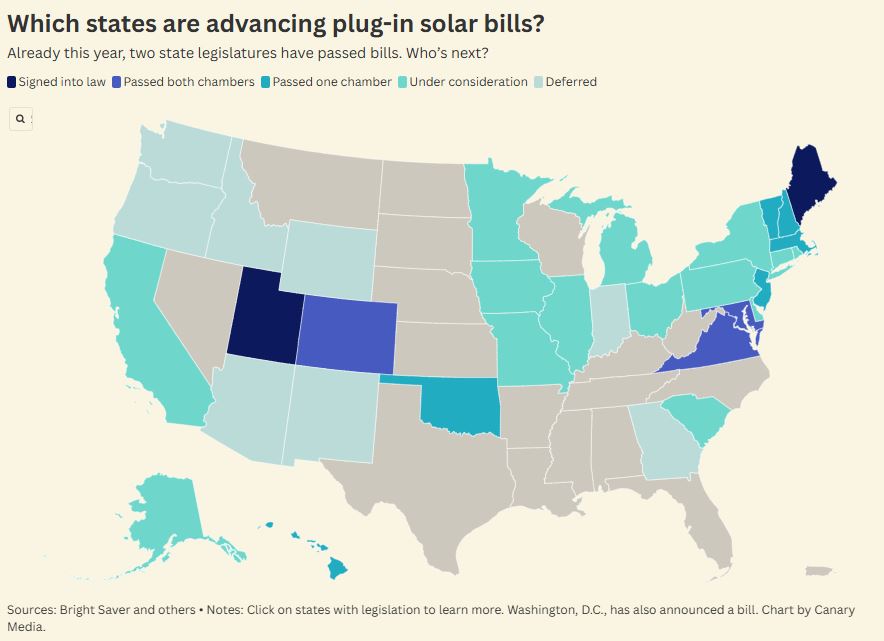
As Americans continue to struggle with soaring power prices, about half the states in the U.S. are considering legislation to pave the way for residents to adopt plug-in solar and start generating some of their own electricity from their own backyard or porch.
“It’s about energy affordability,” said Cora Stryker, co-founder of Bright Saver, a nonprofit that promotes plug-in solar. “Every legislator wants their constituency to have less trouble meeting their energy demands.”
As these efforts work their way through the legislative process, we will be monitoring the action here, using information from Bright Saver and bill-tracking databases.
Latest action: Maine Gov. Janet Mills (D) signed the state’s plug-in solar bill into law on April 6.
The Trump administration has often evoked the plight of whales in its efforts to undermine U.S. offshore wind development — despite there being no evidence that wind-farm activities are harming the giant mammals.
But those purported concerns didn’t stop federal officials last week from voting unanimously to override Endangered Species Act protections for imperiled whales in order to unleash oil and gas development in the Gulf of Mexico. Extensive fossil-fuel production there is already known to hurt cetaceans through vessel strikes, oil spills, and noises that lead to chronic stress.
The dissonance isn’t surprising.
In recent years, the well-being of whales has become a potent political weapon for President Donald Trump, Republican politicians, and right-wing groups to wield against America’s fledgling offshore wind industry. Yet those same factions haven’t fought with similar fervor, if at all, to protect whales from the real leading threats: marine-gear entanglements, boat collisions, and the effects of climate change.
Last week’s decision only highlights that whales were never really the point, environmentalists argue.
“I think it’s pretty clear they don’t care about marine species,” Michael Jasny, director of marine mammals for the Natural Resources Defense Council, said of the Trump administration.
On March 31, a committee of Trump-appointed officials voted to exempt oil and gas drilling in the Gulf from protections under the Endangered Species Act. The God Squad, so named because of its power to decide whether a species lives or dies, has convened only three other times since the landmark law was enacted over 50 years ago to prevent plant and animal extinctions.
The decision may not actually change that much on the ground for oil and gas companies developing and exploring resources in the Gulf. Operators are still expected to comply with existing measures to avoid and minimize environmental risks. These measures were set by the Interior Department’s Bureau of Ocean Energy Management, which is in charge of planning offshore drilling operations, and Bureau of Safety and Environmental Enforcement, which provides regulatory oversight.
“It’s not going to be like the wild, wild west under this order,” said Seth Barsky, a partner at the Bracewell law firm and former deputy assistant attorney general in the Environment and Natural Resources Division at the Justice Department.
He said that a key reason for lifting the Endangered Species Act requirements was to shield oil and gas developers from having to potentially meet new environmental regulations that could force them to shut down. Environmental groups last year sued the National Marine Fisheries Services over its latest biological opinion — a document the agency was required to issue under the ESA to analyze how oil and gas activities could affect wildlife in the Gulf. The groups argued that the opinion failed to require stringent measures to protect endangered species.
The God Squad decision gives drillers certainty that the status quo will stick, Barsky said.
Interior Secretary Doug Burgum chaired the seven-member committee, which also included the U.S. secretaries of defense, agriculture, and the Army, as well as the heads of the Environmental Protection Agency, the National Oceanic and Atmospheric Administration, and the Council of Economic Advisors.
The group claimed its decision was a “national security imperative.” Global energy markets have been in disarray since the start of the U.S.-Israeli war in Iran and the subsequent closure of the Strait of Hormuz, through which about a fifth of the world’s oil and a fifth of its liquefied natural gas supplies flow.
Oil production in the Gulf “provides a vital buffer, insulating our economy and military from foreign instability and reducing the strategic leverage of our adversaries,” Defense Secretary Pete Hegseth said during the committee’s brief meeting. He said the lawsuits brought by environmental groups risk “halting or severely compromising oil and gas activities in the Gulf.”
America’s offshore oil production has soared in recent years, even with endangered species protections in place.
Just a day after the meeting, Burgum announced that the U.S. produced over 714 million barrels in 2025 — the highest annual output on record. Some 3,500 oil and gas structures are spread across the Gulf, pumping out “beaucoup buckets of Texas tea,” as the journalist Craig Pittman recently put it.
The Interior Department also said last week that it is combining two of its bureaus in order to increase efficiency and accelerate permitting for offshore energy development, while still “maintaining all existing regulatory protections and rigorous safety standards,” according to the April 3 announcement.
Expanding offshore oil and gas development will likely only exacerbate the threats facing endangered whales, manatees, and five species of sea turtles in the Gulf, according to the fisheries agency’s biological opinion. Collisions with oil industry vessels in particular could “jeopardize the continued existence” of the endangered Rice’s whale, of which only 51 are estimated to remain.
The number of Rice’s whales has declined considerably since the 2010 BP Deepwater Horizon disaster and subsequent cleanup efforts. Its tiny population size makes it harder for the species to bounce back from oil-industry disruptions.
The God Squad’s main argument — that energy security trumps all else — is similar to the “downside emphasis” tactic that fossil fuel companies use to delay climate action, said Alaina Kinol, a researcher at Northeastern University in Boston who studies resistance to climate policy.
“It’s this idea that if we take climate action, it’s going to really hurt us, or it’s going to hurt marginalized people, or that [fossil fuels] are necessary for society,” she said.
She noted that even as the Trump administration pushes to boost fossil fuel production, it is undermining efforts to develop other domestic sources of energy like renewables. Since 2025, the GOP-led Congress has worked to repeal or scale back much of the 2022 Inflation Reduction Act, which provided hundreds of billions of dollars in federal incentives for wind and solar, energy efficiency, electric vehicles, and other clean energy programs.
“That implies that this is really about supporting the oil and gas industry’s ability to extract fossil fuels from the Gulf,” Kinol said.
In the last year, the Interior Department has frozen almost all offshore wind development in the country, and Trump himself has regularly cited the health of whales as a key motivation for this. “The windmills are driving the whales crazy,” Trump said in January 2025, weeks before signing an executive order pausing federal permitting and new leasing for offshore wind farms.
More recent actions to stymie existing projects have used broad and ill-defined concerns about national security as the pretext.
The department has even tried — so far unsuccessfully — to halt construction of five in-progress offshore wind projects totaling nearly 6 gigawatts of capacity, even though those projects represent a crucial new energy source for densely populated and land-constrained East Coast states. Earlier this year, during a brutal cold snap, power plants fueled by fossil gas, oil, and coal were nearly pushed to the brink, a strain that existing offshore wind turbines helped alleviate in some places.
The double standard is a familiar move for the Trump administration, which has previously used the specter of bald eagle deaths to crack down on wind turbines while also easing the protections for the birds that could interfere with oil and gas production. The federal government has also quietly gutted key research programs meant to protect North Atlantic right whales and other marine mammals living in an increasingly industrialized ocean.
The God Squad decision is already facing legal challenges, and experts say it’s unclear whether this unprecedented maneuver will stand up in court. The Center for Biological Diversity, which initially sued to stop the meeting from happening, said it would amend its lawsuit to challenge last week’s outcome. The Natural Resources Defense Council also plans to take legal action, Jasny said.
The move to exempt Gulf oil and gas development from Endangered Species Act protections is likely a “test case” to see what the Trump administration can get away with, he added. The government is also looking to open up oil and gas operations off the coast of Alaska to flex America’s “energy dominance” and off California’s coast to protect Americans’ “energy security.”
“If the administration can allow the killing of [endangered] sea turtles and whales in the Gulf,” Jasny said, “then there’s no end to what this really dangerous development can lead to.”
If the U.S. is going to decarbonize, tens of millions of homes across the nation will need to make the switch from fossil fuel furnaces and boilers to all-electric heat pumps. California alone has set a goal to deploy 6 million of the superefficient appliances by 2030.
But such retrofits can be complicated to navigate and cost thousands of dollars more than purchasing new fossil fuel equipment.
That has some companies looking to design heat pumps that are easier and cheaper to install. Today, one of those firms, San Francisco–based Merino Energy, announced the launch of its flagship product, the Merino Mono.
The Merino heat pump is a single-room system, as opposed to the popular ducted and ductless whole-home systems. A key feature is that, unlike whole-home heat pumps, the Mono doesn’t require a large outdoor unit to move heat into or out of living spaces. Instead, it’s installed through the exterior of a building, and the portion that would normally live outdoors is tucked into the unit itself.
Merino is offering its heat pumps for a flat rate of $3,800, which — unusually — includes the cost of professional installation. A certified contractor can get the system up and running in under an hour, according to the company.
“The price tag to do regular ductless is just way too high. This really drops the cost,” said Owen Krebs Grimsich, founder and CEO of 1-888-Heat-Pumps, an installation partner with Merino Energy.
Krebs Grimsich’s company will soon deploy Merino heat pumps at a 10-unit building. “If we were to have done ductless, we would have had to open up a whole bunch of walls and put these outdoor units in really funky places. And then we would’ve had to run the electrical in really weird ways, because you have to connect the indoor and outdoor units,” he said. But with the Merino heat pumps, “it just immediately became a very quick and easy project.”
The Mono was born of necessity, said Merino co-founder and CEO Mary-Ann Rau.
In 2023, Rau, a former firmware engineer at tech giant Apple and ductless heat-pump startup Quilt, tried to get a heat pump system installed at her 1906 Victorian home in San Francisco’s Bernal Heights neighborhood. But the complex job was quoted at $40,000. She couldn’t justify that price point, she said.
Soon after, Rau met up for coffee with her neighbor Brad Hall, a former hardware designer at financial platform Square and director of mechanical engineering at window heat-pump startup Gradient. His path to heat-pump ownership had dead-ended, too, thanks to high upfront costs and space constraints. So Rau and Hall decided to found Merino Energy in 2024 to create the product they both wanted.
Fast-forward to today. Each co-founder has at least one prototype Merino heat pump at home.
“We both are living on the product, which is how we know that it solves our pain points and validates that it can solve a lot of other homeowners’ pain points as well,” Rau said. She added that covering the majority of her home with the Mono would come out to less than half the $40,000 she was quoted for a ductless system.
The co-founders were largely inspired by an existing heat-pump design: packaged terminal heat pumps, Rau said. Commonly found in hotels and hospitals, these units combine all components in one container installed through a building’s wall.
Although this type of heat pump can cost less than $1,000 and is relatively simple to use in new construction, putting it in existing buildings typically requires cutting through load-bearing studs, Rau said. Contractors have to take special care to structurally reinforce the compromised wall, adding cost and complexity.
The geometry of the Mono leaves studs intact. Installers drill two vents, each 6 inches in diameter, between the studs of an exterior wall. These holes allow the Mono to exchange thermal energy with the ambient air. What’s visible indoors is a sleek, white air handler.
Like other room heat pumps, the Merino units plug into a standard 120-volt wall outlet. At max, it can pull 900 watts and serve a 350-square-foot space, Rau said. Installing a flock of them can allow a home to avoid an expensive electrical service upgrade that a ductless system might incur, she added.
The unit is particularly well-suited to urban buildings with limited outdoor space and restrictive property rules, Rau said, such as historic homes, condos, and accessory dwelling units. The product is designed for mild and moderate climates like California’s. New York City, by contrast, is using cold-climate window heat pumps from Gradient and Midea to decarbonize public housing. And last year, Boston also contracted Gradient, paying $5,450 per heat pump.
Rau said the Mono is being made in China but declined to name the manufacturer. She also punted on how much the two-person startup has raised from investors, though PitchBook put the figure at just under $1.8 million.
Merino already has its first retrofit project underway. Novin Development selected the startup to deploy its heat pumps in Civic Center Apartments, which will house low-income residents in Richmond, California, Rau said.
1-888-Heat-Pumps is outfitting the building’s 48 studio units with a heat pump each. His team is able to complete four to five installations per day, Krebs Grimsich said. He expects to finish the job by the end of this week.
So far, six contractors have partnered with Merino, according to the startup. It’s aiming to train many more in the coming months.
The company is first targeting California before expanding geographically, according to Rau. The Golden State could prove an especially fertile testing ground as it works to transform the market for room heat pumps.
Individuals who reserve a Merino Mono with a $38 deposit can get their heat pump as soon as this winter, Rau said. If demand materializes, the startup will be ready, she added: “This year alone, we could manufacture up to 50,000 units if we needed to.”


.svg)
