

 Back
Back
In western Illinois, ComEd is tapping a rarely used technique to fast-track community solar installations — working with, not against, environmental groups and solar project developers.
For years, utilities have explored the concept of flexible interconnection, in which solar projects are allowed to come online even when, by the books, there’s not enough space on the grid for these arrays. In return, these solar farms must promise to curtail output during the handful of hours each year when their production would overwhelm power lines and substations.
Flexible interconnection is a speedy way to get cheap new solar online without requiring utilities to spend even more on costly grid upgrades, which are a key driver of the nation’s fast-rising utility bills.
But U.S. utilities haven’t made use of the technique at any significant scale — until ComEd got its program off the ground late last year.
Since then, the utility has fast-tracked more than 50 megawatts of community solar projects using flexible interconnection, and more are likely to be approved before federal tax credits sunset in July.
That’s much faster than utilities in other states have been able to move on flexible interconnection, said Samantha Weaver, senior director of interconnection and grid integration policy at the Coalition for Community Solar Access, a trade group representing community solar developers. In fact, ComEd is “leading the country right now,” she said.
ComEd plans to accelerate that work, said Jessie Bauer, the utility’s senior manager of smart grid and innovation. “Our plan was to do 50 megawatts a year, and we’re hitting that cadence,” he said. “We’re proposing in our grid plan to go even faster, and do 100 megawatts a year, and get to 650 megawatts by 2031.”
The utility has previously committed to deploying 240 megawatts of distributed energy capacity by 2030 to meet its requirements under Illinois’ landmark 2021 climate law.
ComEd was able to succeed where other utilities haven’t thanks to a nudge from regulators that spurred it to collaborate with solar developers and environmental groups.
Historically, utilities and solar developers have struggled to establish the basic mutual trust required to move a flexible interconnection program forward, Weaver said. Utilities are often skeptical that solar farms will reliably cut back as promised during those key hours of potential grid overload. Meanwhile, solar developers suspect utilities will force them offline more than is absolutely necessary.
Illinois’ flexible interconnection process didn’t go that way.
Instead, in 2024 ComEd collaborated with environmental groups represented by the consultancy Eclipse on a flexible interconnection plan. Then, the utility worked out mutually agreeable solutions with those groups, solar developers, and the nonprofit collaborative the Charged Initiative, in a series of workshops that resulted in a program design that gave each side enough of what they needed to move ahead.
Both the utility and solar developers had to make some compromises, Weaver said. But that effort bore its first fruit last November, when 27 megawatts of community solar was green-lit in a region where it would have been excluded by traditional processes. Another 25 megawatts of projects were approved in February.
This coordinated approach is now gaining some momentum in Maryland, Massachusetts, New York, and other states where community solar is struggling, said Nikhil Balakumar, Eclipse’s CEO and founder.
“Now, more than ever, especially in this climate, we need unprecedented collaboration,” Balakumar said. We can’t just slog it out and fight and litigate every little thing till the end of time. There has to be a new way forward.”
ComEd’s push into flexible interconnection was less a choice than a necessity.
Since 2016, Illinois has created and expanded programs that offer lucrative incentives to build community solar projects, which are generally limited to no larger than 5 megawatts. Households can subscribe directly to these projects, which often allow them to lock in cheaper, cleaner energy. The state’s programs are explicitly meant to reduce utility rates for low-income customers.
In Illinois, developers have flooded into the programs over the years, snapping up the most suitable land for community solar arrays.
This posed a problem for ComEd: Everyone wanted to build their solar arrays in the same relatively concentrated geographic area — the rural western reaches of its territory — where there simply wasn’t enough space on the grid.
“We quickly saw all that grid capacity evaporate with the community solar being connected,” Bauer said.
In a situation like this, the standard utility playbook is to require community solar developers to shell out for grid improvements. In western Illinois, that would mean multimillion-dollar system upgrades, he said — a cost that few solar developers can afford.
However, the grid actually does have the space to accommodate those solar farms — at least, most of the time.
Distribution grids are built to serve the times when electricity demand is at its highest. These peaks in demand are relatively rare, happening only during a handful of hours per day, or days per year. That means for the vast majority of the year, there’s unused capacity sitting there.
Flexible interconnection takes advantage of this fact — and helps developers and consumers avoid exorbitant grid upgrade costs as a result.
“If you can give up some of your energy during times of system constraints, you can interconnect much more affordably,” Bauer said.
But this is easier said than done. Utilities can’t perfectly predict how often demand will peak. They need flexibility to handle unexpected changes and respond to emergencies. A major storm or flood could knock out an entire substation for months, leaving other parts of the grid straining to supply power until it’s repaired.
That uncertainty constrains utilities from setting guaranteed limits on how often they’ll ask solar projects to curtail their generation. But for solar developers, “projects aren’t financeable if curtailment is unpredictable,” Weaver said. “We need certain details to be able to literally take to the bank.”
To resolve this conundrum, ComEd and solar developers collaborated on a compromise.
Solar developers calculated that they — and their investors — could bear having about 5% of their annual solar production curtailed. They conceded that ComEd couldn’t guarantee it would stick to that curtailment limit. But if the utility was willing to share historical data on how often its grid was likely to face overloads, developers could use that to convince those investors that the risk was worth taking.
That wasn’t the solar industry’s initial ask, Balakumar noted. Solar developers started out asking for “some sort of fund that compensates us if you do go over 5%,’” he said. But ComEd pays for the power it purchases by passing those costs on to its customers — and the prospect of charging customers for power that didn’t actually get onto the grid was a nonstarter for consumer advocates and regulators.
“We went in wanting a guarantee,” Weaver said. “But we came to the understanding that that wasn’t realistic and that we needed to give up a degree of certainty.”
Nor was it easy for ComEd to agree to sharing confidential data on its substations. Bauer said that process was helped along by community solar developers limiting what data they needed and how they would use it.
Already, the real-world data coming in from ComEd’s flexible interconnection projects could allow it to tighten curtailment expectations for future rounds of development, Bauer said. That could make community solar projects more lucrative to financial backers — and given that the alternative was to not be able to build them at all, or to wait for years for utility grid upgrades to plug them in, that’s better than nothing.
Regulated utilities like ComEd earn profits from the investments they make to expand or upgrade their power grids, not from connecting third-party solar projects. If anything, flexible interconnection exposes them to grid instability risks. Meanwhile, sharing data on how efficiently they utilize their grids can weaken the case for investing in moneymaking upgrades.
But in Illinois, policymakers and regulators forced ComEd’s hand.
Under the 2021 Clean Energy Jobs Act, ComEd and fellow utility Ameren Illinois must invest in their grids to improve customer affordability and meet state climate and clean energy goals. In 2023, the Illinois Commerce Commission rejected the initial grid modernization plans filed by ComEd and Ameren Illinois, because of critiques including an absence of commitments to streamline interconnection of distributed energy resources like community solar systems.
That’s when Eclipse started working with the Environmental Law and Policy Center, the Environmental Defense Fund, the Natural Resources Defense Council, the Union of Concerned Scientists, Vote Solar, and other groups to get ComEd to the planning table, Balakumar said. The following year, these groups agreed to a memorandum of understanding with ComEd, which led to the joint plan submitted to regulators in late 2024.
ComEd then set up that workshop series with solar developers and environmental advocates over the course of 2025. That’s where parties hashed out their positions and came up with compromises that they could live with, Weaver said.
“To give credit where credit is due, the utility came with a lot of information and proposals they’d developed in advance for developers,” she said.
That included detailed information on the capabilities — and limits — of the utility’s technologies to make flexible interconnection possible, Bauer said. For example, one solar developer asked for hour-ahead forecasts of when the utility would curtail projects, he said. “We can do that in the future — in fact we plan to,” he said. But if ComEd had been forced to wait until it could warn solar projects that they would be curtailed an hour in advance, “we wouldn’t have launched this year — we would have launched in a year or two.”
ComEd also chose not to immediately incorporate all the different distributed energy resources that state law requires it to eventually handle, he said. “We were deliberate and focused on community solar, because we recognized that those were not only where the need was, but because those are the most technically sophisticated customers.”
The flexible and collaborative approach that ComEd and solar developers have undertaken stands in contrast to some much slower processes in other states. In California, for example, it took nearly four years between regulators ordering utilities to make flexible interconnection possible and finalizing the rules that allow it to happen — and California still hasn’t created a workable community solar program to make use of those rules.
But speed is of the essence as community solar developers rush to start their projects before July. That’s the deadline for achieving “safe harbor” status for earning tax credits set by the massive tax and spending package passed by Republicans in Congress last year. “Because of these changes happening in the tax credits, we realized we needed to move faster,” Bauer said.
Balakumar agreed that “to go from March workshops to a full-blown program in November for a utility is lightning speed.” But regulators and utilities in states with clean-energy and climate goals that haven’t moved as quickly are setting themselves up for even greater costs — and arguments over who’s going to pay for them — once the window for securing federal tax credits has closed, he said.
That’s not to say that other states can’t still learn from Illinois, he said. Take New York and Massachusetts, two states where Eclipse is closely involved in flexible interconnection work.
“We were in workshops in New York with Avangrid and National Grid,” two utilities serving upstate regions with a lot of community solar and grid constraints, Balakumar said. There, solar developers are “talking to banks and thinking about how they can get much more creative.” In January, National Grid filed a proposal to enable flexible interconnection at seven substations, each potentially hosting 30 to 60 megawatts of new projects.
And in Massachusetts, where utilities have struggled for years to connect more community solar projects, Eclipse has been involved in a workshop jointly hosted with a state regulator–created interconnection working group, with the goal of jointly filing flexible interconnection proposals with National Grid and Eversource “as soon as possible this year,” he said.
Those utilities are actively expanding their grids to accommodate more community solar. But flexible interconnection could allow many projects to connect while deferring $239 million in proposed upgrades, Balakumar said in November 2025 testimony in a proceeding reviewing new grid investment proposals.
In March, ComEd engineers came to a Massachusetts flexible interconnection workshop to share their experience, according to Nick Burica, senior director of grid planning and interconnection engineering at community solar developer Nexamp.
Utilities have plenty of reasons to be leery of requests to operate their grids in this new and unfamiliar way, noted Burica, who previously led development of distributed energy engineering for ComEd. But when those kinds of objections arose, ComEd was “in the room,” able to say that “it will provide energy affordability, and you’ll be able to operate your system better,” Burica noted.
“I was so happy to see ComEd come out and champion what can be done with flexible interconnection,” he said. “Getting people together — industry, utilities, and outside consultants — we’re starting to see the fruits of this labor.”
At a recent city council meeting in Palo Alto, California, Erin Pei stepped up to the podium. Clad in an Arctic Circle sweatshirt, the 11th grader presented hair-raising facts about the health impacts of gas stoves and other appliances that burn fossil fuels.
The Bay Area Air District has found that gas water heaters and furnaces cause premature deaths and create hundreds of millions of dollars in health costs in the region each year. A peer-reviewed meta-analysis found that children living in homes with gas stoves face up to a 42% increased risk of asthma. And according to the Public Health Law Center, cooking with gas releases similar pollutants to smoking cigarettes, including nitrogen dioxide, carbon monoxide, particulate matter, and the carcinogens benzene and formaldehyde.
“The city has an obligation to alert residents to these dangers,” Pei said.
Pei, who attends Henry M. Gunn High School, is an intern with the student-centered environmental and public health task force named Induction Rocks — a nod to the high-tech electric alternative to gas cooking. Sven Thesen, co-founder of the EV think tank National Charging Access Coalition and a Palo Alto resident, created the group last fall. He co-leads it with climate activist Avroh Shah, a junior at Palo Alto High School. Now, about a dozen middle and high school students in the Silicon Valley city volunteer or get paid $20 per hour as interns in the group.
In recent months, Induction Rocks has been pushing Palo Alto to hasten its transition to clean electric appliances — a move that supports the city’s goal to reduce planet-warming emissions 80% below 1990 levels by 2030. The students have met with individual city leaders, participated in a December policy workshop, and provided a regular drumbeat of public comments on the health risks of gas appliances at council meetings.
Induction Rocks has focused on swapping out gas stoves in particular to combat decades of industry marketing that has hooked people on the appliances, Thesen said. In California, 70% of households used gas to cook in 2020, according to the U.S. Energy Information Administration — more than in any other state.
Gas stoves make up a relatively small slice of carbon emissions, but among appliances, they’re typically one of the biggest source of indoor air pollution. Local governments often don’t require them to vent outdoors, like they do other combustion equipment.
Patrick Burt, a former mayor of Palo Alto and current city council member, said the group’s advocacy has already spurred the city to reconsider how it talks about home electrification. The students “probably had a decisive impact in convincing our staff and our city council to make the health [effects] as important in our communications and our programs as the environmental impacts,” Burt noted.
Explaining the health harms of gas stoves could nudge households to finally break up with fossil fuels, Burt said.
“What we’ve seen is that the vast majority of people don’t know this information,” he said. “And when they do, they have a much stronger reaction and motivation to make changes than with just the environmental reasons.”
Last month, Induction Rocks saw a major win when the city launched rebates for those who replace gas stoves with induction ones as part of its 2026–2027 climate action plan. The students hope that the rebates will lower the barrier to entry for induction cooking, especially for the area’s low-income residents, who can receive $100 off a portable cooktop and $1,000 off a range. Others can get $50 and $500 off those items, respectively.
The incentives make induction cost-competitive. Wirecutter’s highest-rated induction range costs $1,499; the top gas equivalent, $849.
As soon as April 22, Earth Day, Palo Alto plans to launch a library lending program for portable induction cooktops to make it easy for people to try out the tech, Burt said.
The climate action committee has also directed the city’s staff to “really elevate the health impacts in all of our communications” in the coming months.
That’s already starting to happen. A recent mailer on Palo Alto’s Electrify My Home program, which helps people ditch gas appliances, reads: “Clean energy and air. Community health.”
I caught up with a few members of Induction Rocks on a recent Saturday to hear about what drives them and their approach. They all gravitate toward science, tech, engineering, and mathematics, and hope to pursue careers in those fields. Every month, the group nerds out at Thesen’s home for dinner and climate-related talks.
Kanami Taniguchi, a junior at Palo Alto Middle College High School, describes herself as introverted. But she loves being in a group of like-minded people learning together about the environmental science and the chemistry of gas-stove pollution, rather than studying it on her own, she said.
The students are also fully aware of the worsening climate crisis. “I’ve been really scared about what will happen [to] my future with climate change,” said Sarah Seeger, an eighth grader at Ellen Fletcher Middle School. “It’s just really terrifying to me.”
Seeger’s family already has an induction cooktop. During a December city council meeting, amid a presentation about the health imperatives of ditching gas, she showed off a side benefit of the appliance: Her cats can traipse across it. Because the stove cools quickly, “I don’t have to worry about their paws getting burned,” she said.
“And most importantly, I don’t need to worry about breathing in these harmful gases like benzene and oxides of nitrogen that I would be breathing in if I had a natural gas stove,” Seeger told the council.
Prisha Goel, a junior at Palo Alto Middle College High School, told me that the group’s strategy hinges on sharing science with the public, rather than dictating behavior. “We’re not telling people that they have to switch,” she said. “We’re giving them information about what a gas stove might be doing to you, even though you’re not aware of it.”
Utsav Gupta, who serves on the city’s Utilities Advisory Commission and founded the AI-and-spatial-computing startup Filarion, called the students “an incredible group.”
“It’s amazing to me, their level of advocacy at such a young age, educating and driving forward this issue,” he said. Their activism has galvanized Gupta to raise the health risks of gas stoves with his fellow commissioners, who are advising the city in its plans to decommission the gas system.
The group has also affected Gupta personally, causing him to realize that he and his partner should replace their gas stove with induction. For now, they’re opening the windows when they cook in order to get more ventilation.
“I’m way more aware of the risks,” he said, “thanks to these students.”
Tropical forests span 1.6 billion hectares (6.2 million square miles) of Earth. These ecosystems support a majority of the planet’s animal and plant species and contain plants that contribute to over a quarter of modern medicine. But over the past two decades, an average of 10 million hectares (nearly 40,000 square miles) of these forests—roughly the size of Kentucky—have been lost each year, according to the United Nations Environment Programme, affecting the ecosystems and communities that depend on them.
NASA scientists recently developed a new method for tracking tropical forest loss that delivers deforestation alerts more than three months faster than current methods. Although the technique was designed for the Amazon rainforest, data from a recently launched satellite are expected to expand its application globally.

July 22, 2020
Because tropical forests are so vast, local communities, conservationists, and policymakers rely on satellite data to manage them. Images acquired by satellites with optical sensors provide highly accurate alerts. For instance, the image above, acquired as part of the Harmonized Landsat and Sentinel-2 (HLS) project, shows newly cleared land in southwest Brazil in July 2020. Images from NASA-USGS Landsat satellites have revolutionized land management for over 50 years. In 1988, Brazil developed one of its first satellite-based monitoring systems using Landsat data, which remains in use today.
Though Landsat is an invaluable tool for Earth observation, it has a critical limitation: clouds. As an optical satellite, it relies on reflected light and cannot observe the ground through cloud cover. This creates data gaps that are especially limiting in tropical regions, which are cloudy most of the year. In some areas, months can pass without acquiring a cloud-free image, hindering efforts to track and curb unregulated forest clearing.
To address Landsat’s cloud challenge, researchers at NASA’s Marshall Space Flight Center tuned into a different wavelength. Led by Africa Flores-Anderson, associate program manager for NASA’s Ecosystem Conservation Program, the team piloted a system for the Amazon that combines existing satellite-based approaches with cutting-edge radar data. The approach builds upon a platform developed by the Cardille Lab at McGill University.
Synthetic aperture radar (SAR) doesn’t require daylight or clear skies. To generate an image, SAR instruments beam radar signals at a surface and measure the signals that bounce back. SAR satellites use various ranges of radar wavelengths, or “bands,” to measure features on Earth’s surface. Over forests, the shorter wavelengths of the C-band scatter off treetops, but the longer wavelengths of the L-band can make it down to the ground.
This L-band is central to Flores-Anderson’s approach. Similar efforts favored C-band because it was more readily available than other SAR data. But when felled trees—along with their branches and leaves—are not removed right away, C-band’s shorter wavelengths are scattered by remaining debris, obscuring evidence of destruction. In contrast, L-band’s longer wavelengths can penetrate this material and reveal the damage. The new method is the first of its kind to automatically combine the user-friendly, intuitive images from Landsat and the consistent, detailed insights from L-band SAR data.

These visuals show the benefit of combining optical images and L-band SAR data. The patch of deforested land in southwest Brazil (top row) is overlaid with colors that represent the month that deforestation was detected (bottom row).
The left map shows that SAR detected two patches of forest loss in January (purple), three months earlier than optical sensors (middle map). The patches appear small because deforestation happens gradually, Flores-Anderson explained. At that point in January, only those areas had been cleared.
By April (green), optical sensors had detected forest loss across a wider area, shown in the middle map. These sensors collect images every few days, while the SAR data used in this study captured the area only once or twice a month. In this case, the optical satellites observed the change during a break in the cloud cover.
The map on the right shows how the new algorithm combines information from both types of observations. To increase accuracy, this algorithm confirms deforestation only if there are multiple, consecutive observations of forest loss. This view confirms deforestation as early as February, up to two months earlier than optical-only, and with much more certainty than the optical- or SAR-only approaches.
On average, the new method for monitoring forests spots felled trees within 16 days with exceptional accuracy, nearly eliminating false alarms. These detections can identify deforestation in very cloudy regions up to 100 days sooner than optical-only systems.
“In the tropics, it’s important to detect deforestation as soon as it occurs,” Flores-Anderson said. “If an image of a cleared forest isn’t available until the following year, the area may already be regrown, and deforestation will be missing from our data.”
For experts like Sylvia Wilson, the chief forest and climate scientist at Wilpa Capacity Development with nearly 20 years of global forest monitoring experience with the U.S. Geological Survey, adding L-band SAR to optical is a scientific game changer. “L-band SAR gives us the opportunity to see what optical doesn’t,” Wilson said. “But it’s not one sensor versus the other; the future is SAR plus optical."
The NISAR (NASA-ISRO Synthetic Aperture Radar) satellite, launched in July 2025, will drastically increase the feasibility of systems like Flores-Anderson’s by providing more frequent and comprehensive L-band SAR data. L-band data has been relatively scarce, with limited images only available in a few areas like the Brazilian Amazon. Once more NISAR data become publicly available, they will provide free, global L-band SAR every 12 days. Flores-Anderson’s system is already prepared to incorporate this data.
“It doesn’t matter which sensor we get data from—whether it’s optical or SAR—it automatically adds to our model,” Flores-Anderson explained. “As more NISAR data become available, we will have more accurate, faster detection of change.”
NASA Earth Observatory images by Michala Garrison, using MODIS data from NASA EOSDIS LANCE and GIBS/Worldview, the Harmonized Landsat and Sentinel-2 (HLS) product, and model data provided by Flores-Anderson et al. Story by Lena Pransky (EarthRISE) with Jake Ramthun (EarthRISE) and Madeleine Gregory (Landsat Project Science Support).
See more from Canary Media’s “Chart of the Week” column.
The European Union is once again facing an energy crisis due to its reliance on imported fossil fuels — and is once again poised to lean into renewables to blunt the effects.
As the war in the Middle East upends global oil and gas markets, European Union energy chief Dan Jørgensen urged member states on Tuesday to build even more renewable energy, faster.
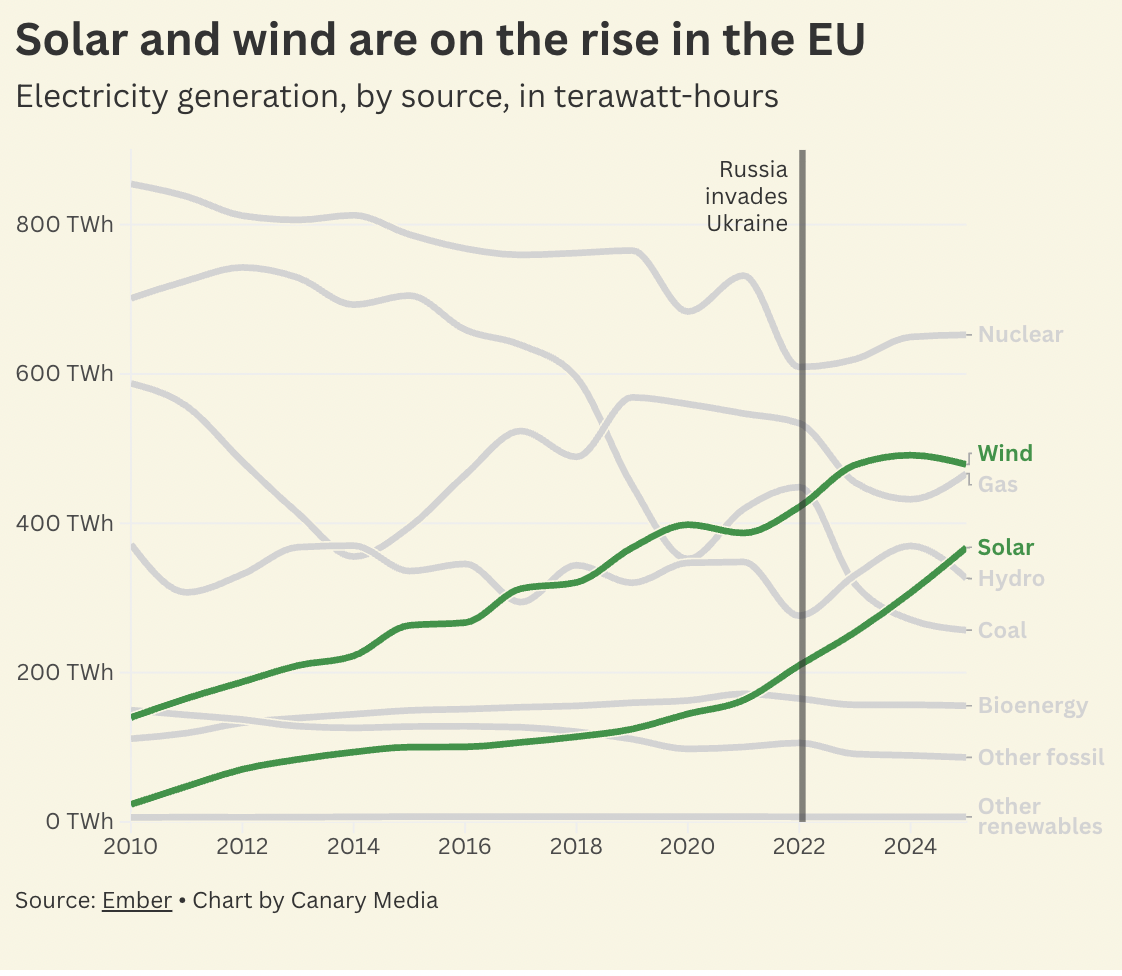
It’s an uncomfortable but familiar position for the EU. Following Russia’s invasion of Ukraine in 2022, the bloc rapidly reduced its reliance on Russian gas imports and swiftly built out new wind and solar power to cushion the blow to the region’s electricity sector.
The results speak for themselves. The European Union more than doubled its solar generation between 2021 and 2025. Wind grew at a more modest 24% over that time period, but it was already providing a higher share of the bloc’s electricity generation. Meanwhile, fossil fuel–generated electricity declined. For the first time ever, in 2025 the EU produced more electricity from wind and solar than it did from fossil fuels.
But the region has not ditched gas entirely. The EU got about 17% of its electricity from gas last year, and it imports almost all the natural gas it burns — 86% in 2024.
That means its energy system is still exposed to the historic disruption caused by the Iran war. The war has shut down liquefied natural gas production in Qatar, the world’s second-largest exporter of the fuel, for the past month. Gas prices globally and in the EU have surged as a result.
This energy shock will be messy and play out in different stages. For Europe, the most immediate and acute effects are being felt in the availability of jet fuel and diesel. But electricity costs will rise too, as nations are forced to buy much-more-expensive natural gas. In certain countries, it will also get dirtier, at least for a time — some EU nations are relying more heavily on coal-fired electricity to get them through the immediate fallout.
But over the longer term, this energy shock is likely to produce the same outcome as the previous one: an even faster transition away from imported fossil fuels and to domestic wind and solar.
The Cow Palace arena, just south of San Francisco, has hosted Dwight Eisenhower, the Beatles, the San Jose Sharks NHL team, and an annual rodeo since it opened in 1941. But an even bigger act is setting up next door: an enormous battery that will perform a starring role in the Bay Area’s energy ecosystem.
Developer Arevon has begun construction of the Cormorant Energy Storage Project, which will occupy an 11-acre vacant lot just southwest of the Cow Palace in Daly City. The battery facility will be large by industry standards, with 250 megawatts of Tesla Megapack containers, capable of discharging for four hours straight, for 1 gigawatt-hour of total stored energy. Bigger batteries have been built, but when Cormorant comes online in about a year, it will be poised to be the country’s largest battery nestled within a major urban area.
Arevon has contracted the battery for 15 years of use by MCE, one of California’s biggest community choice aggregators — entities that purchase electricity on behalf of local residents as an alternative to Wall Street–owned for-profit utilities. The state requires MCE to buy grid capacity commensurate with its members’ usage, and the Cormorant project will fulfill 10% of this annual requirement, known as resource adequacy in California bureaucratese.
MCE has become a major force in the greater Bay Area: It now serves all of Marin and Napa counties, most of Contra Costa, and half of Solano. The aggregator can contract for power plants across California, but it looks for sites within or near its service territory when possible, said Jenna Tenney, MCE’s director of communications and community engagement.
“Having a storage project in a community is going to add to resiliency in that community,” she said. The battery will bring $73 million of property tax revenue to Daly City, she added, and Arevon will donate $1.5 million in community benefits.
Cities need power, but generating it within urban cores is a difficult feat. California effectively stopped building gas-fired power plants, but even if that were an option, sticking a smokestack in San Francisco wouldn’t fly. These days, California expands generation by building large-scale solar plants in wide-open spaces, but those plants need to ship their power over many miles of transmission lines to reach the cities where it gets consumed.
The Cormorant battery provides something new: a dense source of on-demand power that can slip into the urban fabric without any local air pollution, and which absorbs the far-off solar generation at midday to discharge later at night. Arevon CEO Justin Johnson estimated that the battery, fitting on the site of a former drive-in movie theater, could cover the electricity needs of some 321,000 homes for four hours straight.
“It couldn’t keep the whole city going, but it certainly, without a doubt, increases the reliability of the grid in that area in a substantial way,” he said.
Arevon didn’t jump to the highest echelon of energy storage development from nothing. The firm has invested $11 billion in projects and owns 6 gigawatts of solar and battery installations operating across 18 states.
The company launched in 2021 as a spinout of Capital Dynamics, a private equity fund that amassed an early portfolio of energy storage assets. Arevon is owned by the California State Teachers’ Retirement Fund, Dutch pension fund APG, and the Abu Dhabi Investment Authority. Those firms invest for steady, long-term growth, and their patience lends itself to Arevon building and owning batteries for the long haul, instead of building to flip to other buyers.
“When we’re in there developing assets in the community, we can tell them, hey, we’re going to be here a long time,” said Johnson, who stepped up from COO to CEO in March. “You’re incentivized to engineer it well, construct it well, operate it well.”
Arevon focused on the Daly City location because electricity price volatility tends to be highest in proximity to major consumption, Johnson said. Places like that — whether metro areas or large industrial hubs — see the greatest swings from peak to off-peak hours, and having battery facilities to arbitrage between those times should push prices down in the long run. But building within a city comes with obvious trade-offs.
“Siting any infrastructure, whether you’re putting in a Walmart or upgrading an intersection or doing anything in a high-density area, is tough … especially so for power plants or facilities like this,” he noted.
Tough but not impossible, as Arevon proved in San Diego’s Barrio Logan community with its Peregrine project (another entry in a portfolio of projects sporting avian nomenclature), which came online last year. There, the company squeezed 200 megawatts of batteries between a naval shipyard and a light-rail track, in the shadow of the Coronado Bridge. In Daly City, Arevon will need to carve through roughly a mile of streets to run high-voltage cable underground to the nearest substation.
Such projects “reduce your lifespan a little bit” from the stress, Johnson said, but once built, the intrinsic difficulty becomes a sort of strategic moat. If a competitor wanted to open up next door to Cow Palace, well, they probably couldn’t find a viable space.
“Those are assets I’m really proud to own, and I think they’ll become just more and more valuable over time, because they’re hard to replace,” Johnson said.
To achieve that longevity, the batteries need to survive, and that premise is not to be taken for granted, given their location 90 miles north of Moss Landing, where the largest battery fire combusted a little over a year ago. Safety concerns are understandably higher in dense urban areas, so assuring the community that a Moss Landing–style disaster won’t happen here was integral to securing permits.
Arevon’s choice of battery, Tesla’s Megapack 2 XL, addressed the safety question. The containerized storage product is filled with the lithium-ferrous phosphate cells, a battery chemistry known to be significantly less fire-prone than earlier lithium-ion varieties. The older Moss Landing facility packed a huge amount of batteries into a single legacy structure, where they became fuel for an immense conflagration. The Megapack containers, in contrast, will be spread out across the site in a design that will prevent a fire from spreading beyond a single metal box. If one unit ever did catch fire, it would damage only a fraction of 1 percent of the plant’s capacity.
Workers are grading the site and installing “geo piers,” columns of aggregate that extend about 30 feet underground to stabilize the site during earthquakes. This is not an idle threat — the Bay Area just experienced a 4.6 magnitude tremor in the wee hours of Thursday morning. After that work is complete, the 280 Megapacks will take their places so that Cormorant can make its debut.
This analysis and news roundup come from the Canary Media Weekly newsletter. Sign up to get it every Friday.
Renewable energy’s favorite season has arrived.
Spring is when everything comes together for clean power sources. Days get longer, boosting solar generation. Winter’s blustery winds keep blowing, propelling turbines to their max. And melting snow and heavy rains combine to drive hydropower generation.
Previous springs have shown us just what this wild weather is capable of. In the first week of March 2025, Texas’ power grid, known as ERCOT, set all-time records for wind and solar power production as well as battery storage discharge.
Now, just a few weeks into spring, and with plenty more renewable power generation added in the past year, Texas is once again reaching new heights. On March 14, ERCOT reached an all-time high of 28.7 gigawatts of wind power, according to GridStatus.io. Even more impressive is the state’s solar generation, which has already set multiple records so far this year.
And while Texas is the country’s clean power leader, it’s not the only region with renewable power victories to show. Solar records have been achieved across the Southwest Power Pool, PJM Interconnection, the Independent System Operator New England, and the Midcontinent Independent System Operator this spring. ISO-NE also hit a record level for wind power generation, while MISO reached its pinnacle for overall renewables generation.
And in California, batteries stored a ton of that clean energy, and then set record after record for dispatching it throughout March.
A lot of those records were only made possible thanks to the U.S. adding 26.5 GW of utility-scale solar power generation in 2025, and another 5.7 GW of wind generation. A massive 13 GW of grid battery installations last year helped make full use of those renewables.
There’s an added bonus to all these records happening as the weather starts to warm. Most of us are starting to turn down our furnaces and heat pumps, but haven’t yet turned on our air conditioners. That means overall power demand tends to be at its lowest in the spring, and with renewables at their peak, we need far less fossil-fueled power to pick up the difference.
That confluence resulted in something monumental in March 2025: For the first time ever, fossil fuels accounted for less than half of U.S. power production across a whole month, while clean sources generated the rest. Let’s see if the U.S. can repeat that feat this year.
A global energy crisis is in full swing
Continued conflict in the Middle East is highlighting the risks of relying on fossil fuels.
It’s been five weeks since the U.S. and Israel first attacked Iran, sparking a conflict that has largely shut down oil and gas production and transportation in the region. Domestic natural gas supplies have blunted the blow in the U.S., but much of the world is facing a major energy crisis. Thailand has encouraged workers to ditch business suits to curb the use of air conditioning, while Sri Lanka has implemented a four-day workweek to limit fuel use.
The EU’s energy chief this week similarly urged residents to drive and fly less, and pushed countries to speed their transition to clean energy, saying fossil fuels’ price volatility won’t end even with a resolution in the Middle East. That’s been especially clear in the years since Russia’s 2022 invasion of Ukraine, which spurred the EU to cut off Russian gas supplies and turn its attention toward a solar and wind buildout instead.
Residential electricity price hikes aren’t slowing down, report finds
A new report offers a few explanations for why residential electricity prices are on the rise.
Across the U.S., average prices rose by 33% from 2019 through 2025, the Lawrence Berkeley National Laboratory and the Brattle Group found. That’s a big jump, but it tracks with the rising cost of groceries, housing, and other everyday expenses.
Still, that average hides the fact that some parts of the U.S. are experiencing far more dramatic hikes than others. While 29 states actually saw inflation-adjusted retail electricity prices fall from 2019 to 2025, costs spiked in California, Illinois, New England, and some mid-Atlantic states.
The report credits rising fuel costs, growing power distribution expenses, and storm recovery as some of the biggest drivers behind the power price swell. And with utilities requesting rate increases at record levels, researchers anticipate customers won’t see much price relief anytime soon.
Electrify easier: A new study finds many households can adopt energy-efficient, bill-lowering electric appliances and heating without the need for expensive electric panel upgrades. (Canary Media)
Prepare for extinction: The rarely convened Endangered Species Committee rules that federal endangered species protections will no longer apply to oil and gas drilling projects off the Gulf Coast, exposing the Rice’s whale and other creatures to potential harms. (Houston Chronicle, E&E News)
Fossil fuels’ human toll: A Texas refinery explosion last week damaged homes in a neighboring, largely Black town, revealing the human impact of the Trump administration’s push to ramp up fossil fuel production. (Capital B)
Geothermal heats up: Next-generation geothermal projects have the potential to deliver tons of clean power around the clock, but a need for permitting and safety reforms could slow the industry’s progress. (Canary Media)
No resolution: The Ohio trial of two former FirstEnergy executives accused of bribing a former consultant, who went on to become the state’s top energy regulator, ends in a hung jury, with the state vowing to retry the case. (Signal Ohio)
Stuck in limbo: The fate of more than 300 clean energy projects remains unclear after the U.S. Energy Department announced their grants were canceled without officially de-obligating their funding. (Latitude Media)
Chad Shepard has warm feelings about the all-electric Honda Prologue he bought recently. Unlike his first EV, a BMW i3, the SUV is big enough for his two teenage sons and his 80-pound sheepdog. Its 300-mile range is plenty to get him to the homes across the San Francisco Bay Area that he appraises for a living.
And while he hasn’t done the math since he bought it last autumn, he’s pretty certain that he’s saving money on fuel, compared with when he was driving a gas-powered car.
But perhaps the best thing about his new EV is the price he paid: $30,000, well below the sticker price for a new model. “And because it was only a year old, I still had a full 100,000-mile warranty,” he said, which included coverage for its most valuable component — the battery.
Across the U.S., people like Shepard are finding that used EVs are more attractively priced than ever — and are snapping the cars up as a result. It’s a welcome development in what has otherwise been a tough year for an industry that’s key to combatting climate change.
With the oil shock created by the war in Iran, used EVs are likely to become even more attractive to shoppers. Nationally, gas prices have surged to over $4 per gallon on average; in California, the country’s EV capital, they’re nearing $6. Unlike new EVs, used versions have mostly reached priced parity with gas-powered cars, according to new data from Cox Automotive — making the preowned versions the cheapest way for people to ditch increasingly costly-to-fuel gas cars in the near term.
“Affordability is top of mind among Americans, particularly given gas prices today,” said Maximilian Quertermous, co-founder and chief operating officer of Ever, an automotive retail startup focused on electric vehicles. “It’s a great time to buy a used EV overall.”
Used EV sales are climbing even as new EVs sales plummet nationwide.
New EV sales dropped by 28% year over year in the first quarter of 2026, per Cox. That was primarily driven by the loss of federal tax credits under the megabill passed by Republicans in Congress last year.
By contrast, used EV sales increased by 12% over the same period. The reason? Declining prices. The average cost of a used EV is now within about $1,300 of a comparable gas vehicle, Stephanie Valdez Streaty, director of industry insights at Cox Automotive, said during a March forecast call. “That affordability shift has clearly shown up in the data,” she said, “significantly expanding access for mainstream buyers.”

In the U.S., new EVs still outsell used ones. That’s likely to change as the market matures, since the overall used car market is roughly three times as large as the new car market. Right now, EVs make up only about 2% of the used car market, but that share is growing, according to Cox data.
“The trajectory is what stands out,” Valdez Streaty said, “supported by a broader mix of models, more affordable prices, and a significant wave of off-lease EVs.”

These latest data points aren’t coming out of left field, said Scott Case, CEO of Recurrent, a data-science firm specializing in collecting information on used EVs. His company tracked a 35% increase in used EV sales from 2024 to 2025, as well as a consistent downward trend in pricing, with 56% of used EVs selling for $30,000 or less as of January.
“What is different about 2026 is that for the first time ever, there’s actually a big enough used electrical vehicle market,” he said.
In particular, a lot of those used EVs are coming off leases made popular by a “leasing loophole” that allowed automakers and dealers to offer a full $7,500 federal tax credit, without the income qualification and manufacturer restrictions that applied to claiming the credit on direct sales.
More than 1.1 million EVs were leased from January 2023 to September 2025, when the federal tax credit ended. Shepard said he kept a close eye on those trends when planning to buy a bigger EV. “If you track that, you’ll see that [the cars] all go back to the dealer at the same time,” he said. “They have a flood of them, and the price drops a lot.”
And the latest vintages of used EVs offer an impressive value when compared with their gas-powered equivalents, Case said. Recurrent’s latest data indicates that a used EV is a year newer and has nearly 30,000 fewer miles than a similarly priced used gas car.
“When you compare what you’re getting for each of those, this is not an apples to apples — it’s a crappy apple versus a really awesome apple,” he said.
At least 68% of used EVs that Recurrent is tracking are 2022 models or later, which offer newer technology features than the average 6.5-year-old used internal combustion engine vehicle, Case added. Almost all those newer EVs remain under battery and powertrain warranties that tend to offer eight years or 100,000 miles of coverage, he said — and that’s for a class of vehicle that already costs about 40% less to maintain than a conventional car.
If they’re so much better, why are used EVs so cheap? Case outlined several key factors to explain that.
First is the far more rapid pace of improvements from one model year to the next — “more range, faster charging, more technology” — that make newer EVs more valuable than their predecessors. EVs that are even a few years old are seen as less desirable than the latest models, and thus command a lower price, he said. Federal tax credits also pushed down the expectations of what EV should cost, he said.
But many people remain uncertain about buying an EV, Case said. Range anxiety remains one of the chief concerns, he noted. And for used EVs, there’s another layer of uncertainty around “how the battery is holding up.”
Recurrent hopes its research can help disabuse EV buyers of that uncertainty, he said. The company has collected data from more than 50,000 EVs on the road, with more than a billion miles driven. While there’s variability between different manufacturers and EV models, that data shows that used EV batteries are holding up better than expected, he said. That finding is backed by other studies indicating that EV batteries are lasting longer than people thought they would.
These are important factors for low-income customers looking to EVs to cushion themselves from rising fuel costs, said Jason Zimbler, senior director of light-duty vehicles at clean-transportation nonprofit Calstart. “You’re getting a younger car, less road wear, and the battery degradation has been minimal,” he said. “So you’re not putting lemons in the hands of the secondary market.”
And while last year’s Republican-passed megabill killed a $4,000 tax credit for used EVs, along with the bigger rebate for new ones, many buyers can still access state or utility rebates, said Peter Glenn, co-CEO of EV Life, a startup with software used by customers, car dealers, and automakers to find EV incentives.
California’s biggest utilities offer rebates ranging from $1,000 to over $4,000 for income-qualified customers. States including Connecticut, Delaware, Illinois, Massachusetts, New Mexico, New York, and Rhode Island provide rebates in the thousands of dollars range, he said.
Understanding all the price reductions available up front can push used EVs past price parity with gas-powered cars and into the “tipping point” of being cheaper, Glenn said. “You almost need it to tip into obvious savings beyond, so it becomes a total no-brainer.”
Of course, buyers focused on long-term ownership costs can also use a variety of calculators available online that demonstrate how much cheaper it is to fuel and maintain EVs over time, Glenn added. “If you’re charging at home, it can be the equivalent of paying about $1 to $2 per gallon, even in higher-electricity-cost markets.”
Shepard only recently installed a Level 2 charger at home, so he hasn’t had a chance to calculate his fueling savings yet. But he’s glad he doesn’t have to rely on gasoline anymore.
“I just don’t see any need to use fossil fuels to make our cars go when it works just as well with electricity,” he said.
Remell Bryant fed steel coils into the “cold strip” as a way to support her daughter as a single mother.
Valerie Denney worked on the “pickle line,” removing impurities from hot steel, before shifting to a career in public relations.
Jack Weinberg tested metallurgical content until he was laid off, then went on to negotiate international environmental treaties.
Terry Steagall played on the banks of a polluted river near the steel mill as a child, then spent 41 years inside the mill as a machinist, repairing gearboxes, cranes, and line shafts, before retiring in 2023.
Now, the four are collaborating to demand a shift away from coal-based steelmaking and toward cleaner methods for the Northwest Indiana industry in which they once worked. They’re all members of Gary Advocates for Responsible Development (GARD), a grassroots group founded in 2021 by former steelworker Dorreen Carey.
Such a transition could save thousands of jobs, create new economic opportunities, and avoid about $75 million in healthcare costs in the region, according to a report released Thursday by the Indiana University Environmental Resilience Institute and the consultancy 5 Lakes Energy, and commissioned by Indiana Conservation Voters.
Only six integrated mills — facilities that produce both steel and the iron needed to make it — are operating in the United States, and three of them are in Northwest Indiana. With their hulking, polluting blast furnaces, these mills may soon become a thing of the past in the U.S., as steel is increasingly being produced in smaller and cleaner operations, frequently in the Southern states.
The GARD organizers echo the report’s authors and other industry experts in warning that if Indiana’s mills don’t modernize and clean up, they could go the way of the other steel mills that once proliferated in the region, but were shuttered during the steel industry crisis of the late 1970s and ’80s. The region still hasn’t recovered from that era, and further closures could mean thousands of job losses and gutted public coffers. The report notes that Northwest Indiana’s steel mills once had more than 65,000 workers but employ only about 9,000 today. Without modernization, the study estimates, Northwest Indiana steel mill jobs could fall below 5,000 by 2034.
Converting a traditional integrated mill to much-cleaner direct reduced iron (DRI) technology costs billions of dollars, and the Biden-era incentives that could have encouraged companies to make the switch were eliminated by the Trump administration. It’s a hard sell, but GARD considers global steelmaker Nippon Steel’s 2025 acquisition of U.S. Steel’s Gary Works mill, in Gary, Indiana, an opportunity.
Steagall said he “didn’t see a pathway” to green steel until the Japanese company entered the picture.
Nippon plans to allocate $3.1 billion for upgrades to Gary Works. About $300 million of that will go toward relining its largest blast furnace — which will extend its life for about another 20 years. The company could use some of the remaining money to replace the mill’s three other blast furnaces with a DRI plant, GARD proposes in a recent report.
It would cost about $3.6 billion to transition Gary Works to cleaner steelmaking, according to the Indiana University report. Modernizing the area’s other two mills, both owned by Cleveland-Cliffs, would cost $2.8 billion to $3 billion each. That’s in line with what the companies have indicated they will spend to maintain those operations.
In a February earnings call, Cleveland-Cliffs announced that it is planning to reline an Indiana blast furnace next year. The company had in fact proposed a DRI conversion at one of its Ohio mills, but backed off the plan after Trump took office in 2025.
Advocates note that the crucial technologies needed for green steel — DRI and electric furnaces — already exist at commercial scale, and efforts are gaining steam globally to combine the two. Many existing DRI plants use natural gas, which results in much lower emissions than the coal that fuels blast furnaces. But using green hydrogen — produced by splitting water atoms using renewable electricity — would slash emissions even further.
The national climate research groups RMI and Industrious Labs are also touting the feasibility of greening the nation’s integrated steel mills. An RMI analysis shows that such overhauls cost roughly the same as relining and upgrading existing infrastructure.
The biggest challenge may be convincing company leaders to make a major change in an industry that “has never been known to move quickly,” as Steagall put it.
In an integrated steel mill like Gary Works, iron is added to a blast furnace, where it undergoes chemical reactions involving limestone and coke — a baked-down, concentrated form of coal. Molten iron is then converted to “primary steel” in a separate stage. This process results in the type of high-quality, flat-rolled steel suitable for automobiles and buildings.
But it is highly polluting, with about 2 million metric tons of carbon dioxide released for each ton of steel produced globally, along with high levels of particulate matter, sulfur dioxide, nitrogen oxides, and other pollutants.
The fortunes of Gary Works and other integrated steel mills declined starting in the late 1970s because of slowing demand and competition from abroad, including from “mini-mills,” which use electric arc furnaces to make steel — mostly from scrap metal — without producing any iron on-site. Integrated mills in Indiana, Illinois, Ohio, and Pennsylvania downsized their operations and then closed over several decades, transforming thriving cities into Rust Belt relics. Nationwide, steel sector employment fell from about 512,000 in 1974, according to a study by the National Bureau of Economic Research, to about 85,000 today, according to Federal Reserve Economic Data.
“Republic Steel, Bethlehem Steel, J&L Steel, they all shut down or were liquidated,” said Weinberg, who worked for eight years in Gary Works’ sheet and tin division.
Though the Gary Works mill survived, its workforce was greatly reduced – from more than 30,000 people at its peak in the 1970s to about 4,300 people today. By the 2010s, the city was notorious for its abandoned buildings and urban decay.
As GARD organizers see it, without investments in clean steel, Gary’s fortunes could fall further. The plant’s market niche — high-quality primary steel — is vulnerable to competition from the electric arc furnaces that make at least 60% of the country’s steel today.
Facilities using electric arc furnaces have typically not produced the highest-quality steel, mainly owing to their reliance on recycled steel scrap. But they do still require at least some virgin iron to produce steel, which can come from integrated mills or from on-site DRI facilities. Automakers typically demand steel made in integrated mills, but electric arc furnaces could increasingly compete for that market as their steel quality improves.
Big River Steel, along the Mississippi River in Osceola, Arkansas, is a prime example. Its electric arc furnace uses iron from Gary Works to make high-quality steel. U.S. Steel acquired the mill in 2021, and now it’s part of Nippon’s portfolio. Nippon announced in November that it will build a DRI plant at Big River, which would potentially displace the metal it currently sources from Indiana.
So, such electric arc furnace operations could become competitors, rather than customers, of integrated mills like Gary Works. And they could gain a market advantage if automakers and other industries demand a cleaner supply chain, as GARD and other decarbonization advocates predict.
Nippon lags behind most of its peers globally in its readiness for greening operations, according to a scorecard released March 30 by the international climate advocacy organization SteelWatch. The organization analyzed the decarbonization progress and potential of 18 major steel companies in 29 countries and found that Nippon ranked 17th; U.S. Steel, which was ranked before the acquisition, came in eighth; and Cleveland-Cliffs was sixth. While U.S. Steel could help facilitate Nippon’s decarbonization, SteelWatch said, the plan to reline rather than convert the Gary Works blast furnace represents a “backward trajectory.”
There’s a strong public health argument for greening the mills.
Emissions from blast furnaces are linked to an increase in various cancers, asthma, pulmonary disease, and other ailments. Industrious Labs found that in 2022, Gary Works emitted 182 tons of 24 different toxic chemicals. The health impacts are also a clear environmental injustice: 97% of those living within a three-mile radius of Gary Works are people of color, and almost two-thirds are low-income, according to Industrious Labs’ analysis.
Indiana University’s report found that Gary Works annually emits eight times more carbon monoxide and 50% more particulate matter than the state’s largest coal plant; and the region’s three primary steel mills account for not only the $75 million in healthcare costs but also 27,8000 work days and 26,700 school days lost to illness each year.
GARD member Natalie Ammons did not work in the mills, but her husband did. And she blames the Gary Works blast furnace for his early death from cancer.
Her family’s health problems have continued. Two of Ammons’ granddaughters, both of whom live near the mill, rely on breathing machines that look like scuba apparatus, she said. Modeling done by Industrious Labs using federal algorithms shows up to 114 premature deaths and over 31,000 asthma attacks linked to pollution from Gary Works each year.
Bryant retired from Cleveland-Cliffs Indiana Harbor refinery about four years ago, because she had developed a nodule on her thyroid that impeded her breathing. She attributes it to her exposure to pollution there.
“I was always super healthy. It is odd that happened shortly after I worked a lot of overtime in the lime plant,” she said.
Steagall cites examples like these in calling for Nippon to be “a good corporate citizen” for its American neighbors.
“They’ve got to make their mind up,” he said. “Do they want to be the king of steel or the king of death?”
Nippon has not responded to GARD’s proposals and requests for dialogue nor to a request for comment for this story.
The United Steelworkers union, which the GARD members once belonged to, has similarly not engaged with them. While GARD notes that unions are often reluctant to consider any changes that could disrupt the job market, it warns that the shift to mills in the South with electric arc furnaces could be disastrous for the union — as those plants are typically not unionized. (United Steelworkers did not respond to a request for comment.)
At a recent symposium at Purdue University Northwest, students and faculty clamored to hear more about GARD’s vision for the industry’s future. After the event, the GARD members gathered around a table and reminisced about the jobs they used to do. Their eyes lit up describing the complexities of the steelmaking process.
The metal “runs through a big acid bath, then we cut it to specification,” Denney said of the pickle line where she had worked. “At the end, they oil it, and you have this beautiful, very shiny, gorgeous steel.”
Gary itself could be similarly transformed, through clean steel, she imagines.
“People are used to Gary being kind of a throwaway city,” she said. “It’s all bad. There’s an opportunity for it to be all good now for the first time in a while. Nippon could be part of this change. It could be part of changing Gary forever.”
Maria Gallucci contributed reporting for this article.
A clarification was made on April 2, 2026: This story has been updated to clarify that direct reduced iron plants and electric furnaces exist separately at commercial scale.
Examine fossil-fuel subsidies by country in USD. Visualise trends by fuel type and filter by beneficiaries and support mechanism for more detailed insights. To know more about these categories, go to Methodology. Global data in this visual might differ slightly from values displayed in the “Home” page. This is due to the methodology applied to disaggregate the data. For more information about this, visit the section “Data sources” in the Methodology.

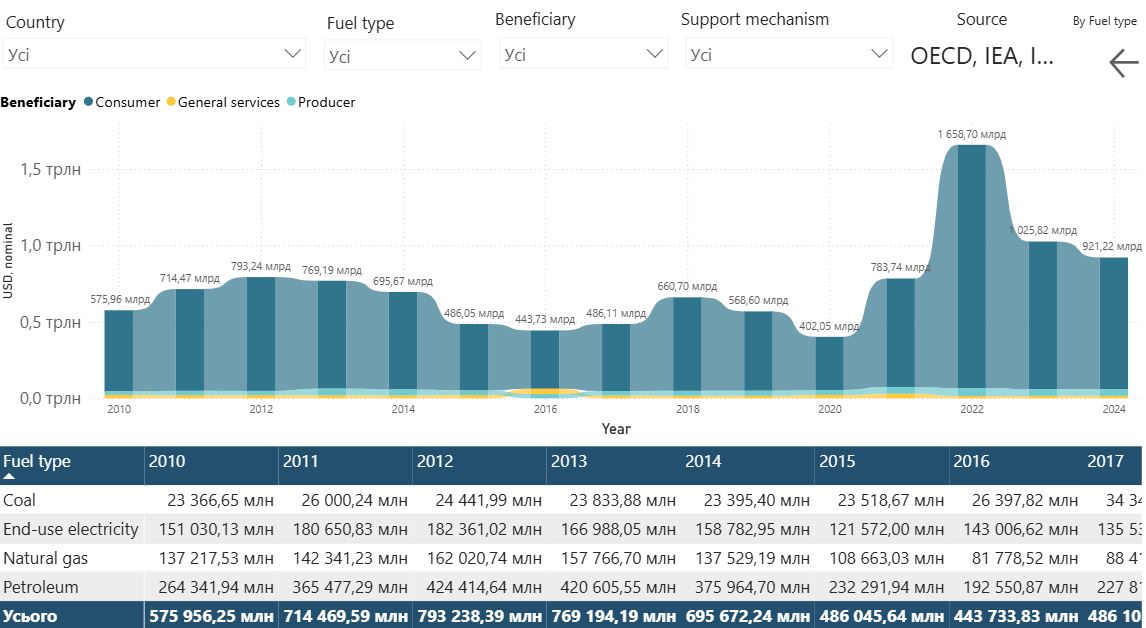
Disclaimer: Any data and any map included herein, are without prejudice to the status of or sovereignty over any territory, to the delimitation of international frontiers and boundaries and to the name of any territory, city or area. The dataset for 2023 is available for 83 economies.
If the war in the Middle East has proved anything over the last month, it’s that fossil fuel prices are extraordinarily unstable. But global conflict isn’t the only catalyst that can send the cost of oil and natural gas reeling. Factors such as extreme weather, policy changes, and pipeline outages can also set off a price roller coaster.
In North Carolina, all this volatility is prompting calls for change. Advocates want the state to join the handful of others that require electric utilities to absorb a fraction of fossil fuel prices — rather than saddling customers with all of them, as the companies do now.
The point of the policy, called fuel-cost sharing, is twofold. It can bring utility bills down for average consumers, who are increasingly angry about ballooning expenses. And it can aid the clean energy transition: If the state’s predominant utility, Duke Energy, knows that its shareholders will take a hit when fuel prices rise, the company may scale back its dependence on polluting gas plants and instead rely more on emissions-free, fuel-free forms of energy, like wind, solar, and batteries.
The notion of fuel-cost sharing is still very much in its nascence here, where Duke wields incredible power over the Republican-controlled legislature, and neither lawmakers nor regulators have pushed the company to invest in cheap, clean energy.
But proponents of the idea say the conversation is still worth having.
“Fuel dependence creates vulnerability — whether it’s gasoline for your car or natural gas for your power plants,” said Josh Brooks, chief of policy strategy and innovation for the North Carolina Sustainable Energy Association. “Tying costs to volatile commodities means a lot of risk exposure for ratepayers. That’s an issue both regulators and policymakers should take up.”
North Carolina is far from unique. Most states with vertically integrated utilities allow them to pass 100% of fuel costs to their customers. Utility shareholders don’t earn a return on those outlays in the same way they profit from building new power plants, but they’re insulated from the wild price swings inherent in the global fossil fuel market. Consumers are not.
Ratepayers, for instance, bore the full brunt of spiking gas prices after Russia invaded Ukraine in 2022. Confusingly for customers, Duke doesn’t specify these fuel charges on their bills; instead, the charges are incorporated into a nondescript line item, leaving consumers to ferret out on their own what they’re paying for fossil fuels.
The lack of clarity around fuel costs adds to customers’ outrage about rising bills. One example of the widespread frustration: A Change.org petition calling for Duke to submit to an independent audit and refund its customers for any improper charges has drawn more than 73,000 signatures so far.
“Unexpected and unexplainable increases in Duke Energy bills have become a major concern for many families,” the petition begins. “When bills rise without reasonable justification or transparency, it impacts our ability to plan and manage our household finances effectively.”
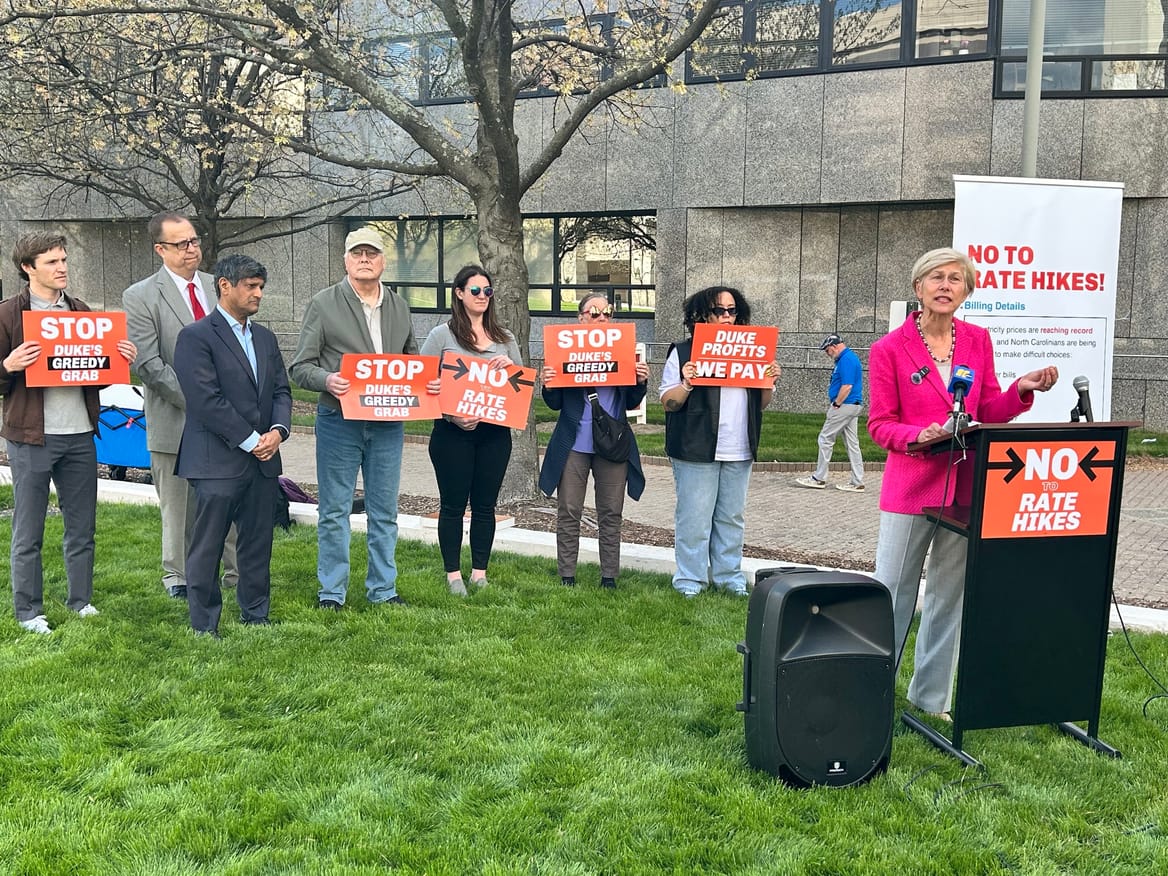
The average household Duke bill has risen by nearly 45% since 2020, according to an analysis from the Energy and Policy Institute, because of a confluence of factors. The cost of natural gas is a major one.
Research from the Environmental Defense Fund shows that fuel costs accounted for 67% of rate increases from 2017 to 2024 in Duke’s central North Carolina territory, and for 46% of the hikes in the rest of the state. While fuel costs did dip last year, they’re still about double what they were in 2017.
“Fuel costs have stayed high since the 2021-22 price spike,” Will Scott, the environmental group’s North Carolina policy director, said in a written response to Canary Media. “At the same time, Duke has become more natural gas reliant, with even more new gas plants on the way.”
Indeed, with the state’s 2030 climate goal gone, and the Trump administration aggressively propping up coal and gas, Duke has every incentive to pursue a massive buildout of fossil fuel infrastructure: Shareholders will profit from the plants and suffer no adverse consequence if gas prices continue to rise.
As Jeremy Kalin, a fuel-cost sharing expert and clean energy finance lawyer, put it, “The utilities are the ones that have all the power, all the visibility, all the expertise — and none of the risk.”
Fuel-cost sharing would shift the balance. In a February report, clean energy think tank Rocky Mountain Institute evaluated one way that North Carolina could structure such a policy: Duke would tell regulators how much it expected to spend on fuel over the course of a year. If the utility went over that estimate, investors would cover 10% of the extra cost — up to a small cap. If fuel ended up costing less than expected, investors would get to pocket 10% of the savings.
The policy, said Oliver Tully, RMI’s carbon-free electricity manager and one of the report’s authors, would “reduce some of the risk exposure that customers have — and essentially give utilities some skin in the game.”
With the 10% sharing scenario in place from 2020 to 2024, RMI concluded, Duke’s roughly 3.8 million customers in North Carolina could have saved a total of $100 million in 2021, 2022, and 2023 — a small but meaningful fraction of the fuel cost increases that followed the pandemic and the invasion of Ukraine. Duke investors, meanwhile, would have gained an extra $9.9 million in 2020 and $1 million in 2024. The net benefit to customers over the study period: $89 million.
Tens of millions in consumer savings is meaningful in and of itself, Tully and other experts stress. But the policy also gives utilities an incentive to reduce their fuel expenses, both in the long term by building fewer gas plants and in the near term by relying less on coal and gas during periods of high demand.
“They have a lot more control, especially compared to ratepayers, over overall fuel costs,” Tully said. “They can decide how much gas-fired generation to build or control. They can choose to invest in resources that don’t have fuel costs, like renewables.”
Ideally, Tully and other experts say, the cost-sharing policy would create a win-win situation that aligns Duke’s incentives with its customers’. Both investors and customers pay more when fuel costs are high and save when fuel costs are low.
“The goal is to get shareholders and customers on the same rope,” Kalin said, “pulling in the same direction.”
Nine states have implemented some form of fuel-cost sharing, according to RMI. Five are in the Northwest, including ruby-red Idaho and Wyoming. Last year, lawmakers in Nevada authorized regulators to study the policy, and Virginia just enacted a law doing the same.
Despite its advantages for customers and even shareholders, the cost-sharing policy’s prospects in North Carolina are uncertain.
The North Carolina Sustainable Energy Association pushed for a study of fuel-cost sharing last year at the North Carolina Utilities Commission as part of its annual deliberation on the fuel charge itself. But regulators rejected the idea, saying they lacked the authority to order such an analysis — at least in the context of a fuel proceeding.
“The commission has historically had a pretty conservative view of its statutory authority,” the association’s Brooks said.
Still, his group plans to raise the issue as part of Duke’s active bid to regulators to increase residential rates by 18% over two years. Proponents will also look for ways to advance the policy during the state legislative session that begins next month, even while expecting that lawmakers will focus their time on other matters.
“That’s not going to stop folks from advocating for some kind of change,” Brooks said.


.svg)
