

 Back
Back
Geothermal energy is on the cusp of a renaissance in the United States. But outdated and piecemeal rules could delay development of the around-the-clock, carbon-free energy source.
Next-generation geothermal is something of a golden child, backed by everyone from climate advocates to leaders in the drilling-obsessed Trump administration. Investors are pouring billions of dollars into the sector. A huge, first-of-a-kind project in Utah will start delivering power this fall, marking a milestone for this new wave of geothermal technologies — and fueling hopes that the energy source can help the U.S. keep pace with skyrocketing demand.
But companies won’t be able to quickly build dozens more of these power plants without updated regulations and standards for developing geothermal projects, industry insiders and experts say.
Today, permitting requirements are fragmented and can vary at the state and local levels, a reflection of the modest role geothermal has historically played in America’s energy sector. However, next-generation technologies are promising to unleash development in areas where harnessing Earth’s heat was previously too difficult or too expensive.
So companies are calling for a more standardized approach to permitting, instead of the bespoke, project-by-project reality they currently face. That will require lawmakers to act, but also the industry itself to develop better systems for defining projects and sharing data.
Meanwhile, pressure is growing within and outside the industry to create more safeguards for preventing accidents and high-profile mistakes that could harm communities and the environment — and could damage the industry’s reputation before it can truly launch.
“We want geothermal to advance as a clean energy solution that can be available anytime that is needed, anywhere that it is needed,” said Angela Seligman, a senior geoscientist at the nonprofit Clean Air Task Force. “But we also want it to stay as a source of clean energy, and we want the good actors … to be the ones who build new projects.”
Here are just a few of the ideas gaining traction for safely accelerating geothermal projects.
An obvious but essential step for creating rules is to establish exactly how next-generation technologies work and what their impacts might be.
The emerging industry has an ever-expanding vocabulary to describe its tools and techniques, but there’s still little consensus about what those terms all mean, said Jamie Beard, executive director of Project InnerSpace, a geothermal research and advocacy organization.
For example, Fervo Energy’s flagship, 500-megawatt Cape Station project is an “enhanced geothermal system” that uses hydraulic fracturing techniques gleaned from the oil and gas industry. Other developers might take a similar approach but use different words to describe it. The same goes for “advanced” and “closed loop” geothermal systems, which broadly include projects that circulate fluids in sealed underground pipes but can still involve intensive drilling methods and encompass a variety of materials.
“Right now, everybody’s kind of calling themselves what they want,” Beard said. “You can’t standardize, and you also can’t build trust about a technology” in this way, she added.
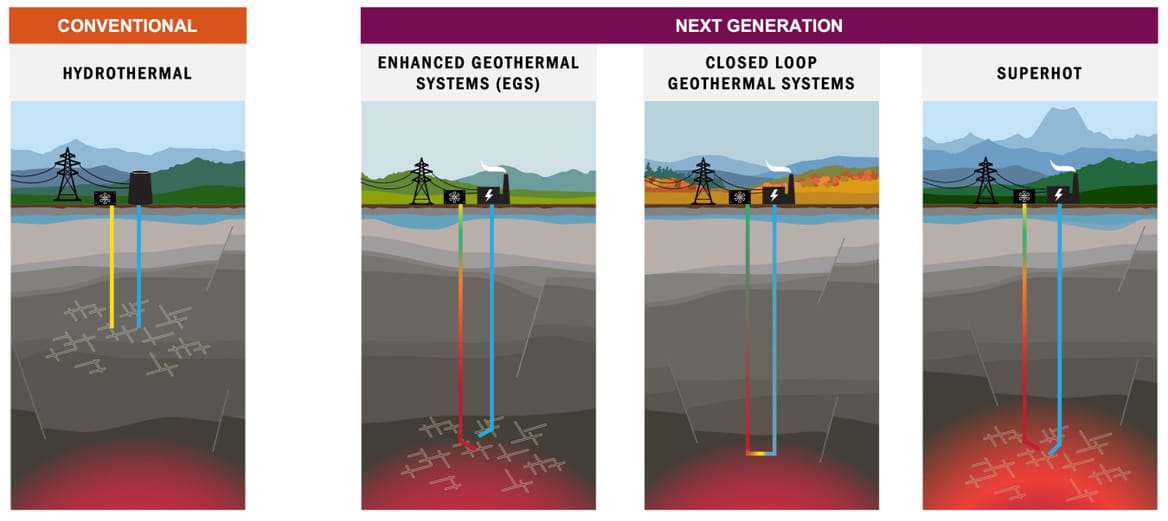
Last month, Project InnerSpace unveiled an initiative to start defining projects in more concrete terms. The Geothermal Resources Management System, which is modeled on the petroleum industry’s system, aims to establish a global framework for classifying and evaluating geothermal reserves. The main idea is to give banks and insurers more clarity and confidence in potential projects. But it would also support larger efforts to establish industry protocols for things like limiting groundwater contamination and avoiding industrial accidents, Beard said.
In the U.S., new bipartisan legislation to accelerate geothermal development is also geared toward creating more public transparency from the sector.
Sens. John Hickenlooper (D-Colorado) and Steve Daines (R-Montana) recently introduced the GEO Power Act, which would require the Department of Energy to help fund geothermal projects in states with limited or no existing geothermal power generation. It also prioritizes data sharing within the industry to “de-risk” future projects and to help regulators, communities, and business partners better understand and address potential impacts, according to the office of Sen. Hickenlooper.
Perhaps no risk looms as large over the next-generation geothermal universe as human-caused earthquakes.
The mistakes made on earlier enhanced geothermal systems are notorious. In France, Switzerland, and South Korea, the process of injecting water at high pressure to fracture rocks underground triggered seismic activity that was strong enough to damage buildings, rattle surrounding cities, and create public backlash.
In response to such events, in 2012, the U.S. Department of Energy revised its induced seismicity protocol, which describes a “traffic light” system for the real-time monitoring and measuring of vibrations caused by geothermal development. Any U.S. geothermal project that receives federal funding — which is virtually all of them today — is required to set up seismicity monitoring stations and follow the DOE’s guidance.
But as the industry matures, projects will likely no longer need government support, meaning they won’t have to follow the system of red, amber, and green lights in their operations. Seligman said that the Clean Air Task Force is pushing for the federal government to require all geothermal projects to adhere to the protocol.
“We want to be really careful about induced seismicity, so that it’s not something that will hinder the advancement of the geothermal industry,” she said.
The startups Eavor Technologies and XGS Energy told Canary Media they would have no issue adhering to a universal protocol. Both firms claim their systems are designed to mitigate such risks from the start. They say their closed-loop technologies don’t require fracking or injecting and withdrawing fluids from the ground — the main drivers of seismicity in geothermal wells.
“Maintaining public trust is vital for the entire geothermal sector,” said Neil Ethier, Eavor’s vice president of commercial and business development. In December, the Canadian startup began delivering power to the grid from its flagship operation in Germany, which is slated to produce over 8 MW of electricity and 64 MW of district heating when fully completed.
XGS is developing a 150-MW closed-loop system in New Mexico that’s expected to provide clean power for Meta’s data centers by 2029. Last week, the Houston-based firm said it was partnering with oil-and-gas services giant Baker Hughes on the exploration and engineering phases of the geothermal project.
Lucy Darago, the chief commercial officer for XGS, said that blanket requirements run the risk of adding “superfluous” rules for companies like hers, and that regulators should instead adopt measures that are “fit to purpose” and reflect the nuances in next-generation systems. She said that XGS is active in ongoing discussions with policymakers in states such as Colorado and New Mexico, which are revising permitting structures to accelerate geothermal development.
“Should we be required to drill a monitoring well and maintain a seismic program that could add millions of dollars to overall project costs?” Darago asked. “We probably will, especially for early projects. But should that be a perpetual part of our regulatory regime? I think that’s an open question, and one that we’d ultimately like our regulators to decide.”
As state and federal agencies work to revise rules for geothermal projects, industry leaders in the U.S. and other countries are also looking to show a token of good faith by proactively committing to certain standards.
Last fall, for instance, Fervo released the Geothermal Sustainable Development Pact, a voluntary framework meant to guide the industry’s growth. The 37-point plan includes steps like adopting DOE’s protocol for reducing seismic risk, prioritizing efficient water use, minimizing land disruption, and engaging with communities.
“As geothermal scales to meet rising energy demand, we have a responsibility to raise the bar on how these multi-decade projects are developed, and not just exclusively focus on the technology itself,” Tim Latimer, Fervo’s CEO and co-founder, said by email.
“Geothermal benefits from decades of lessons across energy: what worked in oil and gas, what worked in renewables, and where both fell short,” he added. “We don’t see it as an either-or situation. It’s not growth or responsibility. It’s both.”
No other companies have signed Fervo’s pact so far, though Latimer said the startup is inviting others across the industry to adopt and build on its principles. The environmental groups Sierra Club and NW Energy Coalition, an alliance of over 100 organizations and businesses in the Pacific Northwest, have said they fully endorse the pact.
“I think everybody will benefit from it, especially at this early stage of an exciting new era,” said Fred Heutte, a senior policy associate for the NW Energy Coalition.
He said that in his home state of Oregon, the startups Mazama Energy and Quaise Energy are working to build novel geothermal projects near the Newberry Volcano. Oregon currently has one large-scale conventional geothermal project — the 33-MW Neal Hot Springs plant — but most states have no geothermal development at all, given the industry’s traditional limitations.
With next-generation systems, “there’s going to be a lot more places that will be looked at for geothermal development … and that’s going to raise issues about land impact, community impact,” Heutte said. “I think the industry is well aware of the risks of problems like that and is trying to get out in front of it.”
This article originally appeared on Inside Climate News, a nonprofit, nonpartisan news organization that covers climate, energy, and the environment. Sign up for their newsletter.
In Alabama, a yearslong battle over one of the nation’s highest backup fees for residential solar customers may have finally come to an end.
A federal judge ruled last week that Alabama Power can continue charging its small solar customers one of the highest standby charges in the nation, dismissing a lawsuit that argued the fee was illegal under the Public Utility Regulatory Policies Act.
“I am frustrated that Alabama Power solar customers like me have to pay an extra monthly fee in order to reduce our power bills,” Mark Johnston, one of the plaintiffs, said in a news release after the ruling.
Solar advocates in Alabama say the fee, which charges customers with an average residential solar array around $39 per month, significantly stifles the residential solar market in the state by nearly doubling the payback time for a solar installation.
Alabama ranks 51st in residential solar capacity among U.S. states plus Puerto Rico and the District of Columbia, trailing only North Dakota, according to the Solar Energy Industries Association, a solar industry trade group. Per capita, Alabama ranks last.
Alabama Power, which provides power to roughly two-thirds of the state, charges its customers that generate their own electricity a monthly fee of $5.41 per kilowatt of capacity installed.
The average size of a U.S. residential solar array in 2024 was 7.2 kilowatts, according to the Lawrence Berkeley National Laboratory. The fee would add $38.95 each month to the customer’s bill regardless of how much electricity the customer consumes or puts back on the grid.
Alabama Power says the fee is needed to cover costs of maintaining the grid when the solar panels aren’t producing, at night or in cloudy weather.
“Customers who rely on the grid must help pay for the grid,” the company said in an emailed statement. “We are pleased the court agreed with the Public Service Commission’s determination that customers who choose to use Alabama Power for backup service should pay their share of costs to maintain the grid.”
Johnston, an Episcopal priest and retired executive director of Camp McDowell, pays about $32 per month for his 6 kilowatt system.
“This charge discourages additional residential solar systems in the state, a source of clean, renewable power that decreases the use of fossil fuels,” Johnston said. “I want lower electricity bills and a better environment for my children and grandchildren.”
The Southern Environmental Law Center and Ragsdale LLC filed the lawsuit on behalf of customers paying the charge and environmental groups that argued the fee was unlawfully stifling the small-scale solar industry in Alabama.
The Alabama Public Service Commission and Alabama Power filed a motion to dismiss the challenge, granted Wednesday by Judge Annemarie Carney Axon, in the U.S. District Court for the Middle District of Alabama.
The SELC said it is examining the decision and its clients’ legal options.
“This is a disappointing day for Alabama Power customers who want to use solar energy to get relief from some of the highest electricity bills in the nation,” said Christina Tidwell, a senior attorney in SELC’s Alabama office, in a news release. “Not only are we missing out on the bill savings that could be realized through installing rooftop solar, but we’re also missing out on opportunities for job creation and economic development.”
Alabama Power has come under increased scrutiny for its high power bills in recent months.
An Inside Climate News investigation found that Alabama Power had the highest total residential power bills in the country in 2024, and the highest electricity rates in the Southeast.
Environmental advocates have continuously challenged Alabama Power’s capacity reservation charge since it was approved by the Public Service Commission in 2013. The decision was appealed to the Alabama PSC and then to the U.S. Federal Energy Regulatory Commission.
Though FERC did not agree to initiate an enforcement action regarding the fee when it examined the case in 2021, Chairman Richard Glick and Commissioner Allison Clements issued a concurrence to express “concern” that the fee may be in violation of federal utility law, and said the petitioners had “presented a strong case that the Alabama Commission failed to adhere to the regulations set forth in FERC Order No. 69.”
The commissioners were concerned about the way Alabama Power calculated the costs for backup power, saying company had not demonstrated that a solar customer’s profiles were different enough from a nonsolar customer to justify the charge, and the company’s methods had “combined apples and oranges” by relying on actual data and projections to determine the cost difference between solar and nonsolar customers.
The District Court judge ruled otherwise, dismissing the plaintiffs’ suit, saying “the plaintiffs have not presented any evidence from which a factfinder could conclude that Alabama Power violated [PURPA].”
The fee is not the only policy in Alabama that advocates say is holding back solar in the state. Alabama does not offer net metering, where solar customers are credited the same amount for electricity they put on the grid as the electricity they use.
Instead, customers who feed excess energy back onto the grid are only credited the amount of money it would cost Alabama Power to generate the same amount of electricity at one of its power plants, an amount much lower than retail rates.
“Alabama communities are dealing with harmful impacts of our state’s reliance on fossil fuels; meanwhile, Alabama Power and the PSC are chilling clean, bill-reducing solar power,” Jilisa Milton, executive director of the Greater-Birmingham Alliance to Stop Pollution (GASP), said in a news release. “Solar energy offers a unique opportunity for residents of Alabama to take control of their energy costs, reduce their carbon footprints, and contribute to a cleaner environment.”
Alabama Power’s solar fee has long stood out as one of, if not the, highest in the country for small-scale solar users.
Some utility regulators have rejected fees outright, while others have allowed such fees in much lower amounts or have limited fees to systems larger than a certain size.
Georgia Power, also owned by Alabama Power’s parent Southern Company, proposed a fee similar to Alabama’s in 2013. Georgia Power withdrew its proposed fee as opposition mounted in the Georgia Public Service Commission. Alabama’s Public Service Commission approved the fee.
In Virginia, solar customers only pay a standby charge if their array is larger than 15 kilowatts, and that limit is likely to increase soon.
Earlier this month, the Virginia General Assembly passed a bill to increase the threshold for projects that require customers to pay the standby charge to 20 kilowatts, meaning larger projects would be eligible for the standby charge exemptions. The bill is awaiting a signature from Democratic Gov. Abigail Spanberger.
That average standby charge for residential customers amounts to between $25 to $75 a month, but sometimes can be more than $100 a month, according to the Virginia League of Conservation Voters.
“Overall—this model creates a disincentive for Virginians to invest in larger systems that meet their full energy needs, which is how this bill can help,” said Lee Francis, chief program and communications officer of the Virginia League of Conservation Voters.
Alabama Power said its fee is intended to prevent other customers from bearing costs of infrastructure required to serve solar customers when the panels are not producing.
“Alabama Power supports customers who want to install solar or other onsite generation, and we do not charge customers for using rooftop solar,” the company said. “However, if those customers want to stay connected to Alabama Power’s grid to meet their electricity needs when their system cannot, they must pay their share of grid costs so other customers are not unfairly burdened.”
Inside Climate News Virginia reporter Charles Paullin contributed to this report.
Sunny Arizona closed out 2025 as the second-biggest state for battery and solar construction. Now, a policy that helped kick-start this success could be going away.
The Arizona Corporation Commission, the elected body that regulates utilities, unanimously voted in early March to eliminate the state’s renewable portfolio standard. The policy, which the commission set in 2006, called for 15% renewable electricity by 2025. The state hit that target; thus, in the words of Commissioner Kevin Thompson, it was time to move beyond “mandates that have outlived their useful life.”
The commissioners — all of whom are Republicans — critiqued the mandate for costs it imposed: It pushed utilities to sign long-term contracts for renewable energy years ago, when it was more expensive than it is now, and added surcharges on customers’ bills to pay for those contracts and for incentives for households to adopt clean energy.
State leaders around the country are searching for tools to bring down soaring electricity costs for their constituents. Arizona’s decision has parallels in many Democratic-led states that are currently targeting surcharges from their own climate policies in the name of improving affordability.
Crucially, it’s not clear whether the end of Arizona’s renewables standard will noticeably lower customers’ bills, given that utilities are still beholden to those long-term contracts they signed a while ago with renewable energy developers.
These concerns took on new pertinence Monday, when State Attorney General Kris Mayes, a Democrat, filed for a rehearing of the decision, charging that the commission failed to complete “the legally required economic analysis.” That gives the regulators 20 calendar days to grant or deny a rehearing. The repeal needs a sign-off from the attorney general to officially take effect, so this opposition could complicate that typically uneventful procedure.
Mayes, who is running for reelection this fall, sat on the commission back when it created the renewables mandate. Back then, it pursued the mandate in the interest of affordability: “An increased reliance on local free energy resources will avoid the negative impacts of energy cost run-ups as were experienced in 2005” after Hurricane Katrina and other storms destroyed swaths of U.S. fossil fuel infrastructure, the commission noted at the time. In the last decade, the same regulatory body chastised utilities for investing too heavily in gas power, and it developed a 100% clean energy standard for the state (though the commissioners ultimately voted down their own proposal).
Today, Arizona’s renewables market is booming, and the operating plants aren’t going to disappear just because the mandate might. But with utilities embracing big gas investments to keep pace with soaring demand, the mix could slip back below 15% renewables.
As Arizona’s power demand rises faster than nearly anywhere else in the country, electricity consumers there need effective, rather than symbolic, tools to contain costs.
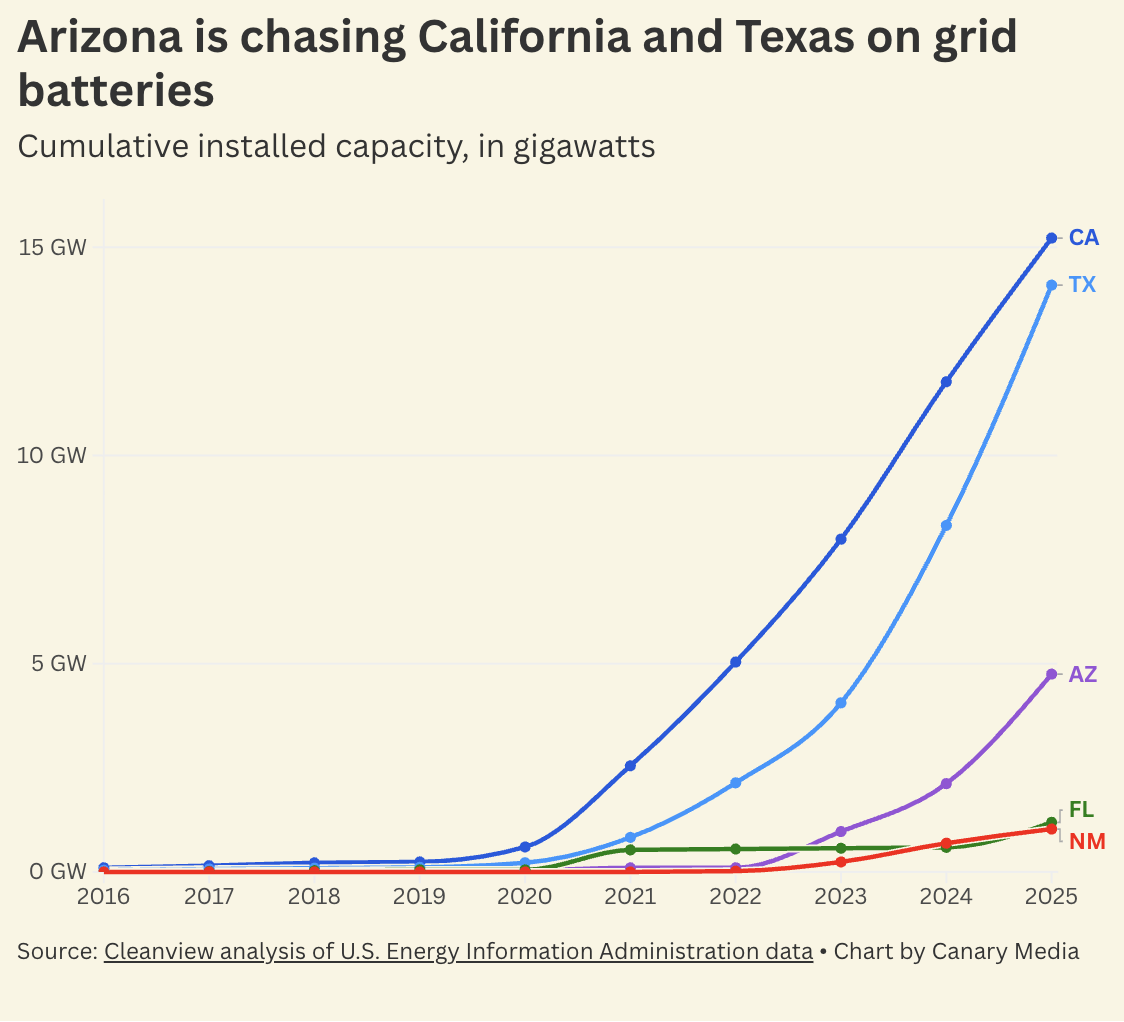
One thing that is undeniable: Clean energy has been crushing it in Arizona lately. The state holds the third-highest grid battery capacity (after California and Texas) and the fourth-highest solar capacity (after California, Texas, and Florida). Indeed, Arizona more than doubled its battery fleet from 2024 to 2025, hitting 4.7 gigawatts and growing at a much faster rate than the two leading battery states.
Overall, Arizona gets about 44% of its electricity from natural gas, a fuel that is not harvested within the state and must be imported from elsewhere in the country. Coal used to rule the roost but has declined to marginality over the last decade. The Palo Verde nuclear plant outside Phoenix has cranked out steady carbon-free power since the 1970s and now accounts for 26% of the state’s production. There’s a little bit of hydropower and wind, but solar — which generates roughly 16% of Arizona’s electricity — drives all the clean growth, with help from the lithium-ion batteries storing it for post-sunset hours.
Arizona has plenty to offer a solar or battery developer. Its desert environment furnishes ample sunshine, and there’s a lot of space to build. The state doesn’t have an open energy market like Texas does, but its utilities have proactively solicited competitive bids for new electricity supplies and handed out contracts to developers who bring winning solar and storage proposals. Indeed, Arizona Public Service, the biggest power company in the state, set an internal corporate goal back in 2020 to get 100% clean electricity by 2050 — and gained ample experience in contracting for clean energy. But it abandoned that ambitious target in August, choosing to extend the life of a major coal plant and invest more in gas infrastructure amid soaring demand.
For decades, Phoenix has attracted a steady influx of residents who like the affordable real estate and dry desert air, and aren’t deterred by the occasional bout of triple-digit heat. More recently, the region has also drawn a spate of data centers: Arizona hosts 2 gigawatts of active data centers, according to independent analyst Michael Thomas.
That’s just a taste of what might be coming. Thomas noted in a January post that Arizona Public Service has 30 GW of proposed data centers in its queue for grid connection, several times more than the utility’s peak demand record of 8.5 GW. That gargantuan mismatch is reason enough to doubt that much of the proposed buildout will ever materialize. Still, the utility has already mobilized to construct a 2-GW gas plant to keep pace with this new demand.
The propulsive growth in consumption creates new urgency for clean energy in terms of both planet-warming emissions and affordability. The state’s progress on cleaning up its electricity supply could slow or reverse if renewables stall out just as utilities fast-track constructing fossil fuel plants. And an assertive clean-energy expansion could help keep prices lower in a period of tight supply. That’s especially true as the turbines used in gas plants get more expensive amid yearslong supply chain backlogs. Furthermore, since Arizona lacks its own gas supplies, consuming more of the fuel requires building more pipelines and shipping more dollars out of state.
At this pivotal moment for Arizona’s energy outlook, details included in the Arizona Corporation Commission’s decision cast doubt on whether customers will save much money from the end of the mandate.
The regulators focused their criticism on costs imposed on customers over the years by the surcharges utilities levied to fulfill the renewables mandate. The implication was that eliminating the mandate would therefore lower people’s bills going forward.
But that rhetoric doesn’t match the facts in the official proceeding, said Autumn Johnson, who argued against the repeal as the leader of the state affiliate of the Solar Energy Industries Association.
The commission’s economic impact statement does say that utilities “may see some marginal savings” from forgoing the administrative work involved in complying with the requirements. However, it notes, one utility indicated that “most renewable-related costs will continue due to long-term contractual and programmatic obligations, which may limit overall savings.”
The rule changes don’t eliminate American contract law. Utilities will still have to pay for contracts they signed years ago, and those costs will continue to be recovered as surcharges, a commission spokesperson confirmed. Utilities had already fulfilled the requirement, so it wasn’t likely to force their hand in signing new deals. Even if it did, solar and battery proposals today compete extremely well on the cost of power; an extra nudge to pick the cheapest source of new kilowatt-hours should not unduly raise costs on consumers.
“What does it say to the country, what does it say to the industry, if even this tiny, anemic RPS [renewables portfolio standard] that’s honestly embarrassing, even that we have a problem with?” Johnson said. “This is just to signal that you don’t like renewables, which I think is really not smart from an economic development standpoint.”
As for why sitting regulators might want to signal such a thing, two of the regulators quoted in the press release are running for reelection in November, with a primary on July 21. Kevin Thompson and Nick Myers are facing primary challenges from state legislators Ralph Heap and David Marshall, who are campaigning to “stop the Green New Deal” and “oppose harmful rate hikes.” This vote gives the incumbents something to talk about to show they are working on affordability while pruning what they see as government overreach.
It’s also possible that the repeal, if enacted, won’t materially damage the pace of the clean energy buildout, since the mandate wasn’t driving that buildout anymore. Excising the old policy enables renewables developers to make a clearer case that they’re winning on the merits, not because of state favoritism.
Still, Arizona’s retreat on its renewables policy coincides with other forces acting against the clean energy industry. Local jurisdictions in the state are passing ordinances that could stymie solar and battery development through restrictive permitting, Johnson said. The Trump administration is phasing out tax incentives for wind and solar installations and holding up permitting for projects on public lands. Arizona’s rooftop solar market has contracted since the state lowered the rate of compensation for customers who send power from their panels back to the grid, and imposed what Johnson called “punitive fees” on those households.
In sum, Johnson hopes the recent clean-energy success story continues in Arizona, but stressed that this outcome is not guaranteed.
“You can’t maintain a third ranking for storage and fourth or fifth ranking for solar if you continue to do things that are antagonistic to those industries,” Johnson said.
Now, the fate of the renewables policy hangs on the wrangling between the attorney general and the commissioners, as election-year politics spices up the usually mild world of utility regulation.
California lawmakers face a make-or-break choice about the state’s biggest and most successful virtual power plant program: Give it enough money to keep running this summer or scrap it altogether.
The administration of California Gov. Gavin Newsom (D) has proposed ending the four-year-old Demand Side Grid Support program, which pays homes and businesses to send rooftop solar power back to the grid or reduce their energy use during times of peak electricity demand. DSGS has more than 1 gigawatt of capacity, making it one of the biggest VPPs in the country.
The proposal has set off alarm bells for environmental advocates and clean energy companies, which say that eliminating the program would be a costly mistake. And some state lawmakers briefed on the plan have questioned the logic of ending a program that’s successfully delivering grid relief.
DSGS backers argue that the program saves money not only for those who participate but also for all Californians, who face some of the highest utility rates in the country.
A study conducted by consultancy The Brattle Group and commissioned by Sunrun and Tesla Energy, two companies with large numbers of solar-and-battery-equipped customers enrolled in the program, indicates that “DSGS is a significantly lower-cost alternative” to relying on costly fossil gas–fired power plants or other resources available during grid emergencies.
In February, the Newsom administration’s Department of Finance issued two budget proposals regarding DSGS. One proposes ending DSGS, which is administered by the California Energy Commission, and shifting its customers to another program administered by the California Public Utilities Commission — either a current program that has been far less successful to date or one that has yet to be created.
For the past two years, environmental and clean energy groups have been fighting to protect DSGS from a series of funding cuts ordered by the Newsom administration, and have so far been unsuccessful. “California has already invested years of effort and hundreds of millions of dollars to build out DSGS. It’s a model now for clean reliability,” said Laura Deehan, state director of Environment California, one of the dozens of environmental advocacy groups that have signed a letter protesting the plan. “We have to make sure we keep the lights on on the program and not abandon what’s already been built up.”
A coalition of industry groups that have enrolled customers in DSGS echoed that view in a March letter to state lawmakers. It warned that “dissolving an existing successful program and attempting to re-create the same type of program at a different agency causes delays, wastes public resources, and has no assurances that it will be as successful.”
Environmental and industry groups are throwing their weight behind the Newsom administration’s other budget proposal, which would instead increase DSGS funding. This alternative calls for shifting money from another, underfunded distributed energy program to DSGS, bringing its funding for the coming year to roughly $53 million, up from the $26.5 million now remaining in its budget.
This is still short of the $75 million that backers have been asking for, said Caleb Weis, clean energy campaign associate at Environment California. But it should be enough to ensure enrolled customers are ready to help the grid through what’s expected to be a much hotter summer and fall season than the state has seen over the past two years, he said.
“The DSGS program kicks on when the primary alternative would be importing expensive energy from out of state or firing up expensive peaker plants that are dirty and cost money just sitting there, not being used,” he added. Meanwhile, DSGS “has clean assets that are ready to protect the California system during times of extreme stress and high cost. It’s almost a no-brainer to use this.”
Supporters of the proposal to end DSGS have been less vocal. While the state has underscored that DSGS was always meant to be temporary, few other justifications have been offered for ending the program before its original 2030 sunset date — and no major stakeholders have come out in support of that plan.
The conversation around DSGS is heating up ahead of key budget decisions. California must pass its 2026–2027 budget by June 15, and that budget must be finalized before Aug. 31. Sometime between now and that deadline, state lawmakers will be forced to decide on the future of the program.
Lawmakers raised concerns about the proposal to scrap DSGS during a March 5 hearing of the Senate Budget Subcommittee on Resources, Environmental Protection, and Energy at the state capitol.
“DSGS has largely been a successful program,” said Sen. Eloise Gómez Reyes, a Democrat who chairs the subcommittee. “Why is the administration proposing to start over?”
David Evans, a staff finance budget analyst at the state’s Department of Finance, responded that the “original vision and intent of the program was not allowed for it to be an indefinite, ongoing program.” He highlighted the state’s ongoing budget shortfall, which the Newsom administration had cited as the rationale for cutting DSGS funding in 2024 and 2025.
But Gómez Reyes pushed back on that justification, noting that the administration’s alternative proposal — shifting funds from elsewhere — could allow DSGS to successfully operate this year without impacting the budget.
“If something is successful, and it appears that this is a successful program, why don’t we continue … even if we intended it to be something that was temporary?” she said.
Gómez Reyes also questioned the wisdom of shifting DSGS participants to the California Public Utilities Commission, given the agency’s comparative lack of success in managing VPP programs.
Under the CPUC’s oversight, California’s biggest utilities have largely failed to follow through on the state’s decade-old policy imperative to incorporate rooftop solar systems, backup batteries, smart thermostats, and other distributed energy resources into how they manage their grids. California remains well short of current targets on that front.
DSGS has been the most successful of a set of programs created in response to California’s grid emergencies in the years 2020 through 2022 designed to utilize individual customers’ devices to help the grid. Unlike those other programs, which are overseen by the CPUC and administered individually by the state’s three biggest utilities, DSGS is credited for its ease of enrollment, clear rules for participants, and availability to all state residents.
In particular, DSGS has been able to scale up and deliver grid relief much better than the Emergency Load Reduction Program, which the CPUC established in 2021.
Both programs enlist customers with batteries, EV chargers, smart thermostats, and other devices. But according to data provided by legislative staff for the March 5 hearing, while DSGS ended 2025 with an estimated 1,145 megawatts of peak load reduction enrolled — “enough to power the peak electricity demand for all of San Francisco” — ELRP has enrolled only about 190 megawatts. Its residential program was discontinued last year “due to very low cost-effectiveness.”
A recent test of both programs underscored once again the difference in scale. In July 2025, utilities measured how much solar-charged battery power capacity each program provided over the course of two consecutive hours.
The test delivered a total of 539 megawatts of capacity over that time. According to the Brattle Group’s analysis, roughly 476 megawatts of that capacity was provided by about 100,000 participants in the DSGS program — while only 64 megawatts came from ELRP participants.
Utility Pacific Gas & Electric lauded the test, noting that it “showed that home batteries can be counted on during peak demand.”
Sen. Catherine Blakespear, a Democrat, brought up the relatively poor performance of ELRP during the March 5 hearing. “It does seem like there are members of the legislature and stakeholders who really have a lot of confidence in DSGS and want it to continue, and that there’s a concern that ELRP is just not as effective,” she said. “We should focus back on the thing that’s already working and that might have a better chance of being successful.”
CPUC Executive Director Leuwam Tesfai noted at the hearing that ELRP isn’t the only alternative on the table. The budget proposal that would eliminate DSGS would also allow enrolled customers to join a new program administered by the CPUC. The agency has yet to create this new program but is actively exploring it as part of an ongoing proceeding scheduled to wrap up by the end of 2026, she said.
But Gómez Reyes replied that any work the CPUC might or might not undertake to create an alternative program to the ELRP wouldn’t be finished until “after we have completed this budget. And that becomes a problem for us as we make our decisions.”
It’s unclear how quickly state lawmakers and the Newsom administration will move to resolve these conflicts.
“It’s not out of the question that it goes through the end of August,” said Katelyn Roedner Sutter, California senior director at the Environmental Defense Fund, an environmental group that supports DSGS. “I hope it goes faster, because by the end of August is when we need to be drawing on some of these resources.”
Roedner Sutter also highlighted that the DSGS program is funded through taxpayer dollars. Most CPUC-administered programs, by contrast, are financed by authorizing utilities to pass on the costs of operating them to their customers.
“At a time when we’re trying to find ways to pay for these things outside of electricity bills, it makes less sense to move things over to the CPUC,” she said.
Sen. Josh Becker, a Democrat who authored a VPP bill that was vetoed by Newsom last year, told Canary Media that he would “strongly urge the administration to reconsider” ending the DSGS program and shifting its participants to a CPUC program. “[For] those in the legislature that have been focusing on this and care about this, it’s not a move any of us think is in the right direction.”
Becker highlighted that dozens of states are pursuing VPPs to make “better use of the clean energy resources that people already have in their homes to lower cost, to improve reliability, and to reduce pollution.” He has introduced another VPP bill in this legislative session that he said would instruct the CPUC to modify “rules that prevent these resources from participating fully in the market.”
Leah Rubin Shen, managing director at the trade group Advanced Energy United, said its member companies involved in DSGS support eventually shifting to a new program that might emerge from the kind of efforts that Becker and other lawmakers are proposing. But “you’ve got to make sure that everyone knows what the rules are, and that the rules aren’t going to change,” she said.
“DSGS has been a great program,” she said. “Keep it humming along for a few more years, until it’s supposed to be put to bed. And in the meantime, set up this market integration pathway that can funnel what we’ve learned from DSGS into something bigger and better.”
The wind turbines arrived in Gloucester at the same time I did. My husband and I moved into a cheap third-floor apartment in the small coastal city in northern Massachusetts in November 2012, just as cranes were assembling the imposing white towers right next to the highway that ushered us into town.
I loved them immediately. Like me, they were newcomers in an old town, looking to the future. Gloucester celebrated its 400th birthday a few years ago, and many families, including my husband’s, have lived here for well over a century. Our daughter, born in 2016, is at least a fifth-generation Gloucesterite. As a toddler playing in our yard, she would glimpse the blades turning in the distance and announce excitedly, “The fans are spinning!”
There were originally three turbines, standing sentinel over the town at the ocean’s edge. Two of these provided electricity to the city through a 25-year power purchase agreement, offsetting 50% to 70% of Gloucester’s municipal energy use. The city also received 20% of the money the spinning blades generated each year, a number that ranged from around $100,000 in the first year of operation to as much as $478,000 in later years.
The first turbine to go up was also the first to come down, removed in 2023 after a series of mechanical failures and a blade unexpectedly falling off. The two that remained continued generating power for years, though supply chain problems delayed needed maintenance and caused unexpected downtime, the owners said. In recent months, residents noticed the turbines appeared to be dripping oil. When the blades stopped turning this fall, people started asking questions about their future.
In January, our local paper broke the news that the turbines’ owner had decided to decommission them. The explanation: The company, a major semiconductor engineering firm, wants to expand its footprint here and needs the land. In compensation for the early termination, Gloucester will receive a payment of $587,000.
Some staunch opponents of wind power have taken the announcement as vindication. Community Facebook groups immediately lit up with I-told-you-sos, declaring the turbines’ 13 years of operation a clear failure. Some even used the early end of Gloucester’s three land-based turbines as proof that large-scale offshore wind could never be successful.
“They are painting the reason why they are being taken down as a failure of wind power,” said City Councilor Jason Grow, a vocal supporter of the turbines.
A second, somewhat quieter group, though, is lamenting their imminent loss.
“I have a feeling of not despair, certainly, but I feel stalled,” said Janet Ruth Young, a local writer and musician. “I feel that there’s a stagnancy where there used to be hope and movement and change.”
When new solar farms or wind turbines are proposed, news stories usually follow detailing opponents’ objections, which are largely rooted in a connection to place and respect for the character of a community. The opponents chose to live in this place — the small mountain town, the historic waterfront city — for the trees and the air and the character, not the lines of turbines on a hilltop or the sun glinting off expanses of solar panels. These positions are, at their heart, emotional and, it seems to me, sincerely felt. I am not here to judge motivations or to parse how much weight such arguments should be given.
However, stories about the debate depict support for clean energy as all about the money to be saved and the greenhouse gas emissions to be lowered. The proponents of solar panels and wind turbines are rendered as a collection of financial and environmental abstractions rather than real people.
In Gloucester, it is clear that framing doesn’t fully capture the reality. Though our community is deeply — sometimes stubbornly — dedicated to history and tradition, the turbines worked themselves into the fabric of the city. They were symbols of progress, an indelible part of our skyline, friendly ambassadors welcoming visitors and residents driving into town.
Linda Brayton was involved in the turbine project from the very beginning, when she volunteered in 2005, she thinks, to serve on a task force investigating the possibility of bringing wind energy to the city. Renewable power was still on the margins of the energy conversation then — Massachusetts had less than a gigawatt of installed capacity, a number that more than quintupled from 2013 to 2024.
For years, Brayton sat in meetings and listened to opponents hurl insults and misinformation. She stuck with it through the evaluation of several potential sites, timelines, and ownership structures.
In October 2012, when the first components finally arrived by boat in Gloucester Harbor, she sat by the water with her niece and watched as a crane lifted the long white tower from a ship onto a flatbed truck, to be driven through the winding downtown streets to its destination in an industrial park.
“It was really the most amazing day,” Brayton said. “I broke into tears. It was so beautiful, and it had been such a long time coming.”
As the turbines were going up, the city held an event during which more than 2,000 residents inked their names on a blade, quite literally signing on to the progressive vision the project represented for many residents. At the event, then-Mayor Carolyn Kirk (who now heads up the Massachusetts Technology Collaborative, a public agency supporting innovation) read the poem “Sea-Fever” by John Masefield, placing the turbines squarely within the fishing town’s legacy of depending on the wind: “And all I ask is a windy day with the white clouds flying.”
The following year, Kirk remembers, she had a chance to climb to the top of one of the turbines, gripping the ladder rungs tightly as it shook and swayed. The experience of standing, exhausted, at the top, some 400 feet in the air, was “incredible,” she said.
The turbines punctuating the horizon quickly became part of the city. They even earned nicknames. Young wrote and performed a song for the city council praising the “Three Sisters.” Brayton recalls people referring to them as the “Three Magi.” In a letter in the Gloucester Daily Times, one supporter likened them to kinetic sculptures and shared the names he gave them: Remus, Romulus, and Big Earl.
One local resident said on Facebook that when she saw the turbines on her first job interview in Gloucester, she knew the community would be a great place to live. A neighbor told me that spotting them — they are highly visible from many spots in the city — often helped relieve some of his stress as a renewable energy supporter enduring the Trump administration’s relentless hostility. They were a sign of something going right.
As the two remaining turbines get ready to come down, though, must we feel that something has gone wrong? It is, perhaps, a hard conclusion to avoid when a once-promising project comes to an end 12 years early. If the turbines had been more profitable or productive or required less maintenance, maybe the owners would have chosen to keep them and expand elsewhere. And the decommissioning plan has fueled the fire of those who are anti-wind, onshore or off.
The world is a different place now than back when Gloucester first started discussing the possibility of turbines, and coal and oil were still significant contributors to energy production in New England. Vitriol against offshore wind may be at an all-time high, yet projects off Massachusetts, New York, and Rhode Island are churning out power, with more expected in coming years. While the Trump administration has done its best to pull back funding for solar, the grid operator ISO New England projects that by 2040 the region will add another 28 GW of solar capacity to the roughly 6.5 GW it had in 2024.
What those next 14 years will bring for Gloucester is an open question. The removal of the wind turbines, however, can not reverse the trends that have gained momentum throughout the region. Nor can it undo the excitement and joy the spinning blades brought to many residents. It can’t stop us from looking forward, and it can’t stop us from hoping.
Blake Herrschaft has plans to fully electrify his Tahoe City, California, home, which runs on a slim 100 amps of electrical service. But even with a hot tub, in an area that sees an average of 15 feet of snow per year and temperatures that dip into the single digits, his house won’t need an expensive service upgrade. “I’ve done the calculations,” he said.
An architectural engineer, Herrschaft manages building electrification programs at Peninsula Clean Energy, a public power agency — also known as a community choice aggregator — in the San Francisco Bay Area. He says he frequently hears people claim at regulatory meetings that electrification rules will force households to undergo electrical service upgrades that many can’t afford; these upgrades can range from $2,000 to $30,000 in the Golden State, according to a 2022 analysis.
But now, Herrschaft and his colleagues have firsthand evidence from a handful of residences scattered across PCE’s territory that homes can be electrified without upsizing their electrical service. Often, 100 amps are more than enough.
In 2024, PCE ran a nine-home electrification pilot for low-income customers in San Mateo County, California, which included five households with 100-amp panels. At no cost to recipients, the agency replaced their fossil-gas and propane appliances with efficient electric ones, using the power the homes already had. Plus, PCE didn’t need to install specialized equipment, such as smart panels, to manage the flow of electricity. After the retrofits, most households saw significant savings on their monthly energy bills.
The results of the pilot program, published in January, demonstrate that home electrification can deliver climate, health, and financial benefits without massive infrastructure costs.
“When you’re working with limited funds, being able to electrify without a panel upgrade is great,” said Cavan Merski, senior data analyst at Pecan Street, a nonprofit research organization that was not involved in PCE’s analysis. It’s “awesome to … see a case study of this working in the wild.”
The findings are especially relevant now as air-quality regulators for the Bay Area, home to more than 7 million, negotiate the details of groundbreaking rules to phase out the sale of gas water heaters and fast-track the switch to heat-pump versions. Over the coming months, officials will weigh final drafts of the regulations and could vote on them as early as October. The rules will take effect next year.
“There’s rampant disinformation going on ahead of the air district rules,” said Pamela Leonard, deputy director of marketing and communications at Silicon Valley Clean Energy, a community choice aggregator in Santa Clara County, California, that partnered with PCE on the pilot. “So we’re really trying to get the word out … In most cases, homes can go all-electric on 100 amps.”
The case study builds on prior evidence that households typically have plenty of play in their existing power supply. In early 2024, PCE found that across more than 700 all-electric single-family homes it analyzed in its service territory, 99 percent of them never drew more than 100 amps of electric current all year. The most common peak demand was 29 amps, less than a third of a home’s capacity.
Still, the pilot’s results come from a small sample size in one county in a temperate region. They may not apply in more extreme climates, according to Scott Hinson, chief technology officer at Pecan Street. Whether a home will typically need electrical upgrades before switching to all-electric appliances and vehicles “is going to be regionally dependent,” he noted.
Households in moderate climes can more easily swap in heat pumps without needing to grapple with weatherization or electrical service upgrades to lower their homes’ energy demands. But even in areas with less hospitable temperatures, the shift is still possible, as demonstrated by the retrofits of a few 100-amp homes in Calgary, Canada.
As Rahul Young, head of community engagement for the electrification advocacy nonprofit Rewiring America, noted of PCE’s pilot, “There will be real value in having … this study replicated in other parts of the country.”
Herrschaft has heard some electrification opponents peg the cost of fully electrifying homes in the $100,000 range, but PCE’s contractor was able to replace fossil fuel–fired furnaces, water heaters, stoves, and clothes dryers with, as needed, heat pumps, heat-pump water heaters, induction stoves, and electric dryers at an average cost to PCE of $35,000 per residence. Like-for-like replacements would have been about $25,000, according to Herrschaft. (Electric-vehicle chargers, which can be part of all-electric homes, were outside the scope of the pilot.)
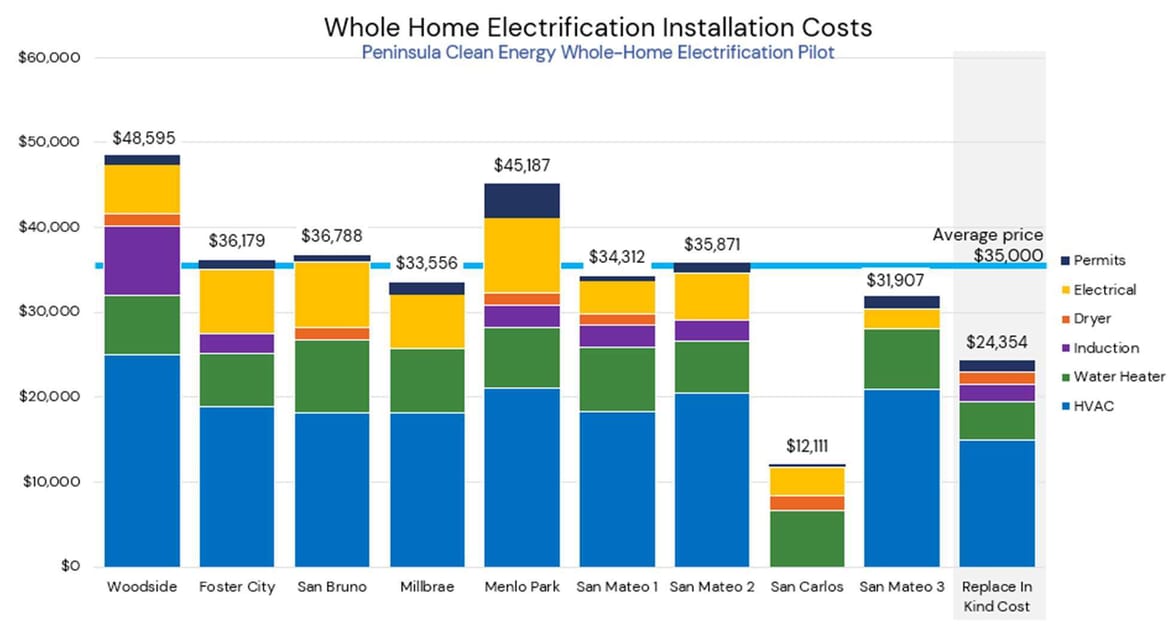
PCE was able to analyze six households for bill savings; ditching gas cut their energy bills by 20 percent on average. Five saved an estimated $24 to $1,068 per year. The bills for one home rose slightly, but its owners would have seen savings had they chosen a beneficial rate from Pacific Gas & Electric, according to Herrschaft.
Another important takeaway from the pilot: If the retrofitted homes, which were spread across the county, had been in the same neighborhood, their greater electrical demand would not have hurt the grid. Even if they were receiving power from the same distribution transformer, their cumulative increased load would have been “mild” — the equivalent of adding about two hair dryers on full blast, Herrschaft said.
“Home electrification — the home appliances in particular — just isn’t an issue when it comes to the grid in California and nearly every other state,” he said, given their shared climate zones. “I feel confident about that from the [electrical] panel all the way to the transmission line.”
In addition to misconceptions around household electrical capacity, Herrschaft hopes to address the separate issue of how contractors determine how much power a home needs.
To decide the necessary amps, installers do calculations written in the National Electrical Code, which sets safety standards. However, many professionals use methods that overestimate a home’s peak electrical load, Herrschaft said. A major focus for PCE this year will be educating them on other approaches, which are much less likely to trigger an unnecessary service upgrade.
Since finishing the pilot, both PCE and Silicon Valley Clean Energy have launched programs to electrify hundreds of homes in their service territories in the next two years, at no cost for low-income households. PCE has done dozens of home retrofits, and 95% haven’t required service upgrades, Herrschaft noted.
“We found it’s easy to electrify on 100 amps.”
Small, sun-driven power plants could soon be coming to backyards and balconies across New England. Lawmakers in all six of the region’s states are considering bills that would allow residents to take advantage of solar panel kits that plug in to standard home outlets, and supporters are optimistic that most — perhaps all — of these measures will succeed.
“As a concept, plug-in solar has a lot of momentum going on right now,” said Connor Yakaitis, deputy director of the Connecticut League of Conservation Voters. “It’s got bipartisan momentum. It’s got interest and intrigue from the utilities.”
Maine’s legislation is close to final passage, and could land on the governor’s desk as soon as next week. Stand-alone measures in New Hampshire and Vermont have each been green-lit by one legislative chamber. Plug-in solar provisions are part of a sprawling energy bill approved by the Massachusetts House of Representatives and working its way through the Senate. In Connecticut, permission for plug-in systems is part of a larger solar bill that has advanced out of a joint committee. Rhode Island’s bill has been held for study by a House committee.
“I am optimistic the bill will get passed,” said Sam Evans-Brown, executive director of Clean Energy New Hampshire, one of the organizations pushing the legislation in the Granite State. “We’re going to be able to come up with language that works for everybody.”
New England is not alone in its enthusiasm for plug-in panels, also commonly called “balcony solar” or “portable solar.” Interest in DIY solar is surging across the country, as escalating energy prices have people — and their elected representatives — searching for ways to lower their bills. Spiking oil prices caused by the Trump administration and Israel’s war with Iran are further heightening cost concerns.
Plug-in solar’s money-saving potential is attracting support from both sides of the aisle. In March 2025, deep-red Utah became the first to authorize the technology. A year later, similar legislation has passed in Virginia and awaits the governor’s signature, and bills are active in more than 20 other states, including some decidedly right-leaning places like Idaho and Oklahoma.
“We think this has taken off because people are thrilled about saving money and having some power to insulate themselves from rising energy bills,” said Cora Stryker, co-founder of Bright Saver, a nonprofit that promotes plug-in solar. “Crucially,” she noted, the legislation “has no fiscal implications. The price tag is zero.”
The matter is perhaps even more pressing in New England, where electricity prices are higher than almost anywhere else in the mainland United States. Homes in the region depend heavily on oil and natural gas for heating, exposing residents to high and volatile fuel prices.
“We are looking for any possible way to bring energy bills down for my constituents,” said Rhode Island state Rep. June Speakman (D), the House sponsor of her state’s balcony solar bill.
Balcony solar has taken off in Europe — most notably in Germany — over the past few years. The systems can be purchased online or from major retailers, like Ikea, and assembled at home. They plug in to a standard exterior outlet and send energy into the wires, rather than drawing electricity out, generally producing about enough power to run a refrigerator.
Plug-in solar systems are modestly sized, which means they can fit into most any sunny spot — from a well-lit backyard to an apartment-building balcony. The kits are relatively low-priced; today, they average about $3 per watt, according to Bright Saver, and the cost is likely to fall by about half once at least five states authorize their use. These prices make them accessible to consumers who can’t afford the upfront cost of rooftop solar panels. Also unlike rooftop solar, these systems can be installed without help from an electrician or approval from a utility company, which means they are an option for renters as well as homeowners.
“It’s not only empowering, but it’s also easy, and it’s so much cheaper,” Stryker said.
In the U.S., balcony solar has inhabited a sort of regulatory gray area, neither prohibited nor expressly authorized by law. The crop of bills working through state legislatures attempts to fix that problem. Provisions vary from state to state, but all the New England measures would allow residents to install systems up to 1,200 watts without utility approval or interconnection agreements. The new rules would also require the solar equipment to be certified by a national safety testing organization, like UL Solutions, which launched a testing program for these systems earlier this year.
In addition to laying out practical rules, these bills could have a more intangible impact, supporters say. They let residents know that plug-in solar is a viable option, not just a questionable technology the internet is trying to sell you.
“Legislation sends a signal that not only is this a thing that’s available on Temu — it’s also a thing you can and should consider buying,” Evans-Brown said.
See more from Canary Media’s “Chart of the Week” column.
Solar and wind developers around the world just keep getting defeated — by themselves.
Yet again, a record amount of new solar and wind capacity came online globally last year, according to the latest numbers by think tank Ember. The jump was sizable: Additions exceeded the prior year’s by 17%.
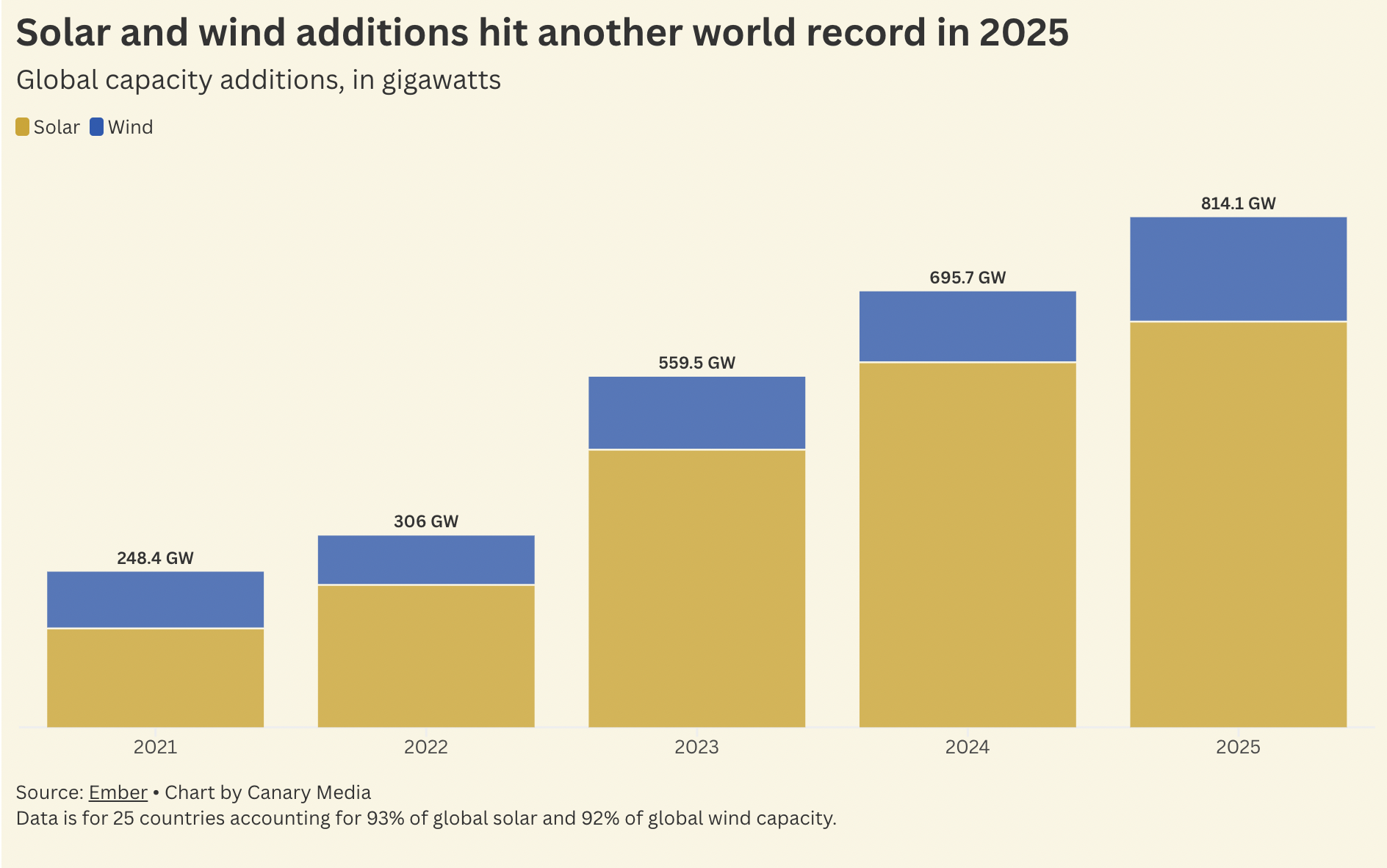
Not to pit friends against each other, but solar is the clear front-runner when it comes to renewables deployment. The world installed nearly four times more solar than wind in 2025. But wind can take solace in the fact that it grew faster last year, with installations up by 47% from 2024 — dwarfing solar’s 11% increase.
It’s also worth noting that nearly two-thirds of the added capacity came online in China, of course.
This renewables boom sounds like good news for fending off climate change, but things are more complicated than that. Lots of fossil-fueled power plants are getting built around the world, too, as energy demand skyrockets thanks to the AI boom and the electrification of cars and buildings. Still, the steady growth of renewables is chipping away at polluting fuels’ grip on the globe: Wind and solar generate an increasing share of the world’s power, hitting 15% in 2024, the most recent year Ember has data on.
Meanwhile, the argument for renewables is only getting stronger as the war in the Middle East spikes oil and gas prices worldwide, leaving countries that rely on imported fuels to pay through the nose.
Despite policy headwinds in the U.S. and elsewhere, there’s good reason to believe that wind and solar will keep notching personal bests. Photovoltaic panels and turbines, plus the batteries that store their energy for later, are fast and cheap to build, making them tough for electricity-hungry countries to say no to.
This analysis and news roundup come from the Canary Media Weekly newsletter. Sign up to get it every Friday.
It’s been a month since the U.S. and Israel first attacked Iran, sparking a conflict that has all but shut down the critical shipping lane of the Strait of Hormuz and sent oil prices on a roller coaster. The effects have been obvious in the U.S.: Average gasoline prices are hovering at just under $4 a gallon, a threshold they haven’t hit since 2022.
Elsewhere, it’s not just petroleum products that are causing price shocks. While the U.S. produces much of its own natural gas, many countries rely on imports from the Middle East to cook, heat homes, and run power plants. Governments, especially in Asia, have had to enact retail fuel price caps and other mechanisms to stop costs from becoming unbearable.
But some countries have another shield against the price hikes: wind turbines, solar panels, batteries, and other fossil fuel–free technologies that provide power unbothered by global upheaval.
Spain’s prime minister boasted that on a recent Saturday, electricity in his country cost about seven times less than in France and Germany, thanks to its investments in clean energy. That margin typically isn’t so high, The New York Times notes: A rainy spring season has unlocked more hydropower than usual in Spain, which will have to turn back to gas in the summer. Still, the United Kingdom, too, hit a record for renewable power output this week, reducing the country’s gas usage and its exposure to the fuel’s rocky prices.
China, meanwhile, is the world’s largest importer of oil and natural gas. Much of that gas comes from Qatar, which has curbed its production amid the attacks. But China is also a renewable energy powerhouse, installing tons of wind and solar over the past decade. That clean power supply, along with some fossil fuel stockpiles, is now helping insulate China from the price spikes and supply disruptions wracking other countries.
While China still relies heavily on fossil fuels, experts say the conflict in Iran could speed its energy transition — and boost business for its cleantech manufacturers, which churn out most of the world’s wind turbines, solar panels, batteries, and electric vehicles. Over the last month, investors have already ramped up spending on these firms.
At the same time, used EVs are seeing surging interest in both Europe and the U.S. — and rising costs are already giving some consumers the final push they need to install solar panels, heat pumps, and other appliances that get them off fossil fuels and their volatile prices for good.
Trump’s latest offshore wind attack is — surprise — legally dubious
The Trump administration is trying a new route on its journey to upend offshore wind, but some critics say the scheme may not pass legal muster.
On Monday, the Interior Department said it had worked out a deal with TotalEnergies, in which it would reimburse the company nearly $1 billion to forfeit its leases, signed in 2022, for offshore wind development near the coasts of New York and North Carolina. In exchange, TotalEnergies agreed not to work on further offshore wind projects in the U.S. and to put the refund toward gas investments, Canary Media’s Maria Gallucci reports.
The deal raises a ton of questions. For starters, as is often a concern: Is the Trump administration allowed to do this, and can anyone sue to stop it? Former U.S. Bureau of Ocean Energy Management head Elizabeth Klein told Maria that it’s legally dubious, though it’s unclear who could challenge the deal in court.
And another question: Where will that money come from? Federal officials haven’t clarified, but because TotalEnergies’ lease payment hasn’t been sitting untouched in a vault for years, taxpayer funding is its likely source.
But there’s a bit of good offshore wind news this week, too: The Coastal Virginia Offshore Wind project has started sending power to the grid.
States change their tune on nuclear power
Nuclear power’s reputation is in the middle of a remarkable shift.
Just a decade ago, at least 16 states curtailed nuclear power development in some way, whether through an outright ban or other conditions. But over the past few years, five states looking to meet rising energy demand have repealed those moratoriums, and another five are considering legislation that would do the same, Alexander C. Kaufman reports for Canary Media.

All these rollbacks come as the Trump administration pushes to reopen shuttered nuclear plants and build both conventional and next-generation nuclear — though it’s not just Republican-led states that are riding the nuclear wave. Just this week, Kentucky Gov. Andy Beshear (D) announced that a $1.76 billion nuclear fuel enrichment project is coming to his state.
Harvesting the sun: A plan to build the world’s largest solar and battery project on fallowed land in California’s Central Valley could provide a lifeline for farmers and supply a significant portion of the state’s clean energy needs. (Canary Media)
Critical climate impacts: A new study finds U.S. greenhouse gas emissions have led to $10 trillion in global damages by driving up temperatures and exacerbating extreme weather, with a quarter of those damages happening in the U.S. (The Guardian)
Batteries surge: Grid batteries are expected to make up nearly a third of U.S. power plant capacity built this year — and new data shows that for the first time, the country will be able to produce enough batteries to meet that growing demand on its own. (Canary Media)
Renewables acquitted: A report from European grid operators blames the massive blackout in Spain and Portugal last April on a sudden increase in voltage combined with other factors, dispelling speculation that the region’s dependence on renewables caused the outage. (BBC)
Funding finds a way: U.S. Energy Secretary Chris Wright has reportedly overstated the extent to which the Trump administration dismantled a Biden-era clean energy loan program, which is still supporting the buildout of infrastructure across the nation. (Grist)
Wind’s Maine event: Maine tried and failed for years to build out tons of wind power production, but its latest attempt, which has backing from neighboring New England states, may have a better chance at success. (Canary Media)
New England plugs in: All six New England states are considering bills that could legalize plug-in balcony solar panels, with Maine on track to get its legislation to the governor as soon as next week. (Canary Media)
As carbon dioxide levels hit record highs, scientists are testing new ways to fight climate change by locking it up in our oceans. On assignment for Climate Central, Correspondent Ben Tracy explores groundbreaking experiments using “antacid” chemistry to expand ocean carbon dioxide (CO2) storage and keep it out of our atmosphere.


.svg)
