

 Back
Back
As an anchor tenant for several off-site arrays in development, the center will help spur investment and educate residents on the benefits of shared solar.
The Obama Presidential Center, which opened on Chicago’s South Side in June, features a museum full of mementos to democracy and the famous family, native prairie landscaping, an indoor basketball court, and other amenities. It will also be powered entirely by clean energy. Solar panels sit on the roof and on a garden pavilion, and a geothermal system heats and cools the complex. But the bulk of its power will be produced by community solar — the center will pay a set “subscription” fee to arrays located off-site.

The Obama Presidential Center will be the anchor tenant for several community solar projects that the Chicago-based company Reactivate is in the process of developing, slated to go online in 2027. Reliable anchor tenants are crucial to the success of community solar: They pay for large amounts — often 40% to 50% — of a project’s output, and can be key to persuading banks or other lenders to help finance a community solar array. The center’s subscription will cover about 6 gigawatt-hours of solar power annually, enough, along with its rooftop panels, for the entire campus.
The Obama Foundation, which runs the center, says community solar is a way to make clean energy accessible to renters, residents in multifamily housing, and those who aren’t able to afford or install solar panels on their own properties. That includes many people who live on Chicago’s South Side, where Obama cut his teeth as a community organizer decades ago.
Community solar delivers significant bill savings to households, especially in Illinois, where a state program guarantees robust benefits to low-income participants.
But in order to reap these savings, residents need to sign up. And too few of the people in marginalized neighborhoods who could benefit most do so, many solar advocates say.
Obama Foundation CEO Valerie Jarrett and Reactivate CEO Utopia Hill hope the Obama Presidential Center’s foray into community solar will raise awareness of, and trust in, the model so that it can help more residents struggling with their energy bills on the South Side and beyond.
They also expect the Obama Presidential Center will set an example for other mission-driven nonprofit organizations and companies to become anchor tenants.
“The foundation sought to use its buying power to catalyze the development of new renewable-energy generation sources,” Jarrett said.
“It is the foundation’s hope that this partnership with Reactivate will encourage other equity-focused organizations to consider community solar as a cost-effective way of procuring renewable energy.”
While Reactivate and other community solar developers in Illinois have signed up thousands of subscribers for their projects, they agree that people are often skeptical of the concept — especially in low-income and Black communities that have sometimes been targeted by predatory lenders and other unscrupulous businesses. Illinois lawmakers and consumer watchdogs, for example, have long struggled to rein in retail electric suppliers that offer residents energy plans under terms that end up being exploitative.
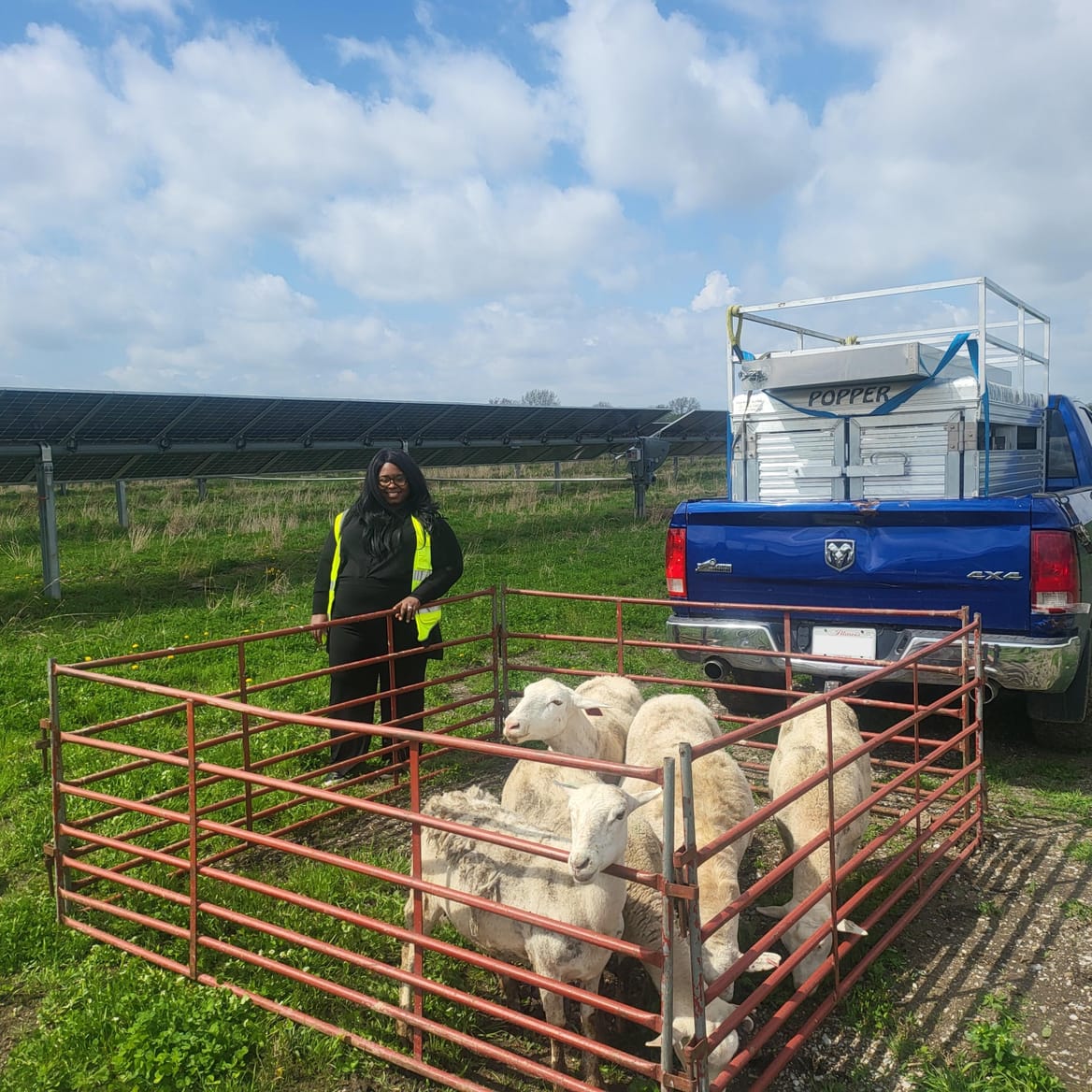
Hill, who grew up in a working-class Chicago suburb, said that people often respond to an offer of guaranteed savings with “What’s the catch?”
“There is no catch. It’s just an opportunity,” Hill said. “Having a well-established name [with the Obama Presidential Center] will hopefully help people understand that community solar is a real program that will provide savings.”
A series of Illinois state clean energy laws created robust incentives for community solar development, with particularly generous support for low-income residents and those in environmental justice communities, who are guaranteed savings equal to at least half of the value of the energy generated from their solar subscription.
The program has spurred the installation of community solar arrays located in and serving communities like Waukegan in northern Illinois, a heavily industrial area where community solar built on a landfill provides clean energy and savings to about 1,000 households and the local school district.
A community solar project developed by Reactivate — which focuses on marginalized and underserved communities — in a Chicago suburb provided a total of $186,000 in savings last year to its 650 subscribers, 44% of whom earn less than $20,000 a year.
Mercy Housing, a national nonprofit affordable housing developer, is the anchor tenant for two Reactivate community solar projects that went online in 2024.
The benefits go to two Chicago-area Mercy buildings, with 96 and 65 living units. Mercy Housing senior environmental analyst Max Stewart said they’ve seen significant savings on energy bills, money that can be reinvested into energy efficiency or resident services, and help keep affordable housing projects sustainable. He noted that it can be hard to find organizations willing to make such a big commitment to community solar.
The opportunities available to anchor tenants should get “more awareness,” Stewart said. “It always helps to have someone leading the way.”
Interior is using tax dollars to pay firms to ditch offshore wind leases and invest in fossil fuels instead. California just became the eighth state to sue to stop it.
The Trump administration has agreed to fork over nearly $4 billion since the spring to get major energy firms to abandon a dozen leases for U.S. offshore wind projects.
The controversial maneuver to return lease payments to developers — often in exchange for their investing in fossil fuels — is part of President Donald Trump’s broader strategy to stymie the clean energy resource, which coastal states have been depending on to meet their growing need for reliable and affordable electricity. The buyouts began as Trump’s earlier efforts to halt in-progress offshore wind farms largely failed under scrutiny from federal judges.
Now the unprecedented lease-refund approach is increasingly facing legal blowback of its own. Late last week, California became the eighth state to challenge the practice, arguing that it jeopardizes the state’s investments and resulting jobs in offshore wind.
The U.S. offshore wind industry had already been struggling before Trump began issuing stop-work orders, freezing permitting, and rolling back tax credits. High inflation, rising interest rates, and supply-chain constraints in recent years threatened to derail a handful of projects along America’s coastlines.
That’s why it’s all the more bizarre that the federal government is proactively paying developers to walk away from beleaguered, undeveloped projects, James Sallee, a business professor at the University of California, Berkeley, recently argued in the Energy Institute Blog. He likened the buyouts to spending billions in taxpayer dollars “to shoot a corpse.”
But for states that were banking on gigawatts of offshore wind power to shore up their grids and hoping the industry could rebound after Trump leaves office in 2029, the agreements are like salt in their wounds — particularly given the deals’ legally questionable nature. Here’s the latest on states’ legal challenges and congressional pushback.
California’s new lawsuit focuses on the agreement between the U.S. Department of the Interior and the company Golden State Wind, which paid $120 million in 2022 to lease waters along California’s Central Coast through a competitive bidding process.
Golden State Wind had planned to develop a 2-gigawatt offshore wind farm using floating turbine technologies in a large swath near Morro Bay. The company is owned by Ocean Winds North America — a joint venture of the European firms Engie and EDP Renewables — and the U.K. offshore wind developer Reventus Power.
In late April, Interior said it would return the $120 million to Golden State Wind. In exchange, the developer agreed to invest the same amount of money in U.S. liquified natural gas facilities and other fossil-fuel projects. Ocean Winds also struck a similar deal that month to get back the $765 million it paid to lease water for Bluepoint Wind, a fixed-bottom project near New York and New Jersey.
California’s challenge — filed by state Attorney General Rob Bonta (D) and the California Energy Commission — asks a federal court to strike down the agreement with Golden State Wind, saying the deal is “blatantly unlawful.”
Offshore wind experts and former Interior officials have previously questioned whether Interior’s Bureau of Ocean Energy Management has the legal authority to return the funds it collects from leasing federally controlled waters. They noted that when oil major Royal Dutch Shell relinquished its offshore leases near Alaska in 2022, the company simply ate the $2.1 billion loss.
California raises the same concerns in its lawsuit and claims Interior improperly tapped the federal Judgment Fund, which Congress intended to be used to settle lawsuits, not to pay for voluntary agreements like this one.
“Offshore wind presents an opportunity for our state to scale up an innovative new clean energy industry that reduces pollution while providing new jobs and investment for the people of our state,” David Hochschild, chair of the California Energy Commission, said in an Aug. 28 news release. “We will not let the Trump administration’s reckless actions turn back the clock.”
Interior has separately moved to cancel and refund two other offshore wind leases in California, with the developers Invenergy and RWE, though neither were named in the lawsuit.
In announcing the legal challenge last week, California Attorney General Bonta accused the Trump administration of using the buyouts to “line the pockets of their Big Oil donors.”
A day earlier, The Washington Post broke the news that another offshore-wind deal with German energy firm RWE will generate a giant payday for one of Trump’s neighbors near Mar-a-Lago.
In early August, Interior agreed to hand over $1.22 billion to RWE to give up its leases off the coasts of California, Louisiana, and New York. As part of the deal, RWE said it would spend $900 million on a stake in a huge Louisiana liquefied natural gas terminal — a stake it’s buying from a private equity fund run by Michael Dorrell, one of Trump’s million-dollar donors, who owns a mansion near the president’s Florida estate.
The administration told the newspaper that it had no involvement in the decision to pick the Louisiana gas project, and RWE said it made its investment plans independently. But for critics of the lease agreements, the revelation only solidified their suspicions. California Rep. Jared Huffman, the top Democrat on the House Natural Resources Committee, said he would expand an ongoing probe of the deals to include the ties to Dorrell’s firm.
“In writing and to their faces when I meet with these energy company CEOs, I am telling them, ‘You better tell your shareholders we are coming for that money,’” he told The Washington Post. “I would not even cash the check.”
As the legal fight heats up in California, an ongoing challenge on the East Coast continues to play out in court.
Earlier this summer, New York and six other Democratic-led states sued Interior over its $795 million agreement with the French energy giant TotalEnergies. In March, the company became the first developer to reach such an arrangement with the government — creating a “blueprint” for other offshore wind leaseholders to follow, according to the lawsuit.
Under the deal, TotalEnergies agreed to forfeit its lease for a large area near New York and New Jersey, where it had aimed to develop over 3 GW of offshore wind power to provide clean electricity for more than a million homes across the two states. Five New England states were also slated to benefit from the wind farm, since they regularly import energy from New York.
In exchange for ditching the project, Interior said it would “reimburse” the developer for the $795 million it paid in a 2022 auction, funds that TotalEnergies promised to invest in fossil fuel projects. At the same time, the company signed a similar, separate deal to cancel the $133 million lease for its planned 1-GW Carolina Long Bay project near North Carolina.
Similar to California, the seven East Coast states argued the New York–New Jersey lease cancellation was “arbitrary and capricious,” since the administration didn’t follow proper procedures or provide a clear reason for striking the agreement, along with violating the Judgment Fund Act. The challenge is still moving through the early procedural stages in a D.C. federal court.
While the eastern states are hoping for a much larger expansion of offshore wind, the few projects they do have are already benefiting the region’s grid — including during recent heat waves and brutal cold snaps. Even with the Trump administration’s attacks, at least a few more gigawatts are slated to come online in the coming years.
Teaming up to buy solar can get residents deep discounts. Virginia is the first to try a statewide campaign as utility bills rise and data centers stress the grid.
Last month, Virginia became the first state in the country to launch a bulk-purchasing campaign for rooftop solar — a move that promises to bring down the cost of installing panels for households across Old Dominion.

The idea behind the program, called Switch Together, is simple: Solar panels come cheaper by the dozen. Trusted solar installers can pool demand to purchase equipment in bulk and pass the discounts on to participants.
Solar United Neighbors, the nonprofit running the initiative, has for years used this model on a local scale in communities around the U.S. But it’s now expanding statewide in Virginia at the urging of the office of Gov. Abigail Spanberger, a Democrat, who is looking for ways to lower energy bills as utilities jack up rates in the world’s data center capital. Rooftop solar both slashes power costs for homes that install it and can drive down expenses for utility customers at large.
“If more people go solar, that’s less strain on the grid, and there’s less need to build costly infrastructure that the entire rate base would actually pay for,” said Brandon Praileau, SUN’s Virginia program director, who joined the group in 2023 after rooftop solar helped his church in Norfolk cut utility bills by a quarter.
The state is not providing any funding for Switch Together, though its partnership promises to amplify the reach of the bulk-purchasing effort, which is focused on solar but also offers residents access to cheaper home batteries, EV chargers, and, in some locations, heat pumps.
Since Spanberger announced the initiative in July, more than 4,300 residents, small businesses, and nonprofits have put their names down to receive more details, and 120 have signed contracts, according to SUN.
The campaign is set to end Oct. 15. By the time the bulk-purchasing drive is over, Praileau expects those figures will swell to 5,000 requests for info and about 500 signed contracts. “We’re talking about a utility-scale amount of solar with those numbers,” he said. “Almost 4 megawatts.”
The rooftop panels are expected to cut $2,200 off the average annual utility bill. Exactly how much households save on installation varies across the state, but it ranges from 20% to 30% off — vital discounts after the Trump administration and Republicans in Congress killed the 30% federal tax credit for households investing in renewable energy.
Over the years, SUN has backed a variety of bulk-purchase models, including recruiting potential participants on its own. But lately, SUN’s secret sauce involves a partnership with local governments, whose seal of approval lends credibility and whose outreach encourages more would-be solar owners.
In Richmond, for instance, a SUN-only campaign resulted in about 20 new solar rooftops. A second push for bulk sign-ups that included mailers from the local government led to about three times as many households adding rooftop panels.
“That level of direct marketing has proved to be the whole difference-maker,” Praileau said.
The success of SUN’s efforts in the D.C. metro area, which includes northern Virginia, drew the attention of Josephus Allmond, a longtime environmental lawyer in the state who now serves as Spanberger’s chief energy officer. “We thought we could drive deeper savings if we opened up the whole state,” Allmond said at an event in Charlottesville last month. “So that’s what we did.”

While the governor’s endorsement is crucial, the expansion is easier said than done: Finding enough trusted rooftop solar companies in every nook and cranny of the state is one limiting factor. For now, only “extreme southwest Virginia” is left out of the campaign that spans 100 counties and cities, Praileau said, since SUN couldn’t vet installers there in time for this year’s rollout. But he believes that will change by next year, when Switch Together hopes to conduct another drive in partnership with the state.
Helping residents go solar through bulk purchasing is just one piece of SUN’s mission; the group also works to bring solar owners together to fight for clean energy policies. That’s part of why Praileau is encouraged by the breadth of sign-ups.
“We’re seeing interest across the entire commonwealth, from places where you would not expect people to be looking for solar,” he said, such as the politically conservative Shenandoah Valley and the New River Valley. “That wide spectrum just goes to show how interested Virginians are at lowering their energy costs.”
While Virginia is unique in some ways, plenty of other states face similar challenges of rising electricity costs and crushing demand from data centers. They, too, could roll out voluntary bulk-purchasing efforts.
“We’re definitely taking note of what works best, of best practices, so that we can offer a road map for others to be able to duplicate networks like this,” Praileau said. “I think this is ultimately a model for any state.”
Analysts are trying to measure the damage President Trump has done to the energy transition so far — and determine where federal climate policy should go from here.
Glass half-empty or glass half-full?
The classic question is now gripping the policy wonks who are trying to measure the damage President Donald Trump has inflicted on the U.S. energy transition — and to figure out what direction to take climate policy from here.
In July, the MIT Center for Energy and Environmental Policy Research released a report arguing that, when it comes to cutting emissions from the electricity sector, the glass remains half full despite Trump’s policies. Report author Lily Bermel found that U.S. power sector emissions are still on track to decline substantially by 2035.
Other analysts and energy modelers are more pessimistic. Amanda Levin of the Natural Resources Defense Council published a rebuttal in Heatmap this week, highlighting a recent peer-reviewed study and modeling from Energy Innovation that finds the U.S. will achieve less than half of the emissions reductions it would have under Biden-era policies. (To be clear: Those are economywide figures, while Bermel is focused on the power sector.)
Let’s state the obvious: No one really knows how full or empty the glass is. The factors that will make or break the next decade of the energy transition are incredibly hard to model.
Right now, clean energy is booming. Yes, Trump eliminated tax credits for wind and solar, but lots of projects were able to grandfather in their incentives so long as they finish construction in four years. Most modelers expect clean-energy deployment to look pretty healthy until 2030, though it’s possible Trump’s persistent efforts to stymie permitting for solar and especially wind will lead to more cancellations.
But after 2030, as Canary Media’s Julian Spector put it in a July article on the Rhodium Group’s analysis of this question, all bets are off.
The range of possibilities in Rhodium’s report is astonishing: In the most optimistic of its three scenarios, the U.S. continues building clean power at the blazing speed of roughly 53 gigawatts per year from 2030 to 2040. In the most pessimistic scenario, in which Rhodium assumes lower natural gas prices and higher clean energy costs, renewable additions drop to an average of just 3 GW per year. There’s also the wild card of data centers, which are driving big but uncertain demand for new gas power plants.
The early 2030s are the hinge years. And their outcomes depend on a medley of unknowable future market forces — and on the results of the 2028 U.S. presidential election.
That brings us to the second leg of this debate: Given where the energy transition is at, what should Democrats do if they regain power in 2029?
Bermel argues that the Dems should forget about reinstating the tax credits for mature wind and solar tech. In her view, it’s time to move on and prioritize permitting reform as well as efforts to boost earlier-stage “clean firm” tech like geothermal and advanced nuclear.
Levin at NRDC agrees that permitting reform should be a priority. But she makes the case that wind and solar tax credits are still important because they guarantee that these carbon-free technologies will beat fossil fuels — namely gas — on price. Plus, tax credits mean utility customers pay less for large-scale clean energy projects, which is crucial as bills rise and Trump’s policies make renewables more expensive.
That last point about affordability has been echoed by some in the industry. Kevin Smith, CEO of the clean energy developer Cypress Creek Renewables, made a similar case during a recent conference. “We can compete without tax credits right now,” he said of clean energy companies. “The issue is affordability. And I think the Democrats will start pushing tax credits as an affordability issue, and they may have a point.”
Tesla’s solar roof shingles are officially toast
Nearly a decade ago, Elon Musk borrowed the set of “Desperate Housewives” to show off Tesla’s newest product: solar-generating tiles that cover a rooftop like shingles. Tesla would be putting the solar tiles on 1,000 roofs a week by 2020, Musk predicted at the time. But by the time 2022 rolled around, Tesla had only installed about 3,000 solar roofs, and the tiles only made up 0.17% of residential solar capacity installed in the U.S. that year.
Now, as Julian Spector and Dan McCarthy report, Tesla is discontinuing its solar shingles, and will instead double down on traditional solar panels. The company recently announced plans to build a $10.1 billion solar cell factory in Texas that it says will be able to churn out 100 GW of integrated solar panels each year.
That would be a huge deal — if it happens. Altogether, every solar factory in the U.S. can only make a combined 65 GW of panels each year, so Tesla would have to take its manufacturing capacity through the roof to make that happen.
Clean energy is on track for a war-spurred milestone
Despite stagnant investment, renewables are still on track to hit a global milestone in 2026.
According to a fresh BloombergNEF analysis, the world invested about $327.5 billion into solar, wind, and other renewable energy sources in the first six months of 2026 — about the same amount as in the second half of 2025. Investment in standalone utility-scale solar power actually shrank to its lowest level in years, but investment in solar-plus-storage hit a record of more than $25 billion, while residential solar investment also skyrocketed.
While coal power generation has rebounded this year amid oil and gas shortages spurred by the war in Iran, clean power sources are expected to produce more electricity than coal for the first time ever this year, the International Energy Agency estimates — and surging demand for rooftop solar is a big reason why.
Trump’s electrical blackout: President Donald Trump bans the “acquisition, importation, transfer, or installation” of foreign-made bulk-power electrical equipment from certain countries, though the DOE will first have to determine targeted equipment’s risk before the order can bar their import. (Project Finance)
The Army goes nuclear: The U.S. Army plans to award up to $2.2 billion to five companies to build small nuclear reactors at military bases around the country, with Antares Nuclear, General Atomics, and Westinghouse among the awardees. (New York Times, Axios)
Canada fights back: Ontario Premier Doug Ford threatens to slow or halt power exports to the U.S. in response to the Trump administration’s new tariffs on a range of Canadian goods. (Utility Dive)
Data-center gas-plant update: Around 189 gigawatts of natural gas capacity to power data centers has been announced, entered pre-construction, or started being built, up from 97 GW at the end of last year. (Heatmap, Global Energy Monitor)
Wind’s Maine event: After nearly two decades spent trying to build utility-scale wind power in its far northern reaches, Maine has finally approved an 800-MW array and a 1.2-GW transmission line that will be built near the Canadian border. (Canary Media)
Not-so-public comment: The U.S. EPA looks to eliminate a federal requirement that states seek public input on applications for air pollution permits for data centers and other industrial facilities. (New York Times)
Solar saves Europe’s summer: Europe has seen record heat and drought this year that has jeopardized power production from nuclear, fossil fuel, and wind sources, but solar performed better than normal and helped keep ACs running amid sky-high temperatures. (Grist)
Unless Gov. Newsom blocks the bill, it will legalize plug-in solar in one of the world’s biggest economies. But the rules are more restrictive than some hoped for.
Californians could soon put solar panel kits on balconies and in backyards to lower their electric bills — without utility approval.
On Wednesday, state lawmakers passed the Plug and Play Solar Act (Senate Bill 868) to legalize balcony solar, a form of DIY clean energy that’s taken off in Germany. The bill, which garnered bipartisan support, now heads to the desk of Democratic Gov. Gavin Newsom. His office declined to say if he’ll sign or veto it within the 30-day deadline; if he does neither, it would still become law and take effect Jan. 1, 2027.
“Imagine being able to reduce your annual electric bill by $400, which is what is estimated here, simply by plugging in one of these devices and leaving it in the sun,” state Sen. Scott Wiener (D), who wrote the bill, said at a Monday press conference on the legislation. “This is a level of convenience in terms of installation and energy savings that we have not seen before.”
Balcony solar kits, already sold by a few businesses in the U.S., put home solar in the hands of millions of renters and homeowners who can’t have panels installed on their roofs. The portable panels push power into a standard 120-volt wall outlet; that electricity then flows to the nearest power-hungry devices, such as the fridge, computer, Wi-Fi router, lights, and air conditioner.
If enacted, California’s legislation would allow households to install plug-in solar systems sized up to 1,200 watts per residence without the costly and potentially time-consuming utility interconnection process that’s required for larger rooftop arrays. Even a 400-watt system can cover roughly 14% of an apartment’s energy use, according to the Environmental Working Group, a nonprofit that advocated for the bill.
The Golden State’s embrace of balcony solar follows a tsunami of support nationwide. More than half of states have considered plug-in solar legislation in the last year, and so far, eight have adopted balcony solar laws: Colorado, Connecticut, Maine, Maryland, New Hampshire, Utah, Vermont, and Virginia. New York passed a bill in June, but boosters are still on tenterhooks as to whether Gov. Kathy Hochul (D) will sign it.
“California is going to have a huge impact on this market,” said Cora Stryker, co-founder of plug-in solar nonprofit Bright Saver. The state’s economy is the largest and among the fastest growing in the nation. “Manufacturers are going to see this and seize upon the opportunity.”
The bad news: Households won’t be able to get plug-in solar that meets the bill’s requirements right away. The state would allow only balcony solar kits that have been certified safe to use by a nationally recognized testing laboratory. One of these organizations, safety company UL Solutions, began testing plug-in systems this year under its new standard, UL 3700, but no product has yet earned certification.
The rule is more restrictive than those adopted by some other states. For example, Utah and Maryland require that the individual kit components pass safety standards, rather than the entire system, according to Stryker.
Stryker said she’s worried that California’s stringent approach could put a damper on balcony solar’s growth in the state in the near term, especially for renters. In its current form, the UL 3700 standard still requires an electrician to get involved, the opposite of plug and play. Still, Bernadette Del Chiaro, the Environmental Working Group’s senior vice president for California, said she expects the standard to evolve to include DIY systems as soon as next year.
Another wrinkle: The legislation includes an expiration date, which the state’s largest utility, Pacific Gas and Electric, appears to have lobbied for. On Jan. 1, 2030, Californians will no longer be able to install plug-in solar without first getting their utility’s sign off.
“We would expect the Legislature to reconsider that sunset in 2028 and at the latest 2029,” Del Chiaro said.
Wiener believes, despite its challenges, the plug-in solar bill will be transformative for Californians. “Balcony solar is incredibly important,” Wiener told Canary Media. “This is a way to lower people’s cost of living when people need relief. … I’m glad that we’re finally making it happen.”
For nearly two decades, the state has sought to bring wind turbines to its breezy northern reaches. Now it’s one step closer to realizing the vision.
For nearly two decades, Maine has tried to build utility-scale wind in the northern reaches of the state. On Tuesday morning, utility regulators brought that vision a little closer to reality, choosing an 800-megawatt wind farm proposal and a 1.2-gigawatt transmission line plan from the bids it received earlier this year.
“I think we now have a pair of projects that are incredibly likely to be built,” said Philip Bartlett, chair of the Maine Public Utilities Commission, during Tuesday’s deliberations.
The commission was tasked with choosing both a clean-generation development for Aroostook County, along the Canadian border, and a transmission project that would shuttle the power to the rest of New England. The panel picked a plan for an onshore wind farm, proposed by developer Clearway Energy, and a transmission line proposed by Avangrid, the parent company of utility Central Maine Power. The selection of the wind project is contingent on the transmission line getting built.
The developments are expected to generate some $400 million in net benefits for Maine consumers over the life of the projects, and create more than 2,500 full-time jobs during construction. The wind farm could lower by 10% the amount of oil — one of the costliest and dirtiest fuels — burned in New England power plants in the winter, Commissioner Carolyn Gilbert said.
“Maine ratepayers are significantly better off for this effort,” she said.
Maine set its first target for land-based and offshore wind in 2008. Aroostook County, a region with lots of open space and particularly robust winds, has long been the focus of these efforts. For years, however, these plans failed to get traction, largely because the region is so isolated from the rest of the New England grid. The cost and difficulty of building new transmission was a significant part of the reason previous plans fizzled in 2016 and 2023.
This time around, Maine went into the process with the support of other New England states.
Connecticut, Massachusetts, Rhode Island, and Vermont all struck an agreement to share the cost of the transmission line. Maine utility customers will pay for less than 11% of the total cost.
The six New England states are also set to share the cost of a second transmission project that will strengthen the connection between the planned wind farm and the rest of the region. In March 2025, at the recommendation of all these states’ governors, Independent System Operator New England issued a request for proposals for transmission infrastructure linking central Maine to the rest of the grid. The grid operator announced its preferred project in July, and is now accepting public comments.
This level of cooperation is, perhaps, unprecedented, Commissioner Patrick Scully said during deliberations.
“I’ve not seen anything like this in the United States,” he said. “I think this effort deserves national attention and provides a model for other regions to work collaboratively to meet common energy, climate, and reliability goals.”
The region’s other states also considered the bids for energy generation, though there haven’t yet been any announcements about whether they will choose to procure power from the wind farm.
While environmental and economic development advocates are optimistic about the selections, they note that previous plans have floundered. There are still many more important milestones to come, including financing, permitting, and construction, said Francis Pullaro, president of clean-energy industry association Renew Northeast. Project planners may also need to navigate public reaction to the proposal. The last major transmission line built through Maine sparked an outcry that led to years of delay and more than $500 million in added cost for ratepayers.
The federal environment for wind-energy development is also more difficult than ever. President Donald Trump has eliminated tax credits for wind projects and directed agencies including the Defense Department to freeze permitting for wind, though courts have ruled against these moves. The attacks have been especially devastating for ambitious plans to build offshore wind in New England, raising the stakes of developing onshore resources in Aroostook and elsewhere in the region.
Still, Pullaro is already looking ahead. The 800-MW wind project will leave room for another 400 MW of power to travel on the new planned transmission line, and Aroostook has plenty of wind.
“We have a lot of untapped potential up there,” he said. “I think there’s a real opportunity here to keep the momentum going.”
Extreme weather spiked power demand just as nuclear, gas, and coal plants had to reduce their output. Solar and batteries helped keep people cool.
Repeated record-breaking heat waves cooked the European continent this summer, delivering the region’s hottest June on record. A simultaneous, though possibly related, drought shriveled rivers to record lows. In addition to their impact on public health, the dual crises put pressure on Europe’s energy system: Wind power struggled under stagnant conditions created by heat waves, and “thermal” power plants — nuclear, gas, and coal plants — had to reduce their output as European waterways warmed and dried, taking away water used for their cooling systems.
Solar power proved the only major energy source that performed better than normal during Europe’s summer of extremes, experts found. When paired with batteries, it helped supply thousands of AC units during historic hot conditions.
Scientists are still trying to understand why so many recurring heat waves materialized this summer, but studies have found that individual heat events are more likely and more intense because of climate change. The intensity of the June heat wave that scorched Western Europe was roughly 200 times more likely in today’s fossil fuel–warmed climate than it would have been two decades ago, one study found. As the continent continues to warm and Europeans install more cooling systems to cope — just 23% of households currently have access to or use air conditioning — experts say this summer provides lessons for the future.
Extreme temperatures in late June bumped up Italy’s power demand by 28% compared to the previous week, according to the energy think tank Ember. In France, that number was 14%. Electricity and natural gas prices spiked in evening hours as demand grew highest and solar generation ended, with some prices hitting their highest levels since the 2022–23 winter gas crisis following Russia’s invasion of Ukraine.
As demand and prices were climbing, power generation in some areas was falling. In the United Kingdom, five gas plants reduced their output by a combined 2.5 gigawatts in generation because heat reduced their cooling systems’ effectiveness. At the same time, heat-induced low wind speeds halved the country’s typical wind farm generation in June.
Historic dryness dropped river levels across Europe: England and Wales reported their driest July on record, while water levels in the Danube River in central and Eastern Europe reached record lows, exposing World War II shipwrecks and prehistoric relics. Europe’s hydropower production hit its lowest July level in a decade, and multiple countries curtailed nuclear power generation as warm, low rivers threatened water supplies for cooling. France lost 18% of its nuclear capacity to “environmental factors” in mid-July, Ember found, extending a trend of summertime nuclear outages that has plagued the country in recent years. French nuclear plants often use river water as a vital component of their cooling systems, drawing the water in at natural temperatures and then discharging it back into the rivers slightly warmer. Because French law caps the temperature of this discharged water to protect aquatic life, plants must reduce cooling operations and related power generation when the intake water from rivers is already warm because of heat waves or drought.
But where these sources faltered, solar shone through. European heat waves tend to deliver optimal conditions for solar power: clear, sunny days. Europe’s solar panels produced 17% more power during the summer’s heat waves than they normally do, stabilizing the grid as afternoon cooling demand climbed, according to Ember. Battery systems helped deliver this solar power into the evening hours, when heat still lingered and air conditioners cranked to allow households to sleep.
“The next challenge is the evening period. Temperatures often remain high after sunset and AC demand can stay elevated, even as solar production declines,” said Walburga Hemetsberger, CEO of SolarPower Europe, an industry group. “This is why battery storage is becoming such an important part of the energy transition.”
For as much as this summer’s extreme heat strained Europe’s grid, the continent’s cooling demand has a lot of room to grow: About half of households in Italy and Spain have air conditioning, and a quarter in France — compared with 90% in the United States.
“There are places where we just can’t do without it now,” Marine Tondelier, national secretary of the Ecologist Party, said this June, a reversal in the party’s long-standing argument against air conditioning because of its greenhouse gas emissions.
France’s state-owned utility plans to spend over $10 billion to adapt its nuclear and hydropower plants to warmer temperatures and lower water availability over the next 15 years, including investments in equipment that cools the water nuclear plants discharge into rivers so that it complies with environmental standards. But adapting to that new demand could also take new generation and storage, especially as grids simultaneously increase demand from data centers.
Solar and batteries have already been growing at a breakneck pace across Europe, with 36 gigawatt-hours installed in 2025, a 48% increase over new additions the previous year. Battery installations saw their 12th straight year of growth in 2025, according to industry group SolarPower Europe.
“Extreme price spikes during heat waves are a blaring signal for regulatory changes that increase power system flexibility,” said Beatrice Petrovich, a senior energy analyst covering Europe at Ember. “Treating this summer as a turning point for energy storage would be an opportunity to remove existing barriers.”
Lakes Mead and Powell have sunk to unprecedented lows, jeopardizing their generation capabilities — but drought persists in the Northeast, too.
The U.S. depends on hydroelectric power — and ever-worsening drought is threatening its supply.
The western half of the country has faced a water crisis for years, and things have only gotten more dire in 2026. Rocky Mountain states didn’t get much precipitation this past winter, and a steamy spring quickly melted what little snowpack there was.
Now, the Colorado River is suffering the consequences. Lake Mead and Lake Powell — the nation’s two largest reservoirs, held in by the Hoover and Glen Canyon dams, respectively — both reached record-low water levels this month. Those reservoirs hold crucial supplies of water for drinking and farming throughout the West, and when they’re full, can produce more than 3 GW of power.
Current water levels in both Mead and Powell are too low to produce anywhere near that much power. And the Bureau of Reclamation, which manages water levels in both reservoirs, projects there’s a slim but real chance that they could sink too low to produce any power at some point next year.
As big as they are, these two dams provide only a small portion of the Southwest’s total electricity supply. But drought, exacerbated by climate change, is challenging dozens of other hydropower plants throughout the West — and across North America. Hydro provides nearly all the power in Quebec, but the Canadian province is stuck in a yearslong drought that has diminished its generation capacity.
That’s not just a problem for Canada. The Northeastern U.S. brought two huge transmission lines into operation this year to carry Canadian hydropower into New England and New York City. But plagued by outages and drought conditions, those lines have transported far less power than expected into the U.S., casting doubt on whether Canada’s once-abundant hydropower can be the clean energy savior the Northeast hoped it would be.
Trump’s cabinet cheerleads battery projects
The Trump administration may be trying to take down clean energy, but it’s cheering batteries on.
This week, South Korea–based company LG Energy Solution opened a battery manufacturing facility in Lansing, Michigan, and Interior Secretary Doug Burgum was there to celebrate. As Claire Hao reports, the project was originally a joint venture between LG and General Motors, but a waning EV market led GM to pull out. LG now solely owns the facility, and half of the cells it produces will go to storage, while the other half will go to Toyota to put in EVs.
Another battery-boosting event this week also had a special guest from President Donald Trump’s cabinet. Energy Secretary Chris Wright joined Maine Republican leaders to tout the construction of Form Energy’s grid-scale battery storage project on the site of a former paper mill.
Despite slashing funding for other clean energy projects, the White House has largely preserved incentives and money for battery storage.
Pennsylvania wants data centers to bring their own energy
As I wrote last week, pretty much every governor looking to be reelected this fall is cracking down on data centers, and Pennsylvania Gov. Josh Shapiro (D) is no exception.
This week, Shapiro issued an executive order requiring that data centers meet “stringent” energy use, economic, and community engagement standards if they want to secure expedited permits. And as Jeff St. John reports, the announcement explicitly follows through on PJM Interconnection’s call for member states to help the grid operator rein in data center power demand. Under Shapiro’s order, data centers that want an fast-tracked grid connection will either have to secure their own power or face potential curtailment when the grid is stressed.
PJM is struggling to keep up with rising demand in its region, and its power prices are increasing as more and more data centers look to come online. Shapiro’s order is a step toward the bring-your-own-clean-energy policies that grid experts have named as a potential solution to data center demand.
Data center dreaming: OpenAI announces plans to develop a 10-GW data center complex in Ohio, which will be powered by a 9.2-GW gas plant built and owned by the U.S. government — two projects of unprecedented size and questionable feasibility. (Wall Street Journal)
Heat pump high-rises: More than half of apartment buildings constructed in the U.S. last year included ultraefficient heat pumps, and new home construction is close to passing that milestone, too. (Canary Media)
Geothermal road map: A new report lays out how state policies can help next-generation geothermal companies secure the financing they need to take off. (Canary Media)
Homegrown solar: U.S. solar manufacturer Qcells, which recently brought the entire panel production process into its Georgia factory, could benefit from the Trump administration’s latest round of tariffs on polysilicon imports. (Grist)
Clean heat revolution: Three projects in Boston and Cambridge, Massachusetts, aim to tap heat from the ocean and rivers to provide heating and cooling to major institutions and replace natural gas. (Canary Media)
Power hour: Xavier Becerra (D), California’s top gubernatorial candidate, proposes giving residents two hours of free power every day in a move that could shift grid demand to when solar power generation is high. (Canary Media)
Despite Trump’s attacks on renewables, it’s the same old story so far this year: The U.S. is building lots of solar and storage and a little bit of everything else.
It’s a tough time to build renewable energy in the U.S.
In 2026 alone, the Trump administration has phased out tax credits, frozen clean-energy permitting, and issued tariffs certain to raise the cost of solar — while continuing to take lazy and misleading swipes at renewables.
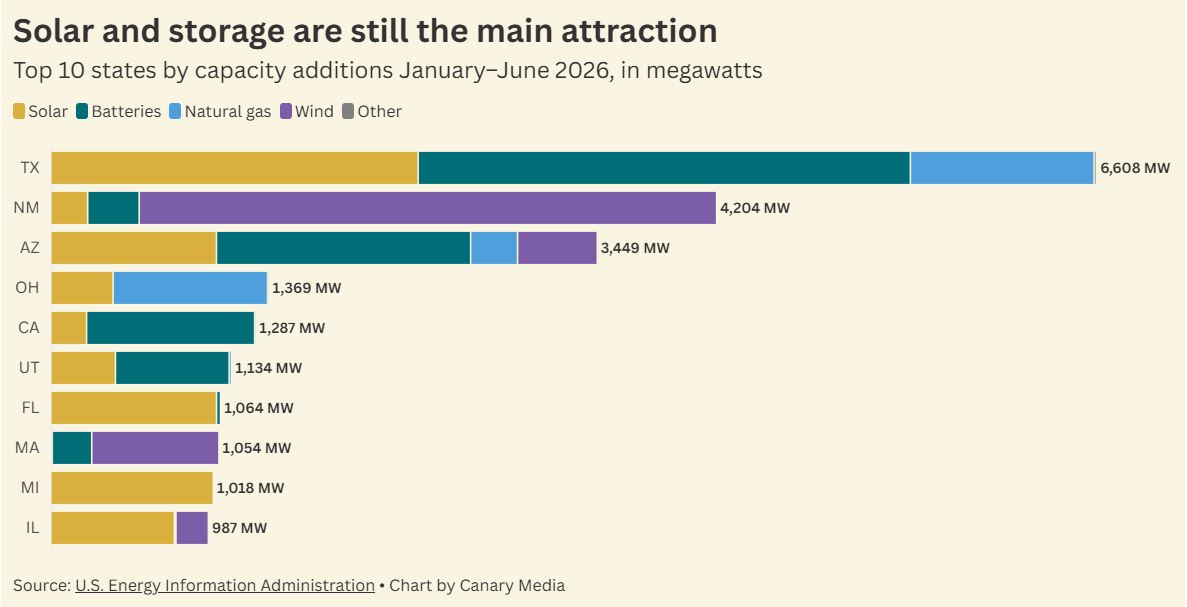
And yet 90% of what was built in the first half of this year is either solar, storage, or wind power, per U.S. Energy Information Administration data.
In fact, solar and batteries alone made up more than two-thirds of all new capacity added to the grid between January and June. As one analyst told Inside Climate News in a story parsing this same data, solar-plus-storage has become the grid’s “workhorse.”
Texas, of course, has led the way in building solar and energy storage — and in overall power plant construction. New Mexico, powered by the gigantic 3.65-gigawatt SunZia wind project that was completed in June, added the next-most overall capacity. (Yes, for those keeping track, that is the largest wind project in America turning on despite President Donald Trump’s vow to block all wind construction during his second term.) Arizona’s continuing solar-plus-storage boom boosted it to the third spot.
It’s no surprise that renewables are leading the way in 2026. It’s a trend that’s persisted for the last few years.
The Trump administration has proved unable to change that, although his tariffs and tax credit cuts have made clean energy more expensive to build. But costlier renewables are still cheaper than fossil fuels, not to mention free of the carbon emissions that are baking the planet.
If bold plans to fuel the AI race with natural gas actually materialize, it’s possible that gas could challenge renewables’ dominance. After all, Amazon and OpenAI plan to build individual gas-fired facilities that could, on their own, eclipse the total amount of gas built across all of the U.S. last year.
But those monster gas plants are far from a done deal. What’s more certain, whatever becomes of the grand plans to build more gas, is that solar and storage will continue to soar.
American solar manufacturers are navigating shifting federal policies on tariffs and tax credits, all while demand for their product continues to grow.
This story was originally published by Grist. Sign up for Grist’s weekly newsletter here.
Inside the vast Qcells factory in Cartersville, Georgia, workers — and a bevy of robots — move ultrathin slices of polysilicon through a lengthy series of machines and chemical baths to get what are known as cells.
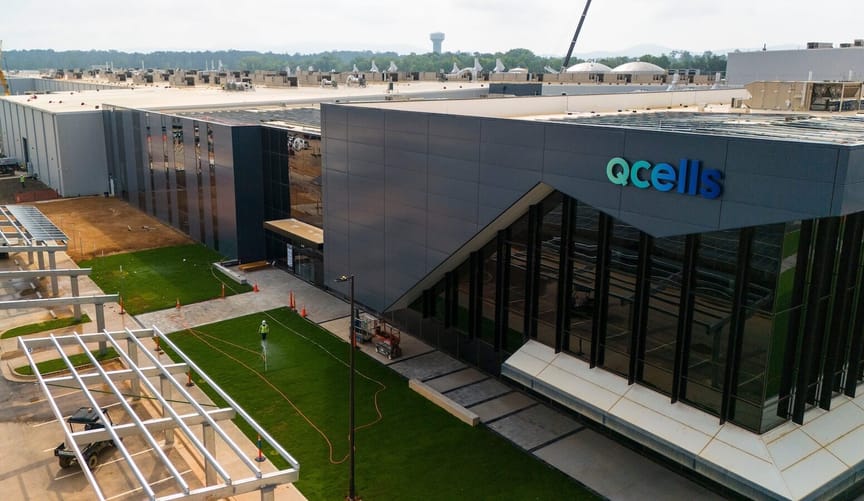
“The $2.5 billion, the 3.5 million gallons of water, the 90 megawatts of power, the 60 tons of chemicals on-site, and all of the football fields’ worth of infrastructure you’ve seen is to arrive at this,” said Scott Bell of Qcells, holding up one of the paper-thin blue cells.
It’s the basic building block of a solar panel.
In June, the plant, about an hour northwest of Atlanta, began its expansion from assembling the major components of solar panels to bringing the whole production process under one roof. It’s a major milestone for the U.S. solar industry. China has dominated solar panel manufacturing since the 2010s, flooding the global market with far cheaper panels than anyone else could make. For a host of reasons — national security, labor practices, job creation — the U.S. is trying to bring back domestic production.
In its latest move, the Trump administration plans to levy new tariffs and impose minimum import prices on polysilicon, the key ingredient for solar cells. The new measures go into effect in December.
“Having the full supply chain is critical,” said solar manufacturing expert Ben Damiani, chief technology officer at Atlanta-based solar developer Cherry Street Energy. Moving that supply chain to the U.S., he said, hasn’t been a smooth road. “Probably the biggest hindrance has been the constant change of our own policies.”
The Biden administration took a carrot approach to attracting solar panel makers: The 2022 Inflation Reduction Act included tax credit bonuses for solar projects that used U.S.-made panels. Qcells, a South Korean firm, has said those incentives were a major reason they built their Cartersville plant.
The Trump administration, by contrast, is taking a stick approach. While last year’s One Big Beautiful Bill Act, or OBBBA, revoked most of the tax credits, it also made solar equipment from certain countries — including China — ineligible for the few tax credits that remain. That, along with the new tariffs, may help a U.S. manufacturer like Qcells compete with Chinese imports, which are now more expensive.
The two policy approaches have the same ultimate goal, according to researcher Coco Zhang of the banking and investment firm ING. But it’s been whiplash for companies.
Following Trump’s latest executive actions, Qcells is still likely able to find a way to be successful, Zhang said. But Qcells has already made a multibillion-dollar investment in its brand-new facility that took more than three years to come online. For other companies with less capital and poorer timing, the supply-side incentives for domestic production may not be enough — especially when the policies could completely change again.
As a part of the OBBBA, the Trump administration closed the IRA loophole that had left room for China-based solar companies to simply set up shop in the U.S., which, according to Zhang, may go further still toward rooting out Chinese competition. In the long run, she’s optimistic that the U.S. solar panel industry can complete its shift to domestic production. But because the rules discouraging foreign ownership cut deeper into the supply chain, those restrictions and the policy back-and-forth could make things harder to navigate in the short term, she said.
The short-term outlook is complicated for those buying solar panels, too. The phaseout of federal clean energy tax credits removed a major incentive to develop new solar projects, and the Trump administration has taken steps to cancel federal funding for clean energy projects and add new hurdles for solar and wind installations on federal land. The courts have blocked or reversed some of those actions, but the delays add costs and uncertainties even for projects that do ultimately move forward.
In the first quarter of this year, clean energy advocacy group E2 tracked nearly $13 billion in abandoned investments in solar, wind, and battery projects. But some $18 billion in new projects were announced as companies scrambled to meet the deadline of the expiring tax credits. While the new tariffs and price controls on polysilicon could help U.S. manufacturers compete to supply the solar developments that remain, they could also drive up costs for developers, Zhang said, and “limited U.S. supply means many will still depend on imports and face higher costs.”
But industry experts maintain that solar isn’t going anywhere. It’s still one of the cheapest sources of electricity at a time when energy demand is growing fast. Solar panels are also readily available, while gas turbines are backordered for years. Solar and storage made up 90% of new power added to the U.S. grid in the first quarter of the year, according to the Solar Energy Industries Association.
“We absolutely should make solar, right? Like it is the fastest deployed, lowest cost foreseeable,” said Damiani. “Solar will be, for the next hundred years, a good portion of our energy.”
The questions, experts agreed, aren’t whether solar development will keep happening, but how quickly, how much it will cost, and who — and where — will make the solar panels.


.svg)
