

 Back
Back
After Republicans voted to undo much of the Inflation Reduction Act, a few cleantech professionals set out to exact electoral revenge. So far, it seems to be working.
Last summer, when the Republican-controlled Congress took a wrecking ball to the Inflation Reduction Act, Tom Matzzie was pissed. Though some Republican members of Congress had written letters trying to save wind and solar tax credits, when it came time to vote, they nearly all fell in line behind President Donald Trump. The One Big Beautiful Bill Act passed with widespread Republican support, canceling a decade-long tax incentive meant to accelerate America’s transition to cheaper, cleaner energy.
Politicians have long lived in fear of certain powerful lobbies — the National Rifle Association, Big Oil, Big Pharma — knowing that if they voted against those interest groups it could cost them their seats. But as the votes came down for the OBBBA, nobody in Congress, Matzzie couldn’t help noticing, seemed scared of antagonizing the clean energy industry.
Matzzie, who founded electricity retailer CleanChoice Energy and previously led campaigns for progressive groups and the Democratic National Committee, resolved to try to strengthen clean energy’s political clout by taking down the industry’s most prominent foes seeking elected office.
This strategy attracted the interest of Chris Larsen, a major clean energy investor who made a fortune in cryptocurrency, and Michael Brune, former head of the Sierra Club. Together, Matzzie, Larsen, and Brune formed the Invest in Tomorrow Coalition — a forgettable name that sounds like those of the other shadowy groups blanketing the airwaves during election season, but that happens to share an acronym with the now-defunct investment tax credit for solar installations. As primary season got underway, the super PAC cobbled together commitments for $20 million from Larsen, Matzzie, and other donors to spend on races this election cycle. Their targets: the far-right House Freedom Caucus members who pushed hardest to undo the IRA.
“Are we strong or weak? Are we someone that people can hurt without consequences?” Matzzie said of the clean energy industry.
Freedom Caucus Vice Chair Rep. Ralph Norman of South Carolina got a fresh taste of those consequences last week, when he lost the Republican primary race to replace the late Sen. Lindsey Graham. ITC had hit Norman with $1 million in attack ads accusing him of insufficient loyalty to Trump. The president happened to corroborate the message by enthusiastically endorsing Norman’s opponent, Graham’s sister, Darline, who went on to beat Norman by 5 points.
https://vimeo.com/1218123668?fl=pl&fe=vl
An Invest in Tomorrow Coalition ad against Ralph Norman
In his concession speech, Norman lamented that he couldn’t keep up with the outside spending against him.
“All of our money came from South Carolina and from my personal account,” Norman said. “My opponents, the money came from outside PACs. It’s a fact; I’m not being critical. The PACs that were against, to me, freedom — as Democrats, they got what they wanted.”
ITC got what it wanted in all five Republican races it intervened in this primary season. The results suggest that even a small amount of strategic spending and targeted messaging can have an outsize impact on the foes of clean energy. If Matzzie and his team keep dealing vengeance to their enemies, they could deliver some of the political firepower needed to create more durable pro-renewable policies.
ITC kicked off election season by funding attack ads against Rep. Chip Roy in his May primary runoff for Texas attorney general. The ads did not mention Roy’s antipathy to clean energy subsidies. Instead, they blasted Roy for not being loyal enough to Trump. ITC rigorously tests different messages to find what’s most effective, Matzzie explained: “We’re going to use whatever works.” Roy lost by 10.4%.
Matzzie, jumping into Republican primary races for the first time, found that each dollar spent on them goes a surprisingly long way. Conservative audiences get their news from a relatively small number of ideologically aligned media spaces, which means ITC can buy ads on Fox News, Truth Social, Rumble, and a few others and have a good shot at reaching a lot of motivated Republican voters, at which point it can cater to those voters’ deeply held beliefs rather than challenging them.
After tackling Roy, ITC put out ads supporting the reelection bid of Iowa Rep. Mariannette Miller-Meeks, a pro-renewable Republican running in a primary against an anti-renewable challenger. “Stand with Trump, support MAGA, vote Miller-Meeks,” one of the TV spots declared, alongside photos of the candidate posing with Trump. She won her primary on June 2.
Then, ITC launched its first offensive against Ralph Norman. At that point, he was running in the June 9 primary for South Carolina governor and needed to place in the top two to advance to a runoff. The PAC funded a wave of attack ads against him, and he finished in a distant third.
ITC’s clearest flex thus far has been to take on Tennessee Rep. Andy Ogles, who faced a primary challenge from former state Agriculture Commissioner Charlie Hatcher. Each campaign had spent nearly $600,000; ITC dropped $2 million on a two-pronged strategy to attack Ogles and elevate Hatcher.
The PAC sought to label Ogles as “Lyin’ Andy” by calling attention to instances in which he missed votes in Congress and triggered an FBI investigation over campaign finance irregularities.

At the same time, since incumbent Ogles had much better name recognition, ITC paid for ads to raise Hatcher’s profile and ran tracking polls to test their efficacy. Over three weeks, the portion of Republican primary voters who had never heard of Hatcher fell from around half to one-quarter, Matzzie said.
Despite an endorsement from Trump and an infusion of more than $700,000 from the Freedom Caucus Fund, Ogles lost the August 6 primary by more than 6 points.
The upset proved sufficiently embarrassing that Trump disavowed Ogles in a subsequent Truth Social post, calling him “a person who I remained loyal to even though he had virtually no chance of winning.”
Of course, there’s no way to prove that ITC’s money played a decisive role in these races. The group operates in a noisy political landscape with many variables at play. Ogles, for instance, was reportedly in hot water with voters over Islamophobic and homophobic remarks, per Politico, and needed to reach new voters due to redistricting. Graham had Trump stumping for her in the state, and his PAC funded a barrage of get-out-the-vote texts for her.
Still, each race turned out the way ITC wanted.
As Matzzie sees it, scientifically proving a causal link is beside the point; what matters is that politicians fear the possibility of this happening to them. That narrative gains strength with each candidate who’s knocked out.
It would be hard to find better testimony to the effectiveness of that strategy than the words of the defeated candidates themselves. Norman railed against ITC during his final minutes in the public spotlight as a candidate. Ogles, before he lost, called out the group during a radio interview: “They literally are trying to make an example out of me to try to strike fear in other Republicans. Which is why, if they prevail, this will have a chilling effect to the conservatives in Congress.”
Even if politicians think they can survive an assault from a scrappy team of clean energy enthusiasts, the PAC’s interventions increase the cost of running a campaign, pushing candidates to raise more money to counter the spending. “If you make enemies, your next election will be more expensive for you,” Matzzie said.
ITC hopes to keep raising money to spend up to $30 million in this cycle, he said. The PAC is now targeting its first Democratic primary, attacking Rhode Island Gov. Dan McKee for scapegoating clean energy as the cause of the state’s affordability problems. McKee was trailing his challenger in an Emerson College poll released last week.
The general election season will draw a much broader electorate than the races ITC has participated in so far. Matzzie declined to comment in detail on what the PAC’s general election strategy will be.
ITC’s efforts may have delivered a visceral satisfaction to clean energy pros chafing from last year’s defeats, but these actions aren’t likely to yield a more renewable-friendly Congress. Two of the candidates it attacked — Norman and Roy — were running for offices outside of Congress. Hatcher was never a champion of wind and solar. Some Republicans may think twice before loudly attacking the clean energy industry in the future, but that doesn’t mean they’re more likely to sign legislation that’s good for the industry.
Meanwhile, the major clean energy trade groups are not exactly embracing the PAC’s approach.
“We’re in the business of making more friends, not more enemies,” Tim Pawlenty, president and CEO of the Solar Energy Industries Association, said in an email. (Matzzie, for his part, allowed that the trade group has “to stay friends with everybody so they can walk into every office.”)
Another clean energy leader, cleantech executive and investor Steve McBee, sees ITC’s work on “enforcing accountability” as a valuable effort in a broader campaign to expand clean energy’s political power, even as he himself focuses on coalition building.
In May, McBee launched Amped, an effort to mobilize clean energy professionals and executives to engage more in public discourse, in order to build sustainable bipartisan support for their industry.
Though solar, wind, and batteries have taken over the power sector, representing an estimated 93% of all new power plant capacity getting built this year, the industry doesn’t yet wield the political power to match that success.
“We don’t show up with any swagger,” McBee said. “We continue to call ourselves ‘alternative.’ … We find ourselves a bit outside the cultural zeitgeist, and that’s not a good place to be.”
McBee believes that the IRA was a “beautifully designed piece of legislation,” but that not enough work was done to tell voters and their representatives about the jobs and economic opportunities flowing to their districts. He wants to spur energy professionals to flood the political arena with the degree of money and effort that the fossil fuel industry has invested over the decades — but without the “lying and distortion.”
“The good news is, as an industry, we have all the facts on our side,” McBee said. “We just have to prosecute the case.”
Since starting Amped, McBee said he has received hundreds of inbound messages from people who want to help the industry put up more of a fight, noting the “organic unstructured energy that can be harnessed.”
That’s a bigger project than the upcoming midterms: to turn the IRA defeat into a political awakening for the clean energy sector.
The Trump admin is propping up the aging coal fleet despite the financial and environmental costs — and also making far-fetched plans to build new coal plants.
The Trump administration seems to be doing all it can to give the coal industry everything it wants. Those efforts may not succeed, but they could keep the dying industry on life support, and soak U.S. citizens with the financial and environmental costs of doing so — unless legal challenges compel it to change course.
The National Coal Council, an advisory group that includes executives from coal mining companies and major U.S. utilities, met with Trump administration officials last week and delivered 19 recommendations. One of its key requests is for the government to issue grants and loans to build the first new U.S. coal plants in over a decade. But the industry also seeks intervention to keep existing coal plants running, including federal government power purchase agreements and the suspension of environmental protections.
Trump administration officials were on the same page. “There’s no road for a great, prosperous America without saving the coal plants we have and doing everything we can to remove barriers that can open up the possibility to expand our coal fleet,” said Energy Secretary Chris Wright.
Already, Wright’s agency has committed to invest $850 million in existing or new coal facilities and has used emergency authority to force coal plants on the verge of shutting down to keep running indefinitely. The Trump administration has also issued executive orders that free plants from regulations for air pollution and coal ash, lift restrictions on coal mining, and open coal leases on 13 million acres of federal lands.
As EPA Administrator Lee Zeldin told attendees, “Many of the items that were on your wish list are now done.”
Overall, the aim is to halt the coal industry’s ongoing decline in the face of cheaper and cleaner alternatives to provide electricity, said Ted Kelly, director and lead counsel for U.S. clean energy at the nonprofit Environmental Defense Fund. EDF is one of several environmental groups and a handful of state attorneys general challenging the administration’s environmental rollbacks in court.
Coal has fallen from supplying nearly half the country’s electricity in 2011 to just 15% in 2024, but it rose slightly last year amid increased power demand and rising natural gas prices.
The Trump administration is “openly admitting that it’s their goal to increase profits and increase operations of fossil fuel in any way these companies want, without the interests of ratepayers or Americans at large in mind,” Kelly said.
The administration has plenty of tools at its disposal to achieve those goals — particularly when it comes to keeping old coal plants online past their planned closure. But certain other goals, like building new coal plants, will prove much harder to achieve.
New coal plants are the most far-fetched item on the coal industry’s wish list, but that’s not stopping the Trump administration from bankrolling such projects.
In June, the U.S. Department of Energy announced plans to spend about $425 million under the 1950 Defense Production Act to retrofit and support 13 existing coal-fired power plants it deems vital to national security. It also directed about $100 million for the engineering and design of two new coal plants: a 1.2-gigawatt facility in Alaska and a 1.6-gigawatt plant in West Virginia.
But that federal contribution is a drop in the bucket for coal plants of that size. According to reporting from CNN, based on an analysis prepared for the Wyoming Energy Authority, it would cost $10 billion to build the West Virginia plant and $8 billion for the Alaska facility, assuming both use carbon-capture technology as currently planned. Those totals are roughly twice the cost of building equivalent natural gas power plants with carbon capture.
The electricity from those plants would, in turn, likely be far more expensive than competing alternatives such as gas, solar, wind, or batteries, said John Miller, a managing director and energy transition policy analyst at investment bank TD Cowen.
Utilities and independent power generation companies are “very happy to take federal money to extend the life” of aging coal plants, he said. But beyond the projects in Alaska and West Virginia, “nobody’s proposing to build new coal-fired power plants,” he said.
The newest major coal plant in America is the Sandy Creek facility, located in Texas and completed in 2013 — and it’s been offline since 2025 due to “catastrophic failure,” he said. The Texas grid operator reported last year that Sandy Creek is expected to be back online in 2027. Similarly, the Comanche 3 plant in Colorado, which opened more than a decade ago, has been offline since August 2025, and remains idle after missing a projected July restart date.
“It doesn’t seem within the realm of possibility that coal plants will open,” Kelly said. “But money has been allocated to that, and we could see the loss of taxpayer money before we come to that conclusion.”
More money could be wasted in attempting to restart coal plants that were purposefully shut down, he added. DOE last month offered $78 million to AES, the owner of the Warrior Run coal plant in Maryland, which shuttered the facility in 2024 but has recently explored reopening it to meet growing demand for power.
“That’s a plant that was shut down because it was not just uneconomic but extraordinarily uneconomic to run,” Kelly said, citing comments from the independent market monitor for PJM Interconnection, the regional grid operator for 13 states including Maryland, which protested AES’s restart plan.
Subsidizing its reopening “could not only cost a lot of money and increase pollution, but also interfere with the opportunity to have a better, more economic way to improve reliability and address system needs,” he said.
Building or reopening long-shuttered coal plants may be a stretch, Kelly said, but the administration has demonstrated that it is able to keep old, costly, and unreliable coal plants open past their planned closure dates.
Through July, the Trump administration has “preserved more than 13 GW of coal capacity that would have closed by now absent intervention,” according to a new report from the National Coal Council.
That tally includes just under 10 gigawatts of coal plants whose closure dates were voluntarily extended by their owners, as well as roughly 3.2 gigawatts of coal plants forced to keep running past retirement via Department of Energy emergency orders issued under Section 202(c) of the Federal Power Act.
These interventions for coal plants in Colorado, Florida, Indiana, Michigan, and Washington state have slowed the pace of coal-plant closures. Only 2.6 gigawatts of coal-fired capacity shuttered in 2025, the lowest amount in the past 15 years, according to an April report from the U.S. Energy Information Administration.
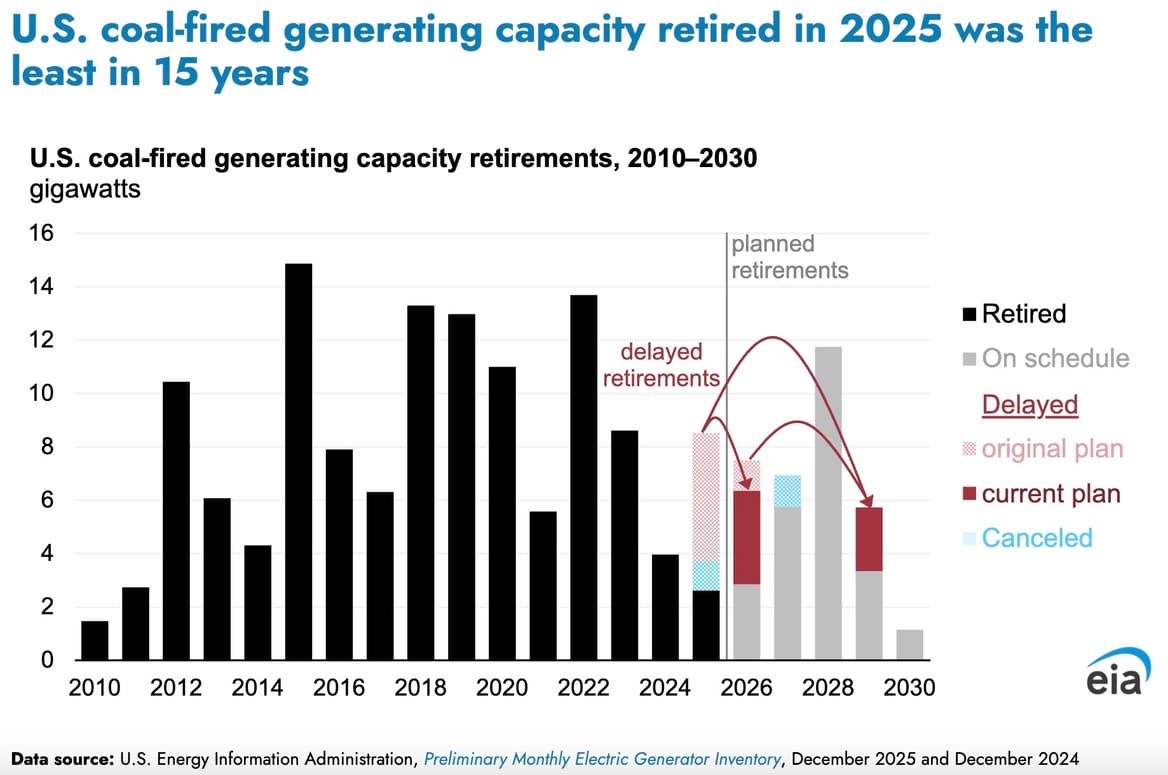
The DOE could force more coal plants to stay online this year. In a February briefing paper, EIA tallied 6.4 gigawatts of coal-fired capacity scheduled to retire in 2026, or about 4% of the U.S. coal fleet. But “renewed or new emergency orders could affect retirements planned for this year as well,” it noted.
Indeed, environmental advocates have little expectation that the DOE will stop issuing stay-open orders.
“The Trump administration is going to continue to renew them until a court stops it,” said Tyson Slocum, director of the energy program at nonprofit watchdog group Public Citizen, citing the legal challenges brought by his group and others.
The first stay-open order to see its day in court will be that concerning the J.H. Campbell power plant in Michigan. Environmental groups and the state itself are seeking to undo the DOE’s orders, arguing that the agency has failed to prove that a true grid emergency exists — and pointing out that the utility Consumers Energy, Michigan regulators, and the regional grid operator have all determined that closing the plant would not threaten reliability.
The U.S. Court of Appeals for the D.C. Circuit heard oral arguments on the case in May, and could issue a ruling as early as next month, Kelly said. “If we get a good decision from the D.C. Circuit, laying out what the standard is for these — and it clearly hasn’t been met in the case of Campbell — that can start to be used to start short-circuiting DOE using these 202(c) orders to keep plants online,” he said.
Meanwhile, the cost of keeping these coal plants open is mounting. The Sierra Club estimates that U.S. utility customers have paid a collective $415 million and counting in excess costs caused by forcing six coal plants and one oil- and gas-fired power plant open under DOE emergency orders. It could balloon further: Consultancy Grid Strategies has estimated that, if unchecked, DOE’s use of 202(c) emergency orders could increase energy costs by nearly $6 billion by 2028.
“It’s very clear this is not doing anything to lower energy costs,” said Patrick Drupp, the Sierra Club’s climate policy director.
In fact, many of the power plants under the DOE’s must-run orders “are not functional and costing lots of money to get functional and back online,” said Michelle Solomon, a policy analyst at think tank Energy Innovation who co-wrote a 2023 report finding that clean energy and batteries are a cheaper alternative to operating 99% of the U.S. coal fleet. “That means they are not contributing to reliability.”
As the California firm boots up a giant thermal battery system in South Dakota, fresh funds will help it build a second U.S. factory and more large-scale projects.
The startup Antora Energy just raised $550 million to build and deploy more of its heat-storing batteries for powering data centers and cleaning up factories.
On Thursday, San Jose, California–based Antora said it closed a Series C funding round co-led by climatetech investor G2 Venture Partners and the VC firm Eclipse, which backs manufacturing-focused startups. That brings Antora’s total corporate and project financing to around $1 billion, the company says, adding that the latest infusion will enable it to expand domestic production of its thermal batteries and accelerate the buildout of large-scale projects.
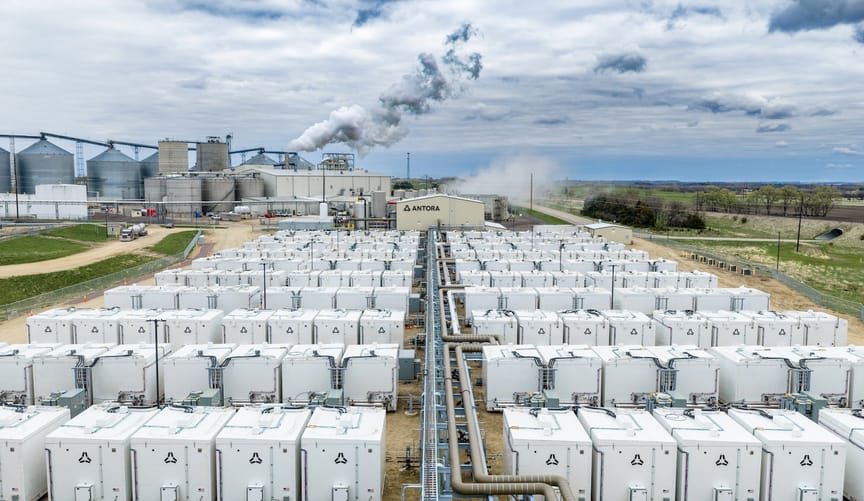
Eight-year-old Antora has likened its technology to an enormous toaster. Electricity runs through a large resistance heater to warm big blocks of solid carbon to extremely high temperatures for days on end. The blocks release controlled blasts of high-intensity light that can be used to either produce power on demand or generate steam for industrial processes.
Just two months ago, Antora began booting up its first commercial-size system: a 5-gigawatt-hour thermal battery at Poet’s biofuels plant near Big Stone City, South Dakota. The project will turn cheap wind energy into steam the plant needs to convert corn into ethanol, displacing some of the facility’s reliance on coal-fueled boilers.
Antora says this system will be one of the largest battery storage projects in the world when it’s fully operating later this year. Meanwhile, its San Jose manufacturing campus ranks among the country’s largest battery factories.
But the firm is hardly alone. Dozens of thermal energy startups in the U.S. and worldwide are developing systems with a variety of heat-trapping materials, including ceramic bricks, crushed rocks, and “stonelike” industrial waste.
The sector is expanding as countries are scrambling to meet power demand from data centers and industrial facilities — and struggling to limit the growing strain on grid infrastructure and household utility bills. In the U.S., high electricity costs have also hindered manufacturers from adopting cleaner, electrified heating technologies.
Energy storage systems in general can address those challenges by charging up when power is cheap and abundant, then dispatching that stored energy when it’s needed, such as by sending electricity to the grid during hours of peak demand. Thermal batteries can also deliver heat directly to factories to keep them from drawing lots of costly peak power.
“From factories to data centers, energy is the bottleneck to industrial growth,” Andrew Ponec, co-founder and CEO of Antora, said in a news release. “Antora has shown we can help break that bottleneck — delivering energy fast, at massive scale, with American innovation.”
The company launched its first pilot project in 2023: a 5-megawatt-hour system installed at a facility owned by the utility Wellhead Electric near Fresno, California. Months later, Antora raised $150 million from corporate and venture investors to scale up thermal-battery production at the San Jose factory, which it has expanded into a three-building manufacturing campus.
Antora built over 200 battery modules for the South Dakota storage system. But the project is notable for more than its technology. Antora is also pioneering an electricity tariff, designed with the local utility Otter Tail Power, that rewards Antora for charging up during periods of surplus local renewable energy production. The idea is to improve the bottom line for thermal energy systems while also ensuring they benefit everyone on the grid. Antora said it’s working with utilities across the country to develop similar rate structures for future projects.
With the $550 million fundraise, Antora said it plans to build a second U.S. manufacturing hub and to start fulfilling its “growing pipeline of signed agreements” with some of the nation’s biggest data center operators and industrial companies, including biofuels and chemical producers and food and beverage manufacturers. The company declined to share more specific details.
“We’re in the process of developing many more projects, very similar to the Big Stone project [with Poet], and those projects span a variety of sectors and are sort of a similar size,” Justin Briggs, Antora’s co-founder and chief operating officer, told Canary Media in a May interview.
“We’re also developing projects in the power sector that would provide the ability for data centers to come online much faster than they otherwise would,” he said, noting that those systems could be anywhere from five to 10 times the scale of its 5-GWh system at the South Dakota ethanol plant.
“Our energy system is at an inflection point, and very few companies can meet soaring power demand,” Jake Tauscher, partner at G2 Venture Partners, said in the news release. “Antora is meeting that demand today. They’re deploying at scale, on budget, and on the rapid timelines customers need.”
State lawmakers must decide whether to unlock $194M to fix aging school HVAC and plumbing systems or return it to utilities for a few dollars off monthly bills.
Should California spend nearly $200 million helping public schools install healthier and more efficient heating, ventilation, air-conditioning, and plumbing systems? Or should it send the money back to the state’s biggest utilities so their customers can pay roughly a dollar less on their monthly bills over the course of a single year?
That’s the choice that California lawmakers must make in the coming months.
The funds at stake are part of the California Schools Healthy Air, Plumbing, and Efficiency program, or CalSHAPE, which funds schools’ HVAC and plumbing repairs and upgrades. The state required its three big utilities — Pacific Gas & Electric, Southern California Edison, and San Diego Gas & Electric — to fill the initiative’s coffers with about $1 billion in fees collected from customers between 2020 and 2023.
Although much of that total has already been doled out, $194 million in CalSHAPE funds has been frozen since 2024 as state leaders debate ways to curb skyrocketing energy bills. Because current law sunsets CalSHAPE at the start of 2027, the leftover money will revert to utilities by year’s end without legislative action.
Clean energy and community advocates are pressing lawmakers to prevent that from happening.
They want leaders to leverage a sprawling budget-negotiating document, known as a budget trailer bill, to extend the looming deadline and to direct the California Energy Commission, which administers CalSHAPE, to disburse the money to schools — many of which have already identified projects they want to pursue. That includes replacing old AC equipment to keep students comfortable as climate change fuels extreme heat, improving air-filtration systems, and swapping fossil-fueled heaters for all-electric heat pumps that can both warm and cool buildings.
“The $200 million or so that’s sitting unused would help about 120,000 students in California electrify their schools, which would reduce their air pollution and give them access to air conditioning,” said Leah Stokes, an associate professor of environmental politics at the University of California, Santa Barbara. That work, she added, is “not optional — it’s to protect kids from extreme weather events, from climate change, from fires, from heat waves.”
Nine members of the state Assembly have signed a letter asking lawmakers who chair key budget committees to extend the CalSHAPE funds. Unless legislation is introduced to alter the current state of affairs, the final decision on whether the $194 million will remain available for schools or be returned to the utilities on Dec. 1 will be made in budget negotiations between lawmakers and Democratic Gov. Gavin Newsom. While a final budget package must be settled by July 1, budget trailer bills that modify state law to implement a broader budget agreement have until Aug. 31, the end of this year’s legislative session, to be completed.
CalSHAPE was created by a law passed in 2020 that aimed to make schools — especially those in underserved areas and “fenceline” communities near polluting facilities — more energy efficient, healthy, and resilient. It has since given out nearly $800 million to more than 1,000 projects, according to a 2025 report from the California Energy Commission.
But the agency abruptly closed further grant applications in mid-2024.
It said it closed the program to ensure that schools had enough time to fully spend their awards before the program’s sunset. But according to a March analysis from a state Senate budget subcommittee, the funding was frozen “in part because legislation and other departmental reports focusing on energy affordability proposed to revert CalSHAPE funds to ratepayers.”
That statement refers to Assembly Bill 3121, introduced in mid-2024 by Assemblymember Cottie Petrie-Norris (D), who chairs the chamber’s Utilities and Energy Committee, in consultation with the Newsom administration. The bill proposed clawing back CalSHAPE funding, along with grants for solar on low-income multifamily buildings and batteries for medically vulnerable households, in an effort to curb the state’s fast-rising electricity rates.
Critics of that plan pointed out that pushing that money back to utilities was likely to yield only $30 to $50 in one-time rebates for customers — an amount they said was too little to validate axing the programs. Those arguments won the day, with AB 3121 failing to advance.
Yet the CalSHAPE funding has remained frozen, and Newsom has continued trying to return the funds to utilities. That’s left schools stuck in limbo. Of the nearly 5,000 schools that received grants to conduct initial assessments — nearly half of which are in underserved communities — only 172 have secured follow-on funding to complete recommended HVAC work, according to the pro-CalSHAPE coalition.
“We’ve been working for two years to try to get this funding revived,” said Keith Butler, deputy superintendent of Torrance Unified School District, in Southern California. His district used $1.6 million in first-phase CalSHAPE funding to deploy carbon dioxide–detecting thermostats and to hire an engineering firm to identify about 300 buildings, serving about 6,000 students, that need to replace decades-old air-conditioning units, he said.
“We were ready to push the button on round 2,” he said — a $6 million investment in replacing those AC units with modern equipment — “and then the plug got pulled.”
The California Energy Commission told Canary Media in an email that it is working with schools to process the nearly $800 million in previously allocated funds, but that “unallocated funding is anticipated to be returned to ratepayers.” The agency declined to comment on pending legislative discussions. Petrie-Norris’ office did not respond to multiple requests for comment.
Returning the unspent $194 million wouldn’t make much of a dent in utility rates. According to the March Senate budget subcommittee analysis, redirecting the funds back to customers “would result in savings of $2 per month for one year for San Diego Gas & Electric ratepayers, $1.25 per month for one year for SoCal Edison ratepayers, and $0.20 per month for one year for Pacific Gas & Electric ratepayers.”
Utilities aren’t obligated to use any unspent money to reduce rates under the law that authorized CalSHAPE, Stokes added. “My fear is that utilities will just do their creative accounting and shuffle things around and take that as profit,” she said.
California isn’t the only state looking to curb energy-efficiency spending to offer short-term utility bill relief. Democratic lawmakers in Maryland, Massachusetts, and Rhode Island, for example, have recently proposed cutting back on energy-efficiency programs to reduce fees on utility customers’ bills. Experts warn that such rollbacks are shortsighted, since lowering energy use through efficiency helps customers save money on their bills and drives down utility costs in the long run.
Efficiency upgrades can also help states meet their climate goals. The California Energy Commission forecasts that the projects funded by CalSHAPE so far will reduce greenhouse gas emissions by 3,300 metric tons, equivalent to taking 770 gasoline-fueled cars off the road for a year.
For example, the Santa Paula Unified School District, in Ventura County, is using $3.9 million in CalSHAPE funds to replace fossil gas–fueled condensers and furnaces at an elementary school with all-electric heat pumps and air-conditioning systems, said Douglas Henning, the district’s facilities and construction manager. “Everything we’re replacing, gas is going away,” he said.
These retrofits have significant health and wellness impacts too, Stokes noted. Students often struggle to concentrate in classrooms that are too hot or cold, and older HVAC systems may not properly filter air pollutants, such as vehicle exhaust or wildfire smoke. Richard Bruns, a scientist at Johns Hopkins University, found that the long-term benefits of school HVAC upgrades — which come in the form of improved health and educational outcomes — outweigh the costs by a factor of 30.
HVAC retrofits can also reduce the burden that schools put on the power grid. Some California school districts are piloting advanced AC control systems to shift when they draw electricity to avoid increasing peak loads on grids during heat waves.
Reducing that strain could lower costs for everyone by reducing the amount of money that utilities have to spend to upgrade their power grids. “Ratepayers will benefit from lower peak demand and lower environmental drag from using less electricity,” the Torrance district’s Butler said.
In an interesting twist, the ongoing dispute over CalSHAPE funding intersects with another controversial energy issue before the California legislature: what to do with the state’s biggest virtual power plant program.
Lawmakers are now haggling over whether to extend funding for that Demand Side Grid Support program or whether to close it down and redirect the funds to utility-managed VPP programs, which have been far less effective at delivering grid relief at an equivalent cost. The Newsom administration has proposed shifting roughly $70 million in interest generated by the CalSHAPE funds to the utility-run programs.
Stokes is among the advocates pushing to redirect that $70 million to the Demand Side Grid Support program, even as she works to retain the $194 million for school retrofits.
In both cases, Stokes said, the choices are to spend money as lawmakers originally intended or to give it back to the state’s politically powerful utilities. “The idea that we would rob from schoolkids to hand another blank check to utilities is to me unacceptable,” she said.
The DOE says the Schahfer plant is key for reliability, but repairs mean it’ll be offline for much of 2026. The grid is set to be just fine without it this summer.
The Trump administration has spent the last year demanding that old, inefficient coal plants stay online long past their retirement dates. But one of those plants in Indiana hasn’t operated in months and won’t be able to until costly repairs are completed — undermining federal officials’ claims that their mandates will make energy more affordable and are needed to avoid imminent blackouts.
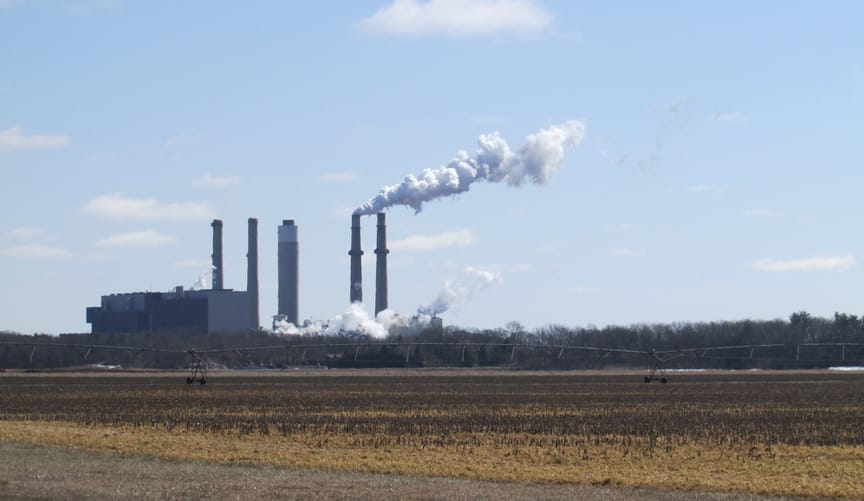
The Trump administration first ordered Indiana’s R.M. Schahfer coal plant to continue running in December, just a week before its scheduled closure date and after regulators had already determined that the polluting plant was not needed to keep the region’s lights on. That 90-day emergency must-run order was reupped on March 23.
Yet the coal plant has been offline for repairs since the end of February and is not expected to start running again until this fall, facility owner Northern Indiana Public Service Co. (NIPSCO) told regional grid operators at their May 19 hearing on summer electricity reliability. The utility added that even without that energy, it is well positioned to meet power demand this summer, in large part thanks to new wind, solar, and batteries.
In other words, “the coal-fired units couldn’t produce electricity for an emergency even if one existed, which it doesn’t,” Sameer Doshi, a senior attorney for the nonprofit law firm Earthjustice, said in a statement. Earthjustice is asking a federal appeals court to overturn the administration’s must-run orders for Schahfer and another Indiana plant.
In total, President Donald Trump’s Department of Energy has ordered seven fossil-fueled plants in the U.S. to run past their retirement dates — sometimes against the wishes of the plant owners themselves — in an unprecedented flex of authority under Section 202(c) of the Federal Power Act. The agency had previously used that power only temporarily on request from utilities and grid operators facing immediate energy threats.
Even before the DOE ordered Schahfer to stay online, one of the plant’s two coal-fired units had been out of service since July 2025 because of mechanical failures.
The plant’s other coal-fired unit operated in January, helping to meet demand during Winter Storm Fern. But it has been offline since Feb. 28 for “planned maintenance,” NIPSCO said. Both units are scheduled for a “tentative” return to service by October, company officials said at the May forum held by the Midcontinent Independent System Operator (MISO), which operates the grid covering parts of 15 states.
“The conditions of both those units were deteriorated,” said NIPSCO environmental compliance director Rockey Pollard, citing issues with equipment including boiler feed pumps and tubes, as well as last summer’s turbine failure.
The company told MISO that “significant boiler and turbine work” is ongoing on both coal units, which were built in the mid-1980s.
Households and businesses will bear the financial brunt of propping up coal plants, which are more expensive to operate than newer gas plants and renewable energy paired with batteries. In March, federal regulators approved NIPSCO’s request to spread the costs of the coal plant repairs among customers across the north and central part of the region. The company has estimated that keeping the coal plant running past its 2025 scheduled retirement date will cost more than $1 billion through the end of 2027.
Local residents are also furious that, along with keeping Schahfer running, NIPSCO is planning to develop a massive data center, and a gas plant to power it, adjacent to the coal plant.
While experts are skeptical of the Trump administration’s “energy emergency,” the U.S. does need to quickly build generation as data centers, factories, and electrification spike demand. But many say wind and solar — the cheapest, fastest types of electricity to build — are the solution, rather than running antiquated coal plants.
NIPSCO, for one, explained at the hearing that it expects to have a surplus of power in the coming months, and that it had added three wind farms, eight solar farms, and two battery sites to its portfolio since 2021. Across MISO’s territory, solar and storage plants — along with some new gas plants — mean that the grid is prepared to meet demand over the summer, the organization reported this month.
“The DOE is using 202(c) emergency orders to force ratepayers to pay for plant rebuilds at this dilapidated coal plant even as Indiana regulators have already approved replacement power plants, which are now operating or under construction,” Earthjustice’s Doshi said.
The Trump administration is expected to issue yet another 90-day must-run order at Schahfer when the current one expires on June 21. But as NIPSCO has made clear, the coal plant won’t be able to run at all for the entirety of that three-month mandate.
Consumers “will be forced to absorb additional costs for facilities that are not delivering any benefit to the public,” Kerwin Olson, executive director of the Indiana consumer watchdog group Citizens Action Coalition, said in a statement. “Ratepayers need relief, not further punishment.”
Air regulators say the new plan balances industry needs and environmental goals — but critics worry that the state has just undermined its own emissions targets.
The California Air Resources Board on Friday approved major changes to the state’s cap-and-invest program, including a controversial plan to allow polluting industries to earn free emissions allowances if they invest in decarbonizing their facilities — a move critics say could undermine California’s decarbonization goals.
Friday’s vote capped months of fighting between environmental groups and polluting industries over the future of the state’s two-decade-old carbon-trading regime, which lawmakers reauthorized last year. Companies covered by the program must either reduce their carbon emissions below a certain state-mandated limit or buy allowances from the market to offset emissions in excess of that limit.
CARB’s initial proposal in January came under fire from several polluting industries, which warned they would have to raise prices or shutter operations given the cost of meeting its increasingly stringent emissions limits. Oil companies such as Marathon Petroleum and Chevron threatened to close some of the state’s last remaining oil refineries.
The January proposal also included cuts to programs funded by cap-and-invest meant to offset rising electricity costs via utility customer credits. California utilities and lawmakers protested changes to that program, which was part of a sprawling energy affordability package passed last year.
CARB issued a revised plan in April that both increased funding for utility bill credits and set aside about $800 million in additional compliance support to polluting industries. The April plan put forward CARB’s manufacturing decarbonization incentive (MDI) program, which will make free allowances available to companies that invest in cutting carbon emissions.
Environmental groups and state lawmakers opposed the MDI proposal, which they fear will threaten the cap-and-invest program’s ability to help California meet its near-term target of reducing carbon emissions by 40% from 1990 levels by 2030.
In response, CARB added last-minute amendments to tie allowances to proven carbon-cutting projects. It also stipulated that the plan will be rolled out in stages so that staff and board members can ensure it’s working as intended before the new rules take effect statewide.
Still, these guardrails were not enough to quell concerns from critics.
“These changes to Cap-and-Invest allow more pollution and undermine the program’s ability to support investments that cut emissions and costs for families,” Katelyn Roedner Sutter, California senior director for the Environmental Defense Fund, which opposes CARB’s plan, said in a Friday statement.
CARB Chair Lauren Sanchez said Friday that the updates represented a “challenging balancing act” between meeting climate targets, improving energy affordability, and supporting industries important to the state’s economy. Offering hard-to-decarbonize industrial facilities a way to reduce the cost of complying with the state’s increasingly stringent emissions caps could help dissuade them from leaving the state, she said.
The MDI, which could provide up to $4 billion in value for companies tapping into it, could also help make up for the billions of dollars of federal industrial decarbonization funds stripped by the Trump administration, Sanchez said. “The federal attacks on that funding are unprecedented, and we are fighting many of them in court, but this part of the proposal can help to backfill some of that investment,” she said.
Gov. Gavin Newsom has also framed California’s cap-and-invest program as a pushback against the Trump administration’s attacks on the state’s clean vehicle regulations and other climate efforts.
“While Trump sows ongoing chaos and uncertainty, California is staying focused by protecting our economy, safeguarding public health, and doubling down on the clean energy future,” Newsom said in a Friday statement praising CARB’s vote.
Critics of the new plan worry that MDI will undermine climate goals for a simple reason: It could let major polluters emit more greenhouse gases than they ought to.
In January, CARB determined that the cap-and-invest program had to remove allowances equivalent to 188 million metric tons of emissions from circulation in order to meet its 2030 decarbonization targets. But the MDI program would keep those allowances in circulation — and give them away for free to companies that invest in carbon-cutting projects, even though those might not deliver emissions reductions until later.
The MDI could also sap funding for some of the climate and energy programs cap-and-invest helps pay for.
Lawmakers, academic experts, and community advocates warned that the MDI could depress prices in California’s carbon market, thereby reducing the revenue cap-and-invest raises for the state’s Greenhouse Gas Reduction Fund. GGRF has become a catchall source of alternative funding for programs facing cuts in the state budget over the past several years.
In particular, the programs CARB has designated as “Tier 3” could lose their funding if carbon market revenues fall. That amounts to hundreds of millions of dollars for affordable housing, low-carbon transit, and clean air and drinking water for low-income communities.
At Friday’s meeting, board members grilled CARB staff for hours over this risk. Rajinder Sahota, CARB’s deputy executive officer for climate change and research, asserted that analyses from environmental advocates and the state’s Legislative Analyst’s Office, which predict the MDI program could lead to billions of dollars of lost carbon-market revenue, have overestimated the likely financial impacts.
But Kyle Meng, a professor at the University of California at Santa Barbara who co-authored an analysis that found the MDI could lead to $2.3 billion less for the GGRF and $1.7 billion less for the California Climate Credit from 2027 to 2030, pushed back against those assertions in a social media post after Friday’s vote.
“Seeing such voodoo economics coming from the agency tasked with governing the world’s second most valuable carbon market was disappointing, to say the least,” Meng wrote.
Sanchez agreed at Friday’s hearing to insert several last-minute amendments, which were proposed by other board members to forestall the risk of MDI undermining state carbon-reduction targets or throttling carbon market revenues.
For one, CARB can claw back allowances if companies don’t follow through on the decarbonization investments they’ve promised, Sanchez said.
Another provision will require CARB’s executive officer to report to the board before any allowances are awarded, to give board members an opportunity to amend the MDI program’s workings to avoid deep hits to carbon market revenues or the integrity of the cap. Sanchez described the changes as “pushing pause on the MDI” pending “analysis that is then reported back to us as a board and any changes and amendments that are needed.”
It’s unclear how these changes might affect the debate over funding for GGRF-reliant programs that’s currently raging in the state capitol.
State Sen. Henry Stern, an ex officio CARB member, brought up this issue at Friday’s hearing, noting that recent proposals from the state Senate Budget Committee are ready to “reject the current expenditure plan” absent more guarantees that the MDI would not undermine program funding.
Even so, Stern, who was among more than two dozen other lawmakers who signed a letter protesting CARB’s April plan, expressed support at Friday’s hearing for an MDI program that could backfill lost federal funding for the toughest-to-decarbonize part of the state’s economy.
“This has serious potential to be a core accountability tool for our justice communities, looking for not just GGRF to take care of their problems but for the polluting entities themselves to pay for them,” he said. “And I, frankly, don’t think we’re going to be able to hit both our targets in this sort of broader transitions that we want to see unless we bring serious private capital to the table.”
A majority of board members voted down a proposal to delay adoption of the new rules after CARB staff warned that revising the plan to exclude the MDI could force the agency into a monthslong process that could prevent it from reauthorizing the program by a September deadline, which would in turn trigger an even longer administrative review. Such delays could do more harm than good to confidence in the carbon market and further depress revenues, Sahota said.
Ultimately, the board voted 10 to 3 to adopt the plan. The MDI program will open to applications from companies in mid-2027.
The guardrails didn’t satisfy Lynda Hopkins, who joined board members Diane Takvorian and Gladys Limón in voting against the updates.
“My concern is that this proposal comes at the expense of zero-emission transit, affordable housing, clean air, clean water, increased gas, greenhouse gas emissions, and potentially community emission-reduction plans,” Hopkins said.
But CARB board member Cliff Rechtschaffen said he supported the program with the changes inserted on Friday, including several he proposed to tie allowances to specific facilities that prove they’ve invested in effective decarbonization projects.
“I don’t support a delay, because of the risks and uncertainties my colleagues have outlined,” Rechtschaffen said. “I think the risks on the market are real. We live in a very volatile world, and a regulation in the hand is worth maybe one and a half or two in the bush.”
Changes suggested by state regulators could put 2030 emissions goals out of reach and shift billions of dollars from state programs to polluters, critics say.
California’s top air regulator wants to overhaul the state’s two-decade-old carbon market. But key lawmakers and environmental groups say the effort will undermine the program — and the state’s decarbonization goals.
Last month, the California Air Resources Board proposed major changes to the state’s cap-and-invest program. The system was put in place in 2006, becoming the country’s first economy-wide emissions-trading mechanism for refineries, factories, power plants, and other major industrial sites. Together, these sources account for about 80% of California’s greenhouse gas emissions.
The program effectively taxes major emitters and uses the proceeds to fund climate and decarbonization solutions throughout the state. CARB is in charge of managing the program, and ensuring it supports the state’s legal mandate to reduce its carbon emissions by 40% from 1990 levels by 2030.
But critics say the agency’s latest proposal would instead put those targets out of reach.
Topping their list of concerns is CARB’s novel plan to grant a total of 118 million metric tons of extra emissions allowances to oil refineries and other industries, in exchange for a promise to invest in decarbonization projects in the future. That could allow polluting industries to keep pumping carbon dioxide into the atmosphere at volumes that will blow past the state’s 2030 targets.
What’s more, giving away that many allowances could dramatically reduce cap-and-invest revenues, potentially by as much as $4 billion over the next four years. That could eliminate billions of dollars meant to fund state programs to defray the impact of rising utility rates and protect disadvantaged communities suffering the greatest harms of climate change.
CARB, for its part, has argued that its proposed changes will not have such dire effects. The agency is set to vote on its new plan on May 28.
Environmental advocates and a group of 28 state lawmakers who helped reauthorize the cap-and-invest program last year are now pushing CARB to revise its plan and offer an alternative that can be implemented in the next few months.
“That’s what we need, because this proposal undermines the integrity of the program so substantially,” said Chloe Ames, a policy adviser at NextGen California, one of 45 environmental groups that signed a letter to California Gov. Gavin Newsom, a Democrat, and CARB Chair Lauren Sanchez calling for the agency to abandon its plan.
In a separate letter to Newsom and Sanchez, the lawmakers wrote that the proposed changes “depart from the spirit of our landmark agreement” to reauthorize the program last year, and demanded that CARB “amend their Cap-and-Invest proposal to push back on pressure from an oil industry that is making hundreds of billions in wartime profits.”
CARB’s April proposal is dramatically more lenient on polluters than the initial plan it put forth in January.
Following that original proposal, major oil and gas companies, including Chevron, pushed hard for CARB to take a more lenient approach. Republican and moderate Democratic lawmakers in the state amplified those pleas.
That’s why environmental groups have blamed the new proposal on “massive lobbying efforts by fossil fuel interests — some of the most profitable companies in the world.”
Some lawmakers criticized the proposal along similar lines in a May 6 Senate hearing with Sanchez. In the hearing, Sen. Caroline Menjivar, chair of the Senate Democratic Caucus, put a fine point on it, referring to the program as a “slush fund” for polluters.
California’s cap-and-invest program works like this: Companies covered by the program must either reduce their carbon emissions below a certain state-mandated limit or buy allowances from the market to offset emissions in excess of that limit. The number of allowances available for purchase declines over time — it’s “capped,” hence the name. As the supply of available allowances falls, the price of each allowance, and so the cost of compliance, tends to rise.
In CARB’s January proposal, the agency determined that the state’s previous carbon accounting had undercounted how many million tons of emissions it needed to eliminate between 2027 and 2030 to hit California’s decarbonization targets. That discrepancy added up to roughly 118 million metric tons.
CARB’s January plan proposed to remove the equivalent amount of allowances from the program entirely. But that spurred an outcry from polluting industries, which warned that such a move would drive up consumer costs and push jobs and investment out of the state.
The Western States Petroleum Association, a trade group, and Chevron, the state’s largest oil refiner, warned that failing to loosen the program’s emissions limits may force companies to close refineries and further increase the state’s highest-in-the-nation fuel prices.
That message has been echoed by California Republicans and some moderate Democrats. Rajinder Sahota, CARB’s deputy executive officer for climate change and research, cited similar concerns during a press briefing after the April proposal was unveiled.
As Sanchez told senators at the May 6 hearing, “We heard a clear message — we must support the ability for California businesses to stay in state while delivering on our statutory climate goals.”
CARB presented its new proposal — known as the manufacturing decarbonization incentive (MDI) — as the solution to those problems.
Its primer on the plan described it as a “first of its kind feature for a carbon market,” one that “would provide $4 billion to support investment and doing business in California,” as well as “make up for the loss of federal incentives” for industrial decarbonization that have been cut by the Trump administration.
The new plan would not only keep the 118 million metric tons’ worth of allowances in circulation; it would also allow companies to claim them for free, rather than force them to purchase the allowances.
Granting some free allowances is a standard practice in carbon markets and has been part of California’s approach from the start. The idea is to give carbon-intensive industries some buffer against the increasingly high costs of complying with emissions limits and to avoid driving these polluting but economically important industries to other states.
But critics say CARB’s math doesn’t add up.
The agency has not “provided evidence to justify the rather large increase in production subsidies” that the MDI program would provide, Meredith Fowlie, a professor at the University of California, Berkeley, and faculty director at its Haas School of Business’ Energy Institute, wrote in an April blog post. “Increasing these output subsidies may further reduce leakage — or it may just transfer more value to incumbent producers without materially changing production decisions.”
And regardless of its efficacy in preventing leakage, environmental advocates say that CARB’s own prior analysis shows that the MDI program would undermine climate goals.
“Creating 118 million additional allowances effectively cancels out the 118 million they’re supposed to be reducing by 2030,” said Caroline Jones, manager of energy transition and carbon markets at the Environmental Defense Fund, which opposes CARB’s plan. “Removing these allowances was initially proposed by CARB as the lowest threshold of change required to meet 40% reductions by 2030.”
CARB’s counter is that these free allowances will flow only to participating companies that pledge to invest in future emissions reductions. But it’s unclear whether CARB will have the ability or the desire to force companies to make good on those promises.
At the May 6 Senate hearing, Sanchez said that CARB would “monitor, evaluate, and propose adjustments to this program to ensure that it is working as intended and delivering on those emissions reductions.”
So far, CARB has provided very little in the way of clear rules for how the MDI would accomplish this, Jones said. “There are no guardrails on how they need to account for the emissions reductions they’re achieving — or even if they are achieving them,” she said.
Concerns loom over the “invest” side of the program as well.
California uses the revenue raised by selling cap-and-invest allowances to fund statewide climate and decarbonization efforts. But that funding mechanism is only as effective as the underlying market for the emissions allowances being traded — and environmental groups and lawmakers fear CARB’s plan will seriously undermine those dynamics.
Over the past two years, prices in the program’s quarterly allowances auctions have fallen from what Jones described as a relatively healthy range in the mid-$30s to low $40s per ton to the mid-$20s range. In fact, recent auction prices have been within a dollar or two of the minimum price set through a complex regulatory formula, she said.
“Prices in this program are already at a floor,” she said. CARB’s new proposal would “effectively flood the market with additional allowances, dragging down the market even further.”
The MDI program could have a particularly pernicious effect because it would open the door for companies to secure allowances on top of those they’ve already been allocated. In some cases, that could allow individual companies to “receive free allowances well in excess of their emissions,” wrote Fowlie, who is chair of the state’s Independent Emissions Market Advisory Committee.
According to Fowlie’s math, refineries tapping into the MDI program could rack up 6.1 allowances per barrel of oil, compared with the benchmark GHG emissions rate for refineries of about 3.89 tons per barrel. That windfall supply of allowances could be sold to other emitters, including other oil companies, depressing program revenues and industry compliance costs while turning a profit for polluters.
If those market dynamics play out, it would put a dent in funding for key climate and energy initiatives in California.
The cap-and-invest program helps fund a Climate Credit program that utilities use to reduce customer bills, as well as the state’s Greenhouse Gas Reduction Fund (GGRF), which has been a go-to source for programs that have faced funding cuts over the past several years of tight state budgets.
As part of last year’s negotiations over reauthorizing the state’s cap-and-invest program, lawmakers and Newsom’s office agreed to prioritize GGRF funds for a variety of purposes. The governor’s proposed 2026–2027 budget calls for $1 billion for the state’s high-speed rail project and $1.6 billion to backfill state forestry and fire protection, among other higher-tier funding priorities.
Money left after those priorities would flow to “Tier 3” allocations, including hundreds of millions of dollars over the next four years for the state’s Affordable Housing and Sustainable Communities Program, the Community Air Protection Program, the Low Carbon Transit Operations Program, the Safe and Affordable Drinking Water Fund, and the Transit and Intercity Rail Capital Program.
CARB, for its part, has argued that the doomsday scenario painted by critics is unlikely. After all, it’s hard to predict how an untested program like the MDI might impact a market that relies on buyers and sellers making their own decisions about what allowances are worth.
The agency “cannot predict auction revenues or results,” Sanchez emphasized in the May 6 Senate hearing.
But analyses from independent experts and from the state Legislative Analyst’s Office estimate that MDI would add up to billions of dollars in lost auction revenue.
The proposal could lead to a $4 billion loss in auction revenue, equating to $2.3 billion less for the GGRF and $1.7 billion less for the Climate Credit from 2027 to 2030, according to an analysis by data scientists Kyle Meng and Jordan Wingenroth of UC Santa Barbara’s Environmental Markets Lab. In a report to lawmakers, the Legislative Analyst’s Office also found it “could somewhat reduce the overall amount of Climate Credit” funding, and would cut annual GGRF revenues to about $2 billion per year — roughly half what they’ve been in recent years.
That “would be inadequate to fully support Tier 2 programs” the report found, “and leave no funding for Tier 3 programs.”
During the May 6 hearing, Sen. Eloise Gómez Reyes, a Democrat and chair of the Budget Subcommittee on Resources, Environmental Protection, and Energy, grilled Sanchez on the risk of losing this funding. “Do you believe the legislature intended to eliminate funding for affordable housing, transit, drinking water, wildfire prevention and clean air programs with the reauthorization?” she asked.
When Sanchez responded that CARB hasn’t proposed to “defund any of those specific programs,” Gómez Reyes interrupted her. “Let me stop you for a moment,” Gómez Reyes said. “That will be the effect. … There’s nothing left to fund Tier 3, and those are the most important programs that have served the community.”
Sen. John Laird, a Democrat who chairs the Senate Budget and Fiscal Review Committee, noted that such a drastic reduction in funding would force lawmakers to “put everything back on the table” for upcoming negotiations over the governor’s revised budget plan.
“It really affects what we do, to what level we do it, how the different pieces fit together,” he said. “So I want to call out the budget side of the equation, because this is a big deal.”
When we compare India today with China at equivalent income levels ($11,000 PPP in 2012), several observations emerge:
The benefits to India are substantial. This energy path avoids deep fossil fuel dependency while positioning the country to supply electrotech to the world.
A new path for emerging economies. India is showing other countries how to take a cheaper, faster, cleaner pathway to the electrotech future.

Many compare India and China’s energy systems as they stand today. From this perspective, China is ahead in most new energy metrics, from solar capacity to electrification.
But the comparison has limits. China is at a later stage of development. China’s GDP in purchasing power terms is over double that of India; its electricity consumption is five times greater; its manufacturing output, in monetary terms, is nearly an order of magnitude larger.
It is more reasonable to compare the two countries at equivalent levels of development. When we do so, a different story emerges. India is generating more solar electricity, burning far fewer fossil fuels and electrifying transport faster than China did at an equivalent GDP per capita.
India is harnessing some of the cheapest solar in the world to power its industrial rise – bypassing an expensive, insecure, fossil-burning interlude. Where China and the West took the long road to the energy future, India is taking a shortcut.
India’s shortcut has consequences, both at home and abroad. It offers a faster, cheaper route to growing electricity. It means greater energy sovereignty at an earlier stage of development. It can position India as a third pole of influence in a world where energy is being reshaped by electrotech and trade by Sino-American competition. Such advantages are not a foregone conclusion, but the signs are promising.
Over the last two decades, the cost of core electrotech like EVs, solar panels and batteries have plummeted. To put that in perspective, in 2004, when China crossed 1,500 kWh of electricity use per capita, coal generation was about ten times cheaper than nascent solar photovoltaics (PV). What followed was predictable: over the next decade, coal made up nearly 70% of the growth in China’s electricity generation.
In contrast, as India crosses 1,500 kWh of electricity use per capita, now, solar-plus-storage costs around half as much as new coal plants. This gap is widening as solar and battery costs fall along predictable learning curves, while coal power becomes more expensive with declining utilisation.
Transport tells a similar story. In 2011, when China reached road transport oil demand of 150 litres of gasoline equivalent per capita, batteries were ten times more expensive than they are now, and the electric vehicle industry barely existed.
Meanwhile, India’s road oil demand at 96 litres per capita, is unlikely to ever reach even 150 litres per capita. Electric vehicles are already undercutting internal combustion engines on price. Why pay a premium for foreign oil and local smog?
The implication is that the energy pathway that makes economic sense for India today, as it rapidly industrialises, is not what made sense for China when it made the same journey.
The energy revolution runs along two tracks. First, renewables coupled with battery storage are taking over electricity supply. Second, electricity is taking over energy demand; everything that can economically electrify will go electric, from transport to industry and buildings. On both fronts, India is achieving greater success at earlier stages of development.
Looking at electricity generation first. In India, solar reached 5% of total generation at around $9,000 GDP per capita; in China, it took until about $23,000 to reach that level. Where solar goes, batteries are following fast: the share of renewable tenders paired with battery storage has climbed from about 12% in 2021 to half in 2024.
Meanwhile, coal power growth is fading at levels a quarter of where China’s did. Indian coal-fired generation in 2025 is set to fall year-on-year, though solar’s rise continues uninterrupted. Ember and TERI’s least-cost pathway projects plateauing coal demand through to 2030. Similarly, IEA’s Stated Policies scenario (which has historically underestimated electrotech growth) sees India’s coal demand in 2035 at roughly today’s level. In all likelihood, India will reach $20,000 GDP per capita without coal generation ever exceeding the levels China was burning at $5,000.

Turning next to the competition between electricity and fossil fuels to provide final energy. India is making strides here too. Electricity has reached 20% of final energy at just 4 gigajoules (GJ) of coal per capita, versus 24 GJ when China crossed the same threshold. At a similar level of development, India has reached the same milestone using roughly one-sixth of the coal.

Oil carries greater strategic weight. India is the world’s second-largest net oil importer, behind only China. Half of that demand comes from road transport – a sector rapidly electrifying.
In the race to curb oil imports, India is already far ahead of where China was at the same stage of development. Road transport oil demand per capita is significantly lower, thanks first to smaller, lighter vehicles and now to the rise of electric vehicles (EVs).
Electric cars exceeded 5% of sales in mid-2025, at a point when oil demand per capita is 60% lower than when China crossed the same threshold. In the three-wheeler category, India leads the world, with electric models now approaching 60% of sales. Two-wheelers are following fast: 1.25 million electric two-wheelers were sold in 2024, four times the number in 2020.

A major reason India’s per capita fossil fuel consumption is far lower than China’s at comparable income levels is that India’s growth model is structurally less energy intensive. India generates a third more economic output per unit of energy than China today. India’s cement and steel demand is a fraction of China’s. Unlike China’s heavy, construction-driven development path, India’s economy is lighter and more services-led.
Zoom out to economy-wide electrification. China has long been held up as one of the great electrification success stories of modern economic history, increasing its electricity share of final energy by nearly ten percentage points per decade since 1990. However, align the timelines by GDP per head and India’s progress looks just as impressive.

Several factors explain why India’s electrification rate is tracking China’s. Buildings are more electrified at equivalent stages of development, largely because India’s climate means temperature control is dominated by cooling – which is inherently electric – whereas China’s heating demand is met by a mix of electric and fossil fuels.
Sectoral composition also plays a role: China’s economy, as noted, is more skewed towards heavy industry, which is less electrified. Details notwithstanding, keeping pace with the electrification leader on an income-adjusted basis remains impressive – and an important indicator of competitiveness in an age where electricity powers the highest-value economic activities.
Another dimension to the electrotech revolution is manufacturing opportunities. The transition from fossil fuels to electrotech is a transition from extraction to manufacturing – a shift that favours Asia in general and India in particular. If any country has the scale, capital and economic dynamism to become a major electrotech manufacturer alongside China, it is India.
Geopolitics is opening the door further. With Sino-American tensions showing few signs of easing and advanced economies scrambling to diversify their electrotech supply chains, the demand for alternative trading partners is only rising.
There are strong signs India is seizing the opportunity, starting with its electronics industry. India’s electronics industry is surging – nearly sixfold from $22 billion in FY2015 to about $130 billion in FY2025. Domestic mobile phone production alone has risen from 2 million units in 2014 to 300 million a decade later. This matters because, as China has shown, electronics is the gateway to electrotech. The capabilities built for consumer electronics spill over into solar panels, batteries, and EVs. A mobile phone, after all, has more in common with a solar panel than a gas plant does.
Indeed, this momentum is expanding beyond electronics. Solar module production now stands at 120 GW – a twelvefold increase over the past decade, and enough to make India self-sufficient. The shift into upstream components is similarly pronounced: solar cell manufacturing, virtually absent a decade ago, has expanded to 18 GW. Beyond solar, government production incentives are spurring domestic industries for batteries and electrolysers. India is positioning itself to capture a growing share of the global electrotech market.
Green hydrogen offers another example of how low-cost solar is opening new markets. Successive auctions by oil refining and fertiliser companies have resulted in highly competitive price discovery. Bid prices in the range of $4–5 per kg position India among the more cost-competitive geographies globally.
Scaling cheap electricity fast is essential for industrial growth. Here solar has the cost and the speed-to-market advantage: its modularity means it can be installed in months, not the years that coal-based assets need. And because it can be installed at almost any scale, from Mumbai rooftops to Rajasthan desert sun farms, far more actors take part in the energy revolution.
The second advantage of India’s electrotech shortcut is sovereignty. Spending 5% of GDP annually on fossil fuel imports strains the balance of payments, leaves the economy exposed to price shocks and weakens India’s position in a global energy system that is increasingly shaped by geopolitical risks. By taking the fast-track, India can develop with far lower fossil fuel dependency than China has today and enjoy the strategic advantages that entails.
The third opportunity is avoiding legacy costs. There is a considerable benefit to building the new when you have less of the old. In India, the total cost of solar projects already undercuts the marginal cost of running existing coal plants. Ember estimates that by 2031, over a third of India’s installed coal capacity could be operating at under 40% utilisation, undermining its economic case. But the assets at risk are far smaller than China’s. As China faces the painful task of writing down its coal fleet, India can emerge with far fewer scars.
Overall, India is on a very different development pathway from China, industrialising on modern renewables, put to work through electrification. Leaning into this offers multiple advantages: manufacturing opportunities, energy sovereignty and faster scaling of electricity supply. As the fastest-growing major economy and the world’s most populous nation, India’s choices carry powerful demonstration effects. It is showing other emerging economies that electrotech can power industrial growth, not just follow it.
Economic comparisons use GDP per capita in purchasing power parity (PPP) from the World Bank – a measure that adjusts for price differences and better reflects development stage than market exchange rates. Electricity data is from Ember, final energy data from the IEA World Energy Balances. Road oil demand is expressed in litres of gasoline equivalent, using the IEA’s conversion factor. The analysis focuses on the period from 2000 to the present.
Throughout this piece, “electrification” refers to replacing combustion with electricity, not to extending electricity access to those without it.
Lead author: Kingsmill Bond, Sumant Sinha
Other authors: Sam Butler-Sloss, Antoine Issac, Daan Walter, Duttatreya Das
Ember: Hannah Broadbent, Rashmi Mishra, Chelsea Bruce-Lockhart, Aditya Lolla, Ardhi Arsala Rahmani
External Contributors: Udit Mathur (ReNew)
In early March 2026, the European Commission (EC) published a proposal for the Industrial Accelerator Act (IAA),[i] a wide-ranging regulation that would introduce local content and carbon intensity requirements in procurement and other public expenditures, establish a pre-approval regime for large foreign investments in strategic manufacturing sectors, and streamline permitting for industrial decarbonization projects across the European Union. If passed, the IAA would represent the EU’s most ambitious industrial policy since the European Green Deal, reflecting both a commitment to a low-carbon future and intensifying concerns about European competitiveness and supply chain resilience. The draft regulation’s preference for European producers and selected EU trading partners constitutes a softening of Brussels’ position on market neutrality—a shift that reflects a broader defensive turn in EU economic engagement driven by dysfunction in the multilateral trade system and concerns about a surging trade deficit with China.[ii]
This commentary unpacks the IAA’s core provisions, examines its implications for third countries, and identifies the open questions most likely to shape its final form and practical effect.
Relative to other leading economies, the EU has made limited use of fiscal incentives to shape industrial outcomes and structure supply chains since the end of the Cold War. The EU’s state aid rules, World Trade Organization (WTO) commitments, and decentralized allocation of trade, tax, and procurement authority across institutional actors have constrained its ability to pursue broad industrial policies on the scale of the Inflation Reduction Act (IRA) or Made in China 2025.
These constraints have come under increasing pressure in recent years. Russia’s invasion of Ukraine in 2022 exposed Europe’s dependence on imported fossil fuels and sent electricity prices soaring. Concurrent with the energy crisis in Europe, the United States passed the IRA, which authorized immense subsidies to the US energy and transportation sectors, further widening the gap between European and American costs of production.[iii] The crisis also coincided with a dramatic erosion of multilateral trade norms, driven by the United States’ unapologetic use of tariffs.[iv]
This confluence of economic headwinds has fueled anxieties in Europe about the EU’s industrial vitality. In response, EC President Ursula von der Leyen commissioned a report on European competitiveness from former European Central Bank President Mario Draghi.[v] The report, released in 2024, characterized Europe’s stalling economic growth as an “existential challenge” and called for a new industrial strategy based on massive investment and a more strategic use of trade policy to build resilient supply chains, reduce dependencies, and accelerate technological progress. This assessment strengthened an emerging consensus in Brussels that interventionist policies were necessary to secure the continent’s economic future.
The IAA is the EC’s most comprehensive response yet to the Draghi Report. It seeks to leverage some of Brussels’ most powerful economic instruments—procurement, market access, and energy regulation—to direct investment toward strategic sectors and technologies and to ensure that Europe’s energy transition does not undermine its technological innovation and economic resilience.
The IAA’s overarching objective is to strengthen the EU manufacturing sector’s competitiveness and resilience in support of European climate objectives. Specifically, it sets a goal for European manufacturing to account for at least 20 percent of EU GDP by 2035, compared to 14 percent in 2024.[vi] The regulation pursues this goal through four main instruments: local content and greenhouse gas intensity requirements, investment conditionality, permitting reform, and the designation industrial zones.
Local content, emissions intensity, and national security requirements for net-zero technologies and industrial goods
The most commercially significant of these instruments is a set of local content and low-carbon requirements applicable to products containing steel, aluminum, concrete, and mortar intended for use in buildings, infrastructure, and motor vehicles. These requirements would apply to both public procurement (i.e., government purchases, leases, and rentals) of those products and buildings and infrastructure construction projects that receive state support.
To meet the requirements, a specified share of the covered products being procured or used in construction must be “low carbon”[vii] and of “Union origin.”[viii] The IAA defines “low carbon” as goods that meet standards set out in the Ecodesign for Sustainable Products Regulation (2024) and the Construction Products Regulation (2024). It defines “Union origin” to include both European-made goods and those made in countries with which the EU has an FTA or a customs union agreement. In procurement contexts, the category also includes goods from countries that are party to the WTO Agreement on Government Procurement (GPA). The requirements differ by material: steel is subject to a low-carbon threshold, but not to origin conditions; concrete and mortar must meet a 5 percent low-carbon content threshold and be of Union origin; and aluminum must meet a 25 percent Union-origin and low-carbon requirement.
Alongside these new rules for energy-intensive commodities, the IAA includes Union-origin requirements and supply chain deconcentration measures for net-zero technologies. Most notably, the regulation would require that public procurement of electric vehicles (EVs) and consumer subsidies for EVs be limited to Union-origin vehicles. It would also impose Union-origin requirements on procurement of solar, wind, hydrogen, and battery energy storage systems products.
Finally, the IAA would build on the Net-Zero Industrial Act of 2024 (NZIA), which mandates the use of non-price criteria in public procurement and auctions relating to net-zero technologies. These criteria include sustainability and supply chain resilience, with the latter defined to encompass situations where a non-EU country accounts for more than 50 percent of a given technology in the European market. The IAA would further require that at least 40 percent of a member state’s auctions of such technologies meet the NZIA’s resilience and sustainability requirements.
These requirements are not unconditional. Authorities can set them aside where no compliant product is available, where meeting them would cause significant delays, or where the cheapest compliant option is more than 25 percent more expensive than the alternative in procurement or adds more than 30 percent to product costs in support schemes.[ix] Such opt-out thresholds are significant given current market conditions: Chinese producers enjoy structural advantages in sectors such as solar and batteries and the cost differential between Chinese and domestic alternatives is likely to fall within the opt-out band for many covered products.
In addition to these Union-origin and low-carbon provisions, the IAA would introduce a restrictive cybersecurity requirement applicable to certain technologies. For auctions and procurement involving net-zero technologies with control, supervisory control and data acquisition (SCADA), or remote access systems, suppliers identified as “high risk” under the EU’s forthcoming revised Cybersecurity Act are fully excluded.[x] That exclusion applies to 100 percent of relevant auction volume, not just the 40 percent or 8 gigawatt floor that governs the Union-origin requirements.[xi] Unlike the regulation’s Union-origin and low-carbon requirements, there is no cost opt-out available.
The application of these requirements to third-country suppliers depends on both the type of public intervention and the EU’s trade relationship with the supplier’s home country. In public procurement, the GPA[xii] provides a route to equivalence: suppliers from GPA member countries are treated as equivalent to EU producers. However, in renewable energy auctions and support schemes, equivalence is limited to countries that have free trade agreements (FTAs) with the EU.[xiii] This creates a two-tier system: GPA membership provides market access for procurement but not auctions, which account for nearly 60 percent of expected global utility-scale renewable capacity growth through 2030, according to the IEA.[xiv] Additionally, companies manufacturing in an EU-friendly country can still be excluded if they are ultimately owned by entities based in countries without a qualifying agreement.
Investment screening tools
The IAA also introduces a new pre-approval requirement for foreign investments above 100 million euros in sectors where the investor’s home country holds more than 40 percent of global manufacturing capacity.[xv] The proposal identifies four strategic manufacturing sectors: batteries and energy storage systems; electric vehicles; solar technologies; and critical minerals. To gain approval, investors must satisfy at least four of six conditions laid out in Table 1. The framework is designed to ensure that qualifying investments generate meaningful positive spillovers within the EU, rather than maintaining operational and technological capacity with a foreign parent.

Lastly, the regulation addresses two structural constraints on industrial investment that operate before any such commercial conditions arise. A reformed permitting regime, building on procedures originally established under the NZIA, would streamline approvals for a broad range of industrial decarbonization projects, reducing the administrative burden associated with creating and updating national facilities. Member states would also be required to designate an industrial acceleration area within twelve months of the regulation entering into force, with projects inside those zones benefiting from area-level environmental assessments and coordinated infrastructure planning.
The IAA’s investment conditionality regime is framed neutrally and without reference to individual countries. However, the trigger, a 40 percent global manufacturing capacity threshold, currently applies only to China across all four covered sectors.[xvi] Combined with the equivalence architecture described above, China’s position vis-à-vis the IAA is singular: it is neither a GPA party nor an EU FTA partner. As a result, Chinese suppliers face full Union-origin requirements across all intervention types, and Chinese investors face the conditionality regime without any exemptions.
Chinese producers could likewise be adversely affected by the IAA’s proposed amendments to the NZIA’s framework for evaluating tenders in public procurement and auctions. China dominates many of the technologies that would fall within the NZIA’s amended scope. As a result, bidders in European auctions and procurement tenders could face harsher scoring criteria or even disqualification if they propose to sell or deploy covered Chinese technologies.
Unsurprisingly, Chinese officials have voiced strong opposition to these and other aspects of the IAA. China’s Ministry of Commerce (MOFCOM) expressed “serious concerns” and warned it would pursue “countermeasures” if Brussels moves forward with the regulation.[xvii] MOFCOM identified the regulation’s mandatory technology transfers, local content requirements, and equity limits for third-country investors as potentially violating WTO commitments and destabilizing global supply chains, warning that the regulation creates “serious investment barriers and systemic discrimination.”[xviii] In response, EU Trade Commissioner Maroš Šefčovič pledged to “fight tooth and nail for every European job, for every European company, for every open sector.”[xix]
In order to become law, EC proposals must be reviewed and approved by the European Parliament and Council of the European Union, a process that usually results in substantial revisions to draft texts. As the IAA moves through this process, several areas are likely to be the focus of negotiations.
First, the inclusion of FTA and customs union partners and GPA parties in the preference schemes under the IAA may raise concerns that the regulation is insufficiently attuned to the needs and challenges of European industry. The EU has trade agreements with approximately 70 countries covering many of its major trading partners and is actively pursuing FTA negotiations with other large economies. This vast and expanding network may limit the IAA’s effectiveness as a tool to strengthen European competitiveness.
Second, the IAA’s investment conditionality rules may be viewed as too permissive by some European industrial and labor interests. Investor flexibility in meeting three of the five non-mandatory requirements under the regulation could result in an expanded foreign investment footprint in Europe’s industrial sector without substantial technology transfer or supply chain localization—particularly with respect to upstream inputs.
Third, the regulation’s expectation that foreign producers comply with EU standards and reporting requirements to qualify as “low carbon” may aggravate tensions about compliance costs precipitated by other trade and industrial policies such as the Carbon Border Adjustment Mechanism (CBAM) and Regulation on Deforestation-free products (EUDR). Many EU trading partners, particularly developing countries, have criticized the CBAM and EUDR as de facto protectionist, arguing that they condition access to the European market on onerous sustainability standards that are not well aligned with the economic realities of non-European economic and regulatory systems.[xx] For similar reasons, the IAA could be perceived as privileging EU-based firms and those of other advanced economies at the expense of the Global South.
Fourth, the regulation will undoubtedly raise concerns about inflation given current energy prices. Local content and emissions intensity requirements can increase input costs. Although the IAA includes opt-out provisions for situations where Union-origin products would be more expensive, those are set at thresholds that some producers may view as too high. A 20 percent increase in the cost of steel, for example, would not justify the opt-out provisions but could nonetheless significantly raise production costs.
Finally, the regulation’s consistency with multilateral trade norms is likely to face scrutiny. Local content requirements are generally disallowed under WTO rules, including in renewable energy contexts. A key question will be whether auctions to deploy net-zero technologies fall within the scope of the GPA or under exceptions in the Global Agreement on Tariffs and Trade and other WTO agreements. Existing trade jurisprudence does not provide clear guidance on this, and without further clarification the IAA is likely to be contested by one of Brussels’ non-FTA trading partners at the WTO.
The IAA reflects an emerging consensus in Brussels that carbon pricing and emissions standards, which have long been EU officials’ preferred decarbonization tools, may be insufficient to secure European industrial interests in a world where major competitors aggressively deploy fiscal and trade measures. As the IAA moves through the EU legislative process, European leaders will need to decide how much they are willing to intervene in the common market to safeguard the continent’s economic future.
Trevor Sutton, a Senior Research Associate at CGEP, focuses on the intersection of trade, climate, and industrial policy and leads the center’s Program on Trade and the Clean Energy Transition. Trevor previously served as Research Director of the Remaking Global Trade for a Sustainable Future Project and was a co-author of a seminar report on trade system reform, the Villars Framework for a Sustainable Trade System. He has also served in various roles at the Center for American Progress, most recently as a Senior Fellow for Energy and Environment, and the United Nations. Prior to these positions, Trevor served as a judicial clerk on the U.S. Court of Appeals for the District of Columbia Circuit. Trevor has a BA from Stanford University, a JD from Yale Law School, and an MPhil from Oxford University, where he was a Marshall Scholar.
Evelyne Williams is a Research Associate at Center on Global Energy Policy at Columbia University SIPA, where she focuses on the intersection of international trade, energy, and decarbonization. She most recently served as a Foreign Affairs Officer in the U.S. Department of State’s Office of Global Change, where she was the deputy lead negotiator on carbon pricing at the International Maritime Organization (IMO) and represented the United States in international climate negotiations under the UN Framework Convention on Climate Change (UNFCCC) and the Organisation for Economic Co-operation and Development (OECD).
A recipient of the State Department’s Colin Powell Leadership Program fellowship for emerging policy leaders, Evelyne also held roles at the U.S. Mission to the United Nations in New York, the Office of the Geographer and Global Issues, and the Humanitarian Information Unit, where she contributed to socio-economic and climate-related policy initiatives.
Raised in Puerto Rico and the U.S. Virgin Islands, Evelyne has a longstanding interest in island economies, economic policy, and climate resilience. As a student at Columbia, she led a property tax reform and infrastructure resilience initiative in Puerto Rico and collaborated on the development of a graduate course on international monetary policy with Professor Richard Clarida. Earlier in her career, she interned at the U.S. Department of Commerce’s International Trade Administration, supporting export strategies for U.S. firms.
Evelyne holds a Bachelor of Arts in Economics with Distinction from Barnard College, Columbia University, and has pursued a Master of International Affairs at Columbia’s School of International and Public Affairs.
Swad Sathe is a Research Associate at the Center on Global Energy Policy at Columbia University SIPA, where he focuses on researching the nexus between trade and energy. He also provides operational support, including project management and strategic communications, for the Trade and Clean Energy Transition Initiative. He most recently was a Climate Intern at the Niskanen Center in Washington D.C., where he conducted research and wrote articles on permitting reform, transmission expansion, and geothermal energy.
A master’s graduate in International Affairs from the George Washington University, Swad specialized in energy and environmental policy, which culminated in a capstone project on incorporating critical minerals into the USMCA. While in D.C., he also had internships with Observer Research Foundation America, a think tank specializing in U.S. – India relations, and the Climate Leadership Council, a think tank focused on market-based solutions to reduce global emissions.
Swad has a background in fintech, having worked at Sezzle, an alternate payments platform, for over four years. He led Strategic Partnerships at the Minneapolis-based startup, where he forged relationships with over 100 technology and platform partners, expanding the company’s presence in the eCommerce space. He also led CSR efforts, including Sezzle’s B Corp recertification process.
Swad also holds a Bachelor of Science in Economics from the University of Minnesota – Twin-Cities.
[i] European Commission, “Proposal for a Regulation of the European Parliament and of the Council on Establishing a Framework of Measures for Accelerating Industrial Capacity and Decarbonisation in Strategic Sectors (Industrial Accelerator Act),” COM(2026) 100 final, 2026/0068 (COD) (Brussels, March 4, 2026).
[ii] Carlo Martsucelli, “Europe-China Trade Deficit Widens,” Politico Europe, February 13, 2026, https://www.politico.eu/article/europe-china-trade-deficit-widens/;
DRM News, “Macron Warns China Is ‘Destroying European Industry’ without Strong EU Protection,” YouTube video, April 24, 2026, https://www.youtube.com/watch?v=zKTj5999BvY.
[iii] Inflation Reduction Act of 2022, Pub. L. 117-169, 117th Cong., 2nd sess. (August 16, 2022), https://www.congress.gov/bill/117th-congress/house-bill/5376/text; International Energy Agency, Energy Technology Perspectives 2024 (Paris: IEA, 2024), https://www.iea.org/reports/energy-technology-perspectives-2024.
[iv] Casey Crownhart, “China’s Energy Dominance in Three Charts,” MIT Technology Review, July 10, 2025, https://www.technologyreview.com/2025/07/10/1119941/china-energy-dominance-three-charts/; International Energy Agency, Energy Technology Perspectives 2024, chap. 6, https://www.iea.org/reports/energy-technology-perspectives-2024.
[v] Mario Draghi, The Future of European Competitiveness (Brussels: European Commission, September 2024), https://commission.europa.eu/topics/competitiveness/draghi-report_en.
[vi] World Bank, “Manufacturing, Value Added (% of GDP) — European Union,” World Development Indicators, accessed April 2026, https://data.worldbank.org/indicator/NV.IND.MANF.ZS?locations=EU.
[vii] Steel products are subject only to a low-carbon content requirement. The other covered goods are subject to both a low-carbon content and a Union-origin content requirement.
[viii] “Union origin” is a legal term relating to the national source of a product as determined under applicable EU regulations and trade agreements. Somewhat confusingly, it can be defined to include goods that are produced outside the European Union, as is the case under the IAA.
[ix] European Commission, “Proposal for a Regulation of the European Parliament and of the Council on Establishing a Framework of Measures for Accelerating Industrial Capacity and Decarbonisation in Strategic Sectors,” Article 11(3); Ibid., Article 12(3).
[x] Ibid., amended Article 26(1)(a)(iv) and Article 28b of the NZIA.
[xi] Ibid., amended Article 26(7) of the NZIA.
[xii] Office of the United States Trade Representative, “WTO Government Procurement Agreement,” accessed March 2026, https://ustr.gov/issue-areas/government-procurement/wto-government-procurement-agreement.
[xiii] European Commission, “Negotiations and Agreements,” accessed March 27, 2026, https://policy.trade.ec.europa.eu/eu-trade-relationships-country-and-region/negotiations-and-agreements_en.
[xiv] International Energy Agency, Renewables 2025: Executive Summary (Paris: International Energy Agency, 2025), https://www.iea.org/reports/renewables-2025/executive-summary.
[xv] European Commission, “Proposal for a Regulation of the European Parliament and of the Council on Establishing a Framework of Measures for Accelerating Industrial Capacity and Decarbonisation in Strategic Sectors,” Article 17(1).
[xvi] Ibid., Article 17.
[xvii] France24, “China Warns EU over ‘Made in Europe’ Plan, Vows Countermeasures,” April 27, 2026, https://www.france24.com/en/europe/20260427-china-warns-eu-made-in-europe-plan-countermeasures.
[xviii] Huan Zhu, “Beijing Labels EU Industrial Accelerator Act ‘Systemic Discrimination,’” China Trade Monitor, March 10, 2026, https://www.chinatrademonitor.com/beijing-labels-eu-industrial-accelerator-act-systemic-discrimination/.
[xix] Euronews, “EU Vows to Fight ‘Tooth and Nail’ for European Industry as China Threatens Retaliation,” April 30, 2024, https://www.euronews.com/my-europe/2026/04/30/eu-vows-to-fight-tooth-and-nail-for-european-jobs-as-china-threatens-retaliation.
[xx] Olivia Rumble and Andrew Gilder, “SA Calls CBAM ‘Policy Coercive’ and LDCs Call Them ‘Beggar Thy Neighbour’ Instruments,” African Climate Wire, July 24, 2023, https://africanclimatewire.org/2023/07/sa-calls-cbam-policy-coercive-and-ldcs-call-them-beggar-thy-neighbour-instruments/.
We’ll often see headlines quoting how many gigawatts of new solar farms or coal plants China is building. But it’s hard to get a meaningful sense of scale for how electricity generation in China is changing.
The chart puts it in perspective.

In 2025 alone, China’s electricity generation increased by almost 500 terawatt-hours (TWh). This is compared here to the total amount of electricity that whole countries generate each year.
Germany generates almost exactly that amount. That means China effectively added a Germany-sized grid to its electricity system in just one year.
What’s also quite staggering is that almost all of this new generation came from solar and wind. China generated 340 TWh more electricity from solar than the year before.
That’s more than our two home countries, the UK and Spain, generate from all sources each year.
Low-carbon sources grew so much that coal power in China actually fell slightly.


.svg)
