

 Back
Back
North Plains Connector has earned backing from the Energy Department and utilities, and could deliver huge cost and reliability benefits — if states give it the OK.
Michael Skelly knows it’s hard to build a huge transmission line that connects different regions of the grid. He has spent a decade trying to get one up and running.
But Skelly, now CEO of Grid United, thinks his current attempt to build a first-of-its-kind transmission line is on the right track. And he’s gotten a consortium of utilities from Minnesota to Oregon, and officials in the U.S. Department of Energy through both the Biden and Trump administrations, to back it up.
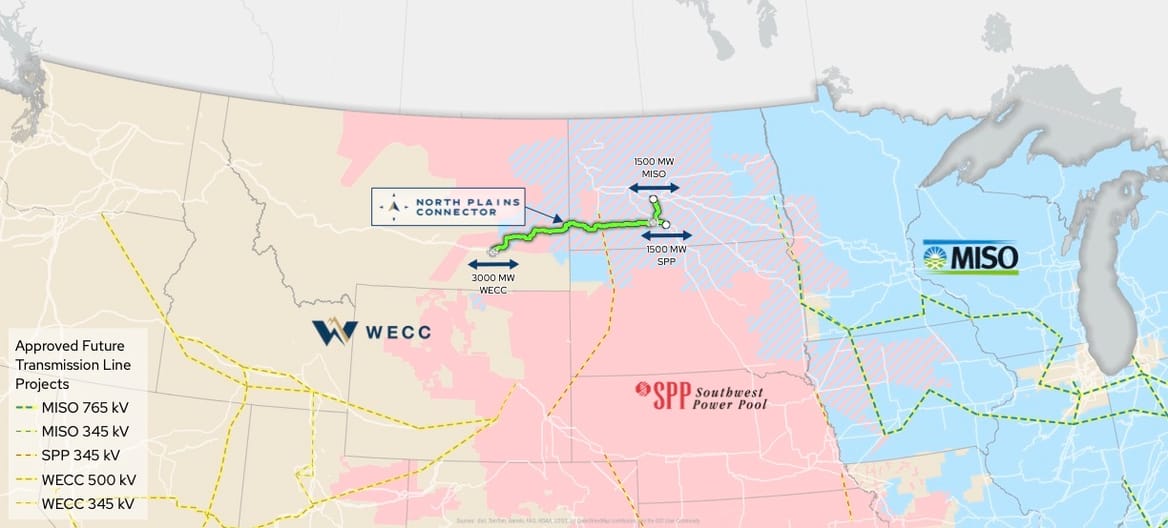
Grid United’s North Plains Connector will be a 420-mile, 3-gigawatt high-voltage direct current (HVDC) link between Montana and North Dakota. It will require an estimated $6 billion in investment across both states, and won’t be completed until 2032 at the earliest.
When it’s done, North Plains Connector will be able to share power between three grid regions spanning three time zones across the U.S. West, Great Plains, and Upper Midwest. Today, such region-spanning connections are extremely rare. But study after study has shown they can yield major benefits that extend far beyond the states the line transects.
“If you connect two grids whose peak moments are at two different times, you create an ability for the grids to lean on one another,” Skelly said.
The reliability and cost benefits that could flow from linking entire regions are almost certainly substantial. But it’s hard to quantify all the good that can come from such links when they have never existed before — and utilities and regulators want to be able to clearly define long-term benefits before they approve major investments.
Grid United’s solution is to front the costs for getting the project off the ground while trying to convince utilities to join in paying for a portion. Financing from the DOE is helping immensely with navigating these early costs and risks — and in getting utilities on board.
Back in 2024, the DOE awarded a $700 million grant to the consortium, including Grid United and the Montana Department of Commerce, which is the lead agency for administering the award. And last week, the DOE published a final environmental impact statement for the project, helped along by a federal interagency process launched under the Biden administration.
The Trump administration has continued to work with Grid United, even as it has clawed back or delayed billions of dollars in other Biden-era grants and terminated a $4.9 billion DOE loan for the Grain Belt Express, another massive HVDC line meant to carry wind and solar energy from the Great Plains to states farther east.
For North Plains Connector, having that federal money available “is quite helpful to the utilities that are participating in the project as they go through regulatory approvals,” Skelly said. Regulators “want their states to get their fair share, if you will — and they also want customers whose utilities are paying for the project to not have to pay for the whole thing.”
This combination of the DOE and Grid United taking on the early costs and risks has given a growing list of utilities enough confidence to make at least conditional commitments to pay for a piece of the project once it’s finished.
Some of them are directly involved in the states where it’s being built, such as Minnkota Power Cooperative and NorthWestern Energy. While others — such as Allete Energy and Great River Energy in Minnesota, Portland General Electric in Oregon, and Puget Sound Energy in Washington state — are joining up to earn a share of the reliability and cost benefits that will flow indirectly from the project and across the grid regions it will link.
Those far-off utilities don’t need to draw power directly from the end points of the HVDC line to gain the benefits, said Gretchen Kershaw, chief operating officer at consultancy Grid Strategies, which is not involved in the project. That’s because HVDC lines enable two-way flows of power that can energize and backfill shortfalls across entire regional grid networks.
Being able to tap into generation well beyond their borders makes it easier for utilities to deal with disruption or demand spikes caused by intense weather events like winter storms or heat waves. That’s one of the benefits cited for North Plains Connector in last month’s draft National Transmission Needs Study, the most recent in a series of DOE reports highlighting the value of these kinds of interregional connections.
“The most reliable and resilient system will have diversity in generation supply, both in terms of types of generation and location,” said Kershaw, who previously worked as a senior adviser to the DOE’s Grid Deployment Office, which was the source of the North Plains Connector grant but disbanded by the Trump administration last year. “You’re essentially able to make the system bigger, with generators and customers on both sides, and weather systems that are different at both ends.”
Those are some of the benefits that drew Allete to partner on the North Plains Connector project in 2023.
“We knew this energy transformation happening in our nation is going to require people to go well beyond the boundaries of their previous business and service territories,” said Julie Pierce, vice president of strategy and planning for the utility and energy company.
Allete owns Minnesota Power, a utility serving about 150,000 customers, as well as renewable energy subsidiaries including wind farms in North Dakota, which happen to be connected with a decades-old HVDC line to its Minnesota territory.
Allete is also part of a group of utilities that developed a large-scale, multi-utility grid-expansion plan in the early 2000s, which helped lay the groundwork for billions of dollars in additional regional transmission buildouts in the Midwest, Pierce said.
A key step in convincing other utilities to sign on is figuring out how to measure the new interregional line’s resource adequacy value. That’s the term of art for how utilities ensure they can keep their grids running during times of high demand, power plant outages, severe weather, or other emergencies.
“It’s so massive, it’s hard to put boundaries around what it’s going to enable,” Pierce said. “How do you value the ability to keep lights on in the Upper Midwest when there’s a storm coming through, but you’re able to import that solar from California?”
That work has some clear starting points, she said. Utilities can start to incorporate the reliability value of their share of the line into the integrated resource plans they file with state regulators, which lay out how much new generation and grid investment they need to make over the next decade or more.
North Plains Connector has its work cut out for it beyond measuring resource adequacy. Before it can break ground, it must make agreements with landowners along the path of the line, secure state and local permits, and win final regulatory approvals from both states it passes through.
“These projects take many years to put together,” Skelly said.
Indeed, high-profile transmission lines like the SunZia project from New Mexico to California and the Champlain Hudson Power Express from Canada to New York City have taken more than a decade from inception to completion. Many transmission projects fail to overcome hurdles. Skelly’s previous company, Clean Line Energy Partners, shut down in 2019 after failing to complete five power lines to carry 16.5 GW of wind power across the Midwest.
But if North Plains Connector can get connected, “the project will be online for 30 years,” he said. “What does generation in America look like in 2050? I don’t know. But it’s very likely we have very different demand profiles in each system, and whatever generation we have in that time, we’ll be better able to optimize if we have a great grid to lean on.”
The outlook for storage construction keeps getting brighter as everyone from the Trump White House to clean energy advocates to AI giants clamors for more.
There’s never been a better time to build energy storage in the U.S. than right now.
Grid batteries — which sop up power when it’s abundant and discharge that energy when it’s needed — have been ascendant for a decade, as the price of the underlying lithium-ion cells fell precipitously. Bolstered by plummeting costs and increasing familiarity with the tech, developers started building bigger and in more parts of the country.
Now, the U.S. power sector has added more battery capacity in the second quarter of this year than any quarter ever, according to a report out today from the Solar Energy Industries Association and Benchmark Mineral Intelligence. Even as the wind and solar industries face uncertain futures, the outlook for continued battery growth is so strong that Benchmark Minerals upped the prediction for cumulative installs through 2030 by 11.5% from its previous report, issued just three months ago.
The 20.2 gigawatt-hours of battery capacity built from April through June represents one-tenth of the nation’s entire grid storage capacity. Seven of the new projects mustered at least 1 GWh or more of storage capacity, reflecting developers’ rising appetite for megabatteries.
To contextualize the numbers, the second-quarter installations can inject 6.7 gigawatts of instantaneous power onto the grid — equivalent to nearly seven big old-school nuclear reactors, but without the decade-plus wait time for construction. That comparison has its limits, though, because nuclear plants can generate around the clock, whereas batteries must refill and discharge.
Batteries can make a huge difference in places where the grid is stretched thin, and can be built quickly and closer to centers of energy consumption than new fossil-fuel-burning plants with their smokestacks and emissions.
Those qualities make the tech attractive in places where capacity is scarce, which happens to include California, Texas, the Southeast, the mid-Atlantic, the Northeast, and just about anywhere else. AI data center developers are turning to batteries to ensure they can keep the algorithms running during peak demand hours. And solar developers leverage batteries to turn their clean electrons into a more valuable on-demand resource; 44% of the new storage capacity was built alongside solar plants.
This widespread zeal for batteries extends to the Trump White House, which revoked wind and solar subsidies last year but kept Biden-era tax incentives for batteries. As the executive branch found novel and often legally dubious means to thwart wind and solar construction, it has left battery developers to go about their business.
Recently, the administration has more proactively encouraged the battery industry, loaning $490 million dollars to a battery project in Puerto Rico as well as funding efforts to reshore the supply chain for critical minerals used to make the tech. Energy Secretary Chris Wright, who regularly blasts solar power on his official platforms, recently stopped by the Maine site of a novel iron-air battery that Form Energy plans to build, with help from Department of Energy grant funding.
An observer unencumbered by historical nuance might conclude that Trump is the battery president, and that no president has done more for batteries than he. SEIA even gestures in that direction, noting in its press release that large-scale storage nearly doubled during the first year and a half of the second Trump term, and that 74% of the second-quarter storage additions happened in states that voted for him — like Texas, Utah, and newly minted battery storage powerhouse Arizona.
The reality is these outcomes took years to build up to. Technologists tinkered with batteries in big boxes; California mandated its utilities buy storage and subsidized it for smaller customers; Texas wildcatters took big risks on early battery investments and made windfall profits; and companies like LG and Tesla built huge factories to solidify domestic battery supplies. Now, all that hard work is paying off with installations on a scale we’ve never seen before.
The Demand Side Grid Support program was given no money for next year, though supporters blocked an effort that could have disbanded the VPP altogether.
California Gov. Gavin Newsom’s administration has blocked an effort to keep the state’s most successful virtual power plant program funded through next year.
State budget language finalized last week does not authorize additional money for the Demand Side Grid Support program, one of the biggest VPPs in the country. Friday was the last day for bills to be published before being voted on by the Aug. 31 deadline for this year’s legislative session.
But that budget language also excluded a plan from Newsom, a Democrat, to shift control of the program from the California Energy Commission to the California Public Utilities Commission, which DSGS supporters feared could lead to it being dismantled entirely.
That means that while “there is no guaranteed funding for the program for next year, at the very least it wasn’t outright gutted,” said Brandon García, California policy director for Advance Energy United, a clean energy trade group that reported the outcome of the DSGS negotiations on Friday.
Newsom’s office did not immediately respond to a request for comment.
A spokesperson for Democratic state Sen. Josh Becker, a DSGS supporter and author of several virtual power plant bills that passed both houses of the legislature last week, confirmed that the $70 million “we were hoping to use for DSGS over the next couple of years was not agreed on” in the final budget bills. At the same time, leaving the program under control of the California Energy Commission “does allow us an opportunity to take this issue up early next year, potentially with a new administration,” the spokesperson said.
Still, that’s cold comfort for the companies participating in the program, which pays households and businesses willing to turn down power use or share solar power stored up in batteries at times when California’s grid is under stress.
Since it was launched in 2022, DSGS has grown to include around 130,000 homes equipped with batteries and nearly 75,000 homes with smart thermostats and flexible load devices. The performance of its rooftop solar–charged batteries has been particularly noteworthy; a July 2025 test yielded roughly 476 megawatts of grid capacity over two hours, in what utility Pacific Gas & Electric called “the largest test of its kind ever done in California — and maybe the world.”
All told, DSGS has brought online more than a gigawatt of collective capacity to relieve costly stresses on the state’s power grid, García said.
Absent an intervention from lawmakers and California’s next governor sometime next year, “we don’t anticipate there being any more money for this program,” García said.
And without secure funding, it’s unclear how companies like Sunrun, Tesla, Leap, Renew Home, and others participating in DSGS will be able to pay their customers to help the grid.
That’s unfortunate, because DSGS stands out in a state that’s largely failed to tap into its nation-leading supply of rooftop solar–charged batteries and electric vehicles as an alternative to utility investments in power plants and transmission lines, said Sachu Constantine, executive director of nonprofit advocacy group Vote Solar.
“We should pursue every avenue available to use these resources that customers and companies have already invested in, that are already providing invaluable resources for the grid,” he said.
Similar programs regulated by the CPUC and administered by utilities have largely failed to thrive. That includes the CPUC’s Emergency Load Reduction Program, another approach to enlisting customers to relieve grid stresses that was created alongside DSGS in response to California’s grid emergencies from 2020 to 2022.
Paying customers with solar-charged batteries, smart thermostats, and remote-controllable EV chargers can also help lower utility bills for residents who don’t have those devices.
That’s because a large portion of the costs being passed on to customers of California’s three major utilities, which now charge among the highest rates in the continental U.S., are driven by the need to pay for fossil-fueled power plants and invest in grid infrastructure to meet peaks in grid demand.
By cutting funding for DSGS, California may be undermining a more economical way to defer those costs “at a moment when utilities are earning record profits and bills are going up, reliability is in question, and we’re continuing to prop up old, outmoded resources that don’t make sense for the future,” Constantine said.
Despite the potential cost savings, DSGS had its budget cut in 2024 and 2025, and was allocated no money in Newsom’s January budget proposal, leaving it at risk of being unable to pay participants this year. Early this summer, lawmakers were able to negotiate a transfer of $27 million from another program to keep DSGS running through 2026, García told Canary Media.
But lawmakers couldn’t overcome opposition from the Newsom administration to secure funding to pay DSGS participants in 2027. The final budget bills drafted by the legislature on Friday failed to include a proposal from Senate Democrats that would have shifted $70 million from another California Energy Commission program to cover those costs.
“We’re incredibly disappointed the administration rejected the legislature’s proposal to fund DSGS. It’s baffling,” García said.
García warned that DSGS participants don’t have much time to wait. “Even if the next incoming administration wants to fund DSGS, if they wait until June, I don’t know how many participants will be around to enroll in that program,” he said.
So far this year, it has built more battery capacity than any state besides Texas. But political shifts could complicate the long-term growth trajectory.
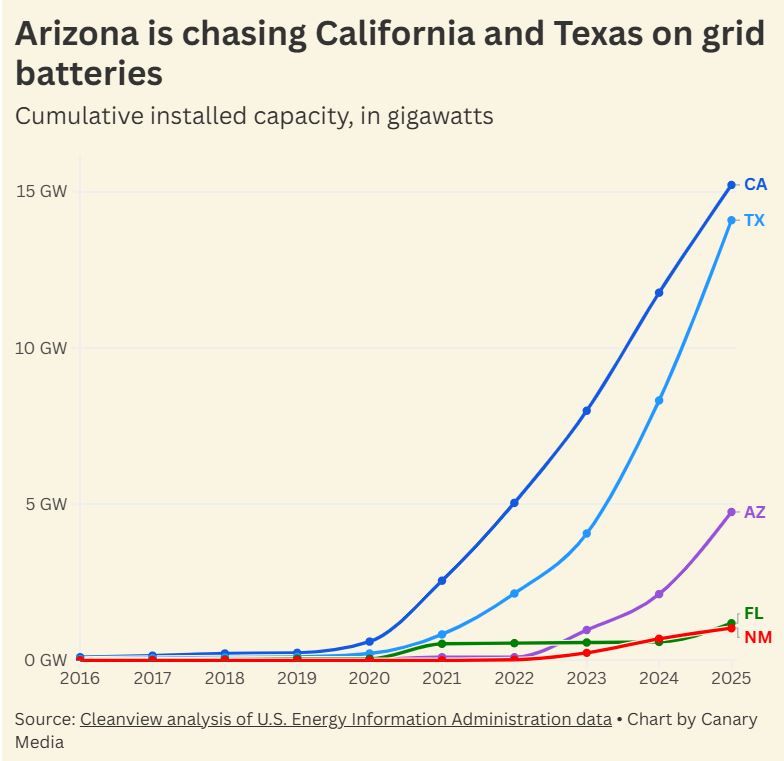
California and Texas have led the charge on America’s grid battery revolution. Now, a third state is racing to catch up: Arizona. The Grand Canyon State installed more battery capacity than every state besides Texas over the first half of 2026, per a Canary Media analysis of U.S. Energy Information Administration data.
It’s the continuation of a trend from last year, when Arizona also edged out California in both storage and utility-scale solar additions. In recent months, Arizona welcomed three new battery projects with 250 megawatts/1 gigawatt-hour of storage each — Beehive, Catclaw, and Pediment — plus several smaller ones.
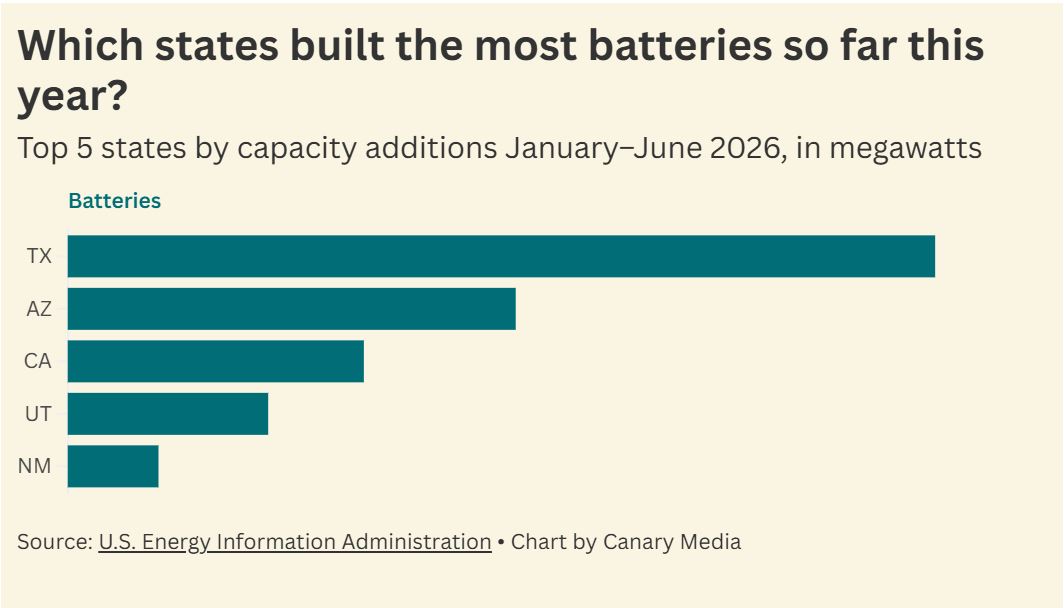
Arizona also effectively tied Florida for the second most solar installations in the first half of this year (again following Texas) and rounded out its portfolio with 300 MW of gas power and 500 MW of wind.
To be clear, Texas and California still have far more solar and storage plugged into their grids. Battery storage has already helped both states avoid grid shortages heading into heat waves or cold snaps, and pushed wholesale prices down by offsetting more costly gas power with cheap solar generation stored from sunnier hours. But Texas and California were the only states that had managed to unlock perennial multi-gigawatt battery construction until now.
Arizona is currently expanding the map of grid storage dynamism — though some renewable energy advocates worry that a recent turn against clean energy in the state could cause the growth to fizzle out.
Texas and California are special cases. Texas lets batteries compete in an open, deregulated market for energy, and investors flooded in when they saw there was good money to be made. California painstakingly funded years of storage policies to complement the state’s grid decarbonization goals, mandating that utilities invest in batteries while making new gas plants nearly impossible to build.
Arizona doesn’t have a Texas-style free market for energy; its customers are served by a handful of vertically integrated monopoly utilities, namely Arizona Public Service (APS), Tucson Electric Power, and the Salt River Project. Nor does the state boast a California-style mandate or policy apparatus. Indeed, the state’s elected board of utility regulators just went out of its way to eliminate the meager renewable-energy target that had been on the books for two decades.
But Arizona does have ample sunshine and clear, dry weather, making solar the obvious winner for cheapest kilowatt-hour of electricity. In such places, a rapid buildout of solar projects leads to diminishing returns — unless you use batteries to store up surplus solar during the sunniest hours of the day.
To properly understand the boom in battery construction today, one must look back to market conditions around five years ago, when the utilities were awarding the contracts for these plants, said Autumn Johnson, executive director of the Arizona branch of the Solar Energy Industries Association.
In 2018, the Arizona Corporation Commission chastised APS for relying too heavily on gas power plants in its long-term planning, prompting the company to take batteries seriously as a cost-effective source of peak power. The Biden administration passed the Inflation Reduction Act in 2022, solidifying a decade’s worth of tax credits for installing solar and batteries. Within a few years, all the state’s major utilities had pledged to decarbonize their fleets by mid-century.
The wave of storage projects built in recent years is the result of contracts the utilities signed in those heady times, Johnson said.
But the political landscape in Arizona and nationally has shifted since then, casting a pall over the future of the state’s solar and storage buildout.
The Trump administration gutted Biden’s climate law last year, though it preserved tax credits for batteries specifically. APS abandoned its own climate goals. The utility regulator is picking performative fights with clean energy instead of pushing the utilities to be more ambitious. The state legislature this year proposed “a record number of terrible energy bills,” Johnson said, including ones to mandate that 85% of electricity capacity come from dispatchable or baseload sources (not intermittent renewables) and to label wind and solar farms a “public nuisance” if they fall within 4 miles of a residential property.
And while the utilities can’t change the fundamental economics of solar and batteries, they can change how they assign contracts, Johnson noted.
APS, the biggest battery builder in the state, said in a July planning session that it was excluding four-hour duration batteries from modeling for its long-term energy plans, limiting the options to those with six to eight hours of duration. Four-hour batteries have in recent years become the standard type of peaker plant getting built in California and Arizona, but now APS seems to be taking them off the table. Adding more hours of energy discharge provides greater coverage for the grid but increases construction costs.
“Given all the changes, will we keep our top spot in five years?” Johnson asked of Arizona’s energy storage leadership. “I’m not sure it will be a long-lived reign at the top.”
At the very least, construction will continue at a rapid clip through 2026, according to the EIA data, anchored by the nearly finished Maricopa Energy Center, which includes a 550-MW/2.2-GWh-hour battery. Seven battery projects are already under construction for 2027 completion, ranging from 100 MW to 300 MW. Utilities will need to be signing new contracts now to keep the momentum going into the 2030s.
Trump officials touted the storage and EV plant as an example of “energy dominance,” underscoring increasing bipartisan acceptance of grid batteries.
LANSING, Mich. — The Trump administration has made clear its disdain for electric vehicles and clean energy. Yet at the grand opening of South Korea–based LG Energy Solution’s latest battery manufacturing facility, Interior Secretary Doug Burgum cheered the factory as a fulfillment of the president’s agenda.
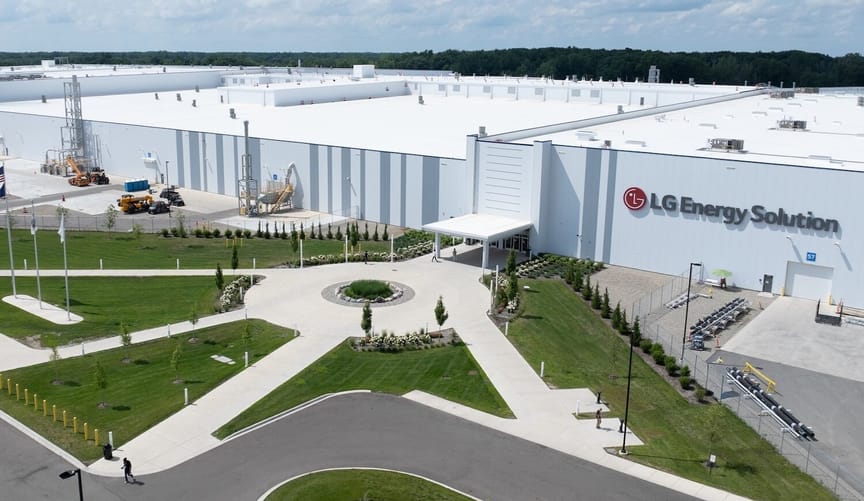
“That’s the American energy dominance in action, which is more jobs, strong allies, secure supply chains — and right here, that’s happening,” Burgum said Tuesday during the Lansing factory’s opening ceremony.
LG executives have framed the plant’s opening in similar terms, echoing the administration’s focus on energy security and the importance of making the tech in the U.S., given that China produces most of the world’s batteries.
And like many of its peers in the industry, LG has adapted wide swaths of its Lansing site, originally meant only for EV batteries, to make what is proving to be a more politically palatable technology: energy storage systems for power grids.
“No matter which side of the aisle you’re on, there’s a desire to have energy independence and to meet load growth,” said Devon Wilson, vice president of sales and marketing for LG’s U.S. energy storage division.
LG invested more than $2 billion into building its new Lansing plant, which currently employs 900 people and plans to hire approximately 800 more.
Once at full capacity next year, the facility is expected to produce more than 35 gigawatt-hours of battery cells annually, according to Anthony O’Donovan, the plant’s operations director. That would make it one of the biggest domestic plants producing cells, which are the individual building blocks of battery systems, LG Energy Solution spokesperson Phil Lienert confirmed.
From Lansing, the cells will go to plants across the country — including both to clients and to one of LG’s own facilities in Holland, Michigan — to be connected together to form battery modules, which are then arranged into battery packs, Lienert said.
This domestic network of battery manufacturing is very new, and arriving just as battery energy storage systems themselves grow at a rapid clip. The U.S. didn’t make any of its own battery cells until 2025, when companies including LG added a total of 20 GWh of manufacturing capacity, according to the U.S. Energy Storage Coalition, an industry group.
By the end of this year, the coalition expects that figure to increase nearly fivefold, to 96 GWh of cell production capacity.
The Lansing facility was first announced in 2022 as part of Ultium Cells, a joint venture between LG and General Motors to source battery cells for the Michigan automaker’s EVs.
By 2024, however, consumer interest in EVs was lagging, and President Donald Trump vowed on the campaign trail to slash federal support for the vehicles. At the end of that year, GM sold its stake in the Lansing factory to LG, making the Korean company the site’s full owner.
The Trump administration has since eliminated the $7,500 tax credit for consumers who purchase EVs and canceled more than $700 million in federal funds for battery and EV manufacturing projects. (It did, however, preserve tax credits for clean energy manufacturing facilities and for the installation of stationary storage systems.)
By the end of 2025, dozens of battery and EV manufacturing projects were canceled nationwide, totaling more than $21 billion in lost investment, according to a report from E2, a clean energy advocacy group. Michigan, which had banked on exactly these types of projects to grow its economy, given its automotive prowess, was hit the hardest.
So, LG leaders decided to embrace a more promising sector: energy storage.
In the last few years, energy demand in the U.S. has surged in part because of the massive data centers being built for the artificial intelligence boom. Battery storage systems are well-positioned not only to swiftly meet tech companies’ demand for power, but also to absorb the sharp dips and spikes in energy usage inherent to AI data centers, Wilson said.

“It’s a great situation for us,” Wilson said. “We’ve seen an explosion in the size of the ESS [energy storage system] market, so we’ve really been able to grow our demand.”
In just four years, the amount of battery storage capacity in the U.S. has increased nearly tenfold, from 4.7 gigawatts in 2021 to 43.6 gigawatts at the end of 2025, according to the U.S. Energy Information Administration.
This year, developers have already built 8.2 gigawatts of battery storage nationwide, according to the EIA — a statistic that Michigan Gov. Gretchen Whitmer, a prominent Democrat, hailed as “amazing” at the opening of LG’s Lansing factory.
She also referenced Michigan’s “historic clean energy law” that requires 2.5 gigawatts of battery storage, which are often installed alongside solar farms to help stretch the carbon-free energy into other times of the day, by 2030.
“Michigan is poised to take advantage of this growth,” Whitmer said.
In line with market shifts, the Lansing plant has diversified so that it will produce roughly half EV battery cells and half energy storage cells, according to Bob Lee, the North American president of LG Energy Solution.
The EV battery cells will no longer go to GM, but to Toyota. And the plant will produce nickel-manganese-cobalt cells, which are more energy-dense, according to LG’s press release.
Meanwhile, the energy storage cells have been contracted by a variety of offtakers, including renewable-project developer Terra-Gen and Korean clean energy manufacturer Qcells, LG spokesperson Lienert said. These cells will be lithium-iron phosphate, which isn’t as energy-dense as other chemistries but has less of a fire risk.
Next year, as the Lansing facility ramps up, it is also expected to supply Tesla’s Megapack 3 factory in Houston, an agreement that Lienert confirmed but would not elaborate on.
First reported by Reuters last summer, the $4.3 billion LG-Tesla deal was officially announced in March — but by the Trump administration as part of its focus on energy security, not by the companies.
Now that it’s up and running, the Lansing facility joins LG’s growing portfolio of cell manufacturing sites. The Korean company still runs two Ultium EV battery plants with GM, one in Tennessee, another in Ohio.
Last year, LG expanded its flagship Michigan site in Holland, which in 2012 became the first in the U.S. to make EV batteries, to also produce energy storage battery cells and packs.
And this March, LG held a grand opening for its facility in Windsor, Ontario — the first commercial-scale battery manufacturing plant in Canada as well as the company’s largest North American plant, Lienert said.
“We’ve almost got a perfect latitudinal line now that extends from Holland through Lansing to Windsor,” Lienert said. “We think of this as being the belt of ESS battery manufacturing for North America.”
As the legislative session nears an end, lawmakers push ahead bills that aim to stop AI centers from raising utility costs and spur builders to opt for clean energy.
California, with its sky-high electricity prices, isn’t facing the same influx of data centers that many other states are. But the massive facilities are still being built and proposed in California — and legislators are racing to stop them from pushing up utility rates and pollution.
Two major data center bills passed a key committee last week as California’s legislative session nears its close at the end of this month. Senate Bill 886 aims to prevent data centers from raising utility costs for other consumers, while SB 887 would incentivize developers to invest in clean energy and nearby communities.
Data centers have lawmakers nationwide walking a fine line. Voters are increasingly worried about the facilities’ impacts on energy affordability and the environment, but the industry also promises jobs and economic benefits. State Sen. Steve Padilla, the Democrat who penned both California bills, says his proposals would rein in the sector without stifling it completely.
“People are asserting that it’s a binary choice” on data centers — “you can either ban them all, which is some communities’ reaction, or you can have zero regulation,” said Padilla, whose bills were inspired by a high-profile conflict between a data center developer and residents in a county he represents.
“I think we can walk and chew gum at the same time,” he said. “We can protect consumers and communities, and support infrastructure that supports tech companies and jobs.”
SB 886 takes on the first part of that equation. It would require the California Public Utilities Commission to set rules for data centers of at least 25 megawatts to fully cover the costs they impose on customers of the state’s three major utilities. Data centers would pay for the new power generation and grid upgrades they need, along with a “reasonable share” of the fees utilities collect for wildfire mitigation, environmental programs, and other social initiatives.
This is not a new approach, with many states already enacting similar “large load tariffs.” Along with these requirements, SB 886 would create a mandatory demand-response program that forces data centers to stop pulling power from the grid during supply-demand emergencies. Similar mandates are under consideration in places like Texas and the 13-state region served by grid operator PJM Interconnection.
SB 887, meanwhile, would offer expedited state environmental review for data centers “if they commit to high standards and serving communities,” Padilla said. Data centers seeking this special treatment must get 100% of their hourly electricity consumption from carbon-free resources within five years, 75% of it newly built. And they’ll need to draw from zero-carbon backup power — most likely batteries — when the grid is under stress, rather than using diesel generators, which are installed by almost all data centers. Developers would also have to pay for grid interconnection costs in advance and commit to a community benefits plan.
Although California has yet to see the massive, gigawatt-scale data centers being built in some states, several larger-scale projects are in the works near Silicon Valley. Those include Microsoft’s 48-megawatt data center in San Jose, developer Stack Infrastructure’s 77-megawatt data center in Hayward, and, most recently, Google’s 250-megawatt research and development center in San Jose.
More data centers are coming. Northern California utility Pacific Gas & Electric has 10 gigawatts of demand from data centers in its pipeline over the next 10 years, equivalent to what’s needed to power roughly 7.5 million homes. PG&E says that load growth will create billions of dollars in tax revenue and — more important to its customers — lower electric bills by 10% or more “by spreading fixed costs across more energy usage.”
Environmental and consumer groups are skeptical. The Union of Concerned Scientists warned in a May report that the state “currently has too few protections to ensure data center costs are not passed along to ratepayers.”
“The data center developers don’t really care about costs,” said Matthew Freedman, senior staff attorney with The Utility Reform Network, a consumer advocacy group that supports SB 886 and SB 887. “They’re focused entirely on speed of development, and on proximity to Silicon Valley.” Meanwhile, PG&E and the state’s other investor-owned utilities earn guaranteed profits based on how much money they invest in capital infrastructure, giving them little incentive to control those costs, he said.
Although SB 886 has won the support of utility worker unions, PG&E opposes it. In an email to Canary Media, company spokesperson Paul Moreno said the bill would “introduce rigid, duplicative requirements that conflict with existing regulatory processes, risk higher costs for customers, and delay critical infrastructure needed to serve the state’s growing energy demand. We continue to work with lawmakers to improve the bill, so it better supports affordability, reliability and equitable cost allocation for all customers.” PG&E has taken no position on SB 887.
Both bills face pushback from the Data Center Coalition, a trade group representing major data center developers, natural gas generator company ERock, and business organizations. The groups wrote in a March letter that data centers shouldn’t be “singled out” for different treatment from other big power-using customers. They also fear that SB 886’s demand-response mandate could force them to curtail computing operations relied on for critical health care and government services.
Meanwhile, the coalition argues that SB 887’s clean power requirements are virtually impossible for data centers to meet. “We don’t see it as a streamlining mechanism, because those standards are not attainable,” said Khara Boender, Western government affairs director for the group.
It’s unclear how Gov. Gavin Newsom (D) will respond to bills opposed by politically powerful utilities and tech companies. Last year, Newsom vetoed a bill that would have required data centers to report their water usage. And Padilla said his 2025 proposal to create a new rate class for data centers was watered down to a “study” bill requiring the utility commission to examine and report on their energy cost impacts.
But the politics are shifting. A recent poll commissioned by Net-Zero California, a Sacramento-based environmental policy group that supports SB 886 and SB 887, found that 70% of voters in the state oppose data centers in their communities, and that 74% want to see requirements for data centers to cover their costs and use clean energy. Newsom recently told reporters that “it’s absolutely essential and appropriate that these hyperscalers pay their fair share,” citing Google and Microsoft specifically.
Padilla said he expects SB 886 and SB 887 will pass in the state Senate and Assembly before the end of the legislative session this month. Newsom has until the end of September to sign bills into law.
While solar and EV sales cratered after the Republican Congress eliminated federal tax credits, batteries bucked the trend. Here’s why.
Last fall, as generous federal incentives for consumer cleantech were set to expire, people raced to lock in good deals on EVs and rooftop solar. Then, this year, sales cratered.
But home batteries bucked the trend. Federal tax credits for residential storage expired at the end of last year, prompting record sales in Q4 of 2025 — and then sales climbed even higher in the first quarter of 2026, per a BloombergNEF analysis of U.S. Energy Information Administration data. Homeowners installed a total of 673 megawatts of battery storage in Q1 of this year.
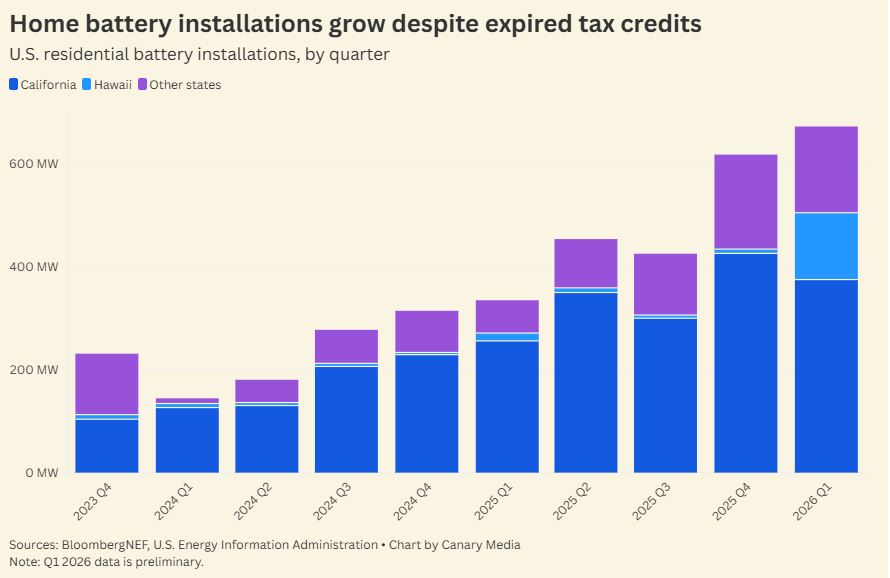
A few factors explain the market’s resilience. There’s the zeitgeisty reason: Across the nation, utility bills are high and rising, and batteries, typically paired with rooftop solar, offer people the ability to radically reduce their reliance on the centralized grid. There’s also the wonky explanation: State policies meant to spur home battery adoption are now doing just that.
Adoption is highest in the states where these factors — high electricity costs and supportive policy — coincide. California has since 2023 incentivized households to pair storage with solar, and in both 2024 and 2025 the state accounted for around three-quarters of home battery installations nationwide. Meanwhile, Hawaii, which has the highest electric bills in the country, created a new storage incentive program last year that resulted in a surge of installations in Q1 of this year, per BNEF.
The rising adoption comes even as the rooftop solar market struggles. Last year’s Republican tax and spending bill, the One Big Beautiful Bill Act, eliminated long-standing tax credits that knocked 30% off the price of both rooftop solar and storage systems. As a result, BNEF expects that this year residential solar installations will fall to their lowest level since 2020.
The stubborn growth of residential energy storage is another reminder that batteries are fast becoming a critical part of the U.S. electricity story. Large-scale batteries, for which Republicans actually preserved tax credits in last year’s law, are being built at a blistering pace. Expect home battery adoption to keep climbing, too.
Firms that enlist homes to reduce energy demand — and costs — have long complained that utility data rules prevent them from helping in PJM. FERC agrees.
A recent ruling from federal regulators will let virtual power plants help meet surging energy demand in the county’s biggest energy market.
Late last month, the Federal Energy Regulatory Commission ordered PJM Interconnection to accept statistical sampling as a valid method for measuring the reliability of programs tapping into demand-response and virtual-power-plant programs, which pay customers to turn down energy use as needed. The decision requires the grid operator to reconsider strict data rules that had prevented providers of this carbon-free resource from participating in PJM’s constrained energy-capacity market.
In its decision, FERC ruled in favor of Voltus, which runs demand-response and virtual-power-plant programs, and the Mission:data Coalition, a nonprofit advocacy group, and against PJM’s desire to preserve its status quo.
FERC agreed with Voltus and Mission:data that, under its current rules, PJM is losing out on at least 4.9 gigawatts of capacity — the equivalent of several large power plants — “at a time when PJM is experiencing unprecedented load growth driven in part by hyperscale data center development, threatening reliability.”
Booming power demand from data centers and bottlenecks in power plant construction are not just threatening reliability in PJM but also driving up energy costs for the 67 million people it serves across 13 states. FERC found it would be “unjust and unreasonable” to allow the current rules to stand.
Last month’s ruling caps a yearslong fight from providers of demand-response and virtual-power-plant services.
“This is a huge win, and we’re really optimistic that it will unlock hundreds of megawatts of residential load over the next several years,” said Marissa Galizia, Voltus’ senior director of partnerships. FERC’s order makes clear that “PJM has the power to change the rules even while utilities aren’t providing the data,” she said.
At issue was PJM’s concern about relying on third-party demand-response aggregators to reduce household electricity demand when needed. PJM insisted that Voltus and other demand-response firms must furnish detailed evidence that participating households actually cut power when prompted to do so. Specifically, PJM required smart-meter data, which is collected in the service territories of most utilities PJM covers.
If firms could not produce that data, PJM would not count on — or pay for — that demand-response capacity to show up during times of peak demand.
But for the most part, demand-response firms could not get their hands on that data. That’s because, as Voltus and Mission:data argued to FERC, most of the major utilities in PJM territory have failed to make that data from their digital smart meters readily available.
It’s a catch-22. And as a result, PJM has missed out on gigawatts of demand-response capacity that could have helped alleviate the reliability and cost crunch it faces — and aggregator firms have been essentially locked out of the lucrative capacity market.
Utilities blame states’ data privacy regulations for their conservative management of smart-meter data. FERC doesn’t get to tell states how to manage those data privacy and data access rules, but it can compel PJM, which it has jurisdiction over, to accept alternative forms of data.
That’s what FERC did in the July decision.
Given the “significant barriers to obtaining interval meter data,” FERC told PJM to allow aggregators to use a statistical sampling method that the grid operator had relied on before smart meters existed. PJM also still allows this method for customers that don’t have smart meters. In light of those facts, FERC found that “statistical sampling is a valid method to approximate load reductions when interval meter data is not reasonably available.”
Both PJM staff and Monitoring Analytics, its independent market monitor, protested that letting demand-response companies use statistical methods could undermine reliability.
Monitoring Analytics argued that allowing statistical sampling would “degrade PJM’s ability to maintain resource adequacy and to correctly determine efficient capacity market prices through supply and demand.”
FERC disagreed, citing evidence presented by Mission:data and Voltus showing that statistical sampling can be as or more accurate than methods that use metered data when applied to large numbers of homes, as opposed to single large customers like factories.
The order won’t take effect immediately. FERC directed PJM to launch a proceeding to work with stakeholders to find a method that parties could agree on, with initial plans due within 45 days of FERC’s order.
“We’re going to be working with our partners to submit answers to the questions and propose what we’d like to see,” Voltus’ Galizia said. “Generally, we’d like to make it as easy as we can while guaranteeing that that process is as accurate as possible.”
FERC’s ruling comes at a tense time for PJM. Over the past year, the Trump administration and state governors have attacked the grid operator for failing to mitigate the huge increase in capacity market prices that are driving up utility rates and driving public anger against utilities and data center developers.
“I hope the decision sends a message to PJM and its stakeholders,” said Ken Schisler, chief legal and regulatory officer at CPower, a demand-response company that brought a similar complaint that FERC rejected in 2024 for lack of evidence. “The message is to stop the nonsense and to remove barriers that are keeping demand response from growing in the market.”
Michael Murray, president of Mission:data, hopes the ruling will also add fuel to his decade-long effort to make utilities and state regulators unblock smart-meter data that technically belongs to customers.
FERC’s order doesn’t address the underlying state-by-state data-access barriers that Mission:data is working on — the agency doesn’t have the jurisdiction to do so even if it wanted to.
Still, Murray hopes it will push state regulators to revisit their data-access policies, since “states may not like the remedies that FERC comes up with in this case or in other cases.”
And more broadly, he said, it’s the first time the agency has acknowledged just how critical this issue is.
“FERC has finally recognized that what I’ll call data blocking is not just an artifact of state privacy laws, and it’s not something to just ignore and say, ‘Oh this is just a state matter,’” he said. “They definitely said that it rises to a Federal Power Act matter.”
The Department of Energy has canceled or stalled funding for thousands of projects that would improve the country’s stressed grid — and not just in blue states.
In Wisconsin, utility Alliant Energy has called off a project meant to reduce power outages in disadvantaged and tribal communities, after the Trump administration terminated a federal grant that would have supported it.
In California, the Sacramento Municipal Utility District, which has deployed and upgraded hundreds of thousands of advanced smart meters, has not received any reimbursement from the U.S. Department of Energy for the work since October, when the Trump administration declared it was killing grants that it described as fueling “the Left’s climate agenda.”
And in the upper Midwest, a consortium of regional grid operators, utilities, and state agencies is still waiting for $464 million in DOE funds meant to help build high-voltage transmission lines to reduce grid congestion — although the agency in charge of the project says the funding will soon be restored.
Across the country, hundreds of such projects to improve grid reliability and make electricity more affordable face a highly uncertain future — the result of Trump administration actions that have slowed the outflow of billions of dollars of DOE funds to a trickle.
Some of those projects in “blue states” were targeted as political retribution, as recent reporting from The New York Times has made clear. A handful of grant awardees in this category have won favorable court rulings, and more are seeking legal redress.
But many others are suffering from the DOE’s broader failure to carry out work that Congress has tasked it to do, according to groups that have been monitoring the agency since the start of last year. In red and blue states alike, the DOE is forcing thousands of grantees to undergo a laborious review process, so even projects that have not been officially terminated are stuck, unable to determine when or if they’ll start getting the money they’re owed.
According to an April report from the DOE Alumni Network, a group of former agency employees, the DOE has announced the termination of 356 awards totaling $12.5 billion since January 2025, and has threatened to terminate 303 additional awards worth $12.2 billion.
But the DOE has also stalled projects for “a large number of awardees who have never appeared on any list,” the report found. “This means the agency is not moving forward to resolve disputes, finalize conditional awards, or respond to continuation applications, leaving projects in administrative limbo and functionally freezing promised funds.”
“DOE both overtly canceled a set of projects, then had this pattern of behavior where for 15 months they stopped actively managing projects,” said one former DOE official. “Projects can’t proceed to the next stages and get their next tranche of funding.”
The former official, who asked not to be named, described a pattern of stalling, stonewalling, and “ghosting” utilities, state governments, energy companies, and nonprofit groups awarded grants under the Biden administration.
Many of those projects have been caught up in a process the DOE announced in May 2025 to review all financial assistance “on a case-by-case basis to identity [sic] waste of taxpayer dollars, protect America’s national security and advance President Trump’s commitment to unleash affordable, reliable and secure energy for the American people.”
Then, in October, the DOE announced the “termination of 321 financial awards supporting 223 projects” — all of them tied to states that voted for Kamala Harris in the 2024 election. The DOE’s termination announcement came right after Russ Vought, director of the White House Office of Management and Budget, declared in a social media post that the administration would cancel “nearly $8 billion in Green New Scam funding.”
Canary Media reached out to a subset of DOE grantees that had won funding from the Grid Resilience and Innovation Partnerships (GRIP) program created by the 2021 bipartisan infrastructure law. The DOE issued a total of more than 100 GRIP grants — in October 2023, August 2024, and October 2024 — for projects to enlarge the grid, harden it against extreme weather, build microgrids to protect vulnerable communities, and deploy technologies to integrate solar, wind, EVs, and batteries.
Some of the GRIP projects involve expanding clean energy and serving disadvantaged communities, two bugbears of the Trump administration. But many more are straightforward grid improvement projects that need federal dollars to reduce the costs borne by utilities and regional or state agencies.
The largest of these is in California. In 2024, the DOE awarded a $630.6 million grant aimed at upgrading more than 100 miles of high-voltage power lines in the state with advanced power cables capable of carrying more electricity along existing transmission corridors, a project estimated to be capable of delivering about $200 million in savings from improved energy efficiency. That project appeared on the termination list in October, and the DOE has not disbursed money for it, according to federal records, though negotiations for resuming funding are underway.
This uncertainty appears to apply to the majority of GRIP projects, according to Emlyn Bottomley, founder of the consultancy High Road Analytics, which focuses on workforce development, and a former Department of Labor deputy policy director in the Biden administration.
According to his tracking of federal spending, of the roughly $11.4 billion in DOE funds obligated to grid infrastructure and resilience — a category that includes GRIP program funds — $9.1 billion remains “at risk,” with funding stalled or timelines for completion shortened. That’s compared with $400 million in grants that have been canceled outright and $1.3 billion not yet disbursed but showing no signs of being stalled.
“It’s a shame these projects are being held up or canceled, especially since the case for them is fairly bipartisan — spanning national security, economic competitiveness, and cost and affordability,” Bottomley said.
All of the GRIP projects required partners to provide matching funds at an amount at least equal to the money DOE is providing, the former DOE official added. “You’re talking about folks putting hundreds of millions of dollars on the line. People have skin in the game for these awards.”
Many of the GRIP grantees contacted by Canary Media declined to comment, citing ongoing discussions with DOE. Others reported that they are no longer pursuing the projects as described in their grant applications, at least not with the help of DOE money.
The latter is the case for Alliant Energy’s Smart Power Automation in Rural Communities (SPARC) project, which won a $50 million grant in late 2024 to add grid visibility and control devices to 140 grid circuits in disadvantaged and tribal communities served by subsidiary Wisconsin Power & Light — a utility in a blue state.
Those devices could allow the utility to quickly find and isolate faults on its grid, cutting power outages in targeted communities by up to 50%. They could also support grid-management software to help integrate more renewable and distributed energy, and potentially expand wireless communications access to these remote areas.
Alliant “voluntarily withdrew” from the grant award process in April, six months after its grant was terminated by the DOE, Alliant spokesperson Melissa McCarville told Canary Media. The agency has disbursed no funds to the project, according to federal records.
Alliant is “actively pursuing many of the goals that were outlined in the SPARC project,” McCarville wrote in a May email, but as part of a 10-year strategic plan with no set timeline. “While the grant did provide valuable funding, it also required a significant investment, and we want to ensure our contributions are properly prioritized,” she wrote.
Still, at least one grant-funded project in a blue state is proceeding despite the absence of DOE funds.
That’s the case for the Sacramento Municipal Utility District, which serves the state’s capitol and environs. In 2023, SMUD won a $50 million grant to support a project to deploy 200,000 smart meters and grid devices and underlying software controls to “improve grid reliability, resilience, visibility and efficiency,” utility spokesperson Gamaliel Ortiz told Canary Media in an email.
SMUD has carried out much of that work, which includes close to $100 million in utility spending, and has received almost $33 million in reimbursements from DOE, according to federal records. However, SMUD “has not received reimbursement for any costs incurred after the grant was cancelled on October 10, 2025,” Ortiz wrote. “We remain committed to this critical work and stay flexible as we evaluate how the loss of grant funding may impact the project timeline.”
In other blue states, some grants have been canceled and others are still under negotiation. In Oregon, utility Portland General Electric has recently learned that the DOE may reinstate a previously terminated $50 million grant to support next-generation “grid edge computing” devices, utility spokesperson John Farmer told Canary Media in an August email. That project had received only $1.2 million in DOE funding, according to federal records.
The purpose of the project was to integrate batteries, EVs, and community solar into its grid to “improve resilience, enable the integration of distributed energy resources, and maximize customer investments in home energy solutions.”
“PGE is evaluating the benefits and risks of reinstating the grant,” Farmer told Canary Media. The utility “recognizes that there are inherent risks of additional and changing demands by the DOE as the administration’s priorities change.”
At the same time, PGE remains in discussion with the DOE on a $250 million grant to build a high-voltage transmission line with the Confederated Tribes of Warm Springs, Farmer wrote. “Without this funding, we would lose the opportunity to offset those costs with external dollars, which could limit how efficiently we can advance needed grid improvements.”
Red state projects are also being held up because the grantee is located in a blue state. Such is the case of the aforementioned $464 million DOE grant for the Joint Targeted Interconnection Queue project to build new transmission lines between the Midcontinent Independent System Operator and Southwest Power Pool, two grid operators spanning nearly a dozen Midwestern states.
The $464 million GRIP grant was meant to bolster $1.3 billion in matching funds from utilities in the region to enable nearly 30 gigawatts of new generation to be built in Iowa, Kansas, Minnesota, Missouri, Nebraska, North Dakota, and South Dakota. All but one of those states voted for Donald Trump in the 2024 election — but the Minnesota Department of Commerce, the entity awarded the grant, is in a blue state.
In May, the Minnesota Department of Commerce announced that the DOE “will honor its $464 million grant,” which will “unlock more than $1 billion in additional private investment and provide communities across the region with economic and infrastructure benefits.”
A DOE spokesperson told Canary Media in a July email that the DOE has conducted its review of GRIP projects based on a “number of criteria,” including whether it has “achieved the milestones set forth in the terms of the award,” whether it “remains technically and economically feasible,” and whether it “continues to effectuate the purpose of the program or the Department’s priorities.”
The spokesperson added that “none of the termination decisions were based on political considerations.” That statement is belied by court testimony reported by The New York Times last month, in which a DOE lawyer stated that none of the October grant terminations were “based on any programmatic, statutory, cost-reduction or performance-based factor,” and that all but one of them “had a recipient location and/or at least one place of performance in a state that awarded its electoral votes to Kamala Harris in the 2024 election and has two Democratic-caucusing senators.”
During a series of congressional hearings in April, Energy Secretary Chris Wright stated that the DOE’s review of more than 20,000 grants was almost complete, and that more than 80% of grantees had received notice that their awards could proceed as is or with modifications.
But an Alumni Network analysis of DOE data shared with Congress showed that the DOE’s review both failed to restore the vast majority of projects caught up in the “blue state” termination action in October and failed to address the hundreds of projects that have never been officially terminated but remain unable to secure funds.
The revelation of the DOE’s explicit targeting of blue states for grant termination spurred 39 Senate Democrats to sign a letter to Wright and Vought demanding the immediate restoration of funding for DOE projects terminated in October.
“Once an Administration begins punishing Americans for how they vote,” the senators wrote, “the threat extends far beyond these projects: no state, community, business, or worker can trust that the federal government will apply the law fairly.”
A correction was made on Aug. 12, 2026. The story initially stated that a DOE grant to the California Energy Commission was terminated. That grant appeared on a list of grants targeted for termination, but was not officially terminated, according to the CEC.
The startup, newly valued at $13 billion, is now manufacturing batteries in Texas. It offers an affordable way for homeowners to get backup power and it helps the grid too.
Home battery startup Base Power seems constitutionally incapable of standing still. After raising $1 billion last October, the Texas company has raised another $1 billion, and upped its valuation from $4 billion to $13 billion.
The latest investment, led by Ribbit, Addition, Valor Equity Partners, and JPMorganChase’s Strategic Investment Group, amounts to one of the largest validations so far for the theory that small-scale energy devices can play a role in meeting the nation’s ravenous demand for new power.
Households could easily spend more than $10,000 to buy their own batteries, but Base Power installs unusually powerful batteries at customers’ homes for an up-front fee ($95 to $695, depending on location) plus an ongoing electricity supply subscription. This model lets more homes access emergency backup power when the grid goes down, and cheaper power on normal days. In exchange, Base Power uses those energy storage systems to provide power to the grid when it’s most stressed — a service that makes money for the company.
Clean energy advocates have called for this kind of distributed energy model for years, saying that generating and storing power in homes and businesses can make more sense than relying on an increasingly expensive centralized grid, if only someone would compensate the systems properly. The market has been slow to heed their calls. But now AI companies are paying top dollar for energy wherever they can find it, and the idea of controlling thousands of dispatchable home batteries lights up investors like never before.
“There’s a real need on the grid for capacity in Illinois and Texas and frankly everywhere else in the U.S. now,” said Base Power co-founder and Chief Operating Officer Justin Lopas. “Distributed batteries are a way that we can add meaningful capacity to the grid.”
In less than three years of operating, Base Power has installed batteries at 17,000 homes, mostly in Texas but recently in Illinois as well. With the ability to provide more than 500 megawatt-hours of power, that aggregated fleet stores as much energy as one of the large utility-scale batteries you could find in the Texas countryside or the California desert. But those projects take years of development and permitting before they can enter construction, while Base Power installers add multiple batteries in a day.
The new funding will equip Base Power to expand its team and increase the rate of installs, Lopas said. But the company has also been working to speed deployments another way: by taking over its own supply chain.
Base Power has been installing batteries that were manufactured to its specifications by a “non-China” overseas supplier, Lopas said. Now, the company has multiple production lines up and running in the former Austin American-Statesman newspaper building in Austin, Texas. This means products can come off the line and go right on a truck for delivery, instead of getting shipped in from overseas.
Base Power’s engineers finessed their design to make life easier for the company’s in-house installers. Many home batteries are mounted on walls, but Base Power has decided to go a different route.
“Ours are installed on the ground, not the wall,” Lopas said. “That simplifies the install, and you don’t have to carry different screws for brick and stone and siding and all this other stuff.”
Base Power has a contract to begin sourcing domestic battery cells by the end of the year, and already buys all the data-processing “smart” components for the battery systems from the U.S., to improve cybersecurity. That also sets up the company to avoid bureaucratic snarls around electronics from China; the White House recently banned new foreign inverters on national security grounds.
The new Base Core model coming off the line in Austin also packs more of a punch in terms of energy. It can push 20 kilowatts of instantaneous power, and stores nearly 40 kilowatt-hours. That’s far beyond the conventional format popularized by the Tesla Powerwall, which discharges 5 kilowatts and stores 14 kilowatt-hours. Customers can stack more than one Base Core for even more storage.
“Our financial model is very aligned with our customers,” Lopas said. “They want as long a duration of backup as they can get, and we want to put as much energy as we can on the home.”
Now the company has a vast war chest to hire more installers, who will each install more energy capacity per visit. Different states are working on mechanisms to nudge AI hyperscalers to pay for distributed energy to meet some of their capacity needs. Those policies are in their infancy, but Base Power sees plenty of runway to grow using the current market rules in Texas and Illinois, Lopas said. The startup also works with utilities to set up home battery networks to solve grid problems, a model that could scale in the states that lack a Texas-style competitive power market.


.svg)
