

 Back
Back
The 1-GWh battery project in Ohio will help suppress power prices and reduce grid strain from a nearby data center hub. The region could use a lot more systems like it.
Just northeast of Columbus, Ohio, the leafy Main Street of New Albany gives way to lush green fields and agrarian ponds — but soon the countryside transitions into mile after mile of enormous white boxes that emit a low hum. This patch of former farmland has become one of the densest clusters of AI computing in the nation, recently joined by Intel, which is constructing a $28 billion computer-chip factory at the northern end of the industrial bloc.
All of this requires a tremendous amount of electricity, but the area falls within the multistate market managed by PJM Interconnection, which has consistently struggled to bring new power plants online even as demand booms. The resulting power price spike has drawn the ire of both Republican and Democratic governors, who are demanding that PJM and tech giants figure out how to stop data centers from driving up costs for everybody around them. No less than the White House is pushing AI companies to “build, bring, or buy new power supply.”
A huge battery that just began construction in the heart of the New Albany computing cluster could model a way to accomplish that task.
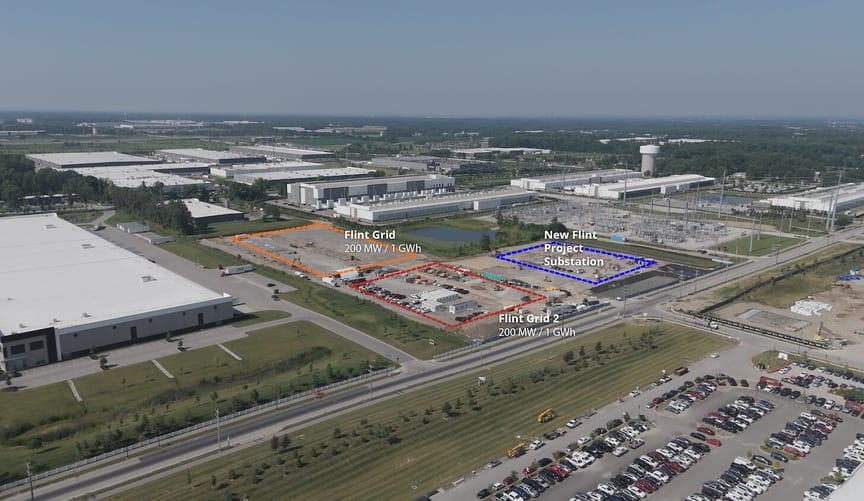
Developer Eolian announced on Wednesday that it’s broken ground on its Flint Grid battery project. The first phase is due online by June of 2027, and will be able to inject 200 megawatts for up to five hours straight into an electrical substation that serves the computing hub. With 1 gigawatt-hour of storage capacity, this battery won’t just be the biggest on the 13-state PJM market; it’ll be the biggest battery east of the Mississippi.
The system will help lower electricity prices by charging up when energy is cheap and abundant and dispatching that stored power onto the grid at times of peak demand — exactly what big batteries have been doing for years in places like California and Texas.
“There are things that have been in progress for a long time, designed to solve these very problems,” said Eolian CEO Aaron Zubaty, in response to the “snowballing narrative” that the grid can’t keep up with demand.
Batteries have set new installation records in the U.S. year after year, swiftly becoming the nation’s top pick for on-demand capacity and beating out new gas plant construction. But construction has clustered in the West, and developers have struggled to make inroads in the Midwest or the densely populated Eastern Seaboard. However, now that those areas face tremendous AI data center growth, they could use the instantaneous power that massive batteries provide.
Eolian can deliver that in New Albany because the firm got started a decade ago, taking calculated risks that seem to have paid off.
“This isn’t just some random 200 megawatts,” Zubaty said. “This is 200 megawatts at the epicenter of one of the largest industrial buildouts ever seen in our country, and by putting it at this spot, it will actually allow more stuff to get built.”
Zubaty didn’t originally have Ohio top of mind for his clean energy ambitions. By the early 2010s, northern Virginia led the nation in data center density, and Zubaty wanted to develop solar farms near those major energy consumers. But he ran into obstacles finding enough land. Solar development had to contend with northern Virginia’s horse farms and suburban subdivisions, and further west from Dulles airport, you hit the Appalachian Mountains.
“Where do the mountains end? A little bit east of Columbus,” Zubaty said.
Central Ohio was already growing in population and economic vitality, Zubaty noted, anchored by a skilled workforce and The Ohio State University. And it had a lot of open space that could accommodate new growth if the titans of the internet wanted to branch out from northern Virginia.
“We started doing land research, looking at where we could build solar in proximity to the Columbus metro area,” Zubaty recalled. “Lo and behold, we stumbled upon a couple obscurely named LLCs that were buying up a bunch of land at substations, and it was Amazon.”
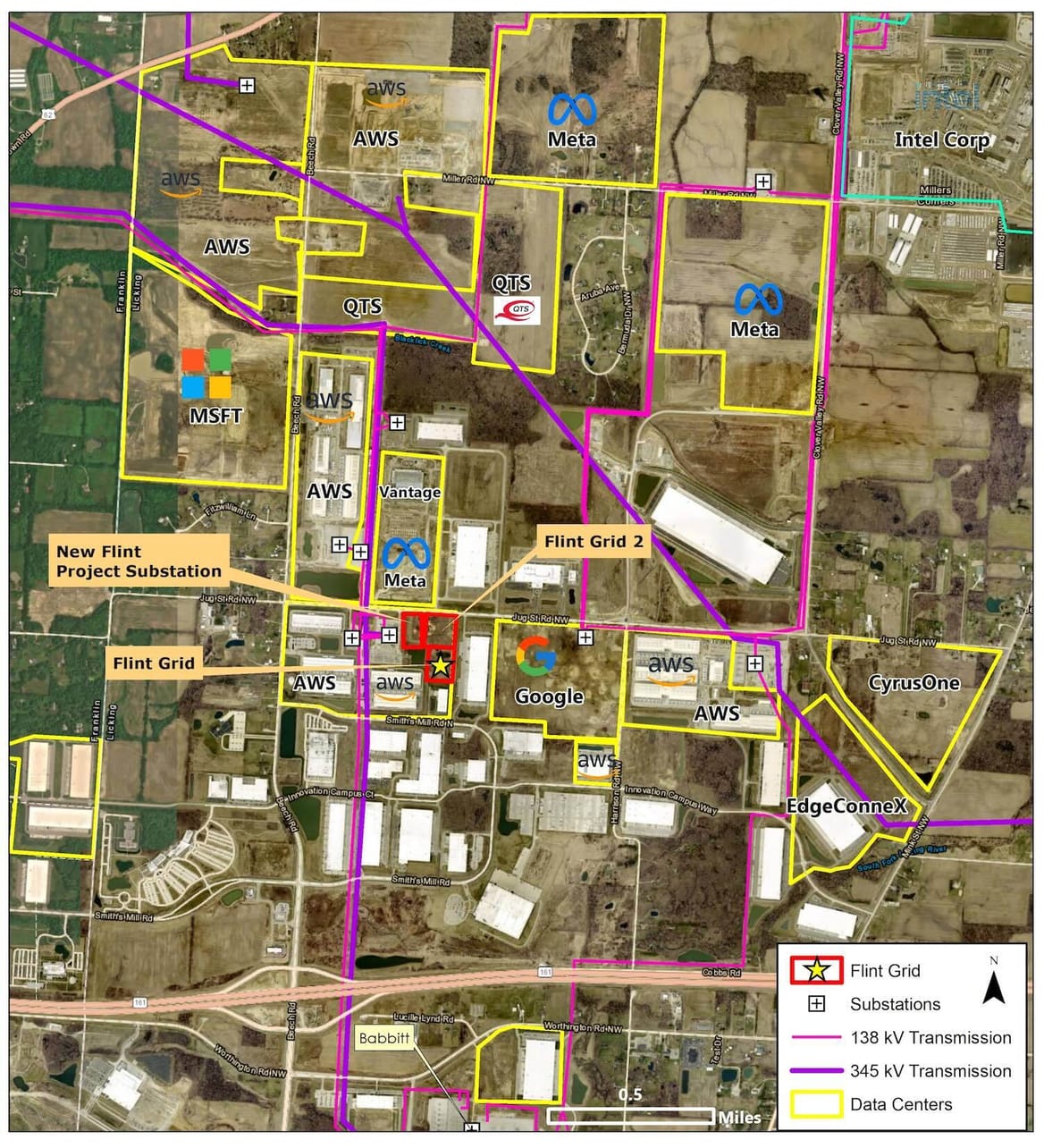
Amazon Web Services opened its first data center outside New Albany in 2016. That kicked off a frenzy of tech companies buying the larger parcels of land nearby. One smaller tract — with an old house, lots of foliage, and a small pond — got left behind in the land race as data center companies bought all the property around it. The owners agreed to sell to Eolian, which considered the acreage well suited for a battery plant.
Today, that house is gone, and the once-peaceful parcel is fully surrounded by looming warehouses filled with servers. Crucially, it abuts a substation owned by utility AEP that receives power from a high-voltage transmission line and feeds it to a lower-voltage line that loops through the data center region. That potent grid backbone is what makes it possible for the area to host so much computing — and gives the battery a means of charging up.
After securing the land, Eolian got to work on permits, interconnection to the grid, and approval from the Ohio Power Siting Board. At the time, PJM’s power prices were quite low, offering little incentive for companies to build new power plants, even as “we were watching this massive amount of data center development unfold at a really epic scale,” Zubaty said.
By 2025, Eolian was ordering transformers and other long-lead-time equipment, even though it lacked a deal to sell power to one of the many corporate customers operating nearby. In December, Zubaty had sufficient confidence in the project to bid it into PJM’s capacity auction, which would award contracts for power delivered for one year starting on June 1, 2027. The auction hit the maximum possible price, signalling that long-simmering demand had unquestionably outstripped supply in PJM.
That win started a clock ticking to build out the site, because “there’s a massive financial penalty to bidding and then not showing up,” Zubaty said. (Eolian also plans to add a second phase of the same size by 2029.)
Typically, power plant investors want to see decades of revenue commitments in order to finance construction. PJM, though, only offers one year of certainty for that capacity payment.
Eolian took the risk of building in the hopes that further contracts will materialize.
Now, it looks increasingly likely that one of the many hyperscalers in the area could sign a deal that lets it take credit for the battery project’s contributions to PJM capacity. This could offset that customer’s need to buy power at sky-high market rates, but it also may become necessary to operate at all.
Tech giants are under tremendous political pressure to figure out how to meet their electricity needs without burdening the power system overall, especially in PJM territory. The White House’s Ratepayer Protection Pledge has pushed leading AI companies to say they will cover their own energy costs. New York state recently froze data center construction for a year, giving itself time to make rules to prevent the development from driving up electricity costs, and other liberal states are considering similar measures.
Should hyperscalers look for a well-situated battery to help meet their needs, they won’t find many. PJM can’t wind back the clock and ask for more developers to have applied for grid connection and secured land near future AI hubs eight years ago. Nor is there any indication PJM will soon refine its rules to allow the kind of flourishing of batteries seen in Texas’ competitive wholesale market.
But once one developer shows it’s both possible and valuable to build big batteries in the region, the sheer pressure to meet the AI moment may carry more batteries through the impasse.
A just-issued national security ban appears to exclude existing inverters for solar and battery projects — but future models could face restrictions, experts say.
Citing national security concerns, the Trump administration has banned the import and domestic use of new power inverters made outside the United States. The move could throw sand in the gears of gigawatts’ worth of planned solar, wind, and battery installations — projects that make up the vast majority of new electricity being built in the country.
On Tuesday, the Federal Communications Commission announced it had updated its “Covered List” to include “connected power inverters produced in foreign countries.” The list includes equipment and services considered to pose a threat to national security, meaning that these inverters “are generally prohibited from receiving FCC authorization to be imported, marketed, or sold in the U.S.,” the agency stated.
However, the ban currently applies only to future new models of inverters, not those already available in the market or being installed today — a distinction that could limit the immediate impact on the clean energy industry.
The FCC stated that its action was prompted by a “White House-convened Executive Branch interagency body with appropriate national security expertise,” which determined that foreign-made inverters, “regardless of the nationality of origin, “‘pose unacceptable risks to the national security of the United States or the safety and security of United States persons.’”
Inverters — devices that convert direct current electricity into alternating current suitable for transmission over power grids — are an irreplaceable component of utility-scale solar, battery, and wind power projects, home solar and battery systems, electric vehicles chargers, heat pumps, and other electricity systems.
The vast majority of inverters in use today are connected to communications networks, which puts them under FCC regulatory purview. And most inverters used in large-scale solar projects are built outside the U.S. — many of them in China, which has been the primary target of national security concerns.
The FCC’s new restrictions do come with that important caveat, though: They only “apply to new device models.” That qualification appears to exclude foreign inverter models that have previously won FCC approval.
The FCC also specified that the new restriction “does not impact a consumer’s continued use of devices they previously acquired,” or “prevent retailers from continuing to sell, import, or market relevant models approved previously through the FCC’s equipment authorization process.”
Those two statements have tempered some of the more drastic interpretations of the potential impact of the FCC’s announcement among energy industry market participants.
“In our world, investors are currently seeing this as kind of a non-event” due to this interpretation, John Miller, a managing director and energy transition policy analyst at investment bank TD Cowen, told Canary Media in a Wednesday morning email. “If either of those conditions were to change, this becomes a much bigger issue.”
This point was echoed by Julien Dumoulin-Smith, head of equity research for power, utilities, and clean energy at investment firm Jefferies, in a Wednesday morning statement. “[T]his has a minimal impact today. There seems latitude to continue to purchase existing inverter models on the market,” he wrote.
On the other hand, Dumoulin-Smith pointed out that any Trump administration steps to restrict new models of foreign-made inverters could create a “long, gradual shift in market share.”
Threats of the Trump administration targeting foreign inverters were first reported in late June by Reuters, which cited unnamed sources stating that a ban on Chinese-made inverters was in the works.
Last year, Reuters reported that technology experts investigating Chinese inverters had discovered communications devices that could be a security risk, citing anonymous sources. Later in 2025, Republicans in the House of Representatives wrote a letter to Commerce Secretary Howard Lutnick asking him to use the Commerce Department’s authority to “block future imports of Chinese equipment used in critical infrastructure nationwide.”
Chinese companies such as Sungrow and Chint Power Systems provide the majority of inverters for utility-scale clean energy and battery projects in the U.S., while U.S.-based Enphase Energy and Israel-based SolarEdge provide the majority of inverters for residential rooftop solar systems.
The FCC’s update targets any new inverters not made in the U.S., including those that U.S.-based companies produce in other countries. That could encompass inverters from other major providers to the solar market, such as Germany-based SMA Solar Technology and Austria-based Fronius International, as tracked by clean energy consultancy Wood Mackenzie.
If the FCC’s ban were to be expanded to include inverters currently being manufactured and sold for use in the U.S., the impact could be drastic. The U.S. built 50 gigawatts of new wind, solar, and battery capacity in 2025, more than any year prior, making up roughly 92% of new generating capacity. And the U.S. Energy Information Administration forecasts these trends will continue in 2026, with solar set to provide 51% of the new utility-scale electricity capacity, batteries 28%, and wind 14%.
In the immediate future, projects likely won’t have to abandon the inverters they’ve already purchased or plan to install, said Joe Shangraw, a solar research analyst at Wood Mackenzie. But he also cautioned that, as with any other industry, “eventually, currently approved products will become obsolete.”
That means inverter manufacturers will ultimately have to bring new products to market and submit them for FCC approval, at which time they’ll have to contend with the agency’s new rules. At that point, any inverters made outside the U.S. will be barred from sale and use unless they undergo a distinct conditional approval or waiver process, he said.
Shangraw also noted that the need to bring new products to the market could be accelerated if the federal government sets new requirements on cybersecurity, grid functionality, or other inverter capabilities.
“If that would require a significant hardware or software update, that would be something where you’d have to request some permissive change from the FCC, or ask for a totally new FCC ID” designating a new model of device for the agency’s review, he said. “So it’s certainly relevant and impactful — probably not in the next couple of months but in the next year or so.”
This growing uncertainty over the federal government’s classification of foreign-made inverters could increase industry interest in securing domestic inverter supplies, he said. On that front, “the storage space looks a lot healthier,” with companies such as U.S.-based EPC Power and Tesla operating significant domestic manufacturing capacity, and others such as Spain-based Power Electronics scaling up U.S. manufacturing.
Residential solar inverters are “in a good place,” Shangraw said, with SolarEdge, Enphase, and Tesla providing about 80% of the U.S. market needs. But the domestic manufacturing capacity for solar inverters for utility-, commercial-, and industrial-scale projects is less clear, he said, given that Chinese inverter makers hold about 60% of U.S. market share in that sector.
Large-scale solar developers could hope to earn waivers from the FCC on foreign-made inverters from non-Chinese companies such as SMA and Power Electronics, he noted. They could also anticipate expanded domestic manufacturing from U.S.-based Nextpower, which is acquiring the inverter and power conversion business of Spain-based Zigor and its U.S. subsidiary Apex Power; or from GE Vernova, which has opened an inverter factory in Pittsburgh and could expand capacity there, he said.
“The main thing is, we don’t know how impactful this is until we learn a bit more about the timeline for when these actual changes to the requirements” for existing inverters might occur that would “force companies to release new products,” he said. “I’d say if this was a hard deadline, and if there were no new imports allowed, we’d be in trouble.”
As tech firms look to build their own gas generators, a new report reveals that likely won’t be enough to avoid a hefty power shortfall in the coming years.
It’s no secret that data centers are slated to bring stunning levels of new power demand to the grid in the coming years.
Report after report has tried to put a number on just how much electricity these facilities will actually use, and BloombergNEF joined the chorus this week. Its report projects that U.S. data centers will consume 20% of the country’s power in 2035, up from 5.9% today.
In all, data centers will consume as much as 194 gigawatts of power in 2035, the report estimates. That’s nearly double the amount BloombergNEF forecast back in December, and it’s more than the firm’s analysts expect the power grid to be able to accommodate.
So what’s a data center developer to do? Well, if you’re Elon Musk, you buy a company that’s operating tons of mobile gas and diesel generators that can provide your data centers with power that’s not connected to the grid.
Federal records unearthed last week by Electrek show that in May, the xAI founder bought APR Energy, a Florida company that runs more than a gigawatt of these portable fossil-fueled turbines. These generators can be installed in just a few days, as opposed to a traditional gas plant, which may take years to build.
This isn’t a new avenue for xAI. Since last August, the company has been using diesel generators propped on truck beds to power its Colossus 2 data center project outside Memphis. A lawsuit from the NAACP and its allies alleges the turbines are running without required permits and releasing tons of pollution that harms nearby, majority-Black communities.
Other data center projects are turning to gas, too, or hope to do so in the future. In Ohio, Meta uses modular gas turbines to power servers that, as of June, are stacked up in temporary tents. Some developers want to construct more permanent fossil-fuel solutions: Google, for example, has proposed building its very own utility-scale gas plant alongside a data center in Nebraska.
But experts are casting doubt on just how much off-grid gas power that tech firms will actually be able to build. Among the challenges: Gas turbines are in short supply, and so is the workforce needed to maintain them, as the clean energy industry veteran Jigar Shah noted in an episode of Latitude Media’s Open Circuit podcast.
BloombergNEF projects that even if the grid can accommodate 7 GW of new data center demand each year — the all-time record — and if many hyperscalers install their own gas turbines, the sector will still face a 19-GW shortfall by 2035. For perspective, a standard large-scale nuclear power plant produces about 1 GW of power, and it’s going to be a gigantic undertaking to fulfill the Trump administration’s goal to build 10 of those in the coming years.
Of course, no one knows for sure just how much power data centers will actually end up needing. Data centers could get way more efficient as their processors improve. The AI boom could peter out. Or maybe, just maybe, we’ll unlock the miracle clean power source that is commercial nuclear fusion and use it to meet all our massive electricity needs — but I wouldn’t hold my breath.
Trump’s ill-timed efficiency rollbacks
America’s war with Iran isn’t letting up, and neither is the energy shortage the conflict has brought upon much of the world.
Energy-efficiency measures could provide one salve to the crisis, but in the U.S., they’re getting ever harder to access. Over the past few months, the Trump administration has scaled back a bevy of programs that make home weatherization and other utility-bill-cutting improvements more affordable. Incentives that helped people trade fossil fuel appliances for electric alternatives are dead, for one.
Even free advice hasn’t survived. The Department of Energy’s website used to be full of tips for lowering your power bills, like how to find and plug drafts in your home. But as Grist reports, those guides disappeared by early July — just in time for a grid-straining heat wave to set in across the country.
State legislatures go easier on renewables
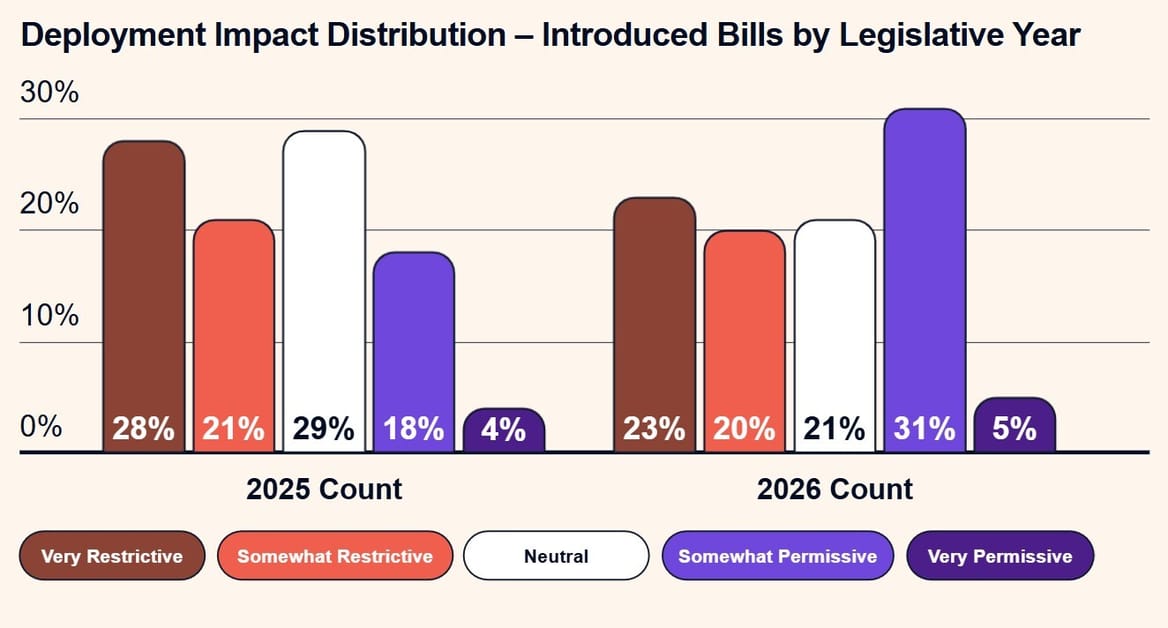
Last year, state legislatures had clean energy in their crosshairs. Lawmakers throughout the country introduced more than 300 bills related to renewable energy siting in 2025, and nearly half of them would have made it harder to build solar, wind, and battery storage projects.
Luckily for renewables, just 10 of those restrictive measures actually became law. But this year is shaping up to be brighter, according to the Siting Solutions Project. While lawmakers introduced 86 measures to rein in solar, wind, and battery permitting in 2026, just one has become law. That record is likely to stick, as most state legislative sessions have already concluded for the year.
Meanwhile, a handful of pro-renewables permitting and siting policies made it into law this year in both Democratic- and Republican-run state legislatures, reports Canary Media’s Jeff St. John. That includes measures that aim to curb local bans on renewables, speed review processes, and set best practices for cleaning up retired solar and battery projects.
Where to buy balcony solar: A few companies are finding their footing in America’s emerging balcony solar market, with some German firms expanding sales to the States, and U.S. solar manufacturers potentially getting involved soon. (Canary Media)
Iran war strain continues: The world has found ways to adapt without oil from the Strait of Hormuz, but experts predict that fallout from a continued closure could be more severe as countries’ emergency stockpiles near depletion. (Grist)
International nuclear deal: The Trump administration signs a deal with Saudi Arabia that paves the way for nuclear power construction in the country — an arrangement that’s likely to benefit U.S. nuclear developer Westinghouse. (Washington Post, New York Times)
Pumping up iron: Mesabi Metallics sees green steel as a path to revitalize Minnesota’s Iron Range, and it’s rolling out a $2.5 billion plan to mine and produce iron that’s key to lower-emissions steelmaking. (Canary Media)
Coal’s climbing costs: Pushback to the Trump administration’s coal-plant stay-open orders grows, with Wisconsin’s governor saying the costs to utility customers could hit $117 million in coming years, and a Colorado analysis estimating costs over $87 million. (Wisconsin Public Radio, Colorado Sun)
Wind allies unite: A coalition of 18 states and Washington, D.C., looks to join a wind industry lawsuit fighting the Department of Defense’s blockade on onshore wind permitting. (Canary Media)
Digging deeper: Geothermal veteran Ormat Technologies is venturing into the industry’s next generation with projects that can unlock energy where natural geothermal resources don’t exist. (Canary Media)
Getting data centers to pay for new generation and batteries could be the best hope for the nation’s biggest power market to finally get a handle on costs.
With the conclusion of its latest capacity auction, PJM Interconnection has once again shown that its process for securing new energy is unable to keep up with the wave of electricity demand from data centers.
But PJM, the grid operator for the country’s biggest energy market, is poised to adopt a new process that could help fix these problems: by pushing data centers to pay directly for the new clean energy, batteries, and fossil-fueled power plants needed to meet their huge electricity demand.
Late last month, PJM stakeholders achieved a rare level of consensus in voting to approve the plan for a new auction, called a reliability backstop procurement.
The measure, which still needs final approval from both PJM and the federal government, represents the grid operator’s most significant step to repair an auction process that has left consumers paying more money for a less reliable grid. PJM’s board of directors is expected to submit the proposal to federal regulators in the coming weeks.
The results of PJM’s Tuesday capacity auction underscore how critical it is for the grid operator to find a solution.
PJM’s capacity auctions, held once or twice each year, are the key process through which it ensures there’s enough capacity to keep its grid up and running during summer heat waves and winter cold snaps. It’s a high-stakes task: 67 million people from Virginia to Illinois depend on PJM for electricity.
For the third time in a row, the capacity auction hit the market’s price cap, in this case, $325 per megawatt-day. Similar caps have been in place since last year, after state governors demanded a limit to the massive cost increases being pushed onto utility customers across the PJM region.
These latest capacity costs reached $16.4 billion, matching the record set last December, and are more than eight times as much as PJM has paid for capacity in prior years. Customers in some PJM states — including Illinois, New Jersey, and Pennsylvania — are already seeing their bills rise by more than 10%, in part because of these soaring costs.
And yet, these maxed-out prices are still not high enough to get energy developers and utilities to build the power plants PJM needs to hit its reliability targets. This week’s auction fell short of PJM’s reliability requirement by over 6.8 gigawatts — the second time in a row that sky-high prices have failed to bring sufficient capacity resources into play.
The upshot is that customers in PJM Interconnection are paying some of the highest rates in the U.S. for grid reliability — even as the grid operator says the system isn’t reliable.
At the root of the problem is an explosion of demand from data centers that utilities and project developers can’t keep up with.
The grid operator forecasts that 30 to 34 gigawatts of data centers will be online in states across its region by the early 2030s. Utilities and developers would struggle to meet that pace under favorable conditions, but PJM’s infamously sluggish interconnection process makes it an impossible task.
While power demand has soared, the capacity being brought online in PJM has stagnated.
Of the 138.3 gigawatts of resources secured in this week’s auction, only 525 megawatts came from new capacity. All told, just under 4 gigawatts of newly built and “uprated” capacity from existing projects have been included in the capacity auctions since 2024, well below the roughly 20 gigawatts of new capacity added in the five prior auctions.
“We’ve got two problems,” said Julia Hoos, who leads coverage of Eastern U.S. power markets for Aurora Energy Research. “One, new capacity is just more expensive than we’re willing to pay for; and two, we haven’t resolved the physical barriers to build. Now, we’re paying for both issues.”
And those problems aren’t going away. Monitoring Analytics, PJM’s independent market monitor, has cited forecasted growth in data center power demand as being responsible for more than $29 billion in additional capacity costs to customers in PJM since 2024. In a May report, the monitor warned that these costs will “continue to grow until the issues associated with the addition of large data center loads are addressed.”
It hasn’t been easy to land on a path forward.
Environmental groups, consumer advocates, and state politicians have been haggling with data center trade groups, utilities, and power plant owners for more than a year over how to manage electricity costs related to data centers.
Some argue that new data centers should be forced to drop offline during grid emergencies, to avoid burdening all other customers with the cost of building power plants to ensure service at those times. Others say data centers should be required to pay directly for the capacity resources needed to mitigate their burdens on overstressed grids.
The plan approved by PJM stakeholders in late June, which was put forward by utilities and the trade group Data Center Coalition, would enable that latter option.
Unlike PJM’s standard capacity auctions, which are aimed at meeting the needs of all the utilities and customers served by its grid, this reliability backstop procurement, or RBP, is meant to be a “one-time process to purchase new supply resources to serve new data centers and other large loads,” PJM explained in announcing the outcome of its stakeholder process.
The proposed backstop procurement auction would come with a price cap of $555 per megawatt-day, much higher than the limit now set on PJM’s broader capacity market. In fact, the amount is pretty close to Aurora Energy Research’s calculation that about $500 to $600 per megawatt-day is what’s needed to finance new capacity resources trying to get built and interconnected to the grid, Hoos said.
This new auction would also structure deals between data centers and project developers under 15-year contracts, which “makes it cheaper to build, because developers have more security,” she said. “In the short term, it may be the only way to build new capacity, because generators need certainty.”
PJM has also showed some signs of life in moving projects through its snarled interconnection queue.
This year, the grid operator finally cleared roughly 53 gigawatts of solar, batteries, wind, and fossil gas power projects to connect to its system. If the RBP is approved by the Federal Energy Regulatory Commission in its current form, it could be “potentially a way to funnel a lot of money to projects that are already in the works,” said Tom Rutigliano, senior advocate for climate and energy at the Natural Resources Defense Council.
But that’s not the only way for new data centers to pay for the resources they need to come online, Rutigliano and Hoos noted. An even bigger channel could emerge in the form of bilateral contracts — agreements between individual data centers and developers of generation, battery storage, and demand-side resources like virtual power plants.
Such bilateral contracting has always been an option for large power customers, Hoos noted. In fact, major corporations have been signing power-purchase agreements with solar and wind projects for more than a decade. But those contracts have been focused on securing clean energy, and not so much on projects that can provide capacity during hours when the grid is under the greatest stress.
That’s a more complicated type of deal to structure, and tech giants like Amazon, Google, Meta, and Microsoft are only in the early stages of combining clean energy, batteries, generators, and demand-side resources or flexible computing that can meet PJM’s capacity needs.
But with states served by PJM demanding that large loads bring their own capacity, these kinds of deals are increasingly seen as necessary to get new data centers built. As part of the same effort, PJM last month also started work on facilitating “bilateral, long-term agreements between large load customers and generation providers” as a way to help these processes along, it also announced.
In fact, the RBP could become a last-resort choice for large loads that can’t strike their own deals, Hoos said. “There’s a lot of value to these bilateral contracting models that move that risk to investors and to the large loads,” she said — not to utility customers at large.
What remains uncertain is whether the RBP and these bilateral deals can enable data centers and new grid resources to come online “without raising rates on everyone else,” Rutigliano said.
PJM was meant to tackle the cost considerations by adopting a “connect and manage” plan, a structure that would require data centers to either bring their own capacity or face being cut off from grid power during emergencies. But PJM stakeholders failed to approve any of the 11 connect-and-manage proposals on hand.
So PJM proposed that state regulators take the lead in setting the rules for how utilities bundle up all the capacity needs of the large loads seeking to come online and submit them to the RBP, Rutigliano said.
This creates a risk that utilities could claim to be representing large loads in future auctions without securing durable commitments from those customers to actually pay for the capacity they commit to buying. If that happens, utility customers would be left holding the bag.
All this is unfolding on a compressed timeframe. Under pressure from the Federal Energy Regulatory Commission and state governors, PJM has agreed to hold its backstop procurement auction in September. That’s not a lot of time to prepare — but Rutigliano thinks PJM needs to work closely with states to ensure that regular customers don’t end up paying for resources that utilities secure for data centers.
“The stakeholder-approved version is that only utilities that affirmatively step up and say ‘we want more capacity’ get put in as buyers,” he said. “States have to make sure that doesn’t get passed on to ordinary ratepayers. They have to make damn sure there’s a data center that pays for it, or [utility] shareholders pay for it.”
The subscription-based approach aims to make it easier and more affordable to get a backup battery in your home. And it might be catching on.
Haven Energy is the newest company offering home battery service in Massachusetts for a low monthly payment, a model supporters say could accelerate adoption of residential storage.
Starting in four counties in the southeastern part of the state, the company will provide customers with a 15-kilowatt-hour home battery, installed and ready to go, starting at $29 a month, with a 10-year contract. These terms make obtaining a battery significantly more affordable in a market where a home system can easily top $15,000.
“Think of Haven as a low-cost battery backup subscription,” said co-founder and CEO Vinnie Campo.
Haven joins Tesla, which last month launched its own lower-cost monthly payment offering in both Massachusetts and Connecticut, a discounted version of its existing battery-leasing program. The Tesla option saves Massachusetts customers about $30 a month, which could shave nearly a third off the price of a standard monthly lease.
How does the pricing model work? Massachusetts utilities operate a demand-response program called ConnectedSolutions, which pays battery owners to discharge energy to the grid during times of peak demand, like those hot summer days when everyone turns on their air conditioners at once. With lots of batteries working in concert, these actions can reduce the need for the utilities to buy pricey, dirty electricity from peaker power plants. In the long term, the strategy can help delay costly grid upgrades paid for by consumers.
A typical battery could earn $1,375 per year participating in ConnectedSolutions. A new expansion of the program, ConnectedSolutions+, pays even more to battery owners in certain geographical areas where the grid is particularly congested, making the availability of local stored power even more valuable.
Haven and Tesla both retain ownership of the batteries in their programs, and thus earn these and any other available incentives. This revenue stream allows the companies to keep the monthly price low for customers. The model has the added advantage of making it easier for homeowners to get started with battery storage, eliminating the complication of sorting out and applying for incentives, Campo said.
“We take a complicated stack of rebates and incentives, and dramatically simplify that so it’s an easy-to-understand product,” he said.
Customers with solar panels will be able to save even more by charging up their batteries during sunny but low-demand times of day to use in the darker hours, rather than drawing from the grid.
When ConnectedSolutions calls on participating batteries — generally 30 to 60 times a year, always in the summer — Haven will leave at least 20% of the stored power available for its customers. If a major storm that could trigger an outage seems likely, the company puts its batteries in “safety mode,” preventing them from discharging to the grid.
“We are always prioritizing backup power for the customer,” Campo said.
The monthly payment model is not a completely new approach to driving battery adoption. Haven debuted in 2023, in California (a state that also has a robust incentive program for residential batteries), and evolved its business model in 2025 when the One Big Beautiful Bill Act changed the way the federal tax credits work. Vermont’s major utility, Green Mountain Power, has offered leases on two-battery systems for $55 a month since 2017. Today, some 4,600 households are enrolled, and the program continues to grow.
Battery boosters hope the trend continues. As of earlier this year, 26 states and Puerto Rico had programs paying residential battery owners to share their power with the grid, and more will join the list soon, said Todd Olinsky-Paul, senior project director for the nonprofit Clean Energy Group. These initiatives could pave the way for more monthly payment models that will make getting a battery as easy as signing up for any other home service.
“It’s like subscribing to cable or garbage pickup,” Olinsky-Paul said. “I think it’s going to be quite popular.”
In a first, the state could speed up data centers’ grid connection if they bankroll energy-saving residential tech like heat pumps and batteries.
New Jersey is offering data centers an unorthodox way to get the power they need: by bankrolling home energy upgrades.
Last week, Gov. Mikie Sherrill (D) signed a bill that will create a first-of-its-kind program to incentivize data centers to secure clean capacity by reducing demand elsewhere on the grid. Data centers will be able to pay for households to replace their energy-hogging electric-resistance space and water heaters with much more efficient electric heat pump appliances — or to install rooftop solar and batteries.
The scheme could lower electricity bills for potentially millions of households statewide by hundreds to thousands of dollars annually. In return, the data centers would get priority in the interconnection queue.
“New Jersey just set a national precedent,” said Ari Matusiak, CEO and co-founder of nonprofit Rewiring America, who served on Sherrill’s transition team. The law, called the Data Center Fair Share Act, “is a blueprint for how policymakers can start to think about households as energy infrastructure.”
Nationwide, utilities propose to spend at least $1.4 trillion on capital expenditures through 2030, according to consumer advocacy nonprofit PowerLines. “A meaningful percentage of that could be directed to households,” Matusiak said.
Rewiring America first championed the approach last September, when it released a report finding that installing heat pumps, solar, and batteries in homes could offset more than 93 gigawatts of anticipated AI-driven demand nationwide. The nonprofit provided input on New Jersey’s bill, but it “very much had its own momentum,” according to spokesperson Alex Amend.
Using what’s known as “voluntary demand-reduction trade programs” established at the utility-level, data centers will be able to hire companies that can aggregate households and other utility customers into a virtual power plant. The utility would then likely work with the aggregator to verify the resulting capacity will be there when the data center is built, according to Amend.
Power-hungry data centers have been pushing up electricity prices in the PJM Interconnection grid region, which includes New Jersey as well as a large swath of the Midwest and mid-Atlantic. And utility customers have been left footing the bill.
New Jersey’s law aims to put the kibosh on that. In addition to the household program, the measure will create a new rate class for data centers, following the lead of Minnesota, Oregon, and Virginia. The move is meant to ensure data centers pay for their own energy use and associated grid infrastructure.
Other states are looking to push data center dollars into home energy upgrades. California, Colorado, Illinois, Pennsylvania, “and likely many others” are considering legislation, said McKenna Beck, policy analyst at the nonprofit Natural Resources Defense Council, which helped create the New Jersey bill’s framework. On Tuesday, New York joined the list: Gov. Kathy Hochul signed an executive order that halts data center development for up to a year and directs regulators to consider requiring data centers to fund distributed energy resources and battery storage.
Hyperscalers are staying mum on New Jersey’s initiative. Microsoft declined to comment, Google did not respond in time, and Amazon told Canary Media that it had no stance.
Still, Big Tech companies are increasingly keen to leverage households as energy assets.
Last month, Google announced a pioneering agreement with the virtual power plant provider Voltus for up to 100 megawatts. Also in June, Tesla, Sunrun, and Renew Home broadcast that they would provide a whopping 16 gigawatts of power across data center hot spots in the U.S. using distributed energy resources. The power will be “ready in months, not years,” according to their website.
In New Jersey, Rewiring America estimates that of about 2 million single-family homes, roughly 85,000 have electric-resistance heating systems and 422,000 have electric-resistance water heaters. “But all households could benefit from home batteries and, in most cases, rooftop solar as well,” Amend said. “So the potential is enormous.”
New Jersey’s public utilities regulator has one year to flesh out the standards of the state initiative for utilities. Utilities then have 180 days to submit proposals for their individual programs.
Enrolled households could start getting data center–funded heat pumps, solar panels, and batteries as soon as mid-2028, Beck noted.
“These resources will directly lower bills for households and communities in which the data centers are built,” Beck said. “It’s incredibly exciting.”
A new program from startup Every Electric and utility Con Edison lets New Yorkers power their window ACs with home batteries to take stress off the grid.
Earlier this month, as a historic heat dome smothered the U.S. Midwest and Atlantic Coast, New York City Mayor Zohran Mamdani asked residents to set their air conditioners to 78 degrees Fahrenheit to protect the city’s severely strained grid. “Let’s ease demand — and get through the heat — together,” he posted on X ahead of the sweltering July 4 weekend.
Previous NYC leaders and elected officials nationwide have given the same advice ahead of extreme weather events. But Mamdani’s suggestion that everyone pitch in sparked backlash from conservative figures and prompted the Trump administration to remove its thermostat-level recommendations from the Department of Energy’s website.
All the while, in apartments across New York City, hundreds of residents were supporting the electric grid without needing to adjust their AC at all.
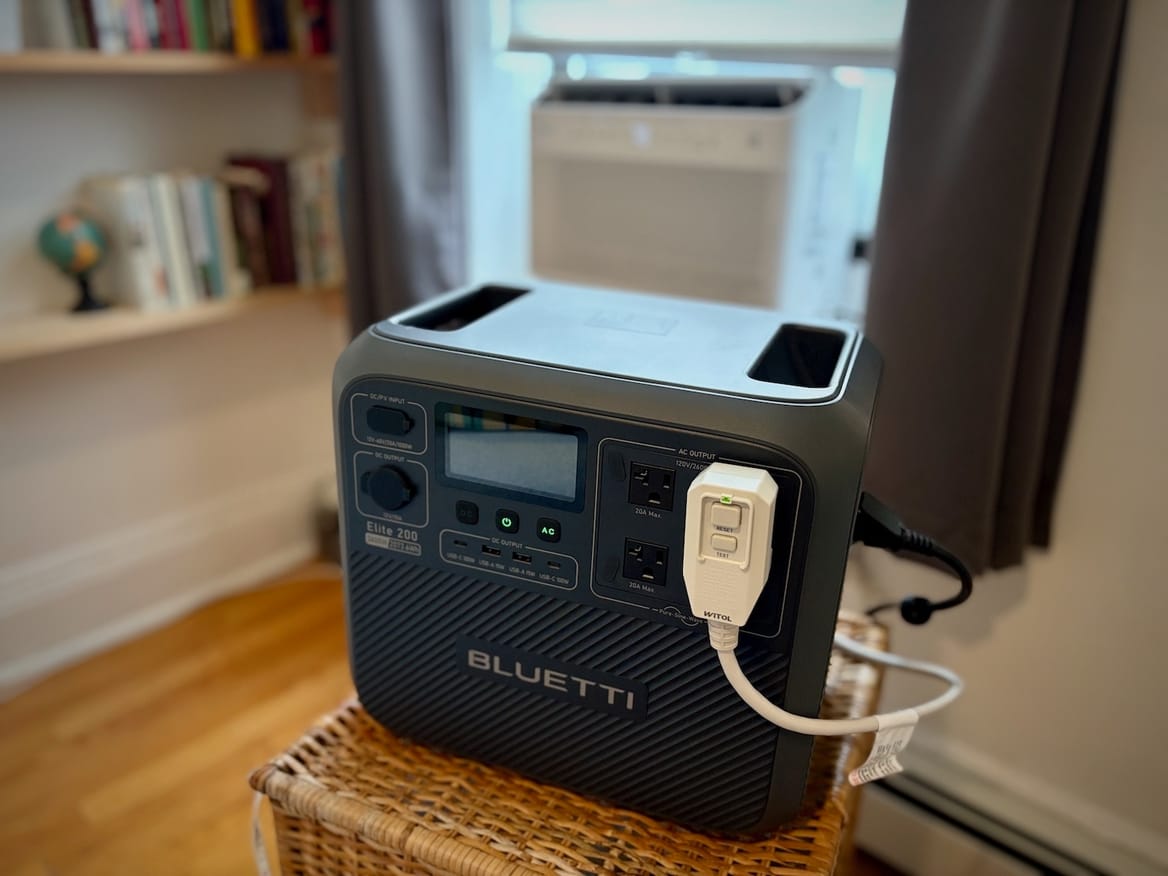
The local startup Every Electric launched a novel pilot program earlier this year with the utility Con Edison that allows participants to plug their window air-conditioning units into a battery pack, which itself is plugged into the wall. The Wi-Fi–connected batteries draw electricity from the grid when conditions are calm, then power ACs with the stored-up energy when demand on the grid is highest.
“The air conditioner can stay on, but we can still reduce load on the grid,” Andrew Wang, the company’s CEO, told me a few days after the heat wave and a subsequent major storm passed over the metropolis.
“And the big thing is, you don’t impact someone’s preferred settings,” he said. In an outage, the batteries can power a typical window unit for about four hours, he added.
Millions of New Yorkers live in older apartment buildings without central air conditioning. Many residents instead use two or more window AC units to keep their homes cool. On blistering, humid days — like July 2, when temperatures hit 104℉ — these appliances can represent about 20% of the entire city’s electricity demand, Wang said. On a household level, it’s more like 75% of total peak energy use.
Every Electric, which ran a small internal pilot last year, has so far delivered over 1,000 batteries to roughly 600 apartments, including mine. It’s free to participate, though I had to pay a $50 refundable deposit for the power bank, which is now shoved against the wall between the window and my bed. (Every Electric’s lithium-iron phosphate devices are different from the beat-up lithium-ion batteries linked to e-bike fires in my Brooklyn neighborhood and citywide.)
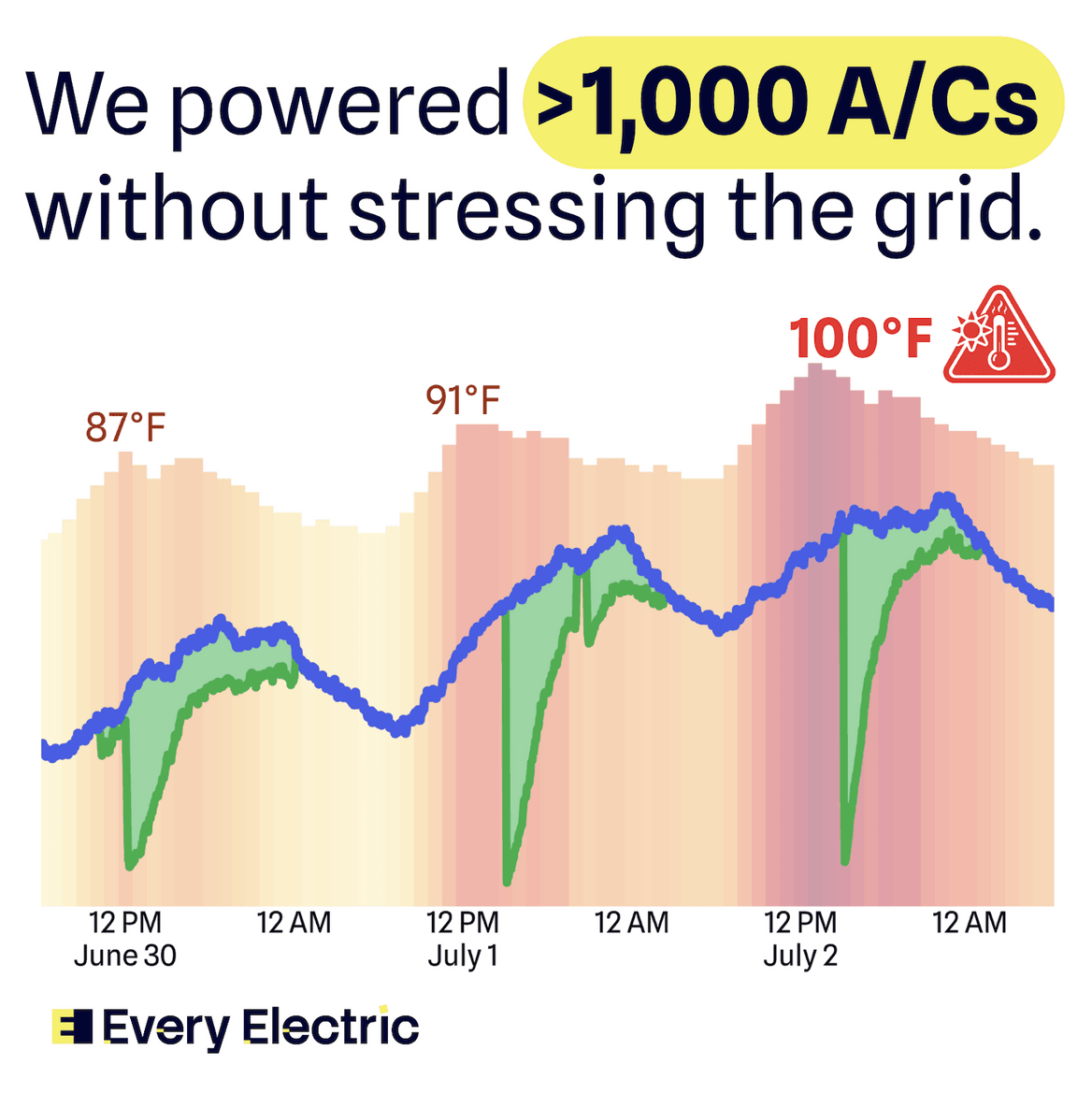
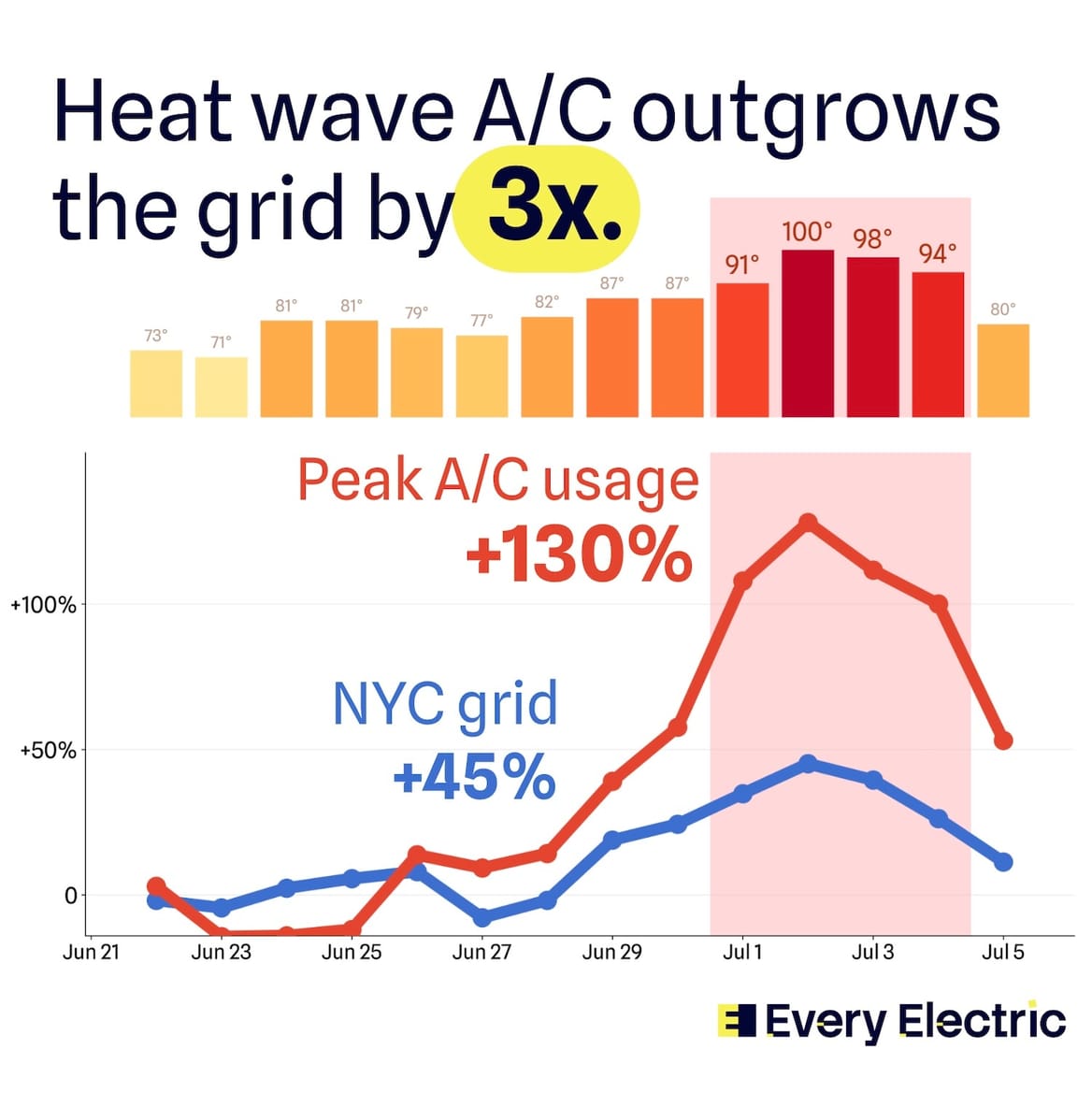
Wang said that heading into the heat wave, New York’s grid operator forecasted a 45% jump in NYC-wide peak demand for July 2. The window ACs in Every Electric’s program used 130% more electricity at their peak that day than they do in a typical week. Yet the company’s batteries met much of that demand, mitigating a source of grid stress and allowing renters to keep cool, even as Con Edison reduced voltages in certain areas to prevent widespread outages.
Collectively, Every Electric’s battery fleet can provide about 2.5 megawatt-hours of distributed energy storage. That’s a teeny sliver of the total power draw from window ACs. But experts say that such programs, when scaled, can play a crucial role in boosting grid reliability, reducing utility costs — and making the overall system more resilient to climate change.
On brutally hot days, utilities often fire up expensive, old fossil-fuel-burning peaker plants to meet the extra demand. Then there are the added maintenance costs and infrastructure upgrades. In May, Con Edison said it was investing a record $3.9 billion to lay more cables and build new transformers and substations to maintain reliable service “as extreme heat becomes more frequent and severe.”
“Distributed energy storage is a resource that [utilities] can leverage to avoid these peak demand spikes, and there’s a clear benefit for them, in terms of deferring their capacity investments,” said Bryan Bollinger, a professor of marketing and economic policy at the Tuck School of Business at Dartmouth, who studies how consumers make energy decisions.
A growing number of states, led by California, are increasingly adopting programs that call upon networks of customer-owned energy devices — like Tesla Powerwalls charged by rooftop solar panels — to support the grid when needed. But these initiatives, also called virtual power plants, primarily serve homeowners who are able to outfit their homes with clean technologies.
Every Electric’s renter-friendly approach “targets a different population completely,” Bollinger said. “You’re getting a bunch of consumers who also want to feel like they’re doing their part, but who don’t have the ability to do things like install solar panels.”
The company’s program also skirts the challenges facing large-scale battery storage systems in New York City. Big batteries can provide even greater relief to the grid, but local developers are ensnared in a regulatory battle with Con Edison related to the cost and effort of connecting to the system. Every Electric’s microwave-sized batteries face no such issues: As the utility sees it, the power bank in my bedroom is no different from a computer or TV.
Participants will be rewarded for our goodwill to the grid, with a payment that reflects each household’s peak summer monthly utility bill, up to $150 per power bank pairing.
The money comes from Con Edison’s Smart Usage Rewards program, under which the utility pays its customers to actively reduce energy use during specific blocks of time, in specific neighborhoods, on the hottest days of the year. Every Electric is enrolled as an “aggregator” that virtually manages all the power banks in its network. Wang’s team distributes a portion of the rewards it receives to its own participants, while keeping the rest to cover its costs and expand the program.
The ability to earn money while staying cool has an obvious appeal: The owners of some 10,000 window ACs units have requested batteries. Every Electric said it’s working to fulfill as many of those orders as possible over the summer.
Con Edison, which serves 3.7 million customers, said over 50,000 electricity users representing 500 megawatts in capacity are enrolled in the utility’s demand-response initiatives. During the past heat wave, the company called on customers to curb energy use 27 times across its networks in NYC and neighboring Westchester County.
A spokesperson said Con Edison doesn’t yet have specific data on how Every Electric’s pilot and other programs performed during the record-breaking heat. But in general, such efforts, combined with infrastructure investments and technological upgrades, have helped limit strain on the grid when it’s needed the most.
Beyond the Con Edison program, Wang declined to get specific about Every Electric’s financials, though he said the six-person startup is supported by a blend of sources. That includes private investors, debt financing from social-impact funds, and grants from the New York State Research and Development Authority.
“We’re excited by how scalable this can be,” Wang said, adding that the utility and state regulators “are telling everyone to look under every rock to find ways to make the grid run a little bit cheaper and more reliable.”
Bollinger, who until recently was a New York City renter himself, said he hopes that programs like Every Electric’s can catch on nationwide — because they can both bolster the grid and benefit more consumers. “It provides access to this kind of technology to non-homeowners as well, which we just haven’t seen with a lot of renewable energy technologies,” he said.
Sodium-ion batteries promise cheaper, more durable energy storage. Peak Energy seeks to kick-start the next-gen battery market by building the first big U.S. plant.
Startup Peak Energy launched in 2023 with a promise to bring the up-and-coming sodium-ion battery chemistry to American shores. Now, it’s building a gigafactory in Sacramento, California, that will be the country’s first to produce sodium-ion battery storage plants for the grid.

If Peak Energy succeeds in its broader mission, it will introduce a new generation of batteries better suited for grid storage than the dominant lithium-ion chemistries, which are effectively hand-me-downs from electric vehicles. These sodium-ion batteries can run safely at a broad range of temperatures, company leaders say, meaning they can operate more cheaply and durably than the lithium-ion phosphate (LFP) cells that have become the go-to for stationary storage.
“We’ve gone from proving the technology out and having really great interest to having contracted business with customers that we have to go deliver on,” said Peak’s CEO and co-founder Landon Mossburg. Chinese battery companies have begun scaling sodium-ion production in recent years, but the technology hasn’t broken into the Western power sector yet. Peak is at the forefront of startups trying to make that happen.
Peak assembled a cohort of interested developers to observe the design and piloting of its storage technology, which it installed at a Colorado testing facility last year. Several power producers signed up for small pilot installations this year, with much bigger orders teed up for 2027. So far, the company has worked with manufacturers in China to supply cells to its specifications and then assembled them into containers at its existing facility in Burlingame, California. That site can produce only 100 megawatt-hours per year — roughly 32 units at 3.1 megawatt-hours each — as a function of its size and reliance on some manual work rather than full automation.
That output won’t suffice in an era when a single battery project may need several times the Burlingame site’s annual production. The Sacramento factory will produce 40 times more, 4 gigawatt-hours per year, when it starts its highly automated production, planned for the first quarter of 2027. Once assembled, the 100,000-pound containers can slip right onto the highway for shipment to customers.
It’s a quick turnaround as far as factory buildouts go, made possible because Peak found a newly built shell to lease in an industrial park near the Sacramento airport, said Mossburg. The site already had power supply from the Sacramento Municipal Utility District, so Peak can drop in its manufacturing equipment with only minor upgrades to the structure and electrical service, he added. It also helps that the factory won’t be doing the highly technical cell fabrication, which takes longer to install.
Peak chose Sacramento after a competitive search around the country, and ended up bucking the conventional wisdom that you can’t build things in California anymore. Mossburg said he wanted to prioritize access to talent, rather than chase the richest state and local incentives or the lowest cost of labor or energy. Operating in California involves spending more in taxes and electricity costs than, say, in Texas, but Sacramento is accessible to the Bay Area and all the electrical engineering expertise of Silicon Valley and the Tesla diaspora. It’s also close to the Burlingame site where Peak has built its first enclosures.
Peak also won $10.5 million in tax credits from the California Competes program, which are tied to hiring milestones, Mossburg said.
Down the road, Peak leadership hopes to find onshore sources for its battery cells, and formed a partnership in June with GM to co-develop that product with the automaker’s Michigan battery labs.
All told, Peak’s strategy could allow for a relatively low-cost and rapid path to large-scale manufacturing. That would be a welcome contrast to the billion-dollar factory expansion pursued by Swedish startup Northvolt, which tried to forge a European battery empire before collapsing into bankruptcy. (Mossburg worked there for a time as president for North America.) But Peak still needs to prove there’s a market for a chemistry that has never been widely deployed in the U.S. grid storage market, which has been notoriously unwelcoming to anything that isn’t lithium-ion.
Peak’s chief strategy officer, Geoff Brown, got in early on the current LFP trend about a decade ago, when he was running pioneering grid-battery firm Powin Energy. His company scoured the Chinese market for the best cells to put into grid storage enclosures, and ultimately picked a form factor that had been designed for electric buses, he recalled. At that point, sodium-ion cells hadn’t made the jump to mass production.
Unlike the chemistries that ruled the grid storage market thus far, sodium-ion was “the first battery really purposely designed” for stationary storage, Brown said.
“You sacrifice some energy density for massive improvements in safety but also very significant economic benefits,” he noted.
A vast global factory base now produces LFP cells, but sodium-ion is already within striking distance of the per-cell manufacturing cost given its cheaper bill of materials, Mossburg said. Peak is pricing its enclosures to match Tesla’s LFP-fueled Megapack, but argues that they cost less on a lifetime basis because the cells are so durable and don’t need energy-sucking temperature-control and fire-suppression equipment.
Still, scale matters, and the Sacramento site is a necessary step for taking on the U.S. storage market with this new battery.
Last week’s high temperatures pushed the U.S. grid to its limits, and showcased how new wind and solar additions are essential to keeping the lights on.
Last week brought soaring temperatures to much of the U.S., forcing Americans to switch on their air conditioners — or, in many cases, flex their heat pumps’ cooling capabilities. And to cope with it all, the U.S. power grid delivered more electricity than ever — a feat that wouldn’t have been possible without clean energy’s massive growth over the past few years.
Temperatures in the triple digits prompted grid operators across the U.S. to prepare for potential emergencies. PJM Interconnection, which covers parts of the Midwest and East Coast, was granted federal authorization to direct data centers and other large power users to tap diesel generators and battery backup systems as a “last resort” to prevent power shutoffs. But the grid region didn’t end up needing those emergency resources, even as its power demand reached its highest level on record.
Texas, meanwhile, set a record for peak demand in any July — 83 gigawatts on the evening of July 6. Solar power, which Texas has recently added in spades, covered more than 30% of that demand, Texas energy expert Doug Lewin noted. Solar also helped Texas’ grid operator avoid the need to push customers to conserve power.
In New England, it was wind power that proved to be a hero as temperatures soared. The region burned less oil this time around than it did during a similar heat wave last year, per Grid Status, thanks in large part to offshore wind farms that have recently come online. The New England Clean Energy Connect power line, which started delivering electricity earlier this year, also brought in tons of hydropower from Canada.
Wind similarly played a strong role in keeping the lights on in the Southwest Power Pool, which spans the central U.S. from North Dakota down to northern Texas.
New York City’s sparkling new transmission line, which was supposed to bolster the city’s grid during heat waves like this one, was unfortunately a letdown. The Champlain Hudson Power Express, or CHPE (pronounced “chippy”), has been bringing clean hydropower from Canada into the city for the last month, but an issue in Quebec forced the line to shut down on July Fourth. The heat wave was luckily on its last legs by that time, and CHPE isn’t essential to New York grid operations just yet. But it’s set to become a vital power source as aging natural gas plants begin to retire.
Aside from a few short-lived outages scattered across the eastern half of the U.S., the grid weathered its first test of the summer pretty darn well. Still, with climate change making summer heat more extreme, and with more and more data centers and other large power users coming online, we’re far from out of the woods yet.
Hawaiʻi is retreating from its clean energy ambitions
Back in 2015, Hawaiʻi set the first statewide clean electricity goal in the country, aiming for a system run completely on renewable electricity by 2045. But as that deadline creeps closer, the state is considering retreating toward fossil fuels, reports Canary Media’s Julian Spector in partnership with Savannah Harriman-Pote of Hawaiʻi Public Radio.
As it stands, Hawaiʻi relies heavily on imported oil to generate electricity, and its residents pay the highest power prices in the nation as a result. But the state’s ambitious plans to build out tons of solar power and battery storage to replace its oil imports have been slowed down by the COVID-19 pandemic, the war in Ukraine, and a catastrophic fire on Maui.
Now, Gov. Josh Green (D) is pursuing a different solution: a natural gas terminal that would again depend on an imported fossil fuel. Julian and Savannah have all the details and explore what Hawaiʻi’s clean energy challenges can teach other states.
Another step forward for nuclear power
America’s nuclear renaissance just keeps getting more credible. Last week, Holtec International — a company usually known for shutting down nuclear plants — announced a big milestone in its quest to reopen Michigan’s Palisades reactor. All major renovations to the plant are done, and the company’s next and final steps are essentially what would be done to restart the plant after a routine outage, reports Alexander C. Kaufman.
The Palisades restart — and the nation’s atomic ambitions — are just one small piece of the world’s nuclear power redux. A BloombergNEF study out this week predicts global nuclear capacity will climb 44% over the next decade. That means as much as 535 gigawatts of nuclear capacity could be on the grid by 2036, up from 372 GW as of last year.
Glass half full: A new MIT report predicts the Inflation Reduction Act’s clean energy legacy will continue despite President Donald Trump and Congress repealing many of its incentives, as tons of renewable power is still on track to get built through 2035. (report, Heatmap)
Demolishing clean jobs: More than 200 clean energy generation and manufacturing projects have been canceled or downsized since Trump took office last year, costing the U.S. hundreds of thousands of jobs, a new report finds. (Canary Media)
Union blowback: Union workers and leaders call out the Trump administration’s buyouts of offshore wind leases, saying the deals are destroying good-paying union jobs. (The Guardian)
Cuba in crisis: Cuba suffered an island-wide blackout early this week amid a U.S.-led blockade on oil imports to the country. (Associated Press)
Cooking up batteries: Brooklyn startup Electra Research is building induction stoves equipped with small backup batteries that can also be leveraged as a grid resource. (Canary Media)
RGGI, set, go: The 11 East Coast states participating in the Regional Greenhouse Gas Initiative will share a massive $1.3 billion for climate programs raised so far this year in auctions of allowances for carbon pollution. (E&E News)
Last year, nearly 40% of all power demand from global data centers came from facilities based in America, per a new report.
Data centers use more electricity in the U.S. than in any other country — China included.
In 2025, nearly 40% of all power demand from data centers came from facilities based in the U.S., according to this year’s Statistical Review of World Energy from the Energy Institute. It’s the first year the sweeping annual report has tracked data center demand, a sign of how central the question of powering these massive facilities has become.

To put that electricity use in perspective: American data centers alone consumed nearly 313 terawatt-hours last year, per the report — more than Australia, Italy, Spain, or the United Kingdom generated to power their entire economies.
This electricity demand has been driven by deep-pocketed Silicon Valley firms racing to build out data centers that can give them an edge in the AI race. Between 2022, when OpenAI shook the world with its release of the ChatGPT 3.5 model, and 2025, global data center power demand grew by 59%.
And it’s only expected to keep climbing. Demand in the U.S. could nearly triple by 2030, according to S&P Global — though estimates vary widely, and some analysts caution that a meaningful share of planned projects may be delayed or never get built.
Still, even conservative estimates find that data center power demand will remain high — and the prospect of yet more growth has spurred urgent conversations across the U.S.
Consumer advocates fear that without stronger regulation, ordinary Americans will be left covering the cost of the strain that data centers put on the grid. And climate advocates worry that, despite the climate goals of Big Tech firms, some new demand will be met with natural gas — a trend that would drive up carbon emissions and local air pollution.


.svg)
