

 Back
Back
When it comes to clean energy, China makes — and the world takes.
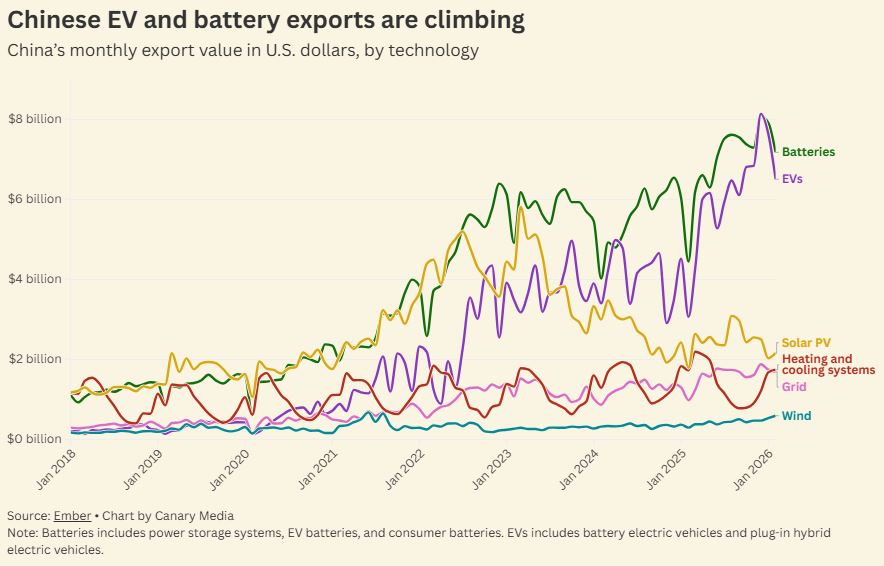
The country produces the vast majority of the globe’s solar panels, batteries, and wind turbine equipment, and most of its EVs. Plenty of that tech is used in China itself, but the country also exports a lot of it elsewhere.
In recent years, China has seen the most growth in its exports of EVs and batteries in particular. For both technologies, European nations have been the main destination.
In the EU, Chinese-made EVs accounted for 9% of sales in December 2025 — up from 6% the prior year. That acceleration happened even though the EU slapped duties on Chinese-made EVs in October 2024, in an attempt to protect its domestic automakers.
Made with Flourish • Create a chart
Though China still makes more than 90% of the world’s solar panels, its exports have declined from their peak in early 2023 as two key markets — Europe and Brazil — have imported and installed solar at a slower pace. Asian countries imported more Chinese solar equipment than did any other region across most of last year.
China’s clean-energy manufacturing machine has taken on new relevance since late February, as U.S. and Israeli attacks on Iran have spurred a historic disruption of global oil and gas markets.
Asian countries are bearing the brunt of the current energy crisis. Some especially hard-hit nations are taking extreme conservation measures — encouraging people to use less air conditioning, work from home, and even ration fuel. But energy costs are also soaring in other places, like Europe, which relies heavily on imported fossil fuels. Americans, meanwhile, are paying higher prices at the gasoline pump, where a gallon has surpassed $4 on average.
It’s the latest reminder of the perils that come with depending on fossil fuel imports — and it’s prompting some countries to double down on renewable energy to insulate themselves from future price shocks. True, importing clean-energy tech is still importing, but it’s fundamentally different from relying on fossil fuels from abroad. With clean energy, you buy it once, roll it out, and for decades it does its job within your borders. That’s not so with fossil-fueled infrastructure.
Ultimately, even if other regions invest in building out their own domestic clean-energy supply chains, China is the clear beneficiary of the coming shift to cleantech. Its head start is just that big.
Canary Media’s “Electrified Life” column shares real-world tales, tips, and insights to demystify what individuals can do to shift their homes and lives to clean electric power.
Balcony solar is poised to take the U.S. by storm.
The DIY systems, which you can hang on a balcony and plug into a normal 120-volt outlet, help lower energy bills and carbon emissions. Already huge in Germany, solar that’s as easy to install as an appliance would be a game changer for the four out of 10 U.S. households that can’t get rooftop systems for financial or logistical reasons.
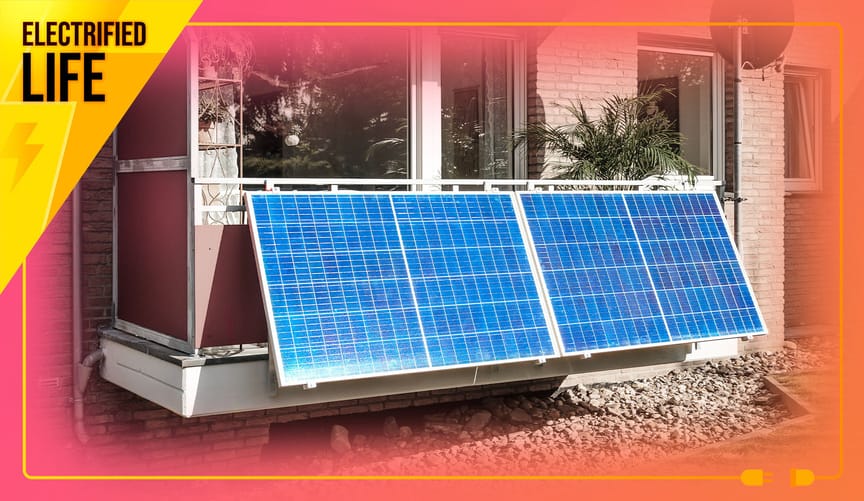
In 2025, deep-red Utah became the first state to pass a bill making it easier to adopt plug-in solar systems. So far this year, four more states have all advanced similar measures — and nearly two dozen others are weighing bills of their own.
Considering a balcony power plant yourself? Check our tracker to see the status of plug-in solar legislation in your state, and keep reading for some FAQs on the tech.
Balcony solar systems are modest in size, ranging from just one to a few solar panels. Most states, including California and New York, are considering capping systems at 1,200 watts — a sixth of the average home-solar installation.
The panels connect to an inverter that converts their direct current into alternating current, the kind our homes use. A plug from the inverter fits into a typical 120-volt outlet (15 or 20 amps), pumping the power of the sun directly into a home’s existing wiring.
The systems can cover a small but meaningful fraction of a home’s electricity use: An 800-watt unit can power the equivalent of a fridge or a few small appliances when the sun’s shining.
One or two people can set up a system in less than an hour without the help of a professional. In states with balcony solar laws, you don’t need permission from your utility, unlike when installing a larger rooftop array. Nor do you need to pay the utility a fee.

Balcony solar costs range from several hundred dollars to more than $1,000, depending on the system size, and can save a household hundreds of dollars per year.
In Los Angeles and the San Francisco Bay Area, for example, the plug-in solar nonprofit Bright Saver offers a two-panel, 800-watt system for $1,499 and a four-panel, 1,600-watt system for $2,348. (Because of utility rules, Bright Saver currently provides these products only to residents who already have rooftop solar and want to expand.)
At $1.47 to $1.87 per watt before taxes, that’s a pretty good deal in the U.S. Nationally, the average rooftop system costs $2.58 per watt before local and state incentives.
The payback period depends on how much electricity your home uses and your utility rate. But according to Bright Saver, these systems can save California households nearly $500 per year and have a payback period of four to five years.
Once they’re paid off, every sunny hour can provide you with free power for the life of the solar panels, many of which are warranted to last 30-plus years.
Absolutely. Physically, the panels can go anywhere they’re safely secured and able to soak up a lot of sun, such as a deck, patio, porch, fence, or yard.
Unless, of course, your home is subject to limiting regulations. Your city or homeowners’ association may have rules about where you can put solar panels. If you’re a renter, you’ll want to double-check your lease to make sure you’re not prohibited from hanging them outside.
Balcony solar produces electricity and sends it directly into the home’s circuitry at a wall outlet. Rooftop solar, by contrast, pours power into a home’s electrical panel.
That distinction has prompted some safety concerns, even as a few companies start to sell these products.
If the solar panels provide too much power, and circuit breakers don’t trip, the wires in the wall could overheat, creating a fire risk, said Ken Boyce, vice president of engineering at safety science company UL Solutions. If a person were to touch the plug prongs either while the panels are illuminated and partially plugged into an outlet or in the fraction of a second after the plug is disconnected but still energized, the individual could get shocked or electrocuted.
But these hazards can be tamed with technical fixes. For example, a special plug could be designed with a built-in circuit breaker and no exposed conductive parts.
In their plug-in solar bills, states are legislating that manufacturers adhere to rigorous standards to protect consumers. Utah’s law, for example, requires that systems are certified safe for consumers by UL Solutions or another nationally recognized testing laboratory, and that they meet the standards of the National Electric Code.
The National Electric Code doesn’t specifically address plug-in solar, leaving the tech in a legal gray area on that requirement. And as of publication, no manufacturer has had a complete balcony-solar product certified as safe.
But that could soon change. After Utah’s law passed, UL created a new safety standard for plug-in solar, UL 3700, and launched a certification program in January. The company is now working with manufacturers to get their systems certified. Boyce anticipates the first certification in “weeks to months rather than years.”
So, if you’re itching to get plug-in solar but concerned about safety, sit tight: A vetted product should hit the market soon.
And, bigger picture, take solace in the evidence from across the Atlantic.
Germany has seen balcony solar grow from roughly 40,000 systems in 2017 to as many as 4 million in 2025. Sebastian Müller, chair of the German Balcony Solar Association, said last year that the country had yet to see any safety issues beyond a few cases of individuals attempting to hook up unsuitable hardware, like a car battery, to the devices.
Not without a battery. For the safety of utility lineworkers, a blackout will trigger the inverter to stop putting out AC power. But if you plug the solar panels into a battery instead of an inverter that feeds your home, then you can pull the stored electrons when you need them.
That peace of mind isn’t cheap, though. For example, while EcoFlow’s inverter retails for $299, a 1.92-kilowatt-hour EcoFlow inverter-battery combo costs $1,199.
Indeed they are. Bright Saver estimates more than 1,000 plug-in solar systems have been installed in California alone.
Bentham Paulos, senior research associate for the Clean Energy States Alliance, recently installed a system at his home in Berkeley, California, for just $0.66 per watt. (He has a rooftop array, and his utility’s rules allow him to add up to 1,000 watts without another interconnection agreement.) To prepare, Paulos, who also authored a plug-in solar policy report released in January, spent many hours studying amps, volts, and wiring configurations on YouTube to assure himself that he could safely put plug-in solar on his garage.
The market for balcony solar could rapidly transform in the U.S. over the next year, as states green-light the tech and manufacturers roll out compliant products.
“I think a lot of companies are waiting for the regulatory landscape to be clear,” Paulos said. Once a handful of states explicitly allow balcony solar, he anticipates that manufacturers will show “a lot of innovation to make this a really super easy and safe consumer product.”
Canary Media’s “Eating the Earth” column explores the connections between the food we eat and the climate we live in.
In late March, President Donald Trump dramatically expanded the federal mandates for farm-grown biofuels in cars, trucks, and tractors. In front of a cheering crowd that he called “the single largest gathering of farmers the White House has ever seen,” Trump announced his Environmental Protection Agency will require record amounts of soy-based biodiesel and corn-based ethanol to be blended into petroleum-based diesel and gasoline.
Like most of Trump’s environmental policies, and almost all biofuels policies, it’s terrible — for consumers, the climate, the hungry, and the country.
By diverting food crops into fuel and inflating demand for grain and vegetable oil, Trump’s jacked-up mandates will increase food prices, food shortages, and food insecurity. They’ll also accelerate deforestation and greenhouse gas emissions, inducing the world’s farmers to clear tens of millions of acres of new fields to exploit the higher prices for their crops. At the same time, they’ll inflate demand for fertilizer that’s already in short supply because of the Iran war, further increasing global food prices as well as corn-country pollution.
This is all bad. It’s morally unconscionable to reroute crops from bellies to cars when the grain it takes to fill the average gas tank could feed one of the world’s 150 million undernourished children for a month. It’s environmentally and economically nutty to use good farmland to grow ethanol when an acre of solar panels produces 20 to 100 times more energy than an acre of corn. The world is on track to deforest a land mass nearly twice the size of India for agriculture by 2050, and biofuels are a remarkably inefficient use of increasingly scarce soil.
But as I wrote in this space four years ago when President Joe Biden was promoting biofuels during a global food crisis, the badness is bipartisan; few Democrats oppose aggressive government support for farm-grown fuels. The badness is global, too; Brazil, Canada, India, Indonesia, and other nations are ratcheting up incentives for crop-based fuels for cars and trucks. There’s also a growing worldwide effort to run planes on farm-grown “sustainable aviation fuel,” including generous subsidies in the One Big Beautiful Bill Act that Trump signed last year.
Really, the only unique aspect of the biofuel badness at Trump’s White House “Celebration of Agriculture” was his candor about its purpose: to shovel cash to farmers, his most loyal voting bloc and America’s most powerful lobbying force.
He didn’t really pretend he was trying to give consumers relief from exorbitant gas prices or reduce America’s dependence on foreign oil, the industry’s current arguments for stuffing more crops into fuel tanks. He certainly didn’t pretend he was trying to help the planet; in fact, he exulted about all the regulatory “environmental nonsense” he’s gutted to save farmers money. He didn’t even pretend he was simply trying to ensure farmers a level playing field; he boasted about all the special treatment he’s given them, including “massive new loan guarantees,” a huge bailout to offset his tariffs —“I just gave you $12 billion!” — and lucrative tax breaks that “only Trump could’ve gotten you.”
“I’m actually giving you much better than a level playing field!” he proclaimed.
This agri-pandering isn’t unusual, even if Trump is unusually brazen about it. In Washington, D.C., it’s almost mandatory to describe farmers as “hardworking patriots” with “heartland values” while showering them with lavish subsidies, grants, cut-rate loans, price supports, and other agricultural welfare. The Beltway’s relentless efforts to prop up crop-based fuels, which would have no hope of competing with conventional fuels without government help, are the ultimate proof that Big Ag has even more political clout than Big Oil.
But Trump is taking the badness to a new level. While his slogan may be America First, his Agriculture Department’s slogan is Farmers First. Timothy Searchinger of Princeton University, the researcher who exposed biofuels as a deforestation disaster in a 2008 Science paper, estimates the EPA’s new blending requirements will ultimately expand global cropland by at least 28 million acres, an area the size of Ohio.
Two decades ago, when there were no viable alternatives to fossil energy and a documentary called “Who Killed the Electric Car?” was chronicling how General Motors literally scrapped its first alternative vehicles, crop-based fuels looked like the renewable future of transportation. But ever since Searchinger and others showed that those fuels are much worse for the climate than gasoline, and a new generation of electric cars proved to be much better, the federal Renewable Fuel Standard has merely reflected Washington’s determination to increase farm incomes by increasing farm commodity prices. In case there was any doubt about his motives at his Celebration of Agriculture, Trump also canceled a Biden administration effort to extend the Renewable Fuel Standard to electric vehicles, which would have helped the cause of cleaner transportation but not the cause of wealthier farmers.
Again, though, the problem is much bigger than Trump. The world devotes 125 million acres of cropland — an area larger than California — to growing biofuels. (The area is actually even larger, but biofuel production does create useful by-products like animal feed that affect the land accounting.) A recent paper concluded that in Indonesia and Malaysia alone, global demand for biodiesel drove an area of tropical forest larger than Connecticut to be converted into oil palm plantations between 2002 and 2018 — and Indonesia’s own biofuels targets contributed to a 66% jump in deforestation there just last year. Searchinger says that meeting the 2030 biofuels targets already set by major countries would require an additional land mass larger than New Mexico; meeting the International Energy Agency’s global goal of more than doubling biofuel production by 2030 could require another California.
The IEA also envisions a massive surge in renewable fuels in aviation and shipping, from less than 1% of global markets to as much as 15%, a recipe for an almost unfathomable assault on nature. The industry hopes to run half the world’s planes and ships on crops by 2050, which could require new farm fields eight times the size of California. Put another way, nearly one-third of the world’s cropland would be needed to generate a mere 2% of the world’s energy.
I’ve been banging my spoon on my high chair about the badness of biofuels since 2008, when I wrote a Time cover story on corn ethanol headlined “The Clean Energy Scam.” Honestly, the policy arguments are starting to bore me. It’s no longer news that producing biofuels can require nearly as much fossil fuel as they replace. It’s just common sense that when one farm grows fuel instead of food, another farm will expand to grow more food — usually into a carbon-rich forest or wetland, not a parking lot. I spend 50 pages of my latest book, “We Are Eating the Earth,” documenting the various ways scientists, economists, and bureaucrats in Washington, California, the European Union, and even the United Nations Intergovernmental Panel on Climate Change have cooked the books of climate analyses to make biofuels mandates look less catastrophic.
Nevertheless, farm-state Democrats like Sen. Amy Klobuchar of Minnesota and Gov. JB Pritzker of Illinois continue to tout biofuels as greener alternatives to fossil fuels. California under Gov. Gavin Newsom has promoted crop-based fuels through its “Low Carbon Fuel Standard,” even though corn ethanol and soy biodiesel are much higher-carbon than gasoline or conventional diesel. And while a few environmental groups have denounced Trump’s latest favors for the industry, most of the environmental community has remained silent, even as they’ve trashed Trump’s other environmental sins.
I get it. Fighting the farm lobby can feel like a waste of time and political capital. But biofuels are an excellent fight to pick, and now that they’re poised for a gigantic growth spurt in the U.S. and abroad, this would be an excellent time to pick it. Most farmers don’t vote for Democrats anyway. Agricultural expansion is an enormous environmental problem, driving biodiversity loss, nutrient pollution, water shortages, and climate change. And at a time when Americans are furious about high food prices — which helped Trump get elected, and have helped make him unpopular — biofuels mandates are specifically designed to increase the cost of things farmers sell and consumers buy.
None of this will persuade Trump or his Republican lackeys, who don’t care about the climate or the rainforests and won’t do anything to offend their farmer base or agribusiness donors. But it is way past time for serious people who know that biofuels are an insidious boondoggle to start fighting to stop the madness. I’m specifically thinking of three groups that should suit up for battle:
Democrats. There used to be a lot of rural Democrats. There also used to be a deal in Washington: Urban Democrats supported biofuels and other farm goodies as long as Republicans supported food stamps. But rural America is now overwhelmingly Republican, and the GOP’s One Big Beautiful Bill Act blew up the deal, gutting food stamps while blasting even more cash into farm socialism; it even included language ensuring biofuels could still qualify for new subsidies no matter how much they expanded agriculture into nature. So why do Democrats continue to support these environment-wrecking handouts for rich farmers who will never vote for them? Maybe it’s understandable that a corn-state Democrat like Klobuchar is now clamoring to permanently increase the ethanol levels in U.S. gasoline from 10% to 15% in order to cushion the blow from soaring gas prices — though she was clamoring for that long before gas prices were soaring — but why isn’t the rest of the party saying no?
Democrats need a new approach to agriculture, focused less on the 1% of Americans who farm and more on the 100% who eat. That would mean redistributing less money from ordinary taxpayers to the biggest farmers who grow the most common row crops, while also opposing the tariffs, price supports, and biofuel mandates that raise prices at the supermarket. Let Trump stand for giving farmers “much better than a level playing field.” Democrats should stand with everybody else.
Environmentalists. Green groups enthusiastically supported the original Renewable Fuel Standard in 2005, back when biofuels looked like an eco-friendly alternative to fossil fuels. To their credit, most of them stopped pushing farm-grown fuels after Searchinger’s science revealed their downsides. European enviros have actually fought back, successfully limiting crop-based fuels on the continent’s roads and excluding them from “sustainable aviation” mandates. But while a few American groups have also sounded alarms — most notably Friends of the Earth, Earthjustice, the Center for Biological Diversity, and the World Resources Institute — most have been silent, or have lobbied for relatively modest tweaks to state and federal mandates. I found no mention of Trump’s latest expanded biofuels mandate on the websites of the Natural Resources Defense Council, World Wildlife Fund, or Environmental Defense Fund, even though it will have a big impact on natural resources, wildlife, and the environment.
This strategy is designed to avoid alienating the powerful farm lobby, even though Big Ag routinely fights environmentalists over climate, wetlands, toxic chemicals, and other issues. And the strategy hasn’t entirely backfired; although biofuels quickly seized about 3% of the global fuel market by 2010, their market share has remained stagnant ever since. But that’s mostly because of the rise of electric vehicles, and the new push for biofuels in planes and ships, which can’t be easily electrified, is a huge new threat to nature and the climate. That’s what enviros are supposed to fight for, even if it means fighting Big Ag.
International institutions. In “We Are Eating the Earth,” I quote several scientists who worked on IPCC reports complaining that their panels were stacked with biofuels advocates who fought desperately to make sure the fuels were endorsed as climate solutions. Someone could write a whole book about that alone, but the long story short is that IPCC reports tend to point out that critics believe crop-based biofuels won’t reduce emissions at all, while supporters believe biofuels can reduce ludicrously massive amounts of emissions — and then suggest the world should aim for something in between to achieve its net-zero goals, which still amounts to a pro-biofuels stance. The IEA and other global institutions have taken a similar approach.
The scientists who still claim biofuels are good for the climate tend to assume they’ll make food so expensive that poor people won’t be able to afford as much meat, which would be bad; or that higher crop prices will miraculously enable farmers to grow way more crops without using more land, which isn’t grounded in empirical reality; or that farmers who do clear more land will somehow avoid carbon-rich forests, which is more wishful thinking. The science is clear, even if it isn’t comforting. It’s true that net-zero will be much harder to achieve if we can’t assume emissions reductions from biofuels. Unfortunately, we can’t, and the sooner credible institutions recognize that, the better.
So that’s my advice. Democrats should stop trying to suck up to farmers who will never love them back. Enviros should stop shying away from a war with Washington’s most powerful lobby. And climate institutions should abandon the most politically popular climate solution even though it will make climate progress look even less achievable.
I can’t pretend that any of this will be easy. If it were, it would’ve happened already. The fact that biofuels are crass political payoffs is one of those things just about everybody in Washington knows but hardly anybody wants to try to change. I’m genuinely not sure change is possible, but I’m sure it won’t happen if nobody tries.
Enormous new batteries keep appearing on the grid, making it devilishly tricky to keep track of which is the biggest in a given region. That’s certainly the case in New England, where acute power needs and robust state climate goals are fueling a buildout of big batteries that keep breaking capacity records.
Canary Media recently covered the inauguration of the 175-megawatt Cross Town battery in Gorham, Maine, which was the largest in New England when it began operating in late November. But that trophy has already passed to a 250-megawatt facility in Medway, Massachusetts, southwest of Boston and about 10 miles from the Patriots’ Gillette Stadium.
The Medway battery came online fully Feb. 25, according to developer VC Renewables, a subsidiary of global energy trader Vitol.
“To be fair, I don’t expect Medway to hold that title for very long, either,” said Tom Bitting, managing director at Advantage Capital, which supported the project with a $158 million tax equity deal. “There are other batteries being developed in New England that are bigger, but I think it is all just a sign that we need all of it, and there’s huge demand for it.”
For instance, Jupiter Power, a heavyweight in Texas’ booming grid storage market, is developing the 700-megawatt/2.8-gigawatt-hour Trimount battery plant at a former oil-storage site in Everett, Massachusetts, just north of Boston. Jupiter aims to finish the project in 2028 or 2029. Trimount is slated to be among the largest stand-alone batteries in the whole country — Vistra’s battery in Moss Landing, California, set that record with 750 megawatts/3 gigawatt-hours, before much of that capacity burned up in a disastrous fire.
The wave of battery megaprojects marks a new chapter for the region, which until recently was focused on building small-scale batteries. Massachusetts encouraged this by requiring energy storage alongside many distributed solar projects that received payments through the state’s main solar incentive; this rule led to a buildout of systems in the range of 1 to 5 megawatts.
Bigger batteries started taking off in the late 2010s out West: in California, Arizona, and Nevada, where developers can sign long-term contracts to deliver grid capacity; and in Texas, where they can bid into a uniquely competitive market.
The first three big batteries in New England — Plus Power’s Cranberry Point and Cross Town, as well as Medway, which was previously developed by Eolian — won seven-year contracts in 2021 to provide capacity for the New England grid, but the grid operator subsequently shortened that kind of contract to one year. After that change, developers have struggled with the lack of long-term capacity revenue; they can still charge up when prices are low and sell when they’re high, but that’s an unpredictable revenue stream that financiers might not want to underwrite.
Massachusetts has succeeded in building a robust fleet of small-scale solar — on recent sunny spring days, it has generated close to 50% of the region’s demand. But leaders knew they needed batteries to keep cleaning up the grid in the hours when solar doesn’t produce. So they created a new policy driver for storage investment called the Clean Peak Standard, which officially took effect in 2020.
The rule orders utilities to serve a percentage of their peak-demand hours with clean electricity, and the target grows with each passing year. Companies that use batteries to save solar energy for the evening — when electricity consumption rises as people get home from work and school — earn credits that they can sell to utilities, providing some revenue certainty outside the wholesale market.
The administration of Gov. Maura Healey, a Democrat, views storage as a key lever to improve energy affordability, Undersecretary of Energy Michael Judge said, because it makes better use of existing grid infrastructure to meet peak demand.
“Store all that solar energy that we’re producing in the middle of the day and bring down the cost of operating the system for everyone,” he said. “You don’t have to run these peakers, and you get all the emissions benefits and integration of clean energy benefits, too.”
It took several years for the rule to actually spur batteries in the multihundred-megawatt range, but now that era has begun. Advantage Capital, for example, factored in revenues from the Clean Peak Standard when it analyzed and underwrote the investment in the Medway project, Bitting noted. A total of 725 megawatts of battery storage had qualified for the Clean Peak Standard as of early March, according to state data.
Stand-alone grid battery projects are also bolstered by a federal tax credit that can cut investment costs by 30%, an incentive that the Trump administration preserved in last summer’s budget law even as it slashed support for wind, solar, and electric vehicles.
Clean Peak cash alone doesn’t pay the bills; battery developers still need to make money in the marketplace. Though New England lacks long-term capacity contracts, storage companies in the region have at least two factors working in their favor: some of the nation’s highest electricity prices and growing demand for power.
“It’s very difficult to get additional generation online in an area with high population density, because regardless of what type of power generation you’re building, it requires a lot of space,” Bitting said. Batteries, though, can fit a lot of power into a relatively small footprint, without the smokestacks or pollution that make it hard to build new fossil-fueled plants in populous areas.
Batteries compete directly with gas power plants to serve the peak hours of demand, when prices are highest. That’s especially valuable in New England, where gas supplies are stretched thin between power generation and home heating on the coldest days of the year.
“When it’s cold, the households are going to continue to demand it,” Bitting said. “But if we can ease some of the peak on the utility side, that will provide a relief valve to supply.”
Jupiter Power’s colossal Trimount project will continue New England’s foray into large batteries, with the ability to discharge enough power for roughly 500,000 homes, per the developer. Trimount was the largest of four battery projects selected in December from Massachusetts’ statewide solicitation to bring on more Clean Peak power. Previously, battery owners could sell off their Clean Peak credits on a quarterly or annual basis. The new solicitation was designed to produce “cost-effective” long-term contracts for storage, giving developers more stable revenue to plan around. Furthermore, Healey doubled down on grid storage in a March 16 executive order that calls for another 5 gigawatts installed by 2035.
“That kind of policy signal, combined with the state’s grid reliability challenges and its decarbonization commitments, creates the conditions for investment at scale,” Hans Detweiler, senior director for development at Jupiter, said in an email.
Massachusetts officials also hope to speed development with new permitting rules, which run large battery applications through a state-level body instead of piecemeal local processes. Community members still get to weigh in, but the program has a clear 15-month timeline and allows just a single appeal to the state Supreme Court, to ensure a more timely resolution of conflicts in the permitting process.
The true test of all these policies will be whether the recent megabatteries kick off a trend, or remain bold outliers in the region’s energy system.
After years of negotiations, data centers and other large customers of Georgia Power have finally won a pathway to pay for their own new clean energy projects to be built and connected to the utility’s grid.
The Georgia Public Service Commission approved the utility’s program last week, allowing these companies to identify and commit to paying for solar, battery, and other renewable-energy projects to supply their own power needs.
If it works as planned, the new customer-identified resource, or CIR, program could help prevent data center growth from raising power bills for Georgia Power’s customers at large — and offer a template for other utilities and regulators wrestling with similar issues nationwide.
Georgia Power is planning one of the largest new fossil-fuel buildouts in the country. Over the next five years, the utility wants to build nearly 10 gigawatts of new capacity resources, roughly 60% of which would come from natural gas power plants. The utility says it needs this new capacity to keep the grid running as power-hungry data centers flood into the state.
Those new power plants may be justifiable if the proposed data centers get constructed and keep operating long enough for the utility to recoup the costs through electricity sales. But if the AI bubble deflates, as more and more industry observers fear will happen, then the cost of paying off those utility investments could fall on everyday customers.
Programs like CIR are meant to protect customers at large from that worst-case scenario as well as from upward pressure on utility rates linked to data centers.
Its effectiveness on that front will depend on whether it results in Georgia Power building a smaller amount of electricity infrastructure than it’s currently planning on through its normal processes, thus reducing cost burdens on customers.
But that effectiveness will be hard to measure, given how the program is designed. Under the program, Georgia Power does not have to include any CIR projects in its long-term grid planning. If regulators don’t rectify that and force the utility to incorporate those projects into its plans, it may wind up adding gigawatts of unnecessary power plants in addition to whatever clean energy moves through the new program. Customers at large would foot part of the bill.
This issue will likely come to a head in Georgia Power’s next integrated resource planning process — the sprawling regulatory proceedings aimed at determining how much power, and what mix of resources, a utility needs to develop or maintain to meet its future needs.
Still, the unanimous vote approving CIR indicates that state regulators want Georgia Power to “work with large loads on the system in a way that manages cost shifts and concerns related to affordability,” said Nidhi Thakar, senior vice president for policy at the Corporate Energy Buyers Association (CEBA), the trade group that negotiated with the utility to create the CIR program.
CEBA includes major hyperscalers — like Amazon, Google, Meta, Microsoft, and Oracle — that signed a “ratepayer protection pledge” at the White House last month, promising to limit the risk that their data center expansion plans will increase everyday utility customers’ electricity rates. But most of the actions that could actually fulfill that pledge will rely on efforts from individual states and utilities, energy experts say — such as the CIR program from Georgia and Georgia Power.
“These large customers are willing to put down capital on the front end and take on the risk” to build the clean energy to supply significant portions of their demand, said Katie Southworth, CEBA’s deputy director for market and policy innovation in the South and Southeast. “This program opens up the procurement pathways.”
Starting this summer, large commercial and industrial customers in Georgia Power’s territory can use CIR to seek out and work directly with independent developers of solar, wind, battery, geothermal, and other carbon-free energy projects, Southworth said.
That’s a first for Georgia Power. As with many utilities in the Southeast and Midwest, it is vertically integrated, meaning it has exclusive rights to contract for power plants. The utility already lets big customers subscribe to clean energy projects that Georgia Power selects and contracts with, but it hasn’t previously allowed customers to bring their own specific clean energy projects to the table.
States without vertically integrated utilities let independent power producers contract directly with big customers. Big power users, and tech giants in particular, have taken advantage of this arrangement where available. U.S. corporate clean-energy procurement surpassed 130 gigawatts of new generation capacity between 2014 and 2025, according to the latest CEBA data. That’s roughly 44% of all new generation capacity built in that time, CEBA told Canary Media.
Under the CIR option, these large customers still won’t directly purchase energy from the projects that they have identified. Instead, they will pay Georgia Power a monthly tariff designed to cover the projects’ construction and operating costs, plus a reasonable rate of profit for the projects’ owners, in an arrangement CEBA likens to a “sleeved power purchase agreement.”
Solar and batteries will probably make up the lion’s share of that new CIR capacity, given that more than 20 gigawatts of those resources are being developed and seeking interconnection in Georgia, according to data from the Southern Renewable Energy Association trade group.
Solar and batteries are also the cheapest source of new generation capacity available nationwide, which could drive lower energy costs for the big customers contracting for it and for Georgia Power customers at large. Together, solar and batteries are expected to account for nearly 90% of new energy capacity built nationwide this year.
Under the CIR structure, if the power from these projects is cheaper than the equivalent cost of power generated and delivered by the utility, 75% of the resulting savings will go to participating customers, while 25% will be shared with other Georgia Power customers, Southworth said.
That could help get large-load customers — namely AI data centers — the massive amounts of energy they need without increasing utility rates for customers at large.
Georgia Power’s previous renewable-procurement structures have helped “diversify our generation mix and increase reliability,” Wilson Mallard, the utility’s director of renewable development, told Canary Media in an email. Adding CIR to those existing structures “offers the opportunity for the procurement of additional renewable resources at competitive prices to meet customer needs,” he said. “We expect these projects will provide energy and capacity benefits to the system value for all Georgia Power customers.”
CEBA fought for some key features that made it into the final CIR program approved by Georgia regulators last week.
For one, Georgia Power removed a contentious provision that would have allowed the utility to terminate CIR contracts at any time and without penalty, Southworth said.
Additionally, small commercial and industrial users of power can now band together to collectively achieve the 3-megawatt minimum required to participate, Southworth noted. That could expand options for retail chains, hotels, local businesses, or local governments to secure their own clean energy resources. And customers will be allowed to transfer in and out of those arrangements, which allows for more flexible participation.
But CEBA wasn’t able to secure one feature it had wanted — a way for CIR customers to earn credits for the capacity value of the projects they bring online. Capacity is how utilities measure the impact that power plants, solar and wind farms, batteries, and other resources have on meeting the peak demands on their grid.
Those peak demands are important because they determine how much generation and grid infrastructure that utilities ultimately build. What’s more, large utility customers typically have to pay demand charges, which are based on how much power they use during those handful of hours when electricity use hits its upper limit.
The CIR program’s monthly tariff is an energy-only tariff. That means participating customers won’t be able to reduce their demand charges on the basis of the projects they’ve enabled to be built under CIR — even if that infrastructure helps Georgia Power reduce its peak demand.
But sooner or later, Georgia Power and its regulators will need to consider how to capture the grid value these CIR projects provide.
That’s likely to play out in the utility’s future integrated resource planning, Southworth said. “When we get to the next IRP, I’m confident there will be some resources — solar and storage — that will be brought on” under CIR, Southworth said. “Those will be resources on the Georgia Power system, and through that modeling, they will absolutely show up” as part of the capacity calculations.
The question then will be whether that newly unveiled CIR capacity will alter Georgia Power’s current power plant expansion plans, which were approved in December through a regulatory process that has unfolded largely outside the utility’s standard IRP proceedings. Georgia Power and regulators justified this approach to deal with a massive increase in the utility’s forecasts of how much power and capacity it will need to supply in future years, which have surged from 400 megawatts in 2022 to 6.6 gigawatts in 2023 to 8.5 gigawatts in 2025.
But environmental groups, consumer advocates, and others say Georgia Power’s latest expansion plan for gas power plants and batteries allows the utility to overbuild for a data center boom that may fail to emerge. Georgia Power will be able to earn guaranteed levels of profit on the $16.3 billion in “company-owned projects” in that plan, giving it an incentive to overestimate its power needs.
Last month, a group of environmental and faith groups brought a legal challenge against the decision. “The commission still has to apply its rules to protect its ratepayers from overbuilding,” said Isabella Ariza, a staff attorney with the Sierra Club, one of the groups filing the legal challenge. “And we think those rules are the only protection that ratepayers have at this point.”
Ariza noted that the final version of the CIR program wasn’t yet posted by the Public Service Commission, which limited her ability to discuss how the resources brought online under the program might impact future capacity planning.
Even so, “in future IRPs, Georgia Power would have a hard time theoretically explaining to the commission why the clean resources shouldn’t offset some of the peak demand,” she said. “But we’ll see.”
A correction was made on April 15, 2026: This story originally misstated that Georgia Power has exclusive rights to build and operate generation in its service territory. In fact, the utility also contracts with third-party solar and battery projects under its CARES program.
Stegra has secured the financing needed to complete its flagship green-steel mill in northern Sweden.
The company, formerly H2 Green Steel, said it landed 1.4 billion euros ($1.65 billion) in capital from a group of new and existing investors led by Sweden’s prominent Wallenberg family. The funding will enable Stegra to finish building and commissioning its novel facility in Boden, just south of the Arctic Circle.
The project is a cornerstone of Europe’s broader ambitions to decarbonize its industrial sector and lead the world on lower-emissions technology. Conventional steel mills rely heavily on coal to produce the ubiquitous metal, making them a major source of planet-warming emissions and harmful air pollution.
Stegra’s first-of-a-kind project will instead rely on green hydrogen, which could slash carbon emissions from steelmaking by up to 95%, compared with traditional coal-based furnaces.
The sprawling facility will use giant electrolyzers, powered by the region’s ample hydro and wind energy supplies, to split water molecules and produce the clean fuel. That hydrogen will then turn raw iron ore into lumps of iron, which will be melted and made into steel in electric arc furnaces, also powered by renewables.
Stegra said it expects to initially produce 2.5 million metric tons of steel annually and eventually double its production of the metal.
The ambitious undertaking has hit some serious snags since construction began in 2022. Stegra previously raised some 6.5 billion euros ($7.64 billion) in loans and equity. But in recent months, faced with rising project costs and delays, the firm had been urgently seeking additional financing to address a growing cash crunch.
In October, the French hydrogen investor Hy24 swooped in to help fund Stegra for an undisclosed amount. That still wasn’t enough to stave off financial troubles for the steelmaker, which has batted away frequent rumors that the company and its marquee steel mill were close to collapsing.
With the new investment from the Wallenberg-led consortium, Stegra says it will now ramp up construction activities following several slower months during its fundraising period. As of last fall, the plant was 60% complete.
The company says the project’s timeline is now “under review,” though Stegra CEO Henrik Henriksson said it will take about 18 to 24 months to start producing steel once the facility is finished, the Sweden Herald reported.
Before its financial woes began last fall, Stegra was planning to complete the steel mill by late 2026.
“As an industrialist, you get a little sad if you come up to Boden now, because there is a half-finished steel mill that is running at perhaps a quarter of the speed it should be running,” Leif Johansson, an adviser to the investor consortium, said at a press event this week. The funding lifeline should change that.
The news comes four months after the European Union’s world-first carbon border tax went into effect. The policy makes it more expensive for European companies to import steel from countries that don’t have carbon-pricing systems, like the EU does, all of which should benefit domestic low-emissions steel producers like Stegra.
“We are convinced of the competitiveness of Stegra and the commercial attractiveness of green steel in addition to the climate benefits, while remaining clear-eyed about the challenges that lie ahead,” Johansson said in a separate statement. “We also consider the project to be of great importance to Sweden’s position as an industrial nation.”
Green steel proponents applauded the news of Stegra’s financing round, which is expected to formally close in June after undergoing credit and regulatory approvals.
“Stegra securing the future of its Boden green steel plant is a welcome development that signals the change towards truly clean steelmaking at scale is happening,” Caroline Ashley, executive director of the nonprofit SteelWatch, said in an emailed statement.
Vermont’s first neighborhood-scale geothermal project is expected to break ground this summer as part of an affordable housing development, providing what developers hope is a blueprint for cost-effective, all-electric new construction in the Green Mountain State and beyond.
“We are decarbonizing and providing the natural energy of the earth to heat and cool our buildings,” said Amy Demetrowitz, chief operating officer of Champlain Housing Trust, one of the nonprofit developers behind the project. “The model is as awesome and as simple as that.”
Across the country, states with ambitious climate goals are looking for ways to cut emissions by weaning their buildings off natural gas and oil heat. Geothermal loops have emerged as a promising solution. These systems use emissions-free electric heat pumps to transfer thermal energy into and out of the earth, and deliver it to multiple households — not unlike pipes carrying water to homes across a neighborhood.
In 2024, utility Eversource launched a geothermal network in Framingham, Massachusetts, that includes some 140 retrofitted buildings; an expansion that will double the network’s size is in development. Work is underway in New Haven, Connecticut, on a geothermal system that will serve the city’s historic train station as well as about 1,000 units of public housing planned nearby.
The Vermont project is smaller; it will heat and cool 36 units at the Riggs Meadow development in the northern town of Hinesburg. An additional eight units and an on-site childcare center will have air-source heat pumps.
The geothermal project will have 12 to 16 boreholes drilled as far as 400 feet into the ground, where the temperature is a steady 45 to 50 degrees Fahrenheit year-round. In the cold weather, liquid pumped down these narrow wells will pick up heat from the earth and deliver it to the buildings above. In hot weather, the process will be reversed, with the system cooling the buildings by transferring heat back into the ground.
Champlain Housing Trust and Evernorth — another affordable housing developer partnering on the project — will foot the bill for the interior equipment, while utility Vermont Gas Systems will pay for and own the in-ground infrastructure, covering an estimated $275,000 in up-front costs that could be hard for a nonprofit like the trust to manage. Champlain Housing Trust, which covers utilities for tenants, will pay Vermont Gas a monthly “geothermal access fee” of $25 to $35 per unit to offset this spending.
“It’s not going to be wildly profitable for us, but it’s going to be a valuable learning experience as we figure out how we’re going to grow this over time,” said Neale Lunderville, president and CEO of Vermont Gas.
The plan took root in 2022 when Jan Blomstrann, former chair and CEO of Hinesburg-based renewable energy firm NRG Systems, donated 46 acres of land to Champlain Housing Trust for affordable housing development, specifying that she wanted the project to use renewable energy. The organization was already working toward decarbonizing its developments, so the request was a natural fit, Demetrowitz said.
At the time, Vermont Gas was considering ways to expand its offerings and keep its business strong as the future of natural gas becomes more uncertain in the face of climate regulations and shifting consumer demand. Currently, Vermont households rely heavily on fossil fuels to stay warm, but the state has a mandate to reduce greenhouse gas emissions by 80% by 2050 from 1990 levels. Decarbonizing home heating is a major element of the state climate plan.
With all that in mind, the utility in 2022 launched a program to sell or lease air-source heat pumps to customers. Geothermal seemed like an obvious next step, building on the company’s existing strengths, including managing long-term investments and installing and managing underground infrastructure.
“We’re really good at providing thermal energy services,” said Morgan Hood, director of product management for Vermont Gas. “There’s a lot of commonality with geothermal.”
While other projects, like the one in Framingham, have retrofitted existing neighborhoods to use geothermal, Vermont’s more dispersed population offers few places where enough households are close enough together for such an effort. Vermont Gas, therefore, set its sights on new construction.
Vermont Gas received a federal grant to study the feasibility of using a geothermal network at the Riggs Meadow development and to design the system. A second grant through the same program was expected to help pay for construction, but the Trump administration froze the funds, putting the project in limbo.
Instead of giving up, the team adapted. The original plan was for a geothermal network, a system that manages the diverse thermal needs of its different members: For example, the heat extracted by cooling a neighborhood ice rink might be used to warm an adjacent apartment building.
That initial scheme would have allowed Vermont Gas to learn valuable lessons about designing and managing a geothermal network, but the housing development didn’t actually require that level of complexity — generally, all the units would need either heating at the same time or cooling at the same time. This uniformity allowed Vermont Gas to shift to a simplified, lower-cost plan: Four buildings will each be served by their own geothermal loop. The company also decided not to pursue federal tax credits, as the cost of complying with the eligibility requirements would have outweighed the benefit.
“We had to pivot,” Hood said. “We needed to cut costs so we could still charge the customer base an acceptable amount.”
The partners hope this system, which is expected to be completed within a year, proves cost-effective enough to reproduce in future developments. As Vermont attempts to address housing shortages, geothermal systems could keep down both emissions and residents’ energy bills. But the approach has promise beyond local borders, Lunderville said.
“There are a lot of places across the country where we could replicate something just like this,” he said.
A correction was made on April 14, 2026: This story originally misstated how the geothermal access fee would be paid to Vermont Gas. The Champlain Housing Trust, not individual tenants, will pay the fee to the utility. The story was also updated to include the estimated cost of the project for Vermont Gas.
As of January, California requires developers of new multifamily buildings to ensure that residents with parking have access to EV charging at home. It’s one of the most equitable EV-charging policies in the nation, according to climate advocates.
But in a bid to reduce costs for builders, a state lawmaker introduced a bill in February that would waive those requirements for affordable housing construction until at least 2036.
Most households don’t have EVs yet, but the vehicles are growing in popularity, their costs are falling, and local rebates are making them more affordable. Clean-driving proponents say the current state policy, which requires outlets for EVs to plug into, is crucial to ensure that residents of affordable housing units can easily transition to electric cars and reap the benefits.
“California shouldn’t drop back,” said Linda Hutchins-Knowles, co-leader of the nonprofit National Charging Access Coalition. “We have the most expensive cost of living in the country. We need to reduce costs for residents of apartments and condos, especially in affordable housing, by giving them access to the lowest-cost charging for the lowest-cost vehicles, which are used EVs.”
In California, where gas is nearly $6 a gallon, EVs are taking off. They made up nearly one-fifth of new cars sold in the last quarter of 2025. Even given the state’s high electricity prices, EVs can cut the cost of driving in half. And drivers benefit most when they can charge at home: It’s both more convenient and cheaper than using public chargers.
Now, affordable housing developers must install one EV-charging outlet per residence with parking that can provide low-power Level 2 EV charging (20 amps, 240 volts). These outlets deliver a charging speed that’s in between what you’d get from a full Level 2 charging outlet (40 amps, 240 volts) and a standard 120-volt outlet.
Assembly Bill 2748, sponsored by Democratic Assembly Member Sharon Quirk-Silva, would instead allow developers to follow the weaker 2022 building code, which doesn’t require any EV-charging infrastructure for up to 60% of parking spaces. Quirk-Silva did not respond to multiple requests for comment on the bill, which will be heard in committee on April 22.
The state has required new single-family homes, duplexes, and town houses to be built with an outlet for EV charging since the 2016 code. The latest code update “finally extended that courtesy to people who live in apartments,” said Sean Armstrong, managing principal of Redwood Energy, a design firm specializing in net-zero, all-electric affordable housing development.
If passed, AB 2748 could affect millions of Californians who move into affordable housing units constructed in the next decade. By 2030 alone, the state aims to build an additional 1 million units for low-income households.
The California Council for Affordable Housing, an industry trade group that supports waiving the EV-charging requirement, says the bill is necessary to ease economic pressure on developers. “Without this exemption, affordable housing projects, already operating within razor‑thin financial margins, would face substantial and unnecessary cost burdens,” the group wrote in a Feb. 25 post.
The EV-charging requirement does increase project costs — by about $1,000 to $2,500 per unit, said Armstrong, who has consulted on hundreds of housing projects. But these expenses add just 0.2% to 0.5% to the total project cost, he noted.
Adding EV-charging outlets after construction is challenging, as it requires digging up concrete, trenching, laying down conduit, and other changes, Hutchins-Knowles said. Plus, retrofits can be several times the cost of up-front installations, according to Peninsula Clean Energy, a public power agency in the San Francisco Bay Area.
The new bill is the latest example of the brewing tension between California’s pro-electrification building standards and its efforts to ease the housing crisis.
Last June, lawmakers passed a housing reform law meant to spur supply. As part of that policy, the state will skip the 2028 building code cycle, ceding the chance to push developers further toward fossil fuel–free buildings. Some legislators said the move would make housing more affordable. But climate advocates said there’s little evidence to back up that claim.
Debate over what services to install in low-income buildings stretches back even further.
Until the mid-1900s, building developers across the country often constructed housing without complete plumbing, including running hot water. People living in these cold-water flats had to heat water on wood- and coal-burning stoves for bathing, cooking, and cleaning. But cities and states eventually decided that hot water was a basic necessity, not a luxury only wealthier homes should have.
“It was a deep inequity that was fixed by building codes,” Hutchins-Knowles said. “No one argues that to make affordable housing less expensive, we should exempt them from providing hot water.”
“Everyone deserves charging at their house,” said Marc Geller, board member of EV-advocacy organization Plug In America.
Hutchins-Knowles predicts that higher gas prices will drive a surge of interest in EVs. As in the past, legislators need to take the long view for low-income renters, she said. “We shouldn’t block out the people who can least afford to pay more for transportation.”
RICHLAND COUNTY, Ohio — In a mostly rural stretch of Ohio nestled between Cleveland and Columbus, residents now have a rare opportunity: They get to vote directly on the future of renewable energy in their area.
Last July, Richland County banned large-scale wind and solar projects in 11 of its 18 townships. The decision not only caught many locals by surprise; it also struck them as bad for economic development and as encroaching on individual property rights.
Almost immediately after the county’s three commissioners made their decision, dozens of residents formed a group, called the Richland County Citizens for Property Rights and Job Development, to fight what they saw as an unjust restriction on renewable energy.
Their initial goal was clear but daunting: Collect thousands of in-person signatures within 30 days in order to put the clean energy ban on the ballot during the 2026 primary election. They succeeded.
Before early voting opened last week, the group held several town halls and spent months educating and canvassing voters. Now, their efforts face the final test. By May 5 at 7:30 p.m., every voter in Richland County will be able to weigh in on the question: Should the county keep its ban on most solar and wind farms — or scrap it and give clean energy a chance to be part of the area’s energy mix?
A majority of “yes” votes on the referendum will mean the ban remains. A majority of “no” votes will overturn it. The referendum comes as local restrictions on solar and wind energy have proliferated nationwide, rising by 16% from June 2024 to June 2025. More than 450 counties and municipalities across 44 states now severely limit whether renewables can be built, according to the Sabin Center for Climate Change Law at Columbia University.
In recent years, these rules have been a stumbling block for renewable energy projects, which are needed both to decarbonize the energy system and to meet the nation’s soaring electricity demand. New solar and wind are also among the cheapest forms of energy — a crucial distinction as utility bills rise nationwide.
Restrictions on renewable energy are especially common in rural areas, where the vast majority of the nation’s utility-scale solar and wind projects are located.
Ohio, in particular, is a hot spot for efforts to stymie renewable energy. A 2021 state law, Senate Bill 52, gave counties the right to ban new large solar farms and wind farms of 5 megawatts and up. Roughly three dozen counties now have such restrictions in one or more of their townships.
The Richland County Citizens for Property Rights and Job Development and its supporters would like to see their county removed from that list.
The group reflects the composition of Richland County, with a range of ages, income levels, and professions; many members hadn’t known each other or worked together before last summer. And while some are concerned about climate change and air pollution, the group’s main arguments — evidenced by its name — echo familiar American issues: property rights and job creation.
“I just don’t think it’s right for the county commissioners to tell other property owners that they can’t do what they want with their land,” said Emily Adams, the group’s treasurer. “I have what I want on my roof. And I think farmers and landowners should be able to do what they want with their property, too.”

The effort to overturn Richland County’s ban could empower other communities to push back on similar restrictions, said Shayna Fritz, executive director of the Ohio Conservative Energy Forum, which favors an all-of-the-above energy policy.
“If you gather enough people and you really voice your concerns to them, you have a chance to walk it back,” Fritz said. “This does not have to be permanent.”
Coalition member Brian McPeek, who is the group’s deputy treasurer and also the business manager for the International Brotherhood of Electrical Workers Local 688, hopes that’s the case. Union workers stand to get jobs from both renewable energy projects and from other businesses that may move nearby to take advantage of their clean energy.
“I think it’s very important for the nation to see what we’re doing here,” said McPeek, who was among the dozens of local citizens who attended and spoke out at the Richland County Board of Commissioners’ meeting last July, when it voted in favor of the restrictions. “I feel like it kind of flipped the blueprint for what others can do if their commissioners do the same thing. We needn’t close off the county for development.”
Richland County’s ban originated in Sharon Township, an area of approximately 9,000 people in the northwestern part of the county.
In January 2025, the township’s zoning board members requested that the commissioners impose a ban there. The following month, the commissioners asked all 18 townships in Richland County if they also wanted to prohibit renewables. (The county’s authority under SB 52 doesn’t extend to its nearly half dozen villages and cities.)
More specifically, the commissioners sent a fill-in-the-blanks resolution to ban solar and wind development to the township trustees. Trustees simply had to add names and dates and put marks on a few lines to sign on to the restriction.
Eleven townships’ trustees ultimately sent back filled-out resolutions asking the board of county commissioners to institute a blanket prohibition in their townships.
So, “that’s exactly what we did,” Commissioner Darrell Banks said.
The three county commissioners did not consult with the general public during this time, according to opponents of the ban. Few people knew their township trustees had even considered the issue until last summer, when it appeared on the agenda of the July 17 commissioners’ meeting.
Dozens opposing the ban showed up to that meeting, held on a weekday morning, to speak out. Still, the commissioners voted unanimously to adopt the ban for those 11 townships. Rose Feagin, a council member for the city of Ontario who opposes the ban, expressed disappointment with the way the commissioners went about the process.
“Other avenues would have been a better way to get input from people, and from across the board, not just a couple of people in a bubble or in a boardroom somewhere making decisions for other people’s lives,” Feagin said.
Under SB 52, county-level bans on renewable energy can be challenged via referendum — so long as enough local residents support a ballot measure. But the law gives groups only 30 days to get enough signatures on petitions.
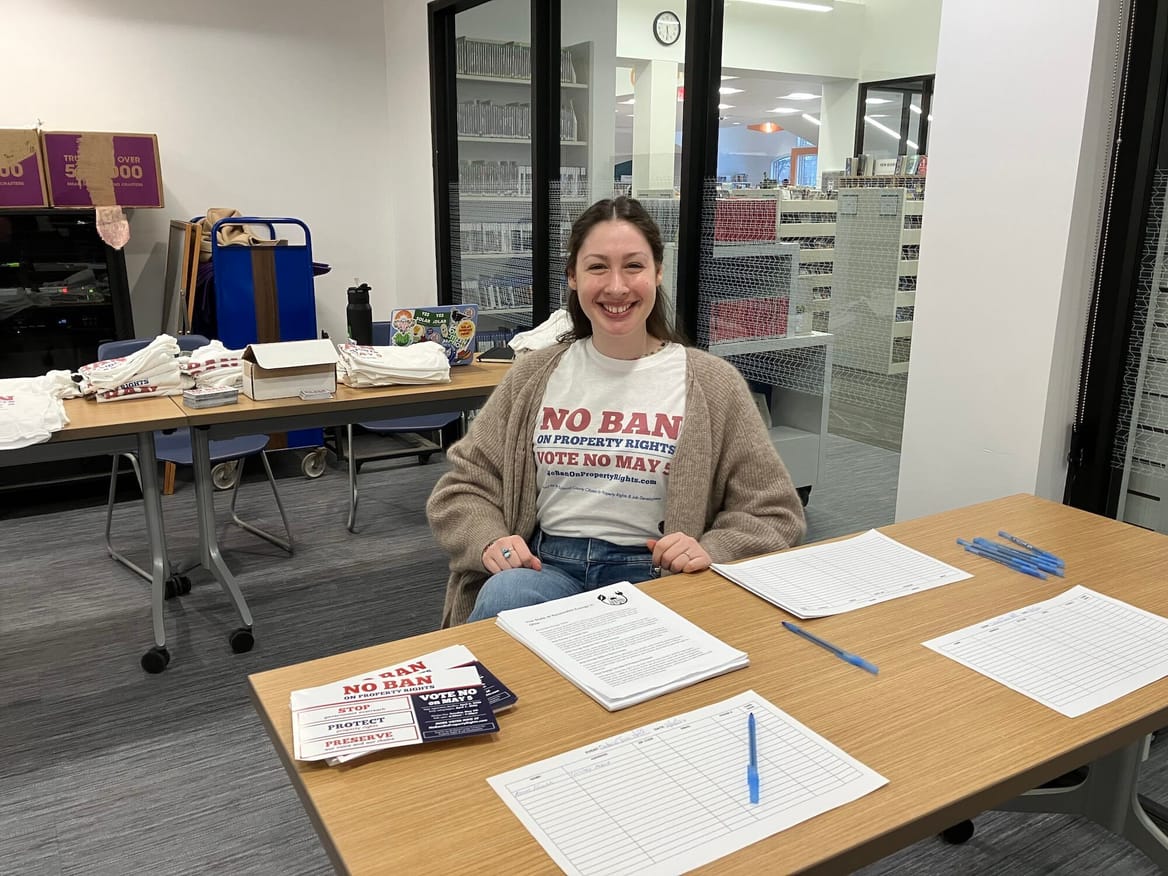
By the Aug. 18, 2025, deadline, the coalition had managed to collect thousands of signatures, and on Sept. 3 the Richland County Board of Elections ruled that they had cleared the threshold required to put it on the ballot.
It’s only the second time a county-level restriction on renewable energy has been challenged via referendum under SB 52.
In 2022, Crawford County commissioners blocked Apex Clean Energy from developing the 300-MW project Honey Creek Wind. A field manager for the company then helped lead the campaign to put it before voters, but ultimately that referendum failed.
At this time, no company is looking to develop a large solar or wind project in Richland County, noted Nolan Rutschilling, managing director of energy policy for the Ohio Environmental Council.
So, the Richland County ballot measure isn’t spearheaded by a company looking to profit from a particular project. Rather, it’s the work of citizens who want to preserve possibilities for the future — and restore the right to consider opportunities on a case-by-case basis.
In the lead-up to the election, the Richland County Citizens for Property Rights and Job Development has been using a slogan meant to win over their neighbors: “No Ban on Property Rights.”
Dan Fletcher, a Madison Township trustee who isn’t actively involved in the referendum campaign, said he knows how he plans to vote: “Taking the rights away from the property owner? That’s wrong in my opinion.”
Richland County is a farming powerhouse. More than 120,000 acres of cropland stretch across nearly 500 square miles. Farmers here mostly grow soybeans and corn, and to a lesser degree, forage, wheat, and other crops. The county also ranks among the top fifth of the nation’s leading producers of poultry, livestock, and other animal products.
The region’s agricultural character is the main focus of the campaign to keep the ban in place, run by a group named Richland Farmland Preservation.
The group’s website calls for farmland preservation and “commonsense limits” on solar and wind. It also includes a badge of endorsement from the Richland County Republican Party, which might go a long way in a county that went heavily for Trump in the last presidential election.
Banks, the county commissioner, is on the advisory committee for Richland Farmland Preservation. Other members include Richland County Prosecutor Jodie Schumacher and a trustee from each of the townships of Sharon, Blooming Grove, and Jefferson.
The group may have links to The Empowerment Alliance, a nationwide pro–natural gas organization that has been an impetus behind bills and resolutions labeling the fossil fuel as “green energy.”
A filing with the Richland County Board of Elections identifies the treasurer for Richland Farmland Preservation as Dustin McIntyre, with an address for a building with several offices in Bellville. But VoterRecords.com does not note any Dustin McIntyre in Richland County, nor does Whitepages.com show him living there.
Federal Elections Committee data does list a Dustin McIntyre with an address in Virginia as treasurer for multiple super PACs, including the Affordable Energy Fund PAC. That group was set up by The Empowerment Alliance in 2021.
The alliance began as a project of former Ariel Corp. chair Karen Buchwald Wright and her husband, Tom Rastin, who was also an executive there. Headquartered in Mount Vernon, Ohio, Ariel makes compressors for the oil and gas industry.
The Richland Farmland Preservation website also features anti–renewable energy talking points espoused by The Empowerment Alliance and other groups, including a variation of a graphic used by The Empowerment Alliance that implies gas-fired power plants should be favored over solar because of their smaller land footprint. (The illustration ignores the large swaths of land needed for drilling and pipelines, as well as pollution.)
Neither McIntyre nor Richland Farmland Preservation responded to Canary Media’s emails or calls.
The No Ban on Property Rights campaign held a fundraiser in February, and its volunteers have been distributing lawn signs, door hangers, and brochures. Volunteers with the nonprofit Ohio Citizen Action have also been helping with efforts to raise awareness and get out the vote.
As to whether the Richland Farmland Preservation group was mobilizing in a similar way, Banks told Canary Media he didn’t expect it to hold a general fundraiser. Instead, he noted that they planned to “call a few people.” Without saying who, he said, “There’s some people who will put some money towards this.”
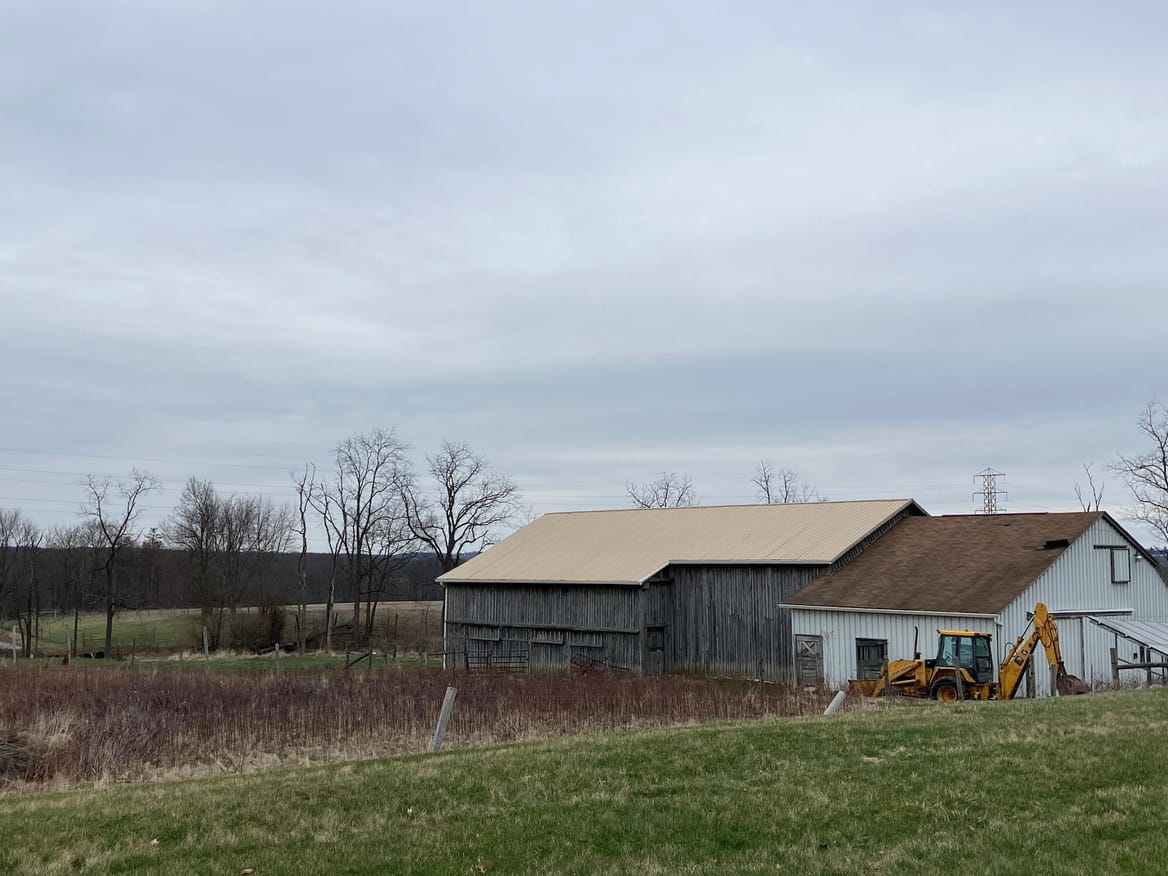
Nonetheless, the push to preserve the renewable energy ban is tapping into real anxieties about ceding land to non-farming uses.
“We’re seeing more and more farmlands being used up for developments, and we want to keep them as farmlands,” said John Jaholnycky, who previously worked for natural gas and electric companies and is now a trustee for Mifflin Township, which opted for the ban.
In Jaholnycky’s view, solar should go on buildings and over parking lots. “I think it’s kind of shortsighted that we want to use up all of this farmland to put these solar panels up.”
Richland County Commissioner Cliff Mears pointed out that the city of Mansfield plans to add a solar farm at the site of a former landfill. But he added, “We feel that farmland overall should remain farmland.”
Still, blocking renewables won’t necessarily preserve farmland. In fact, urban and suburban development has been the major threat over the past several decades.
From 2002 through 2022, Ohio lost over 930,000 acres of farmland. Researchers at The Ohio State University reported last year that most of that loss occurred around metropolitan areas, where urban and suburban sprawl was extending into formerly rural areas. The number of acres for certified and planned utility-scale solar projects, meanwhile, is about one-tenth that amount.
Data centers are also a growing concern, with roughly 200 already in the state, and plans for another 100 or so.
For farmers, leasing their land for renewable energy can supplement income and actually let them keep the land in their families.
“The alternative is that [landowners] will sell it for development or data centers or something,” said Annette McCormick, a county resident and opponent of the prohibition.
Nor are renewables necessarily incompatible with farmland preservation.
Agrivoltaics uses land under and around solar panels for grazing sheep or growing forage or other crops. “There’s a lot of opportunities for farming” amid clean energy installations, McCormick said. “Maybe just not think about corn and soybeans all the time” as the only farming options.
Permit restrictions also generally require renewable energy companies to restore agricultural land when projects finish using it.
Both Banks and Mears criticized SB 52’s provision that lets all voters in the county — not just those in the relevant townships — sign a referendum petition and then vote on the issue. “It has nothing to do with anybody in the cities or villages,” Mears said. In his view, voters “should have some skin in the game.”
That arrangement was once on the table. An earlier version of SB 52 would have given each township the authority to ban solar and wind and then left any decisions on referendums solely up to its own voters. Ultimately, however, the law put the decision to enact prohibitions — and the rights of voters to seek their reversal — at the county level.
“Every voter in Richland County should have a voice on this important issue because it’s a countywide policy,” said Jen Miller, executive director of the League of Women Voters of Ohio, who grew up in Richland County. Although the commissioners chose to defer to trustees in individual townships, “it is the role of county commissioners to represent every voter and to hear from every voter.”
Former Richland County Commissioner Gary Utt agreed: “It’s a county issue. Let the people decide.”
Energy costs are also a big issue this year, not just in Richland County but across the state. Utility bills are rising for all customers as electricity demand surges in Ohio, especially with the proliferation of data centers and growth in electrification. Solar power can come onto the grid faster than other sources. Adding more generation quickly could ease the supply crunch, and clean energy could help protect residents from the volatility of fossil fuel prices.
“That affects all of us — not just countywide, but statewide also,” said Christina O’Millian, a volunteer who worked on last year’s campaign to get the issue on the ballot.
Because SB 52’s hurdles apply only to solar and wind farms, it’s “picking winners and losers in what should be a free market,” said Fritz of the Ohio Conservative Energy Forum.
For McPeek, the electrical union business manager, blocking renewables also means fewer jobs for himself and other IBEW members throughout the county.
“Historically, communities that sort of close themselves off often see investment and innovation going elsewhere,” he said.
Even if residents defeat the ban, it doesn’t mean that any large solar or wind projects will be built in Richland County.
“It just restores the right of a project to be considered,” McPeek said. “There are a lot of hurdles that they have to jump through.”
In unincorporated areas without any ban, SB 52 still lets county commissioners review almost all new large-scale solar and wind farms of 5 MW or more before developers can even file a permit application with the Ohio Power Siting Board.
The law gives commissioners 90 days in which they can prohibit a project, change its footprint, or do nothing. No action means a company can then file its application with the siting board, provided the developer also complied with additional notice and public meeting requirements.
If a company does get to file an application for a solar or wind farm with the siting board, SB 52 then calls for two ad hoc representatives of counties and townships where the development would be located. Those individuals take part in the case as voting members. Any project also must satisfy a long list of other requirements before the siting board grants its approval to move ahead.
Even for projects that have otherwise met all legal criteria, the siting board sometimes simply defers to local government opposition to conclude they are not in the “public interest” — a stance that is currently under review by the Ohio Supreme Court.
Ultimately, it may take a repeal of SB 52 and some other legal changes to put all types of energy generation on an equal footing when it comes to siting and permitting.
But for now, advocates for a “no” vote on Richland County’s ballot issue are focused on what they can most immediately control: defeating a ban that makes solar and wind a nonstarter from the get-go.
“I want to make my children proud,” said Morgan Carroll, a Shelby resident who urges people to vote no. “I want to say that we tried to help them with their energy costs in the future, help the future of clean energy in the county.”
We’re glad you read this story. If you appreciate our independent, paywall-free reporting, please consider making a tax-deductible contribution in celebration of Canary Media turning 5! All donations are currently being matched.
After taking a beating for the first year of the Trump administration, the beleaguered wind energy industry may finally see a glimmer of hope.
President Donald Trump and Interior Department chief Doug Burgum have spent months in an all-out assault against the technology, and in particular against offshore wind projects in federal waters. They have frozen all new leases, repealed clean energy tax credits, and even paid off an oil company to not build a planned wind project. The most dramatic move came in December, when Burgum paused work on five under-construction wind farms on “national security” grounds.
The developers of these five projects — two off the Massachusetts coastline, two south of Long Island, and one off the coast of Virginia — sued over the stop-work orders, and a series of federal judges soon issued injunctions against the Interior Department’s interventions.
Burgum had vowed to fight back, but last week, the department quietly let the final deadline for appealing the courts’ decisions lapse. The move means construction of the nation’s first five major wind farms along the eastern seaboard can continue absent a change in the case. When complete, the wind farms will generate enough electricity to power well over 2 million homes.
The lack of appeals likely represents a recognition that the government couldn’t stop the five projects from moving forward, said Tony Irish, who served as an Interior Department lawyer for decades before leaving in 2025.
“If the actual reason behind the stop-work orders was legitimately founded in national security, I would be very surprised by the lack of appeal,” he said. “So I think the lack of appeal is telling in that regard.”
Developers of the five major wind projects haven’t wasted time, with several of the projects already producing power. Revolution Wind, a project from Danish company Ørsted, delivered its first electricity to the New England grid in mid-March. Coastal Virginia Offshore Wind, a project from the Virginia utility Dominion, is about 70 percent complete and also delivered its first electricity last month. The farthest-along project, Vineyard Wind, produced a massive amount of electricity earlier this year during Winter Storm Fern when other power resources were offline.
The lack of appeals could be good news for future wind projects as well. A bipartisan group of senators has been debating a long-delayed “permitting reform” bill for months. The bill would speed up environmental review for critical energy projects, make it easier to build interstate transmission lines, and protect clean energy permits from federal interventions like those of the Trump administration. (It would also likely afford the same protections to oil and gas projects such as the Keystone XL pipeline, which President Joe Biden scrapped after taking office in 2021.)
Those bipartisan talks broke down after Burgum’s stop-work order. Senator Sheldon Whitehouse, a Democrat from Rhode Island who is leading the talks, told congressional Republicans and the Trump administration that they would only resume if the Interior Department declined to appeal the court injunctions for the offshore wind projects. Senate Democrats are also hoping to see Burgum advance solar projects on federal lands.
A potential thaw on offshore wind might benefit the president as he tries to manage the fallout from the Iran war, which has sent gasoline prices soaring and contributed to fears of an energy shortage around the world. The White House’s “energy dominance council” has begun participating in the congressional permitting talks.
“There’s a confluence of market realities that make this a particularly hopeful year for us,” said Chris Phalen, vice president of domestic policy at the National Association of Manufacturers, in an interview with Bloomberg Government. Proponents of permitting legislation stressed that the next few months before the midterm election season are pivotal for achieving a deal.
A broader set of reforms to the National Environmental Policy Act, the nation’s bedrock environmental permitting law, would be controversial, but research shows that it might accelerate the deployment of onshore wind energy: A recent survey of around 50 renewable developers found that around 80% of them had selected a project site so as to avoid the federal environmental permitting process.
Other developers reported that reviews for historical artifacts and endangered species can add months or years to project timelines, and that the reviews may have held up at least 11 gigawatts of energy, or enough to power almost 5 million homes. A reform effort, likely modeled on the House-passed “SPEED Act,” would aim to shorten review timelines and limit litigation. (The environmental review for the five in-progress offshore wind projects took multiple years, even under the wind-friendly Biden administration.)
“Bipartisan permitting reform is the next critical step,” said Liz Burdock, the CEO of the Oceantic Network, a trade group that advocates for offshore wind. She added that ease of permitting could enable millions more homes’ worth of new wind development, but warned that “without a predictable path to build, manufacturers, shipyards, and skilled workers are forced to sit idle, creating gaps that raise costs and delay benefits for millions of ratepayers.”


.svg)
