

 Back
Back
Distributed solar developers say they could build gigawatts of projects to help ease the state’s power crunch — if lawmakers and regulators set clear rules.
Pennsylvania needs more energy. Data centers are pushing demand skyward, utilities can’t build new capacity fast enough, and electric bills are on the rise. Medium-sized solar installations — smaller than utility-scale farms but larger than home rooftop arrays — could help ease the pressure.
But state lawmakers, utilities, regulators, and solar developers are tussling over the rules that govern such installations, and it’s unclear whether new legislation to resolve their disputes will be passed this year. That worries Victoria Stulgis, president of Black Bear Energy.
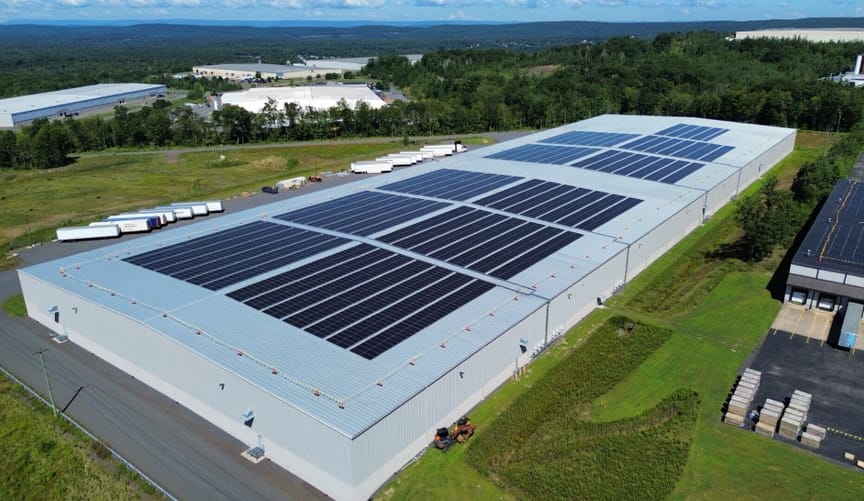
Last month, her company and its partners celebrated the energization of 4.9 megawatts of solar on the roofs of two warehouses owned by EQT Real Estate in Mountain Top, Pennsylvania. The two projects, developed by Sigma Renewables and Scale Microgrids and managed by Black Bear Energy, are among roughly 2,100 mid-sized generation projects being planned in the state, most of them distributed solar.
What makes these projects possible is Pennsylvania’s Alternative Energy Portfolio Standards Act, a 2004 law allowing medium-sized projects that generate power with a range of technologies, from solar and wind to waste biomass and coal-bed methane, to earn a relatively high rate for the energy they feed to the grid.
After years of battling with utilities, solar developers won a 2021 decision from the Pennsylvania Supreme Court that laid the groundwork for a rapid expansion of mid-sized projects throughout the state.
But in the past few years, Pennsylvania utilities have cast a pall over that growth with a series of actions that could curtail the revenues these projects can earn, Stulgis said.
“Developers and institutional property owners have invested significant time and capital to develop these solar projects,” she said. Black Bear Energy has completed 15 megawatts of projects, has 22 more megawatts under construction, and has secured interconnection rights for another 106 megawatts across 34 projects, she said.
“Changing those rules midstream would undermine confidence and create real risk for projects already in development,” she said. “Some developers are still leaning in, believing there may be a viable path forward, while others are walking away from shovel-ready projects because of the uncertainty.”
Unlike neighboring states such as Maryland, New Jersey, and New York, Pennsylvania hasn’t adopted a program to enable community solar. Such projects are designed to provide enough revenue to spur third-party developers to build mid-sized solar arrays, to which utility customers can subscribe to lower their bills.
Instead, solar projects of up to 3 megawatts in Pennsylvania are compensated through net metering, a system that’s more commonly used with residential rooftop solar and other small-scale installations. The projects earn a close-to-retail rate for power they send to the grid, notably more than the wholesale rate that larger projects earn.
Solar developers argue that the existing rules allow businesses, school districts, public agencies, and farms to offset rapidly rising electricity costs by hosting solar projects. But utilities argue that paying close to retail rates for electricity from these arrays forces them to raise rates on the rest of their customer base — a version of the cost-shift argument that has dogged battles over rooftop solar net-metering programs over the past two decades.
The Pennsylvania Public Utilities Commission supports the utilities’ cost-shift argument. In March testimony before the state’s House Energy Committee, PUC Chair Stephen DeFrank said that costs from distributed generation projects moving through the interconnection process are projected to exceed $90 million per year by 2027, and could reach $700 million per year if the more than 2,100 projects seeking to be built “proceed under existing rules.”
If utilities aren’t able to recover those costs, they’ll have to increase other rates, he said. Those increases will be “first borne by commercial and industrial customers, including small businesses operating on narrow margins,” he said.
Advocates of distributed solar are pushing back against this cost-shift argument. Rather than increasing everyone’s utility bills, distributed solar will lower utility costs at large, they say, by bringing much-needed new clean generation to a state facing increasing electricity costs driven by the data center boom.
Those are the findings of an April report by Aurora Energy Research commissioned by community-solar developer Dimension Energy. The report analyzed whether building 2 gigawatts of distributed solar by 2030, a number that’s in line with current market growth, would reduce demand for power across the low-voltage distribution grids they’re connected to.
Aurora found that additional solar power could generate a total savings of $1.7 billion over the next 20 years, compared with a scenario under which it wasn’t built. Utilities would still need to pay those projects about $780 million over that time. But that would leave just under $1 billion in net savings that could be applied toward lowering utility customers’ energy bills.
“There are multiple mechanisms by which distributed solar can reduce costs,” said Zachary Edelen, a senior associate at Aurora.
For example, there is the roughly $1.2 billion over 20 years that Pennsylvania utilities could save in decreasing “capacity procurement obligations,” the costs they pay for resources to keep the grid running when demand for electricity peaks, he said. That change could make a substantial difference in Pennsylvania, which is part of PJM Interconnection, the grid operator serving 13 states and Washington, D.C.
PJM’s skyrocketing capacity costs have been a major factor in pushing up utility rates between 12% and 26% for customers of the state’s major utilities from December 2024 to December 2025. That has driven politicians including Pennsylvania Gov. Josh Shapiro (D) to demand reforms from both PJM and the state’s utilities.
Unlike California, Texas, and other states that are awash in solar and need more batteries to store it to lower summertime peak loads as the sun sets, Pennsylvania gets only about 1% of its electricity from solar, Edelen noted. Adding 2 gigawatts would bring that total to about 4% of the state’s total generation capacity.
That means there’s plenty of room for new solar to flow onto utility grids and reduce overall peak loads — especially during the late afternoon summer hours when PJM measures how much peak demand utilities have, and thus how much capacity they’ll need to procure.
These capacity cost reductions are the biggest source of savings from distributed solar, but not the only one, Edelen said. Aurora’s analysis found that 2 gigawatts of distributed solar could cut the cost of purchasing energy from other resources by about $250 million. And because that solar would provide power to nearby customers, it could cut roughly $200 million from future transmission grid expansions that would be needed to deliver power from large power plants farther away. Aurora also estimated that Pennsylvania could earn about $140 million in renewable energy credits from 2 gigawatts of solar.
And that’s not counting the environmental benefits. The state could reduce carbon emissions by more than 11.3 million metric tons and abate harmful air pollution by supplanting fossil-fueled generation with 2 gigawatts of distributed solar.
To be clear, utility-scale solar can deliver electricity at prices well below those being paid to mid-sized projects under the current Alternative Energy Portfolio Standards Act regime. Some energy experts agree with the utilities that policymakers should cut the rates paid to distributed solar systems and instead compensate them at the lower wholesale electricity prices earned by power plants and other competitive generators.
The problem with relying on utility-scale projects is that PJM’s notoriously backlogged interconnection process has made it difficult to add new generation capacity to its grid over the past half decade. PJM recently reopened its interconnection queue after a multiyear pause. But new projects are still expected to take several years to move through that process, and years more to win permits and secure financing to get online.
Distributed solar, by contrast, can be permitted, built, and interconnected to lower-voltage utility grids within a year or two, according to developers working in the region. That could make it one of the few options to prevent what PJM forecasts could be a regional shortfall in energy supplies as early as next summer.
“The reliability of our energy system is increasingly uncertain,” Elowyn Corby, Mid-Atlantic regional director with the nonprofit Vote Solar Action Fund, said in March testimony to the state House Energy Committee. Distributed solar is “one of the fastest, most cost-effective tools available to bring new supply online where it’s needed most, and ease pressure on an overstretched, under-supplied grid.”
Corby also noted that Pennsylvania’s unusual regulatory structure, unlike almost all other net-metering programs in the country, allows distributed solar systems to have little or no “on-site load” — meaning a solar array on a building or one constructed on open land could send all its power to grid instead of using the bulk of it to meet the host’s needs. This makes many of the projects being developed in the state more akin to “merchant” generators that compete with other power producers, lending weight to arguments that they should receive lower compensation.
“Thoughtful reform that addresses how excess generation is treated, and that draws a clear line between distributed generation intended primarily to meet on-site load and merchant generation where the aim is primarily to sell excess generation to the grid, is not an attack on solar — it is responsible stewardship of a valuable policy,” she said.
Pennsylvania lawmakers have proposed similar bills to draw that clear line — one in the Democratic-controlled House and one in the Republican-controlled Senate. Both bills would allow projects that have already been built or that had utility interconnection agreements before mid-2025 to retain existing payment structures, although they would give the Public Utilities Commission the option to cap the total number of projects that qualify.
For projects that don’t meet that cutoff, the bills would significantly cut the rates earned for power sent to the grid. But the bills would offer higher compensation for projects built on “preferred sites,” such as on warehouse rooftops and parking lot canopies, on abandoned mines and capped landfills, and adjacent to closed coal plants, as well as for systems that serve school facilities.
Brandon Smithwood, vice president of policy at community solar developer Dimension Energy, would like to see these kinds of reforms, but he’s not confident that lawmakers will pass a bill. If they don’t, the state will end up with a patchwork of rules. Different utilities around the state have been making changes to how they classify mid-sized projects and lowering the compensation they earn, and developers have been challenging those changes.
Smithwood thinks that solar advocates can reach compromises with individual utilities to preserve some room for the market to grow. He pointed to a settlement agreement reached in March — between utility PPL Electric Utilities, solar trade groups Coalition for Community Solar Access and Solar Energy Industries Association, and the Pennsylvania Office of Small Business Advocate — as a “workable outcome” for solar developers in the absence of legislative action. The settlement would allow up to 140 megawatts of projects to retain retail net-metering compensation for up to 10 years, and then impose a complex and likely lower compensation structure for projects beyond that cap.
But other distributed solar developers are pushing for the legislature’s bills to be passed into law to avoid rules that differ from utility to utility.
“We are asking for regulatory clarity through a legislative foundation with clear and protected rules and rates,” said David Riester, managing partner at Segue Sustainable Infrastructure, a solar and battery project investor. Segue has invested in a portfolio of roughly 250 megawatts of distributed solar projects in development across Pennsylvania, which, if completed, could represent roughly $500 million in infrastructure investment, he said.
That’s just a portion of the total capacity being targeted by developers in the state. “If the light went green tomorrow, I would put the over-under on 700 megawatts getting placed in service within a year, and up to 2 gigawatts by the end of next year,” he said. “There’s this huge supply of power that’s ready to build.”
Segue is considering putting more money into more projects in Pennsylvania, Riester said. But without some clarity from utility regulators or lawmakers on how much these distributed solar projects will be able to earn, “those investments are on hold,” he said.


.svg)
