

 Back
Back
Big batteries have begun reshaping the U.S. grid. Now, the country has made surprising strides in making those energy storage systems itself, rather than depending on imports from China.
Batteries were always crucial for the effort to scale up renewable energy production, but they have taken on even more significance as AI leaders look for quick-to-build power sources to supply their headlong data center expansion.
That’s why batteries will account for some 28% of new U.S. power plant capacity built this year. For the first time, the country will be able to produce enough grid batteries to meet that surging demand on its own, according to new data from the U.S. Energy Storage Coalition, an industry group.
The onshoring began in earnest when President Joe Biden signed the Inflation Reduction Act in 2022, creating incentives both for domestic battery producers and for storage developers who use Made-in-America products.
Already, the U.S. has enough capacity to meet demand for finished grid battery enclosures. That involves connecting battery cells to power electronics, controls, and safety equipment in weatherproof steel containers that are ready to install. By the end of this year, the U.S. will also achieve self-sufficiency in a higher-value part of the supply chain: the battery cells themselves. It’s a major industrial coup that is bringing thousands of high-tech manufacturing jobs to communities across the country.
“For the first time, the United States now has the capacity to supply 100% of domestic energy storage project demand with American-built systems,” said Noah Roberts, executive director of the U.S. Energy Storage Coalition, on a Wednesday press call. “That is a fundamental shift from where we were just a year and a half ago, when the majority of battery storage systems were imported.”
This success outstrips the country’s considerable progress in solar panel manufacturing, too. The U.S. is self-sufficient in assembling solar modules, but that finished product still often depends on high-value components imported from far away — namely, solar cells. U.S. solar cell production remains a tiny fraction of its solar panel capacity.
By the end of 2025, U.S. factories had mustered the capacity to produce about 70 gigawatt-hours of finished grid storage systems each year, according to the coalition’s survey. Roberts expects that number to rise to 145 gigawatt-hours by year’s end. U.S. storage developers are likely to install about 60 gigawatt-hours annually this year and next, he noted, so the country will actually have a sizable surplus in manufacturing capacity.
As for the underlying cells, it’s a similar story with a slight delay. By the end of 2025, 20 gigawatt-hours of dedicated storage cell lines had opened, and the industry is on pace to hit 96 gigawatt-hours by the end of this year.
Now, the question the industry faces is not whether it can keep up with domestic demand — but whether it can export enough batteries to maintain that mismatch between manufacturing potential and domestic installations.
The development of U.S. grid-battery manufacturing has happened at a dizzying pace. Roberts called it “one of the fastest industrial scale-ups in recent American history.”
At the close of 2024, the U.S. had “effectively zero” factory capacity for battery cells designed for grid usage, which have different specifications than those in electric vehicles and which typically use the lithium iron phosphate chemistry.
LG Energy Solution Vertech, the grid-storage subsidiary of the Korean industrial giant, started turning things around last summer when it completed a dedicated cell production line for grid storage in Holland, Michigan. The company originally envisioned 4 gigawatt-hours of production, but quickly expanded that to 16.5 gigawatt-hours, said Chief Product Officer Tristan Doherty. Now LG plans to hit 50 gigawatt-hours of cell production capacity across North America this year.
“If you had told me that 10 years ago, that this is where we would be, I never would have believed it,” Doherty said.
The upstream supply chain, it must be said, still needs work. U.S. factories can only build the lithium-ion battery cells by importing the high-value battery materials, and China runs the show in that arena.
It’s also worth noting that this scale-up was accelerated by an unintentional nudge from the Trump administration, a sort of collateral benefit.
When the Trump administration passed its budget legislation last summer, it maintained Biden-era incentives for domestic energy manufacturing and grid battery projects even as it removed them for electric vehicle purchases.
The outlook for EV sales in America suffered as a result, and that prompted some manufacturers to repurpose their EV-battery facilities for the red-hot grid storage market. In just the last year, car companies like Ford and General Motors have retreated from their earlier EV ambitions and pivoted their battery lines to storage.
Just last week, LG said it and partner GM would retool an EV battery plant in Spring Hill, Tennessee, to make grid batteries instead; this will bring 700 people back to work after earlier layoffs. LG is also converting a plant in Lansing, Michigan, to make grid batteries instead of EV batteries, and will sell them to Tesla as part of a $4.3 billion supply deal.
It’s a stark reversal. In earlier years, grid battery developers had accepted surplus EV batteries as a sort of hand-me-down from the more mature supply chain; now, struggling EV battery producers are turning to grid storage in their moment of need.
Other companies have made their own direct investments in grid storage in recent years, including Tesla, Samsung SDI, Fluence, and SK On.
Even as the White House fights clean energy broadly, it’s showing interest in strengthening battery supply chains to reduce the upstream dependence on China. Just this month, the Department of Energy rolled out $500 million in funding for processing or recycling battery materials domestically.
The localization of grid storage supplies does more than stroke the national ego. As data center customers ravenously seek immense power supply as quickly as possible, domestic supply chains shorten the time it takes to add storage to the grid, argued Pete Williams, chief supply chain and product officer for Fluence, a major grid storage vendor.
“To deliver this ‘speed to power’ you need a resilient and a responsive supply chain, and that’s been certainly a challenge in the international markets,” he said. “With U.S. manufacturing, we can improve delivery certainty. We can also shorten project timelines for our customers.”
In the past, analysts framed industrial reshoring as a way to protect against the vagaries of geopolitical adversaries. These days, with the White House itself regularly upending global trade through tariff declarations and military interventions in crucial waterways, a local supply chain protects against U.S.-led disruptions as well.
This story was originally published by Grist. Sign up for Grist’s weekly newsletter.
When Krystal Steward started knocking on her neighbors’ doors in Ann Arbor, Michigan, in 2021, to discuss energy efficiency and sustainability upgrades, she was met with a lot of blank stares.
She was new to the issues herself, she said. But the longtime social worker kept at her new job doing outreach for Community Action Network, a local nonprofit dedicated to serving under-resourced communities. She slowly started getting people in her neighborhood to take part first in home-energy assessments, then in a city program to swap out appliances, make structural fixes, and more.
“In the beginning, it was kind of hard — a lot of people were reluctant. If someone is knocking on your door and telling you they can fix up your home for free, most people don’t believe that,” Steward said. But, she added, “Once one person tried it out, they’d tell their neighbors, and others would jump on board.”
Now, the neighborhood, Bryant, is set to pilot a first-in-the-country program that officials hope will speed the city’s transition to renewables — and offer a new model for how local governments can control their energy future.
The idea is technical, but has sparked enthusiasm across Bryant and Ann Arbor: a new city-created Sustainable Energy Utility, known colloquially as the SEU. Rather than replacing the privately owned utility that serves Ann Arbor, the plan is for this city agency to run in tandem, offering a supplemental service that residents can opt into.
If they do, they’ll stay connected to the regular grid, but will be outfitted with solar panels, battery backup systems, or other infrastructure, drawing on that power for their home use and opening up the prospect of selling any excess. The city, meanwhile, would pay for the installation and maintenance of these systems, which Ann Arbor would continue to own — a vision of energy generation and storage distributed across the city.
The plan begins in the coming months in Bryant, a 1970s-era community with about 260 homes, many of which are officially considered “energy burdened.” A quarter of residents pay more than a third of their incomes on utilities, in a neighborhood that is one of Ann Arbor’s only areas of unsubsidized affordable housing, according to Derrick Miller, Community Action Network’s executive director.
The SEU is a major step in a yearslong process to address Bryant’s energy affordability and sustainability concerns — and then expand the approach across the city.
“When we started having a conversation about how to decarbonize the neighborhood about four years ago, it felt outlandish. Now, it doesn’t feel like anyone can stop us,” Miller said.
The appeal of the SEU became clear in November 2024, when a ballot measure on the proposal was approved by nearly 80 percent of Ann Arbor voters. A little over a year later, city officials are ready to implement the vision, said SEU Executive Director Shoshannah Lenski.
In late February, the city announced that it was accepting expressions of interest from residents and businesses to take part, accompanied by a flurry of community meetings, animated videos, and ads in local theater playbills.
Customers who opt in will get two utility bills — one for the power supplied by these new city-owned clean energy systems, and one for any power they’re still drawing from the regular grid — which Lenski and her colleagues say will add up to less than they currently pay.
“Just like customers don’t own a power plant, the city owns and finances the system upfront, and they pay for that electricity through a monthly bill,” Lenski said. She noted that the model could prove particularly helpful for renters, who often get left out of green energy incentives. Signing up large multifamily buildings will be important to quickly expand the SEU’s size, she said.
In addition to installing clean energy systems at participants’ homes, the SEU could build its own microgrids, something that would set it apart from other municipal clean energy programs. For instance, the agency could install solar panels on a school to supply power when students and teachers are in the building, and that power could go to other SEU customers when classes are out.
Backers say the strategy allows Ann Arbor to build out its green energy system with lower financial risk — and lower potential for political or industry pushback.
“When coupled with DTE’s planned investments in clean energy, these voluntary, fee-based programs help accelerate economy-wide decarbonization while maintaining reliability and affordability,” Ryan Lowry, a spokesperson for DTE Energy, which currently supplies energy to the city, said in an email.
It might seem surprising that DTE, Michigan’s largest electric utility, is supportive of the SEU. But industry experts noted that many investor-owned utilities are struggling under the unprecedented new demands for power. Having a local government try to help manage power needs could be seen as an asset, they suggested — though DTE will have no formal role in the SEU.
So far, more than 1,500 people across Ann Arbor have indicated that they want to sign up. The SEU plans to serve around 100 to 150 customers in Bryant this year, expand out to reach 1,000 next year, and then grow by several thousand annually after that.
The approach answers a question prompted when Ann Arbor adopted an ambitious climate plan in 2020.
That framework included an electrical grid powered completely by renewable energy within a decade, but a city analysis in 2023 warned it was likely to miss that goal by more than 40 percent. In order to reach it, the city would need to push DTE to accelerate its renewable energy buildout, or lean on state officials to do so — or detach from DTE entirely and create a separate city-owned utility, an idea that does have some support in Ann Arbor.
But from the city’s perspective, these options seemed too risky or uncertain, Lenski said — until officials realized that the Michigan Constitution allows municipalities to create and run their own utility, even if there’s another present.
“That’s where the idea of the SEU was born,” she said.
When University of Michigan researchers compared the four options, they found the SEU model had the greatest potential to lower energy prices and emissions, boost reliability, and help low-income communities.
“Overall, it came down to having some benefits of local control without some of the costs,” said Mike Shriberg, a professor who led the research, noting a similar model should be possible in every state.
Still, some worry the strategy does not go far enough. Advocates who want the city to break with DTE and replace its services with a utility fully owned by Ann Arbor are seeking a November ballot measure to set that process in motion. (Organizers are currently collecting signatures.)
Brian Geiringer, executive director of the advocacy group Ann Arbor for Public Power, said the SEU plan still leaves too much responsibility for the city’s energy transition with DTE.
But if voters do approve creating a fully public utility, he said, it would not mean an end to the SEU: The two approaches could work together, with the SEU focused on generation within Ann Arbor, and a publicly owned utility able to make its own decisions on purchasing power.
“If you draw a circle around Ann Arbor, the SEU is doing stuff inside the circle. And we’re interested in having the city control what comes in from outside of the circle,” Geiringer said.
Like Ann Arbor, hundreds of cities are working to implement climate goals — and running into similar gaps between ambition and practicality, especially when it comes to control over energy sources.
“Cities have set these goals, and the utilities aren’t obligated to follow those,” said Matthew Popkin, manager for U.S. cities and communities at RMI, an energy think tank.
“So Ann Arbor’s SEU is an example of cities taking more control of their future without dismantling or acquiring existing utility systems,” said Popkin. “That’s a really interesting model.”
Other models also exist. In Washington, D.C., for instance, a program called the D.C. Sustainable Energy Utility has been operating for 15 years, overseeing the city’s efforts to help residents use less energy.
The initiative is far narrower than the Ann Arbor vision, functioning not as a utility but rather as an organization contracted by the city to boost energy efficiency and increase access to clean energy through subsidies and rebates.
The program is a central part of the city’s goals to reduce its greenhouse gas emissions, said managing director Benjamin Burdick, and has helped cut some 10 million metric tons of emissions while saving residents more than $2 billion from reduced energy use.
Nationally, “the conversation that we’re hearing is around how do you continue to talk about climate with affordability,” he said. “Programs like the D.C. SEU are going to continue to be the way that we double down.”
The work in Ann Arbor is now receiving its own attention across the country.
“What caught my eye about Ann Arbor’s efforts were the references to citizen involvement and co-investment in their own grid,” said Jim Gilbert, a retired medical product designer in Boulder, Colorado, who is now helping that city assess the Ann Arbor model.
Boulder has dealt with recent power outages due to worsening climate impacts and aging infrastructure, and Gilbert said an SEU could offer a way forward.
Back in Ann Arbor, as the city prepares to launch the initial pilot of its SEU, the plan is to reach half of the Bryant neighborhood by the end of the year — and local residents are “all in,” said Krystal Steward.
Older members of the community are particularly excited, she said, noting that many are on fixed incomes and will particularly benefit from lower energy bills.
“It’s hard for me to keep up,” Steward said. “Now it’s not me reaching out to residents to sign up — they’re blowing up my phone.”
Illinois could soon follow in the footsteps of Utah and Virginia with a law allowing plug-in solar arrays, often called “balcony solar.”
A bill that would make it simpler to install plug-in solar passed out of the state legislature’s Senate Energy and Public Utilities Committee on March 12. It’s now scheduled for a hearing in the full Senate, and a House committee on utilities is also considering the bill. Advocates are hopeful that the measure will pass both Democratic-controlled chambers this legislative session, which runs through the end of May, and then be signed by the state’s Democratic governor, JB Pritzker.
People are already plugging in these kinds of off-the-shelf small solar arrays to help power their homes, experts say. But legislation would ensure that more people can access the cost-saving clean power. Illinois’ bill would mandate that utilities allow people to plug in solar systems of up to 1,200 watts, without interconnection agreements, fees, or other barriers. That’s about enough energy to run a refrigerator and a few other appliances.
In Illinois, such units could save households up to $400 a year, according to an analysis by the advocacy group Solar United Neighbors, which notes that plug-in solar currently costs about $3 per watt, or about $2,000 for a typical model. Advocates predict that the cost will come down quickly if more states pass plug-in solar laws and the market expands.
More than two dozen other states are considering such bills. The concept has enjoyed bipartisan support across the country, with Utah’s Republican-dominated legislature passing the first law in March 2025. The Virginia legislature passed its law by a unanimous vote on March 11. Illinois’ red-state neighbors — Indiana, Iowa, and Missouri — have also introduced bills.
The momentum comes as affordability concerns mount nationwide. Electricity prices have spiked in many parts of the country, driven by factors including extreme weather and wildfires, natural gas price fluctuations, and the cost of infrastructure to get power where it’s needed. In Illinois, customers are seeing their bills rise sharply because of increasing electricity demand that is driven in part by data centers.
Illinois’ plug-in solar measure would go a step further than most by stipulating that homeowners’ associations and landlords could not enact rules, fees, or insurance requirements around arrays of 391 watts or less, proponents say. This would ensure that renters and condominium owners could take advantage of the option.
Despite the fast-growing enthusiasm for plug-in solar, some bills, like one in Wyoming, have failed. Utilities have raised safety concerns, such as danger to lineworkers if the arrays don’t shut off during power outages and continue sending electricity onto the grid, or a home’s electric system becoming overloaded.
Plug-in solar proponents note that safety concerns can be managed, especially through legislation that requires specific certification, as the Illinois bill does.
“This is a disruptive technology to the American market, and all disruptive technologies are good for the consumer and bad for the power structures,” said Cora Stryker, who co-founded the nonprofit organization Bright Saver last year to sell affordable plug-in solar kits. “We believe these are strategic efforts to confuse legislators and the public, but the real motivation is the threat to the business models of very powerful entities.”
The Illinois bill would mandate that plug-in solar systems not send any electricity into the home when the larger grid has an outage. That means the panels wouldn’t help during a blackout unless paired with a battery, but they would avoid harming lineworkers. Arrays that are commercially available already typically include such safeguards as part of the built-in microinverter.
The Illinois bill would also require that plug-in units be certified by UL Solutions (formerly Underwriters Laboratories) or an equivalent entity.
Hannah Birnbaum, co-founder and chief of advocacy at the nonprofit Permit Power, which focuses on reducing the bureaucracy involved in getting rooftop solar, said that it’s crucial to pass laws that include these sorts of safety provisions. Otherwise, people will continue to install unregulated systems, she said.
In California, for example, customers are already “quietly” using portable solar panels — even though the state has yet to pass the plug-in solar bill it’s considering.
“The real risk is inaction,” Stryker said. “Now there’s so much enthusiasm for plug-in solar, people are buying whatever systems they can get. It’s a regulatory gray area.”
In Illinois, utilities have thus far not raised opposition. ComEd spokesperson David O’Dowd said the utility does not have a position on the bill. Ameren did not respond to a request for comment.
Should the bill pass in Illinois, it would add to the state’s already robust incentive program encouraging residents, businesses, churches, schools, and other nonprofits to get rooftop solar. Clean energy advocates say plug-in solar provides a more affordable and convenient option, and one that’s accessible to both renters and those whose homes aren’t conducive to rooftop solar.
“It’s an untapped resource” in meeting larger clean-energy goals, according to Nick Johnson, an associate professor of sustainability and economics at Principia College in southwestern Illinois. Johnson was among over 100 residents who filed witness slips with the legislature in support of the bill.
“It’s a drop in the bucket for what we need, but every little bit helps,” he added.
In Germany, more than a million households have plug-in solar — a fact often underscored by advocates trying to popularize the technology in the U.S., where it’s still in the early stages. Even in Utah, only a few thousand households have plugged in the devices since they became legal.
Advocates expect the systems will take off once more states make it simpler for people to adopt them.
For her part, Kavi Chintam, Illinois campaign manager for the advocacy group Vote Solar, said she plans to put a plug-in solar array in her yard after the law passes. Her mother wants a solar array on her balcony, to power her TV.
“At a time when electricity prices are rising and rising, it gives an option for people to shave off some of that cost,” Chintam said. “There is something really empowering about seeing a panel you installed on your home. As the market expands, there will be more opportunities for people just to see these things out and about.”
See more from Canary Media’s “Chart of the Week” column.
Clean energy is on a tear. In China and India, it’s growing so fast it’s starting to unseat king coal. In the European Union, solar and wind now produce more electricity than do all fossil fuels combined. Even in the U.S., amid the Trump administration’s attacks on clean energy, nearly all new power capacity comes from renewables and batteries.
But who, exactly, is making all of the solar panels, wind turbines, battery packs, and electric vehicles enabling this transition?
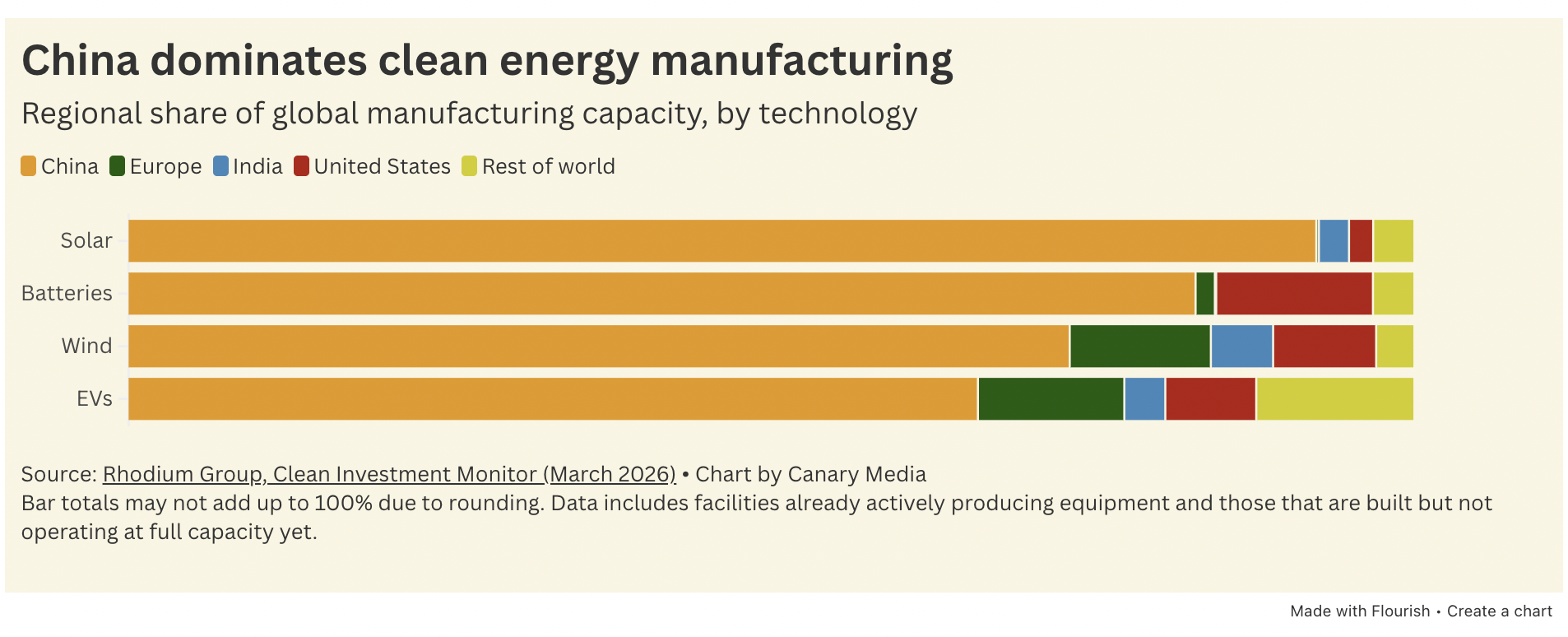
In a word: China. Let’s look at the latest numbers from the Clean Investment Monitor by Rhodium Group and the Massachusetts Institute of Technology. Right now, over 90% of the world’s solar manufacturing capacity is in China. So is 83% of the planet’s battery production capacity, and nearly three-quarters of wind technology manufacturing capacity. China’s grip on the EV sector almost looks measly in comparison, at just two-thirds.
China’s lead is explained by several factors. For one, the country itself uses way more clean energy tech than does any other, due not only to its massive population but also Beijing’s concerted effort to make the nation more self-sufficient on energy. Last year, more than half of the solar and wind installed worldwide plugged into China’s grid. The country dominates global EV adoption, too.
But China also exports enormous amounts of these technologies. The country’s expansion of manufacturing to meet its own domestic energy goals has allowed it to produce super-cheap solar panels, batteries, wind turbines, and EVs. That’s made clean energy more attractive to buyers in other countries.
But China’s investment in these factories is contracting, hard. Last year, it invested $60 billion in cleantech manufacturing overall — less than half of what it put in the year before. In 2023, it spent $50 billion on clean energy manufacturing in a single quarter. Investment in clean energy manufacturing has been sluggish in the U.S. and Europe, too, for what it’s worth, but it’s not crashing at anywhere near the same rate.
China is pulling back for a pretty intuitive reason. It’s already built more clean energy manufacturing capacity than the world wants to use at the moment. The Clean Investment Monitor team expects this mismatch to get even worse by 2030, so as it stands, it makes little sense for China to continue speeding ahead on new factory construction.
Overall, the clean-energy manufacturing picture could look a bit different by the end of this decade — but only by a little. Even with the U.S., Europe, India, and others expected to make some headway in the battery and EV markets, China’s lead ultimately isn’t expected to go anywhere.
Nuclear energy developers have historically operated by a simple principle: Go big.
Reactors cost a lot of money to build, so the logic has been that it’s easier to recoup that investment if the project produces more electricity. Of late, a new generation of companies has made waves by bucking that conventional wisdom and instead aiming to build smaller reactors that can be made cheaper through bulk orders and mass production.
But with few advanced reactors built to date, that argument remains theoretical — and a new report shared exclusively with Canary Media suggests the path to proving it out is harder than many in the industry acknowledge.
It’s a chicken-and-egg situation. Next-gen nuclear startups must establish supplies of rare and legally sensitive types of fuel while also competing for a small pool of skilled workers and a limited output of valves, pumps, heat exchangers, and other equipment. Manufacturers are hesitant to ramp up production without a clear signal that advanced reactors will pan out. Investors, in turn, are leery of reactors meant for mass production that rely on unprepared supply chains.
That’s the core takeaway from the new analysis by the Nuclear Scaling Initiative, a campaign by the nonprofits Clean Air Task Force, the EFI Foundation, and the Nuclear Threat Initiative. The Nuclear Scaling Initiative launched in 2024 and aims to promote fleet-scale construction of reactors in a bid to start bringing at least 50 gigawatts of atomic power capacity online worldwide every year at some point in the 2030s.
The study, conducted by the nuclear consultancy Solestiss, highlights two paths it says are promising for the industry: either sticking to proven designs or simplifying supply chains to tap into the traditional nuclear business’ existing materials and know-how.
It comes as the Trump administration pumps billions of dollars into advanced reactors while also courting developers of more conventional large-scale reactors — and amid a high-stakes debate over which approach is best.
Earlier this month, the Bill Gates-backed TerraPower won the Nuclear Regulatory Commission’s approval to begin construction on the country’s first commercial plant with sodium-cooled fast reactors in Wyoming. In December, the decommissioner-turned-developer Holtec International won a $400 million Department of Energy grant to build its first 300-megawatt small modular reactors in Michigan, using a pressurized-water-cooled design. The DOE awarded another $400 million grant to help American-Japanese joint venture GE Vernova Hitachi Nuclear Energy build its first 300-megawatt SMR in Tennessee, based on a traditional boiling water design.
The Trump administration, meanwhile, is trying to get developers to commit to building more AP1000s — the flagship large-scale reactor from Westinghouse Electric Co. The only two nuclear reactors designed and constructed in the U.S. this century used the Westinghouse design. (A third came online in 2016 but first started construction in 1973.)
The variety of designs racing to become the nation’s fourth new reactor in decades calls into question the feasibility of rapidly scaling up production of any one model.
“We can do any one of these first projects all at once. But can we sustain a build-out of TerraPower, GE, Westinghouse, and Holtec? All the ones that are just moving forward right now? The answer to that is not yet,” said Dillon Allen, president of the advisory services division at Solestiss, who started his career working on nuclear propulsion in the U.S. Navy before moving into the utility business. “Once you’re building four to eight AP1000s and a handful of SMRs of other sizes, you start to run into smaller component bottlenecks.”
Those bottlenecks would worsen if microreactor companies succeed in their objective of securing dozens and dozens of orders for their designs.
“While small reactors have been tried before, mass-manufactured small reactors have not,” Aalo Atomics CEO Matt Loszak, whose 10-megawatt reactors also use liquid sodium as a coolant, wrote in a post on X this week. “Small is more expensive than large, if you only make one reactor. But if you make 1000s per year, small could be cheaper than large. This is what Aalo is setting out to prove.”
One major obstacle to this plan is transportation. To build something and send it without prior testing is no problem, since a reactor that hasn’t been fired up and irradiated “is just a big hunk of metal,” Allen said. But once it’s irradiated, it’s subject to different considerations.
National laboratory researchers have started to discuss a framework for a U.S.-wide transportation network with established logistics and safety standards, the report notes, but no such rules have yet materialized.
The biggest barrier for next-gen nuclear, however, is likely to be the fuel supply. Some small reactor companies have been proactive here. Aalo, for example, has opted for the most commonly used reactor fuel on the planet, low-enriched uranium, so it can tap into the existing global supply chain.
But most advanced nuclear startups are banking on what’s known as fourth-generation reactors. These designs rely on coolants other than water and mostly aim to use one of two types of fuel: high-assay low-enriched uranium, commonly known as HALEU (pronounced HAY-loo), or tristructural isotropic fuel, for which HALEU is typically an input. Tristructural isotropic fuel is also known as TRISO.
HALEU, which firms like TerraPower and microreactor developer Oklo plan to use, is only really produced at a commercial scale by Russian and Chinese state-owned companies. Efforts to bring new centrifuges online in America are slow-going. Meanwhile, the TRISO fuel that startups such as Valar Atomics or Radiant need requires not only securing HALEU but also separating that enriched uranium into ceramic-coated pellets the size of poppy seeds. Manufacturers admit that TRISO may never cost less than low-enriched uranium.
The complications don’t stop there. Because HALEU is up to four times more enriched than traditional reactor fuel, it comes with stricter regulations. On the Nuclear Regulatory Commission’s security-clearance scale of category one, which allows for handling normal reactor fuel, to three, which includes military-grade enrichment levels, facilities with HALEU need to be rated at a category two. No such facilities exist in the U.S. today, though the commission just issued its debut permit for one last month.
As for traditional fuel, the existing supply of low-enriched uranium falls short of what would be required to meet the U.S. goal of quadrupling the nation’s nuclear capacity to 400 gigawatts by 2050.
“The supply chain is pretty well suited to support a fleet of 100 operating reactors,” Allen said, referring to the 94 commercial reactors in service in the U.S. “But then you can have 150, then 180, and pretty soon 200 after that. If you double that demand on the LEU supply, it’s not just the enrichment” that’s a limiting factor.
It’s also, he said, the production of raw uranium and the facilities to carry out conversion, where purified uranium ore is turned into a gas, and deconversion, where it’s solidified once again.
Expanding these upstream operations may be challenging, but it isn’t impossible. In fact, Allen said he came away from writing the report with the impression that supply chains are more capable of scaling up than he previously thought. But his team’s work demonstrates the steep obstacles faced by the entire industry — not only advanced reactor firms — as it attempts to bolt into action following decades of anemic construction in America.
The biggest impression the research left on Allen, he said, is that the AP1000 has a good shot at becoming the next reactor built in the U.S. Its costs are more predictable — and thus easier to finance — thanks to the lessons learned during construction of the two units that came online at Southern Co.’s Alvin W. Vogtle Electric Generating Plant in central Georgia in 2023 and 2024.
“I’m more bullish on the AP1000 than I was when I started this effort,” he said. “I’m broadly bullish on the supply chain.”
The DOE is considering alternatives to the AP1000 to satisfy President Donald Trump’s order to facilitate construction on at least 10 large-scale reactors by the end of the decade. In response to the news that the administration held talks with its rivals, Westinghouse said the AP1000 is“the only construction-ready, gigawatt-scale, advanced modular reactor that is fully licensed and operating in the U.S.”
The U.S. ultimately should focus on designs it can scale up rather than spreading its efforts in many different directions, said Stephen Comello, the executive director of the Nuclear Scaling Initiative. At that point, nuclear power will become cheap enough to be “boring.”
“Once you start accumulating that knowledge from repetition, nuclear construction becomes boring — just like natural gas combined-cycle plants, just like all other complex megaprojects and energy infrastructure that’s out there,” he said.
There’s little doubt that the AP1000 has a well-established supply chain and data showing it runs well, he said.
The question is, “Can you do it in a repeatable, cost-effective way? That’s where the risk lies with the AP1000,” Comello said. “It runs, the technology is great. But we have to prove to investors that we can overcome the execution risk. But here’s the thing: All reactors share execution risk to some extent. Others have a technology risk because they are still not proven at scale.”
A new study, led by researchers at Columbia University and Woods Hole Oceanographic Institution (WHOI), identifies a diverse set of molecules released by marine phytoplankton that fuel microbial life and help drive Earth’s carbon cycle. While scientists know that carbon is moved through an invisible network of phytoplankton and other microbes in the surface ocean, the specific compounds have long been a mystery. These compounds are small, chemically difficult to detect in salty seawater, and are rapidly consumed by other organisms almost as soon as they are produced.
Phytoplankton, a type of microscopic organism, take in carbon dioxide and convert it into organic carbon through photosynthesis, like plants. Each year, this process moves many tens of billions of tons of carbon through the sunlit surface ocean and contributes to the oxygen in the air we breathe. These massive natural carbon flows highlight the central role the surface ocean plays in regulating Earth’s carbon cycle.
“For this study, we placed six phytoplankton species representing major groups of marine phytoplankton under controlled conditions. They had the nutrients and light they needed to grow,” said Yuting Zhu, co-lead author of the study and former WHOI postdoctoral investigator, now with Old Dominion University. “Using a chemical-tagging method developed at WHOI, we were able to quantify the composition of biologically available small molecules released by globally abundant microorganisms.”
These compounds accounted for up to 23% of the dissolved organic carbon that phytoplankton released and may support a substantial share of microbial metabolism in the global ocean.
However, many bacteria are metabolic specialists, or picky eaters. The study found that different phytoplankton species release distinct combinations of metabolites, including carbon compounds also containing nitrogen, phosphorus, and sulfur. Because bacteria vary in which molecules they can consume, the chemical “menu” produced by phytoplankton helps determine which microbial communities thrive in different parts of the ocean.
“The findings help illuminate a long-standing mystery about the composition of the ‘chemical currencies’ that are moved by microbes in the surface ocean,” said microbial oceanographer Sonya Dyhrman, a researcher at Lamont-Doherty Earth Observatory, which is part of the Columbia Climate School, and professor of Earth and environmental sciences. “I think of it as a microbial carbon economy. By identifying the currencies produced by phytoplankton, scientists can begin to build more realistic representations of how marine microbial communities cycle billions of tons of carbon.”
To explore the broader implications, the team, also including researchers from the Massachusetts Institute of Technology and Marine Biological Laboratory, combined laboratory measurements with global ecosystem modeling. Their results suggest that phytoplankton-derived metabolites could supply up to 5 percent of the daily carbon needs of SAR11, one of the most abundant groups of bacteria in the surface ocean.
“Combining the ecological and chemical approaches here allowed us to view the system through a new lens,” said co-lead author Hanna Anderson, a researcher at Lamont and PhD candidate in Earth and environmental sciences at Columbia. “Thinking synthetically about how these carbon substrates can mediate interactions between phytoplankton and heterotrophs, which in turn cycle this carbon within the marine food web.”
The research was conducted as part of the National Science Foundation-funded Center for Chemical Currencies of a Microbial Planet, a science and technology center that investigates how small molecules govern interactions among microorganisms across Earth’s ecosystems.
“Understanding these exchanges is critical because a huge portion of Earth’s carbon cycle passes through this microbial system, but we still don’t fully understand it,” said the center’s director and co-author of the study, WHOI senior scientist Elizabeth Kujawinski. “If we understand what molecules phytoplankton release and what molecules bacteria can take up, we can start building models of how these organisms interact. We think of the surface ocean as a network, where phytoplankton and bacteria are connected by molecules—some compounds feed many different bacteria, while others only support a few.”
Future studies will investigate how environmental conditions such as nutrient limitation, temperature changes, and ocean acidification alter the molecules that phytoplankton release and how microbial communities respond to those “chemical currencies.”
This article was adapted from a press release by the Woods Hole Oceanographic Institution.
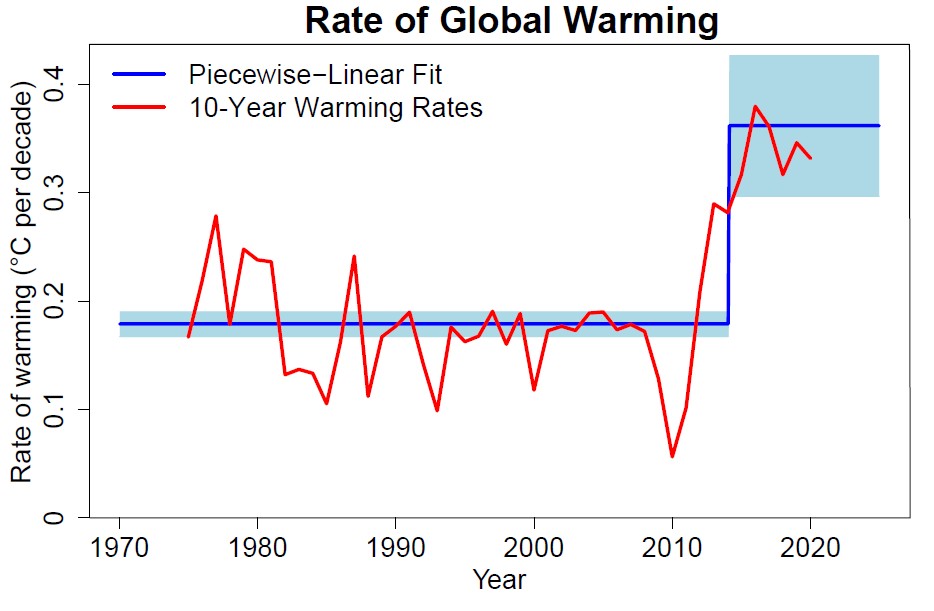
06.03.2026 - Global warming has accelerated since 2015, according to a new study by the Potsdam Institute for Climate Impact Research (PIK). After accounting for known natural influences on global temperature, the research team detected a statistically significant acceleration of the warming trend for the first time. Over the past ten years, the estimated warming rate has been around 0.35°C per decade, depending on the dataset, compared with just under 0.2°C per decade on average from 1970 to 2015. This recent rate is higher than in any previous decade since the beginning of instrumental records in 1880.
“We can now demonstrate a strong and statistically significant acceleration of global warming since around 2015,” says Grant Foster, a US statistics expert and co-author of the study, which was published today in the scientific journal Geophysical Research Letters.
“We filter out known natural influences in the observational data, so that the ‘noise’ is reduced, making the underlying long-term warming signal more clearly visible,” Foster added.
Short-term natural fluctuations in global temperature caused by El Niño, volcanic eruptions, and solar cycles can mask changes in the long-term rate of warming. In their data analysis, which is based on measurement data, the two researchers work with five large, established global temperature data sets (NASA, NOAA, HadCRUT, Berkeley Earth, ERA5).
“The adjusted data show an acceleration of global warming since 2015 with a statistical certainty of over 98 percent, consistent across all data sets examined and independent of the analysis method chosen,” explains Stefan Rahmstorf, PIK researcher and lead author of the study.
After correcting for the effects of El Niño and the solar maximum, 2023 and 2024, which were exceptionally warm years, become somewhat cooler, but remain the two warmest years since the beginning of instrumental records. In all datasets, the acceleration begins to become apparent in 2013 or 2014. To test whether the warming rate has changed since the 1970s, the research team applied two statistical approaches: a quadratic trend analysis and a piecewise linear model that objectively determines the timing of any change in the warming rate.
The study does not investigate the specific causes of the observed acceleration. However, climate models show that an increasing rate of warming is fundamentally within the scope of current climate modelling, according to the authors.
“If the warming rate of the past 10 years continues, it would lead to a long-term exceedance of the 1.5° limit of the Paris Agreement before 2030,” says Stefan Rahmstorf. “How quickly the Earth continues to warm ultimately depends on how rapidly we reduce global CO₂ emissions from fossil fuels to zero."
Winter winds lofted clouds of dust from the Sahara Desert, carrying it north toward the Mediterranean and dispersing it widely across Europe in March 2026. When the dust combined with moisture-laden weather systems, a dirty rain fell in parts of Spain, France, and the United Kingdom.
This animation highlights the concentration and movement of dust throughout the region from March 1 to March 9. It depicts dust column mass density—a measure of the amount of dust contained in a column of air—produced with a version of the GEOS (Goddard Earth Observing System) model. The model integrates satellite data with mathematical equations that represent physical processes in the atmosphere.
The animation shows dust plumes originating in northwestern Africa being blown both to the west across the Atlantic Ocean and north toward the Mediterranean. As plumes spread throughout Western Europe over several days, people observed hazy skies from southern England, where sunrises and sunsets took on an eerie glow, to the Alps in Switzerland and Italy, where a dust layer encroached on the Matterhorn.
Not all of the dust remained aloft. Storms encountered some of the dust, causing particles to fall to the ground with rain and coat surfaces with a brownish residue. A low-pressure system, named Storm Regina by Portugal’s weather service, moved across the Iberian Peninsula and brought so-called blood rain to southern and eastern Spain, along with parts of France and the southern UK in early March, according to news reports.
Over the Mediterranean, areas of “dusty cirrus” clouds developed higher in the atmosphere, where dust particles can act as condensation nuclei for ice crystals, according to MeteoSwiss, Switzerland’s Federal Office for Meteorology and Climatology. Scientists are studying these clouds to better understand their formation and how they affect weather, climate, and even solar power generation.
In a new analysis, researchers used NASA’s MERRA-2 (Modern-Era Retrospective Analysis for Research and Applications, Version 2), observations from MODIS (Moderate Resolution Imaging Spectroradiometer), and other satellite products to parse the effect of airborne Saharan dust on solar power in Hungary. They found that photovoltaic performance dropped to 46 percent on high-dust days, compared with 75 percent or more on low-dust days. They determined the greatest losses occurred because dust enhanced the presence and reflectance of cirrus clouds and reduced the amount of radiation that reached solar panels.
Some research suggests more frequent and intense wintertime dust events have affected Europe in recent years. Researchers have proposed several factors contributing to these outbreaks, including drier-than-normal conditions in northwestern Africa and weather patterns more often driving winds north from the Sahara.
NASA Earth Observatory animation by Lauren Dauphin, using GEOS-FP data from the Global Modeling and Assimilation Office at NASA GSFC. Story by Lindsey Doermann.
This article originally appeared on Inside Climate News(hyperlink to the original story), a nonprofit, non-partisan news organization that covers climate, energy and the environment. Sign up for their newsletter here.
U.S. Sen. Sheldon Whitehouse (D-RI) launched an investigation into the discrepancy between reported and observed methane pollution from the Permian Basin—the largest-producing oil field in the United States and one of the largest in the world.
The investigation, announced Wednesday, follows a recent report by MethaneSAT, a short-lived methane-sensing satellite launched by the Environmental Defense Fund, Harvard University and others in 2024. That report, released in early February, found that methane emissions from oil and gas production facilities in the Permian Basin from May 2024 to June 2025 were four times higher than the U.S. Environmental Protection Agency’s official estimates.
“The inconsistency between emissions reported to EPA’s Greenhouse [Gas] Inventory and satellite data suggest that significant, previously unreported emissions may be occurring,” Whitehouse, the ranking member of the Senate Environment and Public Works Committee, said in a written statement. As a result, “substantial opportunities exist to reduce waste, improve operational efficiency, and mitigate climate change.”
Methane is a climate super-pollutant. Over 80 times more effective at warming the planet than carbon dioxide in the first two decades after its release, it is the second-leading driver of climate change. Its emissions also pose serious public health risks, contribute to smog formation and negatively impact agricultural production.
Whitehouse requested information by April 1 from eight leading oil and gas producers in the Permian Basin of West Texas and southeastern New Mexico—EOG Resources, ConocoPhillips, Occidental Petroleum, ExxonMobil, Diamondback Energy, Devon Energy, Chevron and Mewbourne Oil Company. The senator asked each company about the steps they are taking to address methane pollution in the region, how they monitor and measure their own emissions and their current estimates.
“We appreciate the Senator’s interest in this important topic and look forward to working with him to achieve our shared goal of increasing global supplies of natural gas and reducing cost for consumers and industry,” Allison Cook, a spokesperson for Chevron, said in an email.
A spokesperson for EOG Resources shared the company’s 2024 sustainability report, which noted a low rate of methane emissions, 0.04 percent of total U.S. gas production.
None of the other companies responded to a request for comment from Inside Climate News.
A spokesperson for S&P Global Energy, a research firm that focuses on energy, commodities and financial information, said the discrepancy relates to how the EPA requires emissions data to be reported. An S&P Global report published last year concluded methane emissions from the Permian Basin declined by nearly 20 percent from 2022 to 2024 as oil and gas production grew.
Sharon Wilson, executive director of the nonprofit organization Oilfield Witness, which uses optical gas imaging cameras to reveal emissions of methane and other pollutants in the Permian Basin and elsewhere, cautioned that the S&P Global report had not undergone the peer-review process customary for studies published in academic journals.
MethaneSAT’s findings hadn’t been confirmed through a peer-reviewed study published in an academic journal at the time of their release in February. However, a MethaneSAT study that includes data from the Permian is currently under review by the journal EGUsphere.
Steven Hamburg, chief scientist at the Environmental Defense Fund and MethaneSAT project lead, said emissions from the region are “very large” and the intensity, or rate of emissions, exceeds industry targets for emission reductions.
“Bottom line emissions are far too high, and it is technically and economically feasible to reduce emissions drastically,” Hamburg said in a written statement.
Two of the companies questioned by Whitehouse, ExxonMobil and Occidental Petroleum, have pledged to reduce methane emissions to 0.2 percent of total gas brought to market by 2030 under the Oil and Gas Decarbonization Charter, a voluntary industry group. MethaneSAT reported a significantly higher rate of emissions—2.4 percent of total marketed gas—for the entire Permian Basin.
A spokesperson for the Oil and Gas Decarbonization Charter did not respond to a request for additional information other than providing a link to the group’s 2025 annual report.
All of the companies except Mewbourne Oil are members of the Oil and Gas Methane Partnership 2.0, a global emissions-reduction program for oil and gas companies overseen by the United Nations Environment Programme (UNEP). Member companies commit to an individual methane reduction target, based either on absolute emissions volume or methane intensity.
A UNEP spokesperson said they support measurement data provided by efforts such as MethaneSAT. “The transparency provided by this data is essential for industry to effectively manage emissions and for consumers, investors and others to make informed decisions,” the spokesperson said in an email.
In a press release announcing the investigation, Whitehouse stated that reducing methane emissions “can largely be done at no net cost.” Methane is the primary component of natural gas, a valuable commodity whose price has spiked due to the ongoing U.S.-Israel war in Iran.
Wilson challenged the notion of reducing emissions at little to no cost, noting that methane is considered a byproduct in the Permian Basin and that a significant buildout of additional infrastructure, along with increased equipment maintenance, would be needed. Oil is the primary commodity in the region. Pipelines needed to bring gas to market are often insufficient, resulting in a large volume of gas being flared rather than sold.
Wilson emphasized that producing oil and gas inevitably releases pollution, and permitting new sites will lead to elevated levels.
Whitehouse said stronger federal oversight is needed.
“Fossil fuel companies can’t be trusted to control their dangerous methane leakage,” he said. “There’s a significant discrepancy between reported and tracked methane emissions in the Permian Basin that demands further investigation.”
This story was produced by Grist and co-published with The Texas Observer. Sign up for Grist’s weekly newsletter and for the Texas Observer’s weekly newsletter.
In the far corner of the Crockett County Senior Center, 75-year-old Cynthia Flores almost always has a puzzle going. She and her friends sort colors and look for edge pieces while they gossip — “faster than the telephone” — in the Tex-Mex blend of Spanish and English they grew up speaking in Ozona, a tiny ranching and oil outpost in far West Texas. A couple of days before Valentine’s Day, their puzzle surface was one of the few in the center not covered in red and pink hearts; preparations were underway for the big dance the following night.
“La comida esta ready,” another senior said, calling the puzzlers to lunch. Flores placed one last piece, then took her seat at a long community table. The plate in front of her would have delighted a nutritionist with its lean protein and mountain of steamed broccoli. She pulled a tiny plastic container of teriyaki sauce out of her bag and poured the contents over the meat. “They feed us what we need,” Flores said, “but I always fix it up.” Mostly, she said, she’s just thankful not to have to cook. Like many of her friends, Flores still lives at home, but comes into the center for lunch most days. After being married at 16 and preparing food for herself and her family for almost 60 years, she said she was ready for a break.
Some might say Flores and her friends are living the retirement dream. The center is like a second home, with nutritious food and a full calendar of bingo, dominoes, and social events. Thanks to services like these, many of Crockett County’s aging residents have been able to stay in the familiar community where they, their parents, and sometimes even their grandparents grew up. Flores has been cutting hair locally for decades, working primarily out of her house. Many of her clients now are in their 90s. “I’ve been blessed to work in Ozona, where I can do my own thing,” she said.
Ozona is the only town in Crockett County’s 2,800 square miles, and technically, it’s not even that. “The Biggest Little Town in the World,” as it brands itself, is technically unincorporated, meaning that the county is the only municipal government for its 2,800 residents. One person per square mile means Crockett isn’t the most rural county in Texas, but it’s up there. Taxes and regulations are minimal. The nearest city, San Angelo (the locals just say “Angelo”), is 90 minutes away. The nearest metro area, San Antonio, is three hours.
In her chic, clear-frame bifocals and flowy duster, Flores makes aging gracefully in place in one of the most rural places in the United States look easy. It’s not. In many rural communities, seniors may find it hard or impossible to get the resources they need to remain in their homes and hometowns. Older Americans are already at risk of isolation, and living in a remote area can make that worse. Not to mention, resources are thin, local hospitals and other services are folding, and groceries may be pricey, far away, or both. According to the Rural Health Information Hub’s summary of U.S. Department of Agriculture data, 10.2 percent of seniors in rural areas don’t have sufficient access to healthy and nutritious food, compared with 8.5 percent in metro areas.
But in Ozona, older adults like Flores are thriving. The Crockett County government has created a strong network of senior services, and ensures that they are supported — with the help of a wonky tax arrangement and some powerful new neighbors: wind companies.
About 15 miles north of the senior center on State Highway 163, the wind turbines start cropping up, fleets of towering structures owned and operated by a company called NextEra Energy. In Texas, wind generates 29 percent of the power distributed by the state’s notoriously independent power grid — second only to natural gas. According to the state comptroller, Texas wind generation surpassed nuclear power in 2014 and overtook coal-fired generation in 2020. As of 2023, the state led the nation with 239 wind-related projects and more than 15,300 wind turbines.
In Crockett County, the turbines generate more than just electricity. Money from NextEra supports the meals that Flores and her friends enjoy at the center and helps make events like the Valentine’s Day dance possible.
It all comes down to clever utilization of a section of the Texas tax code. As a way of attracting large projects like wind farms, the state offers companies a temporary property tax break — up to 10 years — in exchange for local investment. This Texas Abatement Act (also known as Section 312) means less tax revenue in the short term, but more dollars immediately flowing to community projects and programs like the senior center in Crockett.
While some economists say the abatements are unnecessary to recruit the companies — there aren’t many places they can go where taxes would be lower — the opportunity to reduce startup costs for wind turbines or data centers or other developments gives the county a bargaining tool.
Many counties and cities use funding generated from these deals to improve roads and other infrastructure that might be strained by the new development, or to fund other public projects that don’t have a place in the regular budget. In Medina County, for instance, officials negotiated with incoming data centers to improve roads where locals were concerned about increased traffic.
In Crockett County, like many places in West Texas, roads, jobs, and public projects have long been tied to oil and natural gas revenue, with its attendant booms and busts. According to Crockett County Judge Frank Tambunga, oil and gas have kept public coffers full in Ozona, even with the ups and downs of the industry — and the steadier (though usually lower) revenues from wind farms will likely add consistency to an already healthy budget.
Ozona’s services for seniors are usually funded by a mix of federal and local funds, as well as charitable donations. As NextEra expanded its wind farms and more turbines cropped up, Tambunga saw the opportunity to offer those aging support services a boost.
Tambunga is a native of Ozona. Now in his early 60s, he’s well acquainted with the sorts of choices his slightly older peers are making. He hears their concerns about health care, groceries, and social isolation. When he considered what to ask for in the tax abatement negotiations with NextEra, those concerns were top of mind. But rather than push for a new public department or project, Tambunga looked to those already doing the work in the community.
“As we negotiate, we ask that, during the term of the abatement, that they make charitable contributions to nonprofit organizations to help the local groups,” said Tambunga. “It allows us to provide support for these organizations that help people within the community.”
Eligio Martinez remembers when the wind companies first arrived in Crockett County in the 2010s. He was a county commissioner back then (at times in Ozona, it feels like everyone has taken their turn in county office), and remembers talking to other counties to figure out the best terms for the tax abatement deal. Locally, he said, the wind turbines were an easy sell. “We welcomed them,” Martinez said. No one got caught up in the politics of green energy — something that Texas’ oil-funded politicians regularly debate — or even the aesthetic effect of adding turbines to the wide open vistas. They saw the chance to increase their tax base and gain funding for local services, Martinez said. “If it’s beneficial to the community, we’re going to stick together.”
For their part, the residents at the senior center didn’t understand exactly how the turbines worked — when the massive structures first arrived, they said, locals wondered if they could run electricity directly from the turbine and were skeptical when they learned that the electricity would be sent to Texas’ power grid to be used elsewhere. Energy-funded towns like theirs are used to asking: “How long will the royalties last?” They’re asking the same about the wind farms. They’ve lived long enough to watch booms and busts in nearly every industry — ranching, oil, and gas, banking — but donations from the tax abatement deals and the increased tax revenue for the school district are welcome while they last.
There’s a pragmatism, Martinez said, that comes from being so remote. “We’re very vulnerable here,” he said. When his mom got cancer in 2013, he saw just how vulnerable. He was lucky enough to have a job that allowed him the flexibility to take her to her chemotherapy appointments in San Angelo, but if he hadn’t, he wondered how she would have made the trek over and over, being as sick as she was.
Even for more able-bodied seniors, transportation is a hurdle in Ozona. The Concho Valley Transit buses make daily runs to San Angelo, and many use them for errands, but some don’t want to be out all day until the scheduled return trip. Some may have to check in for dialysis and cancer treatments at hours when the buses don’t run. And for those with more complex medical conditions or advanced cancer, San Angelo doesn’t have what they need. They have to go to San Antonio, Dallas, or even Houston — all between three and seven hours away. Whoever provides that transportation — usually a family member — is taking on substantial costs.
Martinez started looking for ways to raise funds to help others in his community pay for these travel expenses. He was a radio DJ, so his first idea was a music festival. He organized a daylong festival, and posted some student volunteers by the door to collect entry fees. Almost no one came to hear the music, he said, but when he checked with the students at the door, they had raised $5,000. People had simply dropped off donations. Even if they didn’t want to spend the day listening to music, they wanted to help. Everyone knew that this was a huge issue for rural Texans and that most likely, at some point, they too would need to make long drives to access various forms of medical treatment.
Martinez hosted a few more music festivals, but eventually realized that he didn’t need to put on an event — locals were ready to donate. He created a nonprofit, In Care of Ozona, or Coz 4 Oz, that provides gas cards and hotel funds for folks who need to travel for medical care.
This year, Martinez became a beneficiary of the very programs he helped negotiate back on the commissioners court: He received two donations from NextEra, totaling $3,000 — Coz 4 Oz’s entire budget for the moment.
It’s not just medical emergencies that create transportation woes in Ozona. Ordinary errands can be just as burdensome. As in many small towns, the local grocery store prices are high. Prices are better in San Angelo, so seniors will often carpool for the 90-minute drive, or if someone is planning to make a trip, they’ll take a list of what their neighbors need. Much of the impromptu organizing runs through the senior center, said Director Emily Marsh. “It’s like a huge family.”
Back at the Crockett County Senior Center, while Flores and her friends were working on their puzzles, 69-year-old Arletta Gandy loaded trays of hot meals into her small SUV. The former grocery store manager’s dangly, candy heart–inspired earrings bobbled as she heaved a box full of lunch sacks onto the back seat. She and two other volunteer drivers show up to the senior center every weekday to drive the three “Helping Hands” routes, delivering meals to 42 seniors around Ozona. It’s a good way to get out of the house in her retirement, said Gandy, who doesn’t consider herself “from Ozona” because, as she said, “I’ve only been here over 20 years.”
After eight years delivering meals in the community, she knows the routes by heart. She knows which recipients have dietary restrictions and which dogs will run out of the house if she opens the door too wide. At some houses, she chats briefly. Others have their own rituals. One man does little more than reach out from behind his screen door, but every day, as Gandy walks back down the plywood ramp overpassing the porch stairs, he says, “See you later, alligator.”
“After a while, crocodile,” Gandy responds.
“Nacho nacho,” the man calls back.
“Nacho nacho,” Gandy replies.
The Helping Hands program has been operating in Ozona for as long as Director Stacy Mendez can remember. She’s been involved since childhood. “I remember helping my grandmother and aunt deliver meals,” Mendez said. The program began in a local Catholic church, and when the Crockett County Senior Center opened with its commercial kitchen over 20 years ago, Helping Hands moved in.
In Texas alone, an estimated 100,000 seniors rely on meals funded through Meals on Wheels programs like this one. Across the board, federal funding for these programs has dwindled as pandemic-era appropriations expired and the Trump administration began canceling grants and slashing federal budgets. A government shutdown in the fall further disrupted an already unstable funding stream. Last September, a $20,000 donation from NextEra came just in time, Mendez said. It kept their lean operation afloat, replacing the lost federal dollars and allowing Helping Hands to continue operating through the shutdown, while other programs around the state had to cut back services.
Other Texas counties could also use the renewables boom to meet local needs. The number of Texans 65 and older is expected to more than double, from 3.9 million in 2020 to 8.3 million by 2050, making it the state’s fastest-growing population, according to AARP. That’s a concern for hunger advocates like Jeremy Everett, director of the Baylor Collaborative on Hunger and Poverty, because seniors are already one of the most food-insecure groups, after young children. But while kids can get food through their schools, such hubs don’t usually exist for seniors, especially in rural areas. In 2026, Meals on Wheels reported that nearly 14 million seniors worried about having enough food.
“Without the ability to safely and reliably access affordable food, senior adults may no longer be able to live in the rural communities they have called home,” Everett said. In Crockett County, money from the wind farms is helping to address that issue. The county is also working with the Baylor Collaborative on Hunger and Poverty to identify ongoing gaps. Especially in times of economic uncertainty, a coalition-based approach to senior hunger is vital, said Everett. No one sector can meet every need, so partnerships between local governments, industry, and nonprofits are key. “That’s how strong food systems are built from the ground up,” Everett said.
There’s another group of Crockett County seniors who benefit from the wind farms: ranchers. Steve Wilkins’ family has owned and operated the 6,000-acre Flying W Ranch for four generations, and he and his wife, Belinda, now breed Brahman beef cattle and lease part of their land to hunters. Belinda also sits on the board of the senior center.
As of Valentine’s Day, Wilkins reckoned he was probably a month or so away from signing a deal to lease part of his family ranch to a wind company. Most of the ranches around them have already done so. “I’ve kind of been dragging my feet on it,” Wilkins said. He’s not sure how he feels about wind energy, but these days ranchers have to be pragmatic. Many also lease to oil and gas companies — one of the more lucrative ways to keep a ranch intact. But in “mature regions” like Crockett County, many oil wells have already been producing for decades, putting them near the end of their productivity. Natural gas can have a similar lifespan, but big profits tend to drop sharply after the first six months to two years.
Wind, of course, is not a finite resource. Theoretically, the region could keep producing wind and reaping the benefits indefinitely, or as long as demand for electricity continues apace. Still, there’s skepticism about how long it will last, Belinda said. If the wind boom comes and goes, they’ll just have to keep adapting, as they always have.
In any case, the wind farms are a longer-term investment. Wind money doesn’t start flowing to the ranchers immediately, Wilkins said. The companies told him that it could be seven or eight years before they start seeing royalties. At 70, Wilkins said that this is of little use to him. But ranchers are also used to seeing land management in generational terms. “Maybe my kids can keep the ranch,” he said.
In the hours leading up to the Valentine’s Day dance, Jerry and Willa Perry checked in for their weekly appointment at Flores’ in-home salon. Jerry removed a red MAGA-style cap that said “Make Texas A Country Again” and placed his hearing aids inside while Flores trimmed his white hair. Willa, his wife of 70 years, looked on, smiling. “I can’t wait to get you home,” she joked, raising her eyebrows playfully. Jerry smirked — although he could not hear her, he got her meaning just fine.
Flores charges on a sliding scale from about $12 to $40 to make sure all her clients can afford to stay coiffed. She makes enough to stay in the house, which she rents. But at her age, she said, she knows that she’s just one medical emergency away from needing full-time care, which she’ll likely find at the county’s local public nursing home.
After finishing with her last clients, Flores changed into a billowy red pantsuit, pearls, and bedazzled sneakers. The dance didn’t start until 6 p.m., but she and several other regulars were there by 5 to get a good table. Emily Marsh and Belinda Wilkins enlisted their help setting out food on the long buffet. By the time the DJ fired up the first cumbia number, about 60 seniors were seated around the dance floor with plates of chips, cookies, and veggies with dip.
Things started slowly, but began to pick up when a country two-step song came on. Judge Tambunga and his wife got up to dance, and other couples immediately followed. At the next cumbia, Flores rustled up a group of single ladies to take the floor. A couple songs later, she led a conga line.
This story was supported by a grant from the Solutions Journalism Network.


.svg)
