

 Back
Back
Around the country, community solar has emerged as a way to bring clean, affordable power to people who aren’t able to access rooftop solar, primarily because it’s too expensive or they aren’t homeowners.
But in California, a widely supported plan to get subscription-based multi-megawatt solar-battery projects off the ground has languished for years — despite a state law passed in 2022 meant to spur more development.
That’s because state utility regulators have failed to comply with the legislation, a delay that isn’t just flouting the intent of state lawmakers; it is also threatening to undermine California’s clean energy and energy affordability goals.
So said supporters of the law during a February hearing at the state Capitol that gave lawmakers the opportunity to evaluate whether the measures that they authored are being implemented effectively. The law’s proponents placed the blame on the California Public Utilities Commission and demanded that the agency fix its mistakes.
“Community solar has incredible potential to reduce rates across the board, reduce net peak demands, avoid long transmission investments, displace expensive gas generations, and be built quickly,” said California State Assembly Member Chris Ward. The San Diego Democrat authored AB 2316, that 2022 law ordering state regulators to unblock the stagnant community-solar market.
Though the legislative direction was clear, “the projects aren’t there,” Ward said. “The bill credits aren’t there. The prevailing-wage jobs aren’t there.” In his view, that represents “a dismissal of California’s need for clean, reliable, and affordable energy.”
Ward is not alone in his frustration. AB 2316 was backed by a who’s who of California energy-policy stakeholders — solar advocacy groups, environmental organizations, consumer advocates, commercial real estate companies, farming industry associations, homebuilder industry groups, utility workers’ labor unions, and Republican and Democratic state lawmakers. That broad coalition coalesced behind a detailed plan developed by community solar groups, called the Net Value Billing Tariff, to carry out the law.
The NVBT was designed to reward community solar projects that store power in batteries, which California desperately needs to capture midday solar power for use during summer evenings, when energy use peaks.
But California’s three major utilities were against the plan — and the CPUC sided with them. In a 2024 decision, the commission rejected the NVBT, claiming that it would unfairly burden utility customers at large with excess costs.
Instead, the CPUC took up a plan that Ward described as “fatally flawed.” It introduced a structure that would pay community solar-and-battery developers on the basis of wholesale power rates, which provide far lower revenues to projects. However, similar compensation structures available in California for decades have failed to generate projects.
Because of that structure, the CPUC’s plan — unlike the NVBT — doesn’t provide any incentives for developers to add batteries to their midsize solar projects. That’s a major gap, given that the state needs gigawatts of energy storage to meet its clean energy goals.
What’s more, the CPUC is years behind schedule on delivering a program based on the flawed concept it embraced, Ward said. AB 2316 set a mid-2024 deadline to create a workable community solar-battery program. But the agency doesn’t anticipate having one ready until this summer, he said.
“We’ve had some steps along the way that have certainly, you know, disappointed me, as the author, and many of our stakeholders that worked hard on this,” Ward said at the hearing.
Last year, Ward introduced legislation that would have required the CPUC to revisit its decision on community solar and storage. That bill failed to emerge from a process known as “suspense,” during which the Legislature’s appropriations committees can amend or shelve bills with no debate or transparency.
Ward is planning to reintroduce similar legislation in the coming weeks that would instruct regulators to “implement a program that is going to produce the outcomes we’re expecting,” he told Canary Media in an interview earlier this month.
“Left unchecked, we’ve lost faith that they are interested in producing a program that is workable,” he said. “It’s very frustrating. If they need legislation that’s more specific in its direction, that’s what we’ll have to do.”
Kerry Fleisher, the CPUC’s director of distributed energy resources, defended the agency’s actions at last month’s hearing. She cited analysis proffered by utilities and by the CPUC’s Public Advocates Office, which is tasked with protecting utility customers, that found that the NVBT ran the risk of increasing costs for customers of the state’s three big utilities.
“These are costs that end up on all customer bills,” Fleisher said. “So we need to be really mindful at this time, when affordability is such a challenge, to keep costs as low as possible.”
Shelly Lyser, a program manager at the Public Advocates Office, echoed that position. “Cost shifts are created when programs subsidized by all ratepayers do not create greater or equal benefits for all ratepayers,” she said. Rates can increase when the majority of a program’s “benefits accrue to one or a narrow set of customers” — in this case, subscribers to community solar-plus-storage projects.
But Ward and other backers of community solar-battery projects say that the CPUC has cherry-picked its data and tailored its analysis to make the NVBT appear more costly than it would actually be. In last month’s hearing, Ward pointed out that 22 states and Washington, D.C., have created community solar programs that have resulted in gigawatts of projects — far more than California has been able to build — without any complaints about unfairness. Some of the states with the largest programs, including New York and Massachusetts, use structures similar to that of the NVBT, he said.
At the same time, no other state has adopted the wholesale rate structure that the CPUC has proposed, Ward said, largely because it can’t offer project developers the revenues they need in order to remain profitable while offering subscribing customers lower bills.
In fact, the CPUC’s plan relied on $250 million in federal Solar for All grants to be cost-effective, he noted, while such an outside funding boost hasn’t been required by those 22 other community solar programs.
The Trump administration canceled these Solar for All grants, last year, putting that plan in jeopardy. California and other grant recipients have brought legal challenges to recover the funds, but the outcome is unlikely to be resolved quickly.
All this represents a “huge missed opportunity and a failure of leadership,” Matt Freedman, an attorney at The Utility Reform Network, a nonprofit that represents the interests of utility customers and supports AB 2316, said at the hearing.
“Despite the clear directives in AB 2316, the PUC embraced a nonviable, noncompliant, and incomplete community renewable-energy program that was designed to fail and perhaps never even meant to launch,” he said. “The Legislature is going to need to lead here, perhaps with additional statutory direction and greater oversight.”
This debate over California’s plan for community solar and batteries is unfolding as the state faces increasing pressure to expand its clean energy portfolio. The CPUC has prioritized building utility-scale solar-battery projects as well as other carbon-free resources to meet residents’ needs. But leaving midsize solar and accompanying battery projects off the table is a bad idea, backers of community clean-energy projects say.
During the hearing, Fleisher highlighted the progress that California is making on large-scale clean energy, with an estimated 5 gigawatts of solar and more than 4 gigawatts of solar-plus-storage projects projected to be added by 2029. In the CPUC’s estimation, utility-scale projects are “where the economics make the most sense,” she said, because of economies of scale and competition between developers to provide the lowest-cost projects possible.
Earlier this month, the CPUC released its latest plan for meeting its clean energy and grid-reliability goals, calling on the state’s utilities and community choice aggregators to secure 6 gigawatts of new clean energy and storage by 2032. That plan also stipulates “incremental transmission system upgrades” meant to boost a series of grid expansions already being planned by the state’s grid operator.
But in a November report on the state’s progress toward its long-term clean energy goals, the CPUC found that utility-scale projects have been stalled because transmission grid upgrades that were approved years ago are still incomplete. Those include 13.2 gigawatts in projects that “have already been delayed or are at risk of delay due to delayed transmission project timelines.”
Such slowdowns are exacerbating the yearslong interconnection wait times for solar and battery installations in California. That’s not surprising, given the massive challenges involved in building new transmission lines, as well as the interconnection problems plaguing grid operators around the country, not just in California.
But it’s also a warning for California regulators not to exclusively rely on transmission-connected clean energy to meet its goals, TURN’s Freedman said at the hearing. Finding alternatives to utility-scale projects is even more important in the face of the Trump administration’s efforts to block utility-scale clean energy projects “as part of its war against solar energy,” he said.
Community solar-battery projects could help meet California’s need for clean energy and grid reliability much faster and more cheaply than relying on utility-scale projects alone. According to a 2025 analysis by consultancy Aurora Energy Research, commissioned by the trade group Coalition for Community Solar Access, deploying 5.4 gigawatts of community solar and storage projects across the state would deliver about $6.5 billion in electricity system cost savings over the next two decades.
That’s even though community solar-battery projects cost more per megawatt to build than utility-scale equivalents, James McGarry, western regional director for the Coalition for Community Solar Access, said at the hearing. But the community-power projects can be built more quickly and without costly and time-consuming transmission upgrades on parts of the grid that are closer to customers.
Fleisher said the CPUC hasn’t reviewed the Aurora Energy Research analysis. Nor has the agency conducted an analysis of how the costs of its proposal for community solar compare with those of utility-scale solar. But she reiterated a data point provided by utility Southern California Edison, claiming that the cost of compensating community solar-battery developers under the NVBT would be two and a half times higher than the cost of compensating a project under the CPUC’s preferred wholesale rate.
That statement drew a rebuke from Democratic Assembly Member Cottie Petrie-Norris, who is chair of the Assembly Utilities and Energy Committee and represents Orange County. She pointed out that under the CPUC’s preferred plan, “we’re not going to bring any new resources onto the grid, if I understand correctly. So saying that there was an alternative that was going to be two and a half times more expensive isn’t super relevant.”
Petrie-Norris also said: “My big takeaway is that we just need to get to a single version of the math around all of this. Otherwise, I think we’re going to continue to have pieces of legislation get introduced that are implemented in ways that are inconsistent with legislators’ understanding of where we’re moving.”
Brandon Smithwood, vice president of policy at community solar developer Dimension Energy, highlighted the challenges of attempting to build community solar projects under the state’s existing regimes. Dimension completed three such projects, in California’s Central Valley, under a program structure that was shuttered by the CPUC in 2024.
Those projects have, however, offered low-income subscribers in nearby communities significant reductions in their utility bills. “We’ve seen what can actually come from projects when they do work,” he said. “What has been proposed by the CPUC, particularly with no funding forthcoming, is not going to work.”
In Washington state, the Trump administration’s crusade to force aging coal plants to stay online is meeting resistance from lawmakers — and confronting the reality that the state’s power grid is doing just fine without coal.
On Monday, the Department of Energy issued its second 90-day emergency order demanding the continued operation of Unit 2 of TransAlta’s power plant in Centralia, in southwestern Washington. The DOE had first ordered the facility to keep running in December, the same month it was set to stop burning coal under an agreement with the state that’s been in place since 2011.
The order comes less than one week after Gov. Bob Ferguson, a Democrat, signed legislation that would impose hefty costs on TransAlta should the Centralia facility begin running again. The law, which passed Washington’s Democratic-controlled legislature in February, revokes TransAlta’s exemption from a requirement to buy allowances under the state’s cap-and-trade program. It also eliminates an exemption that allowed TransAlta to avoid paying the state sales tax on the coal it burns at the Centralia plant.
These changes will make it “extremely expensive for them to generate power at that facility,” Washington state Rep. Joe Fitzgibbon, the bill’s lead sponsor, told Heatmap News last week. Fitzgibbon, a Democrat, added that the goal was to forestall the threat of the Trump administration getting “more aggressive” in its use of emergency power by putting the state “in a stronger position to ensure that the plant did not restart operations.”
The DOE has trotted out familiar justifications for ordering the Centralia plant to continue operating. The Monday order stated that the “reliable supply of power from the Centralia plant is essential to maintaining grid stability across the Northwest, and this order ensures that the region avoids unnecessary blackout risks and costs.”
But no such risks exist. According to an Environmental Defense Fund analysis of power generation data from the DOE’s Energy Information Administration, the Centralia plant hasn’t generated any meaningful electric power since January. The state has not suffered from any grid emergencies or supply shortfalls so far this year.
“The data proves that forcing this coal plant to stay open is just a wasteful charade,” Ted Kelly, the Environmental Defense Fund’s director and lead counsel for U.S. clean energy, said in a Tuesday press release. “The Centralia plant hasn’t been producing any power over this supposed ‘emergency’ period because the grid has more than enough electricity without it — yet families and businesses will bear the costs of keeping it operational.”
There’s little reason to expect the state will need the power plant over the next three months, either, Kelly told Canary Media. “We’re heading into the spring period, when there’s generally less demand than during the winter period, and at a time when we have robust hydropower reserves,” he said.
TransAlta President and CEO John Kousinioris echoed this view in a February earnings call. He said that the company was “fully in compliance with the order in the sense of being available, should we be asked to run.” However, he added that TransAlta doesn’t expect to operate the plant this spring, given “how flush the hydro situation is in Washington state right now.”
TransAlta is one of six fossil-fueled power plants forced to remain in operation by Energy Secretary Chris Wright under Section 202(c) of the Federal Power Act. Before last year, DOE had used that emergency authority only temporarily on request from utilities and grid operators facing immediate energy threats.
Wright has taken the unprecedented step of invoking this authority to prevent the closure of power plants that utilities and grid operators have determined were too costly to keep open and weren’t needed to maintain grid reliability. He also appears to be using it indefinitely.
The agency has issued three continuous 90-day orders to force a coal plant in Michigan and an oil- and fossil-gas-fired plant in Pennsylvania to keep running. It is expected to soon extend the forced operations of a coal plant in Colorado and two coal plants in Indiana.
Meanwhile, the costs of restarting operations at plants on the verge of being shut down are mounting — and will be borne by customers who are already struggling with rising utility bills The Sierra Club estimates that DOE’s orders have added up to $269 million as of Tuesday afternoon. DOE’s orders have been silent on how to assign those costs, leading state utility regulators and grid operators to dispute how to apportion them out to utility customers across their regions.
Washington state operates under a set of regulatory and energy market structures that complicate the matter of forcing TransAlta to generate power and foist those costs on utility customers. The Centralia facility is a “merchant” plant, meaning it cannot recover the cost of fuel and maintenance from captive utility customers, and must sign contracts with utilities or other energy buyers to earn enough money to stay open.
For the past decade, Washington state and TransAlta have planned to convert the Centralia plant to run on fossil gas. Kousinioris said last month that this plan remains in place. TransAlta has also secured an agreement to sell future gas-fired energy to utility Puget Sound Energy, he said. Meanwhile, the company has no contracted customers for the plant’s coal-fired power, making it unclear how it would be compensated if forced to generate that power.
Critics accuse the DOE of twisting the law and fabricating grid emergencies to serve the Trump administration’s pro-coal agenda. State attorneys general and environmental groups have brought legal challenges against each of DOE’s must-run orders. The first of these challenges, to DOE’s order for the J.H. Campbell coal plant in Michigan, now awaits a hearing in the U.S. Court of Appeals for the D.C. Circuit.
In a Tuesday email, a DOE spokesperson did not address Canary Media’s questions regarding the critiques raised by these legal challenges, stating that such questions could be answered by reading the agency’s orders. “The Trump Administration is committed to preventing the premature retirement of baseload power plants and building as much reliable, dispatchable generation as possible to achieve energy dominance,” the spokesperson said.
The DOE has not responded to a clarification request from environmental groups on how the agency plans to use its Section 202(c) authority as the language of the law intends. That includes ensuring it forces the Centralia plant to operate “only as necessary to address a ‘loss of power to homes, businesses, and facilities critical to the national defense,’” as DOE’s order states it will do.
DOE has relied on broad and unsubstantiated claims of the risk of longer-term grid supply shortfalls to justify its emergency must-run orders, in Washington state and beyond. But the underlying law that the DOE is using doesn’t allow that, Kelly said.
“The core point here is that 202(c) is intended for real emergency situations, like an act of war, which is specified in the statute, or extreme weather situations that require specific responses,” he said. “Never before this administration has it been used as some sort of long-term planning tool.”
The legal challenges against DOE make this point clear, he said. “We hope we’ll see strong decisions that show how 202(c) is meant to be used and overturn these unlawful orders.”
Last year, Southern California’s air regulators rejected landmark rules that would have encouraged the switch from polluting gas heaters to electric heat pumps in the smoggiest region in the country. Now, environmental and public health advocates are pressing state and local officials to investigate whether opposition in the run-up to the decision was largely faked.
Members of the regulatory board voted 7–5 against the proposed rules in June, after receiving more than 20,000 public comments opposing them. It was “an unusually high number,” said Rainbow Yeung, spokesperson for the South Coast Air Quality Management District, which regulates the air quality for more than 17 million residents across Los Angeles, Orange, Riverside, and San Bernardino counties.
A Los Angeles Times investigation revealed that an advocacy software firm called CiviClick had been hired by a public affairs consultant with industry ties to deliver the large volume of emails — and raised questions about their legitimacy. The deluge “almost certainly” influenced the board’s decision, the L.A. Times reported, adding that most agenda items seen by the agency receive comments numbering in the single digits.
“It is … both shocking and concerning to learn that an agency responsible for regulating the air quality for nearly half of California’s population could have had the integrity of their public process compromised by comments made without people’s consent,” Gracyna Mohabir, clean air and energy regulatory advocate at the nonprofit California Environmental Voters, said during a February press conference with reporters.
Advocates are asking California Attorney General Rob Bonta and Los Angeles District Attorney Nathan Hochman to investigate whether CiviClick and others committed fraud to prevent the clean air rules from passing. As of Friday, no formal investigation had yet been launched. In the meantime, the SCAQMD itself has attempted to verify opposition letters, but those efforts have been inconclusive so far.
The agency’s rules would have ramped down the sale of new gas heaters but not banned them. The proposals would have encouraged manufacturers to gradually increase sales of superefficient electric heat pumps and heat-pump water heaters until they represented 30% of heater sales by 2027 and 90% by 2036. These manufacturers would have also paid a partial mitigation fee of $50 to $500 per gas appliance sold — and likely passed that fee on to customers who still opted for gas.
Still, the rules would have made an enormous difference for Southern Californians. By slashing emissions of smog-forming nitrogen oxides by 6 tons per day by 2060, the agency estimated, the regulations would have saved $25 billion in health costs from 2027 to 2053 — and about 2,500 lives.
Last June after their decision, regulators kicked the proposals back to a subgroup committee for further discussion. They have not announced a timeline to revisit the rules.
In the months leading up to the air district’s vote, the utility Southern California Gas Co., or SoCalGas, and allied groups spread misleading information about the rules, and encouraged mayors and other public officials to send letters, testify, and pass local resolutions railing against the measures.
Now, it’s clear that a key figure rallying opposition was Matt Klink, a public affairs consultant who ran a targeted campaign that resulted in the avalanche of comments now under scrutiny. Klink is a partner at California Strategies, one of the state’s most powerful lobbying firms, whose clients include Sempra, the parent company of SoCalGas.
Klink contracted with CiviClick, which has billed itself as “the first and best AI-powered grassroots advocacy platform,” to generate opposition comments. The platform “made the ultimate difference,” Klink said in a sponsored August article in Campaigns & Elections magazine. He did not respond to Canary Media’s multiple requests for comment.
CiviClick “knew the local targets who would respond to the messaging that was constructed … [And the firm] said, ‘these are the results that we guarantee,’” Klink said in the article. “We did two separate rounds of outreach, and they met the targets in both rounds early. AQMD staff are not used to getting tens of thousands of emails so it made a massive difference in turning the tide.”
In North Carolina, CiviClick is separately facing scrutiny for its involvement in producing mass emails supporting a proposed gas pipeline. Two local county commissioners replied to what they thought were emails from their constituents, only to learn that those individuals hadn’t sent the messages and didn’t know what the commissioners were talking about, E&E News reported in 2025.
SCAQMD staff (not to be confused with the 13 voting board members) found elements of the submissions “disturbing,” as the agency’s executive officer Wayne Nastri put it. Among those discrepancies: an email thanking Nastri himself for his supposed opposition to one of the rules his agency had crafted.
The air district also received multiple messages from the same CiviClick email address — constituent@civiclick.com — made to look as if they were sent by different individuals.
Agency staff members reached out to 172 people whose names were on submitted comments, to verify they were aware of the submissions. But the response rate was low.
“We received five total responses, two of which confirmed they sent letters and three of which had no knowledge of the letters,” Yeung said in an email. “The limited number of confirmations did not allow us to draw a definitive conclusion regarding the authenticity of the entire batch.”
The agency is considering a “more aggressive” way to check the veracity of the comments, Nastri said at the air district board meeting in March. It’s also looking at longer-term fixes such as instituting a secure comment portal.
“This has a lot of attention from a lot of different parties,” Nastri told the board. “I’m sure that we will be working with many people as we continue to address this.”
The controversy highlights mounting fears that interest groups could wield generative AI tools to give the semblance of strong public sentiment where it doesn’t exist.
The L.A. Times reporting initially suggested that CiviClick used AI for the SCAQMD opposition campaign. The firm’s founder and CEO, Chazz Clevinger, has since denied employing such tools in this instance to both the L.A. Times and Canary Media, although he confirmed his company does offer clients AI capabilities to personalize messages.
Local officials elsewhere are facing fraudulent public comments that may or may not have been AI-generated.
In the Bay Area, for example, air regulators received emails opposing air-quality rules last year as a part of a campaign run by a firm that advertises its AI capability, Speak4. Ten individuals identified as having sent opposition comments said they never did so, the San Francisco Chronicle reported last Thursday.
Clean air advocates in Southern California are demanding an investigation in the SCAQMD case to uncover whether identity theft was committed.
“I’m highly skeptical that CiviClick did not use AI to generate the comments, and their denial only increases the importance of a formal investigation into the comments, how they were generated, and whether individuals signed on consented to be included,” said Dylan Plummer, Clean Heat Campaign adviser for the Sierra Club.
The results are important both for this particular case, advocates said, and for the inevitable battles over regulatory proposals to come.
“This really is about the precedent going forward,” said Chris Chavez, deputy policy director of the statewide Coalition for Clean Air. “We need to make sure that we’re taking steps not just to protect our clean air, but [to] protect our regulatory process … to make sure that we can respond to the threats in our communities.”
The Trump administration is pushing to revive the U.S. nuclear industry — but slow-moving talks with the developer of the nation’s flagship nuclear reactor have prompted officials to explore alternatives.
Last May, amid surging demand for more electricity, President Donald Trump issued a flurry of executive orders aimed at quadrupling how much nuclear energy the United States produces.
For all the hype around next-generation technologies, a key prong of the expansion rests on the large-scale reactors the U.S. knows how to build and operate. One order directed the Department of Energy to “facilitate 5 gigawatts” of upgrades that squeeze more electricity out of existing plants and to “have 10 new large reactors with complete designs under construction by 2030.” Two weeks ago, the DOE’s Office of Energy Dominance Financing — previously known as the Loan Programs Office — closed a record $25.6 billion deal with Southern Co. to fund 6 GW of upgrades.
Building those new reactors is proving trickier, even though the language of that executive order was clearly designed to benefit one specific reactor model.
In the early 2000s, Westinghouse Electric Co., the legendary Pennsylvania developer whose pressurized-water reactor technology makes up three-quarters of the global fleet, rolled out the AP1000 as the crown-jewel American reactor model for the 21st century. After years of delays and billions of dollars in cost overruns, the U.S. finally completed its first two — and, so far, only — AP1000s at Southern Co.’s Alvin W. Vogtle Electric Generating Plant in eastern Georgia in 2023 and 2024.
The Trump administration has also explicitly embraced the reactor with a separate announcement. Last October, the Department of Commerce brokered a framework for a deal with the Japanese government that would secure an $80 billion investment for building at least 10 new AP1000s, though the details have yet to be ironed out.
But now the Trump administration is actively considering at least two rivals to the AP1000 that would qualify under the executive order. The DOE has held talks in recent weeks with executives from GE Vernova Hitachi Nuclear Energy and South Korean diplomats representing the state-owned Korea Electric Power Corp. to discuss potential financing if either company decides to compete with Westinghouse to build new large reactors, according to nine industry and administration sources who talked to Canary Media on condition of anonymity because they weren’t authorized to speak publicly. Both companies have gigawatt-scale reactors already certified by the Nuclear Regulatory Commission.
The DOE declined to comment on the talks but said in a statement that the Office of Energy Dominance Financing “plays a pivotal role in deploying high impact capital, which meets the goals for more large-scale nuclear deployment.”
The agency said, “DOE is fully committed to unleashing America’s next nuclear renaissance, from reinvigorating domestic supply chains to delivering gigawatts of new reactors.”
The talks developed as the Trump administration struggles to reach a deal with Westinghouse’s majority owner, the private equity giant Brookfield Asset Management, the sources said. To the DOE, Westinghouse and Brookfield are moving too slowly. To the utilities that the developers would likely work with, the federal government’s generous financing options for new reactors still don’t include the one thing they want most: cost-overrun insurance. Westinghouse was forced to file for Chapter 11 bankruptcy in 2017 after the costs of building the two reactors at Plant Vogtle ballooned.
“Westinghouse is not easy to negotiate with,” one industry source said. “But the bigger problem is the cost overruns.”
Brookfield did not respond to emailed questions. Westinghouse declined to comment on talks with the DOE but, in an emailed statement, called the AP1000 “the only construction-ready, gigawatt-scale, advanced modular reactor that is fully licensed and operating in the U.S.”
The company said, “Westinghouse and its experienced U.S. supply chain partners are ready now to deliver a fleet of AP1000 plants.”
A spokesperson also sent a 24-slide report, released this week and conducted by the consultancy PwC on behalf of the firm, which found that building 10 new AP1000s would give the U.S. economy a nearly $93 billion boost. It’s difficult to compare the price of the AP1000 with the cost of its two U.S.-certified rivals. GE Hitachi — as the U.S.-Japanese joint venture is referred to — has not built its ABWR in 20 years. Meanwhile, South Korea provided state-backed loans that may not be available in the U.S. in its most recent international bids for its competitor, the APR-1400. But research from the Massachusetts Institute of Technology has separately found that the AP1000’s settled design and supply chains make it the cheapest option to build next in the U.S., compared with the small modular reactors on offer. The AP1000, and designs like it, have made up 12 of the 14 new units connected to the grid worldwide since 2023.
GE Hitachi expressed little interest in bringing back its ABWR, three of those sources said. The company did not respond to emailed questions.
The developer built four of the 1,300-megawatt powerhouses in Japan between 1996 and 2006. It nearly finished another two at Taiwan’s canceled fourth nuclear station. The company’s partner in the early 2000s, the Japanese giant Toshiba, also laid plans for the first U.S. ABWR 90 miles southwest of Houston, before abandoning the proposal in 2018. The intellectual property for the ABWR is shared between GE, Hitachi, and Toshiba.
But bringing back the ABWR could pull resources away from GE Hitachi’s big gamble on small modular reactors. The company is currently developing its first two 300-megawatt BWRX-300 reactors: one in Tennessee, with $400 million in backing from the Trump administration, and the other in Ontario, Canada.
South Korea, meanwhile, has long wanted to work with the U.S. on nuclear power, but a legal barrier has stood in the way.
In 2022, Westinghouse accused South Korea’s APR-1400, a 1,400-megawatt pressurized-water reactor, of relying on patented technology derived from the American company’s subsidiary without permission. The threat of a lawsuit kept any project plans at bay even though the Nuclear Regulatory Commission certified the APR-1400 for use in the U.S. in 2019.
The legal dispute has since simmered down. In January 2025, Westinghouse announced a global settlement of the intellectual property dispute with South Korean state nuclear company Korea Electric Power Corp., or Kepco, which owns the developer Korea Hydro & Nuclear Power. The terms of the agreement aren’t public, but the business press in Seoul has reported that the deal was hugely unpopular in South Korea and prohibits the country from bidding on nuclear power projects in North America and Europe. Last August, the Yonhap News Agency reported that Kepco was considering creating a joint venture with Westinghouse to work on projects.
Three industry sources familiar with the settlement confirmed that the agreement bars Kepco from developing an APR-1400 in the U.S. While debate has raged in Seoul over the territorial boundaries drawn into the deal, it’s unclear whether the Trump administration is prepared to press Westinghouse to reopen discussions. Under the settlement, Kepco could partner with Westinghouse to build AP1000s in the U.S. But two sources with direct knowledge of the talks said high-ranking DOE officials met with top Korean diplomats last week about building an APR-1400 in the U.S.
Neither Kepco nor the South Korean Embassy in Washington, D.C., responded to requests for comment. But South Korea’s Industry Minister, Kim Jung-kwan, confirmed in a parliamentary session Monday that the government is in talks with the U.S. to invest in an American nuclear power project as part of the $350 billion deal Seoul brokered with the Trump administration to reduce tariffs.
“We are in serious discussions regarding nuclear power,” Kim said in response to a lawmaker’s question about potential Korean nuclear investments in the U.S., according to Reuters.
To Nick Touran, a veteran nuclear engineer who spent 15 years at Bill Gates’ next-generation reactor company, TerraPower, working with South Korea is “the best way to get big reactors done for cheap.” The East Asian nation emerged in recent years as the democratic world’s leading nuclear developer after Kepco completed work on the United Arab Emirates’ debut atomic power station, Barakah, relatively on time and on budget.
“They can deliver megaprojects, as they just demonstrated in the UAE,” said Touran, who now works as an independent industry consultant and runs the website What Is Nuclear. “For years I have said that if we could do anything in the U.S., we should just hire the Koreans to build a few APR-1400s and train the American construction managers and craft labor in their process.”
The U.S. and Korean nuclear industries have long been entwined.
In the 1980s, Combustion Engineering licensed its underlying technology to Kepco and Korea Hydro & Nuclear Power for the pressurized-water reactor that ultimately became the APR-1400. But the American company granted the license for use only in South Korea. When Kepco started work on the Barakah in Abu Dhabi, the company needed permission from the U.S. to transfer American atomic power technology. Westinghouse, which bought Combustion Engineering in 2000, also stepped in to demand licensing fees for any APR-1400s sold outside South Korea.
“We taught the Koreans how to do nuclear when we sold them Combustion Engineering technology. Korea maintained the knowledge, made it better, perfected it. Now, we want it back. So let’s pull ourselves out of the dark ages by bringing that Korean construction management, design expertise, and supply chain back,” Touran said. “Let’s forget about geopolitics — forget about Westinghouse’s cartel — and get the Koreans to come help America.”
Likewise, he said, the ABWR is a reliable choice.
The U.S. could ultimately provide at least some of the cost overrun insurance the industry is demanding. Last month, Sen. Jim Risch, an Idaho Republican, and Sen. Ruben Gallego, an Arizona Democrat, introduced a bill that would cover up to $3.6 billion in budget busters.
At this point, however, the U.S. has no large reactor projects underway, and industry and government efforts remain largely focused on small modular reactors and microreactors that have yet to be proven out. Dozens of next-generation reactor designs are winding their way through the Nuclear Regulatory Commission process, and 10 designs are currently undergoing testing in a DOE pilot program with a July 4 deadline for at least three projects to split atoms for the first time.
While Touran said that “competition is inherently good and American,” it’s also true that the divided efforts in the U.S. have kept costs high for domestic nuclear power plant construction. Zeroing in on the AP1000 “would help us learn the lesson of serialization faster by focusing on one,” he said.
Jigar Shah, the former head of the DOE’s Loan Programs Office during the Biden administration, agreed that the department needs to narrow its selection of reactors, not widen it.
“If the Trump administration is serious about making a lasting impact on nuclear, it needs to be winnowing down the list of companies that are racing to the finish line,” Shah said. “At some point, the Trump administration can’t say, ‘We’re The Cheesecake Factory, and we have 64 pages of menu items.’ At some point, you have to say, ‘We’re a tasting menu, and here’s what you have to choose from.’”
See more from Canary Media’s “Chart of the Week” column.
California and Texas are far ahead of the pack when it comes to grid batteries. But another state is seeing storage expand quickly as it looks to store more of its abundant, cheap solar power for later.
Arizona saw blistering growth in utility-scale battery capacity last year, more than doubling its fleet to a total of 4.7 gigawatts at the end of 2025, according to U.S. Energy Information Administration data analyzed by research firm Cleanview.
The two leading states each installed far more capacity last year than Arizona did, but neither of these more mature markets grew as quickly. California expanded its fleet by 29%, to 15.2 GW, while Texas’ grew by 69%, pushing it to just over 14 GW of total installed capacity.
Batteries continue to fall in price and are among the fastest ways to add capacity to the grid. At a time when demand for electricity is skyrocketing, threatening to push already elevated utility bills even higher, cost and speed are critical factors. The Republican budget bill passed last summer notably let batteries hang on to their generous tax incentives while sunsetting the same credits for solar and wind.
Still, the technology is relatively new to the grid — even if it’s just a supersize version of the batteries in your phone and computer. Less than a decade ago, hardly any batteries were plugged into the grid, but a combination of those falling costs, surging solar, clean energy targets, and tweaks to energy market designs have opened the floodgates in certain regions.
It makes sense that Arizona is now third on the battery leaderboard.
For one, it has lots of solar power. It’s fourth in the nation in utility-scale solar, after Texas, California, and Florida. Energy storage is most potent when used to soak up dirt-cheap, excess solar — something states like Arizona have in spades, especially on afternoons when power demand is low but the sun is shining.
Meanwhile, Arizona is staring down a bigger increase in electricity demand than “almost anywhere in the country,” writes Cleanview founder Michael Thomas. Arizona is not only a hot spot for the data center boom but also the site of a massive, energy-hungry chip-manufacturing hub being built by the Taiwan Semiconductor Manufacturing Co.
Put simply, Arizona needs to build a lot more energy capacity, fast — and batteries are a cheap and easy way to do it.
This analysis and news roundup come from the Canary Media Weekly newsletter. Sign up to get it every Friday.
California made itself a rooftop solar leader — and now it’s undoing that legacy.
Sure, sunny skies have played a big role in getting Californians to install panels at their homes. But for years, the state has also offered hefty incentives to help rooftop solar grow, including net-metering policies, which determine how much utilities pay solar panel owners for sending excess generation back to the grid. Under the first two iterations of California’s net-energy metering policies — NEM 1.0, established in the 1990s, and NEM 2.0 in 2016 — that power was heavily rewarded. Those big payments for solar power made it easier to recoup the cost of putting up panels — and easier for homeowners to justify their clean investments.
Then came NEM 3.0. In 2022, California utility regulators approved a plan to slash net-metering payments by as much as 75%. The policy, which went into effect the following year, has seen numerous legal battles ever since. And just this week, a court upheld regulators’ solar-tanking move.
The decision comes at a crucial moment for rooftop solar nationwide. After years of setting records, residential solar installations in the U.S. slumped after 2023, falling in both 2024 and 2025, according to a new Solar Energy Industries Association report. Last year’s dip was largely due to economic uncertainty, tariffs, and contractors’ inability to quickly ramp up installations before federal tax credits expired, SEIA said.
In the post-incentive new year, some states have increased their own rebates and tax credits to keep clean energy rolling. But with this week’s ruling, California will continue heading in the opposite direction. Recent numbers of total residential solar installations in California suggest what the state’s future under NEM 3.0 will look like: Annual installations of residential solar dipped significantly from 2023 to 2024 and remained low in 2025. SEIA expects NEM 3.0 to slow installs even further in 2026.
The latest NEM 3.0 ruling could be appealed again to the state Supreme Court, and environmental advocates say they’re considering doing so. But as climate journalist Sammy Roth argues, maybe net metering isn’t worth the fight, and advocates should root for new ways to keep solar power growing.
Permissionless, plug-and-play balcony solar, anyone?
Good news for wind power in the U.S. and beyond
Wind power in the U.S. may be riding a roller coaster, but in the rest of the world, the industry is still on an upward climb.
A record 169 gigawatts of wind power came online around the globe last year, according to a report out this week from BloombergNEF. More than 100 gigawatts’ worth of those turbines were installed in China, though the rest of the world saw increases as well.
There’s also some good wind news to share on the home front. All five under-construction offshore wind farms the Trump administration tried to shut down are set to hit major milestones this month, Canary Media’s Maria Gallucci reports. Off Massachusetts, Vineyard Wind is nearly complete; the Coastal Virginia Offshore Wind project and Rhode Island’s Revolution Wind will soon begin delivering power to the grid; Sunrise Wind is about halfway complete; and New York’s Empire Wind is getting a turbine-installation vessel this month to continue building.
New York’s nuclear future is at a crossroads
New York has its sights set on scaling up nuclear power — but faces dueling proposals on how to make it happen.
It’s been nearly five years since the Indian Point nuclear plant fully shut down, taking with it a major supply of emissions-free power for New York City. Now, looking to spur a “nuclear renaissance,” the Trump administration is pushing for Indian Point’s restart. Energy Secretary Chris Wright recently joined the area’s Republican Congress member at a press event to call for the downstate plant’s reopening — an unlikely prospect given the surrounding communities’ opposition.
After Wright’s visit, Democratic Gov. Kathy Hochul’s office affirmed she “will not support” Indian Point’s reopening. The plant is mired in intense controversy — something Hochul is probably reluctant to wade into during in an election year. But her administration is pressing on with plans to build a nuclear plant somewhere upstate, and so far, at least eight communities have said they’re interested in hosting it.
Release the reserves: The Trump administration says it will release 172 million barrels of crude oil from the Strategic Petroleum Reserve — about 40% of its supply — in an attempt to curb rising prices. (Axios)
Nuclear pivot: Trump administration officials and industry sources say lagging talks with Westinghouse to construct its flagship AP1000 nuclear reactors are leading the DOE to explore rival developers. (Canary Media)
Plugging away: Virginia’s House passes a bill to legalize plug-in “balcony solar” panels, putting it on track to become the second state to allow for the easily installable clean-energy solution. (Canary Media)
Permission to pollute: Mississippi regulators have approved a plan by Elon Musk’s xAI to build 41 natural gas–burning turbines to power a large data center near Memphis, Tennessee, despite residents’ concerns about noise and air pollution. (Mississippi Today, CNBC)
Big battery buildout: Home-battery startup Base Power will use its recent $100 million fundraise to install 100 megawatts of residential energy storage outside Dallas — and the project will be completed quicker than building a typical gas-powered peaker plant with similar capacity. (Canary Media)
Solar influencers: A North Carolina food bank’s rooftop solar array inspired a nearby Goodwill headquarters to install its own panels, with plans to redirect its energy bill savings back to its mission. (Canary Media)
Drilling into the transition: Some former oil and gas workers are finding new work in the geothermal industry, which values their expertise in drilling and other essential skills. (Grist)
The war in the Middle East has spurred the largest oil disruption in history. The Strait of Hormuz, a choke point for much of the world’s oil and gas supply, is functionally closed. Oil prices are hovering around $100 a barrel.
Many Americans are seeing the fallout in the form of higher prices at the gas pump. But in Puerto Rico, a part of the U.S. especially dependent on oil power plants, the conflict also likely means higher electric bills — a painful outcome on an island already beset by an expensive and unreliable grid.
“In the continental U.S., no one’s burning a significant quantity of oil to generate electricity,” said Cathy Kunkel, an energy consultant at the Institute for Energy Economics and Financial Analysis. But that’s not the case in Puerto Rico, where oil-fired plants make up about 60% of generating capacity. The island “just has a lot of old oil-fired power plants that were constructed in the ’60s and ’70s, when oil was obviously a lot cheaper.”
Puerto Rico does not produce oil itself, and so it must ship in every last drop it burns. Given that the U.S. territory’s oil supply contracts are tied to global price benchmarks, Kunkel said that she “can’t imagine a scenario” in which power costs won’t rise in response to the historic oil shock.
“[Puerto Ricans] will see an increase in electricity bills,” said Rodrigo Rosas, a senior research analyst at Wood Mackenzie. The scale and duration of the increase, he said, depend on a “million-dollar question”: How long will the oil market disruption last?
The looming price hikes come amid heated conversation about the future of Puerto Rico’s energy system — and whether it should hitch itself further to imported fossil fuels or focus on transitioning to clean energy.
Puerto Rico relies on fossil fuels for more than 90% of its electricity, with liquefied natural gas as its next-biggest source after oil. For now, the territory is relatively protected from the considerable shocks that the war has sent rippling through the global LNG market, analysts told Canary Media.
That’s because it gets most of its LNG from Trinidad and Tobago and from a facility in Mexico that is fed by U.S. pipeline imports. Those sources both “operate in supply systems that are largely insulated from disruptions linked to the Middle East conflict,” Rosas said.
Puerto Ricans will soon have more specifics on what the war means for their bills in the near term. Every three months, the island’s electricity regulator adjusts prices for fuel costs, a process that is set to happen next at the end of March. That means higher rates would kick in starting in April.
Even a marginal rise in power bills could mean hardship in Puerto Rico, where the median household income is around $26,000 a year, less than one-third of the U.S. median. Already, the island faces some of the highest electricity prices in the U.S.
Faraway energy shocks have caused prices to climb in Puerto Rico before. After Russia’s 2022 invasion of Ukraine sent oil and gas markets reeling, the fuel-cost portion of Puerto Ricans’ electric rates jumped from 15 cents per kilowatt-hour at the beginning of that year to 22 cents per kilowatt-hour in the summer, according to Kunkel. That price jump, she noted, was driven by higher prices for both LNG and oil.
To some, the latest threat of price hikes underscores once again the need to embrace solar, wind, and batteries — all of which produce power unperturbed by global conflict.
Utility-scale renewables provide very little of Puerto Rico’s electricity today. But devastating hurricanes and frequent outages have motivated many Puerto Ricans to install rooftop solar and home batteries in recent years.
In 2023, the Biden administration launched a $1 billion program to boost the buildout of these distributed systems. The Trump administration, however, has clawed back or redirected much of that federal funding. Meanwhile, Jenniffer González-Colón, the Trump-allied governor of Puerto Rico elected in 2024, has supported plans to boost the island’s gas generation and weakened a 2019 law that commits it to ditching fossil fuels by 2050.
In late 2024, the Puerto Rican government approved the construction of a new gas plant on the island, and it’s currently looking to procure another 3 gigawatts of “firm” capacity, which likely means gas plants. Contracts for temporary generators run by LNG and diesel are also advancing, Kunkel said.
“I think the government’s making a huge mistake doubling down on natural gas as opposed to investing more in renewables,” said Sergio Marxuach, policy director at the Center for a New Economy, a Puerto Rican think tank.
In light of that, the island should work “as hard as possible” to insulate its economy from fossil fuels, said Tyson Slocum, director of the energy program at Public Citizen, a nonprofit consumer advocacy group.
“I don’t care what kind of supply agreement you negotiate. I don’t care if you’re getting your LNG from the United States,” Slocum said. “You are going to continue to be vulnerable to shortages and price shocks because of the inherent features of global fossil-fuel supply chains.”
The surge of new data center development is making people worried.
How much energy and water will these resource-hungry centers consume?
Will they drive new fossil fuel pollution?
How much will household electricity prices go up?
These questions have answers, but in many cases, the details of new data centers are blocked from public view.
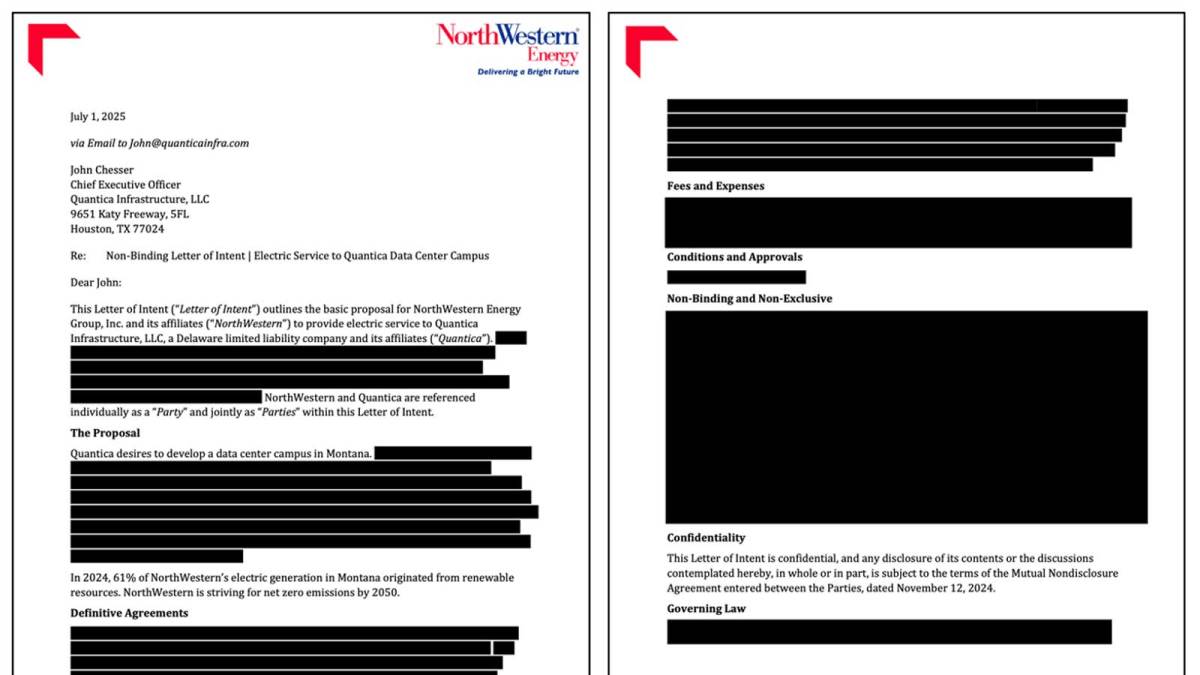
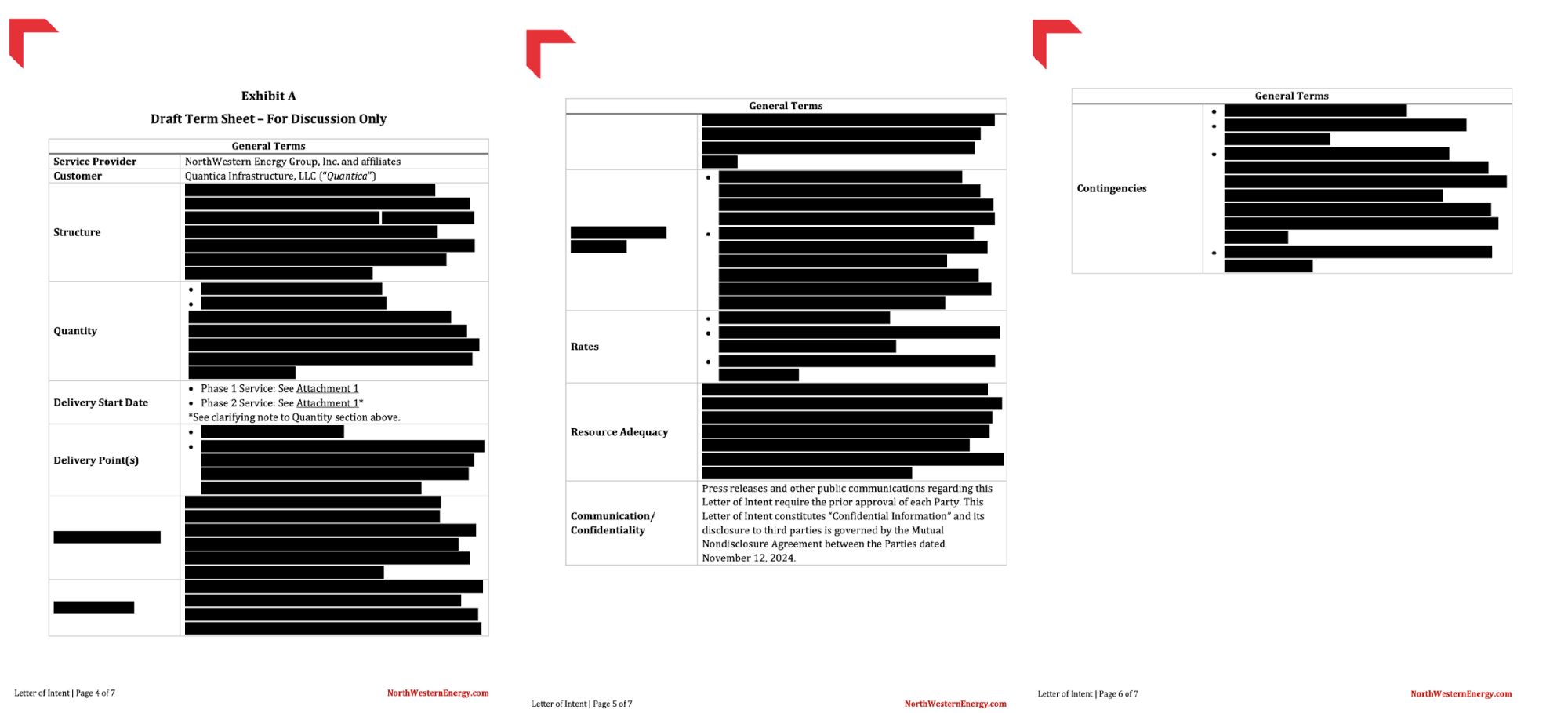
Take this example from Montana. Quantica Infrastructure is planning to build a 5,000-acre energy and technology hub near Billings, Montana, which would use more electricity than all of the households in the state combined. The specifics are spelled out in the documents below – but they’re redacted.
Bipartisan opposition to data centers is growing fast, with 20 projects blocked or delayed nationwide in just a three-month period during spring 2025, according to the research group Data Center Watch.
But secret agreements make it nearly impossible for residents and elected officials to understand the impacts of data center development in their communities – or whether their electricity bills will soon be subsidizing Big Tech.

In Montana, advocacy groups are challenging NorthWestern Energy’s plans to serve data centers. (I’ve been involved as well: I serve on the steering committee of a fledgling nonprofit called Montanans for Affordable Energy.)
State Rep. Kelly Kortum, a Democrat from Bozeman, said he is wary of the proliferation of data center proposals in Montana, and he’s ready to push back.
“I’m looking to make sure the people don’t get screwed over,” he said. Kortum is a computer scientist who works in IT.
“I personally really need to know how much energy is being used and how much of that is public electricity,” he added. “And what’s that going to do to our rates?”
As data center developers scope out plans for new projects, they first need to make sure they can get enough electricity to feed the data center. Often, they turn to the local utility and make basic arrangements to purchase electricity.
The agreement reached between the data center developer and the utility is spelled out in a letter of intent. It includes how much energy will be delivered, the prices, the time frame for when the new electric service will start, and how the utility will ensure that it delivers sufficient electricity to keep the data center churning along.
NorthWestern Energy in Montana has signed letters of intent with developers of three proposed data centers. These three agreements alone would more than double the average amount of electricity used by NorthWestern’s customers. The electricity would be generated by burning coal at Montana’s Colstrip power plant, one of the most polluting power plants in the U.S.
Ari Peskoe is the director of the Electricity Law Initiative at the Harvard Law School Environmental and Energy Law Program and an author of “Extracting Profits from the Public: How Utility Ratepayers Are Paying for Big Tech’s Power.” The report lays out tactics that data centers are using to off-load their costs onto households, such as making secret deals with utilities.
“I mean, look, these are monopolies,” Peskoe said. “They ought to be held to a standard about transparency. That requires they provide meaningful information about major deals that they’re a part of.”
NorthWestern Energy, like many utilities in the U.S., is a regulated monopoly. That means that the company can operate without competition, but it’s overseen by a governmental body. In theory, public utility commissions serve as a backstop against price gouging and other unfair practices.
“The whole point of utility regulation is to really dive into the accounting records, the details, and make sure that the public is protected from their monopoly power,” Peskoe explained.
But in this instance, Montana’s Public Service Commission sided with NorthWestern Energy. The commission decided that “proprietary Letters of Intent information derives independent economic value or competitive advantage from its secrecy.”
Peskoe disagrees.
“They’re claiming that this is a private business deal, but it’s kind of not when you’re a regulated monopoly,” he said. “They ought to have a higher standard for the information they disclose to the public than other private companies.”
“’Trust us’ doesn’t really cut it when you’re a monopoly provider,” he added.
A Montana bill that sought to address some of these issues (HJ-46) failed in the last legislative session, but Kortum, the representative from Bozeman, said that lawmakers will try again.
“Repeating the same bill builds knowledge with the legislators,” he said, noting that data centers are a new topic and many lawmakers are unfamiliar with the issues and possible solutions.
Kortum said when legislators don’t have a firm position one way or another, public input can hold more sway. For some lawmakers, “They have no dog in this race,” Kortum said. “I am expecting them to fall back on what the public wants,” he said.
For the Quantica Infrastructure project, the company already purchased 5,000 acres of land in a county with no zoning and limited local oversight. The project is scheduled to begin construction this year.
NorthWestern Energy said it plans to release a set of proposed terms and conditions for new data centers. These arrangements are called large load tariffs, and in theory, they can contain safeguards that help protect household energy users from shouldering the burden of new infrastructure. For example, the tariff could specify a minimum demand, so that if a data center uses less electricity than originally planned, it would still have to pay for the costs of all of the infrastructure built to bring electricity to the site.
NorthWestern Energy said it planned to file its large load tariff with Montana’s Public Service Commission by the end of 2025, but to date has not released a public plan.
In a recent NorthWestern Energy earnings call, the company appeared to walk back its earlier statement.
“We had said we will file a large load tariff, but I would note that that was tied to signing an ESA,” said Crystal Lail, NorthWestern Energy’s vice president and chief financial officer.
An ESA is an electric service agreement that spells out the specifics of the service between the utility and the data center. By the time a utility and a developer have an electric service agreement, it means the project is less of a proposal and more of a sure bet. In other words, the utility won’t share more details until the project is closer to reality, which also means it could be harder for communities to intervene.
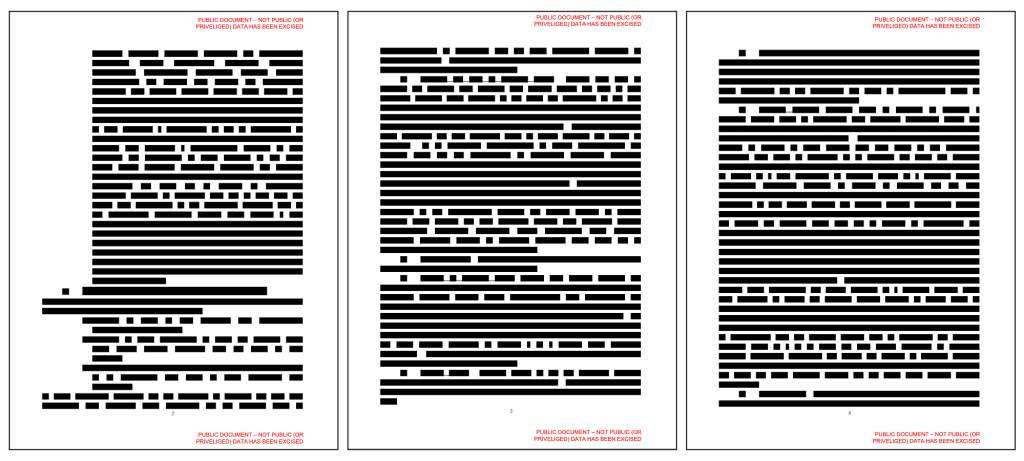
What’s more, electric service agreements are also sometimes hidden from the public. For example, here’s an excerpt from the electric service agreement between Leola Data Center and Montana-Dakota Utilities in North Dakota.
NorthWestern’s Lail said the company wants to “get ahead of this argument that data centers aren’t paying their fair share.”
NorthWestern Energy CEO Brian Bird said the company expects to release its new large load tariff by the middle of 2026, six months later than originally promised.
When Gary Dirks arrived in China in 1995, the country’s government was looking to source more of its energy at home. Dirks was the incoming country head for BP, but efforts to find more oil and gas in the country had largely fizzled.
So government leaders pivoted, Dirks said. China invested heavily in its domestic coal and, later, in building wind and solar energy. Now, those investments and other steps are shielding China from more severe impacts of the volatility unleashed by the U.S.-Israeli war in Iran, despite Beijing’s continued reliance on foreign oil.
“They’ve been taking measures for a very long time to try to maximize their use of their own resources,” said Dirks, now senior director at the Global Futures Laboratory at Arizona State University. “They’ve been aware of this vulnerability for a very long time.”
By some measures, China could appear to be highly exposed to the price spikes and supply disruptions the war has sparked in global oil and gas markets. The country gets nearly half of its oil and one-third of its liquefied natural gas, or LNG, from the Middle East, according to an analysis of data by Columbia University’s Center on Global Energy Policy.
Yet China has built up a crude oil stockpile of nearly 1.4 billion barrels, meaning the country could be cut off from imports for months, “and they’d be OK,” said Erica Downs, a senior research scholar at the Center on Global Energy Policy.
China is more vulnerable with natural gas, for which it doesn’t have such a substantial stockpile, experts say. Because the war has caused prices in Asia to spike, some industrial users in China, like chemical or glass plants, will need to pay more, cut back their operations or both.
“There is definitely going to be short-term pain,” Downs said. “But I think in the longer term there are definitely some silver linings for China.”
In an essay in Foreign Policy written with Jason Bordoff, the founding director of the Center on Global Energy Policy, Downs argued that while the war has exposed China’s dependence on Middle Eastern oil, “it also underscores how deliberately Beijing has sought to prepare for a world in which energy security is inseparable from geopolitics—by electrifying its economy, securing domestic sources of energy, amassing stockpiles, and dominating clean technology supply chains.”
Last year more than half of new cars sold in China were electric, according to the energy think tank Ember, while the country is a leader in electrifying heavy-duty vehicles and high-speed rail, too. Meanwhile, a rapidly growing portion of its electricity is being generated by solar and wind energy as China installs more of those technologies than the rest of the world combined.
Gasoline and diesel demand have already begun to fall, despite rapid economic growth, while China’s total crude demand has plateaued, according to the International Energy Agency.
China has also retrofitted many of its coal plants to operate as flexible power sources, like natural gas turbines that can be turned on and off more easily than traditional coal plants, said Kate Logan, director of the China Climate Hub and Climate Diplomacy at the Asia Society Policy Institute.
“That set up China quite well in terms of any potential shocks to its power sector because China can ramp up coal usage,” Logan said.
Beyond the power sector, China could also use coal to produce liquid fuels and feedstocks to replace oil or gas in industrial processes or for chemical production. Any increased coal use could lead to a surge in greenhouse gas emissions.
“That’s something to keep an eye on in terms of the near-term impact on emissions,” Logan said.
Downs, at Columbia, said she expects any spike in coal use would be short-lived because of the country’s larger goals of reducing air pollution and climate emissions.
In its recently published 15th Five-Year Plan, the Chinese government said it planned to cut its carbon intensity 17 percent by 2030. That’s a slight decrease in ambition from the previous plan, and the program also renewed the possibility of a new gas pipeline from Russia’s Siberia region. The Iran war could prompt more urgent discussions between the countries, Logan said.
“I’d imagine this is something, again, that would bring China closer to Russia for both oil and gas imports,” Logan said.
The chokepoint at the Strait of Hormuz, a crucial passageway for commercial shipping effectively blocked by the Iran war, is also affecting global fertilizer shipments, potentially imperiling the spring planting season across much of the world. Roughly one-third of the global seaborne fertilizer shipments go through the strait, a statistic that has panicked agricultural producers.
But China has attempted to protect itself from fertilizer disruptions, too. While the country imports sulfur, a critical fertilizer ingredient, from the Gulf, it has otherwise become largely self-sufficient.
Fred Gale, a former U.S. Department of Agriculture economist and China specialist, explained that China is a net exporter for nitrogen fertilizer, which is made using natural gas.
In February, weeks before the U.S. attack on Iran, Chinese authorities “issued a document ordering companies and rail transport to ensure fertilizer supplies and build up reserves ahead of spring planting,” Gale explained.
“For now China seems to be feeling pretty smug about the fertilizer situation,” Gale noted.
A spokesperson for the Chinese embassy in Washington said the government has called for an immediate halt to military operations in the region to prevent the conflict from spreading.
“The Strait of Hormuz and waters nearby are an important route for international goods and energy trade. Keeping the region safe and stable serves the common interests of the international community,” the spokesperson said in a statement. “China will do what is necessary to protect its energy security.” The spokesperson added, “We will continue to strengthen communication with relevant parties, including parties to the conflict, and play a constructive role for deescalation and restoration of peace.”
Perhaps the greatest benefit to China, Downs said, could come from overseas. As the country has pushed to electrify and generate more of its energy from renewable sources, Chinese companies have become global leaders in these technologies. Already, nations around the globe have been turning to Chinese firms to import or build solar panels, EVs and batteries. Now, Downs argues, price shocks from the Iran war could accelerate this trend.
Dirks said the war is a reminder that governments still see oil as a geopolitical weapon.
“Any nation today that imports hydrocarbons has to be aware of that,” Dirks said. “And I think now that wind and solar in particular have come down dramatically in price, more and more countries will be asking themselves, ‘What is the balance of risk in using wind and solar and battery resources as opposed to importing oil and gas?’”
Whether at home or abroad, many experts say, the war-induced shock to fossil fuel markets reinforces China’s energy policies.
“The big takeaway,” Logan said, “is that this really vindicates a lot of China’s clean energy push.”
Across the country, state lawmakers are considering ways to address the risks posed by the explosion of power-hungry data centers. They have proposed an array of bills to impose moratoriums on data center development, revoke tax breaks, force data centers to pay for new energy infrastructure, and enact other safeguards.
In Illinois, lawmakers and renewable advocates are especially concerned that data centers could derail the state’s transition to 100% clean energy, since there’s likely not enough renewable sources in the state to meet data centers’ projected demand.
The Protecting Our Water, Energy, and Ratepayers Act, or POWER Act, aims to persuade data centers to pay to build enough new clean energy for sustaining their operations. This should shield customers from rising prices when overall electricity demand increases, proponents of the measure say, and it would ensure that the state’s coal and gas plants don’t need to run past their planned retirement dates just to fuel data centers.
The bill, introduced in February, would entice data centers to make clean energy investments by offering them two of the things such operations most prize: fast interconnection to the grid and uninterrupted power.
Stakeholders involved in crafting the bill said the incentive structure is meant to keep Illinois attractive to data centers, while defending the state’s clean energy shift and customers’ wallets. The facilities could account for between 64% and 72% of energy demand growth in the state by 2030, according to a recent report by the Union of Concerned Scientists, a nonprofit science advocacy group.
Illinois law mandates ending fossil fuel generation by 2045, but unchecked data center growth could cause continued reliance on the state’s fossil-fueled plants — allowed by law if the power is needed — and the importing of dirty power from elsewhere, the report explains.
The bill’s advocates are calling the approach BYONCCE, pronounced like the singer’s name but meaning “bring your own new clean capacity and energy.” (A similar term has been used in other states, sometimes referring to “carbon-free energy.”)
While the addition of new clean energy should help prevent a rise in electricity costs for regular customers, the bill also has other components to keep rates low. It requires data centers to pay for grid upgrades such as the transmission lines and substations needed to serve them. It demands that data centers pay into a “public benefits and affordability fund” that can be used to assist low-income households with utility costs and for environmental justice initiatives; each data center would pay an amount based on its peak demand. The bill also creates a compensation fund for community groups intervening in regulatory proceedings around data centers, helping them push for clean energy and customer protection in individual cases.
“We’re in a new world all of a sudden where demand has gone off the wall,” said MeLena Hessel, Midwest deputy program director of Vote Solar, a nonprofit policy-advocacy organization. “Writ large, we’re trying to figure out how can we get to large loads bringing their own new clean energy and capacity in ways that matter and keep costs lower for customers.”
Supporters of the bill emphasize that while the legislation provides incentives for data centers to develop clean energy, it does not actually force them to do so.
If the power-hungry facilities don’t provide their own energy, they would have to wait, along with all the other large users, in a potentially long line to get connected to the grid. The bill calls for data centers to submit a clean energy supply plan to regulators. If that plan shows that the data center has procured 80% of its predicted annual power demand from new clean energy by 2030 and 100% by 2045, it would receive “fast-track” grid connection.
“We want to encourage data center companies to be clean energy champions, and those that are really excelling are able to jump the queue,” said Kavi Chintam, Vote Solar’s Illinois campaign manager. “That is the incentive that data center companies need and want now.”
Data centers that don’t build enough clean energy could see their electricity curtailed during times of high demand. The bill empowers utilities to take such action as a way to protect other customers from increased prices when the energy supply is tight. That threat is further motivation for data centers to invest in clean energy.
Facilities that pay to build or acquire as much clean energy as they expect to use are guaranteed uninterrupted access to that same amount of power. Solar and wind, as well as battery storage, virtual power plants, and demand-response measures — such as reducing energy use when the grid is stressed — qualify toward that total. Data centers would still be subject to any emergency energy curtailment — like rolling brownouts or blackouts — ordered by regional grid operators.
Illinois has a restructured energy market, in which utility companies do not own generation and instead procure power on the open market to serve customers. In neighboring Wisconsin and Indiana and other states with vertically integrated energy markets, by contrast, utilities pay to build needed generation and pass on the costs to their customers.
Regulators in Illinois and other states with restructured markets may have fewer options to determine how data centers are charged for generation infrastructure, since that is not the purview of the utilities they oversee. In Illinois, management of the flow of electricity on the grid — which utilities do control — is the way to influence data centers’ behavior, said James Gignac, who is the Midwest policy director for the Union of Concerned Scientists’ climate and energy program and one of the authors of its recent report.
“Offering compelling incentives for what the data centers wish to have is our approach,” Gignac said. “They are looking for firm service and the quickest way possible to connect to the power grid. By challenging data centers to meet these higher levels of clean energy, we can recruit the most responsible data center operators to Illinois.”
The Data Center Coalition, a trade group that represents developers of the facilities, and the Illinois Chamber of Commerce, which promotes investment in the state, did not respond to queries for this story.
Three times in the last decade, Illinois’ clean energy supporters and industry representatives have worked closely with lawmakers to pass sweeping energy bills. A 2017 law created ambitious renewable-energy mandates and job creation programs, a 2021 law bolstered clean energy and equity targets, and a law passed last fall addressed the need for much more energy storage on the grid. Those three pieces of legislation were spearheaded by legislators working with the Illinois Clean Jobs Coalition, including dozens of advocates for consumers, clean energy, and environmental justice. That coalition is also backing the data center bill.
Coalition members described the POWER Act as a similarly ambitious measure, which will likely go through a long process of consensus-building.
In addition to the clean power and affordability provisions, the bill includes other safeguards, like mandates for water resource planning and quarterly water-use reports. It prohibits nondisclosure agreements with data centers, mandates community benefit agreements, and requires a proposed data center’s cumulative impact to be examined in the context of other existing or proposed burdens on local residents.
Illinois’ legislative session ends in late May, and bills can also pass in a fall veto session or a special session called by the governor.
Proponents of consumer protection and clean energy say it is crucial for a data center–focused bill to pass soon, since numerous such facilities for powering AI are proposed in the state. The Chicago region, in particular, is already home to around 200 data centers, according to the organization Data Center Map, and more could be in the works. A $20 billion data center proposal was recently approved by local officials southwest of Chicago, in Joliet, for example. In February, Democratic Gov. JB Pritzker called for a two-year pause on state tax incentives for data centers in response to the growing concern from communities.
“This is an urgent problem,” Chintam said. “We need to do something now.”
A correction was made on March 12, 2026: A previous version of this story misrepresented the Union of Concerned Scientists’ prediction for data center energy demand in Illinois by 2030. Data centers could account for between 64% and 72% of growth in demand by that time, not total demand.


.svg)
