

 Back
Back
Teaming up to buy solar can get residents deep discounts. Virginia is the first to try a statewide campaign as utility bills rise and data centers stress the grid.
Last month, Virginia became the first state in the country to launch a bulk-purchasing campaign for rooftop solar — a move that promises to bring down the cost of installing panels for households across Old Dominion.

The idea behind the program, called Switch Together, is simple: Solar panels come cheaper by the dozen. Trusted solar installers can pool demand to purchase equipment in bulk and pass the discounts on to participants.
Solar United Neighbors, the nonprofit running the initiative, has for years used this model on a local scale in communities around the U.S. But it’s now expanding statewide in Virginia at the urging of the office of Gov. Abigail Spanberger, a Democrat, who is looking for ways to lower energy bills as utilities jack up rates in the world’s data center capital. Rooftop solar both slashes power costs for homes that install it and can drive down expenses for utility customers at large.
“If more people go solar, that’s less strain on the grid, and there’s less need to build costly infrastructure that the entire rate base would actually pay for,” said Brandon Praileau, SUN’s Virginia program director, who joined the group in 2023 after rooftop solar helped his church in Norfolk cut utility bills by a quarter.
The state is not providing any funding for Switch Together, though its partnership promises to amplify the reach of the bulk-purchasing effort, which is focused on solar but also offers residents access to cheaper home batteries, EV chargers, and, in some locations, heat pumps.
Since Spanberger announced the initiative in July, more than 4,300 residents, small businesses, and nonprofits have put their names down to receive more details, and 120 have signed contracts, according to SUN.
The campaign is set to end Oct. 15. By the time the bulk-purchasing drive is over, Praileau expects those figures will swell to 5,000 requests for info and about 500 signed contracts. “We’re talking about a utility-scale amount of solar with those numbers,” he said. “Almost 4 megawatts.”
The rooftop panels are expected to cut $2,200 off the average annual utility bill. Exactly how much households save on installation varies across the state, but it ranges from 20% to 30% off — vital discounts after the Trump administration and Republicans in Congress killed the 30% federal tax credit for households investing in renewable energy.
Over the years, SUN has backed a variety of bulk-purchase models, including recruiting potential participants on its own. But lately, SUN’s secret sauce involves a partnership with local governments, whose seal of approval lends credibility and whose outreach encourages more would-be solar owners.
In Richmond, for instance, a SUN-only campaign resulted in about 20 new solar rooftops. A second push for bulk sign-ups that included mailers from the local government led to about three times as many households adding rooftop panels.
“That level of direct marketing has proved to be the whole difference-maker,” Praileau said.
The success of SUN’s efforts in the D.C. metro area, which includes northern Virginia, drew the attention of Josephus Allmond, a longtime environmental lawyer in the state who now serves as Spanberger’s chief energy officer. “We thought we could drive deeper savings if we opened up the whole state,” Allmond said at an event in Charlottesville last month. “So that’s what we did.”

While the governor’s endorsement is crucial, the expansion is easier said than done: Finding enough trusted rooftop solar companies in every nook and cranny of the state is one limiting factor. For now, only “extreme southwest Virginia” is left out of the campaign that spans 100 counties and cities, Praileau said, since SUN couldn’t vet installers there in time for this year’s rollout. But he believes that will change by next year, when Switch Together hopes to conduct another drive in partnership with the state.
Helping residents go solar through bulk purchasing is just one piece of SUN’s mission; the group also works to bring solar owners together to fight for clean energy policies. That’s part of why Praileau is encouraged by the breadth of sign-ups.
“We’re seeing interest across the entire commonwealth, from places where you would not expect people to be looking for solar,” he said, such as the politically conservative Shenandoah Valley and the New River Valley. “That wide spectrum just goes to show how interested Virginians are at lowering their energy costs.”
While Virginia is unique in some ways, plenty of other states face similar challenges of rising electricity costs and crushing demand from data centers. They, too, could roll out voluntary bulk-purchasing efforts.
“We’re definitely taking note of what works best, of best practices, so that we can offer a road map for others to be able to duplicate networks like this,” Praileau said. “I think this is ultimately a model for any state.”
Analysts are trying to measure the damage President Trump has done to the energy transition so far — and determine where federal climate policy should go from here.
Glass half-empty or glass half-full?
The classic question is now gripping the policy wonks who are trying to measure the damage President Donald Trump has inflicted on the U.S. energy transition — and to figure out what direction to take climate policy from here.
In July, the MIT Center for Energy and Environmental Policy Research released a report arguing that, when it comes to cutting emissions from the electricity sector, the glass remains half full despite Trump’s policies. Report author Lily Bermel found that U.S. power sector emissions are still on track to decline substantially by 2035.
Other analysts and energy modelers are more pessimistic. Amanda Levin of the Natural Resources Defense Council published a rebuttal in Heatmap this week, highlighting a recent peer-reviewed study and modeling from Energy Innovation that finds the U.S. will achieve less than half of the emissions reductions it would have under Biden-era policies. (To be clear: Those are economywide figures, while Bermel is focused on the power sector.)
Let’s state the obvious: No one really knows how full or empty the glass is. The factors that will make or break the next decade of the energy transition are incredibly hard to model.
Right now, clean energy is booming. Yes, Trump eliminated tax credits for wind and solar, but lots of projects were able to grandfather in their incentives so long as they finish construction in four years. Most modelers expect clean-energy deployment to look pretty healthy until 2030, though it’s possible Trump’s persistent efforts to stymie permitting for solar and especially wind will lead to more cancellations.
But after 2030, as Canary Media’s Julian Spector put it in a July article on the Rhodium Group’s analysis of this question, all bets are off.
The range of possibilities in Rhodium’s report is astonishing: In the most optimistic of its three scenarios, the U.S. continues building clean power at the blazing speed of roughly 53 gigawatts per year from 2030 to 2040. In the most pessimistic scenario, in which Rhodium assumes lower natural gas prices and higher clean energy costs, renewable additions drop to an average of just 3 GW per year. There’s also the wild card of data centers, which are driving big but uncertain demand for new gas power plants.
The early 2030s are the hinge years. And their outcomes depend on a medley of unknowable future market forces — and on the results of the 2028 U.S. presidential election.
That brings us to the second leg of this debate: Given where the energy transition is at, what should Democrats do if they regain power in 2029?
Bermel argues that the Dems should forget about reinstating the tax credits for mature wind and solar tech. In her view, it’s time to move on and prioritize permitting reform as well as efforts to boost earlier-stage “clean firm” tech like geothermal and advanced nuclear.
Levin at NRDC agrees that permitting reform should be a priority. But she makes the case that wind and solar tax credits are still important because they guarantee that these carbon-free technologies will beat fossil fuels — namely gas — on price. Plus, tax credits mean utility customers pay less for large-scale clean energy projects, which is crucial as bills rise and Trump’s policies make renewables more expensive.
That last point about affordability has been echoed by some in the industry. Kevin Smith, CEO of the clean energy developer Cypress Creek Renewables, made a similar case during a recent conference. “We can compete without tax credits right now,” he said of clean energy companies. “The issue is affordability. And I think the Democrats will start pushing tax credits as an affordability issue, and they may have a point.”
Tesla’s solar roof shingles are officially toast
Nearly a decade ago, Elon Musk borrowed the set of “Desperate Housewives” to show off Tesla’s newest product: solar-generating tiles that cover a rooftop like shingles. Tesla would be putting the solar tiles on 1,000 roofs a week by 2020, Musk predicted at the time. But by the time 2022 rolled around, Tesla had only installed about 3,000 solar roofs, and the tiles only made up 0.17% of residential solar capacity installed in the U.S. that year.
Now, as Julian Spector and Dan McCarthy report, Tesla is discontinuing its solar shingles, and will instead double down on traditional solar panels. The company recently announced plans to build a $10.1 billion solar cell factory in Texas that it says will be able to churn out 100 GW of integrated solar panels each year.
That would be a huge deal — if it happens. Altogether, every solar factory in the U.S. can only make a combined 65 GW of panels each year, so Tesla would have to take its manufacturing capacity through the roof to make that happen.
Clean energy is on track for a war-spurred milestone
Despite stagnant investment, renewables are still on track to hit a global milestone in 2026.
According to a fresh BloombergNEF analysis, the world invested about $327.5 billion into solar, wind, and other renewable energy sources in the first six months of 2026 — about the same amount as in the second half of 2025. Investment in standalone utility-scale solar power actually shrank to its lowest level in years, but investment in solar-plus-storage hit a record of more than $25 billion, while residential solar investment also skyrocketed.
While coal power generation has rebounded this year amid oil and gas shortages spurred by the war in Iran, clean power sources are expected to produce more electricity than coal for the first time ever this year, the International Energy Agency estimates — and surging demand for rooftop solar is a big reason why.
Trump’s electrical blackout: President Donald Trump bans the “acquisition, importation, transfer, or installation” of foreign-made bulk-power electrical equipment from certain countries, though the DOE will first have to determine targeted equipment’s risk before the order can bar their import. (Project Finance)
The Army goes nuclear: The U.S. Army plans to award up to $2.2 billion to five companies to build small nuclear reactors at military bases around the country, with Antares Nuclear, General Atomics, and Westinghouse among the awardees. (New York Times, Axios)
Canada fights back: Ontario Premier Doug Ford threatens to slow or halt power exports to the U.S. in response to the Trump administration’s new tariffs on a range of Canadian goods. (Utility Dive)
Data-center gas-plant update: Around 189 gigawatts of natural gas capacity to power data centers has been announced, entered pre-construction, or started being built, up from 97 GW at the end of last year. (Heatmap, Global Energy Monitor)
Wind’s Maine event: After nearly two decades spent trying to build utility-scale wind power in its far northern reaches, Maine has finally approved an 800-MW array and a 1.2-GW transmission line that will be built near the Canadian border. (Canary Media)
Not-so-public comment: The U.S. EPA looks to eliminate a federal requirement that states seek public input on applications for air pollution permits for data centers and other industrial facilities. (New York Times)
Solar saves Europe’s summer: Europe has seen record heat and drought this year that has jeopardized power production from nuclear, fossil fuel, and wind sources, but solar performed better than normal and helped keep ACs running amid sky-high temperatures. (Grist)
Hot water and low river levels have hampered nuclear power in Europe this summer, forcing a reckoning over plant preparedness.
Europe’s increasingly hot summers come with a worrying trend. The air conditioning that the continent long eschewed as an American indulgence is becoming a necessity, and some of the nuclear reactors needed to run those cooling units are tapping out right as thermometers spike. This summer was especially bad: The series of extreme heat waves that roasted Europe, killing thousands and fueling historic wildfires, also severely impacted the rivers that provide water to cool thermal power plants such as nuclear stations.
In France and Switzerland, nuclear plants went offline as river temperatures rose, to prevent the discharge of warm water into sensitive aquatic ecosystems. In Romania, Hungary, and Bulgaria, nuclear plants built along the Danube River either shut down or reduced output as drought dropped the water levels below intake pumps.
Critics of nuclear power have seized on the moment to challenge whether nuclear energy is as reliable and efficient as its supporters claim.
“Strange that anyone would support new nuclear, which depends on cooling, in the face of an ongoing superlinear global temperature rise,” Mark Z. Jacobson, a Stanford University professor who has long advocated for replacing atomic energy with renewables such as wind, solar, and hydropower, wrote in a post on X after France took 6.3 gigawatts of nuclear plants offline amid the heat wave.
At the heart of the issue is the large supply of water that nuclear plants need to cool their reactors. The problem is most acute in Europe, where many plants rely on rivers — unlike in Asia, where most stations are built near the ocean, or in North America, where reactors more often have cooling towers that help avoid problems with overheated water supplies. Experts say that Europe’s situation has more to do with how its individual plants are engineered and that the flaws are fixable.
“There are multiple solutions to this,” said Madison Hilly, managing director of the nuclear consultancy Radiant Energy Group. But “if you don’t like nuclear, this is the annual occurrence that basically allows you to try … and say, ‘No, actually nuclear is not reliable and it can’t be built for a changing climate.’”
The climate challenge for Europe’s nuclear plants is twofold. First, above-average river temperatures trigger environmental regulations barring the release of water that’s too warm. Second, drought conditions mean that the water levels are too low for the plants’ intake pumps to work. Along the Danube, the intake pumps that pull cooling water into the plant weren’t constructed to handle the low water levels reached this summer. When these plants were designed and built between the 1970s and 1990s, “there was no awareness of the dramatic changes in river flow rates and temperatures that we are witnessing now,” said Jacopo Buongiorno, the director of science and technology at the Massachusetts Institute of Technology’s Nuclear Reactor Laboratory.
Still, he said, “moving the intake is technically feasible, albeit expensive.”
“One has to put things in perspective. Even a severe heat wave like the one experienced by Europe this summer reduces the average capacity factor of these plants by only a few percent on an annual basis,” Buongiorno said. “And while all the attention goes to a handful of struggling facilities located on problematic rivers, the vast majority of nuclear power plants go through the summer heat without any issue. Nuclear plants remain the most reliable power generators on the planet.”
The most obvious solution to water levels dropping below the intake pump is, as Buongiorno described, to lower the equipment. It’s difficult to say exactly how much that would cost, since the renovation of the relevant components would amount to a bespoke engineering project.
But virtually every structure at a nuclear plant is expensive, and renovating part of an existing plant typically costs more than building that section from the ground up. Case in point: Most nuclear plants in the U.S. and Asia were built with cooling towers, the hyperboloid structures that are often the most visible component of a nuclear plant and which prevent the discharge of too-hot water. The towers also allow a plant to recirculate and reuse water in a closed-loop cycle. In 2009, a study that Tetra Tech prepared for California’s Ocean Protection Council found that adding a cooling tower to a built plant would cost about $87 million. Accounting for inflation, that would be roughly $135 million today. Such renovations also take years.
The recent disruptions “call for an upgrade in Europe’s nuclear preparedness for extreme climate events that sadly are now a new norm,” said Adam Błażowski, the Poland-based chair of the pro-nuclear climate group WePlanet.
As a short-term solution to the water-level problem, the Hungarian government sank two barges near the Paks nuclear power station, Hungary’s only such plant, to artificially hike the river levels enough to keep water flowing into the plant’s two units.
While “numerous ideas and technical solutions for securing the cooling water needed for operation have appeared in the press and on social media,” cautioned the HUN-REN Centre for Energy Research, a government laboratory for studying nuclear and renewable energy, “reaching a final, well-founded decision requires the professional evaluation of nuclear safety and electricity generation alongside a number of other considerations — navigation, water and agricultural management, flood protection, and so on.”
“However tempting these proposals may seem from the standpoint of security of supply, economic efficiency — and, should the water level later rise on a sustained basis, the restart of the other units — they conflict with the fundamental principles of nuclear safety and are therefore unacceptable under any circumstances,” the organization said in the statement.
Still, the HUN-REN Centre noted, the problems with specific nuclear plants in France, Romania, and Hungary shouldn’t detract from the critical role nuclear has played in keeping the lights on across the region.
“In these very days, avoiding a collapse of the electricity system owes much to the nuclear power plants operating in the Czech Republic and Slovakia — which are almost entirely identical to Paks NPP but use cooling towers instead of fresh water cooling,” the HUN-REN Centre said. “This also demonstrates that nuclear power plants with different cooling solutions respond differently to extreme hydrological conditions.”
For proof that nuclear plants can be designed to operate in extreme heat and drought, simply look to Arizona.
The three-reactor Palo Verde nuclear plant provides more than one-quarter of Arizona’s electricity. Perennially drought afflicted, the Copper State — now facing fresh cuts to its allotment from the Colorado River under the Trump administration’s plan to ration the region’s dwindling freshwater source — built the plant to run on recycled wastewater from Phoenix, 50 miles away. It could serve as a model for future plants.
“Palo Verde uses recycled water from the city of Phoenix, so it’s pretty much self-sustaining. It’s also an example of brilliant engineering,” Buongiorno said. “They managed to build and successfully operate a three-reactor nuclear power plant in the middle of the desert, without becoming a burden on the city water supplies.”
For next-gen geothermal to scale, drilling costs must drop. Startup Hephae says its novel tech can make that happen — and developers like Fervo are giving it a try.
Thousands of feet beneath the desert valley of southwest Utah, a slender tool tucked inside a drill pipe is barreling through hot granite. The rod-shaped device, built by the startup Hephae Energy Technology, is a tracker of sorts, wirelessly sending data to help operators above steer the drill below and to measure rock conditions.
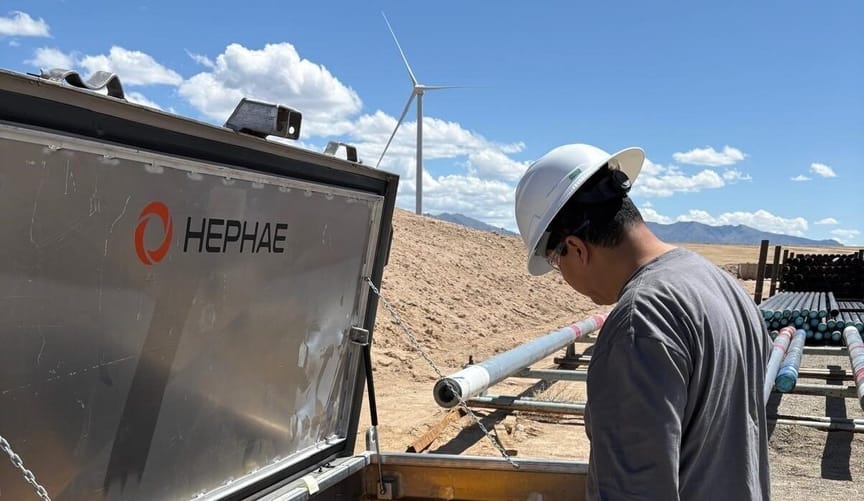
The work is underway at Fervo Energy’s Cape Station, the largest project in the nation using nascent techniques to tap earth’s heat for clean energy. The 500-megawatt endeavor could usher in an era of next-generation geothermal development — but only if the industry can bring down drilling costs.
That’s where tools like Hephae’s can help.
Oil and gas firms have long used similar “measurement-while-drilling systems” to bore holes underground. But off-the-shelf parts aren’t designed to withstand the higher rock temperatures that geothermal companies aim to reach, which makes the equipment less efficient and costlier to operate.
Hephae’s founders, veterans of the fossil fuel industry, saw an opportunity to create a more advanced version for the burgeoning next-gen geothermal market. “We realized that companies like Fervo need the same exact tools that we’ve been working on for the last 45 years,” Steve Krase, Hephae’s CEO, recently recalled.
“They just need to work a hell of a lot hotter,” he added.
Hephae deployed its high-temperature device for the first time commercially at Cape Station earlier this year and has since used it there it additional times, Krase said. His firm will soon ship another of its high-tech rods to the startup Mazama Energy, which has started drilling its commercial pilot facility near the Newberry Volcano in central Oregon.
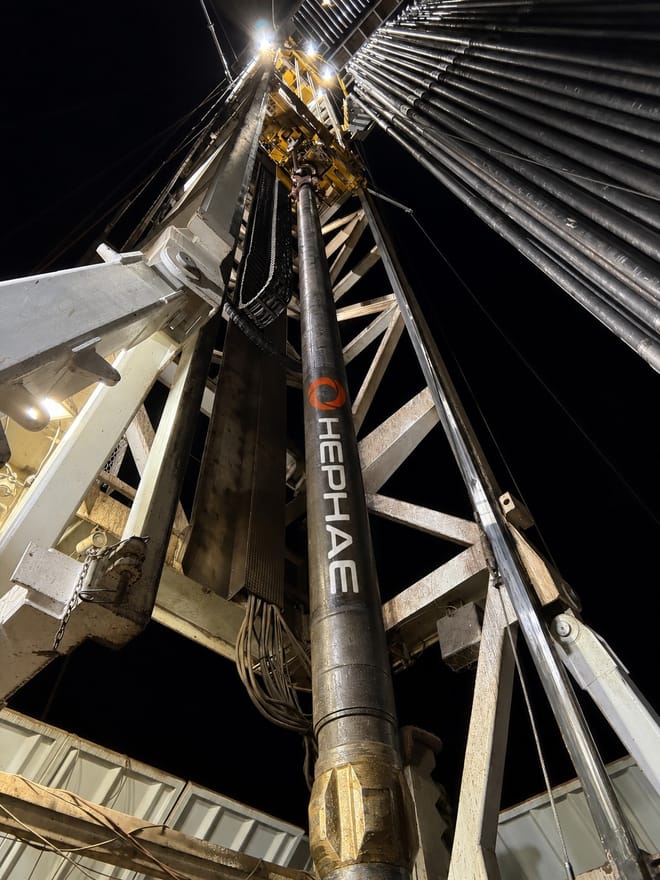
These and other next-generation geothermal projects are poised to become a significant source of on-demand electricity in the western U.S. over the coming decades. Unlike traditional geothermal plants, the newer systems don’t rely on finding natural hot-water pockets to generate heat; they can go wherever rocks are sufficiently scalding.
Yet the fledgling sector will struggle to scale unless companies dramatically reduce the time and money it takes to drill new wells — each of which can require millions of dollars, and together represent as much as half the expense of building new geothermal plants.
“Any way that you can get geothermal to be [cost] competitive with other sources of energy, like nuclear, solar, and wind, … will be pretty crucial,” said Zainab Gilani, an energy and power research associate at Cleantech Group, a consulting firm.
Houston-based Hephae is among a growing number of drilling-focused firms working to reach that goal. The company — whose name evokes the ancient Greek god of fire, Hephaestus — raised nearly $18 million in venture capital funding in July to build more tools to rent to geothermal developers.
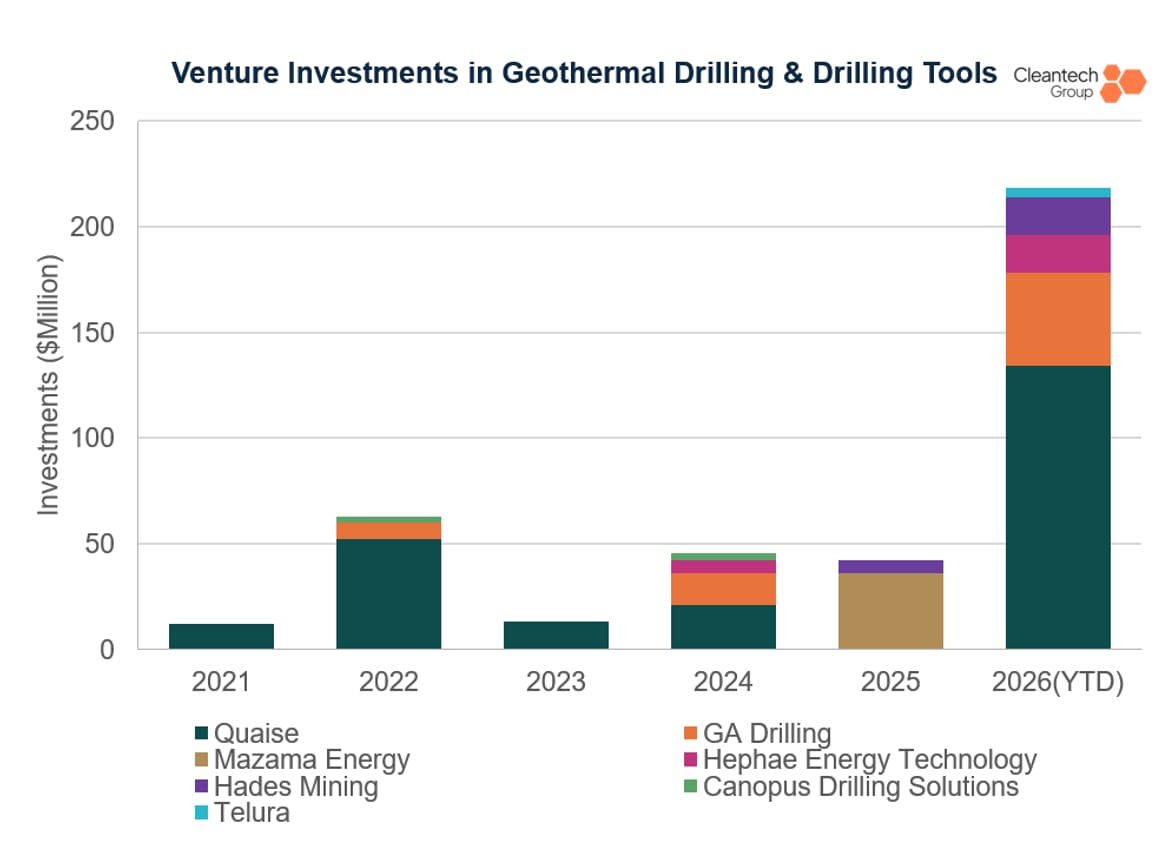
All told, seven startups have secured $393 million in total venture investment since 2021 to develop cutting-edge drilling systems and components for geothermal power, according to Cleantech Group. That includes Quaise Energy’s recent $134 million fundraise to advance its rock-melting technology and build its first geothermal plant, also near Oregon’s Newberry Volcano.
Geothermal firms “are basically trying to get underground as cheaply as possible,” said Stephanie Díaz, a senior associate for technology and innovation at BloombergNEF. She said the pursuit is a “rising tide that lifts all boats,” given how innovation spreads.
Investors are backing firms along the supply chain as a way to get exposure to the geothermal market, but without taking on the risk of building a first-of-a-kind project. “Instead of having to figure out an entire power plant, you just need to figure out one component that is essential to creating the power plant,” Díaz said.
Krase and his co-founder, John Clegg, launched Hephae in 2020 to adapt their oil and gas expertise for geothermal wells.
Their measurement-while-drilling system fits into a thick steel tube that connects to the rock-cutting drill bit. Sensors and rounded circuit boards — stacked like chips in a Pringles can — gather subsurface data and transmit it through a sequence of pressure pulses, enabling engineers to steer the drill through the challenging environment.
Conventional versions of the tool are built to operate at relatively lower temperatures — around 175 degrees Celsius (347 degrees Fahrenheit) — where oil and gas reserves are typically found. But for geothermal firms, the higher the rock temperature, the more energy they can wring out of the system, making each well more cost-effective and productive.
Right now, that means geothermal developers must occasionally pause for extended periods to cool the drilling fluid inside the wells to avoid overheating the electronics. This “nonproductive time” can cost operators roughly $500,000 to $1 million per well, since they’re still paying to rent a drilling rig they’re not using, according to Krase.
Hephae says its unique design can withstand temperatures up to 210℃, reducing work delays by directing heat away from the sensors and circuits as they operate. Before shipping the tool to Cape Station, the company put the technology through its paces at an Oklahoma test facility and in Texas at a high-temperature gas well — another possible market for Hephae.
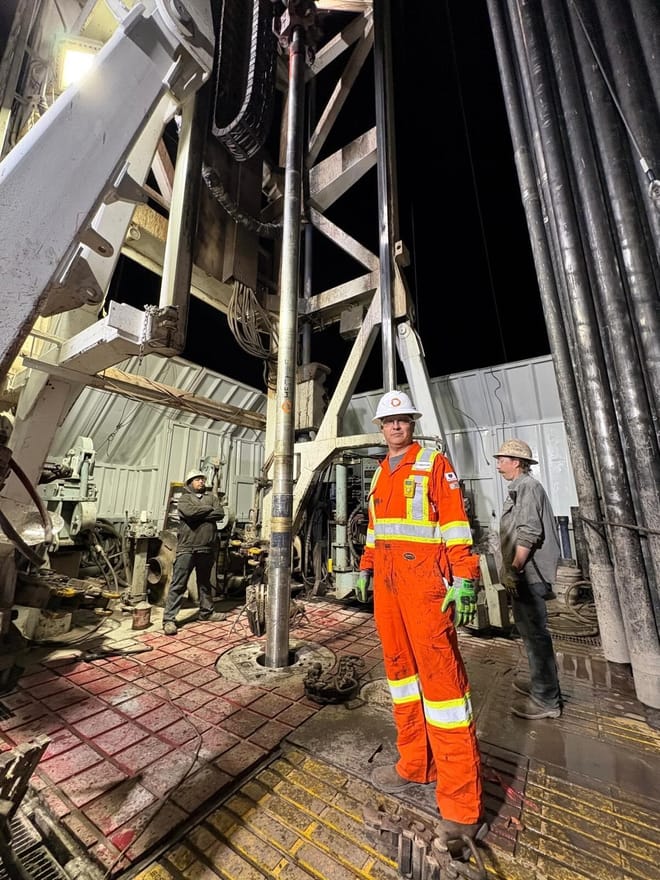
“Fervo has been really supportive, because they know their success depends on being able to get to the good rock,” Krase said.
Fervo, for its part, has already made significant strides in recent years to reduce drilling times and access deeper resources in Utah. In May, the startup became the first next-gen geothermal firm to go public, and Cape Station is expected to be the largest project of its kind in the world when it comes fully online by 2028.
The company declined to comment for this story, but it shared an earlier statement from Elliot Howard, Fervo’s director of drilling and completions.
“Fervo is encouraged by the early progress of our collaboration with Hephae, whose novel high-temperature innovations have the potential to contribute positively to [enhanced-geothermal-system] economics, unlock higher-energy geothermal resources, and further cement the competitiveness of next-generation geothermal power,” Howard said in a July press release announcing Hephae’s fundraise.
With its new funding, Hephae plans to triple the number of tools in its arsenal, from six to 18 by the second quarter of next year. That total could reach 40 tools by the end of 2027 as Fervo, Mazama, and future partners advance their geothermal projects.
Hephae is also investing in R&D to design systems for temperatures above 300℃, which it hopes to launch by 2030.
Gilani of Cleantech Group said that Hephae’s partnerships with Fervo and Mazama make it well positioned to grow with the wider next-gen geothermal industry. If Hephae can play a part in bringing the projects online, “that will both help Hephae to scale and will also help the industry overall,” she said.
Last year, Gov. Newsom vetoed bills promoting home batteries, smart thermostats, and EV chargers to curb energy costs. Will he do the same this year?
Last year, California Gov. Gavin Newsom vetoed a slate of bills meant to expand virtual power plants that could offset the state’s fast-rising electricity costs. Will he do the same this year?
Earlier this month, two virtual power plant bills made it through a key legislative hurdle. Lawmakers must vote on the bills by Aug. 31. Should they pass, Newsom, a Democrat, would have until the end of September to sign or veto them.
Californians pay some of the most expensive electricity rates in the continental U.S., an issue of increasing political salience. Climate advocates, clean energy groups, and supportive lawmakers say the state can curb these costs by tapping into its nation-leading fleet of rooftop solar–charged batteries, remote-controllable EV chargers, and other household devices — in other words, the collective components of virtual power plants.
The bills propose two different approaches for using VPPs to bring down costs: Senate Bill 913 would harness them to blunt the edge of costly grid peaks, while Senate Bill 905 could encourage California’s major utilities — Pacific Gas & Electric, Southern California Edison, and San Diego Gas & Electric — to use VPPs to reduce costly grid investment.
“If we can call on these resources, it is a massive win-win. People get paid, and it also saves everybody in California money,” Sen. Josh Becker, a Democrat who authored both bills, said at a Monday press conference in Sacramento promoting “local, affordable” clean energy policies.
SB 913 would give the California Public Utilities Commission until mid-2028 to craft regulations that allow VPPs to play a role in providing resource adequacy. That’s the term for the increasingly costly services that every utility and community energy provider must secure from gas-fired power plants, battery banks, and other dispatchable resources to keep the grid running when demand for power peaks.
VPPs could cover more than 15% of the state’s peak grid demand and deliver $550 million in annual utility customer savings by 2035, according to a 2024 analysis by consultancy The Brattle Group for GridLab.
“Many of these resources are sitting on the sideline because our rules have not kept up with technology,” said Becker, who also penned one of last year’s vetoed VPP bills.
VPPs face multiple barriers to being counted toward resource adequacy, from measurement protocols that erode their value during heat waves to rules that ban home batteries from getting credit for power they inject back onto the grid.
Meanwhile, Californians are paying roughly $1 billion per year to extend the lives of fossil-fueled “peaker” gas plants needed for only a handful of hours per year, he said. “We can get rid of those if we take better advantage of what’s already in people’s homes.”
SB 913 has won backing from dozens of environmental groups, trade organizations, and companies that manufacture, install, and manage the devices that constitute VPPs. Utilities Pacific Gas & Electric and Southern California Edison withdrew their opposition to the bill after amendments were added to it in late June.
California leads the country in home batteries and electric vehicles, and has millions of homes that could adjust the power usage of smart thermostats, water heaters, and other devices during the handful of hours per year when the grid is under the greatest strain.
Distributed batteries could be a particularly powerful tool. A July 2025 utility test of home batteries delivered more than 500 megawatts of grid relief over a two-hour period corresponding to when California’s grid tends to face its greatest stress during summertime heat waves.
The state currently has 2.5 gigawatts of residential batteries and more than 600 megawatts of batteries at commercial properties, according to the California Energy Commission.
SB 913 could make it more lucrative for households with these “behind-the-meter batteries” to commit their spare power to the grid. That could encourage more participation in VPP programs, said Brandon García, California policy director at trade group Advanced Energy United.
It’s particularly important to create new incentives for households with batteries to participate in VPPs given that California’s largest such program faces the threat of being defunded and disbanded, he said.
That program is called Demand Side Grid Support, and it has grown to one of the largest VPPs in the country, including nearly 75,000 homes with smart thermostats and flexible load devices, and nearly 130,000 homes with batteries. But DSGS is operated by the California Energy Commission using state taxpayer funds — and under a budget proposal from Newsom’s administration, that funding could be cut and the program shut down next year.
Many of the groups supporting SB 913 are also calling on Newsom and lawmakers to extend DSGS for a few more years, to avoid stranding the companies that have invested and the households that have enrolled in it.
“If there’s not a program to keep these resources online with some level of compensation until a resource adequacy pathway is created, those resources will go somewhere else,” García said.
In an echo of debates over rooftop solar in California, the state’s Public Utilities Commission and utilities have argued that it’s unfair to pay households for VPP participation, because it shifts the costs of running the grid onto utility customers who don’t have batteries, EV chargers, or other eligible devices.
García said that allowing VPPs to compete with gas plants, utility-scale batteries, and other providers of resource adequacy could help resolve these concerns. That’s because VPPs competing in those markets “only get enrolled if they’re lowest-cost resources — and we are confident that they will be the lowest-cost resources.”
SB 905, meanwhile, targets an even bigger cost driver in California: utility grid investments.
Among the bill’s wide array of utility affordability measures is a provision that would require the Public Utilities Commission to establish “grid utilization” metrics for the state’s three big utilities. That data could reveal where utilities are using their existing grids more or less efficiently, and potentially encourage them to employ batteries, flexible-load controls, and other VPP-style approaches to smooth out the peaks in electricity demand that drive much of the need for new grid infrastructure.
California’s utilities are planning tens of billions of dollars of investments on their sprawling distribution grids to keep up with growing power demand and mitigate wildfire risks. Using VPPs to reduce peak loads on those circuits and substations could allow them to defer billions of dollars of those investments, reducing upward pressure on rates, Becker said.
“We’re not saying we’re not going to build anything new,” Becker told Canary Media in a Monday interview. “But let’s make the best use of the existing resources that are already out there, that we’ve already paid for, before we go off spending a lot of money on new resources.”
It’s unclear whether Newsom will respond to this year’s VPP policies differently than he did last year’s. The three bills he vetoed in 2025 were passed by large majorities and proposed relatively minor changes in state VPP policy. Newsom’s veto statements cited the risk that they could disrupt existing grid reliability and planning methods.
Those arguments haven’t sat well with lawmakers pushing for VPP reforms. “We should be leaning in a lot more to innovation, especially on clean energy,” state Assemblymember John Harabedian, a Democrat who authored one of the VPP bills vetoed last year, said at an event in Sacramento earlier this month. “How do we utilize the grid in a more efficient way? I think technological innovation will help us do that.”
Becker declined to predict if Newsom would sign his VPP bills. “We’re focused on getting it passed,” he told Canary Media. “Then we’ll focus on the governor’s team and the governor’s reply.”
Unless Gov. Newsom blocks the bill, it will legalize plug-in solar in one of the world’s biggest economies. But the rules are more restrictive than some hoped for.
Californians could soon put solar panel kits on balconies and in backyards to lower their electric bills — without utility approval.
On Wednesday, state lawmakers passed the Plug and Play Solar Act (Senate Bill 868) to legalize balcony solar, a form of DIY clean energy that’s taken off in Germany. The bill, which garnered bipartisan support, now heads to the desk of Democratic Gov. Gavin Newsom. His office declined to say if he’ll sign or veto it within the 30-day deadline; if he does neither, it would still become law and take effect Jan. 1, 2027.
“Imagine being able to reduce your annual electric bill by $400, which is what is estimated here, simply by plugging in one of these devices and leaving it in the sun,” state Sen. Scott Wiener (D), who wrote the bill, said at a Monday press conference on the legislation. “This is a level of convenience in terms of installation and energy savings that we have not seen before.”
Balcony solar kits, already sold by a few businesses in the U.S., put home solar in the hands of millions of renters and homeowners who can’t have panels installed on their roofs. The portable panels push power into a standard 120-volt wall outlet; that electricity then flows to the nearest power-hungry devices, such as the fridge, computer, Wi-Fi router, lights, and air conditioner.
If enacted, California’s legislation would allow households to install plug-in solar systems sized up to 1,200 watts per residence without the costly and potentially time-consuming utility interconnection process that’s required for larger rooftop arrays. Even a 400-watt system can cover roughly 14% of an apartment’s energy use, according to the Environmental Working Group, a nonprofit that advocated for the bill.
The Golden State’s embrace of balcony solar follows a tsunami of support nationwide. More than half of states have considered plug-in solar legislation in the last year, and so far, eight have adopted balcony solar laws: Colorado, Connecticut, Maine, Maryland, New Hampshire, Utah, Vermont, and Virginia. New York passed a bill in June, but boosters are still on tenterhooks as to whether Gov. Kathy Hochul (D) will sign it.
“California is going to have a huge impact on this market,” said Cora Stryker, co-founder of plug-in solar nonprofit Bright Saver. The state’s economy is the largest and among the fastest growing in the nation. “Manufacturers are going to see this and seize upon the opportunity.”
The bad news: Households won’t be able to get plug-in solar that meets the bill’s requirements right away. The state would allow only balcony solar kits that have been certified safe to use by a nationally recognized testing laboratory. One of these organizations, safety company UL Solutions, began testing plug-in systems this year under its new standard, UL 3700, but no product has yet earned certification.
The rule is more restrictive than those adopted by some other states. For example, Utah and Maryland require that the individual kit components pass safety standards, rather than the entire system, according to Stryker.
Stryker said she’s worried that California’s stringent approach could put a damper on balcony solar’s growth in the state in the near term, especially for renters. In its current form, the UL 3700 standard still requires an electrician to get involved, the opposite of plug and play. Still, Bernadette Del Chiaro, the Environmental Working Group’s senior vice president for California, said she expects the standard to evolve to include DIY systems as soon as next year.
Another wrinkle: The legislation includes an expiration date, which the state’s largest utility, Pacific Gas and Electric, appears to have lobbied for. On Jan. 1, 2030, Californians will no longer be able to install plug-in solar without first getting their utility’s sign off.
“We would expect the Legislature to reconsider that sunset in 2028 and at the latest 2029,” Del Chiaro said.
Wiener believes, despite its challenges, the plug-in solar bill will be transformative for Californians. “Balcony solar is incredibly important,” Wiener told Canary Media. “This is a way to lower people’s cost of living when people need relief. … I’m glad that we’re finally making it happen.”
For nearly two decades, the state has sought to bring wind turbines to its breezy northern reaches. Now it’s one step closer to realizing the vision.
For nearly two decades, Maine has tried to build utility-scale wind in the northern reaches of the state. On Tuesday morning, utility regulators brought that vision a little closer to reality, choosing an 800-megawatt wind farm proposal and a 1.2-gigawatt transmission line plan from the bids it received earlier this year.
“I think we now have a pair of projects that are incredibly likely to be built,” said Philip Bartlett, chair of the Maine Public Utilities Commission, during Tuesday’s deliberations.
The commission was tasked with choosing both a clean-generation development for Aroostook County, along the Canadian border, and a transmission project that would shuttle the power to the rest of New England. The panel picked a plan for an onshore wind farm, proposed by developer Clearway Energy, and a transmission line proposed by Avangrid, the parent company of utility Central Maine Power. The selection of the wind project is contingent on the transmission line getting built.
The developments are expected to generate some $400 million in net benefits for Maine consumers over the life of the projects, and create more than 2,500 full-time jobs during construction. The wind farm could lower by 10% the amount of oil — one of the costliest and dirtiest fuels — burned in New England power plants in the winter, Commissioner Carolyn Gilbert said.
“Maine ratepayers are significantly better off for this effort,” she said.
Maine set its first target for land-based and offshore wind in 2008. Aroostook County, a region with lots of open space and particularly robust winds, has long been the focus of these efforts. For years, however, these plans failed to get traction, largely because the region is so isolated from the rest of the New England grid. The cost and difficulty of building new transmission was a significant part of the reason previous plans fizzled in 2016 and 2023.
This time around, Maine went into the process with the support of other New England states.
Connecticut, Massachusetts, Rhode Island, and Vermont all struck an agreement to share the cost of the transmission line. Maine utility customers will pay for less than 11% of the total cost.
The six New England states are also set to share the cost of a second transmission project that will strengthen the connection between the planned wind farm and the rest of the region. In March 2025, at the recommendation of all these states’ governors, Independent System Operator New England issued a request for proposals for transmission infrastructure linking central Maine to the rest of the grid. The grid operator announced its preferred project in July, and is now accepting public comments.
This level of cooperation is, perhaps, unprecedented, Commissioner Patrick Scully said during deliberations.
“I’ve not seen anything like this in the United States,” he said. “I think this effort deserves national attention and provides a model for other regions to work collaboratively to meet common energy, climate, and reliability goals.”
The region’s other states also considered the bids for energy generation, though there haven’t yet been any announcements about whether they will choose to procure power from the wind farm.
While environmental and economic development advocates are optimistic about the selections, they note that previous plans have floundered. There are still many more important milestones to come, including financing, permitting, and construction, said Francis Pullaro, president of clean-energy industry association Renew Northeast. Project planners may also need to navigate public reaction to the proposal. The last major transmission line built through Maine sparked an outcry that led to years of delay and more than $500 million in added cost for ratepayers.
The federal environment for wind-energy development is also more difficult than ever. President Donald Trump has eliminated tax credits for wind projects and directed agencies including the Defense Department to freeze permitting for wind, though courts have ruled against these moves. The attacks have been especially devastating for ambitious plans to build offshore wind in New England, raising the stakes of developing onshore resources in Aroostook and elsewhere in the region.
Still, Pullaro is already looking ahead. The 800-MW wind project will leave room for another 400 MW of power to travel on the new planned transmission line, and Aroostook has plenty of wind.
“We have a lot of untapped potential up there,” he said. “I think there’s a real opportunity here to keep the momentum going.”
Extreme weather spiked power demand just as nuclear, gas, and coal plants had to reduce their output. Solar and batteries helped keep people cool.
Repeated record-breaking heat waves cooked the European continent this summer, delivering the region’s hottest June on record. A simultaneous, though possibly related, drought shriveled rivers to record lows. In addition to their impact on public health, the dual crises put pressure on Europe’s energy system: Wind power struggled under stagnant conditions created by heat waves, and “thermal” power plants — nuclear, gas, and coal plants — had to reduce their output as European waterways warmed and dried, taking away water used for their cooling systems.
Solar power proved the only major energy source that performed better than normal during Europe’s summer of extremes, experts found. When paired with batteries, it helped supply thousands of AC units during historic hot conditions.
Scientists are still trying to understand why so many recurring heat waves materialized this summer, but studies have found that individual heat events are more likely and more intense because of climate change. The intensity of the June heat wave that scorched Western Europe was roughly 200 times more likely in today’s fossil fuel–warmed climate than it would have been two decades ago, one study found. As the continent continues to warm and Europeans install more cooling systems to cope — just 23% of households currently have access to or use air conditioning — experts say this summer provides lessons for the future.
Extreme temperatures in late June bumped up Italy’s power demand by 28% compared to the previous week, according to the energy think tank Ember. In France, that number was 14%. Electricity and natural gas prices spiked in evening hours as demand grew highest and solar generation ended, with some prices hitting their highest levels since the 2022–23 winter gas crisis following Russia’s invasion of Ukraine.
As demand and prices were climbing, power generation in some areas was falling. In the United Kingdom, five gas plants reduced their output by a combined 2.5 gigawatts in generation because heat reduced their cooling systems’ effectiveness. At the same time, heat-induced low wind speeds halved the country’s typical wind farm generation in June.
Historic dryness dropped river levels across Europe: England and Wales reported their driest July on record, while water levels in the Danube River in central and Eastern Europe reached record lows, exposing World War II shipwrecks and prehistoric relics. Europe’s hydropower production hit its lowest July level in a decade, and multiple countries curtailed nuclear power generation as warm, low rivers threatened water supplies for cooling. France lost 18% of its nuclear capacity to “environmental factors” in mid-July, Ember found, extending a trend of summertime nuclear outages that has plagued the country in recent years. French nuclear plants often use river water as a vital component of their cooling systems, drawing the water in at natural temperatures and then discharging it back into the rivers slightly warmer. Because French law caps the temperature of this discharged water to protect aquatic life, plants must reduce cooling operations and related power generation when the intake water from rivers is already warm because of heat waves or drought.
But where these sources faltered, solar shone through. European heat waves tend to deliver optimal conditions for solar power: clear, sunny days. Europe’s solar panels produced 17% more power during the summer’s heat waves than they normally do, stabilizing the grid as afternoon cooling demand climbed, according to Ember. Battery systems helped deliver this solar power into the evening hours, when heat still lingered and air conditioners cranked to allow households to sleep.
“The next challenge is the evening period. Temperatures often remain high after sunset and AC demand can stay elevated, even as solar production declines,” said Walburga Hemetsberger, CEO of SolarPower Europe, an industry group. “This is why battery storage is becoming such an important part of the energy transition.”
For as much as this summer’s extreme heat strained Europe’s grid, the continent’s cooling demand has a lot of room to grow: About half of households in Italy and Spain have air conditioning, and a quarter in France — compared with 90% in the United States.
“There are places where we just can’t do without it now,” Marine Tondelier, national secretary of the Ecologist Party, said this June, a reversal in the party’s long-standing argument against air conditioning because of its greenhouse gas emissions.
France’s state-owned utility plans to spend over $10 billion to adapt its nuclear and hydropower plants to warmer temperatures and lower water availability over the next 15 years, including investments in equipment that cools the water nuclear plants discharge into rivers so that it complies with environmental standards. But adapting to that new demand could also take new generation and storage, especially as grids simultaneously increase demand from data centers.
Solar and batteries have already been growing at a breakneck pace across Europe, with 36 gigawatt-hours installed in 2025, a 48% increase over new additions the previous year. Battery installations saw their 12th straight year of growth in 2025, according to industry group SolarPower Europe.
“Extreme price spikes during heat waves are a blaring signal for regulatory changes that increase power system flexibility,” said Beatrice Petrovich, a senior energy analyst covering Europe at Ember. “Treating this summer as a turning point for energy storage would be an opportunity to remove existing barriers.”
So far this year, it has built more battery capacity than any state besides Texas. But political shifts could complicate the long-term growth trajectory.
California and Texas have led the charge on America’s grid battery revolution. Now, a third state is racing to catch up: Arizona. The Grand Canyon State installed more battery capacity than every state besides Texas over the first half of 2026, per a Canary Media analysis of U.S. Energy Information Administration data.
It’s the continuation of a trend from last year, when Arizona also edged out California in both storage and utility-scale solar additions. In recent months, Arizona welcomed three new battery projects with 250 megawatts/1 gigawatt-hour of storage each — Beehive, Catclaw, and Pediment — plus several smaller ones.
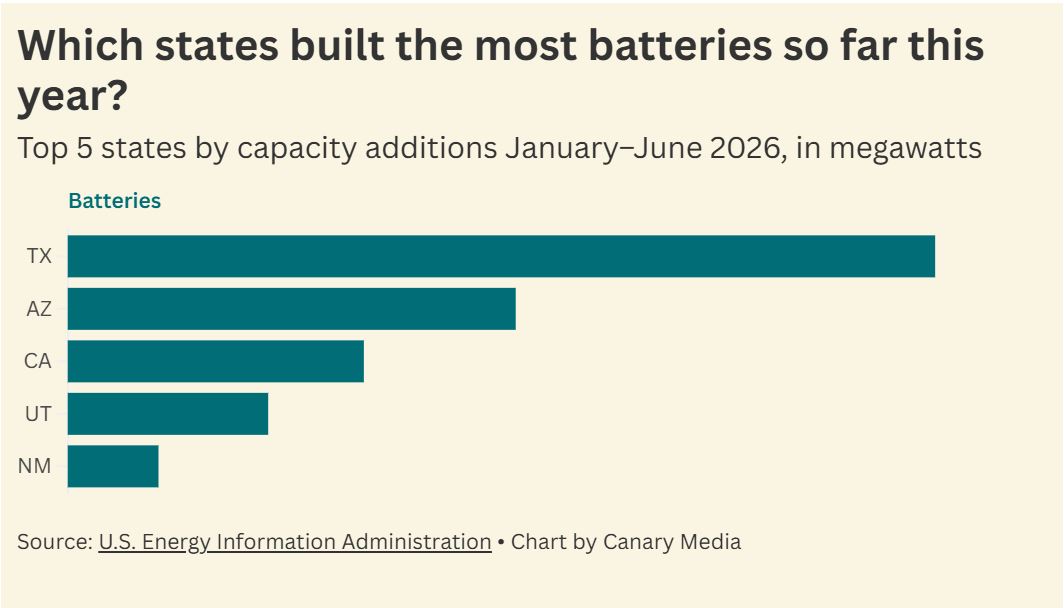
Arizona also effectively tied Florida for the second most solar installations in the first half of this year (again following Texas) and rounded out its portfolio with 300 MW of gas power and 500 MW of wind.
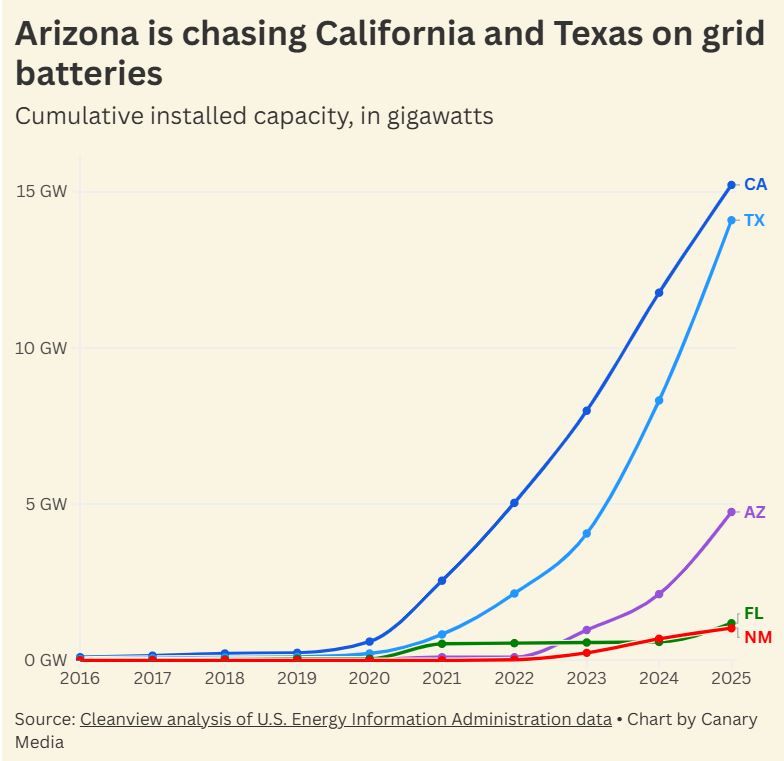
To be clear, Texas and California still have far more solar and storage plugged into their grids. Battery storage has already helped both states avoid grid shortages heading into heat waves or cold snaps, and pushed wholesale prices down by offsetting more costly gas power with cheap solar generation stored from sunnier hours. But Texas and California were the only states that had managed to unlock perennial multi-gigawatt battery construction until now.
Arizona is currently expanding the map of grid storage dynamism — though some renewable energy advocates worry that a recent turn against clean energy in the state could cause the growth to fizzle out.
Texas and California are special cases. Texas lets batteries compete in an open, deregulated market for energy, and investors flooded in when they saw there was good money to be made. California painstakingly funded years of storage policies to complement the state’s grid decarbonization goals, mandating that utilities invest in batteries while making new gas plants nearly impossible to build.
Arizona doesn’t have a Texas-style free market for energy; its customers are served by a handful of vertically integrated monopoly utilities, namely Arizona Public Service (APS), Tucson Electric Power, and the Salt River Project. Nor does the state boast a California-style mandate or policy apparatus. Indeed, the state’s elected board of utility regulators just went out of its way to eliminate the meager renewable-energy target that had been on the books for two decades.
But Arizona does have ample sunshine and clear, dry weather, making solar the obvious winner for cheapest kilowatt-hour of electricity. In such places, a rapid buildout of solar projects leads to diminishing returns — unless you use batteries to store up surplus solar during the sunniest hours of the day.
To properly understand the boom in battery construction today, one must look back to market conditions around five years ago, when the utilities were awarding the contracts for these plants, said Autumn Johnson, executive director of the Arizona branch of the Solar Energy Industries Association.
In 2018, the Arizona Corporation Commission chastised APS for relying too heavily on gas power plants in its long-term planning, prompting the company to take batteries seriously as a cost-effective source of peak power. The Biden administration passed the Inflation Reduction Act in 2022, solidifying a decade’s worth of tax credits for installing solar and batteries. Within a few years, all the state’s major utilities had pledged to decarbonize their fleets by mid-century.
The wave of storage projects built in recent years is the result of contracts the utilities signed in those heady times, Johnson said.
But the political landscape in Arizona and nationally has shifted since then, casting a pall over the future of the state’s solar and storage buildout.
The Trump administration gutted Biden’s climate law last year, though it preserved tax credits for batteries specifically. APS abandoned its own climate goals. The utility regulator is picking performative fights with clean energy instead of pushing the utilities to be more ambitious. The state legislature this year proposed “a record number of terrible energy bills,” Johnson said, including ones to mandate that 85% of electricity capacity come from dispatchable or baseload sources (not intermittent renewables) and to label wind and solar farms a “public nuisance” if they fall within 4 miles of a residential property.
And while the utilities can’t change the fundamental economics of solar and batteries, they can change how they assign contracts, Johnson noted.
APS, the biggest battery builder in the state, said in a July planning session that it was excluding four-hour duration batteries from modeling for its long-term energy plans, limiting the options to those with six to eight hours of duration. Four-hour batteries have in recent years become the standard type of peaker plant getting built in California and Arizona, but now APS seems to be taking them off the table. Adding more hours of energy discharge provides greater coverage for the grid but increases construction costs.
“Given all the changes, will we keep our top spot in five years?” Johnson asked of Arizona’s energy storage leadership. “I’m not sure it will be a long-lived reign at the top.”
At the very least, construction will continue at a rapid clip through 2026, according to the EIA data, anchored by the nearly finished Maricopa Energy Center, which includes a 550-MW/2.2-GWh-hour battery. Seven battery projects are already under construction for 2027 completion, ranging from 100 MW to 300 MW. Utilities will need to be signing new contracts now to keep the momentum going into the 2030s.
The money was mandated by Congress to help manufacturers like Cleveland-Cliffs adopt low-carbon tech. Now it’ll be used to extend the life of a polluting facility.
A $500 million Biden-era grant to decarbonize steelmaking has been refashioned by the Trump administration to upgrade a coal-fueled blast furnace in southern Ohio.
On Friday, Cleveland-Cliffs confirmed that the U.S. Department of Energy had changed the scope of the previously awarded funding for Cliffs’ Middletown steel mill — the longtime economic engine of Vice President JD Vance’s hometown. Vance and Energy Secretary Chris Wright visited the plant on Friday to tout the federal investment.
“The DOE’s support for this project is a testament to the importance of preserving the blast furnace route to produce automotive-exposed grade steels in the U.S.,” Cliffs CEO Lourenco Goncalves said in a statement on Friday. The Middletown plant makes steel used in the exposed parts of cars, trucks, and SUVs.
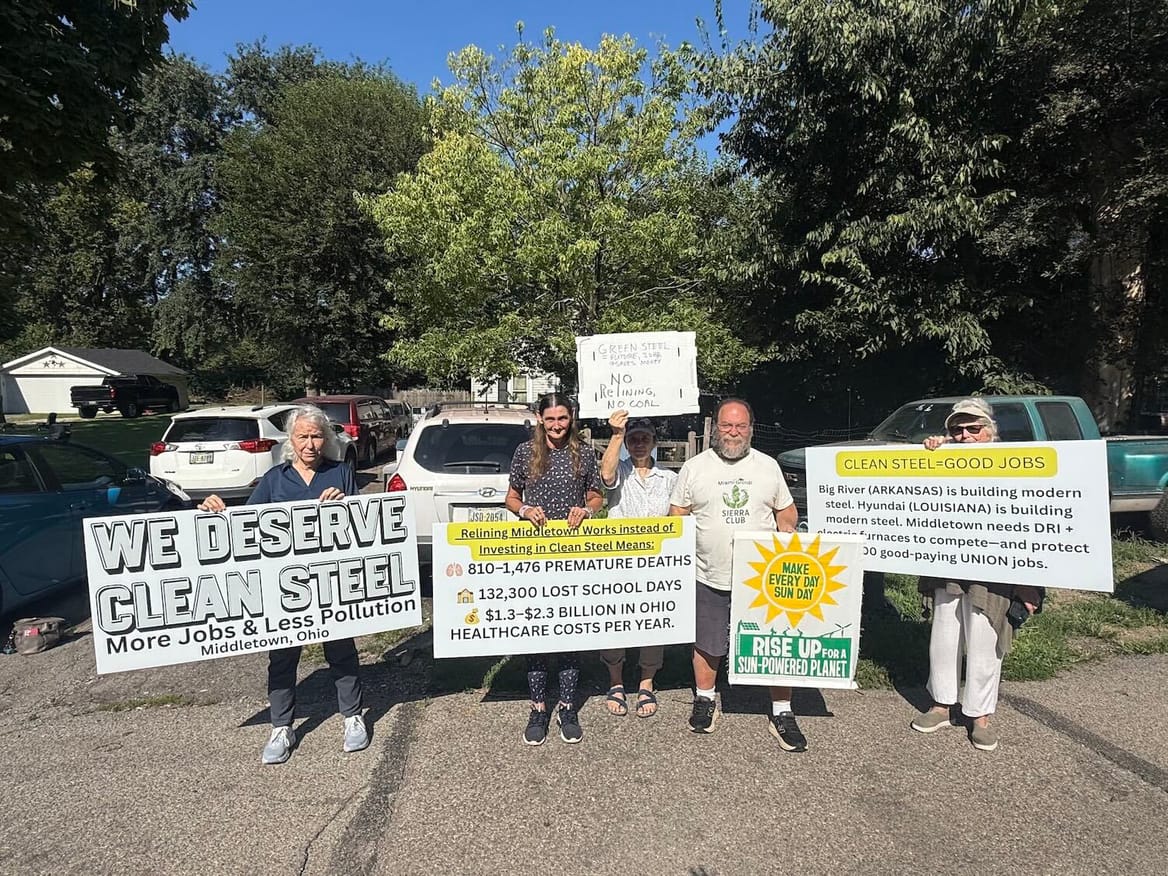
Today’s announcement makes official what Cliffs has been signaling would happen in recent months. The change of plans has drawn pushback from green-steel advocates and some Middletown residents, who say they are dismayed that funding meant to slash industrial emissions could potentially amp up local air pollution instead.
“Cleveland-Cliffs and JD Vance need to get rid of coal and go back to the original project that would clean up the air we breathe and improve our health,” Donna Ballinger, who lives in the shadows of the Middletown steel mill, said Friday in a news release shared by the Sierra Club.
Cliffs initially planned to use its half-billion-dollar award to replace its aging blast furnace with cleaner, hydrogen-ready technology and electric furnaces. In March 2024, the Biden administration’s DOE chose Middletown as the place to unveil its broader, $6.3 billion program for decarbonizing key U.S. manufacturing sectors, which was primarily funded by the 2022 Inflation Reduction Act.
Globally, iron and steel production generates roughly 9% of human-caused CO2 emissions every year, and the vast majority of that pollution comes from using coal in blast furnaces. Replacing the centuries-old technology is considered key to limiting the worst impacts of climate change, and global efforts to clean up steelmaking are advancing, though in fits and starts.
Cliffs’ original project would’ve replaced coal with natural gas — and eventually hydrogen — eliminating roughly 1 million tons of planet-warming emissions. But after President Donald Trump took office in 2025, the Ohio-based steelmaker recommitted itself to using “beautiful coal” at the Middletown steel mill.
Under its current plan, Cliffs says it will refurbish and optimize the 73-year-old blast furnace so that it can run for potentially another two decades. The manufacturer will also install a cogeneration plant that uses waste gases from the blast furnace to generate steam and electricity for the steel mill’s operations. Cliffs said it will invest $500 million of its own money to match DOE’s grant.
Cliffs first outlined the new direction in a February air-permit application submitted to Ohio’s environmental regulator. It wasn’t clear then whether this work would be funded by the DOE, given the nature of the grant program.
However, in July, Goncalves said during an earnings call that the company aimed to redirect the $500 million grant to align with the Trump administration’s priorities. Friday’s announcement cements those plans, with the DOE having “established a framework for Cliffs to finalize negotiations and implementation plans” for the Middletown project, Cliffs said.
In a news release, the DOE said the company “determined that the business case for the original project scope no longer made sense given customers’ unwillingness to pay a ‘green premium’ for steel. Working with the DOE, Cleveland-Cliffs identified a viable alternative that will upgrade and improve the efficiency of its existing coal-fired blast furnace” while also capturing waste gas.
A former DOE official noted that Congress legally mandated that the grant funding be used to, in the words of the Inflation Reduction Act, enable “advanced industrial technology” — defined as something “designed to accelerate greenhouse gas emission reduction progress to net-zero at an eligible facility.”
The Middletown project’s revised scope will move the steel mill away from achieving net-zero emissions, not toward it, the former official said.
As Cliffs sees it, the steelmaker is “going above and beyond a standard blast furnace reline, to include the most advanced technology available,” Goncalves said in Friday’s statement, referring to the cogeneration plant and other planned energy-efficiency improvements.
“Cleveland-Cliffs is making a decisive investment in the future of American steelmaking and manufacturing,” he said.


.svg)
