

 Back
Back
SOLAR: Developers bring the 690 MW Gemini Solar + Energy Storage project online in southern Nevada, making it one of the nation’s largest operational facilities of its kind. (Power)
ALSO:
CLEAN ENERGY: Colorado economic development officials approve up to $1.84 million in tax incentives for a clean energy manufacturer considering establishing a facility in the state. (CPR)
STORAGE:
GRID: Distributed energy provider Sunrun says its virtual power plant composed of some 16,000 residential solar-plus-storage systems sent up to 51 MW to the California grid during a July heat wave. (news release)
MICROGRIDS: Colorado awards utilities more than $2.1 million to construct solar and battery storage powered microgrids. (Microgrid Knowledge)
OIL & GAS: The federal Bureau of Land Management proposes strengthening oil and gas drilling regulations on public land in Colorado to mitigate impacts to wildlife habitat. (news release)
ELECTRIC VEHICLES: California electric vehicle sales for the second quarter of 2024 drop 1.2% from the previous year, raising questions about whether the state can meet its goal of banning new gasoline-fueled car sales by 2035. (Los Angeles Times)
MINING: Advocates push back against a company’s plan to breed an endangered wildflower in a lab to offset its proposed Nevada lithium mine’s impacts to the plant, saying the firm is “greenwashing extinction.” (Associated Press)
NUCLEAR:
CARBON CAPTURE: Montana residents push back on an ExxonMobil subsidiary’s proposal to store 150 million tons of captured carbon in federal lands in the eastern part of the state, saying it would “change our way of life here forever.” (Inside Climate News)
The small southeastern Minnesota city of La Crescent receives just a handful of permit applications each year to install solar panels on homes.
Despite the small volume, it’s still important to city sustainability coordinator Jason Ludwigson that it’s a smooth process for homeowners and installers.
That’s why the city of 5,000 recently became one of the first in the state to start using a software program designed to streamline local solar permitting.
Solar Automated Permitting Plus, or SolarAPP+, was developed by the National Renewable Energy Laboratory (NREL) in collaboration with the solar industry, code organizations, local governments, and the building safety community. Since its release in 2018, SolarAPP+ has been used by more than 160 cities and counties to automate much of the permitting process for smaller solar installations.
In La Crescent, an application that might have taken a few days for a city employee to review can now be approved online in minutes for projects that meet criteria. That “will save (time) for both the contractor and the city,” Ludwigson said. “It makes it faster for our building and zoning department.”
Minnesota lawmakers want to encourage more communities to join La Crescent in adopting the software. This year, the Legislature budgeted $2 million for the Commerce Department to deliver programs and training to local agencies, contractors, inspectors and others involved in solar permitting.
The state’s solar industry association supports use of the software, in part for its potential to standardize a process that can right now vary significantly from city to city. Making it easier to permit installations could save companies time, potentially lowering costs and helping to expand rooftop solar in the state, which will need many megawatts more clean energy to reach its climate goals.
Getting permits for solar projects in Minnesota can take days or weeks and cost as much as $1,000. Typically, solar installers in the state apply electronically or in person for separate building, local electrical and utility interconnection permits. After receiving approvals for all three applications — and any other that are required — they start building projects that, once completed, are reviewed onsite by building and electrical inspectors.
Installers using the software receive automated approvals if they accurately complete forms for their building and electrical permits and, if required, fire and structural permits. Any errors are flagged and sent back to the installer for corrections. The app integrates with existing permitting software programs used by government agencies, according to NREL.
California cities have been the biggest adopters so far, but the app is beginning to catch on in Minnesota, Wisconsin and Iowa. By the end of 2023, the NREL reported that the free software had been used nationally on 32,800 projects, saving 33,000 hours of permitting staff time. Installers pay a $25 administrative fee and the community’s permitting fee.
State Rep. Patty Acomb, who chairs the Climate and Energy Finance and Policy committee, said she and other lawmakers want to provide state grants so cities can learn how to use the software and eventually create a consistent permitting process across the state. “The intention is to make (permitting) easy and predictable,” she said.
Lissa Pawlisch, director of the Energy Development Section at the state Department of Commerce, said the department is developing a program to reach out to communities interested in SolarAPP+ and assist them in incorporating it into existing permitting software. She also believes the app could play a role in helping move installations through the new federally funded Solar for All program that will serve low income households.
Great Plains Institute’s Brian Ross said that Solar for All requires a consistent approach to permitting, and that one way to achieve that is with the SolarApp+ software. The app would give a “jurisdictional consistency” to applications from low income solar customers and “to make sure there are not barriers in the way.”
Despite its promise the app will not work in every situation. It only incorporates local versions of electrical permits and not the state permit, which many communities use. “If the local government relies on the state permitting process (for instance, Minneapolis), then I don’t think there is any advantage to using SolarAPP because the state electric permitting process is already effectively an ‘automatic issue,'” he said.
Donna Pickard of TruNorth Solar has spent decades filing solar permits with dozens of municipalities. She said installers need building, electrical and interconnection permits and approvals before projects begin, often taking over a month.
Pickard wonders if SolarAPP+ will interest Minnesota communities because many already have established permitting systems to manage solar projects. However, having dealt with many different permitting structures, Pickard said she “likes the idea of standardization because it would make things easier.”
Another challenge is that the software can’t evaluate permits for projects on flat or metal roofs in the Midwest. Jeff Cook, solar analysis subprogram manager at the NREL Strategic Energy Analysis Center in Colorado, said the software covers about 80% of eligible solar installations but the number declines in the Midwest due to “high snow load and metal roof penetration.”
Pawlisch said outreach and grants for SolarApp+ would likely start next year. The start date is also unclear for Solar for All as she continues to meet with federal and state officials to work out the details.
The bulk of steelmaking around the world still relies on coal-based blast furnaces.
The bulk of steelmaking around the world still relies on coal-based blast furnaces.
As a result, the steel and iron industry is responsible for 7% of greenhouse gas emissions and 11% of carbon dioxide emissions globally, according to the consultancy firm Global Efficiency Intelligence.
This is more than the total emissions from all the world’s cars and vans.
With steel critical to the building out of decarbonised energy infrastructure, production is expected to continue to rise over the coming years, meaning the potential for decarbonisation is “enormous”, according to not-for-profit data organisation Global Energy Monitor (GEM).
GEM’s annual “Pedal to the Metal” report reveals that 93% of new steelmaking capacity announced thus far in 2024 promises to use lower emission electric arc furnaces (EAFs).
It also shows that 49% of the world’s steelmaking capacity under development now uses EAFs, up from just 43% in 2023 and 33% in 2022.
Of this, nearly all of the capacity announced since the beginning of 2024 operates using EAFs, the non-governmental organisation’s Global Steel Plant Tracker (GSPT) shows.
The tracker covers 2,207m tonnes per year (mtpa) of operating steelmaking capacity and an additional 774mtpa of steelmaking capacity under development globally, across 1,163 individual plants in 89 different countries, analysis of which is captured in its annual report.
However, while the report suggests a positive progression towards lower emission technologies in the sector, the increase in the announced projects is not yet leading to a construction of EAF overtaking coal-based production methods.
Coal-based blast furnace-basic oxygen furnaces (BF-BOFs) – where blast furnaces are used to produce iron from ore and oxygen converters then turn this, with some additional elements, into steel – continue to dominate the projects under construction, meaning “pressure must be maintained all the way through to project completion if real progress is to be seen”, the report finds.
Incoming steelmaking capacity is more heavily EAF-based than ever before, according to GEM’s new report.
There is currently 774mtpa of steelmaking capacity under development, of which 223mtpa is in the advanced development stage.
Based on data from April 2024, the GSPT shows that nearly half of the capacity under development (337mtpa) is EAFs.
Just 36% of steelmaking capacity announced in 2020 with a known production route used EAFs, while in 2023 that number had increased to 92% according to GEM. This grows to 93% of capacity when looking at steelmaking capacity under development announced in 2024.
This “indicates a significant shift toward electric arc furnace steelmaking in the years to come”, the report notes.
Meanwhile, of the 212mtpa of steelmaking capacity slated for retirement, 88% if BOF-based.
However, a net increase in BOF-based capacity is expected over the coming years. If all planned developments and retirements take effect, an additional 171mptpa of BOFs is expected to be added to the global fleet, along with 310mtpa of EAF and 80mtpa of unknown technologies.
Despite this growth in BOFs, the surge of EAF means the steel sector is getting increasingly close to meeting the International Energy Agency’s (IEA) suggested 2030 target.
In its net-zero by 2050 roadmap, the IEA suggests that the share of steel produced by EAF should grow from 24% in 2020, to 37% by 2030 and then 52% by 2050.
Considering all planned capacity and retirements, GEM now estimates that the global steel fleet is expected to reach 36% EAF by 2030, noting: “This is still not sufficient to meet the IEA [net-zero] climate target, but with heightened momentum the goal is increasingly attainable.”
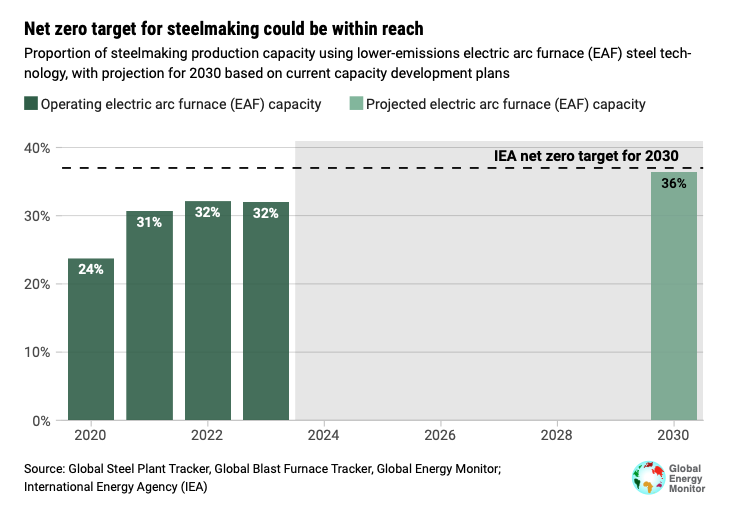
While EAF-steelmaking is being announced at “record rate”, GEM finds that less than 14% of this potential capacity has moved into construction.
Of those that have moved into construction, around 46% are still BOF-based. As such, “while we may be within reach of net-zero targets based on proposed electric arc furnace capacity, actually achieving these goals requires follow-through”, the report notes.
Caitlin Swalec, program director for heavy industry at GEM, said in a statement:
“The progress is promising for a green steel transition. Never before has this much lower-emissions steelmaking been in the pipeline. At the same time, the buildout of coal-based capacity is concerning. What the industry needs now is to make these clean development plans a reality, while backing away from coal-based developments.”
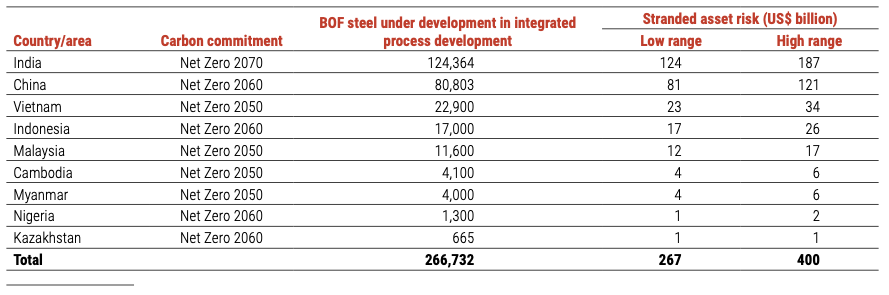
As well as the buildout of new coal-based capacity being out of alignment with a net-zero future, it poses a threat of carbon lock-in and stranded assets, GEM notes.
Blast furnaces are becoming riskier investments given the limited options to mitigate emissions from both the furnaces themselves and the upstream emissions from the metallurgical coal mining, it adds.
Estimating an investment of $1-1.5bn per mtpa capacity at an integrated BF-BOF site, GEM found that the future stranded-asset risk could be as high as $554bn in 2023, falling to $400bn in 2024 due to the continued fall in BOF capacity under development.
Astrid Grigsby-Schulte, project manager for steel at GEM tells Carbon Brief:
“As we grow closer to key decarbonisation milestones, coal-based developments get further out of alignment with the direction the industry is moving and present a greater risk of stranded assets to steelmakers. Coal-based, emissions-intensive blast furnaces represent significant investments that often require decades to recoup. This makes them extremely risky for developers, particularly in countries with stated net zero commitments.”
The limited options for mitigating the climate impact of BOF-steelmaking was also highlighted within a recent report from the thinktank Sandbag.
While carbon capture, utilisation and storage (CCUS) is often touted as a “catch all” solution, its effectiveness varies widely across applications, Sandbag’s “Steel & CCS/U” report finds.
For steel production, BF-BOFs with carbon capture are unlikely to be cost-competitive with EAFs, the report finds. Although given the slow pace of technological and market development, Sandbag anticipates capturing carbon will play a limited role in the steel industry.
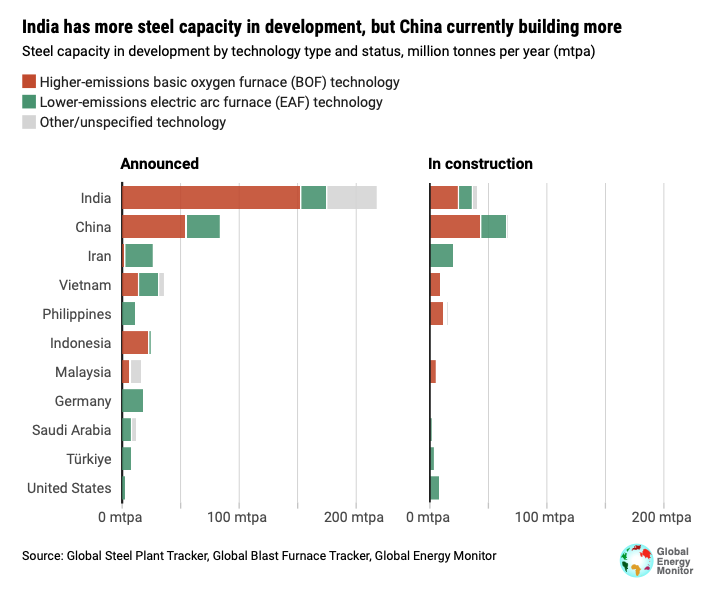
India has now replaced China as the top steel developer globally, with a pipeline of 258mtpa of capacity, of which 177mtpa is BOFs, according to GEM.
China has a pipeline of 150mtpa meaning, collectively, China and India are responsible for 53% of all developments globally.
Asia operates 68% of all steelmaking capacity (1,508mtpa), the majority of which is in China (1,075mtpa), India (123mtpa) and Japan (109mtpa).
When looking specifically at emissions-intensive BOF production, Asia’s share of total operating capacity increases to 80% (1,181mtpa), of which 918mtpa is in China.
Currently, China has 157mtpa of operating EAFs (22% of the global capacity), followed by the US, Turkey, Iran and then India.
According to a new report from the Centre for Research on Energy and Clean Air (CREA), China did not issue any new permits for coal-based steelmaking in the first half of 2024. This is the first time this has happened since the nation’s “dual carbon goals” were announced in September 2020.
During the first six months of 2024, Chinese provincial governments permitted 7.1mtpa of steelmaking capacity, all of which were EAFs marking a “turning point” for the country’s steel industry, CREA notes.
Xinyi Shen, researcher at CREA and the report’s lead author, tells Carbon Brief: :
“China’s EAF steelmaking has been developing rather slowly in the past few decades, mainly due to the constraint of scrap supply. However, as China’s steel demand reaches its peak and more scrap becomes available, a major opportunity arises to reduce emissions in the next 10 years. The government has accelerated plans to expand the national ETS to include the steel sector by the second half of 2024. By implementing carbon pricing on carbon-intensive products, EAF steelmaking would become more economically competitive and continue the growth.”
Despite India now overtaking China in terms of announced steelmaking capacity, China remains the biggest developer of EAF capacity overall, GEM’s report states. And while India has the most steel in development, 84% has not moved into construction.
As such, there is still an opportunity for India’s plans to change, with the percentage of BOFs to EAFs less set.
Chris Bataille, adjunct research fellow at the Columbia University Center on Global Energy Policy and lead author at the global Net Zero Steel project tells Carbon Brief:
“India’s core demand for steel is set to increase from 125mtpa to ~450mtpa by 2050, especially to meet key building and infrastructure needs. Our modelling suggests EAFs consistently rise from ~35 to 150mtpa by 2050. So the +250mtpa BF-BOFs is just barely feasible, but only over ~25 years and with some exports of BF-BOF steel.
“The difference will be between a world where strong climate policy succeeds and fails. If it fails and coal based BF-BOFs are built, then the +258mtpa looks barely feasible. If it succeeds, India is short on the necessary gas and especially clean electricity to power this amount of steel production. While the country does build a lot of EAFs, it builds up to 250mtpa of clean iron making over time, making the short term shortfall with clean HBI iron imports.”
SOLAR: Houston home solar-battery owners were able to keep themselves powered through Hurricane Beryl and its aftermath, demonstrating the potential of distributed energy as CenterPoint Energy took days to restore power across the city. (Canary Media)
ALSO:
PIPELINES: A review of cases filed with federal regulators show erosion around the now-operating Mountain Valley Pipeline, with roughly three dozen reports of sediment leaving the pipeline’s right-of-way in western Virginia. (Roanoke Times)
WIND: North Carolina sees the groundbreaking for only its second wind farm and considers the potential for more as state officials seek to cut carbon emissions. (WSOC)
OIL & GAS: Emissions from a Texas refinery complex skyrocketed by more than 150% between 2015 and 2022, demonstrating how pollution continues to spike at some facilities despite the U.S. EPA’s landmark update to oil refinery regulations nearly a decade ago. (E&E News)
NUCLEAR: A new unit at Georgia Power’s nuclear Plant Vogtle is operating once again after it was taken offline more than a week ago with a valve problem. (Macon Telegraph)
OVERSIGHT: Consumer advocate groups sue to challenge a newly passed Georgia law delaying the election of state energy regulators for one to two years, which critics say unconstitutionally prevents the election of Democrats to the all-Republican board. (Georgia Current)
CLIMATE:
UTILITIES:
COMMENTARY:
OFFSHORE WIND: Construction begins on New York’s largest offshore wind farm, as the state opens its fifth round of solicitations for new projects. (WSHU, Renewables Now)
ALSO:
CLEAN ENERGY: The Massachusetts House passes a bill to streamline permitting for clean energy projects along with new procurements. (Associated Press)
TRANSPORTATION: Transit and labor leaders push a plan for a high-speed rail line connecting New York and Boston in 100 minutes, including a new connection from Hartford to Providence. (Gothamist)
UTILITIES: Central Maine Power and Avangrid are seeking to waive a requirement that state regulators sign off on their proposed merger. (Maine Public)
ELECTRIC VEHICLES:
GRID:
SOLAR: A solar company and an affordable housing firm team up to enroll low-income New York City households in community solar. (Solar Builder)
EQUITY: A New York City council member is introducing a bill to require landlords to provide air conditioning for tenants during summer months. (Brooklyn Eagle)
COMMENTARY: A former congressman and a state representative from Pennsylvania support efforts to allow hydrogen produced from “low-leak” natural gas to qualify for a federal clean-energy tax credit. (TribLive)
SOLAR: Minnesota regulators are poised to approve a 250 MW solar project for Xcel Energy, the last of three large solar projects totaling $1.1 billion that will replace a massive coal plant. (Star Tribune)
ALSO:
CLEAN ENERGY: Officials reopen a highly advanced machine at Argonne National Laboratory in Illinois that will help provide new insights into various fields of research, including battery storage and clean energy. (WLS)
CLIMATE: Record-breaking flooding and deadly tornado events are evidence that climate change is “right in front of your face,” says the mayor of a western Iowa city. (Radio Iowa)
WIND: Two utilities submit a habitat conservation plan for protecting endangered bats to federal officials for a large wind project that would span parts of Iowa and Minnesota. (E&E News, subscription)
TRANSPORTATION:
STORAGE: A Michigan startup is close to raising $5.6 million to commercialize an energy storage battery made from cheaper organic compounds instead of nickel, cobalt and other metals that need to be mined. (Crain’s Grand Rapids, subscription)
UTILITIES: Missouri’s consumer advocate reports that electric and gas rates in the state have been increasing faster than inflation and wages, primarily because of utility infrastructure investments. (KBIA)
COMMENTARY: Federal and state officials should take steps to ensure low-income renters whose utility bills are included in their rent have access to community solar projects, a solar installer writes. (Solar Power World)
OIL & GAS: A judge suspends federal oil and gas leases in Alaska’s Cook Inlet after finding the Interior Department failed to adequately consider drilling’s impacts to endangered beluga whales. (Alaska Public Media)
ALSO:
ELECTRIC VEHICLES: Starbucks and Mercedes-Benz team up to install fast electric vehicle chargers at 100 locations along Interstate 5 on the West Coast. (Los Angeles Times)
STORAGE: A California county begins establishing siting standards for new grid-scale battery energy storage systems following fires at two San Diego-area facilities. (San Diego Union-Tribune)
UTILITIES: Xcel Energy delays implementing its Colorado-mandated clean energy plan over supply chain constraints and uncertainty over tariffs, raising fears its $12 billion price tag will grow. (Colorado Sun)
SOLAR:
HYDROGEN: The Biden administration allocates $30 million to California to help plan and design a regional hydrogen production and distribution hub. (Associated Press)
COAL:
MINING:
GRID: California’s grid operator says its ability to send power to neighboring states to help them weather a July heat wave demonstrates the system’s resilience as it transitions to 100% clean energy. (E&E News, subscription)
CLIMATE:
NUCLEAR: Wyoming residents worry about and support an advanced nuclear reactor proposed for a coal town in the southwestern part of the state. (WyoFile)
COMMENTARY: A Nevada journalist explores the benefits and challenges of installing solar arrays over irrigation canals to generate power and reduce evaporation. (Western Water Notes)
Add lithium to water in a chemistry lab, and you’ll get an incendiary reaction. The same might be said of opening new lithium mines: The prospect can spark conflicts when it comes to water.
Mining companies and the U.S. government are investing in increased extraction for lithium, which is a critical component in some renewable energy technology, especially electric vehicle batteries and large grid-scale storage batteries.
The IRA injected the Department of Energy (DOE) Loan Programs Office with about $11.7 billion to support new loans for energy projects, including mines for needed metals like lithium. This builds on earlier Bipartisan Infrastructure Law (BIL) grants for battery material supply chains. The IRA also offers tax credits of up to $7,500 on eligible electric vehicles, creating additional demand for lithium by the auto industry.
With funding from the IRA, DOE and BIL, lithium miners have gained new financial vigor and governmental votes of confidence. Yet some worry what impact this newfound funding will have on the environment.
Domestic mining is still primarily governed by the outdated 1872 Mining Law, which didn’t enshrine environmental protections, but “declared all valuable mineral deposits in land belonging to the United States to be free and open to exploration and purchase,” according to the Bureau of Land Management (BLM) website.
Through the National Environmental Policy Act, environmental impact statements are required ahead of major projects like mines, although some statements have been criticized as rushed or insufficient. But ultimately, it’s up to companies to choose and monitor their own environmental protections and community agreements, even if they’re collecting federal subsidies.
Lithium mining poses a range of risks to biodiversity and groundwater supplies, depending on the methods used. There are three main types of lithium extraction: brine evaporation, hard rock mining and clay mining.
In brine evaporation, groundwater is first pumped to the surface. There, 90% of it is evaporated away to concentrate the lithium brine, with additional freshwater needed to complete extraction.
Hard rock and clay mining often begin with “dewatering,” or removing groundwater to reach the ore, in addition to needing more water to process the ore. These methods also require chemicals such as sulfuric acid for processing, which in cobalt and copper mining has led to contamination of local water systems.
Concerned about the risks, local residents and environmentalists have resisted new mines with tactics from protests to litigation — but a government-supported lithium boom appears to be underway regardless.
A Center for Biological Diversity map lists more than 125 lithium extraction projects in the western U.S. alone. Seven are inactive, and the majority are in various stages from exploration to development. Most of the proposed mines are in Nevada, predicted as a future “Silicon Valley of lithium.”
Albemarle’s Silver Peak mine in Nevada, a brine evaporation mine that has come under scrutiny for depleting groundwater aquifers in an increasingly-arid region, is the only currently active U.S. lithium mine. That’s likely to soon change, since the IRA has incentivized metal and mineral extraction in the United States and in countries with a U.S. free trade agreement.
Through its loan support and EV sales incentives, the IRA has made lithium mines more profitable, and less financially risky for companies opening new ones. Several lithium companies, including ioneer, Allkem and Albemarle, lobbied for the IRA’s passage or for provisions within it. A 2023 IRA impact report from S&P Global noted “aggressive mine capacity additions” for lithium planned in countries including the United States, Chile and Australia.
Domestically, most lithium deposits are in the West, where water supplies are already stressed.
“There’s a critical minerals and specifically a lithium rush unfolding, especially, but not exclusively, across the western U.S.,” says Providence College political scientist Thea Riofrancos, who specializes in studying the impact of resource extraction on communities. She adds that some of the mining interest predates the IRA, “but it’s picked up a lot since the IRA, because that sent such clear signals.”
Yet new mines pose risks to the region’s biodiversity. In a lawsuit against a Rover Metals exploration project, the Center for Biological Diversity and Amargosa Conservancy alleged that even exploratory drilling near springs in the Ash Meadows National Wildlife Refuge in Nevada would threaten endangered and endemic species. Active mines can have even bigger impacts.
“We need lithium as a part of our transition off of fossil fuels, but it can’t come at the expense of biodiversity or our most precious protected areas,” Patrick Donnelly of the Center for Biological Diversity, said in announcing the lawsuit. “Some places have to be off-limits to resource extraction, and Ash Meadows National Wildlife Refuge is at the top of the list.”
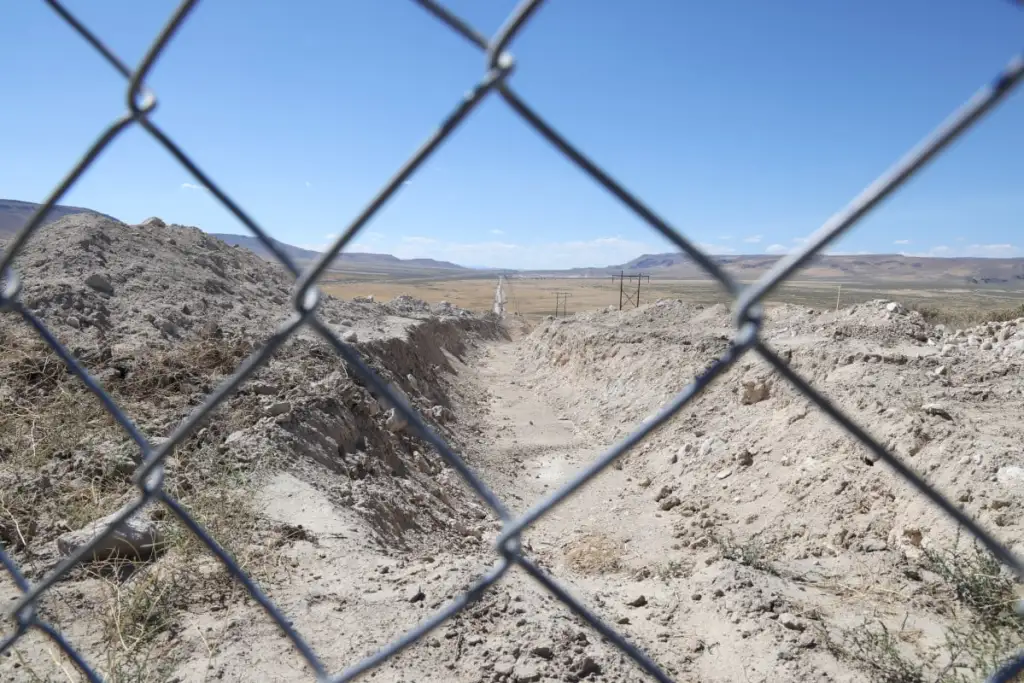
The Thacker Pass mine run by Lithium Americas is on track to become the second active lithium mine in the United States. The project in far northern Nevada may be indicative of what’s to come as more government-fueled mines pop up.
The lithium clay mine is under construction, with most Phase 1 construction costs covered by IRA support: General Motors is investing $650 million in exchange for the mine’s lithium. The U.S. Department of Energy provided a conditional $2.26 billion low-interest loan. Permitting came earlier, from President Trump’s administration. In 2028, the Thacker Pass mine is expected to reach full capacity production.
The DOE said the loan will provide General Motors with enough lithium for 800,000 electric vehicles a year and “reinforces the Biden-Harris Administration’s whole-of-government approach to strengthening America’s critical materials supply chain, which is essential to building America’s clean transportation future and enhancing our national and energy security.”
Lithium Americas plans to recycle and reuse withdrawn water an average of seven times. Its Phase 1 water consumption is estimated to be about 929 million gallons per year, equal to “around five alfalfa irrigation pivots,” according to the company’s blog.
Lithium Americas purchased existing agricultural water rights, so the operation won’t increase groundwater withdrawal, although existing groundwater withdrawal may still be unsustainable. It has also outlined plans for nearby habitat restoration. A post-mining reclamation plan is intended to reduce long-lived environmental impacts by refilling pits and restoring the surface.
But implementing and tracking mitigation strategies like these is left up to the companies.
“What I think is concerning is the proliferation of lots of voluntary governance mechanisms that companies don’t have to do,” says Riofrancos. “What’s important — and it sounds old-fashioned, maybe — is regulation that’s binding; that’s enforceable; that carries sanctions, fees, punishments, fines, whatever, if the regulations are not obeyed.”
Riofrancos believes such regulations, plus sustained protests against irresponsible mines, could get the mining industry to “do better.” She says the IRA-supported DOE loan program represents a missed opportunity to tie robust regulations to mining projects: “It’s very light on guardrails and requirements for loan recipients.”
It’s also unclear how much mitigation is realistically possible.
“There’s ways to tinker around the edges, but ultimately, there’s no mitigating an open-pit mine,” Donnelly, the Great Basin director of the Center for Biological Diversity, said in an interview. “(These mines) cause impacts to the water table, impacts to wildlife, impacts to local and Indigenous communities.”
He believes IRA loans and other federal subsidies help new mines get permitted in spite of environmental risks: “The DOE’s kind of waving a magic wand and saying, ‘This mine is okay to permit.’ ”
But the exact risks of each new lithium mine are tricky to measure. The three different types of mines can have different effects, depending on variables including location, says David Boutt, a hydrogeology researcher and professor at the University of Massachusetts-Amherst. Companies are often reluctant to share data that would help scientists evaluate impacts, he says.
“It’s hard to establish a number, like, ‘This one has like a 30% less environmental impact than the others,’ ” Boutt says. “We don’t see these numbers, because a lot of the impacts are local and hard to quantify.”
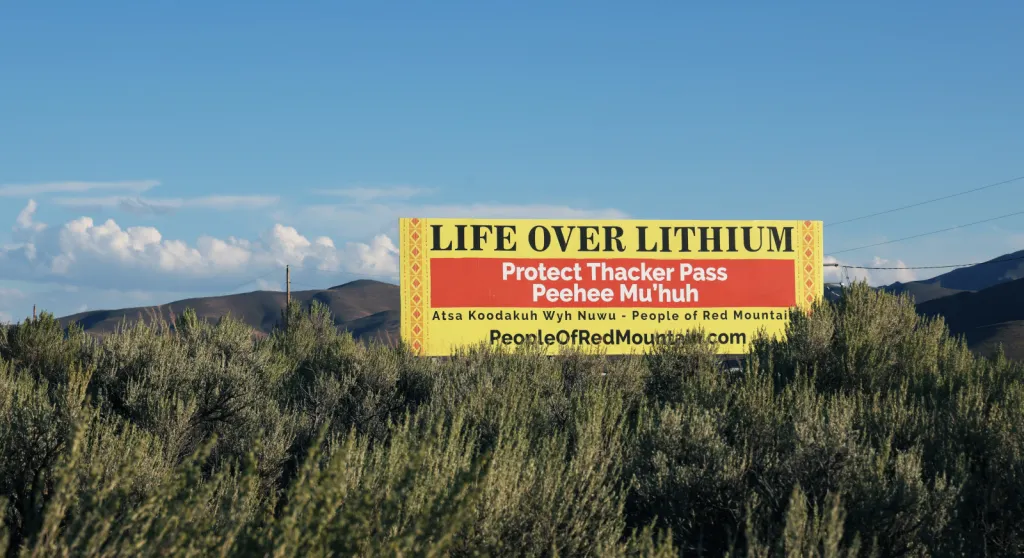
Yet for people living near mining sites, the risks can feel tangible. Dean Barlese, an elder from the Pyramid Lake Paiute Tribe, says he’s opposed to the Thacker Pass mine both because it’s at an Indigenous sacred site, and because his people’s lives are intertwined with the local ecosystem.
“A lot of people think it’s just a desert wasteland,” he says. “But the medicines we use are still out there. As Native people, we still gather our food, roots, berries — we’ve survived here for thousands of years.”
Barlese says he’d rather not see mining projects near Indigenous communities at all, regardless of community benefits agreements and environmental mitigation plans. “I would encourage the public to really look into the devastation that getting a bit of lithium does.”
Lithium demand could be reduced if investments were made in public transit and walkable communities, so fewer people were buying cars, Riofrancos says. Although the IRA includes investments in battery recycling, it doesn’t incentivize efforts to reduce surging lithium demand. Instead, it supports extraction to meet the demand, and helps ensure that the extracting companies can profit.
“ ‘Green energy’ is not green energy,” says Barlese. “Money speaks louder than anything else.”
Another possible solution to the mining debate would be an energy transition that uses less lithium.
“One way to reduce demand for lithium (or any battery metals) would be to make smaller batteries, or batteries that are more resource-efficient,” says Riofrancos. Two-thirds of current EV models are SUVs or large vehicles; small- and medium-sized EVs account for only a quarter of EV sales in the United States. Incentivizing smaller vehicles, which can use smaller batteries, could ultimately lead to fewer lithium mines.
Other battery chemistries are another option.
“Given the complexity of getting a permit, of getting the social license, of having everything in place, it’s going to take a long time (to open new mines),” says Boutt, the hydrogeologist. “And perhaps by the time we get to the point where we are developing those resources, we’ll have different battery technology where we’re not as reliant on lithium.”
Floodlight is a nonprofit newsroom that investigates the powerful interests stalling climate action.
EQUITY: Nearly half of Americans live in states that don’t bar electricity shutoffs during heatwaves, putting 45 million low-income Americans at risk of being unable to cool their homes when heat turns deadly. (The Guardian)
POLITICS:
GRID:
OIL & GAS:
WIND:
SOLAR:
ELECTRIC VEHICLES:
COMMENTARY: Two energy justice researchers warn the U.S. is experiencing an electricity disconnection crisis as utilities are allowed to shut off power to residents who can’t pay their bills even in deadly heat. (The Conversation)
CLIMATE: Washington state allocates $52 million from its carbon cap-and-invest program to help relocate Indigenous communities threatened by climate change and rising sea levels. (Associated Press)
ALSO:
SOLAR: A developer secures $1 billion in financing for its proposed 400 MW solar-plus-battery storage facility in eastern Utah. (Solar Industry)
OIL & GAS:
UTILITIES: NorthWestern Energy plans to begin operations at a contested natural gas plant along the Yellowstone River in Montana this month, even as courts continue to consider legal challenges. (Billings Gazette)
ELECTRIC VEHICLES: California officials say it is unlikely the state can meet its target of 1 million public electric vehicle chargers by the end of 2030 without substantial public and private investment, streamlined permitting and power grid upgrades. (CalMatters)
COAL: Wyoming’s congressional delegation calls on the Biden administration to abandon a proposal to end new federal coal leasing in the Powder River Basin, saying it would harm the state’s economy and grid reliability nationwide. (E&E News, subscription)
PUBLIC LANDS: Western oil and gas and mining groups file a lawsuit seeking to block the federal Bureau of Land Management’s new conservation-oriented public lands rule, saying it violates federal law. (E&E News, subscription)
GRID:
WIND: California regulators greenlight an offshore wind developer to conduct site surveys in Morro Bay on the state’s central coast. (Environment + Energy Leader)


.svg)
