

 Back
Back
CLIMATE: The U.S. and other wealthy western countries are the best-equipped to curb pollution and build out renewables, but have still committed to fossil fuel projects that could release 12 billion tons of planet-warming emissions over their lifetimes. (The Guardian)
ALSO:
POLITICS:
BUILDINGS: The U.S. General Services Administration, which runs the nation’s federal buildings, is using Inflation Reduction Act funding to decarbonize its infrastructure and derisk new technologies that can help other buildings cut their emissions. (Canary Media)
RENEWABLES: While new state measures and federal funds are helping smooth the way for substantially more solar in Pennsylvania, “fossil fuels aren’t going anywhere” amid pro-carbon capture and hydrogen production policies. (Spotlight PA)
CARBON CAPTURE: Members of a Louisiana task force won’t discuss why the group is five months late issuing a report on the impacts of building out carbon capture, leading critics to charge that the state has embraced the fledgling industry without due diligence. (Floodlight)
OIL & GAS:
PERMITTING: Democratic Sen. Martin Heinrich steps behind the latest attempt at permitting legislation, saying it would speed the buildout of transmission lines, geothermal power, and other renewable energy. (E&E News)
COAL: Ratepayers in grid operator MISO’s territory paid $1.1 billion more for electricity than they should have over the past three years as utilities ran coal plants to meet demand instead of cheaper, cleaner alternatives, according to a Natural Resources Defense Council report. (E&E News, subscription)
As 2024 passes its midpoint, the global climate continues to push into uncharted territory.
Carbon Brief’s analysis indicates a 95% probability that this year will surpass 2023 as the warmest year on record in the Copernicus/ECMWF ERA5 dataset.
This projection emerges amid a series of climate extremes that have marked the first half of 2024.
In the latest “state of the climate” quarterly update, Carbon Brief assesses the first full six months of 2024 and finds:
Global temperatures set a new record for each of the first six months of 2024, extending what was already a string of seven record setting months in 2023.
All in all, each of the last 13 months has been the warmest since records began in the mid-1850s.
The figure below shows how global temperature so far in 2024 (purple line) compares to each month in different years since 1940 (with lines coloured by the decade in which they occurred) in the Copernicus/ECMWF ERA5 surface temperature dataset.
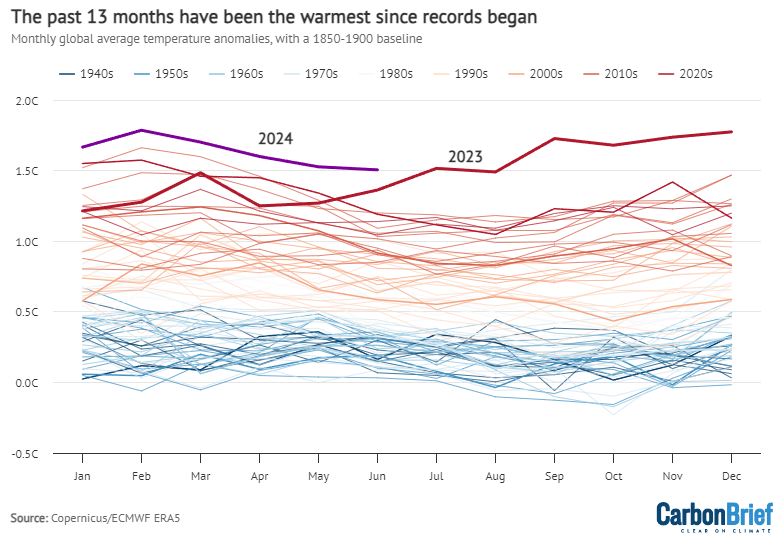
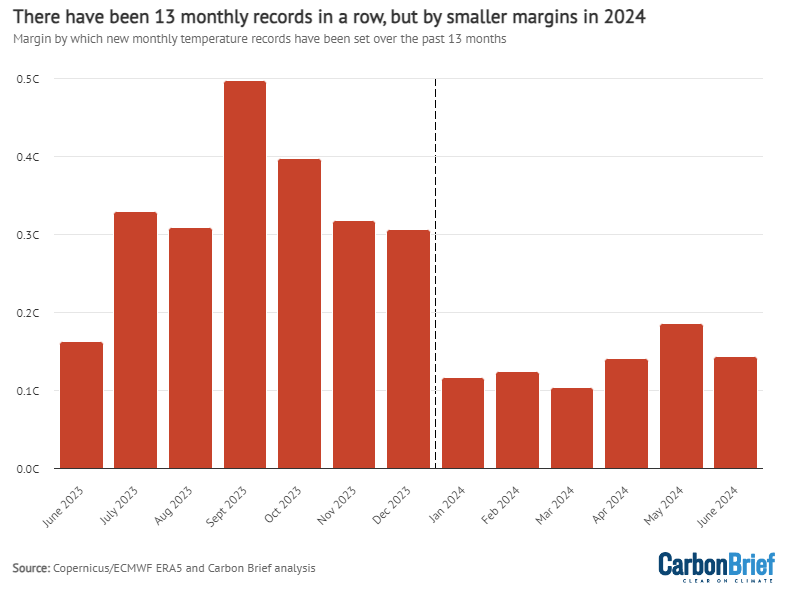
Global temperatures in the latter half of 2023 exceeded prior records by at least 0.3C, peaking in September when 2023 surpassed the previous September record by 0.5C. While 2024 has continued to set records, the margins have been smaller:
It is important to note that June 2024 is being compared to the already high temperatures set in 2023. Compared to the last major El Niño event in 2016, June 2024 was about 0.4C warmer.
The figure below shows the margin by which global temperatures were set in each of the prior 13 record-setting months.
In this latest quarterly state of the climate assessment, Carbon Brief analyses records from five different research groups that report global surface temperature records: NASA, NOAA, Met Office Hadley Centre/UEA, Berkeley Earth and Copernicus/ECMWF.
The figure below shows the annual temperatures from each of these groups since 1970, along with the average over the first six months of 2024. (Note: at the time of writing, June data was not yet available for the Hadley/UEA record.)

The globe, as a whole, has warmed more than 1C since 1970, with strong agreement between different global temperature records. However, there are larger differences between temperature records further back in time (particularly pre-1900) due to sparser observations and a resulting greater sensitivity to how gaps between measurements are filled in.
All show that the average global temperature for 2024 so far is higher than any prior annual record. However, annual temperatures may end up being a bit lower than those of the first six months of the year, as El Niño conditions have faded and a mild La Niña event is likely to develop later in the year.
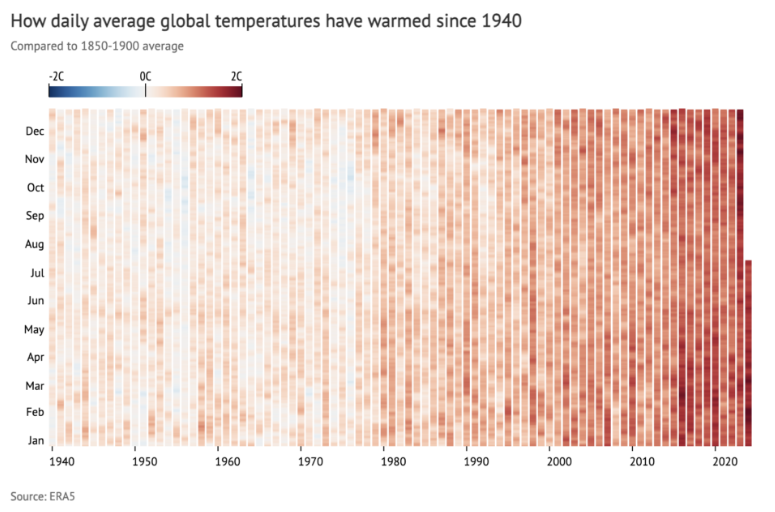
The last two years – 2023 and 2024 – stand out as substantially warmer than any prior year in the temperature record. The chart below shows a heat map of daily global average temperatures in the Copernicus/ECMWF ERA5 dataset, with temperatures shown by colours ranging from blue (-2C) to red (+2C), with the pre-industrial average (1850-1900) set to 0C. The figure below shows each day since 1940 in the dataset.
While global average surface temperature changes are an important indicator of long-term climate change, any month or year will have important regional warm or cool patterns in different parts of the world.
June 2024 saw particularly warm temperatures over much of South America, the southern US and Mexico, northern Africa, western Europe, central Asia and the Middle East among other regions.
The figure below shows the difference between temperatures in June 2024 and the baseline period of 1951-80, taken from Berkeley Earth (using their high-resolution temperature dataset). Red, orange and yellow shading indicate areas that have been warmer than average, while blue shows areas that have been cooler.

In total, 63 countries, mostly in Africa and South America, had their warmest national-average June on record. These included Brazil, Bulgaria, Cambodia, Colombia, Egypt, Ethiopia, Ghana, Greece, Israel, Ivory Coast, Jordan, Kenya, Lebanon, Libya, Nepal, Romania, Saudi Arabia, Somalia, South Africa, South Korea, Sudan, Syria, Turkey, Venezuela and Yemen.
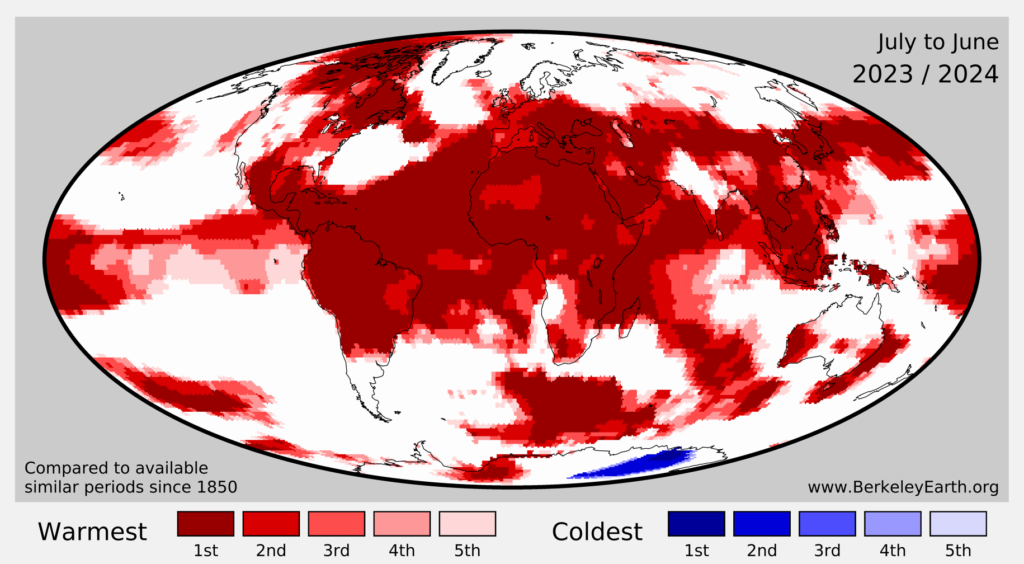
The figure below shows which portions of the Earth’s surface experienced record high temperatures (deep red shading) in June 2024. It is noteworthy that almost no location on the planet experienced record cold temperatures.
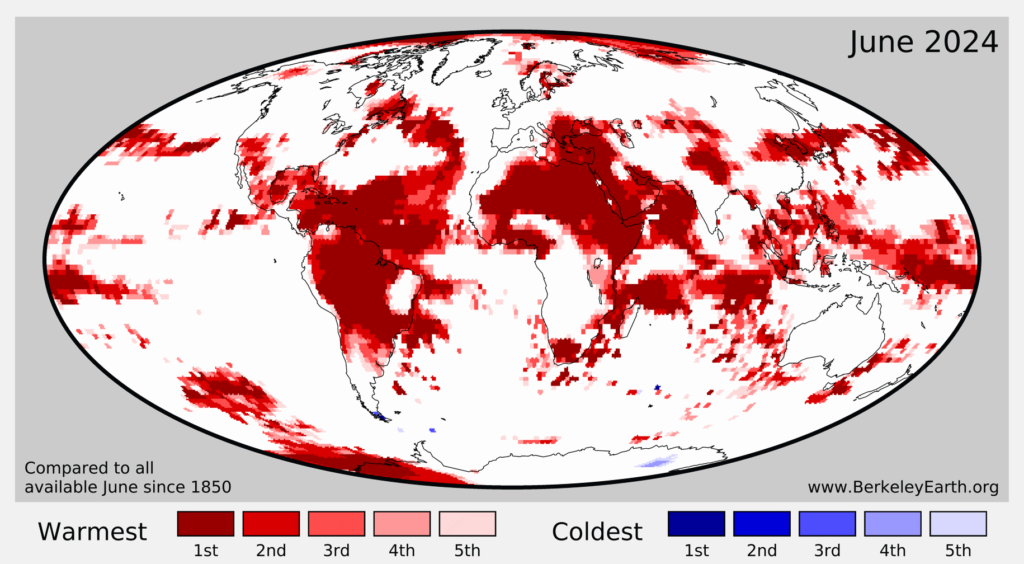
Zooming out to the past 12 months (July 2023 to June 2024), 138 countries saw all-time records broken. This includes much of Central and South America, Canada, Africa, Europe, China, the Middle East and south-east Asia. Only an anomalous patch of east Antarctica saw record cold temperatures.
With half the year of data now available, Carbon Brief has determined that there is now an approximately 95% chance that 2024 will beat 2023 and be the warmest year on record, based on Copernicus/ECMWF’s ERA5 dataset. (Berkeley Earth separately estimated a 92% chance in their June update.)
By looking at the relationship between the first six months and the annual temperatures for every year since 1970 – as well as El Niño-Southern Oscillation conditions for the first six months of the year and projections for the remaining nine months – Carbon Brief has created a projection of what the final global average temperature for 2024 will likely turn out to be.
The analysis includes the estimated uncertainty in 2024 outcomes, given that temperatures from only the first half of the year are available so far.
The chart below shows the expected range of 2024 temperatures using the Copernicus/ECMWF global atmospheric reanalysis product (ERA5) – including a best-estimate (red) and year-to-date value (yellow). Temperatures are shown with respect to the pre-industrial baseline period (1850-1900).
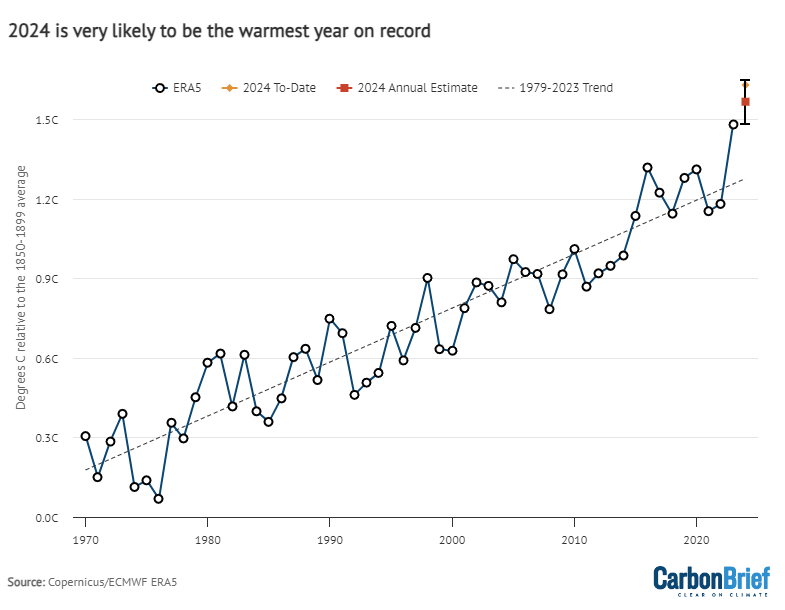
Carbon Brief’s projection suggests that 2024 is very likely to be the warmest year on record, with a central estimate of 1.57C.
This is true even if – as the projection implicitly assumes – the remaining months in 2024 are below the records set in 2023. Because the first six months of the year were so warm – around 1.63C above pre-industrial levels – the second half of the year would have to be relatively cool (below 1.3C) for the year as a whole to not exceed 2023.
It is worth repeating that an individual year hitting 1.5C above pre-industrial levels is not equivalent to the 1.5C limit within the Paris Agreement. This limit refers to long-term warming, rather than an individual year that includes the short-term influence of natural fluctuations in the climate, such as El Niño. Even including data through to the present day, long-term global temperatures (excluding year-to-year variability) are unlikely to exceed 1.5C until the late 2020s or early 2030s.
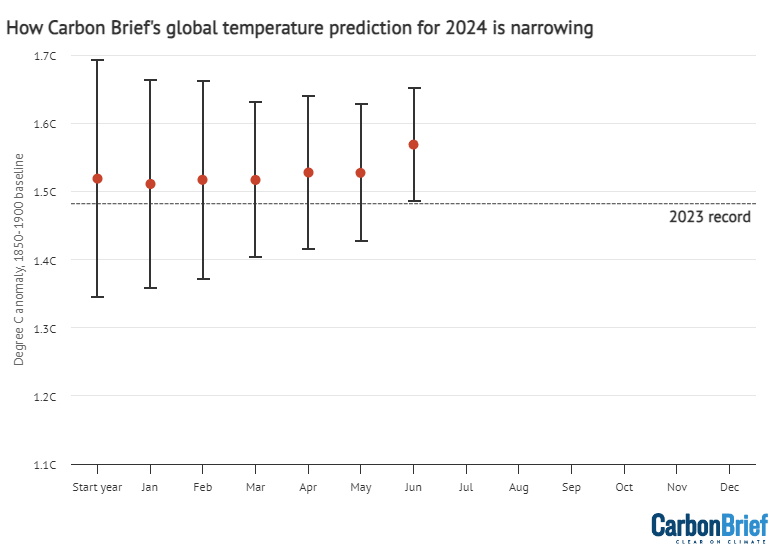
The figure below shows Carbon Brief’s estimate of 2024 temperatures using ERA5, both at the beginning of the year and once each month’s data has come in. The central estimate remained relatively unchanged until June, after which it increased a bit as the month turned out a bit warmer than the model anticipated. The uncertainty has diminished with each additional month of data, as there are fewer remaining months in 2024 to substantially change the results.
There is reason to expect that global temperature anomalies will modestly decline over the remainder of the year as El Niño fades away and moderate La Niña conditions potentially develop. The figure below shows a range of different forecast models for ENSO for the rest of this year, produced by different scientific groups. The values shown are sea surface temperature variations in the tropical Pacific – the El Niño 3.4 region – for overlapping three-month periods.
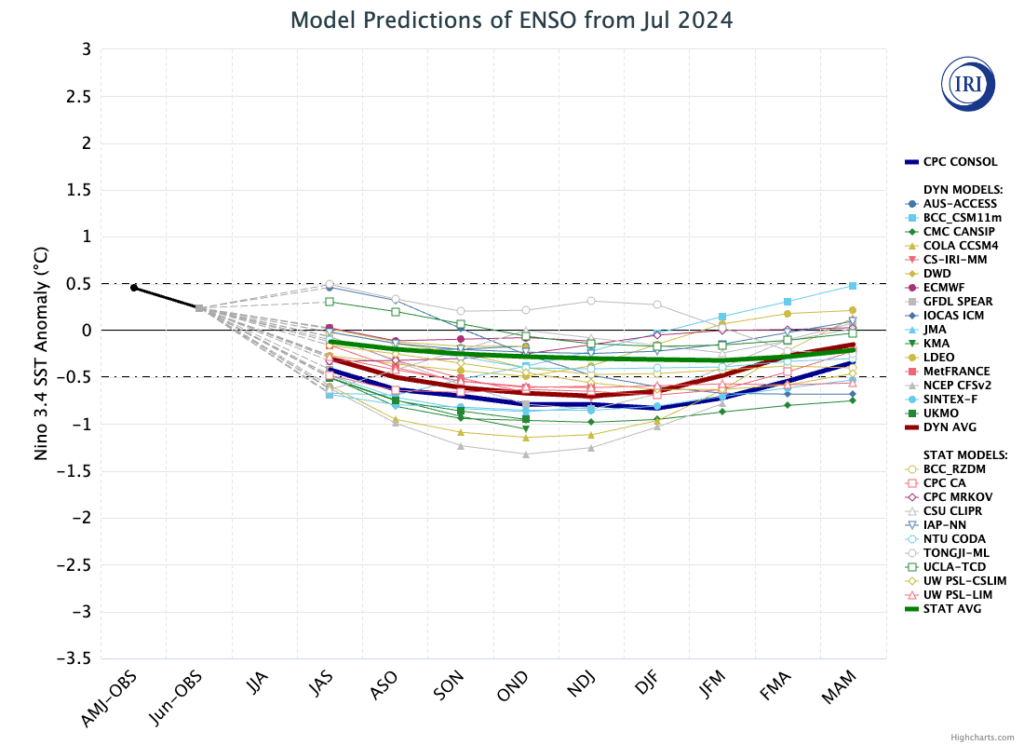
There is a mix of projections across models, with many of the dynamical models expecting very modest La Niña conditions (<-0.5C Niño 3.4 sea surface temperature – SST – anomaly) to develop by October, while most of the statistical models expect ENSO-neutral conditions to persist.
Global surface temperatures have set a 13-month streak of monthly records from June 2023 and June 2024. However, with more than two thirds of July temperature now available, it is looking increasingly likely that July 2024 will break that streak, coming in as the second warmest on record after July 2023.
The figure below shows daily temperature anomalies from the Copernicus/ECMWF ERA5 record for 2024 (purple line), 2023 (red line) and 1940-2022 (grey lines). It highlights that July 2024 has been at or below 2023 temperatures for all but the past few days.
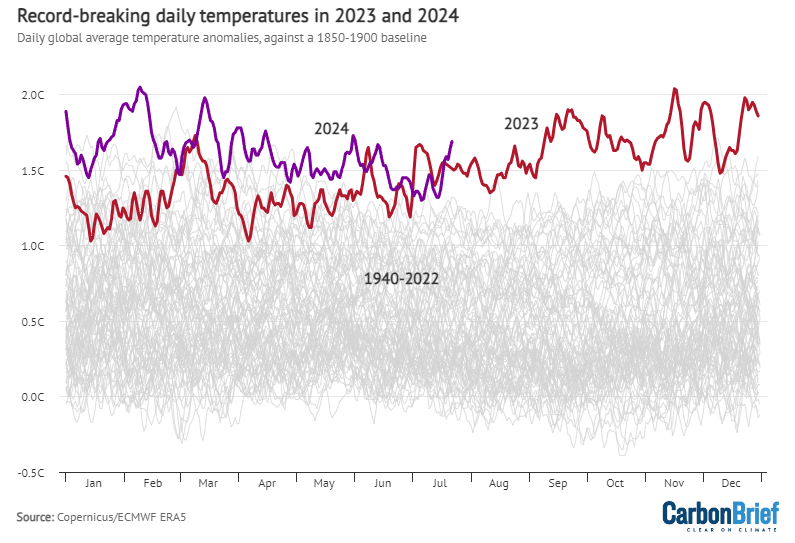
Current global temperature anomalies are back in record territory as of 22 July, at around 1.7C above pre-industrial levels.
This is still well below the anomalies of 2C or more briefly hit in late 2023 and early 2024. However, because the current temperature anomalies align with the warmest week of the year for global surface temperatures, they have resulted in a new record for absolute global temperatures. This is shown in the figure below, which features daily absolute global temperatures from the Copernicus/ECMWF ERA5.
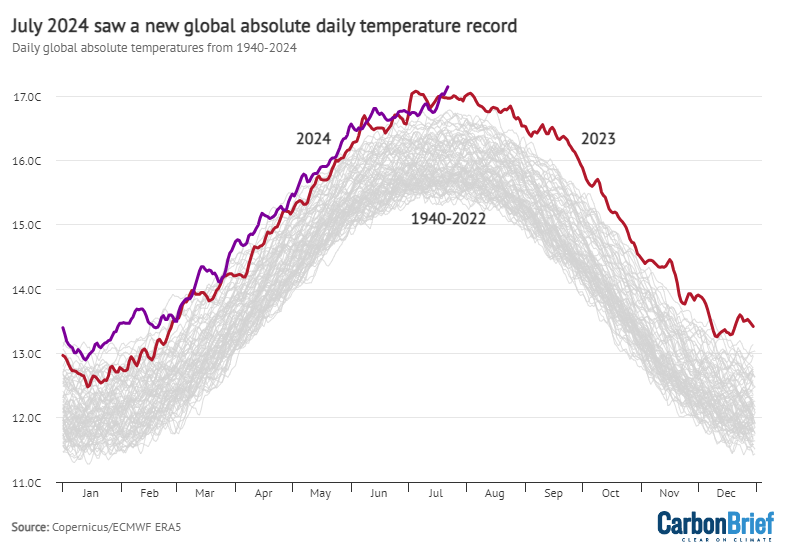
The prior daily absolute temperature record was 17.08C, set in early July 2023. This was exceeded both by 22 July (at 17.09C) and 22 July (at 17.15C).
While these daily absolute temperature records are not that climatically meaningful (and are only available in reanalysis data) – anomalies give a better sense of actual changes that are occurring – they nonetheless represent a symbolic milestone.
To determine where July 2024 temperatures will ultimately end up, Carbon Brief used a statistical model that extrapolates the final monthly temperatures based on the first 22 days of the month in all prior Julys since the ERA5 record began in 1940.
The figure below shows the expected range of July 2024 temperatures (black error bars) alongside a best-estimate (red diamond). Temperatures are shown with respect to the pre-industrial baseline period (1850-1900).
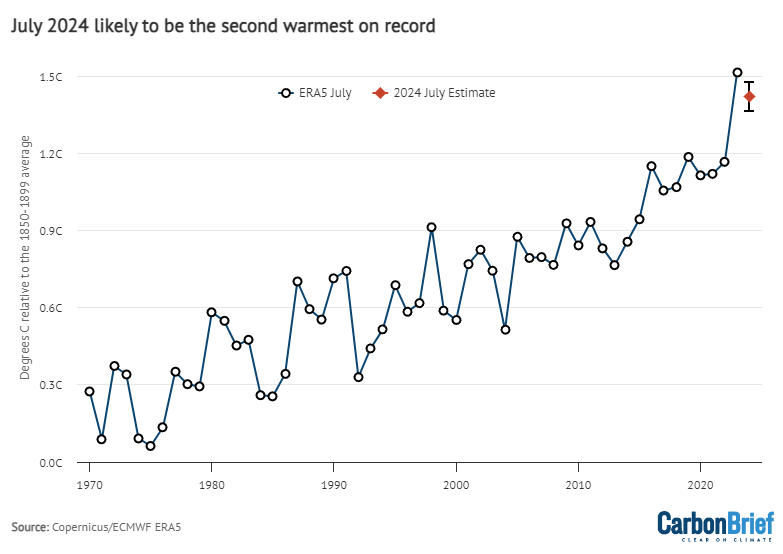
Here, Carbon Brief estimates that there is a very likely (>95%) chance that July 2024 comes in as the second-warmest July on record after 2023. However, it will still be quite warm, at more than 0.2C warmer than any July prior to 2023.
The extreme heat the world experienced in the latter half of 2023 makes setting new records over the remainder of the year less likely.
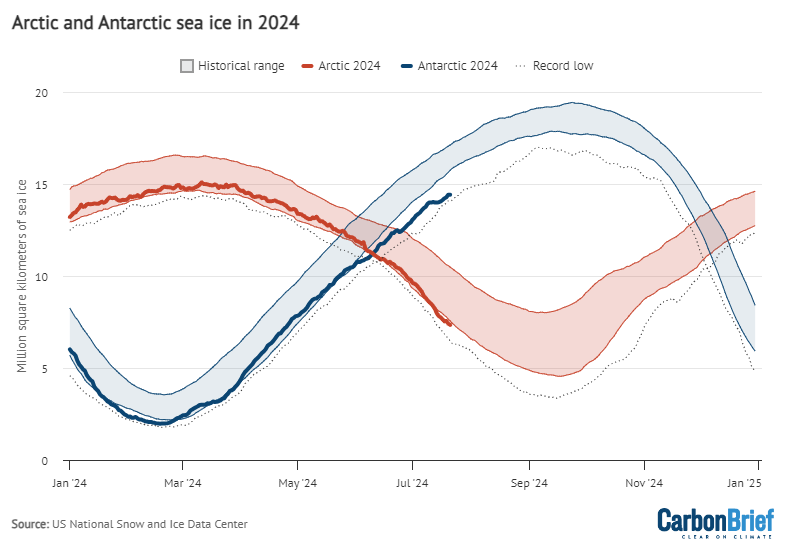
Antarctic sea ice extent spent much of early 2024 at the low end of the historical 1979-2010 range, though it has not quite exceeded record lows experienced in 2023.
However, in recent weeks Antarctic sea ice extent has rapidly dropped, and is now only modestly above 2023 levels.
Arctic sea ice extent has also spent most of this year at the low end of the historical range.
The figure below shows both Arctic and Antarctic sea ice extent in 2024 (solid red and blue lines), the historical range in the record between 1979 and 2010 (shaded areas) and the record lows (dotted black line). Unlike global temperature records (which only report monthly averages), sea ice data is collected and updated on a daily basis, allowing sea ice extent to be viewed up to the present.
SOLAR: Officials with an energy company discuss their plans to begin construction in 2026 on an 800 MW solar farm in Kentucky atop a massive former coal mine, saying the project will provide equitable access to renewables and training for “future-proof energy jobs” as the coal industry declines. (Yale Climate Connections)
GRID:
PIPELINES:
ELECTRIC VEHICLES: An Alabama community college receives a $2.4 million grant to expand a center to train workers how to install, test, operate and maintain electric vehicle chargers. (news release)
EMISSIONS:
HYDROPOWER: The Choctaw Nation of Oklahoma council approves a resolution opposing an Oklahoma energy company’s proposed hydropower project. (news release)
POLITICS: The Democratic governors of Kentucky and North Carolina — both of whom have benefitted from electric vehicle investment linked to federal climate legislation — are among the top contenders to run for vice president with likely presidential candidate Kamala Harris. (E&E News)
COMMENTARY:
PERMITTING: After two years of talks, Independent Sen. Joe Manchin and Republican Sen. John Barrasso agree on a permitting reform bill that would pave the way for increased renewable energy and fossil fuel development. (The Hill)
ALSO: Advocates criticize the energy permitting legislation, saying it is a “giveaway to the fossil fuel industry.” (Common Dreams)
POLITICS:
NUCLEAR: A startup looks to build a series of identical next-generation nuclear reactors throughout the country, targeting 6 GW of deployment by the mid-2030s. (Utility Dive)
SOLAR:
COURTS: Baltimore officials say they plan to appeal a circuit court judge’s decision to dismiss their climate deception lawsuit against more than two dozen fossil fuel companies. (Daily Record)
UTILITIES:
EFFICIENCY: Homebuilders claim a Kansas City ordinance requiring certain energy efficiency standards is slowing construction in an already tight housing market, but advocates say the numbers they’re using are misleading. (The Beacon)
A recently signed New Hampshire law makes significant changes to the operations of the state’s Renewable Energy Fund, directing money to help towns and cities develop municipal solar projects and ending a residential solar rebate program that was generally viewed as deeply flawed.
“The previously existing program had sort of run its course,” said Joshua Elliott, director of policy and programs in the state energy department.
The Renewable Energy Fund, created in 2007, is a pool of money the state uses to support renewable and thermal energy initiatives through grants and rebates. It is funded by annual compliance payments made by electric service providers that failed to buy the legally mandated proportion of their power from renewable sources in the previous year.
The sum the fund collects can vary widely from year to year, ranging from as low as $1.3 million in 2009 to $19.1 million in 2011. More recently, revenue has hovered around $7 million.
This money is then allocated across several programs including those supporting solar hot water heating, low-and-moderate income community solar, and wood pellet boilers and furnaces for residential, commercial, and industrial customers.
The new funding for municipal solar projects represents the next step for an approach just getting underway in the state.
Installing solar power can allow a municipality to both cut carbon emissions and realize significant savings on their energy bills. These savings can be used to cut property taxes or to provide additional support or services for residents. Until recently, however, there was little state or federal support for municipal solar. At the same time, getting a municipality to agree to the upfront costs has always been challenging.
“There’s a variety of competing factors for property tax revenue,” Elliott said. “It can be hard to get a warrant article passed to invest the money to purchase a solar array for town buildings.”
The state began tackling the problem this year with the Municipal Solar Grant Program, which is using a $1.6 million federal grant, part of the 2021 Bipartisan Infrastructure Law, to help cities and towns install solar arrays on municipal property. Lower-income communities that intend to retain complete ownership of their solar system will be eligible for grants up to $200,000; municipalities that don’t meet these criteria can request grants up to $120,000.
Though the program is just getting started — the application period is open until August 1 — the opportunity has already sparked wide interest from municipal governments. Community liaisons for the nonprofit Clean Energy New Hampshire have identified roughly 50 cities and towns likely to apply for a share of the limited funding.
“There’s been a huge response,” said Sam Evans-Brown, executive director of Clean Energy New Hampshire. “That shows this is a good space to be spending the money in.”
The new legislation calls for funding to be allocated to a new municipal solar program this year, with the sum likely to be announced in late August or early September. Then, before the money can be offered to cities and towns, the state will have to design a new system. The new incentive will be inspired and informed by the program now launching, Elliott said.
“We’re certainly going to take feedback, have stakeholder sessions,” he said. “And that will help refine what this program looks like.”
The bill also terminates the state’s rebate program for residential solar and wind installations, an incentive that was widely thought to be ineffective.
The program offered rebates of up to $1,000 to a limited number of households each year. In fiscal 2023, rebates totalling about $424,000 were issued.
The program used a lottery system to determine what order rebate applications would be processed in each year; applicants closer to the end of the list might not end up receiving any rebate if the funds ran out before they made it to the top of the list. That uncertainty meant the program was doing little to spur additional solar development, Evans-Brown said.
“It’s almost by definition not getting projects done: If you can’t know for sure if you’re getting rebate, it’s not factoring it into the purchasing decision,” he said. “When we asked residential solar installers if the rebate was helpful they said no.”
The program also accepted applications from any household with a solar array installed after 2012 that has not yet received a rebate, diminishing its impact on new solar development even further.
“You’re not actually helping to develop the solar market at that point,” Elliott said.
Though the recent law eliminates this rebate, lawmakers were clear during hearings on the bill that they want to see a replacement residential incentive developed. No plans are yet in the works for such a program, and it is unclear what the timeline would be for designing a new incentive from scratch, Elliott said. Furthermore, the law does not require a new program be enacted.
Elliott, however, has every intention of making sure a replacement program comes to be, he said.
“I made a commitment in public saying, ‘Yes, we are going to do this,’” he said, “and I certainly feel beholden to that.”
UTILITIES: A growing number of Georgia companies with climate goals are frustrated that less than half of Georgia Power’s electricity is carbon-free, and although the utility plans to build more solar, it’s still adding new gas turbines and delaying closure of its coal plants. (Grist/WABE)
ALSO:
ELECTRIC VEHICLES:
SOLAR:
CLIMATE:
COAL ASH: A town less than two miles from the University of North Carolina looks to redevelop 10 acres of land containing 46,000 tons of toxic coal ash, but lawyers and community members warn its cleanup plan still won’t adequately protect the public from health risks. (Inside Climate News)
GRID: Houston Mayor John Whitmire promises to hold CenterPoint Energy “accountable” for widespread outages during Hurricane Beryl, but the mayor and city have little power to regulate the utility. (Houston Chronicle)
OVERSIGHT: Environmental lawyers say the U.S. Supreme Court’s decision to overturn a policy giving federal agencies deference to interpret laws could affect Virginia’s regulation of vehicle emissions but probably not its enforcement of clean water rules. (Virginia Mercury)
POLITICS:
CLIMATE: The U.S. EPA awards Western states more than $1.27 billion for projects aimed at reducing greenhouse gas emissions from transportation, utilities, buildings and industry. (Associated Press, Colorado Newsline)
ALSO: A study finds the urban heat island effect increases Tucson, Arizona’s temperature by nearly eight degrees over that of the surrounding, undeveloped desert. (Arizona Daily Star)
UTILITIES: Hawaiian Electric and other defendants reportedly agree to pay $4 billion to settle lawsuits over last year’s deadly Maui wildfires, but disagreements over distribution of the funds is delaying a final deal. (Honolulu Star-Advertiser)
WIND:
SOLAR:
ELECTRIFICATION:
GEOTHERMAL: The U.S. Army looks to heat an Alaska base with geothermal energy. (Task & Purpose)
HYDROGEN: Navajo Nation advocates push back against a proposed 200-mile hydrogen pipeline that would cross tribal land, saying existing regulations are inadequate to ensure safety or mitigate impacts. (Arizona Republic)
OIL & GAS:
COAL:
GRID: Unusually severe winds topple utility poles in eastern Idaho, leaving nearly 8,000 customers without power. (East Idaho News)
UTILITIES: As Duke Energy prepares to face North Carolina regulators and defend its plan to invest in 9 GW of natural gas plants and delay meeting an emissions reduction mandate, it makes small concessions in a proposed settlement and wins support from the state’s ratepayer advocate. (Energy News Network)
ALSO:
COAL ASH: Environmental groups press the U.S. EPA to take control of Georgia’s coal ash program from state regulators because they’ve allowed utilities to keep unlined coal ash ponds where the waste is in contact with groundwater. (Atlanta Journal-Constitution, Georgia Recorder)
SOLAR: Texas saw a spike in the number of homes adding small-scale solar facilities even before Hurricane Beryl, which caused widespread outages that could encourage more state residents to add solar installations. (Inside Climate News)
GRID:
CLIMATE:
OVERSIGHT: Louisiana and Mississippi commissions sue federal regulators over an order that sets requirements for long-term electric grid planning, one of the first challenges to a federal agency since the U.S. Supreme Court opened up ambiguous agency decisions to legal challenges. (E&E News)
EMISSIONS: The U.S. EPA will evaluate air quality at two national parks in Texas as part of a settlement in a lawsuit by environmentalists. (Marfa Public Radio)
STORAGE: An energy company closes on financing for three standalone utility-scale battery energy storage projects in Texas that will be built near solar farms. (Utility Dive)
POLITICS: An official from Kentucky’s attorney general disputes the science behind climate change in testimony to state lawmakers, arguing against U.S. EPA rules that require coal- and new natural gas-burning power plants to capture 90% of carbon emissions. (Kentucky Lantern)
COMMENTARY: West Virginia should embrace wind, solar and electric vehicle industries to add clean energy-related jobs and attract new residents, writes a conservationist. (State Journal)
ENVIRONMENTAL JUSTICE: A natural gas-fired backup power plant for a New Jersey wastewater facility will move forward in a mostly BIPOC Newark community already burdened by pollution, but with strict controls on pollution and a requirement for a solar and storage system. (Associated Press)
ALSO: While a state official says the restrictions will “improve baseline conditions,” advocates remain skeptical and contrast the decision with the recent rejection of a NJ Transit gas plant opposed by primarily White residents. (NJ Spotlight)
WIND:
NUCLEAR: Massachusetts regulators deny a request from the company decommissioning the Pilgrim nuclear plant to dump treated wastewater into Cape Cod Bay. (WBUR)
NATURAL GAS: While acknowledging it’s likely a “freak incident,” officials in a Vermont town are rattled after a truck hauling natural gas catches fire, roughly a year after a similar incident in the same location. (WCAX)
BIOENERGY: As New York dairy farmers increasingly adopt biodigesters to turn farm waste into energy, environmental advocates warn the technology could have unintended consequences. (WSKG)
SOLAR:
BUILDINGS:
COMMENTARY:
POLITICS: Project 2025, the conservative blueprint for what supporters want to see from a Trump presidency, calls for dismantling U.S. EPA regulations, cutting program funding, and otherwise undoing much of the Biden administration’s climate and clean energy progress. (E&E News, Grist)
ALSO:
ENVIRONMENTAL JUSTICE:
GRID: Louisiana and Mississippi commissions sue federal regulators over an order that sets requirements for long-term electric grid planning, one of the first challenges since the U.S. Supreme Court opened up ambiguous agency decisions to lawsuits. (E&E News)
UTILITIES: As Duke Energy prepares to face North Carolina regulators and defend its plan to invest in 9 GW of natural gas plants and delay meeting an emissions reduction mandate, it makes small concessions in a proposed settlement and wins support from the state’s ratepayer advocate. (Energy News Network)
SOLAR:
TRANSITION: In 2023, more than 90% of pipeline and refinery companies said in an industry survey that they had clean energy transition goals; today, that number has fallen to around three quarters. (The Hill)
ELECTRIFICATION: Chicago Mayor Brandon Johnson’s proposal to ban gas hookups in new homes and buildings is dead after a majority of city council members rejected the idea amid stiff union opposition. (Sun-Times)
LITHIUM: Mining lithium needed for batteries and clean energy components can use and potentially contaminate significant water supplies, a newly published study finds. (Inside Climate News)


.svg)
