

 Back
Back
A pair of upcoming decisions by Ohio’s top court could further empower local opponents to block clean energy in what is already one of the hardest states to site new renewable projects.
Two cases before the Ohio Supreme Court ask whether local opposition is enough for the Ohio Power Siting Board to conclude a project is not in the public interest when it otherwise meets all statutory criteria.
The decisions are expected to guide future regulatory rulings, and clean energy industry and environmental advocates have voiced concerns about the potential impact on energy development.
Most power plants, solar farms and wind farms in Ohio need approval from the Ohio Power Siting Board before they can be built and operated.
State law provides eight criteria for approving new electric generation. They include its impacts on the environment, water conservation, and agricultural land, as well as whether a facility “will serve the interests of electric system economy and reliability” and “the public interest, convenience, and necessity.”
Solar developers are appealing two recent siting board decisions in which they say regulators took a narrower view of “public interest” than they and courts previously did, effectively changing the legal standard and giving outsized weight to local opposition instead of considering the question with a state-level perspective, they say.
One case deals with the Ohio Power Siting Board’s denial of a permit to construct and operate Lightsource bp’s Birch Solar project roughly 10 miles southwest of Lima. In the other case, the board denied a permit for Vesper Energy to build and operate the Kingwood Solar project in Greene County.
The developers in both cases made changes to address specific concerns raised by siting board staff or other parties to the cases. In both cases, the board basically ruled that the projects satisfied all criteria except the public interest standard.
Lawyers for the Ohio Power Siting Board argued its rulings are entitled to a presumption of correctness on review. The board also claimed it used a “broad lens” to weigh the pros and cons of each project and make its factual findings.
Several local government groups and a local opponents’ group raised similar arguments in support of upholding the siting board decisions.
“The court should decline Kingwood’s invitation to wade into its own weighing of the evidence in this complex fact-intensive decision,” said one such brief, filed in the Kingwood Solar case by lawyers for the trustees of Miami, Cedarville and Xenia townships along with Jack Van Kley, a lawyer who represented an opponents’ group. Considering local opposition is also properly part of balancing multiple factors to determine the public interest, they wrote.
Developers for each project maintained the power siting board erred as a matter of law when it let local opposition override other factors in its determination of the public interest.
In Birch Solar, the board concluded there was “universal opposition from local governments and residents,” and it then held that opposition by local government bodies was “a determining component” of whether the project met the public interest criterion, the developer’s reply brief noted. That approach also violated Ohio’s statutory law and constitution by improperly delegating the board’s legal authority to local governments, the company argued.
The board also erred by focusing only on the amount of opposition. Rather, the board should have looked at evidence relating to opponents’ objections and considered how permit conditions could address them, the company’s lawyers wrote.
“[T]he Board never even assessed whether there would be any potential negative impacts to the public before deciding that the Project was not in the ‘public interest,’” said a separate brief by the Natural Resources Defense Council and a local chapter of the International Brotherhood of Electrical Workers. What matters is the evidence of a project’s impacts, not the quantity of opinions, their brief said.
In a similar vein, the power siting board unlawfully found the opposition of three adjoining townships was “controlling” in the Kingwood Solar case, the developer’s brief said. In other words, the board treated the opposition as determinative of the outcome.
“Public opinion is not public interest,” said Lindsey Workman, community affairs manager for Vesper Energy, the developer for Kingwood Solar. Ohio’s statute does not say local opposition trumps all other interests, such as economic benefits or enhanced reliability for Ohio’s energy infrastructure, she said. “That’s not how the law is written, and that’s not how the law should go.”
A 2021 law known as Senate Bill 52 did give counties the power to ban most new solar and wind projects from various areas. Among other things, the law also gives counties a chance to review new solar and wind projects that aren’t otherwise banned before they get to the power siting board. Both solar projects in the current Supreme Court cases are exempt from those parts of the law, however.
While SB 52 gave local governments “a chance to participate” in the power siting board process, the legal criteria for approval stayed the same, said Chris Tavenor, an attorney for the Ohio Environmental Council, which filed a brief in the Birch Solar case. Yet by treating local opposition as determinative, the board was “creating essentially a political process for those projects to be approved or denied, as opposed to a legal analysis,” he said.
Other briefs in the Birch Solar case underscored that opposition wasn’t universal. One brief came from a group of local solar supporters. Another explained that leaders for Auglaize County and Logan Township took no position on the project after they reached agreement with the developer on some issues.
In addition to the possibility that Vesper and Lightsource bp’s projects will be canceled, advocates are worried about the impact on future cases.
The Natural Resources Defense Counsel wrote in its brief that “allowing the Board’s unprecedented and unreasonable decision on Birch Solar to stand will prevent the development of other well-planned renewable energy projects in Ohio.” That would reinforce continued use of fossil fuel generation, which releases greenhouse gases that drive human-caused climate change, as well as other pollution.
The natural gas industry also has a stake in the outcome, because the cases could open the door for local opposition to block power plants, pipelines and other infrastructure.
The Ohio Independent Power Producers’ brief in each case said the power siting board’s ruling “erodes a fair and predictable permitting process upon which new investment in power generating facilities in Ohio relies.” The Ohio Chamber of Commerce’s briefs also voiced a fear that the boards’ rulings inject “undue uncertainty into Ohio’s historically stable and predictable regulatory framework for building in-state power generation.”
The Ohio Supreme Court has yet to schedule oral argument in each case. It would likely take several months after that for that court to issue its decisions.
OIL & GAS: The U.S. oil industry is booming, benefitting from cost-cutting and automation to produce record levels of crude from west Texas shale, generate more cash for shareholders, and disconcert clean energy advocates. (New York Times)
ALSO:
GRID:
SOLAR:
NUCLEAR: Georgia Power says one of its new units at nuclear Plant Vogtle has been down for a week after a valve malfunctioned. (Atlanta Journal-Constitution)
CLIMATE:
COMMENTARY:
CLEAN ENERGY: Michigan has added nearly 21,500 clean energy jobs over the past two years, serving as a national leader in clean energy development after adopting several supportive policies, according to a new report. (Michigan Advance)
ALSO: A Republican state senator in Iowa resigns from his elected position to become a policy adviser at a Minnesota-based clean energy advocacy group. (Globe Gazette)
GRID: Illinois Gov. JB Pritzker is among state leaders in PJM’s territory calling on the grid operator to speed up transmission expansion and comply with new federal regulatory orders. (Inside Climate News)
ENVIRONMENTAL JUSTICE: Minnesota regulators work to establish rules and guidelines for a state law that goes into effect in 2026 and attempts to curb pollution in urban environmental justice areas. (Sahan Journal)
EMISSIONS: A small northeastern Wisconsin utility plans to reverse its rising emissions by converting boilers at a coal plant to run on renewable fuel pellets made from industrial paper and plastic waste. (WPR)
PIPELINES:
CLIMATE: Unlike heating mandates, very few regulations exist that require landlords to provide air conditioning to renters, an increasingly dangerous public health problem as heat waves become more frequent and longer. (Vox)
EFFICIENCY:
POLITICS: U.S. Sen. JD Vance, who has been named Donald Trump’s vice presidential running mate, has grown increasingly critical of renewable energy and climate change as his home state of Ohio grows its solar industry. (Bloomberg, subscription)
SOLAR: The U.S. solar industry’s leading trade group issues standards for companies to follow to ensure ethical sales practices as state attorneys general claim companies use deceptive sales tactics to draw business. (E&E News, subscription)
GRID: A new academic paper warns the U.S. won’t be able to decarbonize the grid by 2050 if federal regulators don’t adopt significant grid reforms and implement a national transmission strategy. (Utility Dive)
ALSO:
POLITICS: Donald Trump’s vice presidential pick, Ohio Sen. J.D. Vance, acknowledged climate change and the need for a clean energy transition as recently as 2020, but has since become publicly skeptical of renewables and turned to boosting fossil fuels. (New York Times, E&E News)
ELECTRIC VEHICLES: Electric vehicle sales grew 11% in the second quarter compared to a year earlier, exceeding expectations and suggesting predictions of an industry decline were premature. (Forbes)
OIL & GAS: The U.S. oil industry is booming, benefitting from cost-cutting and automation to produce record levels of crude from west Texas shale, generate more cash for shareholders, and disconcert clean energy advocates. (New York Times)
HYDROGEN:
CLEAN ENERGY: Michigan has added nearly 21,500 clean energy jobs over the past two years, serving as a national leader in clean energy development after adopting several supportive policies, according to a new report. (Michigan Advance)
SOLAR: The U.S. solar industry’s leading trade group issues standards for companies to follow to ensure ethical sales practices as state attorneys general claim companies use deceptive sales tactics to draw business. (E&E News, subscription)
CLIMATE: Unlike heating mandates, very few regulations exist that require landlords to provide air conditioning to renters, an increasingly dangerous public health problem as heat waves become more frequent and longer. (Vox)
COMMENTARY: A journalist and an advocate argue that only phasing out fossil fuels will slash Permian Basin methane emissions, and that new pollution-detecting satellites and inadequate regulations will fall short. (Scientific American)
HYDROGEN: A California transit agency launches the world’s first commercial all-hydrogen fuel cell ferry in the San Francisco Bay. (Canary Media)
CLEAN ENERGY: Rural Nevada counties call on state lawmakers to craft policies requiring federal agencies to coordinate clean energy development planning and decision-making with local governments, saying they are overwhelmed by the flood of new projects. (Nevada Current)
CLIMATE: Portland, Oregon’s city government diverts $7.6 million from its climate action fund to the general budget, marking the first time the money will be used outside its intended purpose. (OPB)
STORAGE:
OIL & GAS:
UTILITIES: Idaho Power offers rebates to commercial and industrial customers for voluntarily reducing power use to ease grid strain during extreme high temperatures. (Boise State Public Radio)
ELECTRIC VEHICLES:
HYDROPOWER: Tribal nations and advocates call on a federal agency to cease hydropower production at eight dams in Oregon, saying they harm fish and are no longer financially viable. (KATU)
EMISSIONS: Washington state implements rules aimed at reducing landfill methane emissions by tightening monitoring requirements and lowering gas collection thresholds. (Seattle Times)
GRID: A fast-moving brush fire damages utility lines in Kauai, Hawaii, forcing evacuations and leaving more than 1,000 households without power. (Honolulu Star-Advertiser)
COMMENTARY:
WIND: Coastal Maine residents concerned about both climate change and ecological preservation are conflicted over the planned location of a facility that advocates say will help launch Maine’s offshore wind industry. (Energy News Network/Grist/Maine Monitor)
COAL: With New England’s last coal plants slated for closure by 2028, the region has “few easy replacements” for the 3 GW of lost baseload power. (E&E News)
GRID:
BIOENERGY: The owner of a Brunswick, Maine, waste-to-energy facility wants to expand the site to increase production, a plan that would help reduce pressure on landfills and increase energy production. (Bangor Daily News)
SOLAR:
CARBON CAPTURE: A bill passed by Pennsylvania lawmakers tells state environmental regulators to draft regulations for underground carbon storage wells, despite concern that there are cheaper and more proven methods of fighting climate change. (Associated Press)
TRANSIT: Construction begins in Maryland’s Montgomery County on what is touted as the country’s largest renewable energy-powered transit depot microgrid, which includes hydrogen energy generation and electric bus charging. (news release)
CLIMATE:
UTILITIES: Rising gas prices, grid infrastructure investments and utility business models that incentivize capital spending are the primary contributors to rising electricity costs, according to a recent report dispelling claims that clean energy is the culprit. (Canary Media)
BATTERIES: A peer-reviewed study finds lithium ion batteries are full of toxic forever chemicals that have contaminated the areas surrounding manufacturing and disposal sites, spurring the need to find alternative energy storage solutions and ramp up recycling efforts. (The Guardian)
GRID:
WIND: Coastal Maine residents concerned about both climate change and ecological preservation are conflicted over the planned location of a facility that advocates say will help launch Maine’s offshore wind industry. (Energy News Network/Grist/Maine Monitor)
ELECTRIC VEHICLES: Some rental car companies are selling off electric vehicle inventories and reducing new orders amid a lack of charging infrastructure, renters’ unfamiliarity with driving EVs, and limited repair options. (New York Times)
COAL:
OIL & GAS: The Biden administration seeks public input on its proposal to expand an area of the National Petroleum Reserve-Alaska with special drilling restrictions. (Alaska Public Media)
NUCLEAR: California startup Oklo looks to build its first small modular nuclear reactor at the Idaho National Laboratory by 2027. (Reuters)
This story was co-published by Energy News Network, the Maine Monitor, and Grist.
Ron Huber rifled through a thick folder full of decades of state environmental records outside a community hall in the tiny coastal Maine town of Searsport. For the longtime local conservation activist, the scene inside was a familiar one: dozens of neighbors, workers and environmentalists mingled over pizza and coffee, discussing the merits of a proposed industrial project that has potential to transform the local economy, but at the expense of a locally beloved natural area.
“We’ve seen these things rise and fall many times,” Huber said outside the event late this past spring. Conservationists have celebrated over the decades as plans for a coal plant and a liquefied natural gas terminal on Sears Island came and went without success.
This latest proposal presents a new kind of conflict. Rather than pitting townspeople against a corporate polluter, this development would support clean energy and be integral to the state’s plan for cutting climate emissions.
In May, the state applied for a $456 million federal grant to build a specially designed port on about 100 acres of Sears Island to support Maine’s nascent floating offshore wind industry. About two-thirds of the 941 acre island is in permanent conservation, and the state retains an easement on the rest, which has been reserved for a potential port for years.
“We’re not optimistic that this one’s going to die under its own weight,” Huber said, noting that the offshore wind port has far more popular support than previous development proposals.
Visits to recent community events like this one show that, unlike the polarized fights over clean energy projects in other parts of the country, Maine’s wind port is creating more personal divides — challenging residents’ values around climate change, conservation and economic factors. It previews what could be coming as wind grows in the Northeast.
“My question is really about why we’re not actually all on the same team,” said Belfast, Maine, resident Julianne Dow inside the community hall, during a question-and-answer period with New England labor organizers. “I’m very pro-union, I’m pro-offshore wind and pro having it here, and for the economic benefits for the region. But I’m also very pro maintaining Sears Island as a precious Midcoast resource.”
Dow and activists like Huber want the port built instead at a Sprague Energy-owned oil and logistics terminal across the water known as Mack Point. It was considered as an alternative in lengthy public processes in recent years, and Sprague and opponents of the Sears Island proposal have continued to urge reconsideration for it so far this summer.
Offshore wind has taken some big steps forward in Maine this year. Federal regulators approved a state research array of floating turbines, which generate power in deep waters far offshore, and are nearing leasing for commercial projects. A new state law calls for Maine to procure three gigawatts of offshore wind by 2040, using union-standard labor to build the projects and a floating wind-focused port.
Formal environmental assessments and site analyses are still pending. But state port authority director Matthew Burns wrote in June that Mack Point’s “physical and logistical constraints, need for significant dredging, and increased costs to taxpayers for land leasing and port construction would result in an expensive and inferior port for Maine compared to a versatile, purpose-built port on Sears Island.”
Still, opponents worry that wetlands and forests on Sears Island could be disrupted by port construction, even if most of the surrounding ecosystem remains intact.
“Because we have to sacrifice something, let’s sacrifice something irreplaceable, instead of cleaning up a dirty old existing port?” Huber said outside the event. “That’s just ridiculous.”
Asked if he saw wind as a climate solution more broadly, Huber began to express doubts about how turbine arrays would affect the ocean ecosystem. Fellow opponent Lou MacGregor of Belfast cut in.
“Right now, what we’re focusing on is protecting Sears Island,” MacGregor said. “We can get to whether we support offshore wind or not after we protect Sears Island.”
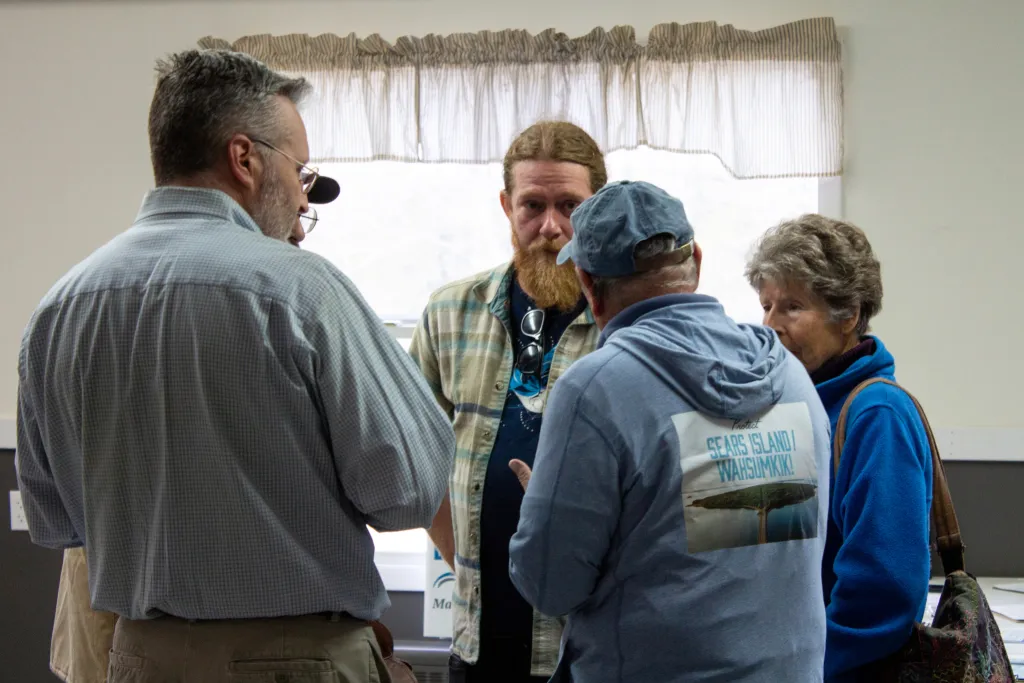
Scott Cuddy, who until recently was policy director of the Maine Labor Climate Council, emphasized at the recent event that his group is agnostic about the port’s location, focusing instead on the benefits it could bring. Under Maine’s wind procurement law, he said, the port’s labor standards will be the same wherever it ends up.
“We desperately want to see this happen, because we need to fight climate change, and we need to do it with good jobs,” Cuddy said.
Cuddy and other labor organizers said state studies indicate that the port project and new wind farms could bring thousands of jobs to coastal Maine towns like Searsport. Local leaders said it could be a boost for shrinking school populations, attracting families to stay in the town long-term.
“I think there’s been a mindset for a long time among kids, especially in rural Maine, like this was the thing I always heard — ‘You got to leave the state if you want to get a good job,'” said Sam Boss, the director of apprenticeships, workforce and equity for the Maine AFL-CIO. “We’ve got to find ways to keep our people here. And if there’s good opportunities, people will stay for them.”
Boss, Cuddy and others answered locals’ questions about plans for training programs for young people to enter the trades, and the family-sustaining wages and benefits promised by the growing wind industry — both in short-term construction positions and into the future.
“These are the skills that pay the bills, and they’re skills that don’t go away. The work might change — you know, we went from nuclear power plants, to now we’re doing offshore wind power development. But the skills are transferable,” said Nicki Kent, a union electrician who came to talk about her experience working on offshore wind in Rhode Island. “We’ve just got to get screwdrivers and wrenches into kids’ hands.”
Belfast resident Daniel Cowan was taking diligent notes on the back of an envelope while his teenage sons listened from the audience. A Navy veteran now pursuing a degree through the GI Bill, Cowan said he was curious about the possibility of wind industry jobs that could help him and his kids stay in Maine.
Cowan empathized with attendees who were opposed to building the port on Sears Island, but said he thought the project’s benefits sounded like they would outweigh the costs.
“You’re going to destroy something no matter what you do. I love Sears Island, I think it’s great, I love walking my dogs out there. But I don’t think that’s going to change,” he said. “The world is coming to an end one way or another, and how fast we get there makes a difference.”
The island itself is connected to the mainland by a long causeway, bisected at its start by rail lines that snake around the coastline toward nearby Mack Point. The causeway juts out into Penobscot Bay, and Sears Island opens up at its end, an oval of land covered in trees and flanked by sandy, seaweedy shores.
On a Saturday morning not long before the Searsport labor dinner, a large group of birders gathered at the gate where the causeway’s pavement continues into the forest. They had come to scout for the tiny, colorful songbirds that rest on the island each year amid long migrations between Canada and the tropics.
Near the edge of the woods, someone had spray-painted the asphalt road with “Wassumkeag,” the indigenous Wabanaki name for the island. Hand-lettered signs with the web address for the advocacy group Alliance for Sears Island read, “Wind power = Good? On Sears Island = Bad!”
The state does not plan to site wind turbines on Sears Island itself. Workers at the proposed port would help build and assemble towers and blades in pieces, towing them far out to sea for final assembly.
Still, anti-wind groups have seized on the proposed project. Lobstermen affiliated with the New England Fishermen’s Stewardship Association (NEFSA), a Maine-based advocacy group founded in 2023 that focuses partly on opposing offshore wind, spoke out against the port at the recent jobs event.
“My concern is only that in trying to affect climate change, that we’re going to cause more damage to the environment than climate change is already causing,” said NEFSA officer Dustin Delano, a commercial fisherman from Friendship, Maine.
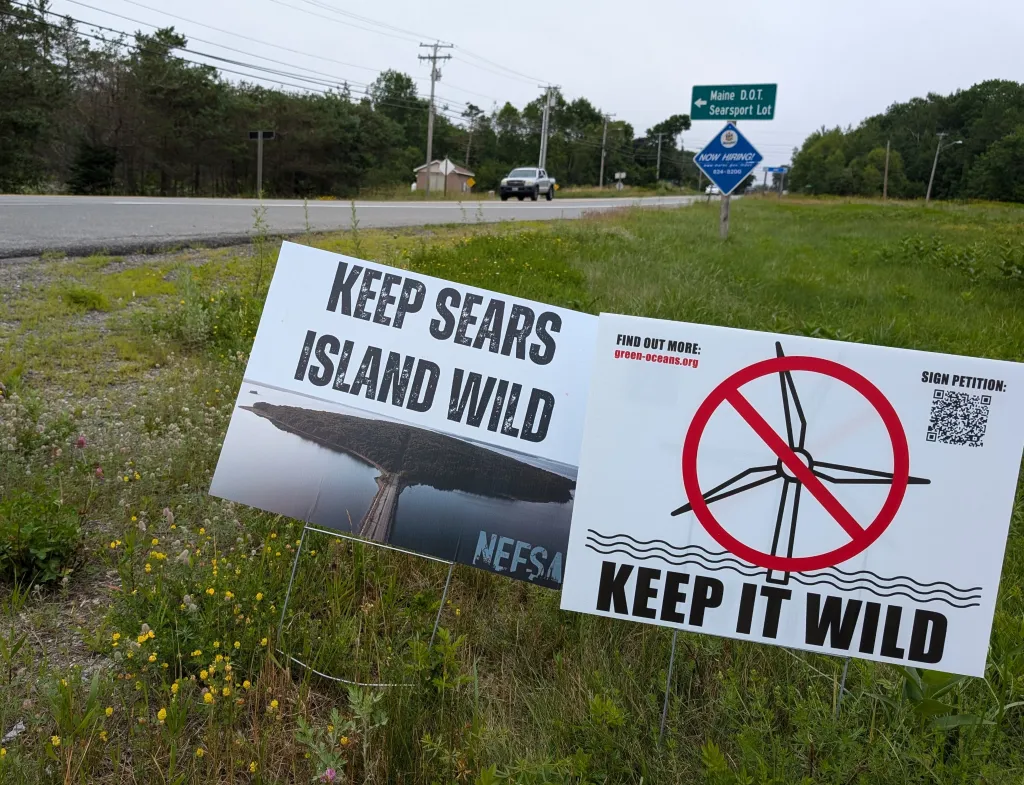
NEFSA has since posted signs where the island causeway intersects with the heavily trafficked Route 1 that read “Keep Sears Island wild.” Similar signs showing a crossed-out wind turbine bore the name of Rhode Island-based Green Oceans. Since its founding in 2022, it has focused mostly on opposing Revolution Wind, currently under construction in waters between Rhode Island and Connecticut.
Many who joined the recent birding trip seemed unaware that Maine’s plans for Sears Island did not involve actually erecting turbines there or close to shore. Others expressed doubts about wind generally. Some did not want to discuss the issue at all, focusing instead on peering through binoculars at the Northern parula, black-throated green warbler or hermit thrush chirping in the trees along the road.
A few people mentioned concerns that wind projects could harm whales. Scientists have found no evidence to support this claim, which has been linked to fossil fuel-funded disinformation campaigns. Green Oceans’ campaigns in Rhode Island have mimicked the delay and disinformation strategies of climate denialist groups like the Texas Public Policy Foundation, according to Brown University research.

The threat of climate change to ecosystems like Sears Island’s, meanwhile, is very real. The Gulf of Maine is one of the fastest-warming water bodies in the world, swelling sea levels, threatening the lobster fishery and leading to more frequent, destructive storms. Maine saw a state-record four federal disaster declarations in 2023 and has received two more already this year.
The warming trend may affect the migratory birds that draw crowds to Sears Island each year. Warming temperatures are reshaping the length and timing of Maine’s seasons, which, combined with declines in insect populations driven by agriculture and other factors, could threaten the birds’ success, studies show.
“If you look at decades and decades of patterns, you’ll see that birds are arriving one to two weeks earlier,” said William Broussard, a Midcoast Audubon board member who led the recent Sears Island trip. “If they get here early, they might not have the insects that they depend on to be out, because maybe the trees aren’t leafing out… and that can be really tough.”
Midcoast Audubon hasn’t taken a position on the wind port issue. It’s a chapter of Maine Audubon, which separately supports the project but is not advocating for one site over the other. Maine Audubon is likewise independent from the National Audubon Society, which advocates for “responsibly sited renewable energy,” including wind, as a climate solution.
Marge Stickler, a birder from Belfast, said she wished the port would be built at Mack Point instead. “I have mixed feelings about what they’re doing here,” she said. “I love coming here… it’s a special place.”
She had read an opinion piece earlier this year by activist Bill McKibben, founder of the climate groups 350 and Third Act, that urged Mainers to support the wind port even on Sears Island. McKibben wrote for Mother Jones last year that solving climate change will require a new “yes in my backyard” mindset.
“McKibben wrote that you have to look at the climate as a whole, and this may be a good thing to have here,” Stickler said. “I’m not sure — why did he write that for Maine, he lives in Vermont, but… he said it’s better to have it and it’s better to have it here, maybe.”
Dave Andrews, a retired engineer from South Bristol, Maine, struck a different tone as he trailed after the other birders. He’d worked on Superfund cleanups and brownfield solar projects in his career, and said he’d often heard “not in my backyard” sentiments from neighbors who were worried about viewshed impacts or a change in a place’s character.
“If it’s a Walmart shopping center, I guess you have a valid statement,” he said. “But when it comes to something like this, this is a different balance.”
Andrews called the port’s siting a “terrible dilemma.” But he felt swayed by the urgency of climate change and the fact that the project would leave much of Sears Island intact. As permitting and siting progress in the coming months, he said he hoped others who love the island would be able to accept the sacrifice.
“I don’t think there is a choice,” he said.
This story has been updated to clarify Maine Audubon’s position on the project and to correct Scott Cuddy’s title.
COURTS: A Baltimore City Circuit Court judge throws out the city’s climate accountability lawsuit against several major oil companies, saying the case sought to go “beyond the limits of Maryland state law.” (Reuters; E&E News, subscription)
BATTERIES:
PIPELINES: A federal court of appeals says Pennsylvania’s Environmental Hearing Board has the authority to review permits to expand a gas pipeline network in that state and New Jersey. (E&E News, subscription)
HYDROPOWER: Rumford, Maine, says it’s “largely supportive” of the license renewal process for the hydroelectric dam operated by Brookfield Renewable Partners on the Androscoggin River. (Sun Journal)
GRID:
SOLAR:
UTILITIES:
WIND: Vineyard Wind says it will hire a carbon-free cement startup in Holyoke, Massachusetts, to provide 2,000 tons of the substance for the Vineyard Wind 2 offshore wind project. (Mass Live)
CLIMATE:
COMMENTARY: A climate advocate and a Harvard Medical School professor write that Massachusetts’ legislature should use building codes to phase out the state’s gas system, citing the “deadly explosions and climate-harming leaks” that threaten residents’ health and community wellness. (Energy News Network)
CLEAN ENERGY: Wisconsin has experienced a “monumental jump” in clean energy development under Gov. Tony Evers as Democrats have focused on its economic benefits rather than climate change. (Inside Climate News)
EMISSIONS: Federal regulators announce a record settlement with Marathon Oil, which will pay $241.5 million in penalties for various Clean Air Act violations in North Dakota. (Inforum)
NUCLEAR: Federal regulators begin the environmental review process as part of a company’s request to reopen a shuttered nuclear plant in southwestern Michigan. (Detroit News)
PIPELINES:
ELECTRIC VEHICLES:
SOLAR:
TRANSPORTATION: An Illinois county transit agency receives a $17.8 million federal grant to replace diesel buses with hybrid and compressed natural gas models. (Journal-Register)
CLIMATE: The Iowa Board of Regents approves a new climate change major at Iowa State University after a discussion about how the syllabus would not stifle students’ “free speech.” (Globe Gazette)
COMMENTARY:


.svg)
