

 Back
Back
Snaking under city streets, behind residential drywall and into furnaces, ovens and other appliances, natural gas pipelines are a ubiquitous presence in U.S. buildings. The question of what to do with them as the planet warms has become a serious debate — dozens of U.S. cities and states have crafted plans to reduce reliance on natural gas, and more than 20 other states have passed laws to preempt that type of regulation.
Now, utilities around the nation have begun testing a controversial idea aimed at reducing the carbon footprint of gas lines, while keeping them in place. Nearly 20 utilities have laid out plans to inject lines with a blend of gas and hydrogen, the latter of which emits no carbon dioxide (CO2) — a major greenhouse gas — when combusted. Testing such blends, these companies say, is an essential step towards understanding the practice, which they argue will help reduce emissions and fight climate change.
Deploying more hydrogen is also a federal priority — the Inflation Reduction Act created a tax credit for hydrogen production, and the Bipartisan Infrastructure Law set aside $9.5 billion to support hydrogen development.
But a federal hydrogen strategy released last year suggests blending hydrogen into gas infrastructure should focus on industrial applications. Many environmental and customer advocates agree; they argue that the use of hydrogen blends in buildings — rather than to power industries that are hard to electrify — makes little sense.
“Every dollar you’re reinvesting into the gas system could be a dollar you’re using to electrify the system,” said Nat Skinner, program manager of the safety branch of the California Public Advocates Office, an independent state office that advocates for consumers in utility regulation. “Finding the right uses for hydrogen is appropriate. But I think being really careful and thoughtful about how we’re doing that is equally important.”
Nearly 30 projects focused on blending hydrogen into gas lines that serve homes and businesses have been proposed or are in operation in more than a dozen states, Floodlight found, and many more utilities have hinted at future proposals. If all are approved, the projects as proposed would cost at least $280 million — and many utilities are asking that customers pay for them.
As regulators consider the proposals, advocates are calling for them to weigh the prudence of the investment. In California — where electric rates have climbed steeply in recent years — the Sierra Club has argued that the projects are “an inappropriate use of ratepayer funds” and “wasteful experiments.”
Hydrogen blending can be undertaken in a section of pipeline isolated from the rest of the gas network or in a larger “open” system that serves homes. Utilities can inject it in large transmission lines, which ferry gas from processing and storage locations to compressor stations, or into distribution lines, the smaller pipes that bring gas to buildings.
Because hydrogen releases only water vapor and heat when it’s burned, it’s considered a clean fuel. And unlike traditional wind and solar energy, it can produce enough heat to run industrial furnaces. Utilities have framed the fuel as a clear way to slash the emissions associated with their operations.
“These demonstration projects are an important step for us to adopt hydrogen blending statewide, which has the potential to be an effective way to replace fossil fuels,” said Neil Navin, the chief clean fuels officer at Southern California Gas (SoCalGas), in a March statement on its application for hydrogen blending pilots.
Burning hydrogen, particularly in homes, also presents certain risks. Hydrogen burns hotter than natural gas, which can increase emissions of nitrous oxide (NOx), a harmful air pollutant that can react with other elements in the air to produce damaging pollutants including small particulates and ozone.
Hydrogen is a smaller molecule than methane, the main ingredient in natural gas, and can leak more readily out of pipelines. Hydrogen is also flammable. And when certain metals absorb hydrogen atoms, they can become brittle over time, creating risks of pipeline cracks, depending on the materials the pipelines are made of.
There are also outstanding questions about how much hydrogen blending actually reduces greenhouse gas emissions.
Of the utilities that have offered details about the hydrogen source they plan to use for their pilot, roughly half plan to use “green hydrogen,” which is produced using clean electricity generated by renewable sources such as wind and solar. Today, fossil fuels power more than 90% of global hydrogen production, producing “gray hydrogen.”
Most utility blending pilots are targeting blends of up to 20% hydrogen. At those levels, research has shown that hydrogen would reduce carbon dioxide emissions by less than 10%, even when using hydrogen produced with clean manufacturing processes.
Some utilities have estimated the emissions impacts of their pilots. A CenterPoint Energy pilot in Minneapolis using blends of up to 5% green hydrogen was estimated to reduce carbon emissions by 1,200 metric tons per year, which is the approximate energy use of 156 homes. A project in New Jersey testing blends of 1% green hydrogen was estimated to reduce emissions enough to offset the energy use of roughly 24 homes.
Blending gray hydrogen may show no carbon benefit at all, according to some research. That’s in part because hydrogen produces one-third less energy by volume than natural gas, meaning three times the amount of hydrogen is needed to make up for the same unit of natural gas.
And hydrogen requires more energy to manufacture than it will later produce when it’s burned. For these reasons, some environmental groups say hydrogen is an inefficient way to decarbonize homes and businesses; some analysts have called the process “a crime against thermodynamics.”
“There are much better, readily available, more affordable ways to decarbonize buildings in the form of electrification and energy efficiency,” said Jim Dennison, a staff attorney at the Sierra Club.
Advocates including Dennison also worry that investing more in the natural gas system will delay electrification and allow utilities to keep their core pipeline businesses running. “I can see why that’s attractive to those utilities,” he said. “That doesn’t mean it makes sense for customers or the climate.”
While the climate benefits are debated, some research and active projects indicate that burning blended fuel at certain levels can be safe. For decades, Hawaii Gas has used synthetic natural gas that contains 10-12% hydrogen. Countries including Chile, Australia, Portugal and Canada have also run hydrogen blending pilots.
And although pipelines can weather when carrying hydrogen, that’s less likely for distribution lines that reach homes because those pipes are often plastic, said Bri-Mathias Hodge, an associate professor in energy engineering at the University of Colorado-Boulder.
Hodge helped author a 2022 review of technical and regulatory limits on hydrogen and gas blending. With blends below 5%, Hodge said customers are unlikely to face risks or notice a difference in how their appliances or furnaces function.
More uncertainty exists around higher blends. “I think we’re not sure if below 20% or say, from 5 to 20% is safe,” said Ali Mosleh, an engineer at the University of California-Los Angeles who is spearheading hydrogen blend pilot testing with 44 partners, including utilities, to address knowledge gaps in the state.
Although Hodge at UC-Boulder thinks electrification is the more efficient choice for homes, he said the pilots can help utilities get comfortable with blending, which may eventually be applied elsewhere. “It’s not going to really move the needle in terms of decarbonization long term, but it’s a step in the right direction,” he said.
Steven Schueneman, the hydrogen development manager at utility Puget Sound Energy, which serves about 1.2 million electric and 900,000 gas customers in Washington, said incremental approaches like utility blending pilots will signal that hydrogen is a “real industry.” That could help the fuel gain a foothold in other areas, like industrial heat and aviation.
But Schueneman also acknowledges there remains uncertainty around whether hydrogen is the most cost-effective way to decarbonize buildings.
“It’s not clear that blending hydrogen is going to be a prudent decision at the end of the day,” he said.
Puget Sound Energy has conducted two small-scale blending pilots at a test facility. In the future, the utility plans to focus its hydrogen efforts on how blends may function in power plants, rather than in buildings. The nearly 30 blending pilots Floodlight tracked include only projects focused on use in buildings, but other utilities have proposed blending hydrogen at natural gas power plants, where the blend will be burned for electricity.
Blending pilots focused on buildings have been spearheaded by some of the largest utilities in the nation as well as smaller-scale gas providers, and are being considered from coast-to-coast.
Dominion Energy, which serves 4.5 million customers in 13 states, has laid out plans for three blending pilots, in Utah, South Carolina and Ohio. National Grid, which has 20 million customers, is pursuing a project in New York. And multiple large California utilities have proposed pilot programs.
Some utilities, such as Dominion and Minnesota-based Xcel Energy, did not reply to several requests for clarification on hydrogen blending plans, or replied to only some queries about their plans. But plans from certain utilities have been detailed in regulatory filings with state utility commissions.
The pilots for which cost data are available range in price from roughly $33,000 for Puget Sound Energy’s small-scale testing (which ratepayers did not fund) up to an estimated $63.5 million for a decade-long pilot proposed by California utility Pacific Gas & Electric (PG&E), which would focus on blending 5% at the start ranging up to 20% hydrogen in transmission gas lines.
If approved, customers would pay up to $94.2 million for PG&E’s pilot, because of the rate of return utilities are able to collect from customers. California utilities are aiming to recover more than $200 million in total from customers for their proposed pilots.
California regulators have rejected some previous blending proposals from utilities, saying companies should use “every reasonable attempt to use existing and other funds before requesting new funds.” Advocates including the Environmental Defense Fund (EDF) have argued that the projects are not in the public interest, particularly amid the state’s spiking utility bills.
“Cost is an essential consideration,” said Erin Murphy, a senior attorney at EDF. “When you’re passing on costs to ratepayers, you have to demonstrate that that is a prudent investment.”
Pilots have gotten pushback in other states, including Colorado and Oregon, where projects were recently dropped or delayed, and opposition has been fierce in California, which has the most pilots proposed to date. The mayor of Truckee, California, which could host a project, submitted a comment to regulators explaining the town does not support it. And following protests at two California universities that planned to collaborate on projects, utilities downsized the plans.
After student opposition at University of California-Irvine, SoCalGas reduced the scope of the project and proposed an additional pilot in Orange Cove, a small agricultural community of about 9,500 people. Ninety-six percent of Orange Cove’s population identifies as Hispanic or Latino, and roughly 47% of residents live below the federal poverty line, according to the U.S. Census.
Some Orange Cove residents also are concerned about blending, which SoCalGas hopes to test at up to 5% hydrogen levels. Genoveva Islas, who grew up there and is the executive director of Cultiva la Salud, a public health nonprofit based in nearby Fresno, said the local approval process lacked transparency and public input.
The project is slated to sit steps away from the Orange Cove football field, near the town’s high school, middle school and community center. “In short, I would just say it is concerning,” Islas said.
In an email, the utility told Floodlight that the city “proactively asked SoCalGas to undertake this project in its community” and said it was “expected to bring socioeconomic benefits to Orange Cove.” The utility also said it hosted a community engagement meeting about the project in Spanish and English and has provided fact sheets to the community in both languages.
In Colorado, where Xcel Energy had planned to blend hydrogen in an isolated neighborhood, some residents learned of the pilot from a journalist reporting on the project.
That has made some feel like unwilling test subjects in an experiment that others, like the Sierra Club’s Dennison, say are unnecessary. “The community’s immediate reaction is that they don’t want to be guinea pigs,” Islas said. “They do not understand how this decision was made without their involvement or their consent.”
The great majority of the projects, including the one in Orange Cove, are still under review by regulators. Meanwhile, researchers are undertaking more studies to understand the technical limits of blending.
“There are a lot of unknowns,” said Mosleh from UCLA. “Some fundamental research needs to be done.”
BUILDINGS: The U.S. EPA grants $450 million to a coalition of five New England states to encourage heat pump adoption, aiming for 65% of home heating and air conditioning sales by 2030. (Canary Media)
ALSO:
GRID:
CLEAN ENERGY: Some Pennsylvania businesses say state and federal requirements are making it difficult for them to get involved in clean energy manufacturing, like a Meadville glass maker that wants to hire at least 120 workers to make solar panel glass. (Environment + Energy Leader)
TRANSPORTATION: In New York, two lawsuits aim to revive the Manhattan traffic congestion tolling program, with one claiming the governor’s indefinite pause is an unlawful use of her powers and another making a constitutional law argument. (Sierra)
LEGISLATION: New Hampshire’s governor signs several energy-related laws, including nuclear power studies, renaming an offshore wind office, and rules around involuntary retirement or decommissioning of power generation assets. (InDepth NH)
WORKFORCE: Pennsylvania’s Bucks County Community College receives a $2 million federal grant to invest in a clean energy HVAC technician program and expand a manufacturing apprenticeship. (WHYY)
WIND: As Maine seeks to put an offshore wind port on an undeveloped island that conservationists want to preserve, a reporter does a flyover of the Sear’s Island and Mack Point area to get a bird’s eye view of the current land uses. (Maine Monitor)
COMMENTARY: Massachusetts lawmakers need to reconvene their session to pass a consensus climate bill — which includes project permitting reform — or otherwise “pay a steep price” for the lack of climate action, writes the Northeast Clean Energy Council’s president. (CommonWealth Beacon)
CLIMATE: A compilation of government documents shows climate change was discussed in Congress and the media in the 1960s and 1970s, including a Nixon administration report that said “the greatest consequences of air pollution for man’s continued life on earth are its effects on the earth’s climate.” (Grist)
ALSO: The research, compiled by historian Naomi Oreskes, contradicts assertions in recent Supreme Court rulings that climate change was not a topic of concern when the Clean Air Act was passed in 1970. (Inside Climate News)
UTILITIES: Hawaiian Electric and six other entities agree to pay $4 billion in damages to settle lawsuits stemming from last year’s deadly Maui wildfires. (CNN)
ELECTRIFICATION: Nearly $500 million in federal funding will help encourage heat pump adoption in Alaska and New England. (Canary Media)
COAL:
GRID: An Exelon executive says the record-high prices awarded in PJM Interconnection’s latest capacity auction could lead to double-digit rate increases for some of its utilities. (Utility Dive)
ELECTRIC VEHICLES:
SOLAR: Michigan farmers seeking additional revenue through solar leases are backed by a new state law that gives state regulators greater oversight in the event of local opposition. (Bloomberg)
POLITICS:
COMMENTARY: A utility-funded California program relies on innovative approaches to help low-income homeowners take advantage of electric heat pump rebate programs. (CalNEXT, sponsored)
Indiana ratepayers spend hundreds of millions of dollars per year for power from coal plants that are operating despite the availability of cheaper sources, including wind and solar.
The state is emblematic of a larger problem, as electricity market rules typically allow utility-owned power plants to essentially cut in line even when they are not the most economical option for customers.
A recent report commissioned by the Natural Resources Defense Council examined how this phenomenon plays out in the Midcontinent Independent System Operator (MISO) regional transmission organization specifically, building on previous research by RMI, the Union of Concerned Scientists and others — all of which show that uneconomic coal plant dispatch takes a huge toll on ratepayer wallets and public health.
The problem happens primarily with vertically integrated utilities or municipal utilities and cooperatives, which can recoup costs of fuel and operations from ratepayers even if they are operating at a loss. In most of MISO territory, energy markets have not been restructured as open markets, making such cost recapture the norm.
The NRDC study showed that Indiana ratepayers bore the second-highest burden in MISO, paying $338 million for uneconomic coal power from 2021-2023, just behind Louisiana’s $341 million. North Dakota ratepayers spent an extra $120 million, Wisconsin $69 million, and Minnesota $54 million, the study found.
Indiana’s R.M. Schahfer plant, run by utility NIPSCO, cost ratepayers more than $100 million in such uneconomical dispatch from 2021-2023, the NRDC study found.
In an ongoing rate case, Duke Energy is seeking to increase reliance on its Gibson and Cayuga plants in Indiana. These plants were responsible for $29 million and $7.6 million in uneconomic dispatch costs to consumers in 2023, according to RMI’s economic dispatch dashboard.
“This has been a problem plaguing Indiana coal plants for many years, it’s costing our consumers in Indiana millions of dollars and it’s one of the factors driving rates higher and driving clean energy off the grid,” said Ben Inskeep, program director for Citizens Action Coalition in Indiana. “It’s a tale of utilities making bad decisions as part of their profit motive and then utility regulators failing to hold them accountable as they’re supposed to. Certainly utilities should be operating their plants efficiently and economically, and when they fail to do so, they shouldn’t be getting cost recovery.”
Duke spokesperson Angeline Protogere said the study misses important context.
“There are a lot of considerations that go into plant dispatch decisions, and the priority is always reliability of service and economics,” Protogere said. “We weren’t able to replicate the NRDC data, but it appears it’s based on incomplete information. For example, there are times when MISO calls on a unit because of grid reliability needs. There’s a bigger picture that’s not reflected here.”
The NRDC study found that over three years across MISO, about 400 MW of wind power was curtailed in favor of power from coal plants generating at higher-than-market costs.
Power producers bid into regional energy reverse-auctions for real-time and next-day power, offering the price for which they can produce their electricity. Grid operators like MISO and PJM are supposed to dispatch the power starting with the most affordable option, until demand is met.
Even if vertically integrated utilities are not selling their power on the open market but rather serving their own customers, they still need to be dispatched by the grid operator to send their energy onto the grid.
But under the rules for MISO and other grid operators, coal plants can “self-commit” to run for a given time period even if they cannot produce power below the market rate. The idea is that coal plants can’t ramp up or down quickly, so they may need to keep running at a certain level to be ready to provide more power when needed.
If this relatively expensive coal power weren’t on the grid, more wind power would be purchased and demand for new renewables would likely be created.
“That increment of power would be filled through the market selecting the next highest bidder,” providing “an accurate picture of what electricity should cost that gives a signal that incentivizes newer generation,” explained James Gignac, Union of Concerned Scientists Midwest senior policy manager.
The lower the energy prices at a given time and the lower the demand, the worse the coal plant dispatch problem gets. Data from RMI and a 2020 report by the Union of Concerned Scientists shows that ratepayer losses due to uneconomic coal dispatch were lower in 2022, because Russia’s invasion of Ukraine caused natural gas prices to spike, making coal more competitive by comparison. Conversely, when energy demand plummeted in 2020 because of the pandemic, uneconomic dispatch of coal plants soared.
Since 2015, the uneconomic dispatch of coal plants has cost Indiana ratepayers $1.9 billion and ratepayers nationwide $20 billion, according to RMI’s dashboard.
The issue has real impacts on the growth of renewables, experts note. If the practice was prevented, market prices would be higher and there would be more incentive for renewable developers to build projects to sell their power on the open market. Meanwhile if vertically-integrated utilities were not allowed to recoup their costs for uneconomic dispatch, they would be motivated not to run coal plants and might decide to invest in building renewables instead, or at least buy wind power on the open market.
“I’ve talked with [wind] developers who say they look at where coal plants self-commit uneconomically, and they avoid those transmission lines because they know they will be curtailed,” said Joseph Daniel, principal in RMI’s Carbon Free Electricity team and lead author of the Union of Concerned Scientists report.
That report shows that if uneconomic coal dispatch was avoided, Indiana customers would save money — but not as much money as ratepayers in other states, because there is less wind power available around Indiana. Over time, a market unfettered by uneconomic coal plants might correct this situation.
“The greatest immediate savings for customers from stopping uneconomic coal plant operations are in areas where there are existing low-cost resources such as wind power being curtailed by that behavior,” said Gignac. “If the replacement for the uneconomic coal generation is something like a relatively higher-cost gas plant, then the market clearing price is higher and customer savings are not as significant. However, that higher clearing price is a signal and an incentive for low-cost renewables to locate projects in that area and deliver further cost savings.
“Removing the market distortion of uneconomic coal operations helps move us toward the cleaner, lower-cost energy system we need.”
Studies show that coal plants that sell their power on the open market – known as “merchant” plants – rarely decide to operate when they are not getting market prices at least equal to their cost of operating – the way vertically-integrated or publicly-owned coal plants do when they know they can recoup their costs from ratepayers, without compensation from the market. In other words, merchant plants do not ask grid operators to be uneconomically dispatched.
These merchant plants nonetheless seem to ramp up in time to operate when their power is needed, experts note, indicating that vertically-integrated plant operators in MISO are understating their ability to ramp up and down quickly, as noted by NRDC policy analyst Dana Ammann and other experts.
“There’s so little incentive to ramp up quickly, because the market really accommodates their inflexibility,” said Ammann, lead author of the recent NRDC study. The vertically-integrated coal plants in MISO are “much less flexible than coal plants in other markets. In PJM you see coal plants turning on much more quickly, since the merchant plant operators are reliant on the price signals to turn a profit. They don’t have the guaranteed rate recovery, so they’re very responsive to price signals.”
State utility commissions can prevent regulated utilities from recouping costs when coal plants are dispatched uneconomically. Michigan regulators did exactly this last year in a rate case for Indiana Michigan (I&M) Power, preventing the utility from passing on such costs for its share of the Rockport coal plant, located in Indiana.
Daniel said Indiana regulators should likewise protect Indiana customers from paying for uneconomic power from the Rockport plant. The RMI dashboard shows that plant dispatched $142 million worth of such power last year. Meanwhile the Michigan ruling could be considered precedent for Michigan utilities like DTE and Consumers Energy in future rate cases.
Ammann noted that states can also use the Integrated Resource Plan process to curb uneconomic dispatch, as Minnesota’s utility commission did when it recently decided that Otter Tail Power’s Coyote coal plant can only recoup costs during a designated power emergency.
“It’s an interesting approach for getting ratepayers basically off the hook for coal plants that aren’t retiring, that might still be economic to run for a small number of hours,” Ammann said.
Grid operators like MISO may have the most important role to play in better managing markets, refusing to dispatch coal plants that aren’t necessary and doing deeper analysis to figure out exactly how much power is needed. Experts say multi-day markets – rather than just real-time and day-ahead ones – could better match supply with demand and avoid unnecessary coal plant dispatch.
MISO’s Independent Market Monitor has recommended such measures, including de-committing coal power producers who sold into the day-ahead market if it turns out that others – including renewables – could sell power more efficiently in the real-time market once the time comes.
“MISO works closely with our members, state regulators and our independent market monitor to ensure our markets are efficient,” said MISO spokesperson Brandon Morris. MISO’s June 2024 monthly operations report shows that in June, 18% of coal-fired power dispatched in the region was uneconomic self-committed dispatch.
Experts note that fuel delivery contracts often include a minimum purchase, so utilities committed to buying a certain amount of fuel might as well burn the fuel even if they are not making a profit on the power. This might not have been an issue in years past when coal plants operated at high capacity most of the time, but as coal plants have become increasingly uncompetitive, the NRDC study notes, they are more likely to be committed to buy fuel they actually don’t need. Fuel contracts are usually of short duration, with 88% of those reviewed by the federal Energy Information Administration expiring by 2025, meaning there is ample opportunity for fuel delivery contracts to be revised, the NRDC study said.
Such fuel contracts have meant massive stocks of unneeded coal piling up at Duke plants in Indiana, Inskeep said, forcing the company to burn it even if the power isn’t needed.
Protogere said the coal supplies are necessary, as “the goal is to ensure a reliable supply in an increasingly uncertain market. The aim is to manage volatility as well as maintain long-term supply reliability and security, so that we don’t have to resort to higher cost options in the market.”
Inskeep hopes state regulators deny requests by Duke and other utilities to increase coal-fired generation and the recouping of the costs from ratepayers.
“The bottom line with this uneconomic dispatch situation is it means utilities are keeping their old expensive coal plants open longer than they should,” Inskeep said. “Utilities should be rapidly transitioning to a renewable energy-based portfolio of resources. Instead, utilities are feeling pressure to justify a lot of the bad economic decisions they’ve made in the past, foolish decisions to invest millions or even billions of dollars to keep these plants open.”
GRID: Minnesota regulators approve key permits for a utility’s $940 million plan to upgrade and boost the capacity of a 465-mile transmission line, allowing it to carry more wind energy from North Dakota and help meet clean energy targets. (Star Tribune)
ALSO:
PIPELINES: Minnesota regulators conclude that a small portion of the Summit carbon pipeline in the state’s northwestern corner would have a net benefit on greenhouse gas emissions. (North Dakota Monitor)
TRANSPORTATION: Owners of the nation’s last coal-fired steamship, which runs between Michigan and Wisconsin, examine potential carbon-free ways to power the vessel. (Bridge)
UTILITIES: Michigan’s attorney general says DTE Energy’s $456.4 million electric rate increase, which the utility says prioritizes grid infrastructure, is “excessive and unnecessary.” (Michigan Advance)
CLEAN ENERGY:
POLITICS:
EFFICIENCY: Homebuilders threaten to move their work to Kansas City’s suburbs as city officials consider stricter building codes for energy efficiency. (Kansas City Business Journal, subscription)
COMMENTARY: An Ohio building trades official says U.S. Sen. Sherrod Brown has backed key federal legislation that led to large clean energy manufacturing investments in the state. (Columbus Dispatch)
EQUITY: Low-income households are increasingly vulnerable to extreme heat, highlighting the urgency of ensuring equitable access to electricity and energy efficiency measures, advocates say. (Associated Press)
ALSO: Massachusetts awards $53 million — with plans for additional funding — to allow affordable housing operators to execute energy efficiency retrofits. (Energy News Network)
GRID:
HYDROGEN:
CLIMATE:
OIL & GAS:
ELECTRIC VEHICLES: A U.S. Senate committee this week discussed ways to help the domestic electric vehicle industry be more competitive globally. (States Newsroom)
NUCLEAR: A company developing a nuclear fusion prototype at a Tennessee nuclear plant raises capital from enthusiastic investors who see potential for an alternative to creating nuclear power from fission. (Knoxville News Sentinel)
COMMENTARY: A utility-funded California program says smart panel technology can help homeowners convert to electric appliances without expensive upgrades. (CalNEXT, sponsored)
Massachusetts has awarded $53 million — and announced plans for additional funding — to allow affordable housing operators to execute energy efficiency retrofits that are expected to reduce carbon emissions, cut energy bills, and create healthier, more comfortable homes for residents.
The state in late July announced the second round of awards in the Affordable Housing Decarbonization Grant Program, allocating $26.1 million to five organizations to improve insulation, tighten building envelopes, and switch to heat pump heating and cooling systems. These grants come seven months after an initial round of $27.4 million was awarded to seven affordable housing operators statewide.
“This has been a really critical funding stream for moving forward critical energy projects at some of our family public housing sites,” said Joel Wool, deputy administrator for sustainability and capital transformation at the Boston Housing Authority, which received grants in both rounds.
Along with the most recent round of awards, the state also announced it would invest another $40 million into the program in anticipation of giving out another set of grants in the fall.
The program was designed to address two major policy goals: decarbonization and addressing the state’s affordable housing crisis.
Massachusetts has set the ambitious goal of going carbon-neutral by 2050. Buildings — which contribute 35% of the state’s carbon emissions — are a particularly important sector to target for decarbonization. This means finding ways to retrofit the state’s existing housing stock, much of which is drafty, heated by fossil fuels, and decades — or even centuries — old.
At the same time, Massachusetts is experiencing an acute housing crisis. State officials estimate at least 200,000 new homes are needed to accommodate demand by 2030. Finding an affordable home is even more challenging for lower-income residents faced with soaring rents and home prices — and often, high energy bills.
“We have such a housing crisis in Massachusetts that we want to do anything we can to create more housing, but also to make the housing we have now a better place to live,” said state Energy Department Commissioner Elizabeth Mahony. “These are investments in our infrastructure.”
Nonprofit Worcester Common Ground received an $820,000 grant in the latest round that it will use to complete deep energy retrofits on four buildings that were last updated some 30 years ago. The money will allow the renovations to include air sealing, more energy-efficient windows, and extra insulation. The grant will also allow the buildings to go fully electric, including with air source heat pumps that will provide lower-cost, more comfortable heating and cooling.
“Even though it’s a higher upfront cost, the hope is that maybe it reduces expenses going forward,” said Timothy Gilbert, project manager for Worcester Common Ground. “It might sound a little cheesy but we really do care about the well-being of the folks who live in our houses.”
In most cases, the grant money is being combined with other funding to allow more complete — and even downright ambitious — upgrades. In Worcester, other funding sources will pay for rooftop solar panels that will make the newly energy-efficient buildings even more cost-effective and environmentally friendly. The Boston Housing Authority is using its latest $5.8 million award as part of a larger project that aims to completely decarbonize the Franklin Fields housing development in the Dorchester neighborhood by combining energy efficiency upgrades and Boston’s first networked geothermal system.
In the Boston neighborhood of Roxbury, the Madison Park Development Corporation is receiving $13.5 million from the Affordable Housing Decarbonization Grant Program to do work at its 331-unit Orchard Gardens development. But it is also seeking out other sources to meet the $20 million expected cost of the planned sustainability upgrades.
“It’s a big property and the heart of one of Boston’s oldest, most diverse, most underserved neighborhoods,” said Oren Richkin, senior project manager for the organization. “This grant money is pivotal for this project.”
Supporters of the program are expecting it to strengthen the state’s ability to respond to climate change in the future as well. Switching affordable housing units from fossil fuel heating to heat pump heating and cooling will allow residents to stay comfortable and safe in their own homes during increasingly hot summers, Wool said.
The funding could also help nudge the ideas of deep energy retrofits and electrification more into the mainstream, Mahony said.
“We are essentially socializing these programs — the more we do it, the more people will get used to the ideas,” she said.
As the recipients of the first round of grants begin their projects, the state is starting to learn how to operate the program more effectively. The state has already, for example, started providing some technical assistance to organizations interested in applying for future rounds of funding. Continued conversations with building owners and nonprofits will be essential to creating an even stronger program moving forward, Mahony said.
“We’re setting ourselves up for success in the future,” she said.
COAL ASH: Georgia Power faces big questions about its plan to clean up coal ash at power plants across the state — including whether the U.S. EPA will go along after it nixed a similar scheme in Alabama. (Grist/WABE)
ALSO: North Carolina residents ask the U.S. EPA to investigate the extent of coal ash contamination in a town after extracting samples with “elevated radioactivity.” (WCNC)
TRANSITION: West Virginia regulators consider renewing an air permit for a coal-fired power plant slated for conversion to a hydrogen-powered graphite production facility after its co-owner is sued for making false statements to receive funding. (Charleston Gazette-Mail)
UTILITIES:
STORAGE: Chattanooga, Tennessee’s electric utility plans to add 36 MW of battery storage at two decommissioned substations as part of a plan to save money and add a total 150 MW of capacity to boost grid reliability. (Chattanooga Times Free Press)
WIND: A company’s unsolicited request for an offshore wind lease in the Gulf of Mexico is reviving hope around the sector after federal officials previously canceled a lease auction later this year for “lack of competitive interest.” (Utility Dive)
GRID:
OIL & GAS:
CLIMATE:
HYDROGEN: The U.S. Energy Department issues $30 million toward the development of a hydrogen hub in West Virginia, Ohio and Pennsylvania. (WV News)
SOLAR: A Korean energy company sells a 260 MW solar project in Texas to another Korean company. (Renewables Now)
POLITICS: West Virginia U.S. Sen. Joe Manchin’s support of a sweeping climate law has benefited the state with new manufacturing and energy projects, but is still unpopular with voters and may have hastened the end of his time in Congress. (E&E News)
COMMENTARY: A company’s proposal to mine mineral sands near the Okefenokee Swamp could disrupt the swamp’s status as a carbon sink, writes a conservationist. (Atlanta Journal-Constitution)
Ohio clean energy projects under an Inflation Reduction Act grant announced last month show how solar sited on closed landfills can reduce greenhouse gases, improve resilience and provide funding for other environmental goals.
Part of the $129.4 million grant from the U.S. Environmental Protection Agency will add 28 megawatts of solar generation to a county central services facility and four former landfill sites in Cleveland and Cuyahoga County. A bigger chunk of the funding will bring 35 MW of solar and 10 MW of battery storage to a brownfield site in Painesville in Lake County, which will let the city close a coal-fired peaker plant that dates back to 1908.
Representatives of the Cleveland, Painesville and Cuyahoga County governments, along with the EPA and others, met July 26 at Cuyahoga County’s 4 MW solar array in Brooklyn, Ohio, to discuss the grant and the work. Funding from the EPA grant will more than double the generation capacity of that landfill solar site, which has been in operation since 2018.
“In Northeast Ohio we’re going to see warmer, wetter, wilder weather in this region. And we have to do our part to address climate change,” said Mike Foley, director of sustainability for Cuyahoga County.
Funded projects under the grant are expected to eliminate the equivalent of 1 million metric tons of carbon dioxide over a 25-year period, with the largest cuts coming from deploying the solar projects in Cuyahoga County, Cleveland and Painesville, according to Valerie Katz, deputy director of sustainability for Cuyahoga County.
The biggest chunk of grant money will go to Painesville, which is in Lake County east of Cleveland. But the 28 MW of solar generation to be built in Cuyahoga County will have a big impact.
“This will triple our solar capacity in Cuyahoga County in the next five years,” Katz said.
The landfill and brownfield projects funded by the grant will do more than produce electricity. By avoiding pollution from fossil fuels, they’ll provide health and environmental benefits. They’ll also produce revenue.
Some of the revenue from the brownfield solar site in Painesville will fund natural habitat for pollinators, birds and other wildlife elsewhere on that site. The city plans to work with the West Creek Conservancy for that and other projects, including building public trails and creating access for fishing.
Cuyahoga County also plans to use revenue from its sites to deploy more solar, Katz said. The added solar, in turn, can help develop microgrids to boost resiliency.
While closed landfills provide plenty of open space, they also are often capped by membranes made from clay or other materials that cannot be damaged without risking environmental harm.
Solar arrays at these sites are feasible thanks to ballast systems, which have been fairly common for such uses for more than a decade. Huge concrete blocks anchor the solar array’s racks and panels. The blocks, or ballasts, support the array and protect it from wind.
“They’re not going through the cap, which works out great for us,” said Jarnal Singh, an environmental supervisor with Ohio EPA’s Twinsburg office in its division of materials and waste management.
Without holes in the cap, the solar array doesn’t provide a pathway for methane or other gases to escape from the landfill. Leaving the cap intact also avoids creating a pathway for water to get in and percolate through the waste. That liquid, called leachate, could pollute groundwater if it’s not collected and treated properly.
Ohio has 141 landfill sites that have been subject to the state’s post-closure care requirements, according to Anthony Chenault, the Ohio EPA’s media coordinator for its Central, Northeast and Southeast districts. The agency has approved four landfills for solar development so far and has had informal discussions about several more sites.
But other practical considerations and site-specific features control whether any particular landfill is suitable for solar development.
“Some factors that could determine viability of a solar installation include proximity to existing power lines, size of the landfill, condition of the landfill cover, ownership (public vs private), and accessibility for equipment and maintenance,” Chenault said via email.
A few years should have passed since a landfill was closed and capped, so some settlement and off-gassing has already taken place, said Scott Ameduri, president of Enerlogics Networks, which was the primary developer for the Cuyahoga County solar site. There also must be a financially sound owner willing to accept responsibility for the waste at the site, he said.
Just as importantly, the electricity will need somewhere to go and a way to get there.
“In Brooklyn, for example, we were fortunate that Cleveland Public Power is a municipal utility,” Ameduri said. Municipal utilities are generally more flexible about making arrangements to take and distribute power than investor-owned utilities, he noted. Community solar legislation, such as House Bill 197, could help change things on that front, he added.
Another option is to have a large off-taker for the electricity adjacent to or near the landfill. The 7 MW of new grant-funded solar power to be built on a landfill south of the IX Center in Cuyahoga County can go to the expo center or the nearby Cleveland Hopkins International Airport, Ameduri said. The general area is also under consideration for one of the Cuyahoga County utility’s microgrids.
Otherwise, a landfill solar project putting electricity onto the grid may require a go-ahead from the regional grid operator, which is PJM for Ohio. The process takes roughly three to five years and adds extra costs. “I’d rather spread that over a 100-MW project than I would for a smaller brownfield site,” Ameduri said.
For now, Cleveland, Painesville and Cuyahoga County are celebrating the EPA grant award.
“This investment will allow us right here in Cleveland to turn brownfields into bright fields,” said Mayor Justin Bibb.
Every increment of global warming above 1.5C increases the risk of crossing key tipping points in the Earth system – even if the overshoot is only temporary, says new research.
It is well established that if global temperatures exceed 1.5C above pre-industrial levels, there is a higher risk that tipping points will be crossed.
The new study, published in Nature Communications, investigates the risk of crossing four interconnected tipping points under different “policy-relevant” future emissions scenarios.
The authors investigate the risk of tipping where warming temporarily overshoots 1.5C, but global temperatures are then brought back down using negative emissions technologies. They find that the longer the 1.5C threshold is breached, and the higher the peak temperature, the greater the risk of crossing tipping points.
The most pessimistic scenario in the study sees global warming hit 3.3C by the end of the century – in line with the climate policies of 2020 – before dropping back below 1.5C over 2100-2300. Under this pathway, there is a 45% chance of crossing tipping points by 2300, the authors say.
The authors also warn that if global temperatures rise above 2C, the additional risk of tipping for every extra increment of warming “strongly accelerates”.
For temperatures between 1.5C and 2C, the risk increases by 1-1.5% for every 0.1C increase in overshoot temperature. However, for temperatures above 2.5C, tipping risk increases to 3% per 0.1C of overshoot.
The research “underlines the need for urgent emission cuts now that do not assume substantial carbon dioxide removal later”, a scientist not involved in the study tells Carbon Brief.
Scientists have warned for decades that as the planet warms, there is an increasing risk that Earth systems will cross “tipping points” – critical thresholds that, if exceeded, could push a system into an entirely new state.
For example, if climate change and human-driven deforestation push the Amazon rainforest past a critical threshold, large parts of the forest could experience “dieback”. This would cause entire sections of lush rainforest to eventually shift to dry savannah.
(See Carbon Brief’s explainer on the nine tipping points that could be crossed as a result of climate change.)
The planet has already warmed by 1.3C above pre-industrial levels, and a recent study warned that five tipping elements – including the collapse of the west Antarctic ice sheet – are already within reach.
That study emphasised the importance of limiting global temperature rise to 1.5C above pre-industrial levels – in line with the 2015 Paris Agreement. It finds that warming of 1.5C would render four climate tipping elements “likely” and a further six “possible”. Meanwhile, 13 tipping elements will be either “likely” or “possible” if the planet warms by 2.6C, as expected under current climate policies.
Many of the potential pathways to limiting global temperature rise to 1.5C by 2100 see the planet initially “overshoot” the threshold before negative emissions methods are used to bring temperatures back down.
The new paper investigates 10 future warming scenarios which run to the year 2300. The authors use the PROVIDE v1.2 emission pathways, which they describe as “an extended version of the illustrative pathways identified” used in the recent sixth assessment of the Intergovernmental Panel on Climate Change (IPCC).
The original scenarios run over 2015-2300, but the authors carried them forward for another 50,000 years by following the temperature trajectory set over 2290-2300. All scenarios stabilise at 1.5C, 1C or pre-industrial temperatures. However, many include overshoots, with peak temperatures ranging from 1.57C to 3.30C.
These scenarios show a range of options for how global temperatures change under these 10 scenarios in the “medium term” – until the year 2300 – as well as in the “long term”, which runs 50,000 years into the future to see how the planet eventually stabilises.
Scenarios that reach net-zero or negative emissions by 2100 and maintain them thereafter are classified as “NZGHG emission scenarios”. The table below gives more detail on each scenario.
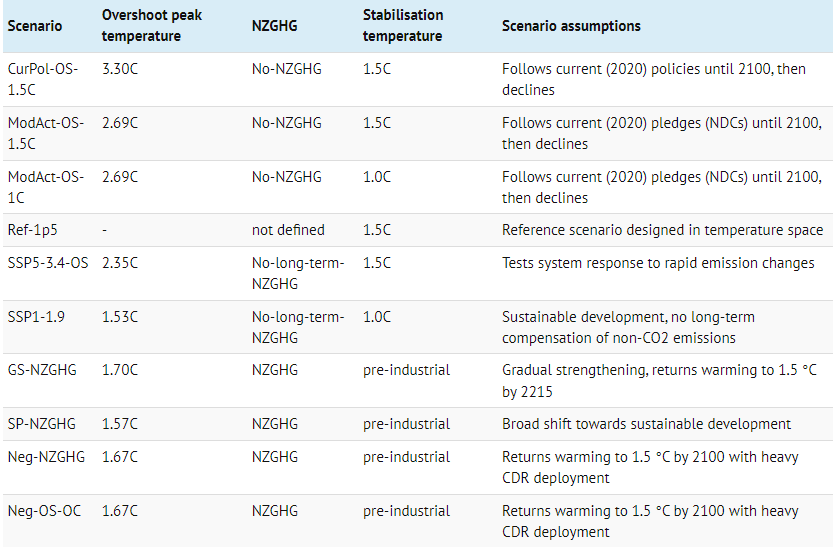
There is quite a range between the 10 pathways.
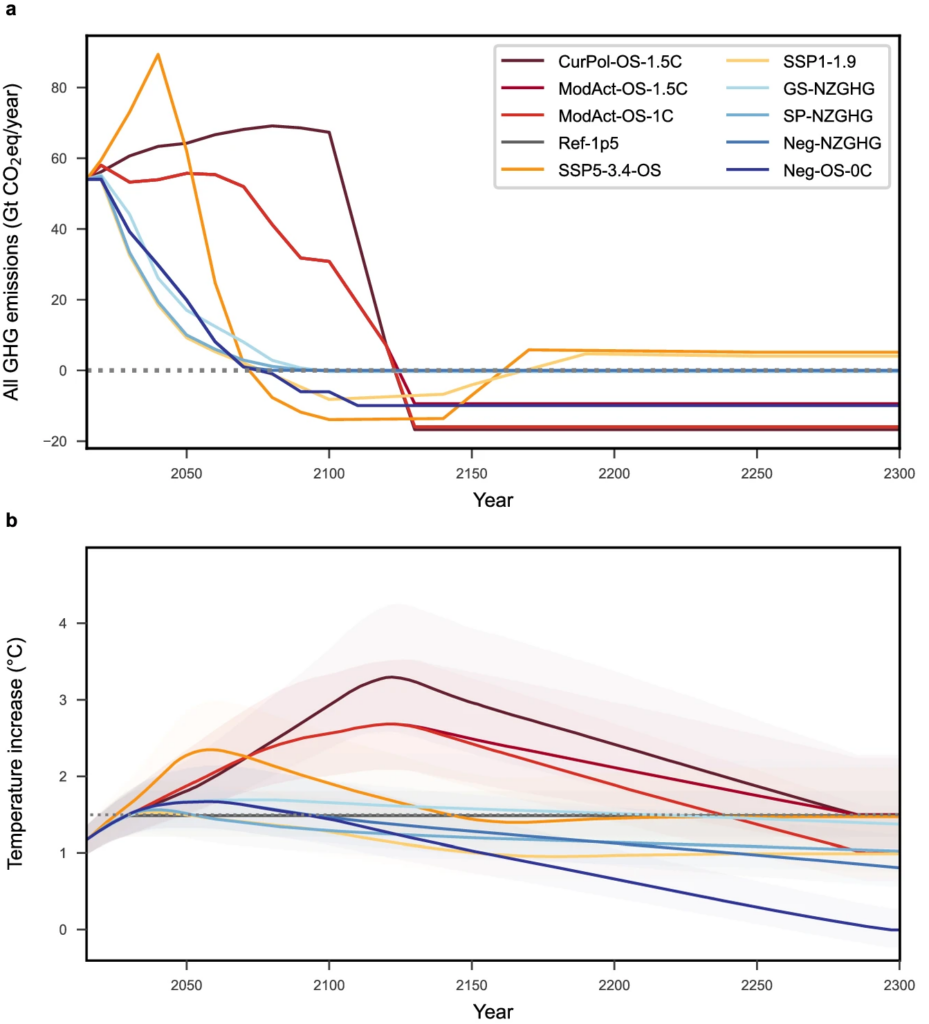
At the high end, the “CurPol-OS-1.5C” scenario sees a continuation of the global climate policies implemented in 2020 until the year 2100, with warming peaking at 3.3C. It then sees a decline in global temperature until reaching a stabilisation of 1.5C by the year 2300.
At the low end, “Neg-OS-0C” scenario initially overshoots 1.5C to 1.67C, but then returns warming to 1.5C by 2100 using “heavy carbon dioxide removal deployment”. It also then sees average global temperatures drop to pre-industrial levels by the year 2300.
In the middle, the Ref-1p5 scenario is the only one that does not include an overshoot, instead stabilising quickly at 1.5C.
The chart below shows greenhouse gas emissions (top) and corresponding global temperature changes (bottom) associated with each scenario, identified by the different-coloured lines. The bottom chart illustrates the range in how quickly the pathways return to 1.5C or below.
Dr David McKay is a research impact fellow at the University of Exeter’s Global Systems Institute, who has published extensively on climate tipping points, but was not involved in this study.
He also notes that some of the scenarios shown in this study “may not be possible”, because there is debate about whether or not “the substantial carbon dioxide removal needed for large overshoots is feasible”.
Many Earth systems are interlinked, so crossing one tipping point can increase the likelihood of crossing others. This is often described as a “domino effect” or “tipping cascade”.
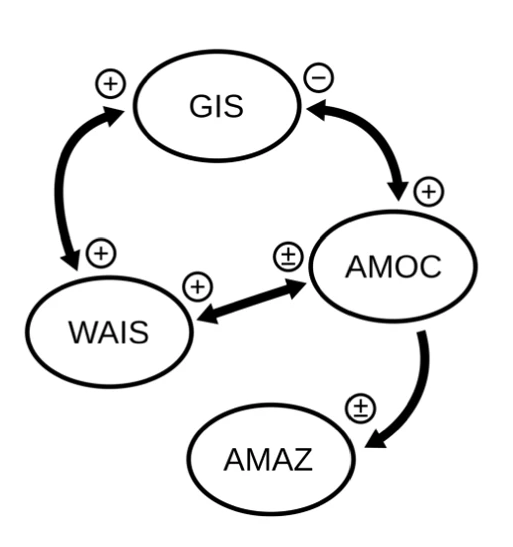
The study focuses on four interconnected tipping points – collapse of the Greenland ice sheet and west Antarctic ice sheet, shutdown of the Atlantic Meridional Overturning Circulation and dieback of the Amazon rainforest.
Annika Högner is a researcher at the Potsdam Institute for Climate Impact Research (PIK) and co-lead author on the study. She tells Carbon Brief these four tipping points were chosen because they “play a significant role in the functioning of the Earth system” and “their tipping would have severe global impacts”.
The graphic below shows how the tipping points interact with each other. A “+” symbol indicates that crossing one tipping point can destabilise another. For example, a collapse of the Greenland ice sheet makes the AMOC more likely to shut down, as a result of the sudden influx of freshwater into the north Atlantic Ocean. A “±” symbol indicates that the relationship between two tipping points is uncertain.
A “-” symbol indicates that crossing one tipping point stabilises another. Högner tells Carbon Brief that the interaction between the Greenland ice sheet and AMOC is the only stabilising interaction in this study. She explains that if the AMOC were to cross a tipping point, “we [would] expect to see strong cooling in the northern hemisphere”, which will contribute to stabilising the Greenland ice sheet.
Earth system models “often don’t resolve tipping processes very well”, making them less suited to modelling full tipping cascades, Högner tells Carbon Brief.
Instead, she explains that the authors developed a “conceptual model”. This model does not attempt to simulate the entire Earth system, but instead just models the likelihood of tipping at different temperatures, based on existing knowledge about tipping elements from other studies.
The model takes temperature trajectories as an input and gives the state of the tipping elements after a specified time – that is, whether or not the element has tipped – as an output.
Importantly, these models include “hysteresis” – a feature of tipping systems, in which a system that has moved to a different state does not easily move back to the original state even if temperatures are reduced again.
The authors use their conceptual model to calculate “tipping risk” under the 10 future warming scenarios. Högner tells Carbon Brief that tipping risk “refers to the model of all four interacting tipping elements analysed in the study”. For example, a 50% tipping risk means there is a 50% chance that at least one of the four climate elements will tip.
The top row of the graphic below shows the risk of tipping in the year 2300 (left) and in 50,000 years from now (right). Bars placed higher up indicate a greater likelihood of tipping. The dot shows the average value for each data point, while the bars show the 10-90% range.
The text on the right hand side gives likelihood levels in the calibrated language used by the IPCC: very likely means a likelihood of 90-100%, likely is 66-100%, about as likely as not is 33-66%; unlikely is 0-33%; and very unlikely is 0-10%.
The middle row shows the peak temperature under each scenario (left) and stabilisation temperature (right). The bottom row shows how long temperatures overshoot before stabilising in each scenario.
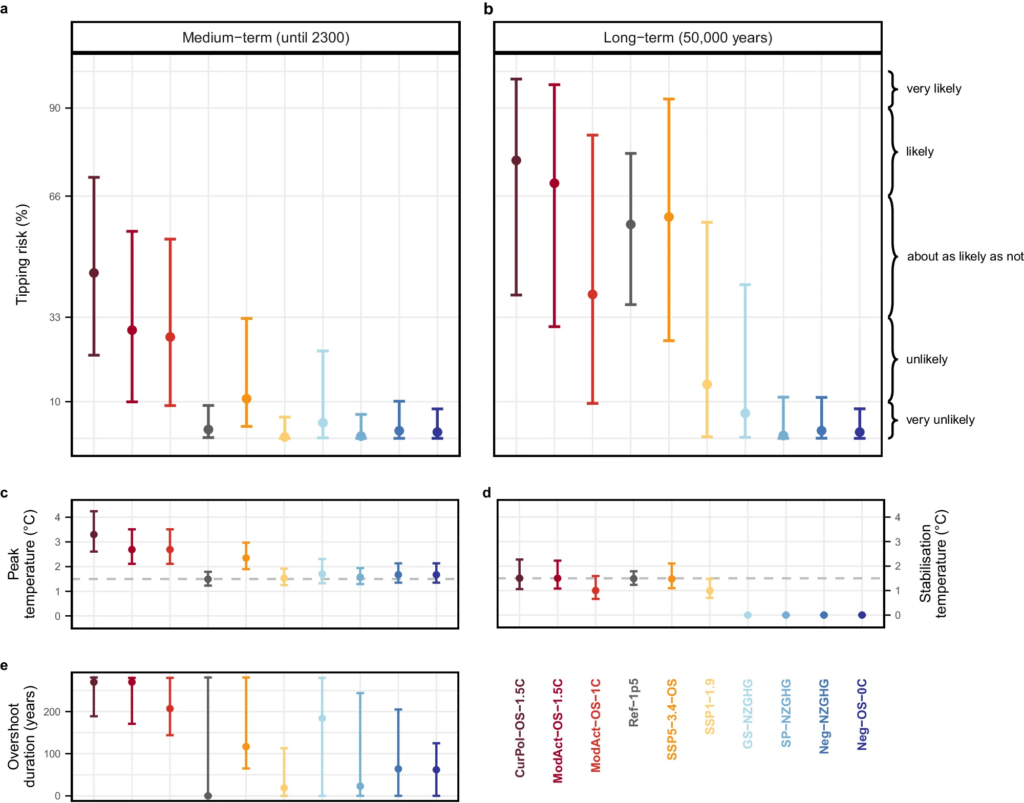
The longer the 1.5C threshold is breached for, and the higher the peak temperature is, the greater the risk of crossing tipping points by the year 2300, the study shows.
The authors find the greatest risk of crossing tipping points in the CurPol-OS-1.5C scenario (red), which follows the climate policies of 2020 until the year 2100 and then reaches 1.5C by 2300, as this scenario has the greatest overshoot temperature and duration.
Under this scenario, there is a 45% tipping risk by 2300 and a 76% chance in 50,000 years, according to the paper.
The five pathways that do not return warming to 1.5C by the year 2100 have the greatest medium-term risks, and those with less than 0.1C overshoot have the lowest medium-term risks.
In the long-term – looking to the next 50,000 years – the authors find that stabilisation temperature is “one of the decisive variables for tipping risks”. They find that even in the Ref1p5 scenario – which sees global temperatures stabilise at 1.5C without any overshoot – there is a 50% risk of the system tipping over the next 50,000 years.
The results “illustrate that a global mean temperature increase of 1.5C is not ‘safe’ in terms of planetary stability, but must be seen as an upper limit”, the study warns.
Högner tells Carbon Brief that the paper “underlines the importance of adhering to the Paris Agreement temperature goal”.
Tessa Möller – a researcher at the International Institute for Applied Systems Analysis (IIASA) and co-lead author on the paper – tells Carbon Brief that “we have a wide portfolio of technologies available” to limit warming to 1.5C, and just need to “implement” them.
However, she also highlights the “large credibility gap” between pledges from individual countries and the policies they have actually implemented. She tells Carbon Brief that not only do we need “stronger pledges”, but it is also essential that countries follow through on them.
The authors also explore the risk of each individual tipping point being crossed in different scenarios.
The plot below shows the tipping risk by 2300 under different scenarios, at different temperatures, on the left. Each colour represents one scenario. Dots positioned further to the right indicate a greater peak temperature and dots positioned higher up indicate a greater tipping risk.
The plot on the right shows the percentage change in tipping risk for every additional 0.1C of overshoot, for different peak global temperatures, for the Amazon (cross), AMOC (plus), West Antarctic ice sheet (black dot) Greenland Ice sheet (square) and overall (yellow dot).

The authors find that AMOC collapse and Amazon dieback would likely be the first components to tip. This could be in the next 15-300 years and 50-200 years, respectively, depending on the scenario, they find.
Meanwhile, the Greenland and west Antarctic ice sheets have tipping timescales of 1,000-15,000 years and 500-13,000 years, respectively.
However, they note that as temperatures increase, the relative risk of each element tipping changes. The graph shows that while AMOC is the main driver of tipping risk at lower temperatures, the Amazon becomes the main driver once global temperatures exceed 2C.
Finally, they find that as global temperatures rise, the risk of tipping accelerates. Overall, tipping risk increases by 1-1.5% per 0.1C increase in overshoot temperature, for temperatures below 2C, according to the study. However, above 2.5C, tipping risk increases to 3% per 0.1C increase overshoot.
McKay notes that there are some limitations in the study. For example, he notes that the paper “has to rely on tipping threshold and timescale estimates with often wide ranges and sometimes low confidence, while tipping interaction estimates are based on dated expert judgement”.
However, he adds:
“This work makes it clear that every fraction of warming increases the chance of tipping points, even if global temperature subsequently falls, and underlines the need for urgent emission cuts now that do not assume substantial carbon dioxide removal later.”


.svg)
