

 Back
Back
Growing up in Southern California, Saxon Metzger and his brother Ayda Donne — now 29 and 26 — didn’t think much about their Indigenous heritage in Oklahoma. Their great-grandmother’s family fled the reservation after her aunt saw her mother murdered during the Osage Reign of Terror, when locals brutally attacked tribal members over oil resources, as the brothers learned while researching the family history.
In the past decade, the brothers began exploring this history, including the fossil-fuel linked violence and exploitation recently showcased in the film “Killers of the Flower Moon.” Today, the Osage Nation is home to the country’s highest concentration of abandoned, uncapped oil and gas wells, which continue to leak methane and other dangerous pollutants.
Now, Metzger and Donne are seeking to connect with and give back to the Osage Nation and other tribal communities by making sure clean energy does not leave its own legacy of abandonment or disinvestment.
Eighth Generation Consulting, an organization Metzger founded, aims to provide solar decommissioning workforce training and project management, as well as promote solar installation.
“Tribal nations, along with many other historically disenfranchised communities, are justifiably skeptical of development that doesn’t fully acknowledge its potential shortcomings, having been bearing the brunt of fossil fuels,” Metzger said.
Osage Nation Chief Geoffrey Standing Bear has officially pledged support for the brothers’ vision. In March, Eighth Generation won a U.S. Department of Energy Community Energy Innovation concept phase prize, meaning a $100,000 grant, mentorship and the chance for more DOE funding. Metzger was also recently awarded a Grid Alternatives Tribal Energy Innovators Fellowship, which comes with $50,000 and mentorship, and he is a finalist for MIT’s Solve Global Challenges Indigenous Communities Fellowship program.
Metzger studied economics at Southern Illinois University and the University of Utah, then returned to Southern Illinois to help facilitate the deployment of solar in the largely rural, lower-income region.
He was program director for the nonprofit Solarize Southern Illinois, then worked as a project developer for StraightUp Solar, a residential and commercial solar installer focused on underserved areas in Illinois and Missouri. Metzger got an MBA with an emphasis in sustainability from Wilmington University, then worked for a decommissioning company in California.
Striking out on his own, he co-founded a company called Polaris Ecosystems that does solar decommissioning project management and consulting. Polaris is under contract to support commercial and utility-scale repowering in California and Texas, Metzger said, declining to give more details because of confidentiality clauses in the contracts.
The company collaborated with a Georgia solar waste management company called Green Clean Solar, whose founder, Emilie Oxel O’Leary, said she plans to partner with Polaris on more contracts. Her company has found ways to reuse solar packaging and components – for example, using thousands of cardboard boxes from solar delivery as mulch for a tree nursery in Hawaii, where landfill space is especially scarce.
“Saxon and I find these solutions together. We find sustainability. We bring circularity to our conversations,” she said. “Very few [companies] do what we do. These billion-dollar companies have never stopped and thought about this.”
Metzger now leads Eighth Generation and Polaris from Chicago, while also teaching a sustainable business class at Wilmington University.
Donne is in charge of grant-writing for Eighth Generation, while pursuing his doctorate in English literature at New York University, with a focus on Indigenous literature and environmental justice. Donne also collaborates with NYU professor and toxicologist Judith Zelikoff, doing blood and urine testing and health workshops with the Ramapough Lenape Nation in New Jersey, who face serious health threats from a former Ford Motor Company illegal dump that is now a Superfund site. Donne hopes to further intertwine the humanities and STEM sides of academia in pursuit of environmental and energy justice for tribes.
“My family is very scarred by what happened during the reign of terror. They tried to run” from that legacy, said Donne, who also works as chief librarian at the International Center for MultiGenerational Legacies of Trauma. “But repressing things like that rarely works, rarely protects you for very long. I like to think that Saxon and my work is kind of a departure from that history of denying our identity and running from the pain that’s in our family.”

On visits to the Osage Nation, the brothers say they’ve recognized the cultural as well as economic importance that fossil fuels still hold for the tribe. They strive to acknowledge and respect this dynamic while promoting clean energy. The tribe currently has no large-scale solar on its land, and this year a federal judge ruled that a controversial wind farm must be removed because it failed to get proper permits a decade ago. The tribe has long opposed the wind farm, which was built on sacred land.
“We’re trying to plug into the existing things that they’re doing, and not show up and say, ‘Hey, we know what the solution is,’” said Metzger. “This is my tribe, these are my folks, my culture, my people. But I am approaching it with the understanding that to a certain degree, I’m also an outsider from a market that they don’t have access to.”
Metzger added that when he first visited the Osage Nation, “I didn’t see a single solar panel, on the entirety of the reservation. I looked for it. I was shocked. It was one of the few places I’ve ever seen that there were no Trump flags, and there were no solar panels.”
Metzger said that it is still likely a long road to installing solar on the reservation, but he’s been encouraged by tribal leaders, and received a letter of support in July from Osage Chief Standing Bear.
More than half of states have decommissioning policies that require financial assurances be put up in advance, according to a 2023 year-end report by the North Carolina Clean Energy Technology Center and DSIRE. Nineteen states have no state-level decommissioning policies at all, the report shows, including Wisconsin, Iowa, Arizona and Pennsylvania.
“When it comes to assurance policies, you want to make sure landowners won’t be stuck with the bill at the end of the day, a dine-and-dash situation,” said Justin Lindemann, a co-author of the report and policy analyst at North Carolina State University’s Clean Energy Technology Center. “In most states, you have to have these finances in place well before the project decommissions.”
Solar project contracts and permits typically include a decommissioning estimate. In states with financial assurance requirements, developers are usually required to put up incremental amounts of financing over time for decommissioning, so that there is not a major financial burden tacked on to the project’s startup cost.
Metzger said that in his experience, estimates can be unrealistically low, a situation that in the near-term can benefit everyone, as the project cost appears lower.
“The reality is that our industry doesn’t really want to have that conversation” about decommissioning costs and logistics, “because a developer, if they included the full cost of decommissioning, would not sell as many projects,” Metzger said. “No one really wants to hear that the project is going to cost more.”
Lindemann said he hasn’t seen major problems with low-balled estimates, but there still have been relatively few large-scale decommissions. State laws and policies can try to ensure that estimates are accurate and large enough financial assurances are available. For example, Ohio requires that estimates be revised periodically, and if the estimate has increased, the required bond must be increased too.
Ideological opponents of solar have stoked fears about solar panels filling up landfills and presenting hazardous waste. Those concerns are often exaggerated, as solar panels are made up primarily of steel and glass and the toxic compounds in the cells present relatively little risk, experts say. Even as solar farms expand exponentially, solar waste will still be much smaller than other waste streams, like construction debris and municipal garbage.
Nonetheless, responsible and smooth decommissioning is crucial for the industry to thrive, experts agree.
“We live in a social media environment where bad stories, singular bad examples do spread,” said Lindemann. “We need to make sure that relationships don’t get strained because of a lack of direction regarding deconstruction and decommission. Do people involved in or impacted by a project understand what’s in front of them 20 to 25 years down the line? That level of trust and transparency can be built, and comprehensive directives from states and other entities provide the first step.”
In 2023, almost 33 GW of solar were installed nationwide, and solar deployment is only expected to keep growing.
“In order to handle that, it’s important to make sure state and local governments have the right rules in place to handle mass decommissioning,” said Lindemann.
Metzger notes there are many costs and logistics to decommissioning that can be easy to overlook: the need to remove fences and drive over fields to haul panels off, lodging for workers, renting equipment like pile drivers, dealing with buried electrical conduit or other hazards.
“If you look at a site, there isn’t one solution,” Metzger said. “Say you have 20,000 panels, that’s a bunch of metal. How heavy is that? What kind of tractor trailers are you going to need to pull it? What about the labor, how many 40-pound panels can someone lift in an hour?”
Metzger and Donne are developing a decommissioning workforce training curriculum, and hope to eventually train Osage tribal members and others in various aspects of decommissioning work and project management.
“We’re thinking about what this is going to look like for our tribe in 100 years,” said Donne. “Are these structural resources available when Saxon and I are long gone?”
That perspective is what inspired the name Eighth Generation, Metzger explains.
“It’s often cited as an indigenous principle to think of an action through seven generations of impact, and that phrase always reminded me that some problems just won’t show up until the eighth generation,” he said.
“And it feels like that is what’s happening here, as we’re staring down millions of panels annually needing decommissioning. It’s all solvable problems to an industry that genuinely is making the world a better place. We need to follow through on the promise we made as an industry to be meaningfully different than previous energy systems, and taking care of our legacy assets is a necessary component of that.”
Editor’s note: An earlier version of this story described Eighth Generation Consulting as a nonprofit; it is a for-profit entity that is exploring nonprofit status.
Human-caused climate change made the “unprecedented” wildfires that spread across Brazil’s Pantanal wetlands in June 2024 between four and five times more likely, according to a new rapid attribution study.
South America’s Pantanal – the world’s largest tropical wetland – experienced exceptionally hot, dry and windy conditions in June, causing blazes in the region to soar.
The World Weather Attribution (WWA) service finds that the month was the hottest, driest and windiest year in the 45-year record.
The team conducted an attribution study to find the “fingerprint” of climate change on these weather conditions.
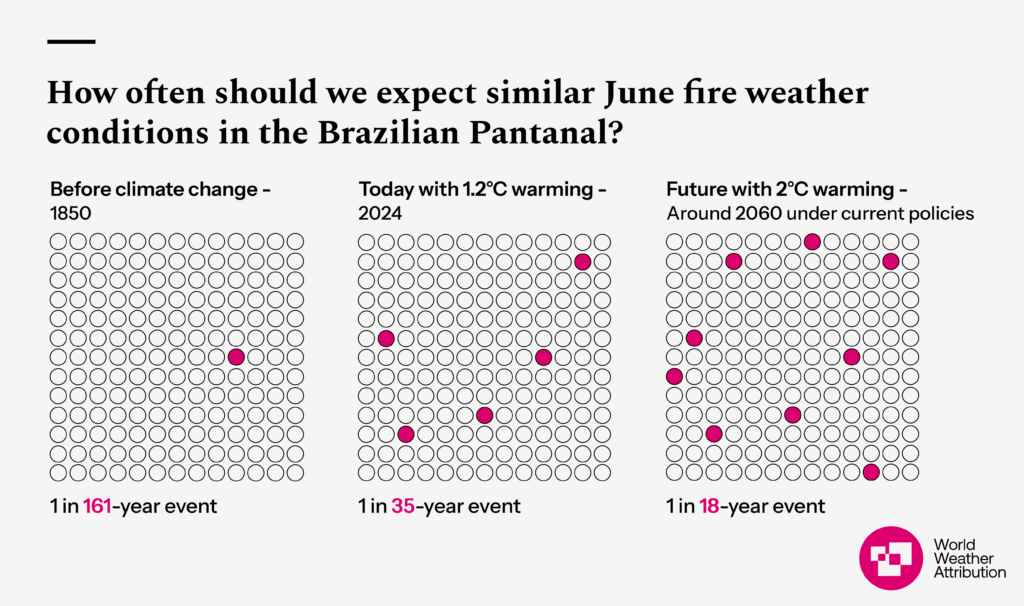
They find that, in a world without climate change, these conditions would be very rare – occurring only once every 161 years.
In today’s climate, which has already warmed by 1.2C above pre-industrial temperatures as a result of human-caused warming, these conditions are a one-in-35 year event.
The authors also explore how wildfires in the region could continue to worsen as the planet warms.
They find that if that planet reaches warming levels of 2C, the likelihood of these conditions could double, to once every 18 years.
The vast Pantanal wetland extends across Brazil, Bolivia and Paraguay.
It is one of the most biodiverse places on earth, home to more than 4,700 plant and animal species.
Every year, hot and dry weather conditions make the wetland prone to wildfires – usually between July and September.
By June this year, intense wildfires were already soaring. The number of Pantanal fires increased by 1,500% in the first half of this year compared to the same period in 2023, according to data from Brazil’s National Institute for Space Research reported by the Brasil de Fato newspaper.
This amounts to more than 1.3m hectares of the wetland burned so far this year – an area around eight times the size of London.
Around 2,500 fires were identified in June, which is the highest number since 1998 and more than six times the level reported in 2020, which was “known as the ‘year of flames,’ when wildfires ravaged the area and sparked widespread outcry”, the Associated Press said.
The region is currently experiencing its worst drought in 70 years, which Brazil’s government has said is being “intensified by climate change and one of the strongest El Niño phenomena in history”.
Prolonged dry periods, high temperatures and land-use change all contribute to wildfire conditions, says Dr Maria Lucia Barbosa, a postdoctoral researcher at the Federal University of São Carlos in Brazil, who was not involved in the attribution study. She tells Carbon Brief:
“While fires are a natural part of the Pantanal ecosystem, the recurrence of extreme fire seasons – such as the current one, shortly after the devastating 2020 fires – suggests that, alongside climate change, a new fire regime may be emerging in the ecosystem, characterised by increased severity and frequency.”
Wildfire intensity and duration are influenced by a wide range of factors, including weather, vegetation and fire management strategies.
The authors of the new study focus on a metric called the “daily severity rating” (DSR), which combines information on maximum temperature, humidity, wind speed and precipitation. Dr Clair Barnes – a research associate at Imperial College London’s Grantham Institute and author on the study – told a press briefing that this metric “indicates how difficult it is likely to be to control the fire once it starts”.
High temperatures and wind speeds, as well as low humidity and rainfall, are very conducive to wildfires spreading and, therefore, produce a high DSR.
The map below shows the average DSR in the Pantanal in June 2024. It reveals that most of the Pantanal was experiencing wildfire risk above the 1990-2020 average over that month.
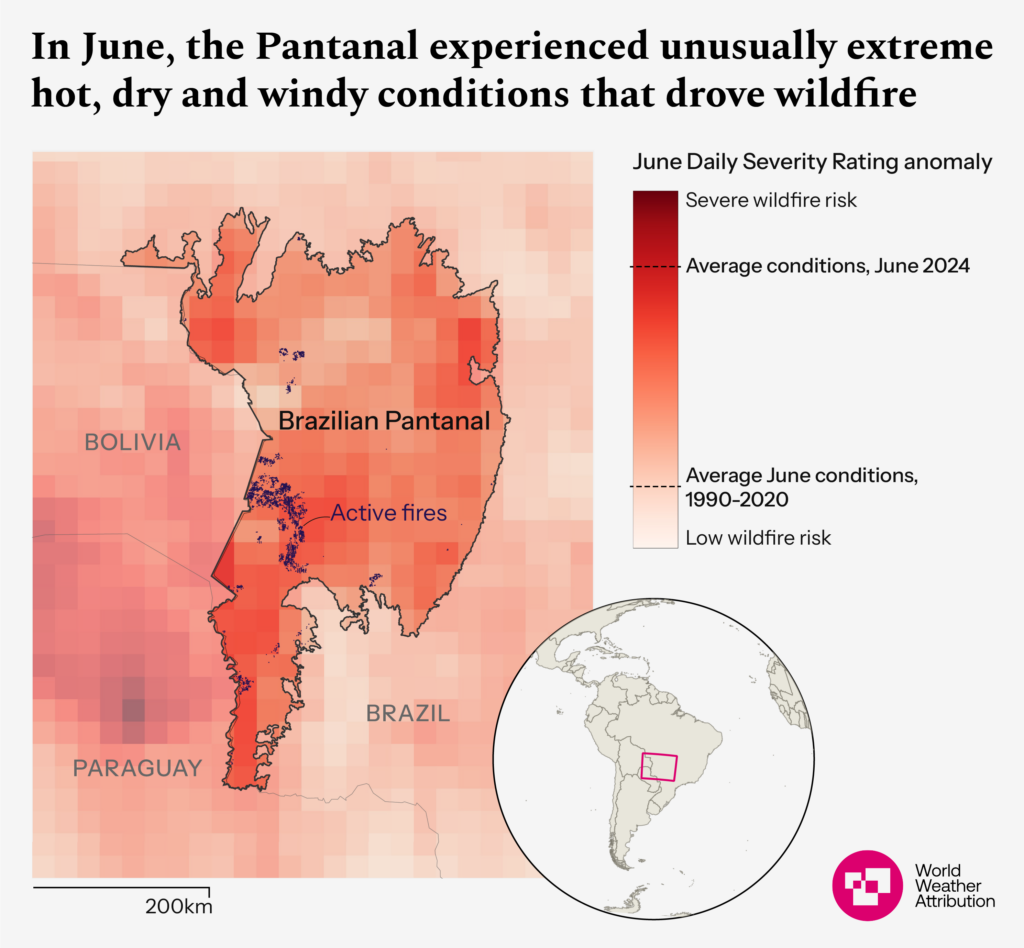
The weather conditions in the Pantanal in June 2024 were “really unusual for the time of year”, Barnes said.
To investigate how atypical the weather conditions in June 2024 were, the authors analysed temperature, windiness, rainfall and humidity data from the past 45 years.
The chart below depicts annual average rainfall and annual average daily maximum temperature in the Pantanal over 1979-2024. It shows that over the past 45 years, the average temperature in the Pantanal has been steadily increasing and total rainfall has been decreasing.
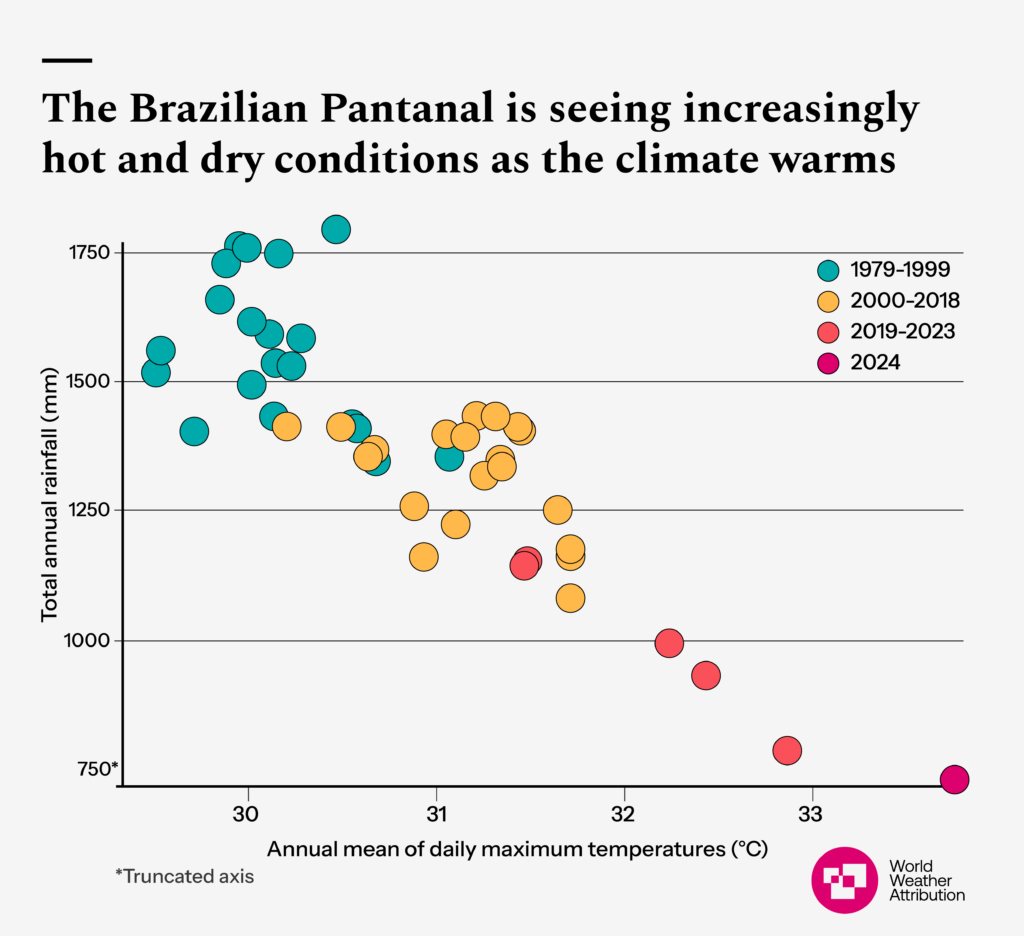
The authors find that June 2024 was the hottest, least rainy and windiest June since records began. They also find that the relative humidity was the second lowest on record.
Annual rainfall across the Pantanal has been decreasing over the past 40 years, the authors note. They point out that natural variability and deforestation are known to impact rainfall patterns across South America, but add that climate change “may also be influencing the drying trend”.
Attribution is a fast-growing field of climate science that aims to identify the “fingerprint” of climate change on extreme-weather events, such as heatwaves and droughts.
To conduct attribution studies, scientists use models to compare the world as it is today to a “counterfactual” world without human-caused climate change. In this study, the authors investigated the impact of climate change on DSR in the Pantanal region.
They find that in today’s climate – which has already warmed by 1.2C as a result of human activity – fire weather conditions like the ones that drove the wildfires in the Brazilian Pantanal during June 2024 are a “relatively rare event”, and would be expected to occur roughly once every 35 years.
However, they say, if the planet continues to warm, these events could become more likely. If the climate warms to 2C above pre-industrial levels, the likelihood of these fire conditions will double compared to today.
The graphic below shows how often June fire weather conditions, such as those seen in the Brazilian Pantanal in June 2024, could be expected under different warming levels.
The square on the left shows a world without climate change, in which these DSR levels would happen once every 161 years. The middle square shows that in today’s climate, the DSR is a one-in-35 year event. And the square on the right shows that in a 2C world, a June DSR like that of 2024 could be expected once every 18 years.
The authors also investigate how climate change affected DSR “intensity”. They find that human-induced warming from burning fossil fuels increased the June 2024 DSR by about 40%.
The authors add that as the climate continues to warm, this trend is likely to worsen. The authors warn that if warming reaches 2C above pre-industrial temperatures, similar June fire weather conditions will become 17% “more impactful”.
(These findings are yet to be published in a peer-reviewed journal. However, the methods used in the analysis have been published in previous attribution studies.)
Wildfires have wide-ranging impacts on people and nature in the Pantanal. In one example, a 2021 study found that around 17m vertebrates were “killed immediately” by the fires in 2020.
Wildfires can “devastate [the] livelihoods” of people living in the Pantanal and “pose significant health risks” from the resulting smoke, Barbosa says.
She notes that wildfires release CO2 into the atmosphere, contributing to climate change, and they “lead to widespread loss of habitat, endanger wildlife and disrupt ecological balances”. She tells Carbon Brief:
“Species that are already threatened or have limited ranges are particularly vulnerable to habitat destruction caused by fires.
“Repeated fires can push fire-sensitive vegetation into a state of permanent degradation, further threatening the ecological integrity of the region.”
Some fires are permitted for agricultural purposes – such as to burn degraded pasture – during the rainy season, from around November to April. This practice is banned in the drier summer months, but a 2020 piece from Mongabay notes that “in reality, the ban is not always respected and enforcement is haphazard”.
Filippe Santos, a researcher at Portugal’s University of Évora and one of the authors of the study, told a press briefing that “fire is part of the dynamics” of the Pantanal – when it is controlled.
Low-intensity fires allow animals “time to leave” the area, he said, adding:
“What we see with wildfires, is that this does not happen, because the fire is so intense and on such a large scale that animals don’t have time to run away.”
The “highly intense” wildfires also “don’t give nature enough time to recover”, Santos says.
In June, Brazil’s environment minister, Marina Silva, told the government news agency Agencia Brasil that the country is “facing one of the worst situations ever seen in the Pantanal”, adding that the fires are heightened by climate extremes and criminal activities.
Most Pantanal fires are caused by human activity, a 2022 study found. Police in Brazil are investigating the “possible culprits” behind 18 fire outbreaks in the region, Silva said last month.
In recent weeks, a law to improve coordination on tackling fires took effect in Brazil.
A statement from the Institute for Society, Population and Nature, a Brazilian NGO, says this new policy is a “significant milestone” and will establish “guidelines for the practice of integrated fire management across all biomes and territories in the country”.
Barbosa says it will be a “challenge” to implement this policy. She would like to see a “comprehensive national early warning system for multiple hazards to ensure risk reduction” for a range of threats – including wildfires. She tells Carbon Brief:
“Collaboration with local communities, firefighters and brigades is crucial for prevention and response efforts…A coordinated approach that integrates all stakeholders, along with the establishment of a national fund dedicated to fire management, is essential for mitigating the impacts of future fire seasons.”
China’s carbon dioxide (CO2) emissions fell by 1% in the second quarter of 2024 in the first quarterly fall since the country re-opened from its “zero-Covid” lockdowns in December 2022.
The new analysis for Carbon Brief, based on official figures and commercial data, shows China remains on track for a decline in annual emissions this year.
This annual outlook depends on electricity demand growth easing in the second half of the year, as expected in projections from sector group the China Electricity Council.
However, if the latest trends in energy demand and supply continue – in particular, if demand growth continues to exceed pre-Covid trends – then emissions would stay flat in 2024 overall.
Other key findings from the analysis include:
A slew of recent policy developments, summarised below, hint at a renewed focus in Beijing on the country’s energy and climate targets.
Yet the precise timing and height of China’s CO2 emissions peak, as well as the pace of subsequent reductions, remain key uncertainties for global climate action.
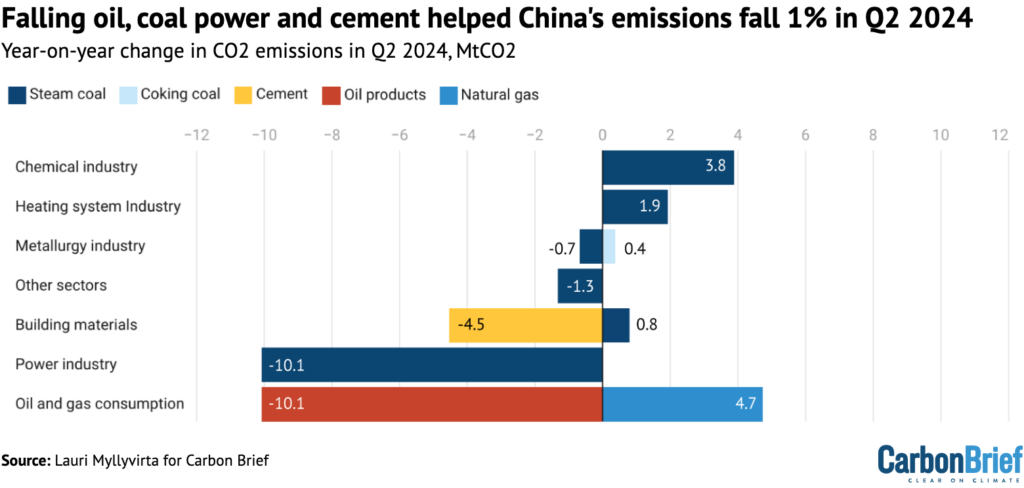
China’s CO2 emissions fell by 1% in the second quarter of 2024, the first quarterly fall since the country re-opened from zero-Covid, as shown in the figure below.
Within the overall total, power sector emissions fell by 3%, cement production fell by 7% and oil consumption by 3%.
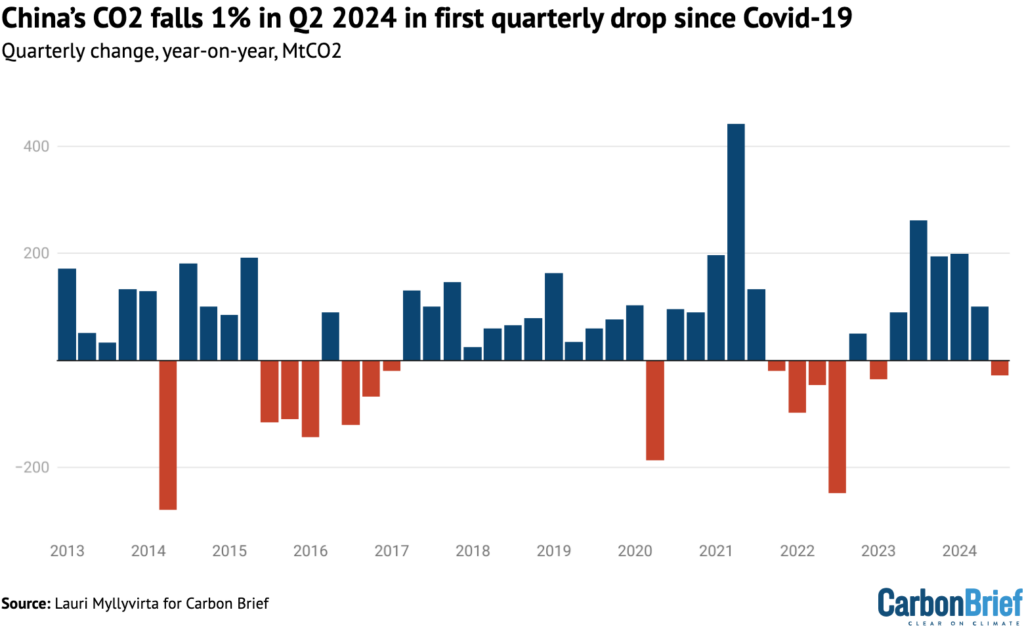
The reduction in CO2 emissions was driven by the surge in clean energy additions, which is driving fossil fuel power into reverse. (See: Clean energy additions on track to top 2023 record.)
However, rapid energy demand growth in sectors such as coal-to-chemicals diluted the impact of changes in the electricity sector. (See: Rapid energy demand growth.)
The additions of new clean power capacity in China have continued to boom this year.
China added 102 gigawatts (GW) of new solar and 26GW of wind in the first half of 2024, as shown in the figure below. Solar additions were up 31% and wind additions up 12% compared with the first half of last year, so China is on track to beat last year’s record installations.
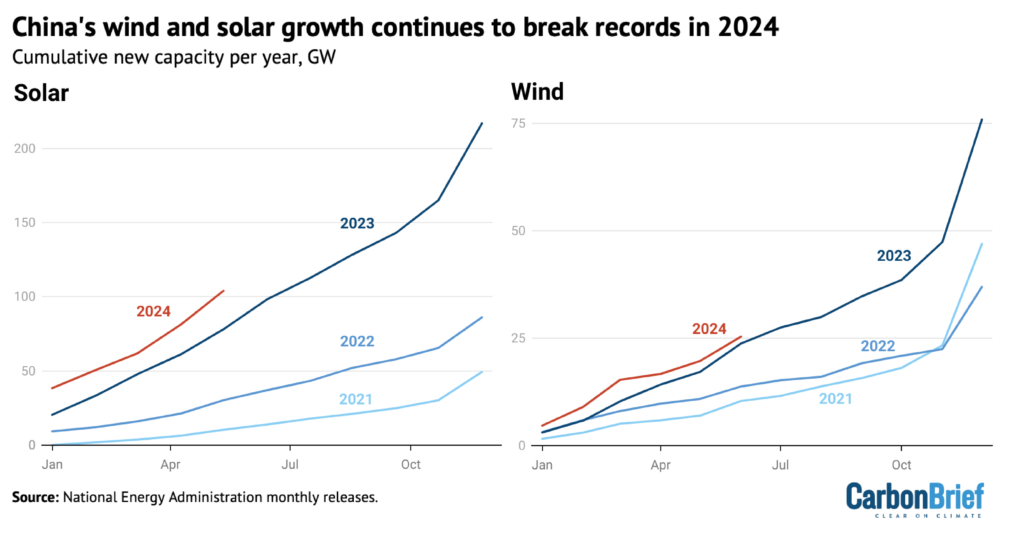
As a result of the strong capacity growth – and despite poor wind conditions – solar and wind covered 52% of electricity demand growth in the first half of 2024 and 71% since March. (The fall in wind speeds can be seen from NASA MERRA-2 data averaged for all of China.)
Indeed, the increase in power generation from solar and wind reported by the National Energy Administration in the first half of the year, at 171 terawatt hours (TWh), exceeded the UK’s total electricity supply of 160TWh in the first half of 2023.
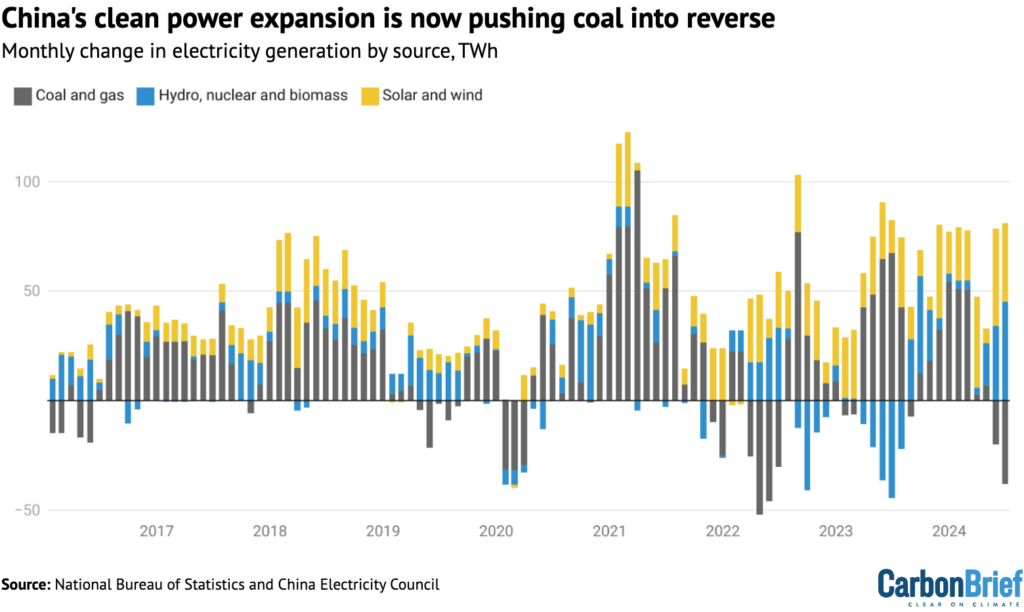
Rapid demand growth in January–February, at 11%, had outpaced even the clean energy additions. But combined with a rebound in hydropower generation, the increase in non-fossil electricity supply exceeded power demand growth in the March to June period.
These shifts are shown in the figure below, illustrating how clean power expansion started to exceed electricity demand growth in recent months, pushing coal and gas power into reverse.
After stopping the publication of capacity utilisation data by technology in May, the National Energy Administration released data in July on power generation by technology for renewable sources – solar, wind, hydro and biomass.
The NEA’s data shows renewable electricity generation covering 35% of demand in the first half of 2024 and growing 22% year-on-year. This is much higher than the previously-published National Bureau of Statistics numbers – which under-report wind and particularly solar power generation – but is closely aligned with estimates previously published by Carbon Brief.
In terms of other clean energy technologies, the production of electric vehicles, batteries and solar cells – the so-called “new-three” due to their recently acquired economic significance – continued to grow strongly in the first half of the year, at 34%, 18% and 37%, respectively.
This growth in production indicates strong demand from China and overseas. The growth of solar cell production halted in June, however.
While clean technologies continue to surge in China, energy consumption has also continued to grow at a fast rate relative to GDP. This indicates that the energy-intensive growth pattern that China followed during zero-Covid is continuing.
In the second quarter of 2024, total energy consumption increased by 4.2%, while GDP grew by 4.7%, marking an energy intensity gain of only 0.5%. This energy demand growth is much faster than the pre-Covid trend.
China’s target is an annual improvement of 2.9%, a rate that was exceeded consistently until Covid-era economic policies shifted the country’s growth pattern. Economic growth during and after zero-Covid has been reliant on energy-intensive manufacturing industries.
The main structural drivers of recent energy consumption growth were the coal-to-chemicals industry, and industrial demand for power and gas.
The coal-to-chemicals industry produces petrochemical products from coal instead of oil, supporting China’s energy security goals but at a great cost to climate goals, as the coal-based production processes have far higher carbon footprints.
China’s energy security drive and falling coal prices relative to oil prices have driven a boom in this industry. When coal supply was tight in 2022–23, the government was controlling coal use by the chemical industry to increase supply to power plants. As the coal supply situation has eased in 2024, this has enabled coal-to-chemicals plants to increase production, with coal consumption in the chemical industry growing 21% in the first half of the year.
Gas consumption increased 8.7% in the first half of the year, with industrial and residential gas consumption rising strongly, even as power generation from gas fell. Residential demand was driven up by extreme cold in the winter, however, rather than by structural factors.
On the flipside, the demand for oil products continued to fall, with a 3% drop in the second quarter that accelerated in the summer.
There are multiple factors driving the reduction: the shift to electric vehicles is contributing to the drop, with the share of EVs in cumulative vehicle sales over the past 10 years – an indicator of the mix of vehicles on the road – reaching 11.5% in June, up from 7.7% a year ago. This means that the increase in EVs cut the demand for transport fuels by approximately 4%.
The ongoing contraction in construction volumes, which is apparent in the fall in cement production, also affects oil demand, as the construction sector is a major source of demand for oil products for freight and machinery.
Another key driver is weak demand for oil as a petrochemical feedstock, which the rapidly increasing coal-to-chemicals production attempts to displace with the use of coal, albeit at a cost of increased CO2 emissions.
The contraction in construction volumes, caused by a slowdown in real estate that began in 2021, is weighing on the demand for cement and steel. Besides the direct effect of less real estate construction, local government revenues are dragged down by a fall in land sales, affecting their ability to spend on infrastructure construction.
These changes in demand for energy can been seen in the figure below, which shows contributions to the change in China’s CO2 emissions in the second quarter of this year.
While CO2 emissions did fall in the second quarter, the rate of CO2 intensity improvements fell short of the level needed to meet China’s 2025 carbon intensity commitment.
The country’s goal is to reduce emissions relative to GDP by 18% from 2020 to 2025, with progress until 2023 falling far short of the target.
As reported GDP growth slowed to 4.7% in the second quarter, and CO2 emissions fell by 1%, CO2 intensity improved by 5.5%, short of the 7% annual improvement needed in 2024-25 to get back on track.
Improvements are also easier to achieve this year than they will be in 2025, as the rebound of hydropower from the low availability in 2022–23 helps reduce emissions. This is a one-off tailwind that is not likely to be present in 2025.
One part of the energy-intensive industry that China has been relying on to drive economic growth is the manufacturing of clean energy technologies. In response, some commentators have exaggerated the CO2 impact of Chinese factories making solar panels, EVs and batteries.
In reality, however, the manufacturing of these goods was responsible for 1.6% of China’s electricity consumption and 2.9% of its emissions in the first half of 2024, based on calculations using publicly available data.
The same calculations show that their CO2 emissions and electricity consumption increased by approximately 27% in the same period, contributing a 0.6% increase in China’s total fossil CO2 emissions and 0.4% increase in electricity consumption.
Looking ahead to the rest of this year, energy consumption growth is expected to cool. The China Electricity Council projects electricity demand growth of 5% in the second half of the year, compared with 8.1% in the first half, and the National Energy Administration expects full-year gas demand growth to moderate to 6.5–7.7%, from 8.7% in the first half.
If these projections are accurate, then the continued growth of clean energy consumption would be sufficient to push China’s CO2 emissions into decline this year.
However, the faster-than-expected energy demand growth in the first half of the year dilutes the emission reductions from the country’s record clean energy additions, and adds uncertainty to whether China’s emissions will indeed fall in 2024 compared with 2023.
If the growth rates of energy demand, by fuel and sector, seen in the second quarter of this year continue into the third and fourth quarter, with similar continuity in the growth rates of non-fossil electricity generation, then China’s emissions would stay flat in 2024 overall.
Energy consumption growth could also be moderated by a renewed policy focus on energy and climate targets. In May of this year, the State Council, China’s top administrative body, issued an action plan on energy conservation and CO2 emission reductions in 2024–25.
This plan is notable both for the unusual time period, covering the last two years of the five-year plan period, and for its high-level nature – energy conservation would normally fall under the jurisdiction of the energy and environmental regulators, rather than the State Council.
This suggests that the government recognises the shortfall against the 2025 carbon intensity and energy intensity targets. The action plan calls for meeting both of these targets, and lists numerous measures to be undertaken in response.
Yet the plan did not set numerical targets for 2024 that would be consistent with meeting the 2025 targets, which could be seen as taking a hedged approach of pushing for more action but not guaranteeing that sufficient results will be achieved.
Another State Council plan, released in late July, calls for speeding up the creation of a “dual control system” to control total CO2 emissions and emissions intensity. (Historically, China has never set numerical targets for total CO2 emissions, only aiming to limit CO2 intensity.)
According to the July release, the 15th five-year plan will set a binding carbon intensity target in the 2026-30 period, in line with previous five-year plans. For the first time, there will also be a non-binding, “supplementary” target for China’s absolute emissions level in 2030. Then, for each of the following five-year periods, there will be a binding absolute emissions target.
After the shortfall against the 2025 intensity target, the 15th five-year plan period would need to set a demanding intensity target to fulfil China’s 2030 commitments under the Paris Agreement.
The most important political meeting of the year, the “third plenum” of the Central Committee of the Communist Party, took place in July. The readout of the meeting mentioned carbon emissions reduction for the first time, but did not signal a shift to stimulating consumption. This could have driven less emissions-intensive economic growth, reducing reliance on higher-carbon manufacturing or infrastructure expansion.
The key focus of the meeting was promoting “new quality productive forces”, meaning advanced manufacturing and innovation. In practice, this likely implies a continued emphasis on manufacturing, with the potential for the energy-intensive economic growth pattern to continue.
Another indication that carbon emissions are receiving more policy emphasis is that the government appears to have stopped permitting new coal-based steelmaking projects since the beginning of 2024.
Hundreds of coal-based “replacement” projects were permitted in previous years, preparing to replace up to 40% of China’s existing steelmaking capacity with brand-new furnaces.
The shift away from new coal-based capacity is consistent with China’s target of increasing the use of electric arc furnaces – but progress towards that target had been lagging.
On coal-fired power, the government issued a new policy on “low-carbon transformation” of coal plants, aiming to initiate “low-carbon” retrofitting projects of a batch of coal power plants in 2025, with the target of reducing the CO2 emissions of those plants 20% below the average for similar plants in 2023, and another batch in 2027 aiming for emission levels 50% below 2023 average.
Under this transformation plan, emissions reductions at targeted coal plants are supposed to be achieved by “co-firing” coal with either biomass or “green” ammonia derived from renewables-based hydrogen, or by adding carbon capture, utilisation and storage (CCUS).
However, there are no targets for how many coal plants should be retrofitted, or what the incentives will be to do that, which will obviously determine the direct impact of this policy.
The impact could be small as biomass supply is limited, while the costs of ammonia and CCUS are high. For example, the International Energy Agency – among the more optimistic on power generation from biomass – sees its share rising from 2% in 2022 to 4.5% in 2035, if China meets its pledges on energy and climate IEA’s.
Furthermore, much of China’s coal-fired generation is already unprofitable, with almost half of the firms in the sector operating at a loss – even before taking on costly new measures.
The policy does however constitute Beijing’s first attempt at reconciling the recent permitting spree of new coal-fired power plants with its CO2 peaking goal for 2030, and looking for alternatives to early closure or under-utilisation of at least a part of the coal power fleet.
China’s emissions fell year-on-year in March and in the second quarter, as expected in my analysis for Carbon Brief last year.
Faster-than-expected growth in coal demand for the chemical industry, however, as well as industrial demand for power and gas, has diluted the emission reductions from the power sector, making the fall in emissions smaller than expected.
Nevertheless, China is likely still on track to begin a structural decline in emissions in 2024, making 2023 the peak year for CO2 emissions.
In order for this projection to bear out in reality, clean energy growth would need to continue and the expected cooling in energy demand growth in the second half of the year would need to materialise, with the new policy focus on energy savings and carbon emissions proving lasting.
The trends that could upset this projection include the economic policy focus on manufacturing, and the expansion of the coal-to-chemicals industry.
The surge in coal use for coal-to-chemicals is also a demonstration that even if power sector emissions begin to fall, as long as China’s climate commitments allow emissions to increase, there is the potential for developments that increase emissions in other sectors.
China has committed to updating its climate targets for 2030 and releasing new targets for 2035 early next year. These targets will be key in cementing the emissions peak and specifying the targeted rate of emission reductions after the peak – both of which have seismic implications for the global emissions trajectory and the level at which temperatures can be stabilised.
Data for the analysis was compiled from the National Bureau of Statistics of China, National Energy Administration of China, China Electricity Council and China Customs official data releases, and from WIND Information, an industry data provider.
Wind and solar output, and thermal power breakdown by fuel, was calculated by multiplying power generating capacity at the end of each month by monthly utilisation, using data reported by China Electricity Council through Wind Financial Terminal.
Total generation from thermal power and generation from hydropower and nuclear power was taken from National Bureau of Statistics monthly releases.
Monthly utilisation data was not available for biomass, so the annual average of 52% for 2023 was applied. Power sector coal consumption was estimated based on power generation from coal and the average heat rate of coal-fired power plants during each month, to avoid the issue with official coal consumption numbers affecting recent data.
When data was available from multiple sources, different sources were cross-referenced and official sources used when possible, adjusting total consumption to match the consumption growth and changes in the energy mix reported by the National Bureau of Statistics for the first quarter and the first half of the year. The effect of the adjustments is less than 1% for all energy sources, and the conclusion that emissions fell in the second quarter holds both with and without this adjustment.
CO2 emissions estimates are based on National Bureau of Statistics default calorific values of fuels and emissions factors from China’s latest national greenhouse gas emissions inventory, for the year 2018. Cement CO2 emissions factor is based on annual estimates up to 2023.
For oil consumption, apparent consumption is calculated from refinery throughput, with net exports of oil products subtracted.
COAL: An Appalachian Power official tells West Virginia regulators the utility continued to operate three coal-fired power plants that lost a combined $87 million over the last year because excessive coal inventories on site threatened worker safety. (West Virginia Public Broadcasting)
ELECTRIC VEHICLES:
SOLAR:
WIND: Federal officials mail surveys to residents on the Gulf Coast to gauge their feelings about offshore wind energy development. (KPLC)
GRID:
OIL & GAS:
CLIMATE:
HYDROGEN: Advocates worry proposed federally incentivized green hydrogen production facilities in Arizona and other arid states will further deplete already strained water supplies. (Floodlight)
GRID:
UTILITIES: Nevada regulators propose allowing NV Energy to stop charging a single statewide disaster preparedness rate so customers in the southern part of the state will not subsidize wildfire prevention in the north. (Nevada Current)
ELECTRIC VEHICLES: An Idaho sanitation company replaces its diesel-fueled garbage collection fleet with electric trucks. (Idaho Statesman)
OIL & GAS:
SOLAR:
ELECTRIFICATION: Berkeley, California’s city council votes to approve a ballot initiative that would tax large buildings that use natural gas-fueled appliances. (Daily Californian)
CLIMATE: An investigation finds Nevada officials continued to offer contracts to a startup even after its carbon emissions tracking system failed to perform as promised. (ProPublica)
POLITICS: U.S. Rep. Harriet Hageman, a Wyoming Republican, proposes removing Boulder, Colorado’s gas stations and streets, citing the progressive city’s efforts to fight climate change. (WyoFile)
BIOFUELS: A southern California city plans to upgrade its wastewater treatment plant to produce biofuels from organic waste and sewage sludge. (news release)
As Maine considers building a new toll highway to improve commutes in and out of Portland, a state climate working group is drafting strategies to reduce driving in the state.
State officials say the two efforts are not inherently at odds, but experts and advocates caution that continued highway expansion could reverse climate progress by encouraging more people to drive.
The parallel discussions in Maine raise a question that few states have yet grappled with: can governments keep expanding car infrastructure without putting climate goals out of reach?
Transportation is the largest source of greenhouse gas emissions in Maine and many other states. Electric vehicle adoption is growing, but not fast enough to solve the problem on its own, which is why an updated state climate plan is expected to include a new emphasis on public transit, walking, biking, and other alternatives to passenger vehicles.
Zak Accuardi, the director for mobility choices at the Natural Resources Defense Council, said the best way for states to invest in their road systems in the era of climate change is to not build new roads, but maintain and upgrade existing ones to accommodate more climate-friendly uses.
“The states who are taking transportation decarbonization really seriously are really focused on reducing driving, reducing traffic,” Accuardi said, pointing to Minnesota and Colorado as examples. “Strategies that help support more people in making the choice to walk, bike or take transit — those policies are a really important complement to … accelerating the adoption of zero-emissions vehicles.”
Electric vehicles have been Maine’s primary focus to date in planning to cut back on transportation emissions. Goals in the state’s original 2020 climate plan included getting 41,000 light-duty EVs on the road in Maine by next year and 219,000 by 2030. The state is far behind on these targets. The climate council’s latest status report said there were just over 12,300 EVs or plug-in hybrid vehicles in Maine as of 2023.
A 2021 state clean transportation roadmap for these goals recommended, among other things, the adoption of California’s Advanced Clean Cars II and Advanced Clean Trucks rules, which would require an increasing proportion of EV sales in the coming years.
Maine regulators decided not to adopt Clean Cars II earlier this year in a 4-2 vote. A subsequent lawsuit from youth climate activists argued the state is reneging on its responsibility to meet its statutory climate goals by choosing not to adopt such rules.
The original climate plan also aimed to cut Maine’s vehicle miles traveled (VMT), which measures how much people are driving overall, by 20% by 2030. The plan said getting there would require more transit funding, denser development to improve transit access, and broadband growth to enable remote work, but included little detail on these issues. It did not include the words “active transportation” at all.
That appears poised to change in the state’s next four-year climate plan, due out in December. Recommendations from the state climate council’s transportation working group have drawn praise from advocacy groups like the Bicycle Coalition of Maine.
The group’s ideas include creating new state programs to support electric bike adoption, including in disadvantaged communities; paving 15 to 20 miles of shoulders on rural roads per year to improve safe access for cyclists and pedestrians; and, depending on federal funds, building at least 10 miles of off-road trails in priority areas by 2030.
The group also recommended the state “develop targets related to increased use of transit, active transportation, and shared commuting that are consistent with Maine’s statutory emissions reduction goals.”
In unveiling the recommendations, working group co-chair and Maine Department of Transportation chief engineer Joyce Taylor noted community benefits from road safety upgrades to accommodate these goals.
“I think this also gets at housing and land use,” she said. “If you can get people to want to live in that community, that village, I think we could all say that it’s more economically vibrant when people are able to walk and bike in their village and feel like they can get around and it’s safe.”
The Gorham Connector project would offer a new, tolled bypass around local roads as an alternative to upgrading those existing routes, an option that’s also been studied. State officials say the new road would smooth the flow of local traffic, including public transit.
Towns like Kittery, in southern Maine, have tried to focus on a more inclusive array of transportation strategies in their local work to cut emissions from passenger vehicles.
Kittery town manager Kendra Amaral is a member of the climate council’s transportation group. She couldn’t comment on the state’s approach to the Gorham Connector, which is outside her region. But she said her town’s climate action plan, adopted this past May, “threads together” public transit, housing growth and emissions reductions.
Stakeholders who worked on the plan, she said, strongly recommended ensuring that housing is in walkable or transit-accessible places.
Amaral said the town has invested in new bus routes, commuter shuttles and road improvements to promote traffic calming and create safer bike and pedestrian access, as well as in EV growth. And she said Kittery was a model for parts of a new state law that enables denser housing development.
“We can’t expect people to reduce (emissions) resulting from transportation without giving them options,” she said. But, she added, “there is no ‘one size fits all’ solution” for every community. “I believe we have to avoid the ‘all or nothing’ trap and work towards (the priorities) that get the best results for each community,” she said.
The Maine Turnpike Authority acknowledges the proposed Gorham Connector project in the Portland area would increase driving. But paired with improvements to transit and land-use patterns, they say the proposed limited-access toll road would decrease emissions overall — though research and other cases cast doubt on this possibility.
“It’s possible for a project like this to be designed in a way that does produce favorable environmental outcomes,” Accuardi said, but “the devil is really in the details.”
For example, he said the new road’s tolls should be responsive to traffic patterns in order to effectively reduce demand. If they’re too low, he said, the road will become jammed with the kind of gridlock it aimed to avert. But set the tolls too high, and the road won’t get used enough.
He said it’s true that this kind of new access road can lead to denser housing development in the surrounding area — but the road will need to be tolled carefully to account for that increased demand.
And the proceeds from those tolls, he said, should ideally go toward new clean transportation alternatives — such as funding additional transit service or safe walking and biking infrastructure around the new toll road, helping to finance subsidized affordable housing in transit-served areas, or allocating revenues to surrounding towns that make “supportive land-use changes” to lean into transit and decrease driving.
Maine has indicated that it expects to use tolls from the Gorham Connector primarily, or at least in part, to pay for the road itself and avoid passing costs to other taxpayers.
But Accuardi said alternative strategies should see more investment than road expansions in the coming years if states like Maine want to aggressively cut emissions.
He said on average, across the country, states spend a quarter of their federal transportation funding on “expanding roads or adding new highway capacity.”
“That’s more money than states tend to spend on public transit infrastructure, and that really needs to be flipped,” he said. “We need to see states really … ramping down their investments in new highway capacity. Because, again, we know it doesn’t work.”
Last month saw another extreme weather milestone with the world’s hottest day on recent record registered on 22 July – yet another indication of the extent to which greenhouse gas emissions from human activities are changing our climate, the World Meteorological Organization (WMO) reported on Wednesday.
Global average temperatures for 13 consecutive months from June 2023 to June 2024 also set new monthly records.
“Widespread, intense and extended heat waves have hit every continent in the past year. At least ten countries have recorded daily temperatures of more than 50 degrees Celsius in more than one location,” said WMO Secretary-General Celeste Saulo.
These trends underline the urgency of the Call to Action on Extreme Heat, a new initiative launched in July by UN Secretary-General António Guterres to enhance international cooperation to address extreme heat.
“Earth is becoming hotter and more dangerous for everyone, everywhere,” stressed the UN Chief.
Extreme heat is causing a ripple effect felt right across society.
An annual 1℃ increase in temperature leads to a 9.1 per cent increase in poverty. Moreover, 12 per cent of all food produced is lost due to a lack of cooling and working hours equivalent to 80 million full-time jobs could be lost due to heat stress by 2030.
The consequences have become deathly. Nearly half a million heat-related deaths occurred each year from 2000 to 2019.
Taken together, extreme heat is tearing through economies, widening inequalities, and derailing the future of the Sustainable Development Goals.
“This is becoming too hot to handle,” said Ms. Saulo.
Listen to: ‘Heatwaves will be more frequent because of human-made climate change’ by United Nations News.
The UN chief launched the Call to Action to mitigate the dire environmental and socioeconomic consequences that are already evident.
The initiative emphasises the need for concerted effort in four critical areas: caring for the vulnerable, protecting workers, boosting resilience of economies and societies using data and science, and limiting temperature rise to 1.5℃ by phasing out fossil fuels and scaling up investment in renewable energy.
It brings together the expertise and perspectives of ten specialised UN entities, underscoring the diverse multi-sectoral impacts of extreme heat on human health, lives, and livelihoods.
“The WMO community is committed to responding to the UN Secretary-General’s Call to Action with better heat-health early warnings and action plans,” said Ms. Saulo, adding that recent estimates indicate that the global scale-up of heat health-warning systems for 57 countries alone has the potential to save around 98,000 lives per year.
OIL & GAS: A Texas lawsuit alleging Chevron and other oil companies failed to properly plug oil wells raises the question of a “colossal liability” that could fall to companies or taxpayers. (Inside Climate News)
ALSO:
GRID:
SOLAR: A Tennessee public housing authority installs solar panels on a property to house a community of veterans at risk of being homeless. (WBIR)
ELECTRIC VEHICLES: Oklahoma transportation officials collect public input on the state’s draft plan to build electric vehicle chargers and other infrastructure. (KSWO)
PIPELINES: Opponents of the Mountain Valley Pipeline praise a provision in federal legislation to create a national office of public engagement to better communicate details about the transport of natural gas. (WFDD)
UTILITIES:
CLIMATE:
COMMENTARY:
GRID: The Department of Energy awards $2.2 billion in grants to eight transmission projects that, matched with $10 billion in private investment, are expected to support 13 GW of new clean energy. (Canary Media)
ALSO:
CLEAN ENERGY: A key oversight body says nearly one-third of the carbon offset credits on the market do not meet its standards, a sign of further upheaval in a process that is already heavily criticized. (Bloomberg)
CLIMATE: The window for lawmakers to repeal the SEC’s climate-risk disclosure rule closed last week, but the policy still faces legal challenges. (Utility Dive)
OIL & GAS:
TRANSPORTATION:
HYDROGEN: Oregon advocates push back against a utility’s pilot project blending hydrogen into its natural gas distribution system in Portland, joining other critics around the region citing safety concerns, high costs and limited effectiveness at decarbonization. (Oregon Capital Chronicle, Floodlight)
NUCLEAR: Federal regulators are seeking more information about plans to sell power from a Pennsylvania nuclear plant to an Amazon data center to be located nearby. (Utility Dive)
HYDROPOWER: Hydropower associations are suing the Biden administration over new rules to protect vulnerable fish populations. (E&E News, subscription)
COMMENTARY: Advocates urge federal lawmakers to protect the Biden administration’s oil and gas leasing rules from legislative attacks, saying they help protect the West’s outdoor recreation economy from drilling’s impacts. (Colorado Sun)
HYDROGEN: Oregon advocates push back against a utility’s pilot project blending hydrogen into its natural gas distribution system in Portland, joining other critics around the region citing safety concerns, high costs and limited effectiveness at decarbonization. (Oregon Capital Chronicle, Floodlight)
UTILITIES: California Gov. Gavin Newsom proposes legislation aimed at lowering electricity bills, but has yet to disclose details. (Sacramento Bee)
GRID:
OIL & GAS:
GEOTHERMAL:
EMISSIONS:
POLITICS: A debate over the domestic uranium industry’s predicted revival dominates a Utah legislative race in the southeastern part of the state. (KJZZ)
STORAGE: Developers bring a 400 MW battery energy storage system online in southern California. (The Sun)
COMMENTARY:


.svg)
