

 Back
Back
GRID: The San Carlos Apache Tribe calls on the federal government to replace an aging transmission line after unusually high winds damaged it and left the northern half of the southeastern Arizona reservation without power. (Associated Press)
ALSO:
SOLAR: The federal Bureau of Land Management seeks public input on the proposed 600 MW Samantha solar-plus-storage project in eastern Nevada. (news release)
HYDROGEN:
UTILITIES: A southern Idaho utility breaks ground on a 17.5 MW natural gas peaker plant and energy research center. (Local News 8)
STORAGE: Industry observers worry a proposed 150 MW battery energy storage system in Idaho could run into opposition after a county in the state rejected a utility-scale solar project. (Power Engineering)
CARBON CAPTURE: A study finds previous estimates vastly overinflate the amount of carbon dioxide that can be stored in crops and soil, throwing an Oregon initiative relying on agricultural carbon sequestration into question. (OPB)
OIL & GAS:
TRANSPORTATION: A historic tourist railroad in southwestern Colorado converts its coal-burning steam locomotives to run on oil in an effort to reduce wildfire hazard. (KSUT)
GEOTHERMAL: Colorado regulators adopt rules for deep geothermal development after expanding their focus from oil and gas to other energy and carbon capture projects. (Colorado Politics)
COAL: Wyoming leads 17 other states in a lawsuit seeking to block new U.S. EPA coal ash impoundment rules scheduled to take effect in November. (Cowboy State Daily)
NUCLEAR: Tech companies increasingly seek to directly connect data centers to nuclear plants, a concept that has drawn opposition from some utilities that claim it would harm other ratepayers. (Canary Media, CNBC)
POLITICS:
RENEWABLES:
SOLAR:
ELECTRIC VEHICLES: The market slowdown around electric vehicles causes concern about the sector’s leading role in Georgia’s manufacturing renaissance, which one state official has called the state’s second industrial revolution. (Atlanta Business Chronicle)
WIND: Despite the depiction of toppled wind turbines in this summer’s sequel to “Twister,” researchers say turbines are generally built to withstand extreme winds and tornadoes. (E&E News)
MANUFACTURING: Around 40% of the largest manufacturing investments announced in the year after the Inflation Reduction Act and CHIPS Act have since been delayed due to market conditions and uncertainty around the next presidential administration, a news organization’s analysis finds. (Financial Times, subscription)
CARBON CAPTURE: A California nonprofit finds state plans to capture and sequester 50 million tons of carbon dioxide would require about 1,150 miles of new pipelines and other infrastructure. (Capital & Main)
The following commentary was written by Larry Glover, a Maryland-based energy marketing & communications SME. See our commentary guidelines for more information.
This heat wave is only the beginning. As climate disasters and extreme weather events become more frequent, ensuring reliable and affordable access to electricity for all communities has never been more urgent. Places that we typically think of as pleasant in the summer months are becoming heat domes, and many electricity providers remain overwhelmed when their peak energy demand threatens the stability of the entire electric grid.
Clean, distributed, energy resources such as solar and batteries are anchoring our country’s electric grid in the face of extreme summer heat. And while the federal government has a duty here, state policymakers and regulators hold an immense amount of power to pave the way for these clean energy technologies.
Let’s start with the good news. Several states are beginning to realize the need for clean energy – both out of protecting energy users from losing power during extreme weather and as an equitable path forward. I’m heartened to see that Maryland is the latest state to heed those calls to action by enacting key legislation that will tackle this challenge head-on, establishing an equitable path toward a sustainable energy future.
This year, Maryland passed a trio of bills — signed by Gov. Wes Moore — to expand access to solar, stimulate the solar industry and require utilities to leverage distributed energy resources that will ultimately benefit underserved communities, which suffer the most from high-energy burdens and pollution. The Brighter Tomorrow Act directs the Maryland Energy Administration to earmark tens of millions of dollars in the coming years to provide upfront grants for low and moderate-income households across the state to install solar. The Drive Act, encourages utilities to harness these home solar and battery systems into virtual power plants (VPPs), which are networks of connected solar and battery systems that function as a unified power source. Finally, the Empower Act ensures those who invest in home batteries are fairly compensated, allowing people to invest in these resources to take care of their neighbors.
There’s not a one-size-fits-all approach to state policy promoting distributed energy, and other states have taken alternative routes. In Illinois, the Climate and Equitable Jobs Act (CEJA), designed to cut emissions across the state, encouraged a rooftop solar boom since its 2021 passage. Texas is on California’s tail for solar and storage, bolstered by a VPP pilot program approved by ERCOT last year.
Unfortunately, for every state or region moving forward, others are moving back. Cuts to the net-metering program in California have caused the solar industry to contract to 2014 levels, and cost 17,000 jobs. Puerto Rico, a territory that is perhaps most in need of solar and storage as it faces frequent heat waves and hurricanes threatening the electric grid, also has net metering on the chopping block, with hurricane season barely underway. It’s truly mind-boggling.
Through the hottest summer many of us have experienced, every state is grappling with the escalating consequences of climate change. As the White House, rightfully, continues to prioritize environmental justice initiatives, our state governments also have a duty to incentivize and enable clean energy resources. Our grid and our lives depend on it.
Darryl Moton is ready to “get on a roof.”
The 25-year-old Chicago resident is among the latest graduates of an intensive 13-week solar training course that’s helping to connect employers with job candidates from underrepresented backgrounds.
Moton was referred by another job readiness program meant to keep youth away from gun violence. He “never knew about solar” before but now sees himself owning a solar company and using the proceeds to fund his music and clothing design endeavors.
He and others interviewed for jobs with a dozen employers assembled at a church on Chicago’s West Side on August 1 as part of the fourth training cohort for the 548 Foundation, which is partnering with Illinois Gov. J.B. Pritzker on a recently-announced $30 million initiative to create 1,000 solar jobs in Chicago’s South and West side neighborhoods.
The 548 Foundation is part of 548 Enterprise, a suite of renewable energy and affordable housing development projects, launched in 2019 and named after the public housing unit where co-founder A.J. Patton grew up.
The idea is to help keep housing affordable by using solar to lower energy bills, while training people left out of the traditional energy economy to supply that solar.
“When you invest in a community, the biggest question is who benefits, who gets the jobs?” asked Patton, during the job fair. “This is as good as it gets,” he added, about the recent state investment. “We just have to keep advocating for quality policy.”
Employers at the job fair said such training programs are crucial for them to find workers in Illinois, where robust solar incentives are attracting many out-of-state companies eager to hire and hit the ground. Mike Huneke, energy operations manager for Minnesota-based Knobelsdorff said he has hired 18 employees from previous 548 cohorts, and he expected to make about six job offers after the recent interviews.
“Illinois is on fire,” said Huneke. “We’re not from Illinois, so finding this new talent pipeline is what we need. We have a ton of projects coming up.”
Lisa Cotton, 30, has dreamed of being an electrician since she was a kid. She had received two job offers at the August 1 fair before the group even broke for lunch.
“A lot of times you go through a training program, get a certificate, and that’s the end of it,” said Jacqueline Williams of the Restoring Sovereignty Project, a partner which administers the wraparound services for the training program.
The 548 program makes sure to connect graduates with employers, and only companies with specific openings to fill are invited to the job fair. 548 and its partners also stay in contact with graduates and employers to make sure the placement is successful.
“We have a post-grad program where they can call us any time, and an alumni fund. If an employer says, ‘This guy can’t come to work because his radiator is busted,’ we’ll take care of that,” said Williams.
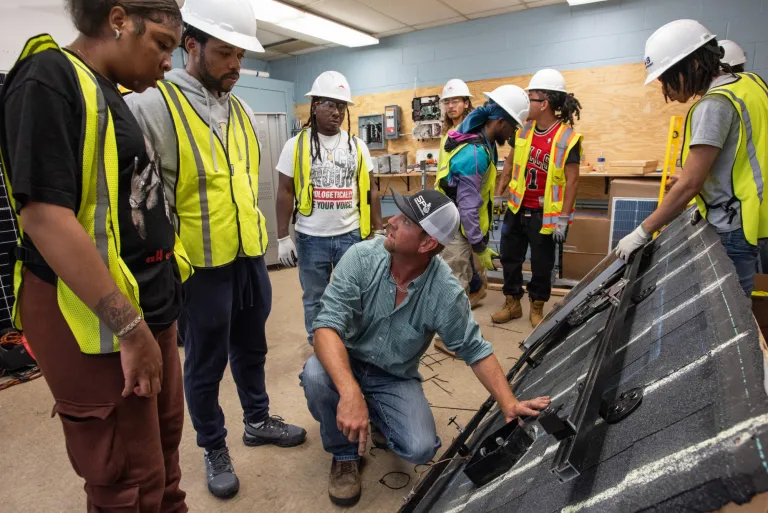
After Illinois passed an ambitious clean energy law in 2017, multiple solar training programs were launched in keeping with the law’s equity provisions. But employers and advocates were frustrated by a seeming disconnect in which many trainees never got solar jobs, and employers weren’t sure how to find the workers.
Since then, the state has passed another clean energy law – the 2021 Climate & Equitable Jobs Act, with even more ambitious equity mandates; and non-profit organizations have developed and honed more advanced workforce training programs. To access incentives under the law, employers need to hire a percent of equity-eligible applicants that rises to 30% by 2030. The program prioritizes people impacted by the criminal justice system, alumni of the foster care system, and people who live in equity-designated communities.
548 affiliates help employers navigate the paperwork and requirements involved in the equity incentives. Several employers at the job fair said this is a plus, but noted that regardless of equity, they are desperate for the type of highly-trained, enthusiastic candidates coming out of the 548 program.
“This is a great way to bridge what the state is trying to do with its clean energy goals, and connecting under-represented people with these opportunities,” said Annette Poulimenos, talent acquisition manager of Terrasmart, a major utility-scale solar provider. “We came here ready to hire, and I think we’re going to walk away with some new talent.”
Member organizations of the Chicago Coalition for Intercommunalism do outreach to recruit most of the training program participants.
Nicholas Brock found out about the training thanks to a staffer at one of these organizations who noticed his professional attitude and punctuality as he walked by every morning to a different workforce program.
“Whatever I do, nine times out of 10, I’m the first one to get there, before the managers,” said Brock, 20. “He noticed that and asked me, ‘Have you ever heard about solar panels?’”
Brock knew little about solar at that point, but now he aims to be a solar project manager.
“I’m so glad I came here,” he said. “They bring out the best in you.”
Wraparound, holistic services are key to the program’s success. During the training and for a year afterwards, trainees and alumni can apply for financial help or other types of assistance.
“There are so many barriers, it might be child care or your car is impounded,” said Williams. “We might be writing a letter to a judge asking to ‘please take him off house arrest so he can work.’ It’s intensive case management, navigating the bureaucratic anomalies that arise when you’re system-impacted.”
Moises Vega III, 26 – who always wanted to work in renewables because “it’s literally the future” – noted that his car battery died during the training program, and he was provided funds to get his vehicle working again.
While ample support is available, the program itself is rigorous and demanding. Classes meet from 9 a.m. to 3 p.m. each day, and trainees are required to check their phones at the door and be fully focused, notes instructor and 548 workforce strategies director Michael Thomas. During the hands-on boot camp week, the day starts at 6 a.m.
“That’s when the trades start,” noted Thomas. “You need to figure out how that works, how will you get child care at 5:30 a.m.?”
Sixty-one trainees started in the first three cohorts, and 46 graduated, the first group in July 2023. The fourth cohort started with 25, and as of the job fair, 18 were on track to graduate. Eighty-five percent of graduates from the first three cohorts are currently working in the field, according to 548.
“Even though I wish the graduation rate were higher, the people who commit to it, stay with it,” said Kynnée Golder, CEO of Global HR Business Solutions, which has an oversight role for the 548 Foundation. “It’s monumental, it’s life-changing for a lot of people.”
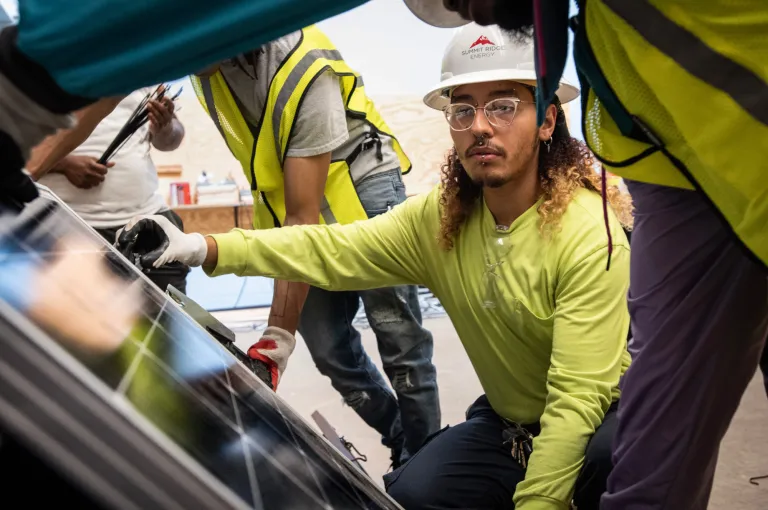
The curriculum starts with life skills, including interpersonal relationships, resume-building, financial planning and more. Each day begins with a spiritual reflection.
The students learn about electricity and energy, and soon move into specific instruction on solar installation and operation. Rooms at St. Agatha’s church served as labs, where students connected wires, built converters and eventually mounted solar panels on a demonstration pitched, shingled roof.
Terrance Hanson, 40, credited Thomas as “the best instructor ever.”
“I’m not a young kid, my brain is no longer a sponge,” Hanson said. “He made sure I got it all. Now I feel like I know so much, I’m confident and prepared to get out and show what I can do.”
He added that people in disinvested neighborhoods have ample untapped potential to be part of the clean energy workforce.
“You see a lot of basketball players in my community because there are a lot of basketball hoops,” he said. “If there were golf courses in the hood, you would see more golfers. It’s about opportunities. And this was the most amazing and empowering thing I’ve ever been through.”
Jack Ailey co-founded Ailey Solar in 2012, making it the oldest still-operating residential installer in Illinois, by his calculations. He noted that there can be high turnover among installers, and intensive training and preparation is key.
“You’re out there in the sun, the cold, it’s heavy physical labor, wrestling 40-pound panels up to the roof,” he said. “You have to know what you’re getting into.”
“Some training programs vary in quality,” Ailey added, but he was impressed by the candidates at the 548 job fair.
Trainees test for and receive multiple certifications, including the OSHA 30 for quality assurance, and the NCCER and NABCEP for construction and solar professionals, respectively. The program is also a pre-apprenticeship qualifier, allowing graduates to move on to paid, long-term apprenticeships with unions representing carpenters, electricians, plumbers and laborers – the gateway to a lucrative and stable career in the trades.
Thomas noted that most trade unions still don’t have a major focus on solar.
“We’re ahead of the unions, and our graduates bring real value to them, and to the companies,” he said. “The students might know more than a company’s foreman knows. It’s a win-win situation. Solar is a nascent industry, there’s so much opportunity in this space.”
When Tredgett Page, 38, connected with 548, his auto detailing work and other odd jobs were not going well. He had always loved science and been curious about photosynthesis and the sun’s power.
“I had been in the streets before, and I was leaning back toward that, but God brought me here,” he said. “Now I have the confidence, I know what I’m talking about, I know about megawatts and kilowatts, net metering, grid-connected, pretty much anything about solar.”
He sees metaphorical significance in his new trade: “Energy is life, and it teaches you balance, it’s all about negative and positive ions.” He feels like “the sky is the limit” after the training.
“I have so much skill that they gave me, now I’m hungry to use it,” he said. “I’m a little nervous, but optimistic, excited, very exuberant!”
OIL & GAS: Officials in oil and gas drilling states say complying with federal endangered species and historic preservation rules is slowing the cleanup of abandoned oil and gas wells. (Grist)
ALSO:
SOLAR:
UTILITIES:
STORAGE:
PIPELINES: Crews rush to install erosion control devices and prepare still exposed portions of the Mountain Valley Pipeline for heavy rainfall from Tropical Storm Debby. (Roanoke Times)
NUCLEAR: Nuclear power is responsible for the largest share of power generation in Southeast states with the least reliance on fossil fuels. (Canary Media)
ELECTRIC VEHICLES: West Virginia lags most states in electric vehicle infrastructure, with additional delays in the transportation department’s search for a vendor to build charging stations. (Charleston Gazette-Mail)
GRID: West Virginia residents and businesses are concerned about Appalachian Power’s plan to upgrade transmission lines near a war memorial and popular trail system. (WSAZ)
OVERSIGHT: An Austin, Texas, board proposes bylaw changes to enable it to advise the city council on natural gas, citing recent price increases as a concern. (Daily Texan)
CLIMATE: Climate change is making wildfires in West Virginia more dangerous, but the state agency charged with managing them has been hobbled by budget cuts. (Mountain State Spotlight)
COMMENTARY:
HYDROPOWER: A study finds climate change-exacerbated drought has diminished hydropower production in Western states, leading to billions of dollars in economic losses and increased natural gas generation. (Energy Mix)
SOLAR: A Hawaii cooperative establishes a community-owned solar system aimed at bringing down power prices and achieving energy sovereignty. (Grist)
GRID:
MINING:
UTILITIES:
WIND: West Coast advocates join other groups to form a national coalition aimed at pushing back on offshore wind development. (E&E News, subscription)
BIOFUELS: A northern California nonprofit secures financing for a proposed 5 MW biomass plant that would process forest restoration project waste. (Renewable Energy)
CLIMATE:
CARBON CAPTURE: Calpine enters a cost-share agreement with the U.S. Energy Department to fund a carbon capture demonstration project at a natural gas plant in California. (Power Engineering)
PUBLIC LAND: The federal Bureau of Land Management issues a proposed plan that would guide renewable energy development and oil and gas drilling on 730,000 acres in New Mexico. (news release)
The following commentary was written by Sophie Loeb, policy analyst at the Center for Progressive Reform, and Michelle Carter, director of clean energy campaigns at the North Carolina League of Conservation Voters. See our commentary guidelines for more information.
If your energy bills seem high this very hot summer, brace yourself. Without drastic measures to curb pollution, summers will be hotter and staying cooler will be more expensive. Unfortunately, the biggest strain on our future electricity bills isn’t our air conditioning, our electric cars, or even our businesses — it’s artificial intelligence (AI).
Data centers have been consuming power all over the country since the 1960s. As the Internet has rapidly been integrated into our lives, so too have data centers. Big data’s assault on North Carolina continues unabated, creating more demand on our energy system and raising our bills.
The new wave of artificial intelligence has the power to change the very nature of our society, in many ways for the worse. Data centers running AI require a constant and consistent power supply, something the utilities in the Southeast have struggled with for decades. These centers raise our bills while providing virtually no benefits to our communities. Data centers across the nation have been given tax incentives, lower electricity rates, and have created few jobs for the amount of resources they use.
As more energy intensive industries take root, we must protect our residents from both the increases in our power needs and our monthly power bills. Unfortunately, Duke Energy’s plans to meet the growing needs of industry expose us to further financial and health risks. Duke Energy claims that their plan, which proposes the biggest methane gas build out in the nation, is needed to meet growing demand, particularly for data centers.
Duke has also warned that ratepayers’ bills will rise if they don’t build these plants, but the opposite is true. Building out solar and utility-scale battery storage instead of gas would yield $8 to $12 billion in electricity savings by 2030 and $18 to $23 billion in savings by 2050. An Environmental Defense Fund (EDF) analysis shows that, for Duke Energy Carolinas customers, increases in fuel costs account for roughly 67 percent of rate increases since 2017. The research is clear: more dirty methane gas means higher energy bills, both now and in the future.
According to Goldman Sachs, data centers will require a $50 billion expansion in electricity generation infrastructure to meet the industry’s demand. This money to build big power plants will come directly from North Carolina consumers like you and me without proper protections from the state.
Why should residential customers, particularly those who struggle to pay their energy bills, pay for these costly plants? Who really benefits from the environmental, social, and economic burdens of artificial intelligence?
Unfortunately, protections from the pressures of data centers are nowhere to be found — for now. Duke Energy has undertaken deals with Microsoft, Google, and other major power consumers to expand renewable generation and protect our grid. Through these agreements, large customers can transition to clean energy while lessening the burden of their power demands on the rest of Duke’s consumer base.
Data centers must be subject to these same agreements — and more — to keep North Carolina ratepayers safe from massive price increases. Consumers deserve transparency and accountability with any new data center project in our state.
In lieu of data centers, North Carolina should invest in good, clean energy manufacturing jobs that promote economic development, resilience, and environmental sustainability. Already, the Inflation Reduction Act is slated to create almost 40,000 jobs by 2030. Tech companies could support these efforts with electric vehicle manufacturing plants, solar panel and battery storage manufacturing facilities, and further build the Southeast as a hub of clean energy manufacturing.
To better center people over tech companies and promote an affordable energy transition:
As temperatures get hotter, there is no doubt our energy bills will go up. However, we must do everything we can to prevent massive projects from raising our bills even more. Investing in energy-draining artificial intelligence data centers not only increases electric rates for everyone, it takes away valuable jobs for rural communities. It’s time to invest in people over profits in North Carolina!
This article was originally published by Canary Media.
A hefty chunk of U.S. emissions comes from the energy used to heat buildings. That means millions of homes must be converted to electric heating in order to meet climate targets.
In Colorado, a 2021 law spurred the state’s largest investor-owned utility to produce a plan that could transition a lot of homes to clean heating — and fast.
Xcel Energy’s Clean Heat Plan was approved this May. It directs more than $440 million over the next three years mainly to electrification and energy-efficiency measures that are meant to reduce reliance on the gas system and cut annual emissions by 725,000 tons.
The utility, which provides both gas and electricity to its customers, filed an initial plan that included proposals to spend heavily on hydrogen blending, biomethane, and certified natural gas. But after strong opposition from clean energy advocates who say these routes do not represent viable pathways to decarbonization, those proposals were reevaluated. Following a motion filed by the Sierra Club, Natural Resources Defense Council, and others last November, Xcel amended its original plan filed with the Colorado Public Utilities Commission.
Now the majority of funds will go toward building electrification and energy efficiency, which the commission found to be the “most cost effective and scalable ways to reduce emissions from burning gas and buildings, both in the short run as well as in the long term,” said Meera Fickling, building decarbonization manager at Western Resource Advocates.
Electrification efforts will primarily take the form of incentives that make it cheaper for customers to switch gas heating appliances to electric heat pumps. The incentives can be combined with federal electrification tax credits and extend to all-electric new construction as well. One-fifth of the program’s funding is earmarked for low-income customers. The plan’s funding is roughly three times the $140 million that the Inflation Reduction Act allocated to Colorado for similar measures.
The utility forecasts gas sales to decline by 14 percent between this year and 2028, The Colorado Sun reports.
While many states have incentives and rebates available for upgrading to energy-efficient appliances and heating solutions, Colorado specifically directs its gas utilities to lead those programs — and holds them accountable for contributing to the state’s climate goals.
That’s why Xcel’s new clean heat program will be “a test case of a utility-led model towards decarbonizing the gas distribution system,” Fickling said. “It really serves as a model — a nationwide model — for how gas utilities can allocate resources to decarbonize their system in the long term.”
Colorado’s push to clean up home heating started three years ago with the Clean Heat Law, which requires gas distribution utilities to create concrete plans to reduce their greenhouse gas emissions 4 percent below 2015 levels by 2025 and 22 percent by 2030. Xcel’s recently approved Clean Heat Plan will carry the utility through 2027, and the utility must propose a new plan in the coming years to meet the next target.
“I expect the next plan to really take a close look at the 2030 target and the trajectory to achieve it,” said Jack Ihle, regional vice president of regulatory policy at Xcel.
The Clean Heat Law was the first of its kind in any state, Fickling said, though others have since taken steps to curtail the climate impact of heating.
Following Colorado’s 2021 law, in 2023 Vermont passed the Affordable Heat Act to reduce emissions from home heating, and Massachusetts drafted similar legislation. This year, Illinois and New Jersey have both introduced bills with clean heating and decarbonization standards.
In Minnesota, the state’s largest gas utility just received approval for a five-year, $106 million plan to reduce its emissions following the state’s 2021 Natural Gas Innovation Act. The utility, CenterPoint Energy, says the plan would “reduce or avoid an estimated 1.2 million tons of carbon emissions over the lifetime of the projects,” though advocates have criticized the approach.
But utilities in Colorado “have a lot more flexibility in terms of the portfolio that they propose,” said Joe Dammel, manager of carbon-free buildings at RMI. While Xcel can prioritize energy efficiency and electrification in Colorado, Minnesota’s Natural Gas Innovation Act requires gas utilities to produce emissions-reduction plans that spend at least half of their budgets on alternative fuels like renewable natural gas, which can still heavily pollute. In Colorado, a much smaller amount is dedicated to alternative fuels; only around $10 million out of the $440 million can be spent on renewable natural gas and recovered methane, and all projects must specifically be approved by the commission.
Another difference between the two recently approved plans is that Xcel delivers gas and electricity to about 1.5 million customers in Colorado, which gives it an opportunity to counterbalance lost gas revenue with increased sales from its electricity business.
Meanwhile, CenterPoint serves gas to about 910,000 customers but has no electricity customers. That gives it fewer opportunities to make up for losses from its gas business driven by electrification mandates, and more incentive to prioritize the use of alternative fuels delivered through the pipelines it owns — and not electrification.
Now that the funds have been approved, Xcel is waiting on a final written order from regulators, which should arrive later this month. From there, it will start implementing the plan and work on defining rebate levels and informing customers on how to access incentives.
The details are still being decided, but customers will likely need to pay first and then get reimbursed later, as is the case for many current rebate programs, said Emmett Romine, vice president of energy and transportation solutions at Xcel. Customers would also get higher rebates if they choose more advanced technologies, like high-efficiency cold-climate heat pumps.
Beyond educating customers, the company is putting workforce-training plans together to ensure there are enough heat-pump installers ready to help customers convert. Xcel is also working with distributors and manufacturers “to make sure that there’s a supply chain that will come to Colorado when we stimulate demand,” Romine said.
The plan represents a significant step up from Xcel’s current pace of upgrades. “The goals are really aggressive,” Romine said. “When you look at the number of heat pumps and the number of water heaters we’ve got to contemplate getting into homes, it’s an enormous amount of work.” Currently, Xcel does around 10,000 rebates a year for traditional gas furnaces. Now, it’s aiming to do 20,000 heat-pump conversions this year and just under 100,000 total by the end of 2026, Romine said.
That supercharged effort won’t come without costs. Ratepayers will see electricity rates go up by 1.1 percent and gas rates rise by 7 percent over the next four years due to the plan. But advocates say it’s worth it to avoid pouring money into a gas system that must be phased out — and that the climate benefits outweigh the upfront costs. Even without the Clean Heat Plan, Xcel projected it would need to increase base rate revenue by 32 percent between 2023 and 2030, The Colorado Sun reported.
Colorado’s plan “is a very good example of needing to pursue both sides of the equation at the same time — decarbonization, electrification — but at the same time ensuring that we’re starting to shrink and eliminate unnecessary investments in the gas system,” said Alejandra Mejia Cunningham, senior manager of state buildings policy at the Natural Resources Defense Council.
The Public Utilities Commission has encouraged Xcel to report its progress by 2026, ahead of the legally mandated schedule, Ihle said. Advocates will be watching closely to see how it all plays out.
“We’re gonna have to make sure that we’re seeing the results of that in terms of participation, customer satisfaction, and ultimately emissions and cost reductions,” Dammel said. “There’s going to be a lot of utilities across the country following this.”
FINANCE: A new U.S. Treasury analysis finds that almost 160,000 Pennsylvanians claimed more than 260 million in Inflation Reduction Act tax credits on their 2023 taxes for clean energy and efficiency improvements. (Environment America)
BATTERIES:
TRANSPORTATION: While a New York City deputy mayor says officials aren’t “waiting on congestion pricing” to limit emissions and fund transit projects, she notes that the city won’t do a full analysis on how to course correct until after a final decision is made on the fate of the program. (City & State)
CARBON CAPTURE: Some Pennsylvania environmentalists want lawmakers to repeal recently signed legislation that outlines a regulatory framework for the carbon capture industry, saying the technology’s climate-mitigating potential is overstated. (EHN, Capital & Maine)
SOLAR:
WIND:
BIOENERGY:
GRID: Central Maine Power says it will route one of four New England Clean Energy Connect power line converter station transformers from Auburn to Lewiston on Thursday evening. (Sun Journal)
OIL & GAS: Some drillers in Texas’ Permian Basin are paying buyers to take their excess supply because they’re producing so much natural gas they’ve exceeded available storage space and pipeline capacity. (New York Times)
ALSO:
SOLAR:
COAL:
GRID: Louisiana residents complain to local and state officials about frequent outages in an area managed by Entergy. (WVUE)
UTILITIES:
CLIMATE: As Tropical Storm Debby swamps the Carolinas, causing widespread outages and threatening a Georgia dam, experts say climate change is making tropical cyclones even worse. (Charleston Post and Courier, The State, WAGA, Inside Climate News)
BUILDINGS: A technology company experiments with using Virginia dredging waste as an ingredient in concrete to lower its carbon footprint and make a stronger product. (Virginia Mercury)
STORAGE: An Oklahoma fire department posts a video of a dog sparking a fire by chewing on a lithium-ion battery to its Facebook page as a warning to residents. (Associated Press)
EFFICIENCY:
COMMENTARY: West Virginia regulators’ push to prop up coal is harming state residents and their pocketbooks, writes an environmental policy analyst. (West Virginia Watch)


.svg)
