

 Back
Back
Editor’s note: Miles Braxton’s company is Okovate Sustainable Energy. A previous version of this post misspelled the company’s name.
Agrivoltaics — co-locating solar arrays with farming operations — is generating enthusiasm among both farmers and clean energy advocates as a way to promote sustainability in agriculture.
When implemented correctly, agrivoltaics provides a vital dual income stream for farmers — in solar energy generation, but also as a means of providing an optimal growing environment for compatible crops and herds. The added revenue may allow more farmers to retain their land for themselves and future generations.
While pilot projects around the country are identifying best practices, not all have been successful, and practitioners say that advancing the technology will require an equitable approach that centers farmers’ needs first.
A discussion during the recent Solar Farm Summit in Rosemont, Illinois, directly addressed the issue, featuring a majority-Black panel of practitioners and service providers. Three major themes emerged during the discussion: maximizing compatibility of solar arrays with existing land use, demonstrating the financial benefits of agrivoltaics, and addressing how solar power can help BIPOC farmers hold on to their land.
“I think one thing that, through our work in this technical assistance, has become very, very clear [is] that people don’t just want to build an agrivoltaics project for the sake of building an agrivoltaics project,” said Jordan Macknick of the National Renewable Energy Laboratory (NREL), who also served as moderator for the discussion. “How does agrivoltaics enable you to take that next step and focus on things like succession planning or farmer training?”
Miles Braxton started his company, Okovate Sustainable Energy, to work exclusively on “farmer-focused” solar development.
Braxton said after several years of developing community solar projects, he “really saw the inefficiencies” of taking farmland out of production for solar projects. “That’s a problem that is just going to keep piling on top of itself until it gets to the point where we can’t develop anything.
“We target crop farmers who are growing a very specific suite of crops that we know works well with our design,” Braxton said.
Cetta Barnhart, owner of Seed Time Harvest Farms in Florida, also cultivates her own plot of fruits and vegetables, and cited her background in food and wellness in promoting the compatibility of solar and agriculture to benefit the bottom line for farmers.
“This is more hands-on of what a farmer can really do in their current practices. If they’re raising cattle, there’s a way that they implement solar with that. If they are having bare land, the pollinator is another way that they can benefit from that,” she said. “So how these solar projects are developed and created for real farmers is still a big conversation to be had.“
Ena Jones, owner of Roots & Vine Produce and Café, and president of Community Partners for Black Farmers, cited her dual role as a working farmer and an advocate as an advantage in promoting the potential compatibility of agrivoltaics and cultivation — especially for Black farmers.
“We advocate and we also lobby for farmers at the state level for the state of Illinois and the state of Georgia. And I’m here to kind of segue to help farmers understand … how different solar opportunities can help them with production on their farms, and be an asset to the production on their farms. And also, to help solar developers understand farm[ing],” Jones said.
Noting that solar projects can help cut energy costs, Jones said “Energy use is one of the farmer’s [major] expenses outside of diesel, and of course seed. So, if they can reduce that cost dramatically, even by a third, that would impact their bottom line in revenue extensively. It is very important, especially for BIPOC farmers, to be ushered into this technology so that they won’t be left behind in the process.”

Agrivoltaics can be a valuable tool to reduce overall costs, expand potential revenue – or both – as a means of promoting optimal use of farmland. A both-and approach can work to address what is often an inherent tension between the best use of large, flat plots of land for large solar arrays – parcels that also frequently comprise some of the richest soil for cultivation.
For example, the 180 MW Madison Fields project in Ohio represents a test ground for large-scale agrivoltaics – farming on 1,900 acres between the rows of a utility-scale solar array. One of the project’s focuses is determining which crops and herds are the best prospects to coexist with large-scale solar developments.
“People have a lot of questions with regard to energy development going forward in this state … Finding a balance where you can do a number of things on the same ground — in this case energy production as well as agricultural production — is obviously huge,” Dale Arnold, director of energy policy for the Ohio Farm Bureau told the Energy News Network in July.
Macknick highlighted another project where NREL and Clean Energy to Communities (C2C), along with the Black Farmers Collaborative, worked on a proof of concept project which incorporated solar panels on a demonstration farm cultivated by Barnhart that features citrus trees, leafy greens, and other produce.
“I had already looked into doing solar on my property and was just looking at it to have solar as the backup,” Barnhart said. “But when we started talking as a team and then we found out about the agrivoltaics portion [and] how that can be incorporated into farming, it really brought forth a bigger and better opportunity to not just benefit by having it but also sharing that with other farmers,” Barnhart told NREL in 2023.
Mike DellaGala of Solar Collective said taking a farmer-centered approach can also be beneficial to product and service providers.
“I think a lot of the conversation … has been the difference between farmers and developers, and how we are or [are] not communicating and getting projects over the finish line or not. And I think… if you’re farmer-first or farmer-centric, I think that’s the way to success for everybody… allowing [farmers] to dictate a lot of the project details has been really successful for us. And it makes our job easier, frankly,” DellaGala said.
A farmer-centric and collaborative approach is especially vital in ensuring equitable access to the benefits of agrivoltaics for BIPOC farmers, Barnhart said.
“I stand in the gap somewhat between having conversations with [BIPOC] farmers and having conversations with project developers because you need someone in the middle. I’m a community advocate. I hope there are more of us in the room than not. They have to be in place in order to bridge the conversation as to how this really works well in real-life time,” Barnhart said.
Braxton cited the need to rein in the power of utilities, which he says frequently raise roadblocks to community-level projects to protect their own interests.
“Utilities have too much power. They have too much money to lobby. They don’t want you to sell power back to your community because [of the impact to] their own rates that they can control. So that’s a risk. The root of those problems is that here in the U.S. … we have 50 little countries [states] that make up their own policies and do their own thing… I think there needs to be a policy to incentivize solar to be developed innovatively. I don’t think policy makers at the state level understand the importance of that,” Braxton said.
Jones noted that policy change will likely be driven by farmer demand, which by extension benefits the larger community.
“In my opinion, once the farmers understand [how solar can] help them on their farms, I can’t say this enough, they will force politicians to comply. The money will be there; the funding will be there. But the engagement needs to happen. It desperately needs to happen,” she said.
Loss of land –through racism and other factors, has long been a contentious topic among BIPOC farmers – and Black farmers in particular. According to a 2022 study, discriminatory federal policies contributed to Black farmers losing roughly $326 billion worth of acreage during the 20th century. In July, the Biden-Harris administration announced a distribution of $2 billion to thousands of Black and other minority farmers, created through the Inflation Reduction Act as a means to begin to address this inequity.
Agrivoltaics may not intuitively track as a relevant strategy for land retention; but Barnhart touted its value, especially for Black farmers.
“[Black farmers] have lost a lot of land because we just couldn’t afford to keep it… We didn’t just lose land because it was confiscated… What solar does is add an income stream or a reduction in your expenses so that there’s more you can do on your farm and create an opportunity for the next generation.
“It gives us a reason to keep the land going, and it gives us, in our community, resiliency we are experiencing through our climate change storms. For the families that can have that piece of land, that builds a resiliency to protect them in their neighborhoods, protect their own backyard, and protect the future generations, give the future generations something they can look forward to that makes sense to them. Then we build into something that takes care of our wealth building opportunities, our succession planning, and our look into the future to make a change,” Barnhart said.
Xcel Energy is proposing a new approach to powering the grid in Minnesota.
The utility recently told state regulators it wants to build a network of solar-powered energy storage hubs, located strategically on its grid and linked with technology so they can be operated in concert with each other.
The result would be what’s known as a “virtual power plant.” By simultaneously discharging the batteries, for example, the collection of distributed resources can function similar to a conventional power plant.
It’s a solution some clean energy advocates have long pushed for as an alternative to larger, centrally located projects that are more reliant on long-distance transmission and create fewer local economic benefits. Xcel’s new embrace of the concept likely reflects the evolving economics of clean energy and the urgency to replace generation from retiring coal-fired power plants.
“I welcome our now-agreement about the importance of distributed energy resources in their future procurement plans,” said John Farrell, director of the Energy Democracy Initiative at the Institute for Local Self-Reliance.
Virtual power plants use sophisticated software and technology to aggregate energy from batteries, smart thermostats, electric vehicles, storage and other connected devices. The clean energy nonprofit RMI predicts virtual power plants nationally could reduce peak loads by 60 gigawatts and cut annual energy expenditures by $17 billion by 2030.
Several utilities, as well as solar and storage companies, have developed virtual power plant programs around the country. Perhaps the best-known is National Grid’s ConnectedSolutions program in New England, which includes residential batteries, electric vehicle batteries, and thermostats.
In May, Colorado Gov. Jared Polis signed legislation requiring Xcel Energy to create a virtual power plant plan in that state by next February.
Xcel is pitching the Minnesota project on its own as part of its latest long-range resource plan. In a recent Public Utilities Commission filing, Xcel proposes combining 440 megawatts of solar power with 400 megawatts of battery storage at dispersed locations. Designed to be flexible, the program might add backup generation and energy efficiency measures in the future.
A virtual power plant, Xcel said, would save ratepayers money, improve reliability, accelerate clean energy development, and reduce energy disparities by playing assets in underserved communities. The “new approach equips us to confidently meet incoming load growth, deliver unique customer and community value, and support economic development,” the company said in its filing.
Kevin Coss, a spokesperson for the company, said the proposal “is part of a larger plan to better serve the grid and our customers while meeting anticipated growth in energy demand. The program would grow our distributed energy resources as a complement to our existing plans for additional utility-scale renewable and firm dispatchable generation to advance the clean energy transition.”
Clean energy advocates say the approach could reduce Xcel’s need to build more infrastructure at a time when electricity demand continues to grow and its fleet of aging fossil fuel plants reach closure dates.
A recent study in Illinois suggested that pairing solar with storage could be the most economical and environmentally beneficial way to maintain grid reliability as the state transitions to 100% clean energy.
“Utilities always treated distributed energy resources as something that happened to them and that they had to figure out how to accommodate because they were being told to,” said Will Kenworthy, Vote Solar’s Midwest regulatory director.
The company’s interest in more distributed resources could lead to a more flexible grid, one that helps mitigate substations congestion and allows it to store energy from wind farms for use during high-demand periods, Kenworthy said.
One area of disagreement between the utility and some clean energy advocates is who should own the facilities. Unlike in Colorado, Xcel is proposing to own the Minnesota solar and storage hubs itself, collecting money to build them — plus a rate of return — from ratepayers.
That’s not the best deal for customers, and it prevents local communities and developers from being able to share the financial benefits of distributed energy, said Farrell, of the Energy Democracy Initiative. If Xcel owns the virtual power plant, the cost could be higher than they would be with an open, competitive process.
Farrell pointed to the recent opposition to an Xcel electric vehicle charging plan in which it sought to own all of the chargers. Convenience stores and gas stations argued Xcel had an unfair market advantage as the incumbent utility and would own too much of the state’s charging network. Xcel withdrew the proposal in 2023 after regulators reduced the charging network’s size.
As Xcel’s plan evolves, Farrell wants Xcel to allow businesses, homeowners, and aggregators to also participate by selling their battery capacity or demand response into the program.
The Minnesota Solar Energy Industries Association, which promotes battery storage, also takes a dim view of Xcel owning a virtual power plant.
“This is an area where competition would likely provide better service, lower cost and more choice to ratepayers,” said regulatory and policy affairs director Curtis Zaun. “Monopolies are not particularly good at providing the best service at a reasonable rate because that is inconsistent with their investors’ interests.”
Virtual power plants are different than demand response, such as thermostat savings programs, in that they add value to the grid “without any change needed to the homeowner’s behavior,” said Amy Heart, senior vice president for policy at Sunrun, a home solar and storage company that participates in virtual power plants in the Northeast and in Texas, California, and Puerto Rico.
Heart said the “devil is in the details” when creating a robust demand response program. A program in Arizona failed, she said, because of the underperformance of the single company it selected to aggregate resources.
Sunrun developed a virtual power plant in four New England states, enrolling more than 5,000 solar and storage customers to share their capacity on the grid. In the summer of 2022, Sunrun’s virtual power plant shared more than 1.8 gigawatt hours of electricity.
Typically, Sunrun customers agree under contract to share a portion of their battery backup 30 to 60 times annually for three hours or less for each event. The process is automated, with Sunrun’s software connecting to customer batteries and sending utilities power during high-demand times or predictable peak loads. Customers receive payment for the electricity provided.
Heart said the best systems are open to individual customers and aggregators using different battery storage brands. Giving a virtual power plant “room to grow, breathe, and adapt will be important,” she added.
The Xcel virtual power plant proposal is part of the multi-year Upper Midwest Integrated Resource Plan, which regulators have been reviewing and will likely approve, with many changes, later this year.
An array of critics came out swinging in January when Duke Energy first filed its plans in North Carolina for one of the largest fossil fuel investments in the country.
But as the months have dragged on in the development of the company’s biennial carbon-reduction plan, some notable detractors have relented.
Just before expert witness testimony was set to begin in Raleigh late last month, the state-sanctioned ratepayer advocate, Public Staff, and Walmart endorsed a settlement with Duke on its blueprint, which includes building 9 gigawatts of new natural gas plants that the utility says could be converted to run on hydrogen in the future.
A few days later, the Carolinas Clean Energy Business Association, a consortium of solar and wind developers, announced it had signed on too.
The agreement, which contains some small concessions from the utility, led to low-key hearings that ended in less than two weeks. It makes it more likely that Duke will get what it wants from regulators by year’s end, including a greenlight, if not final approval, for three large new natural gas plants in the near term.
Chris Carmody, executive director of the Carolinas Clean Energy Business Association, says the proposed compromise also helps lock in forward progress on solar energy and batteries, however incremental.
“It’s a more aggressive solar spend. It’s a more aggressive storage spend,” he said. “Certainly, we would like to see more. But first of all, we like to see it going in the right direction.”
Clean energy advocates believe Duke’s push for new gas plants will harm the climate, since the plants’ associated releases of planet-warming methane will cancel out any benefits of reduced carbon pollution from smokestacks. At the same time, they say the investments could become useless by midcentury or sooner, before their book life is over, saddling ratepayers with costs that bring no benefits.
“There’s not much in it for their customers except unnecessary risk, cost, and more pollution,” Will Scott, southeast climate and clean energy director for the Environmental Defense Fund, wrote in a blog last month.
But Duke’s gas bubble has proved hard to burst. For one, the company’s predictions of massive future demand from new data centers are based in part on confidential business dealings that are challenging to rebut from the outside.
Unlike two years ago, when Duke proposed its first carbon reduction plan, no groups produced an independent model showing how Duke could meet demand without building new gas.
“We can talk about costs, or market conditions,” said Carmody. But, he said, “we did not do any modeling.”
Public Staff ran its own numbers and has urged more caution on new gas plants than Duke proposes. But the agency is unwavering that at least some are needed.
New Biden administration rules haven’t yet proved the death knell for gas that some expected. Duke is suing to overturn the rule, but it insists that building new plants that will run at half capacity is the most economical plan for compliance.
And even as Duke is proffering more gas, it’s also undeniably proposing more solar.
Clean energy backers still object to annual constraints on solar development the utility says are necessary. But the limits have increased from less than 1,000 megawatts per year in 2022 to over 1,300 megawatts. And the settlement would result in another 240 megawatts of solar than Duke had first proposed.
“It’s an iterative improvement,” said Carmody.
What’s more, the settlement opens a discussion with Duke about the scores of 5-megawatt solar projects across the state whose initial contracts will soon expire. A proposal for how to refit them could come in April of next year.
“This is a really important issue to our members,” said Carmody. “These are projects that could be repowered. They could be upgraded with storage. They could have significantly more efficient solar technology than was on them 15 or 20 years ago.”
Still, Carmody said his group tried to word the settlement in a way that left room for clean energy advocates to continue to advocate for less gas and steeper emissions cuts sooner — and that’s certainly their plan.
“Three power plants that will be really expensive to build and then operate for only a few years is just a ridiculous proposal,” the settlement notwithstanding, said Maggie Shober, research director for the Southern Alliance for Clean Energy.
“We remain hopeful that there’s a lot that the [commission] can do in this carbon plan proceeding and in their final order, to move us forward on a clean energy trajectory.”
Nick Jimenez, senior attorney for the Southern Environmental Law Center, acknowledges the settlement stacks the deck somewhat against his clients.
“Historically, the commission approves a lot of settlements,” he said. “It likes to see parties settle, especially when Duke and the Public Staff are involved.”
RENEWABLES: Wind and solar for the first time are on track to generate more power than coal plants in the U.S. this year thanks to a surge of solar deployment in 2023. (E&E News)
SOLAR:
POLITICS:
BUILDINGS:
CLIMATE: Three Democratic Congress members ask a national insurance body to detail how it’s incorporating climate risks into the industry. (The Hill)
COAL: Wyoming leads 17 other states in a lawsuit seeking to block new U.S. EPA coal ash impoundment rules scheduled to take effect in November. (Cowboy State Daily)
CARBON CAPTURE:
HYDROGEN: A firm pauses development of a proposed hydrogen production hub in Washington state, citing uncertainty over tax incentives and a lack of affordable renewable energy. (Washington State Standard)
North Carolina regulators have approved a controversial green tariff proposal from Duke Energy, rejecting protests from critics who argue it won’t bolster the company’s transition to zero-carbon electricity.
Originally designed as a way for large electric customers to chip in extra for renewable energy projects Duke is already mandated to build, an amended tariff offered in April could allow some customers to speed up construction of new solar farms by about two years.
The revision appeared to help sway the Utilities Commission. The change, the panel said in its Jul. 31 order, is an “improvement” because the change “adds additional accelerated capacity” of renewable energy.
The revised tariff, called Green Source Advantage Choice, has backing from the Carolina Industrial Group for Fair Utility Rates, an association of some of Duke’s largest customers. The utility says it plans to formalize the program soon in the wake of the regulators’ order.
“The [commission] didn’t give us a deadline but asked that we do so when reasonably feasible,” spokesperson Logan Stewart said over email, “so it will be in the coming weeks. In conjunction, we will be working on updating the Green Source Advantage public webpage to include the new program details.”
For large customers with 100% clean energy commitments, a green tariff is a necessity in North Carolina, where Duke has a monopoly and cities, data centers and the like can’t buy clean energy directly from solar farms.
In theory, a green tariff allows a company such as Google or Amazon to spur a new supply of clean energy equal to their electric demand, with Duke acting as an administrative go-between. An earlier iteration of Green Source Advantage more or less did just that.
But the accounting got more complicated in 2021, when a bipartisan state law required Duke to cut its carbon pollution at least 95% by 2050. If the company is legally required to build scores of solar farms anyway, can a large customer legitimately claim its sponsorship of one project makes a difference?
This question of “regulatory surplus” sparked a flurry of arguments and counter-arguments before the commission for some 18 months. Duke initially claimed such “additionality” was neither feasible nor necessary, and some businesses said chipping in to support the clean energy transition was good enough for them. More than a dozen local chambers of commerce and potential customers wrote regulators in support of the original program.
But Google, the U.S. Department of Defense, and other large customers joined clean energy advocates to flag the problem of regulatory surplus, as did the Center for Resource Solutions, the nonprofit that certifies voluntary renewable energy purchase programs. Duke University, which has no connection to the utility, said it wouldn’t participate in the tariff.
The debate, along with prodding from commissioners, prompted Duke to add a “resource acceleration option” to its proposal. The alternative allows large customers to advance about 150 megawatts of solar energy each year by sponsoring projects not selected in the company’s annual competitive bidding process. Every two years, Duke gets retroactive credit for this “extra” solar as part of its compliance with the 2021 law.
Clean energy advocates believe the new option is a “small step in the right direction.” But they note it accounts for 1 gigawatt of clean energy over ten years, a fifth of the entire program. Customers who lay claim to the remaining 4 gigawatts would not be impacting the state’s transition to clean electricity, they say.
“If you’re the customer of a business who claims to support our state’s clean energy transition by participating in the program, you’re going to expect that business to be making a difference – not just subsidizing what Duke was going to do anyway,” said Nick Jimenez, senior attorney at the Southern Environmental Law Center.
The Carolinas Clean Energy Business Alliance, a group of clean energy suppliers, also criticized the acceleration option. And though the Carolina Utility Customers Association, another group of large industrial customers, didn’t oppose the amended proposed tariff, it registered skepticism.
“[Our] members have little interest in the Resource Acceleration Option,” the group said in a letter to regulators, “which would deliver electricity at a premium cost without providing the benefit of regulatory surplus-based environmental attributes that would be useful in meeting corporate environmental, social, and governance goals.”
While advocates see little good in the commission’s approval of the Green Source Advantage Choice program, they still have some faint cause for hope.
One is the so-called Clean Transition Tariff, which Duke could propose later this year. An outgrowth of a May agreement between the utility and Amazon, Google, Microsoft, and Nucor, that program could allow participating customers to spur new projects, such as solar-battery storage combos or small nuclear energy, that provide carbon-free electricity around the clock.
“This is not within the order,” said Jimenez, but the May memorandum of understanding, “is the big opportunity for something better.”
Duke says the Clean Transition Tariff would be another voluntary option for customers, not a replacement for the one just greenlighted. “We see the approval of Green Source Advantage Choice as a first step,” the company’s Stewart said, “enabling us to move forward with new tariffs like the Clean Transition Tariff.”
Maggie Shober, research director at the Southern Alliance for Clean Energy, agrees the memorandum of understanding is cause for some optimism. But she also notes that it’s only “an agreement to talk about something. It could be an opportunity,” she said, “or it could be a missed opportunity. “
And no matter what, the Clean Transition Tariff won’t cater to municipalities and other midsize customers with climate commitments. If these customers decline to pursue Green Source Advantage Choice, their only option is to wait for Duke to adjust.
Commissioner Jeff Hughes pointed to that possibility in a concurring opinion.
“Once the program offerings are launched, it will quickly become clear whether the program is as attractive as Duke asserts,” Hughes wrote. “If concerns continue and interest is modest from the outset, it is my hope that Duke will work quickly on new programs that will have a greater impact.”
WIND: Federal officials designate Equinor the provisional winner of a 2 GW offshore wind energy lease auction off the Delaware coast; bidding started at $10.1 million, but the developer locked in at $75 million. (Maryland Matters)
ALSO:
SOLAR:
PIPELINES: The Conservation Law Foundation says National Grid isn’t doing enough to handle the hundreds of leaking gas pipelines around the Greater Boston area, 15 of which are imminent explosion and fire hazards. (Boston Herald)
BUILDINGS: Philadelphia’s school district touts the new cooling systems in ten of its schools, but dozens of schools still lack A/C, a problem that hinders education when children have to be sent home during too-hot conditions. (WHYY)
BIOENERGY: In Burlington, Vermont, activists against a wood-fired power plant say the facility’s $8 million in expected losses this year — not to mention the emissions and its relative inefficiency — should be enough to shut it down. (Seven Days)
ELECTRIC VEHICLES: Connecticut utility commissioners decide electric utilities can apply for annual cost recovery related to the mandated electric vehicle charging incentive program, although some advocates say it will cause additional stress on ratepayers. (Hartford Courant, News Times)
BATTERIES: A Long Island, New York, town fails to pass a proposed one-year moratorium on new large battery storage systems after several neighboring municipalities passed similar moratoriums. (Newsday)
GRID: Workers begin installing roughly 100 miles of underwater power cables in Lake Champlain for the Champlain Hudson Power Express transmission project. (NCPR)
POLITICS: Many New Hampshire gubernatorial candidates support renewable energy but have starkly different approaches for increasing the state’s capacity. (Concord Monitor)
RENEWABLE ENERGY:
SOLAR: The impending construction of a solar panel factory shows how the industry is bringing jobs and investment to Virginia, even as nearly a third of all counties in the state have passed regulations restricting solar project development. (WVTF)
ALSO:
WIND:
OIL & GAS:
CARBON CAPTURE:
COAL: The son of a late coal baron has acquired an Alabama coal mine that nearby residents say caused a fatal home explosion earlier this year. (Inside Climate News)
UTILITIES: CenterPoint Energy, now under fire for its response to widespread outages in Houston after Hurricane Beryl, has courted dozens of current and former state lawmakers at its private conference center. (Houston Chronicle)
POLITICS:
DALTON, Ga. — Growing up in Cartersville, Georgia, Lisa Nash saw what happens to communities when factory jobs disappear. It was the 1980s and corporations were offshoring production to reduce costs and raise profits. The jobs that remained in this northwest corner of the state were typically lower-paying ones that didn’t offer the same ladder to the middle class.
“My parents and grandparents were in manufacturing, and they were the ones saying, ‘Don’t do it,’” Nash recalled.
Nash disregarded their advice, embarking instead on a long career in manufacturing — first in textiles, followed by stints in aviation, automotive, and steel. Now she’s helping to bring higher-tech, higher-paying factory work back to the corridor between Atlanta and Chattanooga.
Nash is the general manager of the Qcells solar panel factory in Dalton, a town of 34,000 located 50 miles up I-75 from her hometown. It opened in January 2019, after the Trump administration imposed a fresh round of tariffs on Chinese-made panels. The Korean conglomerate Hanwha owns Qcells, and initially planned to hire several hundred people at the site, Nash told me on a recent visit to the factory. By the end of 2019, it employed more than 800.
Then, in 2020, Georgia helped elect President Joe Biden and sent two Democrats to the Senate, clinching a thin majority. Senators Jon Ossoff and Raphael Warnock got to work crafting detailed policies to promote domestic manufacturing of clean energy technologies, which China had dominated for years; they wanted solar panels and batteries made in America — specifically Georgia — instead of in China, a geopolitical rival.
Those measures made it into the Inflation Reduction Act, which passed in August 2022 — two years ago this week. The legislation created the nation’s first comprehensive policies to support domestic clean energy manufacturing. Qcells broke ground on a second facility in Dalton in February 2023. Completed that August, the expansion added two football fields’ worth of manufacturing space with four new production lines — which produce 1.5 times more solar panels than the original three lines, thanks to technological advances. Now the whole complex employs 2,000 people full time and makes 5.1 gigawatts of solar panels a year, more than any other site in the U.S.
Politicians have been promising for decades to retrain American workers and revive long-lost manufacturing, with little to show for it. Now, though, the U.S. has entered a new era on trade: Leaders of both parties have rejected the long-standing free-trade consensus and its penchant for offshoring jobs. Biden married that reshoring impulse with a desire to boost clean energy production, to both stimulate the economy and fight climate change.
This grand experiment remains in its infancy, and the success of the clean energy manufacturing revolution is by no means guaranteed. Cheap imports could outcompete even newly subsidized American products.
And if Republicans win the presidency and retake Congress, they’ve threatened to stop subsidizing low-carbon energy resources and instead double down on fossil fuel production. House Republicans — including Dalton’s representative, Marjorie Taylor Greene — have voted repeatedly and unsuccessfully to repeal the domestic manufacturing incentives in the IRA. (Greene’s press office did not respond to multiple requests for comment.)
“Donald Trump and his Republican allies promised to gut the Inflation Reduction Act if he’s reelected, so there’s a lot at stake here,” Representative Nikema Williams, who leads the Georgia Democrats, told me.
Since the IRA passed, Georgia has received $23 billion in clean energy factory investment, much of it flowing to northwest Georgia. I wanted to see what impact this is having on communities formerly hit hard by industrial decline, so I followed the money trail to Dalton earlier this summer.
I found a population that seems to like having advanced solar manufacturing in their backyard. Dalton’s solar jobs are boosting wages, invigorating the historic town center, and employing local high school graduates. Those benefits are starting to spread to nearby communities, where new solar factories are springing to life. In November, voters will weigh two very different visions of America’s energy future on the ballot, but Dalton is already reaping the rewards from slotting solar into its storied history of industrial production.
Both CSX and Norfolk Southern run Class I rail lines through Dalton, a testament to its industrial legacy, and freight trains bellow day and night.
That legacy harks back to 1900, according to local historians, when Catherine Evans Whitener sold a hand-tufted bedspread from her front porch for $2.50. The cottage industry took off in this land of forested ridges and stream-crossed valleys, and over time, local factories consolidated into global carpeting giants Shaw Industries and Mohawk Industries.
“The carpet industry was born here,” Carl Campbell, executive director of economic development at the Greater Dalton Chamber of Commerce, told me when I visited the Chamber. The New Georgia Encyclopedia states that 80 percent of America’s tufted carpet production happens within 100 miles of Dalton.
The conference room where we spoke sported large-format aerial photographs of the major factories nearby: the largest Shaw site, 650,000 square feet; and the new Engineered Floors colossus, 2.8 million square feet.
“You feel like there’s enough carpet in that building to cover the whole world,” said Campbell, who grew up in Dalton.
Dalton employment numbers peaked at 80,200 in 2006, per the Chattanooga Times Free Press. But the Great Recession crushed the homebuilding industry, cratering demand for Dalton’s carpeting products.
Dalton “was a ghost town in 2011, nothing going on because everybody was hurting,” Campbell added. From June 2011 to June 2012, Dalton notched the dubious distinction of most jobs lost of all 372 metro areas surveyed by the Bureau of Labor Statistics. By that point, one-quarter of Dalton’s pre-recession jobs had vanished, and unemployment surged to 12.3 percent.
Since then, the industry has recovered somewhat. Engineered Floors, Mohawk, and Shaw still dominate local employment, with some 14,000 jobs among them, Campbell said. Those companies have had to adapt to evolving consumer tastes, shifting from wall-to-wall carpets to hardwood and other flooring materials. They’ve also automated aspects of production, reducing the number of workers needed.
In the wake of the Great Recession, local leaders sought to diversify Dalton’s industry. The county acquired an undeveloped lot south of town, and Campbell later pushed to clear and level the site, so it was shovel-ready for some future tenant. When Trump’s solar tariffs kicked in, Campbell’s counterparts at Georgia’s Department of Economic Development sent Qcells his way.
Qcells showed up in February 2018, looking to spin up its first American solar-panel factory in less than a year. “Suddenly, we had exactly what they needed,” Campbell said.
Thus Dalton managed to bring in new industry to balance out its base of carpets and flooring. Qcells originally promised to invest $130 million and hire 525 people within five years, Campbell said.
“They did it in three months,” he added. “In terms of an economic development project, they check all the boxes: Everything they said they would do, they did it faster than they said they would do it.”
When I asked folks around town what they thought of Qcells, they kept mentioning the dozens of air-conditioning units arrayed on the factory roof, like a field of doghouses, easily visible from I-75. I later learned that Qcells brought in helicopters to install those units, which made for a bit of small-town spectacle. Still, it struck me as a surprising detail to dwell on for a business that somehow turns the sun’s rays into cheap, emissions-free electricity.
Once I crossed Qcells’ sizzling parking lot and stepped indoors, it started to make sense. Georgia gets hot, and carpet factories get hot, but the vast floors of the twin solar factories are quite literally cool places to work.
The climate control is not unique to assembling solar panels, but it is required for the sensitive, precisely calibrated product. The air conditioners are but one sign that high-tech manufacturing has arrived, and that it makes for pretty comfortable work.
I met my two tour guides, Wayne Lock and Alan Rodriguez, in the factory lobby, and they quickly confirmed the physical appeal of Qcells jobs. Lock, now a quality engineer at Qcells, previously worked in carpet manufacturing; he had to wear special heat-resistant gear to handle carpeting materials that would otherwise deliver third-degree burns. Rodriguez, an engineering supervisor at Qcells, used to apply the coating material underneath carpets.
“You’re sandwiched between the steamer and the oven, so it gets quite hot,” Rodriguez told me. Attending to those machines exposed him to temperatures that could exceed 100 degrees Fahrenheit.
Even more than Qcells’ air conditioning, though, people I spoke to kept bringing up the pay.
By offering more for zero-skill, entry-level positions than the other factories in town, Qcells started attracting workers and pushed up wages across Dalton, Campbell said: “Competition brings everybody, so everybody’s had to kind of equalize to keep employees.”
Now Qcells hourly wages for non-experienced hires start at $17.50 to $22 — that amounts to $36,400 to $45,760 a year for full-time work. Workers with experience in robotics and manufacturing can take home much more than that. Employees can raise their pay through a variety of on-the-job training, most of which involves handling and troubleshooting the in-house fleet of robots.
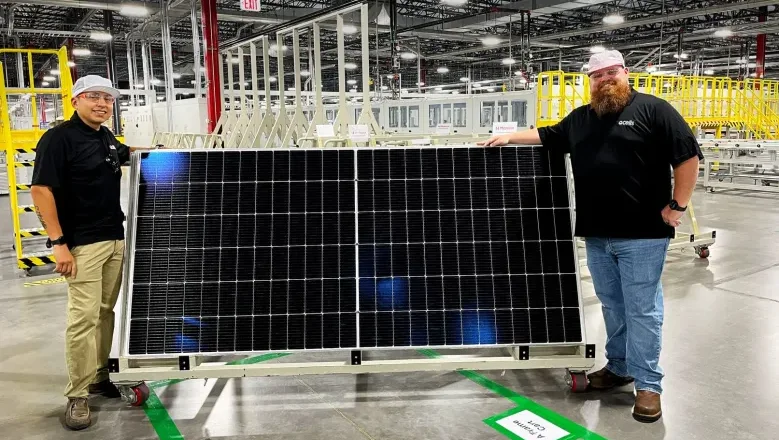
Lock, Rodriguez, and I walked into the newest factory, past meeting rooms with names like Naboo and Mandalore, Star Wars locales where quirky robots coexist with all manner of creatures. As we strolled across the floor, squat wheeled autonomous vehicles rolled past us down pathways marked by tape on the smooth floor, ferrying bales of materials or hauling out hulking boxes of finished panels.
“We try to stay out of their way, and if we don’t, they yell at us,” said Lock. “It’s fun.”
As we stood talking, I noticed that one such robo-buggy was waiting for us to move. Barely discernible over the background drone of machines, a female voice intoned, “Robot is moving. Please look out.” When humans hold up more time-sensitive deliveries, Lock explained, the voice switches to male and gets louder.
Other robots remain fixed in place, carrying out repetitive precision tasks. I stared, mesmerized, at one machine that split wafer-thin silicon cells in half, first scoring them with a laser, then slicing them with a concentrated jet of water. A taller machine grabbed nearly 8-foot metal frames and sliced them through the air like a master swordsman in a Kurosawa film, to slot them around glassed-in silicon panels.
Throughout the process, cameras scan cells and use artificial intelligence to shunt defective items off the line for manual correction.
In the 2019-era factory next door, humans carry out many of these tasks. Lock, though, didn’t see the robots as competitors — he said they were taking on more physically demanding jobs so the humans could step into higher-skilled roles tending to robots.
“The ergonomics are better for you,” he said, and the new lines are more productive.
When Qcells was first staffing up, it relied on Quick Start, a Georgia state program that funds worker training for new factories before they open — a major draw for executives deciding where to locate their factories.
Qcells still recruits to meet ongoing staffing needs, and it has been paying special attention to high schoolers who are graduating and looking for employment. Nash speaks passionately about Qcells’ recruitment efforts; she’s seen the civic fallout from decades when local families encouraged kids to avoid manufacturing.
“Small communities cannot thrive with kids graduating and leaving those communities to live elsewhere, to get high-paying technical jobs,” Nash said. “That’s what’s happening across the country. Bringing manufacturing back, and bringing highly automated manufacturing, is offering job opportunities where now these students are staying here.”
Some 56 percent of Dalton-area students enroll in postsecondary education within 16 months of graduating high school, said Stephani Womack, director of education and workforce development for the Greater Dalton Chamber of Commerce. For the remainder, the chamber wants to make sure family-supporting jobs are available.
For two weeks in June, Womack helped run Project Purpose, a crash course in how to start and navigate careers that pay living wages. Recent high school graduates prepped for interviews, shopped for professional clothes, and toured housing options and downtown hotspots — the kinds of places they could frequent once they join the workforce.
But the centerpiece of the program amounted to professional speed dating, as Dalton’s major employers offered tours and entry-level jobs. Last year, Dalton’s first time running Project Purpose, seven young adults completed the program, and Qcells hired one of them. This time, 18 finished, and Qcells hired 12 of them to start on July 1.
“Next year, we hope to double that, or more,” Nash said.
Several participants came in knowing about Qcells, betting that the intensive crash course would increase their odds of landing good roles there, Womack told me over a table at Garmony House, a downtown coffee shop that draws lines for its statuesque strawberry cupcakes and coffee-glazed cinnamon rolls.
“Qcells is providing a diverse set of options for our students who need to go to work but want to stay in our community,” Womack said. “They see a climate-controlled facility with entry-level opportunities — that’s exciting for them. … Manufacturing isn’t what it used to be.”
For younger people to stay in town and build a life, Dalton needs more housing, and now it’s getting its first large apartment complex in over two decades, Campbell said. In total, 900 apartment units are slated to come online from last August through this November — not enough to catch up on a long-running housing deficit, but a step in the right direction.
That renewed real estate activity is reflected in downtown Dalton’s bustling core.
Locals pack the booths at the Oakwood Cafe, perhaps the only place in America that sells a platter of egg, sausage, toast, and grits for just $3.65. Multiple microbreweries beckon, as does a plush cocktail bar, the Gallant Goat, which stocks fresh mint by the fistful to garnish its drinks. Down the road, diners can sample ceviche of shrimp shipped in from coastal Mexico, succulent chicken wings, and high-end Southern cuisine.
This spring, the plush Carpentry Hotel opened across from the Oakwood Cafe, decked out with vibrant textile art to commemorate the town’s carpeting heritage.
“That’s been big for us, getting that hotel in downtown. That’s indicative of a robust local economy that people are coming to participate in,” local real estate agent Beau Patton told me as the late afternoon sun streamed into the Gallant Goat. Patton works with Qcells employees who want to buy homes in the area. He sees the factory’s decision to locate there as “very mutually beneficial” for Qcells and Whitfield County: “What you hope is Whitfield County grows with it, and it grows with Whitfield County.”
Dalton got in early on the national clean-energy factory revival, and has already seen its solar factory push up wages, enable high school graduates to stay and start careers, and inject money into a reinvigorated downtown. Many more communities in Georgia are following close behind with their own cleantech factories, seeking a similar economic jolt.
“There is a palpable and intense sense of excitement across the state about how these manufacturing and infrastructure policies are supercharging Georgia’s economic development,” said Senator Jon Ossoff, the Georgia Democrat who authored the IRA manufacturing incentives that Qcells is tapping into. “And I would add, it’s not just the primary industrial facilities; it’s all of the secondary and tertiary suppliers and vendors and service companies and the financial services firms needed to support them.”
Qcells is building an even bigger factory compound down in Cartersville, which won a conditional $1.45 billion loan guarantee from the Department of Energy on August 8. This facility will take advantage of Inflation Reduction Act tax credits to onshore more steps of the solar supply chain: slicing silicon wafers, carving them into solar cells, and assembling finished modules with even newer robots than the ones I saw in Dalton. Until now, those high-value precursors to solar panels were shipped in from overseas. Workers in Dalton complete just the last step: assembling modules. Cartersville promises to bring the dream of American-made solar a bit closer to reality.
To achieve that dream, the industry has a few other challenges to confront. For one, 97 percent of the glass that encloses solar panels comes from China. Besides the geopolitical implications of that dependence, glass is so fragile and heavy that its shipping costs make domestic production enticing both economically and environmentally.
“We need domestic glass to have an efficient supply chain,” said Suvi Sharma, founder and CEO of solar recycling startup Solarcycle. His company is breaking ground on a combination solar-panel recycling facility and solar-glass factory in Cedartown, some 70 miles southwest of Dalton. Sharma expects to invest $344 million in the community and hire 600 full-time employees.
Compared with Dalton and Cartersville, “Cedartown is more off the beaten path — this would be the first large-scale factory going up there,” said Sharma. After years in which the population declined and young people looked elsewhere for jobs, “this enables them to keep people and bring in more people. There’s a cascading impact.”
Solarcycle will use its rail spur to ship in low-iron silica from a mine in Georgia, plus soda ash and limestone. Over time, it will supplement those raw ingredients with increasing amounts of glass the company will pull from decommissioned solar panels, including those made by Qcells. The goal is to produce enough glass for 5 gigawatts of panels per year; Solarcycle will ship the glass to nearby customers. At that point, workers in northwest Georgia will have a hand in all the major steps of solar-module production except the processing of raw polysilicon. Hanwha recently became the largest shareholder in REC Silicon to secure access to domestic polysilicon from the Pacific Northwest.
Georgia also nabbed a hefty chunk of the electric-vehicle factory buildout catalyzed by IRA incentives. Hyundai is dropping nearly $1 billion on its “Metaplant” near the deepwater port of Savannah and building an adjacent $4.3 billion battery plant with LG. Kia erected a new EV9 SUV manufacturing line at its plant in West Point, about halfway down Georgia’s border with Alabama. The first EV9 rolled off the line in June — less than two years after the IRA was signed into law.
Dalton, then, is a leading indicator of the industrial invigoration that clean energy factories are bringing to cities and towns across Georgia. People broadly appreciate it — if not for the role in combating climate change or countering China’s industrial might, then for high starting wages, comfortable working conditions, and opportunities for advancement.
But for this nascent factory boom to endure, the policies that triggered it need to stay in effect. The people of Georgia played a decisive role in spurring this manufacturing revival; this November, they’ll have an outsize role in deciding if it continues.
BUILDINGS: The U.S. EPA grants $450 million to a coalition of five New England states to encourage heat pump adoption, aiming for 65% of home heating and air conditioning sales by 2030. (Canary Media)
ALSO:
GRID:
CLEAN ENERGY: Some Pennsylvania businesses say state and federal requirements are making it difficult for them to get involved in clean energy manufacturing, like a Meadville glass maker that wants to hire at least 120 workers to make solar panel glass. (Environment + Energy Leader)
TRANSPORTATION: In New York, two lawsuits aim to revive the Manhattan traffic congestion tolling program, with one claiming the governor’s indefinite pause is an unlawful use of her powers and another making a constitutional law argument. (Sierra)
LEGISLATION: New Hampshire’s governor signs several energy-related laws, including nuclear power studies, renaming an offshore wind office, and rules around involuntary retirement or decommissioning of power generation assets. (InDepth NH)
WORKFORCE: Pennsylvania’s Bucks County Community College receives a $2 million federal grant to invest in a clean energy HVAC technician program and expand a manufacturing apprenticeship. (WHYY)
WIND: As Maine seeks to put an offshore wind port on an undeveloped island that conservationists want to preserve, a reporter does a flyover of the Sear’s Island and Mack Point area to get a bird’s eye view of the current land uses. (Maine Monitor)
COMMENTARY: Massachusetts lawmakers need to reconvene their session to pass a consensus climate bill — which includes project permitting reform — or otherwise “pay a steep price” for the lack of climate action, writes the Northeast Clean Energy Council’s president. (CommonWealth Beacon)
HYDROGEN: Oregon advocates push back against a utility’s pilot project blending hydrogen into its natural gas distribution system in Portland, joining other critics around the region citing safety concerns, high costs and limited effectiveness at decarbonization. (Oregon Capital Chronicle, Floodlight)
UTILITIES: California Gov. Gavin Newsom proposes legislation aimed at lowering electricity bills, but has yet to disclose details. (Sacramento Bee)
GRID:
OIL & GAS:
GEOTHERMAL:
EMISSIONS:
POLITICS: A debate over the domestic uranium industry’s predicted revival dominates a Utah legislative race in the southeastern part of the state. (KJZZ)
STORAGE: Developers bring a 400 MW battery energy storage system online in southern California. (The Sun)
COMMENTARY:


.svg)
