

 Back
Back
HYDROGEN: Advocates worry proposed federally incentivized green hydrogen production facilities in Arizona and other arid states will further deplete already strained water supplies. (Floodlight)
GRID:
UTILITIES: Nevada regulators propose allowing NV Energy to stop charging a single statewide disaster preparedness rate so customers in the southern part of the state will not subsidize wildfire prevention in the north. (Nevada Current)
ELECTRIC VEHICLES: An Idaho sanitation company replaces its diesel-fueled garbage collection fleet with electric trucks. (Idaho Statesman)
OIL & GAS:
SOLAR:
ELECTRIFICATION: Berkeley, California’s city council votes to approve a ballot initiative that would tax large buildings that use natural gas-fueled appliances. (Daily Californian)
CLIMATE: An investigation finds Nevada officials continued to offer contracts to a startup even after its carbon emissions tracking system failed to perform as promised. (ProPublica)
POLITICS: U.S. Rep. Harriet Hageman, a Wyoming Republican, proposes removing Boulder, Colorado’s gas stations and streets, citing the progressive city’s efforts to fight climate change. (WyoFile)
BIOFUELS: A southern California city plans to upgrade its wastewater treatment plant to produce biofuels from organic waste and sewage sludge. (news release)
FINANCE: A new U.S. Treasury analysis finds that almost 160,000 Pennsylvanians claimed more than 260 million in Inflation Reduction Act tax credits on their 2023 taxes for clean energy and efficiency improvements. (Environment America)
BATTERIES:
TRANSPORTATION: While a New York City deputy mayor says officials aren’t “waiting on congestion pricing” to limit emissions and fund transit projects, she notes that the city won’t do a full analysis on how to course correct until after a final decision is made on the fate of the program. (City & State)
CARBON CAPTURE: Some Pennsylvania environmentalists want lawmakers to repeal recently signed legislation that outlines a regulatory framework for the carbon capture industry, saying the technology’s climate-mitigating potential is overstated. (EHN, Capital & Maine)
SOLAR:
WIND:
BIOENERGY:
GRID: Central Maine Power says it will route one of four New England Clean Energy Connect power line converter station transformers from Auburn to Lewiston on Thursday evening. (Sun Journal)
OIL & GAS: Some drillers in Texas’ Permian Basin are paying buyers to take their excess supply because they’re producing so much natural gas they’ve exceeded available storage space and pipeline capacity. (New York Times)
ALSO:
SOLAR:
COAL:
GRID: Louisiana residents complain to local and state officials about frequent outages in an area managed by Entergy. (WVUE)
UTILITIES:
CLIMATE: As Tropical Storm Debby swamps the Carolinas, causing widespread outages and threatening a Georgia dam, experts say climate change is making tropical cyclones even worse. (Charleston Post and Courier, The State, WAGA, Inside Climate News)
BUILDINGS: A technology company experiments with using Virginia dredging waste as an ingredient in concrete to lower its carbon footprint and make a stronger product. (Virginia Mercury)
STORAGE: An Oklahoma fire department posts a video of a dog sparking a fire by chewing on a lithium-ion battery to its Facebook page as a warning to residents. (Associated Press)
EFFICIENCY:
COMMENTARY: West Virginia regulators’ push to prop up coal is harming state residents and their pocketbooks, writes an environmental policy analyst. (West Virginia Watch)
NUCLEAR: Tech companies increasingly seek to directly connect data centers to nuclear plants, a concept that has drawn opposition from some utilities that claim it would harm other ratepayers. (Canary Media, CNBC)
POLITICS:
RENEWABLES:
SOLAR:
ELECTRIC VEHICLES: The market slowdown around electric vehicles causes concern about the sector’s leading role in Georgia’s manufacturing renaissance, which one state official has called the state’s second industrial revolution. (Atlanta Business Chronicle)
WIND: Despite the depiction of toppled wind turbines in this summer’s sequel to “Twister,” researchers say turbines are generally built to withstand extreme winds and tornadoes. (E&E News)
MANUFACTURING: Around 40% of the largest manufacturing investments announced in the year after the Inflation Reduction Act and CHIPS Act have since been delayed due to market conditions and uncertainty around the next presidential administration, a news organization’s analysis finds. (Financial Times, subscription)
CARBON CAPTURE: A California nonprofit finds state plans to capture and sequester 50 million tons of carbon dioxide would require about 1,150 miles of new pipelines and other infrastructure. (Capital & Main)
Darryl Moton is ready to “get on a roof.”
The 25-year-old Chicago resident is among the latest graduates of an intensive 13-week solar training course that’s helping to connect employers with job candidates from underrepresented backgrounds.
Moton was referred by another job readiness program meant to keep youth away from gun violence. He “never knew about solar” before but now sees himself owning a solar company and using the proceeds to fund his music and clothing design endeavors.
He and others interviewed for jobs with a dozen employers assembled at a church on Chicago’s West Side on August 1 as part of the fourth training cohort for the 548 Foundation, which is partnering with Illinois Gov. J.B. Pritzker on a recently-announced $30 million initiative to create 1,000 solar jobs in Chicago’s South and West side neighborhoods.
The 548 Foundation is part of 548 Enterprise, a suite of renewable energy and affordable housing development projects, launched in 2019 and named after the public housing unit where co-founder A.J. Patton grew up.
The idea is to help keep housing affordable by using solar to lower energy bills, while training people left out of the traditional energy economy to supply that solar.
“When you invest in a community, the biggest question is who benefits, who gets the jobs?” asked Patton, during the job fair. “This is as good as it gets,” he added, about the recent state investment. “We just have to keep advocating for quality policy.”
Employers at the job fair said such training programs are crucial for them to find workers in Illinois, where robust solar incentives are attracting many out-of-state companies eager to hire and hit the ground. Mike Huneke, energy operations manager for Minnesota-based Knobelsdorff said he has hired 18 employees from previous 548 cohorts, and he expected to make about six job offers after the recent interviews.
“Illinois is on fire,” said Huneke. “We’re not from Illinois, so finding this new talent pipeline is what we need. We have a ton of projects coming up.”
Lisa Cotton, 30, has dreamed of being an electrician since she was a kid. She had received two job offers at the August 1 fair before the group even broke for lunch.
“A lot of times you go through a training program, get a certificate, and that’s the end of it,” said Jacqueline Williams of the Restoring Sovereignty Project, a partner which administers the wraparound services for the training program.
The 548 program makes sure to connect graduates with employers, and only companies with specific openings to fill are invited to the job fair. 548 and its partners also stay in contact with graduates and employers to make sure the placement is successful.
“We have a post-grad program where they can call us any time, and an alumni fund. If an employer says, ‘This guy can’t come to work because his radiator is busted,’ we’ll take care of that,” said Williams.
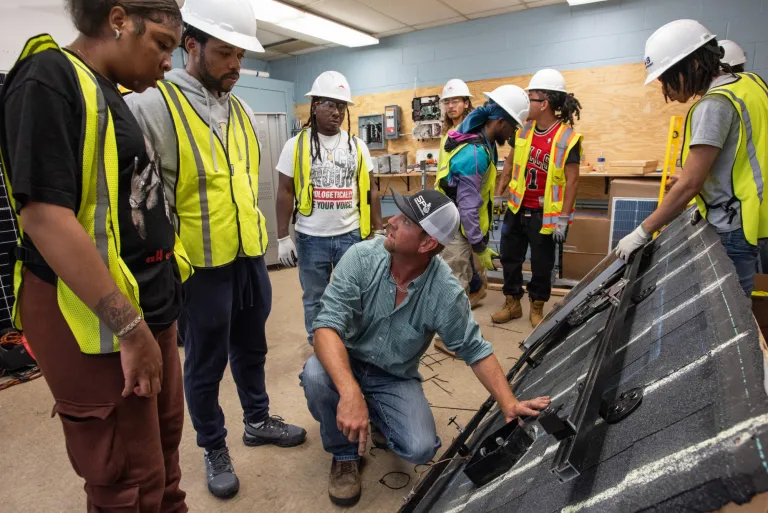
After Illinois passed an ambitious clean energy law in 2017, multiple solar training programs were launched in keeping with the law’s equity provisions. But employers and advocates were frustrated by a seeming disconnect in which many trainees never got solar jobs, and employers weren’t sure how to find the workers.
Since then, the state has passed another clean energy law – the 2021 Climate & Equitable Jobs Act, with even more ambitious equity mandates; and non-profit organizations have developed and honed more advanced workforce training programs. To access incentives under the law, employers need to hire a percent of equity-eligible applicants that rises to 30% by 2030. The program prioritizes people impacted by the criminal justice system, alumni of the foster care system, and people who live in equity-designated communities.
548 affiliates help employers navigate the paperwork and requirements involved in the equity incentives. Several employers at the job fair said this is a plus, but noted that regardless of equity, they are desperate for the type of highly-trained, enthusiastic candidates coming out of the 548 program.
“This is a great way to bridge what the state is trying to do with its clean energy goals, and connecting under-represented people with these opportunities,” said Annette Poulimenos, talent acquisition manager of Terrasmart, a major utility-scale solar provider. “We came here ready to hire, and I think we’re going to walk away with some new talent.”
Member organizations of the Chicago Coalition for Intercommunalism do outreach to recruit most of the training program participants.
Nicholas Brock found out about the training thanks to a staffer at one of these organizations who noticed his professional attitude and punctuality as he walked by every morning to a different workforce program.
“Whatever I do, nine times out of 10, I’m the first one to get there, before the managers,” said Brock, 20. “He noticed that and asked me, ‘Have you ever heard about solar panels?’”
Brock knew little about solar at that point, but now he aims to be a solar project manager.
“I’m so glad I came here,” he said. “They bring out the best in you.”
Wraparound, holistic services are key to the program’s success. During the training and for a year afterwards, trainees and alumni can apply for financial help or other types of assistance.
“There are so many barriers, it might be child care or your car is impounded,” said Williams. “We might be writing a letter to a judge asking to ‘please take him off house arrest so he can work.’ It’s intensive case management, navigating the bureaucratic anomalies that arise when you’re system-impacted.”
Moises Vega III, 26 – who always wanted to work in renewables because “it’s literally the future” – noted that his car battery died during the training program, and he was provided funds to get his vehicle working again.
While ample support is available, the program itself is rigorous and demanding. Classes meet from 9 a.m. to 3 p.m. each day, and trainees are required to check their phones at the door and be fully focused, notes instructor and 548 workforce strategies director Michael Thomas. During the hands-on boot camp week, the day starts at 6 a.m.
“That’s when the trades start,” noted Thomas. “You need to figure out how that works, how will you get child care at 5:30 a.m.?”
Sixty-one trainees started in the first three cohorts, and 46 graduated, the first group in July 2023. The fourth cohort started with 25, and as of the job fair, 18 were on track to graduate. Eighty-five percent of graduates from the first three cohorts are currently working in the field, according to 548.
“Even though I wish the graduation rate were higher, the people who commit to it, stay with it,” said Kynnée Golder, CEO of Global HR Business Solutions, which has an oversight role for the 548 Foundation. “It’s monumental, it’s life-changing for a lot of people.”
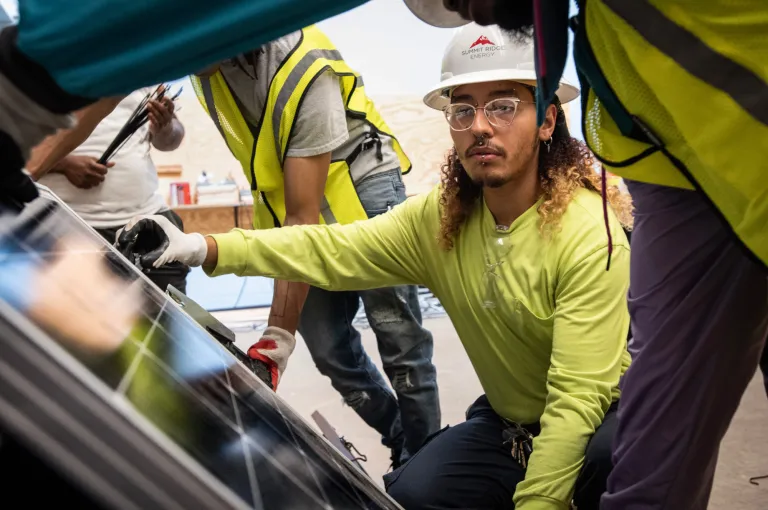
The curriculum starts with life skills, including interpersonal relationships, resume-building, financial planning and more. Each day begins with a spiritual reflection.
The students learn about electricity and energy, and soon move into specific instruction on solar installation and operation. Rooms at St. Agatha’s church served as labs, where students connected wires, built converters and eventually mounted solar panels on a demonstration pitched, shingled roof.
Terrance Hanson, 40, credited Thomas as “the best instructor ever.”
“I’m not a young kid, my brain is no longer a sponge,” Hanson said. “He made sure I got it all. Now I feel like I know so much, I’m confident and prepared to get out and show what I can do.”
He added that people in disinvested neighborhoods have ample untapped potential to be part of the clean energy workforce.
“You see a lot of basketball players in my community because there are a lot of basketball hoops,” he said. “If there were golf courses in the hood, you would see more golfers. It’s about opportunities. And this was the most amazing and empowering thing I’ve ever been through.”
Jack Ailey co-founded Ailey Solar in 2012, making it the oldest still-operating residential installer in Illinois, by his calculations. He noted that there can be high turnover among installers, and intensive training and preparation is key.
“You’re out there in the sun, the cold, it’s heavy physical labor, wrestling 40-pound panels up to the roof,” he said. “You have to know what you’re getting into.”
“Some training programs vary in quality,” Ailey added, but he was impressed by the candidates at the 548 job fair.
Trainees test for and receive multiple certifications, including the OSHA 30 for quality assurance, and the NCCER and NABCEP for construction and solar professionals, respectively. The program is also a pre-apprenticeship qualifier, allowing graduates to move on to paid, long-term apprenticeships with unions representing carpenters, electricians, plumbers and laborers – the gateway to a lucrative and stable career in the trades.
Thomas noted that most trade unions still don’t have a major focus on solar.
“We’re ahead of the unions, and our graduates bring real value to them, and to the companies,” he said. “The students might know more than a company’s foreman knows. It’s a win-win situation. Solar is a nascent industry, there’s so much opportunity in this space.”
When Tredgett Page, 38, connected with 548, his auto detailing work and other odd jobs were not going well. He had always loved science and been curious about photosynthesis and the sun’s power.
“I had been in the streets before, and I was leaning back toward that, but God brought me here,” he said. “Now I have the confidence, I know what I’m talking about, I know about megawatts and kilowatts, net metering, grid-connected, pretty much anything about solar.”
He sees metaphorical significance in his new trade: “Energy is life, and it teaches you balance, it’s all about negative and positive ions.” He feels like “the sky is the limit” after the training.
“I have so much skill that they gave me, now I’m hungry to use it,” he said. “I’m a little nervous, but optimistic, excited, very exuberant!”
OIL & GAS: Texas regulators announce they’ll investigate whether fracking is responsible for earthquakes in a county that recently experienced 61 seismic events in a week. (Houston Chronicle, Abilene Reporter-News)
ALSO:
TRANSITION: The Biden administration has ushered in billions in investment in West Virginia’s clean energy infrastructure while simultaneously opening the door for more fossil fuel growth, yet remains deeply unpopular with voters. (Charleston Gazette-Mail)
SOLAR: A federal board files a lawsuit challenging amendments to a law that extends Puerto Rico’s one-to-one net metering policy until at least 2031. (Associated Press)
WIND: Federal officials again gauge interest in offshore wind lease areas in the Gulf of Mexico after a company expresses interest in developing a commercial wind facility near Texas. (Louisiana Illuminator)
CARBON CAPTURE: The U.S. Forest Service is considering a draft rule to allow carbon storage under federal land after twice denying a company’s requests to do so under national forests in Louisiana and Mississippi. (Floodlight/Mississippi Today)
GRID:
BUILDINGS: A growing number of North Carolina officials call for a reversal of a state law that blocks building code updates until 2031, which Gov. Roy Cooper says will affect insurance and potentially cause the state to miss out on federal disaster recovery funding. (Port City Daily)
TRANSIT: Public transportation advocates launch a campaign to secure tens of millions of dollars to restore New Orleans’ bus transit service to levels of service not seen since Hurricane Katrina severely disrupted the system. (NOLA.com)
HYDROGEN: Researchers find elevated levels of hydrogen around geological features known as Carolina Bays, suggesting the possibility of “white” or “gold” hydrogen wells. (Sierra)
EMISSIONS: A federal appeals court declines to block the U.S. EPA’s new rules restricting emissions from coal and new gas-fired power plants, though it will still consider a case brought by West Virginia and other states. (West Virginia Public Broadcasting)
SOLAR: Texas surpassed California as the nation’s leader in solar installations last year, but a professor explains that has less to do with the state’s commitment to fighting climate change and is more about making infrastructure projects easy to permit and build. (The Atlantic)
ALSO:
OIL & GAS:
GRID:
UTILITIES:
SUSTAINABILITY: Texas A&M University faculty and students work with teachers from Texas’ Coastal Bend to research and develop lesson plans around renewable energy and sustainable agriculture. (Corpus Christi Caller-Times)
COMMENTARY:
SOLAR: A set of projects across Washington, D.C., and California mark the first time a company sold its Inflation Reduction Act solar tax credits to another company, a key tool to help encourage solar in new construction. (Canary Media)
ALSO:
OIL & GAS: Analysts predict Biden administration rules that curbed new and existing drilling could be taken even further under Vice President Kamala Harris. (E&E News)
CLEAN ENERGY: Solar and HVAC companies, advocacy groups, and other entities with a stake in the clean energy transition sign on to an initiative meant to spread the word about available Inflation Reduction Act incentives. (Axios)
GRID:
TRANSPORTATION:
ELECTRIC VEHICLES:
POLITICS: Federal prosecutors argue that a corruption trial involving former Illinois House Speaker Michael Madigan and alleged gifts from ComEd over several years should proceed despite a recent U.S. Supreme Court ruling. (Chicago Sun-Times)
SOLAR: The U.S. Energy Department plans a 1,000 MW solar installation on about 8,000 acres of the Hanford nuclear weapons production site in south-central Washington. (Canary Media)
ALSO:
CLEAN ENERGY: Data show the California grid met 100% of its electricity demand with renewable energy during 5- to 10-minute periods on 100 of the last 144 days. (news release)
ELECTRIC VEHICLES: A southern California city becomes the nation’s first to replace its entire fleet of gasoline-powered police patrol cars with electric vehicles. (Associated Press)
ELECTRIFICATION: The U.S. EPA awards Alaska organizations nearly $39 million to replace households’ fossil fuel based heating systems with electric heat pumps. (KTOO)
BATTERIES: A developer and a Colorado electric cooperative bring a 78.3 MW battery energy storage system online. (news release)
CLIMATE:
UTILITIES: Tucson, Arizona’s city council considers establishing a municipal utility as part of its goal to achieve community-wide carbon-neutrality by 2045. (Cronkite News)
HYDROPOWER: A firm deploys a 1.25 MW wave-energy generator at a U.S. Navy testing site off Hawaii’s coast. (Marine Technology)
HYDROGEN: California environmental justice advocates worry a public-private effort to establish a hydrogen production and distribution hub in the state could increase pollution if strict guidelines aren’t followed. (Grist)
OIL & GAS: Oregon advocates continue to protest a natural gas pipeline expansion even though developers began construction earlier this month. (KTVZ)
COAL: Wyoming officials predict a 25% dip in coal production from the Powder River Basin and weak natural gas prices could diminish mineral tax revenues and strain the state budget. (Cowboy State Daily)
Research underway at a Madison County solar farm promises to shed light on how well multi-use farming can work at a large scale. The answers will help shape best practices for future projects, while addressing some concerns raised in ongoing debates over siting large solar projects in rural farm areas.
Spread across more than 1,900 acres, the 180 MW Madison Fields project will be one of North America’s largest test grounds for research into agrivoltaics — essentially farming between the rows on photovoltaic solar projects.
As farmers seek to lease land for solar arrays to diversify their incomes, the practice could help them maximize their income and fend off opposition from critics concerned that solar development will take prime farmland out of production.
Some farmers have also said the revenue from clean energy can help keep their farms operating amid pressure from housing developers. A recent report from the American Farmland Trust says Ohio could lose more than 518,000 acres of farmland to urban sprawl by 2040.
That number dwarfs the roughly 95,000 acres for certified and other projects noted on the Ohio Power Siting Board’s most recent solar case status map.
Yet solar projects generally deal with big chunks of land at once, while urban sprawl happens bit by bit over time, said Dale Arnold, director of energy policy for the Ohio Farm Bureau. Helping people understand and appreciate that is “absolutely huge,” he said.
Savion, a Shell subsidiary, developed the Madison County project, and it began commercial operation on July 11 with Amazon as the long-term buyer for its energy. Yet work began much earlier this year to set up the site for research by Ohio State University scientists, Savion’s Between the Rows subsidiary, and others.
“People have a lot of questions with regard to energy development going forward in this state,” particularly when it comes to taking land out of use for agricultural production, Arnold said.
Yet today’s industry continues to shift away from coal to a diversified portfolio of natural gas, nuclear, hydropower, wind energy, solar energy and other types of generation. Forecasts also show there will be growing demand for electricity by mid-century, he said.
“Finding a balance where you can do a number of things on the same ground — in this case energy production as well as agricultural production — is obviously huge,” Arnold said. If agrivoltaics is to become more than a buzzword, though, both farmers and solar project developers need to work out best practices.
One big issue is what crops can work well for large-scale utility projects. Compared to most solar farms projects in Eastern and Piedmont states, utility-scale solar projects in Ohio and other Midwestern states can spread across 1,000 acres or more, Arnold said.
“You hear a lot about produce and specialty crops,” for example, said Sarah Moser, Savion’s director of farm operations and agrivoltaics. But raising them is “hard to do on 1,000 acres.”
Moser and Ohio State University researchers think forage crops like alfalfa and hay hold promise. Operations can be scaled up for large areas, said Eric Romich, an Ohio State University Extension field specialist for energy development. And the crops wouldn’t grow too tall amid the panels.
“We also wanted something that we felt had the potential to be economical,” Romich said.
Two 2023 reports by Ohio State University Extension researchers found raising hay and alfalfa between rows of solar panels was feasible and that the harvest’s nutritive value was good. But that small-scale work at the Pigtail Farms site in Van Wert County used data from only a few test plots and controls, which is an important limitation, Romich said.
Work at Madison Fields will now test whether similar results can be achieved at large scale. Part of a $1.6 million grant from the Department of Energy will help pay for that work over the course of four years.
Other research will test how well plants do in sun versus shade, Romich said. That matters because some portion of the land among solar panels will always be shaded.
Researchers planted the crops on test fields and control areas this spring, with an eye toward starting to collect data next year. “Forages are quite temperamental in terms of trying to get them established,” said Braden Campbell, an animal scientist at Ohio State University who is also working on the project. The team has found compacted soil around the solar panels, “but we are relieved to see that the seeds that we put into the ground are growing,” he said.
Moser plans to work with other crops, too. Soybeans are one example. They were already used as a cover crop before alfalfa and hay were planted. Soybeans can also work into a crop rotation when forage crops need to be replanted every few years.
“The market is there for it, and it does well” as a hardy crop which can also loosen soil and restore nutrients to it, Moser said, adding that local communities have expressed interest in the crop as well.
Other work at Madison Fields will explore complementary grazing. The goal is to harvest the forage crops as efficiently as possible. But there will still be a need for vegetation control under and around panels and other infrastructure, said Campbell. So, after harvesting, sheep will go to work.
“To me, that’s three commodities that we can get off one unit of land,” Campbell said: Solar panels will produce electricity. Hay and alfalfa growing will provide a crop. And the land will help support sheep, which in turn can produce meat, milk and fiber.
Other solar farms already use or plan to use sheep for vegetation control. But “there is a big difference” between using sheep to keep plants under control and relying on that for their nutrition, Campbell said.
Studies will need to test the health of sheep that do complementary grazing, compared to other sheep. Other questions include finding optimal grazing rates of sheep per acre, as well as other logistics. But first, the forage needs to establish good roots so it can withstand the pressure of grazing.
A third bucket of research questions under the Department of Energy grant will focus on farm equipment. Tractors and other farm vehicles need to fit between the rows with their attachments. There’s been a trend in the agricultural sector toward wider equipment, which can cover more ground quickly but may not fit between rows of solar panels, Moser said.
“But a lot of farmers still have smaller equipment,” Moser continued, because some parcels aren’t appropriate for wider machinery. Maneuvering 15-foot-wide equipment works fairly well, and 17-foot and even 20-foot widths can still work.
“I could get my 20-foot drill in there,” Moser said. “I just have to be careful.”
Arnold speculated that some companies may develop special equipment whose attachments can fit under solar panel rows more easily. Other possibilities could include raising panels or even feathering them when agricultural equipment is in use, he suggested.
Farm equipment doesn’t just need to go down an alley between two rows of solar panels. It will also have to turn around at the end to go down another one, Arnold said. So, there needs to be an adequate turning radius, without cables blocking farm vehicles’ paths. Poles, stands, and other equipment also can’t block the path of the farm equipment, he said.
The research can help guide the design of future solar projects to be “hay-ready” sites, Romich suggested. At the same time, agricultural operations shouldn’t jeopardize the safe and efficient operation of a solar facility. “It’s an operating power plant,” Romich said.
Arnold has additional questions about infrastructure needs: What facilities will be necessary to dry, bale and store forage? What facilities will other crops need? And how will they be trucked out to markets?
Likewise, what equipment and facilities will be needed for any sheep kept on site? That includes paddock fencing, water, and so forth. And where will their caretaker live?
“You’re going to have to have people there full-time,” Arnold said.
The Ohio State researchers, Moser, and others also wonder how well precision agriculture can work with solar farms. The term refers to methods that rely on technology and data to guide farmers’ work. The range of technologies includes remote sensing of field conditions with drones, in-ground sensors, automated weeders and more.
The big question is which precision agriculture technologies can work well for crops planted between rows of solar panels as they generate electricity.
It’s unclear what any of the studies will show until data has been collected and analyzed, Romich said. By the end, he feels the work will provide a better understanding of what will or won’t work.
Economics questions about business models, contractual arrangements and more also must eventually be worked out, Arnold said. At the end of the day, farmers will need to make a profit if agriculture is to successfully blend with solar projects.
“The possibilities are limitless, really,” when it comes to business arrangements, Moser said. “My motto is always, ‘farmers figure it out.’ And if we work with them, we’ll figure…out how to do this with best practices.”


.svg)
