

 Back
Back
CLEAN ENERGY: A national report identifies thousands of planned, under construction and recently completed clean energy projects that could be eligible for labor-related Inflation Reduction Act incentives, including more than 80 in Wisconsin. (WPR)
ELECTRIC VEHICLES:
WIND: Researchers at the National Renewable Energy Laboratory are developing wind turbines made from recyclable plant material that would avoid the need to send them to landfills. (New York Times)
GRID: A University of Minnesota professor says grid reliability measures like underground power lines, energy storage systems and climate resilience hubs are needed amid aging grid infrastructure and more extreme weather. (MPR)
CARBON CAPTURE: Western Michigan University receives a $5 million federal grant to advance research on commercial-scale carbon capture and storage. (WOOD-TV8)
BIOGAS: Michigan clean water advocates call on state regulators to deny a permit for a biogas production plant that an owner says is needed to remain profitable. (Michigan Advance)
EFFICIENCY: Kansas City, Missouri, receives a $9 million federal Inflation Reduction Act grant to improve energy efficiency in city buildings. (KCTV)
SOLAR:
BIOFUELS: Minnesota will award more than $3.3 million to gas stations to upgrade or replace gas infrastructure to support biofuels with higher levels of ethanol. (Center Square)
COMMENTARY: A Minnesota columnist says it would be easier and cheaper for taxpayers to phase out ethanol plants and grow less corn than building billions of dollars in carbon pipelines to bury emissions underground. (Star Tribune)
WIND: A NOAA Fisheries analysis says pile-driving work on the Vineyard Wind project is unlikely to pose a threat to whales or other marine life, but does expect some sea turtles will be vulnerable to vessel strikes. (State House News Service)
ALSO:
OIL & GAS:
GRID:
ELECTRIC VEHICLES:
UTILITIES: A hearing examiner’s report supports a Maine utility’s effort to avoid state regulatory review of its parent company’s acquisition by Iberdrola. (Portland Press Herald)
OVERSIGHT: Consumer and environmental groups push back on the New Hampshire PUC’s plan to introduce stricter requirements for groups or individuals to intervene in regulatory proceedings. (RTO Insider, subscription)
SOLAR: A Pennsylvania school board unanimously rejects a plan for a solar array on district property that would have brought in $200,000 a year in revenue. (Lancaster Online)
WASTE TO ENERGY: Neighbors push Connecticut regulators to hold a public hearing on plans to allow a waste-to-energy plant to burn medical waste. (WFSB)
EQUITY: Philadelphia is holding a series of neighborhood-level workshops as it plans a city-specific environmental justice mapping tool. (WHYY)
CLEAN ENERGY: The Department of Energy says clean energy jobs last year grew at twice the rate of other sectors, with unionization rates higher than in the broader energy industry. (Reuters)
CLIMATE:
ELECTRIC VEHICLES: The Biden administration announces $521 million in grants for electric vehicle charging, and says the number of publicly available chargers has doubled since 2021. (Utility Dive)
GRID:
OIL & GAS:
UTILITIES: Illinois ratepayers have paid an extra $1.8 billion since 2015 by choosing alternative energy suppliers over traditional utilities like ComEd and Ameren, according to a consumer advocate’s analysis. (Daily Herald)
SOLAR: Opponents of a proposed 800 MW Ohio solar project may turn to the state Supreme Court to block the project after regulators denied repeated challenges. (WCMH)
COMMENTARY:
SOLAR: The Biden administration finalizes its Western solar plan aimed at expediting development on 31 million acres of federal land in 11 states. (Reuters)
ALSO: A Utah county postpones a deal to install a solar array at a local airport to gather more information, but says it plans to move forward with the project later. (Moab Times-Independent)
PUBLIC LANDS: Federal courts prepare to consider several lawsuits seeking to diminish a president’s power to ban future mining and oil and gas drilling on some federal lands via national monument designation. (Bloomberg Law)
EFFICIENCY: The U.S. Energy Department awards Western states and cities $115.2 million to develop, implement and upgrade building performance standards and energy codes for commercial and multi-family structures. (news release, RTO Insider, subscription)
CLIMATE: Colorado awards local governments $1.9 million to support climate action plans and efficiency and sustainable energy programs. (news release)
STORAGE:
GRID:
OIL & GAS:
POLLUTION: Alaska advocates call on federal regulators to ban cruise ship exhaust scrubbers, saying the air-pollution mitigation systems contaminate ocean water. (KTOO)
ELECTRIC VEHICLES:
CLEAN ENERGY: The National Science Foundation awards a Hawaii university $4.2 million for clean energy research and education. (Kauai Now)
CLEAN ENERGY: Researchers estimate the clean energy transition will demand $1 trillion in federal spending by 2031, though only $66 billion — or 6% of that total — has been distributed so far via the Inflation Reduction Act. (Grist)
BATTERIES: The federal government is reportedly considering shoring up domestic projects that process critical minerals for clean energy applications as they face steep competition from cheaper Chinese materials. (Politico)
WIND:
GRID:
POLITICS: In her first formal interview as the Democratic presidential nominee, Vice President Kamala Harris promises she won’t ban fracking if elected. (Axios)
ELECTRIC VEHICLES:
SOLAR: Observers say a growing number of Western water managers are considering covering irrigation canals with solar panels to generate power and reduce evaporation. (Water Education)
EFFICIENCY: University of Maryland scientists are leading research into energy-efficient air conditioners. (Inside Climate News)
UTILITIES: Advocates push back on proposed California legislation aimed at reducing utility bills, saying it would gut low-income clean energy programs without significantly increasing affordability. (Canary Media)
ACTIVISM: Environmental and community activists oppose a federal loan for a project exploring whether plastic could be a viable replacement for coal as fuel for steelmaking. (Inside Climate News)
COMMENTARY: PJM’s latest capacity auction with sky-high prices should not be a cause for panic and shows that the grid operator’s market is catching up to the rest of the country in needing to manage supply changes, a former regulator writes. (Utility Dive)
WIND: Federal ocean energy regulators give the country’s first floating offshore wind research lease to Maine for a project of up to 12 turbines near Portland; the state first sought the lease in 2021. (Associated Press)
ALSO: Federal officials grant $89 million to Eversource to develop its Huntsbrook Offshore Wind Hub on the southeastern Connecticut coast, building a new interconnection point for future projects. (news release)
GRID:
ELECTRIC VEHICLES:
SOLAR:
FOSSIL FUELS: Pennsylvania’s energy production will collapse, making it a “Third World” state, if Vice President Kamala Harris becomes president and enacts her fracking policies, former President Donald Trump claims. (Philadelphia Inquirer)
UTILITIES:
TRANSPORTATION: The Northern New England Passenger Rail Authority seeks public comment on its plan to build a new Amtrak station for Portland that would reduce Downeaster trip times by an estimated 15 minutes. (Portland Press Herald)
FLOODS: A storm sweeps New England, dropping historic rainfall totals on parts of Connecticut and New York and causing widespread floods; Connecticut officials expect a lengthy recovery. (NBC News, CT Mirror)
COMMENTARY: PJM Interconnection pushes back on criticism that its planning processes aren’t helping accelerate the energy transition, saying its power grid reforms are working. (Baltimore Banner)
HYDROGEN: A New Mexico electric cooperative looks to establish a green hydrogen production facility at a defunct mine and Superfund site in the northern part of the state. (High Country News)
SOLAR: Developers break ground on a 140 MW solar-plus-storage installation on the Jicarilla Apache Nation in northern New Mexico. (Albuquerque Journal)
ALSO:
CLEAN ENERGY:
OIL & GAS:
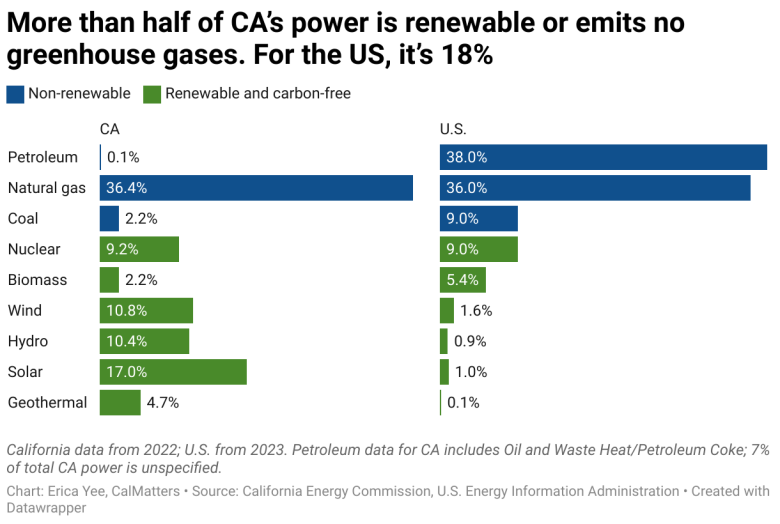
GRID: Data show natural gas remains California’s largest single energy source even though renewable, carbon-free sources provided 100% of the state’s electricity during 100 days so far this year. (CalMatters)
UTILITIES: A Washington state clean energy grant program has awarded $200 utility bill credits to about 50,000 low-income families since launching in July. (Spokesman-Review)
CLIMATE:
TRANSPORTATION: California regulators abandon a proposal to require jet fuel suppliers to pay for greenhouse gas emissions, saying it will look to incentivize sustainable fuel production instead. (E&E News, subscription)
COAL: Federal researchers find a Canada coal mine is sending pollution some 350 miles downstream and across the border to the Columbia River in the Northwest. (Montana Free Press)
ELECTRIC VEHICLES: San Francisco Bay Area cities consider establishing electric bicycle regulations following an increase in related accidents. (Mercury News)
STORAGE: Illinois lawmakers consider establishing energy storage incentives as a new study suggests ramping up storage may be the most realistic path for maintaining grid reliability as the state phases out fossil fuels. (Energy News Network)
ELECTRIC VEHICLES:
CLEAN ENERGY:
UTILITIES: CenterPoint Energy issues a request for proposals from developers to build hundreds of megawatts of renewable energy and other generation sources as part of its long-term energy strategy in Indiana. (Utility Dive)
GRID:
WORKFORCE:
COAL: Consumers Energy will soon offer public tours of a coal plant along Lake Michigan that’s scheduled to be decommissioned within the next year. (MLive, subscription)
COMMENTARY:
CLEAN ENERGY: State policies could supercharge utility-scale clean energy deployment, but experts say too-rapid an expansion could strengthen opposition, and that local participation in the siting process is still key. (Utility Dive)
POLITICS:
GRID:
WIND:
ELECTRIC VEHICLES: Kentucky has attracted more than $11.5 billion in electric vehicle-related investments since 2020, but lagging vehicle sales and a partisan split over the industry create uncertainty about its future. (Louisville Courier-Journal)
COAL:
PIPELINES: Tribal leaders in northern Wisconsin continue their fight to shut down the Line 5 pipeline in the “Everglades of the North,” where they fear a spill would decimate areas for wild rice and fishing. (Inside Climate News)
SOLAR: A Swiss firm cancels plans to establish a solar cell manufacturing plant in Colorado, saying market distortions have rendered the project financially unviable. (Reuters)
EMISSIONS: North Carolina’s ratepayer advocate, Walmart, and other critics of Duke Energy’s initial decarbonization plan relent and endorse a settlement that includes construction of 9 GW of new natural gas plants and more solar. (Energy News Network)
COMMENTARY: A Harris campaign adviser calls for a “Clean Energy Marshall Plan” that would finance foreign investments in renewables and the creation of international clean energy supply chains and trade agreements. (Foreign Affairs)
Stay up-to-date with free briefings on topics that matter to all Californians. Subscribe to CalMatters today for nonprofit news in your inbox.
California has given America a glimpse at what running one of the world’s largest economies on renewable energy might look like.
The state recently hit a milestone: 100 days this year with 100% carbon-free, renewable electricity for at least a part of each day, as tracked by Stanford University engineering Professor Mark Z. Jacobson.
The state notched the milestone while — so far — avoiding blackouts and emergency power reductions this year, even with the hottest July on record.
That progress is largely due to the substantial public and private investments in renewable energy — particularly batteries storing solar power to use when the sun isn’t shining, according to energy experts.
“California has made unprecedented investments in our power grid in recent years — and we’re seeing them pay off in real time,” Gov. Gavin Newsom said in a statement to CalMatters. “Not only is our grid more reliable and resilient, it’s also increasingly running on 100% clean electricity.”
The state faces a huge challenge in coming years: A series of mandates will require carbon-free energy while also putting more electric cars on roads and electric appliances in homes. California, under state law, must run on 60% renewable energy by 2030, ramping up to 100% by 2045.
Signs of progress are emerging. From January to mid-July of this year, zero-carbon, renewable energy exceeded demand in California for 945 hours during 146 days — equivalent to a month-and-a-half of 100% fossil-fuel-free electricity, according to the California Energy Commission, the state agency tasked with carrying out the clean energy mandates.
But California still has a long way to go to stop burning fossil fuels for electricity. Natural gas, which emits greenhouse gases and air pollutants, remains its single largest source of electricity.
Just over half of power generated for Californians in 2022 came from solar, wind, other renewables and nuclear power, while 36% came from natural gas plants.
Reliability of the power grid is a top concern as the state switches to solar and wind energy. Unpredictable events like wildfires and winter storms also cause outages, while hot summer months, with air conditioners whirring, strain the supply.
In August of 2020 California experienced its first non-wildfire blackouts in nearly 20 years, and in late August and September of 2022, a severe heatwave forced regulators to ask consumers to voluntarily reduce power for 10 days.
Since September 2022 — when California teetered on the edge of those blackouts and the governor pleaded for conservation — nearly 11,600 new megawatts of clean energy have been added to the state’s grid, said Elliot Mainzer, chief executive of the California Independent System Operator, which manages the grid. (That’s enough to power around 9 to 12 million homes although it’s not available all at one time.)
California also now has more than 10,000 megawatts of battery capacity, making it the largest supply outside of China. Battery power from large commercial facilities proved its worth during last month’s heat wave, Mainzer said.
Batteries “were a major difference-maker,” Mainzer said. “The batteries charged during the day, when solar energy is abundant, and then they put that energy back onto the grid in the afternoon and evening, when solar production is rolling off the system.”
California relies heavily on four-hour duration lithium-ion batteries, which come in large, centralized facilities and hybrid facilities paired with solar energy projects. More homes also are installing batteries with their rooftop solar installations, but they supply a small amount of power.
Planning and practicing various emergency scenarios has also helped immensely, Mainzer said.
“Our grid operators are now increasingly experienced at managing these extreme heat events,” Mainzer said. “Our forecasters also did an excellent job of reviewing the next day’s conditions so that the market could respond effectively.”
California may need to more than double its energy generation capacity by 2045 to meet the 100% clean energy target while adding electric cars, appliances and other technologies, said Siva Gunda, who sits on the California Energy Commission.
To do that, California aims to build about 6,000 to 8,000 megawatts of new energy resources each year. The state hit a record last year, adding more than 6,000 megawatts, Gunda said. Each megawatt is enough to serve between 750 and 1,000 homes.
“The table is set,” Gunda said. “The pieces are there for success, and it’s about executing it, together with a common vision and collaboration.”
The commission is closely monitoring a new concern: Artificial intelligence technology, which uses large data centers that consume power. “We’re carefully watching where the loads are going to grow,” Gunda said.
Stanford’s Jacobson said running on 100% renewable energy is becoming more common.
Over the July 28 weekend, California marked the 100th nonconsecutive day within a 144-day stretch in which 100% of electricity came from renewable sources for periods ranging from five minutes to more than 10 hours, he said.
On April 8, a solar eclipse reduced solar power generation and increased demand on the grid, which was met by batteries. On May 5, wind, hydroelectric and solar energy reached more than 160% of demand for a significant portion of the day.
California continues to waffle about ending its reliance on natural gas and nuclear power.
Fearing emergency rolling blackouts like the one in 2020, Newsom and the Legislature in 2022 allowed some natural gas plants that were supposed to go offline to keep operating.
And the Diablo Canyon nuclear power plant will continue operating while Pacific Gas & Electric pursues federal permission to stay open past 2025. Nuclear power is considered renewable and carbon-free but it creates radioactive waste.
State officials and private investors aim to create an entirely new industry — giant floating ocean wind platforms — to produce 13% of California’s power, enough to power 25 million homes, by 2045. The massive projects will cost billions of dollars.
Some Democratic legislators are hoping to make it easier to build wind and solar projects, since sometimes local obstacles and permitting take years. They are negotiating an end-of-session package of proposed laws that could streamline construction, CalMatters reported earlier this month. California’s legislative session ends Aug. 31.
Jacobson said the cost of large-scale solar power projects has “dropped substantially” in recent decades largely because of “economies of scale — just the huge growth of solar on a worldwide scale.”
“There’s no miracle technology that was developed,” he said. “It’s just subtle improvements in existing technologies and deployment, deployment, deployment.”


.svg)
