

 Back
Back
An Ohio bill that would establish rules for underground carbon dioxide storage is being shaped behind the scenes by oil and gas companies that stand to benefit from the legislation.
House Bill 170 would pave the way for companies to pump waste carbon dioxide from industrial plants and hydrogen production deep underground as a way to lower their emissions. Companies would lease subsurface property rights long-term and eventually transfer liability for the stored waste to the state.
Oil and gas industry groups have been busy for months vetting bill sponsors, drafting legislation, writing talking points for lawmakers, meeting with regulators, and coordinating with other industry stakeholders.
Industry lobbyists often play an active role in pushing for legislation that will favor them. But public records shared with Canary Media by Fieldnotes, a watchdog group that investigates the oil and gas industry, show that the American Petroleum Institute and the Ohio Oil and Gas Association have played an outsize role in shaping the bill.
Supporters say carbon capture and sequestration, or CCS, is necessary to lower greenhouse gas emissions that drive human-caused climate change, especially for hard-to-electrify industries. As lawmakers and regulators craft rules for the technology, the stakes are high, with potentially large risks and rewards for industry and the public.
Carbon capture is “the new Wild West…where there is a lot of money to be made,” said Jennifer Stewart, the American Petroleum Institute’s director of climate and environmental, social, and governance policy, at a hearing on last year’s carbon capture bill in the Ohio Senate. She suggested that tax credits could offset the costs of reducing greenhouse gas pollution and that companies could also sell carbon offset credits to other businesses.
Left unsaid was that the petroleum industry was then facing Biden-era emissions rules for natural gas plants, which an aide for bill sponsor Sen. Tim Schaffer (R-Lancaster) flagged in an internal memo as “the reason for the push for carbon capture.” The aide’s memo cited an American Petroleum Institute summary of what carbon capture “is and why it is good for the oil and gas industry.”
Although the Trump administration now proposes to repeal those rules, the oil and gas industry still faces increased competition from renewables as the energy transition continues. Carbon capture and storage could serve as a way to continue promoting their products.
Ohio is not alone in the push for carbon capture laws. More than 20 state legislatures have passed or have been considering such bills, according to a spring 2024 presentation by the American Petroleum Institute.
The laws are necessary if states want a lead role on permitting and regulating wells to pump waste carbon dioxide deep underground. As of May 30, four states already had federal approval for that role, called primacy. Nine others had applied.
The public records shared by Fieldnotes show that during the last legislative session, spanning 2023 and 2024, people at the American Petroleum Institute and the Ohio Oil and Gas Association vetted Rep. Monica Robb Blasdel (R-Columbiana) as a potential bill sponsor. Industry representatives offered to arrange media opportunities for Sen. Al Landis (R-Dover). They also provided talking points and supplied wording for initial one-page “placeholder” bills. Robb Blasdel, Schaffer, and Landis introduced identical one-page bills in December 2023.
In February 2024, the industry groups sent a draft substitute bill, with details for the carbon capture program. Ohio’s Legislative Service Commission, which reviews bills for form, clarity, and fiscal impacts, raised questions about the bill with Schaffer’s office. His office had the Ohio Oil and Gas Association provide answers.
Also that winter, the petroleum association sent Robb Blasdel’s office the Ohio Department of Natural Resources’ alternative bill language “in response to the industry draft bill.” The group subsequently supplied her office with an analysis of differences in the industry’s and agency’s language. The agency generally wanted industry to pay higher initial fees, provide financial bonding, and wait decades longer before the state assumed liability for closed wells, along with other stricter provisions.
Although representatives from the industry groups met with staff from the Ohio Department of Natural Resources to discuss terms in May 2024, staff members apparently didn’t talk with Robb Blasdel about the bill until months later. “This will be our first convo with Rep. Blasdel about the subject,” wrote Benjamin Bruns, the agency’s legislative affairs director, on September 12.
A detailed bill was finally swapped out for the earlier placeholder version in the House Natural Resources Committee last December. Along with Robb Blasdel, representatives of both the Ohio Oil and Gas Association and the American Petroleum Institute spoke in its favor.
Despite HB 170 and Senate Bill 136 having terms nearly identical to those of the 2024 substitute bill, Schaffer’s aide gave both petroleum groups a chance for advance review before the bills were introduced this year. House Rep. Bob Peterson (R-Sabina) is now a cosponsor with Robb Blasdel. Replacing Landis as a cosponsor of SB 136 is freshman Sen. Brian Chavez (R-Marietta), who has worked and owned companies in the oil and gas industry. He has not answered Canary Media’s questions about whether the bill might benefit any of his businesses.
After hearings in the Ohio House this spring, Robb Blasdel’s office asked for revised bill language, which the American Petroleum Institute’s representative supplied on June 2. Less than 90 minutes later, her office invited petroleum industry people and others to an “interested party” meeting on June 5. Among them were staff and lobbyists for carbon capture companies and other bill supporters, along with representatives for the Ohio Farm Bureau Federation and the Nature Conservancy, which had identified themselves as interested parties (versus saying they were for or against the bill).
No opponents were invited, despite numerous concerns raised by the Buckeye Environmental Network, the Freshwater Accountability Project, and others, including whether provisions in the bill would infringe on property rights, lower home values, and cause health and safety problems, among other issues.
A new substitute bill was introduced during the June 18 meeting of the House Natural Resources Committee, which Robb Blasdel chairs. More hearings are planned for the fall.
Besides documenting industry’s push for Ohio to pass a carbon capture and storage law, the public records raise questions about whose interests lawmakers are serving.
As Fieldnotes researcher Julia Kane sees it, industry groups that stand to profit have “been in the driver’s seat of this process…I’d think in a democracy you’d want the lawmakers looking out for the interests of the public and talking to all the stakeholders,” she said.
Neither Chavez nor Schaffer responded to Canary Media’s requests for comment. Peterson’s aide, Kylie Fauber, said the representative would defer any comments to Robb Blasdel. She has not answered Canary Media’s questions for this story.
The American Petroleum Institute “regularly engages with policy makers on both sides of the aisle to educate on the critical role of American energy and to share our industry’s priorities,” said Christina Polesovsky, the organization’s associate director for Ohio, in response to Canary Media’s questions about critics who see the group as having outsize influence. She added that the group has provided on-the-record testimony through the committee process.
The Ohio Oil and Gas Association did not answer Canary Media’s request for comment for this story.
Opposing parties have also testified, and Robb Blasdel met with two representatives of the Buckeye Environmental Network on June 4. But they and other opponents were left out of the “interested party” meeting on June 5, before the most recent substitute bill was introduced.
“The cake is most of the way baked, and the oil and gas industry kind of set the foundation for the entire conversation,” Kane said.
While the extent of industry’s involvement in the carbon capture bills wasn’t clear before the most recent batches of the public records were released to Fieldnotes this spring, it’s not necessarily surprising.
“This is the system that we’re in,” said Stephanie Howse-Jones, a Cleveland City Council member who served for seven years as a Democratic representative in the Ohio House. Lobbyists often provide draft bills and talking points. Lawmakers often use those talking points when speaking about legislation, but they don’t always read the full text of their bills, she noted.
Howse-Jones said Ohioans need to understand specifically how bills will impact them and their communities. Getting that information may be more challenging after Ohio’s latest budget bill changed the state’s public records law to shield lawmakers’ notes and some internal communications from disclosure until the next legislative session. But more transparency isn’t enough, she said.
“Ohioans must demand more of their state legislature,” Howse-Jones said. Until campaign finance reform takes place, “most of us won’t be able to compete with the dollars. But we do have organizing-people power.” That goes beyond voting and includes taking an active role in organizing and communicating constituent concerns, she said.
Tristan Rader (D-Lakewood) said he hasn’t made up his mind about the carbon capture bills but has questions, especially whether the waste will escape from the underground spaces in which it will be stored. Yet he sees an imbalance in power at the legislature, where industry often holds more sway.
“The real problem is that the communities that are impacted by the activity of these organizations’ wells have a very minimal presence and limited input. And it’s not for lack of trying,” Rader said.
How do you reduce greenhouse gas emissions from one of the largest sources — buildings — without breaking the bank or the grid? To answer that question, the utility Puget Sound Energy (PSE) turned to DNV, a global risk management and assurance consultancy, to examine the benefits of heat pumps.
While heating, ventilation, and air conditioning technologies have vastly improved in efficiency over time, the intervals at which people replace these systems aren’t that frequent, so it may take decades to upgrade a carbon-intensive but otherwise properly functioning HVAC system. Utility programs to incentivize the replacement of older systems with more efficient ones can speed up the process, but in colder regions, that typically means simply replacing a system fueled by oil or natural gas with a more efficient but still fossil-fueled system. Electric heat was simply too inefficient and expensive for colder climates — until recently. Fortunately, the heat pumps on the market today have matured to the point where they are effective in places with colder climates, like Washington state. But they still need a little push for widespread adoption.
When data met heat pumps
PSE supports approximately 1.1 million electric customers and more than 900,000 natural gas customers and is at the forefront of heat pump deployment across the Evergreen State. The utility, which has worked with DNV on energy projects since 2010, wanted more data on potential customer and system impacts of dual-fuel heat pumps. “I was already in conversation with the customer on a potential project related to load forecasting when a question came up around dual-fuel heat pumps,” said DNV Principal Consultant Kevin Cracknell. “My response was that DNV has the data and expertise to help.”
So DNV and PSE devised a pilot program that provided incentives for two types of heating and cooling systems: dual-fuel heat pump systems and cold-climate heat pump systems. The pilot targeted customers who were either interested in adding a hybrid heat pump system to their natural gas furnace or replacing their electric forced hot-air furnace with a cold-climate heat pump.
What are dual-fuel heat pumps?
Dual-fuel systems have a standard heat pump, which can provide heating down to about 35 degrees Fahrenheit, paired with a natural gas furnace, which turns on when temperatures drop below 35°F. The cold-climate systems are rated to provide 100 percent heating until temperatures drop to about 5°F.
With average winter temperatures between 30 and 40 degrees Fahrenheit, PSE’s territory is an ideal place to deploy heat pumps. But electrification comes with challenges. If the majority of PSE’s 900,000-plus gas customers made the switch to electric heat pumps, the impact on the grid could be significant. Because the impacts on energy savings and peak load from heat pumps hadn’t been closely studied, PSE needed to fully understand the implications before it considered expanding the program. “When it comes to energy efficiency programs, utilities need information backed up by sound science. The DNV team provided critical information on heat pumps to PSE so they can move the energy transformation forward,” said Geoff Barker, a principal consultant at DNV and the sponsor of this project.
To get a clear picture of typical consumption patterns, DNV completed a preliminary analysis using unique localized data, including residential saturation surveys, daily gas data, and interval advanced metering infrastructure (AMI) data. The data was available through DNV’s existing end-use data development work as well as load research completed to support PSE’s gas and electric utility rate cases. Using this data, DNV examined consumption patterns on the basis of outside temperature, home size, and heating technology. DNV’s preliminary analysis enabled PSE to confidently validate assumptions on energy use and changes in load, which got the utility team excited for a more detailed study.
Then PSE engaged DNV to evaluate how much money energy program participants saved and how the new equipment changed peak demand during the heating season. Both these statistics are important — participants need to see at least a small dent in their energy bills to make their investment worthwhile, and the utility needs to make sure the grid can handle the increased demand. Measuring energy savings was relatively simple. DNV analyzed billing data to estimate annual heating savings and hourly peak demand, modeled consumption data, and then estimated annual savings using weather-normalized daily consumption and peak-demand impacts.
A sample of dual-fuel heat pumps were also submetered to determine when the heat pumps or gas furnaces were being used and at what outdoor temperatures. To measure the difference between the modeled and actual consumption, the submeter data was also compared with the consumption data in the AMI billing analysis.
From an energy savings perspective, results were positive: The pilot program showed that all the program participants reduced the total amount of energy used to heat their homes. For participants who switched from an electric furnace to a heat pump, all the energy savings were due to the greater efficiency of the cold-climate heat pump. Results were mixed for participants who switched from a gas furnace to a heat pump and for those who installed a hybrid system. While their electricity use increased, that was countered by a reduction in gas consumption, and thus a reduction in their overall home energy use.
Just as important to PSE was the program’s effectiveness. DNV explored the experiences of the customers who switched to hybrid systems, the contractors who installed the equipment, and PSE staff to understand all aspects of the program. Unlike the energy savings evaluation, this analysis depended on interviews and surveys, and provided PSE with insights on how to improve the program moving forward.
The good news is that all participants were very satisfied with the new equipment. Customers rated their experience with the program very highly, and a majority of them would recommend a similar heat pump system to their friends and family. For energy savings, the average satisfaction rating for customers with a cold-climate heat pump was 4 out of 5. For owners of a hybrid system, it was slightly lower, 3.9 out of 5, likely because the overall savings were a bit less than expected.
What’s next for heat pumps in Washington state? DNV identified several areas where the program could be improved, including the need for more clarity on how to optimally run the hybrid heat pump systems (some participants had their gas heating kick in at temperatures as high as 50°F, and others let it run at any temperature). PSE plans to provide incentives for hybrid heat pump systems for the next 5 years and will continue to evaluate the energy savings, peak demand, and carbon emissions impacts over the next few years.
Additionally, future participants and their systems will provide more data, which will help increase understanding of how hybrid heat pump systems impact energy consumption — giving the industry a greater understanding of this emerging opportunity. PSE plans to provide incentives for hybrid heat pump systems for the next 5 years and will continue to evaluate the energy savings, peak demand, and carbon emissions impacts of the systems over the next few years.
“The collaboration with DNV has allowed us to gather valuable data that will help shape the future of home heating in our region.”
Jesse Durst, senior market analyst at PSE
PSE’s pilot heat pump program is laying the foundation for significant decarbonization in Washington state, ensuring that its customers are saving energy, reducing greenhouse gas emissions, and keeping warm all winter long. But the impact of this pilot program goes beyond the state’s borders. The data and insights DNV has amassed are a solid foundation for utilities, contractors, and customers to understand the value of heat pumps as an effective tool for decarbonization.
The Trump administration just dealt another blow to U.S. environmental regulations — one that could allow more contamination of drinking water from toxic coal ash contamination.
The Environmental Protection Agency proposed on July 17 to extend deadlines for required reporting and groundwater monitoring at coal ash landfills and dumps.
Any delay of these rules would be harmful in its own right, experts say, and they fear the announcement is just the beginning of further efforts to undercut coal ash regulations. During his first term, President Donald Trump largely ignored federal coal ash rules that took effect in 2015. This time around, his administration is widely expected to roll them back.
Advocates suspect that updates made last year to include so-called legacy coal ash, which wasn’t covered by the original rules, and coal ash landfills are especially vulnerable. That’s why alarm bells have been ringing for advocates following the EPA’s latest move to delay enforcement of one key aspect of the updated rules: the regulation of dry coal ash dumps and landfills, known as coal combustion residual management units, or CCRMUs.
The EPA’s July 17 announcement included a direct final rule and a companion proposal that would extend deadlines for these CCRMUs.
The EPA said it wants to extend the deadline by one to two years for the “facility evaluation reports,” which companies have to file if they own coal ash that meets the definition of a CCRMU, and therefore makes the sites newly subject to regulation. The EPA also proposes extending the deadline to start groundwater monitoring at these sites for an additional 15 months, from May 2028 to August 2029. The direct final rule issued by EPA would extend the deadline for the facility report to February 2027.
As it stands, utilities and other owners of coal ash sites are required to report by February 2026 whether they have any coal ash in landfills, berms, dumps, or other dry repositories that would be considered CCRMUs newly subject to regulation under the updated rules.
“We assume what EPA did was give themselves time to make significant changes to the legacy coal ash rule,” said Lisa Evans, senior counsel at Earthjustice. “The amount of time given to utilities to comply with the CCRMU portion of the rules [was] extremely generous. The utilities were given years, and now they’re coming back for more, thinking this EPA will grant them more time.”
The initial coal ash rules took effect in 2015 and were heralded as a major step toward cleaning up the toxic coal ash located at more than 700 sites at over 300 power plants nationwide. But those rules did not cover coal ash that was used to fill in earth or build up berms, or was simply scattered about; nor did they cover ash at coal plants closed before the rules took effect.
The environmental law organization Earthjustice filed a lawsuit on behalf of environmental groups seeking to expand the 2015 rule’s coverage, and after a federal court decision in 2018, the updated rules were eventually adopted in May 2024. These updated rules cover CCRMUs as well as “legacy ponds” — coal ash stored in water at coal plants closed before 2015.
Under federal administrative procedures, the EPA’s new direct final rule will take effect six months after being published in the Federal Register if no “adverse comments” are filed by the public. Groups including Earthjustice are almost certain to lodge adverse comments, in which case the rule would not take effect, and instead the companion proposal — to extend the facilities report deadline to February 2028 — would undergo a public comment process.
This poses a bit of a conundrum for environmental groups: If they challenge the rule, they may end up with an even longer delay.
“If you get a year or two years, you get another two years to put in groundwater monitoring. Then that delays the determination of contamination, which then delays development of a cleanup plan and final remedy,” said Evans. “You’re pushing everything into the future.”
An EPA press release says, “These actions advance [EPA] Administrator [Lee] Zeldin’s Powering the Great American Comeback Initiative,” which includes energy dominance, among other pillars.
Evans said the EPA’s announcement came immediately after a July 17 meeting that she and other advocates had with EPA officials, along with residents who live near some of the country’s hundreds of legacy coal ash impoundments. She said the officials listened to their concerns but made no mention of the delays that were about to be unveiled.
“We were all stunned,” she said. “Years do make a difference when you’re thinking about the movement of contaminated groundwater. This will allow more contaminants to get into groundwater, it will make it hard, possibly impossible, to remediate. We know these sites; we know how contaminated these sites are; we know contamination is moving in the groundwater.”
Almost a century ago, on the shores of Lake Michigan in northwest Indiana, the utility NIPSCO mixed coal ash from its Michigan City coal plant with sand and sod to help fill in the space behind steel retaining walls. On the other side of those now-corroding steel walls is the lake, which provides drinking water for the region and is a hub of both human recreation and aquatic life.
Environmental leaders have serious concerns that waves will pound away at the decaying wall, further weakening it, to the point that tons of toxic coal ash will spew into the lake. Coal ash contains heavy metals and other contaminants known to cause cancer and other serious health problems, as the EPA notes.
The Michigan City coal plant is among more than 300 sites covered by the updated rules, according to Earthjustice’s analysis, meaning NIPSCO should be required to file a CCRMU facilities report by February 2026 and then groundwater monitoring results and cleanup plans. Any delay in the reporting deadlines means a delay in the site being remediated — and extends the risk of coal ash contaminating the lake and possibly the groundwater too, environmental leaders say.
“Having the delay in some of those requirements is pretty devastating to hear,” said Ben Inskeep, program director of the Citizens Action Coalition, an Indiana consumer protection group. “These are coal ash waste dumps that have been there for decades. For all this time, they are just leaching really nasty things into our water supplies, putting us in grave danger of a catastrophic failure of the coal ash, all that coal ash getting into our waterways or drinking water supplies.”
NIPSCO is in the process of repairing one of the steel seawalls adjacent to a creek that empties into Lake Michigan by the Michigan City plant, but local leaders say that is less a solution and more a sign of the risks.
“The utilities have had a long time to figure out what kind of coal ash they have on their properties, what damage has been done, what remedies are possible,” Inskeep said. “Further delay is certainly harmful to communities who have been forced to endure living next to these toxic sites for so long.”
Owners of legacy coal ash ponds were required in November 2024 to file inspection documents for their sites. Those documents show serious groundwater, lake, and river contamination concerns from sites in Alabama, Georgia, Illinois, Indiana, and West Virginia, among other states, according to Earthjustice’s analysis.
The Widows Creek plant on the Tennessee River in Alabama may be the “dirtiest” site subject to the updated rules, according to Earthjustice. The plant was retired shortly before the 2015 rules took effect, meaning that it was not regulated until the update last year. Also unregulated until the 2024 update was the Morrow Lake plant in Michigan, whose location puts coal ash in direct contact with a recreational lake, according to its recently filed inspection reports.
Also troubling, advocates say, is that multiple companies known to have legacy ponds on-site did not file any reports by the November deadline or within an allowed six-month extension period. An EPA website compiling reports includes 46 sites filed under the legacy rule, out of at least 84 sites known to have legacy ash, according to Earthjustice’s analysis.
“It’s unfortunately not surprising, considering the industry’s general noncompliance,” said Mychal Ozaeta, Earthjustice’s clean energy program senior attorney. “It’s nothing new. We’re going to continue to monitor it, utilize our internal resources, work closely with our partners to track it just so the public is aware of various sites across the country failing to make publicly available this critical information and comply with requirements.”
The EPA press release about the deadline extensions also refers back to “March 12, 2025, the greatest and most consequential day of deregulation in the history of the U.S., [when] EPA committed to taking swift action on coal ash, including state permit program reviews and updates to the coal ash regulations.”
It’s a reference to another move the EPA is making to further undercut federal coal ash rules: Giving states, including those with lax records on the environment, the power to enforce their own coal ash rules.
On July 10, the EPA had issued another announcement that could weaken the legacy coal ash rules. It essentially said an earlier memo from the EPA — aimed at defining “free liquids” causing contamination concerns in coal ash repositories — should be ignored.
“It’s pretty nefarious,” said Evans. “This is all just the start of the Trump administration’s attempted unraveling of coal ash protections.”
Emily Walker has been tracking the damage the Republican megabill will do to a solar industry that’s helped roughly 5.4 million households put panels on their rooftops. It isn’t pretty.
“This is a net harm for the industry, especially for the long-tail installers and the small local businesses that have built this industry from the ground up,” said Walker, the director of content and insight at EnergySage.
While big national solar installers like Sunrun get a lot of attention, the majority of the U.S. home solar market is made up of smaller companies, ranging from regional installers to mom-and-pop businesses, she said.
These regional and local companies, often referred to as the “long tail” of the U.S. rooftop solar business, use EnergySage’s online solar marketplace to reach prospective customers and can expect to bear the brunt of the cuts to federal incentives cuts in the law passed by Republicans and signed by President Donald Trump earlier this month.
At the end of 2025, an incentive that’s helped offset the cost of rooftop solar for two decades will disappear. For all but a brief period in 2020, the Residential Clean Energy tax credit, known as 25D for its place in the tax code, has shaved 30% off the cost of a residential solar system, whether homeowners buy it for cash or finance it via a loan. That equates to about $8,400 that a household can save on a typical 11-kilowatt, $28,000 rooftop solar system.
Losing the tax credit will erode the economic benefits of solar, putting it out of reach for many homeowners and making it less valuable to those who can still afford it. It will take the average household several years longer to break even on their rooftop solar investment without the incentive in place.
“Fewer people will be able to go solar, and they will not be able to benefit from the energy cost savings of going solar,” said Glen Brand, vice president of policy and advocacy at Solar United Neighbors, a nonprofit that has helped organize tens of thousands of households to secure lower-cost rooftop solar. “That’s just a fact.”
It’s yet another blow to an industry that’s already struggling with rising interest rates and some negative state-level policy developments, including the steep cuts of net-metering values in California, the country’s largest rooftop solar market. In the U.S., residential solar sales fell last year for the first time since 2017, according to analysis firm Wood Mackenzie.
The new law’s solar-incentive clawbacks will make things worse. Wood Mackenzie’s recent “low case” forecast indicates that the U.S. will see a 42% decline in residential solar installed between 2025 and 2029 compared with what would have been installed with the tax credits in place.
“Many residential solar companies will be able to diversify and survive,” said Wood Mackenzie solar analyst Zoë Gaston. But “we do expect that some residential solar companies will not be able to adapt.”
That will mean “massive layoffs,” EnergySage’s Walker said. The Solar Energy Industries Association estimates that the phaseout of 25D could lead to about 84,000 job losses by the end of 2026. Of the more than 150 smaller solar installers surveyed by EnergySage, 92.3% said the law’s changes will harm their businesses, and 63% said it would “dramatically harm” their future prospects.
The sudden loss of tax credits compounds smaller installers’ challenges, Walker said. “Even if they were given another six months a year, they could pivot business models,” she said. But for “businesses this small, their margins are not huge. They don’t have the bandwidth, while trying to serve as many customers as they can through this year to claim the tax credit, to also pivot.”
Barry Cinnamon, CEO of solar and battery installation firm Cinnamon Energy Systems, said his strategy is to do as many tax credit–backed projects as possible in 2025 and then retrench. “Nobody wants to admit they’re going to have to cut overhead by 30% or 40% or more,” he said. “But for the solar hardcore people who want to stay in the business, you’ve got to cut your costs back.”
Despite the bad news for rooftop solar, the share price of Sunrun, the country’s top residential solar and battery installer, has not cratered over the last two weeks. Instead, it’s rallied since the law’s passage — and that’s because the law offered a bit more runway to a separate tax credit that large companies can use to facilitate third-party ownership structures for rooftop solar.
For more than a decade, nationwide solar companies like Sunrun, Tesla Energy, Freedom Forever, Trinity Power Systems, and the now-bankrupt Sunnova, SunPower, and Titan Solar Power have offered households solar systems through leases or power purchase agreements. Under those structures, companies maintain ownership of the solar systems, which allows them to utilize tax credits designed for utility-scale solar, wind, and other clean energy projects.
Under the Inflation Reduction Act, those decades-old tax credits were replaced this year with a 30% “tech neutral” investment tax credit, known as 48E for its place in the tax code. Republicans initially aimed to eliminate those tax credits for solar and wind power almost immediately. But the final version of the law allows companies to continue to claim them for projects that begin construction before July 4, 2026, as long as they reach completion within four years of that start date, and for projects that are connected to the grid by the end of 2027.
This means that, starting next year, households are going to have two options, Julien Dumoulin-Smith, head of equity research for power, utilities, and clean energy at investment firm Jefferies, said during a Latitude Media podcast last week. They can spend or borrow money to purchase a system without the benefit of tax credits, or they can sign up with a third-party owner that “can qualify for the tax credits, and indirectly flow that back to you in the form of a lower cost arrangement or offtake price,” he said.
That’s a significant advantage for third-party-ownership solar companies, which have regained market share against competing loan-based solar business models amid the rising interest rates of the post-Covid years and now make up roughly half the U.S. residential solar market.
But the pathway for third-party solar companies to tap federal tax credits remains challenging.
In the midst of the megabill’s passage from the Senate to the House of Representatives, Trump issued an executive order calling on the Treasury Department to quickly set guidelines to “strictly enforce the termination” of the solar and wind tax credits, with specific instructions to examine “restricting the use of broad safe harbors unless a substantial portion of a subject facility has been built.”
That throws many of the assumptions on which third-party residential solar companies might build their business into uncertainty, Dumoulin-Smith said. Today, clean energy projects can secure start-of-construction dates for projects by buying at least 5% of the equipment and materials going into them under “safe harbor” provisions. But if the Treasury Department alters that understanding, perhaps by increasing the proportion of prepurchased equipment required, “that’s a big question mark here on what this means for residential solar in 2028 and 2029 and 2030,” he said.
Jenny Chase, lead solar analyst with BloombergNEF, warned of another potential trap: the law’s “foreign entity of concern” (FEOC) rules, which bar tax credits to companies with ties to China. It’s possible that the Treasury Department will issue guidance to “make it essentially impossible to prove there are no components, materials, or intellectual property from China, which would mean that anything not safe-harbored in 2025 cannot claim tax credits,” she said.
The Treasury Department is required in the law to issue its guidance by 2026, though several agency rulemakings under the Biden administration took longer than expected, and the Trump administration has since cut staff at the department.
These same risks extend to the lithium-ion batteries being added to a growing number of residential solar systems. The final version of the megabill allows projects using batteries to claim tax credits for them through the end of 2033, but only if they can meet FEOC restrictions — and most of the world’s lithium-ion batteries have materials and components made in China.
Cinnamon noted that regional installers like his company can partner with third-party solar providers, and he’s actively investigating his options. “But it’s also crazy, because nobody knows what the rules are, due to FEOC and changes in safe harbor.”
“It’s very hard to make specific financial and investment plans in this environment,” he said. “We don’t think it’s going to change — we know it’s going to change.”
Arrayed against all these downsides are some glimmers of hope for rooftop solar, however, including its seemingly inexorable decline in cost. That’s true even in the U.S., where solar system costs remain stubbornly higher than in the rest of the world.
According to the National Renewable Energy Laboratory, the cost of U.S. residential solar systems fell from an average of $8.60 to $2.70 per watt from 2010 to 2023, a 69% decline.
It’s now more affordable to install rooftop solar in large part because solar panels themselves have simply gotten much cheaper. While tariffs have bumped up U.S. prices in recent years, solar equipment costs now represent only a fraction of total installation costs.
Instead, it’s the “soft costs” — acquiring customers, designing systems to meet households’ needs, navigating lengthy permitting processes, securing utility interconnections, and offering long-term maintenance and operations support — that dictate the price tag of a system in the U.S. It’s in those areas that the industry will need to improve in order to make solar more affordable once tax credits disappear.
As Walker noted, state and local governments can be extremely helpful in driving down those costs. States have passed laws to streamline solar project permitting, and cities and counties have installed “instant permitting” software platforms that can dramatically cut wait times and administrative costs. Some utilities are starting to offer incentives to customers that enlist solar and battery systems in “virtual power plant” programs that reduce grid stresses and utility costs.
Rising utility rates themselves are also a counterweight to losing tax credits. The megabill’s cuts to clean energy incentives are expected to force utility rates upward by increasing the cost and restricting the expansion of solar, wind, and batteries, which make up the vast majority of new generation that can be added quickly to the grid, at a time of spiking demand for power from data centers, factories, and broader economic growth.
“There are basically only two ways to reduce and control your energy costs,” Solar United Neighbors’ Brand said. “One is to use less energy, through energy efficiency, insulation in your home, more efficient appliances, etc. The other is to reduce your fuel costs. With solar, your fuel costs are zero.”
Have you been sitting on the sidelines, waiting to decarbonize your home and commute?
It may be time to jump into action.
The “Big, Beautiful Bill” that President Donald Trump signed on July 4 sets early expiration dates for a slew of federal tax credits that have made it easier for millions of Americans to switch to clean and typically cheaper-to-run electric appliances and EVs, make efficiency upgrades to their homes, and put solar panels on their roofs. After the end of the year — and even sooner for EVs — none of those incentives will be available.
“We’re at a ‘use it or lose it’ point,” said Skip Wiltshire-Gordon, director of government affairs for policy strategy firm AnnDyl Policy Group. He’s encouraging people to start talking to contractors to figure out which upgrades make sense for them and to get on installers’ schedules.
Besides improving indoor air quality, switching to a heat pump lowers energy bills by hundreds of dollars for the majority of households, according to electrification nonprofit Rewiring America. Savings climb still higher by installing heat-pump water heaters and rooftop solar. These benefits are especially salient as utility bills rise nationwide, a trend that experts expect the new law to exacerbate.
In addition to the tax credits, households may also be able to access federal home-energy rebates, depending on their state; that Biden-era program was untouched by the new legislation.
Here’s a run-through of the federal incentives that are, for now, available to help you electrify your life.
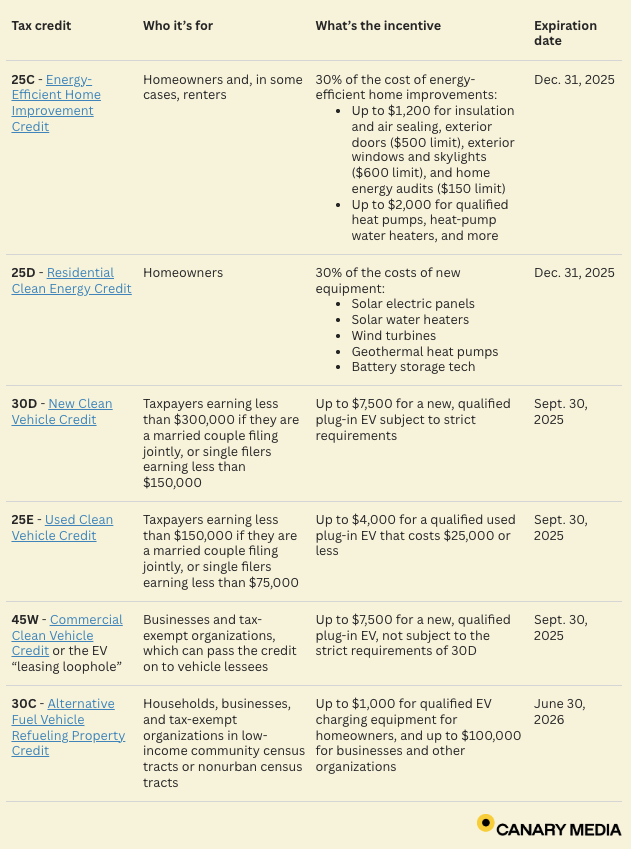
The Energy-Efficient Home Improvement Credit (25C) can get you up to $2,000 off your federal taxes for a qualifying heat-pump heater/air conditioner or heat-pump water heater, and separately, up to $1,200 on other energy-efficient upgrades, including insulation and air-sealing materials, windows, and exterior doors. The credit will even help you pay for an energy audit to diagnose your home’s biggest upgrade opportunities. You can claim a total of $3,200 this year. Under previous law, the credit renewed annually, so before the “Big, Beautiful Bill,” you could claim it every year until 2033. No longer. Expires: Dec. 31.
The Residential Clean Energy Credit (25D) takes 30% of the cost of a clean energy installation off your federal tax bill, with the actual amount uncapped. What tech counts? Solar photovoltaic panels, solar water heaters, home battery storage, geothermal heat pumps, and even home wind turbines. Feel free to go wild; you can use the tax credit for multiple projects in the same year. Expires: Dec. 31.
The New Clean Vehicle Credit (30D) can get you $7,500 off your federal tax bill for a brand-new, qualifying EV model. However, your household must earn less than $300,000 for married couples filing jointly, or $150,000 for single filers. You can get the discount on-site when you make your purchase. Expires: Sept. 30.
The Used Clean Vehicle Credit (25E) can lop up to $4,000 off your federal tax bill for qualifying pre-owned EVs. The income maxima are half of those for 30D: $150,000 for married couples filing jointly and $75,000 for single filers. You can get the discount right at the dealership. Expires: Sept. 30.
The Commercial Clean Vehicle Credit (45W) of up to $7,500 can’t be claimed by consumers directly but still gives them a fiscal advantage. Auto dealers are able to take the federal tax credit themselves and pass on the savings to leasing customers. Called the EV “leasing loophole,” the credit can be used for vehicles that don’t meet the stringent requirements needed to claim 30D. Expires: Sept. 30.
The Alternative Fuel Vehicle Refueling Property Credit (30C) delivers up to $1,000 off your federal tax bill to install qualified EV charging equipment if you live in an eligible area. Expires: June 30, 2026.
Here’s a summary table to easily look up what the tax credits cover:
The $8.8 billion federal Home Energy Rebates program is targeted to low- and moderate-income families (earning less than 150% of the area median income) and comes in two flavors.
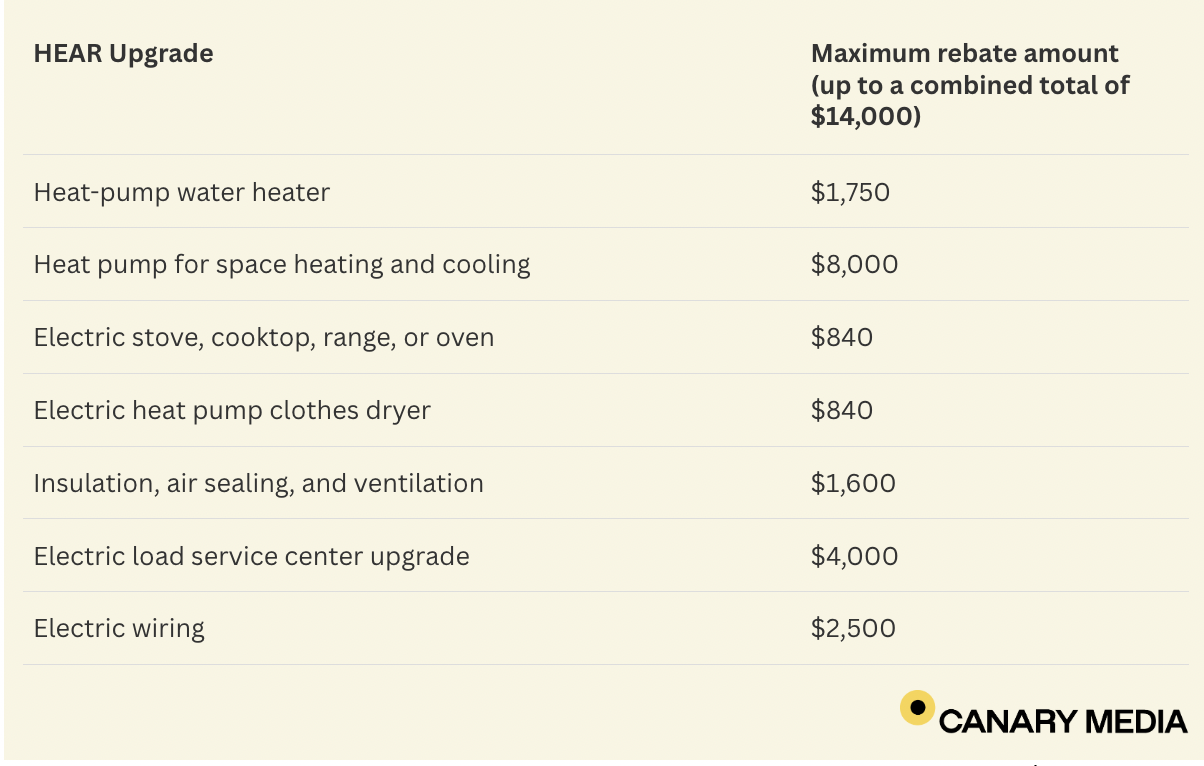
The Home Electrification and Appliance Rebate (HEAR) program provides qualified households with up to $14,000 in discounts for a wide range of efficient electric appliances and enabling upgrades — see the table below for an overview. Up to 100% of costs are covered for households earning less than 80% of the area median income, and up to half of costs for those that make 80% to 150% of the area median income.
The Home Efficiency Rebate (HER) program, also known as HOMES, can provide up to $4,000 — or $8,000 for lower-income households — for whole-home efficiency projects that are modeled to reduce energy use by at least 35%. The rebates can be even larger for actually-measured savings. Unlike HEAR, all households are eligible.
States and territories administer their own instances of the programs, and details vary, including eligibility requirements. The programs are still coming online. So far, five states — Georgia, Indiana, Michigan, North Carolina, and Wisconsin — plus Washington, D.C., have rolled out both HEAR and HOMES programs, making incentives available to residents, according to the Atlas Buildings Hub. Another seven states have launched just the HEAR program.
So check with your state energy office if home energy rebates are available or will be soon and how to qualify. In some cases, they’re going fast.

Home upgrades can be a beast, and Dec. 31 makes for a tight deadline, so the sooner you start exploring your electrification moves, the better.
You could kick the journey off by diving into the archives of this column, scheduling a home energy audit, and playing with a couple free online planning tools. Rewiring America’s personalized electrification planner lets you put in information, like your address and current appliances, and estimates the up-front costs and energy-bill impacts of going electric. The Green Upgrade Calculator by energy think tank RMI allows you to examine the financial expenses and carbon emissions you could avoid by replacing conventional fossil-fuel equipment with more efficient electric upgrades.
Check with your utility for local incentives in addition to the federal ones. Always shop around for at least three contractor quotes. The EnergySage marketplace can help connect you to some vetted options. Also, look for installers who specialize in whole-home electrification and can recommend cost-effective, holistic approaches.
Finally, find friends who have already made electrifying upgrades and yearn to give you advice. Seek out groups like Go Electric Colorado, Electrify Oregon, and Go Electric DMV for D.C, Maryland, and Virginia, which provide resources and electric coaches brimming with enthusiasm. They’ll be there to help you even after the tax credits are long gone.
As you wrap your home in insulation, ditch fossil-fueled furnaces for heat pumps, and trade in your gas-guzzling car for an EV, let me know how it goes! What challenges are you running into? What have you learned that you wished you knew at the start? How does it feel to be a part of the clean energy revolution? Reach out to me at takemura@canarymedia.com; I’d love to hear your stories.
June was a monumental month in the European Union: For the first time ever, it got more electricity from solar power than any other source.
Solar provided 22.2% of the region’s electricity, per clean-energy think tank Ember, unseating nuclear and beating out gas and coal combined. Between nuclear, wind, hydropower, and solar, nearly three-quarters of the EU’s power came from completely carbon-free sources.
It’s a striking illustration of how far solar power, and clean energy as a whole, have come in the EU.
A decade ago, solar contributed just 3.5% of the region’s power while coal supplied 24.6%. Those energy sources are now on pace to essentially trade places. Across all of last year, solar beat out coal for the first time as more and more EU member states shutter their polluting coal-fired power plants. The results speak for themselves: Power sector emissions declined by 41% between 2015 and the end of last year.
Europe has been in hyperdrive with clean energy since Russia invaded Ukraine in 2022, destabilizing the region’s main supply of affordable natural gas and sending gas prices soaring. Since then, for reasons of energy security as much as climate consciousness, the EU has made a concerted effort to ditch fossil fuels even faster and rely more on carbon-free energy sources that can be controlled locally.
That push has helped drive fossil-fueled generation to record lows on the region’s power grid. June was coal-fired power’s worst month ever in the EU, accounting for just 6.1% of electricity, largely thanks to Germany and Poland, the bloc’s two biggest coal consumers, burning comparatively small amounts of the fossil fuel. Meanwhile, solar smashed records in at least 13 of the EU’s 27 member states last month.
The milestone comes as the U.S. under the Trump administration moves backward on clean energy. Earlier this month, President Donald Trump signed into law the One Big, Beautiful Bill Act, which will rapidly phase out subsidies for solar and wind energy. Last week, his Energy Department released a controversial report that experts say will likely be used to justify extending the life of aging, uneconomical coal-fired power plants.
While the Trump administration seeks to tether the U.S. to fossil fuels, Europe and much of the world continue accelerating toward cleaner options.
On Tuesday, the president summoned leaders from tech, energy, and finance to Pittsburgh — that Silicon Valley of western Pennsylvania, a veritable Menlo Park on the Monongahela — where executives gushed about Trump’s apparent leadership as if their survival on a dating show depended on it.
At the summit, the industry offered some new insight into how it is thinking about a key question it faces, namely how AI companies are going to find the electricity to fuel their exponential growth. Hint: The answer might not be solar, wind, and batteries.
Investment firm Blackstone, for instance, unveiled a $25 billion strategy to build data centers alongside fossil gas power plants in Pennsylvania, which is rich in natural gas that’s hard to export elsewhere. Loading up the Keystone State with data centers could thus boost the fracking industry, which has plateaued in recent years.
Google brought its own major commitment, but with a clean twist: The tech giant will work with Brookfield Asset Management to relicense a pair of Pennsylvania hydropower plants to funnel up to 3 gigawatts of clean power to data centers in the region for 20 years.
The splashy announcements follow one from Microsoft last fall, in which the tech giant said it plans to bring back a reactor at Three Mile Island (the quietly retired one, not the one that had those problems you may have heard about) and use its output to power computing operations. No nuclear reactor has ever been restarted in the country, though a few restarts are in progress now.
There’s something other than Pennsylvania’s energy-rich geography connecting these three AI-energy plays: They’re banking on big, old-school, slow-moving energy projects to keep pace with the propulsive sprint of AI.
While gas is the No. 1 source of electricity in the U.S., new plants can’t be spun up quickly; top-tier turbine suppliers have warned of multi-year backlogs for that key ingredient. As for hydropower, new construction of major generators has stagnated for decades. Nuclear construction has shown more signs of life, but barely: Two new reactors were started and finished in the last 30 years, way behind schedule and massively over budget.
Meanwhile, the U.S. has been churning out gigawatts of new solar and battery installations, especially in Texas, where free markets reign and jealous incumbents have fewer tools to eliminate competition.
But Trump’s new budget bill whacked the solar and wind sector and threw new foreign-content restrictions at the grid storage industry. Analysts at the Rhodium Group think the budget law will eliminate about 60% of the clean power capacity we would have built in the next 10 years.
The law, then, is manufacturing energy scarcity at the moment when AI tycoons need abundance. Perhaps the long-lead-time technologies of bygone decades will shrug off their sluggishness and meet the moment. But history suggests that’s a risky thing to depend on for the nation’s tech dominance.—Julian Spector
Rural energy funding in turmoil
For over two decades, the Rural Energy for America Program, or REAP, has helped farmers and rural businesses save on energy costs, ranging from installing solar panels to buying more efficient grain dryers. The program has given out billions of dollars in grants and loans in its lifetime, and was infused with another $2 billion by the Inflation Reduction Act in 2022 — but now the Trump administration has cast uncertainty over the future of REAP, Kari Lydersen reports for Canary Media.
After taking office in January, Trump froze over $1 billion in REAP funds. Then, on July 1, the USDA abruptly canceled a grant application window for the program. The administration has also explicitly said it wants the program to deemphasize its most popular function: helping farmers afford solar. Farmers are concerned about the upheaval with the popular program, which, as Kari reports in a second story, largely benefits Republican congressional districts.
Consumers could lose big as Trump pushes fossil fuels
Twice now, Trump has ordered aging fossil-fueled power plants to stay open right as they were about to close. These directives, which energy experts agree are unnecessary, could cost consumers tens or even hundreds of millions of dollars — and some fear Trump might just be getting started, Jeff St. John reports for Canary.
Last week, Trump’s Energy Department released a report that experts say relies on flawed math to bolster the case for keeping old coal-fired power plants online past their planned closure dates. Experts fear the administration will use this report to justify additional orders like the two Trump has already made. If that happens, Jeff reports in a second story that it would be disastrous for Americans, potentially costing them billions of dollars in extra energy costs all to prop up expensive, polluting energy infrastructure that the grid doesn’t need.
Use it or lose it: The GOP megalaw sunsets tax credits that make it cheaper to do things like install solar, get a heat pump, or buy an EV, meaning consumers must act quickly to lock in discounts. (Canary Media)
Radioactive rubber stamp: Sources say a Department of Government Efficiency representative told high-level Nuclear Regulatory Commission officials in May to “rubber-stamp” new nuclear reactor designs. (Politico)
A breath of fresh air: Window-unit heat pumps perform well on key metrics like cost, ease of installation, and customer satisfaction, according to a new report examining their deployment in New York City public housing. (Heatmap)
Power-line politicking: Sen. Josh Hawley, a Missouri Republican, says he has secured a commitment from the Energy Secretary to cancel a $4.9 billion federal loan to build the Grain Belt Express transmission line, which would carry as much as 5 gigawatts of wind power from Kansas to other states. (New York Times)
Clean and carefree: Even after the GOP’s new law phases out subsidies for solar and wind in the U.S., the energy sources are “economically unstoppable,” a report from Columbia Business School finds. (news release)
Take me home, solar roads: A 5-MW solar canopy proposed for a two-mile stretch of highway median in Lexington, Massachusetts, would be the first such project in the country; developers are confident construction will begin in time to take advantage of expiring federal tax credits. (Lexington Observer)
Ohio’s OK: A major solar project in Ohio receives state approval despite strong local opposition and fossil-fuel-funded misinformation. (Canary Media)
Offshore headwinds: The U.S. EPA declares that Maryland environmental regulators last month improperly issued a permit for the US Wind project off the state’s coast, but Democratic Gov. Wes Moore says he is determined to push forward with offshore wind despite federal challenges. (WBFF)
The American solar manufacturing renaissance was charging ahead. Then President Donald Trump took the reins.
Since Trump resumed occupancy of the White House, promising to bring back manufacturing jobs, new investment in clean energy factories has plummeted from its Biden-era highs, and factory cancellations have surged instead. Now, with Trump’s signing of the One Big Beautiful Bill Act earlier this month, things are about to get even rockier for clean energy manufacturers — but several of the leading firms reshoring solar panel production still see reasons for qualified hope.
That’s not to say the path ahead will be easy. The law swings a battle-axe through the clean energy incentives that were carefully crafted by Democrats in the 2022 Inflation Reduction Act. Solar and wind deployment credits will disappear after 2027. Now, the U.S. will install somewhere between 57% to 62% less clean energy from 2025 to 2035, per a new analysis by Rhodium Group. That’s bad for all the customers and industries who will need vastly more electricity over that timeframe — not to mention the climate — but it also portends a shrinking market for American manufacturers to sell into.
“It’s a massive self-inflicted wound,” said Sen. Jon Ossoff (D-Ga.), an architect of the original clean energy manufacturing policy. “This law is a targeted attack on the advanced energy industry. It will hamstring industrial development; it will undermine energy independence and drive up energy costs by interrupting the development and installation of new generation capacity.”
But for manufacturers who have kickstarted a stunning reshoring of the solar supply chain after years of decline, the legislation’s final form is not nearly as dire as some earlier drafts. Chiefly, Republicans preserved the flagship manufacturing credit, which pays a company for each unit they make of key clean-energy components.
“Because manufacturing and job creation has always been a highlight of all politicians, independent of their party, that part has not been touched,” said Martin Pochtaruk, CEO of Heliene, which runs 1.3 gigawatts of domestic module production in Minnesota. However, the new law “has axed the businesses of many of our clients two years out, so it will require a lot of work by a lot of people to reshuffle how their businesses are run, and how they finance.”
The one major change the law did make to the manufacturing tax credit was to add in “foreign entity of concern,” or FEOC, restrictions, a whole new bureaucratic regime that polices companies’ corporate or supply-chain ties to China. New FEOC restrictions also apply to energy projects, and they actually resemble policies several domestic manufacturers have been requesting for years.
Take the case of T1 Energy, a solar manufacturer currently churning out 12,000 modules a day outside Dallas, on track for up to 3 gigawatts produced this year. Chinese giant Trina Solar actually built the factory but sold it to T1 (formerly known as Freyr Battery) in December, such that it is now operating under the control of a U.S.-based firm traded on the New York Stock Exchange. The company’s executive vice president for strategic communications, former longtime Wall Street Journal energy correspondent Russell Gold, called the law’s FEOC measures “good policy.”
“It promotes U.S. ownership and control of solar manufacturing and solar production,” Gold said. “Given how important solar is becoming on our power grids, that’s totally appropriate.”
Dean Solon, the billionaire solar entrepreneur who has manufactured connectors and cabling systems in Tennessee since the dawn of the modern solar industry, seemed unconcerned when I asked him in June about whether the new FEOC rules were too stringent.
“FEOC? Isn’t that a shitty little Italian car?” he responded.
For now, solar manufacturers that have factories operating or nearly operational can squint and see a good few years ahead while the tax credits are still accessible, though after that, it’s anybody’s guess. Companies that were about to commit to the multiyear effort to build new factories, however, just got an undeniable signal from Congress to take their jobs and economic dynamism elsewhere.
“The hill’s a lot steeper than it was before this for those kinds of investments,” said Mike Carr, executive director of the Solar Energy Manufacturers for America Coalition.

Somewhat improbably, Trump’s signature policy effort let the Biden-era 45X clean energy manufacturing credit continue as planned before phasing down after 2030 and stopping entirely in 2033 (except for wind manufacturing, which got whacked with an early end).
Unlike the earlier House version, Gold noted, the law preserves transferability, which lets factories monetize their credits when they lack sufficient tax burden themselves; factories cost a lot up front before they start making money, so this is especially useful in their early years. Factories almost lost stackability, which guarantees credits for companies that produce several steps of the supply chain, but the final text preserved that, Gold added.
“When you look at 45X, which is what solar manufacturers do receive, it is exactly like what was included in the Inflation Reduction Act and proposed by Sen. Ossoff in the Build Back Better days,” Pochtaruk said.
That has direct implications for a solar cell factory Pochtaruk was developing somewhere in the U.S. but put on hold after the election as he waited to see if 45X would survive. Now that its fate is clear, Heliene can return to developing that factory, if the company determines it still makes sense in the new market landscape.
The major lingering concern for solar manufacturers is what happens next with their customers. The law, after all, attacks the demand-side credits that were designed to stimulate purchases of made-in-America solar products.
The early demise of the solar deployment credits will hit manufacturers in two major ways.
First, with the stroke of Trump’s pen, the amount of clean energy projects expected to come online in the U.S. over the next decade just dropped. Demand for the American factories that opened up to serve that market just took a commensurate hit. Americans pay a lot more for solar panels than the rest of the world, due to the trade protectionism in place to help factories here; thus, U.S.-made solar is for U.S. consumers, and can’t readily export to foreign markets if domestic demand suddenly drops.
Second, in destroying the solar deployment credits, Republicans also eliminated the domestic content adder, a bonus incentive that encouraged developers to pick domestic equipment over cheap imports.
“They removed the key incentive driving investment in American manufacturing of solar technology,” Ossoff said. “Go ask the industry. This is a huge gift to the Chinese Communist Party, which will reinforce China’s stranglehold on the solar value chain.”
Marta Stoepker, a spokesperson for Qcells, which runs the largest solar-module factory in the U.S., located in Dalton, Georgia, corroborated the importance of that policy for encouraging domestic purchases.
“Policy levers like domestic content and trade are critical to ensuring U.S.-made solar can compete against China,” she said.
That said, the new megabill might leave a path for solar installations to continue at a healthy clip for the next five years. It’s the five years after that when solar could fall off a cliff.
Under the new law, solar developers need to start building their projects between now and July 4, 2026, to secure the full 30% investment tax credit. (If they start after that date, arrays must be placed in service by the end of 2027.) Starting Jan. 1 next year, companies will also need to meet the newly written FEOC rules that limit the amount of Chinese-produced materials in a power plant. As far as the IRS is concerned, developers have officially started building once they begin physical construction or buy 5% of the overall capital cost of the project — say by purchasing transformers or inverters. Then, under what’s called safe-harboring rules, developers have four years from the end of that year to finish the project, provided they show continued progress.
That timeline, then, could support something close to the recent high level of solar deployment into 2030, which would be great for newly minted factories that need a little more time to get their footing. Qcells is racing to finish a new factory in Cartersville, Georgia, that will produce 3.4 gigawatts of panels and the cells and wafers that go into them. T1 is still ramping up to its full capacity of 5 gigawatts.
If the market follows the pattern from previous times Congress was set to end solar incentives, developers will rush to safe-harbor projects before the deadline, fast-tracking work that could have been spaced out over the next few years. Then they’ll have several more years to buy the rest of the project equipment, giving domestic factories more time to spin up.
Nonetheless, factories will have to navigate upheaval among their customers in the mad dash to lock in these incentives. Larger developers can afford to hustle and start a number of projects in the next year to secure the full tax credit. Smaller developers typically finish and sell projects to finance their next efforts, a strategy that could be foiled by this truncated timeline.
“There is going to be consolidation, because the larger entities will buy out projects developed by smaller ones that cannot continue to bring them forward,” said Pochtaruk.
Besides the impending blows to domestic demand, a few other variables could skew the fate of the solar manufacturing renaissance.
For one thing, manufacturers will have to navigate the new FEOC rules themselves, proving they are not beholden to China in order to claim the 45X manufacturing credit. The firms who spoke with Canary Media said that, right now, doing so seems manageable, but a lot depends on how the final IRS guidance is written. The Treasury Department has until the end of 2026 to issue rules, according to the budget law.
Despite the uncertainty, some are very confident they’ll make do.
“Our optimism comes from having spent the last six or seven months working through these issues,” said Gold, whose company moved to ensure U.S. control of the factory before Trump took office. “We could give a workshop on how to achieve compliance, by this point. We’re not going to, because we want a competitive advantage, but we could.”
Not everyone is so sanguine. One alarming scenario would be if the administration uses new FEOC rules to launch investigations into clean energy manufacturers or developers. Ossoff deemed that a clear danger.
“It’s the most corrupt administration in American history, and they will wield implementation as a political cudgel,” Ossoff said. “They’ll pick winners and losers based on political considerations.”
As if to underscore that exact point, the White House published an executive order last Monday that targets the very credits that Trump had signed into law three days prior. The order specifically raises the possibility of the Treasury Department “restricting the use of broad safe harbors unless a substantial portion of a subject facility has been built.” Those safe-harbor rules are the same ones providing something of a lifeline to the American solar factories over the next few years. The solar industry is watching this measure intently to see how it affects the already-distorted outlook for the market.
“This is a longstanding, well-established set of practices,” Carr said of the IRS safe-harbor rules. If something happened to upend that established precedent, “basically everybody in the industry would sue pretty much immediately.”
Should manufacturers make it through the near-term turbulence, they’ll still have to figure out what happens to the solar market after the current tax credit-fueled runway peters out around 2030. That future could always involve a policy swing away from the current trajectory.
Over the last decade, solar tax credits have shown a Houdini-esque ability to bounce back from certain death through last-minute legislative maneuverings. But if this latest death proves more enduring, the industry will have to transition to a model that doesn’t revolve around monetizing tax credits. That change will be scary and uncertain for companies, but it would bring the U.S. market closer to the global norm.
“There will be no tax equity — there will be equity and debt, like on all projects in the rest of the planet,” Pochtaruk said. “There’s no tax credits in Chile, in South Africa, in Australia, in Namibia. Pick a country where solar is the most-deployed power generation source; [it’s happening] with no tax credits.”
Ongoing delays and disruptions to a federal rural energy program threaten to disproportionately impact Midwest farmers and Republican congressional districts, experts say.
For more than two decades, the Rural Energy for America Program (REAP) has helped thousands of farmers install solar, energy-efficient grain dryers, biodigesters, wind turbines, and other cost-saving clean energy improvements.
Since 2014, Illinois has benefited more than any other state, with over $140 million in REAP grants, according to federal data obtained by the Chicago-based Environmental Law & Policy Center through a public records request.
Minnesota, Iowa, Michigan, and Ohio are also in the top 10 states receiving grants during that period. REAP proponents say the numbers show what’s at stake as the program faces chaos and uncertainty under the Trump administration.
“It’s popular with all different stripes — not just political stripes, any type of farmer,” said Lloyd Ritter, who helped draft the program as senior counsel for former Sen. Tom Harkin (D-Iowa). “It could be poultry, corn, soybeans, wheat — everybody benefits because the program is so flexible and innovative, you can utilize the program for your type of needs in your area.”
Carmen Fernholz and his wife are among the success stories. The couple has run an organic farm in Minnesota for more than 50 years. Last summer Fernholz used a REAP grant to install a 40-kilowatt solar array. It powers everything on the farm from the electric lawnmower to the heating, and over the last year he’s earned an additional $600 a month on average by sending electricity on the grid back to his rural electric cooperative.
Since 2014, REAP has provided more than $1.2 billion for more than 13,000 solar projects, making up about 70% of the total REAP dollars. More than $292 million went to energy efficiency, including for windows, lighting, heating, and efficient grain driers. Millions more were awarded for biogas, biomass, biofuels, wind energy, hydroelectric power, and other projects.
This has created crucial energy savings and revenue for farmers, as well as important business for solar developers, energy-efficiency auditors, and various types of contractors. Farmers raising livestock and poultry and growing corn, soy, and other crops are the most common recipients of REAP, but funds have also gone to small rural businesses including distilleries, breweries, a car wash, a mental health clinic, a newspaper publisher, and a moving company.
More than 75% of the grants went to congressional districts represented by Republicans. Ritter noted that REAP was a deeply bipartisan effort from the start, led by both Harkin and former Republican Sen. Richard Lugar of Indiana.
“These are their voters,” Ritter said of Republican leaders. “The thing that is so great about REAP is it lowers energy costs and saves farmers money, which ties into the [Trump administration] agriculture secretary’s recent announcements about building rural prosperity and farm security.”
The program was turbocharged by the 2022 Inflation Reduction Act (IRA). Under the federal Farm Bill, REAP grants covered up to 25% of a project’s costs. The IRA created an additional funding source and allowed grants to cover up to 50% of a project’s cost.
More than $1 billion in REAP grants have been promised (or “obligated”) under IRA in just the past two years, while since 2014, Farm Bill REAP grants have totaled $623 million.
More than 80% of the IRA REAP grants — totaling $818 million — were awarded to solar projects, more than 5,000 of them nationwide. Those arrays are expected to generate over 8,000 gigawatt-hours of clean energy annually, according to the federal data.
REAP grants are paid as reimbursement after a project is completed. About $770 million worth of IRA-funded REAP grants have not been paid out yet, according to the data. That’s not surprising given that projects may still be under construction, but after President Donald Trump froze IRA funds earlier this year, some farmers and clean energy advocates are worried about whether promised grants will be paid in full.
Andy Olsen, senior policy advocate for the Environmental Law & Policy Center, has done extensive data analysis on REAP. Given the Trump administration’s hostility toward clean energy, he wonders what REAP will look like in the future.
“Will they support solar and wind projects?” Olsen asked. “This is a crew that likes refineries, likes ethanol, big centralized energy technologies. I could see them only making awards to biomass, ethanol, maybe some energy efficiency.”
In addition to grants, REAP provides loan guarantees for projects. That money does not go directly to the recipient, but the guarantee helps them secure private financing since the government promises to back up the loan if the recipient were to default. More than $3 billion worth of loan guarantees have been made under REAP since 2014, the data shows.
While the majority of REAP grants go to solar and energy efficiency, REAP has also obligated over $115 million to biogas, biofuel, and biomass projects; over $12 million to wind; and more than $8 million each to hydroelectric and geothermal projects.
Battery projects are also eligible for REAP, though only a few of those grants have been made thus far.
Fernholz, the farmer in Minnesota, hopes he can tap such a grant in the future. “The next step for people like myself should be looking at energy storage,” said Fernholz, who grew up on his parents’ farm as one of nine siblings.
He uses sustainable practices like conservation tillage and a tiling system to keep water from running off into nearby rivers. He also has 100 acres of native grassland and wetlands in a conservation reserve program. Solar is a major contribution to these efforts.
“When the REAP grant came through, that was a blessing, the frosting on the cake,” Fernholz said.
A recent U.S. Department of Agriculture policy document, which outlines a strategy to “Make Agriculture Great Again,” says that going forward, REAP will disincentivize solar on “productive farmland.” Ritter is worried that means few ground-mounted solar arrays will receive grants, though he imagines panels on barn and farmhouse rooftops will still be awarded.
“I can understand there are some concerns about the loss of farmland. It’s an emotional issue,” Ritter said. But he notes that housing development is the largest cause of farmland loss. Indeed, the American Farmland Trust reported in 2022 that between 2016 and 2040, the country is on track to convert over 12 million acres of farmland and ranchland to low-density residential development, like scattered houses and subdivisions with big lots. (Another roughly 6 million acres could be lost to higher-density residential development, commercial buildings, and industrial sites, the trust says.)
Ritter said installing solar can actually help prevent such conversions, by providing farmers revenue and energy savings that increase the financial viability of their farms. Meanwhile, agrivoltaic practices — like grazing livestock between rows of panels — mean solar and farming can coexist.
“There are a lot of great ways to do solar on prime farmland,” Ritter said. “You can build energy dominance and farm at the same time.”
Since 2009, Bill Jordan has helped close to 100 farmers write REAP grants to install solar with his company Jordan Energy in upstate New York.
“Electric bills are always in the top 10 expenses of running a farm business,” said Jordan. “Any business that’s going to run itself well will look at those costs. Behind-the-meter solar is a way of offsetting the cost of your own electricity, and it’s a wise diversification of farm revenue.”
Jordan said he has met “farmers who are milking 150 cows and making more money on the solar farm than on milk production. It’s also a diversification that the next generation gets. As farmers do family succession planning, the younger generation gets excited about solar.”
Jordan hopes solar funding under REAP doesn’t diminish because of partisan politics, emphasizing that it drives solar manufacturing and installation jobs along with helping farmers.
“These are good American jobs,” he said. “Let’s not throw out the baby with the bathwater. Creating energy independence is really what this is about.”
A home electrification and solar pilot program for lower-income Cape Cod and Martha’s Vineyard residents is cutting participants’ energy bills nearly 60% and is expected to inform Massachusetts’ ongoing efforts to bring renewable energy and energy efficiency to all households.
“What the commonwealth has to have available, if we’re going to even hope to achieve our climate goals, is that there have to be options for people at every income level,” said Maggie Downey, chief administrative officer of the Cape Light Compact, the organization that administered the pilot.
The program, known as the Cape and Vineyard Electrification Offering, gave solar panels to all 55 participating households and heat pumps to 45 of those, most at no cost and some with a low co-payment, depending on income levels. Twelve households also received batteries, and some got electric dryers and stoves, to transition the homes completely off fossil fuels. Installations began in January 2024, and the final one wrapped up in May 2025.
The results: The average household is saving some $150 per month on energy costs and reducing net electricity use by 59% by getting much of its needed power from the on-site solar panels, according to an analysis published by the consultancy Guidehouse at the end of last month. Perhaps unsurprisingly, participating residents are quite satisfied with these outcomes, giving the program an exceptionally good “net promoter score” of 71%.
“My costs are drastically lower,” said Judy Welch, a homeowner in the Cape Cod town of Chatham who was one of the first folks to sign on for the upgrades. “In the summer now, I don’t have any bills, and I have the air conditioning on the whole time.” Her winter energy bills have also dropped to nearly zero thanks to the solar-powered heat pumps; previously, Welch paid around $500 a month to run electric baseboard heating.
Massachusetts has long had strong incentives for renewable energy and been a leader in policies promoting energy efficiency. The state has had less success, however, in helping lower-income households realize the benefits of these measures. At the same time, Massachusetts residents — especially those who make less money — face some of the highest energy burdens in the country. On Cape Cod, households making less than one-third of the area median income spent an average of 27% of their income on energy as of 2023, according to data from the U.S. Department of Energy. (An updated figure is unavailable because the federal tool that provided this data is no longer live.)
The Cape and Vineyard Electrification Offering was conceived of as a way to overcome the sometimes unmanageable up-front cost of efficiency and clean energy upgrades, and to amplify the impact of individual technologies by deploying them together. Solar panels would keep down the cost of operating heat pumps, and batteries would maximize the amount of zero-cost electricity available to each home.
“It’s all bundled for the participant in a way that makes sense and optimizes all these different systems and combines them through one program,” said Todd Olinsky-Paul, senior project director for the Clean Energy Group, a Vermont-based nonprofit that advocates for a just energy transition. “I haven’t seen that anywhere else.”
The pilot was designed and offered by the Cape Light Compact, a unique regional organization that negotiates electric supply prices and administers energy-efficiency programming for the 21 towns on Cape Cod and Martha’s Vineyard. The compact proposed versions of the pilot in 2018, 2020, and 2021, before the state gave it the go-ahead in 2023.
The version that was finally approved called for 100 homes to participate in the pilot. As the effort rolled out, however, planners realized how challenging it is to deploy a standard package to houses with a wide range of ages and conditions. In some cases, interested homeowners decided against participation when they realized they would have to pay more than they hoped or discovered their yards were too shaded to generate much solar power. Some who did participate needed mold remediation or roof replacements; others were unable to receive batteries because they didn’t have basements.
“There is really no single solution for these questions,” Downey said. “It is so site-specific and customer-specific.”
Ultimately, 55 homes enrolled, as the unanticipated roadblocks raised the expected cost of serving each participant. On average, the Cape Light Compact spent about $45,700 on each heat pump installation, $30,000 on each solar installation, and $33,000 on each battery system, according to preliminary calculations.
These figures raised some questions at a recent meeting of the compact’s governing board, at which the Guidehouse report was presented. Downey acknowledged the cost, but pointed out that the need to transition off fossil fuels is inevitable — and comes with a price tag.
“You cannot hide the expense of what we have in front of us to deal with,” she told the board.
The report offers suggestions for improving any future iterations of the initiative. Pilot participants were prohibited from enrolling their solar systems in the state’s net-metering offering, and therefore their compensation for excess energy sent back into the grid was between 5 cents and 10 cents per kilowatt-hour, rather than at least 25 cents per kilowatt-hour. The evaluation suggests that future programs should allow the use of net metering to improve financial benefits even further. The report also suggests improving coordination among the various installers involved to make the process run more smoothly for participants.
The Cape Light Compact will present the results at the August meeting of the state Energy-Efficiency Advisory Council, the group responsible for writing Massachusetts’ triennial energy-efficiency plan. From there, the council will decide how to use the information to guide future equity-focused electrification efforts and determine the appropriate amount of financial support for households at different income levels.
“The results show that there are savings, and that energy burdens are reduced by more than 50%, when you pair it all with solar,” Downey said. “If we want to have low- to moderate-income customers come with us, we need to have options — that’s all part of the conversation.”


.svg)
