

 Back
Back
So far, 2025 has been a mixed bag for EV sales in the U.S. A record 607,089 EVs left the lot in the first six months of the year, Cox Automotive reports, but sales in the second quarter were still lower than in Q2 2024.
A big part of that Q2 decline has to do with Tesla, which remains the U.S.’s top EV seller but has suffered stateside and around the world thanks to CEO Elon Musk’s stint in the White House. This week, Tesla reported its profits dropped 16% in Q2 compared to the same period last year. Tesla doesn’t report its sales, but it delivered nearly 60,000 fewer vehicles in Q2 compared to a year ago.
General Motors, meanwhile, had better news to share. It sold 46,280 EVs in Q2, more than double its sales in the same period last year. That’s still a far cry from Tesla’s 380,000-plus deliveries, but it was enough to make GM the No. 2 EV brand in the U.S. And slower EV sales across the industry aren’t deterring GM CEO Mary Barra, who said the company sees EV production as its “North Star.”
Rivian reported a delivery decline in the second quarter but still plans to build new headquarters and an EV factory in Georgia. Smaller EV company Lucid says it delivered a record 3,309 cars in Q2.
Be prepared, though, for a rollercoaster in the next few months now that the “Big, Beautiful Bill” has sent EV tax credits to an early grave. Cox Automotive predicts EV sales will hit a new record in Q3 as buyers race to use federal incentives before they expire at the end of September. After that? “A collapse in Q4, as the electric vehicle market adjusts to its new reality.”
Trump calls off loan for major transmission line
The Trump administration this week canceled a $4.9 billion federal loan guarantee for the Grain Belt Express, putting its future in jeopardy, Canary Media’s Jeff St. John reports.
The planned transmission line, which was granted its loan guarantee under the Biden administration, is meant to bring wind and solar power generated in the Great Plains to cities further east. It has been in the works for more than a decade, and construction on its first phase was slated to start next year.
While the Grain Belt Express had support from utility regulators and large electricity consumers along the line’s route, Missouri Republicans turned against it in recent weeks. The state’s Republican attorney general launched an investigation into the project earlier this month, and Sen. Josh Hawley said he made a direct appeal to President Trump to pull back federal support.
Can the EPA revoke all its emissions rules at once?
The U.S. EPA is planning to demolish the bedrock of many of its climate change-fighting regulations, The New York Times reports. The agency is reportedly preparing a rule that would rescind the 2009 “endangerment finding,” which scientifically established that greenhouse gases harm human health. That finding underpins many of the EPA’s landmark emissions rules, including regulations targeting pollution from cars, factories, and power plants. If the finding is revoked, it would immediately end all those limits and make it harder for future presidential administrations to reinstate them.
The draft of the rule change doesn’t dispute that climate pollutants like carbon dioxide and methane drive global warming or put people’s health at risk, according to the Times. Instead, it claims the endangerment finding oversteps the EPA’s authority. The new rule is almost certain to face legal challenges if it’s finalized.
A “shadow ban” on renewables? Democrats, advocates, and industry groups push back on the Trump administration’s decision to heighten reviews for proposed solar and wind projects on federal land, saying it could lead to a clean energy “shadow ban.” (E&E News)
Shaving solar costs: Solar industry veteran Andrew Birch says cutting non-equipment costs like permitting and project management can reduce the price of rooftop solar installations as federal incentives expire. (Canary Media)
Reeling in the deep: The U.S. government’s step toward issuing The Metals Co. deep-sea mining permits conflicts with an international treaty, leaving the startup’s partners abroad wary of continuing to work together. (New York Times)
Can SMRs succeed? Nuclear industry leaders say there’s enough momentum and funding behind small modular reactor development to propel the sector beyond its past failures. (Canary Media)
Data center downgrade: OpenAI’s Stargate project softens its ambitious plans and is now only looking to build one small data center this year, which could have fallout for energy developers who would have powered the projects. (Wall Street Journal)
Carbon capture’s secret supporters: The oil and gas industry has played a big role in crafting an Ohio carbon-capture bill that could help keep fossil fuel operations running. (Canary Media)
Rates on the rise: U.S. utilities have requested or secured a record $29 billion in rate increases in the first half of the year, more than double the total reached halfway through 2024. (Latitude Media)
A controversial bill to unravel North Carolina’s climate law would cost the state more than 50,000 jobs annually and cause tens of billions of dollars in lost investments, a new study finds. The research comes days before the Republican-controlled state legislature aims to override a veto of the measure by Gov. Josh Stein, a Democrat.
First passed by the Senate in March, the wide-ranging Senate Bill 266 repeals the 2030 deadline by which utility Duke Energy must curb its climate pollution 70% compared to 2005 levels. It leaves intact a mandate that the company achieve carbon neutrality by midcentury.
Senate leader Phil Berger, a 13-term Republican from Rockingham County, has said his chamber will vote on the override Tuesday, July 29. The House, which approved the bill with bipartisan support in June, could attempt an override of Stein’s July 2 veto the same day.
Conducted by BW Research for clean energy nonprofits, the new analysis draws on earlier projections from Public Staff, the state-sanctioned customer advocate. That modeling showed that without a near-term climate goal, Duke would build about 40% less new generation capacity over the next decade — leaning harder instead on aging fossil-fueled units to meet demand.
The fresh research calculates the economic losses of foregoing those new power plants, including massive amounts of solar and wind along with 300 megawatts of new nuclear and 1,400 megawatts of combined-cycle gas plants.
From 2030 to 2035, North Carolina would see nearly 50,700 fewer jobs annually and over $47.2 billion sacrificed in power-plant construction, the study says. More than $1.4 billion in tax revenue would also be left on the table.
“This study conveys in real terms the impact of arbitrarily removing a market signal that has proven to be a job creator and an economic booster for North Carolina,” said Josh Brooks, chief of policy strategy and innovation with the North Carolina Sustainable Energy Association.
BW Research finds that if SB 266 became law, Duke would have 12 fewer gigawatts of capacity in 2035 to meet peaks in power demand, like those that happen on unusually cold winter mornings. Experts say the company would likely have to purchase more out-of-state power or rely more heavily on fossil fuels as a result.
“This limitation hampers the state’s ability to meet current energy needs and undermines its competitive edge in attracting energy-intensive industries,” the analysts say.
The new study is the second to show how Public Staff’s modeling belie claims from SB 266 proponents that the bill will save money and promote more power generation.
Late last month, three researchers from North Carolina State University found that with fewer solar, wind, and nuclear plants as projected by Public Staff, Duke would have to burn almost 40% more natural gas between 2030 and 2050.
Under a worst-case but plausible scenario for gas prices, the trio found, customers could pay $23 billion more in fuel costs on their electric bills by midcentury as a result. The figure would cancel out projected consumer savings from building fewer new sources of generation, a fact not lost on the governor.
“My job is to do everything in my power to lower costs and grow the economy,” Stein said in a statement when he vetoed SB 266 early this month. “This bill fails that test.”
In his veto message, Stein also referenced another study, from EQ Research, showing the measure would make energy more expensive for North Carolina households.
“[SB 266] shifts the cost of electricity from large industrial users onto the backs of regular people,” Stein said. “Families will pay more so that industry pays less.”
Still, the findings from independent researchers and the three NC State professors may not be enough to counter the lingering narrative that SB 266, dubbed the Power Bill Reduction Act, will help customers.
Duke Energy and major industrial groups have lined up in support of the measure — the latter falsely suggesting that solar power investments have raised electric rates.
The North Carolina Chamber, the state’s major business lobby, says the bill’s enactment would provide “businesses and consumers with more affordable, predictable energy costs.” The group plans to include SB 266 in its annual scorecard rating legislators’ performances.
Perhaps most daunting for clean energy advocates and other bill opponents is that several Democrats appear swayed by these arguments. While Republicans have enough members to overrule Stein in the upper chamber, they’re one vote shy in the House. With all members present, that means the 11 House Democrats who previously voted for SB 266 would need a change of heart to uphold Stein’s veto.
House Speaker Destin Hall, a Republican from Caldwell County, says that won’t happen.
“I’m disappointed in the governor’s veto of the ‘Power Bill Reduction Act,’ which would have delivered cheap, reliable energy to North Carolina, cut the red tape that is choking innovation and long-term energy solutions, and saved consumers over $12 billion dollars,” Hall said in statement moments after Stein rejected the bill. “Considering the strong bipartisan support in both chambers, we anticipate overriding this veto.”
But Will Scott, Southeast climate and clean energy director for the Environmental Defense Fund, hopes the study will help change lawmakers’ minds.
“This shows that passing this legislation is going to have negative consequences for our ability to meet growing demand,” he said, “and that’s going to have knock-on economic impacts across the state.”
The highest court of the UN has issued a landmark “advisory opinion” stating that nations can be held legally accountable for their greenhouse-gas emissions.
Recognising the “urgent and existential threat” facing the world, the International Court of Justice (ICJ) concluded that those harmed by human-caused climate change may be entitled to “reparations”.
Their opinion largely rests on the application of existing international law, clarifying that climate “harms” can be clearly linked to major emitters and fossil-fuel producers.
The case, which was triggered by a group of Pacific island students and championed by the government of Vanuatu, saw unprecedented levels of input from nations.
In a unanimous decision issued on 23 July, the 15 judges on the ICJ concluded that the production and consumption of fossil fuels “may constitute an internationally wrongful act attributable to that state”.
The opinion also says that limiting global warming to 1.5C should be considered the “primary temperature goal” for nations and, to achieve it, they are obliged to make “adequate contributions”.
While the ICJ opinion is not binding for governments, it could have significant influence as vulnerable groups and nations push for stronger climate action or seek compensation in court.
Below, Carbon Brief explains the most important aspects of the ICJ’s 133-page advisory opinion and speaks to legal experts about its implications.
The case stems from a campaign led by 27 students from the University of the South Pacific in Fiji.
In 2019, they established a youth-led grassroots organisation – dubbed the Pacific Island Students Fighting Climate Change (PISFCC) – and began efforts to persuade the leaders of the Pacific Islands Forum to take the issue of climate change to the world’s top court.
PISFCC joined forces with other youth organisations from around the world in 2020, lobbying state representatives to take action.
In 2021, the government of Vanuatu announced that it would lead efforts to gain an “advisory opinion” from the ICJ. It worked to engage with the Pacific island community first, to build a “coalition of like-minded vulnerable countries”, reported Climate Home News.
Following on from this work, Vanuatu received a unanimous endorsement for its efforts from the 18 members of the Pacific Island Forum. It continued to work diplomatically, engaging in discussions across Europe, Asia, Africa and Latin America to encourage other countries to join the effort.
After three rounds of consultations with other states, the resolution was put before the UN general assembly with the backing of 105 sponsor countries.
Finally, on 29 March 2023, the assembly unanimously adopted the resolution formally requesting an “advisory opinion” from the ICJ.
The resolution posed two questions for the ICJ. In answering these questions, it asked the court to have “particular regard” to a range of laws and principles, including the UN climate regime and the universal declaration on human rights.
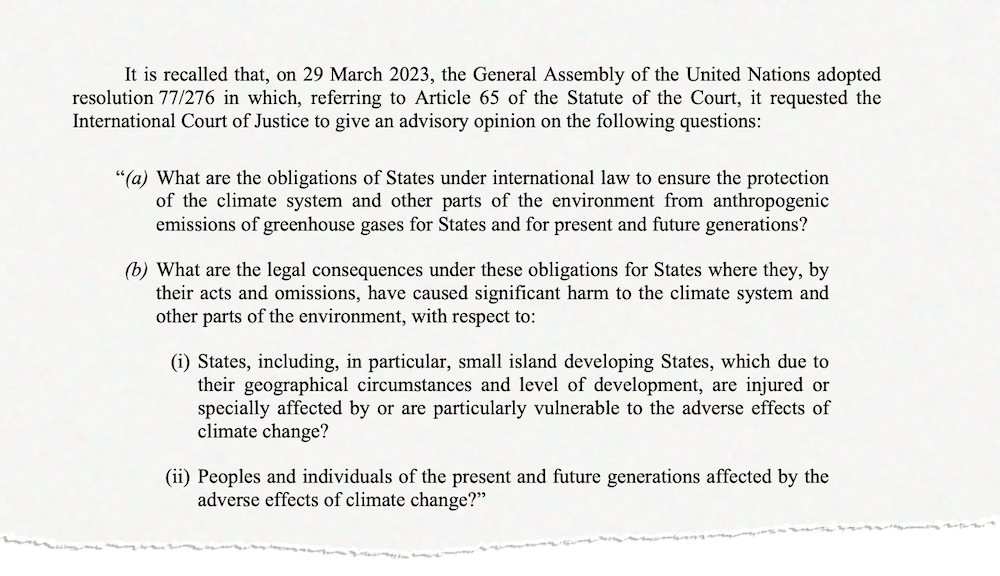
First, the resolution asked what are the legal obligations of states under international law to “ensure the protection of the climate system”.
Second, it asked what are the legal consequences flowing from these obligations if states, by their “acts or omissions”, have caused “significant harm to the climate”.
The resolution asked for the court to consider, in particular, states that are “specially affected” or are “particularly vulnerable” to the impacts of climate change.
It also pointed to “peoples and individuals of the present and future generations affected by the adverse effects of climate change”.
Therefore, the advisory opinion issued this week by the ICJ, in response to these questions, is the culmination of a years-long process.
Although the opinion is not binding on states, it is binding on UN bodies and is likely to have far-reaching legal and political consequences at a national level.
The ICJ was tasked with interpreting international law and arriving at an advisory opinion. While its legal advice will, therefore, not be binding for nations, it will be binding for other UN bodies.
This two-year process involved the judges defining the scope and meaning of the broad questions put to them by the UN general assembly. (See: How did the case come about?)
They then considered which international laws and principles were relevant for these questions.
Among the relevant laws identified were the three UN climate change treaties – the UNFCCC, the Kyoto Protocol and the Paris Agreement.
They also considered various other treaties covering biodiversity, ozone depletion, desertification and the oceans, as well as legal principles such as the principle of “prevention of significant harm to the environment”.
The ICJ’s process has also seen nations and international groups, such as the Organisation of the Petroleum Exporting Countries (Opec), offer their views on the case.
These groups had the opportunity to feed into the judges’ deliberations over several stages, including two sets of written submissions, followed by oral statements to the court.
In total, the court received 91 written statements, a further 107 oral statements – delivered at the Hague in December 2024 – and 65 responses to follow-up questions by the judges.
This is the “highest level of participation in a proceeding” in the court’s history, according to the ICJ. Some nations, including island states such as Barbados and Micronesia, appeared before the court for the first time ever.
These contributions demonstrated broad agreement among nations that climate change is a threat and that emissions should be cut in order to meet the objectives of the Paris Agreement.
But there were major divergences on the breadth and nature of obligations under international law to act to limit global warming, as well as on the consequences of any breaches, as specifically being addressed by the ICJ.
Overall, the main divisions were between high-emitting nations trying to limit their climate obligations and low-emitting, climate-vulnerable nations, who were pushing for broader legal obligations and stricter accountability for any breaches.
Specifically, “emerging” economies such as China and Saudi Arabia, along with historical high-emitters such as the UK and EU, argued that climate obligations under international law should be defined solely by reference to the UN climate regime.
In contrast, vulnerable nations said that wider international law should also apply, bringing additional obligations to act – and the potential for legal consequences, including reparations.
This is a departure from UN climate talks, where the main divide tends to be between “developed” and “developing” countries – with the latter encompassing both high- and low-emitting nations.
In an unusual move, the ICJ judges also organised a private meeting in November 2024 with scientists representing the Intergovernmental Panel on Climate Change (IPCC).
Among those present were IPCC chair Prof Jim Skea and eight other climate scientists from various countries and with different areas of expertise.
A statement issued by the ICJ said this was an effort to “enhance the court’s understanding of the key scientific findings which the IPCC has delivered”.
On 23 July 2025, after some seven months of deliberation, the ICJ issued a unanimous opinion in response to the UN general assembly’s request.
This is only the fifth time the court has delivered a unanimous result, according to the ICJ, after nearly 88 years in operation and 29 opinions.
(In addition to the unanimous opinion of the full court, several of the ICJ judges also issued their own declarations and opinions, individually or in small groups.)
When considering the “context” for the issuing of the advisory opinion on climate change, the court provides information on the “relevant scientific background”.
This was drawn from reports by the IPCC, which the court says “constitute the best available science on the causes, nature and consequences of climate change”.
It comes after ICJ judges held a private meeting with IPCC scientists in 2024. (See: How has the case been decided?)
The advisory opinion states that it is “scientifically established that the climate system has undergone widespread and rapid changes”, continuing:
“While certain greenhouse gases [GHGs] occur naturally, it is scientifically established that the increase in concentration of GHGs in the atmosphere is primarily due to human activities, whether as a result of GHG emissions, including by the burning of fossil fuels, or as a result of the weakening or destruction of carbon reservoirs and sinks, such as forests and the ocean, which store or remove GHGs from the atmosphere.”
It continues that the “consequences of climate change are severe and far-reaching”, listing impacts including the “melting of ice sheets and glaciers, leading to sea level rise”, “more frequent and intense” extreme weather events and the “irreversible loss of biodiversity”. The document adds:
“These consequences underscore the urgent and existential threat posed by climate change.”
The advisory opinion further adds that the “IPCC notes that adaptation measures are still insufficient” and that “limits to adaptation have been reached in some ecosystems and regions”.
On the need to address rising emissions, the document quotes the IPCC directly, saying:
“According to the panel, climate change is a threat to ‘human well-being and planetary health’ and there is a ‘rapidly closing window of opportunity to secure a liveable and sustainable future for all’ (very high confidence). It adds that the choices and actions implemented between 2020 and 2030 ‘will have impacts now and for thousands of years’.”
It adds that the “IPCC has also concluded with ‘very high confidence’ that risks and projected adverse impacts and related loss and damage from climate change will escalate with every increment of global warming”.
In regards to how states should consider climate science when implementing climate policies and measures, the court says that countries should exercise the “precautionary principle”, adding:
“The court observes that where there are threats of serious or irreversible damage, lack of full scientific certainty should not be used as a reason for postponing cost-effective measures to prevent environmental degradation.”
In response to the first question on legal obligations, the ICJ says that countries have “binding obligations to ensure protection of the climate system” under the UN climate treaties.
However, the court’s unanimous opinion flatly rejects the argument, put forward by high emitters, such as the US, UK and China, that these treaties are the end of the matter.
These nations had argued that the climate treaties formed a “lex specialis”, a specific area of law that precludes the application of broader general international law principles.
On the contrary, the ICJ says countries do have legal obligations under general international law, including a duty to prevent “significant harm to the environment”, with further obligations arising under human rights law and from other treaties.
As such, the court, “essentially sided with the global south and small island developing states”, says Prof Jorge Viñuales, Harold Samuel professor of law and environmental policy at the University of Cambridge.
Moreover, the court finds that countries’ obligations extend not only to greenhouse gas emissions, but also to fossil-fuel production and subsidies, says Viñuales, who acted for Vanuatu in the case.
Speaking to Carbon Brief in a personal capacity, he says: “That is important because major producers are not necessarily major emitters and vice-versa.”
In terms of the UN climate treaties, such as the Paris Agreement, the court affirms that these give countries binding obligations including adopting measures to mitigate greenhouse gas emissions and adapt to climate change.
Developed countries – parties listed under Annex I of the UNFCCC – have “additional obligations to take the lead in combating climate change”, the ICJ notes.
States also have a “duty” to cooperate with each other in order to achieve the objectives of the UNFCCC, acting in “good faith” to prevent harm, it adds.
Beyond the climate treaties, it says that “states have a duty to prevent significant harm to the environment”. Therefore, they must act with “due diligence” and use “all means at their disposal” to prevent activities carried out within their jurisdiction or control from causing “significant harm” to the climate system.
The court sets out the “appropriate measures” that would demonstrate due diligence, including “regulatory mechanisms…designed to achieve deep, rapid and sustained reductions” in emissions. This repeats language from the IPCC, but attaches it to countries’ legal obligations.
As with action under the climate treaties, countries’ obligations under broader international law should be taken in accordance with the principle of “common but differentiated responsibilities” it adds, a point reaffirmed throughout the advisory opinion.
Furthermore, countries have obligations to act on climate under a raft of other international agreements, covering the ozone layer, biological diversity, desertification and the UN convention on the law of the sea, the ICJ notes.
The court affirms that states that are not party to UN climate treaties must still meet their equivalent obligations under customary international law. This “addresses the unique situation of the US, but without naming it”, notes Sébastien Duyck, a senior attorney at the Center for International Environmental Law, on Bluesky.
Following his re-election last year, US president Donald Trump signed an order to pull the country out of the Paris Agreement again. As such, there is a question around how the ICJ’s opinion might apply to the US – the country that has contributed more to human-caused climate change than any other nation.
Additionally, states have obligations under international human rights law to “respect and ensure the effective enjoyment of human rights by taking necessary measures to protect the climate system and other parts of the environment”, according to the ICJ.
This follows a ruling from the European Court of Human Rights (ECHR) in 2024 that found that the Swiss government’s climate policies violated human rights, as governments are obliged to protect citizens from the “serious adverse effects” of climate change.
Announcing the opinion to the Hague, judge Iwasawa Yuji, president of the court, said:
“The human right to a clean, healthy and sustainable environment is essential for the enjoyment of other human rights.”
The second part of the advisory opinion deals with the “legal consequences” of countries causing “significant harm to the climate system and other parts of the environment”.
This refers to nations breaching their “obligations”, as defined in the first part of the opinion. (See: What does the ICJ say about countries’ climate obligations?)
Crucially, the court says that countries can, in principle, face liability for climate harms, opening the door to potential “reparations” for loss and damage. Prof Viñuales tells Carbon Brief:
“Perhaps the main take away from the opinion is that the court recognised the principle of liability for climate harm, as actionable under the existing rules.”
Prof Viñuales notes that the court says “climate justice is governed by the general international law of state responsibility, which provides solutions for the recurrent arguments levelled to escape liability for climate harm”.
Essentially, the ICJ rejects the notion that it is too difficult to hold countries accountable for climate damages.
Examples of breached obligations given by the court include failing to set out or implement climate pledges – known as nationally determined contributions (NDCs) – under the Paris Agreement, or to sufficiently “regulate emissions of greenhouse gases”.
The ICJ stresses that it is not responsible for pointing fingers at particular countries, only for issuing a “general legal framework” that countries can follow.
As part of this process, it lays out a justification for why states can be held responsible for climate change.
During the ICJ process, some countries argued that greenhouse gas emissions are not like other environmental damage, such as localised chemical pollution. They said that emissions arise from all sorts of regular activities and it is difficult to tie climate damage to specific sources.
Others argued that it is perfectly possible to attribute such damage to states that, for example, have laws to “promote fossil-fuel production and consumption”.
This is important, as the ICJ points out that attribution is necessary if an activity is to be defined as an “internationally wrongful act”. Ultimately, the court agrees that it is feasible to attribute climate damage to specific states, on a “case-by-case” basis.

The court also finds that it is possible, at least in principle, to link climate disasters to countries’ emissions, though it notes that the causal links may be “more tenuous” than for localised pollution. It cites IPCC findings that climate change has amplified heatwaves, flooding and drought, stating:
“While the causal link between the wrongful actions or omissions of a state and the harm arising from climate change is more tenuous than in the case of local sources of pollution, this does not mean that the identification of a causal link is impossible.”
With this established, the court sets out what the consequences could be for countries that are deemed to have carried out “wrongful acts”.
First, the ICJ stresses that nations must meet their existing climate obligations. This means that if, for example, a government publishes an “inadequate” NDC, a “competent court or tribunal” could order it to supply one that is consistent with its obligations under the Paris Agreement.
Second, it also says that if a state is found responsible for climate damage, it must stop and ensure that it does not happen again.
States may be required to “employ all means at their disposal” to carry out this duty, according to the ICJ. In practice, the court says that this could mean governments revoking administrative or legislative acts in order to cut emissions.
In theory, this could lead to more stringent climate policies. For example, Dr Maria Antonia Tigre, director of global climate change litigation at the Sabin Centre for Climate Change Law, tells Carbon Brief:
“The ICJ made clear that the standard of due diligence is stringent and that each state must do its utmost to submit NDCs reflecting its highest possible ambition. That may strengthen pressure – political, legal and public – on states to raise their climate targets, especially before the next global stocktake.”
Finally, the ICJ opens the door for countries to seek “reparations” for climate harms from other countries.
It says these reparations could be expressed in different ways – including paying compensation or issuing formal apologies for wrongdoing.
This outcome was widely celebrated by climate justice activists and vulnerable nations, who see it as ushering in a “new era” in the fight to obtain financial compensation for climate disasters.
Harj Narulla, a barrister at Doughty Street Chambers and legal counsel for the Solomon Islands, tells Carbon Brief:
“The ICJ’s ruling has provided a legal pathway for developing states to seek climate reparations from developed States…States can bring claims for compensation or restitution for all climate-related damage. This includes claims for loss and damage, but importantly extends to any harm suffered as a result of climate change.”
One of the most significant parts of the ICJ opinion is the assertion that nations and “injured individuals” can seek “reparations” for climate damage.
This ties in with a long and contentious history of climate-vulnerable nations in the global south seeking compensation from high-emitting nations.
The notion of “climate reparations” has often been linked to developing countries pushing for so-called “loss and damage” finance in UN climate negotiations, including the – ultimately successful – fight for a “loss-and-damage fund”.
However, the US and other big historical emitters have ensured that any progress on loss-and-damage funding has not left them legally accountable for their past emissions.
The Paris Agreement states explicitly that its inclusion of loss and damage “does not involve or provide a basis for any liability or compensation”.
Crucially, the ICJ opinion makes it clear that such language does not override international law and states’ responsibilities to provide “restitution”, “compensation” and “satisfaction” to those harmed by climate change.
Danilo Garrido Alves, a legal counsel for Greenpeace International, tells Carbon Brief that this means loss-and-damage finance is not a replacement for reparations:
“If a state contributes to the loss and damage fund and at the same time breaches obligations…that does not mean they are off the hook.”
Legal experts, including Prof Viñuales, tell Carbon Brief that this outcome is not surprising, given its grounding in international law. He says:
“It is the correct understanding of international law, but, in law, progress often takes the form of moving from the implicit to the explicit and that’s what the court did.”

Nevertheless, the outcome could have major implications for climate politics and lead to a wave of new climate litigation. Dr Tigre, at the Sabin Centre for Climate Change Law, tells Carbon Brief:
“[It] could shift the conversation from voluntary climate finance to legal obligations to repair harm, particularly for vulnerable communities and states already suffering loss and damage.”
Notably, the court says that while some states are “particularly vulnerable” to climate change, international law “does not differ” depending on such status. This means that, in principle, all nations are “entitled to the same remedies”.
As for individuals or groups taking legal action for both “present and future generations”, the ICJ notes that their ability to do so does not depend on rules around “state responsibility”. Instead, they would depend on obligations being breached under “specific treaties and other legal instruments”.
The ICJ says that reparations would be determined on a case-by-case basis, noting that the “appropriate nature and quantum of reparations…depends on the circumstances”. It also notes that:
“In the climate change context, reparations in the form of compensation may be difficult to calculate, as there is usually a degree of uncertainty.”
The question of precisely which nations will be liable for paying climate reparations is also predictably complex. Much of this discussion centres around responsibility for emissions, both currently and in the past.
Under the Paris Agreement, “developed” countries – a handful of nations in the global north – are obliged to provide climate finance to “developing” countries, which includes major emitters such as China.
In ICJ submissions, major emitters and fossil-fuel producers categorised as “developing” under the UN system stressed their low historical emissions. Some developing countries blamed climate change on a small group of “developed states of the global north”.
For their part, some countries with high historical emissions argued that it is difficult to assign responsibility for climate change.
However, the ICJ concludes that this is not the case. It says it is “scientifically possible” to determine each state’s contribution, accounting for “both historical and current emissions”.
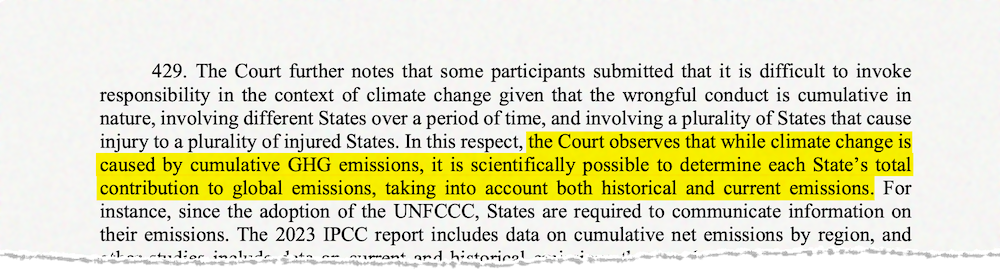
Therefore, while the court explicitly avoids identifying the countries responsible for paying reparations, it makes clear that historical responsibility should be accounted for when considering whether states have met their climate obligations.
Finally, the court also says that “the status of a state as developed or developing is not static” and that it depends on the “current circumstances of the state concerned”.
This is notable, given that the current definitions of these terms – which determine who gives and receives climate finance – are based on definitions from the early 1990s.
The advisory opinion offers clear guidance on the Paris Agreement and its aim to limit global temperature rise to “well-below” 2C by 2100, with an aspiration to keep warming below 1.5C.
It says that limiting temperature increase to 1.5C should be considered countries’ “primary temperature goal”, based on the court’s interpretation of the Paris Agreement.
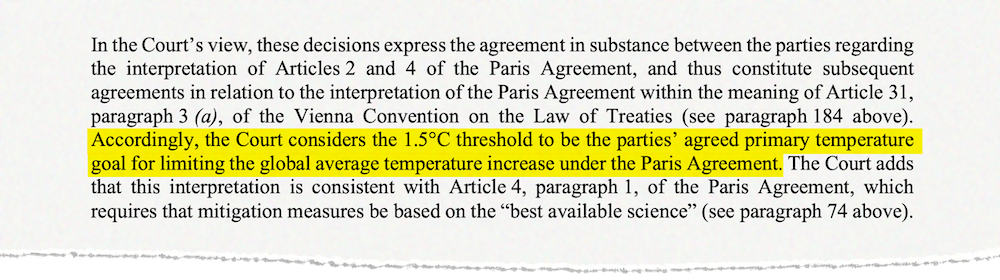
The court adds that this interpretation is consistent with the Paris Agreement’s stipulation that efforts to tackle climate change should be based on the “best available science”.
(In 2018, four years after the Paris Agreement, a special report from the IPCC spelled out how limiting global warming to 1.5C rather than 2C could, among other things, save coral reefs from total devastation, stem rapid glacier loss and keep an extra 420 million people from being exposed to extreme heatwaves.)
Following this, the advisory opinion also makes it clear that countries are not just encouraged – but “obliged” – to put forward climate plans that “reflect the[ir] highest possible ambition” to make an “adequate contribution” to limiting global warming to 1.5C.
(The climate plans that countries submit to the UN under the Paris Agreement are known as “nationally determined contributions” or “NDCs”.)
Moreover, contrary to the arguments of some countries, the advisory opinion states:
“The court considers that the discretion of parties in the preparation of their NDCs is limited.
“As such, in the exercise of their discretion, parties are obliged to exercise due diligence and ensure that their NDCs fulfil their obligations under the Paris Agreement and, thus, when taken together, are capable of achieving the temperature goal of limiting global warming to 1.5C.”
Dr Bill Hare, a veteran climate scientist and CEO of research group Climate Analytics, noted that the court’s stipulations on the 1.5C and NDCs represent a “fundamental set of findings”. In a statement, he said:
“The ICJ finds that the Paris Agreement’s 1.5C limit is the primary goal because of the urgent and existential threat of climate change and that this requires all countries to work together towards the highest possible ambition to limit warming to this level.
“All countries have an obligation to put forward the highest possible ambition in their NDCs that represent a progression over previous NDCs; it is not acceptable to put forward a weak NDC that does not align with 1.5C.
“The ICJ points to potential for serious legal consequences under customary international law if countries do not put forward targets aligned to 1.5C.”
The court also notes that the concept of equity is essential to the Paris Agreement and other climate legal frameworks, commonly referred to by text noting that countries have “common but differentiated responsibilities and respective capabilities”.
Significantly, it adds that the Paris Agreement differs from other climate frameworks by also stating that these responsibilities and capabilities should be considered “in the light of different national circumstances”.
The advisory opinion continues:
“In the view of the court, the additional phrase does not change the core of the principle of common but differentiated responsibilities and respective capabilities; rather, it adds nuance to the principle by recognising that the status of a state as developed or developing is not static. It depends on an assessment of the current circumstances of the state concerned.”
The verdict comes after debate – considered highly controversial by many – about whether “emerging” economies, such as China and India, should be considered “developing countries” at climate summits.
One of the most eye-catching paragraphs of the advisory opinion relates to its verdict on fossil fuels.
In a section labelled “determination of state responsibility in the climate change context”, the court specifically addresses countries’ obligations when it comes to producing, using and economically supporting fossil fuels. (See below).

The court says that fossil-fuel production, consumption, the granting of exploration licences or the provision of subsidies “may constitute an internationally wrongful act” attributable to the state or states involved.
It comes after multiple analyses have concluded that any new oil and gas projects globally would be “incompatible” with limiting global warming to 1.5C.
Speaking to Carbon Brief, climate law expert Prof Jorge Viñuales notes that the clear mention of fossil fuels comes despite not being featured in the questions posed to the court:
“The request characterised the conduct to be assessed by reference to emissions, so the court could have stayed there. Yet, the relevant conduct was expanded to production and consumption of fossil fuels, including subsidies.”
Though the advisory opinion is not legally binding on countries, it could influence domestic decision-making around granting permissions to new fossil fuel projects going forward, adds Joy Reyes, a policy officer at the Grantham Research Institute on Climate Change and the Environment at the London School of Economics. She tells Carbon Brief:
“Litigants can cite the advisory opinion in future climate litigation, which includes the language around fossil fuels. While not legally binding, the advisory opinion carries moral weight and authority, and can influence domestic decision-making around new fossil-fuel projects. If states and corporations fail to transition away from fossil fuels, their risk for liability increases.”
The ICJ’s advisory opinion concludes that nations’ existing maritime zones or statehood would “not necessarily” be compromised by sea-level rise resulting from climate change.
This has long been an important issue for island nations, including the Pacific states that pushed for the court’s advisory opinion (See: How did this case come about?).
Some of these nations are very low-lying and are already making preparations for a time when much of their territory is underwater.
They have been seeking assurances that they will retain territorial rights as the impacts of climate change worsen.
In its assessment of the UN Convention on the Law of the Sea (UNCLOS), the ICJ says that nations are “under no obligation to update charts or lists of geographical co-ordinates” due to sea-level rise.
This means the legal rights of states over their maritime zones – including any resources, such as minerals and fish, that are present there – would be protected.
The ICJ also states that, in its view:
“Once a state is established, the disappearance of one of its constituent elements would not necessarily entail the loss of its statehood.”
Prof Viñuales, who acted for the island nation of Vanuatu in the case, tells Carbon Brief this outcome is a “key aspect” of the opinion, adding that it is “remarkable”.
Following the landmark advisory opinion, one of the biggest questions moving forward is what it could mean for other climate lawsuits, both domestic and international.
Advisory opinions from the ICJ are not legally binding, but the court’s summarisation of existing law carries “moral weight and authority”, according to Joy Reyes, a policy officer at the Grantham Research Institute on Climate Change and the Environment.
This is particularly relevant for states that “accept the persuasive authority of international law”, explains Dr Joana Setzer, an environmental lawyer and an associate professorial research fellow at the London School of Economics and Political Science’s Grantham Institute.
Courts in some states, such as the UK, Australia and Canada, will consult international law when interpreting domestic laws or dealing with international treaties.
Setzer explains to Carbon Brief:
“The ICJ confirms that failures to act – such as maintaining inadequate national targets, licensing new fossil fuel projects or failing to support adaptation in vulnerable countries – can engage state responsibility under international law. The court also dismissed a common defence – that a state’s emissions are ‘too small to matter’. Even small contributors can be held responsible for their share of the harm.
“Domestic climate litigation may seek to use this argument and the court’s opinion to establish greater obligation on states to address climate change at the domestic level. Courts in jurisdictions that accept the persuasive authority of international law, such as the Netherlands, could now cite this ruling in support of decisions compelling stronger climate action from governments or corporations.”
She adds that the court’s conclusion that “states are not only responsible for reducing their own emissions”, but “also have a due diligence duty to regulate private actors under their jurisdiction” could have implications. Stezer continues:
“That includes fossil-fuel companies. This has far-reaching implications: it signals that states could be in breach if they fail to control emissions from companies they license, subsidise or oversee. This will place greater pressure on states to halt any new fossil fuel projects and introduce stricter regulations on the sector.”
Climate law expert Prof Jorge Viñuales says that the opinion makes it clear that the Paris Agreement is a “serious legal instrument imposing genuine and justiciable obligations”, which is likely to have an impact on domestic lawsuits. He tells Carbon Brief:
“We can expect that to be widely litigated around the world.”
In addition, he says that the court’s opinion that countries’ legal obligations extend beyond the UN climate treaties creates a “much wider chessboard for climate litigation”. He adds:
“Last, but absolutely not least, it was important, from a climate justice perspective, to hear from the court that one cannot simply game the climate change regime without legal consequences. Those consequences may take time to materialise, but they very likely will.”
The ICJ’s advisory opinion was welcomed by many governments, NGOs and legal experts as a “groundbreaking” legal milestone and a “moral reckoning”.
However, the European Commission and France were among those responding to the court’s opinion more cautiously, while opposition politicians in the UK were hostile to the ICJ’s findings.
A Chinese government spokesperson, meanwhile, said the opinion was in line with China’s views, while the White House said the US would put itself and its interests first.
One particularly positive response came from Ralph Regenvanu, minister of climate change adaptation, meteorology and geo-hazards, energy, environment and disaster management for the Republic of Vanuatu, who commended the opinion. In a statement, he said:
“The ICJ ruling marks an important milestone in the fight for climate justice. We now have a common foundation based on the rule of law, releasing us from the limitations of individual nations’ political interests that have dominated climate action. This moment will drive stronger action and accountability to protect our planet and peoples.
Vishal Prashad, director of Pacific Islands Students Fighting Climate Change, welcomed the ICJ’s statements on what he said was the need to “urgently phase out fossil fuels…because they are no longer tenable”. He continued:
“For small island states, communities in the Pacific, young people and future generations, this opinion is a lifeline and an opportunity to protect what we hold dear and love. I am convinced now that there is hope and that we can return to our communities saying the same. Today is historic for climate justice and we are one step closer to realising this.”
The reaction from developed countries was more muted, with France stating that the “landmark opinion will be studied very closely”. It reaffirmed its “unwavering commitment to the ICJ”.
A spokesperson for the European Commission, Anna-Kaisa Itkonen, told the media that the opinion “confirms the magnitude of the challenge we face and the importance of climate action”. She added that the commission would examine what the opinion “precisely implies” and noted that the EU’s emissions are behind those of China, the US and India.
A spokesperson for China’s foreign ministry said in a regular press conference that the ICJ opinion was “of positive significance to maintaining and advancing international climate cooperation”.
They added that, in their view, the court reinforced the “long-standing stance” of China, whereby developed countries should “take the lead” in tackling climate change:
“We noted that the ICJ’s advisory opinion pointed out that the UNFCCC system is the principal legal instruments regulating the international response to the global problem of climate change and confirmed that the principle of common but differentiated responsibility, the principle of sustainable development and the principle of equity are applicable as guiding principles for the interpretation and application of relevant international law.”
In response to the opinion, a spokesperson for the White House told Reuters:
“As always, President Trump and the entire administration is committed to putting America first and prioritising the interests of everyday Americans.”
Many within the wider international community also welcomed the advisory opinion. For example, Mary Robinson, a member of the Elders and the first woman president of Ireland and former UN high commissioner for human rights, called the opinion a “powerful new tool to protect people from the devastating impacts of the climate crisis – and to deliver justice for the harm their emissions have already caused”.
António Guterres, secretary-general of the UN said in a statement that the ICJ had issued a “historic” opinion. He added:
“They made clear that all States are obligated under international law to protect the global climate system. This is a victory for our planet, for climate justice and for the power of young people to make a difference. Young Pacific Islanders initiated this call for humanity to the world. And the world must respond.”
Charities such as Amnesty International, Earthjustice and Greenpeace hailed the “landmark moment for climate justice and accountability”.
Tasneem Essop, executive director of Climate Action Network International, said that “the era of impunity is over”, adding that the ruling “could not have come at a better time” ahead of the upcoming COP30 summit.
Within the media, a lot of coverage focused on the potential that nations might have to pay reparations for breaching their climate obligations.
In the Guardian, Harj Narulla, barrister and leading global expert on climate litigation at Doughty Street Chambers and the University of Oxford, discusses what the ICJ’s advisory opinion could mean for Australia and other major polluters in a “new era of climate reparations”.
In its news coverage, the Daily Telegraph says that the UN “has opened the door to Britain being sued over its historic contribution to climate change”. It adds that the opposition Conservative and Reform parties “both rejected the ruling”.
Maine is sprinting to build clean energy projects before federal tax credits expire.
State utility regulators are fast-tracking plans to procure nearly 1,600 gigawatt-hours of renewable energy, with the goal of getting projects started before key incentives disappear under the budget law signed by President Donald Trump this month. Developers were given just two weeks to submit proposals, with a deadline of July 25.
These projects should help the state make up for clean-energy developments derailed by the pandemic, and ultimately progress toward its newly mandated target of 100% clean energy by 2040.
“This is an opportunity to get some things done that Maine had every intention of getting done a handful of years ago,” said Eliza Donoghue, executive director of the Maine Renewable Energy Association, a nonprofit industry group. “It’s good news.”
The move comes as the clean-energy industry pushes other states, including New York and California, to help speed up wind and solar deployments before subsidies expire in the coming years.
For its part, Maine is looking for enough bids to meet roughly 13% of its annual electricity usage. Preference will be given to developments that make use of property contaminated by toxic PFAS, following the discovery in recent years that at least 60 Maine farms have unsafe levels of these “forever chemicals” in their soil and water.
This specification is a win for renewable energy, wildlife, and farmers whose land has been rendered unusable for agriculture, said Francesca Gundrum, director of advocacy for Maine Audubon.
“This work to help deploy solar and other renewable technologies is exactly the kind of siting we need to see more of in Maine,” she said. “Whatever we can do to minimize the turnover of habitat is something we’re going to be supportive of.”
The current procurement has its roots in a bill the Maine Legislature passed in 2023, calling for the state to source renewable energy from installations sited on PFAS-contaminated land. A request for proposals was issued in August 2024, but none of the initial bids were deemed cost-effective, and none were selected. This year, the Legislature went back to the drawing board, tweaking details about how solar and storage projects can enter proposals.
The amended bill was enacted in June with an “emergency preamble,” allowing it to become law immediately, rather than waiting the typical 90 days after the legislative session adjourns. That move required the approval of at least two-thirds of lawmakers in both the state Senate and House, which is an encouraging sign of support for renewables across political divides, said Dan Burgess, director of the Maine Governor’s Energy Office.
“It’s really exciting that a bipartisan coalition of legislators sees this as an opportunity to bring on low-cost clean energy in Maine,” he said.
Previous renewable energy procurements in 2020 and 2021 chose 24 wind and solar developments to buy power from. Many of these projects, however, fell apart when the COVID-19 pandemic disrupted global supply chains and drove up inflation, Burgess said. This latest solicitation is a great opportunity to make up some of that lost ground, he said.
Maine was an assertive early adopter of the “renewable portfolio standard,” a state-level regulation that requires utilities to obtain a certain percentage of their power supply from renewable resources. When Maine adopted the policy in 1999, it required 30% of the electricity sold to be renewable (a number it hit immediately because of the high concentration of hydropower in the state). The total requirement increases over the years; the state is now aiming for 90% renewables by 2040 with the final 10% coming from non-emitting but not necessarily renewable sources, like nuclear.
Today, about 32% of Maine’s electricity comes from gas-fired power plants, and another 31% from hydropower. Solar and wind together contribute roughly one-quarter of the supply.
Studies suggest that Maine’s commitment to renewable energy has already saved residents significant sums and stands to create even more financial benefits. A 2024 report on the impact of the renewable portfolio standard found that utility customers saved a total of about $21.5 million each year from 2011 to 2022. An analysis released in January concluded that reaching 100% clean energy by 2040 would save the average Maine household around $1,300 per year.
The current procurement is to be the last under the existing regulatory structure, in which the state Public Utilities Commission is the body that runs such solicitations. Legislation signed this month will create a cabinet-level energy department — currently Maine has only an energy office — with the authority to run regular procurements as needed to advance the state’s renewable energy goals.
“Instead of doing these one-off procurements specifically directed by the Legislature, we’re now getting to have that predictability,” Donoghue said.
Southern California’s grid needed help in the fall of 2016. The region was still reeling from the calamitous Aliso Canyon gas leak, and its power plants faced a potential shortfall of that fuel to meet air-conditioning demand when the next summer rolled around. The state took a chance on a new grid technology, lithium-ion batteries, to fill in the gaps.
Big names like Tesla and AES stepped in to help, installing storage at record speed, but so did a little-known firm called Powin. Joseph Lu had founded the Oregon-based company years earlier to import consumer products from China and Taiwan. Sensing a new business opportunity, Powin won a bid and installed 2 megawatts of batteries in a warehouse it owned in Orange County.
This proved to be a launchpad for the firm, which rose to the upper echelons of the booming U.S. battery industry before crashing down to earth last month.
After that Orange County installation, Powin refocused on importing battery cells from China and integrating them into grid storage systems, fully packaged with inverters, controls, and safety systems. Powin went on to deliver battery enclosures for many pathbreaking projects: It supplied the first utility-scale battery in Mexico, a landmark utility-endorsed battery fleet in Arizona, and a truly mammoth system in Australia, to name just a few of Powin’s self-reported 11.3 gigawatt-hours of installed systems. It raised some major outside equity rounds to keep growing and last fall obtained a $200 million debt facility from investment giant KKR.
And then in June, Powin filed for bankruptcy, alerting the state of Oregon of mass layoffs at its Tualatin campus, outside Portland. The news jolted the storage industry, since so many major grid storage plants run on Powin’s hardware and software. The bankruptcy proceedings are ongoing, but storage software specialist FlexGen has placed a bid to buy Powin’s assets at auction in early August, offering Powin customers a way to keep their batteries running.
Cleantech bankruptcies have flourished under the second Trump presidency, and the storage sector is uniquely exposed. The industry runs almost entirely on imported battery cells from China, making it vulnerable to rapidly shifting trade policies. The Biden administration raised tariffs on Chinese batteries, and President Donald Trump cranked the overall rate on Chinese imports as high as 145% in April, though he has altered the rate repeatedly in the opening months of his presidency. Trump’s budget law preserved tax credits for installing grid batteries but added a new bureaucratic regime to regulate the amount of China-derived equipment in those storage plants.
“The business model of integrating batteries into a full storage system is one of these classic high-volume, low-margin businesses,” said Pavel Molchanov, a Raymond James analyst covering cleantech companies. “Margins were low even before Trump and these new tariffs on China, and now it’s a safe bet that their margins have been squeezed even further.”
Nonetheless, Powin’s collapse stands out for the scale of the company’s reach — and raises serious questions. Is Trumpian chaos enough to unseat a leading battery supplier, even as the market for grid batteries continues to surge? Or did Powin’s leadership make choices that ultimately led to its early demise? And perhaps more important, what’s going to happen to those 11.3 gigawatt-hours Powin installed before it went bankrupt?
Powin got to the big leagues by spotting technological trends before they hit the energy-storage mainstream.
That started with the rapid-fire California installations in 2016, when hardly anyone was building large-scale storage. At the time, American developers looked to a handful of Tier 1 battery suppliers, like LG, Samsung, and Panasonic. Powin instead scoured China for manufacturers that American buyers hadn’t discovered yet but that could match key quality metrics. Powin signed an early supply deal with a firm called Contemporary Amperex Technology Co., or CATL, which has since become far better known in the West as the world’s largest battery maker.
Powin also focused on the then-lesser-known lithium ferrous phosphate (LFP) chemistry, which executives hailed as safer and longer-lasting than the mainstream nickel-based chemistries handed down from the electric vehicle supply chain. Powin imported these LFP cells from trusted vendors in China, installed them in engineered metal cabinets in Tualatin, then delivered them to project sites across the U.S. and, later, the world.
By the 2020s, U.S. storage installations were growing at a shocking rate. To keep pace with soaring demand, Powin raised $100 million in February 2021 from investors Trilantic Capital Partners and Energy Impact Partners, followed by $135 million in 2022, led by Singapore’s sovereign wealth fund GIC.
The firm’s first major public setback came when a Powin-supplied battery system in Warwick, New York, burst into flames after a summer storm in 2023. Days later, authorities responded to fumes emerging from another Powin-supplied system in that town.
Developer Convergent Energy and Power owned both systems, and its investigation concluded that a manufacturing flaw in that generation of Powin’s Centipede battery container let water leak in and start electrical fires. Those incidents prompted the Warwick Village Board to freeze local battery development, and they undercut Powin’s reputation for safety, which the company previously had promoted after other companies’ battery fires elsewhere in the country. A spokesperson for Convergent did not respond to requests for comment.
It’s unclear what kind of financial impact the fallout from those fires had on Powin, but the firm subsequently found itself locked in a legal dispute with none other than its longtime supplier, CATL. That company sued Powin in Oregon Circuit Court in December 2024 for $44 million in allegedly unpaid bills, following an earlier arbitration on the matter in Hong Kong.
The circuit court noted in February that Powin “does not deny that they owe money to CATL” and that “it is apparent to the court that the amount of money Powin owes to CATL exceeds the value of the assets Powin holds in Oregon.” That’s not a great sign for a company’s metabolism.
In a subsequent filing, Powin’s lawyers asserted that, actually, CATL was refusing to honor the contracts and instead tried to spring non-contracted price hikes at the last minute: “CATL effectively held Powin hostage to choosing between negotiating a solution with CATL or breaching contracts with its customers.”
In the same suit, the Powin lawyers proposed a nefarious explanation for the souring relationship with CATL, one that sheds light on a broader challenge Powin faced in the maturing storage market.
“Powin finds it highly suspect that the timing of this filing for pre-judgment remedies comes as CATL is aiming to compete directly with Powin to supply complete energy storage systems, moving beyond its historical business model of supplying subcomponents to Powin and others like Powin.”
Powin championed CATL’s battery cells to the U.S. market when buyers still had hang-ups about sourcing high-quality batteries from China. But CATL, recently valued at more than $180 billion, did indeed move beyond simply shipping cells and began competing directly with Powin. CATL launched a containerized storage product in 2023, and in May it rolled out a new 9-megawatt-hour, double-decker grid battery enclosure called TENER Stack.
“The past few months have presented considerable headwinds for system integrators, even without considering company-specific challenges,” said Ravi Manghani, senior director of strategic sourcing at data firm Anza Renewables. “The increasing number of battery [original equipment manufacturers] entering the U.S. market with attractively priced DC blocks and AC solutions has put pressure on the traditional value proposition of system integrators.”
Other sources in the grid storage industry noted that Powin’s quality had suffered in the scale-up, lowering customer interest in its products. The company had always had a smaller balance sheet than competitors like Tesla, Fluence, and Wärtsilä, all of which are publicly traded and worth billions.
Longtime Powin CEO Geoff Brown, who led the company from 2016 through its dynamic growth phase, departed in 2023. He was replaced by Jeff Waters, who touted his leadership at solar panel manufacturer Maxeon during its spin-off from SunPower. Those accolades look less auspicious from today’s standpoint: SunPower went bankrupt last year, and Maxeon’s valuation has tumbled precipitously from its 2023 levels.
Last fall, Powin turned to the credit business at KKR, a private-equity trailblazer famous for record-busting leveraged buyouts like RJR Nabisco in the 1980s and utility TXU in the 2000s.
“The facility will be instrumental in supporting Powin’s working capital needs, driving continued innovation, and further enhancing the company’s financial flexibility as it expands its leadership position in the storage industry,” KKR said in a press release from October announcing the $200 million facility.
It’s a strange thing when a company that just secured ample working capital then runs out of working capital just a few months later. Sources familiar with Powin’s business said the debt package, paradoxically, hastened the company’s demise.
Powin drew on only about $25 million of the available debt, but the deal company leadership accepted was “very ugly” and “poorly structured” for Powin’s purposes, said one former Powin customer granted anonymity to speak on sensitive business matters. Another grid storage veteran, who also spoke on condition of anonymity, likened the situation to a payday loan: “They got upside down, and KKR called it in.”
KKR declined to comment on the specifics of Powin’s debt facility.
Powin wouldn’t be the first cleantech company that failed after getting behind on its debt payments. Major rooftop solar provider Sunnova increasingly turned to corporate debt to raise cash as the market soured, then struggled to find cash for debt payments and fell into bankruptcy in June. Electric bus maker Proterra piled up corporate debt before its bankruptcy filing in 2023. When it’s time to pay the tab, even a promising customer pipeline is no legal tender.
Powin’s financial collapse triggered an existential question for all the storage plants out there running on its hardware and software.
“Everyone’s trying to figure out how to maintain their products and solutions and not have bricked systems,” the former customer said.
Software needs updates, as anyone with an iPhone is repeatedly reminded, and the same goes for the systems that tell huge banks of batteries when to charge and discharge. Energy market rules change; hardware trips up. If Powin simply ceased to exist, it would jeopardize the reliability of all the critical power plants running on its control systems.
But those anxious battery owners may soon get some relief now that software startup FlexGen became a stalking horse bidder in June, proposing to buy “substantially all” of Powin’s assets for $36 million. It’s also lending money to keep Powin operating in the meantime. There will still be an auction, and other firms could bid more. But if all goes according to plan, this process will conclude by early August.
FlexGen CEO Kelcy Pegler said he had great respect for Powin, and “gratitude for them being an early mover” in the grid storage industry.
“Powin was such a substantial part of the market,” Pegler told Canary Media. “FlexGen’s interest is in making sure the customers have a successful path to continuous operations.”
FlexGen, based in Durham, North Carolina, employs some 120 software engineers to constantly maintain and improve its storage management software, Hybrid OS, Pegler noted; that product works on whatever storage hardware the customer wants to operate. If the bid goes through, FlexGen will first provide Powin customers with a “continuity plan” that keeps systems running as they are, and customers will have the option to sign new long-term service agreements with FlexGen.
Customers will have good reason to switch over to FlexGen’s flagship product, Pegler added: An independent market study by cleantech data firm Orennia found that batteries running on FlexGen software performed better than those running on that of Powin (and other competitors) in the wholesale markets of Texas and California in 2023.
As for the business of buying battery cells and turning them into storage plants, Pegler is happy to leave that to the existing field of storage manufacturers. He plans to stick to software and services.
Powin has let go of much of its staff. The founders will lose their stakes, and the venture capitalists and private-equity investors won’t rake in a multiple on their few hundred million dollars invested. But a sale to FlexGen would protect Powin’s physical legacy: The gigawatt-hours of batteries installed across the world could keep on humming, as the energy storage market careens ever onward.
New Hampshire’s new state budget redirects an estimated $15 million from a dedicated renewable energy fund into the general fund, likely signaling the end of plans to expand a popular pilot supporting municipal solar developments.
While some New England states have moved to strengthen clean energy policy in the face of President Donald Trump’s efforts to quash renewable power development, New Hampshire has taken a different path: The provisions of the latest budget leave just $1 million in the renewable energy fund each year for programs that, in fiscal year 2024, cost more than $5 million to administer.
“This is a big step backward for renewable energy in the state. There’s going to be very little left over,” said Nick Krakoff, senior attorney in New Hampshire for the Conservation Law Foundation. “That means there would be basically nothing left for this municipal program.”
The renewable energy fund, established in 2007, receives money from electric service providers that are unable to meet their obligations to source a certain level of renewable power each year. Most years, the fund takes in anywhere from $2 million to $8 million. The money has traditionally supported a handful of renewable energy incentives, and revenues have generally exceeded spending. At the beginning of fiscal year 2024, the fund had a balance of nearly $15.3 million.
Earlier this year, the state energy department started laying out plans to use some of this money to support solar projects developed by municipal governments. Such developments have both financial and environmental benefits, saving money for towns — and thus taxpayers — while cutting greenhouse gas emissions from electricity generation in a region that relies heavily on natural gas to fuel its power plants.
Still, municipal solar projects can be a hard sell for voters in New Hampshire, a state with a reputation for frugality. The state has no sales tax or income tax, so government operations are funded mainly by hefty property taxes. It is also home to many small towns with constrained budgets. Though solar installations can save a town money, voters are generally reluctant to approve the upfront cost, which could increase their property taxes.
“The reality for New Hampshire residents is that municipal budgets are very, very, very tight, and property taxes keep going up,” said Sarah Brock, director of the nonprofit Clean Energy New Hampshire’s Energy Circuit Rider program, which helps towns develop clean energy and energy efficiency projects. “Every year at town meeting, there’s a pretty substantial reluctance to approve money for just about anything.”
In 2024, the state launched the Municipal Solar Grant Program to help towns overcome those hurdles and install solar panels on municipal property. The pilot program has a specific focus on small or economically disadvantaged towns that would have a harder time funding such projects on their own. The initiative uses $1.6 million in funding that the state received through the federal Bipartisan Infrastructure Law, passed in 2021.
Thirty towns applied for the funding through the pilot; 16 were selected to receive grants between $45,000 and $200,000. Staff with the Energy Circuit Riders program identified perhaps 20 more towns that might also be interested in future funding opportunities.
“We had over 50 towns in our active project pipeline that would want to go after this funding,” Brock said. “We know the demand is there.”
The plan was to follow up with a permanent program paid for by the renewable energy fund. In the spring, the state energy department asked for comments on the proposed program and ideas about how to modify the approach used in the pilot.
The annexation of the renewable energy fund, however, could put an end to these plans, advocates said. With only $1 million available each year, there would not be enough money available to continue existing offerings like its nonresidential competitive grant program and rebates for wood pellet stoves at current levels. Adding an entirely new initiative may be a nonstarter.
“No one is telling us the program is dead, but it is possible that it will be impossible to run if there isn’t funding for it,” Brock said.
Neither the office of Gov. Kelly Ayotte nor the state energy department responded to requests for comment about the future of the program.
The first project completed under the pilot was a 26-kilowatt solar array atop the town hall in Kensington, New Hampshire, in the southeastern corner of the state and home to about 2,000 people. Kensington has an annual budget of just $2.6 million, so voters were unlikely to approve a nearly $100,000 investment, even if it promised savings in the long run, said Zeke Schmois, chair of the town’s energy committee. So the local solar boosters turned to the state.
The town received about $92,000 for the project. The final panels went up in early July, making Kensington the first place to complete an installation as part of the grant program.
“This isn’t a solar farm, but it’s huge for a town like ours with such a small budget and such a small population,” Schmois said.
Kensington expects the installation to offset about 70% of the town hall’s annual electricity use, Schmois said. But those savings are just the beginning of the impact: The town historical commission was involved with the approval process and realized that modern solar panels can blend inconspicuously with roofing. The group is now eager to collaborate on future solar projects, Schmois said.
Other towns hope for similar benefits. Dublin, New Hampshire, received a grant of about $43,000 for a solar array that should meet all the town fire station’s power needs once it is installed later this summer, said Susan Peters, the chair of Dublin’s select board and founding member of its energy committee. She hopes the installation’s location along a major state highway will help normalize the idea of solar, and help build support for another project under consideration: a ground-mounted array near a capped landfill.
“The fact that we’re doing this project strengthens people’s interest,” she said.
Rooftop solar costs way more in the United States than it does elsewhere in the world. That’s long been a headache for the sector to navigate. But now with Republicans in Congress killing off the decades-old tax credit for rooftop solar, it’s a life-or-death problem.
So says Andrew Birch, a 25-year industry veteran who’s built a career on cutting solar projects’ “soft costs,” which make up roughly two-thirds of the price of a rooftop solar installation in the U.S. and consist of everything other than equipment costs.
Some of those factors are under a solar company’s control, like how much it spends on acquiring customers and managing projects. Others aren’t, like the expense associated with navigating complex permitting and interconnection processes that differ from city to city and from utility to utility.
Those costs rise when solar systems are accompanied by batteries, something that is becoming increasingly common as households look for backup power and respond to new incentive structures that prioritize storage, as is the case in California, the nation’s largest rooftop solar market.
Big upfront costs are the No. 1 reason Americans decide not to put solar panels on their rooftops. The forthcoming spike in installation costs created by the new GOP megabill will only make that hurdle higher. After this year, households will lose access to tax credits for 30% of the cost of solar, batteries, and other home clean-energy equipment, and companies that offer solar systems under third-party ownership models will face a set of uncertain restrictions that could choke off that part of the market.
In order for the U.S. to keep installing rooftop solar at a healthy rate — something that’s key to combatting climate change and helping people manage rising electricity costs and electrify their cars and homes — the industry needs to figure out how to prevent costs from ballooning once the incentives disappear.
“We’re now being forced to operate as an industry without subsidies,” Birch said. That puts the onus on the industry to both tighten its belt in areas that are under its control and press state lawmakers, local government officials, and utility regulators to reform their parts of the equation.
“We can survive and thrive — if we can reduce soft costs,” he said.
Birch, a native Australian known as “Birchy” in the solar world, is working on just that himself.
He helped launch SolarAPP+, an “instant permitting” software platform being used by more than 160 cities and counties across the U.S. to process solar permits in hours rather than weeks. OpenSolar, the company he co-founded and leads, offers free solar project design and management software to installers, paid for by equipment manufacturers and dealers eager for the increased sales it can bring.
There’s plenty of evidence that lowering these costs is possible: The soft-cost problem is a bit of a uniquely American phenomenon. In other places with high rooftop solar penetration, like Australia, the world’s rooftop solar leader, these costs are far lower.
Solar companies in Australia can quote, sell, and install a 7-kilowatt solar system with a 7 kilowatt-hour battery for about $14,000 in a matter of days, Birch estimated. In the U.S., that same system costs about $36,000, and getting permits and interconnections can take months — long enough to kill a fair number of installs before they can be completed, he said.
When it comes to cutting soft costs, local permitting reform is a big target.
Permitting regulations and processes vary widely across the roughly 23,000 city, county, and other local authorities that have jurisdiction over building permits, electrical code enforcement, and other must-haves for a solar or battery installation. Permitting can add roughly $1 per watt to the cost of a typical solar installation, according to the industry trade group Solar Energy Industries Association (SEIA).
Some do a good job of making the process smooth and straightforward. Others can be far less helpful and efficient. Slow or cumbersome permitting takes a toll on solar installers, stretching the time it takes to complete current projects and move on to the next.
“If you can ensure you’re making it through in three weeks versus three months, you’re operating much more efficiently,” said Barry Cinnamon, CEO of Northern California solar and battery installation firm Cinnamon Energy Systems. On the other hand, “in cities where the permitting is slow, you inevitably get them coming back in two weeks saying, ‘You’re missing a dash in that form — send it back,’ and then two or three weeks later saying, ‘We’re not sure the battery can go in that spot. Try again.’”
It’s hard to standardize permitting across local authorities, which range from well-staffed big-city departments to tiny towns with one or two people working on it. But software that can reliably complete the tasks of permitting officials can save time and reduce errors for big and small permitting authorities alike.
In 2018, SEIA and nonprofit the Solar Foundation launched the Solar Automated Permit Processing initiative and enlisted the U.S. National Renewable Energy Laboratory to develop an automated permitting platform. SolarAPP+ was the result. After pilot tests in 2020 proved it dramatically sped up permitting without sacrificing quality, the platform was made available at large.
Automated permitting turns multiple back-and-forth processes into a “one- to two-page digital form,” Birch said. Code standards groups like Underwriters Laboratories and the International Code Council have signed off on SolarAPP+, and similar automated platforms from startups and from city permitting departments are now providing similar same-day options.
The advantages of instant permitting are so great, Cinnamon said, that he’s stopped doing projects in cities and counties that don’t offer some form of it. With less than six months to finish projects that can secure tax credits, “we don’t have the time” to spend elsewhere, he said.
The next step is to expand instant permitting from hundreds to thousands of cities and counties by taking on statewide permitting reforms, said Nick Josefowitz, CEO of Permit Power, a nonprofit advocacy group.
Over the past several years, states including Democratic strongholds like California and Maryland as well as Republican redoubts like Florida and Texas have adopted solar permitting reform laws, he said. New Jersey lawmakers passed a bill this summer that now awaits Gov. Phil Murphy’s signature.
Reform looks different in every state. California set mandates for cities and counties to use instant permitting, while Texas and Florida required cities and counties to allow licensed and credentialed third parties to issue permits and conduct inspections on homeowners’ behalf. Colorado’s law backed off on mandates but offered incentives for local authorities to deploy instant permitting, while New Jersey’s law would empower a state agency to set up instant permitting for cities and counties to use.
Lowering permitting costs can allow solar installers to cut their prices, which increases their business, spurs more competition, and gives households more options, Josefowitz said. A series of studies this year from Brown University’s Climate Solutions Lab and the Greenhouse Institute found that streamlined and instant permitting in Arizona, Colorado, Illinois, Minnesota, New Jersey, New York, and Texas could result in an additional 2 million home solar installations between now and 2030, saving households a collective $100 billion.
The results are good not just for households and solar installers but for cash-strapped municipalities, said Elowyn Corby, mid-Atlantic regional director for nonprofit group Vote Solar, which advocated for New Jersey’s newly passed reform bill.
“When you put the onus on municipalities to process these permit applications, that’s an enormous drain on their resources as well, especially in lower-income communities where there isn’t as much municipal infrastructure,” she said. “We’re hoping this brings capacity back to local governments.”
Permits aren’t the only solar roadblocks. Utilities also need to approve solar and battery systems at homes connected to their grids before they’re allowed to be turned on. Solar installers have long complained that slow or costly interconnection processes are a significant drag on their bottom lines.
“I’ve heard from some of our installers — and some of the bigger ones — that the interconnection approval process is more of a challenge and a bigger cost than the permitting side,” said Ravi Mikkelsen, CEO of Atmos Financial, a financial technology company that connects lenders with solar installers and customers. “Some utilities are better than others, but across the board, this is a major issue.”
Interconnection rules are complicated, and utilities apply them differently. But reports from solar installers over the years have highlighted problems ranging from lengthy waiting times and restrictions on new solar hookups to exorbitant costs assessed on homes wanting to interconnect.
A lack of state regulator oversight for interconnection policies complicates efforts at reform, Josefowitz said.
Regulators in some states like California set rules for all regulated utilities, but other state regulators don’t. Even those that have set statewide guidelines for utilities have been slow to adopt rules that require them to put in place more streamlined processes or take the latest technology advances into account. A 2023 ranking from Vote Solar and the nonprofit Interstate Renewable Energy Council assessed state adoption of interconnection “best practices.” The groups gave only New Mexico an A grade and six other states B grades, while marking 13 with an F for lacking any statewide standards.
“We need [regulator] rules about when projects can be fast-tracked, what types of systems when and where can be automated and approved by software,” Josefowitz said.
Extreme amounts of rooftop solar can cause problems on power grids designed to carry electrons from big substations to customers.
“But batteries totally change the game on this,” he said, enabling homes to store solar power when utility grids don’t need it and release it when they’re in short supply.
That’s why solar companies ranging from nationwide players like Sunrun to regional and local installers are recasting their business approach to include becoming “virtual power plant” providers — active providers of energy and grid resources that help augment the resources that utilities can bring to bear.
Opportunities to earn money for these services are relatively scarce today. But with Republicans in Congress and the Trump administration making it much more expensive and difficult to build more renewable energy to meet the growing demand for electricity, utilities may be well advised to reduce the barriers to installing solar and batteries that can provide it, Mikkelsen pointed out.
“At $2 a watt, you can bring down the cost of your power, and you can save money on electrification,” he said. But also, “your battery can be used economically much more frequently and becomes super-valuable to the grid. You want to unlock the power of batteries? You fill them with cheaper electrons.”
Southern California can keep a landmark rule that’s meant to spur the electrification of certain boilers and water heaters across the smog-choked region.
Late last week, a federal court upheld the first-in-the-nation regulation, which will gradually eliminate emissions of nitrogen oxides (NOx) from more than 1 million fossil-gas appliances in the South Coast Air Quality Management District that covers greater Los Angeles. It applies to light-industrial and commercial boilers, steam generators, and process heaters, as well as residential pool heaters and tankless water heaters.
Opponents of the rule, led by gas-appliance makers and building trade groups, had sued in December to invalidate the standards.
“This decision recognizes our air regulators’ long-established authority to adopt life-saving protections — and sends an undeniable signal to manufacturers and businesses that the future of California’s industrial sector is electric,” Candice Youngblood, an attorney for Earthjustice, which intervened to defend the rule in court, said in a July 21 statement.
The measure is ultimately expected to reduce pollution by 5.6 tons of NOx per day — the same as halving smog-forming emissions from cars in the region.
Advocates say the ruling could help to reenergize efforts around the country to replace fossil-fuel-burning equipment with electric heat pumps and other clean technologies in homes and commercial operations.
Such initiatives have stalled since April 2023, when a different federal court struck down Berkeley, California’s pioneering ban on gas hookups in new buildings. The court said the city’s gas ban was preempted by the federal Energy Policy and Conservation Act and thus wasn’t valid. The groups suing to stop Southern California’s zero-emission boiler rules pointed to Berkeley to claim that the measure also conflicted with the federal energy-efficiency law.
On July 18, the U.S. District Court for the Central District of California found otherwise. The court clarified that the Berkeley ruling is “very narrow” in scope and applies to building codes that concern energy use. The measure in Southern California regulates only appliances’ emissions. Put another way, “It’s about what comes out of the appliance — not what goes in,” explained Nihal Shrinath, a staff attorney for the Sierra Club, which also intervened in the case.
Last week’s court ruling “is a really big deal,” both because it enables significant emissions reductions and it affirms that air-quality measures can withstand such legal challenges, he told Canary Media.
“We think there’s probably been less activity by air districts and local municipalities, in terms of advancing [zero-emission rules], because of the fear of litigation,” he said. The South Coast Air Quality Management District itself recently rejected a plan to curtail pollution from certain residential space and water heaters following an opposition campaign led by utility giant SoCalGas.
The California air district spans large portions of Los Angeles, Orange, Riverside, and San Bernardino counties. More than 17 million people live in the region, where high levels of NOx contribute to some of the worst health-harming smog pollution in the country.
In June 2024, regulators adopted the zero-emission rule for small boilers and large water heaters in homes and businesses as part of its decadeslong mission to meet federal air-quality standards.
Gas-burning appliances covered by the rule account for about 9% of all NOx emissions from stationary sources in the area. They include an estimated 710,000 residential pool heaters and 300,000 tankless water heaters, as well as 60,000 light-industrial and commercial boilers and water heaters at places such as dry cleaners, restaurants, warehouses, and hospitals.
While the measure doesn’t explicitly ban or require any specific technology, the most realistic way for anyone to comply is by replacing their gas-fired appliances with alternatives like ultra-efficient heat pumps or modern electric-resistance boilers.
The limits on NOx emissions are designed to ramp up over time, starting in 2026 for new small units installed in new buildings and extending to new high-temperature units installed in existing facilities in 2033. The drawn-out timeline is meant to allow small businesses and homeowners some flexibility as they phase out their current equipment. It also gives manufacturers of zero-emission technologies enough time to develop and scale up production to meet the new demand.
Critics of the measure, including dry cleaner associations and building contractors, have argued that switching out gas-burning equipment and upgrading buildings’ electrical systems would impose a “significant financial burden.” The air district has estimated that the transitioning to zero-emission equipment will cost companies and households about $49 million to $97 million per year — though the air district will provide rebates to help defray some of those expenses. Industrial heat pumps can also deliver lower operating costs than gas boilers because the electric tech is much more energy-efficient.
Regulators and environmental groups maintain that such rules are necessary both to improve public health within the district and to accelerate the market nationwide for emissions-free industrial equipment. Last week’s court ruling ensures such efforts can continue.
The Trump administration just dealt a blow to the biggest transmission line project currently underway in the United States.
The U.S. Department of Energy has canceled a $4.9 billion federal loan guarantee for the Grain Belt Express, a massive transmission line project seeking to carry wind and solar energy from the Great Plains to states farther east. It’s the latest in a series of Trump administration actions aimed at undermining the U.S. clean energy sector in the name of protecting taxpayer dollars.
In its Wednesday cancellation announcement, the DOE claimed that “the conditions necessary to issue the guarantee are unlikely to be met and it is not critical for the federal government to have a role in supporting this project.”
Energy Secretary Chris Wright is also scrutinizing several other loans made under the Biden administration by the DOE’s Loan Programs Office, which issued its conditional guarantee to the Grain Belt Express in November. He has pledged to closely review and potentially cancel tens of billions of dollars more in financing from the office, citing a need to more responsibly steward federal dollars. However, in its 20-year history, the office has turned a profit for taxpayers by collecting interest and principal payments from the companies that receive loans.
The Grain Belt Express has been in the works for more than a decade. It’s one of only a handful of major transmission projects underway in the U.S., and once built it will be able to support the development of gigawatts of new wind and solar projects and deliver $52 billion in energy cost savings over 15 years, according to Invenergy, the Chicago-based developer that’s building it. Around the country, more projects like the Grain Belt Express are needed to expand the grid fast enough to meet surging demand and to bolster electricity reliability.
The cancellation comes a week after Sen. Josh Hawley, a Missouri Republican, told The New York Times that he had made a personal appeal to President Donald Trump to take action to halt the project, and that Trump had promised to instruct the DOE to do so.
“He said, ‘Well, let’s just resolve this now,’” Hawley told The New York Times. “So he got Chris Wright on the line right there.”
Invenergy did not immediately respond to requests for comment Wednesday morning. The developer had sought the loan guarantee to reduce the expense of borrowing for the project, which will cost $11 billion in total and has already secured agreements with utilities in Missouri as part of its efforts to find buyers for the power it will make available across the regions it will connect.
It’s unclear to what extent the loss of federal loan guarantees will derail or slow down the project’s timeline. In May, Invenergy signed a nearly $1.7 billion contract with contractors Kiewit Energy Group and Quanta Services, and construction is slated to begin next year.
In a statement earlier this month responding to a social media post from Hawley criticizing the project, Invenergy accused the senator of “trying to deprive Americans billions of dollars in energy cost savings, thousands of jobs, grid reliability and national security, all in an era of exponentially growing demand.”
The U.S. faces a looming crisis as new data centers, factories, and broader economic growth cause electricity demand to rise faster than supply is forecast to grow.
Solar, wind, and batteries have made up more than 90% of new energy built in recent years, and are the only resources that can be constructed rapidly enough to meet surging demand in the near term. Other energy resources have far slower development times, including fossil-gas power plants, which currently face manufacturing bottlenecks that will take years to resolve.
In addition to headwinds from Trump and the GOP-led Congress, which just eliminated federal tax credits for solar and wind, the main factor that threatens to hold back clean-energy development is a lack of space on the grid.
The U.S. lags in building the new high-voltage transmission lines that grid experts say are necessary to bring even more new solar, wind, and batteries online. These lines carry clean power from where it’s cheap to produce to where the most energy is consumed, like cities, and building more of them can reduce grid congestion, improve power system reliability, and lower electricity rates.
The Grain Belt Express has won approval from utility regulators in Kansas, Missouri, Illinois, and Indiana, and has received support from lawmakers and organizations representing farmers and large electricity consumers. But the project has also faced multiple challenges from landowners and farmers. Invenergy is currently contesting an Illinois court’s 2024 decision to overturn state regulatory approval for the project, made in response to a challenge from the Illinois Farm Bureau and landowner groups.
Missouri’s attorney general, a Republican, launched an investigation into the project earlier this month, accusing Invenergy of inflating economic benefits and overstating cost savings it would deliver. Invenergy contested the validity of that challenge in a letter to Energy Secretary Wright, saying that all relevant issues have already been decided by state courts and regulators.
It’s common for large-scale transmission projects, which traverse hundreds of miles across many different municipalities, counties, and states, to get bogged down in court battles. It’s a big reason why it takes so long to build new power lines in the U.S. But the Trump administration’s decision to cancel financing for the project is uncharted territory, and the impact is still unclear.
Should the project be delayed, it’d be a major setback for the U.S.’s already-sluggish transmission buildout.
The U.S. needs far more transmission to be built to lower energy costs and reduce the increasing threat of blackouts caused by extreme weather, according to reports from groups ranging from the Department of Energy and the North American Electric Reliability Corp. to the Massachusetts Institute of Technology and Princeton University.
Over the past decade, the number of miles of long-range, high-voltage transmission built across the country has fallen, even as utility transmission spending has risen. A report released this week by advocacy group Americans for a Clean Energy Grid and consultancy Grid Strategies found that only 322 miles of high-voltage transmission lines were completed last year, the third-lowest buildout of the past 15 years, and well below the nearly 4,000 miles built in 2013.
“The Grain Belt Express represents a critical opportunity to modernize the grid, lower electricity costs, and deliver reliable energy across multiple states,” Christina Hayes, executive director of Americans for a Clean Energy Grid, told Canary Media in a Wednesday email. “We encourage the administration to take a fresh look at the value this project brings to achieving its own goals for economic growth and energy dominance.”
New York Governor Kathy Hochul has made energy affordability a centerpiece of her political platform this year, blasting proposed utility rate hikes and even promising to slow down implementation of the state’s climate law over the concern that the clean energy transition is costing New Yorkers too much.
But Hochul’s administration is slashing an energy affordability program that was once a priority for the governor, New York Focus has learned.
The EmPower+ program was designed specifically to help low- and moderate-income households “save energy and money” through energy efficiency upgrades. Since 2023 — at Hochul’s initiative — it has been New York’s one-stop shop to help residents take advantage of green building upgrades they might not otherwise be able to afford, like better insulation and replacing old boilers.
“I don’t know of any other program that makes such a big difference to the energy bill and the quality of life for a household that goes through [it],” said Jessica Azulay, executive director of the advocacy group Alliance for a Green Economy.
The program is now facing drastic budget cuts. In a July 11 meeting, the New York State Energy Research and Development Authority (NYSERDA) warned local contractors who install the upgrades that it would be cutting the EmPower+ budget from roughly $220 million this year to $80 million in 2027.
Michael Hernandez, New York policy director at the pro-electrification group Rewiring America, said he was “shocked” to learn of the impending cuts and has been sounding the alarm among advocates and lawmakers.
Azulay called the projected cuts “devastating.”
“As families are facing rising energy bills, the state is cutting back on a key tool that it has to help people get their energy bills under control, and to have homes that are more comfortable and safer and healthier,” she said.
In recent years, EmPower+ has served tens of thousands of New Yorkers, helping them identify ways that their homes might be wasting energy and fix them through installing better insulation and air sealing and switching to efficient new appliances like heat pumps. The program targets one- to four-family homes, allowing both homeowners and renters to participate.
The program covers up to $24,000 worth of upgrades per household, using a mix of state and federal funding. It aims to cover the full cost of upgrades for low-income households and, in some cases, guarantee that participants never pay more than 6% of their income on energy, by providing ongoing subsidies where needed.
Even New Yorkers who have gotten relatively minor upgrades through the program say it can make a big difference.
Isaac Silberman-Gorn, a first-time homeowner in Troy, outside Albany, said the program recently allowed him to replace a “dinosaur” of a dryer with a brand-new heat pump model. Thanks to the upgrade, his energy usage no longer spikes every time he does a load of laundry.
“It’s the first new appliance I’ve ever had,” he said. “Our energy bills are lower. I’m not worried about the thing starting a fire, which is nice.”
Silberman-Gorn, who works part-time as a bicycle mechanic and at an environmental nonprofit, said he wouldn’t have been able to afford the state-of-the-art new dryer if EmPower+ hadn’t covered the cost. “That was a game changer,” he said.
The program relies heavily on the work of local contractors, who conduct NYSERDA-funded energy audits for homes and then, typically, file the application to NYSERDA for upgrades that might be warranted. They’ve been a key avenue for bringing people into the program, often through customers who refer the companies to friends and neighbors they think might be eligible for similar upgrades.
NYSERDA told contractors in last week’s meeting that they can no longer sign up new customers for EmPower+ themselves. Clean energy advocates and contractors participating in the program see this as another way to tighten the belt.
“That will naturally slow the program down big-time,” said Hal Smith, CEO of Halco Home Solutions and president of the Building Performance Contractors Association of NYS, a trade group.
He said his own company, which works across the Finger Lakes region and has a staff of about 180, should be able to weather the cuts because it does a variety of work and serves customers across the income spectrum. But he worries that some companies working mainly or even exclusively for EmPower+ may have to shut down entirely or lay off much of their staff.
The cuts are particularly hard to stomach after years where NYSERDA was pushing for “more, more, more,” Smith said, building up the program as the state scrambled to meet clean energy targets and encouraging as many contractors as possible to get on board.
“That’s been the march for years, and we’ve all grown, grown, grown,” he said. “Now NYSERDA is saying we have to put on the brakes.”
A NYSERDA spokesperson said that EmPower+ remains a high priority for the agency and that it is only pausing applications from contractors while it reviews how to direct funds to the households most in need. (The spokesperson did not comment on the agency’s funding cuts to the program.)
Smith said he doesn’t blame any one actor for the cuts. The EmPower+ program — which was the result of a 2023 merger between two others — draws its funding from a dizzying array of sources. There’s money from New Yorkers’ utility bills, through a program approved by the state’s Public Service Commission; from the East Coast cap-and-trade program known as RGGI; from the state budget; from a federal home energy rebate program created under former President Joe Biden; and from the longer-standing federal heating assistance program LIHEAP.
Scott Oliver, an EmPower+ program administrator at NYSERDA, told contractors last week that federal and state budget cuts were forcing the agency to scale back the program. Hochul and state lawmakers gave EmPower+ a $200 million funding surge in 2023 but earmarked only $50 million for the program this year. President Donald Trump’s administration is seeking to eliminate LIHEAP entirely and cut back other weatherization funds.
Hochul could direct NYSERDA to tap other funding sources for the program, advocates say.
The cap-and-trade program RGGI has earned New York anywhere from $100 million to $400 million a year over the last decade and accumulated a surplus of more than $850 million, according to NYSERDA’s latest financial statement. The state’s new $1 billion climate fund included only $50 million specifically for EmPower+, but has another $110 million for unspecified green buildings projects, which the governor could use for the program. (The New York State Assembly had sought in negotiations to allocate more than $300 million just to EmPower+.)
And the Public Service Commission, New York’s utility regulator, recently increased the funding going from energy customers’ bills to programs like EmPower+, if not by as much as some advocates had hoped.
Advocates say it’s not yet clear whether Hochul’s administration intentionally cut EmPower+ or whether the program, with its complicated mix of funding, has simply slipped through the cracks.
Still, Hernandez, of Rewiring America, said it was bewildering that Hochul’s administration could allow such cuts to proceed while the governor emphasizes energy affordability as much as she has: “How can she be saying, doing both of those things at the same time?”
In a statement, the governor’s office highlighted the $50 million for EmPower+ in this year’s state budget.
“Governor Hochul has made affordability for New Yorkers a top priority,” said Hochul’s energy and environment spokesperson Ken Lovett. “The Governor continues to push back against devastating cuts in Washington, and calls on our state’s Congressional Republican delegation to join the fight to protect our state’s most vulnerable citizens.”
The EmPower+ cuts further slow New York’s progress toward meeting legally binding climate targets, in particular a requirement to slash energy use in buildings by 2025. That deadline is now just months away, and the state is far from meeting it.
Some climate hawks in the state legislature are beginning to cry foul over the EmPower+ cuts.
“I’m sure that right now the governor is doing her best to look at where we can cut corners,” said Assemblymember Dana Levenberg, of Westchester and the Hudson Valley, referring to the massive funding cuts coming down from Washington. “This is not where we should be doing that.”
In their presentation last week, NYSERDA officials said they were still looking for alternate sources of funding to keep EmPower+ whole.
“This is a problem that is absolutely fixable, and we need the governor to step in here and make the call,” said Azulay, of Alliance for a Green Economy.
Hochul has promised that she’s attuned to such concerns. “Utility costs are a huge burden on families,” she told reporters earlier this month, “and I’ll do whatever I can to really alleviate that.”


.svg)
