

 Back
Back
This article originally appeared on Inside Climate News, a nonprofit, non-partisan news organization that covers climate, energy and the environment. Sign up for their newsletter here.
U.S. energy markets and policy are heading toward the equivalent of a multicar pileup in 2026.
The key factors are consumer frustration with rising energy prices, Trump administration policies that are making the problem worse despite promises to make it better and a growing awareness that investment in AI data centers is part of a bubble that could pop at any time.
I asked seven experts for their outlook on what we’ll be talking about in 2026 and almost all of them touched on this set of intertwined problems. Call it a crisis or a disaster. Or just call it terrible politics for the party in power ahead of November’s midterm elections.
Robbie Orvis, senior director for modeling at the think tank Energy Innovation, said he expects energy affordability to be the major issue of the year. He pointed to the rising wholesale price of natural gas and how that is likely to translate into higher utility bills, since gas is the country’s leading fuel for power plants and home heating.
“I don’t anticipate that people’s home energy bills are going to go down anytime soon,” he said.
The country’s benchmark price of natural gas has risen from an average of $2.19 per billion BTUs in 2024 to forecasts of $3.19 in 2025 (full-year figures for 2025 are not yet available) and $4.01 in 2026, according to the Energy Information Administration’s short-term outlook.
Gas prices are rising for many reasons, including an increase in exports of liquified natural gas, mainly to Europe, and growing demand from U.S. gas-fired power plants.
Orvis also highlighted the Trump administration’s policy of requiring old coal plants to remain online, even when their owners would otherwise have closed them for economic reasons. The administration has done this several times, citing the need to maintain the grid’s reliability during periods of high demand.
The result is that utilities are forced to operate plants they wanted to close, which are dirtier and more expensive than readily available alternatives.
Meanwhile, the least-expensive option for new power plants in most of the world is utility-scale solar. Even if we include the cost of batteries to allow solar to be stored for nighttime use, solar is a low-cost leader, as shown by research that includes a report last month from energy think tank Ember.
The federal government could respond to rising prices by rapidly building new power plants. But the country’s permitting system, supply chains and recent policy decisions are harming the ability to provide relief.
Some of these problems predate the Trump administration. But President Donald Trump has made things worse with executive orders that add restrictions on the development of wind and solar power, including a stop-work order in December that halted construction on five offshore wind projects.
Michael Webber, a professor of engineering and public affairs who studies energy at the University of Texas at Austin, puts this problem in the form of a question:
“Do we return to normal for permitting energy projects or will every project have to price in the risk that the president might impulsively cancel it?” he asked in an email.
He said this risk is a cost driver for developers that will be enough to stop some marginal projects and drive up rates for consumers.
Our crystal balls are not super precise on some topics. For example, several people said the investment in AI data centers and forecasts of rising electricity demand to power them are part of an investment bubble. But it’s unclear if this market will face its reckoning in 2026 or later.
The larger problem is that AI companies are spending tens of billions of dollars to build gigantic, energy-sucking data centers, often without clear plans for how these projects are going to make money.
“There’s a bubble, and what’s going to end up happening is there’s going to be a consolidation,” said Stephen A. Smith, executive director of the Southern Alliance for Clean Energy, an advocacy group based in Knoxville, Tenn.
In a consolidation, the companies with the weakest business plans will go bust and the companies with viable plans and ample cash reserves will pick over the wreckage.
One of the main questions, Smith said, is how much consumers will need to cover the costs of unwise investments to power data centers.
The worst-case scenario would be if utilities make substantial investments to meet data center demand and the demand doesn’t fully materialize, leaving the costs to be paid by households and other consumers.
Some states, including Indiana and Ohio, have adopted rules to try to make data center developers assume much of this risk. But much of the country has yet to thoroughly explore what happens to utilities and their consumers in a data center bust.
State utility commissions have helped set the table for the affordability crisis by approving rate increases and spending that push the limits of what ratepayers can afford.
Commissioners, along with governors and members of state legislatures, “are finally taking heed of their policy missteps,” said Kent Chandler, senior fellow for the think tank R Street Institute and former chairman of the Kentucky Public Service Commission.
Chandler expects that some state-level discussions will focus on introducing competition in areas where utilities now have local monopolies, with the hope that market forces can help contain costs.
At the same time, states and regions that already allow competition in electricity and natural gas markets may go in the opposite direction and explore giving utilities more leeway to build power plants and pass costs on to consumers.
If this sounds disjointed, that’s because it is. The larger point is that officials will respond to frustration with rising prices by wanting to be seen as taking action.
The decision by Congress and Trump to eliminate consumer tax credits for electric vehicles will cast a pall on at least the first half of 2026 and maybe longer. The credit phaseout in the One Big Beautiful Bill Act last summer led to a sudden surge in EV purchases before the incentives expired at the end of September, followed by an expected drop-off in sales.
“We’re going to see sales be a bit more tepid,” said Mryia Williams, executive director of Drive Electric Columbus in Ohio.
The problem is that potential buyers “are not sure what’s going on with anything,” she said.
Automakers have some high-profile EVs coming this year, including the redesigned Chevrolet Bolt and the new Rivian R2. But some companies also are reducing and redirecting their funding for EVs, including Ford, which discontinued the F-150 Lightning pickup as a fully electric model and is replacing it with a gas-electric hybrid.
Williams has concerns that eliminating tax credits sends the wrong message to automakers and consumers at a time when other countries are moving ahead of the United States in building the vehicles of the future. That said, she remains confident that the world will make a near-complete shift to EVs, even if U.S. policymakers decide they want to move more slowly.
It’s normal for the party that’s not in power to gain seats in Congress in the first midterm election after a presidential election. And, considering that Republicans’ majority in the U.S. House is fewer than five seats, it would surprise nobody if Democrats win control of the chamber.
The larger questions are about the scope of Democrats’ gains, including whether the party will pick up enough seats to gain control of the U.S. Senate and make substantial progress in governor’s offices and state legislative chambers.
A big part of the answer will depend on how effectively Democrats communicate their agenda in terms of voters’ affordability concerns, said Caroline Spears, founder and executive director of Climate Cabinet, an advocacy group that supports pro-climate candidates in state and local races.
“Voters are angry about rising prices, and we have an undercurrent of instability in the economy that has become more of a feature rather than a bug in the last few years,” she said.
Spears’ organization is focusing on states such as Arizona, Michigan, Minnesota and Pennsylvania, where flipping just a few seats could make a big difference on climate and energy policy.
She highlights Arizona as a state with a huge upside in terms of Democrats being close to having enough control to unlock more of the economic benefits of solar power.
“The extreme anti-clean energy legislation we’re seeing out of the sunniest state in the country is just astonishing,” she said.
To underscore this point, she noted that Massachusetts has more solar power jobs than Arizona, a fact that should be upsetting to Arizonans.
Now it’s time for the closer: Amory Lovins, an engineer and cofounder of RMI, has done about as much as anyone to foster research and advocacy about energy efficiency and conservation.
I saved him for last because the discussion of rising energy demand should, and could, turn into one about the need for greater efficiency.
Efficiency can take many forms, including batteries with higher energy density, solar panels that can capture more sunlight and computer servers that require less electricity to perform the same tasks.
He expects to see progress in 2026 but thinks more about how actual progress compares to what could be achieved with the right investment, research and policy support.
The obstacles aren’t technical or economic, he said. They’re mainly cultural and institutional.
“This is not low-hanging fruit that you harvest and then it gets scarce and expensive,” he said. “This fruit has fallen off the tree and is mushing up around our ankles, rotting faster than we can harvest more.”
He didn’t discuss efficiency in partisan terms, but I will. We have a president who has taken steps to weaken government requirements that products become more efficient, casting this as a matter of consumer choice. Trump said in his “Unleashing American Energy” executive order that he is safeguarding “the American people’s freedom to choose from a variety of goods and appliances” including lightbulbs, dishwashers, washing machines, gas stoves, water heaters, toilets and shower heads.
While Trump said this is a consumer-friendly action that will save money, decades of research on efficiency standards show the opposite to be true. The Trump administration has said its actions on the standards will save $11 billion, but this is based on an estimate of the cost of the rules that doesn’t include savings on utility bills. If we consider the costs and benefits, the standards have a net savings of $43 billion, according to an analysis from the Appliance Standards Awareness Project.
So, in an election year amid an energy affordability crisis, one side is actively hostile to energy affordability.
Other stories about the energy transition to take note of this week:
Offshore Wind Developers Seek Quick Court Resolution to Allow Construction to Resume: Ørsted and Equinor, two of the companies building offshore wind farms, have gone to court to seek permission to resume construction of two large projects that were stopped by a Trump administration order, as Diana DiGangi reports for Utility Dive. This is in addition to Dominion Energy’s request that a court allow it to resume work on a separate offshore wind farm, which will be the subject of a hearing next week. Interior Secretary Doug Burgum had ordered a stop to construction last month, saying there is new evidence that offshore wind could pose national security risks, but he didn’t go into detail about the risks.
Negotiations on Permitting Reform Hit a New Roadblock: The Trump administration’s stop-work order for offshore wind has made Senate Democrats pause negotiations on a measure that would streamline the federal process for approving construction of new energy projects, according to Sen. Shelden Whitehouse, D-R.I., as reported by Kelsey Brugger of E&E News. Members of both parties have been working on this proposal, but there remain some major sticking points, including the fact that House Republicans want the legislation to favor fossil fuel projects and Democrats are asking for limits on the Trump administration’s ability to pick and choose which projects happen.
EVs Take a Back Seat at Consumer Electronics Show: The Consumer Electronics Show, taking place now in Las Vegas, has become a showcase for new EV models and technologies in recent years. But this year, automakers are not planning any major debuts of new EVs, signaling a shift in emphasis for manufacturers in response to the Trump administration cutting incentives for the vehicles, as Abhirup Roy reports for Reuters. Instead, much of the emphasis this year is on AI, robotics and self-driving vehicle technologies.
Inside Clean Energy is ICN’s weekly bulletin of news and analysis about the energy transition. Send news tips and questions to dan.gearino@insideclimatenews.org.
Federal regulators are demanding that PJM Interconnection, the country’s biggest power market, find a faster way to connect data centers to the grid without spiking energy costs or threatening reliability.
Those regulators and other energy experts increasingly believe that a practice known as flexible interconnection is key to juggling those imperatives — and a recent study offers compelling supporting evidence.
Flexible interconnection is simple in principle: Power-hungry customers like data centers supply their own power during the handful of hours per year when overstressed grids can’t handle their needs, allowing them to get online much faster and also save money for customers at large.
But to date, only a handful of utilities and grid operators have developed the technical and regulatory structures to make flexible interconnection a reality.
Astrid Atkinson, CEO of Camus Energy, and Carlo Brancucci, CEO of Encoord, whose companies aim to enable flexible interconnection, say that PJM could deploy the practice on a large scale. That argument is backed by a unique analysis of real-world conditions — modeled across every hour of the year on the same transmission grids that PJM manages — conducted by Camus, Encoord, and Princeton University’s ZERO Lab.
Their December report looks at six sites in mid-Atlantic states served by PJM. It concludes that a 500-megawatt data center using flexible interconnection and providing its own power during times of peak demand could connect three to five years faster than one that has to wait for grid upgrades and new power plants to be built in order to support its full power needs. By paying for the resources to cover any peak demand deficits, these flexible data centers would avoid passing those grid and generation costs on to customers already struggling with rising energy bills tied to data center growth, the report contends.
What’s more, the methods used in the report can be used by grid operators and utilities in PJM and across the country to enable other real-world flexible interconnection studies using standard interconnection tools and datasets, Brancucci said. “Everything else flows from that — what type of interconnection you need, what type of flexibility you need, what kind of contracts and agreements you need.”
“Our companies both offer commercial products that can do this,” said Atkinson, who co-founded Camus in 2019 after leading the team that maintains reliable computing for Google, the report’s sponsor and the preeminent tech giant working on real-world flexible interconnection projects today. In fact, she said, “we’re doing commercial modeling of similar sites right now.”
Data center flexibility is a hot topic. Recent reports from Duke University, think tank RMI, and analytics firms GridLab and Telos Energy all explore its viability and benefits.
But the report from Camus, Encoord, and ZERO Lab differs in a few ways that make it a far more practical blueprint for flexible interconnection, Atkinson said.
The first thing that distinguishes their report is that it uses in-depth, real-world data.
To approve flexible interconnections, utilities, grid operators, and data center developers must have data on power flows from generators across high-voltage transmission grid networks to giant power users. “You do need privileged data access to do this,” Atkinson said — and other research teams haven’t had that access.
But Camus, which provides grid orchestration software for utilities across the United States, including Pennsylvania’s PPL Electric Utilities and Duquesne Light Co., has that data for the six sites it modeled, Atkinson said. She wouldn’t reveal which utilities provided the data or the location of the sites, which in the report were given animal names such as Koala, Pony, Shark, and Whale. But she did confirm that they represent realistic targets for flexible interconnection.
The second thing that sets the report apart, according to Brancucci, is that it integrates the real-world operating conditions and constraints of the transmission networks serving data center sites. To do that, they used Encoord’s software platform, which simulates how real-world transmission networks operate during all 8,760 hours of the year.
“A 500-megawatt demand will have major impacts on any utility,” said Brancucci, who co-founded Encoord in 2019 after working as a senior research engineer at the National Renewable Energy Laboratory in Colorado and as a researcher at the European Commission’s Joint Research Centre. “That will change the way power flows. And when power flow changes, you need to consider different security constraints.”
Such analyses consider not just business-as-usual conditions but also emergencies when power plants or transmission lines fail and grid operators must act quickly to prevent widespread outages. “This is the type of transmission analysis any ISO or utility is going to do when considering new load,” he said, and it’s a must-have for approving a new 500-megawatt customer.
Encoord works with transmission system operators and utilities struggling to ensure reliable service under a variety of conditions, including during winter storms when fossil gas systems fail. “If 10 utilities and 10 hyperscalers came to us and said, ‘We want to interconnect across 10 sites,’ we could redo this easily,” Brancucci said.
The results for the six sites in the December report show that transmission constraints would force four of them to curtail significant portions of their 500-megawatt peak power demand or build enough on-site generation and battery storage to cover these gaps — but only for less than 35 hours per year. The other two sites did not have transmission constraints.
The third thing that distinguishes their report is that they were able to tap into a model developed by researchers at ZERO Lab and MIT to assess how adding data centers to the grid would affect the amount of generation capacity that PJM needs to cost-effectively meet peak electricity demand.
That model enabled them to analyze how individual data centers could secure a mix of faster-to-build power sources, including solar power, wind power, and hybrid renewable-battery systems, as well as secure commitments from other customers willing to lower their power use to cover data centers’ needs through demand response or virtual power plants.
Ultimately, the new data underscores in the most definitive terms yet that flexible interconnection is viable in PJM, Atkinson said. And if PJM were to allow it, data center developers would likely be more than willing to take on the responsibility of securing their own resources to relieve those rare constraints, she added. Doing so could allow them to get online in two or three years, rather than needing to wait five to seven years for new transmission or generation.
“Data centers are willing to pay more if they can connect, in many cases, because the opportunity costs” of being forced to wait for years “far outweigh the costs of capacity,” she said. “They just need to know how much they need to build.”
And once they’re armed with that knowledge, data centers can take on the cost of securing their own resources, which would almost completely eliminate the need to build more grid infrastructure and power plants, reducing costs for all PJM customers, according to the report.
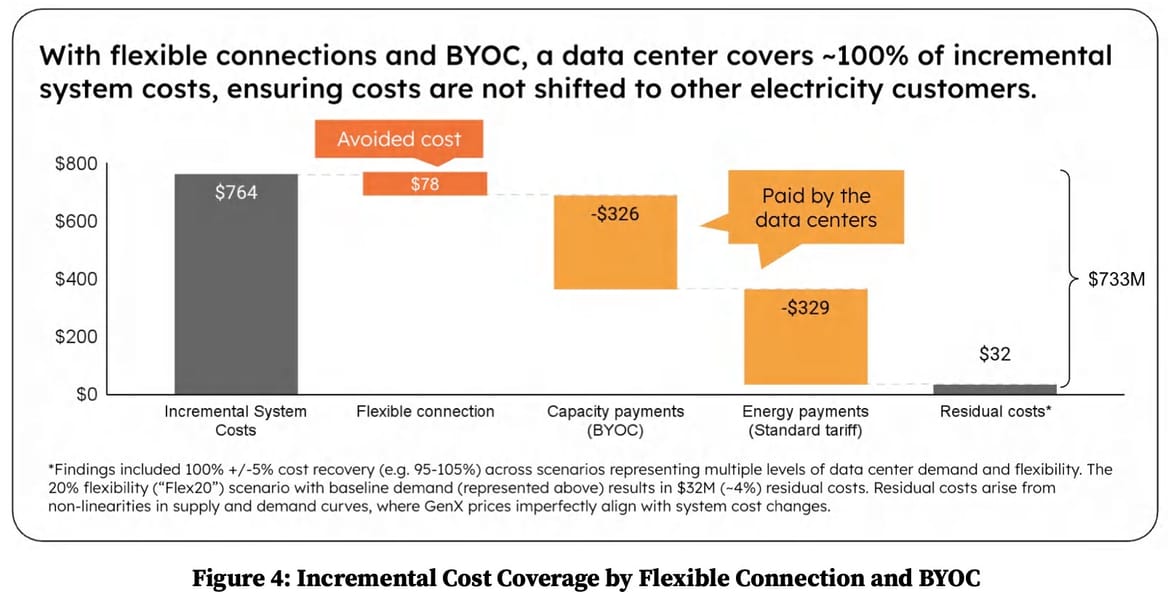
PJM isn’t the only grid operator or utility facing data center–driven cost pressures. But its challenges are more acute than most. PJM has a massive interconnection backlog that has created multiyear delays for new generation seeking to connect to its grid. And its capacity market structure is forcing up utility rates today to cover the future costs of serving forecasted data center demand.
PJM hasn’t been able to gain consensus from stakeholders — including utilities, power plant owners, big corporate energy users, and data center developers — on how to fix these problems, even as the more than 67 million customers that get power from PJM’s system face spiking utility bills to cover those costs.
That lack of consensus has prevented PJM from developing a key policy that could allow flexible interconnection to happen, Atkinson said. In order for the method laid out in the December report to work, PJM and member utilities would need to allow data centers to interconnect via something called “conditional firm” grid service.
In simple terms, this means blending traditional, “firm” service for the portion of power needs that can be supplied without grid upgrades and “conditional” service, which requires data centers to cut their power use or supply their own electricity needs during critical hours.
PJM doesn’t provide this kind of option for customers — though it may have it soon enough. In December, the Federal Energy Regulatory Commission ordered PJM to create structures that would allow data centers and other big customers to connect to its grid in more flexible ways. That order set out a variety of methods for PJM to pursue, including a structure called “interim non-firm transmission service,” which closely approximates the conditional firm service that Camus and Encoord envision.
“At its core, the FERC order moves PJM away from ‘full freight’ assumptions and toward studying and serving large loads based on their actual time-varying grid use,” Brancucci said. “That’s exactly the premise behind the conditional firm service model we analyzed in a few locations in PJM.”
Similar innovations are being pursued by grid operators in the Midwest and Texas, Atkinson noted. The Department of Energy has ordered FERC to launch a fast-track rulemaking to require grid operators and utilities to expedite data center interconnections.
“Today, no market really allows you to have a mix of grid power and on-site power that’s reasonably managed,” Atkinson said. But a growing number of grid experts agree that flexible interconnection is, as she put it, “the only practical way to meet these requirements.”
This article originally appeared on Inside Climate News, a nonprofit, non-partisan news organization that covers climate, energy and the environment. Sign up for their newsletter here.
Venezuela has the world’s largest oil reserves, but the South American country’s heavy oil deposits also stand out for another reason; on a barrel-for-barrel basis, they pack the most climate pollution.
Following the capture of Venezuelan President Nicolás Maduro by U.S. forces, President Donald Trump said, in a social media post on Tuesday, that the country would turn over 30 to 50 million barrels of high quality crude oil to the U.S. However, Trump himself previously stated that Venezuela’s oil is “the dirtiest, worst oil probably anywhere in the world.”
Venezuela’s “extra-heavy” crude is a thick, tar-like substance that typically must be heated to bring it to the surface and diluted with other chemicals before it can move through pipelines.
“It takes a lot of energy to heat the stuff and get it out of the ground and then get it to move and flow, and then turn it into normal products,” said Deborah Gordon, senior principal in the Climate Intelligence Program and head of the Oil and Gas Solutions Initiative for RMI, a nonprofit focused on clean energy. “And every energy input means a lot of emissions.”
Greenhouse gas emissions from heavy crude oil production, refining and use are, on average, 1.5 times higher than those of light crude oil, according to a 2018 study published in the journal Environmental Research Letters. The study, co-authored by Gordon, assessed the climate impact of 75 different crude oils worldwide.
Heavy crudes are also low quality oils that require more refining, which further increases the energy used to bring the fuel to market and its associated emissions, said Adam Brandt, an energy science engineering professor at Stanford University and the lead author of the study.
Oil from Venezuela, the majority of which is extra-heavy crude, has the second-highest carbon intensity of oil from any country, a policy paper published in 2018 by Brandt, Gordon and others in the journal Science concluded.
An updated analysis by RMI’s oil and gas climate index, based on 2024 data, found that oil from Venezuela had the highest carbon intensity among 55 leading oil-producing countries.
“Just because this hydrocarbon exists doesn’t mean that it should be marketed or taken out of the ground,” said Gordon, who is the author of No Standard Oil, a book that looks at the varying climate impacts of different crude oils. “If there is demand, there are far better places to go than Venezuela.”
Leaks and intentional venting of methane gas associated with oil production in the country contribute to its outsized climate impact. Methane is a potent greenhouse gas. On a pound-for-pound basis, it is more than 80 times worse for the climate than CO2 over a 20-year period.
Venezuelan oil had the second-highest methane intensity among leading oil producing countries in 2023, according to the International Energy Agency. The country’s high leak rate is due in part to ongoing oil and gas sanctions, which have led to poor resource management, Gordon said.
A lack of proper maintenance has also led to frequent oil spills. Venezuela’s state-owned oil company Petróleos de Venezuela, S.A., reported more than 46,000 oil spills between 2010 and 2016. The company hasn’t reported any spills since then. However, in 2020, the head of Venezuela’s Unitary Federation of Petroleum and Gas Workers, a labor union, estimated that oil spills occur almost daily in some states.
Despite Trump’s pledge to open Venezuela’s oil reserves to U.S. companies, that may not result in increased production.
Simply maintaining current production levels in Venezuela would require $53 billion in new energy infrastructure investments according to an analysis released Tuesday by Rystad Energy, an independent energy research and business intelligence company headquartered in Oslo, Norway.
Kirk Edwards, president of Latigo Petroleum, an independent oil and gas producer based in Odessa, Texas, called the U.S. government’s recent actions in Venezuela a “nothing burger” for oil markets.
“This is not ‘drop a rig and up comes the bubbling crude,’” Edwards wrote on LinkedIn. “Any real turnaround would require $50–100 billion of sustained investment, modern infrastructure, and years of political stability.”
Edwards said companies are unlikely to make that investment given current low oil prices.
Gordon said Venezuela’s oil and gas sector will continue to have an outsized climate impact, whether production increases or remains in its current state of disrepair.
“They’re just basically throwing stuff into the air,” Gordon said of current methane emissions.
Ohio’s largest utility wants to slash compensation for rooftop solar owners — which would affect not only future investments but also thousands of regulated utility customers who have already installed panels on their homes based on existing rules.
Later this year, the Public Utilities Commission of Ohio will decide whether to keep its statewide net-metering rules intact or whether to switch ratepayers to a less lucrative program proposed by American Electric Power’s Ohio utility.
The changes put forth by the utility are drastic and would raise costs and discourage others from going solar, a broad range of critics say.
“In a time that people are struggling to pay their bills, they are trying to gut net metering, which is one of the ways folks who are able to [can] save money by putting solar on their rooftop,” said Nolan Rutschilling, managing director of energy policy for the Ohio Environmental Council.
AEP’s proposal will be considered as part of the PUCO’s ongoing five-year review of the state’s net-metering rules. Parties’ case filings were due last month, although public comments can still be submitted.
The rules apply to the state’s investor-owned utilities: AEP’s Ohio Power Company, Duke Energy Ohio, AES Energy Ohio, and FirstEnergy’s three Ohio utilities. Ohioans have added more than 20,000 residential solar projects statewide since the current net-metering rules took effect about seven years ago, according to data from the sustainability consulting group Unpredictable City.
In effect, AEP wants to include distribution charges for all electricity flowing into a solar-equipped household, even if a big chunk winds up going back to the grid. The company describes the change as a shift from net usage to net billing. And it wants to limit net metering to customers who don’t pick their own electric generation supplier or take part in a community aggregation program.
The reduced compensation could substantially lengthen the payback period for rooftop solar investments.
“Residents that have already invested in solar have taken on the upfront capital cost because of the long-term utility savings supported by net metering requirements,” Casey Shevlin, director of sustainability and resilience for the city of Akron, wrote in a comment. “Their consumer rights need to be protected from net metering changes that could result in them benefiting less from solar investments they have made.”
Battles over net-metering rules have played out recently across the United States, including in the leading rooftop solar market of California.
There and elsewhere, critics of net metering argue that it forces the average customer to overpay for rooftop solar’s extra energy and that net billing is a fairer system. Supporters of net metering say that it provides systemwide cost savings by increasing distributed energy and that it’s a proven tool for deploying and democratizing clean electricity.
Among utilities, only AEP has formally opposed the recommendation by the commission’s staff to keep net-metering rules in place. The company’s proposal is supported by the Ohio Consumers’ Counsel, which said it wants to ensure there’s no “cost shifting” to people without rooftop solar.
But the AEP proposal has received massive pushback from environmental advocates, business groups, local governments, and others since its filing on the day before Thanksgiving.
The Citizens Utility Board of Ohio, Interstate Gas Supply, the Retail Energy Supply Association, Solar United Neighbors, the Ohio Environmental Council, and the Environmental Law & Policy Center have all filed formal replies with the PUCO, urging regulators to reject AEP’s arguments and to keep the current net-metering rules in place for all ratepayers.
AEP’s Ohio media relations office wrote via email, “Under net metering, a portion of the distribution-related charges are essentially shifted to other customers when the charges are calculated only for the net portion of the electricity delivered,” because infrastructure costs “are designed to be spread across the customers the system was built to serve.”
The company did not respond to Canary Media’s request for data showing how it or other regulated utilities would be hurt by net metering for customers who pick competitive energy suppliers or take part in community aggregation programs. The company has come after net metering before — and ultimately lost.
More than a decade ago, AEP took its arguments to limit net metering to the Ohio Supreme Court. The court ultimately dismissed that case after the PUCO released new rules that generally favored the company. A year after hearing lawyers’ arguments urging it to reconsider those rules, however, the commission changed course.
The current policy, adopted in December 2018, requires regulated utilities to compensate all rooftop solar customers for excess power, but it does not allow credit for distribution charges or for any avoided capacity charges.
AEP’s gambit to change the rules now surprised advocates for renewable energy, such as Mryia Williams, Ohio program director for Solar United Neighbors. “The PUCO staff had already concluded that net-metering rules are working as intended, and they didn’t think any changes needed to be made,” she said, referring to a Nov. 5 administrative law judge’s order in the rules docket.
The utility has not offered any data or other detailed assessment to justify its proposed changes, Williams said. And many rooftop solar owners relied on the current regulations when calculating whether to make the investment. “Everybody is just wanting to make sure that what’s already been promised is continued,” she said.
Plus, rooftop solar customers already pay for equipment to feed excess power to the utility. Levying distribution costs for electricity that customers wind up feeding back to the grid would, in effect, charge them for supplying the utility with distributed energy. Other energy suppliers don’t have to pay that expense, so it shouldn’t be something utilities can charge residents for either, said Nat Ziegler, manager of community solutions for Power a Clean Future Ohio.
Moreover, reducing net-metering compensation and limiting who can get it would discourage more people from adding rooftop solar, said Joe Flarida, executive director for Power a Clean Future Ohio.
“More generation on the grid will help limit the amount of price increases we’re seeing,” Flarida explained. “Certainly, if we can encourage more distributed energy, that would offset the amount of added power we need on the grid.”
Power a Clean Future Ohio is among the hundreds of groups and individuals who filed public comments with the PUCO, in addition to the formal party filings. That level of response represents a big change from a decade ago, Rutschilling said, noting increased interest in rooftop solar over the past few years.
People’s electricity bills have already jumped dramatically as grid operators like PJM have sounded the alarm about needing more electricity to meet demand from data centers, increased electrification, and other factors. And results of the most recent auction will almost certainly increase costs even more.
A bill introduced last fall would declare it state policy to “ensure affordable, reliable, and clean energy security,” with “clean energy” specified as meaning electricity from nuclear or natural gas, with no reference at all to renewables. But any new nuclear power requires years of review, and even with expedited permitting, Rutschilling noted, orders for new natural gas plant turbines have lag times of several years.
“We need as much generation as possible,” he said. “We need to have things like distributed energy.”
Almost a year ago, President Donald Trump declared that the United States was experiencing an “energy emergency.”
At the time, the U.S. was beating national and world-historical records for oil and gas production, as well as for wind and solar generation. But since then, the threat of an energy emergency really has emerged, in large part thanks to Trump’s own interventions in the power sector.
The Trump administration has blocked construction of renewable power sources, rescinded billions of dollars allocated by Congress to expand the grid and clean energy, and helped pass a law that vaporized federal tax credits for wind and solar projects.
These actions have compounded long-running challenges in connecting projects to the grid. All the while, the AI arms race — an avowed Trump priority — has pushed the need for new power production to dizzying heights.
Electricity demand will clearly outpace supply in the coming years, and concerted federal efforts are further reducing that supply. So, does that mean we are inevitably headed for an energy crisis? Nearly everyone I spoke with for this story believed the crisis was coming, if not already upon us.
“The mismatch just grows every day, with every new project cancellation and every new data center,” said Jesse Lee, a senior adviser at Climate Power, which advocates for action on climate change. “When you mismatch supply and demand that way, you get prices going through the roof.”
Indeed, residential electric utility rates rose by 13% from January to September of last year, and pressure on consumers became a major electoral issue in November’s gubernatorial elections in New Jersey and Virginia.
Longer term, the mismatch could result in regional energy shortfalls and threaten hundreds of billions of dollars in AI investment if the grid simply can’t keep up.
“Many parts of the country will have rolling blackouts in the next few years if we aren’t intentional about solving this crisis,” said Costa Samaras, who directs the Wilton E. Scott Institute for Energy Innovation at Carnegie Mellon University and worked on clean energy innovation in the Biden White House.
Somewhat dire stuff to kick off the new year with. But the very recognition of the problem is laying the groundwork for tackling it. And the looming menace of AI’s energy consumption just might deliver our best bet to convert energy scarcity into abundance.
This current energy predicament stands out from its predecessors because so many of the decisions constraining U.S. energy supply are being made domestically rather than by foreign adversaries.
Since resuming office, Trump has overseen continual supply-reducing moves, including:
“There is a crisis. It’s like we’re back in the ’70s, but instead of OPEC squeezing us, it’s us squeezing us,” said Armond Cohen, executive director of the Clean Air Task Force.
All told, 266 gigawatts of planned electricity generation projects fell through in 2025, according to analyst Michael Thomas. Thomas’ data platform, Cleanview, tracks more than 10,000 clean energy projects — a tricky task because developers often advance speculative projects to see if they can win a grid connection. But offshore wind tends to involve less speculation, given the hurdles to secure rights, Thomas said, and there’s been a clear trend of offshore wind cancellations this year in response to the administration’s hostility.
Other cancellations stem from issues that precede Trump’s directives, such as regional grid operators asking developers to pay exorbitant rates to connect to the network and local opposition blocking a project.
“So many of these challenges of how we build the necessary infrastructure to make the world better,” Thomas said, are “playing out county by county in these little battles of ‘Do we build a wind farm here, do we build a solar farm here?’”
Not all clean energy developments are under threat. The budget law Trump signed in July preserved Biden-era tax credits to install on-demand clean energy sources like batteries, geothermal, and nuclear, even as it did away with credits for wind and solar generation.
A Department of Energy spokesperson did not respond to questions about what the administration is doing about the declared energy crisis. The DOE has made some moves to expand electricity supply: It loaned $1 billion to help restart a nuclear reactor at Three Mile Island, and it kicked off a challenge to build new modular reactor designs by July 2026 — though these nascent technologies will take many years to secure regulatory approvals and enter commercial deployment.
Most intriguingly, Trump Media & Technology, the parent company of Trump’s own social media platform, Truth Social, announced in December that it would pursue a merger with nuclear fusion startup TAE Technologies. TAE hopes to generate clean baseload power in the early 2030s, though scientists consider cracking commercially viable fusion to be more technically challenging than running a niche and unprofitable social media platform.
Meanwhile, tech giants’ ambitions for AI computing construction have ballooned. Thomas said that while 20 to 30 gigawatts of data centers are operating today, 100 gigawatts are trying to connect in the next five years. Analysts at BloombergNEF predicted in December that data centers will consume 106 gigawatts by 2035; that number grew by 36% from the company’s tally just seven months prior.
Rep. Sean Casten, an Illinois Democrat and a leading energy wonk in Congress, said he worries about the current federal leadership’s capacity to respond to a full-blown energy crisis.
“Tell me how much volatility is coming down the pike, and it’s sort of like you’ve got a JV baseball team that’s working the ER shift tonight — if nobody checks into the ER, we’re gonna be fine,” he said.
Even so, Casten thinks widespread blackouts are a low-probability outcome because energy regulators have such a bias toward protecting reliability.
“The state utility commissions, the regional transmission organizations, they don’t always make good decisions, but they generally do prioritize reliability,” he said. “Having said that, the energy crisis that I think we should be super concerned about is on the price side.”
The Trump administration has raised the cost of energy not just by reducing supply. The delays it has caused for offshore wind projects have racked up hundreds of millions of dollars of unforeseen expenses, even before the most recent attempt to stop them from finishing construction. The interruptions also signal to foreign investors that billion-dollar projects in the U.S. are susceptible to extralegal disruption by the government, chilling future investment. Trump’s DOE has repeatedly invoked emergency powers to force old coal-fired plants to keep running beyond their planned retirement, leaving customers to foot the bill for tens, if not hundreds, of millions of dollars.
Those are system-level cost increases. On a more individual scale, when Republicans demolished the Inflation Reduction Act, they removed incentives for families to upgrade household energy efficiency, the Scott Institute’s Samaras noted. “Those save the homeowner money, but they also reduce the peak electricity demand when you really need it.”
The Trump administration could tackle the crisis by simply allowing American energy, including clean technologies, to flourish.
“Just get out of the way and stop blocking solar and wind permits,” said Shannon Baker-Branstetter, senior director of domestic climate and energy policy at the Center for American Progress. “If they believe in all of the above, really let it be all of the above.”
But that seems unlikely. Instead, the Trump administration is promoting gas power, though it has not taken steps to deal with the five-or-more-year waitlists to even buy gas turbines or their rapidly inflating costs. Its exotic nuclear bets won’t pay off for years, if ever.
Americans will have to look elsewhere for a remedy, and after so many pessimistic conversations, I finally found someone who was not only unfazed by recent developments but also optimistic about the future.
Pier LaFarge hails from Alabama and runs a startup called Sparkfund, which works with utilities to tap the benefits of clean and distributed energy. He speaks the language of the cleantech world but sees things differently than many in that cohort do.
We won’t crash headlong into an energy crisis, LaFarge assured me, precisely because everyone’s talking so much about crashing headlong into an energy crisis. This point recalled the Heisenberg uncertainty principle from my high school chemistry days: The act of observing something changes the thing that is observed.
Utilities and data center developers, LaFarge said, are coalescing around the understanding that demand during a relatively small number of hours in the year is constraining the AI buildout.
For decades, utilities built out the grid to meet the few hours of the year when demand peaks. That leaves capacity — in terms of power plants and transmission and distribution lines — wildly underutilized much of the time. The energy crisis won’t materialize, LaFarge argues, because it will catalyze the power sector to improve utilization of the existing grid.
Solve for a few moments of stress, and AI’s voluminous consumption of kilowatt-hours can support the fixed costs of running the grid for everyone else.
“Cheap batteries and data centers solve all of it,” he said. “You charge up when there’s excess, you drop it on the transmission and distribution corridors, you serve the data centers, downward pressure on rates, you win the future.”
In Oregon, an AI customer is already directly paying for grid batteries that will be used to benefit all of Portland General Electric’s customers. LaFarge said he has seen other confidential AI energy service agreements that will put multiple billions of dollars of downward pressure on utility rates for regular customers.
That’s more or less what Energy Secretary Chris Wright was talking about on his December publicity tour, though he attracts skepticism from clean-energy analysts when his idea for smart capacity investment amounts to forcing aging coal plants to stay open and hemorrhage money that other people have to pay for.
But if AI companies procure batteries, or portfolios of distributed energy and controllable demand, the economics change drastically. This would, in fact, achieve the cleantech sector’s long-held dream of an interactive and decentralized energy system.
This rosy scenario could fail to materialize for myriad reasons — states and regions failing to build grid infrastructure, regulators letting utilities dump billions of dollars into gas-plant construction at inflated costs instead of targeted battery investments, local leaders giving data centers sweetheart deals instead of demanding they pitch in.
But if batteries are allowed to play, the AI-fueled energy crisis could join the long list of energy crises that never came about. It’s comforting to know that’s at least a possibility.
As someone who spent several years as a workers’ rights organizer, Fredy Amador is intimately familiar with the financial struggles people face in the current economy. Northern Illinois’ skyrocketing energy bills make the situation even tougher.
Now, Amador has become an evangelist for something that can provide a modest measure of relief: a community solar project, built on a Superfund site too polluted for much else in the city of Waukegan where he lives, about 40 miles north of Chicago.
Residents who subscribe to get energy from the solar farm are guaranteed to see savings on their energy bills, under a state program incentivizing solar in low-income areas.
The 9.1-megawatt Yeoman Solar Project, which went online last month, can provide energy for about 1,000 households, as well as the Waukegan school district, which owns the land.
The school district bought the site in the 1950s hoping to build a new high school. But the land proved too swampy, and from 1958 to 1969 it was used as a dump for industrial and municipal waste. The highly contaminated Yeoman Creek Landfill was finally cleaned up 20 years ago, and now the district receives lease payments from CleanCapital, the national solar-investment company that owns and operates the solar farm.
Such brownfields are attractive locations for solar installations because of “existing electrical infrastructure, lower-cost land, and community acceptance,” noted Paul Curran, CleanCapital’s chief development officer. Incentives from the state initiative Illinois Solar for All helped make the project financially viable, even given extra costs incurred from building on a Superfund site.
It’s an example of how state policy can drive clean energy development and cost savings, even as federal tax credits for solar are being cut. The project also shows how solar can turn a community liability into an asset.
“The Yeoman Solar Project encapsulates so much of solar’s promise,” said Andrew Linhares, senior manager for the central U.S. at the Solar Energy Industries Association, a trade group. “The project instills new life into the Yeoman Creek Landfill Superfund site like only solar can.”
As an unlined pit amid wetlands, the Yeoman Creek Landfill leached toxic chemicals into the environment, including its namesake creek. In 1989, the landfill was added to the Superfund list, the federal program that requires companies responsible for pollution to clean it up.
The remediation was completed in 2005, though gas release, groundwater, and sediment are still being monitored.
“Since then, it’s been vacant,” and discussions started in 2012 regarding the fate of the land, said LeBaron Moten, deputy superintendent of Waukegan Community Unit School District No. 60.
“There were not too many options on the table for this specific site. We couldn’t build anything on it,” Moten said. “Our main objective was to keep people off it.”
Representatives of the school district, the city, and the group of companies involved in the cleanup decided to pursue putting a solar farm on the site, and in 2017 the school district issued a request for proposals. A national developer experienced in building solar on landfills, BQ Energy, was selected. In 2022, it was acquired by CleanCapital, which launched construction of the project.
Moten said the lease payments from CleanCapital and the energy savings from solar power will be helpful for the district, which serves over 13,000 students, the majority of whom are Latino and 68% of whom are considered low-income. The school district will be the project’s anchor tenant, using about 40% of the energy produced.
Seven of the school district’s buildings have rooftop solar arrays, which are referenced in sustainability lessons in the classroom. Moten said he hopes Yeoman Solar will similarly factor into educating students about clean energy, and potentially preparing them for jobs in the industry.
A longtime industrial hub, Waukegan is home to five Superfund sites. The city still has a lot of manufacturing, and until 2022 a large coal plant operated on the shore of Lake Michigan, not far from residents’ homes. That location remains contaminated with toxic coal ash. The community organization Clean Power Lake County and local activists have long demanded a just transition for Waukegan, in which economic opportunities and renewable energy benefit residents who have suffered from pollution.
Installing solar on brownfields is one way to accomplish this.
Solar is a good fit for sites that are too polluted for housing or other types of development, noted Curran. Under the terms of the Superfund remediation, residential use is prohibited at the Yeoman Creek site.
But installing arrays on landfills or other remediated areas does entail some challenges.
The U.S. Environmental Protection Agency reviews solar developers’ plans for Superfund sites, Curran said, to be sure the construction won’t damage caps over contaminated soil or otherwise release pollutants. The EPA examines “every single step of construction from how big ballasts can be, to stormwater protection, to how we’re going to revegetate,” he added.
Even mowing the grass below solar panels — a normally mundane process — can pose risks when a landfill lies underneath.
“The lawn is basically what’s holding the land in place, so you don’t get erosion,” Curran said.
An Illinois law passed in October and awaiting the governor’s signature creates a rebate for community solar paired with battery storage. Curran said that batteries would likely be too heavy to locate on a landfill, but CleanCapital may explore putting them on firmer ground nearby.
The company has developed solar on brownfields and landfills in other states, including a new 822-kilowatt site in Maryland. Curran said community solar should be built on more of the nation’s thousands of closed landfills.
Policies like those in Illinois help facilitate the process. A 2017 law created robust incentives for community solar. Since then, more than 700 community solar projects totaling over 1,800 megawatts have been built through the Illinois Shines incentive program. Another 33 projects representing 64 megawatts have been subsidized by Illinois Solar for All, a program for low-income and environmental justice areas (separate from the federal program of the same name that was ended by the Trump administration).
The Illinois Power Agency, which acquires power on behalf of utilities, procures solar built on brownfields. The Illinois EPA also provides low-interest loans and other resources for brownfield redevelopment.
Amador found out about Yeoman Solar from local clean energy leaders after he helped launch a Waukegan branch of the Chicago Workers Collaborative, which organizes and advocates for temporary workers. (He is no longer with the group, though he still lives in Waukegan.)
Community solar makes clean energy accessible to people who can’t or don’t want to install solar on their own homes — like Amador himself.
“I live in a condo building, and if I bought a house I probably would not have solar panels. I don’t like how they look on rooftops,” he said.
He often gets the same reaction when he tells people about community solar. “At first they think I’m talking about installing solar on their homes — they don’t want that.”
But after explaining and extolling the community solar model, Amador has recruited dozens of family, friends, and members of his church to subscribe to Yeoman Solar.
“It will help their wallet and help the ecosystem too,” Amador said.
The Yeoman Solar subscriptions will cover more than 90% of a household’s energy needs, said Ryan Libby, director of subscriber acquisition for PowerMarket, which CleanCapital contracted to recruit subscribers. Amador expects to save about $300 a year through his subscription, which equates to about 5 kilowatts of solar panels.
“That money can pay for utilities, for food, for other bills,” Amador said. “With how bad this economy is, it’s an important impact.”
Yeoman Solar is the largest community solar array in the territory of ComEd, the utility that serves northern Illinois. It reduces the amount of energy the utility needs to provide, and ComEd has praised the project. While any ComEd customer can subscribe, Curran said CleanCapital is prioritizing outreach to Waukegan residents.
Amador indeed feels it represents a new path for the city.
“All the pollution, the coal plant, the disinvestment — communities like Waukegan should be prioritized for projects like this,” he said. “I’d like to encourage people to ask questions — go to meetings, find out how these projects work, try to sign up. That will help them to save some money, and if we all participate, we’re stronger.”
The tale of the clean energy transition is long and winding — and unfortunately, we here at Canary Media don’t have a crystal ball to tell you exactly what’s coming next.
But we can let you in on the big storylines our reporters and editors are keeping a close eye on as we head into 2026. Here’s the list, covering everything from companies on the cusp of tech breakthroughs to policy debates that are hitting a boiling point.
Things are getting messy. President Donald Trump has gutted the only significant decarbonization law the U.S. ever managed to pass. Blue-state governors are backsliding on clean energy goals and easing up on fossil fuels under the cover of affordability. Oil and gas companies have dropped the pretense of caring about climate. ESG is dead. The “climate hawk” is dead. The words “pragmatism” and “realism” have become as inescapable in climate policy discourse as reminders of planetary warming are in the weather reports.
Yes, the climate conversation has changed dramatically over the last year, at least in the Western world. But the techno-economic trends that are driving decarbonization forward have not. Clean energy — mostly solar — is still being built at a blistering pace. EVs are beginning to run gas cars off the road. China’s emissions could be starting to decline. The world is on track for far less warming than it was when the Paris Agreement was signed a decade ago, and we’re still in the early innings of clean energy deployment.
In 2026, I’ll be watching this dissonance between decarbonization vibes and reality. Will politicians, companies, and others grow increasingly quiet on climate, all while the clean energy revolution speaks louder and louder? — Dan McCarthy, senior editor
What do you do when you can’t build actual power plants fast enough to keep the lights on and the air conditioners humming? You turn to virtual power plants.
Utilities and regulators have in recent years begun to embrace these networks of rooftop solar panels, backup batteries, plugged-in electric vehicles, smart thermostats, remote-controllable water heaters, and other “distributed energy resources” in homes and businesses. By controlling this equipment to lower electricity demand and provide energy to the grid, utilities can replicate much of the value of a traditional, centralized power plant.
Now, the AI boom is forcing decision-makers to take VPPs even more seriously. Gigawatts of planned data centers are pushing up already high and rising utility bills. Equipment shortages are making it nearly impossible to quickly build gas plants, while interconnection bottlenecks are preventing lots of utility-scale renewables from coming online. And the risks of overbuilding to serve what could end up being an AI bubble are rising.
VPPs could help solve all those problems by enlisting energy tech that people are already buying. What I’m eyeing in 2026 is whether utilities, grid operators, and the state and federal regulators overseeing them put their weight behind the VPP build-out. — Jeff St. John, chief reporter and policy specialist
2026 is a threshold year for the American nuclear industry as it strives to lay the foundation for an unprecedented scale-up of atomic energy in the U.S. — quadrupling nuclear generating capacity by 2050, as per President Trump’s executive order.
The operators of the Palisades and Three Mile Island plants are pledging 2026 and 2027 restart dates for those mothballed reactors. Additional Trump executive orders are aiming for three advanced nuclear startups to achieve criticality in 2026. (One reactor has already staked that claim.)
Over the coming months, I’ll be tracking whether the industry keeps its bold promise of power-plant restarts and advanced reactor development. We’ll be reporting on the crop of nuclear startups and whether they can deliver on their audacious claims. And we’ll be watching whether the U.S. can start building nuclear reactors at scale.
If those plans are backed by sufficient capital and follow-through, they could restore some of the country’s lost atomic luster. If not, the U.S will have ceded its global nuclear leadership to China and Russia. — Eric Wesoff, executive director
Northernmost Maine has strong winds and lots of open space. But renewable energy developers have not yet managed to capitalize on these conditions to build substantial onshore wind farms, even though the idea has been floating around the state since at least 2008. Last year, Maine energy officials and regional grid operator ISO New England kick-started yet another effort to get turbines spinning up north with requests for proposals for both generation and transmission lines to carry the power south to the rest of the region.
I’ll be watching closely for a few reasons: First, the New England grid needs more power supply as the climate-conscious states it serves make moves to electrify buildings and transportation, and 1,200 megawatts of onshore wind would certainly help. Also, if the plan succeeds, it could offer valuable lessons about the economics of developing renewable energy in the face of federal hostility, which, I think we can all agree, is unlikely to abate anytime soon. — Sarah Shemkus, Northeast reporter
As voters worry about the cost-of-living crisis, all-electric new buildings could help keep mortgage payments and energy bills down.
Though exact savings depend on local energy costs, a growing number of analyses have found that all-electric new construction makes financial sense. Building a home with only an electric system is often a simpler feat than building it with both electricity and gas. In some cases, all-electric homes can save people thousands of dollars over the lifetime of super-efficient electric appliances, such as heat pumps and heat-pump water heaters. Even retrofitting an existing structure with these technologies can pay off in the long term, especially in areas with favorable electricity rates.
Yet policymakers who once pushed ambitious electrification standards have been pulling back. Los Angeles Mayor Karen Bass (D) waived her city’s requirement that new buildings be all-electric after last year’s catastrophic wildfires, then repealed it completely. In June, air-quality regulators in Southern California punted a plan that would have incentivized a gradual phasedown of gas furnaces and water heaters sold in the region. And New York Gov. Kathy Hochul (D) delayed her state’s first-in-the-nation all-electric building code, which would have taken effect on Dec. 31, 2025.
In 2026, I want to see if politicians and regulators will recognize that electrification can in fact boost affordability, especially in newly built homes. — Alison F. Takemura, staff writer
Geothermal energy startups have raised huge sums of money in recent months and years to develop next-generation technologies for harnessing Earth’s heat. But so far, the companies have delivered relatively little carbon-free electricity to the grid.
That will change this year, when Fervo Energy flips the switch on its Cape Station facility in Utah. The startup is building an “enhanced geothermal system” that uses fracking techniques to create geothermal reservoirs in hard, impermeable rocks. The first 100 megawatts (of an eventual 500 MW) are slated to go online in October, which would make Cape Station the biggest project of its kind to connect to the grid worldwide.
The development will send “a powerful signal that next-generation geothermal is moving from promise to commercial reality,” said Jeremy O’Brien of geoscience software company Seequent. “We expect this milestone to accelerate both investor interest and government support globally.”
Fervo isn’t alone in its ambitions. The company Eavor will start working this spring to expand its first-of-a-kind geothermal project in Germany, and firms like Sage Geosystems, Quaise, XGS, and Zanskar are accelerating efforts to satisfy demand for clean, around-the-clock power. I’ll be watching closely to see whether 2026 proves to be the pivotal year the industry is hoping for. — Maria Gallucci, senior reporter
Ohio, where I report from, has for years been a hotbed for dark money and a testing ground for national efforts to hinder action on climate change. State lawmakers and regulators continue to throw up obstacles to renewable energy development, while giving preference to new fossil-fueled power plants. One pending bill, for example, calls for energy permitting decisions to make sure facilities “employ affordable, reliable, and clean energy sources,” with “reliable” meaning energy that’s available at all times and “clean” defined to include natural gas. I’ll keep investigating those efforts in 2026 to hold the people in power accountable as the public struggles with rising energy costs and worsening climate change impacts.
But it’s not all bad news in the Buckeye State, as some communities rally in support of clean energy. One story I’m particularly excited to cover is a May referendum that will give voters the chance to overturn a local solar and wind ban covering most of their county — an approach that could take off elsewhere in Ohio and in other states that allow local restrictions on renewable power. — Kathiann M. Kowalski, contributing reporter based in Ohio
2026 will be the year we start seeing batteries bridge the gap between data centers’ sky-high power demand and what the U.S. grid can actually deliver.
A well-placed battery system can secure electricity for AI computing hubs in the relatively few hours each year when the grid can’t supply them. That can allow data centers to get built far sooner than if they waited for pricey and time-consuming power network upgrades.
Storage developers are reporting a frenzy of interest in such projects, but these typically are shrouded in secrecy. I recently reported on the first publicly confirmed project of this kind, which entered construction in Oregon for Aligned Data Centers and should start operating in 2026. Utility Portland General Electric will own that one and use it to guarantee power a few years earlier than it could have with conventional grid upgrades.
What I found most intriguing is that the data center developer is paying for this smart grid upgrade. This arrangement lays out a rare positive vision for the nation’s energy future: The companies that stand to make boatloads of money on data centers could fund grid upgrades that benefit everyone, as opposed to the general public subsidizing those upgrades to pad the profits of AI ventures. In the year ahead, I’ll be tracking the proliferation of batteries for data centers, and what they mean for consumers’ energy bills. — Julian Spector, senior reporter
Over the past decade, scores of Midwestern coal plants have closed, as environmental regulations kicked in and coal-fired generation became more expensive than natural gas or renewables.
Now, the tables could be turning again.
Utilities are pushing back retirement dates for coal plants as electricity-demand forecasts increase exponentially due to proposed data centers — many of which may never get built. The Trump administration is ordering plants on the brink of closure to stay open and easing up on rules around pollution from coal power. Indiana’s Republican Gov. Mike Braun issued an executive order last spring calling for coal plant “life extensions,” and Illinois experts are researching controversial “clean coal technologies,” including at a demonstration carbon-capture plant that went online in 2024.
Coal is embedded in the culture in these states, and it’s highly political, as I’ve heard many times from elected officials, grassroots activists, and coal miners. In 2026, I’ll be closely tracking how this campaign to revive coal progresses and what it means on the ground in Midwest communities where it is burned and mined. After all, coal isn’t just an increasingly expensive way to generate electricity; it’s also incredibly polluting. — Kari Lydersen, contributing reporter based in Illinois
The future of America’s offshore wind sector may well be in Canada — a country prepping its first projects and willing to share power generated from its frigid ocean breezes with U.S. states just across the border.
Thanks to President Trump’s ire, it’s likely that no new offshore wind farms will be completed in the U.S. until 2035, save for the five projects already being built, BloombergNEF predicted in early December. Even those projects aren’t guaranteed, a fact underscored by the 90-day pause on wind farm construction issued Dec. 22 by the Interior Department.
But Northeast U.S. states aren’t giving up on the renewable energy source. Massachusetts is exploring sourcing offshore wind power from Canada, with Democratic Gov. Maura Healey meeting with Nova Scotia’s premier last month to discuss partnering on energy needs. Maine also seems interested.
In 2026, I’ll be keeping a close eye on whether these deals materialize — and what they mean for North America’s offshore wind workforce and supply chain, which grew under the Biden administration and could otherwise wither away under Trump 2.0. — Clare Fieseler, reporter
“Electricity is the new price of eggs.”
The memorable quote from Charles Hua of consumer advocacy group PowerLines sums up the current conversation on energy affordability, which defined federal, state, and local policy and politics this year.
Americans are in the midst of a broader cost of living crisis, spurred by the first real bout of inflation in decades. Electricity bills have become a major driver of that worrisome trend, with costs rising at more than twice the rate of inflation over the last year, largely because it’s expensive to maintain, expand, and repair the grid.
Now, President Donald Trump’s policies are making the bad situation worse — despite his frequent promises to bring down costs. On his first day in office, Trump declared an “energy emergency,” saying Americans faced an “active threat” from high energy prices and that the country needed an “affordable and reliable domestic supply of energy” to curb them.
“Reliable” is code for coal and gas in the Trump administration’s book. The U.S. Department of Energy has used the “emergency” to keep fossil-fueled power plants open past their retirement dates and to prop up the dying coal industry, at great expense to ratepayers. A Michigan coal plant that was supposed to shutter in May instead racked up $650,000 each day in costs for ratepayers after the DOE ordered it to keep running. That number will only grow as the plant runs through the winter.
Meanwhile, the administration has retaliated against cheaper and quicker ways to get more power online: namely, renewables and battery storage. The One Big Beautiful Bill Act, which Trump signed in July, scraps tax credits for solar and wind deployment as well as incentives for home energy improvements. The result? Fewer cheap clean energy projects will be built, and by 2035 the average American household will pay $170 more each year for energy than they do now, according to the think tank Energy Innovation.
It’s not just electricity. Natural gas prices are expected to rise this winter as well, and a delay in the distribution of federal home heating assistance, spurred by the government shutdown, will only exacerbate the challenge for families. More cuts to federal programs that help households reduce their energy usage and bills, including Energy Star and the Weatherization Assistance Program, could still be on the way.
The urgency of the energy affordability situation is starting to shape politics at the state and local level, too.
Throughout the year, blue-state lawmakers have invoked affordability both to bash the Trump administration for stymieing renewables — and to excuse their own backtracking from climate goals. That dichotomy has been especially apparent in New York, which in July passed a groundbreaking ban on new gas hookups that was expected to lower families’ energy usage and bills, but then paused its implementation just a few months later. In November, New York also authorized a gas pipeline project it had rejected three times before. Democratic Gov. Kathy Hochul has cited affordability concerns for her decisions.
Affordability also factored in on Election Day.
New Jersey’s Democratic Gov.-elect Mikie Sherrill campaigned on the promise of building out more clean energy, including offshore wind, to curb rising prices. In Virginia, Democratic Gov.-elect Abigail Spanberger and Democratic state legislators ran their successful campaigns on the promise of curbing power prices in the data center capital of the world. And in Georgia, where rates are rising fast, two Democrats who promised a focus on affordability and “clean, reliable energy” unseated Republican incumbents on the regulatory commission that oversees ratemaking for the state’s utilities.
The problem is likely to dominate the conversation again next year, exacerbated by concerns about data centers gobbling up power and Trump administration policies making it hard to build new electricity generation. Consumer advocates have called for officials to take bold action — including reducing utility profit rates and finally making it possible to build transmission lines — to alleviate the rising prices. We’ll see if any of those solutions actually come to fruition in 2026.
Disclosure: Charles Hua is a member of Canary Media’s board of directors. The board has no influence over Canary Media’s reporting.
We’re proud of the 650+ clean energy stories our small team brought you last year. We’re so proud we even made a reading list of our favorite articles.
But this is a different type of list. It’s about the stories we didn’t write but wish we had — sharp pieces from rival outlets big and small that uncovered new information, reframed the debate, or were simply fun to read.
Here are some of the stories from last year we wish we could claim as our own. (In a moment of meta-jealousy, it bears mentioning that the idea for a “jealousy list” is borrowed from Bloomberg Businessweek, which has been publishing annual versions since 2015.)
Rooftop solar is a miracle. Why are we killing it with red tape?Mother Jones
Why don’t we have solar panels on every rooftop? Bill McKibben’s story in Mother Jones exposes the stark contrast between installing home solar in the U.S., a process mired in red tape, and doing so in Australia, Spain, Germany, and other countries where it’s so much cheaper and easier. This feisty piece makes you want to slap your forehead and ask, “Why can’t we have nice things, too?” — Alison F. Takemura, reporter
When the blade breaksThe Verge
Nantucket native and novelist Gabriella Burnham wrote for The Verge about the fallout from a 2024 incident in which a turbine blade broke off a New England offshore wind project. With rich detail and narrative momentum, Burnham’s reporting reveals how wealth and island dynamics became a perfect storm for renewables pushback. Nowhere else will you read about local dudes making T-shirts that read “Vineyard Wind is ISIS,” and no one but a local writer like Burnham could have written a piece like this. — Clare Fieseler, reporter
Trump’s quest for ‘energy dominance’ is all about the vibesGrist
President Donald Trump has pulled a total Gretchen Wieners from “Mean Girls” this past year: Just like she wanted to make fetch happen, he’s trying his darnedest to make the term “American energy dominance” stick. But what does it actually mean? Grist’s ever-thoughtful Kate Yoder has answers in a story I wish I had written that draws on experts, history, and smart analysis. — Ysabelle Kempe, associate editor
How a Koch-funded campaign is trying to reverse climate action in VermontVTDigger
Apparently I let this one linger a little too long on my to-do list, because VTDigger’s Austyn Gaffney beat me to it — and, with her in-depth knowledge of Vermont politics, did a better job than I could have. It’s a fascinating, rigorously reported, and kind of frightening look into how the Koch brothers’ Americans for Prosperity is setting up shop in one of the country’s bluest states, making inroads with its brand of clean-energy and climate disinformation. — Sarah Shemkus, reporter
Why did Hochul back down on New York’s gas ban?New York Focus
Democratic New York Gov. Kathy Hochul’s decision to suspend the state’s first-in-the-nation all-electric buildings law had every climate-conscious New Yorker shaking their head and asking “Why?” Colin Kinniburgh of New York Focus provided an answer, albeit not a very satisfying one for anyone who cares about cleaner buildings and a healthier planet. Regardless of how you feel about the state’s constant climate backtracking, it’s a great example of journalism that breaks down the legalese so you don’t have to. — Kathryn Krawczyk, engagement editor
The airline industry’s dirty secret: Clean jet fuel failuresReuters
For journalists, there’s always a push and pull between covering news as it happens and stepping back to make sense of the headlines. This Reuters investigation on “sustainable aviation fuels” does an excellent job at the latter, with a data-driven, multimedia approach. The feature reveals that, behind all the promise of progress, airlines and energy companies are falling far behind on efforts to bring low-carbon jet fuel to the skies. — Maria Gallucci, senior reporter
Is data center flexibility a ‘regulatory fiction’?Latitude Media
Everyone’s talking about data center “flexibility” as the solution to the cost pressures the AI boom is putting on everyday utility customers. But what does “flexibility” mean — and is it allowed? In this quick-turnaround story, Maeve Allsup does an extraordinary job condensing the highly wonky conflicts between grid experts seeking to make data center flexibility a reality in the most data center–impacted U.S. power market. — Jeff St. John, chief reporter and policy specialist
River rafting in Colorado offers climate lessons for Southern CaliforniaLos Angeles Times
Sammy Roth excels at grounding big climate and energy debates in the parched dirt of the Western landscape. As a reporter and commentator for the L.A. Times, he held California leaders accountable when their actions on climate didn’t match their rhetoric. I’m especially partial to (and envious of) his dispatches from far-flung corners of the West, like this one in which a rafting trip in the high mountains of Colorado reveals unexpected linkages from wilderness river guides to inner-city L.A. renters. We’re lucky Sammy kept the whitewater off his notebook, and now he continues the chronicle at his new Substack, Climate Colored Goggles. — Julian Spector, senior reporter
The quick and shameful death of Biden’s biggest policyThe New Republic
Kate Aronoff gives the death of the Inflation Reduction Act the deep treatment it deserves. Her story is sweeping and nuanced, and explains not only the rise and fall of the now-gutted climate law, but also sketches out where climate politics might go from here. If you want to read one thing to better understand where U.S. climate policy stands as we enter 2026, it should be this. — Dan McCarthy, senior editor
Why the time has finally come for geothermal energyThe New Yorker
I’ve covered the rise of geothermal energy in recent years and, in 2024, I was lucky enough to visit Iceland to learn more firsthand. So I was especially jealous to see this beautifully written dispatch by Rivka Galchen about her own tour of the Nordic country. It’s filled with lush details about the landscape, people, and even tiny horses, and it’s a vivid account of how geothermal has developed over centuries — and could help meet the energy and climate challenges we’re facing today. — Maria Gallucci, senior reporter
The obscure philosophical battle that could reshape the clean energy economyHeatmap
If you’re an energy-policy nerd like me, you’ve probably seen he-said, she-said coverage of the battle playing out over renewable energy certificates, and perhaps you’ve asked yourself why we can’t find a win-win solution to the problem of properly accounting for the carbon impacts of clean energy purchases by tech and corporate giants. This story from Emily Pontecorvo does an excellent job of explaining what’s at stake and why it has been so hard to find consensus. — Jeff St. John, chief reporter and policy specialist
The backlash to high electric bills could transform U.S. politicsTIME
As an editor, I’m perpetually preoccupied with how to make wonky topics accessible to non–energy nerds. Rising power costs is one such topic — and the public is sitting up and paying attention to it. This TIME article by Justin Worland was published in the lead-up to the November election for two seats on Georgia’s Public Service Commission, but it remains relevant as an easy-to-grasp primer on things like data center growth, utility regulation, and surging electricity demand. Plus, it tees up all of the issues everyone will be talking about even more this coming year as the 2026 midterms approach. — Wendy Becktold, managing editor
Liberal Oregon and Washington vowed to pioneer green energy. Almost every other state is beating them.Oregon Public Radio/ProPublica
State leadership on clean energy has become all the more vital since the federal government launched an all-out war on renewables. This investigation, by Oregon Public Radio and ProPublica, shows why Oregon and Washington have struggled to build many clean energy projects in spite of passing some of the most ambitious climate laws in the country. Surprisingly, the evidence points to a nonprofit public power agency from the New Deal era holding things up. — Julian Spector, senior reporter
This year was a big one for Canary Media. Our merger with the Energy News Network brought new reporters into the mix, expanding our focus on state and local clean energy policy and progress.
We sure needed the extra manpower to cover everything that 2025 brought. President Donald Trump shook up the clean energy landscape as soon as he entered the White House, taking particular aim at offshore wind and EVs. Worries about rising power demand from data centers reached a fever pitch. And startups boasted major breakthroughs in cleaning up manufacturing, decarbonizing home heating, and bringing battery storage to the masses.
That’s just a handful of the many, many topics Canary Media reporters covered this year through more than 600 stories. Here are 11 that you can’t miss, in chronological order.
Data centers are overwhelming the grid. Could they help it instead?
Jeff St. John started 2025 with a deep dive into what became one of the year’s hottest energy topics: data centers. In this first installment of a four-part series, Jeff explored the growing concern over AI data centers’ capacity to drive power demand to new heights, and how utilities may use that rising demand to justify new fossil fuel construction. But with effective regulation and demand management, it doesn’t have to be that way.
The smell of toasted rock could spell victory for geothermal energy
Julian Spector turned his visit to Quaise Energy’s Texas testing grounds into a feast for the senses. Whirring contraptions, hand-warming heat, and the smell of toasted marshmallows: Those are just a few of the ways Julian described the experience of watching the startup blast through rock with an electromagnetic beam. It’s all in hopes of accessing deeper, hotter levels of the Earth for geothermal power generation.
The rural N.C. mayor betting big on clean energy to uplift his hometown
Mayor Mondale Robinson has big clean energy dreams for his small rural town of Enfield, North Carolina, and shared them with Elizabeth Ouzts back in March. Residents of the largely Black, devastatingly poor town face massive winter energy bills, and Robinson envisions tackling them through a solar-plus-storage array that could help stabilize power costs — and a resilience hub that could teach residents about energy savings and keep them safe during emergencies.
From EVs to HVAC, clean energy means jobs in Central Illinois
In May, Canary Media joined fellow nonprofit newsrooms to report a series of stories on the growing clean energy workforce in rural America. That project took Kari Lydersen to Decatur, Illinois, which has been losing factory jobs for years. But a community college program is training a new generation of solar panel installers to change that dynamic, including Shawn Honorable, who’s planning to start a solar-powered hot dog stand called Buns on the Run.
US hydropower is at a make-or-break moment
Since the late 1800s, America’s network of hydroelectric dams has provided a steady, clean source of electricity. But their age is catching up with them, Alexander C. Kaufman reported in this deep dive. Nearly 450 dams across the country will need to be relicensed in the next decade, but many must make significant, costly upgrades to keep operating — and may opt to shut down instead.
How Trump gutted the team meant to build America’s energy future
The end of 2025 may also signal the end of the Office of Clean Energy Demonstrations. Created under the Biden administration, the office was meant to be a federally backed launchpad for ambitious but unproven clean technologies. In a thoughtful obituary for OCED, Maria Gallucci recounts the office’s biggest wins, and how that all started crumbling on Day 1 of the Trump administration.
Inside the Colorado factory where AtmosZero is electrifying steam
Cheez Whiz, notepaper, and beer all have one thing in common: They’re made with the help of gas-burning boilers. But if it’s up to AtmosZero, that’ll soon change. Alison F. Takemura took us on a tour of the Colorado factory where AtmosZero will soon start building steam-producing heat pumps, in hopes of decarbonizing all sorts of polluting processes.
Why utility regulators need to do more than call ‘balls and strikes’
Marissa Gillett didn’t make a lot of friends during her time leading Connecticut’s Public Utilities Regulatory Authority. While consumer advocates heralded her assertive oversight, investor-owned utility regulators accused her of inappropriate, and even unlawful, bias. In an interview with Sarah Shemkus after she stepped down from PURA, Gillett didn’t back down from her “sustained, rigorous” approach, and called on other regulators to do the same.
This Ohio county banned wind and solar. Now, residents are pushing back.
Ohio has become a hot spot for anti-clean-energy rules, with more than three dozen counties outlawing utility-scale solar development in at least one of their townships. Richland County is among them, but in the new year, residents may reverse the ban. Kathiann M. Kowalski reports on how a group of local advocates secured a referendum on the decision made by just three county commissioners — and how they could inspire other Ohioans to do the same.
As solar booms and coal fades, Greece’s mining region struggles to adapt
This fall, Dan McCarthy took us on a trip to Greece. Far from Athens and the iconic whitewashed buildings of the Cyclades islands is Western Macedonia, which remains the country’s energy-producing hub even as its coal plants and mines shutter. Solar farms have rapidly taken the fossil fuel’s place, but residents are frustrated that the region’s economy hasn’t kept up.
The man behind the fall of offshore wind
Our list closes with a story Clare Fieseler started following three years ago, at a time when Republican lawmakers didn’t have much to say about offshore wind. Since then, the industry has become a prime target for the Trump administration, and David Stevenson is a big reason why. Stevenson is a 75-year-old grandfather from Delaware who believes in climate change — but not in offshore wind’s ability to fight it. Through numerous conversations with Stevenson, Clare shares the winding tale of how his activism brought the fight against offshore to the highest levels of government.


.svg)
