

 Back
Back
On 12 February, US president Donald Trump revoked the “endangerment finding”, the bedrock of federal climate policy.
The 2009 finding concluded that six key greenhouse gases, including carbon dioxide (CO2), were a threat to human health – triggering a legal requirement to regulate them.
It has been key to the rollout of policies such as federal emission standards for vehicles, power plants, factories and other sources.
Speaking at the White House, US Environmental Protection Agency (EPA) administrator Lee Zeldin claimed that the “elimination” of the endangerment finding would save “trillions”.
The revocation is expected to face multiple legal challenges, but, if it succeeds, it is expected to have a “sweeping” impact on federal emissions regulations for many years.
Nevertheless, US emissions are expected to continue falling, albeit at a slower pace.
Carbon Brief takes a look at what the endangerment finding was, how it has shaped US climate policy in the past and what its repeal could mean for action in the future.
The challenges of passing climate legislation in the US have meant that the federal government has often turned instead to regulations – principally, under the 1970 Clean Air Act.
The act requires the EPA to regulate pollutants, if they are found to pose a danger to public health and the environment.
In a 2007 legal case known as Massachusetts vs EPA, the Supreme Court ruled that greenhouse gases qualify as pollutants under the Clean Air Act. It also directed the EPA to determine whether these gases posed a threat to human health.
The 2009 “endangerment finding” was the result of this process and found that greenhouse gas emissions do indeed pose such a threat. Subsequently, it has underpinned federal emissions regulations for more than 15 years.
In developing the endangerment finding, the EPA pulled together evidence from its own experts, the US National Academies of Sciences, Engineering and Medicine and the wider scientific community.
On 7 December 2009, it concluded that US greenhouse gas emissions “in the atmosphere threaten the public health and welfare of current and future generations”.
In particular, the finding highlighted six “well-mixed” greenhouse gases: carbon dioxide (CO2); methane (CH4); nitrous oxide (N2O); hydrofluorocarbons (HFCs); perfluorocarbons (PFCs); and sulfur hexafluoride (SF6).
A second part of the finding stated that new vehicles contribute to the greenhouse gas pollution that endangers public health and welfare, opening the door to these emissions being regulated.
At the time, the EPA noted that, while the finding itself does not impose any requirements on industry or other entities, “this action was a prerequisite for implementing greenhouse gas emissions standards for vehicles and other sectors”.
On 15 December 2009, the finding was published in the federal register – the official record of US federal legislation – and the final rule came into effect on 14 January 2010.
At the time, then-EPA administrator Lisa Jackson said in a statement:
“This finding confirms that greenhouse gas pollution is a serious problem now and for future generations. Fortunately, it follows President [Barack] Obama’s call for a low-carbon economy and strong leadership in Congress on clean energy and climate legislation.
“This pollution problem has a solution – one that will create millions of green jobs and end our country’s dependence on foreign oil.”
The endangerment finding originated from a part of the Clean Air Act regulating emissions from new vehicles and so it was first applied in that sector.
However, it came to underpin greenhouse gas emission regulation across a range of sectors.
In May 2010, shortly after the Obama EPA finalised the finding, it was used to set the country’s first-ever limits on greenhouse gas emissions from light-duty engines in motor vehicles.
The following year, the EPA also released emissions standards for heavy-duty vehicles and engines.
However, findings made under one part of the Clean Air Act can also be applied to other articles of the law. David Widawsky, director of the US programme at the World Resources Institute (WRI), tells Carbon Brief:
“You can take that finding – and that scientific basis and evidence – and apply it in other instances where air pollutants are subject or required to be regulated under the Clean Air Act or other statutes.
“Revoking the endangerment finding then creates a thread that can be pulled out of not just vehicles, but a whole lot of other [sources].”
Since being entered into the federal register, the endangerment finding has also been applied to stationary sources of emissions, such as fossil-fuelled power plants and factories, as well as an expanded range of non-stationary emissions sources, including aviation.
(In fact, the EPA is compelled to regulate emissions of a pollutant – such as CO2 as identified in the endangerment finding – from stationary sources, once it has been regulated anywhere else under the Clean Air Act.)
In 2015, the EPA finalised its guidance on regulating emissions from fossil-fuelled power plants. These performance standards applied to newly constructed plants, as well as those that underwent major modifications.
This ruling noted that “because the EPA is not listing a new source category in this rule, the EPA is not required to make a new endangerment finding…in order to establish standards of performance for the CO2”.
The following year, the agency established rules on methane emissions from oil and gas sources, including wells and processing plants. Again, this was based on the 2009 finding.
The 2016 aircraft endangerment finding also explicitly references the vehicle-emissions endangerment finding. That rule says that the “body of scientific evidence amassed in the record for the 2009 endangerment finding also compellingly supports an endangerment finding” for aircraft.
The endangerment finding has also played a critical role in shaping the trajectory of climate litigation in the US.
In a 2011 case, American Electric Power Co. vs Connecticut, the Supreme Court unanimously found that, because greenhouse gas emissions were already regulated by the EPA under the Clean Air Act, companies could not be sued under federal common law over their greenhouse gas emissions.
Widawsky tells Carbon Brief that repealing the endangerment finding therefore “opens the door” to climate litigation of other kinds:
“When plaintiffs would introduce litigation in federal courts, the answer or the courts would find that EPA is ‘handling it’ and there’s not necessarily a basis for federal litigation. By removing the endangerment finding…it actually opens the door to the question – not necessarily successful litigation – and the courts will make that determination.”
The official revocation of the endangerment finding – initially posted to the EPA’s website – was published in the federal register on 18 February.
It states that the ruling will be effective from 20 April.
It is set to face no shortage of legal challenges. The state of California has “vowed” to sue, as have a number of environmental groups, including Sierra Club, Earthjustice and the National Resources Defense Council.
Dena Adler, an adjunct professor of law at New York University School of Law, tells Carbon Brief there are “significant legal and analytical vulnerabilities” in the EPA’s ruling. She explains:
“This repeal will only stick if it can survive legal challenge in the courts. But it could take months, if not years, to get a final judicial decision.”
At the heart of the federal agency’s argument is that it claims to lack the authority to regulate greenhouse gas emissions in response to “global climate change concerns” under the Clean Air Act.
In the ruling, the EPA says the section of the Act focused on vehicle emissions is “best read” as authorising the agency to regulate air pollution that harms the public through “local or regional exposure” – for instance, smog or acid rain – but not pollution from “well-mixed” greenhouse gases that, it claims, “impact public health and welfare only indirectly”.
This distinction directly contradicts the landmark 2007 Supreme Court decision in Massachusetts vs EPA. (See: What is the ‘endangerment finding’?)
The EPA’s case also rests on an argument that the agency violated the “major questions doctrine” when it started regulating greenhouse gas emissions from vehicles.
This legal principle holds that federal agencies need explicit authorisation from Congress to press ahead with actions in certain “extraordinary” cases.
In a policy brief in January, legal experts from New York University School of Law’s Institute for Policy Integrity argued that the “major questions doctrine” argument “fails for several reasons”.
Regulating greenhouse gas emissions under the Clean Air Act is “neither unheralded nor transformative” – both of which are needed for the legal principle to apply, the lawyers said.
Furthermore, the policy brief noted that – even if the doctrine were triggered – the Clean Air Act does, in fact, supply the EPA with the “clear authority” required.
Mark Drajem, director of public affairs at NRDC, says the endangerment finding has been “firmly established in the courts”. He tells Carbon Brief:
“In 2007, the Supreme Court directed EPA to look at the science and determine if greenhouse gases pose a risk to human health and welfare. EPA did that in 2009 and federal courts rejected a challenge to that in 2012.
“Since then, the Supreme Court has considered EPA’s greenhouse gas regulations three separate times and never questioned whether it has the authority to regulate greenhouse gases. It has only ruled on how it can regulate that pollution.”
However, experts have noted that the Trump administration is banking on legal challenges making their way to the Supreme Court – and the now conservative-leaning bench then upholding the repeal of the endangerment finding.
Elsewhere, the EPA’s new ruling argues that regulating emissions from vehicles has “no material impact on global climate change concerns…much less the adverse public health or welfare impacts attributed to such global climate trends”.
“Climate impact modelling”, it continues, shows that “even the complete elimination of all greenhouse gas emissions” of vehicles in the US would have impacts that fall “within the standard margin of error” for global temperature and sea level rise.
In this context, it argues, regulations on emissions are “futile”.
(The US is more historically responsible for climate change than any other country. In its 2022 sixth assessment report, the Intergovernmental Panel on Climate Change said that further delaying action to cut emissions would “miss a brief and rapidly closing window of opportunity to secure a liveable and sustainable future for all”.)
However, the final rule stops short of attempting to justify the plans by disputing the scientific basis for climate change.
Notably, the EPA has abandoned plans to rely on the findings of a controversial climate science report commissioned by the Department of Energy (DoE) last year.
This is a marked departure from the draft ruling, published in August, which argued there were “significant questions and ambiguities presented by both the observable realities of the past nearly two decades and the recent findings of the scientific community, including those summarised in the draft CWG [‘climate working group’] report”.
The CWG report – written by five researchers known for rejecting the scientific consensus on human influence on global warming – faced significant criticism for inaccurate conclusions and a flawed review process. (Carbon Brief’s factcheck found more than 100 misleading or false statements in the report.)
A judge ruled in January that the DoE had broken the law when energy secretary Chris Wright “hand-picked five researchers who reject the scientific consensus on climate change to work in secret on a sweeping government report on global warming”, according to the New York Times.
In a press release in July, the EPA said “updated studies and information” set out in the CWG report would serve to “challenge the assumptions” of the 2009 finding.
But, in the footnotes to its final ruling, the EPA notes it is not relying on the report for “any aspect of this final action” in light of “concerns raised by some commenters”.
Legal experts have argued that the pivot away from arguments undermining climate science is designed with future legal battles over the attempted repeal in mind.
As mentioned above, a number of groups have already filed legal actions against the Trump administration’s move to repeal the endangerment finding – leaving the future uncertain.
However, if the repeal does survive legal challenges, it would have far-reaching implications for federal efforts to address greenhouse gas emissions, experts say.
In a blog post, the WRI’s Widawsky said that the repeal would have a “sweeping” impact on federal emissions regulations for cars, coal-fired power stations and gas power plants, adding:
“In practical terms, without the endangerment finding, regulating greenhouse gas emissions is no longer a legal requirement. The science hasn’t changed, but the obligation to act on it has been removed.”
Speaking to Carbon Brief, Widawsky adds that, despite this large immediate impact, there are “a lot of mechanisms” future US administrations might be able to pursue if they wanted to reinstate the federal government’s obligation to address greenhouse gas emissions:
“Probably the most direct way – rather than talk about ‘pollutants’, in general, and the EPA, say, making a science-specific finding for that pollutant – [is] for Congress simply to declare a particular pollutant to be a hazard for human health and welfare. [This] has been done in other instances.”
If federal efforts to address greenhouse gas emissions decline, there will likely still be attempts to regulate at the state level.
Previous analysis from the University of Oxford noted that, despite a walkback on federal climate policy in Trump’s second presidential term, 19 US states – covering nearly half of the country’s population – remain committed to net-zero targets.
Widawksy tells Carbon Brief that it is possible that states may be able to leverage legislation, including the Clean Air Act, to enact regulations to address emissions at the state level.
However, in some cases, states may be prevented from doing so by “preemption”, a US legal doctrine where higher-level federal laws override lower-level state laws, he adds:
“There are a whole lot of other sections of the Clean Air Act that may either inhibit that kind of ability for states to act through preemption or allow for that to happen.”
The Trump administration’s decision has received widespread global condemnation, although it has been celebrated by some right-wing newspapers, politicians and commentators.
In the US, former US president Barack Obama said on Twitter that the move will leave Americans “less safe, less healthy and less able to fight climate change – all so the fossil-fuel industry can make even more money”.
Similarly, California governor Gavin Newsom called the decision “reckless”, arguing that it will lead to “more deadly wildfires, more extreme heat deaths, more climate-driven floods and droughts and greater threats to communities nationwide”.
Former US secretary of state and climate envoy John Kerry called the decision “un-American”, according to a story on the frontpage of the Guardian. He continued:
“[It] takes Orwellian governance to new heights and invites enormous damage to people and property around the world.”
An editorial in the Guardian dubbed the repeal as “just one part of Trump’s assault on environmental controls and promotion of fossil fuels”, but added that it “may be his most consequential”.
Similarly, an editorial in the Hindu said that Trump is “trying to turn back the clock on environmental issues”.
In China, state-run news agency Xinhua published a cartoon depicting Uncle Sam attempting to turn an ageing car, marked “US climate policy”, away from the road marked “green development”, back towards a city engulfed in flames and pollution that swells towards dark clouds labelled “greenhouse gas catastrophe”.
Conversely, Trump described the finding as “the legal foundation for the green new scam”, which he claimed “the Obama and Biden administration used to destroy countless jobs”.
Similarly, Al Jazeera reported that EPA administrator Zeldin said the endangerment finding “led to trillions of dollars in regulations that strangled entire sectors of the US economy, including the American auto industry”. The outlet quoted him saying:
“The Obama and Biden administrations used it to steamroll into existence a left-wing wish list of costly climate policies, electric vehicle mandates and other requirements that assaulted consumer choice and affordability.”
An editorial in the Washington Post also praises the move, saying “it’s about time” that the endangerment finding was revoked. It argued – without evidence – that the benefits of regulating emissions are “modest” and that “free-market-driven innovation has done more to combat climate change than regulatory power grabs like the ‘endangerment finding’ ever did”.
The Heritage Foundation – the climate-sceptic US lobby group that published the influential “Project 2025” document before Trump took office – has also celebrated the decision.
Time reported that the group previously criticised the endangerment finding, saying that it was used to “justify sweeping restrictions on CO2 and other greenhouse gas emissions across the economy, imposing huge costs”. The magazine added that Project 2025 laid out plans to “establish a system, with an appropriate deadline, to update the 2009 endangerment finding”.
Climate scientists have also weighed in on the administration’s repeal efforts. Prof Andrew Dessler, a climate scientist at Texas A&M University in College Station, argued that there is “no legitimate scientific rationale” for the EPA decision.
Similarly, Dr Katharine Hayhoe, chief scientist at the Nature Conservancy, said in a statement that, since the establishment of the 2009 endangerment finding, the evidence showing greenhouse gases pose a threat to human health and the environment “has only grown stronger”.
Dr Gretchen Goldman, president and CEO of the Union of Concerned Scientists and a former White House official, gave a statement, arguing that “ramming through this unlawful, destructive action at the behest of polluters is an obvious example of what happens when a corrupt administration and fossil fuel interests are allowed to run amok”.
In the San Francisco Chronicle, Prof Michael Mann, a climate scientist at the University of Pennsylvania, and Bob Ward, policy and communications director at the Grantham Research Institute, wrote that Trump is “slowing climate progress”, but that “it won’t put a stop to global climate action”. They added:
“The rest of the world is moving on and thanks to Trump’s ridiculous insistence that climate change is a ‘hoax’, the US now stands to lose out in the great economic revolution of the modern era – the clean-energy transition.”
Federal regulations and standards underpinned by the endangerment finding have been at the heart of US government plans to reduce the nation’s emissions.
For example, NRDC analysis of EPA data suggests that Biden-era vehicle standards, combined with other policies to boost electric cars, were set to avoid nearly 8bn tonnes of CO2 equivalent (GtCO2e) over the next three decades.
By removing the legal requirement to regulate greenhouse gases at a federal level from such high-emitting sectors, the EPA could instead be driving higher emissions.
Nevertheless, some climate experts argue that the repeal is more of a “symbolic” action and that EPA regulations have not historically been the main drivers of US emissions cuts.
Rhodium Group analysis last year estimated the impact of the EPA removing 31 regulatory policies, including the endangerment finding and “actions that rely on that finding”. Most of these had already been proposed for repeal independently by the Trump administration.
Ben King, the organisation’s climate and energy director, tells Carbon Brief this “has the same effect on the system as repealing the endangerment finding”.
The Rhodium Group concluded that, in this scenario, emissions would continue falling to 26-35% below 2005 levels by 2035, as the chart below shows. If the regulations remained in place, it estimated that emissions would fall faster, by around 32-44%.
(Notably, neither of these scenarios would be in line with the Biden administration’s international climate pledge, which was a 61-66% reduction by 2035).

There are various factors that could contribute to continued – albeit slower – decline in US emissions, in the absence of federal regulations. These include falling costs for clean technologies, higher fossil-fuel prices and state-level legislation.
Despite Trump’s rhetoric, coal plants have become uneconomic to operate in the US compared with cheaper renewables and gas. As a result, Trump has overseen a larger reduction in coal-fired capacity than any other US president.
Meanwhile, in spite of the openly hostile policy environment, relatively low-cost US wind and solar projects are competitive with gas power and are still likely to be built in large numbers.
The vast majority of new US power capacity in recent years has been solar, wind and storage. Around 92% of power projects seeking electricity interconnection in the US are solar, wind and storage, with the remainder nearly all gas.
The broader transition to low-carbon transport is well underway in the US, with electric vehicle sales breaking records during nearly every month in 2025.
This can partly be attributed to federal tax credits, which the Trump administration is now cutting. However, cheaper models, growing consumer preference and state policies are likely to continue strengthening support.
Even if emissions continue on a downward trajectory, repealing the endangerment finding could make it harder to drive more ambitious climate action in the future. Some climate experts also point to the uncertainty of future emissions reductions.
“[It] depends on a number of technology, policy, economic and behavioural factors. Other folks are less sanguine about greenhouse gas declines,” WRI’s Widawsky tells Carbon Brief.
19/02/2026: This article was updated to include information about the publication of the official revocation of the endangerment finding in the federal register.
Hi everyone and welcome. My name is Matias Sundine. I am the editor-in-chief of Warp News and the founder of Warp Institute, a foundation I started a few years ago. Warp Institute is part of Project Energy Society, and the goal there is to use the logic from how the internet is built and apply that to the energy system, the energy grid. This means you will end up with an abundance of energy, and not just any energy, but clean green energy. We think that will really shift the mindset of humanity because we are, of course, super dependent on energy. We have always been and we still are, because it is expensive or damaging to the planet. But that is changing now with technology.
If you put these things together and, as I said, borrow the logic from the internet, we think we can get to an abundance of energy. When you have an abundance of energy, when you do not have to think about the last drop of energy and how we are going to use it, that would shift how we think about things and the things we do. We will do many new things that we thought would be unimaginable today. The leader of this project is Yunas Spirishon and he and his team in Lund have been working on this. I heard this idea from Yunas three years ago and immediately understood this was really something, because when you have dropping costs on solar and batteries and all that, you see the components are already there but everything is getting less expensive. I immediately understood this was a really good idea and a really good theory, but so far it had been a theory. A good one, but still a theory. Now it is not a theory anymore. Recently in Lund, Yunas, you pushed a button and something happened.
Yes, exactly. Matias, thank you for having this call and thank you for supporting us over the last three years. We believe that Energy Society is really the next paradigm shift. This last Saturday we took a really important step because we now have the world’s first operational energy net, as we call it, between two different buildings. We have a freedom cable between them. They are two separate buildings owned by two different real estate companies. There is an office, some apartments, a gym, a lot of mobility spaces like parking spaces, and also a grocery store. They are connected with an independent parallel electrical grid, or as we call it, the freedom cable. There is an energy router in each building. There is solar and there are batteries on both sides, and they can now exchange electricity without paying for distribution, which today is the largest cost component of the Swedish electrical system and is planned to increase dramatically due to large investments in the traditional grid. Apart from the cable and the routers, we now also have the energy router operating system, or OS, because sharing energy is sharing love. It talks to the network management system, which then talks to the BSS OSS system. My company, via ROPA, is thrilled to become the world’s first Energyet operator, helping the real estate companies that make these investments not only with the project but also with running it daily, managing the system and the interactions between these local nodes and the traditional electrical grid. All the key components are here and we have verified them. Everything works and we are ready to start scaling this. One key aspect is exactly what you talked about, Matias: hyperscale. Everything we use is commercial off-the-shelf components. The critical thing that made this practical and financially viable is that the power electronics in the routers are the same components used in electric vehicles. These are the components that transfer energy from a charger to a car battery. They are price-effective and commercially available. By comparison, upgrading a transformer in the traditional Swedish grid can take five to seven years. If we are in a pinch and pay extra for transport, we can get these power electronic components in five to seven hours. The cost difference is about a thousand to one in distribution.
One story from the development team shows exactly what Warp News is about, the exponential development of hyperscale components. We started in the low-voltage space, which in the EU means one thousand volts and below, operating at 800 DC volts because that was the maximum of the components. During the process, a new generation of power electronics from chargers became available. Apparently, humans do not like to wait, so we now have 1500 volt DC components we can use. Even before serial production, the amount of energy we can transfer on the same freedom cable has basically doubled because we are on the right technical trajectory and price performance curve. As vehicles, chargers, buildings, neighborhoods, and cities adopt this, volumes increase and prices drop further. It is surprising that many people miss this. Battery costs have dropped 90 percent in ten years and will continue to drop as production increases.
If you compare this to the internet, we are at a stage similar to ARPANET. Instead of four university nodes, we have these two connected real estate nodes, but it is a full technology stack. The energy protocol is published, open, and free, just like IP. Anyone can build a compatible energy router. We believe hundreds or thousands of people should produce their own routers and let the best win. What is best varies. We can have diversity of vendors, local production, and independent energy systems that can still share resources with neighbors and larger networks without distribution cost if desired. In Sweden, which already has one of the best and cheapest grids in Europe, it is profitable to build this parallel architecture. If it works here, it should work in many places worldwide. In the US, more than 11,000 projects are waiting to connect to the traditional grid, which would double production, and 90 percent are wind, batteries, and solar because they are cheaper and easier. Energy net can also be built super robust. The traditional grid is too sensitive. With internet architecture applied to energy, there is no single point of failure. It becomes super resilient.
This has changed my thinking. At first, I saw abundance and positive effects. Today, with Russia’s war against Ukraine and geopolitical uncertainty, this project has become very important for security. Thousands of small networks are far more resilient than a centralized grid. Even if cut off, you still have some electricity, which makes a huge difference in crisis or war. It is important for Europe’s security and competitiveness.
Now that we are live with real deployments, the next step is to scale. Just as Sweden pioneered modern broadband and digital telephony by combining innovation with new infrastructure, we can break the gridlock in the traditional grid. Filling suitable Swedish roofs with solar could generate over 50 terawatt hours per year, while Sweden consumes about 150 terawatt hours annually. This clean, cheap, resilient local energy is market-paid, not subsidized. It frees capacity in the traditional grid for industrial and transportation transition. It is the cheapest, fastest, and most secure way to accelerate the green transition. If it works in Sweden, it can work even better in many other European grids and eventually worldwide with policy adaptations. Who does not love clean green energy that you can run independently in your backyard together with your neighbors?
If you want to follow developments in the Energy Society, we report on them regularly at Warp News. Sign up for our free newsletter at warpnews.org to receive updates once a week. Thank you very much, and thank you Yonas for chatting with us. Remember, Energy Society will be built by all of us together. Energyet is an open free standard and you can start building your own energy independence right now.
See more from Canary Media’s “Chart of the Week” column.
Not convinced the energy transition is actually happening? Take a look at how much cash is flowing toward fossil fuel–free technologies.
Investors poured a record amount of money into the energy transition last year: $2.3 trillion worldwide, according to new figures from research firm BloombergNEF. That number represents spending on everything from renewables and batteries to power grids and electric vehicles.
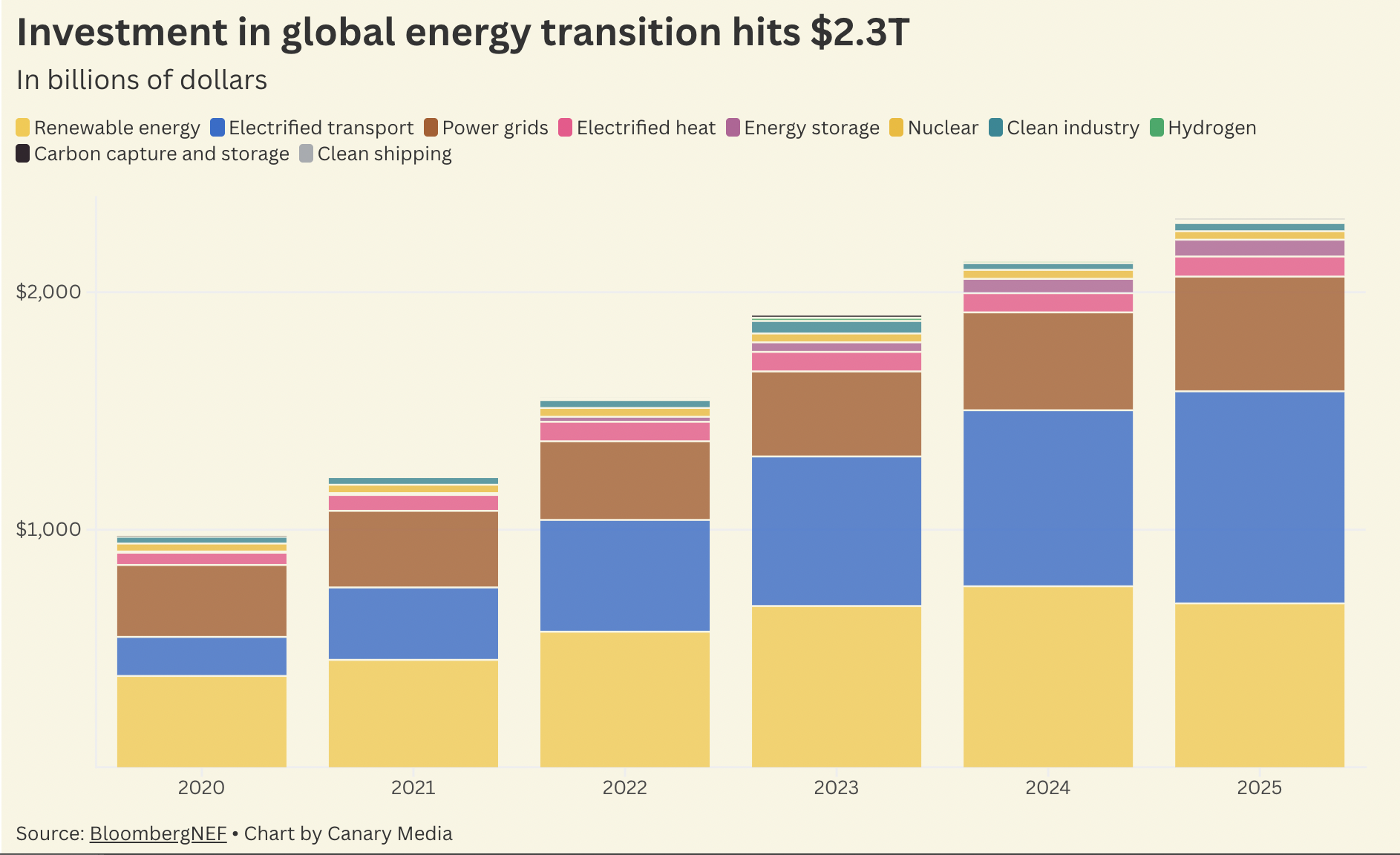
Global investment in the energy transition has broken records over and over again in recent years, and for good reason. Wind turbines, solar panels, and batteries are fast and increasingly cheap to install. Grid operators are scrambling to build out their systems as the world’s demand for electricity skyrockets, driven in large part by the AI data center boom. Meanwhile, electric cars are becoming hugely popular in places like China, where they are often cheaper than gas-fueled vehicles, and Norway, which has long-standing policies incentivizing car buyers to go electric.
Let’s dig a little deeper into the numbers on spending. Investment in clean energy and the grid outpaced the amount spent on fossil fuel supply in 2025 — marking the second year in a row that has happened. And investment in fossil fuel supply dropped last year for the first time since 2020, with BNEF reporting a $9 billion decline from 2024.
Now for the less-great news. Investment in the energy transition is growing overall, but more slowly than it used to —and right when the world needs it to accelerate.
Last year, it rose by only 8% — less than the 12% jump in 2024 and much less than the 22% one in 2023. Plus, while investment in sectors like clean industry and energy storage increased, the amount for renewable energy specifically declined by nearly 10%, something BNEF attributes to uncertainty caused by new power market rules in China. Even so, the Asian country is by far the largest market for energy transition investment, followed by the European Union and then the U.S.
Despite those slips, growth is growth — and the global shift to cleaner energy isn’t stopping just because of recent headwinds in the U.S. and beyond.
This analysis and news roundup come from the Canary Media Weekly newsletter. Sign up to get it every Friday.
“🚨Single. Largest. Deregulatory. Action. EVER. Incoming: TOMORROW!”
That quote comes from an X post made by U.S. Environmental Protection Agency Administrator Lee Zeldin on Wednesday. Sure enough, the next day, Zeldin officially unveiled the subject of this WrestleMania-esque hype: The Trump administration has revoked the scientific basis for the federal regulation of greenhouse gas emissions in America.
For 16 years, a scientific determination known as the “endangerment finding” has served as the backbone of U.S. policies to reduce emissions, allowing the EPA to put limits on planet-warming and health-harming pollution from vehicles, power plants, and other industrial sources of greenhouse gases.
There’s no doubt this will go to the courts. In fact, the finding itself has its roots in the legal system. Back in 2007, the Supreme Court ruled that the EPA had the authority to regulate greenhouse gases under the Clean Air Act — but only if the agency found that the gases were a threat to public health and welfare. In 2009, the EPA furnished overwhelming evidence in support of that point.
As The New York Times reports, a court battle seems to be precisely what the Trump administration wants. That would allow its lawyers to try to convince the conservative-majority Supreme Court to overturn the 2007 decision, thus dealing a more lasting blow to climate policy, as opposed to revoking the endangerment finding, which a Democratic administration would swiftly reverse.
There’s a reason the administration is relying on a legal strategy rather than contesting the science, Inside Climate News points out: The Trump EPA’s attempts to argue with the climate science have been “laughed out of the room,” Meredith Hankins, legal director for NRDC’s federal climate program, told the publication. (This has not stopped top Trump officials like Interior Secretary Doug Burgum from insisting on Fox News, in between breathless praise of “beautiful, clean coal,” that CO2 is merely plant food.)
Environmental advocates unanimously blasted the decision, highlighting how it would not only harm efforts to fight climate change, but threaten public health and affordability, too.
“Most people have never heard of this safeguard — the ‘endangerment’ finding — but repealing it sends a clear message: this government doesn’t care,” David Widawsky, U.S. director of research group World Resources Institute, said in a statement. “The bottom line is that repealing these protections will make everyday life more expensive, more risky and more uncertain for Americans.”
A quick analysis from the research firm Rhodium Group attempted to quantify the exact impact the decision will have on U.S. climate efforts. It found that national emissions will still fall even if the finding is permanently repealed, thanks to the rapid growth of cheap clean energy, but that decarbonization will be more sluggish.
Put simply, repealing the endangerment finding will slow climate progress at the exact moment the world needs it to speed up.
Coal gets another wave of federal support
The federal government unleashed another raft of pro-coal moves this week, aimed at keeping aging power plants running past their prime.
First, on Tuesday, the EPA granted coal-plant owners an extension on cleaning up toxic coal ash. The EPA had previously required owners to start cleaning up inactive coal ash storage sites — which can leech dangerous pollutants into groundwater — by mid-2029, but now they’ll have until early 2032.
The same day, the Tennessee Valley Authority — the federally owned utility whose board is now packed with Trump appointees — announced plans to keep two of its four coal-fired power plants running instead of retiring them in 2035.
And to wrap up the week, Trump ordered the Defense Department to buy more coal-fired power and announced that the Department of Energy would award $175 million to upgrade several aging coal plants. (The details on how this will work are … fuzzy.)
Puerto Rico’s grid crisis reaches a Super Bowl–size audience
If you watched Bad Bunny’s Super Bowl halftime performance on Sunday, you saw a swirling celebration of Puerto Rican culture — and a statement about the island’s fragile power grid.
After a few minutes graced by Lady Gaga, a real wedding, and people dressed as sugarcane, things quite literally turned dark. As Bad Bunny sang his 2022 song“El Apagón” (“The Blackout”), he and some dancers climbed electric poles as the lights flickered and sparks flew.
It was a high-profile reminder that Puerto Rico’s power grid has been in shambles since 2017’s Hurricanes Irma and Maria, Canary Media’s Maria Gallucci reports. Even without major weather events, Puerto Rican utility customers face an average of 27 hours of power grid interruptions each year — and recent Trump administration cuts aren’t helping. Distributed solar and battery systems have shown promise in keeping the lights on and power costs low, but with federal assistance stripped back, most residents are still unable to tap in.
Spinning up success: Offshore wind performed as well as gas power plants and better than coal in January, shoring up the Northeast’s power grid through a brutal cold spell. (Canary Media)
The offshore wind fight continues: Interior Secretary Doug Burgum says the Trump administration plans to appeal five rulings that allowed offshore wind farm construction to continue. (Bloomberg)
Natural gas disconnect: Experts say the Trump administration’s push to expand natural gas exports doesn’t mesh with its promise to curb skyrocketing power prices back in the U.S. (Canary Media)
Coal’s mounting cost: The net cost of keeping a Michigan coal plant open has reached $135 million since President Trump ordered the facility to stay online in May 2025. (MLive)
Powerful pivot: At least 10 North American EV battery plants are being revamped to instead produce grid batteries for energy storage systems. (Financial Times)
Renewables under attack: A bill making its way through Ohio’s legislature would essentially ban wind and solar development in the state — one of several similar attempts around the U.S. (Canary Media)
Heat-pump troubleshooting: Icy crusts kept some heat pumps from performing their best during recent bouts of extreme cold, but experts recommend owners take a few easy steps ahead of storms to keep their systems running. (Canary Media)
Data center crackdown: The White House has reportedly drafted a pact with tech giants that would have them make public commitments to ensure that their data centers don’t raise household power prices, stress water supplies, or hurt grid reliability. (Politico)
Heat pumps outsold fossil gas–fired furnaces in the U.S. yet again last year.
That’s the fourth year in a row — a testament to Americans’ sustained appetite for the zero-emissions appliances crucial to weaning buildings off planet-warming fossil fuels.
In 2025, 12% more air-source heat pump units shipped in the U.S. than gas furnaces, the next most-popular heating appliance, per data released today from the industry trade group Air-Conditioning, Heating, and Refrigeration Institute.
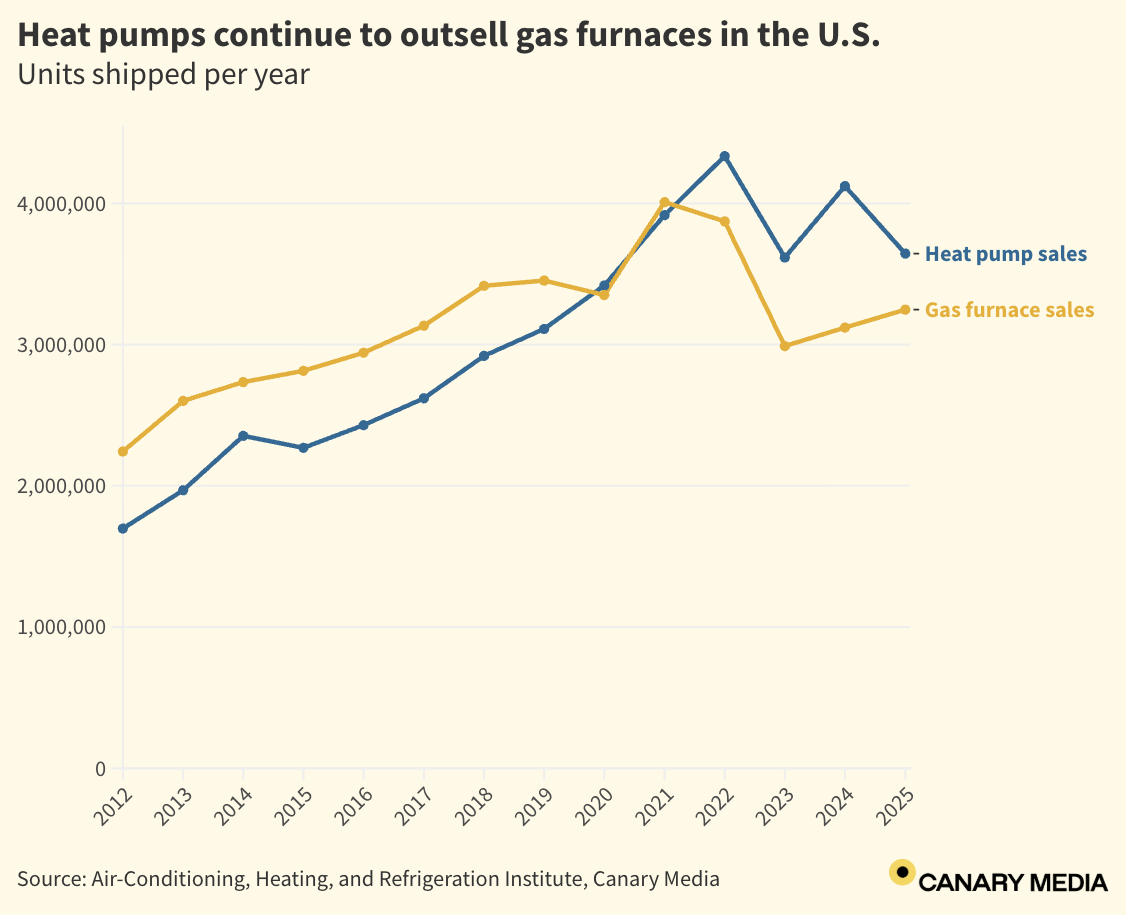
Now, that doesn’t necessarily mean that more households are installing the über-efficient appliance instead of furnaces; one home may need multiple heat pump units to replace a single furnace.
And not all the data was good news for the climate. Shipments of gas-powered units ticked upward last year to 3.2 million, while heat pump sales fell to 3.6 million.
But these are year-to-year fluctuations, and the broader trend is still toward heat pumps, experts told Canary Media.
Given the health, comfort, efficiency, and climate benefits of the tech, a complete transition to heat pumps feels inevitable, said Ryan Shea, manager in the carbon-free buildings team at nonprofit RMI. “I think the only question is … how fast the transition happens, not if.”
Electric heat pumps are two-way air conditioners that offer both space cooling and heating. They’re a critical tool to eradicating carbon pollution from buildings, which account for more than one-third of U.S. greenhouse gas emissions. Because the tech is two to four times as efficient as fossil-fueled systems, heat pumps also save most households money on their energy bills — a winning attribute as more Americans grapple with a cost-of-living crisis.
So why the dip in heat pump shipments last year?
A combination of factors, from tariffs to higher interest rates to a sluggish construction market, was likely to blame, according to experts.
A changeover in refrigerants also played a role. For years, heat pumps and air conditioners utilized the hydrofluorocarbon refrigerant R-410A, which has a strong global-warming potential. But as of Jan. 1, 2025, federal law has required newly manufactured systems to use a less polluting class of refrigerants, called A2Ls.
At least some distributors stocked up on the equipment in 2024, so they’d be ready if customers asked for their broken heat pumps or ACs to be replaced with the same models, said Kevin Carbonnier, senior manager of market intelligence at the nonprofit Building Decarbonization Coalition. That led to a backlog of extra inventory in 2025.
But the refrigerant and market factors “are temporary headwinds,” said Wael Kanj, research manager at electrification advocacy nonprofit Rewiring America. “I don’t think they change the fundamentals. Heat pumps are still the most efficient and comfortable way to heat and cool the home.”
Standing in the way of a total heat-pump takeover has long been their price tag. In 2024, Rewiring America estimated that for a medium-size home, a central heat-pump system costs a median of $25,000. A comparable gas furnace plus central AC system can cost roughly half that.
Even for the same building, contractors may provide hugely varying estimates. Last year, heat-pump research firm Laminar Collective found that for one 2,000-square-foot abode in the Boston area, installers’ quotes for a whole-home heat-pump system could differ by more than $10,000.
The Trump administration has worked against making the tech more affordable. Last year, it terminated home-energy tax credits that reduced the cost of an air-source heat pump by up to $2,000, and of a ground-source, or geothermal, heat pump by an uncapped dollar amount up to 30% of the cost.
Some federal funding to boost heat pumps continues to flow, however, including a $200 million grant to Denver-area local governments. Several states — including California, Georgia, New York, and Indiana — have also been able to tap into an $8.8 billion grant program created under the Biden administration to launch home energy rebate programs that help low- and median-income households afford heat pumps.
Even without the tax credits, thousands of incentive programs that lower the upfront costs of electrification still exist at state, local, and utility levels, Kanj said. Rewiring America and the North Carolina Clean Energy Technology Center offer online tools so that households can find available credits.
State and local governments are also pursuing creative ways to help heat pumps take off. New England and California have launched multipronged initiatives to raise public awareness and get heating, ventilation, and air conditioning contractors on board. Massachusetts has implemented a lower winter electricity rate for heat pump owners. New York City, which has an all-electric standard for new buildings, launched a $38.4 million program earlier this month to deploy window heat pumps in affordable housing. And California legislators are considering a bill that would cut red tape for homeowners looking to install these electric appliances.
Investors are backing innovation in this space. The Vancouver-based startup Jetson, for example, just raised $50 million to scale its direct-to-consumer approach, which it says cuts installation costs in half.
And although U.S. heat-pump sales didn’t break any annual records in 2025, the tech did quietly achieve a major milestone: In September, more heat pumps shipped than central ACs for the first time.
“It’s really exciting to see the market moving in that direction,” Shea said.
The Building Decarbonization Coalition’s Carbonnier hopes that in the next year or two, “we’ll see it fully cross over” — the way heat pumps overtook gas furnaces four years ago.
Startup CarbonQuest already proved it could snatch carbon emissions from the gas-fired boilers that heat New York City high-rises. This year, it’s moving into a big new market: carbon capture for the fossil-fueled engines that generate power in remote or campus settings around the world.
Tourmaline, Canada’s largest natural gas producer, collects gas at its Banshee plant near Edson, Alberta. It uses compressors to move the gas through the pipeline network and runs gas-burning engines — akin to supersize versions of what propels a truck — to power those compressors. Now, Canary Media has learned, Tourmaline has contracted with CarbonQuest to capture carbon emissions from an engine driving its compressors, proving out a new use for the technology.
Over the next 10 months, the startup is assembling its equipment into easily transportable containers at a factory in Spokane, Washington, prior to installation at Banshee. The machinery will hook up to the engine’s exhaust stream and use a process called vacuum pressure swing absorption to pull out and collect carbon dioxide. While elsewhere, CarbonQuest’s CO2 has been turned into concrete, here it will go down an existing well for permanent sequestration underground.
The carbon capture industry stands out among climatetech sectors for its distressing frequency of technological disappointments and outright fraud. CarbonQuest, which launched in 2019 and raised $20 million in Series A funding last year, differentiates itself from such dubious company by making humble promises and following through. Its first commercial installation has been capturing boiler emissions in a 30-story apartment building near New York City’s Lincoln Center since early 2022, and the company is now hooking up its fifth system to clean up gas heating in the metropolis.
Carbon capture, which collects carbon dioxide from smokestacks — and the related field of direct air capture, which grabs trace amounts from the air — has struggled with energy requirements: Burning too much electricity to isolate the carbon dioxide undercuts the climate case for doing so in the first place. Rather than jump to massive-scale carbon capture (with massive energy needs), CarbonQuest has chosen to hone its tech at a level that others thought was too small to bother with, said Anna Pavlova, senior vice president for strategy, market development, and sustainability.
“Our goal is to help us move faster to reducing emissions,” Pavlova said. “That’s what we’re trying to prove. And we’re trying to prove it on maybe not the gigantic scale, but the good-enough scale where results still matter.”
Compressors might not be well known outside the industry, but they play a crucial role in the pipeline network that supplies much of America’s home heating, plus 40% of U.S. power generation today. Some regions depend far more on gas: Even the climate-hawk states of New England, for instance, use gas for 55% of their electricity. There’s a tangible climate benefit in reducing emissions from infrastructure that is very much needed for the foreseeable future.
Indeed, U.S. natural gas pipelines make use of more than 5,400 compressors — all systems that CarbonQuest could theoretically slash emissions from with the tech it’s bringing to Canada.
The Alberta installation also portends impact far beyond the niche of gas pipeline compressors. With this project, CarbonQuest jumps from knowing how to decarbonize boilers to knowing how to decarbonize engines, Pavlova said. That’s crucial, she added, because “engines are in many places.”
The type of engines that run compressors serve small-scale power generation all over the place: university campuses, hospitals, industrial sites, and, increasingly, AI data centers that want to produce their own electricity behind the meter. CarbonQuest’s first boiler installation grabs about 1,000 metric tons per year. Soon, its equipment will process 1,500 metric tons per year from the compressor engine, Pavlova said.
This will mark the first time CarbonQuest is including a “metal-organic framework” absorbent — a material engineered by the company Captivate Technology to capture carbon more efficiently. Anything CarbonQuest can do to suck up more pollution with less energy helps make the process more scalable.
Pavlova is particularly excited to prove that this technology can work effectively at the carbon dioxide concentrations that come out of gas engines. Gas boilers typically produce exhaust that’s 8% to 10% carbon dioxide, she said, whereas the engine exhaust will be only about 5% CO2. (Larger gas turbines and coal power plants have even lower concentrations, part of why carbon capture hasn’t worked well for them.)
This is just a stepping stone, however. CarbonQuest got the project’s $4.1 million budget funded by grants from Alberta and the Canadian National Gas Innovation Fund, and the equipment will be able to catch only a small portion of the compressor site’s emissions. But it will put the technology to the test in a real commercial setting, and CarbonQuest will get paid via a long-term service agreement to keep its system in good functioning order. The startup is already working to close “fully commercial” deals for gas compression engines in the U.S., Pavlova said.
To deliver on that potential, CarbonQuest needs to line up customers that care about reducing emissions and find other ways to monetize carbon capture, either through regulatory credits for sequestration or by creatively reusing the carbon itself. Neither option is particularly outlandish these days: The commodity price for carbon dioxide is quite high now, and the federal tax credit for carbon capture survived the Trump administration’s budget law. The trick has been finding people who can actually do the capturing part.
It’s not just federal headwinds that threaten to constrain renewable energy development. State and local restrictions on solar and wind are spreading across the United States, too.
Few states highlight this fact as well as Ohio does. The Buckeye State makes solar and wind farms go through extra hurdles that don’t apply to fossil-fueled or nuclear power plants, including counties’ ability to ban projects. Its siting authorities have also deferred to local opposition for renewable energy while granting opponents little say over where petroleum drilling rigs and fracking waste can go.
A bill now working its way through the Republican-controlled Ohio legislature threatens to raise even more barriers for wind power and solar farms. On Tuesday, the Ohio Senate’s Energy Committee held its third hearing on Senate Bill 294. It’s unclear whether the committee will hear additional testimony, so under state law the bill could pass out of committee as soon as its next meeting.
The bill would declare it to be state policy “in all cases” for new electricity-generation facilities to “employ affordable, reliable, and clean energy sources.” But the bill’s definitions not only veer from common usage in ways that would exclude renewables but also threaten to block wind and solar development altogether.
“If Senate Bill 294 were enacted, the Ohio Power Siting Board would be unable to support renewable energy projects under the bill’s restrictive definition. This would place Ohio at a disadvantage,” said Evangeline Hobbs, a deputy director at the American Clean Power Association, in joint testimony for that group and fellow industry organization MAREC Action. “At precisely the moment when Ohio needs every available energy source, this bill would tie the state’s hands.”
Based on model legislation from the American Legislative Exchange Council, or ALEC, SB 294 is sponsored by Republicans George Lang of West Chester and Mark Romanchuk of Ontario.
Louisiana passed a similar bill last year that prioritized natural gas. A pending bill in New Hampshire says that energy sources “shall” be reliable, meaning not subject to routine daily weather variations.
Lang praised natural gas during his Oct. 28 proponent testimony, noting the bill is designed to take advantage of the fossil fuel. In contrast, he claimed renewable energy “doesn’t meet those qualifications of being cheap. It misses the reliability … And it doesn’t really meet clean yet.” During the Feb. 10 hearing, however, he claimed solar and wind were not really excluded and stressed that “there are definitions that have to be met.”
Those definitions, however, uniformly ding renewables.
SB 294’s definition of a reliable energy source would require it to be “readily available” with minimal interruptions during high-usage times and for it to have a 50% capacity factor. That’s the ratio of its actual power output to the potential maximum. This condition would exclude virtually all land-based wind and solar generation.
A high capacity factor “does not mean that an energy source will be available during extreme weather, or even generally available at peak times,” said Michelle Solomon, manager of electricity for Energy Innovation, an energy and climate policy think tank. In practice, grid operators “consider how combinations of resources on the grid can work together to meet needs.”
Instead of ensuring systemwide reliability, a single-minded focus on a high capacity factor will distort markets and raise costs for consumers, noted Brendan Pierpont, Energy Innovation’s director of electricity.
In fact, a high penetration of renewables can reduce the intensity of blackouts and vulnerability to extreme weather, according to a 2024 peer-reviewed study in Nature Energy. And, in general, a portfolio of energy-generation resources is more reliable than dependence on only a few sources.
“Reliability is really not a characteristic of a certain technology,” said Diane Cherry, MAREC Action’s deputy director. “And so taking things out of the ‘all-of-the-above’ is a problem.”
SB 294’s perspective on what counts as clean energy is even more questionable than its definition of “reliability.”
Under the legislation, natural gas is called “clean energy,” and language in the bill could potentially even count some coal plants as clean. Meanwhile, solar and wind are only implied to be clean, by way of the bill’s reference to a federal law that deems them so. Nuclear power, which is carbon-free when generated but produces radioactive wastes before and after that point, is also dubbed “clean.”
The definition of “affordable energy source” likewise diverges from the common meaning of those words.
Data released by the consulting firm Wood Mackenzie last October shows land-based solar and wind having lower average lifetime costs, called their “levelized cost,” compared with those of other types of power. Storage costs have also dropped substantially since 2020, and will likely fall even more.
Yet “the bill seems to want energy that is cheaper than renewable energy, which really does not exist,” Solomon said.
Ultimately, consumers would pay under the legislation, at a time when utility bills are already rising fast. Failure to add more clean energy sources to the PJM Interconnection region will cost the average Ohio customer roughly $6,500 more by 2035 than they would otherwise pay, American Clean Power reported in a Feb. 6 fact sheet.
Overall, SB 294 adds uncertainty for the industry and investors at a time when they want to build projects, Cherry said. Many companies are under the gun to start construction by July 4 or place projects in service by the end of 2027 in order to get federal tax credits.
The bill also does not mention energy storage, which can require permits from the power siting board. Pairing storage with renewables can raise their capacity factor.
“Energy storage will be increasingly critical to grid reliability and cost control,” said Nolan Rutschilling, managing director of energy policy for the Ohio Environmental Council Action Fund, calling for the bill to be amended to include storage so that the board “has the full toolbox to evaluate projects that can deliver reliability without increasing fuel-price volatility or long-term customer costs.”
For their part, representatives of ALEC and the Heartland Institute gave proponent testimony on the bill last fall.
Both are “among the most notorious climate-denial organizations out there that have been funded by fossil fuel interests,” said Dave Anderson, policy and communications manager for the Energy and Policy Institute. Yet they also “claim to be totally free-market and libertarian,” he added, an ironic point given the bill’s potential to distort the market in favor of fossil fuels.
To that end, SB 294 “will destroy competition by declaring renewable energy unreliable, and it’s picking winners and losers,” said Janine Migden-Ostrander, who formerly served as the Ohio consumers’ counsel and is a fellow at the Pace Energy and Climate Center. “The legislature should not be deciding this. Let the market decide. If projects are uneconomical, they will not be built.”
Bone-chilling cold and Arctic winds gripped the northeastern U.S. over the past few weeks, straining electricity systems and raising power prices as people cranked up their heat. Now, as the region finally starts to thaw, early data shows how America’s offshore wind farms helped keep electricity flowing during the extreme-weather stretch.
The results demonstrate the bitter irony of the Trump administration’s ongoing — and potentially unlawful — battle against U.S. offshore wind development. Federal officials are calling for additional fossil-fueled power to prevent future winter blackouts, all while trying to block the build-out of offshore wind, one of the most valuable resources for cold-climate coastal states.
“Performance data is showing in real time that offshore wind delivers reliable power when the grid needs it the most … at the scale this region and our country need,” said Liz Burdock, president and CEO of Oceantic Network, which advocates for marine renewable energy sectors.
Burdock was speaking on Tuesday in New York City at the group’s annual International Partnering Forum, where hundreds of offshore wind developers, policy experts, and labor leaders gathered to regroup following President Donald Trump’s yearlong attacks on five in-progress offshore wind farms.
For years, independent energy experts have forecast that offshore wind could deliver substantial amounts of power to densely populated, land-constrained communities along America’s east coast — particularly during winter cold spells, when demand for fossil gas exceeds supply. And grid operators in the region have been banking on offshore wind capacity to come online to meet the rising electricity needs of data centers and electrified homes and vehicles.
The data from January shows that the nation’s two operating utility-scale offshore wind farms — South Fork Wind and Vineyard Wind — performed as well as gas-fired power plants and better than coal-fired facilities, including during last month’s Winter Storm Fern, experts said at the event.
The 132-megawatt South Fork Wind farm, which delivers power to Long Island, New York, had a “capacity factor” of 52% last month. The metric reflects how much electricity the project actually generated compared with the maximum amount it could generate in a given period. That puts South Fork Wind on par with New York state’s most efficient gas plants.
“The wind capacity in the Northeast is absolutely amazing, particularly over the winter,” said Mikkel Mæhlisen, vice president of the Americas Generation division for Ørsted, which jointly owns South Fork Wind with Skyborn Renewables.
The 12-turbine project became America’s first utility-scale offshore wind farm in 2024, when it started providing power to some 70,000 homes. Last winter, it was also a beacon of reliability, notching a 54% capacity factor between December 2024 and March 2025.
Vineyard Wind, meanwhile, can already produce as much as 600 MW of clean electricity off the coast of Massachusetts. The project, which is 95% complete, is one of the five offshore wind farms that were forced to halt construction late last year in response to Trump’s stop-work orders, which cited ambiguous “national security” concerns. Federal judges have allowed all five projects to proceed as the developers’ complaints move through the legal system.
However, Interior Secretary Doug Burgum says the Trump administration plans to appeal those court rulings, Bloomberg reported on Wednesday.
During Winter Storm Fern, Vineyard Wind had a 75% capacity factor, Burdock said. Once fully operational, the project will deliver power at a price of $84.23 per megawatt-hour to the New England grid. That’s markedly less than spot wholesale prices during the storm, which spiked to over $870 per MWh on Jan. 25.
Soaring gas prices and limited supplies pushed utilities in New England to fire up oil-burning power plants in order to avert blackouts, assets that are typically too expensive to justify running. The result will be even higher bills for the region’s residents, who have historically faced some of the highest energy costs in the nation — in part because New England lacks recoverable resources like oil and gas, said Katie Dykes, commissioner of Connecticut’s Department of Energy and Environmental Protection.
Having a more diverse energy mix would help states reduce their reliance on firm, dispatchable, but also costly and dirty power plants during such challenging periods.
“Variable resources like wind and solar, when they’re operating during these cold weather periods, they’re actually helping to keep a lid on prices,” Dykes said during a panel. “It means we can reduce the runtimes of those more expensive oil units. It also means that we can preserve the runtime of those [fossil] resources that are relying on stored fuel.”
Proponents of America’s nascent offshore wind industry said they’re hopeful the five in-progress projects will be completed as planned. In New York, Ørsted’s Sunrise Wind and Equinor’s Empire Wind would together provide 1.7 gigawatts of new capacity — enough to meet more than 10% of the electricity needs in New York City and Long Island.
“The last few weeks have been extremely stressful,” Gary Stephenson, a senior vice president for the Long Island Power Authority, said about the region’s cold snap. The municipal utility, which serves 1.2 million customers, purchases power from South Fork Wind and will connect its grid to Sunrise Wind, which is expected to start operating in 2027.
“I really wish we had that Sunrise facility online. That would have taken so much pressure off the natural gas system,” Stephenson said at the event. “So we’re looking forward to that [coming online] towards the end of next year.”
A correction was made on Feb. 12, 2026: This story originally said Vineyard Wind delivered power at $84.23 per megawatt-hour during Winter Storm Fern, but that is the price the installation will deliver once fully operational.
Canary Media’s “Electrified Life” column shares real-world tales, tips, and insights to demystify what individuals can do to shift their homes and lives to clean electric power.
As Winter Storm Fern was dumping record amounts of snow and ice across the U.S. a couple of weeks ago, Kit Wu sprang into action.
Wu, the founder of the Boston-based heat-pump installation and research startup Laminar Collective, quickly reached out to his customers. He wanted to know how the more than 70 households his startup had installed heat pumps for were faring — and to address any performance issues that might have come up as the city weathered its eighth-biggest snowstorm in history.
The vast majority of heat pumps fared well, Wu’s customers reported. Even as Fern eventually departed and a brutal cold snap gripped the region, more than 90% of heat pump units held up without a hitch. But six did struggle.
Their owners saw dips in indoor temperatures and sent Wu photos of their outdoor units, the parts of heat pump systems that find warmth in even frigid winter air. These appliances had a significant buildup of ice on their backs — up to a half inch thick.
That wasn’t good.
Heat pumps, which provide both heating and cooling, use finned metal coils filled with refrigerant to extract thermal energy from the atmosphere. A stubborn crust of ice throttles airflow, making it tough for a heat pump to scrounge up enough heat to keep residents toasty, Wu explained.
For years, heat pumps have been popular in the warmer U.S. South, but not so much in chillier parts of the country. That’s changing. Tech improvements have made it possible for households in colder climes to embrace the appliances, which are always better for air quality and often cheaper to run than fossil-fueled boilers and furnaces. Even in notoriously frosty states like Maine, they’re taking off.
But with this new territory comes new challenges. While some heat pumps are designed to work in temperatures as low as minus 22 degrees, it’s possible for extreme, prolonged winter weather to dampen their efficiency.
That’s exactly what happened with the struggling heat pumps that Wu encountered: They had accumulated so much ice that they just “couldn’t keep up,” he said.
Thankfully, these challenges are surmountable. Wu was able to return each of the iced-over units to smooth working order in one visit. But it would have been better to avoid the issue in the first place. Here are a few steps you can take to help your heat pump perform at its best even on the worst winter days.
To keep your heat pump humming along in the freezing cold, bring in a heating, ventilation, and air-conditioning technician before the bad weather comes, said Mark Kasdorf, founder and CEO of Forge, a heat-pump installer based in Newton, Massachusetts.
“I think 99% of all issues can be taken care of by just having an expert take a look at the system,” he said.
A professional can perform what’s called a blower-door test to find any big air leaks in your home, which work against a heat pump. And have the technician check for blocked air filters — or do it yourself — particularly if you bought the home with the heat pump already installed.
“Tons of homeowners never change their filters,” Kasdorf noted, even though it’s something most can do on their own. Helpful YouTubers have demonstrated the process for both ductless and ducted systems.
You’ll want to give your heat pump space to breathe, with at least two feet of clearance. If snow or fallen leaves are common in your area, make sure your heat pump is raised off the ground. The appliance needs this space so that, when it goes into defrost mode, water can efficiently drain away, rather than refreeze into ice.
When snow is coming down hard, break out the shovel, Wu added. “If you’re going to dig out your car, you should also dig out your heat pump.”
You could even get a little awning or semi-enclosed hut for your system to give it extra protection from a storm.
A suffocated heat pump is a sad heat pump.
A layer of ice will cause it to run less efficiently and jack up your energy bills. But there are a couple of remedies you could try, Wu said.
One is to run the heat pump in reverse in cooling mode. That will heat up the coils, potentially allowing them to thaw their icy coats.
Another is a manual defrost: pouring room-temperature water over the ice. This trick worked on all the units that he recently tended to, Wu said.
Never use hot water, though, he noted; the metal could crack.
I’ll admit, I was a bit skeptical of this piece of advice. But Kasdorf insisted it has worked for him, so here goes.
If your appliance isn’t pumping out enough heat, then take a picture of the unit, upload it to an AI model — Gemini has worked best for Kasdorf — and describe the weather and your issue.
A large-language model can suggest quick fixes. When I gave Gemini a test case, it offered some of the strategies in this article, as well as warned me to resist the urge to chip at the ice with a sharp object. A misplaced stab could cause a refrigerant leak that takes the heat pump out of commission.
Treat the tool “like a really smart uncle” who’s an HVAC technician, Kasdorf said; the voluble advice may be helpful, if imperfect. It’s also best to think of this exchange as a starting point for some troubleshooting. If it provides anything that seems especially involved — or just weird — call a professional, he noted. And if your problems persist, the same applies: Work with your installer.
That is, after all, what Wu’s customers did, and the results speak for themselves.
Last Friday, 10 days after Fern swept through Boston, area temperatures were still well below freezing, and Wu could see snow piled high outside. But after the simple fixes he employed, every one of his customers’ heat-pump systems was working just fine.
Want more tips on keeping your heat pump humming even in extreme weather? Efficiency Maine has a plethora.
Startup NineDot Energy just raised $431 million to build batteries in New York City’s vacant nooks and crannies — an endeavor that will help the metropolis fend off looming electricity shortages.
The debt financing announced Monday will support the Brooklyn firm’s plan to develop 28 battery projects totaling 494 megawatt-hours of energy storage capacity over the next two years. NineDot estimates that’s enough storage to meet the peak energy needs of about 100,000 households.
NineDot is one of several companies deploying “community battery systems” — grid-tied energy storage installations that can fit into roughly an acre of land or less — in New York City. These systems sop up excess energy from the grid when power is abundant and send it back when demand is high, like on hot summer afternoons when millions of air conditioners crank up. Bigger batteries may be able to store more energy, but community-scale systems can be more realistic to quickly deploy in über-dense places.
The decade-old startup’s latest round of construction finance, led by Natixis Corporate & Investment Banking, brings its total funding to just over $1 billion, said David Arfin, NineDot’s CEO and co-founder.
NineDot already has seven projects operating — including a 12-megawatt-hour battery and solar installation at a former parking lot in the Bronx and a 20-megawatt-hour battery system in Staten Island — or in advanced stages of construction in New York City, he said. By 2028, it plans to have 37 community storage systems with a combined capacity of 1.6 gigawatt-hours up and running across the five boroughs, he said.
It isn’t easy to find spots to build batteries in New York City, said Adam Cohen, NineDot’s chief technology officer and co-founder. It can be even harder to find space on Con Edison’s power grid to connect them, he said.
But the utility is under mounting pressure to expand its energy storage capacity — and that’s driving companies like NineDot to seek out vacant or underused lots in the country’s densest urban environment.
New York law sets a statewide goal of 70% renewable electricity by 2030, and state policy calls for building 6 gigawatts of energy storage by 2030. Upstate New York has plenty of land for utility-scale wind, solar, and battery farms. But downstate New York and New York City are where power demand is greatest and the generation mix is the dirtiest — and there’s not yet enough transmission grid capacity to solve those problems with clean power from the north, Cohen said.
Meanwhile, the New York City area faces an energy crunch as power demand surges and aging fossil-fueled plants in the boroughs prepare to shutter. In October, the state’s grid operator warned that New York City and Long Island might face “reliability violations” as soon as this summer.
Late last year, state regulators ordered Con Edison to seek out “a broad array of potential non-emitting solutions” that could quickly bolster reliability.
“You could solve that with new transmission,” Cohen said — except that’s hard to build. The Champlain Hudson Power Express, a major transmission line from Canada to New York City, is nearing completion and scheduled to start delivering hydropower and wind power in May. But another major transmission line being planned to carry power into the city was canceled in 2024.
Another option is “keeping dirty peaker plants online,” Cohen said. But the fossil-fueled plants that New York City relies on to serve its peak loads are expensive to operate and emit health-harming air pollutants, largely in low-income communities and communities of color.
That’s why state regulators’ order to Con Edison calls for “non-emitting solutions, prioritizing cost-effectiveness and ease of deployment, and minimizing impacts to disadvantaged communities.”
Batteries fit that bill, say proponents of the tech. William Acker, executive director of the New York Battery and Energy Storage Technology Consortium, noted that the utility’s initial report to regulators in January identified a roughly 125-megawatt shortfall for about three hours during peak summer demand starting in 2032. This is “well within the range of the energy storage we expect to be deployed,” he said.
“That’s changing how the state is looking at energy storage deployment in New York City,” Acker said. “It’s one of the most cost-effective ways to address this reliability challenge.”
New York state has struggled to meet its targets for utility-scale clean energy, with supply chain disruptions and rising interest rates undermining the financial prospects for big wind and solar farms. It’s also faced challenges in getting large-scale battery projects up and running, largely because of problematic contract structures that crimped project financing.
But smaller community battery projects, like NineDot’s, have an advantage on that front: They can access the state’s incentives designed to encourage distributed energy resources that deliver power when and where the grid needs it the most. These incentives offer far steadier and more predictable revenue streams than those set up for the state’s larger-scale utility programs, Arfin said.
Community battery projects are also eligible to feed into New York’s Statewide Solar for All program, which provides a portion of revenues from community solar and storage projects to utility customers in disadvantaged communities who are enrolled in energy-affordability programs. NineDot forecasts that the projects it has committed to Statewide Solar for All will deliver more than $60 million in energy credits over the coming decade.
NineDot’s strategy of putting batteries on vacant or underutilized lots is one of several approaches being taken to add energy storage to the New York City grid. For example, Con Edison has deployed batteries at its substations and worked with companies installing them at EV charging stations and electric school bus depots. And some New York City businesses are using small plug-in batteries to cushion their draw on grid power during hours of peak demand.
Meanwhile, larger-scale projects like 174 Power Global’s 400-megawatt-hour battery in Queens are starting to get built, and energy developers, including Summit Ridge Energy and Convergent Energy and Power, have community battery projects underway.
But batteries in the Big Apple aren’t always getting a warm reception from their neighbors. Public opposition, spurred by a spate of grid battery fires, has quashed several projects in Staten Island and has led to an ongoing moratorium on their construction in the Long Island town of Oyster Bay. New York City mayoral candidate Curtis Sliwa railed against battery projects in the waning days of his campaign last year, calling them “mini-Chernobyls.”
But Cohen noted that the Fire Department of New York has spent years developing grid-battery safety rules that may be the most comprehensive in the country. “The FDNY is the global gold standard for approving battery storage technology and sites,” he said. “It’s cumbersome — but it’s trusted and thorough.”


.svg)
