

 Back
Back
For years, utilities have grappled with how to handle the ever-growing number of solar and battery systems trying to connect to the lower-voltage grids that deliver power to customers. That’s especially true for midsize projects like, say, a solar array that might adorn the roof of a multiunit apartment complex or a community-solar project that generates power shared by hundreds of dispersed customers.
On the one hand, utilities have eyed such projects warily, fearing that if the solar panels or batteries inject too much power onto local circuits at moments when electricity demand is low, it might cause grid instability or safety problems. As a result, utilities have thrown up barriers that have delayed or halted grid connections.
But as advocates have been pointing out for over a decade, these distributed solar and battery resources can also be enormous assets: By holding back power when the grid doesn’t need it, and then sharing their extra power during periods of high demand, they can help alleviate grid strains and lower the cost of keeping the grid running for everyone.
It’s taken California regulators, utilities and clean-energy advocates nearly four years to hash out these conflicting ideas. But in mid-March, the California Public Utilities Commission approved new interconnection rules that take into account how, with the right structures in place, solar and solar-plus-battery systems can be more help than hazard to California’s overworked grid.
“This will open up opportunities for distributed energy resources to be designed in a way that aligns with grid needs,” said Sky Stanfield, an attorney who works with the Interstate Renewable Energy Council, the nonprofit group that’s been the main proponent of the new rules. “It’s a long time coming to recognize that distributed energy resources are a whole lot more helpful than they’re allowed to be — and that we don’t have to spend as much to upgrade the grid as a result.”
The “Limited Generation Profile option” just approved by the CPUC is a complicated set of regulations that determine how solar and solar-battery systems interact with the lower-voltage grids operated by California’s CPUC-regulated utilities Pacific Gas & Electric, Southern California Edison and San Diego Gas & Electric.
Today, those utilities make a simplistic set of assumptions when they consider the potential impacts of a project on the lower-voltage grid systems that carry power from substations to homes and businesses, Stanfield said — basically, that each project is producing its peak output at the time of least electricity demand from customers.
That’s pretty much how all U.S. utilities calculate the risks of new generation connecting to their grids, she noted. But this assumption is likely to yield findings that exaggerate how likely a project is to inject too much power onto local grid circuits.
To eliminate those perceived risks, utilities have demanded that project developers pay for grid upgrades themselves or have prevented the projects from connecting at all. Since those grid upgrades can cost hundreds of thousands to millions of dollars and take years to complete, the result either way tends to stop projects in their tracks.
The CPUC’s new policy takes a different tack, one well suited to larger-scale projects that are more likely to trigger grid upgrades. It will allow solar and battery projects to modulate how much power they send to the grid with the help of either solar inverters whose power-control systems can reduce power output from moment to moment or batteries that can soak up excess solar power and inject it back into the grid later.
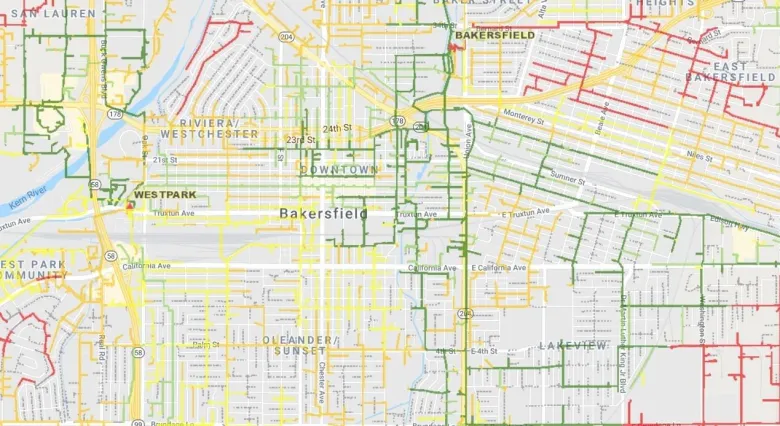
Limited Generation Profile projects would be able to use these capabilities to alter their grid injections during different periods of the day, based on a set of schedules they can choose from. Those scheduling options are derived from the grid data available in the maps of hosting capacity from Pacific Gas & Electric, Southern California Edison and San Diego Gas & Electric. (Here’s a snapshot of PG&E’s hosting-capacity map for a downtown section of the central California city of Bakersfield, with circuit capacity represented in red, orange, yellow and green.)
Most utilities in the U.S. haven’t been ordered by regulators to collect the detailed and accurate local grid data needed to create these kinds of maps, Stanfield noted. In fact, the Interstate Renewable Energy Council has played a key watchdog role in alerting the CPUC to problems with these maps as they’ve been developed over the past decade, as well as in making them more useful for customers and project developers looking for good spots to connect to the grid.
Thanks to those improvements, California’s maps now contain accurate information on the hour-by-hour capacity of individual circuits.
With this data in hand, California’s three largest utilities and clean-energy project developers can finally agree on just how much power solar and battery projects can safely inject onto the grid during different periods of the day and night across each month of the year.
That amount may be close to zero during some stretches — say, on a circuit with many homes with rooftop solar systems during sunny and mild spring daylight hours, when self-generated solar power can exceed customer demand for electricity. Within those hours, Limited Generation Profile projects may export little or no energy at all.
But these “minimum-loading” conditions are relatively rare — and at other moments, that same grid circuit may be hungry for all the power it can get. That’s typically during hot summer and autumn evenings, when the state’s ample solar resources are fading away, yet electricity demand for air conditioning remains high — the same conditions that have caused statewide grid emergencies in recent years.
California’s power grid is struggling to deal with the wide swings between times when it has too much solar and times when all available resources still don’t provide enough electricity. In fact, the CPUC and state policymakers have made significant efforts to address this imbalance via state rooftop solar policy — which has reduced the value of solar delivered to the grid while promoting the value of batteries that can store power for when it’s needed — and with utility-scale power procurement policies, which have put gigawatts of batteries into operation over the past few years to store solar power for those evening hours when demand exceeds supply.
But until now, utility interconnection policy “has not taken into account, or enabled, distributed energy resources to differentiate when they produce power and when they don’t,” Stanfield said. That’s left interconnection policy misaligned with broader state policy imperatives for how best to use solar systems and batteries, she added.
It’s also put interconnection policy at odds with policy efforts to better manage growing distribution-grid costs, Stanfield noted. Pacific Gas & Electric, Southern California Edison and San Diego Gas & Electric are facing tens of billions of dollars of additional grid investment in the coming decades to supply the millions of electric vehicles, heat pumps and electric appliances that the state is asking consumers to adopt in order to reduce carbon emissions.
“Grid upgrades are expensive,” Stanfield said, “and we want to avoid them where we don’t need them” — particularly in cases where new solar and battery systems could actually help reduce grid strains.
Even more fundamentally, rules that bar more solar and battery power from reaching the grid based on outdated and inaccurate methods of determining their grid impacts will rob customers at large of the value those projects could provide.
That’s the conclusion reached by Amin Younes, an electric distribution planning and policy engineer with CPUC’s Public Advocates Office, which represents utility customers’ interests. Younes studied the potential for the Limited Generation Profile option to add more clean energy to California’s grids during hours when energy is in short supply.
This graphic from a presentation of his work indicates how widely the capacity of a typical distribution grid circuit can vary from hour to hour. In this case, limiting a solar or battery project to the minimum loading condition — the red line on the chart — would have forced a project to be sized to deliver no more than 1.5 megawatts of power of maximum capacity. But during many more hours of the year, that circuit could accept far more than that — often more than twice that minimum limit, or more than 3 megawatts of power.
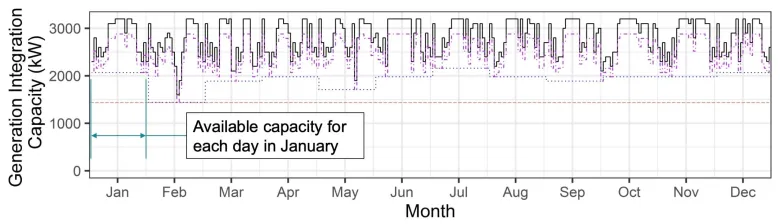
According to his analysis, factoring in that extra capacity across the distribution circuits of all three utilities could add up to tens of billions of dollars per year in additional clean energy that could be delivered. And because that power would supply the grid at hours when electricity costs and threats of grid emergencies are the highest, that “could lower costs and increase grid reliability,” he said in an interview.
Finally, implementing the Limited Generation Profile option should allow solar and battery developers to avoid having to pay for grid upgrades and give them a much faster interconnection process, Stanfield said. And, if it works as planned, it could be a useful model for other states to follow.
In a 2021 blog post, the Electric Power Research Institute, a nonprofit power-sector research group involved in a wide variety of utility technology projects, highlighted the need for more flexible interconnection policies across the U.S. to prevent the tens of billions of dollars of forecasted investment in EV charging, distributed solar and battery backup systems from being stalled out by grid constraints.
The conservative, expect-the-worst approach that most utilities take with interconnection processes may be a way to maintain grid reliability, the institute noted. But it can also “lower customer satisfaction and slow progress toward renewable energy targets.”
It’s important to distinguish the problems plaguing this class of clean energy from the similar but distinct issues blocking hundreds of gigawatts of utility-scale wind and solar farms from connecting to transmission grids across the country. The Interstate Renewable Energy Council’s work in California and other states has focused mainly on distribution grid interconnection policies, which cover everything from rooftop solar systems and home battery and EV charging installations to multi-megawatt solar and battery projects.
While these types of interconnection problems can stymie even smaller-scale home rooftop solar systems, the bigger challenges tend to arise with larger-scale installations like community-solar systems that generate power for many different customers (in California, for example, most projects under 1 megawatt in generation capacity aren’t responsible for paying for grid upgrades). In many states, growing grid-upgrade costs and maddeningly slow interconnection timelines have become increasingly significant roadblocks to connecting these mid-sized projects.
In Minnesota, solar and consumer groups are fighting a utility policy that can assign hundreds of thousands of dollars in grid-upgrade costs to relatively small rooftop solar and community “solar garden” projects. In the community-solar-rich state of Massachusetts, some developers are stuck waiting for years for grid studies to allow projects to move forward.
States including New York, Minnesota and Massachusetts have begun to explore flexible interconnection policies — the more general term for the approach California is taking, according to Stanfield — but only through pilot projects or laborious “non-wires solutions” programs run by utilities. They have yet to embrace a standard way for clean energy developers to work with utilities.
Most other U.S. utilities haven’t been compelled by state law and regulatory mandates to produce the detailed distribution-grid-level data collection and hosting capacity analyses that enable the CPUC’s Limited Generation Profile approach, Stanfield noted. But these kinds of tools are starting to be developed in other states. That’s an important precursor to enable flexible interconnection, she said.
To be fair, utilities have very good reasons to take a conservative, safety-first approach to interconnection. After all, they’re responsible for keeping grids safe and reliable — and distributed energy resources represent potential disruptions to those grids that utilities can’t directly control.
That’s why California’s Limited Generation Profile option won’t go into effect until nine months after certain power-system control technologies are certified by the Underwriters Laboratory standards organization as being able to reliably perform according to schedule. That’s expected to happen sometime within the coming year, Stanfield said.
Utilities have also been concerned that changes on their grids could leave circuits susceptible to dangerous conditions. CPUC’s new policy does allow utilities to curtail a project during emergencies or request a change to the project’s schedule in the highly unlikely circumstance of a “sustained load reduction” on a grid circuit — namely, if a major customer using that circuit closes down and permanently reduces electricity demand.
But under the new rules, utilities are largely required to honor the schedules they’ve agreed to with solar and battery projects, and to take on reasonable costs of grid upgrades to manage them. That’s a vital feature for any successful flexible-interconnection process, Stanfield said, because project developers secure investment for projects based on some level of certainty about how much power they’ll be able to sell over the project’s lifetimes.
Any utility program that injects too much uncertainty into that prospect — by, for example, retaining the right to unilaterally curtail a project’s grid exports without a clear and provable grid problem to justify it — won’t work for developers, she said.
“A flexible interconnection solution, if it’s modeled and can show what the impacts are going to be, might give developers a lot more certainty and more comfort,” said David Gahl, executive director of the Solar and Storage Industries Institute, during a November event held by the Interstate Renewable Energy Council. That nonprofit is leading a flexible-interconnection pilot project in New York state that’s funded by The U.S. Department of Energy’s Interconnection Innovation e-Xchange program.
Utopia Hill, CEO of Reactivate, a joint venture developing community-solar projects for disadvantaged communities, also noted at the November event that the key to future flexible-interconnection processes is increasing their predictability. “If we can’t get financing parties comfortable with that, we can’t get the funding to build the projects,” she said.
It’s still not clear if the CPUC’s Limited Generation Profile rules will meet that need for California solar and battery developers, said Kevin Luo, interconnection policy advisor for the California Solar & Storage Association trade group. One big question is whether the scheduling options approved by the CPUC will actually allow developers to design moneymaking projects.
“That’s one of the reasons why we pushed so hard for customers to be able to pick their own schedules,” he said — an option that the CPUC denied. “Nobody has done the forecasting work necessary to have the confidence in any one schedule.”
Nor are California’s solar policies and market dynamics aligned to support the 1-megawatt-and-up projects that the Limited Generation Profile option would be best suited to, Stanfield said. California lacks effective policies to promote the development of multi-megawatt, distribution-grid-connected community-solar projects or large-scale rooftop solar projects on warehouses or apartment complexes that would be eligible for the new interconnection treatment — although solar and environmental-justice groups are pushing regulators and lawmakers to change that.
Even so, Stanfield said, starting with a schedule-based approach at least begins to align utilities’ grid needs with the imperative to add far more solar and batteries to California’s grid. That way, “you can start to get some of the benefits now — and then we can build on that further.”
The Biden administration’s lucrative incentives for hydrogen are slated to only go to “green” producers who use newly built clean energy sources to make the fuel — and some hydrogen producers aren’t happy about it.
Clean hydrogen has the potential to be a low- or zero-emission alternative to fossil fuels, and could clean up energy-intensive industries like steelmaking and heavy-duty transportation. But it’s not economical to produce just yet.
That’s why the Inflation Reduction Act established the 45V tax credit to help incentivize hydrogen that’s produced with clean energy under these three conditions:
Many companies, including federally backed hydrogen hubs, have pushed back against the rules, saying they will make their projects economically unviable.
But they’re not the only voice out there, Kari Lydersen reports for the Energy News Network. Companies like Hy Stor Energy and Q Hydrogen say they’re committed to producing clean hydrogen, and want the Treasury to only reward fuel that’s produced from new clean energy sources.
Without these parameters, producing hydrogen could actually end up driving up emissions, environmental advocates and academics say. That’s why Hy Stor Energy wants to build new renewable energy, use it to produce hydrogen, and then store it in a network of underground salt caverns for use when renewables can’t meet power demand. Q Hydrogen meanwhile draws its electricity from a nearby hydroelectric plant, and aims to sell its clean fuel to industrial users that otherwise would rely on fossil fuels.
Read more about these hydrogen innovators at the Energy News Network.
— Kathryn Krawczyk
🛑 Coal exports on hold: The bridge collapse in Baltimore is blocking access to the U.S.’s second-largest port for coal exports and will likely disrupt the industry for at least six weeks. (E&E News)
♿ Are EVs really for everyone? Electric vehicle chargers are often inaccessible for people with disabilities, a growing problem as officials forecast millions more electric vehicles on roads in the coming years. (Mother Jones)
🚛 Rolling toward zero-emission trucks: The U.S. EPA announces a new rule that aims to get more zero-emission heavy- and medium-duty trucks on the road by 2032, earning praise from environmental groups but concern from truck and engine manufacturers. (New York Times, NPR)
🏥 Efficiency saves lives: Appliance energy efficiency standards reduced emissions and prevented as many as 4,400 pollution-related deaths in 2017, researchers find, making a case for even stronger requirements. (Utility Dive)
⛵ Offshore wins: Over the past week, four developers bid to build offshore wind projects off the Connecticut, Massachusetts, and Rhode Island coasts, and the federal Interior Department approved three large offshore wind farms. (CT Mirror, E&E News, Associated Press)
🏭 Passing on gas: As economic growth drives new electricity demand, utilities look to natural gas as a quick fix, but customers and clean energy advocates say the strategy lacks ambition and ignores the giant pool of federal money currently available for cleaner alternatives. (Grist/WABE)
🌱 Greenhouse effect: Indoor farming offers producers steady growing conditions amid increasingly unpredictable weather, but their energy consumption represents a potential threat that could worsen climate change. (Washington Post)
👀 Eyes on state climate policy: A new searchable database aims to reveal how lobbying is derailing climate policy in 17 state legislatures. (Inside Climate News)
🗑️ Trash’s emissions impact: Landfills release an average of three times more methane than they report to federal regulators, a study of 1,200 landfills across the country finds. (New York Times)
OFFSHORE WIND: The Biden administration gives the greenlight to two New England offshore wind farms — the Park City and Commonwealth wind projects — bringing the country one-third of the way to the president’s offshore wind goal. (E&E News, Bloomberg)
ALSO: Rhode Island officials unveil a new tool to help them avoid locating projects — like offshore wind and aquaculture facilities — where recreational fishers enjoy going. (ecoRI)
MINING: A Maine legislative committee advances new environmental regulations that companies would have to fulfill before getting mineral extraction exemptions to the state’s open pit mining ban, ahead of allowing testing in Newry’s lithium-rich mineral deposit. (Portland Press Herald)
HYDROPOWER: A Vermont utility wants to give its unprofitable but popular Green River Reservoir dam to the state to spare ratepayers the cost of operating it, and a study is underway now to see how much it would cost the state to take over. (VT Digger, WCAX)
CLEAN ENERGY:
GRID: In Maryland, top environmentalists and lawmakers hash out a compromise to lower environmental processes for data centers in exchange for earmarked tax revenue for clean energy and climate program funding. (Maryland Matters)
FOSSIL FUELS:
TIDAL: A developer files a preliminary permit application with federal energy regulators to resurrect a tidal power project on northeastern Maine’s Pennamaquan River, but the adjacent town says such development would harm native fish. (Bangor Daily News)
ELECTRIC VEHICLES: At a press conference on delivery workers, New York City’s mayor declines to answer questions about required e-bike registration and creating a battery swap program codified into law last fall. (Streetsblog)
CLIMATE: Maine’s working waterfronts are heavily exposed to symptoms of the climate crisis, including rising sea levels and extreme storms, but aren’t uniformly prepared to mitigate their circumstances. (Bangor Daily News)
SOLAR: A developer schedules a public open house so northern New York community members living near their proposed 200 MW solar farm can learn more and ask questions. (NNY360)
SOLAR: Virginia regulators approve a total of 764 MW in new solar power for Dominion Power, including four new solar farms totaling 329 MW plus 13 power purchase agreements with independent projects. (Richmond Times-Dispatch, Power Engineering)
ALSO:
OVERSIGHT:
CARBON CAPTURE:
COAL:
ELECTRIC VEHICLES:
WIND: Dominion Energy agrees to pay $290,000 to a Virginia city and $650,000 to a historic lighthouse to compensate for the visual impacts of its planned offshore wind farm. (WTKR)
OIL & GAS:
GRID:
ELECTRIC VEHICLES: A school district in northern Minnesota is among the first tribal school districts in the country to receive electric school buses under a new $5 billion federal program. (E&E News)
ALSO: After stopping production in late 2023, just a few thousand of General Motors’ best-selling electric vehicle — the Chevrolet Bolt — remain for sale. (Detroit Free Press)
HYDROGEN: Some companies challenge the narrative that industry players want to weaken proposed federal rules for lucrative hydrogen tax credits, maintaining that green hydrogen will be crucial to avoid increasing emissions. (Energy News Network)
AIR POLLUTION:
CLEAN ENERGY:
GRID: Clean energy and environmental groups urge federal regulators to reject grid operator Southwest Power Pool’s latest proposal to measure capacity that critics say discriminates against wind, solar and storage. (Utility Dive)
SOLAR: Walmart partners with a national developer to build more than a dozen community solar projects across five states, including Illinois. (Solar Industry)
CLIMATE: A University of Michigan researcher argues in a new paper that the labor that goes into climate advocacy and fighting fossil fuel projects should be compensated. (Grist)
OIL & GAS: A North Dakota official says building infrastructure to transport carbon dioxide will be key to helping the state meet its oil and gas production potential. (KFYR)
COMMENTARY: An attorney and former director of the Nebraska Energy Office says a proposed bill would discourage renewable energy investments in the state by creating more red tape for developers. (Nebraska Examiner)
COAL: Rocky Mountain Power cancels plans to close two Utah coal plants by 2032 and replace them with nuclear reactors after a court blocks a federal ozone-pollution rule in the state. (Salt Lake Tribune)
ALSO: Federal regulators block a Montana law that would have allowed coal mines to violate water quality standards for a limited time after finding it didn’t meet minimum requirements. (Daily Montanan)
OIL & GAS: Advocates say a California city’s primary news source refuses to report on a Chevron petroleum refinery’s pollution and accidents because the oil company owns the outlet. (Floodlight)
SOLAR:
WIND: Oregon’s commercial fishing industry calls on Gov. Tina Kotek to urge the Biden administration to postpone a planned offshore wind lease auction until the state finalizes its roadmap for the development. (Oregonian)
EFFICIENCY: The U.S. Energy Department awards a Colorado company $22 million to implement an aluminum milling process that requires less heating and cooling. (Colorado Sun)
TRANSPORTATION: New Mexico seeks $577 million in federal grants to help establish hydrogen fueling and electric vehicle charging centers for long-haul freight trucks along Interstate 40, and to fund a clean truck incentive program. (news release)
ELECTRIC VEHICLES: A court rejects Tesla’s bid to dismiss a federal lawsuit accusing the company of widespread racism at its factory in California. (East Bay Times)
NUCLEAR: Washington state researchers work to develop new nuclear reactor cooling methods that will remain effective as the climate warms. (news release)
MINING: Southern Nevada residents and advocates push back on a proposed lithium extraction project in the Amargosa Valley, saying it could affect drinking water wells and endangered species’ habitats. (Nevada Current)
GEOTHERMAL: Colorado begins offering investment and production tax credits for researching, developing and producing geothermal energy. (news release)
GRID: Washington state researchers develop grid resilience-quantifying software aimed at determining how likely an extreme weather event is to cause a power outage. (news release)
CLIMATE: Oregon regulators begin revamping the state’s climate program that was invalidated by a federal court last year, with the goal of establishing new greenhouse gas reduction rules by the end of the year. (OPB)
COMMENTARY: A California university professor urges the Biden administration to revise its proposed Western Solar Plan to better align with conservation goals. (Bulletin of the Atomic Scientists)
The term “clean energy” often brings to mind gleaming solar panels, spinning wind turbines or water surging through a hydroelectric dam.
Few people would imagine dark salt caverns a mile underground, but these geologic formations could play a key role in the development of emissions-free green hydrogen.
Hy Stor Energy wants to use such salt caverns in Mississippi and elsewhere to store hydrogen made by splitting water molecules with electrolysis powered by new renewable energy. The fuel could then be stored in the caverns until electricity demand spikes and then used to generate emissions-free electricity when other renewables can’t meet demand.
Hy Stor Energy is among the companies that supports proposed rules for a potentially lucrative federal tax credit for “green” hydrogen fuel production. These companies provide a counterpoint to power companies and other industry players who are pressuring the government to relax provisions that demand green hydrogen production does not use existing renewable or nuclear power that would otherwise be used on the grid.
Companies, including members of federally funded hydrogen hubs, have argued that under the proposed rules governing the tax credit known as 45V, not enough hydrogen will be produced to meet demand and help develop a zero-emission economy.
But environmental advocates and academics point to studies showing that hydrogen production without stringent rules can actually lead to emissions increases. They, along with some industry sources, are calling on the U.S. Treasury Department to enshrine proposed requirements that hydrogen receiving tax credits meet “three pillars”: The renewable energy used to power electrolysis must be newly added to the grid, known as incrementality or additionality; it must be generated near the hydrogen plant, known as deliverability; and it must be generated around the same time it is used, known as hourly matching.
“Without the right rules in place, you’re going to see companies try to make as much hydrogen as possible, since the 45V tax credit is so lucrative,” said Dan Esposito, manager of the electricity program for the consulting firm Energy Innovation: Policy & Technology.
That, in turn, would place additional demand on the existing grid, much of which would be supported by coal and natural gas.
“Not only are you making [greenhouse gas emissions] worse, you’re making it more difficult to clean up our electric system,” Esposito said. “The climate community is saying if we set weak rules it will be a disaster, this will not be clean hydrogen, it will just be a huge greenwashing campaign.”
Hy Stor Energy is among the hydrogen companies and renewable energy developers that have sent letters supporting the rules as proposed. A March 1 letter to Treasury and White House officials from companies including Hy Stor Energy says:
“Clear section 45V guidance that upholds the three pillars is necessary to guard against harmful climate impacts and significant emissions increases that might be driven by increases in fossil fuel-based generation to sustain electrolysis when renewable generation sources are not available. Weak section 45V rules would permit this perverse result, thus imposing significant climate and market risk that would undermine the achievement of U.S. climate goals, further the perception of political risk in U.S. climate regulation, and upset the hard-won momentum currently driving investment in the sector.”
That letter was also signed by renewable energy developers CWP Global and ACCIONA, ACCIONA affiliate Nordex Green Hydrogen, major hydrogen producers Air Products and Synergetic, geothermal energy provider Fervo Energy and others.
The action followed a Feb. 26 letter from seven federally funded hydrogen hubs to the Treasury Department arguing against the three pillars. That letter touts the job creation potential of the hubs, but adds:
“Unfortunately, these investments and jobs will not fully materialize unless Treasury’s guidance, in its current form, is significantly revised, as many of the projects generating these investments and supporting jobs will no longer be economically viable.”
Esposito noted that when the hubs were created by the 2021 Bipartisan Infrastructure Law, the Inflation Reduction Act, including the 45V tax credits, had not yet passed; it was signed by President Joe Biden nine months later. In other words, the federal government expected the hubs to be able to succeed even without tax credits, Esposito argues.
“The public evidence suggests the hubs can do this the right way from the start,” he said. “They’re supposed to be centers of innovation, the whole point is they are research and development, so we shouldn’t give them the easiest path forward.”
Hy Stor Energy CCO Claire Behar said that the company controls 10 salt domes in Mississippi and has necessary permits from the state oil and gas regulatory body to move forward with their hydrogen production and storage project.
“We like to think our location at scale can really serve as a strategic hydrogen reserve, with years worth of hydrogen storage,” Behar said.
Power generation companies, “green steel” mills, and other hydrogen-hungry industries could be co-located near Hy Stor Energy. The company says these industries would basically be powered by renewables built specifically for this purpose, fueled by hydrogen that is created by renewables then stored for when it’s needed.
“It is really about having that large-scale storage that is dispatchable, we’re able to deliver a 24/7 product,” said Behar. “Those end users understand that the zero-carbon solution will have to be hydrogen. We’re focused on both the industry already existing in our region — maritime, large industrial — and also attracting new greenfield customers.”
Behar said requiring new renewable generation is crucial to define hydrogen production as clean.
“We can’t be cannibalizing current demand by using those renewables” already on the grid, Behar said. “We need a strong 45V rule that will protect against harmful climate impacts. If we have weak or blurred rules, it can really carry significant climate and emissions risks that will undermine both the achievement of climate goals and industry credibility.”
Start-up company Q Hydrogen argues that green hydrogen can be produced in ways that use much less energy and water than typical electrolysis. Q Hydrogen CEO Whitaker Irvin Jr. said his company never pushed for tax credits, and he thinks Q Hydrogen can produce hydrogen at a profit without such supports.
But since tax credits are reality, he wants stringent rules making sure that only truly green hydrogen production is eligible.
“The economic incentive is so astoundingly large, that if it does exist people can be creative and make [the three pillars] work,” Irvin said.
Irvin explained that technology pioneered by his father to develop a more efficient heat pump can actually make hydrogen with low energy and water requirements, by using streams of air with wide temperature differential to create a chemical reaction.
The company’s flagship facility is in the New Hampshire town of Groveton, drawing water from the Ammonoosuc River and electricity from a nearby hydroelectric plant, as well as backup power from the grid.
The hydrogen produced can in turn create clean energy that can be sold to industrial users and deployed when needed, Irvin said. This could relieve demand on the grid from existing industries during peak demand times, and help attract new industries to a town that has struggled economically since a paper mill closed in 2007. Irvin said he ultimately hopes the hydrogen-powered plant on the former paper mill site can sell power into New England’s grid.
He said Q Hydrogen would qualify for tax credits under the proposed IRS rules, since they use relatively little energy and since New England’s grid operator already employs technology that makes it possible to log when and where renewable energy is consumed and produced, helping to meet the hourly matching and deliverability pillars of the rules. This capability, along with ample water resources, are the reasons Irvin chose New England for the company’s first commercial-scale plant.
The company has a pilot operation in Park City, Utah, running since 2016, that can produce 10,000-50,000 kgs of hydrogen per day. Plants are also planned in Sweden and Germany, he said.
In December 2022, Q Hydrogen wrote a letter to the Treasury Department in response to its request for input on the tax credits. The letter urges the department to require additionality and stringent accounting for emissions impacts, in awarding tax credits.
“We don’t need [the tax credit] to be financially viable, but the industry does,” Irvin said. “That boost will allow for innovation, technological deployments, mass use at scale. I compare it to the early solar and wind days when subsidies were involved. I see this as the beginning of hydrogen becoming a real player in the market.”
The 45V rules as drafted require hourly matching documentation for renewable energy by 2028, showing that the renewable energy used to power hydrogen production was generated within the same hour.
Currently, energy attribute certificates, or EACS — similar to renewable energy credits — are based on annual matching, denoting how much clean power a user theoretically buys and uses in a year.
But if that power is mostly generated by solar in the summer, for example, the user is actually still relying on fossil fuel generation in the winter. Hourly matching can help ensure that renewable energy is literally powering an operation, but critics have said the software and other technology isn’t available to document hourly matching on a large scale any time soon.
Toby Ferenczi is co-founder and CEO of Granular Energy, a software company that provides hourly matching certification to utilities around the world. He says such documentation is entirely feasible and will drive construction of more renewable energy, including for powering green hydrogen.
“How do you as a consumer choose one type of electricity over another?” asked Ferenczi. “Whether you are a homeowner trying to buy clean energy for your home, or a tech company trying to buy clean energy for your data center, or a green hydrogen developer trying to buy green energy for your electrolyzer, it’s the same question.”
Hourly matching does not prevent green hydrogen producers from diverting renewable energy from the grid and causing other customers to rely on fossil fuels. But affixing time stamps to renewable energy credits and mandating hourly matching for tax credits will create market value for renewable energy used in real time, Ferenczi argues, driving the construction of more renewables and energy storage. Batteries or other storage technologies can store renewable energy that would also qualify for hourly matching when dispatched.
“Eventually tradable instruments can be priced according to supply and demand, with revenue streams for things like energy storage and flexibility, as well as more renewable energy,” Ferenczi said. “If you’re a green hydrogen producer, you could either sign lots of individual contracts with individual wind farms or solar farms, or just sign up for a product from your local utility or energy supplier” that can provide clean energy with hourly-matched credentials.
Even hydrogen producers that have exclusive power purchase agreements, or PPAs, with new renewable developments or on-site renewables will still need energy from the grid when the wind isn’t blowing or sun isn’t shining, he argues. So hourly matching will help them ensure all their power is truly green. He thinks hourly matching is a potentially better way to create more renewable energy than PPAs with new renewable developments.
“Additionality is first of all very difficult to prove. Even if you’re the one that signed a PPA, how do you know that someone else wouldn’t have signed that same PPA?” he asked. “Is it the person who signed the PPA who gets to claim the benefit, as opposed to the person who put up the equity or debt for the project or took the risk of developing the site at the very beginning? It’s very difficult to claim additionality and then assign the rights to those claims to any one individual.”
Time-stamped EACs are kept in a registry operated by regional transmission organizations. While technology upgrades will be needed to handle hourly matching nationwide, Ferenczi said PJM and other transmission organizations — including New England’s — already have similar capability.
Ferenczi said it is crucial that tax credit rules retain strong requirements to ensure “clean” hydrogen production doesn’t actually increase emissions, and called on regulators to make sure the proposed rules “aren’t watered down.”
“They’re absolutely essential to preventing what could be a catastrophe in terms of carbon emissions, that pushes up the cost of electricity for everyone,” said Ferenczi, who previously founded an international NGO called Energy Tag focused on time-stamped EACs. “If we build a fleet of gas turbines to meet this increased demand [for electricity to make hydrogen] because you don’t have an hourly matching requirement, you’re going to have a perverse side effect which is the opposite of what you intended.”
Editor’s note: This article has been updated to correct Claire Behar’s title.
ELECTRIC VEHICLES: After setbacks to adopting electric vehicle sales targets in Maine and Connecticut, frustrated New England clean transportation advocates refocus on charging infrastructure and consumer education. (Energy News Network)
ALSO:
POLICY:
OFFSHORE WIND: Boston’s mayor throws her support behind Avangrid Renewables’ bid to develop an offshore wind farm supporting Connecticut, Massachusetts and Rhode Island, saying the city would purchase up to 15 MW from the site. (Boston.com)
SOLAR:
FOSSIL FUELS:
FUEL CELLS: Massachusetts’ governor and other top state officials visit Nuvera Fuel Cells in Billerica to announce $30 million in federal funds for the hydrogen fuel cell company. (Lowell Sun)
INCINERATION: Dozens of community and climate groups ask Maryland’s governor and legislative leaders to hold a vote on a bill to end subsidies for trash incineration plants. (Baltimore Brew)
WIND: After “inflammatory rhetoric” about renewables discouraged bids in last year’s auction of offshore wind leases near Texas, federal officials are shifting their attention to areas off Louisiana instead. (Louisiana Illuminator)
ALSO:
CLEAN ENERGY:
OIL & GAS:
ELECTRIC VEHICLES:
HYDROGEN: Environmental advocates and residents who live near a proposed Appalachian hydrogen hub express concerns about the project’s potential to disrupt their lives and prolong the region’s dependence on fossil fuels. (WV Metro News)
CARBON CAPTURE: A Virginia company claims it successfully used carbon capture technology to grow lettuce at an indoor farm. (Roanoke Times)
CLIMATE:
GRID: Oklahoma lawmakers consider legislation to give utilities more of a stake in building electric transmission lines while moving oversight of bidding, construction and operations from federal to state officials. (NonDoc)
COMMENTARY: Federal money intended to fight climate change in Louisiana is set to pay for carbon capture projects that will perpetuate the oil and gas industry, writes a professor. (The Conversation)
COAL: North Dakota officials prepare to launch a court challenge against a forthcoming final federal rule that aims to cut mercury emissions from lignite coal-burning power plants. (North Dakota Monitor)
GRID:
UTILITIES:
SOLAR:
PIPELINES: In an unusual move, Iowa House Democrats provided no comments before unanimously approving a carbon pipeline siting bill, allowing Republican backers to champion the legislation as a win for property rights. (Bleeding Heartland)
CLEAN ENERGY:
ELECTRIC VEHICLES:


.svg)
