

 Back
Back
Ohio has seen a big jump in the number of agency orders forcing property owners to allow oil and gas development on their land, whether they want it or not.
The number of so-called “unitization” orders issued by the Ohio Department of Natural Resources has surged in recent years, peaking at 112 in 2022 and continuing at nearly 100 last year, according to data obtained from the agency by the Energy News Network.
The practice is common, with rules varying by state. In Ohio, lawmakers began working to streamline the process for oil and gas companies in 2019, coinciding with a decline in the state’s gas production after a seven-year fracking boom.
Those changes run contrary to other efforts in Ohio to restrict energy development in the name of neighbors’ private property rights, including strict wind farm setbacks passed in 2014 and a 2021 law allowing counties to block new wind and solar projects.
Under Ohio law, companies must meet several conditions before initiating unitization, including a showing that at least 65% of property owners in a project area consent to drilling.
Critics say the process was already tilted in the companies’ favor, and that the recent changes will make it even harder to block drilling or negotiate concessions.
“All the cards are stacked against us,” said Patrick Hunkler. In 2018, ODNR issued an unitization order for property he and his wife, Jean Backs, own in Belmont County, which is one of the state’s top-producing counties for oil and gas. The developer later canceled the project, so the order was revoked. More recently, Ascent Resources had tried to lease their land before backing out.

The legal process known as unitization has been available to Ohio oil and gas companies since 1965 but was rarely used until about a decade ago, after advances in drilling technology made it profitable to tap into harder-to-develop pockets of petroleum.
“The unitization process exists to protect the rights of those … who want to lease their minerals for development,” said Rob Brundrett, president of the Ohio Oil and Gas Association, “so that a small minority of owners … cannot stop everyone else from realizing the full potential of their property and minerals.”
For petroleum companies, the process has also promoted efficient oil and gas extraction. Otherwise, reduced pressure from too many wells could reduce the total recovery from an area.
Companies must show they have consent from owners of 65% of the area above a common oil and gas deposit before they can seek a unitization order. Companies also must show they tried to reach an agreement with holdouts, and that drilling under those properties is necessary to substantially increase the amount of oil and gas recovered. Any added value must also exceed the related costs.
“Our experience at the unitization hearing was that oil and gas runs the show,” Backs said.
Hearings don’t consider environmental impacts or other reasons landowners might not want drilling and fracking. “It’s just not part of the evaluation,” said Heidi Robertson, a Cleveland State University law professor who has written about unitization. Rather, she said, the basic question is: “Will adding this land to the unit make it easier for the developer to more efficiently and more profitably get the oil and gas out of the ground?”
The answer is almost always yes.
The Ohio Department of Natural Resources has denied only one unitization application since 2012, according to spokesperson Andy Chow. Meanwhile, it has approved more than 500 applications, with more than half the orders issued after 2020. The agency hired an additional employee in 2021 to deal with an increase in applications, Chow said.
Owners whose property is unitized won’t have pads or roads on their property, but they still get royalties and other payments. Ohio law requires “just and reasonable” compensation for landowners.
In most cases that compensation starts with a 12.5% royalty. Additional payments are adjusted for the developer’s expenses and other factors and the compensation is often smaller than that for voluntary participants. Orders typically have let companies recoup twice those amounts before unitized landowners can get payouts beyond royalties, said attorney Matthew Onest, whose firm has represented multiple landowners in oil and gas matters.
In some cases, property owners must wait even longer. At a March 27 hearing, for example, drilling company EAP Ohio asked for a “500% penalty” for owners who did not agree to a lease. Anna Biblowitz, a negotiator for Encino Energy, claimed the higher penalty was justified by the developer’s risk and “as a motivator for other working interest owners to participate.” A ruling in the case is due this month.
Some property owners, including Backs and Hunkler, worry about climate change and other environmental impacts. They said companies wouldn’t agree to requested lease terms for no flaring, methane monitoring and monitoring of the spring on their property.
“These oil and gas companies aren’t addressing the important issues of our environment,” Hunkler said.
Other landowners may hold out because they want more money, said Onest. “They kind of dig their heels in,” he said.
Industry experts said market forces could partially explain the rise in unitization cases. Property owners could hold out more often because they want higher payments like others got early on in the state’s fracking boom. Or, higher oil prices might be motivating companies to pursue projects that once seemed too complicated to be worthwhile.
State officials have made the process easier, too. In 2019, lawmakers added language about how to calculate the 65% threshold, tucking the terms into a 2,600-page state budget law. Matt Hammond, who was then president of the Ohio Oil & Gas Association, told lawmakers the added language was meant to “clarify” the law.
In practice, the change likely lowered a barrier for companies to use the tool, according to Clif Little, an Ohio State University Extension educator in Old Washington, Ohio. “If you’re seeing actually more [cases] for forced unitization, that would be a significant player in that,” Little said.
Another law passed in 2022 requires the Ohio Department of Natural Resources to hold hearings on unitization applications within 60 days. The agency must rule within 60 days of the hearing, and also let companies know in advance if an application is incomplete.
For industry, the primary benefit from the 2022 law change was to get certainty about timing. “This impacted how a producer was able to plan their drilling schedules,” said Mike Chadsey, director of external affairs for the Ohio Oil and Gas Association.
The Ohio Department of Natural Resources also changed its guidelines last year to standardize unitization applications. The agency’s website said the changes were “aimed at streamlining the review process” and that applications would include fewer documents.
Among other things, companies don’t need to file testimony from engineers, geologists and landmen in advance of hearings — something they had generally done in the past, said Robertson at Cleveland State. In her view, that further limits any dissenting landowners’ ability to prepare challenges to such testimony when the hearing does take place.
The Covid-19 pandemic also affected unitization hearings, which are now generally held via Zoom. “Allowing these meetings to be held via Zoom is a benefit to all parties involved,” Chadsey said, adding that it’s more convenient for landowners.
Folks in “suits and ties” had to come from out of state when ODNR held the unitization hearing for Hunkler and Backs’ property back in 2017. With a remote format, though, the hearing panel and company personnel “don’t have to look at you in person,” Hunkler said.
Oil and gas companies said they take every step to avoid forced leases, but that unitization is an important tool when that is not possible.
“When those means are exhausted, which often includes situations of poor record-keeping or the inability to locate an owner, unitization can be a tool to ensure property and mineral rights are realized by all stakeholders,” said Zack Arnold, president and CEO of Infinity Natural Resources.
Jackie Stewart, vice president of external affairs for Encino Energy voiced a similar position. “Encino makes every attempt to lease all landowners in each unit and only utilized unitization after all leasing efforts are exhausted, so the property rights of Ohio’s landowners can be realized,” she said.
“This isn’t something any lawyer can handle. You have to be an expert in this stuff,” Robertson said. “And all the experts are on the other side, because that’s where the money is.”
Robertson is unaware of any legislation to make matters fairer for landowners who don’t want to lease their land. And gerrymandering makes it unlikely such bills will be passed anytime soon. As she sees it, the process is “stacked against the dissenting landowner.”
CLEAN ENERGY: The location of a New Hampshire coal plant primes it well for a future of supporting offshore wind and energy storage projects, according to the facility’s owner. (Granite Geek)
EQUITY: Massachusetts’ residents with limited English proficiency face linguistic barriers to participating in or benefiting from the state’s energy assistance, assessment and weatherization programs. (WBUR/El Planeta)
CLIMATE: Even if Vermont’s governor, who hasn’t promised his signature, vetoes legislation making fossil fuel companies pay for climate damages, the legislature appears to have enough support to override him. (Heatmap)
WIND:
GRID:
SOLAR:
TRANSIT: The transit agency of Pennsylvania’s Cambria County purchases four new compressed natural gas buses to replace four diesel models. (Tribune-Democrat)
GRID: AEP Ohio asks state regulators for new rate structures that would require data centers and cryptocurrency mining facilities to commit to long-term purchase agreements as the industry threatens to spike power demand. (Columbus Dispatch)
ALSO: Federal energy regulators approve sweeping transmission policy changes that aim to speed up interregional lines to move clean energy, improve long-term planning and fairly spread out costs. (Reuters)
MINING: Geologists say they have found a massive deposit of manganese in northern Minnesota and are determining whether it’s feasible to mine as a key mineral to reinforce steel and make lithium-ion batteries. (WCCO)
OIL & GAS: North Dakota enhanced oil recovery pilot projects could potentially unlock billions more barrels of oil over the coming decades, state officials say. (North Dakota Monitor)
CLEAN ENERGY:
HYDROGEN: High-profile hydrogen and advanced battery projects in Michigan face major uncertainty as demand for the products remains in question and investors rein in spending on unproven technologies. (Crain’s Detroit Business, subscription)
UTILITIES: The death of former Public Utilities Commission of Ohio Chairman Sam Randazzo, who was facing federal and state charges for his alleged role in a major utility corruption scheme, was officially ruled as a suicide. (Statehouse News Bureau)
CLIMATE: Homeowners across the Midwest are being dropped from their insurance policies as insurers increasingly lose money from more extreme weather events tied to climate change. (New York Times)
SOLAR:
STORAGE: Detroit-based utility DTE Energy seeks proposals from developers to build energy storage projects totaling about 120 MW. (Renewable Energy World)
COMMENTARY:
GRID: A new order from the Federal Energy Regulatory Commission will require grid operators to plan for a massive transmission buildout to support renewable energy, but critics say the rule infringes on state authority and could be subject to legal challenge. (Canary Media)
ALSO:
TRANSPORTATION: A coalition of 24 states yesterday petitioned a federal court to overturn EPA rules limiting emissions from trucks, while a separate lawsuit challenges California’s phase-out of diesel engines. (Associated Press)
ELECTRIC VEHICLES: As anticipated, the Biden administration yesterday announced a new 100% tariff on Chinese electric vehicles and 50% on solar components; China claims the move violates international trade rules. (CNN)
CLIMATE:
POLITICS: House Democrats are investigating whether Donald Trump’s solicitation of $1 billion in donations from oil companies violates federal campaign finance laws. (Washington Post)
NUCLEAR:
COAL: Federal and state records show a company that operates an Alabama coal mine where an explosion killed one nearby resident and critically injured another has been cited hundreds of times for safety violations and is delinquent on dozens of penalties. (Inside Climate News)
ELECTRIFICATION: California lawmakers advance legislation that would require labels on all new natural gas stoves warning customers of potential health hazards resulting from the appliances’ emissions. (Associated Press)
COMMENTARY:
In 2022, decades of advocacy by the Louisiana Environmental Action Network to address poor air quality near industrial facilities took a significant leap forward.
That’s when the Biden Administration awarded more than $50 million through the Inflation Reduction Act to increase air quality monitoring in some U.S. communities historically overburdened by pollution.
A year later, LEAN, a nonprofit environmental advocacy group, got $500,000, which it used to deploy a fleet of mobile air monitoring vehicles. For three months earlier this year, the cars cruised up and down the Mississippi River, collecting continuous air quality data along a 300-mile route in southwest Louisiana known as “Cancer Alley.”
MaryLee Orr, LEAN’s executive director, has called the project a “dream” come true for her and the organization she founded in 1986.
“I get teary-eyed because for me, it’s been a lifetime of trying to find this kind of technology that communities could have,” Orr said during a virtual community meeting in January to roll out the project.
Now Louisiana will likely become one of the first states to push back on such community-led efforts. A Republican-backed bill headed to the governor’s desk will implement standards prohibiting data collected through some community air monitoring programs like LEAN’s from being used in enforcement or regulatory actions tied to the federal Clean Air Act.
“(Lawmakers) are making one hurdle after another to stop communities and discourage them from collecting any data by saying even if you collected it, we’re not going to count it; it’s not going to be important,” Orr said.
The industry-backed bill passed the House Wednesday on a 75-16 vote. The amended version returns to the Senate Monday, where an earlier version passed by an overwhelming majority.
What’s happening in Louisiana could be an indication of what’s to come elsewhere. A similar measure is up for consideration in the West Virginia Legislature.
Meanwhile, millions more in IRA grants are up for grabs for community-based groups, state, local and tribal agencies to do their own air monitoring in low-income and disadvantaged areas.
Localized air monitoring efforts allow marginalized communities overburdened by polluting industries to force transparency about the air they breathe and push state leaders to hold industry more accountable for harmful emissions.
Proponents of the new standards in Louisiana frame it as an attempt to bring more uniformity and standards to community air monitoring. But in a letter to one lawmaker, Region 6 Environmental Protection Agency Administrator Earthea Nance said the law would conflict with federal law, which states that “various kinds of information other than reference test data … may be used to demonstrate compliance or noncompliance with emission standards.”
Environmental advocates view the bill as a way to protect industry’s bad actors.
“The petrochemical industry is working with Louisiana legislators to inhibit community air monitoring because they know full well that they are polluting the air,” said Anne Rolfes, director of the Louisiana Bucket Brigade.
Since it was established in 2000, the Louisiana Bucket Brigade has offered residents living near industrial facilities a low-cost, air monitoring tool approved by the U.S. EPA. The group’s name comes from the industrial-size buckets that contain monitoring equipment that members use to collect their own air samples around industrial facilities in their neighborhoods.
“It shows that they are scared of science and scared of the facts,” Rolfes said. “The power is on our side.”
Sen. Eddie Lambert, R-Gonzalez, whose legislative district includes three of the most heavily industrialized parishes in southeast Louisiana, sponsored the bill. It mandates that any air monitoring data used for enforcement and regulation must come from the most up-to-date EPA-approved equipment.
Analysis of that data can now only be conducted by labs approved by the state, which currently lists 175 accredited labs.
According to Stacey Holley, chief of staff for the Louisiana Department of Environmental Quality, the accreditation process can take between nine months and a year. The time is shorter for labs and research facilities wanting to amend their existing accreditation, she said.
Lambert did not return multiple emails or calls seeking comment on his bill. During a previous committee hearing, Lambert said the measure would ensure the public had accurate air quality information in this “age of the internet and disinformation.”
The Louisiana Chemical Association said the new standards don’t stop anyone from doing community air monitoring.
“Senator Lambert’s bill encourages that any air monitoring being conducted by individuals or organizations adhere to basic standards that EPA and LDEQ follow when testing air quality in the community,” Greg Bowser, president and chief executive officer of the statewide lobbying group, said in a statement. “These are the same standards a facility must meet when it complies with air monitoring requirements under their approved permits.”
Opponents say they need to do their own monitoring because the LDEQ is apathetic to concerns around air quality and the agency is slow to respond to spikes in pollutants detected by community air sensors.
“Essentially, every time a community member reports an air quality problem, whether it’s a dust cloud or toxic odors, DEQ doesn’t respond immediately,” said Kim Terrell, a research scientist and director of community engagement at the Tulane Environmental Law Clinic in New Orleans. “Part of that is that the agency is underfunded and understaffed. And part of that is that responding to residents’ complaints aren’t as big of a priority as they should be.”
Holley did not respond to inquiries related to those allegations.
In earlier committee testimony, Terrell said community-based air monitoring provides the best indication of air quality within certain geographical areas. She told lawmakers that reliable data can come from sources besides what the bill deems as the “gold standard” of air quality monitoring.
“There are other types of monitoring technologies that can provide useful data beyond the very limited techniques that are required in that bill,” she said.
Rolfes views the new standards and the most recent actions of Republican Gov. Jeff Landry, who took office in January, as troubling signs that Louisiana leaders want to dial back accountability and enact a pro-oil and gas industry stance.
“The legislators involved in this are showing us that … the petrochemical industry is worth more than the health of people in this state,” she said.
LDEQ’s air monitoring system consists of 40 stationary air quality sensors across a sprawling state that has among the highest emissions of toxic and greenhouse gasses in the country.
Terrell said LDEQ’s monitors are often insufficient to capture “real time” air quality data because many are too far away from “fence line” communities, don’t measure certain harmful pollutants or are unable to detect spikes depending on their position and wind flow.
She added that the kind of 24-hour, seven days a week air monitoring LEAN’s program did is a way to bridge those gaps.
LEAN was among four entities awarded a total of $2.4 million for community air monitoring in Louisiana. The other recipients were LDEQ, the Louisiana State University Health Foundation and the Deep South Center for Environmental Justice.
Adrienne Katner, associate professor at LSU’s School of Public Health, said the new standards won’t directly impact the nearly $500,000 the university received for a project collecting air quality data for a road construction project along Interstate 10 and the Claiborne Expressway in New Orleans.
But, added Katner, “We are concerned it might affect how we release the data should one of the community groups we work with want to take that data and file a complaint about air quality in the area.”
LEAN spent about $250,000 in 2023 to hire Aclima, a San Francisco-based pollution mapping company, which used its fleet of mobile air monitoring vehicles — Orr calls them “Harry Potter cars” — to collect samples around the clock for three months. The route included more than 20 cities in south Louisiana along the Mississippi, many of them majority Black and overburdened by industrial pollution.
The Aclima monitors sucked in air every second and uploaded the data for its science team to analyze and map for the public. The mobile monitors measured carbon dioxide, carbon monoxide, fine particulates, nitrogen dioxide, ozone, black carbon and at least five other toxic emissions.
Earlier this year, LEAN’s mobile monitoring detected a methane leak in St. Charles, Louisiana that Orr said would have likely gone unnoticed. LEAN alerted state officials about it.
Orr said a full report of Aclima’s findings would be released in the coming months.
“I think there are going to be some surprises for people,” she said. “I think there are some areas where maybe people wouldn’t have expected things to be high, and they are. And then I think there’s places where you thought there might be huge, bigger numbers, and there weren’t.”
Should the governor sign Lambert’s bill into law before then, the findings likely would be disregarded by LDEQ. That’s because Aclima — named one of Time magazine’s 100 Most Influential Companies for its hyperlocal air pollution and greenhouse gas mapping — is not listed among the laboratories accredited through LDEQ.
Orr said LEAN has no plans to abandon its citizen monitoring effort. The group will use the rest of the IRA funds to install stationary air sensors.
“They’re saying they are not taking away air monitoring, but it seems like they want to take the teeth out of it,” Orr said. “They’re taking away the thing that seems to scare the people who are behind this bill, and that’s people having the right to know what they’re being exposed to.”
Floodlight is a nonprofit newsroom that investigates the powerful interests stalling climate action.
SOLAR: A northern Maine community of around 11,400 homes and businesses was able to run on only solar power last week for about 12 cumulative hours, a first-ever occurrence for utility Versant. (Maine Public Radio)
OFFSHORE WIND: New Hampshire lawmakers and business leaders want state energy officials to take a more active role in encouraging offshore wind development in the Gulf of Maine compared to the “market-based approach” to electricity decarbonization being used. (NHPR)
GRID:
ELECTRIC VEHICLES:
TRANSPORTATION:
GAS: A Connecticut county’s farm bureau wants the state to support more anaerobic digesters on farms to turn wasted food into electricity, heat and fertilizer. (CT News Junkie)
CLIMATE:
UTILITIES: A consortium of four southeast Pennsylvania counties signs a five-year deal with a retail energy supplier to help them purchase more renewable power. (WHYY)
HYDROPOWER: Both federal- and state-level public comment periods are open this summer as the lengthy relicensing process draws closer to an end for three hydropower dams in Massachusetts’ Franklin County. (Mass Live)
TIDAL: Federal energy regulators grant an eight-year license to a nonprofit firm to test out tidal energy turbines in the Cape Cod Canal. (Cape Cod Times)
COMMENTARY: The Chesapeake Bay Foundation’s former president encourages Marylanders to ditch gas-powered landscaping equipment to reduce emissions and noise pollution. (Baltimore Sun)
CLIMATE: Norfolk, Virginia, works through the design stage of a hotly debated $400 million project to reimagine a poor, majority Black community that includes a linear “Blue Greenway” to capture stormwater and reduce flooding that regularly saturates the neighborhood. (Energy News Network)
ALSO: Documents reveal Alabama officials have long been aware of Black residents’ flooding concerns, but have used restrictive land covenants to block their ability to file flooding-related claims. (Inside Climate News)
PIPELINES:
ELECTRIC VEHICLES: Workers at a Mercedes-Benz plant in Alabama begin voting whether to join the United Auto Workers, just weeks after a Tennessee Volkswagen plant opted to unionize. (AL.com)
STORAGE: Texas’ rapidly growing battery sector has already bailed out the state power grid once this year, injecting 2 GW of power on a warm April night as a large number of gas and coal plants were offline for maintenance. (Canary Media)
SOLAR:
WIND:
OIL & GAS: Workers building a $21 billion liquified natural gas plant in Louisiana are beset by dangerous, silica-laden dust blown around at the construction site. (Sierra)
GRID: A Georgia water group releases a report showing how state economic incentives have resulted in a rash of new data centers that strain the power grid and use large amounts of water for cooling. (Georgia Recorder)
EMISSIONS:
ELECTRIC VEHICLES: The Biden administration is expected to announce new tariffs on Chinese electric vehicles this week, extending Trump-era policies aimed at boosting domestic manufacturing. (New York Times)
ALSO:
POLITICS: A $6.6 million fuel industry ad campaign is targeting President Biden and Democratic Senate candidates over support for tougher emissions standards for cars. (NBC News)
GRID:
TRANSPORTATION: U.S. Transportation Secretary Pete Buttigieg calls for developers to emulate the public-private, transit-oriented real estate approach behind a high-speed rail line under construction between Las Vegas and southern California. (E&E News)
CLIMATE:
SOLAR: A northern Maine community of around 11,400 homes and businesses was able to run on only solar power last week for about 12 cumulative hours, a first-ever occurrence for utility Versant. (Maine Public Radio)
NORFOLK, Va. — Rainstorms at Tidewater Gardens public housing complex were anxiety-inducing enough. That dread among parents was only amplified when the skies opened up on schooldays.
Fast-pooling water would convert the low-lying community along the Elizabeth River floodplain into a soupy mess that trapped cars and made flippers a more fitting footwear choice than rubber boots.
“If it rained for just 10 minutes straight, it was flooded and you were stuck,” said Zenobia Wilson, a mother of three and resident of the public housing complex for 12 years. “We had to carry our children on our backs to get them to and from school.
“It was beyond boots because the water was up to our knees, every time.”
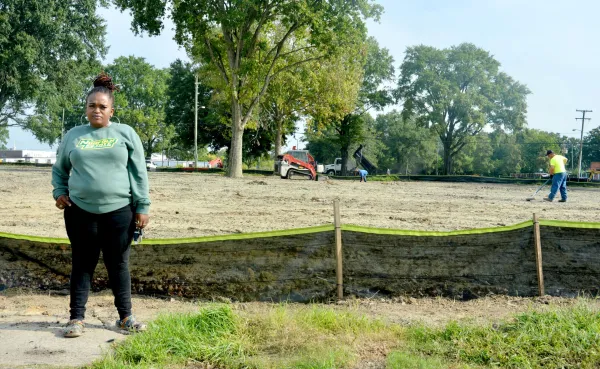
Norfolk is on the cusp of acting to tame the torrents that regularly saturated a marginalized neighborhood as climate change-induced rainfall intensifies.
Their proposed remedy is a massive endeavor to reshape both land use and water flow as the city of 233,000 plugs away at its ambitious St. Paul’s Transformation Project.
What’s called the Blue Greenway is the environmental centerpiece of the first phase of a hotly debated, $400 million undertaking to reinvent the housing, layout and vibe of a poor, majority Black community along the city’s neglected east-side waterfront.
Ideally, the linear park still in the design stage will blend the practical with the pretty to fabricate a linear 23-acre resource to capture storm water runoff, welcome back a slice of the natural world and appeal to picnickers and outdoor exercisers deprived of green spaces for decades.
Construction likely won’t begin until next spring, but landscape architect Tim Stromberg has been huddling with a team of engineers, environmental scientists, architects and other specialists for several years. They’re striving to turn a liability — stormwater runoff — into an asset.
“This area is a park desert,” said the 45-year-old principal with Norfolk-based Stromberg/Garrigan & Associates. “We see this as a health and wellness project.”
Most of the Blue Greenway will flow through the broad footprint of what was Tidewater Gardens, built in the early 1950s atop a tidal creek and a radiating network of wetlands.
The last of the red brick, barracks style apartments — where residents tangled regularly with leaks and mold infestations — was demolished in August 2023. The nearby Tidewater Park Elementary School, where parents dropped off their children, is shuttered and set to be torn down.
Just feet from the school, along bustling East Brambleton Avenue, crews will eventually “daylight” Newton’s Creek, constricted to an underground culvert for decades. That liquid spine of the Blue Greenway will wind its way south to the center of a pillar of east Norfolk’s Black community, the Basilica of St. Mary of the Immaculate Conception.

Roughly three acres of newly constructed wetlands and the primary water channel — about the length of four football fields and up to 130 feet wide — will be the workhorses of the engineered project. They will play a gigantic role in filtering pollutants from absorbed runoff before it empties into the Elizabeth River and then the Chesapeake Bay.
Its price tag of up to $60 million will be covered with city dollars and federal grants.
Basically, it will resemble an elongated bathtub that is 8 to 9 feet deep. Its wide, encircling rim is designed as a necklace of green space dotted with amenities.
Norfolk, part of Virginia’s expansive Tidewater region, is trying to address warming of the planet on multiple fronts because of the well-documented double-whammy effect of climate change.
Not only are deluges more intense, but sea levels are rising faster here than anywhere else on the East Coast. The latter is exacerbated by a phenomenon called subsidence. Simply put, coastal lands are sinking because communities are withdrawing — and not replenishing — enormous quantities of groundwater.
On a separate but complementary climate front, the city is in the midst of advancing a gargantuan floodwall endeavor made up of tide gates, levees, pump stations and natural features such as oyster reefs and native vegetation along the shoreline. The federal government is covering 65% of the $2.6 billion project specifically designed to protect Norfolk from catastrophic storms. State and local funds are supposed to cover the remainder.
Preventing flooding is just one of the Greenway’s climate and health benefits. It also can clean the air and mitigate the urban heat island effect, which is especially harsh in congested cities where concentrations of asphalt and concrete raise temperatures to dangerous highs.
“Climate change is about adaptation,” Stromberg said about incorporating the Blue Greenway into a reimagined neighborhood. “That made us think about the scenarios of today and of the future.”
Once it’s built, “maintaining this will require five or six city departments,” Stromberg said. “This could serve as a model for how to repurpose a piece of land for a higher and better use.”
Landscape architects, he explained, tie the built and urban environments to natural systems.
“Creating something like this is a landscape architect’s dream,” Stromberg said about SGA’s largest project to date. “The reward when it’s built will be to see people using the space.”
After all, the handprints of former Tidewater Gardens residents are all over the Greenway’s blueprints.
While Stromberg’s team is handling the park’s technical infrastructure elements, they relied on input about amenities from Tidewater Gardens residents who called the 618-unit complex home until they were relocated two years ago.
“Listening is so crucial,” Stromberg said, about the joint brainstorming sessions that began in 2019. “We wanted to make sure we were extremely sensitive to the community’s needs.”

Preserving and protecting the canopy of thirsty and mature oaks, magnolias and other trees that once shaded the apartments was paramount for residents. They also wanted pavilions added for reunions, parties and cookouts.
Yet another request centered on access to walking paths, fitness equipment, a splash park, playgrounds, basketball courts, and lessons about birds, butterflies and native plants.
“These are simple requests and we want to honor them,” Stromberg said. “This is about giving people access to something they cherish.”
Greenway plans call for planting at least 300 trees, 5,000 shrubs and 200,000 grasses and flowers.
Balancing man-made and natural systems serves as a welcome mat for inclusivity, said Mike Fox, Stromberg’s colleague.
“With the wetlands come the butterflies and frogs and crickets,” Fox said. “That whole experience, being part of nature is what’s therapeutic and adds to visitors’ serenity.”
Stromberg is counting on the unique oasis to be a neighborhood magnet. He noted that it can be extended north of East Brambleton Avenue, near the former elementary school.
That expansion idea remains in the mix as Norfolk plans to eventually raze and reinvent two other nearby public housing complexes shortchanged on parks — Young Terrace and Calvert Square — in the next phases of the St. Paul’s transformation.
Also, the Blue Greenway will be at the centerpiece of a related city scheme to link the St. Paul’s neighborhood to the previously inaccessible Elizabeth River Trail, the expansive downtown waterfront and Norfolk’s more affluent west side.
For 60-plus years, the community has been isolated by loud, pedestrian-unfriendly, heavily trafficked roads and a tangle of on- and off-ramps, cloverleaf interchanges and overpasses feeding Interstate 264.
City officials are studying how to tackle a large-scale roadway makeover courtesy of a federal grant designed to heal past injustices inflicted on Black communities nationwide.
Tensions have festered about who will actually benefit from such wholesale changes.
For instance, activists with the New Virginia Majority accused the city of “saving the trees, not the people” with its Blue Greenway project. In tandem, they claim wealthier newcomers, not displaced former residents, will eventually become the majority in mixed-use housing being built near the site of Tidewater Gardens. To help prevent flooding, the new housing is being built on ground that has been elevated with at least seven feet of soil.

Stromberg is tuned in to how complicated and difficult these transitions are for cities. As the planet warms, they’re an even trickier balancing act for leaders trying to meet the needs of residents while also accounting for racist policies of the past.
“The jury is still out on what the success rate will be for the return of former Tidewater Gardens’ residents,” he said, adding he’s hoping the Blue Greenway will serve as a lure.
“As some start to move back, I can see a second wave of former residents reconnecting to their neighborhood,” he said. “The key is that they have a sense of ownership.”
Susan Perry, director of the city’s Department of Housing and Community Development since 2021, has focused on resilience and alleviating poverty in her decade-plus career with local government.
Norfolk would have been remiss with this redevelopment project, she said, if it had stopped at simply replacing deteriorating housing and re-establishing a street grid to tether the neighborhood to downtown amenities.
The impact of soaring emissions of heat-trapping gases couldn’t be ignored.
“What we always say is that the Blue Greenway is our resilience strategy writ large,” Perry said. “It really will be a crown jewel of the neighborhood.”
This story was reported via participation in the USC Annenberg Center for Health Journalism’s 2023 National Fellowship. The Dennis A. Hunt Fund for Journalism provided training, mentoring and funding.
The Port of Cleveland is going electric.
One of the Great Lakes’ largest shipping ports is transforming part of a large warehouse into an “electrification hub” to anchor its emission-cutting efforts in the coming decades.
The project is among the Cleveland-Cuyahoga Port Authority’s first steps toward its goal of net-zero emissions for its own operations by 2050. The target does not include “Scope 3” emissions from the ships, trains, and trucks that come and go from the port, but officials hope the upgrades will support their emissions cuts as well.
“Upgrading the electric feed into the terminal is not the most exciting thing,” said Carly Beck, the port’s senior manager for planning, environment and information systems, but it’s a necessary foundation for all other parts of the port authority’s climate plan.
Shipping ports are a major source of not only climate emissions but also harmful air pollution for nearby communities. Fossil fuels power most of the cranes, vehicles, and other equipment used to move commodities and consumer goods around the globe. The United Nations estimates that global shipping is responsible for about 3% of emissions worldwide.
The Cleveland-Cuyahoga County Port Authority became the first port on the Great Lakes to announce a net-zero emissions goal when its board unanimously approved its climate action plan last September. In February, the board approved spending $32 million from state and federal transportation grants to modernize the warehouse and make electrification upgrades.
Cleveland’s downtown port on Lake Erie handles about 13 million tons of cargo each year, from steel and iron ore to wind turbine parts and heavy machinery. Most goes to or comes from parts of Ohio and neighboring states via rail or truck.
“Lake Erie … sits at a very important position geographically as part of the Great Lakes,” said Dana Rodriguez, a senior analyst on global shipping at the Environmental Defense Fund.
The Cleveland-Cuyahoga County Port Authority, like many of its U.S. counterparts, is a public entity that owns and maintains infrastructure at the port. It contracts with a commercial operating company, Logistec, to run day-to-day operations.
The port considered multiple approaches for cutting greenhouse gas emissions, including hydrogen power, before deciding to focus its efforts on electrification, Beck said. All told, the port estimates full electrification will require roughly 5 to 7 megawatts of available power, she said. Design work for modernization and the electrification hub at the port’s Warehouse A is underway.
The port also is working with Logistec on a grant application for funds under the U.S. EPA’s Clean Ports Program, set up under the 2022 Inflation Reduction Act. Roughly $2.8 billion in competitive grants are available for deploying zero-emission technology, with an additional $150 million for climate and air quality planning. The application is due May 28.
If successful, the port plans to add 2 megawatts of solar capacity on top of Warehouse A, which will provide a significant chunk of its anticipated electrical needs. Other funds would be used to start acquiring electric equipment for port operations, such as a large forklift.
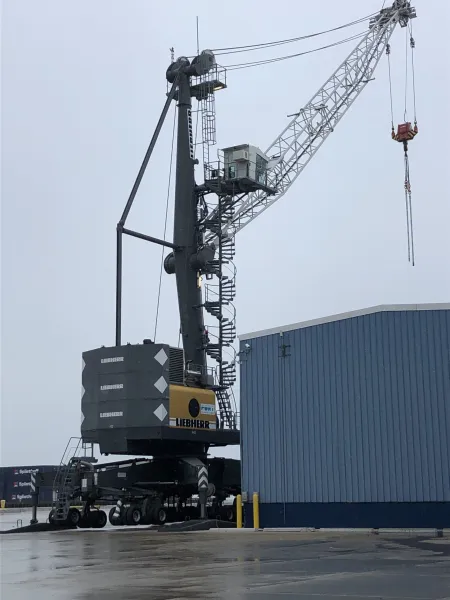
Over time, the port plans to acquire additional equipment as and when machinery and funds become available, including replacements for a large crane and other material-handling equipment.
“It’s just a matter now of biting off chunks as we can,” Beck said. Timing for the acquisitions will also depend on when different types of electrical equipment become available, which will involve ongoing review.
Port Authority President and CEO Will Friedman said the electrification push fits with the port’s broader sustainability goals, including reducing water pollution in Lake Erie and managing dredged material more sustainably.
“We’re doing it because it’s the right thing to do. We have a social conscience here,” Friedman said.
The decision also should help the port stay competitive, especially as more companies consider the indirect emissions of their contractors.
“We think that’s going to be the future if you’re part of the supply chain network,” Friedman said, adding that ignoring greenhouse gas emissions really isn’t an option. “All industries are trying to figure out how they can decarbonize, and maritime shipping is certainly a part of that.”
Decarbonization makes sense for Cleveland and Cuyahoga County in the global scheme of things, said Grant Goodrich, executive director for the Great Lakes Energy Institute at Case Western Reserve University.
“Getting products in and out of Europe and being able to advertise and market that you can do it in a more emissions-friendly manner gives you a competitive advantage,” Goodrich said. The European Union already is pushing for the shipping sector to cut greenhouse gas emissions, and Goodrich expects that will ultimately become important in the American marketplace as well. Cutting greenhouse gases also could help attract more cruise ship business to Cleveland, he added.
The port’s regional nature likely will make some aspects of decarbonization easier. For starters, the port generally does not store fuel for ships on site. Ships typically fill up elsewhere, often from barges, depending on where they believe they can get the best deal, Friedman said. If a ship does need extra fuel while in Cleveland, trucks deliver it.
On the other hand, the Cleveland-Cuyahoga County Port Authority has less bargaining power than some much larger ports on the East and West coasts. That limits its ability to increase fees, which makes grants and other types of funding particularly important.
The Cleveland-Cuyahoga Port Authority’s focus on Scope 1 and Scope 2 emissions is consistent with the goals for a majority of other ports included in a March 2024 report from the Environmental Defense Fund and Arup. However, the report noted, the majority of total port emissions driving human-caused climate change generally are not within ports’ direct control and would fall into Scope 3.
“Action in the broader zone of user and community and industry influence, where impacts are often far greater and where potential benefits are significant, is lacking,” the EDF report said.
The Cleveland-Cuyahoga County Port Authority’s upgrades include planning to provide power for some of those other indirect emissions.
“We don’t want to forget about Scope 3,” Beck said.
She added that the port anticipates offering incentives to encourage ships and others to reduce their emissions.
An example would be for ships to plug into electrical shore power, known as “cold ironing,” instead of running diesel engines while in port. Besides cutting greenhouse gas emissions, the process can also reduce pollution from particulate matter, nitrous oxides, hydrocarbons and carbon monoxide. The port also hopes to encourage independent operators to acquire electric tugboats and similar equipment.
“Port decarbonization is just one key piece of the full decarbonization equation,” said Rodriguez at the Environmental Defense Fund. “It is also up to the trucking and shipping sectors to meet the ports halfway and contribute to the decarbonization efforts. In an effort to reach net zero by 2050, all stakeholders must play their part.”


.svg)
