

 Back
Back
A coalition of energy equity and justice advocates says Minnesota regulators should consider reinstating a utility shutoff moratorium after a recent academic study revealed racial disparities in disconnections by the state’s largest utility.
Xcel Energy customers in communities of color were more than three times as likely to have their electricity involuntarily disconnected between 2017 and 2021 compared to those in predominantly White neighborhoods, according to the analysis by the University of Minnesota’s Center for Science, Technology and Environmental Policy.
Those racial disparities persisted even after researchers controlled for other factors such as income, ownership status and housing age.
“We still find consistently that homes that are disconnected are predominantly” in communities of color, said Bhavin Pradhan, a postdoctoral associate and study co-author.
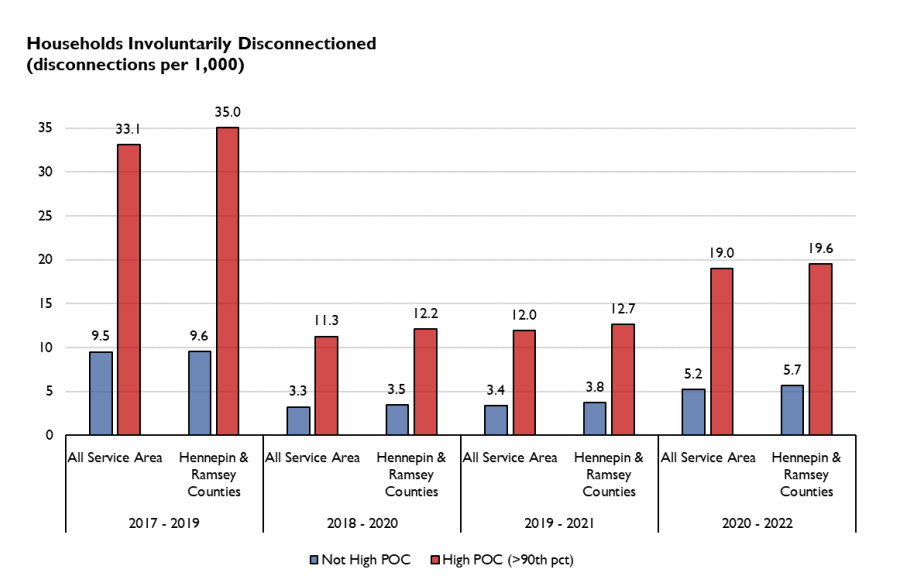
The study’s findings are at at the center of recent comments filed by advocacy groups including the Cooperative Energy Futures, Environmental Law & Policy Center, Sierra Club, and Vote Solar, which asked the Minnesota Public Utilities Commission last month to order a study of the costs and benefits of reinstating the state’s pandemic-era moratorium on utility shutoffs.
“(We) recommend that the Commission order this study now and then rely on it to inform Commission action to consider a moratorium on disconnections until Xcel can develop a more robust set of measures to eliminate racial disparities in disconnections,” the groups wrote in April 12 reply comments (MN 23-452).
Xcel Energy, which had already hired a consultant to review the issues raised in the study, in a March 22 response attributed the racial disparities to “deeply entrenched economic and social reasons that are not driven by the energy system,” including the age of housing stock. It suggested targeting energy efficiency programs at low-income neighborhoods as part of the solution.
The study by Pradhan and Associate Professor Gabriel Chan looked at utility shutoffs, power outages, and the grid’s capacity for distributed energy by Census block across Xcel Energy’s Minnesota service territory. It also relied on data from the Council on Environmental Quality’s Climate and Economic Justice Screening Tool, which maps disadvantaged communities as defined by federal law.
Xcel’s interactive service quality map allowed researchers to overlay various data at a granular level. “We could link this (data) with a lot of other variables,” Chan said.
In addition to utility shutoffs, the researchers found disparities in reliability, with communities of color almost 50% more likely to experience prolonged power outages than predominantly White areas.
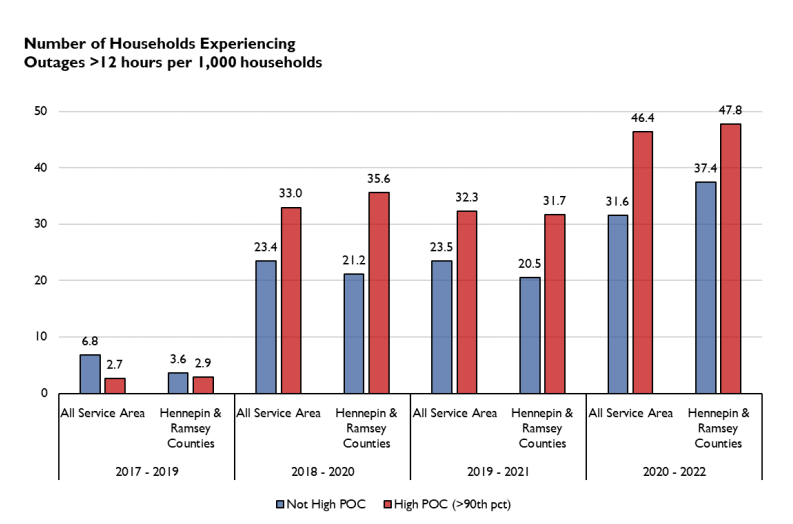
“Across a battery of regression models, we find that living in poorer neighborhoods with a greater concentration of people of color is associated with a statistically and practically significant difference in the likelihood of disconnection from service due to nonpayment and the experience of extended power outages,” the report concludes.
Chan said the research does not necessarily suggest grid planners were intentionally racist. “But we do think that there’s a real opportunity here to think about how to affirmatively plan the distribution grid to address racial disparities that are caused by many other racialized systems.”
The research echoes inequities that have been found for everything from air quality and bike lanes to infant mortality and drownings, in which gaps similarly persist even after controlling for poverty.
“It would be almost surprising if there weren’t racial disparities” in utility service, Chan said.
Will Kenworthy, Midwest regulatory director for Vote Solar, said the type of racial disparities identified in the study are not unique to Minnesota.
“What we’re finding in Xcel service territory for reliability is consistent with what we’re seeing in Michigan and Illinois to varying degrees,” Kenworthy said.
The paper’s conclusion says the findings don’t necessarily imply deliberate racial bias but do highlight an “urgent need for policy interventions to protect low-income customers from disconnections, invest in marginalized communities, and equitably expand distributed energy resources such as solar and batteries.”
The energy equity and justice advocates, intervening as Grid Equity Commenters, attached the study with comments submitted in March as part of an Xcel Energy integrated resource planning docket. They argued that the disparities, and equity in general, needs to be part of any discussion about the utility’s system planning.
“Racial disparities in shutoffs have been repeatedly shown and the commission needs to do something about it,” said Erica S. McConnell, staff attorney for the Environmental Law & Policy Center.
Minnesota had a moratorium on utility shutoffs during the Covid-19 pandemic from early 2020 through August 2021. In addition to a study looking at the implications of reinstating that moratorium until racial disparities have been eliminated, the groups’ recommendations include proactive investments in grid reliability and distributed energy in disadvantaged areas.
Fresh Energy, a nonprofit policy advocacy group that also publishes the Energy News Network, separately filed comments on April 12 recommending that the commission require Xcel to track and report additional data regarding shutoffs and reliability in disadvantaged areas.
Utility shutoffs and outages can be scary, costly and “dramatic” for lower-income customers, said George Shardlow, executive director of the Energy CENTs Coalition, which works with Xcel Energy to help connect customers with energy assistance and conservation programs. Energy CENTs is not among the groups intervening in the Xcel planning docket.
Shardlow said targeting all customers in areas of high poverty with assistance programs, even for a limited time, could help reduce disconnections and energy burdens. That approach is in line with a proposed Xcel pilot program to offer automatic bill credits to all customers living within targeted, low-income areas where energy burdens exceed 4% of household incomes.
Xcel Energy’s comments framed the disconnection disparities as an issue of poverty. It says it has improved its efforts to avoid disconnections, contacting customers via phone and email for nine weeks to help connect them with assistance programs and offer long-term payment plans before shutting off service.
The company said its own analysis did not find a strong relationship between long-duration outages and the racial composition of the neighborhood. The frequency of long outages is so small, affecting less than 5% of households, and largely reflect the random paths of storms, it said.
“We recognize that even if the likelihood of extended or multiple outages remains small, the impacts of an electrical outage could be greater in disadvantaged neighborhoods that are disproportionately vulnerable to such emergencies,” the company said.
While equity and environmental justice are priorities for the company, Xcel said, it also pushed back on the discussions’ inclusion in the integrated resource planning docket, arguing that would duplicate conversations already happening elsewhere.
One surprising finding in the study could also point to potential solutions. In parts of Xcel’s territory, interconnecting distributed energy resources such as solar or batteries has become challenging due to congestion.
“This doesn’t look like an issue for low-income” areas, Pradhan said. “That’s a good point for energy poverty and energy equity” as solar installations could help reduce utility bills and stabilize the grid to reduce outages.
Minnesota Public Utilities Commission staff has tentatively scheduled a meeting to discuss Xcel Energy’s equity analysis with stakeholders in July.
CLEAN ENERGY: Midwest states have received nearly $30 billion in private investments to boost clean energy manufacturing since Congress passed the Inflation Reduction Act in late 2022. (Inside Climate News)
UTILITIES:
POLITICS: Ohio’s HB 6 scandal remains politically fraught for GOP Attorney General Dave Yost, who helped to prosecute four people involved but has ignored questions about his name surfacing in a federal trial and remained silent about the law itself. (Ohio Capital Journal)
OIL AND GAS: North Dakota’s top oil and gas regulator, Gov. Doug Burgum and former President Trump during an oil and gas event Thursday railed against government regulations’ potential to hold back the industry. (North Dakota Monitor)
SOLAR:
TRANSPORTATION: The influx of electric bikes in Minnesota and elsewhere are challenging cities and transit agencies to improve bike parking, bus bike racks and more. (MinnPost)
ENVIRONMENTAL JUSTICE: Michigan officials announce $12 million more in funding to improve local health, monitor pollution and improve indoor air quality in low-income neighborhoods and communities of color. (Michigan Advance)
ELECTRIC VEHICLES: Ohio Gov. Mike DeWine announces nearly $16 million more for electric vehicle charging stations that moves the state closer to a goal of having public stations available every 50 miles. (WLWT)
WIND: The supervisor of a northwestern Iowa airport raises concerns about a proposed wind farm’s potential to disrupt helicopter ambulances and other flights. (Radio Iowa)
STORAGE: Ohio regulators approve plans for an 85 MW battery storage facility outside Dayton. (Daily News)
NUCLEAR: The company working to reopen a shuttered southwestern Michigan nuclear plant has hired about 150 people since the effort began and now employs more than 360 people at the site. (WOOD-TV8)
COMMENTARY: An Ohio clean energy advocate says utility-scale solar projects can play a vital role in helping the state meet a forecasted spike in electricity demand. (Columbus Dispatch)
COAL: The federal Bureau of Land Management proposes ending new coal leasing in the Powder River Basin in Wyoming and Montana following a court order requiring the agency to redo a Trump-era land use plan. (WyoFile)
ALSO: Utah lawmakers hold a special session to tweak a new bill allowing the state to buy a retiring coal plant to extend its life. (Utah State Dispatch)
TRANSITION: New Mexico advocates urge regulators to require the state’s largest utility to develop a large-scale solar array in the northwest part of the state to replace generation and school funding lost with the 2022 closure of the San Juan coal plant. (Albuquerque Journal)
UTILITIES: California lawmakers kill a bill that would have required legislators to review a controversial new fixed electric utility fee. (Los Angeles Times)
EFFICIENCY: Portland, Oregon’s climate action fund plans to invest $140 million over the next five years on efficiency upgrades for low-income households. (Washington State Standard)
SOLAR:
OIL & GAS:
MINING:
TRANSPORTATION: Colorado Gov. Jared Polis signs several bills creating new channels to fund public transit, including an oil production and a rental car fee. (Loveland Reporter-Herald)
HYDROGEN: An Oregon natural gas utility unveils a blue hydrogen-fuel production project that incorporates captured carbon into asphalt. (news release)
A climate trust fund proposed in Portland, Maine, would use money from the sale of city-owned renewable energy credits to kickstart further efforts to cut local carbon emissions.
Portland is among the hundreds of U.S. cities that have adopted ambitious climate goals in recent years. Now, in search of sustained funding to meet those targets, many are turning to novel fiscal approaches, such as the one approved in Portland last week by the first of two city council committees.
The ordinance, if passed by the full council, would establish a new climate fund next year using money primarily from the sale of renewable energy credits, or RECs, from city-backed solar projects, such as at the Portland International Jetport and on the former city landfill.
The money could help pay for consulting work on emissions-cutting or resiliency projects, climate grant-related costs or local matches, community micro-grant programs for climate-friendly improvements, or other expenses for the city sustainability office.
“This is a new source of funding that can get invested in other city projects to, again, save more money,” said Bill Weber of Portland Climate Action Team, a local Sierra Club offshoot that’s been pushing for the city to make progress on its climate plan. The city, along with neighboring South Portland, adopted a shared target in 2020 of cutting emissions 80% over 2017 levels by 2050.
Proceeds from the sale of RECs would amount to about $300,000 to $400,000 a year, according to a memo from Portland sustainability director Troy Moon. It’s not enough to entirely fund major construction projects, Moon said, but “could provide leverage to launch such projects.”
The fund would also include money from “penalties paid for violations of sustainability related ordinances, private donations, proceeds from grants, and voluntary appropriations made by the Council,” he wrote.
Weber describes the proposed fund as “seed money for larger savings.” He suggested a study of solar potential across city schools’ rooftops as one hypothetical use, with results that could be used to attract developers, choose priority projects and speed along their implementation.
“A lot of these projects will pay for themselves over time, but you need to do some engineering,” he said.
Peyton Siler Jones, the Portland-based interim director of sustainability with the National League of Cities, said creative approaches are essential to creating long-term funding streams for local climate work.
“Figuring out how to have those savings not just go to the general fund, but go to a special climate fund to continue to implement climate projects, is one example of an innovative solution,” she said. “It’s exciting to see that being something that can be scaled and replicated in smaller communities.”
Siler Jones said Portland’s fund could be used to pay a consultant to write grants that could bring in federal funding. Or, she suggested as a hypothetical example, it could pay sustainability-related cost differentials on an affordable housing project — helping the developer by covering the extra cost of building materials to install heat pumps or funding a subcontractor to oversee climate-friendly engineering.
While she wasn’t sure whether this idea is happening anywhere as of now, she said the general principle of dedicating city funding to climate efforts is becoming more popular. Boston now puts at least 10% of all new capital funding toward “open space, infrastructure, and facilities projects that are climate resilient or contribute to making the City more environmentally friendly,” according to the city’s website.
Washington, D.C., has a long-running sustainable energy trust fund seeded with fees on electric, gas and fuel oil companies, as well as the sale of credits from the Regional Greenhouse Gas Initiative. And in Ann Arbor, Michigan, millions in annual proceeds from a 20-year property tax increase adopted in 2022 go toward community climate projects.
The idea of using REC sales to seed the fund, as proposed in Portland, involves a complicated trade-off.
The credits are an annual return for Portland’s investment in a given renewable energy project, essentially letting the city own proof of the progress on local emissions goals made by that investment. Selling those credits means selling that proof, and therefore that small piece of progress, in a given year.
“We have to be really clear that if we’re making the sale, we’re not using renewable energy per se,” Moon told city councilors before a committee vote on the proposed fund last week. “But… there’s an opportunity to use those RECs to fund climate action that may otherwise not be able to happen, and that also provides other benefits, like resilience and cleaner air and improved infrastructure.”
In comments to the council’s sustainability committee on the proposed fund, Weber argued that it’s imperative not to sell RECs to benefit anything other than continued, more substantial emissions cuts, meaning, he said, that the money should not be used for sustainability office salaries or resilience work.
“From my perspective a ‘trust’ represents a sacred commitment that is made to future generations,” Weber wrote. “Spending the revenue from the RECs on anything that doesn’t generate a material return on that investment breaks the trust.”
Before voting to advance the proposed fund last week, Portland city councilor Anna Bullett said she agreed that this funding should remain set aside for clear progress on city climate goals, not necessarily more general operations.
“We’re already paying for everyone’s salaries as is,” she said. “Let’s try to protect that money that we already budget for every year and not backfill it with this instead.”
WIND: The developers behind the 704 MW Revolution Wind project install the first foundation needed for the facility’s 65 turbines. (Providence Journal)
ALSO:
CLIMATE:
OIL & GAS: Pennsylvania lawmaker introduces legislation to bar local governments from receiving any state oil revenues if they sue oil companies, responding to a climate lawsuit filed by Bucks County against the fossil fuel industry. (E&E News, subscription)
TIDAL: The firm testing tidal energy turbines on Lake Erie says their prototype is better than that of their competitors because it doesn’t need to be plunged as deeply and is less visually intrusive. (Go Erie)
GRID:
SOLAR:
ELECTRIC VEHICLES: New York City records show that neighborhood stores and major online retailers alike are ignoring summons and cease and desist orders issued over uncertified e-bike battery sales. (The City)
BUILDINGS: In response to climate protests, a Baltimore art museum drafts a sustainability plan that its director says will hopefully include energy efficiency measures and rooftop solar. (Baltimore Sun)
COMMENTARY: A New Jersey doctor argues a free market approach to developing more clean energy doesn’t account for the “lives lost and illnesses caused by fossil fuel pollution.” (NJ Spotlight)
SOLAR: Solar developer Silicon Ranch’s planned 110 MW solar farm for customers of a Tennessee electric cooperative establishes a bulwark for community driven solar in the heart of the largely renewables-reluctant Tennessee Valley Authority’s service area. (Canary Media)
ALSO:
OIL & GAS:
CLEAN ENERGY:
ELECTRIC VEHICLES:
WIND: A newly completed 160 MW wind farm near Houston, Texas, was designed to withstand the region’s weather, including safety features for hurricanes. (KTRK)
NUCLEAR: A company will use a supercomputer at a Tennessee laboratory to train its artificial intelligence tool to guide nuclear power companies through applications for construction and operating licenses. (Knoxville News Sentinel)
CLIMATE: Florida Gov. Ron DeSantis signs legislation to erase the phrase “climate change” from state policy and instead promote “an adequate, reliable and cost-effective supply of energy for the state,” even as the state feels the brunt of rising seas and warming temperatures. (Miami Herald, Associated Press)
GRID:
EMISSIONS: Virginia will likely see more days rated with poor air quality, due more to the recent revision of federal pollution standards than to increased pollution. (WHRO)
COMMENTARY: The electric vehicle industry’s recent slowdown represents just a temporary delay in the clean vehicle transition as oil prices continue to fluctuate and EV technology rapidly advances, writes a quality manager at a Kentucky factory. (Courier Journal)
MINING: Copper isn’t being mined quickly enough to keep up with U.S. policies for transitioning to electric vehicles and clean energy, creating a potential bottleneck for Michigan automakers unless recycling improves and deeper mines are tapped, a University of Michigan researcher says. (Bridge)
OIL & GAS:
PIPELINES:
CLIMATE: For the Great Lakes region, a repeat of 2023 this year is possible as wildfire smoke threatens to continue undoing decades of progress on air quality improvement. (Bridge)
COAL: The USDA hosts a two-day workshop in southern Illinois aimed at helping the region find new economic opportunities amid the decline of coal plants and mining. (WPSD)
CLEAN ENERGY:
EMISSIONS: American Electric Power is among the latest electric utilities to join a lawsuit challenging the Biden administration’s new rules for cutting pollution from coal and gas plants. (E&E News, subscription)
GRID: Wisconsin utility We Energies deploys high-tech acoustic cameras that scan distribution grid equipment to identify potential problems and improve reliability. (WISN)
UTILITIES: American Electric Power sells its distributed resources business that owns more than 300 MW of solar and storage projects across the U.S. for what will amount to about $315 million. (Utility Dive)
SOLAR: The U.S. has surpassed 5 million solar installations, with more than half of those coming online since 2020, according to a new industry report. (Power Magazine)
ALSO:
ELECTRIC VEHICLES:
OIL & GAS:
CLIMATE:
WIND: The developers behind the 704 MW Revolution Wind project off Rhode Island install the first foundation needed for the facility’s 65 turbines. (Providence Journal)
TRANSMISSION: Nevada advocates criticize the federal Bureau of Land Management for proposing that the Greenlink West transmission line run through a national monument while avoiding a mining site. (Nevada Independent)
JOBS: Community colleges around the country are offering training programs in clean energy technology, in response to a surge in job demand since the passage of federal climate legislation. (Associated Press)
PIPELINES: New York environmental activists say they will continue working to end gas pipeline expansions in the state, saying “the fight has shifted” after the defeat of the Williams Pipeline project. (City Limits)
WIND:
SOLAR:
HYDROGEN: The energy firms looking to build a $1.5 billion hydrogen fuel facility at Pittsburgh’s airport say they can’t do so unless federal clean energy tax credits include coal mine methane projects. (Associated Press)
ELECTRIC VEHICLES:
BATTERIES: New York’s Staten Island currently has 13 lithium-ion battery energy storage sites under development, according to a state database of projects receiving incentives. (SI Live)
GRID:
WORKFORCE: Massachusetts and a social impact investment firm want to create a climate tech workforce training loan program to educate the 30,000 workers needed to achieve the state’s climate goals, planning to raise $10 million in funds to do so. (WHDH)
FOSSIL FUELS: Con Edison says a roughly 4,400-gallon oil spill into the Hudson River last month was due to a failed piping component and cracks in the floor of the power station. (W42St)
OIL & GAS: Advocates say a loophole in New Mexico’s methane emission rules allows oil and gas companies to vent record-high volumes of the potent greenhouse gas, endangering the state’s climate goals. (Capital & Main)
ALSO: Alaska lawmakers advance legislation that would reduce state oil and gas royalties in hopes of spurring production and avoiding a looming natural gas shortage. (Alaska Beacon)
CARBON CAPTURE: A California oil-reliant community looks to spur economic development by building a carbon capture and sequestration industry utilizing depleted oil fields. (High Country News)
UTILITIES:
CLIMATE:
MICROGRIDS: Pacific Gas & Electric plans to build six remote microgrids in wildfire prone parts of northern California. (Microgrid Knowledge)
SOLAR: Colorado Gov. Jared Polis slams the Biden administration’s plan to increase tariffs on China-made solar panels, lithium ion batteries and other goods, saying it will hurt consumers and clean energy development. (Colorado Newsline)
CLEAN ENERGY: New Mexico awards seven companies $3.4 million to fund clean energy research and development. (news release)
MINING: An Indigenous advocacy group petitions the U.S. Supreme Court to block a proposed copper mine in Arizona that would destroy a site considered sacred by tribal nations. (Arizona Republic)
TRANSMISSION: Developers propose a 137-mile high-voltage transmission line to carry solar, wind and geothermal power from Arizona to southern California. (Coast News)
COAL: Wyoming lawmakers consider slashing coal severance taxes to help the beleaguered industry even though studies have shown such incentives don’t affect employment or production. (WyoFile)
TRANSPORTATION:
COMMENTARY: A California columnist urges state lawmakers to reform a property tax law to make it easier to site utility-scale solar installations on non-productive farmland. (Los Angeles Times)


.svg)
