

 Back
Back
Over 200 major clean energy projects were canceled over the first year and a half of Trump’s term. A report says that’s left nearly half a million jobs on the table.
President Donald Trump’s attacks on clean energy haven’t spelled disaster for the energy transition — but they have definitely hurt job prospects for Americans.
Between January 2025, when Trump took office for his second term, and May 2026, a total of 216 major clean energy generation and manufacturing projects were scrapped, closed, or downsized, according to a new report from the business-focused advocacy group E2.

Those cancellations, driven in large part by the Trump administration’s hostility toward clean energy, have resulted in the loss of nearly half a million potential jobs, E2 found. Just over a tenth of those would have been permanent roles at clean energy facilities, while the rest would have been either temporary construction jobs or steady work in roles supporting the sector, from selling building materials to serving food at restaurants near a new factory.
Trump took office amid an unprecedented surge in the clean energy economy. The 2022 Inflation Reduction Act spurred the rapid construction of both renewable power projects and domestic factories intended to build solar panels, electric vehicles, batteries, and other crucial cleantech.
But the boom went bust pretty much as soon as Trump won the election in late 2024. Even before Trump and congressional Republicans gutted the Inflation Reduction Act one year ago, companies began reevaluating and stepping away from investments given Trump’s favoritism for fossil fuels and opposition to renewables, particularly wind.
When it comes to jobs, most of the damage to date is in the EV sector, which in the U.S. was already plagued by high costs and weak demand prior to the Trump administration ripping away key discounts for car buyers.
Still, new clean energy continues to be built in America, and while EV sales have taken a hit, they haven’t ground to a halt. The country’s solar manufacturing industry is notching new milestones, and EV makers are pivoting their battery-making factories to serve the red-hot storage sector.
The clean economy has had some real setbacks since Trump took office last year — but it’s still poised to grow even without support from the federal government.
Gov. Josh Green, a Democrat, wants to import LNG to slash energy bills. But the move might not lead to savings — and it could trip up the state’s climate goals.
On June 8, 2015, Gov. David Ige sat under the great seal of the state of Hawaiʻi and signed the nation’s first legal commitment to run an entire state’s grid system on 100% renewable electricity.
Ige, a Democrat, lamented that Hawaiʻi was “the most oil-dependent state” in the U.S.; unlike others, it relied on oil to produce nearly all of its electricity.
“Making the transition to renewable, indigenous resources for power generation will allow us to keep more of that money at home, thereby improving our economy, environment and energy security,” he said at the time.
Two months later, he shot down a pricey proposal to use another imported fossil fuel — natural gas — to reduce the islands’ dependence on oil imports. Ige’s reasoning was clear: “It’s time to focus all of our efforts on renewables,” he said.
Now, Ige’s successor, Gov. Josh Green, is abandoning that all-out focus on renewables — and throwing his support behind a natural gas import scheme that critics contend would threaten the state’s climate targets while delivering marginal savings, at best, to residents.
Green, also a Democrat, is backing a $2 billion bid by Japan’s largest energy company, JERA, to construct a floating liquefied-natural-gas import terminal called Longboard LNG. In May, the Federal Energy Regulatory Commission granted JERA’s request to begin the review process for the project.
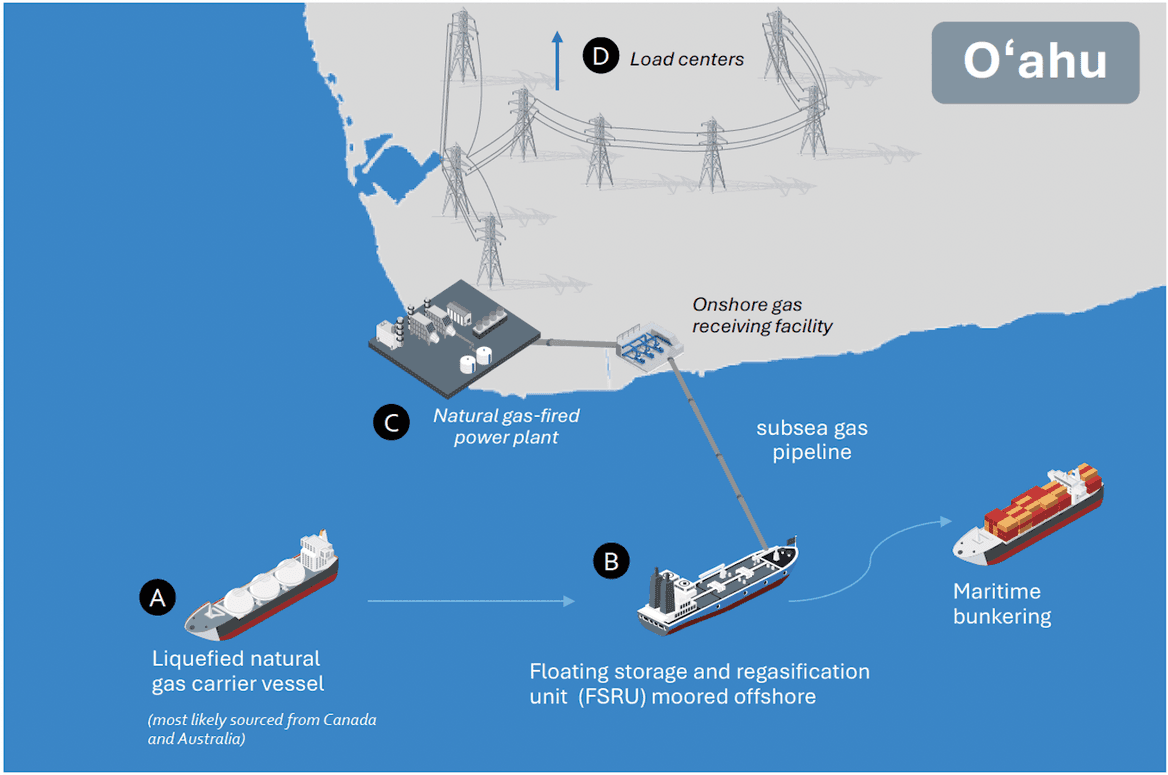
This vessel would ride the surf near Barbers Point, an industrial zone in west Oʻahu that’s home to several power plants. LNG tankers would pull up every three to four weeks to unload the gas, which would flow via undersea pipeline to shore and then fuel a new 500-megawatt power plant to serve Oʻahu, the state’s most densely populated island.
The proposed plant could comfortably meet about 40% of the island’s highest recorded electricity demand and has a target commercial operations date of 2030. Green contends that natural gas can help the state wean off costly and polluting oil without undermining its legal mandate to fully decarbonize its electricity system by 2045. In June, he told Hawaiʻi Public Radio that while the state needs solar and other renewables, it also should have pursued natural gas a decade ago.
“We made a mistake not having a more balanced energy plan,” he said.
The state’s renewables buildout has been buffeted by a once-in-a-century pandemic, multiple global conflicts, and a catastrophic fire. A decade into the transition, utility customers in Hawaiʻi remain mercilessly exposed to the whims of the global oil market, which saw prices spike this spring after Iran cut off most shipping through the Strait of Hormuz.
To date, the energy transition has not sufficiently addressed the primary concern of many of Green’s constituents: Their energy rates are the highest in the nation. JERA, meanwhile, claims it can cut Oʻahu households’ electric bills by $500 a year on average.
But critics say that it makes no sense to tether the state to yet another internationally traded fossil fuel — one whose price also shot up thanks to the war in Iran.
“You can’t solve this problem of a reliance on imported oil by moving to another import that we don’t control,” said Chris Lee, a Democratic state senator who authored the 100% clean energy law and stood beside Ige as he signed it. “And that’s just very painfully obvious.”

This isn’t just a problem for the 50th state. Hawaiʻi started a trend with its 100% clean energy law; nearly half of all states followed with similar measures, and many of them have struggled to build renewables as fast as they hoped, too. Now, elected leaders of these states are also grappling with rising energy costs and, in many cases, a slower-than-expected buildout of renewables.
In New York, long a self-styled leader in the fight against climate change, Gov. Kathy Hochul (D) just eliminated binding interim carbon-reduction targets due to concerns about affordability. Several other Northeastern states considered weakening or undoing their own climate policies in spring legislative sessions, signaling a broader shift toward a less hopeful era of the clean energy transition.
While Hawaiʻi has not yet touched its marquee climate laws, the politics of affordability are clearly having an impact: The biggest energy conversation over the last year in one of the nation’s bluest states has revolved around a massive fossil fuel investment. If Hawaiʻi locks in this natural gas infrastructure, it would mark a significant change from the path it first laid out when it bet on the clean energy transformation.
Lee, who represents part of Oʻahu’s eastern coast, spent three years arguing on behalf of the 2015 climate legislation before skeptical colleagues, hesitant state agencies, and a reluctant utility. When it finally passed, Lee recalled it signaled a “paradigm shift.”
“We realized this is very possible, and not only possible, but inevitable,” he said recently from his office at the Hawaiʻi State Capitol.
Ultimately, advances in renewable energy technologies, like wind and solar, helped make the case for decarbonization, Lee said. The goal also tapped into a broad desire to make Hawaiʻi more self-sufficient.
“For a long time here in Hawaiʻi, we’ve been dependent on imports — food, energy, pretty much everything we consume — and that’s been one of our Achilles’ heels,” Lee said. “We spend billions of dollars that we send overseas every single year to import these things that we rely on, bare necessities.”
In 2018, Hawaiian Electric, the investor-owned utility that supplies power to 95% of customers in the state, awarded bids to four new large-scale solar projects to move Oʻahu toward the 2045 target. The utility mandated the projects come online by the end of 2022.
Only one of those projects, Clearway Energy’s Mililani I Solar, hit that deadline. The others stumbled amid COVID supply chain disruptions and the state’s notoriously slow permitting process. The last of the batch, Hoʻohana Solar, came online last year.

The utility was just beginning to move on from the challenges of the pandemic when a deadly blaze burned through the town of Lahaina on Maui on Aug. 8, 2023, killing 102 people and damaging or destroying thousands of buildings. A local and federal investigation implicated Hawaiian Electric’s equipment; the utility subsequently confirmed that broken power lines had ignited dry vegetation and started a fire, which later rekindled and spread out of control.
In the wake of the fire, Hawaiian Electric’s credit rating dropped to junk status, leading Clearway to cancel three major solar projects and other developers to raise their electricity prices.
Despite the sluggish large-scale solar buildout, Hawaiʻi is technically on track to meet its interim targets under the clean energy law. Hawaiian Electric hit 37% qualifying renewable generation in 2025, mostly due to broad adoption of rooftop solar. Hawaiʻi has the highest rooftop solar penetration of any state in the U.S.; around half of single-family homes on Oʻahu boast panels.

Rooftop solar delivers substantial savings for those with the means to install it, and has reduced the overall volume of oil the state needs to burn to meet electricity demand. But that progress isn’t translating into savings for most customers: Families without solar on their homes are still paying the highest electricity rates in the nation and remain susceptible to dramatic shocks in the global oil market. When Russia invaded Ukraine in 2022, for instance, power prices for average Hawaiʻi households jumped by more than 20%.
In May 2015, an Oʻahu residential customer who used 500 kilowatt-hours of energy in a month paid $140.48. In May 2026, that same customer using the same amount of energy paid $256.27, according to Hawaiian Electric’s estimates. In a state that also has some of the nation’s highest food and housing costs, Hawaiʻi’s most vulnerable residents are often burdened with more bills than they can reasonably pay.
At a local energy conference in May 2024, Green suggested publicly that LNG could reduce the state’s reliance on oil — and thus energy bills — while it worked toward the 2045 clean energy mandate. Last October, the governor’s office announced a strategic partnership with JERA.
“On the table, I have the offer of over $2 billion of private investment,” Green told Hawaiʻi Public Radio in March. “We have an opportunity, if I’m constructive and pragmatic, to help our next generation have a lower cost of energy.”

Aside from the governor, the loudest local champion of the JERA project has been the Hawaiʻi State Energy Office, led by Chief Energy Officer Mark Glick.
In March, Glick appeared before the state’s House energy committee to discuss a study his office conducted on alternative energy pathways for the state. The study, which came out in January 2025, concluded that switching to imported gas power could save residents hundreds of dollars a year on energy costs, or a total of $700 million in net present value compared to sticking with oil.
He was followed at the podium by Matthias Fripp, an electrical engineer who taught at the University of Hawaiʻi at Mānoa for a decade and now conducts energy policy analysis at Energy Innovation, a San Francisco–based think tank that advocates for decarbonization.
“It’s an honor to be here — it’s my first time speaking in front of a legislature, so I’m a little bit nervous, but thank you for having me,” said Fripp, sporting dark-frame glasses and an aloha shirt adorned with green leaves and orange flowers.
Fripp had pored over the spreadsheets the Energy Office had shared with him, and in doing so, he told the committee, he had uncovered a series of errors that collectively inflated the supposed benefits of LNG by $1.2 billion. Most glaringly, a spreadsheet formula left out the fuel cost of LNG in comparison to fuel oil, such that the projected benefits would only accrue if Hawaiʻi miraculously got LNG delivered for free. Removing those errors, Fripp said, reversed the administration’s top-line finding: Instead of saving money, LNG would actually cost consumers around $300 million.
Rep. Nicole Lowen (D), the committee chair, pressed Glick to acknowledge these errors. He initially called out “the way that this is transpiring,” adding that “we received no ability to even look and understand what the differences are, because we’re being delivered this in real time.”
Fripp then testified that he had emailed Glick’s team about the errors some three weeks prior, and never heard a response. Glick challenged that assessment, but under subsequent questioning, his colleague Monique Zanfes confirmed receipt of the email in question and acknowledged that the team had not followed up on it.
The next day, March 13, the Energy Office posted a defensive Instagram message calling Fripp’s assertions “INCORRECT” and stating “HSEO unequivocally stands by its work on the study.” Six days later, the office officially acknowledged an “unintentional algebraic syntax error” and retracted the scenario that had shown the greatest net benefits, to the tune of $700 million.
The Green administration and the Hawaiʻi State Energy Office continued to push for natural gas despite the collapse of their official case.
Within days of the committee hearing, administration officials coordinated the release of a sleek slide deck laying out JERA’s project proposal. Emails obtained by the environmental groups Earthjustice and Life of the Land through public records requests show that throughout that time, the governor’s office and the Energy Office collaborated on a media campaign to promote the LNG proposal with iQ 360, a public relations firm contracted by JERA.
One email chain from March 16 shows state press officers working alongside a rep from iQ 360 to craft responses to questions from a journalist with Bloomberg News.
“I think we do need to add something to the effect that this program aligns with our 2045 aspirations. Both Mark and Erik spoke to it tonight and national story must carry this aspiration,” wrote the Energy Office’s Strategy and Marketing Officer Yvonne Hunter, referring to an event in which Glick appeared alongside JERA Americas Vice President of Development Erik Montague.
Life of the Land, founded in 1970, regularly intervenes in regulatory proceedings involving new energy projects. Executive Director Henry Curtis said that with the JERA LNG project, the Energy Office has stepped well outside its usual role.
“We’ve never seen the State Energy Office handpick a specific technology and a specific company and throw their weight behind it,” he told Hawaiʻi Public Radio.
The Energy Office has since revised its non-retracted scenarios, which currently show more substantial benefits from LNG. In the scenario the state is leaning on now, net present values jumped from $150 million to $651 million in the republished study.
While that may sound impressive, experts at Hawaiʻi Natural Energy Institute, the state’s primary academic body researching and modeling the energy transition, say those savings are negligible. HNEI Director Rick Rocheleau said that after spreading $651 million out over the proposed 15-year timeline for burning gas and then breaking it down by the energy Hawaiian Electric sells, it boils down to less than a penny per kilowatt-hour in savings.
“We would effectively be breaking even,” Rocheleau said.
JERA has run its own calculations on what LNG could save customers and produced a figure higher than that in the Energy Office’s study: It claims that by burning gas instead of oil, it can lower energy costs by 20% and provide Oʻahu households with an average of $500 off their bills each year.
Rocheleau called those numbers a “mirage.” He said that JERA is calculating its savings per meter, not per household, and neglected to distinguish between commercial and residential meters. Large commercial customers will see higher savings, whereas residents would get a much lower return — closer to 2 cents per kilowatt-hour, or 5% of the average customer’s bill, according to Rocheleau’s calculations based on JERA’s assumptions.
“To put it in perspective, total fuel cost is only about 20% of our electricity costs now, so LNG and the infrastructure would have to be free for us to save 20%,” Rocheleau said.
Even if the case for savings was airtight, the JERA proposal makes other questionable assumptions. It has little margin for error in its projected timeline, especially if the LNG facilities will indeed comply with the 2045 clean energy deadline, as Green insists is the case.
JERA is offering to front roughly $2 billion to build the gas infrastructure, and plans to profit from this investment by charging Oʻahu residents for the gas-fired electricity. JERA hopes to have its LNG terminal and power plant fully constructed in 2030, an extremely optimistic timeline that would still allow only 15 years to make money burning gas before that becomes illegal.
But gas power plants are hefty investments, so developers or utilities typically run them for decades to recoup what they spent; JERA’s calculation for the supposed household savings assumes a 40-year power plant operating life, which would stretch into the 2070s.
“Once you build the infrastructure, unless you’re going to keep it for a very long time, anything you do to amortize it quickly is going to drive up the cost,” said Jay Griffin, who chaired the state utility regulatory commission from 2019 to 2022. “If you’re really intent on saying ‘We’ll only do this for 15 years,’ now it’s a 15-year mortgage on a $2 billion loan, versus 30 or 50 years.”

To hit that 2030 target date for commercial operations, JERA would have to make quick work of permitting this complex and multifaceted project, and shepherd the controversial plan swiftly through approvals at the Public Utilities Commission.
“That alone can take years because the PUC takes its job very seriously. These are very technical issues,” said Isaac Moriwake, the environmental attorney who leads Earthjustice’s Mid-Pacific Office.
Navigating PUC approval will also require some degree of buy-in from Hawaiian Electric, the electric monopoly that actually runs the Oʻahu grid. JERA needs the utility to either solicit bids for the project or request a waiver from the competitive bidding process on JERA’s behalf. Thus far, the utility has played no formal role in JERA’s proposal, and one of its press statements about LNG exuded a rare degree of saltiness for the typically bland genre of utility communications, noting how the state has zigzagged in its approach to LNG over the past quarter century. Hawaiian Electric confirmed to Canary Media and Hawai’i Public Radio that it has not formed a partnership with JERA.
Even after the PUC rules on the proposal, community members have a right to appeal up to the state Supreme Court, an eventuality Moriwake said was “almost guaranteed.”
And even if the project wins all the necessary approvals and deflects legal incursions, it still wouldn’t be out of the woods.
“We have an extensive track record of projects going over budget and taking too long,” Griffin said of construction efforts in Hawaiʻi. “After all the infrastructure, the build, and any delays, who’s going to guarantee those savings?”
JERA’s Montague acknowledged in an email that 2030 completion would be “an aggressive timeline,” but added that “we fully believe it can be accomplished.” The company’s slide deck stressed that it still expects savings for customers if the project is delayed by three years or its cost grows by 20%.
Crucially, though, its expected savings depend on “assuming thermal plants switch to renewable fuel at 2045.” JERA asserts that the power plant’s turbines could burn renewable natural gas, clean hydrogen, or clean ammonia with limited upgrades to comply with the clean energy law.
When asked to name power plants burning green hydrogen, Montague said that JERA upgraded a turbine in New Jersey to be capable of burning a 40% blend of hydrogen with natural gas, and noted that GE Vernova sells turbines it says can handle a 100% hydrogen fuel.
Testing is one thing, but power plants have not yet adopted hydrogen as a sole fuel for regular operations. Staking Oʻahu’s grid on clean fuels entails betting on specialized generator equipment not yet in widespread production and an uninterrupted supply of fuels that remain niche and expensive.
Renewable natural gas does exist — it can be siphoned off landfills and manure ponds so it doesn’t hit the atmosphere as unabated methane. But the Energy Office study, for instance, made clear that “RNG is not scalable or widely available enough to meet Hawai‘i’s energy demands.”
Should Oʻahu find itself in a position where the LNG plant eventually gets approved, but comes online years late due to the predictable community challenges or construction delays, or both, and then cannot actually deliver a quick and easy switch to burning hypothetical clean fuels by 2045, JERA would have to make its money back in that compressed timeframe, with the captive customers on Oʻahu footing the bill.
“This project’s a loser, and for it to make any kind of sense, they’re going to have to sprinkle some fairy dust on it,” Moriwake said. “If you sign up for this long-term fossil-fuel commitment, you’re going to be pushing back cleaner and cheaper renewable resources and forfeiting our clean energy and climate goals.”
JERA and the Green administration counter those unresolved questions with a sense of urgency. They paint a binary picture: the expensive, polluting, oil-burning status quo versus a cheaper, cleaner future powered by natural gas. On April 16, the 48th day of the Iran war, Green told listeners of Hawaiʻi Public Radio that the state’s dependence on oil had to change.
“Right now, the idea of continuing to rely on oil from places like Libya or worry about what happens in the Middle East when you have a war with Iran, it’s just insanity,” Green said. “And I’m just not going to be a governor that sits on my butt and doesn’t do something when I can try to make things more affordable.”
Of course, Iran’s blockade of the Strait of Hormuz didn’t just stop oil flows; it cut off shipping access for about one-fifth of global LNG supply, too. Iranian missiles damaged Qatar’s primary gas facility so badly it will take years to repair, creating a long-term constraint on gas markets in Europe and Asia.
Even if Green wasn’t pursuing gas import dependence at a historically volatile time for the commodity, his oil-versus-gas dichotomy overlooks another option: solar.
Clean energy advocates argue that the state should instead fast-track investment in solar and batteries to drastically reduce Oʻahu’s need for imported fuel. If anyone wanted to see receipts from a natural experiment that tested this exact strategy, all they’d have to do is hop on a 40-minute flight from Honolulu to Līhuʻe, Kauaʻi.
Neighboring Kauaʻi is the only island in the state served by an electric utility outside of Hawaiian Electric’s purview. Member-owned Kauaʻi Island Utility Cooperative (KIUC) built enough solar and batteries that it routinely runs solely on renewable power for portions of sunny days. Its leaders aren’t worried about hitting the 2045 deadline — they expect to entirely forgo fossil fuels by 2033, 12 years ahead of schedule.
When KIUC formed in 2002, electricity rates on Kauaʻi were 70% higher than on Oʻahu, according to KIUC president and CEO David Bissell. Today, the island has the lowest rates statewide, and Bissell said customers are far more insulated from the vagaries of the oil market.
Solar investments have been key to KIUC’s success. One-fifth of KIUC’s members have rooftop solar on their homes. Utility-scale solar currently accounts for roughly a quarter of Kauaʻi’s annual generation. Two recently approved solar and battery farms will bring that up to around 60%, each providing electricity at a rate of about 15 cents per kilowatt-hour, a steep discount compared to oil-fired generation.
These projects, together with KIUC’s other renewable facilities, will help Kauaʻi avoid more than 300 million gallons of fossil fuel use over the next 25 years.
“It’s helped our greenhouse gas emissions get radically reduced, and it uses Kauaʻi’s abundant resources to produce energy and benefit the island,” Bissell told state lawmakers in April.
Oʻahu has a much higher energy demand and more land constraints than Kauaʻi, but some experts say the island can overcome those hurdles. In that same April meeting, Fripp appeared alongside Michael Roberts, an economist and fellow at the University of Hawaiʻi Economic Research Organization, to discuss how Oʻahu might achieve comparable results to Kauaʻi.
Roberts and a Ph.D. student updated a model originally designed by Fripp and ran more than 100 scenarios comparing energy project and fuel costs to determine the most affordable path forward for Oʻahu utility customers. This analysis concluded that investments in solar, not natural gas, presented Oʻahu’s best bet at mitigating electricity costs. In late June, Roberts published a report on the Economic Research Organization’s website that built on the initial analysis.
That case for solar became muddied on July 7, when Roberts withdrew his study, noting errors made in the rush to publish, including one in a correction that relied on data points hallucinated by an AI assistant.
Roberts is conducting an internal audit of the report, which he plans to reissue soon. So far, his top-line takeaway stands: “Building no new fossil-fuel plant remains the least-cost path for Oʻahu in every corrected case,” he said in a statement.
Gov. Green, in an emailed statement, commended the Economic Research Organization for recognizing the “flaws and bias” in the research. “The faulty study and analysis, deeply compromised by vested interests, threatens to set back our collective opportunity to build a sane bridge to a fully renewable future.”
Prior to the retraction, the Energy Office had contested Roberts’ expectation that solar will maintain its cost advantage over other sources. The Energy Office had pointed out that Hawaiian Electric recently submitted power purchase agreements to the Public Utilities Commission for two new Oʻahu solar and battery farms, Puʻuloa Solar and Mahi Solar, at price points of about 21 cents and 23 cents per kilowatt-hour, respectively.
That’s double what grid-scale solar has cost in Hawaiʻi in the past. In the contract document, Mahi Solar developer Longroad Energy noted concerns about Hawaiian Electric’s tenuous financial position since the Maui fires and the rollback of federal incentives for solar projects. That price jump, though, is anomalous in the broader trend of solar costs, which have a long track record of declining over time, while the cost to build gas power plants has been rising amid roiling demand.
Griffin, who as a regulator sparred with Hawaiian Electric to pick up the pace of clean energy to avoid surging oil costs when the state’s last coal plant closed, maintains that much of the delay in Hawaiʻi’s renewables buildout “is self-inflicted.”
“Can we do things better here? One hundred percent,” he said. “Do we have more potential to improve the clean energy pathway? Absolutely.”
Amid these conflicting reports on Oʻahu’s energy pathways, state lawmakers have called on the Public Utilities Commission to step in. Lee, in the state Senate, and Lowen, in the House, introduced resolutions that their respective chambers approved requesting that the commission conduct its own analysis on how to cut costs for residents.
The commission has until the end of the year to return its preliminary findings to lawmakers. In the meantime, Lee said the state shouldn’t tether itself to yet another imported fossil fuel.
“Unless somebody can guarantee the price of an imported fuel at a rate that is far lower, or at least comparable to investing in local renewables, … then I don’t see how the math maths,” Lee said.
A U.S. appeals court upheld the first-in-the-nation measure, which will slash smog-forming emissions from certain gas-fueled boilers and heaters in the region.
Southern California’s landmark rule to slash emissions from industrial heating sources just notched a major victory in court.
The region has some of the worst air quality in the U.S., and the gas-fueled boilers and water heaters that serve its factories and large buildings are a key culprit.
In 2024, air quality regulators passed a first-in-the-nation rule to clean up those dirty sources. Since then, opponents of the measure — including gas-appliance makers and trade groups for pipefitters and building contractors — have tried repeatedly to quash it. But last week, the U.S. Ninth Circuit Court of Appeals upheld the regulation, which is meant to spur a shift toward clean, electrified technologies.
The standard, which took effect in January despite the legal challenge, gradually eliminates emissions of nitrogen oxides (NOx) from more than 1 million gas appliances across Greater Los Angeles.
“It was a big win for folks who breathe air in Southern California,” Candice Youngblood, a senior attorney for Earthjustice, which intervened to defend the rule in court, said by phone. “The court fully understood how important this rule is to saving lives.”
The South Coast Air Quality Management District set limits on NOx emissions for light-industrial and commercial boilers, steam generators, and process heaters, as well as residential pool heaters and tankless water heaters. The rules currently affect small units installed in new buildings, but they’ll broaden in scope until covering new high-temperature units installed in existing buildings in 2033. Existing gas equipment must be replaced with zero-emission units once it reaches a certain age, or at the end of its useful life, depending on the appliance.
A spokesperson for the South Coast air district stressed that the rule does not ban gas appliances but rather regulates emissions. The agency said it “remains committed to developing technology-neutral solutions that protect public health, reduce harmful nitrogen oxide (NOx) emissions, and move the region closer to meeting federal air quality standards.”
The measure is ultimately expected to reduce pollution by 5.6 tons of NOx per day — the same as halving smog-forming emissions from cars in the air district, where more than 17 million people live.

Yet the policy is likely to make an impact well beyond the four-county region. Proponents say a major goal of setting the zero-emission standard is to signal to heat pump manufacturers and other clean technology suppliers to start ramping up production — which could benefit industrial electrification efforts elsewhere by driving down appliance costs.
The Ninth Circuit’s ruling comes as California is pushing to decarbonize all corners of its $4.3 trillion economy. Manufacturing facilities are responsible for more than one-fifth of annual greenhouse gas emissions in the state, making them the largest source after transportation.
Last year, Democratic Gov. Gavin Newsom signed a law, Assembly Bill 1280, that expands incentive programs to help manufacturers install industrial heat pumps, thermal storage systems, and other electrified equipment. Utilities and state lawmakers are also developing new electricity rate structures that would lower the cost of operating electric appliances.
Such efforts are meant to address the financial challenges that can come with switching to electric appliances in industrial settings. Cleaner alternatives, such as heat pumps and electric boilers, are typically more expensive up front. Electricity is often far more expensive as a fuel than natural gas, especially for large industrial users — an issue that’s true in California as well in other parts of the country, including the Upper Midwest and Northeast.
If policies can help overcome those hurdles, industrial firms stand to reap significant economic benefits by reducing their exposure to volatile fossil fuel prices, making their operations more efficient, and lowering their energy bills over time. All told, electrifying the entire U.S. industrial sector could generate around $471 billion in total economic growth through 2035, according to a recent analysis by the Renewable Thermal Collaborative and the Industrial Heat Pump Alliance.
California is well positioned to capture some of those benefits, given its existing climate policies and high levels of industrial activity. The state could see over $31 billion from the construction, installation, and manufacturing of electrified technologies, as well as indirect effects from growing supply chains, the report said. That’s even accounting for the expected decline in economic activity and job losses from gas-equipment makers and service providers.
The gas industry, however, sees the Golden State’s electrification push as a threat.
Last year, Southern California Gas, the nation’s largest gas-distribution utility, helped sink the air district’s separate plan to push households away from gas-burning space and water heaters and toward electric heat pumps. Rinnai America, which manufactures gas appliances, has led the legal fight against the zero-emission standards for boilers and water heaters.
In July 2025, a U.S. district court upheld the clean boiler rules, rejecting opponents’ argument that the measure conflicts with the federal Energy Policy and Conservation Act and thus isn’t valid. Rinnai and other plaintiffs have continued to fight the policy, resulting in the Ninth Circuit’s July 2 decision to affirm the district court’s earlier ruling.
The opposition will still have a chance to challenge the policy again, by asking the Ninth Circuit to review its ruling, Youngblood said. In the meantime, Southern California regulators are preparing to propose a new set of rules for larger commercial and industrial systems in the region, which the agency staff aims to present to its board by the end of this year.
The startup closed the first tranche of Series B funding as it pushes to build a novel geothermal plant in Oregon and advance its rock-melting drilling tech.
Startup Quaise Energy has raised $134 million to advance its first superhot geothermal power plant in central Oregon.
On Tuesday, the Houston-based company announced the first tranche of its Series B financing round, which brings the firm’s total funding to $230 million. Quaise is developing a 50-megawatt plant near the Newberry Volcano that will use novel rock-melting technology to tap into significantly hotter geothermal resources than conventional plants can.

The fundraise comes as Quaise prepares to start drilling its first test well later this month for the Oregon plant, called Project Obsidian, which is slated to come online by 2030.
“Our ambition is to power civilization with Earth’s most compelling energy source,” Carlos Araque, CEO and president of Quaise, said in a statement. “This round takes us from field-proven technology to first commercial revenues.”
The Series B was led by Prelude Ventures, which backs early-stage climatetech firms, and included strategic investments from two major Japanese energy players: the power generation company JERA and the petroleum refiner Idemitsu Kosan. Japan is increasingly investing in cutting-edge geothermal projects to help meet the land-constrained nation’s need for clean, around-the-clock power — and to harness the potential of its 111 active volcanoes.
In the United States, the geothermal industry is experiencing a renaissance as new technologies make the energy resource viable in a wider range of geographies. Soaring power demand from data centers is fueling much of that interest, as are state renewable-energy targets and the electrification of vehicles and buildings.
In May, the startup Fervo Energy became the first next-generation geothermal firm to go public, netting about $1.9 billion. The company focuses on enhanced geothermal systems, an emerging approach that involves fracturing rocks and pumping them full of water to create artificial reservoirs. Fervo is developing a large-scale enhanced geothermal plant in Utah that is set to start sending power to the grid later this year.
At Quaise’s Project Obsidian site, the company will initially use standard drilling tools to build an enhanced system. But as early as next year, Quaise aims to deploy its millimeter-wave drilling techniques to access even hotter and deeper geothermal resources.
The technology uses high-frequency beams to melt and vaporize rocks at depths and temperatures that are too difficult or costly for conventional tools to access. Quaise aims to tap rocks at 300 to 500 degrees Celsius (572 to 932 degrees Fahrenheit) to heat fluids that drive steam turbines on the surface. The hotter the fluid, the more efficient and powerful the system, which means projects can derive more energy from a smaller number of wells.
Quaise isn’t alone in chasing the promise of superhot geothermal. The startup Mazama Energy is developing its own pilot project at the Newberry Volcano, where it says it can reach temperatures of over 330°C. And major research projects are moving forward in Iceland, Japan, and New Zealand.
As Quaise develops its Oregon plant, the company is continuously demonstrating its unique approach at its field site in central Texas. Quaise said it drilled through more than 100 meters (330 feet) of granite there last year and is now approaching 1 kilometer of depth, which would represent a milestone for its drilling technology.
Meanwhile, Quaise is looking to secure another $100 million in grants and debt for Project Obsidian, on top of the Series B funding. The firm has already inked a power-purchase agreement for the initial 50 MW with an undisclosed customer, and it’s working to sign deals for an additional 200 MW in future capacity.
“We have backed Quaise since the beginning because we believed accessing superhot rock would unlock geothermal energy at a scale the world has never seen,” Mark Cupta, managing director at Prelude Ventures, said in a press release. “What the team has achieved in the field and what they are now building at Project Obsidian validates that conviction.”
Startup Electra is outfitting induction stoves with slender batteries that enable the electric appliances to be plugged into a standard outlet — and help the grid.
BROOKLYN, N.Y. — When the startup Electra Research launched four years ago, its founders set out to hook more batteries up to the electric grid. Energy storage is key to balancing the coming and going of wind and solar power, and it can help reduce strain on the electricity system during the busiest hours.
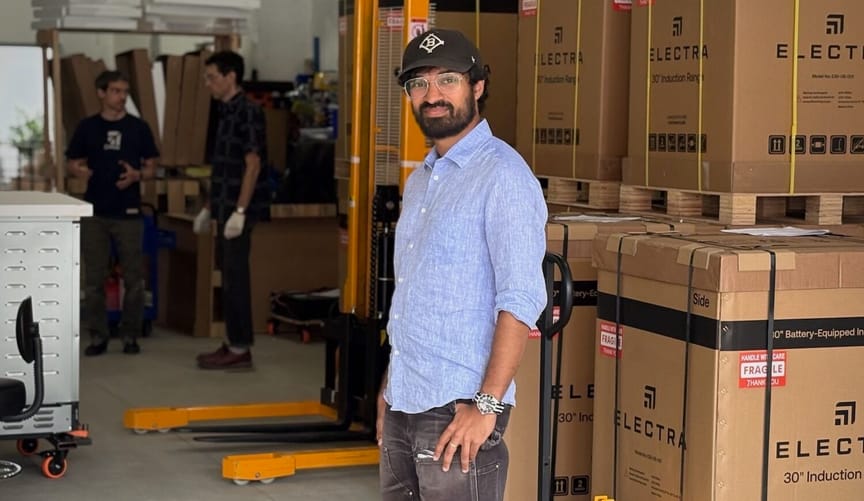
But with the line to plug into the grid being very, very long, Electra opted for a faster route: It would put batteries directly in people’s homes, only with a twist. Instead of installing whole-home backup storage, the firm would pair smaller batteries with energy-intensive appliances. The goal was to help people clean up their homes, reduce energy use — and add some useful capacity to the broader electricity system.
“It became clear that the straightforward thing to do is to colocate a battery with the biggest loads in the house, which are water heating, refrigeration, HVAC, and cooking,” Bert Muthalaly, Electra’s CEO, told me from the startup’s new warehouse in Brooklyn.
“And when you look at it that way, there is one that people care about,” he said. “People love their stoves.”
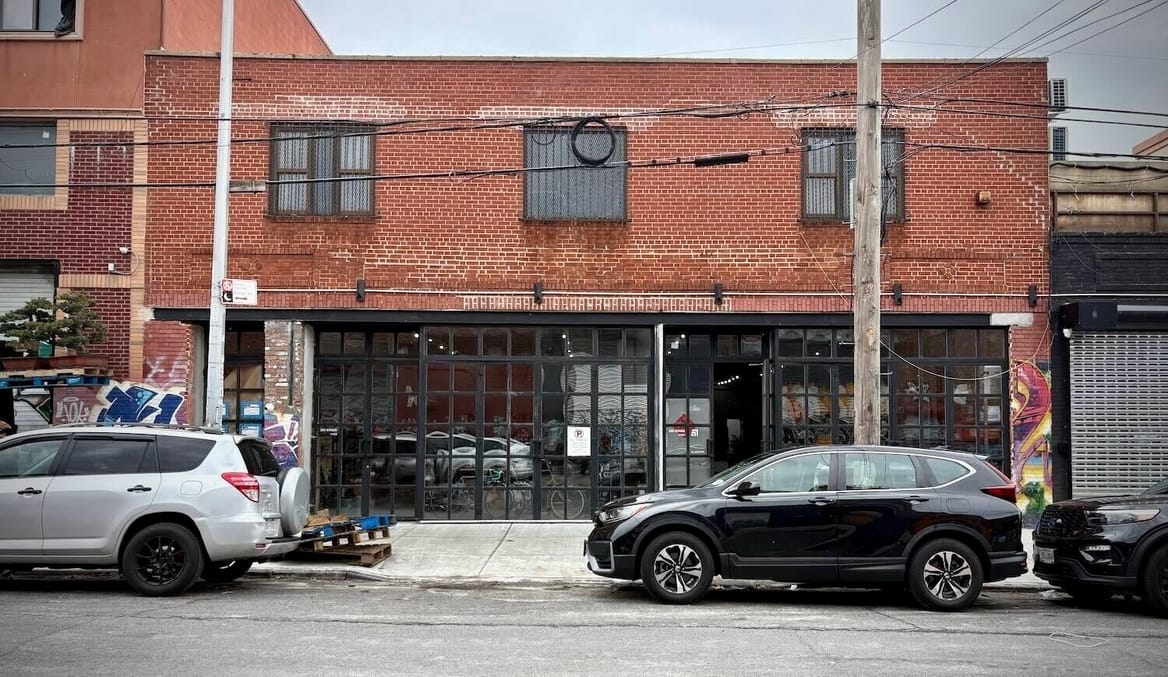
Today, Electra makes battery-powered induction stoves, which it began shipping to U.S. customers in April. The startup recently gave me a first look at its operation on the edge of Brooklyn’s Bushwick neighborhood, where the glass-fronted warehouse sits somewhere between a pickle-packing plant and a kitchen-supply distributor.
When I visited on a cloudy day in late June, Alexia Avina was rewiring a 305-pound appliance to connect a slender battery pack, which replaces the drawer that holds broiler trays and pans. Electra does the metalwork for its stoves in China and final assembly at the Brooklyn facility, turning them into energy-storing, Wi-Fi-enabled devices — ones that won’t fill your kitchen with harmful pollution by burning natural gas.
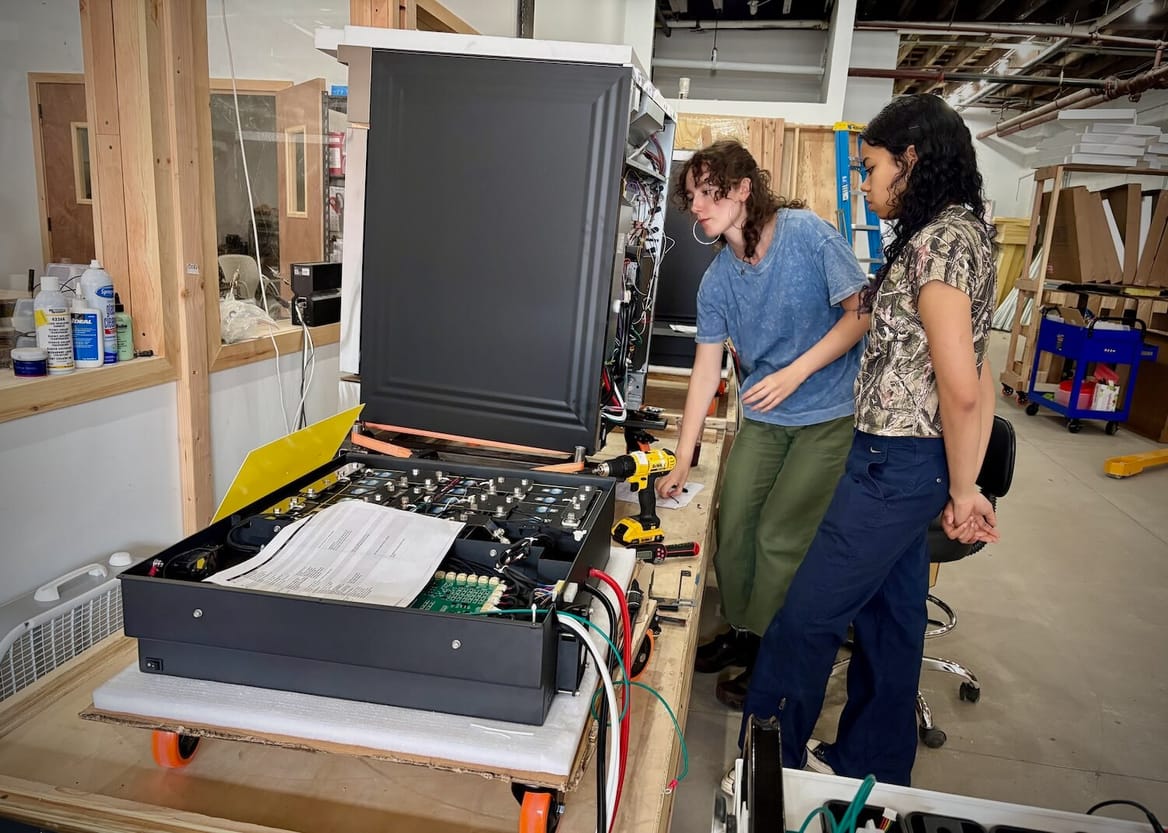
Avina joined the team in May, having mainly worked in restaurants and as a musician before training with Electra’s engineers to outfit the stoves. “It’s been cool to learn something totally different,” she said later while standing next to stacks of stoves packed in cardboard boxes. “It’s rare to have hands-on opportunities like this.”
Unlike many induction stoves on the market, Electra’s model can plug into a standard 120-volt outlet and draw power to charge a 5-kilowatt-hour battery. The induction cooktop heats pans directly using electromagnetism, while the oven cooks food using electric-resistance elements.
Customers can choose to turn their batteries into helpful grid tools. With its software partners, Electra directs the batteries to charge up during the most beneficial times — for example, when solar power production is most abundant — and to discharge power during the grid’s peak demand periods. Electra estimates its appliance uses roughly 80% less peak power than a typical electric-resistance stove.
The company now employs nearly two dozen people, eight of whom work on the Brooklyn production line. It’s self-funded but declined to share financial details.
Electra’s appliances are hitting the market at a time when induction cooking is becoming increasingly popular in American kitchens. The technology cooks faster and more efficiently than gas and traditional electric appliances, and, unlike gas stoves, it doesn’t release pollutants that can harm people’s health. Although federal rebates for electrification expired early under the Trump administration, some states and utilities still offer incentives to help defray the upfront cost of going electric.
Electra’s induction stove costs $3,999. That’s more than triple the price of Wirecutter’s highest-rated electric range — although because that model uses 240 volts, it might require upgrading a home’s electrical panel, rewiring the kitchen, or hiring electricians to hook it up. All that can add thousands of dollars to the final bill. Electra says its unit avoids those added costs and, thanks to its battery, can even operate for several meals in a blackout.
The plug-in-ready approach is similar to that of Copper and Impulse Labs, two leading companies in the niche but growing category of battery-powered induction ranges (who, as it happens, are suing each other). California-based Copper has sold over 1,000 units, and it was awarded $32 million last year to design, test, and install 10,000 of its stoves in New York City public housing facilities. Electra says it designed its own model for that same competition.
The startup began receiving stoves from China around three months ago. Electra has since shipped 75 of its appliances from Brooklyn to customers across the United States, and it plans to send out thousands more by the end of this year. Early data show that people who cook frequently are still using only about a fifth of the battery’s power per day, which bodes well for the lithium iron phosphate device’s longevity, Muthalaly said.
The company is also developing a pilot program with the city of Burbank, California, to help residents electrify their kitchens. And it’s partnering with a property owner closer to home, in the Bronx, to equip an 80-unit apartment building with its stoves. In both California and New York, local building codes are effectively pushing natural gas appliances out of new buildings in order to reduce carbon emissions and improve air quality, raising the incentive for households to explore options like Electra’s.
Muthalaly described Electra as a “climate research lab,” and the company continues to refine and develop its stove technology. Greg Shakar, an electrical engineer on staff, was testing a unit for electromagnetic “noise,” or unwanted radio interference, when I walked through the side of the warehouse dedicated to R&D.
But as orders pick up, Muthalaly said the company is constantly evaluating which parts of the assembly process should remain in-house or should move overseas for higher-volume, lower-cost manufacturing.
“We’re thinking about this as an experiment,” Muthalaly said of the Brooklyn operation. “We’re going slow, but we’re learning from each install. And it’s getting smoother and smoother.”
A correction was made on July 6, 2026: This story originally stated that the battery sits beneath the drawer that holds broiler trays and pans, when in fact it replaces the drawer.
After insisting it wasn’t needed, Duke pitched a “large load tariff” for big energy users — a concession to critics before a hearing on its proposed rate hike.
For months, clean energy and consumer advocates in North Carolina have pressed Duke Energy to follow the national trend and create special rules and prices for data centers. The state’s predominant utility insisted such rules were unnecessary, rejecting claims that the power-hungry facilities could overwhelm the grid or burden households with unfair costs.
But now, the company is changing its tune.
In testimony submitted to the North Carolina Utilities Commission in late June, Duke proposed what it calls a “large load tariff” — a scheme by which data centers and other big electricity customers would pay a minimum bill amount for at least a decade, no matter their actual power use.
The transparent setup would replace the confidential, one-off service agreements that Duke makes with large energy users now. The system would result in a “measured set of customer protections” as data centers flock to the state, the company said.
Duke recently raised its 2035 forecast of electricity demand from large customers to 8 gigawatts in the Carolinas — an increase of 2 gigawatts since its projection from last year — with most of the new growth expected in the form of the gigantic computer warehouses. The company is using that prediction to help justify building a whopping 9.7 gigawatts of new gas plants over the next decade.
Around the nation, large load tariffs are gaining steam as states scramble to prevent the AI boom from exacting an enormous cost on consumers and the climate. At least 75 such tariffs have been proposed or approved in some 35 states, according to data tracked by the Smart Electric Power Alliance and the North Carolina Clean Energy Technology Center.
Duke’s about-face on large load tariffs comes as it prepares to defend its deeply unpopular bid to raise electricity prices at commission hearings that begin July 7. The company has lowered its original rate request but still seeks an increase of 11.6% over two years for residential customers.
The reversal on data centers follows advocacy from the state’s attorney general, state-sanctioned consumer advocate Public Staff, and clean energy groups — all of which have argued for large load tariffs.
“This is a welcome development,” said Munashe Magarira, senior attorney with the Southern Environmental Law Center, which is representing the Southern Alliance for Clean Energy, the North Carolina Housing Coalition, and other nonprofits at the commission as it weighs Duke’s rate-hike request.
“It builds on hard work that’s been done to push the commission to address these issues head on because of the impact large customers will have for the utility, the grid, and society as a whole in North Carolina,” he said.
Still, Magarira said, Duke’s proposal falls short in a few ways. The company recommends that large electricity users pay at least 75% of their maximum potential energy use, instead of the 85% proffered by advocates. The tariff would make minimum contract terms of 10 or 15 years — less than the 20 years proposed by the nonprofit coalition. And it would only apply to customers with loads of at least 50 megawatts, as opposed to the 25-megawatt floor that the nonprofits pushed for.
Advocates say these details matter because it’s vital to minimize risk as much as possible: If Duke builds expensive gas-burning power plants and other infrastructure in anticipation of data centers that don’t materialize as planned — a distinct possibility, according to some analysts — households could be left holding the bag.
Even more concerning for Magarira: Duke doesn’t appear to propose that data centers become a new class of customers. Instead, it offers to standardize the bilateral service agreements it already signs with tech companies.
The distinction is more than semantic, he said. A separate customer class would better enable regulators to design rates tailor-made for data centers and their immense energy needs.
“If the projections are right, we’re facing a pretty unique moment with regards to electricity growth,” Magarira said. “We think there’s a real need to create a separate customer class for these customers — just given how different they are.”
A final overarching concern: Duke’s most recent filing fails to mention a “clean transition tariff.” Such programs are vital in vertically integrated electricity markets like North Carolina’s, where entities that want 24/7 carbon-free energy can’t independently contract for it. Only Duke can sell them electricity, so if Big Tech firms want to pay for clean electrons for their data centers — as many say they do — they need a program like a clean transition tariff that lets the utility serve as a go-between.
A handful of other states have enacted clean transition tariffs. In North Carolina, the idea has been bandied about for years, and Duke has publicly agreed to consider it. But the utility has never formally proposed such a tariff to regulators.
“Let large customers who want to be good corporate citizens, who care about the environment, have the opportunity to purchase incremental clean energy to meet their power consumption,” Magarira said. “That feels like a win-win for everyone involved.”
Duke declined to comment for this story, pointing instead to its testimony. The five-member Utilities Commission could open a separate docket on the large load tariff proposal. Otherwise, its decision on that and other matters in the rate case is expected this fall.
Last year, nearly 40% of all power demand from global data centers came from facilities based in America, per a new report.
Data centers use more electricity in the U.S. than in any other country — China included.
In 2025, nearly 40% of all power demand from data centers came from facilities based in the U.S., according to this year’s Statistical Review of World Energy from the Energy Institute. It’s the first year the sweeping annual report has tracked data center demand, a sign of how central the question of powering these massive facilities has become.

To put that electricity use in perspective: American data centers alone consumed nearly 313 terawatt-hours last year, per the report — more than Australia, Italy, Spain, or the United Kingdom generated to power their entire economies.
This electricity demand has been driven by deep-pocketed Silicon Valley firms racing to build out data centers that can give them an edge in the AI race. Between 2022, when OpenAI shook the world with its release of the ChatGPT 3.5 model, and 2025, global data center power demand grew by 59%.
And it’s only expected to keep climbing. Demand in the U.S. could nearly triple by 2030, according to S&P Global — though estimates vary widely, and some analysts caution that a meaningful share of planned projects may be delayed or never get built.
Still, even conservative estimates find that data center power demand will remain high — and the prospect of yet more growth has spurred urgent conversations across the U.S.
Consumer advocates fear that without stronger regulation, ordinary Americans will be left covering the cost of the strain that data centers put on the grid. And climate advocates worry that, despite the climate goals of Big Tech firms, some new demand will be met with natural gas — a trend that would drive up carbon emissions and local air pollution.
Now the legislature must hammer out the differences between the Senate text and the House version, which includes major cuts to energy-efficiency funding.
The Massachusetts Senate yesterday passed a sweeping energy-affordability bill that aims to save residents $14 billion over 10 years in a state that has some of the country’s highest utility costs.
The legislation includes measures that would change the state’s energy procurement process, put guardrails on the activities of third-party electric suppliers, and allow utilities to securitize certain spending, essentially lowering the cost they pay to borrow money. Other provisions aim to cut energy costs by decreasing residents’ reliance on fossil fuels. The bill would authorize the use of plug-in solar systems and phase out a major source of gas infrastructure spending.
“We believe if we can reduce our overdependence on gas … then we’ll be better off,” said Sen. Michael Barrett (D), chair of the Joint Committee on Telecommunications, Utilities, and Energy, and a major voice on climate and energy issues in the legislature, during yesterday’s debate. “These high bills are all fossil fuel–driven.”
Several amendments were approved during the debate. One specifies that data centers will not be eligible for state tax credits unless they meet requirements for clean energy procurement, energy efficiency, and load flexibility. Others call for an investigation into whether utilities’ guaranteed rates of return on investment are excessive, and would close a loophole that might otherwise allow a contentious wood-burning power plant to go forward in western Massachusetts.
The goal of the legislation was to dig into the complexities of the sprawling electric and gas systems to find and eliminate unnecessary fees and costly inefficiencies, Barrett said.
“You cannot save people money, fundamentally, without going after the status quo,” he said. “What we don’t want to see is legacy overcharges that you pay every month.”
The legislation, notably, would not lower spending for Mass Save, the state’s energy-efficiency program, in sharp contrast to the controversial $1 billion reduction the House version calls for. The House’s proposed cut would represent about two-thirds of the roughly $1.5 billion remaining in Mass Save’s three-year budget. Supporters say the move would quickly bring down customers’ bills, but opponents argue that these savings would be small — and that every dollar spent on energy-efficiency programs lowers overall costs for everyone.
The House and Senate now have to hammer out the differences between their versions, and each chamber will need to vote on the final legislation.
One year ago, President Donald Trump signed a massive bill into law and ripped away clean energy tax credits. Renewables have rolled with the punches.
One year ago, President Donald Trump got his Fourth-of-July wish. Republicans rammed a massive tax and spending bill through Congress before his preferred July 4 deadline, allowing Trump to sign it into law during a showy holiday ceremony at the White House.
Alongside huge cuts to Medicaid, food stamps, and other programs aiding America’s neediest residents, the One Big Beautiful Bill Act repealed large swaths of the Inflation Reduction Act — the only significant piece of climate legislation the U.S. has ever managed to adopt.
That law would have marshaled as much as $1.2 trillion to transition the U.S. economy away from fossil fuels and toward renewable energy, largely through tax credits that make it cheaper to build wind turbines and solar panels. But Trump’s big bill sunsetted those incentives; as of Saturday, they will no longer be accessible to clean energy developers unless they have already hit certain construction benchmarks.
Still, despite the tax credits’ looming demise, and the Trump administration’s myriad other attacks on clean energy, developers have continued building renewables at a stunning pace over the past year. More than 90% of the power plants brought online in America in 2025 were solar, wind, or battery farms, according to the U.S. Energy Information Administration. And the agency projects that these clean resources will account for 93% of new additions to the power grid this year.
There’s a simple reason for clean energy’s unstoppable rise: America needs more energy fast, and only renewables and batteries can deliver it.
After decades of staying flat, energy demand is surging. Big Tech firms are building new data centers that use as much electricity as small cities. Homeowners are switching to electric stoves and heating. People are swapping gas vehicles for electric ones.
Meeting this new demand requires building more supply: more power plants, batteries, poles, wires, and transformers that can produce, store, and transport more electrons. And as gas power faces yearslong supply-chain delays, clean energy is the only thing that can be built quickly and cheaply enough to keep up.
It’s not as if clean energy will escape unscathed from the One Big Beautiful Bill Act — or from the Trump administration’s continued clean energy onslaught.
Over the long term, the disappearance of tax credits will take its toll: One estimate suggests the U.S. will build less than half as much clean energy between 2025 and 2035 as it would have with the incentives in place, with the biggest hit happening in the latter years of that range.
In the near term, the Trump administration’s blockade on federal permitting for wind and solar projects, its payouts to cancel offshore wind leases, and other attacks are having a real negative impact.
This past year has proven that clean energy can roll with some punches — and also that the Trump administration is prepared to keep on taking swings at the industry.
Independence nay: The U.S. Supreme Court rules the president can fire regulators at independent federal agencies, including FERC and the Nuclear Regulatory Commission. (E&E News)
Another wind payoff: The Trump administration says it will pay Duke Energy $129 million to abandon its offshore wind project off North Carolina, which the utility says it will reinvest in gas and nuclear power projects. (New York Times)
Farming the sun: Solar opponents in Ohio have used alleged threats to agricultural land to derail projects, but a new report makes clear that arrays only take up a fraction of a percent of prime farmland both in the state and beyond. (Canary Media)
Permitting plateau: Trump administration policies holding back clean energy permitting are putting 92 GW of projects at risk, representing $121 billion in investments, a new Wood Mackenzie report finds. (Reuters)
Sunrise, sunset: Connecticut passed a law that authorizes the use of plug-in balcony solar panels, expands the state’s community solar program, and extends solar incentives, while also instituting new restrictions on solar development. (Canary Media)
Steel’s clean opportunity: It’s been a year since Japan’s Nippon Steel acquired U.S. Steel, but former steelworkers and other residents in Northern Indiana are still waiting to see if the acquisition turns into clean, job-creating investments. (Canary Media)
Grid funding disconnect: A Government Accountability Office audit finds Puerto Rico has only received about 25% of the $14 billion it was allocated for grid repairs and a solar and battery buildout after 2017’s Hurricane Maria destroyed much of the island’s energy system. (Associated Press)
A head-to-head matchup of electric and gasoline cargo trucks shows how rising fuel costs make EVs much cheaper to run. Now, can manufacturers lower up-front costs?
Electric cargo trucks have been getting more cost-competitive for years. But the fuel price spike triggered by the Iran war has made it clear just how much cheaper it can be to move freight with trucks that run on electricity instead of gasoline or diesel.
New data from electric-vehicle manufacturer Workhorse, which runs identical routes with both gasoline cargo trucks and electric cargo trucks for its Stables by Workhorse business, provides a case study of how elevated gasoline prices make EV options more appealing.

Stables delivers packages as an independent service provider for FedEx in Ohio. Its use of internal-combustion-engine and battery-electric trucks side by side has given it a rare “controlled, real-world comparison” of the two vehicle classes with “the same routes, the same drivers, and the same weather,” as explained in a presentation at the ACT Expo trucking industry show in May.
The electric trucks Workhorse builds and runs in its Stables fleet, a type known as step vans, were already cheaper to operate last year than their gasoline-fueled counterparts — saving about 42.5 cents per mile, based on electricity at 11 cents per kilowatt-hour and gasoline at $2.98 per gallon.
But by May 1, gasoline had spiked to an average of $4.83 per gallon in Ohio, pushing the savings advantage for electric trucks up to 73.6 cents per mile. With gas prices so high, a Workhorse step van driving about 50 miles per day can expect to save about $11,000 per year on fuel costs.
The operating-cost difference matters a lot when it comes to electrifying truck fleets. EV trucks cost 50% to 100% more than fossil-fueled versions, according to industry estimates, which means they need to provide enough savings on operations to make up for that higher sticker price.
In the past few months, Workhorse CEO Scott Griffith said customers have grown more interested in buying trucks from his company, which is a small-scale producer in the broader world of medium-duty truck manufacturing.
“The phone is certainly ringing, and the interest is high, and everyone’s doing the math,” he said. “What is the cost of electricity, what are the lease costs, what are the operations and maintenance costs? They’re coming in with a much more sophisticated approach.”
Workhorse’s experience is only one example of how EV trucks are growing more appealing to fleet operators, said Corey Cantor, research director at the Zero Emission Transportation Association trade group. He noted that other fleet operations have observed similarly high savings as gas and diesel prices have spiked in recent months. While those prices have declined slightly since a purported peace deal between the U.S. and Iran last month, they remain significantly higher than before the war began.
Diesel, which is the primary fuel for trucks around the world, has seen an even greater increase in cost than gasoline, putting pressure on fleet operators.
“When diesel is at such an elevated price — even if it may come down over the longer term — it spurs a conversation,” Cantor said.
While the recent gasoline and diesel price spikes are driving conversations about electrification, it’s not clear whether that’s resulting in more purchases or leases of EV trucks.
That’s mainly because the data hasn’t yet come in, said Jacob Richard, technical project manager at Calstart, a nonprofit group whose members include energy producers, carmakers, and other businesses.
There’s plenty of room for growth. Electric trucks made up less than half a percent of the total U.S. truck stock as of mid-2025, according to Calstart’s January report Zeroing in on Zero-Emission Trucks.
Of the 72,000 electric trucks deployed in the U.S. at the end of last year, the vast majority were so-called “last-mile” delivery vans. Cargo vans — the smallest type of commercial cargo vehicle — are an ideal electrification target because they run relatively short routes to and from central depots where they can recharge overnight using slower, less-expensive charging infrastructure, said Mike Roeth, executive director of the North American Council for Freight Efficiency.
The nonprofit research group has put vehicles through real-world tests in its “Run on Less” events and found that battery-electric trucks cost less to operate than fossil-fueled equivalents on the sub-100-mile daily routes that make up about half of all freight miles traveled in the U.S.
Griffith agreed that shorter-haul, “return-to-base” freight routes have been a good fit for Workhorse customers like Purolator and Gateway Fleets, both of which have placed orders for 100 of the company’s electric step vans this year.
“Many of them are running what we call lollipop routes — 90 miles out from the depot, and coming back and charging up,” Griffith said. He added that “a significant chunk of medium-duty trucks” are running such routes, “especially the large fleets.”
But electrifying medium-duty trucks is more complicated than electrifying cargo van fleets, Roeth noted. Medium-duty trucks range from step vans like the ubiquitous brown UPS delivery vehicles to box trucks that have different types of rectangular cargo containers mounted on separately built “cutaway” chassis. They tend to be built for a wider variety of custom markets in much lower quantities than cargo vans, which more closely resemble mass-market passenger vehicles in how they’re manufactured and marketed.
“The smaller and more automotive you are, the greater the scale of production, the lower the cost,” Roeth said. “As you move to a cutaway, where you have to work with a different manufacturer to get that box on, the cost challenges go up.” That’s true for both EV and internal-combustion vehicles in this class, he said.
Still, manufacturers of battery-electric trucks stand a good chance of making headway across market segments while fuel prices are high, Cantor said.
He highlighted Harbinger Motors, a startup that manufactures medium-duty electric-vehicle chassis that can be customized for different classes of vehicles. The California-based startup has raised about $360 million in venture financing, including a $160 million round in November co-led by FedEx, which also ordered 53 of the company’s medium-duty truck chassis.
Workhorse has taken a more circuitous route, Roeth said. He worked at the company back when it was an affiliate of Navistar International making chassis for internal-combustion-engine trucks. In 2013, Workhorse was acquired by startup AMP Electric Vehicles and shifted to making battery-electric chassis.
Last year, it merged with long-time electric-chassis startup Motiv, in what Roeth described as “a perfect marriage.” Even so, it’s not easy to break into established medium-duty truck markets: Workhorse reported widening losses in its first earnings report as a combined company in the first quarter of this year, despite increasing revenues.
Those losses were driven in part by higher investments in manufacturing, as Workhorse retools its factory in Union City, Indiana, for the latest generation of its all-electric chassis, featuring more efficient batteries, drivetrains, and power-control systems. That factory is capable of producing up to 5,000 vehicles per year.
“We’re not just sticking an electrified powertrain on what we currently sell,” said Griffith, who was CEO at Motiv before the merger. “You can get some efficiencies out of that. But you can’t capture the full benefits of a fully software-defined vehicle without going all the way.”
The primary barrier to fleet electrification is the up-front cost of electric trucks. Right now, “a standard rule of thumb is that these vehicles are going to cost two times more than the equivalent cost of a diesel or gasoline version,” Calstart’s Richard said.
But there’s a lot of variation. Commercial vehicle pricing data “is not as transparent and easy to access as [data on] passenger cars,” Cantor said. Many vehicles are custom-designed, and pricing varies greatly depending on factors such as bulk purchase orders and preexisting relationships with fleet operators.
In the case of Workhorse, Griffith estimated that the company’s electric step vans cost about 30% to 40% more than comparable fossil-fueled vehicles. In early April, Workhorse dropped the price of its standard-sized W56 battery-electric step vans by roughly $60,000 to bring them just under $200,000 apiece, about level with the highest-end gasoline- or diesel-fueled alternatives.
The payback time on an electric truck depends on a mix of things — the model, state incentives, fuel prices, and so on. In states like California and Washington, which have generous incentives, buyers can recoup the extra costs on Workhorse’s larger step-van model in three to five years depending on gas prices, according to the company’s chief communications officer, John Williams.
Whether these kinds of paybacks are fast enough will depend on the fleet operator.
In general, bigger operators can afford to take a risk and wait longer, according to Richard. But Calstart presumes that the majority of buyers need to see a payback in three years, which coincides with how they structure financing and resale planning for their internal-combustion fleet vehicles, he said.
Today, the vast majority of electric trucks are being bought by big corporations that have both the deep pockets and the sustainability goals to make the up-front costs worth absorbing, Griffith said.
“But this is a $23 billion-a-year industry,” he said, citing estimates of annual U.S. sales of medium-duty vehicles — and to meet the needs of the broader market, “we’ve got to get the price point down.”
In certain regions, government incentives can nearly close that price gap, Richard said. Though the Trump administration and Republicans in Congress erased many of the federal tax credits that incentivized EV purchases, some EV-friendly states still provide incentives and rebates, he noted. “It makes sense for fleets to capture those up-front incentives while they stand.”
But electric truck manufacturers can’t bank on government incentives, Griffith said. “Those dollars are disappearing in the coming years. The industry has to get to the point where [total cost of ownership] blows internal combustion out of the water — and the buying price of an EV has to be closer to a 10% premium.”
To be clear, electric trucks offer significant benefits beyond lower fueling costs, Roeth said. Companies participating in his organization’s Run on Less events have tracked financial benefits like significantly lower maintenance costs as well as perks like increased driver comfort. Plus electric trucks release much less carbon and local air pollution — an important improvement, as commercial trucks are responsible for a disproportionate amount of such emissions from the U.S. transportation sector.
“For good or for bad, these trucks are used in routes that are sitting and idling for long periods of time,” Griffith said. “They emit three or four times per mile the emissions and carbon you get out of a passenger car. And they’re on routes that tend to affect dense populations,” he said.
Ultimately, he said, “if we can improve the economics and emissions together, make everything better on that route, fleets are going to adopt it.”


.svg)
