

 Back
Back
Swapping your gas car for an electric vehicle is a climate win in almost all cases, says a new study, which even “tipped the scales” against EVs.
A few years ago, environmental scientist Elliot Campbell went around asking people why they would, or would not, switch to an electric vehicle. A surprising number of them asked him a question in return: Because building an EV generates emissions, isn’t it better for the planet just to keep my gas car running for as long as possible?
Campbell, a professor at the University of California, Santa Cruz, didn’t know the answer, so he set out to find it. Turns out the old adage that the greenest car is the one in your driveway is a myth. In fact, his study, published today in the journal Science, finds that swapping even a two-year-old gas car for an EV leads to a lifetime emissions savings of roughly 50 percent.
Not everyone can afford to ditch a nearly new car, of course. It’s simply the most extreme example of the broader point his study revealed: The emissions saved by driving an EV very quickly compensate for the planet-warming gases generated by building it. Campbell said that finding consistently surprises his students, and goes against his own instincts.
“I like to repair things and keep them going,” he said. But, “we found there is a big advantage to retiring the gas vehicles early.”
Campbell designed the study to give internal combustion vehicles every possible advantage. “We really tipped the scales in favor of the gas vehicle,” he said. Most notably, it ignored the emissions that went into making the gas car, treating them instead as a sunk cost. The EV still came out ahead, which suggests that climate-conscious drivers should make the switch as soon as it’s feasible.
“You’re just delaying the benefits longer and longer,” he said, noting that sidelining gas guzzlers off the road can improve air quality as well. This is especially true for cars that were built to less stringent standards, added David Reichmuth, a transportation sustainability expert at the Union of Concerned Scientists. “The magnitude of the benefits for getting an older gasoline vehicle,” he said, “can be much higher in terms of the air pollution.”
Reichmuth was not involved with Campbell’s study, but said it aligns with his own work on the issue. His analysis found that EVs reach an emissions break-even point at around 18,000 miles, which the average driver travels in about 18 months. That, however, depends on where a person lives and the source of their electricity.
The benefit is greatest where the grid is greenest. In upstate New York, which generates a lot of hydroelectric power, getting around in an EV is like driving a gas car that gets 219 mpg. But even in the Rockies, where coal and natural gas are the norm, an EV is better than anything getting less than 68 mpg.
Campbell’s study identified few exceptions to the conclusion that replacing a gas car with an electric one significantly reduces greenhouse gas emissions. Even moving away from high-efficiency vehicles and hybrids, like the Toyota Prius, is a climate win in the long-run. One case where it wouldn’t make sense, Campbell and his co-author found, is with plug-in hybrid electric vehicles, which have larger batteries and travel farther on electric power before switching to an internal combustion engine. Another is low-mileage situations, such as with a second car that doesn’t get used that often.
“To me, this is the biggest factor,” said Moaz Uddin, senior electric vehicle policy specialist at the think tank Great Plains Institute, about mileage. He gave the example of a retiree who only drives their Prius a few thousand miles a year. “It’s good that the study considers that.”
The new research finds that in order to repay the carbon debt of making a new EV, it must be driven 4,400 miles if it’s a car and 6,700 miles each year if it’s a truck. That’s already well below the 12,500 miles the average driver travels in a year, and the benefits to making the switch are likely to grow.
As the United States increasingly relies on renewables, for example, charging an EV becomes even more environmentally appealing. Campbell and his co-author also point to improvements in battery recycling as a way of reducing the emissions involved with making an electric car.
One hole in this latest study is that it doesn’t consider the cost of going electric. While previous research has shown that EVs come with higher upfront costs but lower operating expenses, it’s a thread that Campbell hopes economists pull on. He would also like to see someone better account for the emissions generated while extracting oil and getting gasoline to the pump, rather than simply the burning. But, for now, he believes the study sends a clear message.
“We’re trying to show that there’s not an environmental motivation for extending the lifetime of a gas vehicle,” he said. “Electric vehicles are a very clear winner.”
The most direct policy interpretation of the study would be to give people money to scrap gas cars. There have been some efforts to do this, such as the 2009 federal Car Allowance Rebate System, also known as “cash for clunkers.” That gave people $3,500 to $4,500 if they upgraded to more efficient vehicles, and blew through its $3 billion budget in only a month. Reichmuth, though, says that the issue could be tackled earlier in the process.
“The obvious policy implication is don’t sell the gasoline car to begin with,” he said, with the corollary being that EVs need to be as attractive an alternative as possible. “Make sure there are more options, more support, for people to make that initial choice.”
With the sub-$30,000 Fathom, Ford hopes to capitalize on growing demand for low-priced EVs and avoid the fate of its now-defunct Lightning.
Ford’s first all-electric pickup truck didn’t exactly fly off the lot. The automaker is hoping a lower-cost model will fare better.
On Thursday, the automaker rolled out a first look at its forthcoming all-electric pickup truck. The Fathom, as Ford is calling it, will start at $28,350 once it’s eligible for preorder early next year, and will headline a planned suite of low-cost EVs.
Details on the Fathom are scarce. Ford previously said its new entry-level model would travel just under 300 miles on a full charge, but that higher trim packages would be able to go farther. It’ll be similar in size to Ford’s Ranger pickup, but with a roomier interior than Toyota’s RAV4 crossover SUV. Ford aims to deliver the first vehicles in fall 2027.
The Fathom will be offered at a far lower price point than Ford’s now-defunct F-150 Lightning, as well as other EVs on the market. The average new EV clocked in at over $56,000 as of June, while the average full-size pickup costs over $66,000.
The Lightning, meanwhile, cost more than $55,000 by the time it was phased out late last year. In total, around 105,000 Lightnings were sold across the truck’s four years on the market. (Ford sold more than 800,000 F-series fossil-fueled trucks in 2025 alone.)
So how will Ford cut the Fathom’s price tag so dramatically? The truck will be built on what Ford calls a “Universal EV Platform,” which will allow it to construct several types of EVs with common parts and on a shared assembly line.
The Fathom has a noteworthy competitor in the Jeff Bezos–backed startup Slate Auto, which will soon offer a bare-bones pickup that starts at just below $25,000 — radio and power windows sold separately. But with touchscreen navigation and even bidirectional charging capabilities, the Fathom comes packed with a few more perks for its slightly higher price.
Cheaper models are helping drive EV adoption as drivers worldwide embrace cutting-edge and low-cost Chinese-made EVs. In the U.S., Chinese EVs aren’t available, and affordable models are rare — plus President Donald Trump has eliminated federal discounts for EVs.
Those factors go a long way toward explaining why EV sales in the U.S. are set to shrink this year while they hit new records elsewhere. Though electric options are often cheaper to own and operate than comparable gas cars, their higher upfront cost has scared off many drivers.
Price point, then, is where the opportunity lies for EV makers in America. The Fathom — and other as-yet-undisclosed Universal EV Platform models — are Ford’s attempt to seize it.
Federal clean energy funding remains in limbo
A coalition of nonprofits scored a major — if tentative — win this week. A federal appeals court ruled that the EPA acted improperly when it terminated billions of dollars in “green bank” financing for nonprofits to undertake climate and clean energy projects across the country, Canary Media’s Jeff St. John reports. But that doesn’t mean grant recipients will get their money now, as the Trump administration still can appeal the ruling to the Supreme Court.
These projects aren’t the only ones waiting on money they were promised by the Biden administration. The Department of Energy was supposed to allocate billions of dollars to utilities, local governments, and other recipients for grid-improvement projects intended to lower power prices. But as some former DOE employees told Jeff, the department has explicitly canceled hundreds of these grants, and delayed the disbursal of plenty more, jeopardizing projects that would benefit red and blue states alike.
xAI is removing its mobile gas generators — next year
Elon Musk’s SpaceX has been using unpermitted mobile gas turbines to power its xAI data centers outside Memphis for months. Now, they finally have a termination date — but it’s a long way off. SpaceX said it will remove the turbines by next July, and then turn to a 1.2-GW gas power plant it’s currently building.
The data centers’ supposedly temporary solution has prompted a lawsuit from the NAACP, which alleges neighboring majority-Black communities are dealing with unchecked air pollution and constant noise. And as I wrote a few weeks ago, xAI isn’t the only tech company turning to “pop-up” power plants for quick solutions. In Georgia, one developer is facing scrutiny after installing temporary gas turbines before receiving necessary permission. And xAI will likely roll in some generators at another data center soon — Musk recently bought a company that operates a fleet of these mobile gas and diesel turbines.
Wind’s court win: A federal judge orders the Pentagon to resume military reviews of onshore wind projects, ending a blockade that had stalled more than 150 arrays. (Canary Media)
Change of plans: Steel giant Cleveland-Cliffs will repurpose as much as $500 million it was awarded under the Biden administration to lower emissions at its Middletown, Ohio, operation, instead aligning its work with “the Trump administration’s energy dominance goals.” (Canary Media)
Harnessing the midnight sun: European countries are starting to build large solar farms near the Arctic Circle and other areas once deemed too dark or cloudy for effective production, as lower panel and equipment prices and higher power costs make these projects viable. (Bloomberg)
Solar growth spurt: Renewable energy developer Origis Energy switches on another 500 MW of solar capacity at its West Texas array, bringing the project’s total operating capacity to nearly 1 GW, with as much as another gigawatt of generation still to be built. (Electrek)
Capitalizing on crisis: Eight major oil companies made more than $90 billion in profits from April through June, up from $50 billion during the same period last year, as oil prices skyrocketed amid conflict in the Middle East. (The Guardian)
Coal’s deadly consequences: A new medical study finds cases of black lung in U.S. coal miners are rising to their highest levels since the 1970s — a warning sign as the Trump administration tries to revive the coal industry. (NPR)
The aim? To expand access to electric vehicles among lower-income residents of Massachusetts, which has big EV dreams as it tries to decarbonize.
Residents in four lower-income Massachusetts neighborhoods now have access to a new, low-cost option for running errands or getting to appointments: a shared, solar-powered electric vehicle.
The innovative pilot program, CommunityEV Carshare, launched Monday and offers eligible drivers discounted prices on hourly EV rentals at locations in Boston, Chelsea, Framingham, and Quincy.
Transportation is responsible for 38% of Massachusetts’ greenhouse gas emissions. Replacing gasoline-burning vehicles with electric options is therefore a major part of the state’s strategy for meeting its goal of net-zero emissions by 2050. And progress is being made: The EV market share has grown steadily in recent years, and as of 2025, roughly 3% of the state’s 5.6 million cars were electric or plug-in hybrids.
EV adoption, however, has largely come from higher-income households, said Lizzi Weyant, executive director of the Metropolitan Area Planning Council, a regional planning organization that is spearheading the pilot.
“It’s really about increasing access,” Weyant said. “If we are going to make EVs a more first-choice vehicle, we need to make them more accessible to lower-income residents.”
The idea for CommunityEV Carshare was first hatched by two of Weyant’s employees. At the same time that they were brainstorming the possibilities, the Massachusetts Clean Energy Center opened up a grant opportunity for projects that aimed to expand access to clean transportation options for historically underserved communities. The EV carshare plan received an award of $1 million to get off the ground.
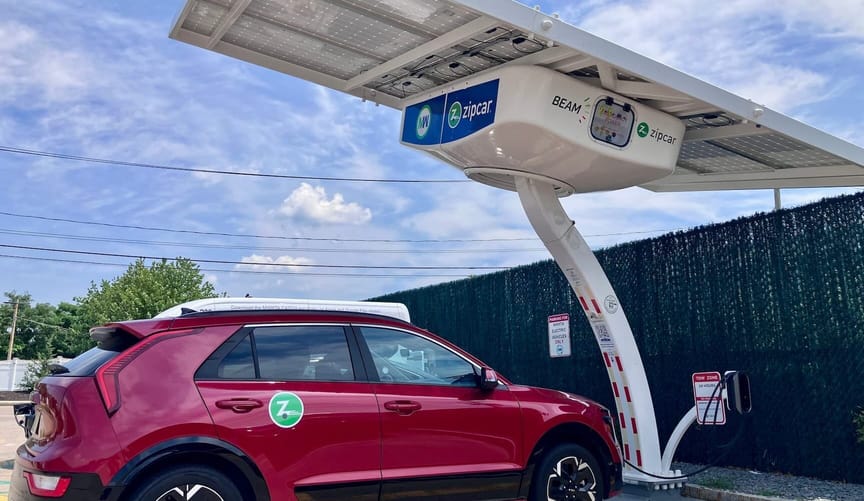
The result is a network of four cars — three Hyundai Konas and a Kia Niro — provided through Zipcar, the formerly Boston-based company that pioneered the carsharing concept. The vehicles are located in public housing developments in Boston and Chelsea, and sites in downtown Framingham and Quincy.
Each vehicle is paired with a solar-powered charger from EV infrastructure company Beam Global. The portable charging stations include a solar canopy held aloft by a large, curved metal arm. The whole thing looks something like “an alien spaceship,” Weyant joked, but the technology has the potential to get more charging capacity deployed more quickly, since it doesn’t require digging trenches, disrupting roads, or going through a grid interconnection process.
“We actually get to understand the impact of bringing something to residents in a faster, more affordable way for our cities and towns,” she said.
To make using the vehicles affordable, Zipcar has agreed to waive its standard $25 application fee and lower the annual membership fee from $90 to $35. Once they’re enrolled, drivers can use the car for an hourly rental rate of $11 on weekdays and $13 on weekends, which includes the cost of insurance and charging. Standard Zipcar fees vary by market, but are generally from $14.50 to $17 per hour.
In Boston and Chelsea, all residents of the public housing complexes where the cars are located are eligible to sign up for the pilot. In Framingham and Quincy, interested drivers must show evidence that they already receive government assistance through programs such as the Supplemental Nutrition Assistance Program or MassHealth, the state’s Medicaid program.
The first participants have already enrolled, and the cars hit the road this week. The organizers will be watching closely to see who is driving the EVs, where, and how often, said Scott Nathan, CEO and founder of charger platform company Alwayz, a partner in the project. They’re hoping to learn more about whether there is demand for such service in the targeted communities, what kind of education or messaging is needed to get drivers behind the wheel, and how many miles users drive per trip.
The goal is to gather information that will help expand EV use, boost businesses in the sector, and drive down emissions, Nathan said.
“We think there are long-term benefits to providing greater access,” he said. “We think that will grow the market of electric vehicles, and ultimately help reduce impacts on climate change.”
Research shows that once drivers try an EV, they stick with them. That’s why these incentives target those who’ve never owned one to maximize the bang for the buck.
California is making a bet: Once you’ve driven an EV, you won’t want to go back to a gas-powered car.
Earlier this month, Gov. Gavin Newsom (D) signed legislation creating the MyFirstEV program. It’s the state’s first big attempt to make up for the loss of federal EV tax credits, and it’s exclusively targeting the key demographic of EV neophytes.
The fine details are still being hashed out in advance of MyFirstEV’s official launch later this summer. But, in broad strokes, the program will offer a $3,500 rebate at the point of sale for a first-time purchase or lease of any new EV that retails for $50,000 or less, and a $1,750 rebate for a used EV selling for $25,000 or less.
The program is funded with $270 million. Half of that will come from the state budget, and the other half — in a rare arrangement — will come from participating automakers, including Ford, General Motors, Honda, Hyundai, Kia, Lucid, Mitsubishi, Nissan, Rivian, Subaru, Tesla, Toyota, and Volvo.
For years, consumers across the nation could get discounts of up to $7,500 for new EVs and up to $4,000 for used EVs. These tax credits were crucial: They could make some new EVs cost-competitive with new fossil-fueled cars.
But the megabill passed by Republicans in Congress last year killed those federal incentives at the end of September 2025, and EV sales have plummeted since.
That poses problems for decarbonization goals held by states like California, as fossil-fueled vehicles are among the largest sources of greenhouse gas emissions in the nation.
The Golden State is not the only one trying to make up for lost tax credits. Programs in Connecticut, Delaware, Illinois, Maine, Massachusetts, New Jersey, New York, Rhode Island, and other states offer incentives and rebates that can reduce the cost of an EV by more than $1,000. Residents of most states can find some form of assistance from government or electric utility programs for vehicles and for home chargers.
California’s new program is notable both because it is by far the nation’s largest EV market and because it’s the first to tie rebates to first-time EV buyers.
That’s according to Rachel Reolfi, senior policy analyst at research firm Atlas Public Policy. She made the case for strategies like MyFirstEV in a December policy paper that argued states will get more “bang for the buck” if they limit incentives to first-time buyers.
As Reolfi told Canary Media, this “pretty novel concept” makes sense because of a simple fact: “When folks buy an EV, they don’t go back to gas cars.”
Survey data supports the point. J.D. Power’s February consumer satisfaction survey shows that 96% of U.S. EV owners would consider purchasing or leasing another EV for their next vehicle. Concerns about range and charging availability also drop significantly once a person starts driving an EV, per analysis from EV-advocacy group Plug In America.
This data helped inform California’s MyFirstEV program, said Dan Krassner, executive director of EVs for All America, a nonprofit research group that commissioned the Atlas report.
By focusing scarce state funds on first-time EV buyers, “each rebate buys a customer rather than a transaction,” Krassner said in an email. American EV Jobs Alliance, his group’s advocacy affiliate, “took that concept into California and made the case for it with lawmakers, the administration, and coalition partners.”
This approach makes sense, according to Corey Cantor, research director at the Zero Emission Transportation Association trade group. “When you leave the early adopters behind and try to hit mass market scale, we know up-front price and charging concerns have been a challenge,” he said. “The people we really need to reach are those that have yet to be convinced to drive electric.”
Restricting rebates to first-time EV buyers does add some complications.
MyFirstEV will require participants to submit a document attesting that they haven’t previously bought an EV, according to John Swanton, a communications specialist at the California Air Resources Board, the agency administering the program.
It’s possible that some applicants may try to game the program by failing to disclose that they’ve bought an EV before, said Scott Shepard, transportation senior director for the Center for Sustainable Energy, a nonprofit group that manages EV rebate programs in multiple states, including the California Vehicle Rebate Program, which ended in 2023. But there are fairly simple ways to police that, he said, like checking records with the state Department of Motor Vehicles to “keep people honest.”
If anything, Shepard said, it’s easier to look up vehicle registration data than it is to enforce the income limits that some other state programs require. MyFirstEV has no income restriction.
Meanwhile, limiting rebates to purchases of new EVs that sell for $50,000 or less helps prioritize people seeking lower-cost alternatives, he said, although the program does waive that limit for vehicles made by companies headquartered in California, which includes Lucid and Rivian.
Including credits for used EVs also helps lower-income buyers, Shepard said. New EVs still cost quite a bit more than their gasoline-fueled counterparts, but used EVs are much cheaper comparatively, particularly as previously leased vehicles start to come back onto the secondary market. “Creating used-vehicle options is a great way to distribute air quality and economic benefits,” he added.
Finally, the program will adopt what’s become a best practice for EV incentives: Allowing customers to instantly receive the discount rather than needing to wait to file their taxes to claim the rebate.
“One of the sticky points early on with EV tax credits was that it was a tax credit and not a point-of-sale rebate — and that adds sand to the gears,” said Andrew Garberson, head of growth and research at Recurrent, a company that aggregates data on EV battery health. “Making it point-of-sale adds grease instead of sand to the gears.”
Targeting first-time EV buyers may be particularly appropriate for a state where EV enthusiasm is recovering more quickly than the U.S. as a whole, noted Cantor of the Zero Emission Transportation Association. New data from the Newsom administration and from the California New Car Dealers Association shows that EV sales have started to climb back after their post–federal tax credit slump.
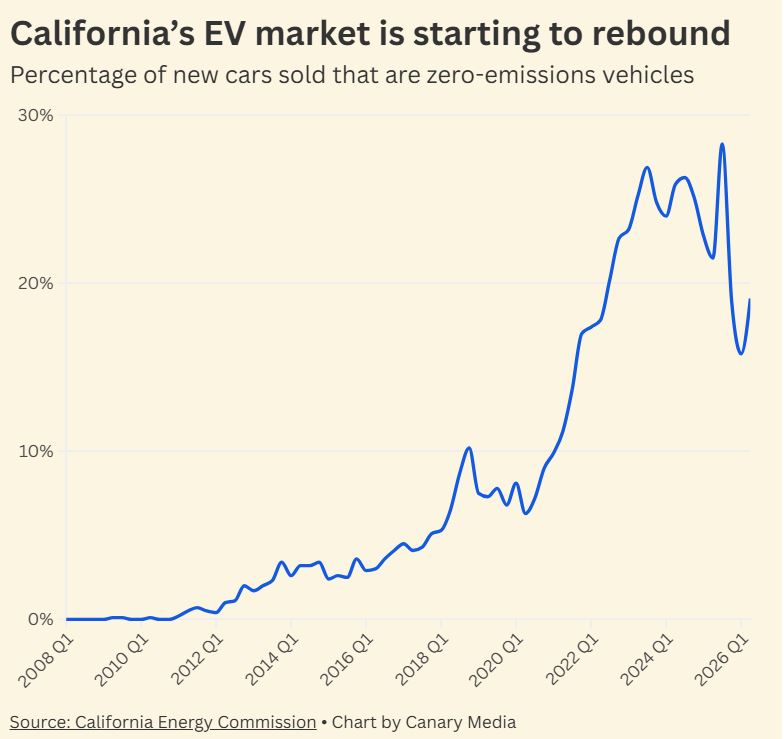
What remains to be seen is whether California and other states can help the U.S. automotive industry recover from the federal government’s pullback, Shepard said. But states are inherently more constrained in how much money they can commit to these kinds of programs, which limits their impact.
According to Shepard’s initial analysis of demand for EV incentives from the California car-buying public, the $270 million for the MyFirstEV program will most likely be depleted within less than a year. States may need to commit to “funding mechanisms that are more reliable, more stable, perhaps more meaningful,” than what they’ve been able to pull together thus far, he said.
Even a state as wealthy and as central to the EV market as California will struggle to make that happen, Atlas’ Reolfi said. “It’s clearly a constrained state budget environment,” she said. “But it’s good to see states sending a message.”
In that light, getting automakers to match the state’s $135 million in funding was something of a coup, Cantor said. German automakers have contributed to that country’s government EV subsidy programs in the past, but “that hasn’t been done in the U.S. before,” he said.
Krassner of EVs for All America said he has promoted prioritizing first-time EV buyers in testimony before the Maryland Mitigation Working Group, a key body under the state’s Commission on Climate Change.
“California just handed every other state a template that works.”
A head-to-head matchup of electric and gasoline cargo trucks shows how rising fuel costs make EVs much cheaper to run. Now, can manufacturers lower up-front costs?
Electric cargo trucks have been getting more cost-competitive for years. But the fuel price spike triggered by the Iran war has made it clear just how much cheaper it can be to move freight with trucks that run on electricity instead of gasoline or diesel.
New data from electric-vehicle manufacturer Workhorse, which runs identical routes with both gasoline cargo trucks and electric cargo trucks for its Stables by Workhorse business, provides a case study of how elevated gasoline prices make EV options more appealing.
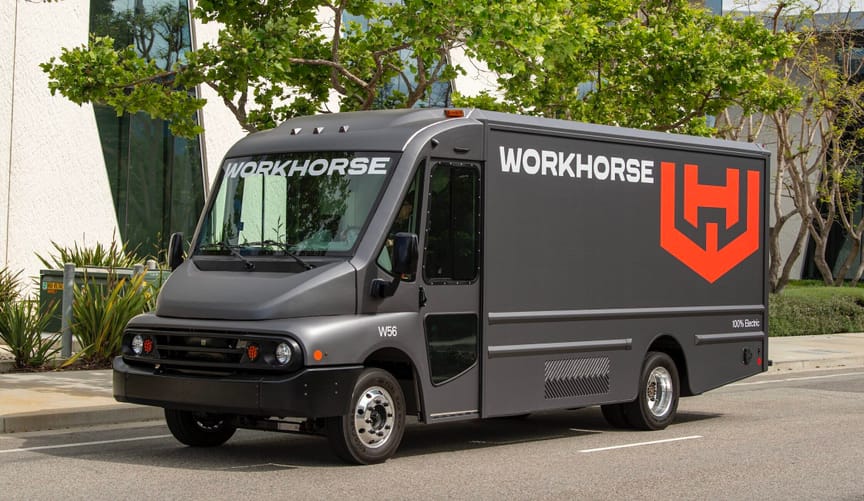
Stables delivers packages as an independent service provider for FedEx in Ohio. Its use of internal-combustion-engine and battery-electric trucks side by side has given it a rare “controlled, real-world comparison” of the two vehicle classes with “the same routes, the same drivers, and the same weather,” as explained in a presentation at the ACT Expo trucking industry show in May.
The electric trucks Workhorse builds and runs in its Stables fleet, a type known as step vans, were already cheaper to operate last year than their gasoline-fueled counterparts — saving about 42.5 cents per mile, based on electricity at 11 cents per kilowatt-hour and gasoline at $2.98 per gallon.
But by May 1, gasoline had spiked to an average of $4.83 per gallon in Ohio, pushing the savings advantage for electric trucks up to 73.6 cents per mile. With gas prices so high, a Workhorse step van driving about 50 miles per day can expect to save about $11,000 per year on fuel costs.
The operating-cost difference matters a lot when it comes to electrifying truck fleets. EV trucks cost 50% to 100% more than fossil-fueled versions, according to industry estimates, which means they need to provide enough savings on operations to make up for that higher sticker price.
In the past few months, Workhorse CEO Scott Griffith said customers have grown more interested in buying trucks from his company, which is a small-scale producer in the broader world of medium-duty truck manufacturing.
“The phone is certainly ringing, and the interest is high, and everyone’s doing the math,” he said. “What is the cost of electricity, what are the lease costs, what are the operations and maintenance costs? They’re coming in with a much more sophisticated approach.”
Workhorse’s experience is only one example of how EV trucks are growing more appealing to fleet operators, said Corey Cantor, research director at the Zero Emission Transportation Association trade group. He noted that other fleet operations have observed similarly high savings as gas and diesel prices have spiked in recent months. While those prices have declined slightly since a purported peace deal between the U.S. and Iran last month, they remain significantly higher than before the war began.
Diesel, which is the primary fuel for trucks around the world, has seen an even greater increase in cost than gasoline, putting pressure on fleet operators.
“When diesel is at such an elevated price — even if it may come down over the longer term — it spurs a conversation,” Cantor said.
While the recent gasoline and diesel price spikes are driving conversations about electrification, it’s not clear whether that’s resulting in more purchases or leases of EV trucks.
That’s mainly because the data hasn’t yet come in, said Jacob Richard, technical project manager at Calstart, a nonprofit group whose members include energy producers, carmakers, and other businesses.
There’s plenty of room for growth. Electric trucks made up less than half a percent of the total U.S. truck stock as of mid-2025, according to Calstart’s January report Zeroing in on Zero-Emission Trucks.
Of the 72,000 electric trucks deployed in the U.S. at the end of last year, the vast majority were so-called “last-mile” delivery vans. Cargo vans — the smallest type of commercial cargo vehicle — are an ideal electrification target because they run relatively short routes to and from central depots where they can recharge overnight using slower, less-expensive charging infrastructure, said Mike Roeth, executive director of the North American Council for Freight Efficiency.
The nonprofit research group has put vehicles through real-world tests in its “Run on Less” events and found that battery-electric trucks cost less to operate than fossil-fueled equivalents on the sub-100-mile daily routes that make up about half of all freight miles traveled in the U.S.
Griffith agreed that shorter-haul, “return-to-base” freight routes have been a good fit for Workhorse customers like Purolator and Gateway Fleets, both of which have placed orders for 100 of the company’s electric step vans this year.
“Many of them are running what we call lollipop routes — 90 miles out from the depot, and coming back and charging up,” Griffith said. He added that “a significant chunk of medium-duty trucks” are running such routes, “especially the large fleets.”
But electrifying medium-duty trucks is more complicated than electrifying cargo van fleets, Roeth noted. Medium-duty trucks range from step vans like the ubiquitous brown UPS delivery vehicles to box trucks that have different types of rectangular cargo containers mounted on separately built “cutaway” chassis. They tend to be built for a wider variety of custom markets in much lower quantities than cargo vans, which more closely resemble mass-market passenger vehicles in how they’re manufactured and marketed.
“The smaller and more automotive you are, the greater the scale of production, the lower the cost,” Roeth said. “As you move to a cutaway, where you have to work with a different manufacturer to get that box on, the cost challenges go up.” That’s true for both EV and internal-combustion vehicles in this class, he said.
Still, manufacturers of battery-electric trucks stand a good chance of making headway across market segments while fuel prices are high, Cantor said.
He highlighted Harbinger Motors, a startup that manufactures medium-duty electric-vehicle chassis that can be customized for different classes of vehicles. The California-based startup has raised about $360 million in venture financing, including a $160 million round in November co-led by FedEx, which also ordered 53 of the company’s medium-duty truck chassis.
Workhorse has taken a more circuitous route, Roeth said. He worked at the company back when it was an affiliate of Navistar International making chassis for internal-combustion-engine trucks. In 2013, Workhorse was acquired by startup AMP Electric Vehicles and shifted to making battery-electric chassis.
Last year, it merged with long-time electric-chassis startup Motiv, in what Roeth described as “a perfect marriage.” Even so, it’s not easy to break into established medium-duty truck markets: Workhorse reported widening losses in its first earnings report as a combined company in the first quarter of this year, despite increasing revenues.
Those losses were driven in part by higher investments in manufacturing, as Workhorse retools its factory in Union City, Indiana, for the latest generation of its all-electric chassis, featuring more efficient batteries, drivetrains, and power-control systems. That factory is capable of producing up to 5,000 vehicles per year.
“We’re not just sticking an electrified powertrain on what we currently sell,” said Griffith, who was CEO at Motiv before the merger. “You can get some efficiencies out of that. But you can’t capture the full benefits of a fully software-defined vehicle without going all the way.”
The primary barrier to fleet electrification is the up-front cost of electric trucks. Right now, “a standard rule of thumb is that these vehicles are going to cost two times more than the equivalent cost of a diesel or gasoline version,” Calstart’s Richard said.
But there’s a lot of variation. Commercial vehicle pricing data “is not as transparent and easy to access as [data on] passenger cars,” Cantor said. Many vehicles are custom-designed, and pricing varies greatly depending on factors such as bulk purchase orders and preexisting relationships with fleet operators.
In the case of Workhorse, Griffith estimated that the company’s electric step vans cost about 30% to 40% more than comparable fossil-fueled vehicles. In early April, Workhorse dropped the price of its standard-sized W56 battery-electric step vans by roughly $60,000 to bring them just under $200,000 apiece, about level with the highest-end gasoline- or diesel-fueled alternatives.
The payback time on an electric truck depends on a mix of things — the model, state incentives, fuel prices, and so on. In states like California and Washington, which have generous incentives, buyers can recoup the extra costs on Workhorse’s larger step-van model in three to five years depending on gas prices, according to the company’s chief communications officer, John Williams.
Whether these kinds of paybacks are fast enough will depend on the fleet operator.
In general, bigger operators can afford to take a risk and wait longer, according to Richard. But Calstart presumes that the majority of buyers need to see a payback in three years, which coincides with how they structure financing and resale planning for their internal-combustion fleet vehicles, he said.
Today, the vast majority of electric trucks are being bought by big corporations that have both the deep pockets and the sustainability goals to make the up-front costs worth absorbing, Griffith said.
“But this is a $23 billion-a-year industry,” he said, citing estimates of annual U.S. sales of medium-duty vehicles — and to meet the needs of the broader market, “we’ve got to get the price point down.”
In certain regions, government incentives can nearly close that price gap, Richard said. Though the Trump administration and Republicans in Congress erased many of the federal tax credits that incentivized EV purchases, some EV-friendly states still provide incentives and rebates, he noted. “It makes sense for fleets to capture those up-front incentives while they stand.”
But electric truck manufacturers can’t bank on government incentives, Griffith said. “Those dollars are disappearing in the coming years. The industry has to get to the point where [total cost of ownership] blows internal combustion out of the water — and the buying price of an EV has to be closer to a 10% premium.”
To be clear, electric trucks offer significant benefits beyond lower fueling costs, Roeth said. Companies participating in his organization’s Run on Less events have tracked financial benefits like significantly lower maintenance costs as well as perks like increased driver comfort. Plus electric trucks release much less carbon and local air pollution — an important improvement, as commercial trucks are responsible for a disproportionate amount of such emissions from the U.S. transportation sector.
“For good or for bad, these trucks are used in routes that are sitting and idling for long periods of time,” Griffith said. “They emit three or four times per mile the emissions and carbon you get out of a passenger car. And they’re on routes that tend to affect dense populations,” he said.
Ultimately, he said, “if we can improve the economics and emissions together, make everything better on that route, fleets are going to adopt it.”
California, Massachusetts, and several other states are home to robust charging networks and strong consumer incentives that make it easy to go electric.
America’s EV industry has suffered a series of bad breaks over the last year and a half.
The end of federal tax credits for electric vehicles sent sales of new EVs off a cliff last fall. A nationwide buildout of chargers has been slow to get rolling. And the Trump administration has been dismantling air pollution regulations that were nudging the country away from gas cars.
But in the absence of a federal push for EVs, several states have been picking up the slack by building strong charging networks, introducing consumer incentives, and adopting other policies that make going electric a sweeter prospect.
A new analysis from the Brookings Institution dives deep on what makes a state an EV oasis, and scores states based on how far they’ve gone to promote vehicle electrification. At the top of its ranking? It’s a tie between California and Massachusetts, both of which scored 11 out of 13 possible points for overall EV readiness.
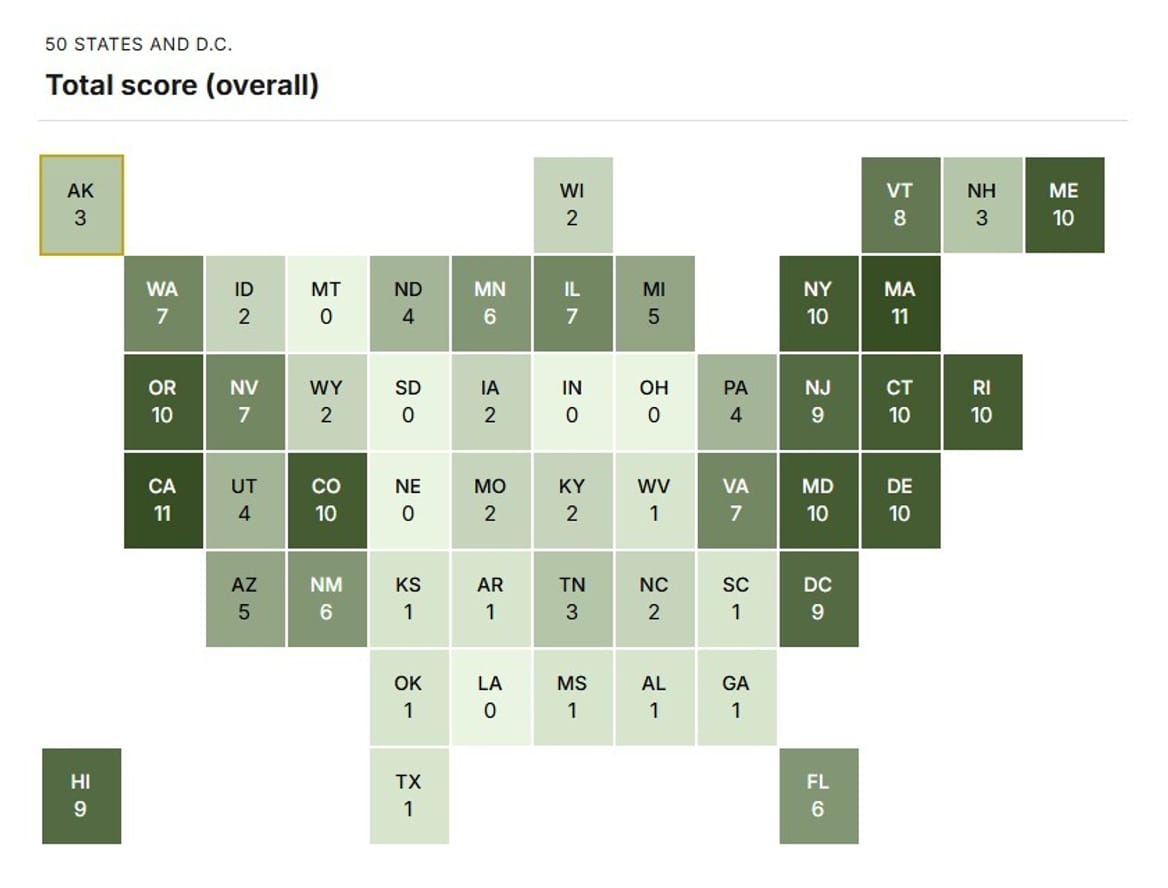
Massachusetts, New York, and Connecticut, meanwhile, have three major incentives to encourage average drivers to buy EVs: purchase rebates or tax credits, benefits like toll credits or parking perks, and no annual EV registration fees.
What about charging? Massachusetts and New York are the winners here, as they both have robust public charging networks, rebates that help people install chargers, and special utility rates for charging.
And yet Massachusetts still has room for improvement, according to Brookings. For one, EV manufacturers aren’t allowed to service vehicles in the state, which also lacks a plan for building out EV-charging infrastructure. As for California, the state’s annual registration fee for EV owners and lack of special utility rates for charging are weak spots.
At the other end of the spectrum, six states — Indiana, Louisiana, Montana, Ohio, Nebraska, and South Dakota — don’t have a single policy in place that’s getting them ready for an EV future, according to Brookings. Nineteen more have just a few EV-boosting policies on the books. Clearly state action alone won’t be enough to propel the entire U.S. toward a cleaner driving future.
Coal plants forced to stay open aren’t producing much power
The Trump administration has effectively stopped fossil fuel power plants from retiring on its watch, despite the strategy providing little benefit to the power grid and racking up hefty costs.
Six power plants, five burning coal and one burning oil and gas, had been slated to retire by the end of 2025, but were instead ordered to stay running to prevent what the administration called an “energy emergency.” At least one of those coal plants hasn’t operated at all under the emergency order, and another ran for only about two weeks, according to federal data reviewed by Utility Dive.
Altogether, the five coal plants produced just 1.5 million megawatt-hours of power during the first quarter of 2026, down 65% from what they generated during the same period last year. At the same time, the plants have racked up hundreds of millions of dollars in costs that could end up coming out of utility customers’ pockets.
Hyundai is building a massive steel mill in Louisiana. Will its neighbors benefit?
Hyundai’s plans to build a steel and iron plant in Louisiana could drive a clean revolution — or add yet another polluting factory to an area already known as “Cancer Alley.”
Canary Media’s Maria Gallucci recently visited the rural stretch between New Orleans and Baton Rouge where Hyundai is building a massive facility that will produce steel for automaking. At first, the plant will use natural gas to melt iron into steel — already a lower-carbon alternative than the coal that powers aging steel mills in the Midwest. But Hyundai has said it may later power its furnaces with hydrogen made from renewable electricity.
In the nearby city of Donaldsonville, residents and local leaders told Maria they’re skeptical Hyundai will actually follow through. They’re already surrounded by petrochemical facilities and oil refineries, and worry this latest factory won’t be any better for residents’ health or job prospects.
Read Maria’s thorough take on a complex story to learn more about the perils and promises of Hyundai’s green steel plans.
Nuclear ball out: The Trump administration announces $17.5 billion in loans to spur the development of 10 large nuclear reactors, with aims to begin construction by 2030 and get plants up and running in the next decade. (Associated Press)
Pumped-up home sales: A new report finds that installing an all-electric heat-pump heating and cooling system can increase a home’s resale value — as long as the appliance is mentioned in the real estate listing. (Canary Media)
Raising the roof: Warehouse roofs could be the perfect place to build solar arrays that can bring low-cost clean power to communities that can’t install their own panels, but states and utilities first need to do more to promote these community solar projects. (Canary Media)
Slated for takeoff: Jeff Bezos–backed EV startup Slate Auto says it has more than 180,000 reservations for its low-cost, bare-bones electric pickup, and customers now have a chance to preorder a vehicle with a $300 deposit. (Axios)
A data center surprise: The House Energy and Commerce Committee’s top Democrat, Rep. Frank Pallone, unexpectedly calls for a nationwide moratorium on data center development as Congress crafts legislation to protect household utility bills from spiking because of data centers’ massive power demands. (E&E News)
Can electric vehicles finally start working as backup batteries for homes and the grid? This 120-home pilot project in California is working out the kinks.
At first glance, Frances Bell’s home in Oakland, California, doesn’t look like a postcard from the EV-powered future. But if a new program takes off, it could be a harbinger of what’s possible for homes across the state and the country.

Sure, there’s a shiny new Kia EV9 in the driveway and a black charging cord that runs from the car to an EV charger on the side of her house. But that’s a pretty standard setup in California, the nation’s leader in electrical vehicle adoption.
What makes this EV and the charger special is that they don’t just draw power — they also send it back to both Bell’s home and the grid.
As the CEO of Bidirectional Energy, Bell is outfitting homes across California with the same Wallbox Quasar 2 bidirectional direct-current charger that’s mounted to her house. This year, Bidirectional Energy and Wallbox are installing the equipment at about 120 homes as part of a state-funded pilot program that offers participants rebates for two-way chargers. Bell’s household was among the earlist to enroll, primarily to test the technology firsthand.
Their goal: to establish rules of the road for city and county permitting inspectors and utility interconnection engineers to handle these installations, similar to the standards for regular one-way EV chargers and backup batteries.
“From my perspective, a DC bidirectional charger is essentially the same technology as a solar or battery inverter,” Bell said. And those technologies are straightforward for a household to install.
Bidirectional systems are not anywhere near as simple to adopt. Pilot projects have been going on for decades, and federal and state governments have been working with automakers, charging manufacturers, and utilities to standardize the underlying technologies. Nevertheless, no large-scale programs exist today to allow customers to send power from their EVs to the grid or their homes.
If companies like Bidirectional Energy and Wallbox can crack the code on broader adoption, it could unlock serious benefits to the grid and consumers. Vehicle-to-grid (V2G) applications can turn cars into cheap energy storage for the electricity system and vehicle-to-home applications (V2H) can turn their cars into batteries that can power their house, saving them money.
Bell is convinced that the larger scale of this California program will help push the technology out of pilot purgatory and into the mainstream.
“Previous bidirectional demonstrations were in the ones and twos,” Bell said. “When you get to 100 or more, you start to get to more standard processes. That’s how you start to scale.”
On a sunny May afternoon, Bell showed off her bidirectional charging system — and the benefits it provides.
The combination of Wallbox’s hardware and Bidirectional Energy’s software can actively draw power from the battery of a Kia EV9 to reduce a household’s costly utility bills, to send power to the grid to prevent rolling blackouts, or to power a home during an outage. The system isn’t available for use with other EVs yet, though the companies are in discussions with undisclosed automakers.
“If the grid goes down, this will just kick in. You don’t have to walk out here and switch it,” Bell said. Then she flipped a switch in the Wallbox power recovery unit, which connects the Quasar 2 to Bell’s electrical meter and the grid beyond, to mimic a power outage.
With a click, Bell’s home was being powered by the Kia EV9’s battery, which stores about 99 kilowatt-hours of energy. That’s as much as seven Tesla Powerwall batteries, and enough to keep a typical home powered for about three days, Bell said.
Next, Jessica Kwong, Bidirectional Energy’s senior software engineer, sent instructions from her laptop to the company’s software platform to curb grid power use to avoid high time-of-use rates. Bell opened the Bidirectional Energy app on her iPhone to track the shift in home power coming from the EV battery. Then she toggled to a screen that showed the money she’s saving on her utility bill.
“Every day, when I plug in my car, this number ticks up,” Bell said.
Finally, Kwong mimicked a demand-response event, when utility customers are asked to either send stored energy back to the grid or simply use less energy when the grid is under stress. The EV’s battery started delivering 12.5 kilowatts of steady power back to the grid — and earning money for the grid relief it was providing.
None of this is particularly groundbreaking from a technical perspective, said Bell, who’s worked at battery companies including Tesla and Fluence and as a grid planner for Northern California utility Pacific Gas & Electric. And after years of work from automakers, charger manufacturers, and software companies, a lot of progress has been made on setting the technology standards for bidirectional charging, she said.
That’s why this Bidirectional Energy and Wallbox project, funded by the California Energy Commission, is focused on more than simply proving the technology works, she said.
“We’re training some of the first installers, we’re getting the first interconnection processes established, and hoping to take that to other geographies.”
Bidirectional charging is an intuitive idea: Most cars spend most of their lives parked, which means that EVs are often sitting there with unused battery capacity that could be helping the grid, making money, or providing emergency backup services.
Lots of utilities are working on managed-charging programs, which ask customers to shift when their EVs pull power from the grid, whether to mitigate their contribution to peak power demand or to avoid overloading local circuits and transformers. That’s important, but it ignores EV batteries that could actively bolster the grid, not just reduce strain on it.
In California, the value of that latent EV capacity could be “an order of magnitude larger” than simply throttling EV charging, according to a 2021 study by University of California, Irvine, professor Brian Tarroja and Rochester Institute of Technology professor Eric Hittinger. It could also provide EV owners with thousands of dollars per year in utility bill savings and demand-response revenue, the report found.
Still, the approach has remained elusive — something of a holy grail for the EV industry.
Automakers have promoted these kinds of uses for years, from the earliest Nissan Leaf EVs to the now-discontinued Ford F-150 Lightning. Some automakers have designed their own vehicle-to-home connectors, as with the PowerShift charger from General Motors’ GM Energy business and Tesla’s Backup Switch for enabling Cybertruck Powershare mode. A growing number of EV-charger manufacturers make bidirectional-capable chargers that have been certified for use in California and in other states.
Many other states are pushing utilities to explore the concept, too, whether it’s using electric school buses as grid batteries or enabling homes to rely on plugged-in EVs for grid relief.
But California has set a goal of having 8 million light-duty EVs on its roads by 2030, making it ground zero for development via utility trials, state-funded pilot programs, and regulatory guidelines for streamlining bidirectional charger interconnections.
Wallbox, a Spanish company that does a lot of business in Europe, has seen a big uptick in North American sales in recent years, “especially when we talk about V2G,” said Oliver Waterhouse, the company’s director of strategic partnerships.
But injecting power from EV batteries to the grid “requires collaboration with utilities and grid operators,” he said — and while customers are eager to set up their EVs as backup batteries, “a lot of demand falls off when it takes 6 to 9 months to get an interconnection complete.”
Wallbox initially launched the Quasar 2 in partnership with Kia as a home backup system, he said. “Then Bidirectional Energy came in and said, ‘Let’s make it V2G as well.’”
One of the trickier tasks for the two companies has been getting the components of the bidirectional system to feel like a single streamlined experience for the customer, Bell said. To achieve this, the companies have been establishing the linkages between onboard EV-battery management systems, the controls embedded in the chargers, and the inverters within those chargers, which deliver power to the home and the grid, Bell said.
Industry groups and certification organizations have settled on a plethora of technology standards for handling those tasks. But every automaker and charger manufacturer may implement them slightly differently, which means each combination has to go through its own round of testing.
Automakers also need to make sure cars are charged when drivers need them to be. “First and foremost, you want your car to be a car,” Bell said. Bidirectional Energy’s software allows customers to set what time in the morning they want to be fully charged and establish limits on how much power can be pulled from their EV batteries, she said.
Getting utilities to trust that these underlying controls can safely send power back to the grid has been the next challenge, Waterhouse said. Wallbox has gone through these processes with all three of California’s major utilities, he said, “but when you submit interconnection applications, they all have different questions.”
This is where doing hundreds of installations, as is the plan for the second phase of the Wallbox and Bidirectional Energy pilot, can start to smooth things out, Bell said. Utilities have sent engineers to pore over every detail of the first installations done by Wallbox and Bidirectional Energy, she said. That’s pretty similar to how utilities used to treat conventional home batteries, she noted.
“For solar and batteries today, there’s no engineer that gets sent to the house,” Bell said. “Getting these first 120 right will be really key for the next hundred or thousand — or million.”
A correction was made on June 9, 2026. The story misstated that bidirectional charging systems can export EV battery power to the grid during an outage.
Despite the state’s political embrace of EVs, it has built zero chargers nearly four years after receiving federal funds from the Biden administration.
For all the concern about lost federal funding courtesy of the Republican trifecta in Washington, Massachusetts still has not deployed a single electric vehicle charger through a Biden-era program that President Donald Trump has left intact.
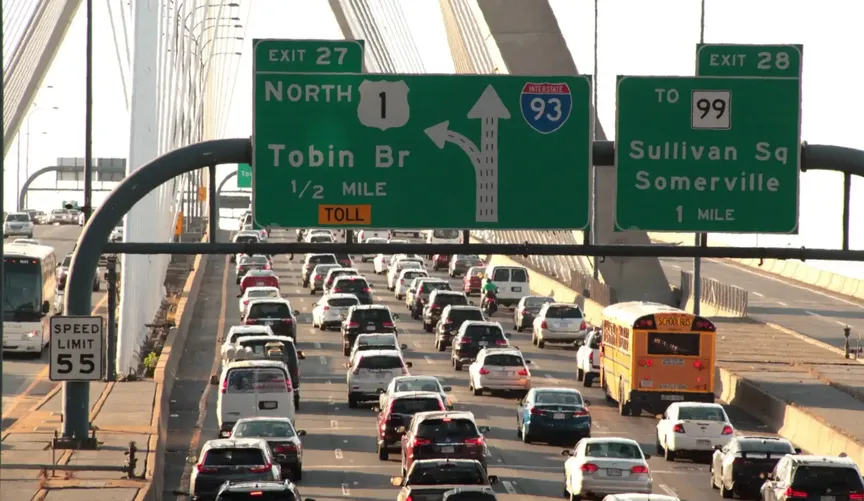
The Bay State is sitting on the roughly $64 million it was awarded through the National Electric Vehicle Infrastructure (NEVI) program, a $5 billion federal initiative authorized through the 2021 bipartisan infrastructure law meant to strategically dot the nation’s major highways with charging infrastructure that would make it easier for EV drivers to reliably travel greater distances.
Two years ago, Massachusetts selected three vendors to identify locations for NEVI charging stations and then build and maintain them. Only contracts with two of those companies, however — Applegreen and Global Partners — are signed, the state’s Department of Transportation confirmed to CommonWealth Beacon, leaving open questions about the viability of the third vendor, Weston & Sampson.
Now, nearly four years after receiving federal approvals, no EV chargers on Massachusetts’s major roadways through NEVI are up and running, MassDOT also confirmed.
It’s not clear what exactly is causing the holdup. CommonWealth Beacon filed a public records request to view the contracts with the two companies to ascertain whether there are deadlines associated with charger installations, but MassDOT did not provide those contracts in time for publication.
“The slowness of adoption here is mystifying,” said Jim Aloisi, a former state transportation secretary who now lectures at the Massachusetts Institute of Technology and serves on the board of the advocacy group TransitMatters. “If your approach to transportation sector decarbonization is largely about the transition to EVs, then you should be spending a fair amount of effort accelerating the process of getting people to adopt EVs, and one way to do that is obviously to roll out the NEVI initiative. That’s the disconnect.”
MassDOT didn’t respond to questions about why the pace of NEVI work has been so slow. The department’s “conservative” projections in 2022 found that NEVI funding would be sufficient for building 92 charging ports.
Some officials serving on the state’s Electric Vehicle Infrastructure Coordinating Council, which was established in 2022 to help create an equitable and reliable charging network, also appear to be in the dark. Eric Bourassa, who is a member of the group and serves as the director of transportation for the Metropolitan Area Planning Council, said that he’s “not privy to the details of what’s holding it up,” but that “everyone would agree that the pace of NEVI deployment in Massachusetts has been disappointing.”
So far, the two signed NEVI vendors have spent close to $4 million, according to Marshall Hook, a MassDOT spokesperson, all of which are for “development-focused” activities like engineering, permitting, and procurement.
There have been signs of progress. Applegreen has placed an order for EV charging equipment for locations in Greenfield and Newburyport and is targeting late July to begin construction, Hook said. Global Partners, meanwhile, has been approved to place orders on equipment and is finalizing plans to install chargers in Lancaster, Wrentham, and Raynham.
James Cater, senior director for sustainability strategy and innovation at Global Partners, said in a statement that the company is “happy” to be working on Massachusetts’s NEVI program and is beginning the procurement process for contractors for their initial charging sites “soon.”
Applegreen and Weston & Sampson did not respond to requests for comment.
Yet the slow adoption rate through NEVI continues to bewilder transit advocates given the state’s relatively small size and political embrace of EVs. Neighboring states like Rhode Island, New York, and Vermont boast a significant stock of NEVI chargers, in addition to more sprawling red states like Utah and Ohio.
“We should be capitalizing on every opportunity that we have available to us,” said Anna Vanderspek, electric vehicle program director at the Green Energy Consumers Alliance. “MassDOT should explain why it’s taken so long and what timetable we can expect now.”
The uptake on NEVI has been slow nationwide: Just 19 states have at least one operating EV charger funded through the program, according to the National Association of State Energy Officials. Adie Tomer, a senior fellow at Brookings Metro who specializes in infrastructure policy, said that poor capacity more broadly across states has stifled their ability to quickly implement the program as they wrangle procurement processes, permitting, and electrical grid transmission complications.
“There were plenty of ingredients here to have paralysis by analysis,” Tomer said. “Government officials are naturally going to be risk averse, especially with newer programs, and officials needed to learn on the fly. NEVI hits all those sweet spots, so it’s not terribly surprising that deployments are coming along slower than initially hoped.”
The data around Massachusetts’s EV push offers a mixed bag. On one hand, the state’s slow crawl on NEVI is contrasted by its relative success deploying EV chargers in general. State data show the Commonwealth ranking fourth in the country for charging ports per capita after a sharp increase in installments over the past few years.
Yet, Massachusetts still has about 2,000 charging ports less than what it estimates it needs, according to the most recent state climate report card.
The state also remains significantly behind its targets for registered electric cars and trucks as it races to cut its greenhouse gas emissions in half compared to 1990 levels by 2030. There are just 735 medium-and-heavy-duty EVs on the road, a sliver of the 3,200 called for by the end of 2025.
On light-duty EVs and plug-in hybrids, Massachusetts has about 166,000 such cars, short of the 200,000 needed by last year. Last year, the Healey administration also delayed an EV sales requirement.
Part of convincing consumers to purchase generally more expensive electric cars involves easing “range anxiety,” the worry of EV drivers about whether they’ll make it to their destination or the next charging station — one of the core functions of the NEVI program.
Notably, Massachusetts has also placed its NEVI bet on two companies that have been at intense odds with each other in the past year.
Applegreen and Global Partners — the two vendors with signed contracts with the state for NEVI work — have been at the center of a bitter dispute over the state’s efforts to redevelop 18 highway service plazas. MassDOT awarded Applegreen that major contract last year, but the company backed out after losing bidder Global Partners sued the state and fought to block the deal over allegations that the process was unfair.
MassDOT is now preparing to rebid the whole project, and the state inspector general ridiculed the agency for having “too many flaws” in its process that has attracted the ire of Beacon Hill.
The bad blood between Applegreen and Global Partners may not spill over into how fast the companies can deploy chargers on the state’s major highways since they will be responsible for separate individual sites, minimizing the necessity for direct collaboration.
But the situation speaks to the challenges of complicated procurements and the fragility of the private market to perform this sort of work, when a small pool of companies competes for similar supplies and subcontractors and could be vulnerable to price spikes.
“The word ‘irony’ is a good one,” Aloisi said. “It may be that there’s just not a lot of good competition in this area. What does that landscape look like, and who wants to play in that sandbox? And it may be that the unfortunate answer is not too many players, so you’re stuck with the same.”
This article first appeared on CommonWealth Beacon and is republished here under a Creative Commons Attribution-NoDerivatives 4.0 International License.
Despite sluggish EV sales in the U.S., it’s full steam ahead for electric vehicles in most other regions.
Electric vehicles may be struggling to find buyers in the U.S. — but they’re making inroads elsewhere.
A record-breaking 28% of new cars sold this year will be battery-powered, according to new data from the International Energy Agency. That’s a big deal: Driving around in gas-guzzling vehicles spews tons of planet-warming and health-harming pollution into the atmosphere.
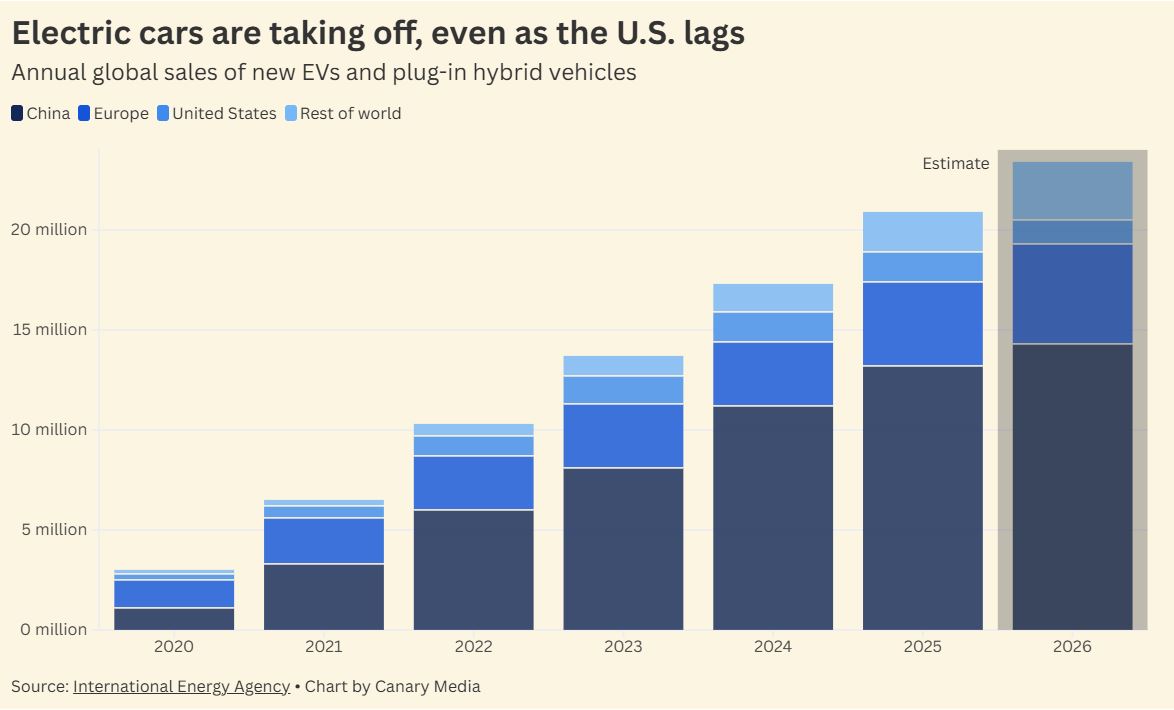
The latest projections come even as the Trump administration’s attacks on electric vehicles stymie sales in the U.S., the world’s second-largest car market. The country is a massive laggard when it comes to EV adoption, with electric models making up just around 10% of new car sales. New EV sales are expected to decline for the second year in a row in the U.S., though used models are surging in popularity.
But outside the U.S., the picture is very different. The clearest example of that contrast is China, the world’s biggest car market and the global leader in electric vehicle and battery manufacturing. Nearly 60% of cars sold in China this year will be electrified.
EV sales are growing rapidly across the rest of Asia, too. This year, sales are expected to leap by over 50% across Asian countries other than China, IEA found, driven in large part by the availability of super affordable Chinese EV models.
In Europe, which has strong emissions standards that push consumers toward EVs, sales are growing especially fast. This year, EVs will make up one-third of new cars sold in the region, powered not only by EV-adoption poster child Norway but also by rapid uptake in Germany, the U.K., and Turkey.
It’s worth emphasizing that these figures are for new car sales only. It will take longer for EVs to become the most popular type of car on the road: Right now, they make up just about 5% of the global car fleet.
Still, we’re well past the peak for gas car sales, and the trends are in favor of EVs. By 2035, the IEA expects half the new cars sold worldwide to be EVs. In China and the E.U., 90% of new cars could be EVs by that time.
And then there’s the war in Iran, which has caused the price of gasoline to surge and even resulted in fossil-fuel shortages in some countries. The crisis is adding more urgency to the transition to electric vehicles, particularly for nations that rely on imported oil. As EVs get cheaper and the volatility of fossil fuels becomes more apparent, economics may start to drive the transition from gas cars faster than climate goals ever could.
Three electric school buses will kick-start the state’s groundbreaking vehicle-to-grid pilot program once school’s out, with more EVs to be added in the coming months.
After the school year ends in the Massachusetts towns of Acton and Boxborough, the district’s electric buses will mostly stay put in a parking lot. But they won’t sit idle all summer.
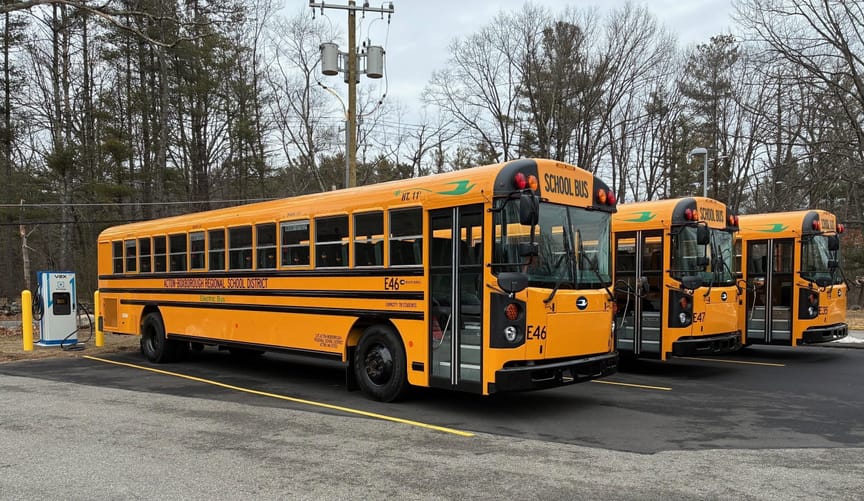
The three vehicles will charge up their nearly 200-kilowatt-hour batteries overnight, when the power supply is at its cleanest and cheapest, then send energy back to the grid from 4 p.m. to 7 p.m. on days when the grid is strained. The district will earn revenue for the power it shares, perhaps even enough to cover the costs of charging up during the school year, said Kate Crosby, energy manager for the Acton-Boxborough school district. Plus, the strategy will help lower the emissions and cost of the region’s electricity supply.
“The more we plug in batteries to the grid, the less we use peaker plants,” Crosby said. “They will help to stabilize the grid, help to reduce the cost of electricity for all ratepayers, and they’ll help make the grid cleaner.”
Acton-Boxborough’s school buses are the first vehicles to plug in to a Massachusetts program that aims to demonstrate and investigate the potential of “vehicle-to-everything” technologies, more commonly known as V2X. These systems use bidirectional chargers, which can power up a vehicle as well as send the energy stored in an EV’s battery back to a building or the grid.
Supporters say V2X technologies can yield a host of benefits. They can lower emissions by using stored energy generated at times when the grid is consuming less fossil fuel. They can help users offset their electricity bills by compensating them for power sent to the grid. They contribute to resilience when the power goes out. Plus, they can keep prices lower for everyone by sending cheaper power to the grid during times of high demand.
So far, however, widescale adoption has been elusive. Pilot programs across the U.S. and abroad have tested the possibilities, but they haven’t gained much traction in the face of high upfront costs, technical complexity, the huge variation among what equipment works with what vehicles, and the lack of established plans to compensate users for the power they pour back into the grid.
Massachusetts hopes its initiative will make some headway against these obstacles. At an event last week, the planners behind the demonstration program discussed what they’ve achieved so far, what they’ve learned along the way, and what problems remain.
The Massachusetts Clean Energy Center, an economic development agency, announced the demonstration program in early 2025, with the goal of giving away up to 100 bidirectional chargers to a variety of users. Participants were announced in February 2026: five school districts, four municipalities, and 30 residents. In order to understand how the systems function in a wide range of settings, the planners selected projects in all geographical corners of the state, and in rural, urban, and suburban areas served by 10 different utilities. The installations will include six different types of chargers plugging into eight different vehicles, from buses and pickup trucks to SUVs and compact hatchbacks.
“It’s not just about getting the right vehicle and the right chargers,” said Sally Griffith, transportation electrification program manager for energy consulting firm Resource Innovations, which is working with the state to run the program. “It’s about the whole system — how all of this needs to work together,” she said at the event.
Between 10 and 15 chargers are now installed and awaiting authorization to begin bidirectional charging. The rest are expected to be online by September.
Already, some challenges have been identified. The most pressing, speakers at the event said, have to do with finding a financial model that works.
For one, the systems are pricey: $15,000 to $40,000 for a residential setup, the Massachusetts Clean Energy Center estimates. Pilot programs can help defray costs for small numbers of users for a limited time, but a long-term, reliable compensation plan is needed to get any meaningful number of EV owners to make the leap.
But it turns out those compensation programs can be tricky to design. In Massachusetts, one major discovery so far has been the conflict between state solar incentives and the ConnectedSolutions program, which compensates battery owners for sending power onto the grid. Existing technology can’t tell the difference between electrons sent from solar panels and those coming from batteries. For a home with both solar panels and a bidirectional charger, it would be impossible to separate the solar power that should receive net-metering incentives from the EV battery power that would receive payment from ConnectedSolutions.
The Massachusetts Clean Energy Center had to immediately disqualify roughly 75% of the nearly 300 residential applicants for the V2X program because their homes had solar power, said Elijah Sinclair, the center’s senior program manager.
The state was aware there might be a conflict, but the scale took program planners by surprise, delaying the selection of participants and therefore the deployment of chargers.
One possible answer could lie in a program that compensates virtual power plants — networks of distributed energy resources like solar panels, batteries, and demand management — rather than providing different incentives for each component of the system, Steve Letendre, senior adviser at the Vehicle-Grid Integration Council, an EV charging advocacy group, told event attendees.
“We believe it’s a mechanism by which we can bring EVs onto the grid in a way that maximizes their value,” he said.
An unexpected bright spot so far has been the ease of interconnection, the process of formalizing agreements with utilities for hooking up an energy resource to the grid, Sinclair said.
“Utility interconnection was expected to be a big barrier,” he said. “But everyone has been just awesome to work with, and interconnection hasn’t slowed us down.”
The Massachusetts Clean Energy Center will collect data from participants for the rest of the year. By the end of the year, it aims to publish a comprehensive guidebook on what it’s learned about the cost, system design, and technical and regulatory barriers, with the goal of helping other agencies and states replicate the program.
In the meantime, the students and bus drivers of Acton-Boxborough will be enjoying quieter rides without any diesel fumes, said Crosby, the district energy manager.
“We are improving their quality of life immediately, and helping to create a cleaner, more stable future for them,” she said. “There’s nothing that matters more to us.”


.svg)
