

 Back
Back
There’s no sugarcoating it: A new North Carolina law unraveling utility Duke Energy’s climate goals is a massive setback for the state’s clean energy transition, and it’s being exacerbated by the Trump administration’s full-scale assault on wind and solar power across the country.
Yet many observers believe that in the short term the renewable energy sector will bend but not break — buoyed by the realities of rising electricity demand and the increasingly bleak economics of fossil fuels.
The Republican-led legislature passed Senate Bill 266 last month, overriding the veto of Gov. Josh Stein, a Democrat. The legislation erases a 2030 deadline by which Duke must cut its carbon emissions by 70% compared to 2005 levels, though it retains a mandate for the utility to decarbonize by midcentury.
Those deadlines were set into state law in resounding bipartisan fashion only four years ago, with just over two dozen “no” votes in the GOP-controlled House and Senate combined.
But it was a different era politically. Democrat Joe Biden had just won the presidency, spurred in part by voters animated by the climate crisis. Then-Gov. Roy Cooper, a Democrat, had made promoting the clean energy economy a signature of his administration, and his party held enough seats in both chambers to sustain his veto.
Elected in 2024, Stein has made no secret of his support for clean energy, but his focus to date has been recovery after Hurricane Helene, which struck the state nearly a year ago. Republicans in the General Assembly are only one vote shy of a supermajority. President Donald Trump’s stunning attack on wind, solar, and climate science has given license to like-minded allies in his party and in powerful state industrial groups to follow his lead.
The utility landscape has also shifted dramatically. In 2021, Duke, ever-influential with lawmakers, was willing to compromise on a wide-ranging energy bill to secure approval for a long-sought multiyear ratemaking scheme. Before a cleantech manufacturing resurgence and the explosion of AI, the company also faced relatively flat electric demand. State utility regulators, all but one appointed by Cooper, appeared inclined toward climate action, even if they sometimes frustrated advocates.
Today, Republican-appointed members — including one with an apparent axe to grind against solar — comprise the majority on the Utilities Commission. After the passage of SB 266, the panel wasted no time in ordering Duke to stop near-term planning for cutting its carbon emissions by 70%.
Duke still must zero out its climate-warming pollution by 2050, and its latest plan for doing so is due Oct. 1. But if predictions from Public Staff, the state-sanctioned customer advocate, are any indication, removing the near-term goal could mean seismic changes to the company’s forecast for the next decade.
With the blessing of regulators, the company was already on pace to miss the interim target by five years. Without any midway goal, Duke could build about 12 fewer gigawatts of new power capacity by 2035 and lean harder on aging fossil-fuel plants and purchased power instead. The forgone generation includes 4.4 gigawatts of solar, 2.8 gigawatts of battery storage, and 4.5 gigawatts of wind, according to Public Staff.
Advocates are working hard to make sure those predictions don’t come true.
One dynamic that may help is the urgency of rising electricity demand. According to June figures from Duke, new economic development projects in the form of data centers and other large customers could require roughly 6 new gigawatts of capacity by 2030.
Yet wait times for new natural gas turbines are as long as seven years, according to S&P Global. And Duke plans to be a so-called second mover on small modular nuclear reactors — meaning it doesn’t foresee becoming the first U.S. utility to put the nascent resource into service. A new reactor won’t come online for at least 10 years, per the company.
Even if the most extreme predictions about new economic development don’t pan out, solar and battery storage, and even onshore wind, are all poised to fill a need left by these delays, advocates say.
“It’s a matter of meeting a deficit — a potential deficit — in energy demand,” said Karly Brownfield, a senior program manager with Southeastern Wind Coalition, a nonprofit that advocates for the industry. With similar development timelines as gas and a well-established and tested permitting process in the state, she said, “I think onshore wind is definitely going to continue to move to the front.”
Another factor favoring renewables: cost. While the tax and spending bill signed by Trump this summer indubitably scrambles the calculus on wind and solar by phasing out tax incentives more quickly than before and making them harder for developers to access, these resources are still cheaper than new fossil-fueled plants — even without subsidies. The cost of battery storage, meanwhile, continues to decline.
At the same time, the specter of rising natural gas prices should loom large, says Josh Brooks, chief of policy strategy and innovation with the North Carolina Sustainable Energy Association. “The passage of SB 266 puts into sharp focus retail ratepayer exposure to fuel-price volatility,” he said. “The best and quickest opportunity to address that risk is through distributed renewables — especially solar paired with storage.”
Brownfield is also not giving up on offshore wind, despite the Trump administration’s aggressive antipathy for ocean-based turbines and Duke’s recent decision not to solicit any offshore projects in the near term. The three developers who hold leases off North Carolina’s coast have spent relatively little on their projects so far, Brownfield said. They can bide their time until the politics and the economics become more favorable.
“They’re early enough in the process that they feel like they can mitigate that risk over the next couple of years,” Brownfield said. “The conversation about offshore wind is not going to go away.”
Advocates also point to the colossal economic development impact of renewables in the state — from the farmers who increase their profit margins by leasing land for turbines or solar panels to the county commissioners looking to fund public schools. An analysis released just before lawmakers passed SB 266 showed the law could cut investment in power plant construction by more than $47.2 billion between 2030 and 2035, and reduce tax revenue by more than $1.4 billion — mostly because of forgone renewable energy development.
In hurricane-prone North Carolina, resiliency concerns loom large, too, said Brooks, who noted the success of solar microgrids and other climatetech in the wake of Helene’s devastation. “There’s no doubt about it that that was the quickest way to respond to Helene,” he said. “As incidents like that increase, we’re only going to see more need for the utility to think about decentralized assets.”
Even without the 2030 carbon goal, clean energy advocates will have several chances over the next year to advance these arguments before the Utilities Commission.
An analysis of Duke’s large load growth projections is ongoing, and an expert witness hearing is scheduled for October. The company’s latest draft plan for phasing out climate-warming emissions comes this fall and must be finalized by the end of 2026. What’s more, Duke is proposing to merge its two separate utilities in North Carolina, and could soon proffer another three-year rate increase to begin in 2027.
“There’s going to be tens of billions of dollars of investment decisions made at the regulatory level in the next year,” said Will Scott, Southeast climate and clean energy director for Environmental Defense Fund.
Regulators have also directed the company to test gas-fired plants that can be fueled with hydrogen. If that experiment ultimately proves unworkable, it could force Duke to abandon its apparent plan to convert its fossil-fueled plants to hydrogen at the last minute to comply with the midcentury carbon deadline.
“Given how big a piece hydrogen was in their 2050 plan, in terms of reducing emissions from the new proposed gas units, that’s going to be good to keep an eye on,” Scott said.
Still, the immediate future of renewables is likely to depend most on Duke itself, whose sway with regulators appears steadfast as ever. And the company’s shareholders, who per one Wall Street firm secured a “more predictable earnings trajectory” from the passage of SB 266, could pull away from wind and solar and toward more robust investments in fossil fuels.
What’s more, the current political climate, as set by the White House, could embolden anti-clean-energy lawmakers to push to eliminate Duke’s carbon goals entirely before possible Republican losses in next year’s midterms.
Advocates are clear-eyed about that risk. But they also point to electric bills that are already rising and predicted to climb even more under SB 266, especially for households. That could create the impetus for bipartisan legislation to course correct.
“I can easily foresee a world where we do not have to engage much to get parts of this bill overturned in a future session once the economic realities of it hit the ratepayers,” Brooks said.
The Trump administration is making it harder for low-income households to access the money-saving benefits of solar — but hard doesn’t mean impossible.
There’s a lot for developers of affordable solar projects to navigate at the moment.
The Trump administration has clawed back billions of dollars in Inflation Reduction Act funding for projects serving low-income communities across the country, including $7 billion for the federal “Solar for All” program. In July, the GOP-controlled Congress passed a sweeping law that will swiftly phase out the tax credits solar developers use to bring down costs. And for months now, the administration has held up $20 billion in federal green bank funding, which some organizations planned to use to make solar available to more people.
Clean energy supporters are opposing the Trump administration’s freeze on green bank money in court and are expected to challenge the Solar For All clawback as well. In the meantime, the nonprofits and state agencies planning affordable solar projects with the money are left in limbo.
Still, some developers are forging ahead.
Take John Miller and Jessica Pitts as an example. The pair, which founded Flywheel Development in 2014, is still proceeding with all 35 of their planned low-income solar projects, which will deliver a total of 17.5 megawatts of solar power to people who otherwise wouldn’t be able to access the clean energy source. Miller and Pitts think organizations like theirs can withstand Republican attacks on clean energy programs — so long as other financing and policy partners pick up the slack.
Figuring out a way to continue this work is crucial as energy costs rise even faster under Trump.
Rooftop solar is an effective way for households to reduce their electricity bills. But for a number of reasons, many low-income households can’t install rooftop solar: They may not own their home, or if they do, the up-front costs might be too high or they could struggle to qualify for a loan. Meanwhile, solar power is a tough sell for most multifamily housing, particularly rental properties where landlords take on the cost of installing panels that primarily benefit tenants, who usually pay the lion’s share of utility bills.
Community solar projects like those developed by Flywheel and others can solve these problems. Low-income households are able to sign up to access energy from these shared installations, letting them tap into the benefits of the clean energy resource.
In places where community solar isn’t available, multifamily properties can still use on-site arrays to reduce their utility bills. Those savings can be used to invest in cost-of-living upgrades, as can lease payments paid to properties that are hosting solar systems.
Federal action may not have completely foreclosed affordable solar aspirations — but in many cases, it has narrowed what’s possible.
“This is a drastically different world,” said John Fox, senior director of clean energy at Enterprise Community Partners. His organization runs Enterprise Community Development, one of the nation’s largest nonprofit affordable housing providers.
Enterprise has deployed 2.1 megawatts of solar at 13 of its properties in Maryland, Pennsylvania, Virginia, and Washington, D.C. It’s working on another 7.6 MW of solar as well as various projects around battery storage, electric vehicle charging, geothermal heating and cooling systems, and energy-efficiency retrofits.
Enterprise had hoped to deploy 24 megawatts of solar across its properties by 2032. “Now, I think it’s going to be half of that, because that’s what’s cost-effective in this new environment,” Fox said.
And although Flywheel is pushing ahead with its full project pipeline, the financial calculus has gotten tougher due to Trump’s policy changes. The tax-credit phaseout “has a fairly significant impact on the timeframes for projects, and how we manage compliance,” Pitts said.
While the new law doesn’t immediately eliminate the federal tax credits that cover 30% or more of the cost of solar investments, it does require projects to start construction by July 2026 or to be delivering energy by the end of 2027 to qualify for the incentive. It also forces installers to abide by complex and still-vague anti-China rules starting next year.
These policy headwinds are raising costs and cutting into the utility bill savings that developers can pass on to low-income residents, Fox said. Enterprise has historically offered average savings between 20% to 50%, and while Fox says the nonprofit can maintain that 20% level for systems that still qualify for tax credits, the “steep discounts of 50%” are not tenable in the current policy environment.
Flywheel earns a fairly good return on its investments, if not as lucrative as those possible from higher-end real estate projects, Pitts said. The company evenly splits its revenues with host properties for some of its projects, and accepts 30% of the revenues for its Solar for All projects — a skinnier cut that still pays out well, given the program’s generous long-term payments for the solar power generated, she said.
Losing federal tax credits will make solar projects more expensive, which will require lenders to adjust their expectations, but Pitts said she thinks their more community-focused financing partners, like the DC Green Bank and local nonprofit community development financial institutions (CDFIs) will understand that need.
“With that category of financier, there’s a focus on community investment,” she said.
A large part of why Flywheel can press on with its plans is its partnership with the local government.
Much of its work has been backed by payments from D.C.’s Solar for All initiative, the inspiration for the embattled federal program that offers lucrative payments for shared solar projects that can reduce energy bills for lower-income D.C. residents. To date, Flywheel has installed 6.2 megawatts of solar across 88 sites in D.C. and Maryland.
Finding lenders for these relatively novel solar projects was tough at first, said Miller. The company has primarily worked with CDFIs, which focus on underserved communities.
It also found a crucial partner in the DC Green Bank — one of a growing number of “green banks” that make clean energy, efficiency, and environmental remediation loans in communities that have been shunned by mainstream lenders. Flywheel’s Fairfax Village project received one of the DC Green Bank’s earliest loans in 2020, said Gary Decker, the bank’s chief operating officer. The DC Green Bank has also financed some of Enterprise’s projects.
The results speak for themselves. Flywheel’s D.C.-backed projects at properties like the Fairfax Village and Perrington affordable condominium communities and Abrams Hall, an affordable senior living community at the former Walter Reed Army Medical Center, have delivered $15.4 million in no-cost electricity to low-income residents of Washington, D.C., Pitts said.
They’ve also provided $4.25 million in lease payments to the properties involved, which have used the money for tasks including replenishing reserve funds and paying for roof repairs.
Flywheel is helping property owners put some of those proceeds toward energy-efficiency upgrades, Pitts said, which would slash utility bills even further.
At the Perrington Condominiums property in D.C., for example, Flywheel combined solar photovoltaic panels that meet about half the building’s annual electricity needs with rooftop solar thermal systems to offset about 40% of the property’s use of fossil gas to heat water. The property plans to invest the money it’s saving on energy into other capital investments, including efficiency improvements, Pitts said.
Enterprise is encouraging its buildings to do something similar. The nonprofit is working on long-term solar power purchase agreements to hedge against rising utility rates in the region. “We’re not going to be passing on fluctuations in the market,” Fox said.
Any savings Enterprise can achieve through solar PPAs can be put toward energy-efficiency investments. “We have to run tight buildings. We don’t have a lot of profits to dole out,” Fox said. “Our residents pay 30% max of their living wage on rent plus utilities.”
Plowing energy savings back into properties is key to increasing the financial attractiveness of low-income solar projects to conventional lenders, said Sadie McKeown, president of Community Preservation Corp., a CDFI specializing in affordable multifamily financing. CPC has provided $15 billion in investments and loans over the past half-century for more than 230,000 housing units in 24 states, with a focus on New York.
“We know when you make buildings better, their operating economics improve, and you can do more financing because you improve cash flow,” she said. Energy efficiency has been part of CPC’s approach for decades, she said. ”It keeps rents down. It provides much better air quality and health outcomes. It creates resilience against storms. And yes, it addresses getting carbon out of the atmosphere.”
CPC is hoping to use its share of a $7 billion award from the still-frozen federal green bank program to spur more lenders and investors to “crowd in” to building-sustainability projects like these, McKeown said. “When the money comes back, we are ready,” she said.
Driving down the cost of borrowing to pay for these kinds of sustainability investments is a critical step in reducing the need for incentives or subsidies to make them pencil out financially, she said.
“Niche lenders like green banks and CDFIs are really important actors in the front end of this transition,” she said. “Mainstream private capital doesn’t want to change until they see results.”
Europe’s largest wind energy company was brought to its knees last week by a market it helped create.
Ørsted, the Danish energy giant that constructed the first wind turbines in U.S. federal waters just five years ago, needs $9.4 billion to complete its two remaining U.S. offshore wind projects and to continue to be financially sound enough to build wind farms elsewhere — likely in places far away from the United States.
During its Aug. 11 earnings call, Ørsted blamed its funding needs on “adverse developments” in the U.S. market, referring to the political risk, red tape, and tax credit changes created in recent months by Trump administration policies. Ørsted’s investor presentation described these MAGA headwinds as “unexpected developments outside our control.”
The announcement follows a series of setbacks for foreign offshore wind developers that were once seen as essential to fulfilling the decarbonization goals set by the U.S. government and many Northeastern states.
In January, the U.K.’s Shell exited the now-defunct Atlantic Shores wind project slated for the waters near New Jersey, absorbing a $996 million loss. In late July, Norway’s Equinor announced a $955 million impairment from unexpected changes and delays to its Empire Wind project, which President Donald Trump tried — and failed — to cancel.
Though intensified by the current administration, the industry’s financial troubles began even before Trump took office. One year ago, Ørsted announced a $575 million impairment due in part to delays on its 704-megawatt Revolution Wind project near Rhode Island. Two years ago, it booked a more than $5 billion impairment from its scrapped Ocean Wind 1 and 2 projects off New Jersey’s coastline.
“‘Come to America and lose a billion dollars’ should be the headline of your article,” said Elizabeth Wilson, a wind energy expert and professor of environmental studies at Dartmouth College, in an interview with Canary Media.
Denmark, which owns half of Ørsted, is backing the new fundraising effort in which the company will issue new shares worth about 45% its total value. It’s a fallback plan resulting from Ørsted’s failure to sell part of its ownership stake in Sunrise Wind, a 924-megawatt wind farm under construction near Long Island, New York. The project is more than one-third of the way built and is slated for completion by the end of 2027, but no one wanted to buy into it at a workable price.
Selling off a stake of Sunrise Wind was always part of the plan; the proceeds were meant to cover a large chunk of its construction. Now that would-be buyers are avoiding Trump’s chaos, Ørsted is left footing the entire bill. The firm’s other active U.S. project, Revolution Wind, is 80% complete and is expected to be fully operational by the second half of 2026, the company announced during the call.
But despite assurances that both Revolution Wind and Sunrise Wind will be finished, even at a steep cost to the firm, Ørsted — according to Wilson — is unlikely to invest in American offshore wind again. Ørsted did not respond to a request for comment by publication time.
“What developers really need is market certainty,” said Wilson, who wasn’t surprised that Ørsted could not find a buyer for Sunrise Wind. Trump’s presidency has brought too much risk, she explained.
Trump issued an executive order on Inauguration Day that froze all offshore wind permitting and leasing pending a federal review. Seemingly safe at the time were eight projects, including Ørsted’s Sunrise Wind and Revolution Wind, that already had all their federal permits in hand. Of those fully permitted projects, the 2.8-gigawatt Atlantic Shores project off the New Jersey coast has since fallen apart. Two more are likely to be mothballed — MarWin near Maryland and New England Wind off the Massachusetts coastline — since they probably won’t qualify for the wind-energy tax credits that Trump’s July megabill sent to an early grave.
Trump did not kickstart the sector’s problems — he simply poured gasoline on the fire.
The financial struggles offshore wind developers faced in 2023 and 2024 were caused not by political headwinds, but instead by inflation, high interest rates, pandemic-related supply chain issues, and the U.S.’s lengthy approval process for new projects compared to Europe or Asia. Beyond Ørsted and Equinor, other foreign developers like BP and Avangrid also canceled or attempted to renegotiate contracts during this time.
By fall 2023, it was already clear that the industry would struggle to meet the Biden administration’s ambitious goal of building 30 gigawatts of offshore wind capacity by 2030 — a target that helped spark the rush of European investment into U.S. wind lease auctions and projects. Analysts at BloombergNEF predicted at the time that just 16.4 GW would be built by the decade’s end.
Soon after Trump took office, Barbara Kates-Garnick, a professor of energy policy at Tufts University, told Canary Media that America would fall short of 5 GW of offshore wind power generation — less than 20% of former President Joe Biden’s original goal. Now, with major European wind developers losing billions and looking for the door, reaching even that figure will be an achievement.
Canary Media’s “Electrified Life” column shares real-world tales, tips, and insights to demystify what individuals can do to shift their homes and lives to clean electric power.
Heard of Earth Day? Get ready for Sun Day.
On Sept. 21, a Sunday of course, thousands of people will gather across the U.S. to spread the message that the clean energy revolution is here. By harnessing the sun — whose thermal energy also gives rise to wind — instead of burning fossil fuels, we can all enjoy cleaner air, lower utility bills, and a host of other benefits.
The day of action is the brainchild of climate journalist and activist Bill McKibben and is being spearheaded by nonprofit communications lab Fossil Free Media. They and a coalition of dozens of advocacy groups are bringing people together on Sun Day to celebrate the progress humanity has made in advancing and adopting renewable energy — and to push for a faster transition away from fossil fuels.
Helping Americans understand all that clean energy has to offer is more urgent than ever, as the Trump administration continues to target renewables, rapidly phasing out tax credits for solar and wind, halting offshore wind development, and maligning battery projects.
Meanwhile solar and wind power are booming globally. And even in the U.S., more than 90% of new power capacity installed last year came from solar, wind, and batteries. Everywhere, the cost of building renewable power is plummeting, making solar and wind the cheapest sources of new electricity.
“We still think of photovoltaic panels and wind turbines as ‘alternative energy,’ as if they were the Whole Foods of power, nice but pricey. In fact — and more so with each passing month — they are the Costco of energy, inexpensive and available in bulk,” writes McKibben in his new book “Here Comes the Sun: A Last Chance for the Climate and a Fresh Chance for Civilization,” which shines a light on the growth of renewables.
“The general public just isn’t aware of how far clean energy has come,” said Jamie Henn, a longtime climate activist and now head of Fossil Free Media.
Individuals and groups have planned more than 150 community events around the country for Sun Day so far. In New York City, organizers are hosting a festival with informational booths, performances, and face-painting. Around Clemson, South Carolina, residents with homes powered by rooftop solar are throwing open their doors to public tours. In Moscow, Idaho, people will be able to test-drive their neighbors’ zero-emissions cars at an electric-vehicle fair.
“It’s going to be a beautiful day,” said Antonique Smith, a Grammy-nominated singer and actress who cofounded the nonprofit Climate Revival and has assumed the role of Sun Day ambassador.
Inspired by Martin Luther King Jr.’s organizing in churches for the Civil Rights Movement, Smith visits houses of worship to explain that there’s an alternative to the fossil fuel plants that spew cancer-causing pollution disproportionately in disadvantaged neighborhoods.
“Clean energy and solar are so important, especially to communities of color and poor communities,” Smith told Canary Media. “How wonderful is it that we have this solution? … It’s not a luxury anymore.”
At climate events, Smith often sings a slowed-down version of The Beatles’ “Here Comes the Sun” to honor the power of activism and clean energy. Her rendition is also the anthem for the upcoming day of action, and she’ll be performing the song at Sun Day extravaganzas in Brooklyn and Times Square, she said.
Sun Day will also give people a chance to reflect on the risks of a rapidly warming world, according to the Rev. Fletcher Harper, executive director of GreenFaith, a global interfaith environmental coalition. GreenFaith is working with more than 30 partner groups, representing a couple hundred congregations, that are hosting Sun Day gatherings, including a climate-justice pilgrimage in Harrisburg, Pennsylvania.
“When you look at the impacts of climate change — dangerous levels of heat, drought that forces small farmers around the world off of land that sustained their families for generations, fires that destroy people’s homes, and floods from severe storms — it’s the destruction of the environment that creates enormous human suffering,” Harper said. “It’s just wrong. … And the crime is that it’s preventable.”
The fossil fuel industry, having peddled its products while knowing the existential threat they pose, is a candidate for “one of Dante’s inner circles,” he noted wryly.
Sun Day’s organizers aim to spark a widespread popular movement whose influence is felt long after the day of action.
“People power is just this incredible way to unlock progress more quickly,” Henn said. “And that’s what we need to meet the kind of climate targets that we have in place.”
With all of its economic and societal advantages, clean energy might be inevitable, but “we can’t let this take 40 years,” he noted. “We need it to happen over the next five to 10 years, [which] will require a real mobilization.”
Solar and wind projects are increasingly hitting resistance at the local level.
“We’re just getting completely outplayed,” Henn said. The fossil fuel industry has “invested in front groups [and] field campaigns” to spread misinformation through Facebook and organize people against clean energy, he noted.
Sun Day will bring together people who can call on local leaders, regulators, and representatives to deliver clean energy now. Indeed, Fossil Free Media is already helping build those local grassroots networks, said Deirdre Shelly, who’s leading organizing efforts for the big day.
Want to participate but not sure where to jump in? Start by checking out Sun Day’s map to see if an event is already scheduled in your area. If you want to plan your own shindig, organizers have pulled together a toolkit to help you realize your vision, be it a solar-panel show-and-tell, an e-bike parade, or a clean energy rally turned block party. You can also tap one of the dozens of climate, justice, and grassroots groups that are core partners for the day of action, including 350.org, EcoMadres, Sierra Club, Solar United Neighbors, and Third Act, to see if they’re looking for Sun Day volunteers.
“We definitely will need everyone to be a part of this fight,” Shelly said. “Join us for Sun Day.”
Eager to hear more about Sun Day and the meteoric rise of clean energy? I’ll be interviewing McKibben about both in our discussion of his new book, “Here Comes the Sun.” Register to join us on Wednesday, Aug. 27, at 2:30 pm ET — and bring your questions!
The U.S. is still on track to build a record amount of new solar capacity this year, even as the Trump administration works to obstruct renewables.
As it stands, the power industry is building more solar than any other type of power plant, which has been the case for several years running. Roughly 12 gigawatts of new solar capacity joined the grid in the first half of the year, and 21 gigawatts more are slated for completion by the end of the year, according to a recent survey by the federal Energy Information Administration.
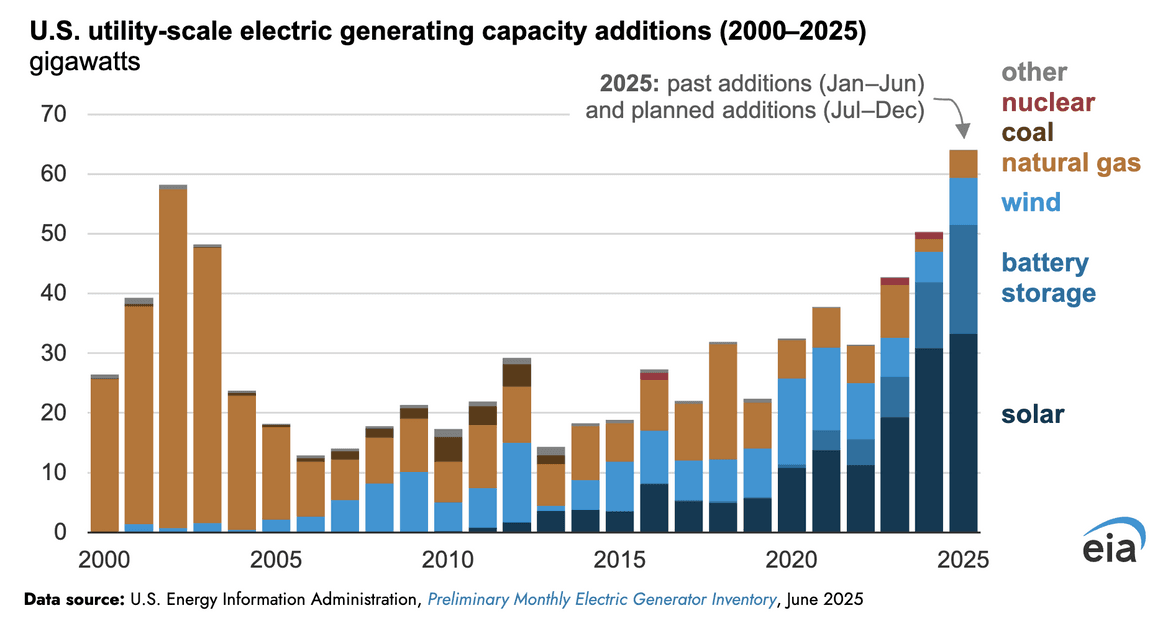
Solar thus will contribute more than half of the expected 64 gigawatts of new power capacity additions this year. Adding in battery storage and wind installations, clean energy is on track to deliver 93% of new power-plant capacity this year, the EIA predicted in February. Moreover, 2025 could set the U.S. record for new power-plant construction, beating the 58 gigawatts added in 2002 at the height of a natural-gas plant boom.
Those facts reflect a set of hopeful trends: The U.S. is building power plants at a record pace; nearly all of those new plants will not emit carbon emissions; and, since renewables and batteries cost far less to operate than fossil fuel plants, they exert downward pressure on electricity costs. These are all good things to see at a time when demand for new power production is soaring — thanks to electrification, industrial growth, and an AI computing bubble — and consumers are grappling with steadily rising electricity rates.
Of course, these trends could prove short-lived, because the Trump administration is actively working to obstruct the buildout of clean and cheap energy.
This summer’s signature Republican domestic policy law targeted wind and solar with early termination of their tax credits, effectively raising the cost to deploy these types of power plants. The executive branch has sought to halt or inhibit offshore wind and renewable development on public lands. Simultaneously, the Trump administration is giving an artificial boost to fossil-fuel plants. The Department of Energy is invoking emergency powers to block the planned shutdown of the J.H. Cambpell coal-fired plant in Michigan, forcing customers to pay millions of dollars extra to preserve an outdated, uneconomical facility. Analysts fear the DOE could repeat this tactic with other uneconomic fossil-burning plants that are scheduled to retire.
Any clean power plants coming online this year were planned, permitted, and undergoing construction before Trump’s policy shifts took effect (though his officials have found ways to interrupt construction that was fully permitted, like the Empire Wind project off the coast of New York). In that sense, this year’s buildout offers the last snapshot of what it looks like when the electricity industry serves market demand with modern technologies absent active resistance from the U.S. government.
It’s still possible that momentum will carry the solar industry to another record year in 2026. Developers effectively need to start construction by the first half of 2026 to claim the full tax credit, and the administration recently tightened the longstanding tax rules on what counts as “starting,” further upping the pressure to get going. Historically, an impending tax-credit cliff incites a temporary rush to begin solar projects in time to qualify.
It will take a few years, then, for the Trump-era energy policies to fully remake the market landscape for solar. There’s little hope that the pace of gas-plant construction will match the current one for solar installations. Absent some reworking of U.S. energy policy, the country is heading for a time of decreasing power-plant construction just when we desperately need it to accelerate.
For years, anti-renewable-energy advocates have opposed solar and wind projects on the grounds that they take up too much land. Now those talking points, popularized by groups linked to the fossil-fuel industry, have made their way into a sweeping new directive from the Trump administration.
On Aug. 1, Interior Secretary Doug Burgum mandated that federal leasing decisions factor in “capacity density” for solar and wind projects.
His order defines “capacity density” as the amount of electricity a proposed facility is expected to produce, as a share of the maximum “nameplate” amount, divided by the site’s total acres. An appendix to the order shows that nuclear and combined-cycle gas plants rank highest on this measure, while renewables come in last.
The Interior Department will now have to consider the density measure in environmental reviews. With that in mind, the order questions whether the law allows any federal land use for wind and solar projects, “given these projects’ encumbrance on other land uses, as well as their disproportionate land use.”
Only a small portion of solar and wind projects are located on areas owned and managed by the U.S. government, but there is vast potential for development. A January 2025 report from the National Renewable Energy Laboratory found that 1,300 gigawatts of solar and 60 GW of onshore wind could be cost-effectively built on public lands, and that significant deployment in those spaces would be needed to meet grid-decarbonization goals.
It’s unclear whether the order might also block some projects on private property if they require reviews under the National Environmental Policy Act.
The directive is yet another example of the Trump administration’s push to slow the development of solar and wind, which together with batteries will account for more than 90% of new utility-scale energy-capacity additions this year. But more broadly, it illustrates how the administration is elevating fossil-fuel-backed misinformation about land use into federal energy policy.
“This is the latest sign that the Trump administration is really just relying on political talking points to push back on renewable energy that have little or no basis in fact,” said Dave Anderson, policy and communications manager for the Energy and Policy Institute, a watchdog group that focuses on the fossil-fuel and utility industries.
Before “capacity density” became a factor in federal leasing decisions, anti-renewable-energy groups were using the argument to build local opposition to utility-scale clean-power projects across the country.
The battle over a now-approved solar project in central Ohio provides a case in point.
In November 2023, a group called Knox Smart Development held a town-hall meeting to stoke opposition to the proposed 120-megawatt Frasier agrivoltaics project.
Canary Media (then the Energy News Network) confirmed last year that one of the main funders of the group was Tom Rastin, former vice president of Ariel Corp., which makes compressors for the oil and gas industry. Rastin and his wife, Karen Buchwald Wright, who is the company’s board chair, also play large roles in The Empowerment Alliance, a pro-natural-gas group.
Steve Goreham, a policy advisor to conservative think tank The Heartland Institute, was one of the speakers at the 2023 event.
In addition to denying that climate change requires a shift away from fossil fuels, Goreham told people at the Knox County meeting that solar farms require much more land than nuclear, gas, and coal-fired power plants. He also focused on “power density” in a 2023 opinion piece for the conservative-leaning Western Journal, warning that “environmental devastation” will result from policies that aim to accomplish net-zero carbon emissions. Goreham repeated this land-use argument in a Real Clear Energy post in March.
A Heartland Institute policy brief released this spring also relied on information about the land areas needed for solar and wind energy to conclude that large-scale electricity production from those sources “requires substantial ecological damage and impact.” The institute’s funders have included Exxon Mobil, coal-mining company Murray Energy (now American Consolidated Natural Resources), and foundations supported by the Koch brothers.
Another speaker at Knox Smart Development’s town hall, a lobbyist named Mitch Given, had previously represented The Empowerment Alliance in a 2023 presentation to the Ohio legislature’s Business First Caucus. His slides on the “nonsense of turning corn fields into solar fields” compared 6,050 acres for an Ohio solar project to just 5 acres for a similar-sized combined-cycle gas power plant.
A 2024 rally against the Frasier agrivoltaics project then brought in Robert Bryce, a former Manhattan Institute fellow who spent an entire chapter of his 2010 book arguing that wind and solar energy are not green because of their land use and power density. The argument is also featured in an anti-solar video he released this month.
The Manhattan Institute has received funding from fossil-fuel interests, such as Exxon Mobil and organizations linked to the Koch brothers. The Checks and Balances Project, a pro-clean-energy watchdog group, has criticized Bryce multiple times for failing to disclose those links. Bryce did not respond to Canary Media’s request for comment for this story.
“Everybody needs to come to this debate with a full picture of who they’re talking to and why they’re saying what they’re saying,” said Ray Locker, executive director for the Checks and Balances Project. Companies in the fossil-fuel industry “have a vested interest in preserving their business,” so when they present renewable energy “as somehow dirty, then that furthers their interest.”
This month’s Interior Department order is not the only recent federal attack on clean energy based on the land-use argument. Last week, the U.S. Department of Agriculture Secretary Brooke Rollins said that the agency’s longstanding Rural Energy for America Program would no longer fund large solar projects on “prime farmland,” a major shift for a program whose main use case has been helping farmers install solar energy.
Burgum’s order to the Department of the Interior is “really implementing an ideological agenda,” said Brendan Pierpont, director of electricity modeling at think tank Energy Innovation. In his view, the mandate’s definition of capacity density is an “absurd metric,” with multiple flaws.
Among other things, the capacity-density measurement does not capture the full picture of what it takes to produce electricity from a fossil-fueled or nuclear power plant.
The metric focuses only on the step where electricity is generated. A full life-cycle analysis would consider all stages for producing equipment, obtaining and transporting fuel, and dealing with waste. The Interior Department’s recent order is “entirely designed to make these [renewable] resources they don’t like look bad,” Pierpont said.
The definition of capacity density also fails to account for the fact that renewable projects can coexist with other activities, such as livestock grazing or farming certain crops, noted Matthias Fripp, global policy research director at Energy Innovation.
Additionally, land used for solar or wind energy can produce electricity for decades, he said, unlike fossil fuels, where the industry must “keep finding new land” for resource extraction. Researchers made a similar point in a 2016 study in the peer-reviewed journal PLOS One, which found the land requirements for coal-fired electricity could equal or exceed those for renewable energy within two to 31 years.
Anderson at the Energy and Policy Institute called the rationale for the Interior Department’s order “a red-herring argument to focus on just one of the impacts of different energy sources.”
Nowhere does the order address environmental and health concerns about mining for coal or uranium, drilling for oil and gas, or transporting and burning those fuels. Waste disposal, particularly for coal and nuclear plants, also poses a challenge.
Renewables “are obviously leaps and bounds ahead of fossil fuels in terms of their net benefits,” Anderson said.
Discover the best places to build new clean energy to maximize the benefits to people and climate.
In order to accelerate global decarbonization and run the world’s power grids free of fossil fuel power plants and their pollution, where new solar and wind farms get built matters. A lot.
To reduce air pollution and tackle the climate crisis faster, the best places to build new clean energy are where the electricity grid still depends on heavily-emitting fossil fuel power plants.
Brought to you by WattTime, with support from The Nature Conservancy and Project Drawdown.


The Trump administration has set up yet another roadblock for wind and solar power in the U.S. — one that will make it harder for clean-energy developers to qualify for federal tax credits before they expire next summer.
Treasury Department guidance released Friday puts new restrictions on the “safe-harboring” rules that have for decades guided whether solar and wind developers are considered to have “commenced construction,” a key milestone required to secure tax-credit eligibility.
The rules, which will go into effect on September 2, are likely to further slow the rollout of wind and solar power — two of the fastest-growing sources of energy in the country, both of which have been under siege by President Donald Trump since January.
Clean-energy industry advocates attacked the guidance as an improper use of executive authority that will make it harder for the U.S. to meet growing electricity demand and will further drive up electricity bills. But industry analysts noted that the new rules, though restrictive, could have turned out even worse.
Under the big new tax and spending law passed by Republicans last month, solar and wind projects must commence construction by early July 2026 to access tax credits.
For projects larger than 1.5 megawatts in size, Treasury’s new guidance eliminates one way for developers to prove they’ve started work: spending at least 5% of the total cost of the project by the deadline. That new restriction won’t apply to residential and commercial solar installations, so companies in that space such as Sunrun, Freedom Forever, SolarEdge, and Enphase, saw their share prices rise on Friday.
But it will apply to most other clean-energy developments, from community solar farms to massive utility-scale solar and wind projects. Starting in just a few weeks, projects larger than 1.5 megawatts will have only one option for proving they’re under construction: They must demonstrate that they are undertaking “physical work of a significant nature” on a continuous basis.
The test is not new, and project developers have relied on it in the past. But it is less straightforward than the 5% safe-harbor rules, creating uncertainty that could make it harder or more expensive for developers to lock down financing for a project.
“Unless you’re pretty far along, you’re not going to go build some roads and install racking overnight,”said Andy Moon, CEO and cofounder of Reunion Infrastructure, a company that manages clean-energy tax-credit transfers. “It’s not so easy to change your plans and accelerate something that fast.”
Clean-energy industry groups declined to speculate about how the changes would impact the hundreds of gigawatts of solar and wind projects now under development across the country. But these industries are already reeling under the much-shortened timeline for securing tax credits under last month’s One Big Beautiful Bill Act; previously, under the Inflation Reduction Act, developers had until at least 2032 to commence construction and thereby secure tax credits. Analysts have said the drastically shortened tax-credit window will cut clean-energy growth by more than half over the coming decade.
That’s a problem for a country facing rising demand for power for data centers, factories, and broader economic growth. Solar, batteries, and wind made up 96% of new capacity added to U.S. grids last year and will remain the primary option for new power in the next few years, given that there are five- to seven-year wait times for new gas turbines and even longer construction timelines for nuclear and geothermal power plants.
“This is yet another act of energy subtraction from the Trump administration that will further delay the buildout of affordable, reliable power,” Abigail Ross Hopper, president and CEO of the Solar Energy Industries Association, said in a Friday statement.
Since Trump signed the megalaw in July, his administration has taken a host of anti-wind and anti-solar actions, including subjecting projects to byzantine Interior Department reviews, setting “capacity density” restrictions for projects on federal lands, and potentially halting already permitted wind farms both onshore and offshore.
Shortly after the law passed in July, Trump ordered the Treasury Department to review the safe-harbor rules. The directive came after pressure from the ultraconservative Freedom Caucus members in the House of Representatives, who were upset that the law preserved tax credits for wind and solar projects at all. In that same executive order, Trump also told Treasury to develop rules governing “foreign entity of concern” restrictions; those rules, which are still in development, could be even more disruptive to the industry.
“The Treasury Department’s decision to accelerate the phaseout of clean energy tax credits undermines the integrity of our energy grid and our legislative process,” Jason Grumet, CEO of the American Clean Power Association trade group, said in a Friday statement. “Congress explicitly chose to provide energy companies with one year to phase out tax credits to keep energy prices low while meeting growing power demand.”
Friday’s guidance came despite entreaties from Senate Republicans Chuck Grassley of Iowa and John Curtis of Utah, who negotiated the tax-credit amendment to the final bill. Though both senators voted for the One Big Beautiful Bill Act, which cleared the Senate by just one vote, earlier this month they placed holds on three of Trump’s Treasury Department nominees in an attempt to force the administration to negotiate a less harmful change to the safe-harbor rules.
Grassley’s office did not immediately respond to a request for comment on Friday afternoon.
“Frankly, I think the intervention worked,” said Pavel Molchanov, a Raymond James analyst covering cleantech companies. “Treasury could have gone really far in the direction of making life difficult.”
Molchanov cited rules left unchanged in Friday’s guidance, such as the four-year window for projects that commence construction by July 2026 to complete their work to secure their tax-credit eligibility. “Imagine if they had said, ‘Oh, did we say four years? It’s actually two.’”
Similarly, the “physical work” requirements listed in Friday’s guidance are not outside the bounds of what a large-scale solar or wind project developer can reasonably take on over the next year, he said. Exemptions for extreme weather, permitting delays, and other obstacles to continuing work should shield developers from risks of being declared out of compliance with those requirements, he said.
“The good news is that it’s still almost 11 months until July 2026, so developers have plenty of room to make adjustments before starting construction,” Molchanov said. “From my perspective, it’s actually better than expected. But maybe my expectations were just so low to begin with.”
Jeff Cramer, CEO of the Coalition for Community Solar Access, a trade group that represents companies building smaller-scale solar and battery projects, decried the new guidance as a violation of the deal Republicans made in crafting the megalaw. But he also said that simply knowing the rules of the game is a help.
“I think the only good news is that there may now be less uncertainty,” he said. “The onus is now on the states to ensure that any projects that can meet that July 2026 deadline can do that.”
President Donald Trump’s crusade against wind energy is intensifying — and it could come with some serious costs.
As much as $317 billion in lost investment, to be exact, per new analysis from research firm Cleanview. That figure is based on the 790 projects totaling 213 gigawatts that developers plan to build in the years to come — all of which are at risk of delay or even cancellation under the administration’s policies.
To be clear, those figures represent the high end of what’s at stake — they’re based on what’s currently in the interconnection queue, and projects drop out of that process all the time for various reasons.
But if even a fraction of that investment is canceled or delayed, it will be painful for the regions that miss out on the tax revenue and jobs, with Texas, Illinois, and New Jersey standing to lose the most.
It would also be bad timing: Electricity demand is on the rise nationwide, largely due to the boom in AI data center construction. Delaying or blocking the buildout of gigawatts worth of wind projects when the U.S. is in the midst of an energy-supply crunch would drive up already-climbing power bills. Wind produced just over 10% of U.S. electricity last year.
And, of course, any slowdown in the construction of clean energy is a setback for efforts to transition the U.S. away from fossil fuels, a task that grows more urgent with the passage of every hot summer day.
Trump entered office in January with promises that not a single new “windmill” would be constructed during his second term. Though he’s not managed to carry out that vision in its most literal sense, he has certainly operated with its spirit in mind.
On his first day, he issued an executive order calling for an end to offshore wind leasing and a review of leases and permits for all wind projects. In the spring, Trump tried — and ultimately failed — to quash the Empire Wind offshore installation that had just begun construction near New York’s coast. After GOP lawmakers rammed the One Big Beautiful Bill Act through Congress, Trump signed the megalaw on July 4, mandating the swift phaseout of tax credits for wind (and solar) projects.
In recent weeks, his administration has stepped up its attacks even further and undertaken an all-out blitz on wind power, issuing a barrage of far-reaching orders that, at least in theory, could jeopardize every wind project underway in the country.
State leaders and clean energy groups across the country are pushing to build more wind and solar projects before the window to claim federal tax credits slams shut.
The new GOP megalaw rapidly phases out incentives for clean energy, years before the Biden-era tax credits were set to lapse. The shortened timeline is expected to slow the construction of wind and solar projects at a moment when states are grappling with soaring power demand that is raising both utility bills and greenhouse gas emissions.
Many local lawmakers and utility regulators were already working to modernize their grids and streamline energy permitting before President Donald Trump signed the budget bill last month. Recently, decision-makers in a handful of places have taken steps to expedite those efforts so that more large-scale renewables projects can qualify for the tax credits before they expire.
Under the megalaw, wind and solar farms must either start construction by July 4, 2026, or be placed in service by Dec. 31, 2027, to qualify for the full production or investment tax credits. The 2022 Inflation Reduction Act previously allowed developers to access credits if they began construction either by 2033, or by the time the U.S. power sector cut emissions by 75% compared with 2022 — whichever came later.
For states, “The question then becomes, what can they do to try to maximize the benefits they’ll get from those [clean] technologies between now and then — the jobs, clean air, and power?” said Nathanael Greene, director of renewable energy policy for the Natural Resources Defense Council (NRDC).
In Maine, state utility regulators have responded by fast-tracking plans to procure nearly 1,600 gigawatt-hours of renewable energy, so that projects can get started before tax credits phase out. Residential and community solar developers in California’s Orange County and Minnesota say they’re focused on installing as many solar arrays as they can, including by tapping into state and municipal incentives that still remain.
Meanwhile, New York Gov. Kathy Hochul (D) has directed state energy regulators to conduct “a high-level review” of the budget law and its “specific impacts to New Yorkers.” However, clean energy developers in the state are calling for more specific actions to expedite wind and solar development, such as speeding up the yearslong process for issuing construction permits and improving coordination among state agencies.
For now, Colorado Gov. Jared Polis (D) is the only state leader to issue an executive action to prioritize deployment of clean electricity projects in response to Trump’s budget law.
Earlier this month, Polis penned a letter that directs state agencies to “move quickly and secure success” for large-scale wind, solar, and battery storage resources, as well as community solar projects. The letter calls for eliminating “administrative barriers and bottlenecks” and “prioritizing expeditious review of projects as they come into the queue for state consultation and permitting.” It also raises the idea of invoking the Public Utilities Commission’s authority to override local permit denials.
“When we look at the new generation that is being built in Colorado, the vast majority of it is wind and solar,” Will Toor, executive director of the Colorado Energy Office, told Canary Media. “Getting as many projects as possible able to move forward on a timeline that allows them to receive those [tax] credits is very much in the interest of the state — not only for clean energy goals, but very much for reducing costs to ratepayers.”
Alana Miller, who leads NRDC’s climate and clean energy policy team in Colorado, said the governor’s letter “is a key first step and provides a lot of urgency at this specific moment.” Still, “There’s a lot to be seen how it plays out and how agencies actually implement it,” she said, noting that state legislative action could follow next year.
In Colorado and beyond, officials are largely waiting to outline more concrete plans until the Treasury Department issues its new tax-credit guidance, which is expected to tighten the rules on which projects can claim incentives. Policy experts say they’re watching closely to see how the leaders of other major energy-producing states, including Pennsylvania and California, step in to support renewables in their backyards.
In June, Pennsylvania Gov. Josh Shapiro (D) warned legislators that the House’s version of the budget bill — which proposed even deeper cuts to clean energy incentives than the final version — would undermine more than $3 billion in direct investment in Pennsylvania energy projects. The impact would be most severe on the “nearest-term energy sources,” namely wind, solar, and batteries, that are coming online to meet surging demand in the state, his letter said.
Shapiro has made building “next-generation power” a key priority as power-hungry data centers strain the state’s grid and drive up electricity costs. His sweeping six-part energy strategy released in January includes policy proposals to increase the amount of electricity that comes from renewable sources in the state, and to establish a “cap-and-invest” program that reduces carbon emissions while also lowering electricity bills.
In California, a leader on clean energy deployment, the industry is urging Gov. Gavin Newsom (D) to help blunt the megalaw’s impact on utility-scale wind, solar, and energy storage developments.
Five trade groups sent a letter last month asking Newsom’s office and state legislative leaders to create a “coordinated action plan” to address the shortened tax-credit timelines, as well as the Treasury Department’s forthcoming guidance. The groups proposed steps such as streamlining environmental reviews and making it easier to build projects on agricultural land.
Another measure that California officials could immediately take is to enable wind, solar, and batteries to access “surplus interconnection” at existing gas-fired power plant sites — a concept that state legislators are currently considering.
Gas power plants in California are running less often as the state works to slash its planet-warming emissions, Mike O’Boyle, director of electricity policy at Energy Innovation, explained in a recent opinion piece in the Los Angeles Times. That leaves gas plants’ transmission wires mostly unused. Wind and solar projects could use this existing surplus to immediately connect to the grid, rather than wait years for system upgrades.
A working paper by researchers at the University of California, Berkeley, estimates that this pathway could allow California to cost-effectively integrate 24 gigawatts of renewable energy capacity by 2030. For context, the state currently has nearly 90 GW of total generation capacity.
Clean energy developers in every state will need all the bureaucratic fixes and outside-the-box solutions they can get in order to maintain momentum for the energy transition. Early estimates found that Trump’s megalaw could shrink new clean capacity additions to the grid by up to 62% over the next decade compared to the baseline scenario. By 2035, national average household energy bills could be $78 to $192 higher than if Biden-era policies remained in place, according to Rhodium Group.
“We still anticipate that clean energy will be built and will likely still be able to compete [with fossil fuels] despite the headwinds,” said Miller of NRDC. But the cost of electricity will be higher without the tax incentives.


.svg)
