

 Back
Back
To all the challenges the solar industry is facing today, add one more: cultivating a domestic market for lamb meat. It may seem an unlikely mission for clean-energy developers, but in many states, including Illinois, grazing sheep between rows of photovoltaic panels is considered the most efficient form of agrivoltaics — the combination of solar and farming on the same land.
Solar advocates, researchers, and developers have given much attention to agrivoltaics. The practice includes growing crops like blueberries, tomatoes, or peppers in the shade of solar panels and letting cows or sheep graze around the arrays.
Perhaps the biggest benefit of agrivoltaics is that land is not being taken out of agricultural production in favor of clean energy, a concern that has stoked intense opposition to solar. The Trump administration codified this sentiment when the head of the U.S. Department of Agriculture announced on Aug. 19 that the agency “will no longer fund taxpayer dollars for solar panels on productive farmland.”
Illinois’ sprawling fields of corn and soybeans don’t coexist well with solar panels, but sheep do, making grazing a promising type of agrivoltaics for the state, proponents say.
In a typical solar grazing arrangement, sheep farmers (called grazers) are paid by solar developers to bring the animals to sites hosting large arrays — often farms — where they munch away on the vegetation. Meanwhile, the landowner benefits from lease payments. Grazing is a lower-emissions alternative to mechanical mowing, and sheep can reach corners that mowers can’t.
But to make a living herding sheep, the grazers need to be able to sell the lambs they raise as meat. In the U.S., lamb is sold primarily in halal markets and appears on menus only during Easter holidays. Three-quarters of that meat is imported from Australia and New Zealand.
“What there needs to be, honestly, is more demand for lamb in the country,” said Stacie Peterson, executive director of the American Solar Grazing Association, which offers solar grazing certifications and contract templates. “We’re hoping to help develop more breeding stock, more farmers, more grazers doing this.”
Brooke Watson would like to see demand for lamb soar in the Midwest, in tandem with demand for solar grazing. Brooke’s husband, Chauncey Watson IV, has been raising sheep since he was in 4-H, a program that teaches kids about agriculture. Chauncey’s family has farmed in Illinois since 1856. The couple has raised lambs and sheep for wool, but in 2023 they bought a new flock of “hair sheep,” which don’t need shearing, to give solar grazing a try. “Hooves on the ground” happened last summer, Brooke said. Now they have 500 ewes grazing on over 320 acres at nine community solar sites in six Illinois counties.
Brooke laments that Americans “lost their taste for lamb” after World War II — because veterans had grown tired of wartime canned lamb rations, according to some accounts. (Other historical factors also likely influenced the decline in mutton’s popularity.)
“It has picked up in the last few decades, but more so with immigrant communities, where lamb is that really valuable cultural and religious product,” she said, adding that “traditional beef and chicken consumers” should give lamb a chance. “There’s really a huge, huge potential for both of these industries to grow and evolve together side by side.”
Brooke said solar grazing can also provide a way for younger farmers to stay in the business.
“The landowner most typically is hitting retirement age, and they don’t want to work the land anymore. So solar is a way for them to still maintain ownership of that parcel, and they’re compensated to host the solar on the site” while collaborating with farmers like her and her husband, who are typically “younger, maybe first generation or newer farmers, and they’re excited about the sheep grazing.”
According to a census by the American Solar Grazing Association and the National Renewable Energy Laboratory, sheep solar grazing is concentrated in the West and the South. In 2024, almost 62,000 sheep were grazing over 87,000 acres at 109 solar sites in the South, with more than half of the animals in Texas. In the Midwest, including Illinois, just over 13,000 sheep grazed almost 7,000 acres of solar at 148 sites.
Texas and California have long histories of shepherding, and in many areas sheep are central to the ranching culture. That means grazing sheep under solar panels is continuing these areas’ traditional agriculture.
But in Illinois, there is little history of raising sheep. So converting acres of the state’s primary corn and soybean fields may still raise eyebrows.
“In Europe, solar grazing has taken off, but they are much more into sheep,” said Ken Anderson, director of the Advanced Energy Institute at Southern Illinois University. “When you see sheep move into Illinois, it’s unfamiliar to people; they’re not used to seeing sheep. It’s better with cattle, but cattle are harder — they like to scratch. It can do damage to the panels.”
Solar grazing goats, meanwhile, has been “a disaster,” Anderson said, because they chew wires and other parts of solar arrays. He is working on a proposed agrivoltaics research site that would grow peaches, apples, and other specialty crops amid solar panels on a former military munitions site in Illinois. Anderson prefers growing crops under panels to grazing, but crops need more specialized solar configurations.
Solar panels suited for sheep are “strictly industrial arrays,” he said. “All you’re going to be able to do is graze sheep there in the future, so you need to think about the long haul.”
Sheep may be the state’s best option for large arrays because, Anderson thinks, there’s limited potential for solar panels to occupy the same land as the state’s traditional sprawling corn and soybean fields.
“In my opinion, the economics will never work,” for pairing corn and soy with solar, Anderson said. “When you grow broad-acreage crops like corn and soy, you use very large equipment, so you have to put the panels far apart,” resulting in less energy output.
While solar grazing in Illinois might often replace corn or soybean production, Watson sees it as a positive trade-off.
“So much of that corn is used for ethanol production, and so much of that soy is, quite frankly, exported to other countries,” she said. “So we really look at solar grazing as an opportunity to have more U.S.-sourced energy production and food production as well.”
The Watsons work with a solar developer called Pivot Energy. Since 2021, agrivoltaics has been the company’s main focus, according to director of operations and maintenance Angie Burke. In Illinois, Pivot Energy has 365 sheep grazing at 11 sites, and those numbers are projected to more than double by next year.
“Agrivoltaics is this great way to support those family farmers locally and provide that cost-competitive, locally sourced, and high-protein-value food for those communities that are excited to eat more lamb,” Burke said.
While solar grazing may not be more profitable than mechanical mowing for landowners, it leaves the soil in better condition than if it were left idle under the panels.
“Let’s be delicate — [the sheep] are contributing to the soil” with their excrement, said Anderson.
In climates like Illinois’, sheep must be housed and fed inside during winter — a considerable expense. But Brooke Watson noted that, unlike solar grazers in Western states, she and her husband don’t need to provide much water for sheep in summer, as the lush vegetation and frequent rain suffice. In any state, solar grazing means ensuring that there are safe fences or wires around sites and that predators are kept out.
“In the early days, there were some horror stories where people dropped sheep off and came back at the end of the summer and there weren’t any sheep anymore,” said Ethan Winter, national smart solar director of American Farmland Trust, an organization committed to farmland preservation and sustainable farming practices. “You’re starting to see more professionalization, more formalized best practices for grazers.”
The organization United Agrivoltaics connects would-be grazers with solar developers and provides resources for insurance and contracts, Winter added.
American Farmland Trust’s Midwest solar specialist Alan Bailey noted that existing crop residue or debris must be cleared and specific cover crops planted to prepare for solar grazing, but this can happen while an array is being built. “One of our principles is having some sort of living cover on those sites throughout the entire construction process,” he said.
Because solar grazing’s benefits to the land and environment are well established, Winter said, boosting the lamb market is “the next big step” for expansion.
“There’s both the need and opportunity to think about markets for the lamb,” Winter said, noting that the animals could be sold to wholesale processors or marketed locally. “There may be a real advantage in having the Illinois Solar Lamb label.”
At 15, Kyle Barber started working at the Captain coal mine in southern Illinois — “following in the footsteps of my forefathers,” he says.
It was 1996, and the mine was closing, so his job involved swinging sledgehammers and scrambling down dangerously steep hillsides to retrieve huge rolls of discarded chain-link fence. He knew this was not the industry he wanted to spend his life working in.
Barber had long been fascinated by clean energy; he even won a grade school contest designing a solar canopy to go over highways. After graduating from college, he connected with the southern Illinois solar company AES to learn the trade, and in 2010 founded his own solar company, EFS. In 2017, he began teaching in a solar workforce training program in Peoria, Illinois, that was created by the state’s Future Energy Jobs Act (FEJA), which went into effect that same year.
Now, Barber is spreading the gospel of solar from the Scott Bibb Center at Lewis and Clark Community College in the southwestern Illinois city of Alton, on the banks of the Mississippi River. It’s one of 14 clean energy jobs hubs created by the 2021 Climate and Equitable Jobs Act (CEJA), successor to FEJA. And it shows how even in the wake of dire federal cuts to clean energy programs, a well-funded and thoughtfully implemented state program can foster a robust transition to renewables on the local level.
Barber has been on the faculty at Lewis and Clark since February 2020, originally teaching classes on solar through a program funded by the U.S. Department of Energy. After the pandemic, Barber saw interest in the solar training program surge. CEJA allowed the school to bolster its offerings with wraparound social services and basic education, helping a wider range of students overcome barriers and prepare for careers in the industry.
With one of his former students, Richie Darling, Barber cofounded a nonprofit, Solar Workforce Development, to teach courses on solar installation, marketing, technology, and other aspects of the business at CEJA workforce hubs and elsewhere around the state, including Richland Community College in Decatur, where leaders are pinning their hopes on electric vehicle manufacturing.
Darling was this summer named manager of the Alton CEJA hub based at Lewis and Clark. Barber teaches classes there and also owns the residential and commercial solar company BKJ, having sold his interest in EFS.
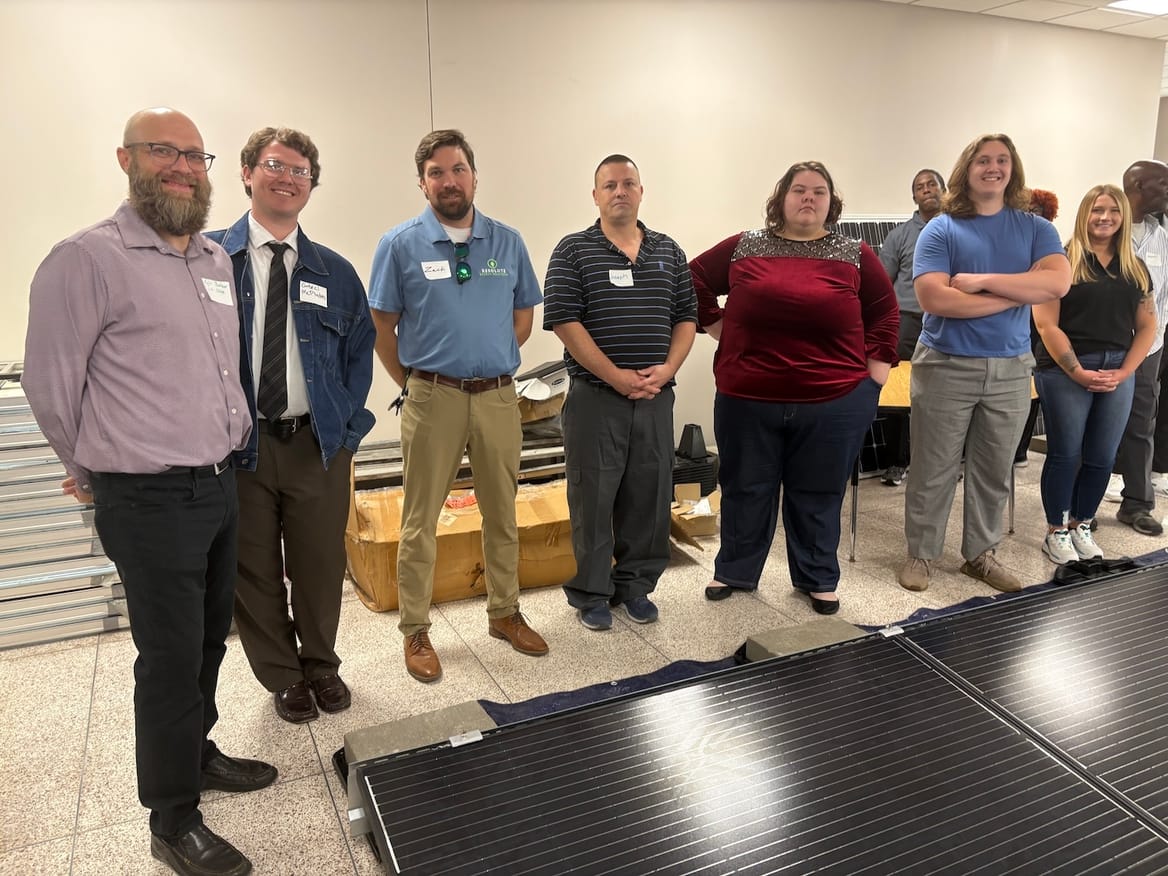
Another of Barber’s proteges, Austin Frank, founded a solar company called ARF that installed a 100-kilowatt array on the Bibb Center roof. Thanks to federal and state incentives and labor donated by Frank’s company, the system cost the school nothing and saves the institution about $5,000 a month in energy bills, covering 40% of the building’s energy, he said. Frank has hired multiple graduates from Lewis and Clark.
“It all starts with Kyle,” said Darling. “It’s like vertical integration. We’re training people in solar, getting contractors set up, and then we have solar on the roof.”
For six decades, residents of Alton breathed pollution from the nearby Wood River coal plant. The plant closed in 2016, taking around 90 jobs with it, and the facility was spectacularly imploded in 2021. Clean energy advocates have proposed a solar farm be built on the site.
Alton was founded more than 200 years ago at the confluence of the Mississippi, Illinois, and Missouri rivers. The city was once a booming industrial and commercial center, but its fortunes have declined as has its population, which now hovers near 25,000, though a smattering of trendy breweries, restaurants, and antique stores attract visitors from the St. Louis area and beyond.
The college qualified to be a workforce training hub under CEJA because the Alton area is home to a closed coal plant and because the state has deemed that the community was historically excluded from economic opportunities. CEJA prioritizes job creation and clean energy deployment in such spots, to make sure the clean energy transition benefits those who were harmed by or left out of the fossil fuel economy.
Advocates applauded the law’s impact at a celebration of the Alton hub at Lewis and Clark last month. “Now because of CEJA,” said Francisco Lopez Zavala, climate policy program associate of the Illinois Environmental Council, hubs like the community college “are helping to build Illinois’s clean energy future, which in turn makes our air easier to breathe, our communities healthier, and our grid more resilient.”
Under CEJA, students are paid to take the clean energy and related basic skills courses. At Lewis and Clark, students can choose from four tracks: solar, energy efficiency, HVAC/ heat pumps, and a Climate Works pre-apprenticeship program affiliated with labor unions. Since launching last fall, the school’s program has graduated 57 students in 10 cohorts — five focused on solar, one on energy efficiency, one on HVAC, and three in pre-apprenticeship. Ninety-five percent of enrolled students have graduated, and eight companies, including ARF, have already hired graduates.
CEJA also sets aside money to reduce barriers for students, who can apply for funding for everything from car repairs and bus passes to electric bills and child care. This opportunity lasts for a full year after graduation. Each hub has a navigator organization that administers the aid; in Alton’s case, that’s Senior Services Plus, a social service agency that helps people of all ages.
“We’re bringing people from barely being able to get to class, because of barriers, to getting them hired,” Darling said.
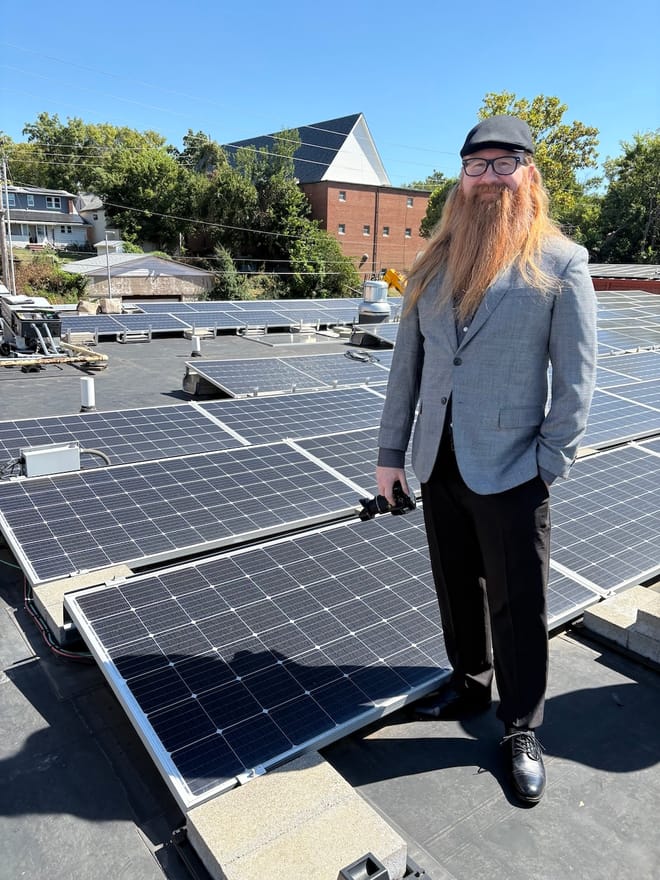
During the August event, current students enthused about the program and the opportunities it creates. In one of the HVAC classes, Michael Mahon Jr. said he wants to set a good example for his daughter, and John Bone said he wants to solve the problems of greenhouse gases and ozone.
Chase Ellinger said that he is excited about the chance for a real career after bouncing between minimum-wage jobs in warehouses, bars, and landscaping. “I want to make a better world and contribute to something for real,” he added.
Other students were learning how to build energy-efficient tiny houses in a workshop on the college grounds.
Up on the roof of the Bibb Center, Frank’s employees were installing the latest addition to the solar array. Frank started his career in construction, working with his father. After a number of customers asked them about solar, “we were like, ‘Holy cow, this is the next big thing. We’ve got to get educated,’” Frank said. He enrolled in Lewis and Clark’s solar training program before it was funded by CEJA.
Following his graduation, he founded ARF Solar in 2021 and became an approved vendor for the Illinois Shines and Illinois Solar for All programs created by FEJA and expanded by CEJA. Illinois Shines provides incentives for residential, commercial, and community solar, and Illinois Solar for All offers even more robust support for deploying solar in lower-income or environmental justice areas and hiring employees who meet equity-focused criteria.
ARF has installed systems on fire stations and other municipal buildings around southern Illinois, as well as schools and churches. Frank is also hoping to branch into community solar, which allows individuals to subscribe for access to energy from a shared array.
“The state had my back,” Frank said. “It created a program for small contractors like myself to come in and have a safe space where we’re able to grow.”
People with criminal records are among those prioritized for CEJA’s equity-minded incentives, and at Lewis and Clark, multiple students and graduates said the solar training could provide a crucial job opportunity especially given barriers they’ve faced due to their pasts.
“I come from a background of poverty, addiction, and mental illness. I didn’t have anyone to teach me how to do life things,” program graduate Taryn Sensmeyer told visitors. “By the time I found recovery, I had created a lot more barriers to entry,” including “my colorful criminal history.”
She heard about the program from a friend who described it as “this weird thing you are totally going to love,” and she said the friend was right.
“I thought I’d just be showing up to learn how to install solar panels, but I got comprehensive knowledge of the whole industry and a deep passion for the environment.”
She’s now participating in an apprenticeship that will prepare her to become a journeyman electrician.
“For the first time, I can put food on the table without any outside help,” Sensmeyer said. “It’s had a ripple effect on everyone I come in contact with.”
Zachary Resmann, a current student in Barber’s class, grew up on an Illinois dairy farm and worked in solar sales. But he felt he was being taken advantage of by out-of-state solar companies flocking to the Illinois market to cash in on incentives, especially for community solar. He joined the CEJA program in hopes of becoming a contractor himself, and his background qualifies him to tap into the law’s equity funds and services. He plans to become an approved vendor under Illinois Shines and Illinois Solar for All, and develop residential arrays for the many friends and acquaintances who have asked him about solar.
“Solar power is power by the people for the people,” said Resmann, who founded the company Resolute Energy Solutions, which helps customers interested in solar, energy efficiency, and other services get quotes and connect with suppliers. “With four kids and a felony, it was hard to get hired. This has changed my life and given me hope.”
In October, a clean energy job fair will be held at the college. Resmann noted Barber’s determination to get his graduates good “W2” jobs — rather than independent contractor gigs that entail 1099 tax forms.
Barber grew up near the massive Baldwin coal plant, which is scheduled to close in 2027 — an extension from a previous 2025 closing date. A lot of renewables will be needed to replace the 1,185-megawatt plant. A 68-MW solar array and 2-MW energy storage system have already been built on its site, under the state’s coal-to-solar program.
With such demand plus state incentives and training programs, Barber is confident the solar industry has strong prospects in Illinois, despite federal rollbacks.
“Under CEJA, there is truly no limit to the number of jobs, companies, projects we can create,” he told visitors to Lewis and Clark in August. “There is no magic; it’s just hard work and determination to create a cleaner and brighter future here in Illinois.”
This story was originally published by The Texas Tribune.
When Texas legislators conceived of the Texas Energy Fund in the spring of 2023, its goal of jump-starting the construction of more natural gas power plants to support the state’s strained power grid seemed reasonable.
In the two years since that vote, however, experts say the energy market has turned against the development of gas-fired power plants. Experts and energy companies say the fund’s $7.2 billion worth of low-interest loans and bonus grants may not be appealing enough to overcome those economic headwinds.
“It is a challenging market for natural gas developers right now, and it has been for a good amount of time,” said Walt Baum, CEO of Powering Texans, a trade association representing Calpine, Constellation, NRG, and Vistra, the state’s four largest operators of dispatchable power.
Only two new proposals have been approved so far through the TEF’s In-ERCOT Generation Loan Program, one of four programs included in the fund intended to coax energy companies into building new gas power plants. The two loans, both to be paid back over 20 years at a 3% interest rate, would tap just $321 million of the $7.2 billion total.
Together, the plants would have a capacity to generate 578 megawatts of electricity, a drop in the bucket compared to the roughly 62,500 megawatts of additional electricity that regulators forecast the state will need to generate by 2030.
Another 15 loan applications are currently in the pipeline, totalling 8,392 megawatts, according to the Public Utility Commission, which administers the TEF.
But of the 25 total loan applications that have advanced to the fund’s due diligence review stage, seven have been pulled from consideration by the companies that filed them, citing supply chain issues or forecasts that the projects would not be as profitable as expected. An eighth application was denied funding last fall due to accusations of fraud.
The most recent company to withdraw an application, Hunt Energy Network, cited the cost-effectiveness of constructing a natural gas power plant under the loan program as the reason for its withdrawal, according to a July 25 letter to the PUC.
The fund was created in the wake of Winter Storm Uri, the February 2021 storm that plunged most of the state into blackouts during freezing weather for days, leaving hundreds of people dead.
Gov. Greg Abbott and other Republican leaders were quick to blame trouble with wind and solar power generation for the power outages. While renewables did struggle to generate electricity in the frigid temperatures, so did natural gas power generation after power plant equipment and some pipelines that supply gas to the plants froze.
After that disaster, lawmakers argued that the state needed more on-demand power — specifically natural gas power plants — that doesn’t require wind and sun to generate electricity. They started the Texas Energy Fund with an initial $5 billion, and earlier this year added another $5 billion — but $2.8 billion was set aside for separate programs to support backup power generation for critical infrastructure and modernization incentives for natural gas plants.
But since 2023, the economic factors working against the development of natural gas plants have only worsened.
Energy demand is rising globally due to the construction of new data centers for artificial intelligence, and many regions are turning to natural gas power because of its relative affordability, lower emissions compared to coal, and its ability to operate at all times of the day, unlike wind and solar.
That demand is straining the supply chain for turbines, specialized equipment used in power plants that cost tens of millions of dollars. Wait times on orders for the machinery have doubled just over the past year, and tariffs are now increasing their price further.
A turbine order placed today likely would not arrive before 2029, and only if a company were willing to pay a premium to get it quickly, said Doug Lewin, author of the Texas Energy and Power Newsletter.
At the same time, the Electric Reliability Council of Texas, the state’s power grid operator, is predicting energy demand in the state will double by 2030. The increase is driven by oil and gas operators in the Permian Basin transitioning operations to run on electricity rather than gas or diesel, as well as Texas’ own AI and data center boom.
The state is on course to meet those electricity demands, but largely through advancements in solar technology and battery storage, which are significantly cheaper than natural gas power plants to install. In Texas’ deregulated energy market, which gives preference to the least-expensive power, this takes away the forecast market share available to companies hoping to profit from a new natural gas power plant, meaning the plants cost more to install and are likely to make less money over time, said Dennis Wamsted, an energy analyst with the nonprofit Institute for Energy Economics and Financial Analysis.
“Markets speak loud and clear if you listen to what they’re saying,” Wamsted said. “The market in Texas is saying loud and clear that gas is not going to be built any time soon.”
Legislators this spring have responded by extending the deadline for spending the $5 billion they approved in 2023. Under the original legislation creating the fund, the PUC had until the end of this year to distribute the money earmarked for power plant construction loans. Senate Bill 2268 by state Sen. Charles Schwertner, R-Georgetown, gave the PUC authority to extend that deadline if “market factors necessitate.”
“What we didn’t know two years ago is that various market influences would affect the TEF application process, such that supply chain disruptions … would impact the timeline for several otherwise well-qualified projects,” Schwertner said in an April committee hearing about the bill.
The PUC said in a statement that demand for the natural gas plant loan program has been high, citing the 15 applications that have reached the due diligence review stage. The agency said it is focusing on reaching loan agreements for those 15 applicants before deciding if an extension on the disbursement deadline is necessary.
State Rep. Rafael Anchía, D-Dallas, said he believes those who have applied for loans were planning to build a natural gas plant without the state energy fund and are now asking taxpayers to help cover the cost.
“If taxpayers are subsidizing a lower interest rate than what they could get in the market, of course [energy companies] will take a free ride,” Anchía said.
Anchía voted against SB 2268, calling the loan program a “big government” approach to influencing the energy market. He did vote for the additional $5 billion in money for the fund, citing the fund’s two other programs supporting backup power generation for critical infrastructure and modernization incentives for natural gas units.
Members of the Legislature’s Texas Energy Fund Advisory Committee have not met since October but plan to in the coming months as part of a regular review of the effectiveness of the fund’s policies, said Rep. Ana Hernandez, D-Houston, and a member of the committee.
Rep. David Spiller, R-Jacksboro and cochair of the advisory committee, said he believes the fund’s effectiveness is worth studying because the Legislature’s original intention was to bring these gas plants online quickly.
“We know that over a period of time we will get to where we need to be,” Spiller said. “My concern is over the next five or six years, bridging that gap. I think sooner rather than later, we need to look at that and maybe review what we have in place and tweak it some.”
The Texas Tribune is a nonprofit, nonpartisan media organization that informs Texans — and engages with them — about public policy, politics, government, and statewide issues.
The Trump administration’s latest attack on an offshore wind project could make New England’s electricity less reliable and more expensive.
Late last month, the administration halted work on the nearly complete Revolution Wind project off the coast of Rhode Island and Massachusetts, citing dubious “national security” reasons. State governors, labor leaders, and even New England fishermen who voted for Donald Trump oppose the move, which is part of the president’s monthslong assault on an energy source central to the Northeast’s grid and decarbonization plans.
Should Trump tank the project, it would leave a gaping hole in New England’s energy mix, driving up the region’s already-high electricity prices and leaving its grid more vulnerable to collapse during winter storms. New England’s grid operator has already factored the 704-megawatt wind farm into its plans starting next year. Delaying delivery of that power “will increase risks to reliability,” ISO New England warned in a statement last week.
That’s not to mention the longer-term disruptions that could stem from killing a project that’s followed all the rules and is already about 80% built.
“Unpredictable risks and threats to resources—regardless of technology—that have made significant capital investments, secured necessary permits, and are close to completion will stifle future investments, increase costs to consumers, and undermine the power grid’s reliability and the region’s economy now and in the future,” ISO New England said in the statement.
In the measured world of grid operators, warnings like these are “unprecedented,” said Abe Silverman, an attorney, energy consultant, and research scholar at Johns Hopkins University. But so is the threat of the federal government smashing a cornerstone of a region’s energy mix, he said.
“We’re talking about a really significant hit to consumers, at a time we’re all hyper-concerned about inflation and energy prices generally,” Silverman said. Losing Revolution Wind’s electricity could cost New England consumers about $500 million a year, he estimated, based on the value the project has secured in ISO New England’s forward capacity market and its potential to supplant costlier power plants used during grid emergencies.
And “we don’t need a bunch of fancy studies to tell us that these units are needed for reliability,” he said. New England has long struggled to meet electricity demand during winter cold snaps and summer heat waves. When temperatures surpassed 100 degrees Fahrenheit for several days in June, “they had every single generator on,” he said. “Here we have a unit that should be operating as of next summer that is now in doubt.”
But it’s during the winter months that the loss of Revolution Wind could be most keenly felt, said Susan Muller, a senior energy analyst at the Union of Concerned Scientists. That’s when the region’s limited supply of fossil gas is stretched even thinner, since the fuel is used both for building heating and power generation. ISO New England is banking on offshore wind — which blows most strongly in the winter — to meet energy needs as temperatures plummet.
But as the move to shut down Revolution Wind shows, the Trump administration’s relentless attacks on the offshore wind industry are making the energy source harder to plan around.
In the winter, “we essentially run out of pipeline gas” for the gas-fired power plants that make up New England’s largest single source of power, Muller said. The region is forced to rely on power plants fueled by oil and costly liquefied natural gas to cover the gap.
That’s an expensive way to keep the lights on. Wholesale power costs from December to February spiked to $4 billion, up from $1.6 billion the previous winter, according to ISO New England data, largely driven by increasing gas costs and a bump in coal- and oil-fired generation. ISO New England reported that total energy costs this spring rose 67% compared to last year, driven primarily by a 112% year-over-year increase in gas prices.
Luckily, strong winter winds make offshore wind farms a great solution to these problems, Muller said — and she has the fancy studies to prove it.
Muller consulted on a new report from Daymark Energy Advisors that found New England could have saved $400 million in energy costs this past winter if 3.5 gigawatts of offshore wind capacity had been online. That’s roughly the total combined capacity of Revolution, the in-progress Vineyard Wind, and two other yet-to-be-built projects, New England Wind 1 and the first phase of the SouthCoast Wind project.
A similar analysis Muller worked on last year found that Revolution Wind and Vineyard Wind would have slashed blackout risk had they been available in recent decades. Vineyard Wind is already sending power to the grid from 17 of its 62 turbines, and the entire project is expected to be complete by year’s end.
The money-saving mechanism is pretty simple, Muller explained. Offshore wind farms are costly to build, and the utilities in Connecticut and Rhode Island that signed long-term contracts with Revolution Wind will be paying prices for that power that are higher than the average prices on ISO New England’s wholesale energy market. But the price is steady and not susceptible to huge swings like that of fossil gas. During wintertime peaks, it costs the same to generate power from offshore wind as it does on a mild day — the same is not true for gas.
Because of this dynamic, the Daymark Energy Advisors analysis found that Revolution Wind’s power would still save consumers money even if the utilities pay twice as much as wholesale prices, Muller said.
Revolution Wind is also meant to supply power to ISO New England’s forward capacity market, which is designed to secure the resources the region needs to ensure its grid can keep running during times of peak demand in future years.
The project would make it less expensive for the region to meet those peaks, Silverman said, putting New England in a better position than other areas of the country. Grid operator PJM Interconnection, which covers 13 states and D.C., has seen capacity prices skyrocket in the past year because it has not built new generation fast enough, he noted.
Perhaps even more valuable is that offshore wind can be a buffer against fuel shortages, Muller said. “In other words, we might have enough power plants, but they might not have enough fuel to get us through,” she said.
This summer, ISO New England unveiled the initial findings of an assessment on the grid’s ability to deliver energy during extreme weather events. That’s an incredibly complicated evaluation with a lot of variables, ranging from the future of large-scale transmission lines that can deliver more power from outside the region to the capacity of the Everett Marine Terminal, a major LNG import and storage facility near Boston.
But out of all those variables, the study’s base case assumes that ISO New England will have about 1.6 gigawatts of offshore wind power in 2027, including 704 megawatts from Revolution Wind. “If you take it out of the model, the risk will go up,” Muller said.
Fossil fuels can’t replace the power that would be lost if Revolution Wind isn’t brought online, Muller and Silverman said — even if the Trump administration is touting more gas pipelines as a solution.
Last month, U.S. Environmental Protection Agency Administrator Lee Zeldin published an op-ed in The Boston Globe claiming that a proposed pipeline originating in Pennsylvania would bring down energy costs in New England by enabling the region to access more gas from the line’s terminus in New York.
The piece came after the Trump administration lifted a stop-work order on New York’s Empire Wind offshore wind project in May, claiming it had struck a deal with Gov. Kathy Hochul to allow two major gas pipelines to be built in the state. Hochul, a Democrat, has denied any quid pro quo but has said the state will “work with the administration and private entities on new energy projects that meet the legal requirements under New York law.”
Energy experts have pointed out many flaws in the administration’s push for more pipelines, including a lack of capacity to move gas from New York to New England and poor long-term economics for expanding that capacity. Every state in New England except New Hampshire has set clean energy and decarbonization mandates that call for using less fossil gas, not more, in the years to come.
“We know that pipelines cost billions of dollars to build,” Muller said. But while Revolution Wind will generate energy throughout the year, “a pipeline would only change things for a handful of days, a few weeks of the year. The rest of the time, it wouldn’t be needed. … There would be cheaper options.”
The Trump administration has insisted that fossil-fueled power plants must stay open to ensure grid reliability, going so far as to use emergency powers to force coal-, gas-, and oil-burning plants to keep running past their planned retirements. Those orders will force customers to bear tens of millions of dollars or more in unnecessary costs while doing nothing to improve reliability, according to energy analysts as well as the state attorneys general and environmental groups challenging the extensions in court.
Fossil-fueled power plants also pose reliability challenges in cold weather. Gas plants made up the majority of generator failures during widespread winter blackouts in Texas in 2021, across the U.S. Southeast in 2022, and during the 2014 “polar vortex” in the U.S. Northeast.
The cold can cause malfunctions at gas plants themselves, or it can limit fuel supply by spurring breakdowns at the wellheads and compression stations that feed pipeline networks. ISO New England’s most recent winter outlook assumed that 3.9 gigawatts to 4.8 gigawatts of gas-fired power “may be at risk due to constrained natural gas pipelines.”
All of these factors were considered in the years-long decision-making processes that New England states went through to decide that offshore wind is their best choice, said Larry Chretien, executive director of the nonprofit Green Energy Consumers Alliance.
“We’re buying 30 years of power at a fixed price, and it’s a good price,” he said. “The states have decided they want to buy this stuff.” By blocking completion of Revolution Wind, the Trump administration is “forcing fossil fuels down our throats.”
Colorado is pushing hard to quickly approve a massive amount of renewable energy while the projects are still eligible for federal incentives.
The Republican tax and spending law that passed this summer drastically shortened the timeline for wind and solar projects to qualify for federal tax credits. Under the 2022 Inflation Reduction Act, developers had until at least 2033 to start construction; now they must begin before July 4 of 2026, or meet the abrupt deadline of commencing operations by the end of 2027.
This sudden change puts states in a tight spot: If wind or solar projects can’t get started within a year, they’ll be considerably more expensive. And power demand and utility bills are already rising nationwide.
All of these factors are putting pressure on state energy regulators, who typically move at an exceedingly deliberative pace, which is to say, very slowly. The usual months of back and forth and obscure bureaucratic wrangling could force customers to pay billions of dollars more, based on the new deadlines from the Republican majority in Congress.
In recent weeks, Colorado became one of the first states to try getting ahead of that damaging outcome, creating a playbook others could learn from. Gov. Jared Polis, a Democrat, kicked off the effort with an Aug. 1 letter urging state authorities to “eliminate administrative barriers and bottlenecks for renewable projects.” Polis, who campaigned on a strong clean energy platform, identified the immense financial stakes of the moment.
“Getting this right is of critical importance to Colorado ratepayers; by maximizing the utilization of tax credits while they’re available and reducing future tariff uncertainty, the State can avoid billions of dollars in additional energy costs for decades to come,” he wrote.
Taking up that call, key players in the Colorado energy establishment filed an official request with the state’s Public Utilities Commission on Aug. 22 to speed up decision-making for a “near-term procurement.” This effort would enable final approvals before mid-2026 for 4 gigawatts of renewables (which could include batteries), 200 megawatts of thermal power (like gas), and 300 megawatts that could be gas or energy storage. That’s a considerable amount for the state, which currently has around 5 gigawatts of wind and 4.5 gigawatts of solar installed.
On Aug. 27, the utilities commission approved an expedited timeline to decide on the joint proposal. Prospects seem favorable for its passage in the coming days, as it was put forward by the commission’s own staff, the Colorado Energy Office, the Office of the Utility Consumer Advocate, and the state’s largest utility, Xcel Energy.
Delivering on the faster schedule could save Xcel’s Colorado customers $5 billion over 20 years, said Michelle Aguayo, a spokesperson for the utility.
For several years running, solar, wind, and batteries have accounted for over 90% of new additions to the U.S. power grid. New turbines for gas-fired plants are more or less sold out until 2030. And all around the country, electricity demand is rising faster than it has in decades. For those reasons, experts still expect lots of renewable energy to be built even once subsidies expire.
But expediting projects now is still worthwhile. Federal tax credits can cut project costs by more than 30% — a fact that’s helping forge some unlikely coalitions.
“We are seeing, in states like Colorado, a coming-together of forces to try to execute on taking advantage of these incentives as quickly as possible,” said Sam Ricketts, a longtime climate policy advocate who recently cofounded S2 Strategies, a clean energy advisory firm. “Many of [these projects] are going to get built. It’s a matter of when: Will it be lower cost or higher cost?”
Indeed, it’s rare to find enthusiastic agreement between a monopoly utility and a ratepayer advocate, whose job is to contest utility spending that could raise bills for customers. In this case, the clear threat of higher energy prices from Trump administration policies has created an unusual alignment of interests. Ricketts refers to this catalyst as “the fierce urgency of commence construction,” the technical term for when developers can lock in the favorable tax credit rates.
Speeding up regulatory approvals is valuable on a number of levels. The typical pace of states’ energy infrastructure deliberations has been out of step both with the urgency of the climate crisis and the more recent spike in electricity demand. Faster approvals of cheap clean energy projects could push down prices compared to further reliance on expensive, aging coal and gas plants. But the exigencies of climate change, demand growth, or customer wellbeing haven’t prompted the kind of speed-up that Trump’s reworking of federal energy policy achieved.
That said, the acceleration will be limited in its scope. States will have to allocate time and effort to salvage just some of the energy benefits that had been promised for a decade to come. Aguayo, from Xcel, described this as a “one-time process in response to the current policy environment,” not a long-term change to the state’s “robust competitive resource planning process.”
Other states can learn from Polis’ timely response to the about-face in Washington. And, indeed, some are already taking action of their own. Maine fast-tracked its renewable procurement a few weeks after President Donald Trump signed his signature policy bill. California Gov. Gavin Newsom, a Democrat, signed an executive order Aug. 29 directing state agencies to do what they can to help clean energy projects meet the new federal deadlines.
As it stands, though, the list of states taking prompt action pales in comparison to those facing cost hikes on their wind and solar projects, which is to say, all 50. Eventually, state leaders across the country will have to grapple with a dire outlook: Trump came to office declaring an energy emergency, and then took one action after another to reduce the supply and raise the cost of American electricity production.
“Clean energy really is the lowest-cost, fastest to deploy resource now,” Ricketts noted. “We need more generation, and everyone knows it. … [But] the federal government is doing all it can to go in the wrong direction.”
Hundreds of business people, policy analysts, and conservative advocates filled a downtown Cleveland conference hall last week for the National Conservative Energy Summit. One major theme: the need for both the federal and local governments to remove increasingly high hurdles to building renewable energy.
“Conservatives can and should lead on energy,” said John Szoka, CEO of the Conservative Energy Network, in his opening remarks.
The group, which cohosted the program with the Ohio Conservative Energy Forum, has a mission “to champion secure, reliable, affordable, clean American energy.” Its goal of achieving American energy independence includes support for a range of technologies, including solar, wind, battery storage, hydrogen, biomass, and small modular nuclear reactors.
The Trump administration has taken a more single-minded approach to energy.
Since January, it has promoted more fossil-fuel use and stalled the retirement of aging power plants. At the same time, it has rescinded grants and loans for clean energy projects; eliminated tax credits for wind, solar, EVs, and home-energy upgrades; and even halted construction on some offshore wind projects.
“While it’s easy to view this as a roadblock, … it’s a signal that we have more work to do,” Szoka said. He encouraged attendees to use what they learned during the conference in their grassroots efforts to build support for clean energy, especially when faced with extremism and misinformation. “If we don’t explain what’s going on clearly, we risk losing the argument before it even starts.”
As President Donald Trump attacks clean energy at the federal level, some states like Colorado and Maine are pushing to speed up deployment. But in general, state and local laws that restrict renewable energy development are gaining steam nationwide. A June report by the Sabin Center for Climate Change Law at Columbia University notes 16 states with laws limiting solar or wind, with over 450 counties and municipalities across more than 40 states imposing other restrictions.
Speaking at the conference, Jenifer French, chair of Ohio’s Power Siting Board and its Public Utilities Commission, noted that approximately 30 counties in the state ban solar or wind energy in all or parts of their territories, an authority granted to them by a 2021 law known as Senate Bill 52. The board or its staff have also determined solar and wind projects are not in the public interest in several cases where bans didn’t apply but where local governments unanimously opposed the proposals.
Asked for her advice to developers, French said, “I just think communicating with the local officials around the project is so helpful, and being part of that community and earning their trust is very effective.”
Companies often hear such suggestions, but “frankly, I think that’s used as a cop-out sometimes,” said Drew Christensen, senior director of public engagement at utility-scale developer Apex Clean Energy, during a later panel about how policies shape companies’ decisions.
No matter how many community meetings are held, some people will still fight projects, putting pressure on local officials who may not have expertise in energy issues, he noted.
The deference to local governments creates a slippery slope, said Amanda Stallings, senior policy manager for clean-energy developer Geronimo Power, who also spoke on the panel. In her view, the states that pile on restrictive policies will not only see less investment from solar and wind developers, but will also discourage other industries from moving in.
Constraints on renewables also tread on landowners’ property rights, Stallings said, pointing out that in some cases a local government tells farmers not to use their land for solar but would have no problem with a housing development.
“What country do we live in when our government tells us what we can and can’t do?” Stallings said. The point resonated with various attendees from state chapters of the Land and Liberty Coalition, who made comments during networking breaks that property owners should be free to make their own economic decisions about their land.
Meanwhile, “this idea of behind-the-scenes picking winners and losers, that’s what’s going to create a reliability problem,” Stallings said. That risk is already visible: Late last month, the grid operator ISO New England warned of potential reliability issues from delaying Revolution Wind, a nearly finished offshore project that the Trump administration has halted for now.
This past spring, Ohio managed to pass bipartisan legislation that is expected to help the state build more energy — both renewable and fossil-fueled — in large part because the law doesn’t pick winners, according to state Rep. Tristan Rader, D-Lakewood. House Bill 15 passed with unanimous support in the Ohio Senate and just two dissenting Republican votes in the House.
Speaking on a panel about the new law, Rader called it a big step but emphasized that the state still has barriers to getting additional renewable energy on the grid.
“We don’t need to incentivize it. In Ohio, we just need a level playing field,” he said.
For one thing, the Ohio Senate removed provisions from HB 15 that would have created a community solar pilot program. Two Republicans in the House have introduced a separate bill to revive a version of that measure.
Beyond that, the law left SB 52’s extra hurdles for solar and wind in place, along with property line setbacks for wind that were tripled by a last-minute addition to a 2014 budget law.
“We have put up a lot of barriers to different forms of power over the years,” said state Rep. Tex Fischer, R-Boardman, who noted that added levels of government review compound uncertainty for developers. “I think the solution is removing those barriers.”
The Trump administration’s latest attack on an in-progress offshore wind project is now being challenged in court. Two lawsuits announced Thursday — one brought by the wind farm’s developers, the other by Rhode Island and Connecticut — seek immediate relief from a federal stop-work order that froze construction of Revolution Wind two weeks ago.
The developers, Danish energy giant Ørsted and investment firm Global Infrastructure Partners, filed a complaint Thursday morning in the U.S. District Court for the District of Columbia, requesting a preliminary injunction that would allow Revolution Wind’s offshore construction to resume. The 65-turbine project being built 15 miles from Rhode Island’s coastline is 80% completed.
Hours later, attorneys general from both Rhode Island and Connecticut announced a separate lawsuit against the Trump administration, asking the court to declare the construction halt unlawful — and overturn it.
If allowed to proceed, the project would generate enough carbon-free electricity to power more than 350,000 households across the two states. Should President Donald Trump tank the development, it would be a disaster for New England’s grid.
The project was set to come online next year, and New England’s grid operator had already factored its 704 megawatts into its plans. Delaying delivery of that power on such short notice “will increase risks to reliability,” ISO New England warned in a statement last week, adding that the hold-up could also increase utility bills and discourage future investment. New England governors, labor representatives, and even local fishermen have also demanded Trump overturn his decision.
“Does this sound like a federal government that is prioritizing the American people? This is bizarre, this is unlawful, this is potentially devastating, and we won’t stand by and watch it happen,” said Rhode Island Attorney General Peter F. Neronha in a statement.
The lawsuit comes as the Trump administration steps up its already hostile campaign against offshore wind. There’s new chaos almost daily.
Since ordering Revolution Wind to stop construction in late August, the administration has filed documents with federal courts signaling it intends to revoke permits for projects near Maryland and Massachusetts. The Transportation Department clawed back $679 million in federal funding for infrastructure supporting offshore wind. And White House officials are reportedly directing a wide range of agencies — including unrelated departments like Health and Human Services — to seek out reasons to cancel projects already underway.
In choosing litigation over negotiation, the moves made on Thursday mark a shift in how the wind industry is responding to the U.S. government’s new war on the energy resource.
When the Interior Department stopped New York’s Empire Wind project in April, developer Equinor opted not to take the Trump administration to court — even as its losses rose to nearly $1 billion. Instead, the firm and diplomats from its home country and majority shareholder Norway lobbied the government to overturn its decision. In May, the Trump administration reversed course, claiming that it had struck a deal with New York Gov. Kathy Hochul (D) to allow gas pipelines in the state. Hochul’s office denies any such deal was made.
In both instances, the Trump administration used vague and dubious justifications for the stop-work orders. For Revolution Wind, the Interior Department cited “national security” concerns that a retired Navy commander called “specious.” For Empire Wind, it pointed to a mysterious report that officials blacked out entirely on a federal website and still refuse to share with the public.
Ørsted and others are now embarking on a legal battle that could determine not only the fate of Revolution Wind, but whether a more aggressive response is a cheaper and better way to push back on Trump’s always-escalating crusade against “windmills.”
Three bills have advanced through the California Legislature that are meant to increase the use of virtual power plants as a way to rein in energy costs. While good news for utility customers, that welcomed progress comes with its own dose of bad news: The most ambitious proposals were stripped out of one of the bills in a secretive process inaccessible even to the bill’s author.
Two of the bills, AB 44 and AB 740, cleared a key legislative hurdle with only minor alterations that will not significantly reduce their impact, according to Edson Perez, who leads California legislative and political engagement for clean-energy trade group Advanced Energy United.
But SB 541, the most pioneering of the three bills in question, was “gutted” last week via an opaque legislative maneuver, Perez said. Those amendments stripped the bill of important provisions that would have required the state’s biggest utilities to provide data to enable them to build virtual power plants into their grid investment plans.
Those provisions “would have helped California get the most out of its existing grid while saving ratepayers billions,” Perez said. “At a time of skyrocketing electricity bills and reliability challenges, California can’t afford to sideline tools that make the grid cleaner, more resilient, and more affordable.”
California has the highest electricity rates in the nation outside of Hawaii. Virtual power plants, which stitch together distributed energy like rooftop solar, home batteries, and EVs, can’t solve that problem on their own. But they can certainly help: A new report from think tank GridLab and Kevala, a grid-data analytics startup found that California could cut energy costs for consumers by $3.7 billion to $13.7 billion in 2030, compared to a base case, by using home batteries, EV chargers, and smart thermostats to avoid or defer costly upgrades to power lines and other infrastructure.
The changes made to SB 541 will dramatically reduce the savings it could offer, according to Sen. Josh Becker, the Democrat who authored the bill and chair of the Senate energy committee.
“We’re very disappointed,” he said.
The bill still includes measures to spur utilities to expand their use of VPPs, “so we can avoid overbuilding to meet the highest peaks in demand,” he said. “But we’ve missed an opportunity to do so much more by focusing on the other half of the problem — all this spending on upgrading poles and wires that can be avoided if we take better advantage of distributed energy resources.”
Becker said he didn’t know who was responsible for excising that portion of the bill or why they did it. The amendments were introduced during a process known as “suspense,” during which the Legislature’s appropriations committees can amend or shelve bills with no debate or transparency into how changes are made or by whom. Last Friday’s process ended up culling more than a quarter of the 686 bills under consideration, including high-profile ones like a proposal to streamline permitting for high-speed rail.
“We’re pursuing every avenue to keep that language alive,” Becker said of the removed text. But there’s little time for lawmakers to secure revisions before Sept. 12, the last day for the Legislature to pass bills this year.
For a handful of hours every year in California, often on the hottest days, electricity use soars beyond the usual day-to-day level and hits what’s known as peak demand. To meet these peaks, utilities have historically opted to build more power plants and power lines than they need on a daily basis — an expensive choice that is responsible for a large portion of utility bills.
But California can reduce demand peaks and make a big dent in those costs by taking advantage of solar-charged batteries, smart thermostats, EV chargers, and other devices scattered across homes and businesses. Individual customers are compensated for allowing the rest of the grid to use their energy resources, but if done right, a VPP’s benefits outweigh those payments.
A 2024 analysis from The Brattle Group found that VPPs could shave about 15% of California’s peak demand by 2035, saving utility customers about $550 million each year. Most of those savings would flow to those whose clean energy assets are enrolled in the programs, but customers at large would also see costs decline because utilities wouldn’t have to build as much infrastructure.
California badly needs to cut those costs. Average residential electricity rates in the state increased 47% from 2019 to 2023 and now stand at nearly twice the national average, largely driven by the effort to prevent power lines from sparking deadly wildfires. Pressure to expand power grids to serve data centers, EV charging, and home electrification is set to push rates higher still.
In the face of these rising costs, “making better use of what’s already on the grid rather than building something from scratch is a pretty important consideration,” said Ryan Hledik, a principal at Brattle and lead author of the study.
But California is not on track to meet its VPP targets. In 2023, the California Energy Commission (CEC), acting to comply with a law passed the previous year, set a “load-shift” goal of 7 gigawatts by 2030 for the state. But the CEC’s June progress report found that California’s demand-flexibility capacity barely grew over the past two years and remains at just over 3.5 gigawatts, or about half the 2030 goal.
The state isn’t likely to reach its 7-GW target under “business-as-usual” conditions, the CEC report found. That’s especially true if the policymakers decide to eliminate programs created after grid emergencies in 2020 and 2022, which have grown fastest in recent years compared to utility-managed VPPs. The report concludes that California needs “additional near-term strategies” to close the gap.
SB 541 was designed to help fill that gap.
In particular, the bill was meant to do two main things to incorporate load flexibility into how California manages its grid costs, Becker explained: Track progress toward state goals and embed VPPs into how the state’s major utilities invest in their power grids.
The amended bill still requires the California Energy Commission to create regulations to track the progress toward the 7-GW goal by utilities, community energy providers, and other “load-serving entities” supplying power to customers. “We need to know which load-serving entities are doing a good job of it, and learn from the best practices,” Becker said.
But the original version of SB 541 also called on the California Public Utilities Commission to create regulations to require the state’s three major utilities to share data on their low-voltage distribution grids, and use that data to discover how VPPs can reduce the cost of managing that infrastructure. Last week’s amendments entirely cut this portion of the bill.
Brad Heavner, executive director of the California Solar and Storage Association trade group, said that’s a missed opportunity. Today’s VPPs and demand-response programs are triggered to reduce pressure on the state’s transmission grid and generator fleets when energy demand exceeds supply, he said. In other words, they’re “focused on times when we may not have enough energy statewide,” which is “obviously important.”
But as originally written, SB 541 would have required a more proactive approach that integrates VPPs into grid planning.
“From an affordability perspective, most of the reason our rates have increased is due to utility overspending on the distribution grid,” he said. “VPP programs should be equally focused on using networked batteries to avoid the cost of expanding substations and other big infrastructure.”
Getting utilities to do this has been a longtime challenge. For more than a decade, California regulators have been under state mandate to press utilities to integrate rooftop solar, batteries, and other distributed energy resources — DERs in industry parlance — into how they invest in and manage their grids.
But as Hledik told a California Assembly committee in July in testimony supporting SB 541, “attempts to use load flexibility as a distribution system resource have had limited success.” Existing programs aimed at requiring utilities to seek out DERs that can replace or defer grid investments have failed to result in any significant projects.
SB 541 was designed to overcome those previous pitfalls, Hledik said, by requiring that “load flexibility opportunities be considered earlier and more comprehensively in distribution planning.”
The other VPP bills don’t take on distribution grid costs. AB 740 would require the CEC to adopt a virtual power plant deployment plan by November 2026, in collaboration with state grid operator CAISO, the utilities commission, and an advisory group representing disadvantaged communities.
”It doesn’t require them to implement anything specifically,” said Perez of Advanced Energy United. “But it does require that cross-agency deep dive that is just not happening right now.”
AB 44, which Advanced Energy United also supports, is “more surgical,” Perez said. It would order the CEC to adopt a method to value VPPs as a means of reducing “resource adequacy” requirements — the calculation of the grid resources needed to meet peak demand in future years.
Resource adequacy costs are rising across California. A handful of community choice aggregators (CCAs), the city- and county-level entities that procure clean energy for a growing number of the customers of California’s big three utilities, have worked with CEC to prove that their VPPs function well enough to count toward resource adequacy. The CEC has then reduced their requirements accordingly, which has allowed CCAs to cut their customers’ energy bills.
That’s a useful route to capturing the value of VPPs, Perez said. But it’s largely been done on an ad-hoc basis to date, and “there’s no clear process” for other CCAs to follow suit, he explained. “AB 44 tries to make that process more transparent.”
None of the bills have passed yet. If they can clear the Legislature by mid-September, Gov. Gavin Newsom (D) will have until Oct. 12 to sign the legislation into law.
This isn’t state lawmakers’ first attempt to pass VPP bills.
Similar efforts failed to advance in last year’s legislative session, as did bills aimed at restricting utility spending. Utilities earn guaranteed profits for every dollar they spend on power grids and other capital infrastructure, which incentivizes them to resist VPP policies that might reduce those expenses — and California’s utilities have political heft in state government.
But Becker, who is also pushing legislation to offset utility spending through public financing in this year’s legislative session, said the state’s utilities are already struggling to expand their grids quickly enough to serve large new customers like EV charging depots and data centers.
In other words, they can’t spend money fast enough to build the grid that’s needed right now. “We’re just trying to align the rules of the game to reward good behavior,” he said.
State legislatures saw a torrent of anti-clean energy bills introduced this year — and little more than a trickle of measures that would benefit renewables. Fortunately, most of the legislation was not signed into law.
As of June, with most states’ legislative sessions wrapped up for the year, 305 bills related to the siting of new clean energy developments had been introduced across 47 states, according to a new report from Clean Tomorrow, a policy-focused nonprofit. Of those, 148 would likely have made it harder to build renewables, while just 68 would have helped wind, solar, or battery storage projects move forward. The remaining 89 would have had a neutral or unclear impact.
The vast majority of these bills stalled out, and of the few that were signed into law, slightly more were favorable to clean energy than hostile to it. Ten pro-renewables siting laws passed versus seven that are expected to restrict clean energy.
Still, the flood of new anti-renewables legislation underscores the increasingly hostile policy environment for clean energy.
Already, 16 states have significant restrictions on new solar, wind, and battery projects, and 459 counties and municipalities across 44 states have restrictions of their own, per a June 2025 report from the Sabin Center for Climate Change Law at Columbia University. These restrictive policies range from giving local officials more authority over permitting decisions to imposing onerous setback requirements on projects, which prevent solar or wind from being built within a certain distance of, say, a road or a property line.
Such policies are becoming more common around the U.S., the Sabin Center finds, a fact that is not surprising given shrinking public approval for large clean energy projects. Support for expanding solar farms fell from 66% to 52% between September 2022 and this past June, per an AP/NORC poll; pro-solar sentiment declined most among independents and Democrats over that period.
Still, some Democrat-led states are boosting policy support for clean energy deployment — most notably Colorado. Even in deep-red Ohio, the governor signed into law a bipartisan, tech-neutral bill that is expected to make it modestly easier to build clean energy.
States and municipalities have significant power to advance clean energy, even without the federal government. They also have the ability to stifle it, making state and local government a crucial arena for the energy transition. Right now, with Trump’s all-out campaign against clean energy at their back, opponents of renewables have the momentum.
If you didn’t think President Donald Trump’s attacks on offshore wind could get worse, think again. In just the last week, the administration targeted more already-permitted wind projects, slashed funding for projects tied to offshore wind, and enlisted a wide array of federal departments to go after the industry.
Trump vowed on the first day of his term that “we aren’t going to do the wind thing,” and it’s been blow after blow to the sector since. But in the last two weeks, the Trump administration has doubled down on its commitment to crushing offshore wind in particular — and what was already an aggressive campaign has now become an all-out war.
In late August, the Interior Department sent a stop-work order to the Revolution Wind project off the coast of Rhode Island, even though the development is just months away from completion. It echoed a similar — failed — attempt to halt construction of the Empire Wind project off the coast of New York back in April.
New England’s grid operator has since warned that delays will jeopardize power reliability and raise electricity prices, and even fishermen who voted for Trump are urging the administration to let work resume. Developer Ørsted and the states of Rhode Island and Connecticut are now suing the Trump administration to get Revolution Wind construction up and running.
The halt turned out to be just the start of a new wave of attacks. Late last week, the Transportation Department said it would pull $679 million from projects to support offshore wind. That includes about $426 million granted to turn a California port into the country’s first hub for floating offshore wind construction.
Recent federal court filings reveal the administration is also looking to revoke and reconsider permits for three already-approved projects: Maryland Offshore Wind, as well as the SouthCoast Wind and New England Wind projects off Massachusetts.
And now, Trump is expanding his full-court press by calling on federal departments that typically have nothing to do with offshore wind, The New York Times reports. The Health and Human Services Department is apparently researching whether turbines emit harmful electromagnetic waves — a claim multiple studies have debunked. And the Defense Department is looking into whether offshore wind farms pose national security risks, the dubious reason the administration cited when halting Revolution Wind last month.
If it wasn’t clear before, it is now: The Trump administration is going to leave no stone unturned in its attempt to stop offshore wind in America.
Court OKs green bank termination
The Trump administration scored a significant, but potentially temporary, win in its efforts to claw back billions of dollars meant to bring clean energy to communities nationwide. A federal appeals court decided on Tuesday that the U.S. EPA has the authority to cancel awards under the $20 billion Greenhouse Gas Reduction Fund.
The “green bank” program, created by the Inflation Reduction Act, is supposed to provide low-interest loans for emissions-reducing projects in low-income and disadvantaged communities. The EPA moved early in Trump’s presidency to revoke the funds, which had already been awarded to the nonprofits administering the program, and the money has been frozen in Citibank accounts ever since. Still, it’s not the end of the line: The nonprofits indicate they’ll appeal the decision further.
What utilities can learn from the data center capital of the world
As tech giants continue to build data centers, utilities will have to figure out how to meet growing electricity demand without raising power prices and carbon emissions. And in Virginia, Dominion Energy might be showing them what not to do, experts and advocates tell Canary Media’s Elizabeth Ouzts. The utility has already gotten regulators to approve its plan to build a raft of new fossil-fueled plants over the next 15 years, despite a state law requiring the total phaseout of fossil fuel power by 2045.
Dominion isn’t in an enviable position, to be sure, as no utility can be sure of whether the data center power boom will fully come to fruition. But utilities can still turn to efficiency measures, battery storage, and grid-enhancing technologies to cut their need to add more power, and data centers can be flexible with their power usage to avoid overwhelming the grid.
Stretching EV incentives: The IRS clarifies that consumers can still receive EV tax incentives if they sign a contract and make a payment by Sept. 30; they don’t necessarily have to take possession of their vehicle by then. (CNBC)
Use it or lose it: Rewiring America is working with elected officials, manufacturers, utilities, and other groups to encourage consumers to tap federal incentives for efficient home upgrades and appliances before the tax credits expire. (Canary Media)
Nuclear interference: Nuclear Regulatory Commission Chair David Wright confirms a Trump administration official told him the agency would be expected to “rubber-stamp” reactors approved by the Energy or Defense departments, and says he pushed back. (E&E News)
Curbing carbon capture: A peer-reviewed study finds the Earth can store far less captured carbon than previously thought after accounting for earthquake-prone areas and other risk factors. (Grist)
Solar still surges: Global solar deployment hit 380 gigawatts in the first half of this year, a 64% increase from the same period in 2024, a new Ember report finds. (Utility Dive)
Wind’s lesson: As state and local leaders defend offshore wind against the federal government, solar developers should take note and double down on state and local engagement, a clean energy advocate says. (Latitude Media)
Gassing up EVs: The Trump administration will prioritize EV charging stations at gas stations and truck stops for funding as it reopens the $5 billion National Electric Vehicle Infrastructure program. (E&E News)


.svg)
