

 Back
Back
One sign read “Let the Wind Power Our Future.” Others displayed nothing more than the giant gold seal of America’s largest electrical workers union. These logos and slogans stood out among the 100 or so people crowded on top of the marble steps of the Nassau County Executive and Legislative Building in New York on Tuesday, as they called for the right to continue building offshore wind turbines near the Long Island coast.
That right had just been revoked.
On April 16, the Trump administration issued a stop-work order that paused the construction of Empire Wind 1. The 810-megawatt wind farm was two weeks into at-sea construction. It’s also the anchor project of an in-progress effort to build an offshore wind staging terminal in South Brooklyn, which has been celebrated as a major economic win for the local, mainly working-class community.
“It was time to demonstrate the diverse support for offshore wind,” said Adrienne Esposito, rally organizer and executive director of the nonprofit group Citizens Campaign for the Environment. She said the group includes retirees, union workers, young people in job training, a charter boat captain, and a whale expert.
They’re emblematic of the broad array of stakeholders who stand to lose from President Donald Trump’s ongoing war on offshore wind, which started with a pause on new permitting and has in recent weeks escalated to attacks on projects already underway. These projects are central to the climate goals of many East Coast states, the economic development plans of neighborhoods and towns, and public health concerns of those who have lived for decades in the shadow of dirtier, air-polluting industries.
Empire Wind 1 is a critical component of New York’s strategy to address climate change and achieve a 70% renewable energy share by 2030. It’s the largest energy infrastructure project the state has undertaken in the last 50 years, according to a top state official who lambasted the Trump administration’s stop-work order as doing “irrefutable harm.”
“This project underwent extensive and robust federal reviews … and is already under construction with strong support from the local Sunset Park community and more than 1,500 construction workers currently employed,” Doreen Harris, president of the New York State Energy Research and Development Authority, said in a statement last week.
Since early April, vessels had been laying rocks roughly 20 miles offshore from New York City in preparation for attaching 54 wind towers to the seafloor in May. The project was supposed to go online in 2027. All at-sea work is now halted.
The Trump administration’s order didn’t impact the massive terminal being built along a Brooklyn waterfront to support the installation. About 1,500 people have been constructing the 73-acre offshore wind hub since June. But local supporters now worry what the order means for all the green jobs promised by the Empire Wind project.
“Offshore wind, if done properly, gave us a real shot at creating economic opportunities for a neighborhood and region that has carried the weight of environmental racism for too long. It meant good jobs and local investment for our local residents,” Elizabeth Yeampierre wrote in a statement issued Tuesday, the same day as the rally. She is executive director of the grassroots nonprofit organization, UPROSE, and a longtime resident of Brooklyn’s Sunset Park neighborhood.
For the past decade, Yeampierre has led efforts in her community to advocate for redevelopment of Sunset Park’s industrialized waterfront, a stretch of which has sat vacant since the 1990s. At one point, city officials considered plans to rezone the area for apartments and retail shops. Yeampierre pushed officials instead towards plans to rebuild a “working” waterfront that would generate jobs and place Sunset Park residents at the center of the energy transition.
That vision, the South Brooklyn Marine Terminal, is becoming a reality. The offshore wind hub, once completed by the end of 2026 if it’s not interrupted, will be used for storing and assembling wind turbines. Equinor, the Norwegian energy giant building Empire Wind, was planning to use it as a staging ground for not just Empire Wind but for a sprawling array of already-approved wind projects being built across the Northeast and mid-Atlantic by various developers.
The previous administration gave some level of approval to nearly a dozen offshore wind farms. But only nine projects, including Empire Wind, managed to get all of their permits before Trump took office. Another one of those approved projects — Atlantic Shores in New Jersey — has already been shelved, thanks in part to the Trump administration’s decision to claw back a previously issued Clean Air Act permit.
A spokesman for Equinor told Canary Media, “We will not comment about the potential consequences until we know more.” He said the company is engaging directly with the Department of the Interior to “understand the questions” raised about its federal permits, which were issued in 2024.
Equinor signed its federal lease for Empire Wind during the first Trump administration in 2017. Its project took over eight years to go from proposal to full approval, though President Trump’s interior secretary, Doug Burgum, who oversees the core offshore wind permitting process, recently suggested in a post on X that “the Biden administration rushed through its approval without sufficient analysis.”
That leaves Sunset Park community members to wonder what’s next.
“Unfortunately, that door of what is beautifully possible and necessary is being shut on our knuckles,” wrote Yeampierre in response to Trump’s interference.
Offshore wind promises cleaner and more reliable energy for New York and the East Coast. But for residents of Sunset Park in particular, these projects — and the South Brooklyn Marine Terminal that relies on them — offer benefits beyond that.
What’s also at stake is a real shot to revive Sunset Park, a mainly working-class neighborhood of Asian, Latino, and immigrant communities. Equinor has already given $5 million in grants to help local community groups, like UPROSE, build education and job-training programs around a new wind-power economy.
Maintaining Sunset Park’s industrial character is key to keeping housing affordable in the area, Eddie Bautista, executive director of the New York City Environmental Justice Alliance, told Canary Media in 2022. Many envision Sunset Park as a place where people have job training and good salaries without the air pollution that spewed from the port during its 20th century heyday.
“We were building a whole industry … and the problem with shutting down the project is that it really sends a signal to the developers in the market — like, what certainty is there?” said Lara Skinner, executive director of the Climate Jobs Institute at Cornell University’s New York City campus.
She fears that developers like Equinor may pull out, not for lack of commitment, but for lack of certainty that Trump will honor the federal government’s permits and approvals. And if the offshore wind turbines don’t get installed, she said, the wind hub in Sunset Park is in jeopardy.
New York Gov. Kathy Hochul, a Democrat, has expressed similar fears about the stop-work order and vowed last week to “fight this every step of the way.”
Meanwhile, some local Republican officials are pleased. Speaking at a press conference last week, Nassau County Executive Bruce Blakeman sided with the Trump administration’s view that Biden-era permitting was insufficient: “We think there [were] shortcuts. We think there was false information. And a lack of public input.”
Esposito, the organizer of Tuesday’s rally, said politics should not be part of the Empire Wind debate.
“Look, offshore wind is not a Republican issue and not a Democratic issue,” said Esposito, who noted the threats of a warming planet and rising seas. “At the end of the day, we all live on an island.”
As electric and gas bills rise across the country, a poll released today finds that an overwhelming majority of people in the U.S. are concerned about growing energy costs — and experiencing greater financial stress because of them.
In a nationwide survey of about 2,000 adults, conducted by the consumer education nonprofit PowerLines and the polling company Ipsos in late March, 73% of respondents reported feeling concerned about rising utility bills. Nearly two-thirds of surveyed billpayers said they have seen their gas and electric bills rise over the last year, and 63% reported feeling more stressed as a result of energy costs. The results held consistent across the political spectrum, with Republicans, Democrats, and Independents alike expressing similar levels of concern.
The findings arrive as the Trump administration’s continued attacks on clean energy — and its support for coal and other fossil fuels — threaten to raise utility bills even higher, according to energy experts.
“Bottom line is, American energy consumers are hurting and they’re stressed out,” Charles Hua, executive director of PowerLines, said of the survey’s findings.
Yet according to the poll, most Americans aren’t familiar with the state entities in charge of regulating energy utilities and setting those prices: public utility commissions. That’s a problem, said Hua, because a lack of public participation prevents consumer interests from being fully considered when state regulators receive and approve rate-hike requests from utilities.
In the survey, 60% of respondents said they aren’t familiar with the state or local authority that oversees gas and electric bills. Around 90% of people couldn’t name their public utility commission as the correct regulatory body.
Meanwhile, these relatively unknown regulators have approved ballooning utility cost increases in recent years. In 2022, state utility regulators collectively approved $4.4 billion in bill increases; in 2023, they approved $9.7 billion. In the first quarter of 2025 alone, gas and electric utilities requested or received rate hikes totalling about $20 billion. Residential electricity costs have grown by nearly 30% since 2021, while gas prices have risen by 40% since 2019, far outpacing inflation, according to a separate report released today by PowerLines.
The reasons behind these fast-rising rates vary by utility and state. Still, Hua singled out one driver of higher electricity rates in particular: utility spending on transmission lines and distribution systems — in other words, the poles, wires, and lines that deliver power to customers.
Utilities have spent increasing amounts of money to replace aging infrastructure and repair or harden the grid after storms, wildfires, and other disasters made more likely by climate change. State rules guarantee investor-owned utilities a rate of return on those investments, creating a financial incentive to overspend on grid infrastructure that some researchers have estimated costs consumers billions of dollars each year. Volatility in global gas markets has also contributed to rising gas bills.
The extent to which customers are suffering proves that the current regulatory system isn’t working, said Hua. “Eighty million Americans are struggling to pay their utility bills, and that issue is not only not going away, but it’s only going to get significantly worse in the coming years.”
Households that struggle to afford utilities often have no choice but to sacrifice needs like food, medicine, or basic physical comfort in order to pay their energy bills. Total utility bill debt in the U.S. has reached $17 billion, according to PowerLines, and power shutoffs due to nonpayment have risen across the country, posing potentially deadly health risks.
Four in five respondents to the poll said they felt powerless to control increasing utility costs. Around 60% — across all political affiliations — said they don’t think their state governments are sufficiently protecting consumers when regulating utilities.
For that to change, public utility commissions need to better engage the communities they serve, said Hua.
They could, for example, hold public meetings virtually or at night so that more people can attend, he said. Commissions could also allow consumers to comment on regulatory proceedings online or in person, and could provide intervenor compensation that covers the legal fees of advocates and stakeholders so that more groups can get involved in ratemaking cases. Hua added that states should invest in expanding the staff and capacity of public utility commissions and consumer advocacy offices, which are often vastly out-resourced by large investor-owned utilities.
Other consumer advocates have called for a range of reforms to rein in high rates, such as implementing performance-based ratemaking, which rewards utilities for reaching certain environmental or equity goals. States could also prohibit utilities from charging customers for trade association and lobbying fees, and lower the rate of return utilities can earn on infrastructure investments.
Electricity and gas bills may rise even more under the Trump administration’s energy policies. Several reports have found that repealing the clean energy tax credits under the Inflation Reduction Act, which some GOP lawmakers have promised to do, would significantly raise household energy costs, given that solar and wind are now far cheaper sources of electricity than coal, oil, and gas. President Donald Trump’s sweeping tariffs — now on pause for most countries except China — and recent executive orders to keep aging, unprofitable coal power plants running would make energy costs even more unaffordable.
The administration has also targeted a popular federal assistance program that helps more than 6 million U.S. households pay for their heating and cooling bills. Early this month, Trump officials laid off the entire staff running the Low Income Home Energy Assistance Program, and a budget proposal leaked last week eliminates the program altogether. States are still waiting on about $378 million in funding this year for utility bill assistance, and lawmakers from both sides of the aisle have called for program staff to be reinstated.
“At a time when so many families are struggling to make ends meet — and tariffs are poised to drive prices even higher — it’s unconscionable to rip away the help that Congress has already offered to people in need,” Mark Wolfe, executive director of the National Energy Assistance Directors Association, told USA Today.
Georgia Power, which expects a boom in power demand from data centers, says it needs to get a lot more electricity online — fast.
So what kind of power plants does the utility intend to rely on to accomplish this? It’s refusing to say, raising concerns that the state’s largest utility is trying to avoid public scrutiny of plans to build huge amounts of expensive, unnecessary, and polluting fossil-fueled infrastructure.
Georgia Power filed its mandatory 20-year plan with state regulators in January. In it, the utility proposes keeping several coal-fired power plants open past their previously planned closure dates. That has already earned it an “F” grade from the Sierra Club.
But the integrated resource plan (IRP) also has few details about the mix of energy sources the utility wants to draw on to supply the new electricity generation it says it needs by 2031. Georgia Power puts that amount at 9.5 gigawatts, which is equal to nearly half of its total current generation capacity. This means stakeholders don’t know to what extent the utility plans to build new fossil-gas power plants versus clean energy and batteries.
That worries environmental and consumer advocates as well as trade groups representing the tech giants whose data center plans are driving Georgia Power’s electricity needs to begin with. For years, these groups have been pressing Georgia Power and the state Public Service Commission to prioritize clean energy, batteries, and other alternatives to fossil-fueled power plants.
Now, they fear Georgia Power’s secretive IRP process may allow the utility to rush through approval of a gas-heavy plan. By keeping its intentions to itself until the last possible moment, Georgia Power is giving the public little time to digest proposals and respond with economic or environmental counterarguments.
It also puts the state’s utility regulators in a bind. The utility says it needs to start building these new power plants ASAP or else grid reliability will suffer. That sense of urgency may give regulators little choice but to approve Georgia Power’s plans as-is.
“It’s very confusing, and it’s very concerning for us to be planning a future of growth without knowing how we’re going to meet it,” said Jennifer Whitfield, senior attorney at the Southern Environmental Law Center, one of several groups demanding more information on Georgia Power’s plans. “And that’s the position we’re in until we know more.”
Whitfield brought up the issue at a Public Service Commission hearing last month. Georgia Power’s IRP has identified only 517 megawatts of projects, she pointed out. The utility is seeking out the remaining roughly 9 GW of resources needed by 2031 through an “all-source RFP,” or request for proposals. The process is separate from the IRP — and shrouded in confidentiality.
That’s a problem, Whitfield said at the hearing, because state law requires IRPs to provide “the size and type of facilities” that a utility expects to own or operate over the next 10 years. Yet, in Georgia Power’s current IRP, “95% of the need to fill capacity in Georgia in 2031 is not made available,” she said. “How are we supposed to effectively intervene to judge the economic mix without additional information?”
Jeffrey Grubb, Georgia Power’s director of resource planning, replied at the hearing that those details are, “by commission rule, not publicly available because that could have detrimental impacts on the RFP itself.”
Whitfield argued that Georgia Power should at least disclose what portion of the roughly 9 GW of unidentified resources might consist of fossil gas–fired power plants built by the utility, as opposed to clean power, batteries, or resources built and owned by third-party developers.
Grubb declined to provide that information. “We cannot speak about those because we’re still working on them,” he said.
But Georgia Power is already working on at least one large expansion of fossil-fueled power. In March, the utility applied for state permits to build four gas-fired turbines with a combined generation capacity of about 2.9 GW at the site of the utility’s coal-fired Plant Bowen.
Grubb conceded in the hearing that the utility sought those permits in preparation for possibly building the gas-fired units, which aren’t mentioned in Georgia Power’s IRP.
“We’re not sure if we’ll need all four of those,” he said. “There’s other things that we’re looking at, but I can’t speak more than they are potential resources from that RFP, and that’s why we had to move forward” with filing the permits.
Whitfield asked the Public Service Commission to require Georgia Power to provide more information on the projects being considered in its RFP, including details on fuel type, ownership, and size. Last week, in response to that request, Whitfield received the following document from the utility, which contains nothing but two columns of the word “redacted.”
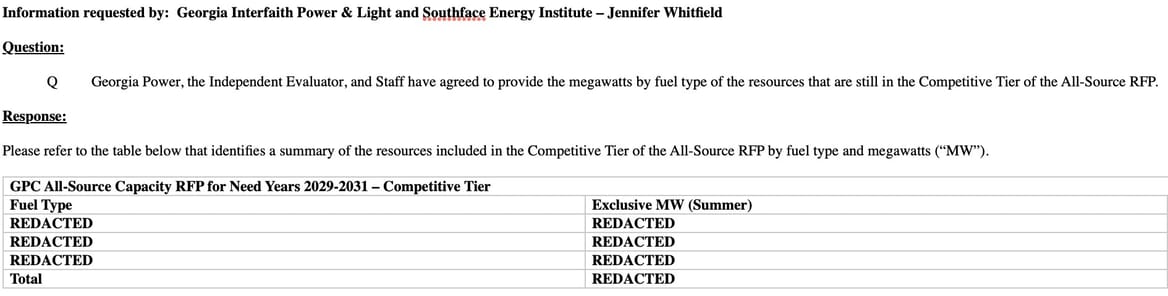
“It’s difficult to understand any justification for redacting this information,” said Bob Sherrier, a staff attorney at the Southern Environmental Law Center. “How can the public meaningfully engage with Georgia Power’s proposed data center plans without any insight into what’s coming?”
Georgia Power spokesperson Jacob Hawkins told Canary Media in an April 18 email that the utility follows “established processes and legal requirements when submitting sensitive or proprietary information that, if made available broadly and publicly, could hurt our ability to negotiate and procure the best value and resources for our customers. Intervenors who sign confidentiality agreements as part of the process have access to much greater and detailed information.”
“We would disagree in the strongest possible terms that we are not following all statutory requirements and state law across the board in these proceedings, period,” Hawkins wrote.
Many states allow utilities to withhold details about the cost or type of resources in all-source RFPs to avoid undermining the competitive bidding process. But what’s uncommon about Georgia Power’s current case is just how much of its future will be dictated by this process.
Georgia Power’s need for new generation has exploded in the past two years, driven largely by a flood of plans to build data centers in the region. The utility has tripled its decade-ahead electricity demand forecasts since 2022. That projected boom in demand has somewhat scrambled the standard processes for utility resource planning, Whitfield told Canary Media.
In its last full-scale IRP in 2022, Georgia Power identified enough resources to cover its needs until 2029, she said. But it also identified an approximately 500 MW gap between demand and supply from 2029 to 2031, and agreed with regulators to launch the all-source RFP to fill it. That all-source RFP process is not subject to the same disclosure rules as an IRP, as it involves competitive bidding between the utility and third-party energy project developers.
Regulators approved an interim IRP last year that allows Georgia Power to build 1.4 GW of fossil-fueled power plants and 500 MW of batteries, and to contract for nearly 1 GW more from other utilities’ coal- and gas-fired power plants, to relieve some of its nearer-term pressures.
But the all-source RFP launched back in 2022 has remained Georgia Power’s main mechanism to get what it needs by 2031, Whitfield said. That’s despite the fact that it was initially meant to cover just 500 MW, a figure nearly 20 times smaller than the 9.5 GW it is now planning to fill via the all-source RFP process.
This has created something of a regulatory shell game in which Georgia Power can contract for the vast majority of its future energy and capacity needs outside the purview of the standard IRP process, said Simon Mahan, executive director of the Southern Renewable Energy Association trade group.
“Many organizations and companies focus exclusively on the IRP, while the ultimate decisions may occur in a totally separate docket, where fewer intervening parties are engaged,” he said.
The battle over Georgia Power’s missing gigawatts comes as the utility has failed to bring as much renewable energy into its resource mix as it previously pledged to.
The utility has about 3 GW of solar, helping to push Georgia into the top 10 states for solar growth. But it’s also been slow to contract with third-party owners of solar and battery projects to meet its power needs. Georgia Power’s 2025 IRP calls for an additional 3.5 GW of renewable energy by the end of 2030, but that plan partially just makes up for the utility’s cancellation of previous clean-power procurements, Mahan noted.
Solar alone can’t meet Georgia Power’s capacity needs, which are driven by demand for electricity for heating in wintertime.
But batteries that can store solar or general grid power could play a more significant role. Regulators approved Georgia Power to add 500 MW of battery storage in last year’s interim IRP, and its 2025 IRP calls for further expanding its energy storage capacity. Mahan noted that much of the solar power being proposed in the state will likely be paired with batteries to enhance its value to Georgia Power’s grid.
Without more information on the contents of the all-source RFP, it’s nearly impossible for environmental groups, consumer advocates, and other stakeholders to know whether Georgia Power is properly weighing renewable alternatives to gas-fired power plants that the utility will build and own itself.
Georgia Power’s commitment to fossil gas and coal — which together made up nearly 60% of its capacity last year — is certainly a problem for the climate. The Sierra Club calculates that the generation mix laid out in Georgia Power’s proposed 2025 IRP would make the utility “one of the top greenhouse gas emitters in the U.S.”
It could be a problem for utility customers, too, who have already seen rates rise significantly in recent years due to Georgia Power’s more than $30 billion expansion of its Vogtle nuclear power plant.
Like most regulated utilities, Georgia Power earns a set rate of profit on investments in power plants, power grids, and other capital assets. It’s also required to allow third-party developers to compete with it to build solar and battery projects — a process that can yield lower costs for its customers but also lower rates of return for the utility.
Regulators have a responsibility to closely monitor the utility’s process for choosing which resources end up winning to ensure those decisions aren’t maximizing Georgia Power’s profits at the expense of its customers, said Patty Durand, a consumer advocate and former Public Service Commission candidate. But she fears regulators will fail to challenge Georgia Power’s assertions on which resources will most cost-effectively meet its grid needs.
“We need to keep stock of how many gigawatts of fossil fuel Georgia Power is building or keeping on the grid because of data centers,” she said. “That is a climate change disaster.”
Durand has also challenged Georgia Power’s load-growth forecasts, noting that the utility has consistently overestimated future electricity demand across the past decade, helping it justify increased spending on profit-earning assets.
“Are utility bills a kitchen-table issue? If they are, these guys are in trouble,” she said. “Data centers are about to make the bills we pay now into a joke.”
Some of the tech giants playing a role in the data center expansion driving Georgia Power’s demand forecasts have similar concerns. Last year, Microsoft challenged the utility on how it models the value of clean energy resources as well as how it forecasts load growth.
Georgia Power also faced pushback from the Clean Energy Buyers Association (CEBA), which represents companies like Amazon, Google, Meta, and Microsoft that are simultaneously planning major data center expansions and striving to decarbonize their energy supplies. In testimony before the Public Service Commission last year, CEBA warned that “some of the new load Georgia Power is forecasting may not materialize if Georgia Power increases the carbon intensity of its resource mix.”
CEBA ended up supporting last year’s interim IRP on the condition that Georgia Power follow through with a promise to offer large industrial and commercial customers new options to bring more carbon-free resources onto the utility’s grid.
Georgia Power’s 2025 IRP lays out a “customer-identified resource” proposal to meet its end of the bargain, said Katie Southworth, CEBA’s deputy director of market and policy innovation for the South and Southeast. In simple terms, the utility would allow big customers to work with third-party developers to build solar, batteries, and other carbon-free resources that they could use to power their data centers and other large facilities. That’s a fairly common practice in parts of the country operating under competitive energy markets — but not in Georgia and most of the U.S. Southeast, where utilities remain vertically integrated.
However, the utility’s plan lacks transparency and certainty about how customer-proposed projects will be assessed and approved, and it limits the scale and scope of resources that big customers can bring to the table. Georgia Power also plans to delay implementation of that program, frustrating CEBA members eager to start searching for potential projects.
Hawkins, the Georgia Power spokesperson, told Canary Media that the utility continues to “incorporate CEBA’s feedback into our program designs, while still ensuring that all Georgia Power customers are protected. Our proposed IRP portfolio of renewable procurements and programs represents a continuation of our steady and measured renewable growth that delivers benefits to all customers.”
In the meantime, Southworth said, CEBA is encouraging Georgia Power customers looking for cleaner energy options to “get involved in the design of the all-source process. That gives us a chance to include other resources that could play a role.”
That may be an option for qualified energy developers active in that competitive procurement. But it remains unclear if or how the Public Service Commission will push Georgia Power to open the hood on that process for consumer advocates and environmental groups that have been denied information thus far.
“This is an exceptionally unusual time in the Georgia energy world for a million reasons, of which this is one. I think this is a hugely important issue,” Whitfield said. The investments being planned today are “going to transform our energy system,” and Georgia Power is conducting that work “without providing critical information about what that new system might look like.”
But time is running short to order more transparency. Georgia Power plans to announce the winning bids for its all-source RFP in July, Whitfield said — the same month that state regulators expect to take their final vote on the IRP.
Canary Media’s “Electrified Life” column shares real-world tales, tips, and insights to demystify what individuals can do to shift their homes and lives to clean electric power.
At 420 East 51st St., nestled in the Midtown East neighborhood of Manhattan, a 13-story beige brick building sits among a handful of other hulking structures. Its tidy facade doesn’t particularly stand out. Nor does its height. In fact, from the street it’s impossible to see what makes the cooperatively owned 1962 building unique among most other apartment properties in New York City: Its residents opted to fully electrify the heating and cooling system.
The co-op board decided in 2023 to swap out the structure’s original fossil-fuel steam system for large-scale electric heat pumps that provide space heating, cooling, and water heating. Utility and state incentives covered a whopping one-third of the $2.9 million project’s cost.
The move, which the seven-member board approved unanimously, puts the co-op well ahead of the curve in complying with Local Law 97, the city’s landmark legislation limiting CO2 emissions from buildings larger than 25,000 square feet. Owners of buildings that overshoot carbon thresholds face financial penalties.
The law’s first reporting deadline is May 1, and the 110-unit co-op has hit its emissions reduction targets far ahead of schedule. With the upgrades completed last September, it’ll avoid triggering penalties through 2049.
Also known as 420 Beekman Hill, the edifice is among the first multifamily structures in Manhattan to switch to all-electric heating, cooling, and water heating, according to staff at NYC Accelerator, a building decarbonization initiative run by the Mayor’s Office of Climate and Environmental Justice.
The retrofit provides a model for the work that will need to happen in buildings around the country in order to achieve climate goals and comply with laws similar to Local Law 97, said Cliff Majersik, senior advisor at the nonprofit Institute for Market Transformation.
There are more than 30 million multifamily housing units in the U.S., 40% of which were heated with fossil fuels as of 2020, according to the Energy Information Administration.
The co-op had originally relied on the local utility Con Edison’s district steam system, which is primarily fed by fossil gas and some fuel oil. The retrofit design team weaned the building off that piped steam, solving a problem that still bedevils building owners connected to the hundreds of steam loops operating across the country, including in Cleveland, Chicago, and Philadelphia.
“Getting off steam is the most challenging transition,” explained Ted Tiffany, senior technical lead at the Building Decarbonization Coalition, who added that he was really excited the Beekman Hill project popped up on his radar. “This gives us an example” for how buildings on steam can go electric cost effectively and in a way that doesn’t disrupt tenants’ lives, he said.
The vanguard achievement in the Empire City comes as four states and 10 other locales have passed their own laws to rein in emissions from existing buildings, and more than 30 other jurisdictions have committed to adopting similar rules, known as building performance standards.
New York City’s policy was among the first such laws to be passed in the U.S.
Under Local Law 97, 92% of buildings are expected to meet emissions standards within this first compliance period, which runs from 2024 to 2029, according to the nonprofit Urban Green Council. But getting buildings to make the deeper cuts needed to cumulatively slash emissions 40% by 2030 will take a lot more action.
NYC Accelerator, which helped on the Beekman Hill retrofit, exists to support city building owners with free resources, training, and one-on-one guidance to complete decarbonization projects.
“What we’re seeing most of all is that these [retrofits] are complex and sometimes difficult,” said Elijah Hutchinson, executive director of the Mayor’s Office of Climate and Environmental Justice. “You do need to hand-hold and get to people very early.”
The accelerator is holding up Beekman Hill as a shining example of what’s doable. Last month, the office threw an open house at the co-op so other building owners could see the climate-friendly upgrades.
Ten gleaming Aermec heat pumps on the roof capture heat from the winter air and shuttle it to heat exchangers in the basement, which then deliver that heat to the building’s water-based hydronic system. The water carries the heat to each residential unit, where warmth wafts out from an unobtrusive piece of equipment called a fan coil.
Because all of the installation work, including an upgrade that tripled the building’s electrical capacity, was done outside of the living spaces, “there was no disruption to the tenants,” said Rahil Shah, engineer and director of sustainability at Ventrop Engineering Consulting Group, the firm that designed and managed the project.
In the summer, the heat pumps work in reverse, drawing heat from inside the apartments and dumping it outside. The double-duty equipment allowed the co-op to ditch its old absorption chillers that ran on Con Edison steam.
The new system also has three additional Colmac heat pumps in the basement that can give the water heated from the rooftop heat pumps a thermal boost. While those on the roof can only reach temperatures up to 110–120 degrees Fahrenheit, the basement heat pumps can reach 160°F — potent enough to store the co-op’s hot water.
Shah said this is the first time that Ventrop Engineering has used both types of heat pumps together to help decarbonize a building’s space and water heating. The firm plans to deploy the winning combo again in the future.
In all, Beekman Hill expects a 60% reduction in energy use and a 76% drop in its greenhouse gas emissions compared with running on steam. The building still has some gas stoves that it will need to replace in the coming years to go fully electric.
Without the updates, the co-op would have faced penalties of about $30,000 per year from 2030 to 2034. Fees would’ve climbed sharply afterward to nearly $90,000 per year by 2040. Plus, the building simply needed an upgrade: Its six-decade-old system was on the brink of breakdown.
What convinced the co-op to electrify? “Me,” said Randolph Gerner, Beekman Hill resident and board member in charge of capital improvements, as well as principal at GKV Architects.
“On a board, you have different expertise. My expertise is very much in this field,” Gerner said. “I’ve designed a number of buildings … and my new buildings are all electrified.”
With assistance from NYC Accelerator, Beekman Hill secured $154,000 from the New York State Energy Research and Development Authority’s Multifamily Buildings Low-Carbon Pathways Program and $1 million from Con Edison’s Clean Heat Program to help cover the project bill of $2.9 million before incentives. The co-op took out a loan to finance the rest over three years at a cost of about $15,000 to $20,000 per unit, depending on its size.
The funding actually made the project about $600,000 cheaper than the alternative — a traditional gas boiler and electric air-conditioning, Gerner said.
It’s rare that building boards have architectural and engineering design pros on them, Gerner added. So neighboring co-ops have sought him out for guidance on how to decarbonize their buildings. He’s already sat down with six other co-op boards in the past two years, he said.
Gerner’s advice for co-ops grappling with whether to embrace heat pumps is simple: “Give me a call.”
A correction was made on April 24, 2025: This story originally stated that staff at NYC Accelerator said Beekman Hill appeared to be the first co-op in Manhattan to electrify its heating, cooling, and water heating. The organization has clarified that although it is among the first, NYC Accelerator cannot confirm it is the first.
Each time a hurricane batters Florida, the country’s second-largest market for solar energy, broken panels pile up in landfills.
OnePlanet Solar Recycling has a plan to tackle that problem. The Jacksonville, Florida-based startup, led by a former steel executive who worked on the industry’s efforts to reuse scrap, just raised $7 million to start developing a first-of-its-kind solar recycling plant. The facility would break down busted panels and turn the waste stream into a new domestic source of metals such as copper and aluminum at a moment when tariffs are set to hike the price of imported materials.
The company plans to build its $90 million facility, dubbed the River City project, in Green Cove Springs — just south of Jacksonville, Florida’s most populous city. In 2027, OnePlanet aims to complete the first of three phases of construction on the plant and open the debut disassembly line capable of deconstructing 2 million solar modules per year. The firm set a deadline to triple capacity to 6 million panels by 2030.
At peak output, the company expects the facility to be among the largest solar recycling plants in the nation.
OnePlanet’s ambitious plans rest on its unique solar recycling process. The company uses existing technologies but developed a proprietary workflow for divvying panels by shape, model, and physical integrity before crushing, grinding, and chemically treating the hardware to extract raw materials.
“We’re doing a lot of work before we actually feed the panels into the recycling line,” said André Pujadas, OnePlanet’s chief executive. “We batch panels together so we can run campaigns to extract different types of materials, thereby optimizing the process and optimizing production and efficiency.”
Employing artificial intelligence and state-of-the-art sensors, OnePlanet can recover not just the panels’ glass, plastic, and silicon but up to 97% of metal concentrates of aluminum and copper, Pujadas said.
“You can recover the glass and still leave a fairly large amount of impurities in the remaining elements that complicate any further separation process,” he said. “That increases costs for recycling; then you don’t have as pure a product.”
Pujadas previously worked at the steelmaker Nucor, which led the U.S. industry’s adoption of electric arc furnaces. The technology turns scrap metal into new steel using electricity, offering a lower-carbon alternative to fresh steel generated from iron ore in a coal-based blast furnace. That experience taught Pujadas about where costs can mount in a supply chain and how much value a firm can create by freeing feedstock from contaminants.
Compared to that of other recyclers, OnePlanet’s approach will save the company money on maintenance since the pre-disassembly separation process avoids unnecessary wear on the machines, he said, basing the claims on the success of the firm’s pilot plant in Jacksonville.
The financing round announced Tuesday will “be used for final engineering, environmental permits, master recycling agreements, and long–lead time items,” Pujadas said.
The funding “reflects our belief that solar module recycling is not only necessary — it is investable at scale, with durable tailwinds driven by regulation, economics, and resource security,” Ashlynn Horras, partner at the climate-focused venture firm Khasma Capital, said in a statement. Khasma Capital led OnePlanet’s recent seed round.
Among the biggest challenges for recycling is finding cheap methods to transport panels to the processing facility. Shipping busted equipment from Texas, Pujadas said, is more expensive than hauling in panels from Puerto Rico. The location near Jacksonville not only has access to a Class I railroad and a port, he said, but to a lot of local material from within the state itself.
OnePlanet is also getting some help from the Inflation Reduction Act. The company’s facility will be funded in part by a $14.5 million investment from the Department of Energy’s competitive 48C tax credit awarded last year.
Pujadas said “the jury is still out” on whether President Donald Trump and the Republican-controlled Congress will revoke the program.
“At the end of the day, I’m happy for the vote of confidence from the Department of Energy that this project presented some level of viability and can have a positive effect on domestic value chains,” he said. “Whether or not 48C comes to fruition or not, it’s not going to prevent us from continuing with the River City project.”
While he said tariffs may negatively impact the broader economy, the trade levies are expected to raise the price of key raw materials like aluminum, copper, and silicon, for which OnePlanet can offer a new domestic source.
“There’s a lot of unknowns on the tariff side,” Pujadas said. “But overall if there’s upward pricing pressure, the aluminum we produce will go up, the silicon will go up, and the copper will go up.”
A correction was made on April 22, 2025: The final quote in this piece initially read “the aluminum we procure will go up,” when it should have read “the aluminum we produce will go up.”
The Chicago Teachers Union expects its new, hard-fought contract to help drive clean energy investments and train the next generation of clean energy workers, even as the Trump administration attacks such priorities.
The contract approved by 97% of union members this month represents the first time the union has bargained with school officials specifically around climate change and energy, said union Vice President Jackson Potter. The deal still needs to be approved by the Chicago Board of Education.
If approved, the contract will result in new programs that prepare students for clean energy jobs, developed in collaboration with local labor unions. It mandates that district officials work with the teachers union to seek funding for clean energy investments and update a climate action plan by 2026. And it calls for installing heat pumps and outfitting 30 schools with solar panels — if funding can be secured.
During almost a year of contentious negotiations, the more than 25,000-member union had also demanded paid climate-educator positions, an all-electric school bus fleet, and that all newly constructed schools be carbon-free. While those provisions did not end up in the final agreement, leaders say the four-year contract is a “transformative” victory that sets the stage for more ambitious demands next time.
“This contract is setting the floor of what we hope we can accomplish,” said Lauren Bianchi, who taught social studies at George Washington High School on the city’s South Side for six years before becoming green schools organizer for the union. “It shows we can win on climate, even despite Trump.”
The climate-related provisions are part of what the Chicago Teachers Union and an increasing number of unions nationwide refer to as “common good” demands, meant to benefit not only their members in the workplace but the entire community. In this and its 2019 contract, the Chicago union also won “common good” items such as protections for immigrant students and teachers, and affordable housing–related measures. The new contract also guarantees teachers academic freedom at a time when the federal government is trying to limit schools from teaching materials related to diversity, equity, and inclusion.
“Black history, Indigenous history, climate science — that’s protected instruction now,” said Potter.
Chicago Public Schools did not respond to emailed questions for this story, except to forward a press release that did not mention clean energy provisions.
The union crafted its proposals based on discussions with three environmental and community organizations, Bianchi said — the Southeast Environmental Task Force, People for Community Recovery, and ONE Northside.
The Southeast Environmental Task Force led the successful fight to ban new petcoke storage in Chicago, and the group’s co-executive director Olga Bautista is also vice president of the 21-member school board. People for Community Recovery was founded by Hazel Johnson, who is often known as “the mother of the environmental justice movement.” And ONE Northside emphasizes the link between clean energy and affordable housing.
Clean energy job training was a priority for all three of the organizations, Potter said.
Under the contract, the union and district officials will work with other labor unions to create pre-apprenticeship programs for students, which are crucial to entering the union-dominated building trades to install solar, do energy-efficiency overhauls, and electrify homes with heat pumps and other technology. The contract demands the district create one specific new clean energy jobs pathway program during each year of the four-year contract.
It also mandates renovating schools for energy efficiency and installing modern HVAC systems, and orders the school district to work with trade unions to create opportunities for Chicago Public Schools students and graduates to be hired for such work.
“The people in the community have identified jobs and economic justice as being essential for environmental justice,” said Bianchi. “I’ve mostly taught juniors and seniors; a lot expressed frustration that college is not their plan. They wish they could learn job skills to enter a trade.”
Installing solar could help the district meet its clean energy goals, which include sourcing 100% of its electricity from renewables by this year.
The district has invested more than $6 million in energy efficiency and efficient lighting since 2018, and cut its carbon dioxide emissions by more than 27,000 metric tons, school district spokesperson Evan Moore told Canary Media last fall as contract negotiations were proceeding.
The schools are eligible for subsidized solar panels under the state Illinois Shines program, and they can tap the federal 30% investment tax credit for solar arrays, with a new direct-pay option tailored to tax-exempt organizations like schools.
The union contract’s climate stance represents a “reversal of what’s happening at the federal level,” said Potter. “It’s decreasing dependency on fossil fuels, ensuring the district is moving toward more environmentally efficient practices.”
While the future of federal clean-energy tax credits is in doubt under the Trump administration, Illinois elected officials and advocates say the state’s clean energy transition will continue thanks to ambitious state laws — including a major new energy bill before the legislature.
“As [Chicago Public Schools] is facing many financial woes, we see solar and lowering energy costs as a way we can actually save money that we can then use to prevent layoffs and staff programs,” said Bianchi.
The contract also calls for upgraded windows and HVAC in all schools, as funding permits, which would boost energy efficiency, union leaders said. And it mandates more transparency from the district about the progress of building work orders, which Potter said will help the community track energy-efficiency investments. With school buildings that are 83 years old on average, such overhauls are crucial both to saving money on energy bills and keeping conditions adequate for learning. In 2012, the teachers union went on strike and ultimately won guarantees for air conditioning in all schools, where students and teachers had been sweltering in aging buildings without functioning AC.
Moore said the district is committed to another program that the teachers had demanded, though it did not end up in the contract: the creation of community resiliency centers at schools, where residents can stay warm or cool during extreme weather. Moore noted that Chicago Public Schools received a federal Renew America’s Schools grant in 2024 that will help prepare 20 schools for that role.
The district also received federal funds last year to purchase 50 electric buses under the Clean School Bus program. The city said it worked closely with the union on the application, and Potter added that contract provisions, including formation of a joint Green Schools and Climate Change Preparedness Committee, ensure the union can work with the district to seek additional funds for electric buses.
In recent years the teachers union was deeply involved in a successful fight to prevent a polluting metal shredder’s move from a wealthy North Side neighborhood to the low-income community where George Washington High School is located. The campaign, led in part by now–school board Vice President Bautista, resulted in an agreement between the state and federal government meant to prevent development of new polluting sources in environmental justice communities.
“We’re treated as the city’s dumping ground, but with the community’s organizing power, history, and legacy of resistance, ultimately the community won,” said George Washington High teacher Kevin Moore, who talks about environmental justice and climate change in his courses, including human geography.
The union demanded during bargaining that George Washington High and at least two other schools be replaced with new carbon-free buildings. The contract ultimately has no such promises but says any new school buildings should “aspire to be carbon-free.”
Other unions nationwide have also included climate provisions in their demands, including under the “common good” banner. The Los Angeles teachers union UTLA has for several years made climate justice a successful plank in its contract negotiations, building on its common good advocacy for racial justice and citing blistering heat and wildfire smoke that affect local schools.
In February 2020, 4,000 janitors who were members of Minneapolis’ SEIU Local 26 union held a one-day “climate strike” — joined by students and other community groups — demanding greener cleaning practices and action by banks and other companies to reduce emissions in corporate buildings. After walking off the job, the janitors succeeded in enshrining some climate-related measures in their contract.
“Helping both the larger community and our members to see the union as a vehicle to win on other issues is critical to the survival of organized labor,” wrote two SEIU Local 26 officials and a high school student in a joint essay in Labor Notes, highlighting that more than 40% of the union’s members reported that climate change has impacted their families.
The United Auto Workers union has supported Environmental Protection Agency vehicle emissions limits and the electric vehicle transition.
“A lot of people see this as a new thing we’re doing,” Bianchi said of the Chicago Teachers Union’s focus on energy and climate. “However, as a history teacher, I want to point out that health and safety is something that unions have always fought for. The farmworkers were fighting against toxic chemicals. Mineworkers were fighting for safety. This isn’t just an issue that intersects with our working conditions and the broader public good. It really is both.”
Californians face steep up-front costs if they want to install solar panels to produce clean power and batteries to back up their homes in outages. A new state program will cover those costs for low-income homeowners, but they still have to pay up to tens of thousands of dollars initially and then wait months for the rebate to come through.
Now a startup called Haven Energy is going to take on the task of filing that paperwork, giving homeowners something that sounds too good to be true: a solar and battery system with no out-of-pocket cost.
It’s the latest riff on the evolving market for virtual power plants, which aggregate thousands of small energy systems into a meaningful tool to meet the energy needs of utilities or competitive electricity markets. The grid needs more energy just about everywhere in the U.S., but large-scale infrastructure construction runs into persistent delays and challenges. Adding generation and storage capacity in homes is relatively quick, and with the right incentives, can add up to a substantial tool to meet the grid’s needs.
If Haven successfully implements those incentives, it thinks it will be able to install 10 megawatts of dispatchable battery capacity across thousands of homes in the next two years. The (non-paying) customers will benefit from bill savings and backup power; to qualify for the state-funded rebate, they just need to make their batteries discharge regularly when the grid is stressed, namely in the evening hours when solar production dips and demand surges.
Haven launched in 2023 to streamline the home battery purchase experience and has overseen installations at hundreds of homes in California. But after a couple of years, cofounder and CEO Vinnie Campo determined the company needed a new strategic approach.
“We thought if you were able to remove all the friction from the process, that you could dramatically increase the adoption,” he explained. “That’s only fractionally true. The reason most people don’t get a battery is that they’re incredibly expensive.”
At the same time, utilities have begun grappling with a sudden uptick in electricity demand to supply AI computing, industry, and electrification. Utilities increasingly recognize the value of fleets of aggregated batteries to help meet peak demand, Campo said, but they’re much more comfortable contracting for large assets than thousands of small ones.
Putting these threads together, Campo decided Haven should own the batteries it installs at customer homes, so it can control them to serve utilities’ grid needs, and pull together different revenue streams to lower the cost for consumers.
“We’re seeing from the utilities and the retail companies, they just want that fixed, firm capacity every day,” Campo said. “That’s part of the gap that we’re trying to play into.”
Now Haven can tap into a new tranche of state funds to make this a reality.
Batteries don’t generate power, but for arcane bureaucratic reasons California has long funded its desired battery expansion with the Self-Generation Incentive Program. This legacy program has shifted with the times, and its newest evolution opened up $280 million to pay for batteries (and optional paired solar panels) for low-income households.
Technically, those homeowners can apply for the funds themselves. But this is a rebate program, so they would have to front the cost — which can easily tally up to $30,000 or $40,000 — then wait to get paid back by SGIP, which can take three or four months, Campo said. That’s an obvious nonstarter for many households.
Haven, though, has raised a debt facility and studied up on the necessary details. It can fund the cost of installation and wait for the rebate without sweating. Then it’s on the hook to make sure the installed battery system meets the program requirements for lowering demand in the evenings over 10 years. (Haven routes the installations to local installers and partnered with an undisclosed software company to handle the distributed energy management system)
The customer, meanwhile, doesn’t have to pay Haven any money, but benefits from the backup power and from lowering their electricity demand during peak pricing hours. Customers who use the SGIP funds to pair solar with their batteries will further lower their energy bills by producing their own clean power. And after a decade, Haven will transfer ownership to the homeowners.
Haven has already signed up a few hundred households for this program; the new rebates for solar-battery systems will open up on May 20, when the state rolls out updates to its online system for processing them.
“The biggest objection we get is, people don’t think it’s real,” Campo said. “They’ve always been sold ‘free solar,’ right? And this is the first time it actually is free solar — it’s not ‘no money down,’ it’s no money ever.”
Customers could be forgiven for not believing this program is real, because up until now, it hasn’t been.
State legislators originally allocated $900 million for a new branch of the long-running SGIP bureaucracy back in the Budget Act of 2022. At that time, the state was revising its policies for rooftop solar compensation to encourage more battery adoption; a flagship, broadly accessible home battery rebate could bolster that market in its time of transition. Originally, 70% of that funding was for low-income households, and the rest was open to the general populace. Rather than raising the money by charging people’s utility bills, as SGIP had previously, the Legislature pulled the new funds from the state’s cap-and-trade revenue.
But instead of quickly establishing the rules and moving the money out the door, the California Public Utilities Commission oversaw a yearslong process of laborious updates to the SGIP handbook and the backend database.
“It’s taken forever to go live,” said Joshua Buswell-Charkow, deputy director at the California Solar and Storage Association, a trade group.
While that cumbersome process was underway, the Legislature pared down most of the allocation, leaving just $280 million for low-income households. Updating the necessary web infrastructure has proven time-consuming. The commission also allowed the Los Angeles Department of Water and Power, the state’s largest municipal utility, to delay launching the solar-battery rebate program for Angelenos until late December, because the utility wasn’t ready to administer it on time.
The funds still need to be claimed by June 30, 2026. As the money finally starts to flow, Buswell-Charkow is most concerned about the practicality of meeting the new requirement that state-funded batteries enroll in demand response.
SGIP-funded batteries already had cycling requirements, meaning they couldn’t just sit in backup mode and not provide more value to the grid, he noted.
Going forward, the batteries have to be enrolled in a “qualified demand response program.” But, so far, the commission has only qualified two types of programs: critical peak pricing rates, which are only available to Californians who buy power from the three big investor-owned utilities, and the capacity bidding program, which currently only serves commercial customers, according to the California Solar and Storage Association’s survey of the market.
Other demand response programs include home batteries, like the Demand-Side Grid Support and Emergency Load Reduction programs, but the commission hasn’t approved them for the SGIP requirement.
The commission did grant an exemption for customers of municipal utilities who don’t have access to any qualified demand response programs, Buswell-Charkow said. But the regulators denied an exemption to the millions of customers of community choice aggregators, locally organized power-purchasing organizations that similarly lack access to the small number of approved demand response programs. Haven has encouraged utility regulators to approve demand response programs for customers of community choice aggregators, so those millions of Californians can access the SGIP funds, too.
The demand response requirement “makes the program needlessly more complicated than it needs to be,” Buswell-Charkow said.
Given those layers of complexity, it’s hard to imagine homeowners wading into the morass themselves. Even local solar installers struggle with the administrative burden of meeting SGIP’s bureaucratic requirements, Buswell-Charkow noted. This could give companies like Haven an opening: If they get good at filing the necessary paperwork and executing on the dense program requirements, they can make money and give households free clean energy at the same time.
The future of the U.S. electric vehicle transition is murky — but at least through the first three months of 2025, the data tells a clear story.
Almost 300,000 EVs were sold in the first quarter of the year, according to a new report from Cox Automotive. That’s 11% more than over the same period in 2024.
Over the last few years, two trends have defined the U.S. EV market: somber headlines and slow-but-steady growth.
In late 2023, analysts began warning EV sales were not increasing as fast as once projected as concerns about cost, range, and charger availability persisted. Some even forecast sales would decline in 2024. Major automakers began walking back their 100% electric commitments. Ultimately, new EV sales rose by just 7% last year — enough to push the sector to an annual record-high of 1.3 million vehicles sold, but far slower growth than the 49% surge in 2023.
After Republicans swept the November elections, the market’s outlook grew even gloomier. That’s because federal policies supporting EV adoption are likely to disappear or at least be severely watered down.
President Donald Trump’s Environmental Protection Agency has already moved to kill the strict tailpipe emissions rules supported by legacy U.S. automakers. Congressional Republicans are on a (potentially doomed) crusade to revoke waivers that have allowed states like California and New York to ban the sale of new gas vehicles after 2035. They’re also reportedly looking to gut the consumer EV tax credit, an action that would hobble EV sales. Trump’s tariffs, such as they are, present yet another hurdle: The U.S. relies heavily on China for key battery components and minerals.
But at least in Q1, EV sales were still ticking up. And that’s despite Tesla’s big decline. The U.S. market leader saw its sales drop by 9% year-over-year, the result of a stagnant product lineup and, according to some analysts, public distaste for CEO Elon Musk’s political persona. Meanwhile, General Motors, Ford, Hyundai, and BMW all saw their sales continue to rise.
The fact that the industry managed to grow despite the struggles of its overwhelming leader — Tesla accounted for 44% of the market in Q1 — speaks to the increasing vibrancy and resilience of the U.S. EV market. The question now is whether it is vibrant and resilient enough to keep growing despite federal policy headwinds.
A correction was made on April 18, 2025: The chart and image for this story were originally incorrectly labeled with 2024. The year has been changed to 2025.
Aubrey Gunnels, CEO of 3V Infrastructure, understands the risks involved in installing and owning EV chargers in thousands of apartment building garages and condominium parking lots. She also sees the opportunity.
Just look at the statistics. By 2030, EVs are expected to make up close to half of all new U.S. car sales. Today, roughly 80% of EV charging takes place at home, and roughly one-third of Americans live in multifamily housing. But only 5% of U.S. multifamily housing offers on-site EV charging, according to CBRE, one of the world’s largest property management companies and a 3V Infrastructure partner.
“People really prefer to charge at home,” Gunnels said — and they’ll want to live in apartments or condos that offer that option.
Tenants don’t pay to install EV charging, though — property owners do, and they aren’t in the business of financing, installing, or operating complex EV charging projects.
That’s where 3V Infrastructure comes in, Gunnels said. Since launching last year, the New York–based startup has raised up to $40 million from an affiliate of Greenbacker Capital Management to finance charging installations in properties across the country. With big-name customers like Camden Property Trust and Bridge Investment Group, 3V is installing chargers at hundreds of sites in 17 states, and hopes to expand to thousands by 2030, she said.
Getting big is key to 3V’s business model, Gunnels said. Many “charging-as-a-service” offerings for multifamily properties already cover the cost of chargers in exchange for monthly fees or other payback structures. But 3V isn’t asking property owners for any money at all, she explained — just a 10-year contract to let it build chargers on the site and charge customers for using them.
That means it’s up to 3V to pick the right properties, install the right number of chargers in the right locations, keep them in good working order, and decide how much it needs to charge users to make its money back.
“We’re taking early risk with the EV driver adoption rate at each site,” Gunnels said. “And once we’re profitable, we share the profits with the property owner — and that helps allow us to maintain the chargers.”
In that sense, 3V’s business model more closely resembles that of the public charging operators that rely on electricity sales to earn back their up-front costs. That’s inherently riskier than getting someone to pay you to install and operate EV chargers — and so far it’s a rarity in the world of multifamily EV charging developers.
It is, after all, still early days for the EV charging industry. The first public charger deployments were boosted by significant government or utility incentives to make up for the fact that there weren’t enough EVs on the road to reliably finance their costs.
But up-front incentives aren’t a good mechanism to ensure that chargers keep performing over the long haul. In fact, EV chargers have a long and troubled history of not working when drivers need them to. This is a well-publicized problem with public chargers, but it’s affected multifamily properties as well.
“As we all know, the statistics about EV charger uptime are not great. A lot of those chargers may be not functioning,” said Mark Kerstens, vice president of EV charging solutions at CBRE. That’s certainly true for the earliest rollouts of multifamily charging, many of them undertaken by property owners themselves.
CBRE manages and advises multifamily property owners around the world, and works with a number of chargepoint operators, including 3V, for those looking to install EV charging, Kerstens said. Some property owners have taken on charging installations and operations on their own, he said. But most are simply looking for a way to not be left behind in a market that’s constantly seeking out new amenities to draw in tenants and residents.
How badly property owners feel they need EV chargers depends on where they are and what type of tenant they want to attract, he said. He sees the overall market as shifting to the point where it could be “a negative differentiator, if you’re the only multifamily property that does not have an EV charger.” And for many property owners, “it’s just like a vending machine in the rec room — they don’t want to do it themselves, they’d rather have a service provider.”
CBRE’s EV charging partners run the gamut from all-in risk-takers like 3V to a range of “as-a-service” models that charge monthly fees or arrange cost- and revenue-sharing agreements with property owners, he said. What’s paramount, he said, is that the chargers work properly — and “there’s quite a bad track record for those who’ve tried to do it on their own.”
The same concern applies to charging provided by a third party, said Clark Longhurst, president of commercial markets at SitelogIQ, the company working with 3V on its projects with Bridge Investment Group. SitelogIQ has decades of experience installing LED lighting, building controls, and other energy-efficiency projects in multifamily housing. EV charging is a relatively new addition to that roster — and “there’s a longer list of people who will do it ‘as a service,’” he said.
But EV charging for multifamily properties has had some serious problems. Early projects were plagued by chargers that couldn’t receive wireless control signals in concrete parking garages, low-cost chargers that companies failed to repair promptly when they broke, and other issues, he said.
“I don’t want to hand this over to someone who will provide a bad experience – that’s bad for me as a property owner,” Longhurst said. Any provider of charging as a service “needs to have the same incentives — or maybe more incentives — than you have as an owner to ensure the charging works, that it’s done without friction, and if there’s a problem it’s handled quickly.”
Multifamily property owners also have to consider the risks of taking responsibility for charging infrastructure that could end up being abandoned as companies exit various markets, said Larsen Burack, EV charging product manager at analysis firm Ohm Analytics. His company’s latest report on the U.S. multifamily charging space indicates how many choices exist, from multifamily specialists such as Swtch and EverCharge to large-scale public charging providers like ChargePoint and Tesla. But those choices have also included companies like Enel X Way that abruptly exited the market and stopped supporting customers.

“Options like the 3V model are intriguing for property managers because there is no up-front capital cost and can be seen as relatively low risk,” Burack said. At the same time, “this is still a volatile industry, and if a company shutters, you risk having another Enel X situation on your hands.”
Gunnels conceded that 3V’s customers will need to have faith in its ability to execute on its 10-year contracts. She also highlighted that the company doesn’t rely on government subsidies for its projects to be profitable, and takes a conservative approach to forecasting utilization — the critical metric of how often chargers are used, and thus how quickly they can pay back their costs and earn profits.
That’s important for aligning the long-term incentives of the charging business, she believes. “Many of the stranded chargers we have across the nation are not a product of hardware or software [issues] — it’s really the economics,” she said. “If someone’s not incentivized to make sure the chargers work, they’re not going to work.”
3V’s conservative approach may limit the scope of markets and properties that the company goes after. ”We don’t believe every multifamily building has to have an EV charger in the next five years,” she said, even if most will eventually need them. 3V will also limit how many chargers it installs at each property during its initial deployment phases, as the company tests its utilization forecasts against reality.
The key to success, Gunnels said, is scale and diversity. Each individual project may be relatively small — costing, say, between $30,000 to $100,000 to install up to 14 Level 2 chargers per property.
Luckily for 3V, it’s easier to predict utilization for multifamily properties than roadside and public charging. So said Quinn Pasloske, a managing director of the Greenbacker investment fund that supplied 3V with up to $40 million going into its first round of investments.
“Historically we’ve been very averse to taking utilization risk. This has been the third rail” for investors in the charging sector, he said. Roadside charging, for instance, runs the risk of too few EVs showing up to pay back its up-front or ongoing costs — or the risk that another charging station will open across the street and steal its business.
“But when there’s charging at home, people charge at home,” he said. “Now, all of a sudden, you have captive demand. Even though you are taking utilization risk, you can measure and modulate that so much more carefully.”
To be clear, that dilution of utilization risk works best at large scales, he said.
“You cannot be doing this on a property-by-property basis,” Pasloske said. “You need scale — it needs to be over $100 million, and to get to really attractive costs of capital, over $500 million. And you need a lot of diversification.”
“But once we have scale, the cost of capital comes down dramatically,” he said. That’s because these kinds of projects can be bundled into portfolios and sold as asset-backed securities — a class of investment that can include anything from home mortgages and credit card debt to residential solar projects.
“The market is very good at understanding the risk of distributed assets, even if these assets are high risk,” Pasloske said.
3V’s eventual success relies on achieving that level of scale, Gunnels said. It’s not there yet: “We are using equity to invest in this, so the cost of capital is high. But we have enough data to show that utilization is dependable,” she said — and “we know we have to be at thousands of properties to make this model work.”
Ohio consumer and environmental advocates are calling on state regulators to address disparities within FirstEnergy’s grid after a recent report found disadvantaged communities are more likely to rely on older, more outage-prone equipment.
Areas defined as disadvantaged under the Biden administration’s Climate and Economic Justice Screening Tool were twice as likely to have low-voltage circuits compared to other parts of FirstEnergy’s Ohio territory, according to the study by the Interstate Renewable Energy Council. Equipment was also generally older and had less capacity for normal and overload situations.
The results reflect historical patterns of underinvestment in disadvantaged communities, the report says, but the full scope of the problem — including across Ohio’s other utilities — is unclear due to the lack of information from utilities and regulators.
“The public availability of any utility data is very, very limited in Ohio,” said report author Shay Banton, a regulatory program engineer and energy justice policy advocate for the Interstate Renewable Energy Council.
The Ohio Environmental Council submitted the report as part of FirstEnergy’s pending rate case before the Public Utilities Commission of Ohio and is asking regulators to address the topic in an evidentiary hearing set for May 5.
The state of the local grid matters when it comes to the reliability of customers’ electric service, their ability to add distributed renewable energy resources like rooftop solar, and a community’s potential to attract business investments that could improve its economic conditions.
Regulated electric utilities file reliability reports each spring that focus on two commonly used metrics. The system average interruption frequency index, or SAIFI, shows how many outages occurred per customer. The customer average interruption duration index, or CAIDI, measures the average length of time for restoring service to customers who lose power.
The annual reports also list factors involved in outages, with breakouts for transmission-related service problems and major events. Major events such as severe weather are considered statistical outliers that don’t count for calculating whether utilities meet their company-specific standards for CAIDI and SAIFI.
While weather accounted for the majority of time Ohioans went without power last year, equipment failures also triggered thousands of outages. For the ninth year in a row, at least one Ohio utility company failed to meet reliability standards, reports filed this month show. Both AEP Ohio and FirstEnergy’s Toledo Edison missed their marks for the average time before power is restored for customers who experience outages.
The Public Utilities Commission of Ohio also collects data on the worst-performing circuits. Individual circuits serve anywhere from a few hundred to several thousand customers. However, the state doesn’t post these reports online or disclose the circuit’s exact locations, which could be used to show whether they are concentrated in disadvantaged communities.
The SAIFI and CAIDI metrics used by state regulators did not show significant disparities between disadvantaged neighborhoods and other areas in FirstEnergy’s territory. But Banton said those reliability metrics rely on averages for large groups, which can obscure disparities. They said that utilities should also be required to publicly report the number of customers experiencing frequent service interruptions and the number of customers who faced long outages.
Utilities in Ohio tend to be reactive in dealing with circuit problems, Banton said. Communities can face longer outages if utilities wait for equipment to fail before replacing it. Instead, Banton wants utilities’ capital investments to address current disparities and then prevent them from recurring in the future.
“The bottom line is that consumers should get reliable service, and utilities are obligated to provide reliable service,” said Merrilee Embs, a spokesperson for the Office of the Ohio Consumers’ Counsel, which did not work on the report. The group is concerned about whether utilities’ capital improvement spending directly benefits customers — an issue that relates to grid disparities.
“FirstEnergy’s (and other Ohio utilities’) failure to implement grid modernization plans in a way that benefits residential consumers likely contributes to grid disparities such as those described in the [study],” Embs wrote via email after reviewing the report.
FirstEnergy has challenged the Ohio Environmental Council’s objections about grid disparities in its rate case. Meanwhile, the Public Utilities Commission of Ohio is due to consider revisions to the annual reliability reporting requirements by Sept. 30, 2026. The commission will likely start accepting comments on the rules later this year, said spokesperson Matt Schilling.
The quality of a neighborhood’s grid influences more than whether residents’ lights stay on.
“These inequities can have serious consequences for customer access to distributed energy resources, which can save money,” said Karin Nordstrom, a lawyer for the Ohio Environmental Council.
Rooftop solar or other distributed clean energy can add to traffic on local grid circuits, posing a challenge for equipment that’s older or has lower voltages or capacity. Those circuits generally can handle less grid traffic, Banton said. In contrast, newer, high-voltage circuits tend to have “less bumps and less potholes [along with] better on-ramps.”
The grid’s quality and capacity also impact an area’s economic development. Historically, utilities have focused capital investment on places where people are moving or where they expect new industrial demand. That approach exacerbates inequity, Banton said. Even if businesses otherwise wanted to move to disadvantaged areas, poor electrical infrastructure may lead them to go elsewhere to avoid huge costs for upgrading the local grid, they said.
“The energy transition is in full effect, but many of the communities that suffer first and worst from climate change are not able to make the transition due to underinvestment in infrastructure,” said Tony Reames, a professor of environmental justice at the University of Michigan School for Environment and Sustainability, who did not work on the new report. He served at the U.S. Department of Energy as deputy director for energy justice and principal deputy director for state and community energy programs during the Biden administration.
Because utilities have failed to invest in and maintain the grid evenly throughout their service territories, an equity-based approach to infrastructure modernization should make sure resources now go to areas that were left behind, Reames said.
He supports the report’s call for more granular data, including details on customers with repeated or prolonged outages. The report also calls on utilities to publish maps showing grid capacity, and information about which census tracts are served by each circuit and substation transformers.
“I often say, ‘The data you don’t have is the problem you don’t see,’” Reames noted. “Difficulties accessing data or the lack of certain data availability are sometimes a result of entities not wanting to confirm issues that are anecdotally known.”


.svg)
