

 Back
Back
Massachusetts-based Boston Metal is on the verge of earning its first revenue as it continues honing a novel steelmaking process so clean it can vent emissions into a parking lot the company shares with a day care center.
“It just proves how different the future of steel can be,” said the firm’s senior vice president for business development, Adam Rauwerdink.
The technique, which was developed at the Massachusetts Institute of Technology and is now being scaled up for commercialization, uses electricity to remove contaminants from iron ore, producing a small fraction of the emissions generated by traditional fossil fuel–fired blast furnaces. Indeed, the technology releases no carbon dioxide — just oxygen — and the only greenhouse gas emissions are those associated with the electricity used to power the system.
Promoting green steel was a major element of former President Joe Biden’s economic and environmental agenda. However, the Trump administration’s desire to boost fossil fuels has already undermined these efforts and left the future of the sector in question.
Against that backdrop, Boston Metal, with its carefully calibrated business plan and lack of dependence on increasingly unreliable federal funding, seems to have unusually bright prospects.
The company was founded in 2013 to take on the challenge of reducing the tremendous amounts of greenhouse gases released by the steel industry, a sector responsible for 7% to 9% of global emissions. Boston Metal has since received some $400 million in investments from a range of backers including global steel giant ArcelorMittal, the venture-capital arm of oil company Saudi Aramco, global investment manager M&G Investments, the World Bank’s International Finance Corp., and major climatetech funds such as Breakthrough Energy Ventures and Microsoft’s Climate Innovation Fund.
The possible payoff is significant: Demand for low-emissions steel is expected to increase by at least 6.7 million tons by 2030, though production of green steel is still very limited globally, said Kaitlyn Ramirez, senior associate with energy transition think tank RMI.
“The demand for green steel is there,” Ramirez said. “We’re seeing the momentum … even when there are challenges on the supply side that need to be resolved.”
The task of greening steel production is daunting. Globally, nearly 1.9 billion metric tons of steel are produced each year, and on average, each ton of steel is responsible for 2 tons of carbon dioxide emissions.
Roughly 90% of the emissions associated with steelmaking are generated by refining iron to use as a base material, Rauwerdink said. And that step has historically depended on burning a fuel — usually coal — to create the high temperatures at which iron ore can be melted and impurities removed. Seven such coal-fired plants remain in operation in the United States, contributing to high pollution levels in the cities where they are located.
Another process, known as direct reduction of iron, or DRI, burns natural gas to remove contaminants from iron ore. DRI systems can also be configured to burn hydrogen, though the current supply of green hydrogen — hydrogen created using renewable energy — is too scant and too expensive to be a reliable source of low-emissions fuel right now, Ramirez said. Still, she noted that hydrogen-fueled DRI is currently the most promising emerging alternative to traditional, emissions-intensive steel production.
“They can start using more hydrogen as it becomes available,” she said.
Boston Metal sidesteps that complication by refining iron through a process called molten oxide electrolysis. Iron ore is poured into a brick-lined chamber, where it dissolves in an electrolyte solution. An electric current runs through the liquid, melting the ore. Contaminants in the ore — like alumina, silica, and calcia — are left behind in the solution, while the molten purified metal settles to the bottom of the chamber.
When enough iron has accumulated, the chamber is tapped, in a sort of fiery, industrial analog to tapping a maple tree for sap. A meter-long bit drills into the cell, allowing the molten iron to flow out. Then the hole is plugged with a ceramic clay until the next tapping.
Though the equipment runs constantly at a temperature of about 1,600 degrees Celsius, the air just a few feet away remains cool. The entire production floor is light and clean, and the only noise is a low buzz from the machines — a far cry from the traditional sweltering, clamorous steel mills.
The electricity powering the process runs from an anode at the top of the chamber to the molten metal, which acts as a cathode. The anode is one of Boston Metal’s major technological innovations. For the equipment to produce significant quantities of molten iron, the anode must be made of a material that can resist corrosion in the oxygen-rich environment. MIT researchers developed an alloy that can do just that.
The anode “can run for a month and it comes out the same shape and size,” Rauwerdink said, noting that the company relies on laser imaging to precisely find and measure even the most miniscule changes.
The first trial runs in the MIT lab used an anode about the size of a marble and produced a roughly 1-gram nugget of purified iron. At Boston Metal’s 38,000-square-foot facility in a Boston suburb, five of these small-scale systems are still in operation, allowing technicians, over the course of several hours, to see how variations in the electrical current or the electrolyte composition affect the process.
Several midsize systems also run in the facility as does one full-scale cell that can produce roughly a ton of purified iron per month using 10 anodes, each roughly the size and shape of half a basketball. When expanded to production scale, each cell can be fitted with more anodes, and each operation can have multiple cells running. Rauwerdink estimates that commercial producers will be able to put out multiple tons every day.
As Boston Metal continues to refine its system, it is also trying to work its way toward profitability. To get there, company leaders have decided on a strategy that, perhaps unexpectedly, puts steel on the back burner for the moment.
The key is niobium, a metal that is valuable as an alloying element in steel production and that can be extracted from other materials using molten oxide electrolysis. Niobium sells for about $82 per kilogram (about $74,000 per ton) right now, according to the Shanghai Metals Market, while steel goes for roughly $900 per ton. Boston Metal plans to focus on extracting and selling the metal for now, to start bringing in money while continuing to finesse its method for producing green steel.
In 2023, the company began building a facility in Brazil to extract niobium from mining waste and industrial slag. The first cell in the operation should come online this month, and revenue is expected to start flowing later this year.
“That’s a big milestone for us,” Rauwerdink said.
This graduated approach gives the company some stability at a time when the future of green steel in the U.S. is anything but certain.
Last year, the Biden administration awarded $500 million each to two projects aiming to make low-emissions steel using hydrogen for DRI. However, one recipient, Cleveland-Cliffs, has announced that, in light of the Trump administration’s preferences, it will instead be relying on “more economical fossil fuels” and also prolonging the life of an existing coal-burning blast furnace. Further, as Japan’s Nippon Steel looks to acquire U.S. Steel, Trump has touted the possibility of keeping the operation’s coal-burning blast furnaces up and running for another 10 years. The Trump administration has also halted or rolled back much of the funding Biden had dedicated to green steel development.
Boston Metal, however, is somewhat insulated from these headwinds. While Trump’s funding moves have created economic uncertainty, the company is not directly supported by any federal grants, though it has received some federal support in the past. The company is waiting to hear the fate of a $50 million grant related to chromium production, but the outcome will have no effect on its plans to commercialize the molten oxide electrification process. And because the system doesn’t use any fossil fuels, the political battles over coal and natural gas have little relevance.
Boston Metal plans to build a demonstration plant for steel production by 2028 — it’s still looking for the right site — then take the system to market. The company intends to license the technology to steel-making operations, rather than owning and operating facilities itself, and is already exploring opportunities in the United States, Europe, the Middle East, and Asia, Rauwerdink said.
Producers using Boston Metal’s technology are likely to seek out locations with a clean, low-priced electric supply to maximize the economic and environmental advantages, he said.
Boston Metal’s technology and that of other companies exploring the use of electricity hold a lot of promise, but plenty of questions and hurdles remain, Ramirez said.
“They’re very exciting, and they definitely have a role to play,” she said. “The questions are timeline and scale.
A correction was made on June 5, 2025: This story originally misidentified Boston Metal’s initial source of revenue. It will be from the sale of niobium, not from steelmaking. The story also originally misstated the material from which Boston Metal will extract niobium. The firm will extract niobium from mining waste and industrial slag, not iron ore.
A pesky question has long stalled efforts to expand U.S. power grids in the face of growing demand and surging renewable energy: Who should pay for the upgrades?
An under-the-radar breakthrough in Massachusetts may finally provide a template for answering that question.
Over the past year or so, the state’s largest utilities and regulators have approved plans for dividing grid costs between customers and the companies that build solar arrays.
It’s been a long time coming. The plans in question have gone through numerous iterations since utilities, regulators, and solar developers started working on them about six years ago, making progress hard to track. And the name they settled on — “Capital Investment Projects,” or CIPs — isn’t exactly an attention grabber.
But behind the staid name lies a significant advance for a state striving to fairly allocate the costs of shifting to clean energy, said Kate Tohme, director of interconnection policy at Massachusetts-based community solar developer New Leaf Energy. In fact, advocates working on similar efforts in states from New York to California are “all trying to use the Massachusetts framework as a model,” she said.
The roughly $334 million in CIP grid projects from utilities Eversource and National Grid that have been approved or are being considered by regulators are doing something rare in the world of regulated utilities. Instead of forcing distributed solar and battery projects to pay up-front for grid improvements that allow them to connect to the utility system, the CIPs spread those costs onto customers’ future utility bills. Under the old system, clean energy projects regularly died on the vine because up-front grid costs were prohibitively high.
That doesn’t mean developers are getting a free ride, however. They’ll still have to pay a portion of those costs back as they’re connected to the grid, reducing the burden on customers over time. And every project in question had to prove to regulators that the grid improvements at large also deliver customer benefits, whether through improved grid reliability, enabling access to cheaper community solar power, or both.
Massachusetts can’t avoid these kinds of grid investments if it’s to meet its clean energy and electrification goals, according to Tohme, a former official at the state Department of Public Utilities who was directly involved in some of the earliest CIP work. The state has committed to cutting emissions 50% below 1990 levels by 2030, which will require building lots of renewable energy and electrifying vehicles and home heating.
“In the short term, it’s going to increase our costs,” Tohme said. But “once the grid is modernized and we get distributed energy interconnected, it’s going to drastically decrease our electricity costs” by replacing expensive fossil-fueled power with cheaper renewable energy and batteries.
The landmark plan emerged as a response to what might be seen as a clean-energy success story — Massachusetts had too much community solar trying to get onto an overly crowded grid.
The launch of the Solar Massachusetts Renewable Target program in 2018 had created lucrative incentives for community solar developers, spurring a rush of applications to connect to utility distribution grids. As available capacity was used up, the cost of upgrading those grids to accommodate more solar power started to rise.
“For a while, the cost to interconnect was tens of thousands of dollars, something a project could absorb,” said Mike Porcaro, director of innovative grid solutions at National Grid, one of the state’s largest utilities. “But eventually the modifications grew so large — hundreds of thousands or millions of dollars — that it was hard for projects to move forward.”
National Grid was encountering the same kind of interconnection backlog and upgrade cost challenges that have tied up utility-scale solar and wind projects on high-voltage transmission grids across the country. The main difference is that community solar projects connect to lower-voltage grids that carry power from big substations to end customers. Similar backlogs have dogged other states with lots of community solar, including Minnesota and New York.
One of the best-established ways to relieve interconnection stresses is for utilities and grid operators to stop painstakingly studying each project one at a time and batch them instead. Such “group” or “cluster” studies of multiple projects seeking interconnection in a particular region allow utilities to conduct a speedier and more holistic assessment of the impacts they’ll cause and upgrades that will solve them.
It also allows grid-upgrade costs to be shared among the projects in the cluster, rather than foisting them on whichever project engineers determined would push that part of the grid over its existing capacity limit, thus triggering an upgrade, Porcaro said.
But the approach has its limits. “You’re still sharing the costs among that group,” he said — and forcing projects to pay even a portion of those costs up front can still make them too expensive to move forward.
To deal with that disconnect, the Department of Public Utilities launched its “provisional system planning program,” the precursor to the CIPs, in 2021. The idea, Porcaro said, was to allow utilities to move faster on solving the fundamental problem for all of those community solar projects — a grid that wasn’t being built out quickly enough to match the exploding demand for capacity.
National Grid and other utilities already plan ahead to accommodate growing electricity demand from customers or to serve big new developments like housing subdivisions or factories, Porcaro noted. The goal of the provisional system planning approach was to find a way to similarly pay in advance for proactive grid investments to bring community solar projects online.
“The review and discovery to get these CIPs approved was no small feat,” Porcaro said. “It wasn’t a quick decision.”
In late 2022, the Department of Public Utilities approved its first test case for CIPs — a cluster of projects put forward by utility Eversource, known as the “Marion-Fairhaven Study Group” after two of the Southeastern Massachusetts towns in the area being considered for upgrades.
Eversource estimated at the time that it would cost about $116 million in distribution grid upgrades to enable roughly 140 megawatts of community solar to connect to the grid. To avoid the chicken-and-egg problem of requiring projects to pay up front for the upgrades — something they couldn’t afford to do — Eversource proposed charging them about $370 per kilowatt of solar they connected once the grid work was done.
The risk of this approach is that some of the projects involved in the group study would end up dropping out, leaving customers on the hook for their unpaid share, Lavelle Freeman, Eversource’s vice president of distribution system planning, told Canary Media in a 2023 interview. That put the burden on Eversource to plan a grid upgrade that didn’t just make room for the solar projects but benefited customers as well.
Fortunately, the same kinds of upgrades that expand capacity for community solar also improve customer reliability and provide headroom for growing electrical loads.
“We’re also improving the substations, adding new capacity, adding new transformers and feeders, making the system more robust,” Freeman said. “We developed a very rigorous algorithm to calculate the reliability benefits,” which ended up showing a roughly 50-50 split in the benefits between customers and solar developers. “That went a long way toward convincing regulators that the cost-allocation principle would work.”
To be clear, there are significant risks to committing utility customers’ money to building out grid infrastructure to serve the needs of community solar projects. In Massachusetts, the state Attorney General’s Office is tasked with protecting utility customers’ interests in regulatory proceedings like these.
A senior official at the Attorney General’s Office who was involved with the CIP process told Canary Media that the office “took serious issue” with how Eversource first proposed splitting grid-upgrade costs. “Not only were ratepayers paying more than they should have, it created a lot of risk for ratepayers,” said the person, who was granted anonymity to discuss matters outside the official regulatory process.
On the other hand, the official said, “being able to have more homegrown generation is going to be important for Massachusetts. It is a cost risk. But how do we minimize those cost risks to ratepayers, and maximize those benefits to ratepayers, as we bring this solar online?”
These concerns from the Attorney General’s Office pushed the finalized version of CIP to shift more of the cost of new grid investments onto community solar projects as opposed to utility customers. That’s not ideal from the perspective of solar developers, obviously, but it’s far better than being stuck with the unaffordable upgrade costs they faced before.
Having a known per-kilowatt cost locked in well in advance is also helpful, said Mike Judge, currently undersecretary of energy for the Massachusetts Executive Office of Energy and Environmental Affairs, who spoke to Canary Media in 2023 when he was vice president of policy for the trade group Coalition for Community Solar Access.
Developers often need to secure interconnection rights before they can secure the financing and start signing up subscribers that allow them to move forward with projects, he said.
“There’s so much value for a developer to know I’m going to pay $370 a kilowatt to connect,” Judge said. “You’re not waiting a year, year and a half for a utility to come back with study results to say, it’s $5 million — and you have to cancel your project.”
The model that Eversource established for the Marion-Fairhaven project is largely mirrored in the 10 other CIPs that it and National Grid have submitted to regulators. All told, Eversource has identified six groups with more than 250 MW of community solar or battery storage capacity. Porcaro said that National Grid has five CIPs that will enable about 300 MW of new projects — “that’s huge.”
Massachusetts isn’t the only state working on policies that aim to spur grid expansion while keeping customers’ power costs in check, Tohme said. Similar efforts are now underway in states including California, Colorado, Maryland, Minnesota, and New York.
But to Tohme’s knowledge, no other state has accomplished what Massachusetts has with its CIP structure. New York is closest, she said, with a cost-sharing framework that allows community solar developers to split up the costs of necessary upgrades rather than bearing them alone. But that still doesn’t include the same “build in advance, pay later” structure that the CIPs have, she said.
At the same time, Tohme pointed out, the CIPs remain a response to a problem that’s been hounding the state for years now: projects stuck behind an inadequately upgraded grid. The next logical step is to figure out where grid upgrades should be made before that kind of situation happens again.
That’s one of the goals laid out for the state’s three major investor-owned utilities under a sprawling grid-modernization mandate created as part of a major energy and climate law passed in 2022. It’s called the Electric Sector Modernization Plans process, and the Department of Public Utilities is now reviewing the proposals submitted by utilities last year to determine next steps, Porcaro said.
CIPs are a part of that broader plan, he said. But the modernization plans are “going above that and saying, ‘plan for everything’ — for everyone having an EV, and electrifying their homes, and specific goals for how much energy storage we need. It’s a tall order.”
Given how long it took to figure out CIPs, clean energy developers have reason to worry that this even more sweeping and complicated planning task could take even longer. Clean-energy industry group Advanced Energy United has urged state regulators to keep doing CIPs while it undertakes this broader new effort.
Porcaro highlighted other work that can help get more clean energy connected even before the grid gets built out. He pointed to National Grid’s Active Resource Integration pilot, launching this year, which is looking at ways community solar and battery projects can connect to grids that can safely absorb their power output during all but a handful of hours of the year. If those solar farms can curtail their output during those hours, they could connect years ahead of utility grid upgrades.
These kinds of “flexible interconnection” structures, as they’re generally known, could help “get us through now to when the full system could be built, or to get through certain areas where you don’t need a full buildout,” Porcaro said.
Meanwhile, the clock is ticking on building out a grid that can support Massachusetts’ clean energy and electrification ambitions. Later this year, the Department of Public Utilities is expected to issue its ground rules on how utilities should start to calculate the fair sharing of costs between their customers and the community solar and battery projects trying to connect to their grids under the Electric Sector Modernization Plans, Tohme said.
Once that’s done, utilities and other stakeholder groups will bring cost-sharing proposals to the regulator and start to hash them out, she said. ”So we have a long way to go before we have proactive proposals.”
But just because it’s going to be hard doesn’t mean it isn’t worth doing, she said. “We have to modernize our grid. Right now we’re doing it anyway — we’re just reacting. We’re just doing it non-strategically. And that’s just as expensive,” Tohme said — if not more so.
2025 is a pivotal moment for climate action. Countries are submitting new climate commitments, otherwise known as "Nationally Determined Contributions" or "NDCs," that will shape the trajectory of global climate progress through 2035.
These new commitments will show how boldly countries plan to cut their greenhouse gas (GHG) emissions, transform their economies, and strengthen resilience to growing threats like extreme weather, wildfires and floods. Collectively, they will determine how far the world goes toward limiting global temperature rise and avoiding the worst climate impacts.
A few countries, such as the U.S., U.K. and Brazil, have already put forward new climate plans — and their ambition is a mixed bag. But it's still early: Many more countries, including major emitters like the EU and China, have yet to reveal their NDCs and are expected to do so in the coming months.
We analyzed the initial submissions for a snapshot of how countries' climate plans are shaping up so far and what they reveal about the road ahead.
A decade ago, the world was headed toward 3.7-4.8 degrees C (6.7-8.6 degrees F) of warming by 2100, threatening catastrophic weather, devastating biodiversity loss and widespread economic disruptions. In response, the Paris Agreement set a global goal: limit temperature rise to well below 2 degrees C (3.6 degrees F) and strive to limit it to 1.5 degrees C (2.7 degrees F), thresholds scientists say can significantly lessen climate hazards. Though some impacts are inevitable — with extreme heat, storms, fires and floods already worsening — lower levels of warming dramatically reduce their severity. Every fraction of a degree matters.
To keep the Paris Agreement's temperature goals within reach, countries agreed to submit new NDCs every five years. These national plans detail how (and how much) each country will cut emissions, how they'll adapt to climate impacts like droughts and rising seas, and what support they'll need to deliver on those efforts.
Countries have gone through two rounds of NDCs so far, in 2015 and 2020-2021, with their commitments extending through 2030.
While the latest NDCs cut emissions more deeply than those from 2015, they still fall short of the ambition needed to hold warming to 1.5 or 2 degrees C. If fully implemented (including measures that require international support), they could bring down projected warming to 2.6-2.8 degrees C (4.7-5 degrees F). And without stronger policies to meet countries' targets, the world could be heading for a far more dangerous 3.1 degrees C (5.6 degrees F) of warming by 2100.
Now the third round is underway, with countries expected to set climate targets through 2035.
These new NDCs are expected to reflect the outcomes of the 2023 Global Stocktake, which was the first comprehensive assessment of global climate progress under the Paris Agreement. In addition to bigger emissions cuts in line with holding warming to 1.5 degrees C, the Stocktake called on countries to act swiftly in areas that matter most for addressing the climate crisis — especially fossil fuels, renewables, transport and forests — and to do more to build resilience to climate impacts.
2025 NDCs are also an opportunity to align near-term climate action with longer-term goals. Over 100 countries have already pledged to reach net-zero emissions, most by around mid-century. Their new NDCs should chart a course toward achieving this.
Under the Paris Agreement's timeline, 2025 NDCs were technically due in February. As of late May, only a small proportion of countries had submitted them, covering around a quarter of global emissions.

These early movers include a diverse mix of developed and developing nations from different regions and economic backgrounds.
Among the G20 — the world's largest GHG emitters — only five countries submitted new NDCs so far: Canada, Brazil, Japan, the United States and the United Kingdom. (Since submitting its NDC, the U.S. announced its intention to withdraw from the Paris Agreement.)
Several smaller and highly climate-vulnerable countries have also stepped forward, including Ecuador and Uruguay in Latin America; Kenya, Zambia and Zimbabwe in Africa; and island states such as Singapore, the Marshall Islands and the Maldives.
That means close to 90% of countries have yet to submit their new NDCs.
There are several reasons for this. The last round of NDCs was pushed back by a year due to the COVID-19 pandemic, giving countries only four years to prepare new plans. Geopolitical tensions, ongoing conflicts and security concerns have further complicated progress. Many smaller developing nations are also facing capacity constraints as they work to complete biennial climate progress reports and new national adaptation plans (NAPs), also due this year.
Most countries are now expected to present their new NDCs by the UN General Assembly in September.
Compared to previous targets, the NDCs submitted so far have made a noticeable but modest dent in the 2035 "emissions gap": the difference between where emissions need to be in 2035 to align with 1.5 degrees C and where they're expected to be under countries' new climate plans.
If fully implemented, new NDCs are projected to reduce emissions by 1.4 gigatons of carbon dioxide equivalent (GtCO2e) by 2035 when compared to 2030. Looking only at unconditional NDCs (those that don't require international support), this leaves a remaining emissions gap of 29.5 GtCO2e to hold warming to 1.5 degrees C. When conditional NDCs (those that do require international support) are included, this gap shrinks to 26.1 GtCO2e.


Much of the progress in narrowing the gap comes from major emitters that have already submitted new NDCs — most notably the U.S., Japan and Brazil. Given their large emissions profiles, their new commitments account for the majority of the reductions seen so far.
While this marks progress, it's far from what's needed to keep global warming within safe limits. Getting on track to 1.5 or even 2 degrees C would require much steeper cuts than what's currently on the table.
However, this is not the full picture.
Many of the world's largest emitters have yet to submit their 2035 targets. The remaining G20 countries alone account for about two-thirds of global GHG emissions. This makes their forthcoming NDCs especially important: The scale and ambition of these commitments could meaningfully narrow the emissions gap — or, if they fall short, leave the world locked into a trajectory that puts global temperature targets out of reach.
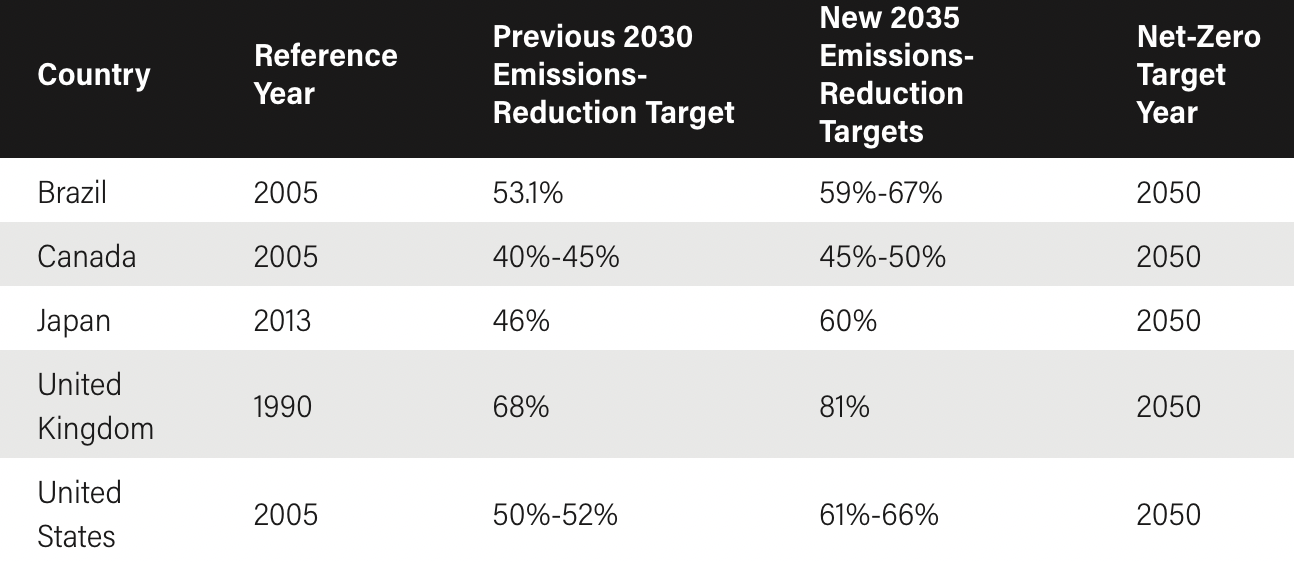
Among the countries that have submitted new NDCs so far, the United Kingdom stands out for its ambitious climate trajectory. Following the recommendations of its Climate Change Committee, the U.K. has set a bold target to reduce emissions 81% by 2035 from 1990 levels. This rapid decline in the coming decade would put the country on track toward its net zero goal by 2050, based on realistic rates of technology deployment and ambitious but achievable shifts in consumer and business behavior.
Other countries, such as Japan and the United States, have opted for a "linear" approach toward net zero — meaning if they drew a straight line to their net-zero target (for example, 0 GtCO2e in 2050), their 2030 and 2035 targets would fall along it, reflecting a constant decline in emissions each year. Japan aims to cut emissions 60% from 2013 levels by 2035, while the United States has pledged a 61%-66% reduction from 2005 levels by 2035.
Despite the U.S. withdrawing from the Paris Agreement, undermining climate policies and attempting to dismantle key government institutions, its NDC target may still provide a framework for climate action at the state, city and local levels, as well as for future administrations. Many of these entities have already rallied around the new NDC and are committed to making progress toward its targets.
However, the linear approach Japan and the U.S. are taking to emissions reductions — as opposed to a steeper decline this decade — risks using up a larger share of the world's carbon budget earlier and compromising global temperature targets.
Brazil presented a broader range of emissions targets in its NDC, committing to a 59%-67% reduction by 2035 from 2005 levels. These two poles represent a marked difference in ambition: A 67% reduction could put Brazil on track for climate neutrality by 2050, while a 59% reduction falls short of what's needed to meet that goal. It is unclear which trajectory the government intends to pursue, leaving Brazil's true ambition in question. The NDC also omits carbon budgets for specific sectors (such as energy, transport or agriculture), which would clarify how it plans to meet its overarching emissions goals. However, Brazil committed within its NDC to develop further plans outlining how each sector will contribute to its 2035 target.
Elsewhere, Canada made only a marginal increase to its target, shifting from a 40%-45% emissions reduction by 2030 to 45%-50% by 2035 from 2005 levels. This falls short of the recommendation from Canada's own Net-Zero Advisory Body, which called for a 50%-55% reduction by 2035 — and warned that anything below 50% risks derailing progress toward the country's legislated net-zero goal by 2050. While every increase in ambition counts, such incremental changes do not match the urgent pace of progress needed among developed and wealthy economies like Canada.

Several early trends are starting to emerge among the new NDCs. While these initial submissions offer valuable insights, they don't yet reflect the full picture; deeper analysis will be needed as more NDCs come in throughout the year.
Almost all of the 22 NDCs submitted thus far include 2035 mitigation measures. The exception is Zambia, which reiterated its previous 2030 pledges in a provisional NDC (although this may still be revised to include 2035 mitigation measures).
Of the other 21 submissions, 20 countries expressed their 2035 targets as emissions-reduction goals. The exception was Cuba, which instead committed to increasing renewable electricity generation to 26% and improving energy efficiency by 2035.
Seventeen of the 20 countries with emissions-reduction goals set economy-wide reduction targets for 2035, as encouraged by the Global Stocktake, covering all sectors and greenhouse gases. The remaining few — smaller developing countries such as the Maldives and Nepal — submitted targets that cover only specific sectors or gases.
Under the Paris Agreement, developed countries are required to submit economy-wide targets, while developing countries are encouraged to work toward them over time. In Nepal's case, for instance, a lack of comprehensive data limited its ability to define an economy-wide target or fully assess the impact of its policies.
Despite clear scientific evidence and UN decisions urging stronger 2030 targets, only four countries — Saint Lucia, Nepal, Moldova and Montenegro — have strengthened their 2030 emissions pledges. For example, Montenegro revised its emissions-reduction target from 35% to 55% by 2030 compared to 1990 levels, and set a 60% emissions-reduction target by 2035.
Notably, none of the wealthier, high-emitting and more developed countries have strengthened their 2030 targets — despite having the greatest capacity and responsibility to take the lead on slashing emissions.
In the face of worsening climate impacts, 16 of the 22 countries that have submitted new NDCs strengthened their adaptation commitments — continuing a trend seen in previous rounds. Countries are prioritizing adaptation across sectors such as food and water systems, public health and nature-based solutions.
Ecuador, which is particularly vulnerable to heavy rainfall and floods, prioritized action to build resilience of its water resources, human health and settlements, as well as its natural heritage. Some developed countries are also prioritizing adaptation action in their NDCs. Canada, which has witnessed devastating wildfires in recent years, cited its National Adaptation Strategy, which provides a framework for disaster resilience, biodiversity, public health and infrastructure.
Some countries' NDCs also recognize the critical role that subnational actors — such as cities, states and regions — play in shaping and delivering climate action.
Eleven of the newly submitted NDCs come from countries that have endorsed the Coalition for High Ambition Multilevel Partnerships (CHAMP). The CHAMP initiative — launched in 2023 by the COP28 Presidency, in partnership with Bloomberg Philanthropies and with the support of WRI and other partners — aims to strengthen collaboration between national and subnational governments on climate planning and implementation. As part of this commitment, 75 countries pledged to consult with and integrate subnational priorities and needs into their NDCs. Of the 11 endorsing countries that have submitted new NDCs, four explicitly mentioned CHAMP.
Brazil's NDC in particular recognizes the critical role subnational governments play in delivering national climate goals. Referred to as "climate federalism," it highlights an instrument designed to support the integration of climate action into planning and decision-making across all levels of government: federal, state and municipal.
As countries submit new NDCs for the first time since the Global Stocktake in 2023, a clearer picture is emerging of how governments are embedding sector-specific action into their new climate plans. From detailed emissions-reduction targets to broader policy frameworks, most NDCs are setting out concrete steps to cut emissions across sectors that largely drive climate change, such as energy, transport and forestry.
Some countries — such as Switzerland, the UAE, Kenya and Zimbabwe — have included sector-specific emissions-reduction targets directly in their NDCs. Switzerland's targets, for instance are aligned with its Climate and Innovation Act, with plans to cut emissions by 66% in buildings, 41% in transport and 42.5% in industry by 2035 compared to 1990 levels. Kenya, on the other hand, has set an ambitious target to achieve 100% renewable electricity generation in the national grid by 2035.
Others, like the United Kingdom, Brazil, Singapore, the Marshall Islands and Canada, have focused on elaborating national policies and strategies that respond to the Global Stocktake's priority areas. The U.K.'s NDC highlighted its Clean Power 2030 Action Plan to fully decarbonize electricity by 2030; the Warm Homes Plan to boost energy efficiency in residential buildings; and reaffirmed its plans for phasing out internal combustion engine vehicles by 2030.
Countries such as Brazil and New Zealand have committed to developing detailed sectoral strategies as a next step to support NDC implementation. Brazil plans to update its national climate strategy by mid-2025, breaking it down into 16 sectoral adaptation plans and seven mitigation plans. New Zealand committed to publishing its emissions-reduction plan for 2031-2035 in 2029, which will set out sectoral mitigation strategies to help deliver on its NDC.
As more countries prepare to submit their new NDCs, attention will focus on whether they follow the trend of outlining sector-specific actions to meet their broader emissions targets. In particular, the spotlight will be on how countries plan to contribute to the transition away from fossil fuels — the single largest driver of the climate crisis.
We have yet to see new NDCs from many major emitters, including the European Union, China and India. All three have demonstrated climate leadership in various ways, and their actions will set the tone for future climate efforts. While these three are in the spotlight, attention will also be on other key countries — such as Indonesia, Mexico and Australia -— that are critical to reducing the global emissions gap.
The EU is still working to set a 2035 emissions target for its new NDC, which will hinge on its longer-term 2040 target. Last year, the European Commission recommended cutting emissions 90% by 2040 — a move that's seen as beneficial for enhancing industrial competitiveness in clean technologies, strengthening energy security and cutting energy costs. Some EU member states have suggested following a linear trajectory between the 2030 and 2040 targets, which would imply a 72.5% reduction by 2035 if the 90% target for 2040 gets adopted.
However, European member states have yet to adopt the 90% target. Ongoing discussions could see the EU's target weakened to address concerns from heavy industry and agriculture. The delay in finalizing the EU's 2040 target is also putting its NDC timeline at risk, raising the possibility of missing the expected September submission date.
As the world's largest emitter, China's NDC will be critical to keeping global temperature goals within reach. The country has already made major strides in clean energy, leading the world in solar power and electric vehicle deployment. However, a surge in coal plant approvals post-pandemic has raised concerns about its path toward net zero by 2060.
China's 2035 emission target will be the first in a post-peak emissions context. Studies aligned with 1.5 degrees C and China's net-zero pledge suggest the need for sharper cuts by 2030 and continued deep reductions through 2035. In this context, some research suggests that China could reduce CO2 emissions 30% by 2035 (compared to 2020) on the way to achieve its net zero target by 2060.
President Xi Jinping announced in April that China will submit its updated NDC ahead of the UN climate summit (COP30) this November, covering all sectors and greenhouse gases. This marks a notable shift for the country: Its previous NDCs covered only CO2, but China's non-CO2 emissions alone place it among the world's top 10 emitters.
Unlike other major economies, India has some of the lowest per capita emissions, and its national emissions are still growing as the country works to eradicate poverty and achieve development goals. This means its emissions are not expected to decline by 2035, though some studies suggest earlier declines are needed. Rapid advances in renewable energy and clean technology offer a significant opportunity for the country to accelerate its low-carbon transition while also ensuring energy security and economic competitiveness.
Strengthening renewable energy commitments in India's next NDC — building upon its domestic target of 500 GW by 2030 — could chart a pathway for sustainable growth, while also delivering co-benefits like cleaner air and enhanced energy security.
The UN climate change body (UNFCCC) will release an NDC synthesis report ahead of this year's COP30 climate summit, assessing the collective impact of the new pledges submitted to that point. While this report will solidify where we're headed in relation to the Paris Agreement's temperature goals, the storyline is already clear: New NDCs will not put the world on track to limit warming to 1.5 degrees C.
The emissions gap is likely to remain dangerously wide, and the report will reaffirm what we already know — that much greater ambition and action are needed. Still, the findings will serve as a key input for this year's climate conference, where countries will decide on next steps to narrow that gap. They must address what comes after NDCs, grappling with how to turn ambition into action and keep a safer future within reach.
Ultimately, putting forward strong plans — and fulfilling them — are essential levers: not only for limiting warming, but for safeguarding the health, prosperity and security of current and future generations.
Editor’s note: A correction was made on June 3, 2025 to reflect an update in the underlying data. New conditional NDCs are estimated to reduce emissions by 1.4 GtCO2e by 2035 rather than 1.5 GtCO2e.
One of the biggest grid batteries in California almost resumed operations Sunday following the cataclysmic Moss Landing fire in January.
The San Francisco Bay Area’s power grid used to draw on two battery storage plants in the quiet seaside town of Moss Landing. Texas-based power company Vistra built the nation’s largest standalone grid battery on the grounds of an old gas power plant there, and utility Pacific Gas and Electric Co. built and owns the Elkhorn project next door.
A roaring fire engulfed Vistra’s historic turbine hall in January, wrecking rows of lithium-ion batteries that delivered 300 megawatts of instantaneous grid power. That site is still in shambles. PG&E’s battery plant suffered far less disruption: Hot ash blew over the fenceline from Vistra’s property, posing an environmental hazard and potentially clogging batteries’ thermal management systems. But after several months of remediation, cleaning, and testing, PG&E attempted to flip the switch Sunday to reconnect Elkhorn to the grid. But the utility ran into a problem.
“On June 1 we began methodically returning the batteries to service as a part of the planned return to service, and in the process a clamp failure and coolant leak was identified in one of the 256 megapacks onsite,” the company said in a statement Monday evening. “We are working to remediate the issue and out of an abundance of caution we are deferring the facility’s return to service until a later date.”
PG&E has not released any more details on how long it will take to restore the facility. It noted that the testing and discovery of the malfunctioning unit led to no injuries, smoke, or fire.
Had the operation succeeded, it would have returned 182.5 megawatts/730 megawatt-hours of storage capacity to the power-hungry Silicon Valley grid corridor right before the region’s first major heat wave of the summer.
“The concern was lower in the winter months, with demand lower,” said Dave Gabbard, vice president of power generation at PG&E, in an interview Thursday. “It will be critical to have assets like Elkhorn available as we get into the peak summer months.”
Indeed, California has been building grid batteries at a record pace, to store the state’s nation-leading solar generation and deliver it during crucial hours, like after sunset. The tech is displacing some gas-fired power generation in the state. California’s battery fleet passed 15.7 gigawatts installed per a May tally, which Gov. Gavin Newsom’s office touted as “an unprecedented milestone.” The governor, a Democrat, did not specify why the 15.7-GW threshold merits particular attention, but it does mean California has added more than 5 GW since it crossed the 10-GW mark a year prior.
“The pace of construction for large-scale energy storage in California is phenomenal, the kind of accomplishment that was beyond our wildest dreams a few years ago,” said Scott Murtishaw, executive director of the California Energy Storage Alliance.
The state’s battery buildout is plowing ahead. But Vistra’s fiery failure sparked deep community concerns about battery safety in California and beyond, as Moss Landing residents were forced to evacuate for several days and plumes of smoke loomed over surrounding estuaries and farmlands. In April, Vistra rescinded an application to build a 600-MW battery in Morro Bay, two hours down the coast from Moss Landing, following significant local resistance that intensified after the January fire.
Even before the unsuccessful restart, the plan to revive Elkhorn had rekindled concerns among community leaders who are still grappling with the fallout from the largest-ever battery fire in the U.S., and quite possibly the world. The Monterey County Board of Supervisors had asked to keep both battery plants offline until the Vistra investigation was completed and acted upon.
“Restarting operations before investigations are complete and before stronger emergency protocols are in place is disappointing and deeply troubling,” Monterey County Supervisor Glenn Church posted on Facebook after learning of PG&E’s plans in early May.
Crucially, PG&E’s battery layout, completed in 2022, mitigates the hazards that took out the neighboring Vistra plant, which was completed two years earlier.
Officials have not yet pinpointed the cause of Vistra’s fire, but it became so destructive because it spread through the densely packed rows of batteries in the old turbine hall, igniting more and more fuel as it grew. By contrast, PG&E’s Elkhorn plant spans 256 individual Tesla Megapack containers spaced over the property.
“We have a completely different design,” Gabbard said. “We have compartmentalized our design so that fire propagation won’t occur to adjacent units.”
That industry-wide preference for separate, containerized systems doesn’t eliminate the chance of battery fires, but it does limit the potential severity. One container might burn, but the fire can’t reach all the other batteries. A fire could knock a facility offline temporarily, but it would only eliminate a small percentage of its capacity, Murtishaw said. That stands in contrast to Moss Landing’s failure, or the all-or-nothing issues that can occur when a gas-burning turbine malfunctions.
“The technology and standards have changed considerably since the first big batteries,” like Vistra’s, Murtishaw said. “Facilities coming online now are being constructed with newer technologies meeting newer standards. Risk of runaway incidents has decreased dramatically relative to the amount of storage being deployed.”
That compartmentalization strategy worked out when Elkhorn suffered its own battery fire in 2022 — the result of water seeping into a unit through an improperly installed roof, Gabbard said. The single unit burned in a contained fashion and did not spread to any other batteries. PG&E restarted the facility three months later, after implementing recommendations from an independent investigation into the cause.
Since that incident, PG&E installed air quality monitoring onsite and upgraded the battery enclosures to automatically discharge stored energy if abnormal behavior is detected, Gabbard said. PG&E additionally updated its emergency action plan and instituted annual exercises with the North County Fire Protection District.
When Vistra’s plant burned up in January, Elkhorn’s thermal imaging cameras spotted it and automatically severed the connection to the grid, halting the flow of high-voltage power out of the site. PG&E also made the air quality data available to emergency response teams.
The utility then kept Elkhorn offline for the subsequent months to allow for environmental remediation of the soot to keep it out of local waterways, Gabbard said. Workers also cleaned the Megapacks “outside and inside,” he noted. The main concern was that the ash could have intruded into the systems that cool batteries during operations. Staff pressure-washed all those components and tested their functionality to get the site ready for operations.
Another 10 gigawatts of storage are already under contract for California’s regulated utilities and community choice aggregators over the next four years, Murtishaw said. That would put the state over 25 gigawatts, well on its way to the current goal of 52 gigawatts by 2045, stemming from the state’s clean energy law SB 100.
To achieve that goal, the Moss Landing calamity needs to remain an outlier event. There’s good reason to believe that will be the case. For one thing, the industry has all but abandoned Vistra’s strategy of packing huge amounts of batteries into a single building.
California now has 214 grid-scale batteries, and only about 10 of them reside in a building, Murtishaw noted. Those are subject to inspection by the California Public Utilities Commission under a recently expanded authority, he added; in the meantime, owners have stepped up safety measures in response to the Moss Landing news.
Small-scale batteries in homes and businesses also count for California’s top-line storage goal. They depend on the same core battery technologies as the large-scale storage projects, but as mass-produced consumer items, they go through a different gauntlet of tests before they reach customers.
“The home batteries are tested inside and out, up and down — they undergo rigorous safety testing and certification to standards,” said Brad Heavner, executive director of the California Solar and Storage Association, which advocates for rooftop solar and battery installers.
In the state Legislature, Sen. John Laird, a Democrat from the Moss Landing area, introduced a bill in March to systematize coordination between battery owners and local emergency responders, and to fix a timing mismatch so California’s fire codes match the latest standards set by the National Fire Protection Association. Murtishaw said the California Energy Storage Alliance supports the measure, which passed out of the Senate last week.
A correction was made on June 3, 2025: This story initially stated that PG&E restarted its Elkhorn battery facility on June 1. The story has been updated to reflect that the company initiated the restart process on June 1 but halted the process due to equipment issues. The story also originally said the utility installed heat-sensing cameras at Elkhorn after the January Moss Landing fire; those cameras had actually been part of the facility since it was built.
Wildfires in Canada — forcing mass evacuations in Manitoba and prompting urgent calls for assistance from First Nations leaders in Saskatchewan — have intensified as heat, drought, and atmospheric conditions collide, during the last week of May 2025.
Climate change is fueling this early-season heat, making high temperatures in parts of central Canada at least five times more likely than they would be in a world without climate change.
Note: This event may continue beyond May 30. Use the Global Climate Shift Index map to stay updated on heat in your region.
Dr. Kristina Dahl, VP of Science at Climate Central, said:
"When temperatures reach a CSI level 5 across such a large area, it’s not just unusual—it means this kind of heat would be incredibly unlikely without climate change," said Dr. Kristina Dahl, VP of Science at Climate Central. "These conditions, which set the stage for dangerous wildfires, will only become more frequent and more severe if we continue burning fossil fuels."
Kaitlyn Trudeau, senior research associate for climate science and wildfire expert at Climate Central, said:
"Climate change-driven heat dries out vegetation and sets the stage for wildfires. Combine that with persistent drought and a locked-in high-pressure system, and you have a perfect storm—one that’s becoming more common as we continue to burn fossil fuels and heat the planet."
To request an interview with a Climate Central scientist, please contact Abbie Veitch at aveitch@climatecentral.org.
The Climate Shift Index uses peer-reviewed methodology and real-time data to estimate how climate change has increased the likelihood of a particular daily temperature.
Canary Media’s “Electrified Life” column shares real-world tales, tips, and insights to demystify what individuals and building owners can do to shift to clean electric power.
An affordable housing complex for older adults in Sacramento, California, boasts some enticing features. Residents of the earth-toned, low-rise structures can cultivate gardens, swim laps in the pool, and toss bocce balls. They can stroll to visit neighbors. And now, after an electric transformation of the buildings, Foothill Farms residents can also enjoy the cleaner air that comes with ditching gas appliances.
The project not only slashes the complex’s health-harming and planet-warming pollution — it also made financial sense for both the owner BRIDGE Housing and its tenants. Two years ago, the 138-unit property’s original gas-fired equipment was nearing the end of its life. Coupled with available financial support, the timing gave executives of BRIDGE, a nonprofit affordable housing developer and manager, a chance to pivot away from fossil fuels.
The “smart, opportunistic” project at Foothill Farms illustrates how properties can electrify while keeping costs low for residents, according to a case study written earlier this year by staff at the Stewards of Affordable Housing for the Future, a collaborative of 13 nonprofits, including BRIDGE. The retrofit is also a trailblazer for the decarbonization journey millions more units of government-supported affordable housing will eventually need to take.
Although single-family housing is by far the most prevalent in the U.S., and the biggest source of carbon pollution from homes, cutting fossil fuels from multifamily affordable housing is a particularly tricky task.
Some of the most vulnerable Americans live in subsidized apartments, including low-income households with older adults, disabled individuals, young families, and veterans — and they usually rent these units. Residents typically lack the power or cash to electrify properties, which presents a hurdle to eradicating emissions from buildings and denies inhabitants the upsides of these retrofits: greater comfort, safer air, and potential bill savings.
“There’s an opportunity for delivering outsized benefits to [these] residents and communities,” said Lucas Toffoli, principal of the carbon-free buildings division at clean-energy think tank RMI.
In 2023, BRIDGE Housing decided Foothill Farms would be a good candidate for energy-efficiency upgrades after Bright Power, an energy services provider, and Carbon Zero Buildings, a company specializing in decarbonization retrofits, analyzed BRIDGE’s entire portfolio of properties.
Carbon Zero carried out the electrifying changes: The turnkey contractor swapped out polluting gas-fueled water heaters for Rheem heat-pump water heaters and replaced ACs with Samsung heat pumps capable of both warming and cooling spaces. The firm also installed LED lighting everywhere, which consumes a tenth of the energy of incandescent light bulbs.
Carbon Zero’s team first piloted the complete retrofit in one unit to work out the kinks. With feedback from staff and residents, the crew honed its approach so that it could complete a unit’s upgrades in a single day during business hours.
“I love that,” said Toffoli, who wasn’t involved in the project. “Displacing folks is not only expensive and burdensome … it’s a real disruption to people who may be juggling a lot of things, like work and family, or who have limited mobility or health problems.”
In the common areas, Carbon Zero installed a new heat-pump pool heater and heat-pump spa heater, 30 EV charging stations, and 240-volt power outlets in the laundry rooms. Foothill Farms still has gas-powered clothes dryers, but BRIDGE plans to replace them with electric dryers when they conk out.
Comparing 2023 average monthly energy usage data to 10 months of data after the in-unit retrofits were completed last spring, natural-gas use has decreased by 98% while electricity use has risen 24% across the whole property, thanks in large part to the almost-magical efficiency of heat pumps.
Virtually all of the project’s $2.6 million cost was covered by state and utility grants: California’s Low-Income Weatherization Program, TECH Clean California, and the Sacramento Municipal Utility District. Other projects, though, are by no means guaranteed to see so much aid, with funding limited and awards variable, said Sebastian Cohn, senior project manager at the nonprofit Association for Energy Affordability and BRIDGE’s primary contact for the weatherization program incentive.
“It is typically in a property’s best interest to enroll [in these incentive programs] sooner than later,” Cohn told Canary Media. “The same project reserved today would receive less than half the [Sacramento Municipal Utility District] incentives Foothill Farms did due to updated incentive levels and per-project limits.”
Unlike many landlords who don’t pay tenants’ utility bills, and thus don’t benefit from energy-efficiency upgrades, BRIDGE actually had a financial incentive to make this switch to electric appliances: The organization pays for residents’ gas usage but not their electricity bills. How then did the project prevent residents’ costs from going up?
Elementary, my dear reader. Federal rules for most subsidized affordable housing protect residents from high rent and utility costs — and make sure these expenses don’t exceed 30% of their income — by requiring owners to provide what are called utility allowances, i.e., rent reductions to tenants paying their own utilities. The exact amounts are set by housing authorities and depend on locale, home size, and types of appliances. Based on the utility allowances for Sacramento when Carbon Zero pitched the project, the contractor estimated that residents would come out ahead, with each unit on average saving over $200 annually. The estimated savings for BRIDGE itself were $25,000 per year.
The real-world results match the initial project modeling very well, Cohn said, though BRIDGE declined to share specific dollar savings.
BRIDGE isn’t planning to stop with this project; a spokesperson said it’s already working with Carbon Zero and Bright Power on similar retrofits at a few other California properties.
See more from Canary Media’s “Chart of the week” column.
The future of steel and ironmaking in the U.S. is poised to get cleaner — so long as the country can let go of the industry’s dirty past.
All new steelmaking and ironmaking capacity in the U.S. is slated to use technologies that sidestep the need to burn coal, according to a new report from nonprofit research group Global Energy Monitor.

Steel and iron are among the most essential and widely used materials in the world. They’re also among the dirtiest to produce, responsible together for as much as 9% of global carbon dioxide emissions and a staggering amount of harmful local air pollution.
This is because the sector burns through an enormous amount of coal. The fossil fuel is traditionally used both in blast furnaces to purify iron ore and in basic oxygen furnaces to turn that purified iron into primary steel.
In the U.S., 12 blast furnaces are still producing iron ore this way, but the country’s steelmakers have largely shifted away from making primary steel. Instead, they increasingly rely on electric arc furnaces, a much cleaner technology that uses electricity to melt iron and scrap steel and turn it into fresh steel.
About 70% of the country’s steelmaking capacity today uses electric arc furnaces. All of the new capacity planned in the U.S. will come in the form of facilities that use electric arc furnaces, per Global Energy Monitor’s report.
In theory, steelmakers can run this electric equipment on clean power and pair it with a coal-free iron production process called direct reduction to create carbon-free primary steel. All of the new ironmaking capacity planned in the U.S. will use direct reduction, the report says, likely including Hyundai’s $6 billion plan to make what it describes as “low-carbon” steel in Louisiana. The country will more than double its capacity for direct reduction of iron in the coming years, the report found.
For now, U.S. facilities that use direct reduction will mainly rely on natural gas to purify the ore. Doing so can halve carbon emissions compared with using a coal-based blast furnace. The holy grail from a decarbonization standpoint is to eventually use carbon-free hydrogen in place of gas in the reduction process.
However, despite plans for cleaner facilities, steelmakers don’t intend to retire their dirtiest assets. Several of the dozen coal-fired blast furnaces still operating are slated to undergo costly relinings before 2030 — effectively committing to operating for many more years. A retirement plan has been announced for only one.
This analysis and news roundup comes from the Canary Media Weekly newsletter. Sign up to get it every Friday.
Over the past few months, the Texas Senate passed three bills that could’ve devastated the state’s nation-leading renewable energy rollout — but clean energy has dodged the bullet.
The first of those bills would have established new fees, setback requirements, and other permitting regulations on utility-scale wind and solar development, even though fossil-fuel plants don’t face the same restrictions. The second would have required large renewables installations to buy gas generation as a backup.
And the third would’ve ensured all renewable power development came with a side of fossil fuels, as it directed that 50% of all new power plant capacity added to the state’s grid come from dispatchable resources other than battery storage. That would have amounted to a gas mandate: Since solar panels and wind turbines can only produce power under certain conditions (sun shining, wind blowing, you know the drill), they can only be dispatchable power sources if batteries are involved. An earlier version of the bill explicitly said 50% of new capacity would have to come from gas.
These bills would have seriously slowed Texas’ deployment of solar, batteries, and wind power, which are shattering power-generation records in the state and helping its grid withstand extreme weather and meet surging electricity demand. The legislation would have caused reliability to fall and utility bills to soar, according to an April report from Aurora Energy Research.
But the Texas House’s session is set to end on June 2, and none of those three bills have been scheduled for consideration. This doesn’t necessarily mean they won’t resurface at some point, but they’re at least dead as standalone bills for this session, Doug Lewin writes in his Texas Energy and Power newsletter.
There are growing signs that these sorts of restrictions on renewables aren’t popular among many Texas Republicans and business interests. Recent polling from Conservative Texans for Energy Innovation shows widespread Republican support for renewables, while even the Texas Oil and Gas Association allied with renewable power generators to oppose the state House’s companion to the Senate’s bill requiring gas backup for clean energy.
Similar efforts in the state were defeated two years ago as well.
DOE orders a coal plant to stay open
The Trump administration took its pro-coal agenda to a new level last Friday, ordering a retiring Michigan coal plant to stay open through at least the end of August. The J.H. Campbell plant was supposed to shut down tomorrow, and Michigan utility Consumers Energy had been working since at least 2021 to do so. But the administration contended that the Midwest faces an “energy emergency” and needs the plant to guarantee power reliability.
Clean energy advocates, consumer watchdogs, and even Michigan’s top energy regulator disagree. “We currently produce more energy in Michigan than needed,” Michigan Public Service Commission Chair Dan Scripps said in a statement. “The unnecessary recent order from the U.S. Department of Energy will increase the cost of power for homes and businesses across the Midwest.”
Trump’s nuclear orders probably won’t outweigh cuts
President Donald Trump signed a series of executive orders late last week to boost nuclear power — though they probably won’t counteract his many moves to weaken the industry. The four orders will:
But in recent months, the Trump administration has also looked to reduce funding for the Energy Department’s Office of Nuclear Energy, and cut staff at the Loan Programs Office, even though it funds nuclear reactor projects. And though nuclear made out better than other low-carbon energy sources in the federal budget bill recently passed by the House, projects would only be eligible for tax credits if they start construction by 2028 — an ambitious timeline for a famously slow-to-build energy source. Those are big setbacks that won’t “magically be solved” by simply cutting red tape, Josh Freed, who heads the climate and energy program at that think tank Third Way, told Latitude Media.
DOGE days over? Elon Musk announces he’ll leave the Trump administration as Tesla investors demand he return to the company, then condemns the U.S. House’s proposed end to clean energy tax credits. (Associated Press, Financial Times, Politico)
A blow to industrial decarbonization: The U.S. Energy Department announces the termination of $3.7 billion in grants from the Office of Clean Energy Demonstrations, which funds carbon capture and other ambitious but unproven projects to help cut industrial emissions. (news release)
Solar loses its farm: A U.S. Agriculture Department report says solar development on productive farmland poses a “considerable barrier” to agricultural expansion, and the department says it will reshape federal loans to disincentivize solar on farmland. (Heatmap)
I’ll drive what she’s driving: A nonprofit’s nationwide campaign aims to get more women into electric vehicles, including by turning suburban moms into EV ambassadors who can talk about benefits, like lower operating costs than gas cars and added storage space with “frunks.” (Canary Media)
Recycling reduction: The collapse and bankruptcy of EV battery recycling startup Li-Cycle underscores the battery recycling industry’s challenges, especially as federal support dwindles. (Canary Media)
Things that make no sense: The U.S. EPA has reportedly drafted a plan to eliminate all greenhouse gas emissions limits on coal and gas power plants, stating in its proposed rule that the facilities“do not contribute significantly to dangerous pollution” or climate change. (New York Times)
Another threat to batteries: Executives overseeing battery component production at an LG Energy Solution plant in western Michigan say the combination of high tariffs and restricted federal subsidies would devastate the domestic market that’s attempting to compete with China. (New York Times)
Cities step up on climate: Cleveland’s work around reducing building emissions and installing EV chargers in underserved neighborhoods shows how U.S. mayors are taking climate action, with or without the help of the federal government. (Grist)
A clarification was made on June 2, 2025: This story has been updated to reflect that Texas bills targeting renewable energy have not passed.
The Department of Energy announced Friday that it is canceling over $3.7 billion in funding for projects that would cut carbon emissions and toxic air pollution from power plants and industrial sites, ranging from cement kilns to ketchup-processing plants.
The DOE shared a list of the projects to be cut with Canary Media on Friday, which showed that more than half of the awards under the ambitious Industrial Demonstrations Program, housed under the Office of Clean Energy Demonstrations, will be terminated. OCED funding focused on carbon capture at gas-fired power plants is also impacted.
DOE claimed the projects “failed to advance the energy needs of the American people, were not economically viable, and would not generate a positive return on investment of taxpayer dollars.”
But advocates disagree. Not only would the projects kickstart efforts to clean up industries that are notoriously tricky to decarbonize — they would have generated serious economic benefits, too.
Analyses from groups including the Center for Climate and Energy Solutions and the American Council for an Energy-Efficient Economy have found that federal spending from OCED would have created hundreds of thousands of jobs nationwide and helped position U.S. industries to compete in international markets that are increasingly demanding cleaner materials and products.
Stakeholders have for months expected the Trump administration to cut the OCED awards, which were authorized under the Biden administration by the 2021 bipartisan infrastructure law and the 2022 Inflation Reduction Act.
In March and April, reports surfaced of plans by Elon Musk’s Department of Government Efficiency to eliminate the office’s $6 billion Industrial Demonstrations Program, cut carbon capture and sequestration projects, and cancel billions of dollars of funding for clean-hydrogen hubs based in Democratic-leaning states.
Today’s announcement doesn’t include any hydrogen-hub funding cuts. But the feared elimination of money for carbon capture and industrial decarbonization has become a reality.
The Trump administration is getting rid of funding for several efforts to decarbonize the production of cement, one of the most carbon-intensive industries in the world. That includes $189 million for Brimstone and $87 million for Sublime Systems, two startups pioneering new low-carbon cement production methods. Global cement giant Heidelberg Materials will lose its $500 million award to capture carbon emissions at a massive existing cement plant in Indiana. And the National Cement Company of California won’t receive its $500 million grant to take a multi-technology approach to cutting emissions from its plant in Lebec, California.
The DOE is also pulling funding for projects to replace fossil-fueled industrial heating equipment with heat pumps, electric boilers, and thermal energy storage systems.
Kraft Heinz will lose its $170 million award to install clean heat technologies at 10 of its food production facilities. Beverage giant Diageo North America will no longer receive the $75 million it was promised to help install thermal energy storage systems from startup Rondo Energy at production facilities in Kentucky and Illinois. And Texas-based industrial heat pump manufacturer Skyven Technologies, which had been awarded a $145 million grant to install its technology at a New York state ethanol plant, was listed on DOE’s spreadsheet as having a $15 million grant rescinded. (DOE did not immediately respond to inquiries to determine whether Skyven was set to lose only part of its $145 million grant or if DOE’s spreadsheet was in error.)
Projects to cut pollution from factories that make metals are also on the chopping block. That includes a $75 million grant to back American Cast Iron Pipe Co.’s “Next Gen Melt Project,” which would have lowered emissions from iron and steelmaking at its site in Birmingham, Alabama. It also includes $75 million for United States Pipe and Foundry Co. to replace a coal-fired furnace with electric arc furnaces.
The DOE’s cancellations will also impact several projects seeking to reduce carbon emissions from glass production, including $75 million for Gallo Glass in Modesto, California; $57 million for Owens-Brockway Glass Container in Zanesville, Ohio; and $45 million for Libbey Glass in Toledo, Ohio.
Friday’s list also includes projects to cut carbon emissions from chemicals production, including $100 million for Ørsted to capture and use industrial carbon dioxide waste to make shipping fuel at its Star e-Methanol facility in Texas; $375 million for Eastman Chemical Co.’s plastics recycling project in Longview, Texas; and $331 million for Exxon Mobil to use hydrogen instead of fossil gas for ethylene production in Baytown, Texas.
Funding for carbon capture and storage projects at power plants will be scrapped, too. Calpine will not receive a pair of $270 million awards to retrofit power plants in Texas and California.
The list did not include some high-profile metals decarbonization projects, like the $575 million in grants set to flow to two Cleveland-Cliffs steel facilities in Pennsylvania and Ohio — the latter in Middletown, Vice President JD Vance’s hometown — or the $500 million for Century Aluminum to build a “green smelter,” likely in Kentucky.
What remains unclear is the extent to which Friday’s cancellations have disrupted ongoing construction, hiring of workers, or other unrecoverable commitments from companies impacted. Firms have been tight-lipped about plans to navigate the consequences of federal funding clawbacks. All of the awards required participating companies to invest at least as much as they were set to receive in federal grants.
A representative of Sublime Systems told Canary Media that the company was “surprised and disappointed” by DOE’s decision to cut its grant. Sublime this week announced a deal with Microsoft, which said it would buy 600,000 tons of the low-carbon cement to be produced from the startup’s first commercial-scale plant in Holyoke, Massachusetts — a plant backed by DOE’s grant.
“It is our hope to continue to partner with the DOE to show a success story of American innovation and ingenuity at its finest,” Sublime’s representative said in a Friday email. “Nevertheless, we have prepared for the possibility of this disappointing outcome and are evaluating various scenarios that leave our scale-up unimpeded.”
The projects are without a doubt now on far shakier financial footing, and advocates do not expect that they’ll be able to move forward without the federal funding. Should they fail, the effects would be profound, according to Evan Gillespie, a partner at advocacy group Industrious Labs.
“[The projects] would have helped catapult the U.S. into a leadership position in the technologies that will bring down emissions and pace the next generation of industrial evolution,” he said. “Killing these projects means more emissions, more pollution, and more people getting sick.”
Energy Secretary Chris Wright, a former oil and gas industry executive who insists that climate change is not a crisis, said in Friday’s announcement that the decision would benefit U.S. taxpayers.
“While the previous administration failed to conduct a thorough financial review before signing away billions of taxpayer dollars, the Trump administration is doing our due diligence to ensure we are utilizing taxpayer dollars to strengthen our national security, bolster affordable, reliable energy sources and advance projects that generate the highest possible return on investment,” he said.
Industrial decarbonization advocates pushed back.
“This program could have been a centerpiece of achieving the administration’s goal to bring manufacturing back to the United States,” Steven Nadel, executive director of the American Council for an Energy-Efficient Economy, said in a Friday statement. “Choosing to cancel these awards is shortsighted, and I think we’re going to look back at this moment with regret. Locking domestic plants into outdated technology is not a recipe for future competitiveness or bringing manufacturing jobs back to American communities.”
A new state law aimed at expanding gas and nuclear power plants in Ohio may also provide opportunities for solar developers — if they can overcome other policy and political barriers.
Solar industry advocates say House Bill 15, signed by Republican Gov. Mike DeWine in mid-May, contains several technology-neutral provisions that could benefit clean energy projects, including property tax breaks for siting them on brownfields and former coal mines. The law also loosens restrictions on behind-the-meter electricity generation and lowers the overall tax burden for new power plants.
“This is just smart economic development. We need the energy,” said Michael Benson, board president of Green Energy Ohio, whose members include a variety of clean energy companies. In his view, a market-based approach should work in favor of renewables and battery storage, which can generally be deployed more quickly and cheaply than power plants that burn fossil fuels.
Much of the public discussion around the legislation focused on its repeal of coal plant subsidies mandated by HB 6, the 2019 law at the heart of Ohio’s ongoing public corruption scandal. HB 15 also will end the use of “electric security plans,” which let utilities add special charges to customer bills without reviewing all revenue and expenses in a full rate case.
But many of the measures in HB 15 are meant to encourage new electricity production in the state.
“We should open the market to dispatchable energy generation to address future energy shortages,” the bill’s primary sponsor, Rep. Roy Klopfenstein (R-Haviland), said in his February testimony, in which he also noted growing energy demand from data centers and other large electricity users, and energy supply issues raised by grid operator PJM Interconnection. The term “dispatchable” is often used to refer to power plants that can be turned on or off as demand requires, as opposed to solar or wind without battery backup.
Most of the law’s incentives for new energy production are technology-neutral, however.
Under HB 15, new electricity production on brownfields and minelands designated as priority investment areas will be exempt from property taxes for five years. Grants of up to $10 million each will be available to clean up or prepare the sites for construction. And the Ohio Power Siting Board will speed up its review of energy projects in those areas.
“It’s a huge opportunity,” said Rebecca Mellino, a climate and energy policy associate for The Nature Conservancy in Ohio. Last year the organization estimated that Ohio has more than 600,000 acres of minelands and brownfields suitable for renewable energy production. The sites often have good access to roads and transmission lines, too.
As Mellino sees it, solar in priority areas would avoid objections raised by some people about displacing farmland. And counties with renewable energy bans could presumably modify them to allow development in priority investment areas without affecting other parts of their jurisdictions, she suggested.
The law also removes a restriction that has required behind-the-meter generation to be located on the premises of the customer who is using the power. The change might allow data centers to tap into gas-fired backup generators on an adjacent property, for example. But it could also create new opportunities for clean energy-powered microgrids, in which a group of customers share solar panels and a large battery.
“That is significant, all by itself,” because it provides more flexibility, said Dylan Borchers, an energy attorney with law firm Bricker Graydon in Columbus, Ohio. Just as importantly, the law “allows essentially a portfolio approach for customers and energy resources.”
In other words, multiple businesses could form a shared “self-power” system with equipment for electricity generation or battery storage on adjacent land or on premises controlled by one or more of them. Such a system could include numerous generation or storage facilities, allowing a cluster of data centers, factories, or other large energy users to combine multiple behind-the-meter resources, whether they be natural gas, solar, batteries, or small nuclear when it becomes available.
The ability to combine resources means customers wouldn’t necessarily need lots of land to add renewable energy, said Benson. “If you want the most power quickly and cleanly, you can use rooftops and parking lots and build out a lot of small-scale generation.”
The law also reduces the overall tax burden for new electricity production. Local governments may collect less revenue but still welcome the jobs and other spending that come with new energy investments. And less stringent requirements might even benefit some communities when new power generation is sited, Borchers suggested.
Ohio’s current tangible personal property tax rates have been so high that companies have often used “payments in lieu of taxes,” also known as PILOT programs, to avoid getting walloped by huge tax bills as soon as energy production starts. But counties face somewhat strict requirements for how they must allocate PILOT payments. Developers that take advantage of the lower tax rates available under HB 15 may have more financial flexibility to be able to fund some projects that local governments want most, such as a new fire station or community center, Borchers said.
Taken together, the provisions in HB 15 promise to make it easier to build more solar in the state, industry representatives say.
The governor and legislature saw “the urgent need to expand energy generation as Ohio confronts rapidly increasing demand and the threat of escalating costs and supply shortages,” said Will Hinman, executive director for the Utility Scale Solar Energy Coalition of Ohio. “House Bill 15 is a critical step towards addressing these challenges by reducing barriers to energy development — including utility-scale solar projects.”
The law still requires projects to meet multiple criteria to benefit from its provisions. For example, power-generating facilities and transmission lines exceeding certain thresholds may need approval from the Ohio Power Siting Board. The state’s director of development must approve local governments’ designations of priority investment areas. And self-power systems have to be independent of the main power grid.
The biggest downside is that the new law left in place a 2021 statute, Senate Bill 52, which requires utility-scale renewable energy developments to get local approval, said Molly Bryden, a climate and sustainability researcher with think tank Policy Matters Ohio.
Under that earlier law, 34 of Ohio’s 88 counties have banned new solar generation in all or part of their territories. Even where the local law doesn’t bar a new project, local officials can still block projects before a developer even seeks a permit from the Ohio Power Siting Board. A county representative and a township representative also get to vote with state siting board members on whether facilities get a permit, even for some projects that were in the grid operator’s queue before the 2021 law.
Another law took effect in early 2023, letting local governments limit small solar and wind projects that connect to the grid but don’t otherwise fall within the scope of the 2021 law.
Requirements of the 2021 and 2023 laws don’t apply to generation fueled by natural gas, coal, or nuclear power. And Ohio’s high court has ruled local governments can’t ban or regulate gas wells and related infrastructure or even enforce broader zoning laws that would prevent such development.
Lawmakers also cut out provisions from an earlier version of HB 15 that would have allowed community solar development. Community solar lets residential customers save money by sharing the electricity from a local solar array, which doesn’t have to be on their own property.
“There’s still a real need for permitting reform,” Bryden said.


.svg)
