

 Back
Back
On Wednesday, the U.S. EPA proposed repealing Biden administration rules that limit toxic pollutants and planet-warming emissions from coal and gas plants across the country. These plants “do not contribute significantly” to “dangerous” air pollution, the EPA claimed — something that many, many studies have shown isn’t true. Power plants are the second-largest source of carbon emissions in the country, and they’re responsible for a lot of health-harming pollutants like sulfur dioxide, nitrogen oxides, and mercury, too.
When the Biden administration first announced the rules last year, the EPA estimated they would stem 1.38 billion metric tons of carbon pollution through 2047. That’s the equivalent of taking 328 million gas cars off the road for a year, and amounts to an estimated $370 billion in climate and public health benefits.
Those benefits would’ve helped communities surrounding gas and coal plants around the U.S., according to the Sierra Club’s Trump Coal Pollution Dashboard. For example, Montana’s Colstrip 3 plant would have to reduce its toxic pollution under the Mercury and Air Toxics Standard, while a slew of plants across the Midwest and Southwest would have to install carbon-capture systems or shut down under the greenhouse gas rules.
The changes will allow coal plants around the country to keep burning. In North Dakota, some state officials are celebrating what they say is a big step toward protecting jobs and the coal industry. But in Georgia, health advocates and scientists warn the preservation of coal plants in their state will fall hard on vulnerable communities, especially those surrounding the facilities.
Still, none of this is set in stone. The EPA’s proposals are vulnerable to several legal pitfalls, including challenges involving the Clean Air Act, the agency’s insistence that power plants don’t produce “significant” emissions, and the health, economic, and other costs of increasing pollution, E&E News reports. Analysts with TD Cowen expect the EPA to finalize the rules by early next year, but say legal challenges and uncertainty will continue through all of 2026.
“Big, Beautiful Bill” threatens rooftop solar
President Donald Trump’s “Big, Beautiful Bill” is already having big impacts on the rooftop solar industry. The bill, now undergoing negotiations in the Senate, looks to repeal tax credits for solar installations and other clean energy projects. That includes credits that allowed a North Carolina food bank to install solar panels on the roof of its headquarters, which it anticipates will save the organization $143,000 each year. Other nonprofits are looking to follow suit — but they probably won’t be able to if they can’t access federal incentives, Canary Media’s Elizabeth Ouzts reports.
The bill is also causing problems for two solar companies. Lender Solar Mosaic filed for bankruptcy last week, specifically citing “legislation that threatens to eliminate tax credits for residential solar” as a forthcoming challenge. Residential solar giant Sunnova followed with a bankruptcy filing over the weekend.
While both companies’ difficulties predate the Trump administration, it’s clear that the residential solar sector is facing a difficult and uncertain moment, one analyst told Canary Media’s Jeff St. John. An analysis by Ohm Analytics estimates that the House’s version of the bill would lead rooftop solar installations across the country to drop by half next year, and another from Morgan Stanley projects an 85% decrease through 2030.
Bright spots for clean energy
Amid a sea of bad news for clean energy companies, some are still finding success.
Take Sublime Systems, which recently had its $87 million federal grant cancelled: Sublime says private-sector support is allowing its $150 million low-carbon cement factory in Massachusetts to move forward anyway.
Solar panel manufacturer Qcells said it’s launching a new recycling operation in Georgia to repurpose retired panels. Heirloom Carbon is meanwhile keeping its operations rolling by winning over Republican state leadership in Louisiana, where it aims to build a facility that extracts carbon dioxide from the air. Developer Intersect Power got the green light Wednesday to build what would be the biggest solar-and-storage plant in the nation.
And in the Chicago area, Sun Metalon just raised $9.1 million from investors — including Japan’s Nippon Steel — to build its steel decarbonization business, Canary Media’s Kari Lydersen reports. The startup has created an oven-sized box that melts down waste metal and sludge from steel and aluminum production, churning out pucks of reusable, recyclable metal.
Vehicle emissions blowback: A group of 11 states sue after President Trump signs a congressional resolution rolling back California’s vehicle emissions standards, which several other states have adopted. (The Hill)
Budget bill update: Democrats — and some Republicans who voted for the House-passed version of the “Big, Beautiful Bill” — look to convince Senate Republicans to preserve clean energy tax credits as budget discussions continue. (The Hill, Politico)
Community electrification: California researchers report success and lessons learned from an experiment aimed at cutting electrification costs by upgrading multiple households in a single neighborhood, which saved contractors time and allowed residents to buy products in bulk. (KQED)
GM reverses on EVs: While General Motors is still ramping up EV production, its new plan to spend $4 billion on mostly gasoline-powered cars means the company has given up on a goal to make only EVs by 2035, analysts say. (E&E News)
Texas’ gas commitment: A study finds developers have proposed more than 100 gas-fired power plants totaling 58 gigawatts in Texas, which have the potential to emit an estimated 115 million metric tons of greenhouse gases every year. (Inside Climate News)
Charging forward: A J.D. Power survey finds fewer attempts to charge at public EV stations are ending in failure than in years past, and that the total number of public chargers is rapidly expanding. (New York Times)
Batteries’ battle: U.S. battery recyclers face“a limbo moment” because the Trump administration has endorsed efforts to produce critical minerals while also imposing tariffs and threatening to repeal clean energy tax credits. (Grist)
A legislative proposal in Maine that would impose new fees on community solar projects is having a chilling effect on solar developers, some of whom say they may stop working in the state, or even already have.
“The problem is that they’re looking to change the rules of the market after the fact,” said Brendan Bell, chief operating officer of Aligned Climate Capital, which owns several community solar projects in the state. “We’ve already stopped investing in Maine because of this. Simply the risk of this happening has made us stop.”
The legislation, which was approved in late May by the Energy, Utilities, and Technology Committee, aims to reform Maine’s net energy billing program — often called net metering in other states — which pays the owners of solar panels for the excess energy they share with the grid.
Nationally, net metering programs have been contentious, with states like California, New Hampshire, and North Carolina making big changes to mixed — and sometimes litigious — receptions. Maine’s system has been under scrutiny for years, as many critics say it has created excessive profits for developers while unfairly shifting costs to consumers who don’t even use solar power.
While many renewable energy advocates and developers agree that the program needs some reform, they say the current bill goes too far. The legislation outlines a new system for compensating commercial and industrial customers who own solar panels. Currently, the compensation rate is based on standard utility electricity rates, meaning solar owners make more revenue when power prices rise. The bill would require a new mechanism of gradual, annual rate increases to avoid excessive windfalls for solar owners when energy costs go up.
Of particular concern, however, are other provisions that apply to community solar developments, larger-scale installations that sell power to multiple subscribers.
In 2019, reforms to Maine’s net energy billing program paved the way for community solar to take off in the state. As of 2021, 79 megawatts of community solar capacity had been installed; as of May, that number is up to 1,008 MW.
“Community solar is incredibly important to Maine,” said Kate Daniel, Northeast regional director for the Coalition for Community Solar Access, a national trade group. “It’s been the driver of the new clean energy that’s gone onto the grid in recent years.”
The bipartisan legislation now under consideration would impose a monthly fee, paid by community solar owners to utilities. The money would be intended to cover the cost of delivering the solar power to consumers. Those “distribution costs” would otherwise be borne by utility customers.
Projects between 1 MW and 3 MW in size would pay $2.80 per kilowatt of capacity — so $5,600 a month for a 2-MW project, for example. Larger arrays between 3 MW and 5 MW would pay $6 per kilowatt — so, $24,000 per month for a 4-MW installation. These rates would be increased as needed to keep up with the cost of maintaining and expanding the grid. The goal, proponents say, is to continue supporting solar in a way that does not add to residents’ financial hardships.
“It is really important to me that we are fighting climate change in an economically just way,” said Rep. Sophie Warren, a Democrat and one of the bill’s sponsors.
However, renewable energy advocates and solar developers say the monthly fees could scare away new projects as well as put existing operations at risk.
“It basically … will consume all of our free cash flow and put us in a position where we may default on our loans,” said Cliff Chapman, CEO of Syncarpha Capital, a New York-based clean energy investment firm with eight community solar projects operating in Maine.
Opponents question the way these fees came to be included in the bill. They were not in the original draft legislation, but the idea was raised and voted on during committee debate. The language is in the process of being officially added to the bill so that lawmakers can report it out of committee and send it to the House floor. It is concerning that the fees received no public hearing, and many stakeholders and lawmakers are not even aware they are being added in, said Eliza Donoghue, executive director of the industry group Maine Renewable Energy Association.
Even if this bill fails to pass, the damage may already be done: Investors in all sorts of clean energy segments are becoming wary of doing business in a state that would even consider retroactively changing the rules for projects that were designed and financed under a different set of expectations, opponents said.
“It’s a retroactive policy proposal that many folks strongly believe would cause significant financial harm to the solar industry in Maine,” said Lindsay Bourgoine, director of policy and government affairs for Maine-based solar company ReVision Energy.
Opponents also worry that the bill sends the inaccurate message that increasing solar adoption makes energy more expensive, when research suggests the reverse is true. In 2024, solar development in Maine yielded about $1.42 in benefits for every dollar of cost, according to a report by state utilities regulators. As of the second half of 2024, net energy billing added about $7 per month to the average residential electric bill in the state.
Warren, however, says reining in even this modest increase could help some of her constituents.
“I know there are people on reverse mortgages, on fixed incomes, who are rationing their medicines,” she said. “These [compensation] rates are far too high, and unnecessarily high for what we’re getting from them.”
Bill proponents are also not convinced by claims that the new rules would cause financial problems for developers. The provisions are designed to have less financial impact on smaller companies that are less able to take the hit, said Maine Public Advocate Heather Sanborn, a supporter of the bill.
The bill also contains important consumer protections that opponents aren’t talking about, Sanborn said. Community solar operators would be required to rightsize customers’ subscriptions, preventing them from paying for more credits than they can use. Should a customer still end up with more credits than they need, the operator would be required to issue a refund. The legislation would also encourage the installation of battery storage in conjunction with solar.
“It is a responsible and balanced solution,” Sanborn said.
For opponents, however, the community solar fees are an intractable problem that outweighs any other provisions.
“What we don’t do in America is change rules retroactively and blow up existing investment,” Chapman said. “Being a state that does something like this has huge implications — they’re making themselves a pariah for investors.”
U.S. companies that install and finance residential solar have been struggling for years with rising interest rates and unfavorable policy shifts in California, the country’s biggest rooftop solar market. Now, they face an even more serious threat — Republicans in Congress, who have proposed to take away the tax credits that undergird the industry.
These mounting pressures have driven two of the most prominent firms in the U.S. residential solar sector into bankruptcy in recent days.
Residential solar provider Sunnova filed for Chapter 11 bankruptcy protection on Sunday, three months after the publicly traded company warned investors that it could run out of cash due to falling sales, rising operational costs, and a growing debt burden. The Houston-based company, which reported 3 gigawatts of solar and battery systems under management as of the end of 2024, stated on Monday that it “intends to continue operating its business in the ordinary course throughout the sale process.”
Privately held solar lender Solar Mosaic filed for Chapter 11 bankruptcy protection on Friday, stating it has taken action to “reorganize the business to meet its current liquidity needs.” The Oakland, California-based company, which claims it has funded $15 billion in loans to more than 500,000 households, cited “[m]acroeconomic challenges facing the entire residential solar industry, including high interest rates and legislation that threatens to eliminate tax credits for residential solar.”
Those two companies have unique problems that have contributed to their financial collapse, said Joe Osha, an analyst at Guggenheim Securities. “The causes of the difficulties that Mosaic and Sunnova face predate Trump,” he said.
But they also suffered from a market environment that is increasingly difficult and uncertain for every firm in the sector, he said.
The reconciliation bill passed by the House of Representatives last month and now being considered in the Senate would abruptly end a tax-credit regime that’s supported households and solar installers for the past 20 years.
The bill would terminate the 30% tax credit available to households installing solar panels, batteries, inverters, and associated solar equipment at the end of 2025, essentially making those installations about one-third more expensive than they are today.
And the legislation would eliminate the tax credit of 30% or more available to companies that lease solar panels to households and businesses. That would be a blow to firms like Sunnova and Sunrun, the country’s top residential solar company, which have made such third-party ownership structures central to their business models.
All in all, the changes in the House bill could mean U.S. households install 40% less solar over the next five years compared to current policy, according to research firm Wood Mackenzie.
That’s not just a threat to large companies like Sunrun and Tesla, but also to the regional and local businesses that are responsible for a majority of the roughly 5 million rooftop solar systems installed in the U.S. to date — and to a source of zero-carbon energy that stood at more than 50 gigawatts of generation capacity as of 2024.
That bill hasn’t been passed yet, however. Osha warned that it’s too early to extrapolate broader implications for the industry at large from these latest bankruptcies.
That’s because both Mosaic and Sunnova have fallen prey not only to challenging business conditions, but to mistakes in how they’ve reacted to the sector’s ongoing woes, he said.
“The way this business works, at the most basic level, is that you spend money now to create a long stream of contracted cash flows in the future,” Osha said. In the case of solar companies like Sunnova and Mosaic, those cash flows come from households making payments on the loans, leases, or power purchase agreements they’ve signed. The companies bundle those into asset-backed securities for sale to investment banks and other financial firms.
But those securities become far less attractive to buyers when the market for residential solar sours — and in the past year it has soured dramatically. Wood Mackenzie reported a 31% drop in U.S. residential solar installations in 2024 from the prior year.
The Solar Energy Industries Association reported in March that last year’s sales hit a low not seen since 2021. The trade group’s latest data, released this week, shows that “we have now had six consecutive quarters of year-over-year decline in residential solar installations,” Pavel Molchanov, investment strategy analyst at financial services firm Raymond James, pointed out. That includes a 13% year-over-year decline in the first quarter of 2025.
“In any industry, six consecutive down quarters is going to lead to pressure on companies across the board,” he said. “There’s just no escaping that.”
This downturn left Sunnova and Mosaic exposed to a cash crunch, Osha said.
Over the past 18 months or so, Sunnova had chosen to take on large amounts of corporate debt rather than selling off more of its portfolio to raise cash, he explained. As the market turned, finding buyers for those solar-backed assets became harder, making it difficult to raise cash to meet debt payments. The firm listed estimated assets and liabilities of $10 billion to $50 billion and debt of $10.67 billion as of Dec. 31.
Mosaic most likely experienced a similar liquidity crunch as it was unable to sell its portfolios of solar loans at the volume and price required to raise enough capital for new loans, Osha said. In a Monday analyst note, he highlighted that Mosaic had also “failed to make the transition from solar loans to third-party ownership” as interest rates climbed, making loans more expensive options compared to leases or power purchase agreements.
Molchanov emphasized that “financing is at the center of how this industry has historically functioned.” The companies in question built their businesses during the 2010s, when the country had historically low interest rates. But those interest rates have spiked in the past three years in response to the Covid pandemic’s economic disruptions and resulting inflation, driving up the cost of capital for all businesses — including companies borrowing money to install rooftop solar systems.
“There’s a very narrow pathway to navigate when the broader interest rate environment is so difficult,” Molchanov said. “Whatever strategic or tactical mistakes companies made, if we had this conversation five years ago, when interest rates were close to zero, those mistakes would not have been lethal. But now they can be lethal.”
Sunnova is the latest in a string of residential-solar bankruptcies in the past two years, which has included firms from regional installers and financing providers to icons of the industry like SunPower, which collapsed in August 2024. Solar lender Sunlight Financial, which offered lending options similar to those from Mosaic, declared bankruptcy in 2023 and emerged from reorganization later that year.
Filing for bankruptcy protection doesn’t necessarily mean that the companies will cease to exist. Some of SunPower’s business was purchased by Complete Solaria, which has since rebranded under the SunPower name, for example.
Nor does bankruptcy mean that customers will be bereft of customer service support for the solar systems these companies have financed, although that’s certainly a risk, as customers across the country have attested.
It’s also important to distinguish these newly bankrupt companies from others in the space, Osha said. For example, Sunrun, the biggest U.S. residential solar installer with roughly 10% of the market as of 2023, has better managed its way through the market downturn of the past 18 months or so, he said.
“What Sunrun has done in contrast to Sunnova is say, ‘We’re going to sell off those future cash flows to the greatest extent possible, so that we have money today,’” he said.
The House bill’s provision that would cut off tax credits for solar leasing does, however, pose a significant threat to Sunrun’s predominant business model of offering leases and power purchase agreements to residences, Osha said.
The House bill would not cancel tax credits for power purchase agreements, the other primary mechanism for companies that offer third-party-owned solar, Osha said. But in his Monday research note, he opined that this exclusion was “a loophole, not a deliberate plan on the part of legislators,” and that incentives for power purchase agreements would likely suffer the same fate as those for leases and homeowners in a final bill to emerge from Congress.
Whether tax credits expire abruptly at the end of 2025 or there’s an extension beyond that will have a significant impact on the financial viability of large-scale residential solar companies like Sunrun.
“Today, Sunrun’s business model is entirely centered on third-party ownership and tax credits,” he said. “But you can also say that they are a very well-run company that has surely thought about this, and [it] is likely, if the hammer does come down, they have a plan.”
At the same time, thousands of smaller companies that make up the majority of residential solar installations would almost certainly suffer from the tax-credit changes, even if their challenges go less noticed than those of industry stalwarts, said Kristina Costa, former clean energy adviser for the Biden administration.
That would have negative consequences for those working in the industry. Residential solar installation accounted for just over 100,000 jobs in the U.S. at the end of 2023, according to the most recent survey from the Interstate Renewable Energy Council. The current market downturn has already had a negative impact. The California Solar and Storage Association estimated that roughly 17,000 people, or 22% of the state’s distributed solar and storage workforce, lost their jobs between April 2023, when the state reduced incentives for rooftop solar owners, and the end of that year.
“You have a lot of mom-and-pop small business outfits in the solar residential space that are going to be profoundly affected by this bill that’s being debated in Congress right now,” Costa said. “It will be harder and more expensive to install solar and storage in homes — and it may or may not still make sense for somebody to do so, depending on what their state’s energy prices are looking like.”
Given that the House bill is expected to drive up electricity prices already being pushed higher by President Donald Trump’s tariff and energy policies, undermining the economics of rooftop solar “is a pretty direct attack by the House on energy prices in the wrong direction,” Costa said.
This story was originally published by Floodlight.
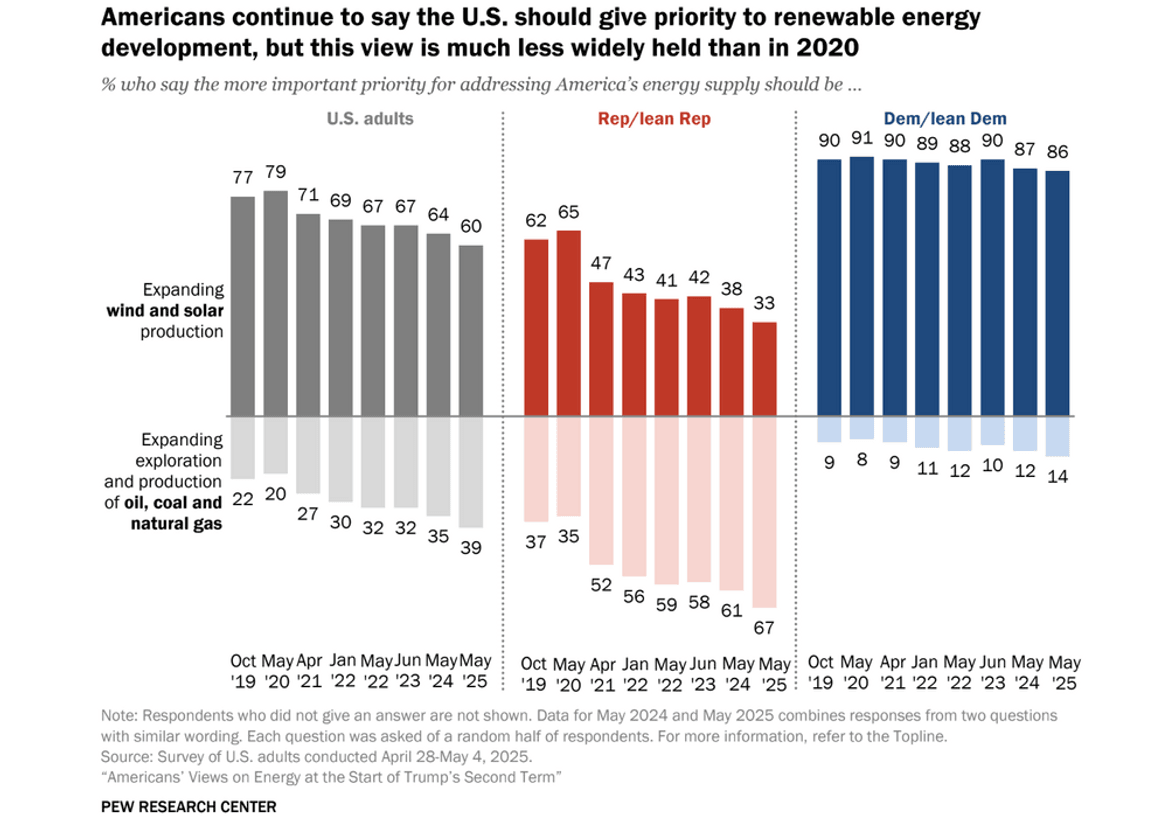
Republicans and Democrats alike are less likely to support renewable energy than they were five years ago, according to a survey released last week by the Pew Research Center.
The results mirror growing pockets of opposition to solar farms, reignited political support for coal plants, and moves by President Donald Trump and congressional Republicans to kill federally funded clean energy projects.
This shift in opinion dates back to when Democratic President Joe Biden took office, said Brian Kennedy, Pew senior researcher and one of the study’s authors. “This isn’t a new trend,” he said.
Still, Kenneth Gillingham, professor of environmental and energy economics at the Yale School of the Environment, was surprised.
“I see this shift … as a successful effort to link climate change and renewable energy to broader culture war issues,” Gillingham said. He added that in the past, “prominent” Republicans supported renewables and sought solutions to climate change, but those stances could now be seen as “disloyal” to Trump.

The survey of 5,085 U.S. adults taken April 28 to May 4 revealed that while 79% of Americans favored expanding wind and solar production in 2020, that number has dropped to 60%. And 39% of Americans today support expansion of oil, coal, and natural gas — almost double the 20% that supported it in 2020.
Combustion of fossil fuels — in transportation, energy generation, and industrial production — is the No. 1 cause of climate change.
Much of the change in opinion is driven by Republicans, whose support of oil and gas grew from 35% in 2020 to 67% today. But Democrats also indicated less support for renewable energy and more for fossil fuels than five years ago.
While many results reflect Trump’s policies opposing most renewables and boosting fossil fuels, Pew found a few notable exceptions: 69% of all respondents favor offshore wind — a technology Trump has specifically targeted.
Both Democrats and Republicans indicated stronger support for nuclear power, with Republicans’ favorable opinions increasing from 53% in 2020 to 69% in 2025. Democrats’ support rose from 37% to 52%. The Trump administration has signaled support for a nuclear renaissance, despite its high cost.
There were wide partisan splits on several topics. In March, the U.S. Environmental Protection Agency announced it would scale back environmental regulations. Pew asked whether it was possible to do that and still protect air and water quality: 77% of Republicans said yes, and 67% of Democrats said no.
Pew didn’t ask the respondents why their attitudes have shifted. But Kennedy said in Pew’s past surveys, Republicans have expressed concern about the economic impacts of climate change policies and transition from fossil fuels to renewable energy sources.
Mike Murphy, a Republican consultant and electric vehicle backer, said when the environmental benefits of clean technologies are touted, it polarizes Republicans. Instead, Murphy said messages should be about pocketbook issues — like lower fuel costs — and jobs.
“It’s hard for pro-climate people to understand,” said Murphy, who has advised dozens of state and national GOP campaigns, including John McCain’s 2008 presidential bid. “[They think] we just need to shout louder and hit people over the head about climate, climate, climate. The key is you want to talk about jobs and national security and other events that naturally resonate a lot more with right-of-center people.”
That’s what Murphy’s groups, the EV Politics Project and the American EV Jobs Alliance, are trying to do to depoliticize electric vehicles. “Whenever electric cars are seen through a climate lens,” Murphy said, “their appeal narrows.”
It’s a strategy also being used by the Electrification Coalition, a left-of-center pro-EV group. Ben Prochazka, the coalition’s executive director, echoed Murphy’s strategy, adding that EVs have “become overly politicized and caught in the culture wars, impacting markets and ultimately hurting our ability to realize their many benefits for all Americans.”
Prochazka noted that once introduced to EVs, consumers support them: “EV drivers love their vehicles, with more than eight out of 10 reporting that their next car will also be electric.”
Perhaps those practical messages are getting through. In the Pew survey, electric vehicles were the one item that saw an uptick in support — 4 percentage points in the past year.
But popular support might not be enough to stop Congress from killing a $7,500 electric vehicle credit, which Murphy said would be “policy disaster.”
Republicans, he said, are in a “real squeeze,” because “they don’t have enough money for the tax cuts the president has promised.”
Said Murphy: “It’s easier for Republicans to cut Biden electric cars … than it is for them to cut more Medicaid.”
Gillingham is still optimistic that solar, wind and other greenhouse gas-reducing technologies will move forward — because they are the cheapest.
“The continued decline in the price of renewable energy and battery technologies, as well as other new technologies, is a reason to continue to have hope that the worst impacts of climate change can be addressed,” he said.
Floodlight is a nonprofit newsroom that investigates the powerful interests stalling climate action.
Residential customers of Duke Energy in North Carolina could pay $87 million more per year for electricity under a proposal rocketing through the state legislature, a new study shows. The figure represents about a 4% jump in household bills.
The legislation, Senate Bill 266, would change how Duke distributes the cost of electricity it buys to supplement generation from its own power plants — significantly hiking the share paid by residential consumers and cutting the portion paid by industrial electricity users, like chemical manufacturers and textile mills.
The analysis shows the legislation is a better deal for industrial customers than the status quo, said Will Scott, Southeast climate and clean energy director for the Environmental Defense Fund. “They will pay less to use the same amount of energy, and residential ratepayers will pay more,” he said.
SB 266 is the latest version of a Senate-passed measure that would unravel the state’s climate targets. It was publicly unveiled moments before it was debated and approved by the House Energy and Public Utilities Committee last week, and received fulsome praise from Duke, industrial groups, and others in testimony.
On Tuesday, despite protests from clean energy advocates and some Democratic lawmakers, the bill easily cleared the Republican-controlled House and now returns to the Senate, also run by the GOP.
The study, conducted by independent analysis group EQ Research, has a narrow scope, homing in on the ramifications of just one section of the 30-page bill — the part that covers how purchased power is billed to customers.
“We were pretty laser-focused,” said Justin Barnes, president of EQ Research, “because that’s the analysis we could do with readily available information quickly.”
While Duke generates much of its own electricity from a fleet of fossil fuel and nuclear plants, it also contracts to buy some of its solar power from independent producers and purchases energy from other generators under certain conditions, such as when demand spikes.
Under current law, the entire cost of this purchased power is passed on to customers annually along with a charge for natural gas and other fuels. The utility divvies up the costs of this fuel “rider” between residential and industrial customer groups based partially on their peak electricity demand and partially on their overall energy use.
According to EQ’s analysis of Duke’s latest filings with regulators, the fuel rider totals about $2.75 billion for the company’s two North Carolina entities, Duke Energy Progress and Duke Energy Carolinas. The purchased power portion is around $1.1 billion.
Of the purchased power portion, residential customers currently pay about 41.2%, and use just over 40% of the energy.
SB 266 eliminates any weight given to overall energy use in allocating purchased power costs, according to EQ, shifting charges from large industrial users of electricity to residential consumers. The result is that households would pay just under 49% of those costs while using the same 40% of energy, the group’s study found.
“It is not going to be a savings for us ratepayers,” said Rep. Pricey Harrison, a Guilford County Democrat, speaking against SB 266 on the House floor. “It is going to be an increase.”
The EQ study does not incorporate the potential effects of other parts of the bill, including alleged savings from eliminating a 2030 deadline by which Duke must cut its carbon pollution, and the impact to customers of allowing the utility to recoup some costs for power plants not yet delivering electricity.
Rep. Dean Arp, the Union County Republican championing SB 266, said last week in committee that erasing the 2030 climate target would save all customers a total of $13 billion by 2050. He said allowing Duke to recover plant-construction financing costs early would net them another $1.4 billion. He echoed those claims Tuesday on the House floor, rounding up the total savings by over half a billion dollars.
“A vote against this legislation is a vote to make all ratepayers pay $15 billion more in electricity costs,” Arp said.
But opponents of the bill reject the allegation that striving for more wind and solar energy in the near term will contribute to rising rates, an assertion stemming from an elusive study from the state-sanctioned customer advocate, Public Staff, that hasn’t been provided widely to legislators or members of the public.
Clean energy advocates say the Public Staff analysis considers only the cost of building new power generation, not the rising price of fossil fuels. And they continue to question the wisdom of allowing Duke to charge consumers for costs related to nuclear and gas plants that may never come online.
Perhaps above all, EQ’s findings show why more time is needed to vet the bill with all interested parties, including clean energy and consumer advocates, not just Duke and large industrial customers, critics contend.
“When we rush processes like these and don’t include all the stakeholders, we can end up with results that unfairly burden North Carolina households,” said Scott with the Environmental Defense Fund. “I hope that we can slow down and make the adjustments we need so that this bill doesn’t cause unnecessary pollution or unnecessary costs.”
But the House’s public deliberation of the measure has been anything but slow. In less than a week, it cleared two committees and two required floor votes. It could appear on the desk of Gov. Josh Stein, a Democrat, as soon as this week.
“There are all kinds of reasons to vote no on this bill,” Harrison said to the full House on Tuesday, including its treatment of residential customers, its abdication of climate targets, and the process by which it was rushed through the chamber.
As the House prepared to vote around 7 p.m., she said, “It’s not clear why we’re doing this tonight.”
The Texas Legislature ended its biennial session without passing a slew of bills that could have killed the state’s booming solar and battery sector, and by extension, the ability to keep the Texas grid running amid extreme weather and surging demand for electricity.
It did pass a law that could strengthen the state’s electricity reliability by encouraging the construction of more microgrids — combinations of small-scale gas-fired power, solar, and batteries that can be built quickly. Last week, Texas lawmakers authorized a long-awaited $1.8 billion fund to support microgrid deployment at hospitals, nursing homes, water treatment plants, police and fire stations, and other critical facilities across the state.
The Texas Backup Power Package Program has awaited funding since 2023, when it was created as part of a broader legislative package. The goal is to help Texans protect themselves against extreme weather-driven grid emergencies like the disastrous blackouts during 2021’s Winter Storm Uri, or the widespread power outages after 2024’s Hurricane Beryl.
Lawmakers failed to authorize the $1.8 billion in microgrid funding in 2023, however. Instead, the state pushed ahead with $5 billion for the Texas Energy Fund, which offers low-interest loans to developers of large-scale gas-fired power plants. That program has struggled. One project that applied for funding was found to be fraudulent. Others were denied loans. And many more projects have dropped out of contention, as developers deal with the same gas turbine shortages and rising costs that are dogging gas build-outs across the country.
This year, lawmakers finally approved the microgrid funding, which is part of the remaining $5 billion in Texas Energy Fund spending officially authorized during the just-concluded session. That’s a big deal, said Doug Lewin, president of Texas-based energy consultancy Stoic Energy and author of The Texas Energy and Power Newsletter.
“Now those funds will presumably begin to flow — and I think that puts us in the upper echelon of states for microgrid policy,” he said.
Among the bills that failed this session in the face of opposition from environmental, business, and consumer groups were two — SB 388 and SB 715 — that would have forced new solar, wind, and battery projects to pay for a massive and equivalent amount of new capacity from fossil-gas power plants.
The problem with such policies is not just the fallacy that building more planet-warming gas power plants guarantees a more reliable grid, industry experts say. It’s also that companies simply can’t build gas power plants fast enough to meet booming energy needs, not just in Texas, but across the country. Because those bills would have required gas to be built alongside renewables — and because gas power plant construction is seriously constrained — the legislation would have amounted to a block on many gigawatts’ worth of new solar, wind, and battery developments in the state.
”I think one of the most important things that happened this session is this really broad-based business coalition communicating to anyone who would listen that these policies trying to restrict development of renewables aren’t helpful,” Lewin said.
Low-cost power from renewables and batteries “is a big deal to manufacturers, to industrial customers, and to the oil and gas industry that’s been working off diesel generators for decades and are now connecting to the grid,” he said.
For years now, Lewin has been calling on state leaders to focus on helping customers save energy and keep power flowing during hurricanes, heat waves, and winter storms. He thinks microgrids are a good way to do that.
When the broader grid is functioning well, facilities equipped with microgrids can use their solar, batteries, and generators to reduce their use of grid power. But when the grid goes down or experiences serious stress, those facilities can rely on those resources to continue running.
Microgrids could also help meet ballooning power demand from homes, businesses, factories, and especially data centers chasing the AI boom that make up a massive share of future load growth forecasts, he said. The Electric Reliability Council of Texas, the grid operator for most of the state, forecast in April that peak electricity demand could more than double in the next five years. The number of data centers that end up getting built in Texas will ultimately determine how much new power the state actually needs.
The microgrid program limits individual projects to no larger than 2.5 megawatts, Lewin said. That’s far smaller than the hundreds of megawatts of capacity that can come from a single gas-fired power plant. But what microgrid projects lack in size they make up for in speed of construction, and many smaller-scale backup power projects will do more to meet demand than big power plants that take five or more years to build, he said. That’s especially true if the microgrids are located at data centers themselves.
To be clear, data centers aren’t the target of the Texas Backup Power Package Program. Instead, the fund is set up to help sites that can’t otherwise afford on-site backup power, explained Joel Yu, senior vice president of policy and external affairs at Enchanted Rock. The Houston-based microgrid operator runs 500 megawatts’ worth of projects at grocery stores, truck stops, and other large power customers in Texas. Enchanted Rock has also deployed gas-fired generators at water utilities and irrigation districts, including Houston’s Northeast Water Purification Plant.
“The $1.8 billion is a huge amount of money, and more ambitious than programs we’ve seen in other jurisdictions,” Yu said. “But it’s very much in line with state policy to improve resilience at critical facilities since Winter Storm Uri,” which knocked out power to more than 4.5 million people for up to a week in February 2021, leading to the deaths of an estimated 200 people and more than $100 billion in property damages.
Enchanted Rock’s existing customers tend to be larger entities that can secure financing and clearly quantify the financial value of backup power generation, Yu said. The $1.8 billion microgrid program “unlocks opportunities for customers who aren’t as sophisticated, and don’t have the wherewithal to pay that extra cost,” he said.
Assisted living facilities are particularly good candidates for state-funded microgrids, given how deadly power outages can be to older adults or medically compromised people. Alexa Schoeman, deputy of the state’s long-term care ombudsman’s office, told the Public Utility Commission of Texas in a March statement that the more than 80,000 residents of assisted living facilities in the state are at risk from extended power outages, and that “operators have cited cost as the reason they are not able to install life-saving backup power at their locations.”
Yu declined to name any customers that Enchanted Rock is working with to take advantage of the fund. “But there’s been a lot of interest from critical facilities that might want to make use of this. We’ve talked to folks in nursing homes, assisted living industries, and low-income housing, and other critical infrastructure, trying to get into the program.”
Enchanted Rock has joined other backup generation providers including Bloom Energy, Base Power, Cummins, Generac, Mainspring Energy, and Power Secure in what Yu called an “informal group of like-minded companies.” Dubbed Grid Resilience in Texas, or GRIT for short, the coalition is working with the Electric Reliability Council of Texas and the Public Utility Commission on the $1.8 billion microgrid program, he said.
Most of these companies focus on gas-fueled power generation systems, whether those are reciprocating engines like those Enchanted Rock uses, linear generators from Mainspring, or fuel cells from Bloom Energy. Others specialize in battery backup systems, as with startup Base Power, or combine solar, batteries, and energy control systems with generators, as with Generac.
The legislation creating the Texas Backup Power Package Program allows projects to tap up to $500 of state funding per kilowatt of generation capacity installed, and requires solar, batteries, and either fossil gas or propane-fueled generation, Yu said. But it “isn’t prescriptive about what proportions are in the mix,” he added.
Different combinations could offer more favorable economics for different types of customers. Some may find that lots of solar panels are useful for lowering day-to-day utility bills, while others may want to maximize gas-fueled generation to cover multiday winter outages, when solar-charged batteries are less useful.
The legislation creating the program does limit projects from actively playing in the grid operator’s market programs, Yu added, meaning microgrid owners will face restrictions on selling the power they generate or the grid-balancing services they can provide to the market.
Still, that “does leave some room for customers to leverage the assets for behind-the-meter value,” such as using solar to offset utility power purchases, Yu said. “That’s going to be very important to making the economics work.”
A new state law will require Ohio utilities and regulators to consider how technology might offer cost-effective options for improving the state’s aging electric grid.
Ohio’s grid, like those in many states, faces rising repair and maintenance costs, growing demand from data centers and other new customers, and increased risks as climate change fuels more frequent severe weather and outages. House Bill 15, signed last month by Republican Gov. Mike DeWine, calls for a focus on software and hardware solutions to boost the safety, reliability, efficiency, and capacity of existing infrastructure.
Clean energy advocates are hopeful the investments will also allow the grid to accommodate more renewable energy and battery storage projects, which can suffer costs and delays related to transmission bottlenecks.
“This is a really, really great inclusion in the bill,” said Chris Tavenor, an attorney at the Ohio Environmental Council, an advocacy group.
Advanced transmission technologies that utilities must contemplate under HB 15 include things like sensors that allow lines to safely carry more electricity when conditions are favorable, a concept known as dynamic line rating. Digital controllers can remotely adjust the amount of power flowing through different parts of the grid, while topology optimization software can reroute power around congested areas, like a navigation app for electricity.
A key benefit of these technologies is that they can be used with existing infrastructure. When wires do need to be replaced, advanced conductors provide an energy-saving option. Those conductors use carbon composites or other materials to carry more electricity with less loss of that energy, compared to traditional wires of similar diameter.
A high-tech approach can create space on the grid for more renewable energy to come online. That would lessen the need to run expensive, polluting coal-fired power plants, said Rob Kelter, a senior attorney with the Environmental Law & Policy Center, a legal advocacy organization based in the Midwest.
Besides helping to mitigate climate change, less pollution would help people’s health as well, Tavenor said.
Under HB 15, owners of high-voltage power lines must file annual reports showing which advanced transmission technologies they considered as part of their five-year forecasts. Those companies will also need to identify areas of the grid with congestion, and compare the cost of addressing it with traditional versus advanced technologies.
The reports will be available to the public, and interested parties may ask the Public Utilities Commission of Ohio to hold a hearing on whether utilities properly reported transmission information and whether they should be able to recover costs from customers.
The Ohio Power Siting Board must also require companies to consider technology solutions before it approves any new transmission projects. Companies would have to file reports and expert testimony to support any decision to forego advanced technologies in favor of conventional projects, Kelter said.
Advocacy groups and other stakeholders “would have a chance to similarly argue that those technologies are available and that they’re cost-effective, and that they would be able to alleviate congestion and delay the need for new transmission lines,” Kelter added.
The law requires the Public Utilities Commission of Ohio to study the costs and benefits of the various technologies, including how to streamline their deployment. That report will be due by March 1 next year.
Some Ohio utilities have already been exploring the potential for advanced transmission technologies. In 2023, AES installed 42 dynamic-line-rating sensors at towers along five transmission lines owned by its Ohio and Indiana utilities. The companies shared early results last year showing that installing the sensors was cheaper and faster than replacing power lines, and using the sensors increased the system’s electricity-carrying capacity.
American Transmission Systems, a subsidiary of FirstEnergy, is planning to spend nearly $900 million on dozens of transmission projects across Ohio in the coming years. “We are currently reviewing House Bill 15 and exploring how its provisions around advanced transmission technologies could be integrated into our planning to strengthen the power grid for Ohio customers,” said FirstEnergy spokesperson Lauren Siburkis.
Many of the law’s potential benefits hinge on how the Ohio Power Siting Board and Public Utilities Commission of Ohio implement its terms when making decisions on siting and electric rates, Tavenor noted.
The law’s advanced technology provisions only apply to high-voltage parts of the grid that move electricity over long distances. It doesn’t require utilities to consider high-tech approaches to improving the local distribution lines that deliver electricity to homes and businesses.
So, for example, AEP Ohio won’t need to consider advanced transmission technologies in its latest rate case filed on May 30, spokesperson Laura Arenschield said. That’s because AEP wants to use the 2.14% increase in base rates to pay for improvements to its local distribution system, not the AEP transmission network.
Similarly, the new law won’t address grid inequities affecting disadvantaged communities in FirstEnergy’s Ohio territory, which the Interstate Renewable Energy Council described in a report released earlier this year.
Even so, investments that use existing system capacity more effectively can still promote equity by reducing the need to build all-new transmission lines. Siting such infrastructure “can be incredibly invasive and inequitable, harming both communities and ecosystems,” said report author Shay Banton, who is a regulatory program engineer and energy justice policy advocate at the Interstate Renewable Energy Council.
Building less brand-new transmission can also save consumers money. Ohioans have generally paid for transmission maintenance and upgrades through a “rider” on their bills. For the average AEP Ohio consumer, that extra charge is roughly $40 per month. HB 15, however, aims to get rid of single-issue riders, so in the future, utilities will instead have to consider transmission costs through rate cases that consider all utility costs and expenses and are heavily scrutinized by regulators. That could also lead to lower costs or at least smaller increases.
“Ohio utility consumers already are burdened by billions in utility transmission projects,” said Maureen Willis, who represents the interests of Ohio’s utility customers in her role as the state’s consumers’ counsel. “By adopting advanced transmission technology, these costs can be reduced, staving off unnecessary ‘gold-plating’ by utilities, giving consumers more bang for the buck. We strongly advocate for this approach to transmission spending.”
On Friday, air-quality regulators for Southern California rejected a plan to gradually phase down a major source of pollution: new gas-burning space and water heaters in homes. It’s a blow to efforts to clean up harmful, planet-warming emissions from buildings — in Southern California and possibly beyond.
The rules would’ve reduced smog-forming emissions in the South Coast Air Quality Management District, home to more than 17 million residents across Los Angeles, Orange, Riverside, and San Bernardino counties — a region with some of the nation’s dirtiest air, according to the American Lung Association.
“We had the opportunity to pass life-saving legislation that would have significantly reduced air pollution from home appliances sold in our region,” Holly J. Mitchell, an LA County supervisor and SCAQMD board member who voted in favor of the measures, said in a statement. The rules were a chance “to improve health, reduce medical expenses, and fulfill our job of bringing our region into compliance with the Clean Air Act.”
Friday’s 7-5 vote against the rules, which were poised to be the agency’s strongest in three decades, came after more than two years of development and months of intense industry-led opposition.
An investigation published by Floodlight and The Guardian last week found that, since December, the Southern California Gas Co. — or SoCalGas, the nation’s largest gas-distribution utility — and allied groups have spread misleading information about the rules and encouraged mayors and other public officials to send letters, testify, and pass resolutions opposing the measures. On Thursday, the Trump administration threatened to sue if the measures were adopted.
At the end of the six-hour meeting Friday, the board sent the rejected rules back to a committee. They won’t be revisited this year, according to the agency. But what comes of any further rejiggering is “almost without a doubt, going to be weaker than what was initially proposed,” said Christopher Chavez, deputy policy director at the California nonprofit Coalition for Clean Air.
Opponents repeatedly claimed the proposals, updates to rules 1111 and 1121, were a mandate to switch to electric equipment and a ban on gas-burning appliances. But they were, in fact, neither.
The rules would have allowed residents to keep their gas-fueled equipment — and even to replace it at the end of its life with gas systems if that’s what they chose. SCAQMD’s staff had proposed a glide path for manufacturers to gradually increase their sales targets of super-efficient electric heat-pump water heaters and heat pumps: from 30% by 2027 to 90% by 2036. Manufacturers would have also paid a nominal mitigation fee of $50 to $500 per gas appliance sold — far less than the actual health costs associated with them, the agency acknowledged in March.
Heat pumps can cost more or less than conventional appliances depending on the equipment and home type. For example, according to the SCAQMD, installing a heat pump in a single-family home typically costs $1,000 less than installing a gas furnace and AC.
Industry-led pressure had already significantly watered down an earlier draft of the rules that would have effectively barred the sale of gas-burning heaters and water heaters. Still, even the weaker measures would have slashed emissions of nitrogen oxides by 6 tons per day by 2060 in the smoggiest region in the country. In its socioeconomic analysis, the agency estimated the regulations would have saved around 2,490 lives and $25 billion in health costs from 2027 to 2053.
Opponents included the Orange County Business Council, the Central Valley Business Federation, and former LA Mayor Antonio Villaraigosa, a Democrat running for California governor. Many claimed the rules would impose a huge financial burden on consumers, referencing a report that puts the cost of the measures at $8.9 billion annually. The report’s author works for the California Business Roundtable, an organization that SoCalGas parent company Sempra paid membership dues to last year.
A SCAQMD staff member called the oft-cited analysis inaccurate, pointing out severe flaws in the modeling approach at Friday’s meeting. The agency’s staff, which is separate from the voting board, maintained that the measures made economic sense, ranging from an estimated price tag of $174 million to an estimated savings of $191 million annually. But even after the staff’s briefing, board members who voted no continued to bring up costs.
Southern California’s decision has put advocates on guard as other jurisdictions aim to develop and implement zero-emissions appliance rules, according to Dylan Plummer, building electrification campaign advisor at the Sierra Club. That includes the San Francisco Bay Area, which adopted a zero-emissions standard for space and water heaters in 2023; the state of California, as air regulators could produce a similar proposal late this year; and Maryland, which is crafting zero-emissions rules for heating homes and businesses.
For SCAQMD’s proposed regulations, the gas industry, real-estate associations, and the California Republican Party mounted an effective campaign of falsehoods about costs and consumer choice, Plummer said. “We have a lot of work to do to inoculate not just the public but regulators and elected decision-makers against those talking points.”
When the team at Second Harvest Food Bank of Northwest North Carolina first started planning construction of a new headquarters in Winston-Salem in 2019, they seriously considered solar panels.
“Food banking at its core has always been about sustainability,” said Beth Bealle, Second Harvest’s director of philanthropy, stewardship, and engagement. The organization rescues food that would have ended up in landfills to feed those in need, and Bealle and her colleagues wanted to push the sustainability concept “in other aspects of our work — like our facility.”
But at the time, they were advised that a rooftop array would be too expensive. Second Harvest shelved the idea and moved into its gleaming new 140,000-square-foot building in a former R.J. Reynolds Tobacco industrial park.
“Fast forward to the Piedmont Environmental Alliance Earth Day Fair of April 2023,” Bealle said. That’s where she met the alliance’s new green jobs program manager, Will Eley, who asked, “Did y’all know about the Inflation Reduction Act?”
Eley and Bealle “hit it off fabulously,” she said. Together, they took the food bank’s solar plan off the shelf and worked through the details of complying with the federal law’s clean energy incentives. Two years later, on Earth Day 2025, Second Harvest and the alliance flipped the switch on a 1-megawatt array, one of the largest rooftop solar projects in the state.
Assuming promised refunds from the federal government materialize, the project is expected to save Second Harvest $143,000 each year, funds the group says will be reinvested directly into programs that provide food, nutrition education, and workforce development across 18 counties of Northwest North Carolina.
But with the tax rebates now on the chopping block in Congress, other organizations considering new facilities may not have the chance to follow Second Harvest’s footsteps.
“We’ve already talked to several food banks who are in that process about our project, because they’re interested in putting solar on the rooftops of their new buildings,” Bealle said. “And that’s not going to be within reach for some people if these tax credits aren’t available.”
The federal government has long offered tax credits to incentivize renewable energy projects, from solar farms to rooftop arrays. But before the Inflation Reduction Act, those enticements were of little use to food banks and other entities that don’t pay an income tax.
The 2022 landmark climate law allowed organizations like Second Harvest to access the 30% tax credit on their solar investment by essentially transforming it to a rebate.
“The process by which they were able to fully monetize the tax credits was quite the game changer,” Eley said.
In North Carolina, the provision known as “direct pay” serves as a vital sequel to an expired rebate program from utility Duke Energy, which helped dozens of houses of worship and other nonprofits go solar during its five years of existence.
“Duke Energy had the nonprofit solar rebate, and that was a tremendous tool that was very helpful,” said Laura Combs, a one-time solar salesperson who worked with tax-exempt groups around the state to access the cash back from the utility. “When the direct payment came into play,” she said, “that took up that slack.”
The federal climate law also offers other inducements. It provides a 10% bonus to tax credits for projects deployed in government-defined “energy communities,” including those on former industrial sites or brownfields. At least another 10% is available for clean-electricity projects that are located in or benefit low-income communities.
As an organization that serves food-insecure households and that is headquartered in a poor census tract on a brownfield, Second Harvest qualified for both of these extra incentives.
“We really maximized the clean-energy layer cake,” Eley said.
Altogether, the tax credits cut the $1.5 million price tag for the solar rooftop installation in half, Eley said. While the food bank had to pay the full amount up front and won’t recoup those savings until it files its tax return for the year, the extra incentives mean the 1,702 solar panels will pay for themselves more quickly in the form of lower energy bills.
Second Harvest and Piedmont Environmental Alliance hoped the project would serve as a beacon to other nonprofits looking to go solar. And in and around Winston-Salem, that’s starting to come true, Eley says.
“It’s opened up several doors there,” he said, mentioning that a local credit union and groups like Goodwill have expressed interest in installing panels. “We’re presently working with six faith communities that are navigating [direct pay] and going through their feasibility and contracting processes for solar specifically.”
That tracks with a nationwide trend of houses of worship going solar thanks to the Inflation Reduction Act.
There’s also been an uptick in nonprofit installations statewide, according to data compiled by the North Carolina Sustainable Energy Association.
The association doesn’t monitor whether institutions access the direct-pay feature, and some recent arrays may be holdovers from the Duke rebate program, which ended in 2022. But the numbers are striking nonetheless: Since 2011, almost 150 houses of worship, local governments, and other entities that don’t pay taxes have erected solar arrays, nearly all on rooftops. Sixty-three, or 42%, did so in 2023 and 2024.
Now, Eley said, the groups he’s working with are especially motivated to act quickly.
“The idea of going solar has been something they have tossed around for a number of years,” he said. “We’re certainly reiterating to them if you’re going to make that investment, do so now.”
That’s because the massive budget bill passed last month by the House — dubbed the One Big Beautiful Bill Act in an homage to President Donald Trump — would make tax credits for solar and other renewable energy projects nearly unusable. The Senate is now considering whether to pass the measure as is or to make changes.
As the legislation stands now, projects would have to begin construction within 60 days of the bill’s passage to access the 30% tax credit. That’s an easier feat for a rooftop installation than a larger, ground-mounted affair, but still incredibly difficult for nonprofits, religious institutions, or local governments that tend to have lengthy decision-making processes and aren’t already planning to go solar.
Even more unworkable is a provision that requires documentation that no component of a project, no matter how small, is linked to a“foreign entity of concern” such as China.
While House lawmakers voted to make the underlying 30% tax credit virtually useless, they didn’t explicitly target the three related adjustments that helped enable the Second Harvest project: direct pay, the low-income community benefit, and the brownfield benefit.
“These cross-cutting provisions are part of the tax credit structure, but they are their own mechanisms,” said Rachel McCleery, the former senior adviser at the U.S. Department of the Treasury who led stakeholder engagement for the climate law’s implementation.
The survival of direct pay in the House measure stands in contrast to the elimination of its twin in the private sector, transferability, which allows smaller energy companies better access to incentives.
But direct pay means little if the baseline 30% tax credit is still hamstrung by the 60-day start-work requirement and the foreign-entity provision.
“This is backdoor repeal of the IRA,” said McCleery, who now advises clients on defending clean energy tax credits, “and it’s backdoor repeal of direct pay — because you can’t use direct pay if you don’t have an underlying tax credit.”
The same applies to the bonus incentives for low-income and brownfield communities. “These cross-cutting mechanisms can still be used,” McCleery said, “but if the underlying credit is moot, that essentially repeals the mechanisms.”
On the flipside, if the Senate restores the viability of the underlying 30% tax credit in its version of the bill, the mechanisms that aid nonprofits like food banks and houses of worship will also be accessible.
But advocates say that remains a big “if.” And there are other challenges: Slashes to the Internal Revenue Service workforce could delay payments to Second Harvest and others. And the group is bracing for the impact of the other budget cuts in the House bill as written, such as to food assistance and Medicaid.
“It’s just going to put pressure on people who are already under-resourced,” Bealle said. “And that has a ripple effect to every organization that supports under-resourced people, including us.”
Combs, the former solar sales professional who also volunteers with climate advocacy group North Carolina Interfaith Power and Light, called it a “tragic snowball.” She then brought up U.S. Sen. Thom Tillis, the North Carolina Republican who has consistently voiced disapproval of a full-scale repeal of the tax credits.
“Thank goodness Sen. Tillis has spoken out and been a leader on the importance of the Inflation Reduction Act incentives,” Combs said. “I am anxious to see how this plays out in the Senate.”
A plan to build a wood-burning power plant in a Massachusetts city once dubbed the asthma capital of the country could be springing back to life years after state and local officials struck it down — and opponents are ready to renew their fight against what many call a “zombie project.”
Palmer Renewable Energy, the developer of the project in the city of Springfield, recently won a pair of legal victories reversing previous decisions to revoke key permits. At the same time, a little-known provision buried in the state’s 2021 climate law could pave the way for the project to improve its financials by selling renewable energy credits.
Local residents, community leaders, and environmental advocates are gearing up for another round of resistance by appealing the recent court rulings and pushing legislation to block the developer’s financial path forward.
“It’s really urgent,” said Laura Haight, U.S. policy director for the Partnership for Policy Integrity, a nonprofit that advocates against burning wood for power generation. “This is about making sure Palmer doesn’t rise again. There is no benefit — there’s only downside for the community.”
Palmer first proposed the plant in 2008, pitching it as a sustainable way to generate electricity by burning the woody waste left behind when utilities trim vegetation along power lines. The Springfield City Council issued initial approvals with little fanfare or public attention. Not long after, however, local residents and advocates realized what had happened and began to mobilize against the plan, kicking off years of debate and litigation.
Springfield, the third-largest city in Massachusetts, has long grappled with poor air quality and high asthma rates. The city sits at the intersection of two interstate highways, has a long industrial history, and was for many years home to a coal-burning power plant and neighbor to an oil and gas-fired plant. In 2018 and 2019, the Asthma and Allergy Foundation of America dubbed the city the country’s asthma capital because of the prevalence of the disease and the high numbers of emergency room visits.
A wood-fired power plant may have an environmentally friendly ring to it. Proponents argue that the process is carbon-neutral because new trees can be grown to capture carbon, offsetting the emissions. However, researchers have found that promise is not the reality: The emissions created by burning wood have years to do climate damage before regrowth is adequate to absorb the added carbon dioxide. Burning woody biomass releases 50% more carbon dioxide than coal and three to four times as much as natural gas. Wood-burning facilities also emit other air pollutants and particulate matter that can cause or aggravate respiratory conditions.
Still, power plants that burn wood have often been propped up as valuable, sustainable resources. In the United Kingdom, the country’s largest single emitter is a wood-fired power station that, as of 2022, released more than 12 million metric tons of carbon dioxide per year. In European Union countries, the production of wood pellets to fuel power plants is big business, despite the objections of scientists and climate advocates.
In Springfield, a new power plant that would burn more than 1.2 million pounds of wood a day was not — and is not — an acceptable option, said many angry public health advocates, environmental activists, community leaders, and average citizens.
“It was a bad idea then, and it is still a bad idea,” said Sarita Hudson, senior director of strategy and development at the Public Health Institute of Western Massachusetts. “The community is against it.”
In 2015, however, the Massachusetts Supreme Judicial Court ruled in favor of Palmer in one of the cases challenging its permits, a decision that seemed to clear the way for construction. Palmer, however, never started building. So, in the spring of 2021, the Springfield Zoning Board of Appeals, at the request of the city council, ruled the project’s permits invalid, and the state rescinded its environmental approval, citing this lack of progress.
Opponents celebrated the demise of the project.
Palmer, however, was not ready to give up and appealed both of those decisions, arguing that statewide permit extensions implemented during the Great Recession and the Covid-19 pandemic meant it had more time to begin work. In January, the Massachusetts Superior Court agreed and ruled the project’s state air permit is still in effect. A few months later, the state Appeals Court also found Palmer’s building permits still valid, creating what many are calling a “Franken-permit.”
Both the state and Springfield City Council have appealed these rulings.
“There’s nothing stopping Palmer at this point from going back and applying for new building permits,” said Alexandra St. Pierre, director of communities and toxics for the Conservation Law Foundation, which is representing the city of Springfield in court. But the company would be unlikely to get approval this time around, she said, “and that’s why they’re pushing and pushing and pushing this issue.”
Permits are not the only potential hurdle: The plant still needs to make money, and observers doubt just selling power onto the grid would bring in enough revenue to turn a profit on an investment of that scale.
Earlier in the process, the administration of then-Gov. Charlie Baker (R) considered adding biomass facilities like Palmer to the list of renewable energy resources that qualify for the state’s renewable portfolio standard. Investor-owned utilities meet the standard by buying credits from operators of eligible renewable energy generation. Putting biomass on the list of renewable options would have allowed Palmer to make money selling such credits.
As public opposition mounted in 2021, however, Baker scrapped that proposal. But Palmer was already working on another plan.
While investor-owned utilities are required to meet the renewable portfolio standard, the state’s 41 municipally owned power companies are not. A 2021 climate law, however, created a new, separate standard for municipal utilities. The legislation does not include biomass on the initial list of eligible renewable resources, but does include a line adding biomass to the options as of 2026.
Palmer did not respond to requests for comment, so Canary Media cannot confirm when company leaders knew this addition was likely. But by late 2019, the developer had connected with Energy New England, a cooperative of municipal power companies, to promote the plant. In early 2020, eight municipal power companies signed contracts to buy 75% of the energy the Palmer plant was to produce.
“Which meant they were very, very close to having whatever financing they needed to get this project built,” Haight said.
As the project continued to stall and public sentiment against the plant grew, the municipal utilities all dropped their contracts in 2023. Observers, however, worry that some would sign back up if it helped them meet state requirements, either because they don’t know about the negative impacts of wood burning or because they are willing to overlook them.
Lawmakers in both the state House and Senate have introduced legislation to prevent biomass from joining the list of eligible resources next year. Gov. Maura Healey (D) also included the measure in the major energy bill she introduced last month, though supporters worry that legislation won’t advance quickly enough.
“There’s nothing subtle about this,” Haight said. “We have to close this loophole.”
A correction was made on June 17, 2025: This story originally misstated the amount of CO2 produced by the wood-burning power station that is the U.K.’s largest single emitter. As of 2022, the facility released over 12 million metric tons of carbon dioxide per year, not per day.


.svg)
