

 Back
Back
2025 is a pivotal moment for climate action. Countries are submitting new climate commitments, otherwise known as "nationally determined contributions" or "NDCs," that will shape the trajectory of global climate progress through 2035.
These new commitments will show how boldly countries plan to cut their greenhouse gas (GHG) emissions, transform their economies, and strengthen resilience to growing threats like extreme weather, wildfires and floods. Collectively, they will determine how far the world goes toward limiting global temperature rise and avoiding the worst climate impacts.
A few countries, such as the U.S., U.K. and Brazil, have already put forward new climate plans — and their ambition is a mixed bag. But it's still early: Many more countries, including major emitters like the EU and China, have yet to reveal their NDCs and are expected to do so in the coming months.
We analyzed the initial submissions for a snapshot of how countries' climate plans are shaping up so far and what they reveal about the road ahead.
A decade ago, the world was headed toward 3.7-4.8 degrees C (6.7-8.6 degrees F) of warming by 2100, threatening catastrophic weather, devastating biodiversity loss and widespread economic disruptions. In response, the Paris Agreement set a global goal: limit temperature rise to well below 2 degrees C (3.6 degrees F) and strive to limit it to 1.5 degrees C (2.7 degrees F), thresholds scientists say can significantly lessen climate hazards. Though some impacts are inevitable — with extreme heat, storms, fires and floods already worsening — lower levels of warming dramatically reduce their severity. Every fraction of a degree matters.
To keep the Paris Agreement's temperature goals within reach, countries agreed to submit new NDCs every five years. These national plans detail how (and how much) each country will cut emissions, how they'll adapt to climate impacts like droughts and rising seas, and what support they'll need to deliver on those efforts.
Countries have gone through two rounds of NDCs so far, in 2015 and 2020-2021, with their commitments extending through 2030.
While the latest NDCs cut emissions more deeply than those from 2015, they still fall short of the ambition needed to hold warming to 1.5 or 2 degrees C. If fully implemented (including measures that require international support), they could bring down projected warming to 2.6-2.8 degrees C (4.7-5 degrees F). And without stronger policies to meet countries' targets, the world could be heading for a far more dangerous 3.1 degrees C (5.6 degrees F) of warming by 2100.
Now the third round is underway, with countries expected to set climate targets through 2035.
These new NDCs are expected to reflect the outcomes of the 2023 Global Stocktake, which was the first comprehensive assessment of global climate progress under the Paris Agreement. In addition to bigger emissions cuts in line with holding warming to 1.5 degrees C, the Stocktake called on countries to act swiftly in areas that matter most for addressing the climate crisis — especially fossil fuels, renewables, transport and forests — and to do more to build resilience to climate impacts.
2025 NDCs are also an opportunity to align near-term climate action with longer-term goals. Over 100 countries have already pledged to reach net-zero emissions, most by around mid-century. Their new NDCs should chart a course toward achieving this.
Under the Paris Agreement's timeline, 2025 NDCs were technically due in February. As of early June, only a small proportion of countries had submitted them, covering around a quarter of global emissions.
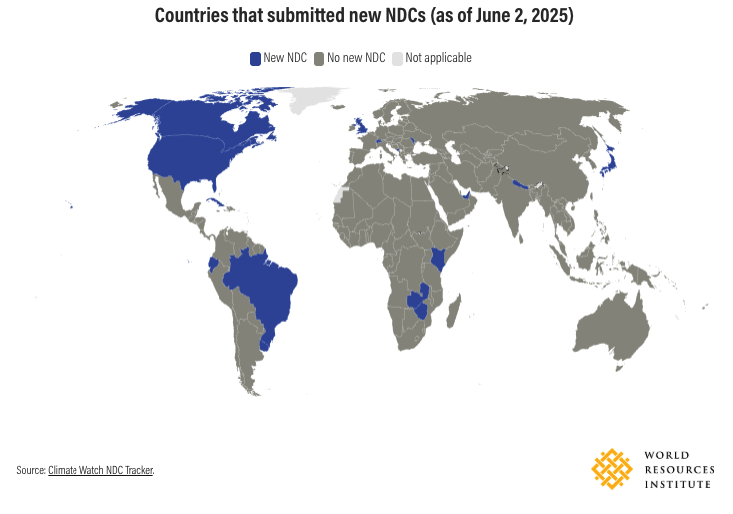
These early movers include a diverse mix of developed and developing nations from different regions and economic backgrounds.
Among the G20 — the world's largest GHG emitters — only five countries submitted new NDCs so far: Canada, Brazil, Japan, the United States and the United Kingdom. (Since submitting its NDC, the U.S. announced its intention to withdraw from the Paris Agreement.)
Several smaller and highly climate-vulnerable countries have also stepped forward, including Ecuador and Uruguay in Latin America; Kenya, Zambia and Zimbabwe in Africa; and island states such as Singapore, the Marshall Islands and the Maldives.
That means close to 90% of countries have yet to submit their new NDCs.
There are several reasons for this. The last round of NDCs was pushed back by a year due to the COVID-19 pandemic, giving countries only four years to prepare new plans. Geopolitical tensions, ongoing conflicts and security concerns have further complicated progress. Many smaller developing nations are also facing capacity constraints as they work to complete biennial climate progress reports and new national adaptation plans (NAPs), also due this year.
Most countries are now expected to present their new NDCs by the UN General Assembly in September.
Compared to previous targets, the NDCs submitted so far have made a noticeable but modest dent in the 2035 "emissions gap": the difference between where emissions need to be in 2035 to align with 1.5 degrees C and where they're expected to be under countries' new climate plans.
If fully implemented, new NDCs are projected to reduce emissions by 1.4 gigatons of carbon dioxide equivalent (GtCO2e) by 2035 when compared to 2030. Looking only at unconditional NDCs (those that don't require international support), this leaves a remaining emissions gap of 29.5 GtCO2e to hold warming to 1.5 degrees C. When conditional NDCs (those that do require international support) are included, this gap shrinks to 26.1 GtCO2e.


Much of the progress in narrowing the gap comes from major emitters that have already submitted new NDCs — most notably the U.S., Japan and Brazil. Given their large emissions profiles, their new commitments account for the majority of the reductions seen so far.
While this marks progress, it's far from what's needed to keep global warming within safe limits. Getting on track to 1.5 or even 2 degrees C would require much steeper cuts than what's currently on the table.
However, this is not the full picture.
Many of the world's largest emitters have yet to submit their 2035 targets. The remaining G20 countries alone account for about two-thirds of global GHG emissions. This makes their forthcoming NDCs especially important: The scale and ambition of these commitments could meaningfully narrow the emissions gap — or, if they fall short, leave the world locked into a trajectory that puts global temperature targets out of reach.

Among the countries that have submitted new NDCs so far, the United Kingdom stands out for its ambitious climate trajectory. Following the recommendations of its Climate Change Committee, the U.K. has set a bold target to reduce emissions 81% by 2035 from 1990 levels. This rapid decline in the coming decade would put the country on track toward its net zero goal by 2050, based on realistic rates of technology deployment and ambitious but achievable shifts in consumer and business behavior.
Other countries, such as Japan and the United States, have opted for a "linear" approach toward net zero — meaning if they drew a straight line to their net-zero target (for example, 0 GtCO2e in 2050), their 2030 and 2035 targets would fall along it, reflecting a constant decline in emissions each year. Japan aims to cut emissions 60% from 2013 levels by 2035, while the United States has pledged a 61%-66% reduction from 2005 levels by 2035.
Despite the U.S. withdrawing from the Paris Agreement, undermining climate policies and attempting to dismantle key government institutions, its NDC target may still provide a framework for climate action at the state, city and local levels, as well as for future administrations. Many of these entities have already rallied around the new NDC and are committed to making progress toward its targets.
However, the linear approach Japan and the U.S. are taking to emissions reductions — as opposed to a steeper decline this decade — risks using up a larger share of the world's carbon budget earlier and compromising global temperature targets.
Brazil presented a broader range of emissions targets in its NDC, committing to a 59%-67% reduction by 2035 from 2005 levels. These two poles represent a marked difference in ambition: A 67% reduction could put Brazil on track for climate neutrality by 2050, while a 59% reduction falls short of what's needed to meet that goal. It is unclear which trajectory the government intends to pursue, leaving Brazil's true ambition in question. The NDC also omits carbon budgets for specific sectors (such as energy, transport or agriculture), which would clarify how it plans to meet its overarching emissions goals. However, Brazil committed within its NDC to develop further plans outlining how each sector will contribute to its 2035 target.
Elsewhere, Canada made only a marginal increase to its target, shifting from a 40%-45% emissions reduction by 2030 to 45%-50% by 2035 from 2005 levels. This falls short of the recommendation from Canada's own Net-Zero Advisory Body, which called for a 50%-55% reduction by 2035 — and warned that anything below 50% risks derailing progress toward the country's legislated net-zero goal by 2050. While every increase in ambition counts, such incremental changes do not match the urgent pace of progress needed among developed and wealthy economies like Canada.

The ocean makes up nearly 70% of the planet’s surface, bursting with rich biodiversity and natural resources that are vital for both the climate and economies. Yet, beyond national coastlines, protecting much of the ocean has long been a murky endeavor.
For nearly 20 years, governments, scientists and ocean advocates have worked toward securing a global treaty to protect marine life in the ocean areas that lie beyond countries’ individual jurisdictions. These vast, mostly unregulated waters, known as the high seas, hold huge importance to the health of the planet.
Finally, in June 2023, the 193 member states of the United Nations adopted the landmark Treaty for the Conservation and Sustainable Use of Marine Biological Diversity of Areas Beyond National Jurisdiction (BBNJ agreement), under the UN Law of the Sea Convention (UNCLOS).
Though the text of what is commonly known as the “High Seas Treaty,” has been agreed, the story is far from over. By the conclusion of the third UN Ocean Conference, 51 parties had ratified the treaty with more pledging to follow, putting the treaty within reach of the 60 needed to put it into force. Once ratified, it will trigger a 120-day countdown, leading to the first Conference of Parties (BBNJ COP) that will determine how the treaty is fully implemented.
The ambition of the High Seas Treaty has always been immense. Roughly two-thirds of the ocean lies outside any single country’s jurisdiction, forming a collective space teeming with life from microscopic plankton to colossal blue whales.
The high seas are also home to lucrative natural resources, which countries and companies increasingly seek to explore and exploit, such as critical minerals needed for EV batteries and other low carbon technologies and marine genetic materials that are increasingly sought after to support pharmaceuticals, biotechnology and other innovations.
Yet, without a binding treaty, the high seas are governed patchwork-style through regional fisheries agreements, shipping conventions and scattered marine protected areas. This leaves critical gaps in protecting marine biodiversity or ensuring developing countries are also benefiting from discoveries made in international water.
When ratified, the High Seas Treaty will fill critical regulatory gaps and complement national efforts. It will help to guide regional cooperation and link seamlessly to sustainable ocean plans for national waters already being delivered by member countries of the High Level Panel for Sustainable Ocean Economy (Ocean Panel) and future plans through the 100% Alliance. Together, they will weave a comprehensive net of ocean stewardship from coastlines to open ocean.
In 2023, countries compromised on four core pillars of the BBNJ agreement:
The treaty will create a mechanism to establish marine protected areas (MPAs) and other conservation management tools on the high seas. MPAs are typically clearly defined geographical spaces, recognized, dedicated and managed, through legal or other effective means, to conserve marine biodiversity and ecosystems.
Many MPAs on the high seas already exist. For example, in 2010, six MPAs were established in the Northeast Atlantic with a total area of 286,200 square kilometers (110,502 square miles) and in 2016, the Ross Sea MPA with a total area of 1.5 million square kilometers (600,000 square miles) was established in the Southern Ocean.
The treaty will also establish a process for proposing new zones for protection via a consultation process, supported by scientific evidence.
The treaty will also establish rules for sharing financial and non-financial benefits from the commercial application of genetic material sourced from high-seas marine organisms — such as bacteria, corals or deep-sea sponges — that can be used in medicine, cosmetics, food, and biotechnology. These innovations hold huge potential benefits for human health and wellbeing.
The High Seas Treaty also supports sharing technology and knowledge developments, particularly to low-income countries that need and request it for conservation and sustainable use to ensure they participate fully in high seas governance.
The treaty will create a process for countries or companies proposing high seas activities — such as deep sea mining in areas beyond national borders — to conduct assessments and follow international standards, that can be shared transparently.
By the conclusion of UN Oceans Conference on June 13, the treaty had 136 signatories and was ratified by 51, just nine shy of the 60 parties needed to put the treaty into force. Those ratifying the treaty include island states such as Antigua and Barbuda, Barbados, Belize, Cuba, Dominica and the Maldives; the European Union and some of its members including France, Portugal and Spain; and other nations such as Chile, Norway and South Korea. (Track the signatories and parties on the UN website here.)
Starting in the early 2000s, the United Nations began informal discussions on how to close the regulatory gaps over how to manage the high seas, wrangling over how to share the benefits of its natural resources while ensuring necessary protections. But the very complexity of coordinating nearly 200 countries meant progress was often incremental, alternately buoyed by breakthroughs and bogged down by competing interests.
The slow ratification progress highlights both the strengths and limitations of international diplomacy. On the one hand, global consensus ensures that the resulting High Seas Treaty creates a single set of rules for all high-seas users. On the other hand, aligning the diverse interests of small island states, distant water fishing nations and environmental non-profit organizations is inherently time-consuming. Each negotiating text must thread the needle between these interests, with every word or comma potentially sparking months of debate.
Moreover, the decision-making processes of the UN, anchored in principles of sovereign equality and consensus-building, can struggle to keep pace with the urgent, evolving threats that marine ecosystems face: like the increasing demand for deep-sea minerals, growing plastic pollution and overfishing practices. By the time a treaty is finalized, new pressures may emerge, requiring fresh rounds of technical and legal work.
Countries, operating within their own jurisdictions — also known as exclusive economic zones, which extend 200 nautical miles from a country’s coastline — can make more immediate progress on conservation and climate initiatives. For example, Ocean Panel members are sustainably managing 100% of their national waters. The process for developing these holistic sustainable ocean plans, while not simple, has been faster than multilateral processes. Ocean Panel members are now calling on all coastal and ocean states to replicate this success in their own national waters by 2030 by joining the 100% Alliance.
At this month’s UNOC, it’s expected that many UN member states will announce either their signing or ratification of the High Seas Treaty. However, for it to be effective, it is crucial that the underlying framework and governance structures are agreed upon before coming into force. The BBNJ Preparatory Commission (BBNJ PrepCom) hopes to fill this gap: shaping the treaty operations and preparing for the first BBNJ COP.
Governments and negotiators are hoping to develop key recommendations to shape the critical elements of the treaty. This includes forming governing structures; outlining the roles and responsibilities of institutions such as those that provide data, and scientific and technical advice; creating tools and mechanisms to ensure equitable implementation of the treaty; and establishing systems to ensure funding and technical knowledge is distributed so all member states can fully participate.
The first BBNJ COP will see these recommendations brought forward and hopefully adopted. It is critical therefore that these meetings are constructive and that a consensus is reached. Only with the relevant governing and financial mechanisms in place can this High Seas Treaty go from a landmark agreement to a fully functioning international treaty that protects the global ocean.
Management of the ocean needs to be as interconnected as the ocean itself. By weaving together national actions with a robust global treaty, the world can ensure a resilient, equitable and thriving ocean for generations to come.
Editor's Note: This article was originally published on June 5, 2025 and updated on June 17,2025 to reflect new information about the countries who have signed and ratified the treaty.
This story was originally co-published by Floodlight and The Texas Tribune.
Whisper Valley is a peek into what the future could look like.
The sweeping community in the Austin, Texas, suburb of Manor is filled with modern homes, small manicured lawns, quiet streets, and rooftops outfitted with solar panels. Hidden beneath it is a network of pipes and man-made reservoirs that heat and cool hundreds of households via geothermal technology — a source that currently provides less than 1% of the U.S. electrical demand.
When completed, Whisper Valley will consist of approximately 7,500 owner-occupied and rental homes and multifamily units ranging in price from $350,000 to $750,000; three schools; 2 million square feet of commercial space; and 700 acres of park and outdoor community spaces. Habitat for Humanity is set to build affordable housing, which will hook up to the geothermal network.
Zac Turov, business development manager for EcoSmart Solutions, which runs the community’s geothermal system, says savings on utility bills for residents here with geothermal-powered heat pumps that cool and heat buildings can run up to $2,000 a year — based on a third-party-verified Home Energy Rating System.
Michael Wilt has lived in the community for six years, moving into his three-bedroom, 1,800-square-foot house during the first phase of Whisper Valley’s development.
He says he’s never had utility costs higher than $70 during the summer months or $45 a month during the winter. That doesn’t count the $60 monthly fee he pays to EcoSmart in operation fees.
“It absolutely works better than the HVAC system I had in the house that I was renting before purchasing the house,” Wilt, 47, said.
“The geothermal system was definitely part of the appeal, but really it was kind of the entire ‘agrihood’ feeling of the whole development,” he added, referring to places that are “intentional” about incorporating green infrastructure into the neighborhood and individual homes.
Developer Michael Thurman has built 30 of the more than 600 homes in this massive mixed-use development. And his company, Thurman Homes, is set to build up to 50 more.
The developer calls geothermal a commonsense way to preserve the planet by cutting the use of fossil fuels to power the homes and businesses here. Heating, cooling, and providing electricity to residential and commercial buildings accounts for about 30% of U.S. greenhouse gas emissions, according to the Environmental Protection Agency.
The community sits 15 miles northeast of Austin. It’s an area home to multiple tech companies, including Google, Tesla, Dell, Samsung, and Applied Materials.
But not all of the developers building in Whisper Valley tap into its geothermal system.
The reason, said Thurman, is money. It costs approximately $40,000 per home to install the heat pumps and hook up to the geothermal network.
“We can’t keep doing the same things,” Thurman said, referring to the imperative to cut greenhouse gas emissions. “This isn’t tough to do, but you have to have core values that make you want to do it.”
Geothermal is more expensive than other forms of renewable energy, including wind and solar, according to new estimates from the consulting firm Lazard.
“The goal is for all the developers who build here to use geothermal,” Turov said. “But it’s still a tough sale.”
Drilling advancements have expanded how and where geothermal technology can be used for heating and cooling individual buildings — and broader power generation.
“The thing is: It is hot everywhere underground,” said Drew Nelson, vice president of programs, policy, and strategy at the Houston-based, geothermal-focused nonprofit Project Innerspace. “Today, with the advances in modern drilling, we are now able to tap into that heat almost anywhere.”
The International Energy Agency (IEA) estimates there is enough next-generation geothermal potential to power the world 140 times over. And Nelson says the United States has the most potential to be a leader in the industry, with countries including China and India also having the resources to generate geothermal power.
“As more projects are implemented, costs will continue to come down,” Nelson said, noting the IEA analysis also predicts geothermal in coming years will be “competitive with solar and wind paired with battery storage.”
Using underground water reservoirs for heating and cooling or to generate electricity isn’t new. But until recently it was mostly confined to specific regions where it was easier to drill into hot water reservoirs — like in Iceland or California.
As of 2021, geothermal was concentrated in Western states, with California and Nevada accounting for more than 90% of the country’s geothermal power production, according to the National Renewable Energy Laboratory.
Geothermal is one of the cleanest ways to produce electricity. And it is the only renewable energy technology that has largely stayed out of the crosshairs of President Donald Trump, who has slashed federal support for renewable and clean energy, including wind and solar.
“One of the reasons President Trump really likes geothermal right now is that it’s all American,” said Bryant Jones, executive director of Geothermal Rising, a California-based nonprofit that advocates for the industry internationally. “It’s local. It’s a way to help rural America figure out their own economies as they transition from one technology to another.”
Geothermal tax credits — for both developers and for homeowners who install heat pumps — helped Whisper Valley thrive in its infancy.
However, industry insiders are ringing the alarms and pressuring the U.S. Congress to not eliminate clean energy tax credits and incentives included in former President Joe Biden’s Inflation Reduction Act. If those tax credits are phased out, insiders say it would cripple the industry before it has a chance to get on its feet.
While billions in federal funding for wind, solar, and other clean energy technology are on the chopping block, the budget bill mulled by Senate Republicans currently would retain tax credits for geothermal, nuclear, and hydropower projects that begin construction by 2033.
The U.S. Department of Energy did not respond to multiple requests for comment on whether it would continue to support geothermal through federal funding and tax incentives, as it did under the previous administration.
“We do need the tax credits for geothermal energy to be maintained,” Jones said. “Geothermal doesn’t have a technology problem, it has a policy problem. [It’s] been around for over 100 years, [but] it hasn’t had the policy support the way the oil and gas industry has, or the nuclear industry, and most recently, the solar and wind industry.”

Traditionally, geothermal was limited to places with naturally occurring underground hot reservoirs, usually near tectonic plates or in volcanic areas.
But evolutions in geothermal have opened the door for developers to utilize oil and gas drilling technologies which help lower costs and allow them to create their own reservoirs almost anywhere. The models fall in two categories: enhanced geothermal systems, or EGS, and closed-loop geothermal systems like the one in Whisper Valley.
With EGS systems, developers create artificial underground reservoirs through hydraulic fracturing or “fracking,” and then inject water or other fluids into a well. The water is heated as it moves through hot rocks and is then pumped up into a separate production well to generate energy.
Closed-loop systems use an underground network of sealed wells where water or fluid is pumped and heated without ever coming in direct contact with rocks. It is then piped into the homes and buildings connected to the system. These systems also cool buildings by drawing out heat during warm weather.
“The more that people learn about geothermal,” Jones said, “the more obsessed they become.”
He says geothermal’s appeal includes a low carbon footprint, reliability, and established drilling technology pioneered by the oil and gas industry. Unlike batteries and wind power, geothermal does not rely on critical minerals whose supply can be disrupted by geopolitical events.
It’s also among the more expensive energy sources because it requires specialized drilling, installation equipment, and skilled workers trained to build it all. Supporters say the industry will continue to need federal tax credits and funding to grow, especially in communities where utility bills are already unaffordable.
While many geothermal units serve just a single household, systems that serve many buildings are more affordable.
“A way to address that is through thermal energy networks, or geothermal district networks,” Jones said, referring to connecting multiple homes and buildings, which means “the cost goes down for everybody.“
He cites Framingham, Massachusetts, where one utility, Eversource, is providing geothermal energy for roughly 140 residential and commercial customers in one neighborhood. After the two-year pilot project ends, customers can return to natural gas, also known as methane, or continue using geothermal, the company says.
“We are still collecting data as we enter the start of the cooling season, but over the winter we saw strong system performance even during the January and February cold snaps,” said Olessa Stepanova, spokesperson for Eversource.
Stepanova says the company expects to have insight into energy savings from the project within a year from when each customer is connected to the geothermal system. And the utility is in final negotiations with the DOE and state to expand the network.
“This would not only demonstrate the scalability of networked geothermal systems,” she added, “but also how they become more cost-effective as they are expanded.”
Last year, the U.S. Department of Energy Geothermal Technologies Office awarded a total of $37.7 million to five cities to install district-scale geothermal heating and cooling systems.
Ann Arbor, Michigan, was awarded the most money, $10 million, which the city is using to build and operate a community geothermal system. It is projected to provide heating and cooling to 262 homes, a local elementary school, and community center in the Bryant neighborhood. The predominantly minority, lower-income area seeks to become the most sustainable neighborhood in the United States.
“It’s a neighborhood that has been disinvested in, and as we were working on our climate goals to be carbon neutral, we wanted to do that in a just and equitable way,” said Missy Stults, director of the city’s Office of Sustainability and Innovations.
Stults says some households in the community shell out up to 30% of their income on utility bills.
“We started to think about what’s a sustainable source of heating that we could look at that helps maintain affordability for everyone [and] that’s clean,” Stults said. “And so geothermal was one thing that came up, and the residents were really interested in it.”
Stults says it’ll likely be a year before the city starts drilling — and that’s only if Congress or the Trump administration keeps the federal funding in place. The city has been “sort of treading water” since Trump announced freezes on various renewable energy program spending. As of June, Stults says the grant had not been terminated, but the funding still hadn’t been allocated to move their project forward.
“Our hope is that [the project] will align with the administration’s goals,” she said. “This is American-made energy. It’s our grounds, our soil. It’s pretty powerful.”
As a selling point, Thurman uses the utility bills for his model home in Whisper Valley and compares them with other homes of the same size he built with traditional HVAC systems.
For the three-bedroom,1,800-square-foot home he built in Whisper Valley, utility bills in June and August 2023 were $42.16 and $74.54, respectively. A home the same size he built using an HVAC system had bills in those same two months of $233 and $326, respectively.
Turov says some developers have opted to build homes in Whisper Valley that use traditional HVAC systems instead of geothermal.
“Developers are reluctant to innovate, usually because it costs more, even though there are great benefits from using the technology,” he said. “We might have to make it work without [federal] subsidies, which will be a challenge but could be good for the long-term viability of the technology in the United States.”
EcoSmart Solutions successfully lobbied Texas state lawmakers for changes in state law and initiatives that can help geothermal grow there — with or without federal subsidies. They include measures that cut drilling regulations for geothermal projects, allow such systems to be added to the electric grid and pave the way for financing through bonds and “special purpose” taxing districts.
Turov explains that such districts allow developers to install infrastructure such as lights, roads, and water systems, the cost of which is then repaid by owners on their property tax bills.
“I think right now, we’re in the first adopter stage,” Turov said. “And that’ll probably still be the case for the next few years. And then I think more and more people will adopt it.”
Floodlight is a nonprofit newsroom that investigates the powers stalling climate action. The Texas Tribune is a nonprofit, nonpartisan media organization that informs Texans — and engages with them — about public policy, politics, government, and statewide issues.
See more from Canary Media’s “Chart of the week” column.
Wind and solar are on the rise worldwide — here are the 10 countries that rely on the clean-energy sources most for their electricity.
All of these countries used wind and solar to produce at least one-third of their electricity in 2024, according to a new report from the Energy Institute. For leading countries such as Denmark, Djibouti, and Lithuania, that figure was in the range of two-thirds or more.
Those numbers are much higher than the global average: Overall last year, wind and solar accounted for 15% of global power generation, up from 13% in 2023.
To be clear, China is still by far the largest producer of solar and wind energy in the world in terms of volume. The country generated 1,836 terawatt-hours of wind and solar last year. All of Europe, for comparison, generated 990 TWh over the same period. But despite that huge amount of renewable energy generation, China received a much lower share of its power from solar and wind in 2024 than the 10 countries on this list — just about 18%.
The list is mostly populated by smaller countries, but it does include some large economies like Germany and Spain. In Germany, wind and solar accounted for a combined 43% of power. In Spain, 42%. (Spain recently suffered a countrywide blackout for which its high share of renewables was blamed. The true culprit, according to a government report released last week, was poor grid planning.)
By the end of the decade, the International Energy Agency expects wind and solar together to account for nearly 30% of global electricity generation. So, while only a handful of countries boast high levels of renewable energy penetration today, many more will join their ranks in the coming years, as wind, and especially solar and batteries, get cheaper and harder to refuse.
This analysis and news roundup comes from the Canary Media Weekly newsletter. Sign up to get it every Friday.
Record-breaking heat swept across the eastern U.S. this week — and with millions of air conditioners whirring, power demand came close to breaking records too.
The ISO New England grid region, which covers most of New England, saw its second-highest power demand ever on Tuesday. In Maine, experts with the Governor’s Energy Office told the Portland Press Herald that New England would’ve beaten the record if it wasn’t for behind-the-meter solar power, like panels on rooftops and over parking lots that aren’t controlled by grid operators. But the region still had to activate fossil fuel-fired peaker plants — which worsen climate change and air quality — to meet demand in the evening.
The grid operated by PJM Interconnection, which includes New Jersey, Ohio, Pennsylvania, Virginia, and other mid-Atlantic states, also came close to breaking demand records both Monday and Tuesday. Power outages affecting thousands of homes were reported throughout the region, with utilities blaming many of them on the high temperatures.
One growing technology could’ve helped the grid manage the heat even better: battery storage. Take New England. Instead of switching on fossil-fuel peaker plants, batteries could’ve stored excess power generated during the day and discharged it when demand peaked — something numerous studies have suggested as a solution for the region. It’s a method that the grid operators for Texas and California rely on every day, as power generated when the sun is shining is stored for use when it sets.
But not every region is embracing the technology. PJM, in particular, has failed to take advantage of batteries in spite of its demand challenges, partly because it has one of the longest waits in the country to connect to the grid.
Battery storage is also threatened by the “Big, Beautiful Bill” currently making its way through Congress. While the Senate did extend a lifeline to the energy-storage industry in its version of the bill, a Wood Mackenzie/American Clean Power Association analysis out this week found that grid-battery installations could still dip as much as 29% next year if tax credit and tariff uncertainty continues.
New York envisions a nuclear future
New York Gov. Kathy Hochul (D) launched an ambitious quest this week, directing the state’s Power Authority to build a large nuclear reactor. The reason? Rising power demand.
“If we don’t increase our capacity over the next decade, we will see rolling blackouts,” Hochul warned at a press conference. “This is the best technology to meet this demand.”
New York is already home to three nuclear power plants, and until just a few years ago, it had four. The Indian Point power plant shut down in 2021 over environmental contamination concerns. But since then, New York has had trouble making up Indian Point’s lost generation capacity, leading the state to rely on more gas power — which has in turn raised greenhouse gas emissions.
In Texas, a company led by Rick Perry, former Republican governor and Trump administration energy secretary, is proposing a nuclear project of its own. Fermi America aims to build four 1-gigawatt nuclear reactors to power a massive data-center campus.
It’ll be years before either one of these proposed plants would come online. But at the very least, it’s yet more evidence of nuclear power’s rebounding popularity on both sides of the aisle.
Senate parliamentarian rescues some energy measures from the “Big, Beautiful Bill”
Some of the Senate’s efforts to roll back Biden-era energy and environmental measures were knocked down a peg this week, courtesy of the body’s parliamentarian. The nonpartisan adviser to the Senate ruled that many “Big, Beautiful Bill” provisions can’t be passed via the 50-vote budget reconciliation process, and instead will need 60 votes to pass. Senate Republicans have only 53 seats.
The parliamentarian’s critique includes a measure that would force the U.S. Postal Service to sell all 7,200 of its newly purchased EVs and scrap its charging infrastructure — a move the USPS said would cost it $1.5 billion. The parliamentarian also ruled against provisions to speed fossil-fuel project approvals, repeal the EPA’s tailpipe-emissions rules, and sell off public lands.
In response, Senate Republicans unveiled new language on Wednesday that omits the tailpipe-emissions rollback and makes other energy-related edits.
Also this week, several groups — including car dealers, energy investors, and even Georgia Republican state legislators — wrote to the Senate urging it to protect clean energy tax credits.
EV funds restored: A federal judge orders the Trump administration to release billions of dollars of frozen funding for 14 states to build a public EV charging network, but leaves out Minnesota, Vermont, and Washington, D.C., which had also sued to get funding restored. (Associated Press)
Building more batteries: LG Energy Solution cuts the ribbon on its expanded battery plant in Michigan, where it’ll now produce utility-scale battery cells that utilize lithium iron phosphate chemistry. (Canary Media)
Coal’s deadly impact: The “old man’s disease” of black lung has been affecting younger coal miners at rates not seen since the 1970s, and advocates worry cuts to federal health and mining safety offices Trump’s attempt to revitalize the mining industry could exacerbate the problem. (New York Times)
Green lawns, greener mowers: Colorado landscapers are making the transition to electric lawn equipment after new state regulations went into effect this month to help curb noxious fumes that contribute to poor air quality. (Canary Media)
Fishing for electrification: Electric boats and solar-powered processing equipment are starting to create environmental and financial benefits for Maine’s growing shellfish industry, but uncertainties around federal funding could slow progress. (Maine Monitor)
A geothermal community: A suburb of Austin, Texas, aims to power 7,500 planned homes and commercial buildings with a sprawling geothermal energy project. (Texas Tribune/Floodlight)
Weatherization paradox: Many low-income households can’t access the free, energy-saving Weatherization Assistance Program because they can’t afford to make basic but expensive repairs required for qualification. (Grist)
Steel’s cleaner future: Steelmakers planning new facilities in the U.S. are embracing a cleaner technology for purifying iron ore, which can then be used in electric furnaces to finish the steelmaking process. (Canary Media)
Massachusetts last week enacted a revamped version of its solar incentive program that developers and advocates say should keep the state’s solar industry moving forward even as the Trump administration pushes to undermine federal support for clean energy.
“In short, the program makes Massachusetts a very healthy market for solar,” said Nick d’Arbeloff, president of the Solar Energy Business Association of New England. “We’ll still be able to present a compelling case to an investor.”
The newest iteration of the Solar Massachusetts Renewable Target program — generally called SMART — makes fundamental changes to the structure of the incentives to be more responsive to market conditions. Other provisions aim to make the benefits of solar available to more low-income residents, protect valuable open space from development, and encourage placement of panels on rooftops and in parking lots.
The state filed the new rules as emergency regulations, allowing them to go into effect immediately.
The move comes just in time, according to solar developers. The previous version of SMART hasn’t been effective in quite some time, they say. While draft regulations for this newest version of SMART were first released nearly a year ago, and a final revision was expected in fall 2024, months went by without new rules.
“The uncertainty we were facing was confusing inventors, was killing projects, and could have done even more damage,” d’Arbeloff said.
In the meantime, President Donald Trump took office and Republican legislators have been working on a budget bill that seems likely to accelerate the elimination of federal renewable energy tax credits. Massachusetts solar developers became increasingly worried they would find themselves in a “valley of death,” with neither state nor federal support, at least for a time, said Ben Underwood, co-CEO of Resonant Energy, a Boston-based solar company that specializes in projects serving environmental justice communities.
Developers, therefore, heaved a sigh of relief when the new state regulations were filed. The reimagined program will start accepting applications on October 15, which will give developers a chance to get projects in place and investors lined up, even with the threat of disruption at the federal level, Underwood said.
“Now we and other members of the industry can start to plan for the incentives,” he said. “It gives us a much easier transition in case federal incentives are taken away.”
Launched in 2018, SMART pays the owners of solar systems a set rate per kilowatt of energy generated by their panels. The base rate depends on project type, location, and size. Projects advancing goals the state supports — serving low-income communities, for example, or building on a closed landfill — receive a boost, known as an “adder,” to their base rate.
The program was initially designed to lower its rates as more solar installations were built. The thinking was that, as the solar industry became more established, the cost of developing projects would go down and developers would need less financial support to be viable.
For years, SMART helped drive solar growth in the state: From 2019 to 2021, annual solar installations more than doubled. Then the Covid-19 pandemic intervened, upending supply chains and sparking inflation. At the same time, SMART compensation rates had fallen, as intended. Suddenly, the incentive payments weren’t enough to cover growing costs, and the industry took a hit. In 2024, less than half as much solar capacity was installed than in 2021.
“You were finding that the incentive level for many projects was, in fact, zero,” d’Arbeloff said.
The new rules jettison the old system of declining rates, replacing it with one that resets the compensation and program size each year, allowing the program to adjust to future unexpected market changes. Annually, the state will conduct an economic analysis that considers progress toward emissions reduction goals, regional and national solar costs, current and historic program participation rates, and land-use and protection goals, and will use the results to set compensation for the coming year. Adders will still be part of the system, and will also be adjusted annually, as needed.
“We can understand the costs, we can understand the size of the program, and we can make adjustments with ratepayers in mind,” said Elizabeth Mahony, commissioner of the Massachusetts Department of Energy Resources. “That’s really important for ratepayers and the development community — we’re going to be so nimble.”
For 2025, the program will be open to up to 450 megawatts of capacity. The base compensation rates will be set after the state completes a new economic analysis in the next few months, Mahony said.
The revised regulations also aim to increase the amount of money flowing to solar projects serving low-income residents. For a development to receive an adder as a community shared solar project, it must allocate at least 40% of the bill credits it generates to low-income households and guarantee these customers a savings of at least 20%, compared with the basic retail price.
“It represents a substantial move toward having greater value for low-income community shared solar participants,” Underwood said. “It’s really good to see that.”
The new regulations also target ongoing tensions about how best to site solar projects while still protecting wildlife habitats and agricultural land.
“We hope the way this works is it pushes folks to do more on rooftops, to do more on canopies, and to do more on previously developed land,” said Michelle Manion, vice president of policy and advocacy for the Massachusetts Audubon Society. “When it comes down to the actual numbers, then we’ll see how well it actually works.”
Certain categories of land with particular environmental value have been declared ineligible for solar development going forward. Projects built on other open spaces will have to pay a mitigation fee that will be determined by a list of factors, including the land’s carbon storage and agricultural potential, the parcel’s ecological integrity, the cumulative impact of the proposed development and others in the area, and location of the planned project relative to grid infrastructure.
“It’s a good way to be a little more strategic about siting solar,” said Erin Smith, clean grid director for the Environmental League of Massachusetts.
These measures are combined with provisions that encourage more development on the built environment. The regulations expand the definition of a solar canopy that qualifies for an adder — which was limited to projects over parking lots, canals, and pedestrian walkways — to include any array raised high enough off the ground to allow the use of the area beneath for another function. The rules also create a new category of adder for panels mounted above other equipment atop buildings, allowing more efficient use of rooftop space.
Though the emergency regulations process put the new rules into effect immediately, the state must still hold three hearings within 90 days to gather public feedback and get final approval from utility regulators. Some tweaks to the program could be coming, but state officials are confident they’ve got the basics right.
“There are quite a few projects that have been waiting for this to come out,” Mahony said. “We believe this is one of the best ways we have to build energy generation in the next few years.”
This article originally appeared on Inside Climate News, a nonprofit, non-partisan news organization that covers climate, energy, and the environment. Sign up for their newsletter here.
In Richmond, California, Zenaida Gomez is ready to say goodbye to the gas stove in the apartment she has rented for over a decade. She has a hunch that the pollution it emits is exacerbating her 10-year-old son’s asthma attacks, and she has heard from public health experts and doctors who’ve said it probably is.
“I’ve learned that not only do we have contaminated air when we are outside in Richmond, but there’s contamination and toxins within our homes,” Gomez said in a recent phone call.
She started attending City Council meetings and organizing with her neighbors as a member of the Alliance of Californians for Community Empowerment (ACCE) Action, because, she said, “I wanted something different. I wanted something better.”
But ACCE Action’s goal isn’t simply to get rid of gas stoves. In a city where about one in four people — nearly double the national average — suffer from asthma due in large part to pollution from heavy industry, the group wants to shut off or “prune” the lines that send natural gas into homes in some neighborhoods. The phenomenon is called “neighborhood-scale decarbonization,” and it’s just getting off the ground in California.
Pacific Gas & Electric, the utility in the area, is on board with the idea. It has expressed a willingness to spend a portion of the money it would otherwise use to maintain gas lines to help electrify the homes in the neighborhood that will no longer use the gas.
David Sharples, county director at ACCE Action, says the group is looking at different neighborhoods that PG&E has identified as likely candidates. Once the group chooses an area, it plans to run a pilot project with the goal of electrifying all the appliances and adding solar panels and batteries for up to 80 homes.
“We’re looking at the Coronado, Iron Triangle, and Santa Fe neighborhoods, which are working-class, Black and brown neighborhoods where ACCE has been organizing for years,” Sharples said. “They all have old gas lines that need to be replaced, so it represents an opportunity to electrify.”
To understand the appeal of neighborhood-scale decarbonization, which is also sometimes called “zonal decarbonization,” it helps to be able to envision the vast network of gas pipelines that exist under most cities in the Western U.S. That network holds a potentially explosive gas, and it requires constant, expensive upkeep.
California has pledged to install 6 million heat pumps by 2030 as part of its larger effort to reach net-zero by 2045. And while a rule will begin going into effect in the Bay Area in 2027 requiring that broken water heaters and furnaces be replaced by electric appliances, a similar rule was just rejected in Southern California.
Experts say a large-scale effort just makes more sense than a piecemeal approach in many parts of the state. And as dramatic as it might sound to transition a whole block or neighborhood off gas at once, the approach may also cost less overall and make it easier to employ people fairly.
Neighborhood-scale decarbonization has also been popular with lawmakers. Last fall, the California Legislature voted to adopt SB 1221, a bill that will enable up to 30 neighborhood-scale projects of this type over the next five years.
The catch is that most residents in the neighborhoods must agree to the change. While the state’s obligation to serve currently requires 100% approval, SB 1221 will lower the threshold to 67% as the pilot projects start rolling out. Several groups have begun the work of educating communities about the benefits of the switch.
In Albany, a city of about 20,000 people north of Berkeley, Michelle Plouse, the city’s community development analyst, has spent the last few years working with PG&E to pilot one of the first neighborhood-scale projects in the state. Using the gas line mapping tool developed by the utility, Plouse and other city staff worked with the Albany City Council to identify 12 potential blocks. This spring, they narrowed it down to three.
The goal, Plouse said, is to find blocks that are easier to electrify while also focusing on lower-income parts of the city, where residents are less likely to be able to afford to electrify.
“What will happen if we don’t decommission the gas line is that the cost of maintaining it will continue to increase over time, and the user base will drop as people electrify,” said Plouse. “The folks who don’t have the money to electrify will be stuck on gas that will get more expensive every year.”
The City of Albany received a grant from the U.S. Department of Energy for the project, and they’ve used the funds to support an outreach plan that involves a block party, a focus group, and a team that goes door-to-door in hopes of talking to everyone on the three blocks. “It’s going to be a lot of listening and a lot of connecting with different people,” said Plouse.
Rachel Wittman, a senior strategic analyst at PG&E, said the utility provided a letter of commitment in support of Albany’s DOE grant, but it won’t be providing financial support for the project.
Although the California Public Utilities Commission is soliciting interest from communities that want to take part in the SB 1221 pilot program, a spokesperson for the commission said it won’t have a list of potential sites until the second half of 2026, at the soonest.
The Albany project will begin before then, so it won’t likely be considered one of the 30 pilots, and Plouse said they’re hoping to get 100% of the residents to sign on. “What’s most likely is that we continue serving as a kind of first test run that can provide information for those pilots,” she said. If that doesn’t work, they may decide to wait until they only need 67% resident approval.
“Albany’s learnings from their efforts in community outreach and advocacy during this project will provide valuable insights that can inform zonal electrification outreach strategy,” said Wittman. “This applies not just for SB 1221 and PG&E, but for any utility or community.” She said over three dozen cities, counties, and other energy providers have reached out to the utility with interest in zonal decarbonization.
ACCE Action and others in Richmond hope its neighborhood-scale project — dubbed Clean Energy and Healthy Homes — will be included in the list of pilot projects, and it appears to have a good chance at making the list. If they’re able to decommission a gas line there, Sharples estimates that it could cost as much as $15 million to upgrade and electrify homes spanning a few different neighborhoods and provide them with solar power. He hopes PG&E will cover around 10% of that cost.
The Richmond City Council approved the effort in early 2024, but the remaining funding is still in question. Chevron, whose local refinery has been a major polluter for more than a century, entered into a settlement with the city for $550 million over the next 10 years to avoid paying a per-barrel tax on the oil it produces. ACCE Action wants to see a portion of that money spent on the neighborhood-scale project. The group has been hosting community events and engaging community members like Gomez.
Tim Frank, a representative of the Building and Construction Trades Council in the county, wants to see the project move forward because it could also create a model for so-called high-road work in the home-electrification space. Currently, unionized workers tend to do larger electrification projects, while one-off residential projects are done by smaller companies not affiliated with unions. While some pay their workers well, many hire temporary laborers and keep wages low.
Electrifying all the homes on one block allows for the efficiency and stability associated with larger projects while benefiting individual families. It’s also more cost-efficient because it allows for bulk purchases of supplies.
It’s a worthwhile experiment, Frank said. “We’re engaged, partly because we see the huge promise of this strategy and we want to help prove out the model and scale it up,” he added.
For Gomez, who has been talking to her neighbors about the possibility that all their homes could be upgraded and electrified at once, the biggest barrier is convincing them that it’s not a scam. Richmond’s low-income communities have seen their share of companies that go door-to-door trying to extract money from people who are stretched thin and working multiple jobs. Some clean energy providers have turned out to be imposters.
“It’s something they’ve never heard of before. So, people ask: Is this a real thing? Can it actually happen?” And she tells them that yes, if the plan goes as a growing number of people hope it will, it just might.
This story was produced with support from the Climate Equity Reporting Project at Berkeley Journalism.
The U.S. battery supply chain just got a little stronger.
LG Energy Solution, a division of the major Korean battery manufacturer, is now producing battery cells for grid-scale energy storage at a site in Holland, Michigan. The company spent $1.4 billion to expand the factory, which previously made electric vehicle batteries. At full capacity, the new lines will produce 16.5 gigawatt-hours of lithium iron phosphate cells per year.
“That’s a sizable portion of annual domestic demand for energy storage battery cells,” said Noah Roberts, vice president for energy storage at the American Clean Power Association trade group, who toured the LG factory Tuesday. “It’s a testament and demonstration of the industry’s commitment to onshoring manufacturing and ramping it up in short order.”
The lithium iron phosphate chemistry, often abbreviated as LFP, has grown increasingly popular for stationary storage and EVs; it offers fire-safety benefits, durability, and lower costs compared to the typical electric vehicle chemistries, at the expense of some energy density. Until now, American battery customers had to turn to China for any LFP supplies. LG’s facility appears to be the largest giga-scale LFP production in the U.S. Japan’s AESC recently launched LFP production at its factory in Smyrna, Tennessee, and Tesla is working to onshore LFP production as well.
As such, LG’s investment is strengthening the U.S. clean energy supply chain at a time of great precariousness, when several other would-be battery manufacturers have failed to deliver.
The plan originated as a way to bolster local supply chains, before Congress passed concerted battery manufacturing incentives, said Jaehong Park, CEO and president of LG Energy Solution Vertech, which focuses on stationary grid storage. But when the Inflation Reduction Act of 2022 created incentives for manufacturing and grid storage deployment, LG upped its planned capacity from 4 gigawatt-hours to the eventual 16.5.
The company initially intended to install these manufacturing lines in Arizona, but relocated them to a portion of its Holland facility that had been developed to expand EV battery production, which LG has done there since 2012. By shifting the LFP equipment to the space in Holland, LG could open commercial production a full year earlier than originally planned, noted Tristan Doherty, chief product officer at the storage division.
Now the Holland manufacturing space covers the area of 42 football fields, and will employ 1,700 people when fully staffed.
“It is very clearly a state-of-the-art facility with the most advanced manufacturing that you can have in the United States,” Roberts said.
The LFP products are booked up six months out, and LG is already looking at doubling the production capacity next year, Park said.
Manufacturers took a gamble in betting that the U.S. could reshore the battery production that China has cornered with dedicated industrial policy over the last decade or more. Companies need to build new industrial hubs and train American workers, and then try to match the quality and consistency of the incumbent industry in China.
The Biden administration passed several incentives to reduce the cost premium for “Made in the USA” batteries, including tax credits for purchasing electric vehicles with domestic batteries, and bonus credits for grid storage developers who buy domestic content.
But the current Republican majority in Congress is working to eliminate those policies, to save money for much more costly deficit spending in President Donald Trump’s signature policy bill. Companies like LG that greenlit multibillion-dollar factory investments under one tax credit regime no longer know which rules will apply when they start production.
Doherty acknowledged there’s a great deal of uncertainty at the moment, but said he’s confident in the long-term bet on U.S. battery production.
“It’s clear that the industry is here and it’s here to stay — the question is just what it looks like and what are the nuances to make it work,” he said. “There’s a lot of very big deals that are in the works. Everyone understands, you need to get U.S. battery supply in your supply chain as quickly as possible.”
Trump’s massive tariffs on China could in theory support domestic producers. But the president has changed his tariff plans from week to week, denying would-be manufacturers the stable business environment they like to see before committing billions of dollars to a yearslong endeavor. Blanket tariffs on China also inflate the cost of battery materials, which are almost entirely processed in that country, as well as the cost of battery manufacturing equipment, which also largely originates there.
LG, as a South Korea-based conglomerate, has been able to avoid the negative scrutiny that American politicians have increasingly leveled at Chinese clean energy manufacturers. LG now sources its battery materials for Holland from outside China, and its manufacturing equipment came from Korea and Japan, Park said.
When Trump came into office, the U.S. was on track to achieve self-sufficiency in battery cell production, per a 2024 analysis by Argonne National Laboratory. The U.S. could make 74 gigawatt-hours of lithium-ion battery cells in 2023, but was set to grow that to 1,133 gigawatt-hours by 2030, comfortably more than expected demand.
During Trump’s tenure, though, new manufacturing investments have plummeted compared to the Biden years, and project cancellations surged to nearly $8 billion in the first quarter of 2025. In that time, for instance, Freyr Battery canceled a planned battery factory in Georgia (and later rebranded itself as T1 Energy), and Kore Power axed a lithium-ion factory slated for Arizona.
Elsewhere in Michigan, startup Our Next Energy has been laboring to build the first large LFP factory in the U.S. But it has yet to secure the funding necessary to fill out the cavernous building it acquired west of Detroit, and the company is struggling to stay afloat.
T1 Energy, Kore Power, and Our Next Energy share something in common: They are venture capital-backed startups attempting to compete with the incumbents of the global battery industry. That model hasn’t produced a standout success yet — even Tesla initially tapped an incumbent, Panasonic, to make EV batteries at its Nevada Gigafactory.
The achievement at Holland looks rather modest compared to LG Energy Solution’s global portfolio, which Doherty said has reached around 500 gigawatt-hours of annual battery production.
“As a big company with a big balance sheet, we can have the confidence to say we’ll weather this storm,” Doherty said. “We’ll make it to the other end because we see where this is going.”
LG’s customers may have more difficulty riding out the turbulence of constantly changing tariffs and tax policy.
“This is a market that is growing, and any disruption that causes it to contract is something that will harm manufacturing,” Roberts said of the grid storage construction sector.
Global demand for steel is rising, and with it, emissions from the coal-fired blast furnaces that churn out around 70% of the world’s supply. American steelmakers are less reliant on blast furnaces than other countries, but they are doubling down on plans to extend the lives of the handful still operating in the U.S.
As those same steelmakers plan new facilities, though, they are embracing a cleaner technology called direct reduced iron, or DRI, to purify iron ore, the first step in the production of primary steel.
The DRI process uses a high-temperature gas to remove oxygen from the ore. The remaining iron can then be added to a traditional basic oxygen furnace or, more commonly in modern systems equipped with DRI, to an electric arc furnace that can be powered by carbon-free electricity.
Most DRI plants operating today use natural gas, a fossil fuel primarily made up of planet-warming methane. But even those can produce 50% less carbon emissions than coal-fired blast furnaces — and if the technology can be paired with carbon capture or fueled instead by green hydrogen, carbon-free steel becomes a possibility.
While DRI facilities account for just 9% of global ironmaking capacity today, they comprise nearly 40% of what’s under development. The U.S., for its part, has only three DRI plants up and running — but every new ironmaking facility slated to be built in the country will use DRI. That includes South Korean automaker Hyundai’s planned DRI plant in Louisiana, which the company announced in March.
The technology for DRI has existed for more than half a century, but it’s made exclusively by two firms that few outside the industry have ever heard of: Midrex Technologies and Tenova. Now, as some countries seek to build steel plants that don’t burn coal, these two firms are poised to reap the benefits.
Midrex Technologies dominates the DRI market. The North Carolina-based company built the first U.S. plant using the technology in Portland, Oregon, in 1969.
“DRI has a bigger and bigger role to play in the energy transition. The long-term view for DRI is positive. Demand for DRI keeps increasing,” said Vincent Chevrier, Midrex’s general manager of technical sales and marketing. “It’s probably going to double, then triple, in the next 20 years.”
The other major manufacturer, Tenova — owned by the Buenos Aires-based Techint, with technology jointly developed with Italy’s steel giant Danieli — started making DRI technology at the turn of this century. With just a fraction of the market, the firm may be the underdog, but CEO Francesco Memoli sees an advantage.
Tenova’s technology can swap out natural gas for hydrogen without any modifications. While Midrex says its equipment needs only minor upgrades to optimize for hydrogen, Tenova said the innate flexibility of its system allows it to ride out whichever way the political tides turn in the U.S.
Lately those tides have been turning against green steel.
In January, just before President Donald Trump’s inauguration, the Swedish steelmaker SSAB bowed out of negotiations for $500 million in federal funding the Biden administration had put up to support a DRI plant powered entirely with green hydrogen in Mississippi.
Cleveland-Cliffs — considered the more progressive of the American steelmakers — has suggested it would abandon its plans to build a DRI facility and use hydrogen to produce steel at its Middletown, Ohio, plant as it renegotiates the $500 million grant it had been awarded with the Trump administration.
Weeks after Cleveland-Cliffs started backing away from the project, Nippon Steel secured Trump’s approval to take over American rival U.S. Steel. The Japanese behemoth, the world’s fourth-largest steel producer, lags so far behind other companies in developing a decarbonization plan that the watchdog group SteelWatch recently described Nippon as “a coal company that also makes steel.” While Nippon has pledged to build a new electric arc furnace, a machine that uses electricity to turn scrap metal into fresh steel, the company has also staked out plans to extend the operations of U.S. Steel’s existing blast furnaces.
Meanwhile, Republicans in Congress have proposed eliminating the federal tax credit meant to spur green hydrogen production, which would create yet another setback.
In the near term, most of the new DRI plants in the U.S. will likely run on gas, Memoli said.
“Natural gas is very accessible in the U.S.,” he said.
Already, Tenova can capture some of the emissions from the gas it uses. Steelmaker Nucor deploys Tenova equipment at its plant in Louisiana, which last year set a world record for DRI production. In 2023, Nucor inked a deal with Exxon Mobil Corp. to capture and store the carbon from the steelmaker’s DRI process.
In Mexico, the Latin American steelmaker Ternium funnels CO2 captured from Tenova’s DRI equipment to Coca-Cola, Memoli said. Tenova puts the gas through two rounds of cleaning until it’s safe for use in beverages, and sells it to another company that in turn supplies the CO2 to Coca-Cola.
“All of the soda produced in Mexico by Coca-Cola is using CO2 recycled from an ironmaking plant,” Memoli said. “The joke is that Mexican Coke tastes better because of that.”
While the CO2 emitted by the DRI process is captured in the Tenova system, Memoli said the carbon produced from heating the gas to 1,000 degrees Celsius remains a source of pollution. The company is planning to roll out new features in the next few years to capture even that “residual” CO2.
Elsewhere, the company’s equipment is already running on hydrogen, or will be soon.
Last year, a major Swedish green metal project selected Tenova’s technology to generate iron with 100% hydrogen for the steelmaking giant SSAB. The fuel is gaining ground in China, too, which lacks domestic gas resources. Tenova-equipped plants in the world’s second-largest economy are already churning out 700,000 tons of iron per year using anywhere from 30% to 70% hydrogen, Memoli said, though only some of that hydrogen is green. The world produces about 2.5 billion tons of iron each year, for context.
Despite the headwinds for hydrogen-based steelmaking in the U.S., the industry could still move away from traditional steel plants (also called integrated plants because of their use of blast furnaces and basic oxygen furnaces) in the coming years. Industry analysts say DRI is the technology that will enable this shift — one that some say is critical both economically and for the climate.
“Blast furnace technology is outdated — full stop. It’s too dirty, it’s too energy intensive, and it’s too inefficient,” said Elizabeth Boatman, a lead consultant at 5 Lakes Energy, a Michigan-based research firm. “Overhauling our integrated mill fleet will be expensive, but it’s an investment that will pay off in the long term.”
Already, mini mills across the U.S. make use of the large volumes of scrap metal in the U.S. to produce lower-carbon steel than what coal-fired plants in China make fresh.
“What we are seeing, because of the switch of energy from coal, is that it offers the possibility of decoupling ironmaking from steelmaking,” said Midrex’s Chevrier. “You can place your ironmaking facility where the energy is cheap, and maintain your steelmaking facility at the location where your customers are and your scrap is.”
That could also create an opening for some of the startups looking to popularize next-generation ironmaking techniques. The Colorado-based company Electra, which aims to use a process called “electrowinning” to purify iron without a blast furnace, raised $186 million in April to support its scale-up. The Massachusetts Institute of Technology green steel spin-off Boston Metal, meanwhile, is inching toward its first commercial revenue.
Memoli said Tenova’s own research and development teams are working on similar technology. But he warned that it’s unlikely to be able to scale up fast enough in the near term to compete with DRI or blast furnaces.
A medium-sized blast furnace can churn out enough iron for 3 million tons of steel per year. A DRI plant can reach about 2.5 million tons. It’ll be decades before any of these newer electricity-based technologies reach that scale, Memoli said.
“The level of development of those technologies is still at a very early stage,” he said.
“We’re still talking about 20 years, 30 years from now. We need to be conscious of what are the targets and what are the deadlines today,” he added. “If we wait for something like that, the target of cleaning the planet will be pushed down and the cost of cleaning the planet will be much higher.”
Memoli said he wants to see more competition in the DRI space.
“Today there are only two companies – us and Midrex. Two is not enough,” Memoli said. “Not even four would be enough to develop all the projects that potentially could happen. Anybody with a green solution is welcome.”
Canary Media’s “Electrified Life” column shares real-world tales, tips, and insights to demystify what individuals and business owners can do to shift to clean electric power.
CENTENNIAL, Colo. — At a grassy city park this spring, professional landscapers sauntered between vendor booths, asking questions about the shiny new wares laid out before them: battery-powered push mowers, leaf blowers, string trimmers, chainsaws, and more. Some hopped on new standing and riding mowers to give them a spin.
Noticeably absent throughout it all was the scent and the roar of gas-guzzling equipment; the tools were all electric.
At the event hosted by the nonprofits Regional Air Quality Council and the Colorado Public Interest Research Group Foundation, landscapers were scoping out battery-powered tools to prepare for statewide regulations that kicked in this month. The first-of-their-kind rules, adopted in 2024, restrict the use of landscaping equipment with small gasoline-powered engines on public property during the summer — the state’s high-ozone season.
As you might guess from just a whiff of the noxious fumes, gas-fueled lawn and garden equipment are extremely polluting. Their combustion engines are a hazard not only to a stable climate, but also human health.
In 2020, nationwide, these machines belched over 68,000 tons of nitrogen oxides (NOx) and 350,000 tons of volatile organic compounds, according to the U.S. Public Interest Research Group Education Fund, referencing data from the U.S. Environmental Protection Agency. Together, the chemicals form lung-searing ozone, a key component of smog linked to respiratory problems and even premature death. The amount of NOx emitted by fossil-fueled lawn equipment is equivalent to the annual emissions from about 30 million cars, or more than a tenth of those registered in the country.
After personal vehicles and oil and gas operations, the third-largest source of ozone-causing pollutants in Colorado’s Front Range region is lawn and garden equipment, said David Sabados, spokesperson for the Denver-based Regional Air Quality Council, the lead air-quality planning agency for the area. These machines don’t have catalytic converters, he pointed out, so “they have an oversized footprint on our air-pollution problem.”
The Front Range, which includes Denver and Boulder, frequently exceeds federal air-quality standards for ozone — but it’s not alone.
Cities, counties, and states around the country are also pursuing cleaner air and quieter neighborhoods by limiting the use of gas-fired landscaping equipment, incentivizing electric options, or both. California has had a zero-emissions (i.e., electric) standard for newly manufactured leaf blowers, lawn mowers, and other small off-road engines sold in the state since 2024. Montgomery County, Maryland, banned the use of gas-powered leaf vacuums and blowers, effective July 1. And New York is considering a bill to deliver a financial boost to commercial landscapers who switch to electric tools.
Colorado’s new rules, called Regulation 29, don’t affect individual homeowners, but instead require landscapers who work on federal, state, municipal, and public school properties to use zero-emissions handheld tools and push mowers from June 1 through Aug. 31.
To keep grooming these grounds, contracted companies are replacing their gas gear with electric options as it wears out, which can happen in as little as three years.
Some landscapers say the switch has broad customer appeal. Certain clients prefer electric tools because they work from home and don’t want combustion equipment disrupting their calls. Others prize the environmental benefits.
“The community we serve is very Earth-conscious,” said Ed Johnson, division manager for landscape company Outdoor Craftsmen, which has transitioned two of its six maintenance crews to predominantly electric models. “There’s definitely been a desire” among customers, many in Boulder County, for landscapers to act as good stewards, he said.
Johnson added that it’s strategic to ease into electrification now rather than scramble to overhaul operations when stricter regulations come down in the future. This winter, the Colorado Air Quality Control Commission will weigh tighter restrictions on commercial landscapers working on private properties, The Denver Gazette recently reported.
Making the switch to electric equipment isn’t easy, though. Cost can be a barrier, a concern the industry raised when Regulation 29 passed last year.
“It’s a big investment for all the batteries,” said Brian Levins, manager at Designscapes Colorado, a landscape design, construction, and maintenance firm. “When you’re buying a battery, you’re basically prepaying gas for two years.” The company, which earned $45 million in revenue last year, has spent about $36,000 (after incentives) on handheld electric tools and charging gear for six of its 20 crews, he said.
Designscapes was able to take advantage of the 30% discount on electric lawn equipment that Colorado offers through participating retailers. Other landscaping firms have defrayed costs with grants from state and local agencies, such as Boulder County’s Partners for a Clean Environment program.
Another hurdle is figuring out how to keep the equipment charged.
Johnson has rigged up an equipment trailer with a portable power station from manufacturer Kress that can recharge batteries in as little as eight minutes. And Aurora, Colorado, landscaper Singing Hills has beefed up the electrical infrastructure at its home base to handle the added load from electrifying some of its equipment. That upgrade cost about $15,000, said Jake Leman, CEO of the 30-year-old company.
An added challenge to going electric is that gas versions are still more powerful for a couple types of equipment, like leaf blowers, Johnson of Outdoor Craftsmen said. But the electric tech “is coming along,” he noted. “It’s getting really, really close.”
Plus, electric landscaping equipment boasts a bevy of benefits. It’s safer for operators, who no longer have to breathe their tools’ fumes or go home with the stench clinging to their clothes. Leman has heard from some crew members that they enjoy being able to talk while operating an electric machine — uncomfortable to do over a firing engine — and they’ve praised the faster start up of electric tools compared with gas-powered options that require pulling a cord, he said.
The electric machines also require much less maintenance, Leman noted: “There’s not the filters and the belts and the fluids to change.” With savings on fuel and upkeep costs, Johnson estimated some of his larger equipment would pay back after 27 months of operation.
Some companies don’t have to deal with the challenging economics of replacing equipment. Jordan Champalou started his business, Electric Lawn Care, with primarily electric machines four years ago, when he was 19. “I enjoy not breathing in fumes all day,” he said.
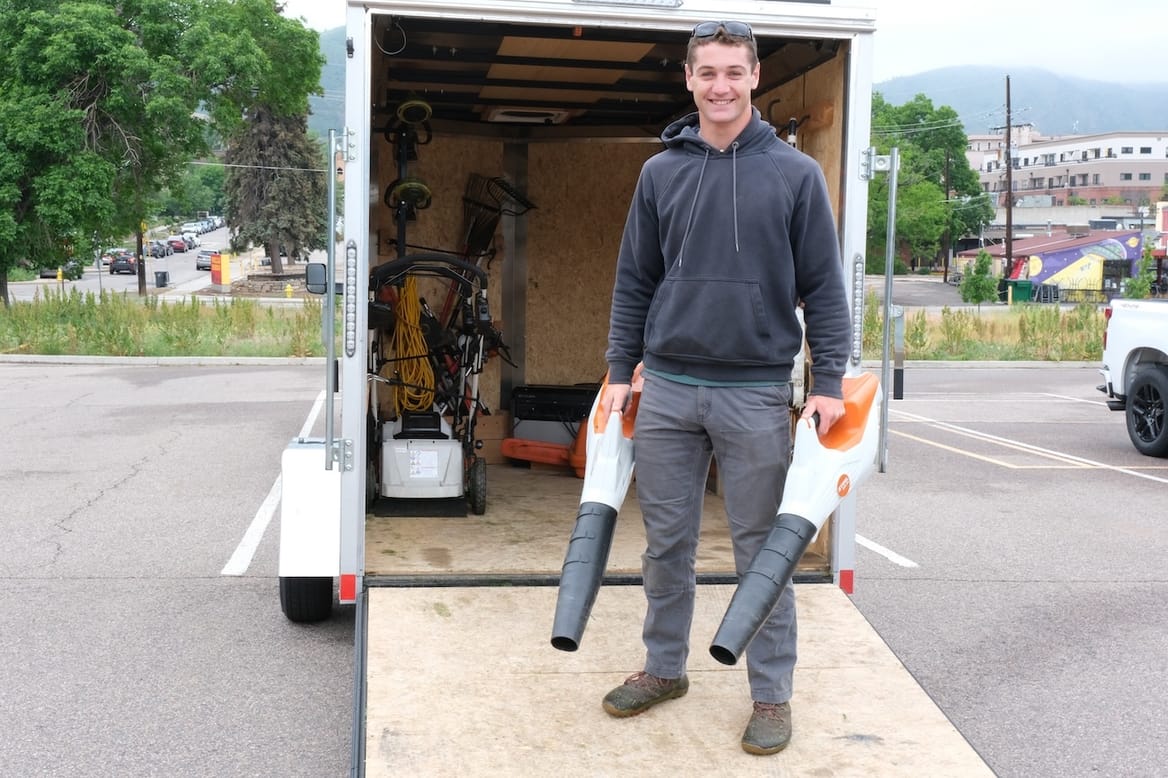
He’s also able to save on energy costs and charge in between job sites using cheap renewable power from two solar panels he installed on the roof of the trailer in which he hauls his Stihl mowers, blowers, trimmers, and chainsaw. His leaf blowers are indeed less powerful than gas-fired versions, he said, but he’s found a solution: He slings two at once.
About a third of Champalou’s clients hire him because he uses electric tools, he said. “This year has been more than ever.”
Some commercial customers are now also breathing easier on landscaping days, says Levins of Designscapes. A few client buildings have ventilation systems that inhale air from close to the ground. With gas equipment, “we need to notify them before we go out there, because otherwise those fumes will get sucked into the air-intake [system] and distributed through the building,” he said.
Battery-powered zero-emissions tools don’t have that issue, Levins noted. “And those customers love that aspect of the electric equipment.”


.svg)
