

 Back
Back
Kansas ranks among the sunniest states in the nation, and its famously flat landscape is ideal for vast rows of solar panels. Yet it ranks just 41st for solar installations, raising the question: What’s the matter with Kansas?
The simple answer is that on the gusty Great Plains, wind energy gained an early foothold and dominated the renewable buildout. The wonkier explanation points to the state’s weak incentives — including a voluntary renewable energy portfolio standard and a limited net-metering rule — as well as pushback from residents who don’t want to live next to solar arrays. As a result, the state has few utility-scale solar installations.
The developer of a 270-megawatt project in the northwestern corner of Kansas thinks the Sunflower State’s solar industry is poised to bloom.
Last week, Doral Renewables announced a power-purchase agreement for its Lambs Draw Solar project in rural Decatur County, bordering Nebraska. The company declined to disclose its offtaker, but CEO Nick Cohen said, “It’s a major tech company with a big name that does a lot of data centers across the U.S.”
“This is a turning point,” Cohen said. “You’re going to see more and more solar in places like Kansas.”
As recently as five years ago, he said, “it would have been wind.” But the best tracts of land for building turbines have already been developed.
The data indicates that a solar boom is indeed getting underway in Kansas — one in which Lambs Draw will be a key participant but far from the only one. In May, the state plugged in its first major project in the 189 MW Pixley Solar Energy installation, a big leap from the state’s second-biggest array of just 20 MW. Several even larger projects are expected to come online over the next few years, including a sprawling 510 MW installation slated to go live next December.
Construction hasn’t yet begun on Lambs Draw, but Cohen said the site is “shovel ready” and expects the project to benefit from safe-harbor rules that allow developers to lock in expiring federal investment tax credits by breaking ground early next year.
“What has happened is that solar has become the lowest levelized cost of energy of any new-build energy source out there,” Cohen said. “Solar has reached the tipping point where it’s the most economical and achievable energy solution in places like Kansas.”
Lambs Draw will span 4,000 acres leased from four landowners, though not all of it will host panels. Part of Doral Renewables’ strategy is to “use avoidance and what I call neighborly courtesy,” Cohen said. That means “getting more land than we need, then avoiding any sort of environmental features, whether it’s a habitat or wetlands.”
Then, he said, “we’ll ask neighbors, ‘Is it OK if we put this here?’”
The local acceptance matters. At this point, solar development is “not really a question of state by state anymore,” said Pol Lezcano, the director of energy and renewables research at the real estate and consulting firm CBRE.
“It’s more like a county-by-county issue,” he said.
The economic development agency in Decatur County lured Doral to the region in hopes of generating more tax income and finding a way for farmers to diversify revenue.
“They respect landowner rights as sacred,” Cohen said. “The officials in the county are also very professional and see this as a generational uplift for everyone. They’ve been incredibly friendly. They convinced us to come, and it worked.”
Part of Doral’s appeal was that Lambs Draw may, in fact, involve lambs. The company plans to incorporate agrivoltaics, with crops planted between rows of panels and livestock employed to graze and keep the grasses trimmed. Cohen said the company and its landlords haven’t yet decided what to plant.
Despite the acreage, Lambs Draw’s 270 MW is smaller than the Philadelphia-based Doral’s typical 500 MW project. The size, Cohen said, is limited by what the local power lines — which connect to the Southwest Power Pool grid system — can handle.
“Originally, we wanted it to be more, but ultimately the grid is a constraint,” he said. “It’s healthy at 270, and that’s where we’re going to keep it.”
Nationwide, Doral has 400 MW of solar in operation, another gigawatt under construction, and more than 15 GW in the queue.
The company hasn’t yet selected the panels for Lambs Draw. But its 1.3 GW Mammoth Solar project currently underway in Indiana uses panels from manufacturers in Texas and India. Doral expects to make a similar deal for Lambs Draw, allowing the company to obtain panels quickly enough to access sunsetting federal tax credits and avoid new restrictions on imports from China.
“Solar is a once-in-a-lifetime opportunity for rural America, and places like northwestern Kansas have an opportunity to have a competitive advantage,” Cohen said. “They have something other people don’t have: flat, tillable farm fields with a strong grid connection.”
American factories use lots of hot water and steam to produce everyday goods like milk, cereal, beer, toilet paper, and bleach. Most facilities burn fossil fuels to get that heat, emitting huge amounts of planet-warming pollution in the process.
Switching to electricity could significantly and immediately slash those emissions in many places, according to a new report by The 2035 Initiative at the University of California, Santa Barbara. Electric versions of industrial boilers, ovens, and dryers are already available, and newer models promise to boost factories’ efficiency and curb energy costs even further.
“We can make progress today with the technologies we have,” said Leah Stokes, an associate professor of environmental politics at UC Santa Barbara and one of the principal researchers for the report.
But electrifying factories is a far more complex undertaking than, say, trading a gasoline-fueled car for a battery-powered vehicle. The process involves making many head-scratching calculations and engineering choices, which is partly why companies have been slow to adopt electrified equipment. Stokes said the report aims to demystify some of those decisions so that U.S. manufacturers can start tackling their heat-related emissions.
“We wanted to answer this question [of] where is it most technologically and economically feasible to electrify industrial process heat today?” she said during a Dec. 16 webinar. The study also drives home the need to rapidly build more clean energy to power all that new demand.
Researchers simulated what it would look like to electrify nearly 800 large industrial plants within three sectors: food and beverage, chemicals, and pulp and paper manufacturing. These facilities use relatively low- and medium-temperature process heat — unlike scorching cement kilns or steel mills — and together account for about 40% of CO2 emissions from the U.S. industrial sector.
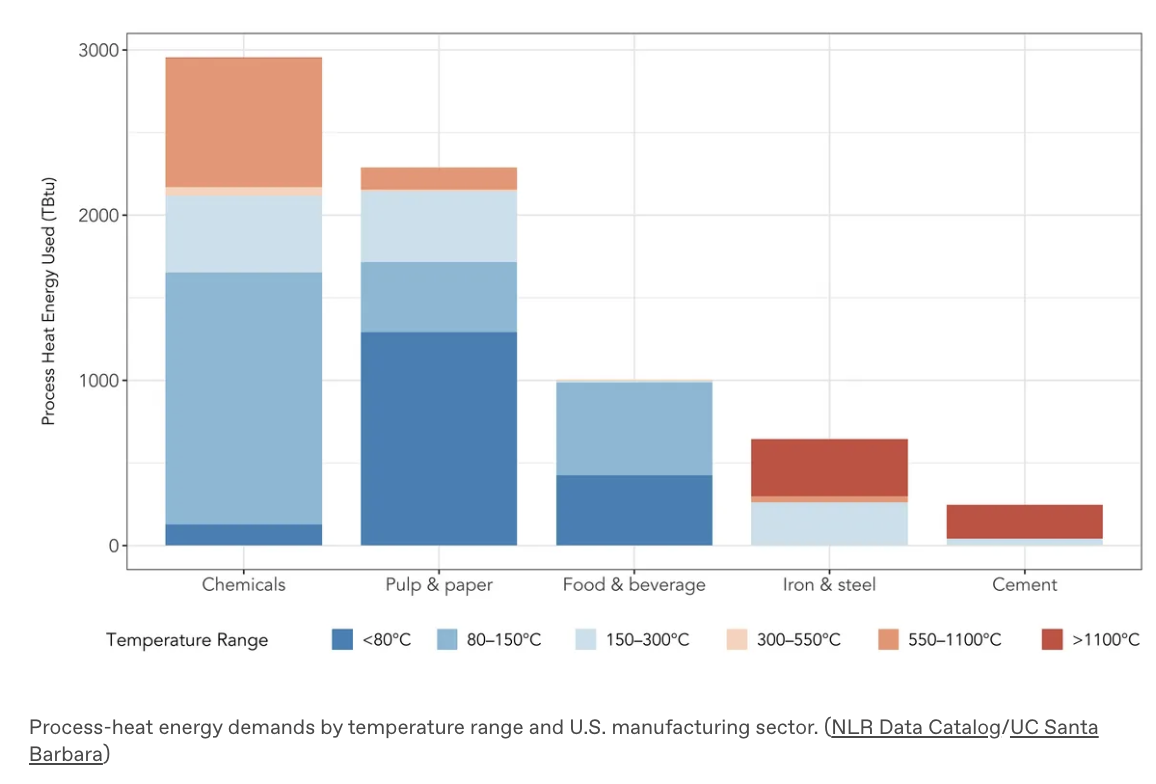
The UC Santa Barbara team modeled four scenarios for electrifying each of these plants, beginning with “drop-in electrification” — using electrode boilers and electric ovens and dryers — and progressively expanding efforts to include major energy-efficiency upgrades and advanced technologies, like high-temperature heat pumps from the startups AtmosZero and Skyven.
At the most ambitious level, electrifying these factories could slash the country’s emissions by 1.3 billion metric tons of CO2 equivalent by 2050, while also providing $475 billion in public health benefits by improving air quality, researchers found. The figures assume the U.S. electric grid will be running almost entirely on clean energy by mid-century, up from 40% today.
“This one space actually can contribute an outsize share of the global [climate] mitigation we need to keep our global temperature rise in check,” said Eric Masanet, a sustainability science professor at UC Santa Barbara who led the study with Stokes.
In certain cases, it can cost manufacturers about the same amount of money to get heat from electric systems rather than gas-fired ones, he said. That includes processes that use less intensive heat, like ethanol and plastics production, since heat pumps work more efficiently at lower temperatures. It’s also true for factories located in places where fossil gas is relatively expensive. In Delaware, New York, and Washington state, for example, companies enjoy a more favorable “spark gap” — the difference between electricity and gas utility costs for the same unit of energy delivered.
Just as cost varies by facility, so does the potential for emissions reductions. The largest CO2 savings are in states with low-carbon grids, like Washington, California, and Vermont. In places with dirtier grids, switching to electricity can actually increase emissions in the near term if utilities meet that demand with gas- and coal-fired power plants. But even in those areas, researchers expect that electric equipment installed today will still cut pollution over time as the grid gets cleaner.
For that to happen, factories will need a lot more wind, solar, geothermal, and other carbon-free sources to come online. Electrifying the processes included in the study could require 158 to 301 terawatt-hours of additional power, or about 16% to 30% of the electricity currently consumed by industry. That new load would add to the soaring demand that’s already coming from data centers and electrified homes and vehicles.
“If we want to bring the type of electricity to the industrial sector that it’s going to need … we’re going to need to improve the grid,” Sen. Sheldon Whitehouse (D-R.I.) said during the webinar, adding that streamlining the federal permitting process would hasten the build-out of new transmission and clean energy projects.
The UC Santa Barbara team outlined other policies that could accelerate industrial decarbonization, particularly for the facilities where electrification is more expensive than burning fossil fuels. A 30% federal investment tax credit or state-level grants would offset the up-front costs of investment in new equipment. A “clean heat” production tax credit would lower operating costs, as would reducing industrial electricity rates.
Stokes noted that, even without such incentives, cleaning up manufacturing would take a minimal toll on consumers’ wallets. Take breweries, which use heat for mashing, boiling, and fermenting ingredients and sterilizing containers. “Our modeling shows that even if electrification doubles the cost of energy as an input to beer production, it’s 1 cent per beer,” she said.
“This is something that we can do, and it’s super important,” she added.
Rooftop solar and home batteries are way more expensive in the U.S. than in most countries, largely due to slow and burdensome local permitting and utility interconnection processes.
But there are tools installers can use to bring down these so-called “soft costs,” which make up about two-thirds of the price of installing solar, batteries, and EV chargers in the U.S.
One of the most effective such tools is called the meter socket adapter — and major home-electrification companies are increasingly making use of it. Over the past few years, companies including Tesla, ConnectDER, and Enphase have won approval from a growing number of utilities to use these devices to circumvent complex electrical work that can add days of labor and thousands of dollars in costs to installations.
Recent regulatory momentum in California, the largest home solar market, is also boosting the tech, which takes the form of a metal ring that’s inserted between utility meters and the meter boxes that connect homes to the grid. Inside each meter socket adapter is all the technology needed to connect, protect, monitor, and control solar, batteries, EV chargers, and other electrical devices.
Using tools like these to decrease soft costs is increasingly important as utility bills climb nationwide and regulatory headwinds threaten to make solar more expensive. Federal tax credits for home electrification expire at the end of this year, and several states have pared back compensation programs for solar owners.
Meter socket adapters are also a no-brainer for installers to use, according to Marcelo Macedo, who previously worked at SolarCity and Tesla and now runs his own installation company, Coastside Clean Energy. He said they can turn a multi-day job into a simple, half-day, plug-and-play exercise, largely because they help standardize projects.
“You can supervise more people doing more work faster, and most importantly, more predictably,” he said. “You can more reliably close out jobs on a tighter time frame with fewer hiccups. Your time to cash flow is more predictable. That leads to saying yes to more jobs, and being able to get more jobs done in a month.”
Meter socket adapters can generate serious — if highly varied — savings.
So says Colby Hastings, senior director of residential energy at Tesla, whose meter socket adapter device called the Backup Switch has been approved for use by dozens of utilities across the country, including Green Mountain Power in Vermont, Commonwealth Edison in Chicago, and all of the biggest utilities in the solar-rich states of Arizona and California.
Where utilities have cleared their use, “the Backup Switch can save thousands of dollars on a typical installation in both material and labor,” she said.
Exact figures depend on the particulars of household meter design and configuration and what equipment is being installed. On average, the Backup Switch can deliver savings of about $335 in hardware costs and about $360 in labor costs per storage installation, according to a report Tesla published this summer. More complicated projects can see greater savings, Hastings said. And Tesla Cybertruck owners get the added benefit of being able to use the Backup Switch to connect their EV battery for home backup power.
Most of those savings come from avoiding the need to relocate key household circuits into a different electrical panel for battery backup, Hastings said. A separate remote energy meter will still be necessary for homes that only want to back up a subset of their circuits. But for whole-home backup setups using a Backup Switch alongside a Powerwall battery, installation can be as quick as “a few hours,” she said, compared to more than a day needed to install equipment and run conduits if a battery is installed without the Backup Switch.
To be clear, meter socket adapters aren’t helpful for every home that wants to go solar. But for those adding solar and storage or an EV charger, it’s more likely than not that they can speed things up and shave some cost.
Home design also matters. Meter socket adapters are particularly useful for homes with meter boxes located right above the circuit breakers. These “meter-main combos” are more common in warmer climates, including California, the country’s top home solar and battery market.
Meter-main combos can make it particularly hard to install home energy tech through the electrical panel, said Raghu Belur, chief product officer at solar microinverter and battery vendor Enphase. Their tight configuration leaves no room for the microgrid controllers that automatically isolate homes when the grid goes down, or the current transformers that can measure power flows on home circuits.
Meter socket adapters simplify things because they integrate all of these devices into a single unit. Enphase has its own meter socket adapter now approved by nearly 50 U.S. utilities.
“It has a powerful 200-amp switch inside it to isolate the home during outages,” Belur said of the device. “That dramatically reduces the balance-of-system costs” and can “save thousands of dollars in labor.”
Meter socket adapters are also far more elegant systems, said John Bergh, CEO of Bay Area solar installation company Cobalt Power Systems. He likened the custom-designed webs of electrical conduits, transfer switches, junction boxes, and electrical sub-panels typically required to install batteries to a “wall of spaghetti” on a home.
“If you think about one crew having to take three to four days to install a battery system with a traditional transfer switch or system controller or gateway, versus a crew that can now do multiple installations in one day with a Backup Switch and Powerwall 3, it’s much more scalable,” he said. That means getting “more clean energy installed faster, which is what we’re all looking for.”
But for meter socket adapters to put a real dent in soft costs, more utilities will have to let installers use them — and getting utilities comfortable with third-party devices that plug into their meters has been a long slog.
Whit Fulton, CEO of ConnectDER, knows just how long it has taken. He launched his meter-socket-adapter company in 2011, and won his first utility project in 2015 with Green Mountain Power, which is in the vanguard in deploying solar-charged batteries in households. Similar utility-led projects have followed in Arizona, Hawaii, and New York.
But it wasn’t until more recently that ConnectDER has been able to supply a meter socket adapter for use by solar and battery installers. “It’s been a crawl-walk-run approach,” Fulton said, driven as much by policymaker pressure as by utility acceptance.
One big win came in 2021, when Colorado state lawmakers passed a law that required utility Xcel Energy to allow customers to use meter socket adapters to connect solar systems. “Xcel adopted it, and it worked pretty well,” he said. “From there, we were off to the races,” with utilities in 25 states serving a collective 30 million households now allowing some use of ConnectDER’s meter socket adapter designed for installation with home solar systems.
A separate ConnectDER meter socket adapter designed for installation with EV chargers has also been approved for use by 21 utilities in 14 states, he said.
This summer, ConnectDER launched its latest product, dubbed IslandDER, built specifically to simplify whole-home battery backup systems that are an increasingly common add-on for homes installing solar or looking for alternatives to fossil-fueled generators, Fulton noted. IslandDER is being used by partners including Lunar Energy, FranklinWH, SolarEdge, and EcoFlow, with test installations in 12 states and larger-scale deployments expected next year, he said.
Getting approvals for these devices is not easy. Utilities are cautious by nature. For Tesla to notch its dozens of approvals, Hastings said it took years and “hundreds, if not thousands, of meetings.”
At the same time, California regulators helped push utilities to accept meter socket adapters with a decision this summer that “created a regulatory framework by which the utilities have to review products like these, and create an avenue for approval,” said Kyle Breuning, director of applications and fleet analytics for Lunar Energy, a home-battery and energy-controls startup.
Ultimately, Hastings would like Tesla’s Backup Switch to be an option for installers across the country. Right now, only about 40% of the projects installed today that could use a Backup Switch are allowed to do so, she said.
“It’s safe, it’s reliable, it’s field-tested. It has gone through extensive processes with many utilities,” she said. “I can’t think of any good reason not to approve it.”
A correction was made on Dec. 22, 2025: This story originally misstated Kyle Breuning’s title. He is now director of application and fleet analytics for Lunar Energy, not senior manager of applications engineering.
The Interior Department announced Monday it is pausing leases for all five large-scale offshore wind projects under construction in America, citing unspecified issues of national security.
Canary Media obtained a copy of a letter notifying one of the affected wind farm developers, providing new details about the move — the Trump administration’s most sweeping attempt yet to halt offshore wind construction.
A Bureau of Ocean Energy Management letter to Dominion Energy executive Joshua Bennett orders the Virginia-based utility to “suspend all ongoing activities” related to its Coastal Virginia Offshore Wind project, a 2.6-gigawatt wind farm slated to start coming online in less than four months, for “the next 90 days for reasons of national security.”
“Based on BOEM’s initial review of this classified information, the particularized harm posed by this project can only be feasibly averted by suspension of on-lease activities,” the letter reads.
The 90-day time frame is not mentioned in the Interior Department’s official statement on the order.
The letter adds that BOEM will work “in coordination with [the Department of War]” during the suspension to determine whether the risk posed by the Coastal Virginia Offshore Wind project can be mitigated. It also states that “BOEM will consider all feasible mitigation measures before making a decision as to whether the project must be cancelled.”
Ultimately, “BOEM may further extend the 90-day suspension period” based on its review of each project, according to the letter.
News of the pause was first reported by Fox News. Wind developers didn’t receive stop-work orders via letters from BOEM until roughly an hour or two later, according to a person familiar with the matter who was granted anonymity because they are not authorized to comment publicly.
The letter obtained by Canary Media mentions an “assessment” completed by the “Department of War” in November that contains “new classified information, including the rapid evolution of relevant adversary technologies and the resulting direct impacts to national security from offshore wind projects. These impacts are heightened by the projects’ sensitive location on the East Coast and the potential to cause serious, immediate, and irreparable harm to our great nation.”
There is currently one large-scale offshore wind installation operating in the U.S. — the South Fork Wind farm off the coast of New York — as well as two pilot-scale projects generating electricity near Block Island, Rhode Island, and Virginia Beach, Virginia. The letter makes no mention of these East Coast projects or any national security risks their operation may pose.
The letter was signed by Matthew Giacona, the acting director of BOEM, a young political appointee and former oil and gas lobbyist for the National Ocean Industries Association.
In October, congressional Democrats asked the Interior Department’s inspector general to investigate Giacona following revelations, first reported by the news site Public Domain, that he has used his BOEM position to work on niche policy matters previously the focus of his oil lobbying role.
The Interior Department’s press release about the pause also cites claims not included in the letter to Dominion Energy, including mention of a 2024 Department of Energy study that determined offshore wind turbines could cause radar to “miss actual targets” while also noting that “wind energy will play a leading role in the nation’s transition to a clean energy economy.”
Dominion Energy did not respond to a request for comment.
A spokesperson for Equinor, the partially state-owned Norwegian energy firm that is developing the Empire Wind project off the coast of New York, said, “We are evaluating the order and seeking further information from the federal government.”
The Trump administration had previously hit two of the affected projects — Empire Wind and Revolution Wind — with stop-work orders. Both installations were later allowed to proceed, although that construction pause cost Equinor nearly $1 billion. The remaining three projects, Coastal Virginia, Vineyard Wind, and Sunrise Wind, had been spared until now. Several of these projects are more than halfway complete; Revolution Wind is at least 80% finished.
Monday’s announcement is not the first time the administration has used national security as an excuse for throwing sand in the gears of offshore wind.
Upon pausing the Revolution Wind project in August, Interior Secretary Doug Burgum invoked national security concerns, including the threat posed by “undersea drones.”
But between 2020 and 2023, the Revolution Wind project endured an extensive regulatory review, including by the Pentagon and Federal Aviation Administration. BOEM approved the project under the condition that all turbines be built to lighting and marking standards that would ensure they’re visible to aircraft at night. Radar mitigation requirements were mentioned in the approval, demonstrating stakeholder engagement on this issue. In August 2023, the U.S. Army Corps of Engineers — a branch of the military — co-signed the authorization of plans for Danish developer Ørsted to build 65 wind turbines for the Revolution Wind project.
“Was the military at the table, represented and consulted with during this stakeholder process? The answer is: very much so,” wind energy veteran Bill White told Canary Media in August. From 2009 to 2015, White represented Massachusetts on a BOEM-led intergovernmental task force focused on the siting of New England offshore wind energy areas.
In February 2024, a Brown University research group examined 441 claims made against offshore wind during the first six months of 2023. They found multiple times “military readiness” and “radar interference” were mentioned in ways that the researchers found misleading or problematic.
“[S]uggesting that our military is unaware of this issue or has done nothing to address it is completely untrue,” the report concluded.
J. Timmons Roberts, a co-author of the report and a professor of environmental studies and sociology at Brown University, called the administration’s halt to five approved wind farms because of classified national security information “bonkers.”
“These claims aren’t new and they have been, in the past, shown to be quite baseless,” he said.
A correction was made on December 23, 2025: This story originally stated that Giacona had yet to receive Senate confirmation, but his position does not require such approval. It has also been updated to clarify the terms of Revolution Wind’s approval, which included radar mitigation requirements
It’s been a difficult year for clean energy in America. President Donald Trump entered office in January and promptly stopped the transition away from fossil fuels and toward solar, wind, and batteries in its tracks. Right?
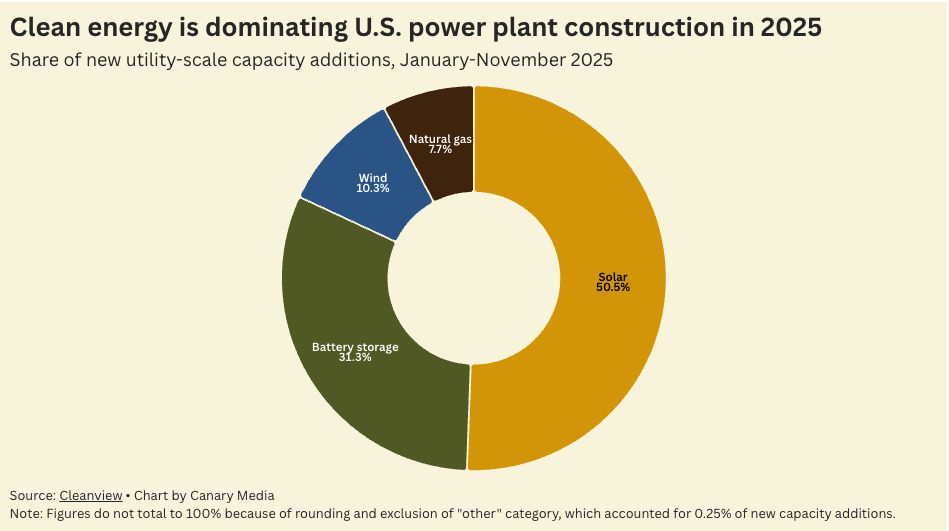
Not quite. In fact, for all of Trump’s paeans to “beautiful, clean coal” and to natural gas, it’s clean energy that has once again led the way this year. Through November, 92% of new power capacity added to the grid in 2025 came in the form of solar, wind, or storage, according to Cleanview analysis of U.S. Energy Information Administration data shared with Canary Media.
That’s in line with figures from recent years. In 2024, 96% of U.S. capacity additions were carbon-free.
This year, solar alone accounted for half of new capacity added to the grid through November, while storage made up 31%. Despite Trump’s all-out assault on wind energy — and his pledge that no “windmills” would be built during his term — the energy source has so far accounted for more gigawatts of new electricity than gas turbines have.
It’s worth noting that December is typically the busiest month for new energy deployments in the U.S., so these numbers will look a bit different when the full-year data comes in. It’s also possible that clean-energy deployments are artificially high right now as developers race to complete projects before Trump’s restrictions on lucrative tax credits kick in. And, overall, fossil fuels still generate a much larger share of U.S. electricity than renewables do — even if solar and wind are closing that gap.
Still, the figures underscore the warnings made by energy experts, policymakers, and advocates: The Trump administration is playing with fire by trying to limit the development of solar, battery, and wind energy right when electricity demand is rising at its fastest rate in decades.
These are the quickest sources of energy to deploy. Meanwhile, gas turbines face a supply-chain crunch that is both driving up the cost of some new power plants and making it near impossible to build enough gas facilities to meet new demand, even if climate concerns weren’t a factor.
Should Trump administration policies succeed in drastically slowing down solar, batteries, and wind next year, it’ll only make the mounting energy-affordability crisis even worse.
This year in energy has been an absolute blur. We started with President Donald Trump’s declaration of a federal energy emergency, saw the gutting of clean-energy tax credits, and finished with an Election Day where affordability took center stage.
Now, with 2025 almost behind us, let’s rewind and revisit the 10 stories that defined this year.
Trump declares an energy emergency
On his first day in office, Trump set course for a total revamp of the American energy landscape. Step one: Citing rising power demand to declare a national emergency on energy, all while freezing funds for clean energy programs. Trump proceeded to use that “emergency” to prop up fossil fuels — more on that below.
Interior Department halts — then restarts — Empire Wind construction
The Trump administration’s laser focus on killing offshore wind became impossible to ignore when, in April, it ordered Empire Wind to stop work. The turbines off New York had only been under construction for a few weeks, and the stop-work order was eventually lifted. The story essentially repeated itself a few months later with the nearly complete Revolution Wind project.
The Department of Energy forces coal plants to stay open
In May, the U.S. DOE cited its “emergency” to force Michigan’s J.H. Campbell coal plant to run past its retirement date. That order has been extended twice, and so far, the plant has racked up more than $100 million in costs for utility customers. The DOE later ordered other soon-to-retire fossil-fueled plants to keep operating.
The “Big, Beautiful Bill” guts clean energy incentives
On the Fourth of July, Trump signed into law the One Big Beautiful Bill Act, which was big but certainly not beautiful for clean energy. The legislation took an axe to the Biden administration’s Inflation Reduction Act and its tens of billions of dollars in funding for the energy transition.
Nuclear gets a federal boost
At least one carbon-free power source has been exempt from Trump’s hit list. The administration has elevated nuclear power as a solution to rising power demand, including by promoting the restart of some retired nuclear plants. It’s also poured funding into the development of small modular reactors and other next-generation technologies.
Batteries have a stellar year, again
Energy storage was also spared the Trump administration’s wrath, though tariffs and “foreign entity of concern” rules will likely weaken the industry. Still, the U.S. installed 12.9 GW during the first three quarters of the year, already beating 2024’s total installed capacity of 12.3 GW.
EVs’ record quarter and collapse
Federal tax credits for EV purchases went out with a bang. In the three months before their expiration at the end of September, the U.S. saw nearly 440,000 new EVs hit the roads, smashing the past quarterly sales record. But now that we’re in a post-incentive world, EV sales have sunk.
Blue-state climate grants slashed
One of the Trump administration’s biggest attacks on clean energy came in October, when the DOE moved to claw back nearly $8 billion in grants for climate and energy projects, largely in states that voted for Democratic nominee Kamala Harris in the 2024 election. The Justice Department later admitted in a court filing that those states’ politics put them in the administration’s crosshairs.
Data center opposition reaches a fever pitch
Data centers and their potential to use huge amounts of energy became a top concern in 2025, especially in hot spots like Virginia and Texas. State legislatures introduced close to 200 bills regarding data centers this year, with about 50 aimed at incentivizing their development, and others targeting their impact on the environment and on electricity costs for other consumers.
Energy affordability defines state elections
Democrats swept this year’s few statewide elections, many of which centered on rising energy prices. Both New Jersey Gov.-elect Mikie Sherrill and Virginia Gov.-elect Abigail Spanberger campaigned on promises to tackle spiking energy costs, and the two Democrats who won seats on the Georgia Public Service Commission said they’d push to build more clean, cheap energy.
Ford trades EV ambitions for battery storage
From electrifying its bestselling F-150 to building a massive manufacturing complex in Tennessee, Ford once aspired to lead the EV transition. That all changed this week as the company announced it will incur nearly $20 billion in charges to extricate itself from its EV investments. That Tennessee facility, known as BlueOval City, will build gas-powered trucks in lieu of electric models, and production of the F-150 Lightning will end.
But as Ford backs away from EVs, it’s entering a new market. The automaker will repurpose its Kentucky EV battery facility to build grid-scale batteries instead. As Canary Media’s Julian Spector put it, Ford is essentially copying Tesla’s game plan to expand into storage — but without an EV stronghold to fall back on, it could be a risky move.
Another coal plant restart — and more to follow?
As you read above, the Trump administration’s coal plant restarts are a huge piece of its fossil-fuel-boosting agenda, and we got two more updates on that front this week. On Tuesday, the DOE ordered Unit 2 of TransAlta’s Centralia, Washington, coal power plant to stay open for the next 90 days. TransAlta has been planning since 2011 to shutter the facility, and was prepared to do so this month to comply with a Washington state law prohibiting coal burning that takes effect next year.
A similar situation may soon play out in Indiana, Canary Media’s Kari Lydersen reports. Two coal plants in the state are supposed to close this month, but their owners have told regulators they anticipate orders from the Trump administration will keep the facilities running.
Also this week: The U.S. House passed a bill that will broaden the Federal Energy Regulatory Commission’s authority to keep power plants online past their scheduled retirements.
Not so fast: The U.S. House passes the SPEED Act, an attempt at revamping the National Environmental Policy Act to hasten energy project permitting, but the bill faces a big hurdle in the Senate: opposition from climate-hawk Democrats. (Inside Climate News)
The sun is setting: Solar companies face a “mad rush” of customers looking to get panels before federal tax credits expire, leading to installation delays that could cause many hopeful buyers to miss out on the incentives. (The Verge)
Can you dig it? A Colorado coal town prepares for the closure of its nearby power plant by building an industrial park that aims to attract businesses by offering low-cost geothermal heating and cooling. (Canary Media)
Fusion fight: China pulls ahead in its race with the U.S. to prove and commercialize fusion energy technology, largely because it’s devoting far more resources to the effort. (New York Times)
Keeping renewables rolling: Tribal nations look to loans and philanthropy to keep building planned clean energy projects after the Trump administration revokes the Solar for All program and other federal funding. (Utility Dive)
Planning committee: A New Hampshire program that deploys experts to help small towns plan for a transition to clean energy inspires a federally funded nationwide pilot. (Canary Media)
Winter woes: The National Energy Assistance Directors Association predicts U.S. home heating prices will rise an average of 9.2% this winter compared to last — about three times the rate of inflation — thanks to increasing gas and electricity prices and cold conditions. (New York Times, news release)
The Georgia Public Service Commission on Friday approved a controversial plan that will allow the state’s biggest utility to commence one of the largest new fossil-fuel buildouts in the country — a move that critics fear will raise utility bills for most Georgia residents over the coming years.
The last-minute settlement was approved unanimously by the five commissioners, all Republicans. The vote came just weeks before two of those commissioners are set to be replaced by Democrats who won upset victories in the November election by running on the issue of energy affordability.
Back in November, staff at the PSC recommended that the commission allow Georgia Power to build only about one-third of the nearly 10 gigawatts of new gas-fired power plants and batteries the utility had requested. Friday’s decision instead gives it the go-ahead to move forward on building the full total.
The utility has justified that scale by pointing to forecasts of booming electricity demand due to new data-center construction. In recent weeks, however, even Georgia Power has reduced its data-center demand projections. And across the state and the country, concerns are rising that the boom in artificial intelligence that is driving data-center investments may be a bubble about to burst.
That’s why PSC staff deemed the utility’s full buildout plan too risky — and why energy experts and consumer and environmental advocates oppose it. Should Georgia Power build all of that infrastructure while data-center demand fails to materialize, its customers would be forced to pay higher bills for the unnecessary power plants.
“It is a massive financial gamble,” said Jennifer Whitfield, a senior attorney at the Southern Environmental Law Center, one of several groups protesting Georgia Power’s gas-heavy buildout plan. “The bottom line is that we don’t need this much energy based on the data that’s been provided.”
The PSC staff expect the plan to raise average household utility bills by about $20 per month, or possibly more if gas prices rise or data-center demand fails to show up, according to testimony from November. Those costs would be layered on top of six rate hikes since late 2022 that have already increased average residential bills by $43 per month, and which helped propel the two incoming Democratic commissioners to victory in November.
Georgia Power can expect to profit handsomely from the commission’s decision. The utility revealed in a Securities and Exchange Commission filing last week that the plan would allow it to invest $16.3 billion in “company-owned projects” — capital investments on which the utility earns a guaranteed rate of return.
To avoid passing extra costs onto consumers, Georgia Power would need gigawatts’ worth of data centers to be built and to continue buying electricity for decades.
Right now, it’s highly uncertain whether those data centers will ever show up.
“[O]nly a fraction of the requested capacity is backed by data center customers that have signed contracts for electric service, and even less have signed contracts covered by the protections contemplated in the Commission’s new rules and regulations,” the Southern Alliance for Clean Energy and Sierra Club wrote in a briefing filed with the commission. “With no data center customer committed to pay for most of the capacity Georgia Power is requesting for the entirety of the assets’ lifetimes, ratepayers will inevitably be on the hook.”
PSC staff in November testified that only about 3.1 gigawatts of Georgia Power’s buildout should be approved right away, based on the number of data centers that have executed contracts with the utility. It also proposed allowing about 4.3 gigawatts more on condition that additional data centers sign definitive contracts by March 2026.
Indeed, PSC staff’s forecasts of demand growth between now and 2031 were far lower than Georgia Power’s: about 6 gigawatts less under a “lower large-load materialization assumption,” and about 4 gigawatts less under a “greater large-load materialization case.”
Utilities and regulators across the country are struggling to manage similar mismatches between the unprecedented boom in proposed data centers and the increasing uncertainty that those plans will come to fruition.
When the new Democratic commissioners take office next month, it’s unclear whether they’ll be able to adjust the plan or rein in costs.
Foes of the plan are pressing commissioners to use their authority to force Georgia Power to update its load-growth forecasts and report on changing costs for the power plants it plans to build, and to retract approval for spending plans that may no longer be justified by growing demand.
But Whitfield noted that Friday’s vote by the commission authorizes Georgia Power to begin charging customers for the expenses it incurs to build and procure the resources approved by the plan.
“If in the future the commission were to modify its certification order — which it could — Georgia Power would still be able to recover any costs it incurred up to that point,” she said.
It’s also unclear whether the settlement agreement will force Georgia Power to follow through on its public pledges to limit the impact of its data center–driven investments on everyday customers, Whitfield said. Her group filed a motion earlier this week asking the commission to order Georgia Power to provide more information about its plan to use revenue from data centers and other large customers to put “downward pressure” on rates for typical residential customers.
“There are so many loopholes in the financial assurances that staff tried to achieve when it entered into this stipulation,” she said. “The end result is nearly meaningless for a typical Georgia Power customer … The reality is, we just don’t have any reassurance that all of us aren’t going to be on the financial hook for it.”
For years, a team of experts has traveled from tiny town to tiny town in New Hampshire, helping the communities plan and execute clean energy strategies. Now the idea has secured federal funding to expand nationwide — a notable win as the Trump administration claws back billions of dollars for decarbonization policy.
The $3 million in funding was included in the fiscal 2026 agriculture spending package that President Donald Trump signed into law last month as part of the bill that reopened the government after the shutdown this fall. Sen. Jeanne Shaheen, a Democrat from the Granite State, led the push for the pilots, which could help municipalities not only cut greenhouse gas emissions but save money as energy costs rise nationwide.
“It’s very exciting to us that Sen. Shaheen saw what we were doing and saw the potential,” said Sarah Brock, director of the New Hampshire program, dubbed Energy Circuit Rider. “It would be amazing to have versions of this program scattered across the country to help communities understand and find solutions to whatever their energy challenges are.”
Shaheen’s office hopes to get the program — which will be administered by the U.S. Department of Agriculture’s Rural Utilities Service — up and running within the next year. Because it is a pilot, it does not have to go through the same extensive regulatory processes as other programs, which should allow a relatively timely implementation, a Senate aide said.
Shaheen originally proposed a national version of the program with an annual budget of $25 million in standalone legislation in 2023, and again in June 2025, before pushing to include the smaller pilot in November’s spending bill.
“The commonsense energy circuit riders pilot is an important and effective way for communities to get the tools they need to take on clean energy and energy efficiency projects that lower costs,” Shaheen said in a statement to Canary Media.
The seeds of New Hampshire’s program were planted roughly a decade ago, as towns and cities across the state formed energy committees tasked with lowering power bills and emissions, Brock said. Clean energy advocates began talking about how to support these groups, which were made up of volunteers with widely varying levels of expertise, and which often served small towns without the resources to hire staff focused on energy issues.
The conversation turned to the idea of hiring a “circuit rider,” a position modeled on the traveling preachers, judges, and doctors of centuries past, who provided their services to communities along their route. In 2018, the Neil and Louise Tillotson Fund, a foundation that supports causes in New Hampshire’s rural north, funded a position for a full-time clean energy expert who would provide knowledge and support to any town in the region at no cost. Nonprofit Clean Energy New Hampshire agreed to host the new hire.
The first energy circuit rider, Melissa Elander, had a mission statement but no real guidance on how to do her new job. She spent her first year introducing herself to towns throughout the region, offering her services as a researcher, consultant, and grant writer, and she slowly began to rack up some wins, Brock said. The first initiative she supported was an energy-efficient lighting project for the town of Whitefield, population 2,500.
“As word of those successes spread, more and more communities were interested,” Brock said. “It was clear to us there was something here.”
Today, the program has six energy circuit riders on staff, including Elander. It has expanded to cover all of the state’s 234 municipalities — 138 of which the program has provided support for — as well as small businesses. The team has helped towns navigate a wide range of projects, including weatherization of public buildings, solar installations, and planning for fleet electrification. Clean Energy New Hampshire does not have complete data, but estimates that just 41% of completed projects have yielded $4.26 million in total savings for municipalities.
The program was vital to the successful completion of an all-electric, solar-powered library in the community of Barrington, said Cynthia Hoisington, chair of the town’s energy committee. The municipality worked with an energy circuit rider to manage the process of accepting bids and choosing a vendor for the solar installation.
“You need a trusted expert in these special-knowledge situations when you want to make sure you’re doing what’s right for your town,” Hoisington said. “The bottom line is a lot of this never would’ve gotten done without their help.”
European steelmaker ArcelorMittal is an industrial giant, producing more of the high-strength metal than any other company except China’s state-owned Baowu Group. Its reliance on coal-fueled blast furnaces has made it a target for climate activists, who claim the Luxembourg-based manufacturer isn’t moving nearly fast enough to reduce its planet-warming pollution.
For years, advocacy groups have urged ArcelorMittal to adopt lower-carbon methods of making iron and steel. When the company sponsored the 2024 Summer Olympics in Paris, members of the Fair Steel Coalition staged a series of public actions, including projecting the message “True Champions Quit Coal” onto the side of an ArcelorMittal building in Luxembourg.
Now they’re trying a new tactic: formally documenting their frustration.
Last week, the U.K.-based nonprofit Opportunity Green filed a climate-related complaint through a process overseen by the Organisation for Economic Co-operation and Development — an influential group of 38 market-based democracies, including Luxembourg. The OECD sets voluntary guidelines for “responsible business conduct” for multinational enterprises within its sphere, and civil groups can raise concerns if they feel companies aren’t adhering to those standards.
In its complaint, Opportunity Green claimed that ArcelorMittal lacks “a robust, science-based climate strategy” — which the OECD guidelines call for — and is “failing to take adequate action” to reduce its emissions. ArcelorMittal, which generated $62.4 billion in revenue in 2024, produced more than 100 million metric tons of carbon dioxide equivalent that year, about the same amount as Belgium.
“The impact that [those emissions] are having on climate and people needs to be addressed,” Kirsty Mitchell, the legal manager at Opportunity Green, told Canary Media.
The climate group said it sent its complaint to the Luxembourg National Contact Point, a nonjudicial body that handles OECD grievances against firms in the tiny European country. Mitchell said Opportunity Green hopes to foster a “cooperative dialogue” with ArcelorMittal and to reach a resolution that accelerates the steelmaker’s efforts to clean up.
“ArcelorMittal, given its scale and influence, should really be driving more of that positive action, and that’s what we’re hoping to get out of this process,” she said.
Steelmaking is responsible for roughly 9% of global greenhouse gas emissions, making it one of the world’s most heavily emitting industries. Most of that pollution is the result of using coal-fueled blast furnaces that convert iron ore into iron. A separate furnace then turns the iron into steel for use in cars, ships, roads, bridges, furniture, appliances, and more.
ArcelorMittal operates 32 blast furnaces globally, and coal-based steelmaking accounts for about three-fourths of its annual production, according to the company.
The European steelmaker didn’t directly address questions about the Opportunity Green complaint in an email to Canary Media. But ArcelorMittal said that it remains “committed to decarbonizing our operations.”
The company noted that between 2018 and 2024 it invested over $3 billion in efforts to reduce emissions, including by testing carbon-capture technology, installing wind and solar projects, and using more scrap metal in electric arc furnaces. Scrap-based steelmaking now accounts for a quarter of its total production, up from 19% in 2018. And ArcelorMittal’s absolute emissions fell by almost 50% over the six-year period, though much of that drop was due to declining production and selling off steel and mining assets.
Still, ArcelorMittal acknowledged that “progress in decarbonizing has been slower than initially expected.”
In 2021, the company outlined plans to lead the steel industry in achieving net-zero carbon emissions by 2050. ArcelorMittal set a goal of reducing its emissions intensity — the amount of CO2 released per ton of steel produced — by 25% globally by 2030 and by 35% for steel made in Europe. The company also pledged $10 billion in total investment to help it reach those targets, including funding for hydrogen-based steelmaking.
ArcelorMittal planned to use green hydrogen — made from renewable energy — to produce iron at a proposed facility in Gijón, Spain. New electric arc furnaces, also powered by renewables, would then convert the clean iron and scrap metal into steel. While ArcelorMittal is moving forward with the electric furnaces, in 2024 it postponed making a final investment decision on the iron-production plant, citing economic headwinds for green steel and uncertainty around the European Union’s climate and trade policies.
“Our original plans were premised on a favourable combination of policy, technology, clean energy, and market development that have not progressed as originally foreseen,” ArcelorMittal said in the email. “We are not the only company — nor is steel the only industry — to be experiencing such challenges.”
In Mitchell’s view, ArcelorMittal shouldn’t sit back and wait for all the political and economic stars to align before committing to more ambitious climate action today. Instead, she said, the company should press ahead and help drive broader demand for green hydrogen.
“We really need near-term, deep emissions reductions” to limit global warming, Mitchell said. “And we need clear direction and transformative decisions now that create certainty, and not just acting only when everything is perfectly suited.”
The Luxembourg National Contact Point will likely review Opportunity Green’s complaint within the next three months to assess the arguments and decide whether to move it forward, Mitchell said. If ArcelorMittal opts to participate in the voluntary process, it could take anywhere from six months to a few years for the groups to reach an agreement.
“Public scrutiny and independent oversight are essential to ensure companies like ArcelorMittal deliver credible climate action,” Caroline Ashley, executive director of SteelWatch, said in a news release supporting the complaint. “The stakes are too high for further delay.”
LED light bulbs and TVs. Front-loading washing machines. Energy-lean refrigerators. All were once nascent technologies that needed a push to become mainstream.
Now, California is trying to add über-efficient plug-in heat pumps and battery-equipped induction stoves to that list.
It’s a tall order; today these innovative products cost thousands of dollars and aren’t widely available in stores, unlike their more polluting, less efficient counterparts that burn fossil fuels or use electric-resistance coils to generate heat.
But late last month, the California Public Utilities Commission signed off on a plan to spend $115 million over the next six years to develop and drive demand for the fossil-fuel-free equipment — a first-of-its-kind investment for the state. These appliances, which plug into standard 120-volt wall outlets, don’t need professional installers or the expensive electrical upgrades sometimes required for conventional whole-home heat pumps or 240-volt induction stoves. That ease of installation makes them crucial tools in California’s quest to decarbonize its economy by 2045.
The initiatives to boost plug-in heat pumps and induction stoves are explicitly meant to help put electrification within reach of renters, low-income households, and frontline communities that have suffered disproportionate environmental harms and disinvestment.
“This is an incredible example of what it looks like to center [these] communities,” said Feby Boediarto, energy justice manager of the statewide grassroots coalition California Environmental Justice Alliance. “It’s extremely important to think about the long-term vision of electrification for all homes, especially those who’ve been heavily burdened by pollution. And these initiatives are stepping stones to that vision.”
California’s move comes as the federal government seeks to dismantle efficiency programs and policies even as U.S. energy costs surge. The Trump administration is eliminating federal tax credits for energy-saving home upgrades at the end of the year. Meanwhile, a Republican-sponsored bill making its way through Congress would make energy-conservation standards for appliances more difficult to create — and easier to undo.
California’s initiatives, developed by the commission’s California Market Transformation Administrator (CalMTA) program, are multipronged. They take aim at the whole supply chain, from tech development to distribution to consumer education, said Lynette Curthoys, who leads CalMTA. The initial investment by the world’s fourth-largest economy is expected to deliver about $1 billion in benefits, including avoided electric and gas infrastructure costs, through 2045.
One major goal is to bring the price tag of battery-powered induction stoves way down. Current products from startups Copper and Impulse start at about $6,000 and $7,000, respectively — far more than top-rated gas ranges, which customers can snag for less than $1,000.
As for the heat-pump plan, an essential element will be encouraging manufacturers to develop products for the California market in particular.
One quirk they have to deal with is that windows in the Golden State commonly slide open from side to side or by swinging outward. The most efficient window-unit heat pumps available on the market today, by contrast, are designed to fit windows that open up and down.
To spark better-suited designs, the state intends to create competitions for manufacturers — a strategy that’s worked before.
In 2021, the New York City Housing Authority, along with the New York Power Authority and the New York State Energy Research and Development Authority, issued the Clean Heat for All Challenge. The competition pushed manufacturers to produce a window heat pump that could handle the region’s chilly winters, with a promise to purchase 24,000 units for public housing. San Francisco-based startup Gradient and Guangdong, China-based manufacturer Midea made the requisite technological leaps for New York. The state later bumped up its heat-pump order to 30,000 units.
CalMTA, in a similar vein, plans to aggregate demand from multifamily-building owners to entice manufacturers to participate in heat-pump and induction tech challenges. The one for heat pumps is expected to launch in mid-2027. Curthoys said the induction contest will come later, after the administrator makes tweaks required by regulators to the clean-cooking initiative.
Gradient has “been working closely with CalMTA over the past year to support this plan,” said Vince Romanin, the company’s founder and chief technology officer. “We’re thrilled to see a clear, coordinated strategy that benefits both manufacturers and consumers.”
Copper plans to participate in the challenge for battery-equipped induction stoves, said Sam Calisch, founder and CEO at the startup. “Copper is now significantly scaling its manufacturing and distribution to meet demand,” and CalMTA’s initiative is “a key element of this effort,” he noted.
The administrator also aims to incentivize appliance retailers to drive adoption.
“We found that a key influencer of buying decisions are actually the sales associates,” Curthoys said. “Some of our interventions will focus on training sales associates to understand the benefits of induction and encourage customers to buy it.”
CalMTA is running a pilot that started the week of Black Friday and gives sales associates “a small bonus” for every induction stove they sell, Curthoys said. This tactic, one of many, played a role in the successful market-transformation campaign for front-loading clothes washers, the administrator reports: In the late 1990s, the Northwest Energy Efficiency Alliance provided retail employees with a typical bonus of $10 for each unit they sold. The alliance’s efforts helped drive these efficient appliances from just 2% of household washer sales in the U.S. in 1993 to 10% in 2000. In 2020, that market share had bloomed to 53%.
CalMTA’s hope is for affordable versions of plug-in heat pumps and induction stoves to be widely available for purchase by 2030.
More appliances could follow. The administrator is working on plans to spur demand for energy-efficient technologies such as heat-pump water heaters, as well as windows and rooftop heat pumps for commercial buildings, Curthoys said.
Ultimately, the state’s investment could benefit households around the country, she noted. “When these [products] become available, they will be suitable for other markets — well beyond California.”


.svg)
