

 Back
Back
To say something moves at a glacial pace is to imply sluggish, unhurried change. But what transpired over the course of 15 months at Antarctica’s Hektoria Glacier was uncharacteristically quick. Between January 2022 and March 2023, the glacier lost about 25 kilometers (15 miles) in length. That included a two-month period in which the terminus retreated more than 8 kilometers (5 miles)—the highest rate of grounded glacial ice loss observed in modern history.

A team of scientists published an analysis of Hektoria’s collapse based on a suite of remote-sensing data, finding that its particular geometry enabled the rapid change. Like many glaciers on the Antarctic Peninsula, Hektoria starts on land and extends to the sea, with the last section being a thick, floating plate of ice, or “ice tongue.” The researchers determined Hektoria lost both its ice tongue and an area of grounded ice spread over a flat plain—the latter directly contributing to sea level rise. Although Hektoria is relatively small as Antarctic glaciers go, scientists say that similar events at larger glaciers could be much more consequential.
The images above capture the scale of the loss of Hektoria’s grounded ice on the eastern Antarctic Peninsula. Note that the right image was acquired about one year after the remarkable loss of grounded ice; a cloud-free Landsat image showing the whole area was not available from the previous March. Hektoria’s terminus remained relatively stable after the sudden loss, the study reported, though the neighboring Green Glacier continued to retreat.
The chain of events culminating in Hektoria’s breakup goes back to early 2002. At that time, the Larsen B ice shelf, which served as a backstop for Hektoria and neighboring glaciers, splintered and collapsed in short order. The glaciers then thinned and retreated for several years. In 2011, landfast sea ice in the Larsen B embayment near Hektoria’s terminus filled in enough to allow the glacier to start advancing.
But after several years, the new support for the glacier front was suddenly removed. Landfast ice in the embayment broke up in January 2022, likely due to large, destabilizing ocean swells. From that point, rapid change at Hektoria was again underway. Throughout the rest of the austral summer, the floating ice tongue disaggregated in a series of calvings, resulting in a loss of 16 kilometers.
The glacier’s terminus stabilized during the 2022 austral winter. However, satellite-based laser altimetry data, including ice elevation measurements from NASA’s ICESat-2 (Ice, Cloud, and Land Elevation Satellite-2) mission, revealed that the ice continued to thin during that winter.
The thinner remaining ice was still grounded during the 2022 austral spring (left image, above), the study authors concluded, based on the detection of earthquakes occurring beneath the glacier. They determined the ice was spread out over a relatively flat area of bedrock, forming an ice plain. This geometry allows seawater to infiltrate the glacier’s bed during high tide and intermittently lift ice off the ground. When ice is thin enough, large areas can lift and break away at once. The process, called buoyancy-driven calving, is believed to have caused the second stage of Hektoria’s rapid retreat, resulting in an additional loss of 8 kilometers in length.
Naomi Ochwat, a glaciologist at the University of Innsbruck and the study’s lead author, is now looking into other glaciers that may be at risk of destabilizing in a similar way. As the Antarctic Peninsula responds to warming, more of its glaciers are losing their ice tongues, and their termini are now resting on the seabed, as Hektoria's does. (Called tidewater glaciers, this type is common in Alaska and Greenland.) New technologies developed by NASA and partners can aid in understanding rapid glacial retreat, said Ochwat and study co-author Ted Scambos, a senior research scientist at the University of Colorado Boulder.
The NISAR (NASA-ISRO Synthetic Aperture Radar) satellite, for example, can detect the movement of land and ice surfaces down to the centimeter. Its data will be “very useful for structural evaluations of Hektoria and other glaciers in the region,” Scambos said.
“In addition to NISAR,” Ochwat added, “I'm particularly interested in learning what SWOT can tell us about rapid glacier changes.” The SWOT (Surface Water and Ocean Topography) satellite’s primary mission is to observe the fine details of Earth’s surface water height. But scientists are also exploring its applications to the cryosphere, such as measuring surfaces of ice shelves and sea ice.
At Hektoria Glacier, the days of dramatic change are likely past, now to be replaced by slow retreat. Scambos said he would not be surprised to see the ice slowing down. “The glacier has lost so much elevation and mass that it simply can’t continue to maintain the same output,” he said. “It’s on its way to being a fjord, not a glacier.”
NASA Earth Observatory images by Lauren Dauphin, using Landsat data from the U.S. Geological Survey. Story by Lindsey Doermann.
In the face of soaring energy demand and electric rates, battery developers across the U.S. are stepping in with massive, multihundred-megawatt systems that can cheaply dispatch power when it’s needed most.
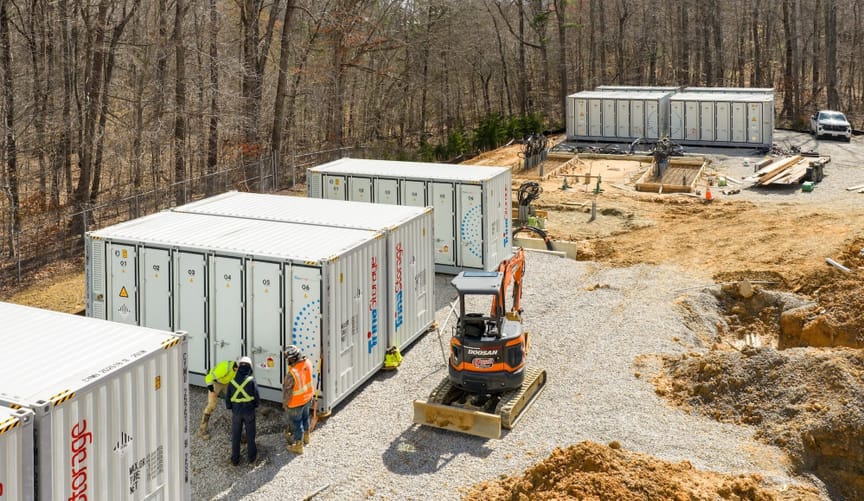
Lightshift Energy is constructing a second battery project for the city of Danville, Virginia. (Sanjay Suchak)
In the face of soaring energy demand and electric rates, battery developers across the U.S. are stepping in with massive, multihundred-megawatt systems that can cheaply dispatch power when it’s needed most.
Virginia — the world’s data center capital — is starting to catch on to the big-battery trend. But a new project by local electric providers in the state underscores that much smaller storage projects have value, too: They’re designed to fill specific community needs and — due to their size — relatively quick and low-cost to build.
The Blue Ridge Power Agency, which serves a string of nonprofit utilities in central and western Virginia, is set to go live this summer with a collection of five batteries of about 5 megawatts each. The systems will help two rural electric co-ops and the city of Salem’s utility save money by storing power when it is cheap and abundant. They can then rely on that saved-up power when high demand on the grid spikes prices.
All in all, the projects are predicted to save the member utilities $100 million over the batteries’ 20-year lifespan, addressing long-held local concerns over rising costs.
Lightshift Energy, the storage developer building the five batteries, has formed a bit of a niche working with small, member-owned utilities, said Rob Greskowiak, the company’s chief commercial officer.
These nonprofit utilities are rooted in their communities and intimately familiar with their customers and grids, Greskowiak explained. “These municipalities are like, ‘Listen, I know the 50,000 people that live here, and I know that this distribution circuit is not reliable and that our energy costs are going up,’” he said. At Lightshift, “we can find a very acute problem and solve it with 5- to 30-megawatt-sized batteries.”
Small cooperatives’ investment in storage extends well beyond Virginia. As of the first quarter of 2025, 136 battery storage projects sponsored by co-ops were underway or operational in 27 states, according to an analysis by the National Rural Electric Cooperative Association. It predicts that storage deployed by co-ops will more than triple, from 439 megawatts of capacity to 1.5 gigawatts, in the next three years.
The smaller batteries these co-ops tend to favor are cost-competitive because they avoid the need for expensive network upgrades, don’t require expensive long-lead equipment, and are sited on very small footprints, Greskowiak said.
Their minimal impact means they’re often quicker to permit and gain community acceptance than larger versions, he added. “If you’re putting in a battery that isn’t that big in a spot that already has that infrastructure, people aren’t really batting an eye on that.” The company can typically go from initial discussions with a utility to operations in 18 to 24 months, he said, significantly faster than transmission-scale assets.
The rapid setup is particularly meaningful in Virginia as data center plans flood the state and send power-demand forecasts ballooning, said Nikhil Kumar, program director at GridLab, a nonprofit that provides technical support on the clean energy transition in a range of settings. “Speed to power,” he said, “it’s in the zeitgeist right now.”
While reining in power prices is the main motivation behind the Blue Ridge Power Agency’s midsize-battery buildout, Greskowiak emphasized other advantages as well. “Battery storage is best when it acts like the Swiss army knife that everybody talks about,” he said.
A key benefit includes storing electrons from solar and wind and dispatching them when the sun fades or the breeze dies down, enabling even more renewable energy deployment. “Local homeowners, local businesses, local community solar gardens can add to that grid more sustainable energy,” he said, “because we’ve released and unlocked more capability at those substations to host more solar.”
Batteries are also getting cheaper and cheaper, with the average price of a lithium-ion battery pack dropping by nearly 80% over the last decade. And even though President Donald Trump and congressional Republicans slashed incentives for wind and solar last year, they retained the 30% credit for storage well into the next decade. “That’s another big advantage,” Kumar said.
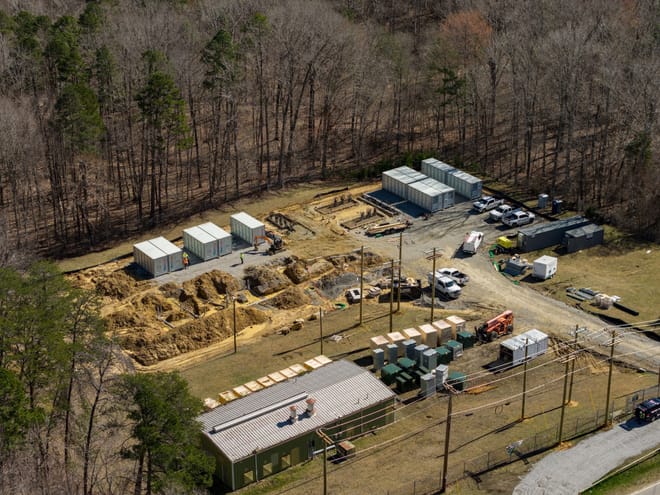
Lightshift Energy’s Danville II project (Sanjay Suchak)
The Blue Ridge Power Agency project is just the latest example of a small Virginia utility quickly deploying batteries. Lightshift has partnered with the city of Danville on two systems that total over 20 megawatts and are expected to save customers $70 million; the first went online in 2022, and the second is under construction. Last year, developers announced two similar-sized projects for a co-op on the state’s Eastern Shore.
Co-ops’ increased interest in storage comes as the state directs its two investor-owned utilities to ramp up investments, too: A law recently enacted by Gov. Abigail Spanberger, a Democrat, requires Dominion Energy and Appalachian Power to build nearly 17 gigawatts of battery storage by 2045; their former target was 3 gigawatts by 2035.
All these planned storage investments will be necessary to ease grid strain and bring down costs, Kumar said. “Especially in Virginia, with the large loads and the data center growth, we’ll need a lot of these projects to help the grid.”
The United States has taken one of its biggest steps yet to encourage the construction of commercial microreactors — the latest move in its broader push to overhaul the country’s nuclear regulatory processes.
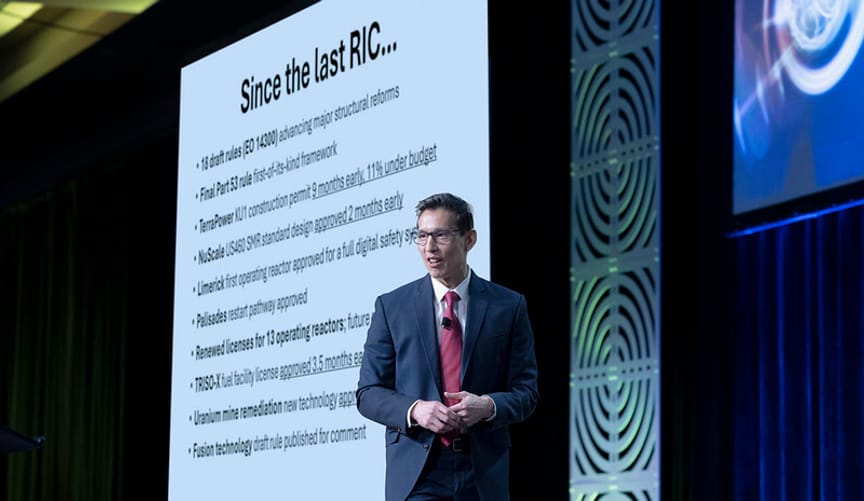
U.S. Nuclear Regulatory Commission Chair Ho Nieh speaks at the annual Regulatory Information Conference in March. (U.S. Nuclear Regulatory Commission)
The United States has taken one of its biggest steps yet to encourage the construction of commercial microreactors — the latest move in its broader push to overhaul the country’s nuclear regulatory processes.
In late April, the U.S. Nuclear Regulatory Commission released its draft rule for a proposed new licensing pathway for commercial reactors. Known as Part 57, the regulation tailors the application process to account for the fundamental differences between a so-called microreactor, designed to generate 20 megawatts of electricity or less, and a behemoth traditional reactor such as a Westinghouse AP1000, which pumps out 60 times as much power. The rule, which would allow eligible projects to obtain dual permits to both construct and operate a reactor, is meant to encourage fleet-scale deployment of the technology.
While no commercial microreactors are in operation anywhere in the world today, some corners of the U.S. industry see them as a way to slash the time and money it takes to build a nuclear plant by harnessing the benefits of assembly-line production.
The proposal comes after a string of actions by the NRC to speed up the regulatory process for nuclear reactors that use different designs or technology than the country’s existing fleet of 94 large-scale light-water reactors. The regulatory changes, spurred by a Biden-era law and encouraged by the Trump administration, have been widely celebrated by the industry — but they have rankled some who fear the NRC is jeopardizing safety by moving too fast.
In March, the NRC shook up its licensing pathways for the first time in decades. Dubbed Part 53, the final rule was the first new set of regulations to address initial reactor licensing since 1989 — and the first major update to reactor licensing standards since 1956.
Part 53 is an optional alternative to two existing frameworks, Part 50 and Part 52. The former has long been developers’ preferred pathway for new reactors, but it grants only construction permits — not operating licenses. Part 52 was created to speed things up by allowing a dual construction and operating license to be obtained in one shot, but that pathway carried risks if the developer deviated even slightly from the approved design.
Neither option made much sense for the wave of advanced nuclear reactor firms that have attracted enormous amounts of funding and industry hype over the last decade. Part 53 was specifically designed to accommodate these technologies, including small modular reactors, microreactors, and those that use coolants other than water.
“With all these new and advanced technologies coming, we needed something more flexible,” said Mike King, the NRC’s executive director of operations. “That’s what Part 53 does. It provides us a framework that’s not so focused on large light-water reactors.”
Last week’s proposed Part 57, he said, “takes what we’ve done with Part 53 and scopes it appropriately for these microreactors that have a much lower risk profile for the public and could be licensed in a more streamlined fashion.”
Part 57, set to be added in the coming days to the Federal Register, won’t be operational until the rule is finalized in the next few months. But already, several microreactor developers have put out statements indicating they plan to apply for NRC licenses through the new pathway.
Central to the rule is the “risk-informed” change that Part 53 pioneered.
Rather than require the same safety protocols and infrastructure that the NRC mandates for traditional light-water reactors, Part 57 sets a target that developers are free to meet in a variety of ways.
Like Part 53 before it, the rule also limits the radiation emitted from an accident to 1 rem — the same amount of radiation from a CT scan. But while Part 53 institutes those limits for 96 hours after an accident occurs, Part 57 mandates that operators stay under that limit only throughout the duration of the accident. For some companies, meeting that standard could mean building the concrete containment vessels that house traditional light-water reactors. While certain microreactor designs — either those that are extremely small or those made of or fueled with material that cannot melt down — might be able to avoid having to build such containment domes.
Traditional reactors regulated by Part 50 are required to keep radiation emitted from an accident to 25 rems — which is the maximum recommended lifetime dose of radiation.
In that way, Part 57 is narrower than the original pathway, said Adam Stein, the director of nuclear energy innovation at the Breakthrough Institute, because “to even get into Part 57, you’d have to stay under 1 rem for the entire duration of the accident, not just 96 hours. So it’s inherently more restrictive.”
Many of the changes now underway at the NRC stem from the Accelerating Deployment of Versatile, Advanced Nuclear for Clean Energy (ADVANCE) Act, which President Joe Biden signed into law in 2024 after the Senate, in a rare show of bipartisan zeal, almost unanimously approved the bill. The statute overhauled the NRC’s mission statement for the first time, directing the agency to consider the threat of holding back nuclear power in the U.S. in addition to the risks associated with radiation. Work on Part 57 began under the previous administration.
Last May, President Donald Trump supercharged those efforts with a series of executive orders designed to defibrillate the flatlining nuclear sector as China’s industry runs laps around the U.S., and Russia dominates exports to newcomer countries seeking to build their first atomic power stations.
Among those orders was one to restructure the NRC, requiring the agency to do more, faster, with fewer staff and more direct oversight from the president. Presidents have always been able to appoint commissioners but have historically had little influence over the agency’s day-to-day workings. The White House directive raised alarms, particularly as Trump sought to bring previously independent agencies like the NRC and Federal Communications Commission under direct control. His decision to fire a Democratic NRC commissioner a month later only deepened fears.
Career staffers at the NRC have blown the whistle over concerns that the Department of Government Efficiency, which billionaire Elon Musk established shortly after Trump’s inauguration, was wielding too much internal influence and slashing necessary parts of the regulatory apparatus.
“It’s hard to know if they are getting rid of unnecessary processes or if it’s actually reducing public safety,” one official working on reactor licensing told ProPublica last month. “And that’s just the problem with going so fast — everything just kind of gets lost in a mush.”
But Caroline DeWitte, the co-founder of Oklo, a nuclear developer favored by Silicon Valley, said skeptics of overhauling the NRC fail to recognize the extent to which the agency in its previous form was ill suited to oversee construction of new types of reactors.
The NRC official who rejected Oklo’s application in 2022 told Bloomberg last year that the company’s submission was one of the worst ever reviewed. But DeWitte, who leads the company as chief operating officer alongside her chief executive officer husband, Jake DeWitte, said the NRC couldn’t understand that Oklo’s reactor and similar designs have “inherent safety features.”
“Literally, the physics of the metal made it safe,” Caroline DeWitte told Canary Media. “So, how do you account for that? Even with passively safe features, the NRC forces you to assume that it can fail. But, like, is it reasonable to assume metal is not metal anymore? Those are the types of questions we were asking — how do we put that in a risk analysis?”
Among the more controversial regulatory changes proposed at the NRC is the move to overhaul the way radiation safety is measured altogether.
For years, the dominant rule has been for any radiation exposure to be kept as low as reasonably achievable, called ALARA. It’s based on the assumption that the more exposure someone faces, the higher the risk of cancer or other disease.
That assumption stems from the highly contested “linear no-threshold model” from the 1950s, which assumes that exposure to radiation at any level causes harm. Still, no one has yet determined a better alternative on which the country — and, more broadly, the world, which has long followed the U.S. lead on nuclear regulation — can agree.
The NRC has been treading lightly so far: Its proposed rule has been pushed back seven times already and is now due out on June 24.
Paul Dickman, who served as chief of staff to the NRC’s chair from 2006 to 2010, said he is not concerned that his former agency will approve anything that doesn’t stand up to rigorous testing.
“The NRC staff is being creative, and that’s a good thing,” he said. “Some people may worry. But I have high confidence in them. At the end of the day, you still have to prove your point on safety. That’s the bottom line.”
The strategy appears to be bearing fruit. In what NRC Chair Ho Nieh called a “milestone” that “proves we can deliver results quickly without compromising safety,” the agency just approved Duke Energy’s application to run its Robinson nuclear plant in South Carolina for 80 years. It was the fastest license renewal in the NRC’s history.
When it comes to electric vehicles, old is gold.
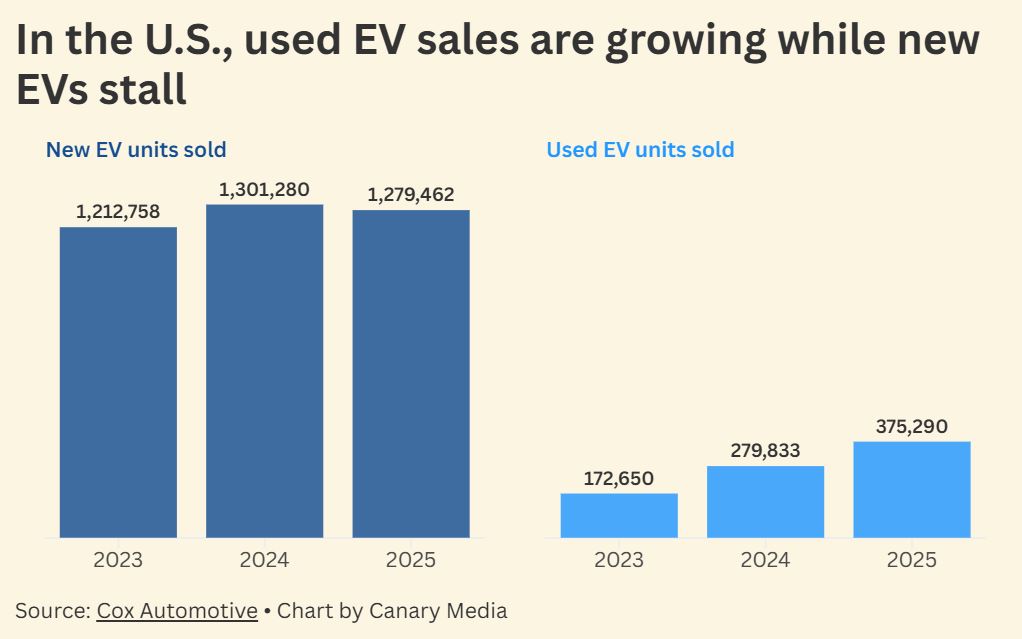
In the U.S., sales of new EVs are slumping — but more used EVs are being driven off the lot than ever, per Cox Automotive data. With hundreds of thousands of battery-powered vehicles coming off leases soon, the used EV market is set to accelerate even further in the years to come.
Made with Flourish • Create a chart
Although Americans still buy a lot more new EVs than used ones, the Cox data shows the gap beginning to close: Used EV sales jumped by 34% in 2025, compared with the prior year, as new EV sales shrank a bit. Overall, electric models made up nearly a tenth of new vehicle sales in the U.S. in 2025, and about 2% of used car sales.
A combination of factors explains why used EVs are on the upswing while new ones are stagnant.
For one, a lot more used EVs are on the market these days than in the past. About 300,000 EVs will come off of leases this year, up from 123,000 last year, and Cox expects another 600,000 to do so in 2027. Not all of those will hit the used car market, but many will, providing a rush of inventory that helps drive down prices.
Speaking of prices, on average a used EV is now basically at price parity with a used gas car. That’s a big deal: Up-front cost is one of the main barriers preventing people from buying battery-powered vehicles, which are typically cheaper to drive and maintain but have long been more expensive than similar gas-fueled models.
A new EV is still about $6,500 more than a new gas car, on average. Consumers used to be able to shave $7,500 off the EV price with a federal tax credit, but the Trump administration did away with that incentive in September.
The rise of used EVs is a rare positive signal for the American vehicle-electrification effort.
While new EV sales hit record highs under the pro-EV Biden administration, adoption was slower than expected, causing some automakers to walk back commitments to churn out electric models. When President Donald Trump took office last year and tossed out the tax credit along with a bunch of other supportive regulations, it added fuel to the fire.
Some analysts expect EV sales to surge as fallout from the war in the Middle East spikes oil and gas prices worldwide. In the U.S., the average cost of a gallon of gas is now well over $4 a gallon — and climbing — and in some countries, fuel shortages have spurred driving bans and fuel rationing. So far, the early evidence suggests that those expecting an EV boom are on to something.
This analysis and news roundup come from the Canary Media Weekly newsletter. Sign up to get it every Friday.
America’s hydropower systems are in hot water — but the federal government may soon unclog a stream of funding to help them out.
We’ve been using water to generate electricity in the U.S. since the 1880s, expanding from projects harvesting Niagara Falls for power to a whole network of systems that span the rivers of the West. America’s dams have since become a reliable, round-the-clock source of clean energy, generating nearly 6% of the nation’s power in 2025 even as drought in the West limited many projects’ capacity.
That long history is exactly why hydroelectricity is now in trouble. Hundreds of dams across the U.S. representing nearly 16 GW of capacity will have to be relicensed by the federal government in the coming years, as Alexander C. Kaufman previously reported for Canary Media. But the average dam in the U.S. is 65 years old, and many were built without the infrastructure they’d need to be licensed today, like passages for fish and other wildlife. Many operators will have to choose between spending millions of dollars on infrastructure upgrades or simply shutting down — and some are already choosing the latter.
In September 2024, the Biden administration announced it would use $430 million from the 2021 bipartisan infrastructure law to address some dams’ dilemmas. The pool of funding was supposed to be distributed by the now-defunct Grid Deployment Office and go toward grid resiliency upgrades, safety improvements, and environmental retrofits like fish passages at 212 facilities across the U.S. At least 17 of those facilities are up for relicensing through 2036.
Like tons of other federal clean energy funding, this initiative stalled out under the Trump administration. But this week, it showed some promising signs of life: The DOE’s Hydropower and Hydrokinetic Office — formerly the Water Power Technologies Office — announced it’ll resume negotiations to issue that $430 million, which, when paired with private investments at each facility, could result in more than $2.8 billion in improvements.
That’s a noteworthy amount for the U.S. hydropower industry, which doesn’t have the deep pockets it did decades ago, back before cheaper power sources like solar, wind, and natural gas had reached their current dominance. Even so, the funding won’t resuscitate the industry on its own. Facilities will still have to cope with challenges like years of relicensing bureaucracy and the capacity-diminishing effects of drought, which will only worsen with climate change. But in a country that’s now scrambling for all the nonstop power it can get, solving hydropower’s hang-ups has a huge upside.
Wind power’s month of major wins and losses
Another two offshore wind projects are being cast out to sea. The Interior Department announced Monday that it had reached a deal with Bluepoint Wind, off New York, and Golden State Wind, off California, in which their developers would be refunded for abandoning the offshore wind leases and reinvesting the money in fossil fuel projects instead. It’s essentially the same agreement the agency worked out with TotalEnergies a few weeks ago — a deal that Democrats in Congress are moving to investigate.
But it’s not all bad news for offshore wind power. Vineyard Wind, a project the Trump administration unsuccessfully tried to halt, began selling power to Massachusetts this week under a contracted price that’s expected to save Bay Staters $1.4 billion on their power bills over the array’s lifetime.
Meanwhile, on dry land, the massive SunZia wind project recently started delivering electrons to California — and it’s already propelling the state’s grid to new wind power generation records.
These Republicans want to preserve clean energy tax credits
A small group of House Republicans has proposed something a little unexpected: restoring Biden-era clean energy tax credits.
The American Energy Dominance Act, introduced late last week, would erase the accelerated June 30, 2026 expiration date that President Donald Trump’s One Big Beautiful Bill Act set for many renewable energy incentives — a change that would once again let developers access investment and production tax credits into the 2030s. The proposal would also remove early expiration dates for incentives related to energy-efficient buildings and clean hydrogen.
The four Congress members sponsoring the bill include one who signed a letter urging the preservation of clean energy incentives in the OBBBA, and another who voted against the megabill — and remains vulnerable to a Democratic upset in his reelection fight this fall.
The new proposal follows an effort by more than half of House Democrats to reestablish clean energy tax credits gutted by OBBBA, though neither piece of legislation is likely to pass in the Republican-controlled House. But the chamber probably won’t remain in GOP hands after the midterm elections, and both of these bills suggest the incentives could be saved if Democrats regain congressional control.
Clean money: Reports find the U.S. renewable energy sector could install a record amount of new capacity in 2026 and attract $120 billion in investment as developers race to meet demand growth and claim expiring federal tax credits. (Latitude Media)
All gas bans, no brakes: Even though a court struck down Berkeley, California’s pioneering ban on gas hookups in new buildings three years ago, similar lawsuits against building electrification policies have fallen short. (Canary Media)
Scapegoating efficiency: Maryland, Massachusetts, and Rhode Island are looking to slash energy-efficiency funding to quickly lower power bills, but experts say the moves will cost residents in the long run. (Canary Media)
Sowing REAP’s revival: The Trump administration froze the federal Rural Energy for America Program, which helps farmers install bill-reducing clean energy projects, but supporters hope Congress can restore the popular, bipartisan initiative with this year’s Farm Bill. (Canary Media)
Data center ban deferred: Maine Gov. Janet Mills (D) vetoes what would have been the first statewide data center moratorium, saying it would have blocked a widely supported project already under development. (Maine Morning Star)
Lithium lode: A large swath of untapped lithium deposits along the East Coast could provide the U.S. with enough of the crucial battery metal for hundreds of years, a new federal report finds. (E&E News)
Countries attending a first-of-its-kind summit have walked away with plans to develop national roadmaps away from fossil fuels, along with new tools to address harmful subsidies and carbon-intensive trade.
The first conference on “transitioning away” from fossil fuels held in Santa Marta, Colombia, from 24-29 April saw 57 countries – representing one-third of the world’s economy – debate practical ways to move away from coal, oil and gas.
Against a backdrop of war, a global oil crisis and worsening extreme weather events, ministers and envoys from across the world sat side-by-side in small meeting rooms to have open and frank conversations about the barriers they face in transitioning from fossil fuels to clean energy.
This new format – devised by co-hosts Colombia and the Netherlands – was described as “refreshing”, “highly successful” and “groundbreaking” by countries attending the talks.
The event also featured a “science pre-conference” attended by 400 global academics, which included the launch of a new science panel that will aim to provide agile and bespoke analysis to nations wanting to accelerate their transition away from fossil fuels.
At the summit’s conclusion, Tuvalu and Ireland were announced as the co-hosts of the second transitioning away from fossil fuels summit, which will take place in the Pacific island nation in 2027.
Below, Carbon Brief outlines all of the key takeaways from the talks.
The idea for a specific fossil-fuel transition conference hosted in Colombia first emerged during tense end-game negotiations at the COP30 climate summit in Belém, Brazil.
Amid a push by a group of around 80 nations to refer to a “roadmap” away from fossil fuels in the formal COP30 outcome text, Colombia and the Netherlands jointly announced that they would co-host a summit in Santa Marta in April.
The calls for a fossil-fuel “roadmap” to be mentioned in COP30’s outcome text ultimately failed. However, the Brazilian COP30 presidency promised to bring forward an “informal” fossil-fuel roadmap, drawing on the discussions and debates in Santa Marta.
The Santa Marta conference took place from 24-29 April. It included a “science pre-conference” from 24-25, a day for subnational governments, parliamentarians and other stakeholders and a “high-level segment” with ministers and climate envoys from 28-29.
Colombian environment minister Irene Vélez Torres – herself a former academic – was particularly keen to emphasise the importance of science to the conference, telling journalists: “We need to go back to science and base our decisions on science.” (See: Academic meeting)
From the outset, the hosts stressed that the high-level segment was not a space for negotiations, but rather a forum for countries and other stakeholders to discuss practical steps to move away from fossil fuels.
This format was widely praised by ministers and climate envoys, who described the conversational atmosphere in break-out sessions as “refreshing”, “highly successful” and “groundbreaking”. (See: Closed-door discussions.)
A total of 57 countries participated in the conference, according to the Colombian government.
These countries were: Angola, Antigua and Barbuda, Australia, Austria, Bangladesh, Belgium, Brazil, Cameroon, Canada, Chile, Colombia, Denmark, Dominican Republic, the EU, the Federated States of Micronesia, Finland, France, Germany, Ghana, Guatemala, Iceland, Ireland, Italy, Jamaica, Kenya, Luxembourg, Malawi, the Maldives, the Marshall Islands, México, Mongolia, the Netherlands, Nepal, Nigeria, Norway, New Zealand, Palau, Panama, Philippines, Portugal, Saint Lucia, Senegal, Singapore, Slovenia, the Solomon Islands, Spain, Sweden, Switzerland, Tanzania, Turkey, Tuvalu, Uganda, the UK, Uruguay, Vanuatu, the Vatican and Vietnam.
At the summit’s opening press conference on 24 April, Vélez Torres confirmed that Colombia and the Netherlands had decided to only invite a select group of countries to the conference.
Vélez Torres told journalists that countries including China, Russia and the US were not invited. She suggested that they had not shown the necessary spirit to be part of the “coalition of the willing” and that Colombia wanted to avoid a rehashing of the lengthy debates at COP30. (Carbon Brief understands that India was also not invited.)
In a later press huddle, Dutch climate minister Stientje van Veldhoven clarified that the two co-hosts had partially based their invitation criteria on who showed support for the fossil-fuel roadmap at COP30, saying:
“It was a combination of what happened in Belém and all the existing initiatives that have been driving this agenda for a long time already.”
However, it is worth noting that some countries that had opposed a formal reference to a fossil-fuel roadmap in the COP30 outcome were invited to Santa Marta, according to Carbon Brief’s analysis of the “informal list” of those against the idea in Belém.
For example, Tanzania was invited to take part in the Santa Marta talks, despite appearing on the list of countries opposed to the roadmap in Belém.
On the other hand, neither China nor India were invited, despite having rejected media coverage portraying them as the “blockers” of the fossil-fuel roadmap at COP30.
Country officials and observers expressed a range of views on whether excluding certain countries from the conference was the right approach.
Juan Carlos Monterrey Gómez, Panama’s special representative on climate change, told a small group of journalists that he thought it was the “right decision”, adding:
“This first meeting had to be done with those that wanted something to be done. Otherwise, it would have been a repeat of a UNFCCC meeting.”
UK special representative for climate, Rachel Kyte, told a press huddle that China should feel “welcome to be here”, adding:
“China has to be part of this equation for multiple reasons.”
One veteran observer told Carbon Brief that their impression was that Colombia and the Netherlands had been “overly cautious” about who would have caused disruption if invited to the conference, saying:
“Yes, maybe there is an argument for not inviting countries that have a long history of blocking progress, such as the Gulf states. But, if we look at what countries are really doing on the ground – including JETP [Just Energy Transition Partnerships] initiatives – then more countries should have been here, including Indonesia, for example.”
However, they also urged caution on reading too much into which countries were and were not present, adding that this could also partially be explained by “scheduling and countries’ availability”.
During the summit’s final plenary, van Veldhoven stated that, going forward, it was the Netherlands and Colombia’s wish to create an “open coalition”, including by extending an “invitation for others to join us”.
Dr Maina Talia, the climate minister of Tuvalu, who will co-host the second transitioning away from fossil fuels summit alongside Ireland, told journalists that the island nations would “revisit” and “improve” the criteria used for inviting countries to the conference.
The two-day high-level segment began with an opening plenary, which saw more than 20 countries put forward their views on the need to transition away from fossil fuels.
Developed and developing nations alike spoke of the need to transition away from fossil fuels not only to tackle worsening climate change, but also the high prices, insecurity and volatility associated with continued reliance on coal, oil and gas.
Opening the plenary alongside Colombia, Dutch climate minister Stientje van Veldhoven told countries:
“Price volatility and dependence on imports are structurally and unacceptably impacting our economies. We need to move away from fossil fuels not only because it is good for the climate, but because it strengthens our energy security. Investment in clean energy also lays the foundation for a more resilient and sustainable economy, capable of mitigating these shocks.”
First to speak in plenary was Nigerian minister, Abubakar Momoh, who said:
“Nigeria is actively diversifying its economy away from extracting oil, which accounts for around 80% of our exports. Nigeria strongly believes that it is not whether extraction should decline, but how to organise it so it is manageable, fair and politically viable across countries.”
Also speaking during the session, UK special representative for climate Rachel Kyte said it “would be irresponsible to ignore the second fossil-fuel crisis in five years”.

Several nations also used their interventions to lament a lack of progress in addressing fossil-fuel use during the last 30 years of annual UN climate negotiations.
Dr Maina Talia, climate minister for Tuvalu, said that “for years, international climate negotiations have circled around fossil fuels without directly confronting the core issues”.
Juan Carlos Monterrey Gómez, Panama’s special representative on climate change, told countries:
“For 34 years, we have negotiated the symptoms of the climate crisis and bulletproofed its cause. Thirty-four years of pledges. And where are we now?
“Economies built on fossil fuels are unravelling in real time. Fossil fuels are not just dirty. They are unreliable, they are dangerous and they must end.”
A small number of nations from the Pacific and Africa used their interventions to show their support for the Fossil Fuel Treaty initiative, an idea to negotiate a new legally binding agreement to control fossil-fuel use, currently supported by 18 countries. (The treaty did not feature in the summit’s final outcome.)
France’s special climate envoy, Benoît Faraco, used his intervention to announce that the nation has produced a new roadmap for transitioning away from fossil fuels.
Later on, on the first day, Colombian president Gustavo Petro also gave a speech at the summit, telling countries:
“What I see is resistance and inertia within the power structures and the economy of this archaic energy system. Today, fossil fuels bring death; undoubtedly, that form of capital could commit suicide, taking humanity and life itself. Humanity cannot allow that.”
Following the opening plenary, ministers and climate envoys spent much of the two-day high-level segment in closed-door “breakout sessions”, discussing issues ranging from “planned phase down and closure of fossil-fuel extraction” to “closing gaps in financial and investment systems”.
Carbon Brief understands that each session featured 12 ministers and envoys representing different countries sitting in an inner circle, with an outer circle made up of civil society members and other stakeholders. Each session was led by a different minister, appointed by the co-hosts.
In a departure from UN climate negotiations, the conversations that took place were free-flowing, with ministers and stakeholders given equal opportunities to contribute, observers told Carbon Brief.

Many countries were highly complimentary of this informal format, describing it in the closing plenary as “refreshing”, “highly successful” and a “safe space for discussion”.
UK special representative on climate, Rachel Kyte, told a huddle of journalists that there was “real value” to having informal conversations with other country officials, saying:
“I have to say that it is really nice to sit in a small circle…In a negotiation, it’s very, very fast-moving and transactional. But now we have had two days to think about [fossil-fuel transition issues] and this only.”
Speaking to Carbon Brief, Panama’s special representative on climate change, Juan Carlos Monterrey Gómez, said the format was “groundbreaking”, adding:
“I’m going to be honest. [At] first I was like: ‘What the f*ck am I doing here? I don’t know where this is going’.
“But then, as the workshop started, I realised there were ministers, envoys, civil society leaders and Indigenous people. They put us in a format where we could not open our computers, so we had to speak from our minds and our hearts. That completely flipped my perception. That kind of space I haven’t seen in my 10-year history with the UNFCCC.”
All of the sessions were held under the Chatham House rule, meaning discussions were not attributable to individual speakers to encourage more open debate.
Co-host nations Colombia and the Netherlands gave a broad overview of the topics and themes discussed during the sessions in a takeaways report. (See: Final outcomes.)
At the conference’s final plenary session on 29 April, co-host nations Colombia and the Netherlands presented a range of “key outcomes” from the summit.
The first outcome was confirmation of the news that Tuvalu and Ireland will co-host a second transitioning away from fossil fuels conference in the Pacific island nation in 2027.
The co-hosts also announced the establishment of three “workstreams” on issues to bring forward to the second summit.
The first of these workstreams will focus on developing national and regional roadmaps away from fossil fuels.
Speaking in plenary, Vélez Torres said that the roadmaps should be “connected” to countries’ UN climate plans, known as nationally determined contributions (NDCs). She added that it would be important for the roadmaps to be “very clear and honest” about “emissions exported from producing countries”.
The development of the roadmaps will be supported by the newly established science panel for global energy transition and the NDC Partnership, a global initiative helping nations prepare their NDCs, she added.
(At the final press conference, it was clarified that countries are not obligated to produce a new fossil-fuel roadmap and that participation in all of the work streams is voluntary.)
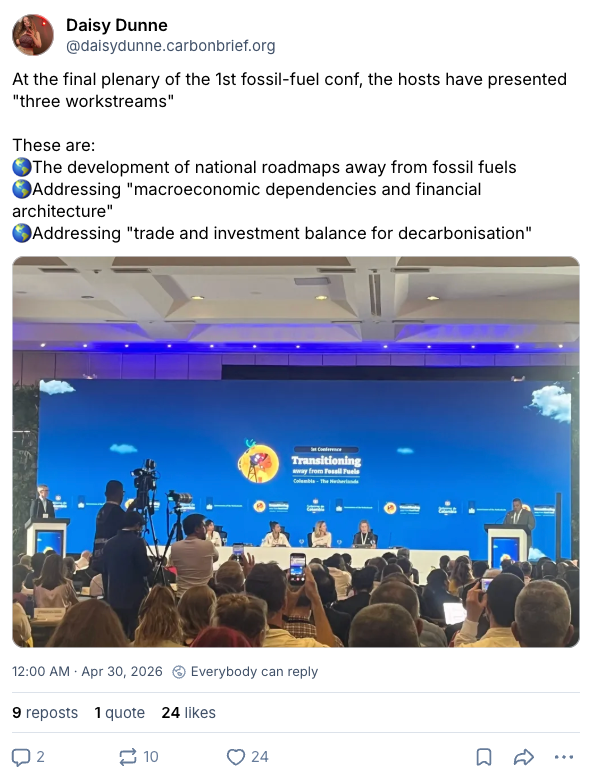
The second workstream will be focused on changing the financial system to better facilitate the transition away from fossil fuels.
This will include work to identify fossil-fuel subsidies and find solutions to “debt traps”. It will be supported by the International Institute for Sustainable Development thinktank, the co-hosts said.
Separately, Dutch climate minister van Veldhoven said that all countries would be invited via “email” to begin a process for identifying and reporting their fossil-fuel subsidies. (The Netherlands is the co-chair of COFFIS, a group of 17 nations that have pledged to remove fossil-fuel subsidies.)
The final workstream will address fossil-fuel-intensive trade, with the aim of “advancing progress towards a fossil fuel-free trade system”, Vélez Torres said. This workstream will be supported by the Organisation for Economic Co-operation and Development (OECD) group of wealthy nations.
A document summing up the co-chair’s takeaways from the summit says that other key outcomes include the establishment of a “coordination group [to] ensure continuity towards the second and subsequent conferences”, adding:
“It will consist of countries leading different alliances and initiatives that are implementing elements of the transition away from fossil fuels, and of the co-hosts of the first and second conferences, Colombia, the Netherlands, Tuvalu and Ireland.”
The document adds that a key task will be delivering the findings of this conference to the COP30 presidency, which is currently preparing a global fossil-fuel roadmap to present at COP31 in November.
The summit kicked off with a “science pre-conference” attended by around 400 academics from across the globe from 24-25 April, held at the University of Magdalena in Santa Marta.
At the behest of the Colombian government, these scientists split into 11 different “workstreams” to debate a vast array of topics related to transitioning away from fossil fuels.
These ranged from “fossil-fuel phaseout policies” and the role of methane, to “just transitions and economic diversity” and the role of multilateralism.
Speaking on the summit’s first day, Colombian environment minister Irene Vélez Torres – herself a former academic – stressed the importance of science in political decision-making. She told a press conference:
“There has been a growing gap between science and governments, and governmental decisions, and it happens because there is a lot of denialism. There is a lot of economic and political lobbying as well. That is actually deviating [from] scientific rationale.
“The true belief of the countries that are here is that we need to go back to science and base our decisions on science, and back up our decision-making, processes and pathways with science.”
The pre-conference saw the announcement of three new scientific initiatives.
The first was a new global science panel, calling itself the “science panel for global energy transition”, which was launched by Dr Johan Rockström, director of the Potsdam Institute for Climate Impact Research in Germany and Dr Carlos Nobre, an eminent researcher on the Amazon rainforest from the University of São Paulo in Brazil.
They announced at a public event in Santa Marta that the panel will involve “50-100 scientists” from around the world and will be based at the University of São Paulo.
The scientists on the panel will aim to provide rapid analysis on how to transition away from fossil fuels for countries and multilateral talks, including bespoke information for nations that request it, they said.

Speaking at its launch, Rockström said the panel will be split into four working groups, focusing on “transition pathways”, “technology solutions”, “policy design and evaluation” and “finance instruments and governments”.
It will have three co-chairs: Dr Vera Songwe, an economist and climate finance expert from Cameroon; Prof Ottmar Edenhofer, chief economist at the Potsdam Institute for Climate Impact Research; and Prof Gilberto M Jannuzzi, professor of energy systems at Universidade Estadual de Campinas in Brazil.
Speaking to Carbon Brief, Nobre said that he and Rockström were first approached with the idea for a new panel by Ana Toni, Brazilian economist and CEO of the COP30 climate summit, while the negotiations were taking place in Belém. He said:
“Johan and myself, we’re not energy transition scientists, but we were the creators of the planetary science pavilion at COP30, that’s why Ana Toni came to us. And we have already invited three top energy transition experts to join us.”
At the launch, Rockström said the panel would be different in several ways from the world’s existing global climate science panel, the Intergovernmental Panel on Climate Change (IPCC).
He said that, in comparison to the “seven-year cycle” for IPCC reports, this panel will “be able to come up with annual updates” and “be able to scale down to the national level”.
Nobre told Carbon Brief that he was among scientists who have grown “frustrated” with some aspects of the IPCC’s process, including the line-by-line approval of summaries for policymakers by all of the world’s governments. He said:
“A long time ago, when I was working as a scientist studying the Amazon, I wanted to include some information about the risks the Amazon faces in one of the summaries. But a representative from my own country [Brazil] said no.
“This panel is totally independent. There is no way for somebody to say ‘you can’t say that’ or ‘you can’t do that’.”
The second new science initiative to emerge from the academic conference was a new “synthesis report”, offering “12 action insights” for how countries can transition away from fossil fuels.
First covered by Carbon Brief, the report contains some explicit “action recommendations” for countries, such as “halt all new fossil-fuel expansion” and “prohibit fossil fuel advertising…recognising fossil fuels as health-harming products”.
The report was first put together by an “ad-hoc” group of 24 scientists at the request of the Colombian government. It was then further debated and refined by many of the 400 scientists gathered at the academic pre-conference in Santa Marta.
A preliminary version of the report was circulated to governments attending the talks.
In addition, one of the report’s coordinating authors, Prof Andrea Cardoso Diaz, from the University of Magdalena, was given a two-minute slot in the opening plenary of the “high-level segment” to highlight its findings to gathered ministers.
The final scientific initiative unveiled at the academic segment was a new roadmap for how Colombia can transition away from fossil fuels. This was drafted by a team led by Prof Piers Forster, head of the Priestley Centre for Climate Futures at the University of Leeds.
The roadmap says that Colombia can cut its emissions from energy use to 90% below 2015 levels by 2050, through ambitious policies to move away from fossil fuels and electrify its transport sector.
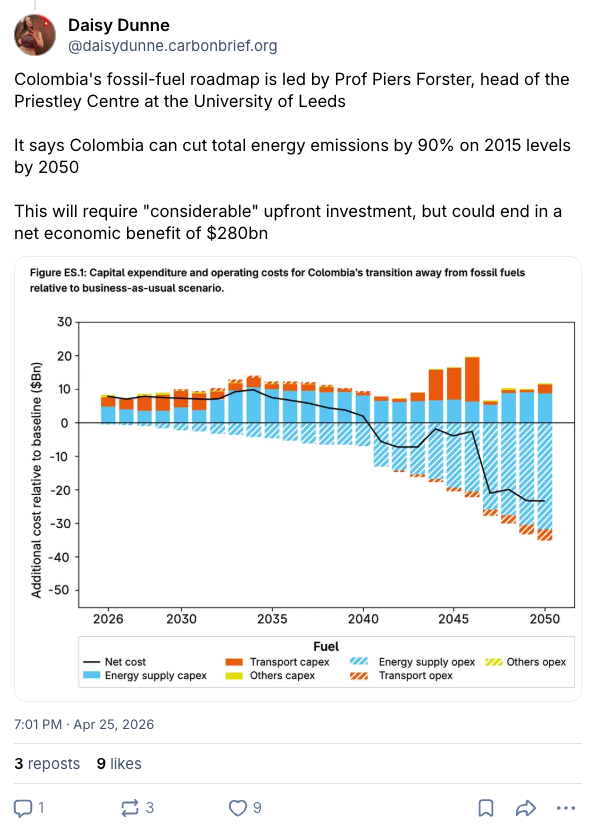
This would require “considerable” upfront investment, with the roadmap estimating the cost to be an average annual investment of around $10bn above a business-as-usual scenario.
However, by the 2040s, Colombia could see net economy-wide savings from transitioning away from fossil fuels, says the analysis, which could reach $23bn annually by 2050.
Speaking to Carbon Brief, Forster said his experience as interim chair of the UK’s Climate Change Committee highlighted to him the importance of presenting national roadmaps in economic terms. He said:
“The biggest issues facing countries are economic and to do with the cost of living. To convince our own government back in the UK to sign up to our recommended carbon budget, we put a lot of work into the economic aspect. So that was also the focus of this work for Colombia.”
In addition to holding a dedicated meeting for scientists, the Colombian government also organised a “People’s Assembly”. This brought together hundreds of Indigenous peoples, Afro-descendent peoples, peasant farmers, trade representatives, women and children and other civil society members.
The goal was to gather the thoughts from these groups on the summit’s main “pillars” of addressing fossil-fuel production, economic constraints and global governance and multilateralism.
According to Climate Lens News, Óscar Daza, the secretary general of the Organisation of Indigenous Peoples of the Colombian Amazon, Karebaju people, told the gathering:
“The Indigenous peoples of the world have made historic demands, such as the non-extraction of natural resources from our territories, so that our resources that are there in the territory remain intact, remain still.
“As Indigenous peoples, we want those historic struggles to somehow be reflected and taken up here by the different states.”

Following on from the meetings, the Colombian government summarised the main talking points discussed by each of these groups in a series of “contributions” documents.
Indigenous peoples and civil society groups were also allocated opportunities to speak during the summit’s high-level segment.
In a departure from UN climate summits – where inputs from civil society are usually heard after countries have finished speaking – the Santa Marta summit invited a range of representatives to speak alongside ministers in the opening and closing plenary sessions.
This included an intervention in the opening plenary by Larissa Baldwin-Roberts, a climate leader from the Bundjalung Nations, who told countries:
“This is the last time we will be a token. You want our pictures, not our voices. You want our stories, not our struggles…True solidarity with each other is the prerequisite to a just transition.”
Indigenous peoples and civil society members were also free to speak in closed-door discussions with ministers, Carbon Brief understands.
Separately from the events organised by the Colombian government, civil society also organised its own “people’s summit”, involving 900 organisations and networks, held in the city of Santa Marta from 24-26 April.
This summit also organised sessions for representatives from different groups to offer their thoughts and insights into the transition away from fossil fuels, ending in a joint “declaration”.
In a statement, Tasneem Essop, the executive director of Climate Action International, said:
“Movements from across the globe and the region – Afro-descendants, feminists, youth, peasants and fisherfolk, social movements and Indigenous peoples converged in a three-day peoples summit in Santa Marta to build a collective consensus on our demands and solutions for the just transition away from fossil fuels.
“[We saw] the adoption of a powerful declaration that spells out our positions on ensuring that the transition has to be rights-based, funded and results in the dismantling of the systems that have caused harm and destruction driven by fossil fuel dependency.”
New electric rates for heat pump owners helped more than 140,000 Massachusetts households save money on their heating bills this winter.
Massachusetts consumers with home heat pumps saved some $37 million on their power bills — an average of more than $250 per customer — for the period from November 1 to March 31, compared to what they would have paid without the new seasonal rates. The seasonal rates are in effect until the end of April.
The state Department of Public Utilities is mulling a proposal to make its winter heat pump rates even lower.
In at least two additional states, conversations are happening about the possibility of creating discounted rates for customers using the fossil-fuel-free technology. Rhode Island is actively considering heat pump rates, and a new report from climate think tank Switchbox outlines the policy’s potential in New York.
“This was a big deal, for Massachusetts to be the first state to implement these rates with all of the major investor-owned utilities,” said Amanda Sachs, state policy manager at electrification nonprofit Rewiring America. “It really helps our case for electrification being a key part of energy affordability.”
Massachusetts, Rhode Island, and New York all have ambitious climate targets, cold weather, and lots of drafty old homes that use fossil-fuel heating. Heat pumps, which create no carbon emissions other than those associated with the electricity used to run them, are vital to decarbonizing each state’s buildings.
All three already have financial incentives in place to help residents with the up-front cost of installing heat pumps. Worries about high electricity rates, however, have been a more stubborn barrier to adoption, particularly for homeowners heating with natural gas, which has long been a less-expensive option.
Heat pump rates attempt to eliminate that obstacle by discounting the price of electricity for all the power consumed by houses using the equipment.
For example, even without special rates, nearly 45% of Massachusetts households would have saved money by switching to a heat pump, according to an analysis released last year by Switchbox. That number jumps to 64% with the existing heat pump discount and could go up to almost 82% if the deeper proposed cuts are implemented. Recent surges in oil prices could boost savings for homeowners using heating oil.
The logic behind these discounts is that traditional electricity rates overcharge heat pump owners for their share of grid construction and upkeep.
The delivery portion of a residential electric bill pays for the poles and wires needed to carry power to customers. Most of this charge is paid volumetrically: The more electricity you use, the more you pay. So if a homeowner installs a heat pump, their power consumption, and thus their delivery charges, will go up significantly.
It might seem to make sense on the surface, but it’s actually quite unfair, said Juan-Pablo Velez, Switchbox’s executive director.
That’s because the grid is built to work at the moments when demand is highest — those hot summer afternoons when everyone turns on their air conditioning at the same time. During the winter, demand is lower, and there’s plenty of room on the system for electrons to flow to heat pumps without the need for infrastructure improvements. So, delivering power to a growing number of heat pumps doesn’t really cost the utilities more in grid maintenance or upgrades, but consumers are still paying a lot more.
In New York, for example, it costs utilities 2% more to deliver energy to heat pump users than to other homes, but heat pump households pay more than twice as much in delivery charges as their neighbors who warm with fossil fuels, according to the new Switchbox report.
“Heat pump customers using the system in the winter are not driving the same infrastructure costs as the summer peaks,” Sachs said. A heat pump rate “fixes that mismatch to make electrification more affordable.”
These rates are not a permanent fix. As heat pump adoption grows, the grid will eventually experience peak demand in the winter, rather than the summer, upending the logic that supports the discounts. For now, however, this approach makes sense financially and environmentally, proponents say.
Massachusetts was the first state to require all of its major electric utilities to provide seasonal heat pump rates, knocking from 4.3 cents to 7.5 cents per kilowatt-hour off the standard winter price; during the summer, rates are the same for those who own heat pumps and those who don’t. Customers who received heat pump incentives from Mass Save, the state energy efficiency program, were automatically enrolled.
The state’s Department of Energy Resources and climate advocates would like to see even more of a discount. The energy department has asked utility regulators to approve a seasonal rate that would save heat pump owners from 12 to 17 cents per kilowatt-hour. At that level, houses switching to heat pumps from other sources would save a median of $687 each winter, according to Switchbox’s 2025 analysis.
“The current rates are still overcollecting from heat pump customers,” Velez said. “They didn’t reduce the rate enough.”
The case is still pending before regulators, who have said they intend to decide the matter in time for any potential new rates to take effect for the 2026–2027 heating season.
The action on heat pump rates is at an earlier stage in New York. There are no proposals before regulators yet, but Switchbox is attempting to jump-start the conversation with its new report on the potential for the state. That analysis finds that 72% of current natural gas customers would save money by switching to a heat pump if discounted rates were adopted, up from 27% under current rates. The organization plans to file the report as part of New York’s “Grid of the Future” proceedings, in which utility regulators are considering policies to prepare the grid for growing demand.
Rhode Island could be following in the footsteps of its northern neighbors as soon as this year. A climate action plan released in December identifies “ambitious adoption of heat pumps” as a key strategy in reaching the state’s emissions targets, a goal that dovetails nicely with heat pump rates, said James Rhodes, clean buildings director for Conservation Law Foundation, an environmental advocacy organization.
“If that’s our strategy, the first thing you have to do is make that an affordable decision,” he said. “The cost to serve a heat pump customer should not be multiple times higher than the cost to serve a non–heat pump customer.”
Rhodes had been tracking the progress of Massachusetts’ rates and promoting the idea to Rhode Island energy officials and the state’s major utility, Rhode Island Energy, but getting little traction. So the foundation intervened in Rhode Island Energy’s ongoing rate case, and earlier this month filed a proposal that would reduce delivery rates for heat pump owners by 5.8 cents per kilowatt-hour, according to analysis by Switchbox. Customers without heat pumps would see a rate increase of 0.29 cents per kilowatt-hour — for an average of $1.57 a month — to ensure the change is revenue-neutral for the utility.
A decision should be made in the case by the end of August, Rhodes said.
“This seems like a slam dunk,” he said. “I like to think this is going to be an inflection point, and I hope it is for the positive.”
U.S. Steel says it will invest $1.9 billion to build a modern and lower-carbon ironmaking plant in Arkansas — marking a key expansion beyond the company’s coal-based steel mills.
The new “direct reduced iron” plant will sit alongside the sprawling Big River Steel Works, in the town of Osceola, where four electric arc furnaces melt down scrap metal with iron to make high-quality steel for vehicles and electrical equipment. Put together, the forthcoming ironmaking plant and the existing furnaces represent an emerging model for cleaner steelmaking.

Finished iron ore pellets at U.S. Steel’s Minnesota Ore Operations (U.S. Steel)
U.S. Steel, which is owned by Japan’s Nippon Steel, announced the project on Wednesday. The parent company has committed to investing $11 billion in the U.S. by 2028 to expand its lower-emissions production as well as to extend the lives of aging blast furnaces in places like Gary, Indiana.
Blast furnaces use coal and extreme heat to transform raw iron ore into molten iron, and the process is responsible for most of the planet-warming emissions and toxic air pollution associated with the industry. The iron then flows into a neighboring furnace to be processed into sturdy steel.
Direct reduction plants, by contrast, primarily use natural gas to turn iron ore into lumps of iron. These facilities can emit about half the CO2 emissions of coal-based blast furnaces. A handful of efforts are underway globally to instead use green hydrogen, which is made with renewable energy, to produce nearly zero-emission iron.
In the United States, three gas-fueled DRI plants are already operating: in Louisiana, Ohio, and Texas. The iron they make helps strengthen and improve the quality of recycled steel. But none of those facilities is sited next to any of the nation’s 150-odd electric arc furnaces, meaning the iron must be cooled, transported, and eventually reheated.
U.S. Steel’s new DRI facility in Arkansas will be the first in the country with the ability to “hot charge” iron directly into the steel furnace while it’s still at high temperatures, a spokesperson for the manufacturer told Canary Media by email. That will allow the facilities to operate in a way similar to traditional integrated steel mills, where iron- and steelmaking happen at the same site.
“This increases efficiency and reduces electricity needs,” the spokesperson said.

An illustration of U.S. Steel’s planned DRI facility at Big River Steel Works, in Osceola, Arkansas (U.S. Steel)
The ironmaking plant will use natural gas, the company confirmed, and it will source iron ore pellets from U.S. Steel’s mine in Minnesota. Construction on the DRI facility is expected to happen across the next 30 months, with startup slated for the first half of 2029.
“Our partnership with Nippon Steel helped accelerate this investment years sooner than would have otherwise been possible,” David Burritt, president and CEO of U.S. Steel, said in a Wednesday press release.
For some green steel advocates, Nippon Steel’s 2025 acquisition of U.S. Steel represents a key opportunity to not only invest in new projects but also modernize and decarbonize its legacy operations in Illinois, Indiana, Michigan, and Pennsylvania. Steel jobs in those states have dramatically declined in recent decades as American steelmakers lost out to overseas suppliers, and as fierce competition emerged at home from steel-recycling mills in primarily Southern states.
In fact, the Arkansas expansion may accelerate that downward trend. New iron made there could potentially replace some of the metal that Big River Steel’s electric arc furnaces currently source from the Gary Works mill in Indiana, said Roger Smith, who follows Nippon Steel and U.S. Steel closely as the Asia lead for the nonprofit SteelWatch. He added that the companies have also announced plans to build a major new plant with electric arc furnaces somewhere in the United States.
“But when it gets to the rest of the legacy facilities, the things they’ve talked about to date are really largely in the category of maintenance,” Smith said during a recent green-steel panel in Chicago. At Gary Works, Nippon Steel has committed to spending around $300 million to revamp the largest of its four blast furnaces this year and another $200 million to refurbish a hot-strip mill.
Local advocates are pushing for the company to go further. Jack Weinberg, a member of Gary Advocates for Responsible Development and a former steelworker, said that replacing Midwestern blast furnaces with DRI facilities would offer a path forward for historic steel communities. That could include initially building gas-fueled ironmaking plants that later switch to using green hydrogen as supplies become available.
“We’re advocating for a transition where they don’t have to shut down the mill,” he said during the panel.
Could California’s major utilities control their rapidly rising electricity rates by using their power grids more efficiently? State lawmakers want to find out.
A set of bills introduced this year would order Pacific Gas & Electric, Southern California Edison, and San Diego Gas & Electric to measure and improve how they’re utilizing the hundreds of thousands of miles of power lines that carry electricity to customers.
At issue is how those utilities handle peaks in electricity demand that happen only a handful of hours per year — typically by upgrading and expanding expensive grid infrastructure. Identifying exactly where on the grid that utilities have taken, or plan to take, this approach and where extra capacity could be freed up is key.
Armed with that knowledge, regulators could set metrics and create incentives for utilities to use technologies like advanced grid controls and distributed solar with batteries to smooth out those peaks — and thus, reduce one of the biggest drivers of soaring electricity costs.
Assembly Bill 1975, introduced by Assembly Member Nick Schultz, a Democrat, would require utilities to measure grid utilization and find ways to improve it over time.
Senate Bill 905, a wide-ranging utility cost-containment package, includes a provision that would mandate “additional reporting on how effectively utilities are using existing distribution grid capacity, particularly during off-peak periods,” when grids have more headroom to deliver power.
“At a time when cost is an issue, making better use of the grid we already have — and have already paid for — is paramount,” state Senator Josh Becker, the Democrat who introduced SB 905, told Canary Media. “That doesn’t mean we won’t keep building new transmission for clean energy. But let’s make sure we’re using our existing grid well.”
One way to do that would be through load flexibility programs, which help relieve temporary grid constraints by paying customers to reduce the amount of power they use via smart thermostats and other devices, or to share the electricity they’ve stored in plugged-in electric vehicles and home batteries charged with rooftop solar.
Making better use of the existing grid could save a lot of money over the long run, Becker said. California’s three big utilities are spending more than other utilities around the country on their distribution grids, according to data from the Department of Energy’s Lawrence Berkeley National Laboratory and The Brattle Group. The costs of those grid investments must be recovered through the rates they charge their customers — who are now paying roughly twice the national average for electricity.
Much of that grid spending is meant to reduce the risk of sparking deadly wildfires. But a sizable chunk goes toward expanding substations, transformers, and power lines to serve EVs, heat pumps, data centers, and broader economic growth.
As the state pushes to meet targets to electrify vehicles and buildings, those costs could grow even further. A 2023 study commissioned by the California Public Utilities Commission found the state’s three major utilities could need to invest up to $50 billion by 2035 to meet growing power demand.
But if utilities can successfully get EV chargers, heat pumps, and other devices to use electricity when the existing grid has more capacity, it would minimize the need for expensive upgrades while also increasing sales of electricity to cover new and existing grid costs.
And such devices are eminently capable of orchestrating their load-shifting capacity as “virtual power plants,” which could flip them from driving up grid costs to lowering expenses for utility customers at large. This “load shift” approach could cut costs passed on to California customers by up to $13.7 billion through 2030, according to a 2025 analysis prepared for think tank GridLab by grid analytics startup Kevala.
Utilities don’t have a clear incentive to constrain excess grid spending, however. In fact, under traditional cost-of-service regulation, they earn guaranteed profits based on how much money they invest in infrastructure. That’s why elected officials who are facing voter anger over high utility bills in states across the country are looking to measures like those that have been proposed in California.
Deploy Action, a nonprofit formed to promote distributed energy as a solution to rising electricity costs, is pushing these kinds of grid utilization bills in California and several other states.
“We all know what’s driving up utility rates and bills,” said Phil Ting, the organization’s co-founder and a former California Assembly member from 2012 to 2024. “Every time PG&E is building something, they’re getting their rate of return. That adds to our rate base — the rates go up — and that’s what they’re financially motivated to do.”
Last month, Deploy Action won its first victory on this front in Virginia, with the passage of a law that would set grid utilization requirements for Appalachian Power and Dominion Energy, the state’s two major investor-owned utilities. The law was supported by Gov. Abigail Spanberger, who campaigned on containing rising electricity costs.
Virginia’s law requires utilities to gather and report detailed data on their grid utilization, and orders regulators to use that data to establish targets and timelines for utilities to optimize grid usage, with special consideration to “non-wires alternatives” like batteries and advanced grid controls.
“A goal would be for California to follow in Virginia’s footsteps,” said Arnab Pal, Deploy Action’s executive director and a former adviser in the Biden-era Department of Energy. “Then, we can do some procurement reforms around the technologies that increase utilization.”
This work wouldn’t happen overnight. Under AB 1975 and SB 905, the California Public Utilities Commission would order utilities to collect and share core grid-utilization data. Though the bills differ slightly in their approach, both stipulate that the CPUC set rules for the utilities to improve their grid utilization starting in 2028.
Simply getting the data is the first step, Becker said. Today, regulators lack insight into “how well we’re using the existing infrastructure,” he said. “There’s data we just don’t have.”
Grid utilization can be measured in lots of ways. Some are holistic in nature, such as determining “load factor,” which is a ratio of average load compared with peak load over a year. While this data isn’t disclosed in a consistent way, Becker and Pal both noted that comments in regulatory proceedings indicate that California’s utilities are experiencing load factors of about 45% to 50% in recent years, meaning that roughly half their grid capacity is underutilized much of the year.
That’s down from roughly 60% to 65% in previous decades, when the state had more steady electricity demand from factories and other big customers and fewer “peaky” loads like air conditioners and EV chargers. Similar dynamics have been reducing load factors for utilities in other states, Pal said.
Knowing your average load factor only gets you so far, though. Finding out which parts of the grid that utilities should target for peak demand reduction, or where excess grid capacity can better serve new loads, takes more fine-tuned data, Ting said.
Luckily, California has had mandates in place for more than a decade that have ordered utilities to collect data on grid hosting capacity — a measure of how much room is available on grid circuits and substations to add new generation sources like solar panels — and publish that data on maps, which have gotten incrementally more accurate and useful over time.
A bill authored by Becker and passed in 2023 instructed California utilities to find ways to overcome grid bottlenecks preventing new customers from getting connected. Since then, California utilities have made progress on using locational grid data to support flexible interconnection of solar and battery projects, as well as flexible energization of big electricity users like EV charging hubs — and could potentially do the same with new data centers.
Utilities have also launched pilot projects to figure out how to use distributed energy resources — like rooftop solar–charged batteries, grid-responsive smart thermostats, and EV chargers — to relieve grid pressures. Other pilots are asking customers who want to add EV chargers, heat pumps, and other new loads on stressed circuits to promise to limit their draw on the grid during times of peak demand.
What’s missing from all these efforts so far is a regulatory structure that rewards utilities for planning their grid investments around these new ways to smooth out peak demand, Pal said. To address this, AB 1975 and SB 905 include provisions that would require the CPUC to design and implement penalties for utilities that fail to improve grid utilization, as well as incentives for achieving better performance over time.
“The way to do this is, give them the ability to use more of their grid, give them a set of metrics, give them the tools to actually plan for that — that is, require it of them,” Pal said.
That may involve incentives for utilities that expand options for customers to enlist their batteries, EV chargers, and remote-controllable appliances in virtual power plant programs, he said. But it could also mean giving utilities the opportunity to earn a regulated profit on technologies they deploy.
For example, utility-controlled batteries could be used to relieve peak loads on substations, a scenario that Minnesota regulators recently approved for utility Xcel Energy. Other options include so-called grid-enhancing technologies, which help utilities identify and optimize underused portions of their grid; and advanced conductors, which carry more power than traditional power lines do.
Deploy Action is supporting another bill in the California legislature, SB 1295, that would create a pathway for utilities to identify and propose projects that could meet those needs. “When it comes to distributed batteries and advanced conductors and other things that help with efficiency, we want to make sure there’s a procurement function available,” Pal said.
One way to achieve that would be for utilities “not necessarily to own the technology behind it, but perhaps rate-base some of it, so they’re able to make some of the right decisions,” he said. “We’re comfortable with that.”
These kinds of concessions to utilities raise red flags for Matthew Freedman, staff attorney for The Utility Reform Network. The consumer advocacy group supports legislative directives to the CPUC to set metrics and establish targets for improving utilities’ grid utilization, he said.
But TURN is leery of moving too quickly to create financial incentives that would reward utilities for doing things that might not directly reduce rates for customers, Freedman said. “If we say to the utility, ‘We’ll reward you based on the utilization of the system,’ but we don’t have another metric to track total spending, utilities could maximize that incentive by spending through the roof, or diverting money from other programs,” he said.
That’s why TURN has asked California lawmakers to amend AB 1975 to avoid giving the CPUC authority to set utility incentives right away, he said. “Let’s give it a number of years to play out. And at that point, we’ll have more confidence on which targets and metrics are worth putting our money on.”
Pal said that Deploy Action understands such concerns. “We’re going to want to see an incentive structure for utilization,” he said. “But we want to make sure … the ultimate goal is cost reduction.”
The Middle East crisis is straining global supplies of aluminum — a metal that’s key to making everything from fighter jets and soda cans to clean-energy technologies like solar panels and electric vehicles. Iran’s strikes on two Gulf aluminum smelters and the monthslong blockade of the Strait of Hormuz have disrupted production and pushed up prices, fueling fears of a coming aluminum crisis.
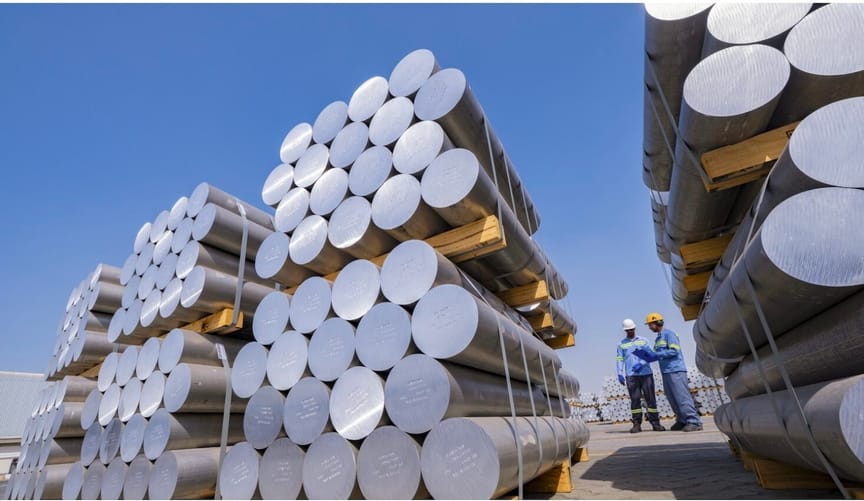
(Emirates Global Aluminium)
The United States has plans for a massive new smelter that would help to somewhat insulate the country from future global disruptions. But how quickly the $4 billion facility moves ahead depends largely on when it secures a long-term power contract — something its developers have been trying to do for almost a year.
In May 2025, Emirates Global Aluminium announced that it was building a new smelter in Oklahoma, a state with abundant natural gas and wind and solar energy resources. Earlier this year, Chicago-based Century Aluminum said it was partnering with EGA to build the plant, slated to produce up to 750,000 metric tons annually, through a joint venture named Oklahoma Primary Aluminum.
The energy-hungry facility will be America’s first new smelter since 1980, and it will more than double the nation’s capacity for making primary aluminum. The companies say they expect to start construction in late 2026 and begin producing metal by the end of the decade.
“Finalizing the power agreement is the next critical step,” Ryan Plotkin, an Oklahoma-based manufacturing executive who helped lure the smelter to the state, wrote in a Tulsa World opinion piece this week. “Oklahoma was chosen because of our resources and reliability. Now we must follow through.”
The smelter could require over 11 terawatt-hours of power to convert raw materials into shiny aluminum — enough electricity to power the city of Boston or Nashville annually, according to an Aluminum Association report.
To secure its electricity supply, Oklahoma Primary Aluminum has been pushing for a competitive deal with Public Service Company of Oklahoma, which is a subsidiary of utility giant AEP. The aluminum company is slated to receive hundreds of millions of dollars in incentives from the state of Oklahoma, including power discounts, along with a $500 million grant from the U.S. Department of Energy.
“Negotiations are ongoing and remain aligned with our original timeline,” Ziad Fares, project director for Oklahoma Primary Aluminum, told Canary Media.
“The project will source power from the grid, and its energy mix will evolve based on decarbonization goals, market conditions, and demand for low-carbon aluminum,” he said, adding that decisions about expanding electricity capacity to meet the smelter’s demand — whether through gas, wind, or solar — will be made by the utility.
A spokesperson for Public Service Company of Oklahoma didn’t directly address the contract talks but said that the utility “works closely with large prospective customers early in the planning process to ensure safe, reliable, and cost-effective electric service.”
Aluminum production has always been closely yoked to electricity prices.
America’s fleet of smelters has shrunk in recent decades as industrial electricity rates steadily climbed, from 33 facilities in 1980 to just four operating plants. Today’s producers still face the same challenge of securing affordable, yearslong contracts. Only now, smelters are increasingly competing with data centers and electrified cars and buildings for a slice of the nation’s limited power supply.
“There’s a future in which American manufacturing in general will have more competition from other sectors for the energy that we need to be successful,” Charles Johnson, president and CEO of the Aluminum Association, said on an April 23 press call. The industry group represents companies that make about 70% of all aluminum and aluminum products shipped in North America.
As it happens, Century Aluminum recently sold an idled Kentucky smelter to a data center company, which will use the site’s existing grid capacity. The manufacturer Alcoa is in talks to sell a shuttered smelter in New York to a bitcoin mining firm as part of its larger plan to offload 10 closed or curtailed sites to the tech industry.
In the last year, the Trump administration has attempted to reverse America’s aluminum decline by slapping steep tariffs on imported metals. But while tariffs can boost the bottom line for some domestic primary producers, Johnson said the measures don’t contend with the underlying energy issues that smelters must first overcome. (In fact, Trump administration policies have made it harder to deploy the fastest and most cost-effective resources for expanding grid capacity: utility-scale wind and solar projects.)
For now, the Aluminum Association’s members have been able to adapt to the rising commodity prices and supply chain disruptions since the U.S. and Israel waged war on Iran in late February. Iran subsequently bombed the two biggest smelters in the Middle East: EGA’s Al Taweelah site in Abu Dhabi and Aluminium Bahrain’s smelter. The Gulf region accounts for about a fifth of primary and alloyed aluminum imports to the U.S.
Still, Johnson said, “We do think that as the conflict drags on and the strait stays closed, that the impacts on our supply chains could be more profound.”
The Oklahoma smelter, despite its massive size, will cover only a fraction of America’s demand for primary aluminum, which totals around 5 million metric tons a year — or nearly four times the combined capacity of the new and existing smelters. To reduce its reliance on imported aluminum, the U.S. will need to build multiple new smelters. That likely won’t happen without federal policies that usher more affordable, reliable electricity onto the grid, said Joe Quinn of SAFE, which advocates for policies to enhance U.S. energy security.
“The aluminum problem will be solved with an energy solution,” he said.


.svg)
