

 Back
Back
WIND: Vineyard Wind becomes the first large-scale offshore wind farm in the U.S. to begin delivering power, a step Massachusetts Gov. Maura Healey calls “a turning point in the clean energy transition.” (Associated Press)
ALSO: Federal interior officials approve the construction and operations plan for the two-part Empire Wind project slated to provide roughly 2 GW of electricity off the New York coast. (WorkBoat)
GRID: FERC seeks $27 million in penalties from a Texas company called “Ketchup Caddy” after finding it bid hundreds of megawatts of non-existent capacity into MISO markets. (Utility Dive)
ELECTRIC VEHICLES:
SOLAR:
POLLUTION: The EPA’s science advisors warn a proposed power plant emissions rule will not be aggressive enough to meet Paris Agreement climate targets. (E&E News, subscription)
OIL & GAS: The Mountain Valley Pipeline’s developers say they’ll purchase $150 million in carbon offsets to ensure the natural gas transmission project is “carbon neutral” during its first decade. (WV News)
BIOFUELS: The U.S. EPA issues a final rule to allow year-round sales of higher blends of corn-based ethanol in eight Midwestern states despite concerns that it could worsen smog during warm weather. (Associated Press)
UTILITIES: Ohio Gov. Mike DeWine defends a top adviser after a criminal indictment alleges she knew about millions of dollars FirstEnergy paid to Sam Randazzo before DeWine appointed him as the state’s top utility regulator. (Ohio Capital Journal)
GEOTHERMAL: A Chicago environmental justice organization is helping to build out a geothermal heating and cooling network on the city’s South Side. (Grist)
HYDROGEN: The CEO of North America’s largest flat-rolled steel company is betting on hydrogen to decarbonize its operations while also driving profits: “We are doing this to get paid, not to brag about it.” (E&E News)
COMMENTARY: A Harvard legal scholar says interregional transmission lines, which will be critical for reaching climate targets, are being held back by utilities protecting their profits. (IEEE Spectrum)
POLLUTION: Colorado lawmakers introduce a suite of bills aimed at reducing ozone pollution that would pause summer oil and gas drilling, restrict gasoline-fueled automobile traffic and increase fines for polluters. (Colorado Sun)
COAL: As cases of black lung surge on the Navajo Nation, a study finds Indigenous coal miners are less likely to receive federal benefits. (Rocky Mountain PBS)
OIL & GAS:
STORAGE:
UTILITIES:
ELECTRIC VEHICLES: A California nonprofit plans to launch an electric bicycle voucher program for low-income residents this spring. (inewsource)
SOLAR:
WIND: California lawmakers raise concerns about a recently approved long-term energy plan that downgrades offshore wind targets. (Politico)
CLIMATE: The University of Arizona delays implementing its new climate plan, citing a $177 million budget deficit. (Grist)
HYDROPOWER: Alaska utilities move forward with a plan to alter a hydropower dam even though local officials asked them to pause the project to consider possible impacts. (Anchorage Daily News)
URANIUM:
SOLAR: Texas accounts for more than a third of planned U.S. solar facilities and a significant chunk of battery projects this year as new solar and storage development is projected to shatter records. (S&P Global)
ALSO:
COAL ASH: The U.S. EPA warns Georgia regulators they’re likely allowing Georgia Power to store coal ash in ways that fall short of federal standards. (Atlanta Journal-Constitution)
NUCLEAR: The Tennessee Valley Authority plans to hire 330 people to conduct nuclear fusion energy research at a Tennessee coal-fired power plant that was closed late last year. (Chattanooga Times Free Press)
ELECTRIC VEHICLES:
OIL & GAS:
BIOFUELS: Florida lawmakers consider legislation written by a utility that would make it easier to develop manure-to-gas facilities and pass the cost to ratepayers. (Tampa Bay Times)
HYDROGEN:
CLIMATE: A Florida university receives a $9 million federal grant to build wells along the coast to determine how rising groundwater might destabilize thousands of buildings crowding the state’s coastline. (Miami Herald)
UTILITIES: Jurors hear testimony in the trial of two former executives of Jacksonville, Florida’s municipal utility who are accused of conspiracy and fraud. (Jacksonville Daily Record)
COMMENTARY: Virginia lawmakers consider creating a retail market for cannabis, which will almost certainly drive up power demand and carbon emissions, writes an editor. (Cardinal News)
CLIMATE: State and local governments, including those in Iowa, Illinois, Indiana, and Wisconsin, are preparing applications for a $5 billion federal grant program to implement big ideas in climate action plans. (Energy News Network)
EFFICIENCY: The home builder lobby is mobilizing members to fight stronger energy-efficient building standards, inflating upfront costs and ignoring how efficiency measures could quickly pay for themselves through lower energy bills. (Washington Post)
UTILITIES:
GRID:
CARBON CAPTURE: A North Dakota environmental group says a $300,000 public contract to a consultant to educate residents about carbon capture is essentially lobbying for the practice. (North Dakota Monitor)
ELECTRIC VEHICLES:
SOLAR: A developer begins early siting work for a planned 1,400-acre solar project in southwestern Indiana. (WEVV)
COMMENTARY: A retired Michigan minister and columnist says state lawmakers should pass a pair of bipartisan bills that would open community solar in the state. (Holland Sentinel)
EFFICIENCY: Policies to improve energy efficiency in housing have faced strong opposition from builders associations, who frequently deploy inflated cost estimates to fight code upgrades. (Washington Post)
CLEAN ENERGY: While U.S. investment in renewable energy reached record levels last year, a new report says the pace will need to accelerate to meet the country’s climate goals. (Canary Media)
POLLUTION: The Supreme Court will hear arguments today on a challenge to the Clean Air Act’s “good neighbor” provision, which aims to protect people from air pollution from other states. (NPR)
ELECTRIC VEHICLES:
SOLAR: A new report projects the U.S. will have installed 14 GW of community solar by 2028. (Solar Power World)
GRID:
CLIMATE: Chicago files a lawsuit accusing six oil companies and a major industry group of waging a campaign to discredit climate science and misleading the public about the dangers of fossil fuels. (E&E News)
CARBON CAPTURE: Montana advocates and residents push back against ExxonMobil’s proposed carbon sequestration project on 110,000 acres of federal land, citing potential impacts to wildlife, groundwater and livestock. (Independent Record)
MINING: The developer of a proposed lithium mine in Nevada struggles to work around environmental opposition and an endangered wildflower in its path. (Forbes)
PIPELINES: The Mountain Valley Pipeline announces yet another delay and cost increase, moving projected completion from March to June and raising the price tag to more than $7.5 billion. (Roanoke Times, WVTF)
COMMENTARY:
CARBON CAPTURE: Montana advocates and residents push back against ExxonMobil’s proposed carbon sequestration project on 110,000 acres of federal land, citing potential impacts to wildlife, groundwater and livestock. (Independent Record)
ALSO: Wyoming lawmakers advance a bill amending a controversial law requiring utilities to study carbon capture for coal plants slated for retirement. (WyoFile)
OIL & GAS:
SOLAR:
POLITICS: Republican Utah lawmakers push a suite of bills that would make it more difficult for utilities to retire coal and natural gas power plants. (Utah News Dispatch)
ELECTRIC VEHICLES:
CLIMATE: California and several municipalities merge their lawsuits accusing oil companies of using disinformation campaigns to thwart efforts to reduce emissions. (DeSmog)
CLEAN ENERGY: California regulators approve a plan requiring the state to reduce electricity sector emissions by adding more than 56 GW of clean energy generation and storage to the grid. (Utility Dive)
UTILITIES:
MINING: The developer of a proposed lithium mine in Nevada struggles to work around environmental opposition and an endangered wildflower in its path. (Forbes)
GRID: Colorado lawmakers consider offering tax breaks to data centers, even though their outsized electricity demand could threaten state decarbonization efforts. (Big Pivots)
COMMENTARY: A California advocate urges state lawmakers to pass a bill that would establish carbon dioxide pipeline regulations. (LegalPlanet)
This article was originally published by the Maine Morning Star.
The International Energy Agency has estimated that offshore wind could generate $1 trillion in worldwide investments in the next 15 years.
Gov. Janet Mills said, “the time has come to bring some of that investment to Maine.”
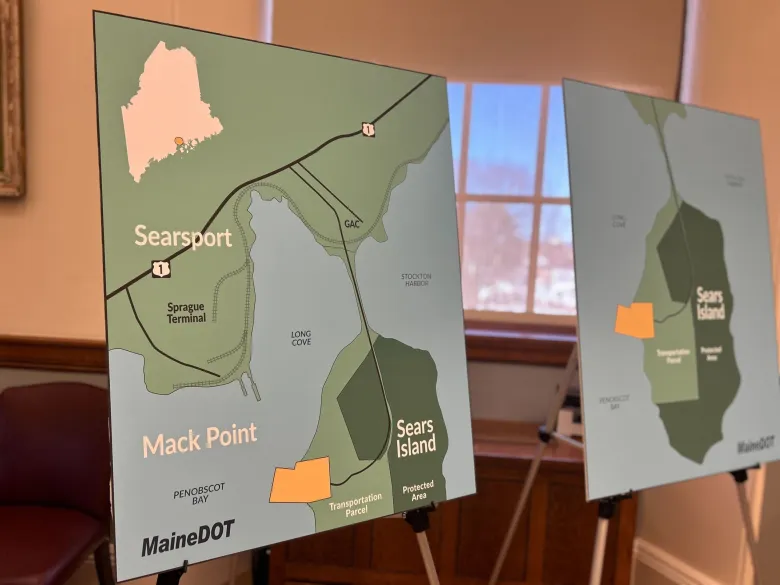
Mills announced at a press conference Tuesday afternoon that Sears Island in Searsport is the preferred site for a designated port to support the state’s budding offshore wind industry because of its economic and environmental opportunities. The turbines will be fabricated and assembled at the dedicated port.
Within Searsport, there were two potential locations: Sears Island and Mack Point. Both are in Penobscot Bay and have garnered conflicting reactions from the public. Since Sears Island is undeveloped, proponents see it as a blank canvas ready to be transformed into an offshore wind port. But opponents argued against clearing more natural land over the redevelopment of Mack Point.
Mills laid out half a dozen reasons why she believes the 941-acre Sears Island is the best choice financially and environmentally for the people of Maine, although she emphasized that she didn’t make the decision lightly.
Since the state already owns the land, it will minimize upfront costs and eliminate the potential for leasing, making Sears Island more cost-effective in the short- and long-run, Mills said. She didn’t provide an exact number, but Mills said the entire project could ultimately cost several hundreds of millions of dollars.
The island also has the required physical characteristics, namely a large, level surface with access to deep water.
Knowing that some people may be unhappy about the decision, Mills said she has hiked the island and circumnavigated it by boat so she understands the appreciation for the island. In 2009, the state put about 600 acres — two-thirds of the island — into a permanent easement. That portion will remain untouched by the port, which will be built on about 100 acres outside of the protected area.
Searsport and the surrounding region has faced economic challenges in the past decade after a paper mill closed and took more than 500 jobs with it.
“We have not recovered from that loss,” said James Gillway, town manager of Searsport. “Offshore wind will change that.”
Representatives from Maine State Chamber of Commerce, Maine Conservation Voters and Maine Audubon were also present at the press conference in support of the announcement. Sen. Chip Curry (D-Waldo) also spoke about the opportunities this will offer by creating a new industry to “strengthen families up and down the Midcoast” with good-paying jobs.
“Offshore wind will be essential to our transition away from expensive and dirty fossil fuels, and to realize this incredible opportunity, we need port infrastructure,” said Beth Ahearn, director of government affairs for Maine Conservation Voters, who was also part of the 19-member Offshore Wind Port Advisory Group.
Organized by the Maine Department of Transportation, the advisory group met six times between 2022 and 2023 to explore prospective sites and help inform the governor’s decision.
Maine relies on natural gas to support much of its energy needs, so diversifying power sources can help stabilize prices for ratepayers, said Dan Burgess, director of the Governor’s Energy Office.
“This is an investment in Maine-made, clean energy that we think will stabilize rates,” Burgess said of offshore wind. He added, “the more we can do homegrown, the better.”
In a statement, Sean Mahoney, vice president of the Conservation Law Foundation Maine, which was also part of the advisory group, said, “Offshore wind will grow our economy and help us meet our obligations to ditch polluting fossil fuels. It’s critical that this process is now moving forward and we’re one step closer to getting this clean energy on the grid.”
In November, a coalition of organized labor and environmental groups voiced support for building a new port for offshore wind, highlighting benefits such as job-creation and the use of innovation developed by Maine people. They also stressed the urgency of moving forward with the project for environmental reasons.
The state is still waiting for the federal Bureau of Ocean Energy Management to publish a final map showing where offshore wind can be developed in the Gulf of Maine.
In the meantime, Maine DOT will begin applying for state and federal permits. That process is expected to take about a year. Construction, however, will take multiple years. Mills estimated it could wrap up in 2029.
Even before the governor’s decision, Searsport stood out among the other options.
While the water is plenty deep, there isn’t enough space in Portland, so it wasn’t a viable option, explained Kathleen Meil, senior director of policy and partnerships for Maine Conservation Voters.
Eastport, another potential location, would require going through Tribal land and has a lot of rock, granite and other materials that would need to be blasted.
“So, that leaves us with Searsport,” Meil said in an interview with Maine Morning Star last week.
ELECTRIC VEHICLES: A new poll suggests over half of New Jersey residents don’t think they’ll buy an electric vehicle, even though most agreed it would improve health and air quality, fearing personal and statewide economic consequences. (New Jersey Monitor, Asbury Park Press)
FUNDING:
SOLAR:
CLEAN ENERGY: Although construction is years away for a massive wind power and transmission line project proposed for northern Maine, clean energy workforce development programs are already stepping up. (Mainebiz)
FLOODS: Parts of Boston, including Long Wharf, saw notable flooding yesterday as a nor’easter blew through southern New England, reviving conversation around potential nature-based and human-built mitigation strategies. (Boston Globe, NBC Boston)
TRANSIT: In the face of vehicle traffic issues, Rhode Island officials give $160,000 to East Providence to help the city create a bike and pedestrian master plan that builds on two existing, popular paths. (ecoRI)
EMISSIONS: New York City councilmembers discuss a proposed bill to force cruise ships to plug into onshore power rather than use onboard diesel engines while docked in the city. (Gothamist)
CLIMATE:
BUILDINGS: Efficiency Maine and the town of Brunswick strike a deal to offer better terms on energy efficiency loans to local businesses. (Times Record)
STORAGE: Georgia Power prepares to begin operation of a 65 MW battery storage system in Georgia, the first in a series of battery installations planned to eventually total 915 MW. (Macon Telegraph)
NUCLEAR: A Southeast trade association says the nuclear industry’s $9.8 billion footprint in Tennessee means the state will lead a pending “nuclear renaissance” in the region as utilities consider building a wave of new plants. (Knoxville News-Sentinel)
TRANSITION:
SOLAR:
WIND: Wind energy company Enel considers whether to appeal, negotiate with tribes or remove its 48-turbine wind farm in Oklahoma after a judge found the company failed to secure mineral rights from the Osage Nation. (Engineering News-Record)
ELECTRIC VEHICLES: Kentucky breaks ground on the first of 40 electric vehicle charging stations planned for the state’s interstates and highways. (Spectrum News, WHAS)
EMISSIONS: An analysis finds oil and gas producers would have owed as much as $1.1 billion, largely from leaky well and pipeline infrastructure, had a new federal methane fee been in place for a one-year period ending in March 2023. (Grist)
UTILITIES: Duke Energy revises its long-term plan in North Carolina to reflect an “unprecedented” increase in power demand by adding more solar and offshore wind, but also new natural gas-fired power plants and experiments in nuclear power. (Wilmington StarNews)
OIL & GAS: West Virginia lawmakers complain about miscalculations that cost eight counties a total of $22.9 million as they advance legislation to make permanent a relatively new method for assessing tax valuations for oil and gas properties. (WV Metro News)
RENEWABLES: A Spanish company secures $200 million in financing to build out 1.9 GW of solar, storage and wind facilities on Texas’ standalone power grid. (PV Tech)
COAL: A creditor of West Virginia Gov. Jim Justice’s coal companies joins a legal dispute between those companies and a Virginia bank over $226.2 million plus interest in debt payments. (Cardinal News)
COMMENTARY: An analyst at a conservative think tank complains that net-metering subsidizes homeowners with rooftop solar at the expense of other utility customers. (Carolina Journal)
EMISSIONS: The top 25 U.S. oil and gas producers would’ve been liable for $1.1 billion in charges had the federal climate law’s methane emissions fee been applied over a year ending in March 2023, an analysis finds. (Grist)
ELECTRIC VEHICLES:
WIND:
POLITICS: Democrats fear the dismantling of Inflation Reduction Act clean energy incentives if they lose the presidency this fall. (New York Times)
NUCLEAR:
OIL & GAS:
CARBON CAPTURE: Alaska Gov. Mike Dunleavy proposes legislation that would allow the state to lease subsurface rights for storing carbon dioxide in an effort to maintain or increase fossil fuel production while reducing emissions. (Alaska Beacon)
CLIMATE: Washington state lawmakers propose spending carbon allowance auction revenues on electricity bill credits for low-income residents and to purchase hybrid-electric fire engines and charging infrastructure. (Washington State Standard)


.svg)
