

 Back
Back
CLIMATE: Colorado climate advocates debate whether slashing fossil fuel demand, restricting oil and gas supplies or a combination of the two would be most effective in cutting greenhouse gas emissions. (Colorado Newsline)
ALSO: Washington state lawmakers allocate $30 million to provide fuel surcharge rebates to farmers and truckers not exempted from the state’s carbon cap-and-invest program. (Washington State Standards)
OIL & GAS:
SOLAR:
WIND:
CLEAN ENERGY: The Biden administration awards Mountain West tribal nations about $26 million to bring electricity to off-grid homes and fund clean energy systems. (KUNR)
ELECTRIC VEHICLES: A southern California port unveils the nation’s first all-electric tug boat and expects to begin operations next month. (San Diego Union-Tribune)
UTILITIES:
TRANSITION: A Navajo Nation nonprofit looks to convert a defunct rail line connecting a decommissioned coal mine and power plant in northern Arizona into a running and cycling trail. (Navajo-Hopi Observer)
ELECTRIFICATION: Colorado restaurants say switching from natural gas to electric induction stoves and ovens has improved their food quality and the kitchen atmosphere. (Rocky Mountain PBS)
COMMENTARY: A Montana advocate urges the federal government to stop leasing land to oil and gas companies, saying drilling will harm the state’s growing outdoor recreation economy. (Montana Standard)
HYDROGEN: Pennsylvania’s governor says at a divisive public meeting that the state is “all in when it comes to the hydrogen hubs,” but environmentalists say the hard-to-reach location of the meeting shows a lack of interest in community engagement. (WHYY)
FOSSIL FUELS:
SOLAR: In New York, Niagara County’s environmental coordinator says the county’s solar panel recycling law is improving end-of-life panel management, but not all solar projects are complying. (Union-Sun & Journal)
ELECTRIC VEHICLES:
GRID: New Jersey lawmakers mull the potential impact of two bills, which would codify a gubernatorial order to have all electricity sales involve clean energy by 2035 and spend $300 million on grid upgrades. (RTO Insider, subscription)
POLICY:
STORMS: Massachusetts plans to appeal federal emergency management officials’ decision to not issue a major disaster declaration over the severe flooding that swept through the state in September. (Associated Press)
CLIMATE: The president of the New York Farm Bureau says his farmers support climate action but worry the push for electrification comes before electric farm equipment can handle the long hours required. (Spectrum News 1)
TRANSIT: Two Somerville, Massachusetts, council members plan to introduce a resolution to remove “unnecessary” parking spaces from new developments to help meet climate goals. (Boston Herald)
GRID: An analysis finds Texas has experienced 263 power outages since 2019, the most of any state in the country, indicating its power grid is struggling under demand and extreme weather. (Houston Chronicle)
ALSO:
ELECTRIC VEHICLES:
STORAGE: Texas residents are worried about a developer’s plans to build a battery storage facility near a neighborhood and elementary school. (KTRK)
OIL & GAS:
COAL:
CLIMATE:
UTILITIES: Austin, Texas’ municipal utility pauses the process of reworking its resource, generation and climate plan while the mayor pushes to divest from a coal-fired power plant and environmentalists call for more renewables. (Austin Monitor)
GEOTHERMAL: A student team from the University of Oklahoma wins a competition for its design of geothermal wells to heat a 40,000-square-foot greenhouse operated by the Osage Nation. (KWTV/KSBI)
MINING: A Virginia company moves to reopen critical minerals mining and production facilities in the state, after having previously discontinued operations there in 2015. (Virginia Mercury)
COMMENTARY:
CARBON CAPTURE: A North Dakota electric cooperative is betting a $2 billion carbon capture project will allow a coal-fired power plant to comply with Minnesota’s law requiring carbon-free electricity by 2040, but critics say the plan is absurdly complicated and expensive compared to alternatives. (MPR News)
CLEAN ENERGY:
MATERIALS: The closure of three U.S. aluminum manufacturing plants, including one in Missouri, could threaten the transition to clean energy and electrification, experts say. (E&E News)
SOLAR: South Dakota’s largest solar project, a 128 MW installation near Rapid City, is scheduled to come online ahead of schedule. (South Dakota Searchlight)
CLIMATE: Nebraska’s 76-page climate action plan includes incentives for a host of energy efficiency, solar and regenerative agriculture projects. (Nebraska Examiner)
EMISSIONS: A new report calls on Chicago to set limits on emissions from certain commercial buildings that could grow stricter over time. (Chicago Tribune)
PIPELINES: Indigenous author and advocate Winona LaDuke says both North Dakota and the U.S. Army Corps of Engineers are to blame for the policing costs and handling of Dakota Access pipeline protests in late 2016. (North Dakota Monitor)
BIOENERGY: An Irish company plans to invest $400 million at a Wisconsin ethanol plant to include a new large plant-based renewable natural gas production facility. (Journal Sentinel)
NUCLEAR: South Dakota Gov. Kristi Noem signs a bill into law that updates legal language and allows the state to potentially enter into agreements for nuclear power projects. (SDPB)
COAL:
UTILITIES: WEC Energy Group taps Indiana utility NIPSCO’s president and COO to lead We Energies and Wisconsin Public Service Corp. (Journal Sentinel)
This story was originally published by Canary Media.
One of California’s marquee programs for cleaning up transportation emissions is at a crossroads. Decisions made in the next few months could set the decade-and-a-half-old Low Carbon Fuel Standard on one of two very different paths.
One path, favored by fossil fuel and renewable natural gas interests, would lock in a market scheme that currently extracts billions of dollars per year from Californians at the pump and subsidizes crop-based and cow-manure-derived biofuels.
That would be a disaster, according to environmental advocates, who point to a growing body of scientific evidence showing that this approach, if extended until 2045 as proposed, would cause these biofuels to grow at a scale that would harm the climate and the environment.
The other path, proposed by environmental groups, transportation-decarbonization analysts and climate and energy researchers, would limit the scope of unsustainable biofuels in the program, and instead reorient it to support what experts agree should be California’s primary clean transportation pathway: electric vehicles.
To date, roughly 80 percent of LCFS funding has gone to combustion biofuels rather than electric vehicles. That’s simply incompatible with the state’s EV ambitions and needs, said Adrian Martinez, deputy managing attorney of nonprofit advocacy group Earthjustice — and the imperative to reduce emissions from transportation, which account for nearly 40 percent of the state’s greenhouse gas emissions.
“We’ve got to eliminate our reliance on combustion,” he said, but “the program as designed will continue to provide lucrative incentives for combustible fuels well into the future.”
The regulator in charge of the LCFS program — and this high-stakes decision — is the California Air Resources Board. CARB’s board, which comprises 14 voting members, 12 appointed by the governor and two by the state legislature, holds a host of responsibilities around California’s energy transition. Those include shaping the state’s nation-leading EV policy, as well as determining its broad plans for achieving long-term greenhouse-gas reduction goals.
Critics say the LCFS program’s increasing support for biofuels is in direct contrast to both the EV targets and the climate goals also overseen by CARB — and that the program has been captured by deep-pocketed industries trying to greenwash the continued use of combustion fuels.
CARB has a chance to reform the program with an upcoming vote, initially set for this month, but now postponed to an undetermined future date. But its pathway to fixing the problems that plague LCFS is murky and messy at best.
Right now, the staff managing the LCFS program hasn’t given CARB board members an opportunity to pick a climate- and EV-friendly alternative. Instead, a December staff proposal provides only one option for the board to vote on later this year: a set of policies that Earthjustice forecasts would direct $27 billion over the coming decade toward biofuels and worsen effects on the climate, the environment and the prices that Californians pay at the pump.
CARB does have another option, however — an alternative proposal laid out by CARB’s Environmental Justice Advisory Committee, created to advise the board on environmental-justice issues.
That proposal would cap the fast-growing share of crop-based renewable diesel flooding the state. It would also end the unusual structure that now allows biogas produced by dairy farm manure to offset a much higher amount of carbon emissions than any other source of alternative fuels.
And, importantly, it would make the core of the program — its carbon-offset marketplace — function in a much healthier way, proponents say. A torrent of cheap, polluting renewable diesel and dairy farm biogas credits have dragged down the price that LCFS credits can fetch for avoiding emissions, diluting the incentive to deploy new climate technologies and sapping what could be a key funding source for EV infrastructure in the state.
“The stakes are very, very high,” Martinez said. “That’s why you see so much attention focused on this — and a very broad and diverse coalition that is pushing for more systemic change to the program, versus more modest tweaks that will really just keep this market owned and dominated by fossil fuel interests.”
California’s Low Carbon Fuel Standard was born out of AB 32, the 2006 law that created the state’s carbon cap-and-trade market. Much like carbon markets, LCFS is meant to make companies pay for their carbon emissions by buying credits from technologies that reduce carbon emissions.
The program requires all fossil fuels refined and sold in California to meet increasingly stringent carbon-intensity targets. In practice, fossil fuel producers have to buy a bunch of LCFS credits from low-carbon transit sources operating in the state in order to comply. The goal is to create a system that taxes planet-warming fossil fuels to fund cleaner transportation alternatives.
But the LCFS has strayed from its initial focus on vehicle electrification and “advanced” non-crop-based biofuels to become “a swag bag for venture capitalists, big oil, big agriculture, and big gas, increasingly coming at the expense of low- and moderate-income Californians.” That’s how Jim Duffy, a 13-year veteran of the agency who served as branch chief of the LCFS program from 2019 to 2020 and retired in 2022, described the evolution of the program in comments filed with CARB.
Under the LCFS regulation adopted in 2009, dairy-manure-to-biogas projects did not receive special treatment compared to other sources of methane such as landfills and sewage treatment plants, Duffy wrote. Similarly, diesel fuels made from crops like soybeans were considered “only marginally better than fossil diesel.”
But in the years since, “the LCFS was revised to provide additional and unnecessary support to landfills and first-generation crop-based biofuels” and “to mitigate the methane problem created by the dairy industry itself,” Duffy wrote — despite the fact that evidence increasingly suggests that both sources harm the planet far more than they benefit it.
The result has been an increasing share of LCFS credits being supplied by renewable diesel and dairy-generated biogas.
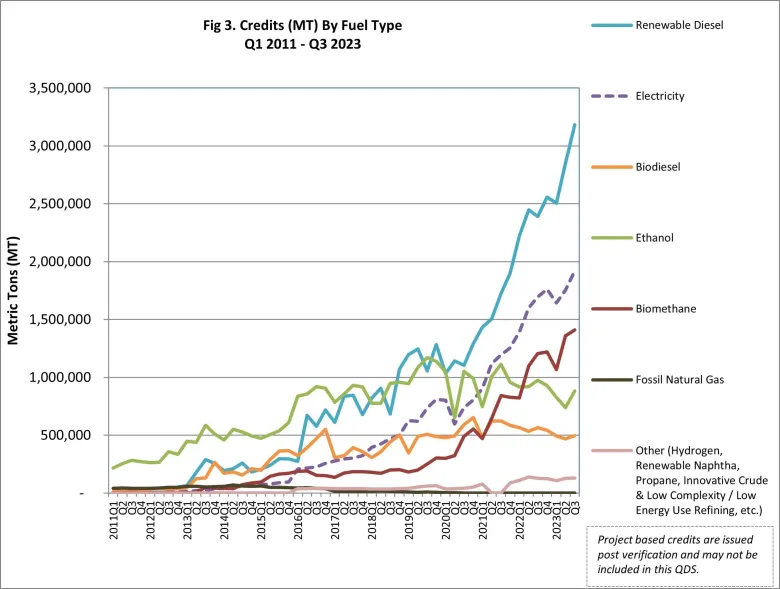
CARB has justified these shifts with analysis indicating they will yield net positive climate impacts.
“The proposed amendments now under consideration will directly increase the program benefits in the most burdened communities, by reducing the carbon across the supply chain for fuels sold in California, as well as improving public health for fuels sold in California,” CARB spokesperson Dave Clegern said in an email to Canary Media. He cited data from CARB staff’s analysis of its proposal indicating that, by 2045, its plan will reduce nitrogen oxide emissions by 25,586 tons, cut greenhouse gas emissions by 560 million metric tons and yield public-health cost savings of nearly $5 billion.
But critics say the agency is failing to account for the full scope of climate harms that will be caused by its continued emphasis on biofuels.
They warn that the sheer scale of California’s program — totaling some $4 billion per year — is driving investment in the wrong transportation alternatives. The consequences are dire, they say — not just within the state, but across the country and around the world.
Take renewable diesel, a fuel made from fats and oils processed to be identical to fossil diesel fuel. The U.S. increased production of the fuel by 400% between 2019 and 2022, and it is set to double it again this year, according to Jeremy Martin, senior scientist and director of fuels policy for the Union of Concerned Scientists.
Unlike ethanol and biodiesel, which can only partially replace gasoline and diesel, renewable diesel has “no limit on how much can be blended,” Martin said. It could theoretically completely replace diesel fuel for trucks, buses and other vehicles. And California’s LCFS offers credits on top of the federal incentives the fuel receives, making the state the primary target of renewable diesel producers across the country.
As a result, the share of renewable diesel as a percentage of total diesel fuel use has skyrocketed in California compared to the rest of the U.S., as the chart below shows.
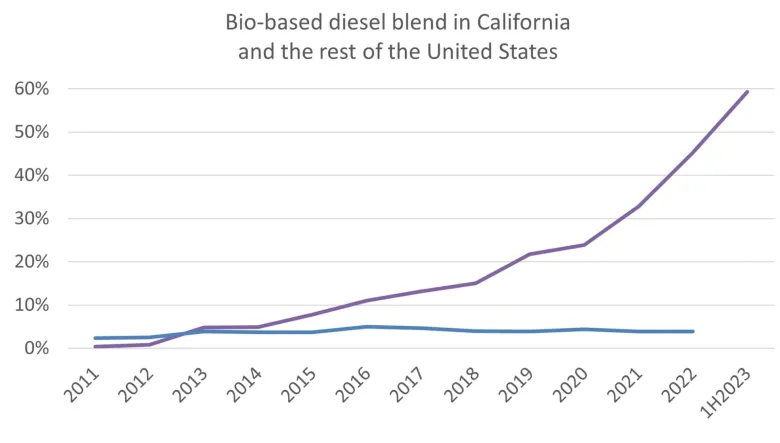
In a September meeting, Steven Cliff, CARB’s executive officer, highlighted a milestone for the LCFS program: As of mid-2023, California had “more than half of our diesel demand being met by non-petroleum-based diesel alternatives. This is a direct result of the LCFS program, and it’s bringing real climate and air-quality benefits to the state.”
In Martin’s view, that milestone is not a win, but a warning. It indicates that renewable diesel is “flooding the LCFS, drowning the policy — and it doesn’t make sense” on climate or environmental terms.
Once the demand for renewable diesel outgrows the supply of waste oils and other non-crop feedstocks that can be used to make the fuel in genuinely climate-friendly ways, it becomes highly likely that it will cause more greenhouse gas emissions than it will displace. Critics like Martin argue that demand has now reached this point, though it’s a contested question.
This additional demand for crop oils could mostly serve “to expand the cultivation of palm oil to replace the soybean and other oils made into fuel,” the Union of Concerned Scientists argued in comments to CARB. That, in turn, is likely to lead to more rapid deforestation in nations that produce large amounts of these crops, such as Brazil and Indonesia — an outcome that would cause far greater climate harms than whatever emissions reductions result from replacing fossil diesel.
To stop this, the Union of Concerned Scientists and other groups want CARB to set a limit on how much renewable diesel can receive LCFS credits. CARB staff’s proposal declines to set such a cap, citing renewable diesel’s climate and health benefits.
But CARB’s methodology is out of step with the latest science, according to multiple groups studying these issues. The Union of Concerned Scientists, for its part, says CARB’s analysis is “based on inaccurate claims of climate and air-quality benefits and associated health outcomes.”
In a recent comparison of five different models for evaluating the climate impacts of crop-based biofuels, the U.S. Environmental Protection Agency found that only CARB’s own model shows a positive carbon-reduction impact.
And while the agency has a proposal to limit deforestation harms by setting “sustainability guidelines” for crops being used for renewable diesel, it applies only to feedstocks grown in the U.S., Martin noted. That’s a problem: California is on pace to consume 10 percent of global soybean oil supplies for renewable diesel, meaning a significant amount of the crop oil produced for the program will be grown under conditions CARB cannot police, he said.
Given that reality, Martin said, “If California declines to act — if they say, ‘This is evidence of success; look how little fossil diesel we’re using’” by replacing it with renewable diesel, “then, in fact, California is giving its support to a fuel that we know is unsustainable at these volumes.”
CLEAN ENERGY: For every dollar the Inflation Reduction Act put toward clean energy incentives, policy analysts say the private sector has matched $5.47, totaling nearly $750 billion in the first year after the law passed. (Grist)
ELECTRIC VEHICLES:
CLIMATE:
OIL & GAS:
COAL:
PIPELINES:
BUILDINGS: A New York City public housing pilot project currently underway shows promise in reducing greenhouse gas emissions and making apartments more comfortable through window-mounted heat pumps. (Associated Press)
GRID: Connecticut regulators approve the first round of pilot projects in a new program aimed at testing innovative hardware and software to decarbonize the electric grid. (Energy News Network)
MINING: Tribal nation citizens urge a federal human rights commission to push back on a predicted uranium mining boom, saying Indigenous communities continue to suffer from Cold War-era extraction of the fuel. (Inside Climate News)
BIOFUELS: California advocates call on the state to overhaul its low-carbon fuel standard program to support and fund electric vehicles and charging infrastructure rather than biofuels. (Canary Media)
COMMENTARY: An ecologist suggests that solar projects designed to have synergy with agriculture and ecosystems can preserve farmland and natural environments as the U.S. builds out solar arrays. (The Conversation)
BIOFUELS: California advocates call on the state to overhaul its low-carbon fuel standard program to support and fund electric vehicles and charging infrastructure rather than biofuels. (Canary Media)
OIL & GAS: U.S. Coast Guard officials say an oil sheen spotted off southern California’s coast last week may have emanated from a natural seep on the ocean floor. (ABC News)
COAL:
SOLAR: New Mexico’s Supreme Court rejects investor-owned utilities’ bid to loosen the state’s community solar program’s rules. (Albuquerque Journal)
GRID: Federal regulators approve new rules allowing California’s grid operator to participate in an extended day-ahead power market once it goes live. (RTO Insider, subscription)
CLEAN ENERGY: A California power agency awards cities in the northern part of the state $11.5 million to help fund clean energy-related projects. (Daily Journal)
CLIMATE: The U.S. Energy Department awards five New Mexico startups over $6 million to research, develop and scale up climate technology. (news release)
ELECTRIC VEHICLES:
UTILITIES:
MINING:
COMMENTARY:
PIPELINES: Residents who live along the Mountain Valley Pipeline complain that Virginia regulators are ignoring erosion and pollution complaints as construction nears completion. (WVTF)
ALSO: The Mountain Valley Pipeline’s biggest stakeholder announces it will merge with its former owner, Pittsburgh gas company EQT, in a $5.5 billion stock deal. (Cardinal News; Bloomberg, subscription)
ELECTRIC VEHICLES:
SOLAR:
OIL & GAS:
COAL:
UTILITIES: The prosecution rests and defense begins its case in the trial of two former executives who are accused of scheming to collect bonuses by privatizing Jacksonville, Florida’s municipal utility. (WTLV)
CLIMATE:
Correction: Connecticut’s Innovative Energy Solutions Program is working with the consulting firm Strategen. An earlier version of this story misspelled the name of the program and firm. Also, the participating company Kraken is not affiliated with the similarly named cryptocurrency company.
Connecticut regulators have approved the first round of pilot projects in a new program aimed at accelerating innovation across the electric grid.
Seven tech companies have received the go-ahead to partner with utilities Eversource or United Illuminating to test the potential of their hardware or software to help decarbonize the state’s electric grid.
The Innovative Energy Solutions Program is part of a broader effort by the state Public Utilities Regulatory Authority (PURA) to modernize the grid. It encourages utilities to embrace new technology while limiting the risk to ratepayers.
The selected companies were winnowed from an initial 50 applications. While some of the technologies have been deployed successfully elsewhere, none have been tested in Connecticut, said Julia Dumaine, PURA’s supervisor of strategy and operations. The projects, funded at a total of just under $10 million, were chosen after a multi-step review process that included scrutiny from a nine-member advisory council.
“Having these increasingly stringent reviews minimizes ratepayer risk,” Dumaine said. “These are technologies that have demonstrated the potential to provide real ratepayer and grid-level benefits.”
None are startups in the research and development phase — they are all prepared to scale up at a later date, she said.
After the pilots launch, each company has a set of metrics they must meet and will be required to report on them quarterly, said Eli Asher, a senior manager at Strategen, the consulting firm responsible for developing and administering the program.
“We will be gathering data on how effective the projects are,” he said. “At the end of the deployment period, we’ll have a cost-benefit analysis to inform the recommendations as to whether they should be fully deployed at scale across the state.”
The program allows the utilities to recover their costs for testing these new technologies, something they might be reluctant to do otherwise.
“I think it’s great to have regulators backing a program like this,” said Alex Ghanem, commercial manager for Piclo, one of the companies participating. “It’s a risk to test things out and it costs the utilities resources to do so. I think this is a great framework.”
Based in London, England, Piclo will work with United Illuminating to launch a grid flexibility market. They will recruit owners, operators and managers of any type of distributed energy resource — battery storage, electric vehicles, and other types of dispatchable power sources commonly known as DERs — to operate in an independent marketplace in return for compensation.
Piclo will work with DER aggregators on their platform. They will provide United Illuminating with local flexible DERs that represent alternative — and ideally, cheaper — places to buy energy than on the wholesale market when the utility has insufficient supply to meet customer demand.
Piclo is already operating in New York in partnership with National Grid.
“The penetration of DERs is disrupting the grid and the utilities need to pull on multiple different levers to manage that,” said John Bayard, Piclo’s chief commercial officer. “Grid flexibility marketplaces are one of the tools they can use.”
Another British company, Kraken, will also work with United Illuminating to help them better manage DERs.
Kraken’s platform “can connect to any kind of DER — electric vehicles, heat pumps, smart thermostats,” said Devrim Celal, chief executive officer. “We can connect to them in an effective way, monitor them in real time and control what they do.”
This pilot will focus on customers that use heat pumps and drive electric vehicles. The company will recruit ratepayers to sign up to use their mobile app, which will give Kraken access to their DERs. For example, they might tell the company what kind of EV and charger they have, and what time of day they need to have their car charged by.
“We will determine when is the best time to charge their cars to achieve low-carbon emission targets, and in exchange we’ll give them a reward,” Celal said.
The pilot is intended to help the grid run greener and more cheaply.
An EV charging software company called AmpUp will work with Eversource to try to balance electricity demand during peak periods by decreasing load at electric vehicle chargers. Based in Santa Clara, Calif., AmpUp will provide incentives to compensate charging station owners for decreasing charging during peak periods.
They are still working out what level of incentive might stimulate participation, as well as whether it might appeal to a workplace with four chargers as much as to a company operating a fleet of vehicles, said Matt Bloom, director of partnerships.
“We’re really excited,” he said. “It’s good to see the regulators take a little risk. This is a good way to innovate, see what we learn and whether it’s something Eversource could adopt long term.”
CLIMATE: The continental U.S. experienced its warmest winter on record, during which average temperatures throughout the Midwest and Northeast exceeded past averages by as much as 10°F. (Axios)
ALSO:
ELECTRIC VEHICLES:
GRID: Four Congress members push the Federal Energy Regulatory Commission to institute an incentive that would encourage the use of new technologies to increase capacity on existing and new transmission lines. (Utility Dive)
ELECTRIFICATION: A recent study shows electric heat pumps reduce emissions compared to other heating systems, even when they run on fossil-fueled grid power. (Canary Media)
CLEAN ENERGY:
CARBON CAPTURE: The developer of a multi-state carbon pipeline says it remains open to contracts that offtake the carbon for enhanced oil recovery, despite sworn testimony that the project is for underground storage. (Reuters)
OIL & GAS:
UTILITIES: Clean energy advocates applaud Minnesota’s largest gas utility for drafting a $105 million decarbonization plan, but say it doesn’t move fast enough to meet state emission-reduction targets. (Energy News Network)


.svg)
