

 Back
Back
CLIMATE: Colorado advocates worry proposed legislation aimed at luring more energy-intensive data centers to the state will put climate goals out of reach and drive up power costs. (CPR)
ALSO: An advocacy group launches an ad campaign in Arizona and Montana urging residents to support the federal Securities and Exchange Commission’s new climate risk disclosure rules. (news release)
SOLAR: A California school district unveils a 17.5 MW solar-plus-storage network consisting of 40 projects across 31 sites. (news release)
STORAGE: A firm signs on to purchase all of the capacity of a 200 MW stand–alone battery energy storage system under construction in southern California. (Solar Industry)
UTILITIES:
OIL & GAS:
TRANSPORTATION: Colorado lawmakers propose levying a daily fee on car rentals to help fund public transit projects. (Colorado Public Radio)
CARBON CAPTURE: Oregon researchers discover a way to pull carbon dioxide from the air with vanadium, potentially boosting the nascent direct air carbon capture industry. (Oregon Capital Chronicle)
PUBLIC LANDS: U.S. Rep. Harriet Hageman, a Wyoming Republican, looks to block a management plan for 3.7 million acres of federal land in the state, claiming it would hamper energy development. (WyoFile)
COMMENTARY: Energy investors and experts call on the uranium industry to ensure mines and mills financially benefit affected tribal communities, regardless of property ownership. (Wilson Center)
A pair of cousins who want to lease land for a contested solar project in central Ohio say a vocal minority is trying to interfere with their property rights.
“I have rights as an owner, farmer and investor that shouldn’t be limited by a small group of individuals who are opposed to any solar development,” said Richard Piar. He and Ethan Robertson jointly own two parcels of property in Knox County, which they want to lease to developer Open Road Renewables for the proposed 120 megawatt Frasier Solar project.
Much of the public debate surrounding the project has pitted local groups that oppose solar energy on agricultural land against the developer and clean energy advocates. But for the cousins, the project is a way to bring in new revenue and help keep the land in the fourth-generation farm family.
“Solar gives my family opportunities it otherwise would not have for a financial future,” Piar said.
Robertson is now seeking to intervene in the Ohio Power Siting Board case that will decide the project’s fate, and the cousins recently shared with Energy News Network how the project is important to them and their property rights.
“When someone who is not a farmer can tell us farmers what we can do with our land, it creates a slippery slope for property rights,” Piar said.
Concerns about conservation also factored into the cousins’ decision to lease the land, which the solar farm will have to restore at the end of the project. In Robertson’s view, those terms counter opponents’ arguments about blocking the project to protect farmland, especially when much of it – on the outskirts of Mount Vernon in Clinton and Miller townships, about an hour’s drive from Columbus – could otherwise become residential subdivisions.
“My children are nine, seven and five years old. This project is a key way to protect our land from the many ways this county may change over the next four decades,” Robertson said.
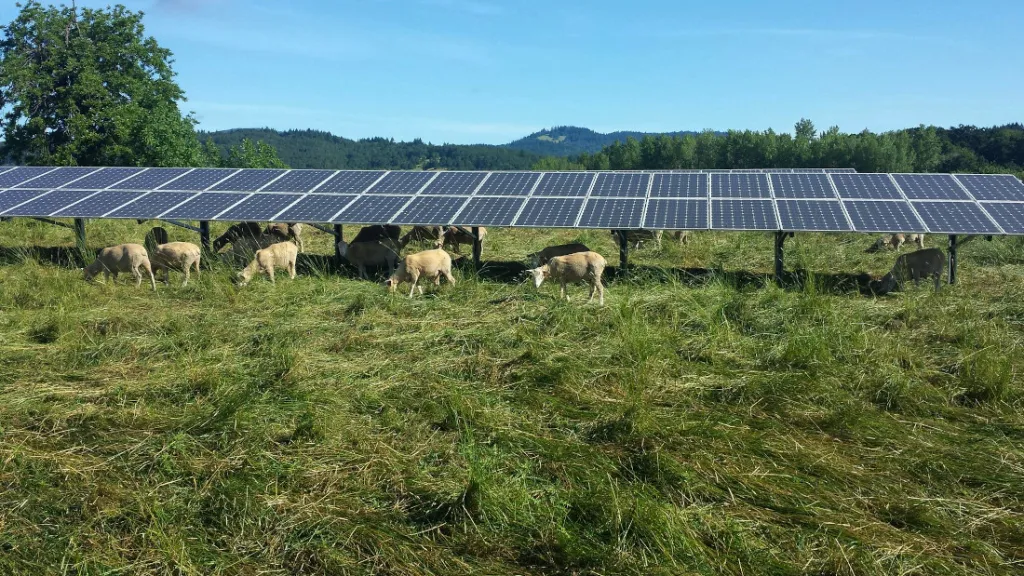
And much of the land in the Frasier Solar project will still be used for agricultural purposes while the solar project is in operation. On March 8, Open Road Renewables and New Slate Land Management announced they signed a letter of intent to use sheep grazing to manage vegetation for the project.
Brad Carothers, who runs New Slate, lives in Knox County and raises Katahdin sheep. When a letter came from Open Road Renewables about the Frasier Solar project, he reached out to the company.
“One of the main issues new and emerging farmers face is access to land,” Carothers said. “We’re a first-generation business. And so land is not something that I have from previous generations to utilize. And so this is how we can expand our business.”
Under Ohio law, a landowner generally gets to control who has access to real property and how it is used, including the right to lease it to others. Zoning can restrict some uses to certain areas, such as industrial or commercial activities.
For electric generation facilities, however, state law and rulings of the power siting board generally take precedence, except as provided in Senate Bill 52, said Jacob Bryce Elkin, one of Robertson’s lawyers who is with the Renewable Energy Legal Defense Initiative at Columbia Law School’s Sabin Center for Climate Change Law.
The 2021 law lets counties ban solar projects from parts of their territory, but only if they were not already in the grid operator’s queue when the law became effective.
“Frasier Solar clearly fits the bill to be grandfathered” under that exception, wrote Ohio Rep. Bill Seitz in a Feb. 23 letter urging the Ohio Power Siting Board to approve the project. Under the law, one county and one township representative will serve as ad hoc board members on the case.
Elkin also noted that while the Knox County Commissioners decided to ban wind farms in 2022, the same resolution said they would allow large solar facilities. So, because of SB 52, “if the OPSB grants the approval for the project, there’s nothing in local law that prohibits this project from being developed,” he said.
Yet when Knox Smart Development, an anonymously funded group opposing the solar project, hosted a program last month, speakers there talked about zoning and hypothetical situations that don’t apply to the solar farm case.
“For anybody preaching property rights, I always just like to ask them flat out: Does that mean you want to just ban or abolish all zoning?” said Jared Yost, a Mount Vernon resident who incorporated the group. Surely, he suggested at the Feb. 24 event, landowners wouldn’t want a chemical plant going in next door or sewage flowing into their yards.
Kevon Martis, a frequent opponent of renewable energy projects, took a similar tack, suggesting no one would want a 24-hour truck stop or adult bookstore next door – uses already governed by local zoning rules.
“Everybody says, ‘I should be able to do what I want on my private property,’” Martis said. “And while they may mean that about them, they never mean that about their neighbors.”
A company official with Open Road Renewables was denied entry to the group’s Nov. 30 “town hall meeting” on the project. The group’s events have also denigrated the perspective of farmers and other landowners who will benefit from solar.
“In this project and a lot of projects like this, it’s easy for the supporters of the project to have their voices drowned out by a vocal minority of people opposing the project,” Elkin said.
Even aside from SB 52, zoning doesn’t let governments arbitrarily limit people’s use of their property, Elkin said. Instead, it needs to be rationally related to legitimate land use concerns.
“The onus is really on the opponents to put forward a case that’s grounded in fact, and they haven’t done that,” Elkin said.
Filings by Preserve Knox County and Knox Smart Development in the Ohio Power Siting Board case claim the Frasier Solar project could interfere with adjacent owners’ property rights. And Robert Bryce, a former fellow with the Manhattan Institute, which has been linked to fossil fuel interests, claimed it was “BS” to think solar projects wouldn’t hurt property values in an area.
Among other things, Bryce cited a 2023 study in the journal Energy Policy by researchers at Lawrence Berkeley National Laboratory and the University of Connecticut. The study team’s analysis of 1.8 million real estate transactions found, on average, a 1.5% impact on sale prices for homes within half a mile of a solar project.
However, data for the study ranged from 2003 through 2020, which wouldn’t necessarily reflect the current real estate market. The study also didn’t compare the effects on property values near projects with or without measures to prevent potential negative impacts, although the authors did note that developers or policymakers have various tools to employ, such as landscape measures or compensation for neighbors.
The Ohio Power Siting Board revised its rules for solar farms after the Berkeley Lab study came out. The rule changes require setbacks from property lines, homes and roads. The rules also call for “aesthetically fitting” fencing and other requirements.
Open Road Renewables also stressed steps it takes to accommodate nearby landowners.
“We offer good neighbor agreements at all of our solar projects, and they generally include some sort of compensation,” said Craig Adair, the company’s vice president for development. Payments compensate for periodic disturbances during construction, while also letting neighbors benefit financially from the project, he explained.
Payments also encourage many neighbors to cooperate by sharing drainage tile information. That helps the company protect against problems with drainage or even improve local conditions, said Open Road president Cyrus Tashakori.
Robertson, Piar and other potential lessors are not alone when it comes to valuing property rights in Knox County.
Resident Steve Rex said he attended a Knox Smart Development meeting, which he felt was one-sided and presented inaccurate claims. Property owners shouldn’t have to worry about what other people think about how they use their land, he noted.
Franklin Brown, another Knox County resident, took exception to solar opponents trying to limit the rights of property owners for the Frasier Solar project. “The same conservative people say, ‘Well, we don’t want government up in our faces,’” Brown said. “But oh, here they do?”
The Ohio Power Siting Board is supposed to use statutory factors to decide whether a project moves ahead, rather than the number of supporters or opponents. However, the board has referred to local opposition in some past decisions blocking solar projects. The board will hold a public hearing on the Frasier Solar Project on April 4 at the Knox Memorial Theatre in Mount Vernon. The evidentiary hearing is currently scheduled for April 29.
POLICY: As Vermont lawmakers consider requiring most utilities to procure only renewable electricity by 2030, a new analysis finds the clean energy switch will cost ratepayers between $150 million and $450 million, or less than half of what a state agency previously estimated. (VT Digger)
EMISSIONS: The mayor of Burlington, Vermont, says the city has notched notable emissions reductions since 2018: 18% from the transportation and thermal sectors and 19% in buildings. (WCAX)
BUILDINGS:
WIND: A Pennsylvania legislative committee advances a bill to form a framework for the state to build up a Lake Erie wind industry. (Pennsylvania Capital-Star)
GRID: New England’s power grid may still see resource adequacy problems even if it makes annual transmission investments of $1 billion through 2050 to keep up with clean power adoption, ISO New England reports. (Utility Dive)
UTILITIES:
BIOENERGY: A New York firm buys a Maine biowaste-to-power plant that was built less than a decade ago, planning to refit the facility to produce methane gas. (Mainebiz, Reuters)
SOLAR:
NUCLEAR:
CLIMATE:
TRANSIT: Washington, D.C., prepares to roll out the first application round for its e-bike voucher program, reserved for in-need communities like those enrolled in food assistance like SNAP. (Axios DC)
PIPELINES: The South Dakota Supreme Court hears arguments in a case over whether a proposed carbon pipeline is a public commodity and thus eligible to survey private land and use eminent domain. (South Dakota Searchlight)
ALSO: Iowa lawmakers advance a bill that would allow either party in a utility eminent domain case to ask a district court to decide whether the project is a public necessity. (Cedar Rapids Gazette)
GRID:
SOLAR:
CLIMATE: Rapid City, South Dakota, will seek $50 million in federal climate funding after state officials declined to apply for the money. (South Dakota Searchlight)
RENEWABLES: As Michigan regulators collect public input on a new law giving the state final say on where clean energy projects can be built, a developer notes that projects need to be completed with landowner cooperation in the first place. (WWMT)
OIL & GAS: BP’s large oil refinery in northwestern Indiana resumes normal operations more than six weeks after a power outage prompted a temporary shutdown of the complex. (Associated Press)
ELECTRIC VEHICLES: Rivian is leasing space for what’s expected to be the electric vehicle startup’s second service center in Michigan. (Crain’s)
STORAGE: Western Michigan is poised for additional growth in battery storage production based on the number of suppliers currently operating there, economic development groups say. (Second Wave Media)
COMMENTARY:
EMISSIONS: Flaring and venting of natural gas in the U.S. is causes about two premature deaths each day and costs the economy about $7.4 billion annually in lost work time and other health effects, a peer-reviewed study finds. (Inside Climate News)
ALSO: A coalition of 20 Democratic state attorneys general sign on to defend the U.S. EPA’s methane emissions rule as it faces a lawsuit from 24 GOP-led states. (The Hill)
MATERIALS: The U.S. aluminum industry is declining even as demand for the material grows, posing a challenge for domestic production of solar panels, wind turbines and other clean energy components. (Canary Media)
ELECTRIC VEHICLES:
POLITICS:
STORAGE:
GRID:
BUILDINGS: Vermont saw mixed success encouraging residents to install heat pumps and other upgrades after devastating floods last summer, but advocates, utilities and state agencies are revisiting those residents to work on long-term, climate-minded rebuilds. (Energy News Network)
NUCLEAR: New York’s emissions have risen since the Indian Point nuclear plant closed in 2021, with fossil fuels, not clean energy resources, used to fill the power generation gap left behind. (The Guardian)
CARBON CAPTURE:
Overnight in early July last year, Vermont solar installer Bill Chidsey got a call that a grocery store he worked with in his village of Hardwick was flooded. He arrived to find feet of water in the Buffalo Mountain Market’s utility room, spilling over from the rising Lamoille River in a record-breaking rainstorm.
“The grocery store survived by an inch,” Chidsey said. “If it had rained fifteen more minutes, they’d have lost four compressors.”
He’s now helping the co-op build a net-zero energy system that will use solar power and recycled waste heat from the store’s refrigerators. But it’s going to be a long project — just one of countless examples Vermont has seen since last year of how sustainable rebuilds in the wake of a flood don’t happen quickly.
“I think we’re just getting started with this,” Chidsey said.
Advocates, utilities and state agencies have seen slow progress and mixed success since July 2023 in trying to replace flood-damaged home and business energy systems with more efficient, cost-effective, low-carbon technology. Now, they hope to redouble these efforts as part of a long-term recovery — both to keep people affected last year from falling through the cracks, and to be more resilient in the next storm.
“We consider that we’re now about to start ‘phase two,’ where we hope to go back and talk about energy systems,” said Sue Minter, who leads Capstone Community Action in central Vermont. “In the emergency — with winter and nowhere else to go, and oh, by the way, no contractors available, labor shortage, material shortage, crisis — we couldn’t do the transition work, but that doesn’t mean we won’t.”
More than a decade ago, Minter was the deputy secretary of Vermont’s Agency of Transportation when the 2011 Tropical Storm Irene — comparable in its severity to the 2023 floods — washed out hundreds of miles of roads and bridges across the state.
As the state’s Irene Recovery Officer, Minter spent the next two-plus years grappling with federal regulators and pushing through new policies and programs to rebuild “stronger, with resilience in mind,” she said. This included allowing easier upsizing of culverts and clearing development out of floodplains.
Many places with these post-Irene resilience upgrades and reforms saw less damage in the July 2023 floods as a result, Minter said. Vermont officials even came to a recent meeting of the Maine Climate Council, after a pair of weather disasters there, to talk about their approach to flood-resilient infrastructure.
“When you know you’re in an emergency, and you know everything has been destroyed, you also know it’s an opportunity to innovate … to rebuild differently,” Minter said.
Vermont, often called a potential haven for future climate migrants, is nonetheless seeing more frequent and intense rain and floods as one of its top impacts from human-caused climate change. The state also relies heavily on pricey, carbon-intensive heating oil.
After last year’s floods, Vermont leaders wanted to seize the moment to help affected residents make future-looking energy and efficiency upgrades on a widespread scale.
“They’re ripping out drywall, they’re having to update systems — this is the time to make sure that you do it properly,” said Efficiency Vermont supply chain engagement manager Steve Casey.
Efficiency Vermont, a statewide energy efficiency utility, created an emergency flood rebate program for affected homeowners and renters, reallocating $10 million in pandemic aid already set aside for low-income weatherization projects.
The new program offered up to $10,000 per household to repair or replace flood-damaged energy systems and other appliances, on top of existing funding for efficient electric heat pump water heaters and electrical panel upgrades. Similar rebates for damaged businesses were just raised to a $16,000 cap.
But uptake on this funding has been slow. As of January, only 155 households had received flood rebates of $5,100 apiece on average, according to state legislative testimony from Efficiency Vermont director Peter Walke.
It’s partly because the initial $10 million was “an overshoot to ensure we wouldn’t run out of funds,” allocated quickly “without knowing what the actual need would be,” said spokesperson Matthew Smith.
But people also ran into myriad barriers to using the money quickly.
Some lacked up-front cash to pay for upgrades that would be rebated later. In response, Efficiency Vermont has begun offering a 100% cost-coverage program for the lowest-income clients, where contractors are paid directly by the state. That program had paid out nearly $92,000 to 10 people as of January, per Walke’s testimony, with 58 more in the pipeline.
“The households that are still in significant need at this stage were vulnerable households to begin with,” Casey said. “We do have this repeating situation where flood events kind of just exacerbate some vulnerabilities for certain households.”
The timing of the 2023 floods was another complicating factor. The upcoming heating season loomed in the months after the disaster, and limited housing stock meant people couldn’t relocate from damaged homes, unlike after Tropical Storm Irene, said Sue Minter.
“In 2023, July, people had to get into their homes as quickly as possible,” she said. “You always have to have life and safety first.”
The repairs and retrofits needed most urgently were not simple. Many people’s water and space heating systems and electrical panels were in basements, “the first place to flood,” said Casey.
Parts of Vermont are trying to change this norm — Waterbury, for example, requires basements to be above flood elevation in new or substantially improved home construction, among other flood protections.
Chidsey, the solar installer in Hardwick, said he and his electrician have tried to shift to putting electrical panels on the outside of homes, with any indoor subpanels out of the basement. Ideally, he said, the cellar becomes “just a hole in the ground that holds up the house, because water comes in often now.”
But moving HVAC infrastructure out of a vulnerable basement, whether to meet a local requirement or voluntarily, isn’t easy, especially after major damage, Casey said. People may not have a ready space for that equipment on the first floor, or may need mold remediation before taking on serious flood-proofing.
It means that the advocates working to facilitate upgrades have had to take a long view.
Last fall, Efficiency Vermont, Capstone, the state’s utilities and a range of other partners stood up a new system of Vermont Energy Recovery Teams, who went into damaged homes to help people plan and prioritize repairs before winter, including coordinating holistically across contractors and funding sources.
Some homes were able to switch straight to heat pumps as a cheaper, cleaner method of water and space heating, officials said. But for many, a replacement oil or gas system was the simplest short-term option.
Efficiency Vermont does not normally offer incentives for installing fossil fuel systems, but made exceptions for high-efficiency Energy Star-rated models as part of its flood recovery rebate program.
“In every case, we looked for something that was more efficient than what they had before,” said Vermont Gas energy innovation director Richard Donnelly, who was part of many recovery team home visits.
In each of those visits, the teams would take note of residents’ long-term needs and goals for decarbonization, resilience, comfort and lower energy burdens, with an emphasis on heat pumps.
“We left off with sort of the promise that we’ll be back,” said Vermont Gas CEO Neale Lunderville — that “there’s money available for some of these technologies, that we can help you with the same process.”
The recovery teams are now under the umbrella of GreenSavingSmart, a pilot energy and financial coaching program for low-income residents run by the Vermont Community Action Partnership. They’ll soon begin revisiting last fall’s clients to facilitate a new round of resilient improvements.
“In the grand scheme of things, it’s a hopeful pathway to allow these households to have — once they’re fully made whole and recovered from all of this — a lower energy burden and cost burden than the situation they were in to begin with,” said Steve Spatz, an account manager on the supply chain team at Efficiency Vermont. “It really is an opportunity to … upgrade the conditions for the household.”
STORAGE: A battery company that powers cars made by Tesla, Volkswagen and BMW has become the latest front in the conflict between China and the U.S. after Duke Energy says it will stop using the batteries after concerns over their use on a Marine Corps base in North Carolina. (Guardian)
ALSO: A Texas-based clean-energy and battery developer is working on a tool for grid batteries to measure the cleanliness of emissions, which could appeal to projects with clients bound by strict carbon-accounting standards. (Canary Media)
GRID: Southeast utilities are juicing their near-term forecasts for power demand amid the construction of data centers, cryptocurrency operations, marijuana farms and electric vehicle factories. (Floodlight)
ELECTRIC VEHICLES:
WIND:
SOLAR: A Florida utility announces a 2-acre solar facility on a pond, which it claims is the largest floating solar array in the U.S. (Solar Industry)
OIL & GAS: Energy Secretary Jennifer Granholm receives a frosty welcome at a Houston energy conference because of the Biden administration’s pause on approving permits for liquified natural gas export terminals. (Houston Chronicle)
EFFICIENCY:
ENVIRONMENTAL JUSTICE: A report by Virginia officials finds the numerous programs to assist low-income residents with energy bills fall short of need. (Richmond Times-Dispatch)
CLIMATE: Texas’ historic wildfires were triggered by malfunctioning electrical infrastructure and amplified by climate change, providing a possible glimpse of the future as state officials continue to resist regulations on the oil and gas industry. (Sierra)
EMISSIONS: A new report finds Louisiana, Texas and other states have significantly subsidized plastics manufacturers, only for those plants to repeatedly violate air pollution rules into vulnerable neighborhoods primarily occupied by people of color. (DeSmog)
OVERSIGHT: Florida lawmakers pass numerous bills to override existing city and county ordinances, including one to prevent local governments from mandating heat-exposure protections for outdoor workers. (WLRN, Inside Climate News)
MINING: Georgia moves closer to approving a titanium mine just outside the Okefenokee National Wildlife Refuge, amping up an already raging fight over protecting America’s largest intact blackwater swamp. (Washington Post)
SOLAR: Indiana’s utility-scale solar market rebounds from supply chain issues and interconnection delays with its strongest year yet in 2023. (WFYI)
UTILITIES: ComEd and Ameren Illinois file scaled back infrastructure spending plans after regulators rejected previous proposals to align with the state’s Climate and Equitable Jobs Act. (Capitol News Illinois)
NUCLEAR: A Minnesota nuclear plant is back to full power after an outage dragged on for nearly two months longer than expected and drew questions from state officials. (Star Tribune)
PIPELINES:
ELECTRIC VEHICLES: An Indiana Congress member wants the Biden administration to investigate the potential security risks of U.S. reliance on Chinese-made electric vehicles and battery components. (E&E News)
OHIO: An Ohio disciplinary board says the state’s former top utility regulator, who faces state and federal corruption charges, violated attorney ethics rules in his relationship with FirstEnergy. (Bloomberg Law, subscription)
WIND: A new study finds wind turbines have a negligible effect on property values, and the negative impact on homes close to wind turbines disappears within a decade. (CNN)
CLEAN ENERGY: Advocates urge the Biden administration to encourage manufacturers to revitalize domestic aluminum production to support the clean energy transition. (Canary Media)
FOSSIL FUELS: The National Park Service and a regional foundation announce that national parks around Lake Superior have begun efforts to transition park operations off fossil fuels. (Michigan Advance)
CLIMATE: The $10 million allocated to fund Minneapolis’ climate action plan includes $4.7 million for energy efficiency in buildings and $1.4 million for workforce training. (Minnesota Daily)
CLEAN TECH: A state-funded program in Minnesota is providing seed funding for clean energy startups to scale their technologies and help make the state economically competitive. (Star Tribune)
COMMENTARY: The executive director of the Sierra Club says the Line 5 pipeline trespasses on tribal land and is an environmental disaster waiting to happen. (Sun-Times)
COAL: The Intermountain Power Agency urges Utah Gov. Spencer Cox to veto legislation that would force the agency to sell its coal plant to the state to keep it operating beyond its scheduled retirement date, saying it could provoke a federal backlash. (Salt Lake Tribune)
TRANSPORTATION: Colorado researchers find electric scooters are the most efficient means of commuting for limiting life-cycle greenhouse gas emissions. (Colorado Sun)
UTILITIES: New Mexico’s Supreme Court upholds regulators’ denial of a utility’s bid that would have allowed it to collect $5.2 million from ratepayers for exceeding mandated renewable energy targets. (Las Cruces Bulletin)
SOLAR: A food manufacturing company installs solar-powered microgrids at six of its California bakeries expected to offset about 20% of the facilities’ energy use. (Deli Market News)
CLEAN ENERGY: Washington state local officials urge the U.S. Energy Department to add clean industrial facilities and energy storage to its plans to develop solar at the Hanford nuclear site. (The Chronicle)
HYDROPOWER: An advocacy group’s study finds four Northwest hydropower dams targeted for removal emit 1.8 million tons of carbon dioxide-equivalent of methane annually, casting doubt on claims they provide clean energy. (E&E News, subscription; news release)
ENERGY STORAGE: A national lab identifies 1,800 sites in Alaska suitable for closed-loop pumped hydropower energy storage facilities. (news release)
OIL & GAS:
ELECTRIC VEHICLES:
NUCLEAR:
BIOFUELS: A Hawaii biofuel company expands its feedstock crops and considers developing a second refinery. (Hawaii Public Radio)
COMMENTARY: A former U.S. lawmaker urges Washington state regulators to help tackle climate change by expediting solar and wind development rather than hampering clean power based on faulty science. (Seattle Times)
The United States is facing a new energy crisis — one that could make the climate crisis even worse.
After more than 30 years of falling or flat demand for electricity, electric utilities are forecasting the nation will need the equivalent of about 34 new nuclear plants, or 38 gigawatts, over the next five years to supply power for data centers, electrification and new industry according to filings made to the Federal Energy Regulatory Commission and compiled by Grid Strategies.
Since those reports, several utilities have further increased their near-term forecasts.
And those estimates don’t necessarily include the growth of hard-to-track, but energy-hogging cryptocurrency or cannabis farming, which are estimated to be using up to 2.3% and 1%, respectively, of the nation’s electricity. Energy demand in these industries has skyrocketed as the popularity of cryptocurrency and as legalization of marijuana have spread.
The utilities “were either just caught unaware or not believing what they were hearing,” said Rob Gramlich, president of Grid Strategies, which provided a cumulative look of the demand in December.
In response to this demand, which seems to have power providers in the United States flat-footed, many utilities want to build new power plants to burn methane, a fossil fuel also known as natural gas, or to delay closing their coal plants.
“I can’t recall the last time I was so concerned about the U.S. energy trajectory, as major utilities maneuver for mass gas capacity expansion in the face of load growth. Unless course is changed … (greenhouse gas) goals are effectively dead,” Tyler Norris, a doctoral fellow at Duke University, said in a recent tweet.
The issue is also a global one, as a recent International Energy Agency report says electricity for data centers, including for AI and cryptocurrency, could double by 2026.
At the same time, there hasn’t been enough construction of enough new transmission to bring renewables such as solar and wind to the grid.
“We see (the gas buildout) as a huge threat — we are at a moment where we need to be phasing out fossil fuels and not locking it in for decades longer,” said Gudrun Thompson, energy program leader for the Southern Environmental Law Center.
Norris said in 2022 he pointed out in hearings on Duke Energy’s carbon plan that the company seemed to be “low-balling” the need for more electricity, including for the growing amount of electric vehicles. At about the same time, Georgia Power told regulators it only needed the equivalent of one more mid-sized power plant to meet growth for the rest of the decade after its two new nuclear units at Vogtle came online.
But late last year, Georgia Power said it will need 17 times more electricity — the equivalent of four new nuclear units — than what it had forecast just 18 months earlier because of new data centers and manufacturing in this state.
One Georgia Public Service Commissioner, known for backing Georgia Power, questioned whether the company should have seen that growth coming ahead of time.
“Talk with me about why I should have any confidence whatsoever in these projections when the 2022 projections were so off,” a heated Tricia Pridemore asked in a PSC hearing.
Economic development interests in the state call the demand a measure of success. Georgia Gov. Brian Kemp has aggressively recruited new industry to the state, and its economic development arm and Georgia Power tout low electricity prices there as a way to attract that industry.
The same is true in Texas, where data mining centers have requested the equivalent of roughly 41 new nuclear power plants to power their energy-intensive computer processes to find the cryptocurrency.
In Virginia, data centers are no longer as welcome as they once were. Dominion has threatened to turn away new centers, saying it can’t meet the power demand.
The utility said in 2023 that demand for electricity from those centers would increase 376% by 2038. Even if that demand is tempered, Dominion still expects overall demand for power to grow by 85% over the next 15 years as consumers shift to electric appliances, heating and cooling units and vehicles.
The Tennessee Valley Authority is also a hotspot for new data centers, with 65% of its new load growth since 2019 coming from data centers. TVA has contracts from additional centers not yet online that will increase its load another 40% to 50%. The quasi-public utility has proposed or is building eight new natural gas plants to fill the demand.
“The timeframe that they can get online has been aggressive on their part,” said Lori Stenger, TVA’s director of enterprise, forecasting and financial planning.
This underscores one point made by observers: Data centers and data miners aren’t just going to places where power is cheap, but where they can get power the fastest. In fact, some crypto miners are purchasing coal plants to provide electricity for their operations.
Utilities say they can’t meet the skyrocketing growth with wind, solar and other renewable energy, but a large group of businesses including Google and Microsoft, beg to differ. The 400-member Clean Energy Buyers Association said fossil fuels are not aligned with their goals.
“Georgia Power’s proposals to add more fossil fuel resources into its resource mix in this docket send the wrong message to the business community and large customers evaluating Georgia as a place to do business,” said Priya Barua, CEBA’s director of market and policy innovation, in written testimony over Georgia Power’s request to add more capacity.
Despite the utility’s forecasts, it’s still unclear exactly how much power is needed.
Jeremy Fisher, a principal advisor for climate and energy with the Sierra Club, said while data centers in Northern Virginia are using roughly the equivalent of three nuclear plants worth of energy, the centers themselves are building almost four times that much in backup diesel generation around their centers, according to a review of permitting data. The backup power could be an indication those centers are preparing for future growth, Fisher said.
“There’s such little data, it’s frustrating,” said Mandy DeRoche, a lawyer at Earthjustice who has been tracking data centers.
That lack of clarity around the nation’s electricity use — no single agency has a full picture of how much is needed or used — was in the spotlight this year after the federal Energy Information Administration sent an emergency request to cryptocurrency miners requiring them to share how much electricity they use.
Texas miners sued to stop the request, and the EIA has agreed to go through a more formal process that will take longer to gather that data.
At least one publicly traded Bitcoin miner, Riot, which sued the EIA to stop the data collection, highlighted the risk of such data becoming public in its annual report to the Securities and Exchange Commission last year.
“It is possible that mandatory surveys such as this will be used by the EIA to generate negative reports regarding the Bitcoin mining industry’s use of power and other resources, which could spur additional negative public sentiment and adverse legislative and regulatory action against us or the Bitcoin mining industry as a whole.”
Floodlight is a nonprofit newsroom that investigates the powerful interests stalling climate action.


.svg)
