

 Back
Back
ELECTRIC VEHICLES: Global electric vehicle sales will hit a new record this year, and prices will be comparable to gasoline-powered cars by 2030, the International Energy Agency predicts. (Guardian)
ALSO: The United Auto Workers’ win at a Tennessee Volkswagen factory sets up another push next month at an Alabama Mercedes-Benz factory — and from there to auto factories in Georgia and South Carolina. (Politico; AL.com; Atlanta Journal-Constitution, subscription)
CLIMATE:
SOLAR:
NUCLEAR: A new report questions whether increasingly extreme weather could threaten the safety or viability of aging nuclear power plants. (Yale Environment 360)
PIPELINES:
GRID:
INDUSTRY: A Minnesota startup company wants to help customers convert diesel engines to burn ammonia, a potential climate solution whose benefits hinge on how the chemical is produced. (Energy News Network)
CLIMATE: California Gov. Gavin Newsom unveils a climate plan that would see the state leverage more than 50 million acres of its land to optimize carbon absorption and reduce wildfire risk. (Los Angeles Times)
ALSO: A Wyoming city and tribal nation seek federal greenhouse gas emissions-reduction funds for solar projects, microgrids and electric vehicles after the state refused to apply for the grants. (Inside Climate News)
UTILITIES: California lawmakers kill legislation that would have tightened regulations prohibiting utilities from spending ratepayer funds on advertising or lobbying. (Associated Press)
SOLAR:
WIND: The federal Bureau of Land Management extends the public scoping period for the proposed 600 MW Jackalope wind facility in Wyoming. (Cheyenne Post)
EFFICIENCY: Honolulu officials plan to extend efficiency measures to 80 additional facilities after they saved the city $2.7 million in utility costs last year. (KHON)
CLEAN ENERGY: Utah cities scramble to find clean energy sources after Rocky Mountain Power decided to postpone its planned coal-generation phaseout. (Salt Lake Tribune)
TRANSPORTATION:
WIND: The federal Bureau of Land Management extends the public scoping period for the proposed 600 MW Jackalope wind facility in Wyoming. (Cheyenne Post)
BATTERIES: Colorado’s economic development commission approves $1.1 million in incentives for a proposed sodium-ion battery manufacturing facility in the northeastern part of the state. (Greeley Tribune)
LITHIUM: California advocates file a lawsuit challenging a proposed direct lithium extraction operation at the Salton Sea, saying the county’s review downplays the project’s water use and other environmental impacts. (inewsource)
COAL: Federal regulators indicate they will nullify a new Montana law loosening water quality standards for coal mines because it is weaker than federal rules. (Montana Free Press)
OIL & GAS: The federal Bureau of Land Management seeks public input on a proposal to revoke oil and gas leases on 6,000 acres in the Permian Basin that are the target of an environmentalists’ lawsuit. (KRQE)
A Minnesota company is among a growing number of startups nationwide hoping to help customers replace diesel and natural gas with ammonia in industrial applications.
“It’s not as big of a leap as you might think to retool and change an engine from running diesel to ammonia,” said Aza Power co-founder and CEO Seamus Kane. The company is developing conversion kits that allow diesel engine owners to switch their energy source to ammonia and reduce their carbon emissions.
Ammonia is a pairing of hydrogen and nitrogen, which means it doesn’t emit carbon when burned. Its production is typically very carbon intensive, however, accounting for about 2% of the world’s total carbon emissions, according to the International Energy Agency.
More than 70% of ammonia produced today ends up as liquified gas in nitrogen fertilizer that farmers inject into soil. Other major uses for ammonia include as a refrigerant and cleaning solution. The chemical has a long history as an experimental transportation fuel, having been a base for a NASA and Air Force jet, the X-15, that set a speed record in the 1960s that has not been matched.
Today, startups are also testing ammonia as a combustion fuel and as a medium for transporting hydrogen, another potential clean energy source in which the federal government is investing billions of dollars.
In the last few years, several countries have begun producing “green” ammonia using renewable electricity. China, India and Australia are building green ammonia plants to mainly serve hydrogen fuel cell vehicles.
Aza Power is a spinoff of research at the University of Minnesota Morris, where a facility uses wind power to produce green ammonia and hydrogen. Will Northrop, director of the University of Minnesota’s Thomas E. Murphy Engine Laboratory in Minneapolis, has been studying and testing the idea of replacing diesel with ammonia in tractors and other engines since 2016. A few years ago he received $12.5 million from the Legislature to study ammonia as an energy carrier.
The company sells conversion hardware allowing clients to switch from fossil fuels to ammonia and offers a maintenance agreement to provide any required service after installation. Kane, the co-founder, said that any machine with a piston engine is a prospect for conversion.
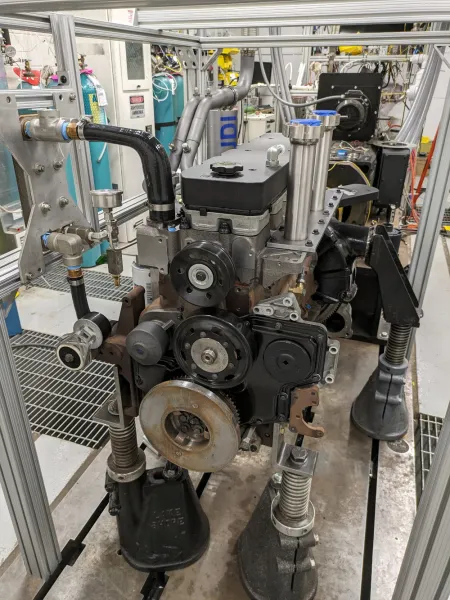
The company’s core technology replaces diesel fuel injector components in common diesel engines used in trucks, earthmovers, tractors, generators and other products.
“We would be able to package the technology so that it can go for a bunch of different engines,” he said.
The company recently received support and funding from the clean energy incubator Grid Catalyst and from Minnesota Energy Alley, a new program managed by Clean Energy Economy Minnesota.
Ammonia has potential advantages as a clean fuel. One is that it’s already one of the most commonly produced chemicals in the world. A global distribution network exists for producing, storing and transporting about 175 million tons annually.
In addition to use as a combustion fuel in certain engines, ammonia could serve as a safe and efficient way to transport hydrogen. Its production can be reversed, splitting off the hydrogen in a process known as “cracking.” Ammonia’s ability to store energy is eight to 12 times higher than the best performing lithium-ion batteries based on measures such as kilowatt hours per kilogram, Kane said.
“Ammonia is just a liquid in a tank,” he said, requiring no wires or cases that batteries require.
Tim Krebs, Aza Power’s chief financial officer, serves on the boards of other ammonia startups and comes from an oil and gas background. After lithium-ion and hydrogen, ammonia will become “the next complement for decarbonizing the world and as a way to move hydrogen around the planet,” Krebs said.
He lists off the potential market: Offroad tractors, mining equipment, bulldozers, locomotives, mining equipment, tractors, backhoes and maritime fleets, especially ferries and tugboats. These kinds of engines can be converted to burn ammonia without great expense, he said.
A variety of market reports are available on the growth of green ammonia and green transportation. ChemAnalyst, which studies industries involved in chemical commodities, suggests in a report that ammonia fuel demand will grow more than 14% annually for use in transportation, power generation and industrial feedstock.
Mike Reese, renewable energy director at the outreach center, believes ammonia could be one of the solutions for fueling machinery and storing energy. Ammonia “is well understood and financeable” compared to other competing technologies such as fuel cells, he said.
Reese said the cost of ammonia needs to decline to be competitive, but it may still cost less than lithium-ion battery technologies.
“Batteries have proven to be very expensive at scale and less is known about the performance,” he said. “I think it’s reasonable to move towards power generation using ammonia in internal combustion engines.”
The size of the entire market remains hard to gauge but Kane provides a glimpse of the generator marketplace. In working with Grid Catalyst, Aza Power has been developing technology to replace diesel in electric generators. That market alone is a “$35 billion to $40 billion globally,” Kane said.
Kane said Aza Power and other startups still need green ammonia from renewable energy to grow significantly from its tiny market share. Even green ammonia, though, creates some emissions. When burned to produce energy, green ammonia can emit nitrogen oxides (NOX) and nitrous oxides (N2O), which have a “global warming potential” 300 times greater than carbon emissions. Improved combustion technologies could help reduce emissions dramatically, he said.
Kane said Aza Power meets NOX emissions set by the EPA for by using mature catalytic formulations. The N20 emissions occur in any fuel combustion but Aza Power’s conversion technology reduced greenhouse gas emissions, including N20, by 80% to 90% over diesel engines, he said. He’s “confident” the number will rise to 98% next year.
Trevor Brown, executive director of the 262-member Ammonia Energy Association, said Aza Power is exploring a potentially lucrative market of industries that will need to decarbonize vehicles and engines. Achieving net-zero emissions will require a portfolio of technologies and ammonia’s global reach and transportability make it a potential solution, he argued. The industry needs policy support to compete with fossil fuels, though.
“There’s no cheaper solution than fossil fuels,” Brown conceded.
Aza Power’s main U.S. competitor is Amogy, a startup with nearly $200 million in venture capital primarily from Amazon’s Climate Pledge Fund. Amogy combines ammonia with fuel cell technology for decarbonizing the transportation sector and has developed an ammonia-powered tractor.
After the Grid Catalyst engagement ends, Aza Power wants to raise seed capital for an 18 month development time to scale their generation technology to bigger engines. It is eyeing other markets, namely locomotives running on diesel, and has a partner with expertise in converting trains to run on alternative fuels.
Kane also sees the mining industry, an important player in Minnesota, as another market.
“Those applications in mining that use big engines where we’re looking at scaling up our conversion technologies,” he said.
RENEWABLES: In northern Illinois and across the nation, waitlists to connect large renewable energy projects to the electric grid have ballooned, leaving over 1,400 gigawatts of wind and solar projects in limbo. (Chicago Tribune)
ALSO:
CLIMATE:
OHIO: FirstEnergy donated $2.5 million to a dark money group backing Ohio Gov. Mike DeWine’s campaign, according to newly released records. (Floodlight/USA Today)
OIL & GAS:
COAL: A St. Louis-area coal plant emitted far more sulfur dioxide pollution than any plant in the country, a news organization’s analysis finds. (Post-Dispatch)
NUCLEAR:
BUILDINGS: A monastery expects to become Wisconsin’s first net-zero retreat center this year after it integrates battery storage and geothermal systems with its existing ground-mounted solar array. (Cap Times)
ETHANOL: The U.S. EPA issues an emergency fuel waiver allowing gasoline blended with 15% ethanol to be sold during the summer despite concerns that it contributes to ground-level ozone in warmer weather. (South Dakota Searchlight)
ELECTRIC VEHICLES: A Minnesota electric vehicle driver has used a website and app to review nearly 2,100 charging stations over the last seven years. (Star Tribune)
SOLAR: The U.S. EPA announces $7 billion in Solar for All grants for 60 projects expanding solar power access in low- and middle-income communities. (Associated Press)
ALSO: California grid operators look to exports, added transmission and battery storage to tame the deepening “duck curve” resulting from a growing solar power glut. (Washington Post)
CLIMATE: The White House launches a website that lists openings and accepts applications for the Climate Corps jobs and training program. (NPR)
MANUFACTURING: The U.S. Energy Department announces the first 35 projects receiving a total of nearly $2 billion in tax credits meant to accelerate clean energy manufacturing and emissions-reducing industrial projects. (E&E News, subscription; news release)
ELECTRIC VEHICLES: Workers at a Tennessee Volkswagen plant that makes electric vehicles overwhelmingly vote to unionize, handing the United Auto Workers a major breakthrough in its push to organize Southeast auto factories. (Chattanooga Times Free Press)
OIL & GAS:
OFFSHORE WIND:
GRID:
OHIO: FirstEnergy donated $2.5 million to a dark money group backing Ohio Gov. Mike DeWine’s campaign, according to newly released records. (Floodlight/USA Today)
POLICY: Maryland environmentalists say they have a lot to celebrate after the state’s most recent legislative session, but also several setbacks, including failed bills to stop trash incineration subsidies and permitting changes to reduce further pollution in disadvantaged communities. (Bay Journal)
ALSO: Maryland’s chief sustainability officer says a budget amendment that delays building efficiency measures would put the state years behind on its climate goals and risk federal funding. (WBAL)
WIND:
HYDROPOWER:
SOLAR:
ELECTRIC VEHICLES:
RENEWABLE ENERGY:
BIOGAS: An anaerobic digester company based in the Boston suburbs aims to hire up to 100 more workers in the next year as it looks toward its goal of opening 100 waste-to-gas facilities. (Boston Business Journal)
BUILDINGS: Federal energy officials grant $158 million in Inflation Reduction Act funds to New York to help homeowners pay for energy efficiency upgrades. (NCPR)
UTILITIES: Although New York’s Assembly is considering a bill to fully municipalize the Long Island Power Authority, state senators have yet to introduce such legislation. (TBR News Media)
INCINERATION: A new documentary highlights the plight and resilience of residents of a suburban Philadelphia city burdened with air pollution from a trash incineration plant. (Philadelphia Inquirer)
OIL & GAS: A $67 million medical claims settlement for cleanup workers in BP’s 2010 Deepwater Horizon oil spill has fallen far short of expectations, leaving the vast majority of workers with no more than $1,300 each for complicated, lasting health conditions. (Associated Press)
ALSO: Congressional Republicans grill a Biden administration official over how the pause on permitting new liquified natural gas export terminals is affecting U.S. allies in Asia and Europe. (Houston Chronicle)
TRANSITION: Health care emerges to account for more than 20% of all jobs in eastern Kentucky counties where coal mining jobs have declined 70% over the last generation, with jobs in educational services, remote work and tourism also growing. (Lexington Herald-Leader)
GRID:
SOLAR: A Georgia-based company strikes a deal to incorporate its monocrystalline silicon solar cells into solar panels made by a Minnesota company, ensuring a source of entirely domestically made solar panels. (Electrek, The Cool Down)
STORAGE: A Virginia commission approves incentives for a California company backed by a $100 million federal grant that’s considering building a lithium-ion battery factory. (Cardinal News)
WIND: “I hate wind”: Republican presidential candidate Donald Trump reportedly rants about the wind industry during a Florida fundraising meal with oil and gas executives. (Washington Post)
GEOTHERMAL: A Texas business park built on a former military airfield unveils a geothermal HVAC system. (KXAN)
CARBON CAPTURE:
UTILITIES:
COMMENTARY:
OVERSIGHT: Hydrogen industry leaders and environmentalists expect the U.S. EPA to exclude hydrogen from its final power plant emissions rule, leaving carbon capture as the only option for gas plants looking to reduce emissions to meet the regulation. (E&E News)
FOSSIL FUELS:
PIPELINES: A major CO2 pipeline leak this month in Louisiana that took more than two hours to fix should raise “alarm bells” about the country’s readiness to expand the carbon capture industry, advocates say. (Guardian)
CLIMATE:
GRID:
WIND:
OIL & GAS:
OHIO: The death of Ohio’s former top utility regulator stokes a growing sense of urgency among plaintiffs and prosecutors to gather evidence and testimony in HB6 corruption cases before it’s lost to time. (Energy News Network)
OIL & GAS: The Biden administration blocks new oil and gas drilling on 13 million acres of the 23-million-acre federal petroleum reserve in the Alaskan Arctic; the ban will not affect the controversial Willow project. (Associated Press)
ALSO:
PUBLIC LANDS:
COAL: California researchers find coal train dust significantly affects the health of people living near rail lines, with underserved communities bearing a disproportionate burden of the impacts. (news release)
UTILITIES:
GRID: California utilities and energy agencies seek $2 billion in federal funding to increase statewide transmission capacity and streamline clean energy interconnections. (Reuters)
WIND: A Washington state energy siting council recommends approval of a scaled-back version of the proposed Horse Heaven Hills wind facility in endangered hawk habitat in the southern part of the state. (Crosscut)
SOLAR:
STORAGE: A 300 MW battery energy storage system comes online on federal land in southern California. (Solar Industry)
GEOTHERMAL: The federal Bureau of Land Management greenlights a geothermal exploratory drilling project in northern Nevada. (news release)
ELECTRIC VEHICLES: Disneyland plans to replace gasoline-powered cars with fully electric vehicles at its Autopia attraction by fall 2026. (Los Angeles Times)
SOLAR: Critics charge that Duke Energy’s revised green tariff program in North Carolina will do little to accelerate new renewable development because it requires large customers to choose from projects among losing bids in the utility’s solar procurement process. (Energy News Network)
ALSO:
ELECTRIC VEHICLES: Construction has stalled on Vietnamese electric vehicle maker VinFast’s planned North Carolina factory after the company revised its plans for a smaller building footprint but hasn’t yet submitted new documents to the state. (Raleigh News & Observer, WRAL)
ENVIRONMENTAL JUSTICE: Republican attorneys general from Florida and 22 other states petition the U.S. EPA to stop taking race into account when regulating pollution. (Floodlight)
GRID:
UTILITIES:
COAL: Democratic U.S. senators in Virginia and West Virginia applaud a new federal rule to more tightly regulate silica dust, which factors into black lung disease. (Bluefield Daily Telegraph)
EMISSIONS:
CLIMATE: Advocates and families of people incarcerated in Louisiana prisons say the state has failed to protect prisoners from extreme summer heat, while officials say they’ve asked for state funding to install air conditioning in two prisons. (Verite News)
NUCLEAR: Virginia lawmakers approve Gov. Glenn Youngkin’s changes to a bill that allows utilities to seek regulatory approval to charge customers for the cost of developing small modular nuclear reactors. (Cardinal News)


.svg)
