

 Back
Back
Blake Herrschaft has plans to fully electrify his Tahoe City, California, home, which runs on a slim 100 amps of electrical service. But even with a hot tub, in an area that sees an average of 15 feet of snow per year and temperatures that dip into the single digits, his house won’t need an expensive service upgrade. “I’ve done the calculations,” he said.
An architectural engineer, Herrschaft manages building electrification programs at Peninsula Clean Energy, a public power agency — also known as a community choice aggregator — in the San Francisco Bay Area. He says he frequently hears people claim at regulatory meetings that electrification rules will force households to undergo electrical service upgrades that many can’t afford; these upgrades can range from $2,000 to $30,000 in the Golden State, according to a 2022 analysis.
But now, Herrschaft and his colleagues have firsthand evidence from a handful of residences scattered across PCE’s territory that homes can be electrified without upsizing their electrical service. Often, 100 amps are more than enough.
In 2024, PCE ran a nine-home electrification pilot for low-income customers in San Mateo County, California, which included five households with 100-amp panels. At no cost to recipients, the agency replaced their fossil-gas and propane appliances with efficient electric ones, using the power the homes already had. Plus, PCE didn’t need to install specialized equipment, such as smart panels, to manage the flow of electricity. After the retrofits, most households saw significant savings on their monthly energy bills.
The results of the pilot program, published in January, demonstrate that home electrification can deliver climate, health, and financial benefits without massive infrastructure costs.
“When you’re working with limited funds, being able to electrify without a panel upgrade is great,” said Cavan Merski, senior data analyst at Pecan Street, a nonprofit research organization that was not involved in PCE’s analysis. It’s “awesome to … see a case study of this working in the wild.”
The findings are especially relevant now as air-quality regulators for the Bay Area, home to more than 7 million, negotiate the details of groundbreaking rules to phase out the sale of gas water heaters and fast-track the switch to heat-pump versions. Over the coming months, officials will weigh final drafts of the regulations and could vote on them as early as October. The rules will take effect next year.
“There’s rampant disinformation going on ahead of the air district rules,” said Pamela Leonard, deputy director of marketing and communications at Silicon Valley Clean Energy, a community choice aggregator in Santa Clara County, California, that partnered with PCE on the pilot. “So we’re really trying to get the word out … In most cases, homes can go all-electric on 100 amps.”
The case study builds on prior evidence that households typically have plenty of play in their existing power supply. In early 2024, PCE found that across more than 700 all-electric single-family homes it analyzed in its service territory, 99 percent of them never drew more than 100 amps of electric current all year. The most common peak demand was 29 amps, less than a third of a home’s capacity.
Still, the pilot’s results come from a small sample size in one county in a temperate region. They may not apply in more extreme climates, according to Scott Hinson, chief technology officer at Pecan Street. Whether a home will typically need electrical upgrades before switching to all-electric appliances and vehicles “is going to be regionally dependent,” he noted.
Households in moderate climes can more easily swap in heat pumps without needing to grapple with weatherization or electrical service upgrades to lower their homes’ energy demands. But even in areas with less hospitable temperatures, the shift is still possible, as demonstrated by the retrofits of a few 100-amp homes in Calgary, Canada.
As Rahul Young, head of community engagement for the electrification advocacy nonprofit Rewiring America, noted of PCE’s pilot, “There will be real value in having … this study replicated in other parts of the country.”
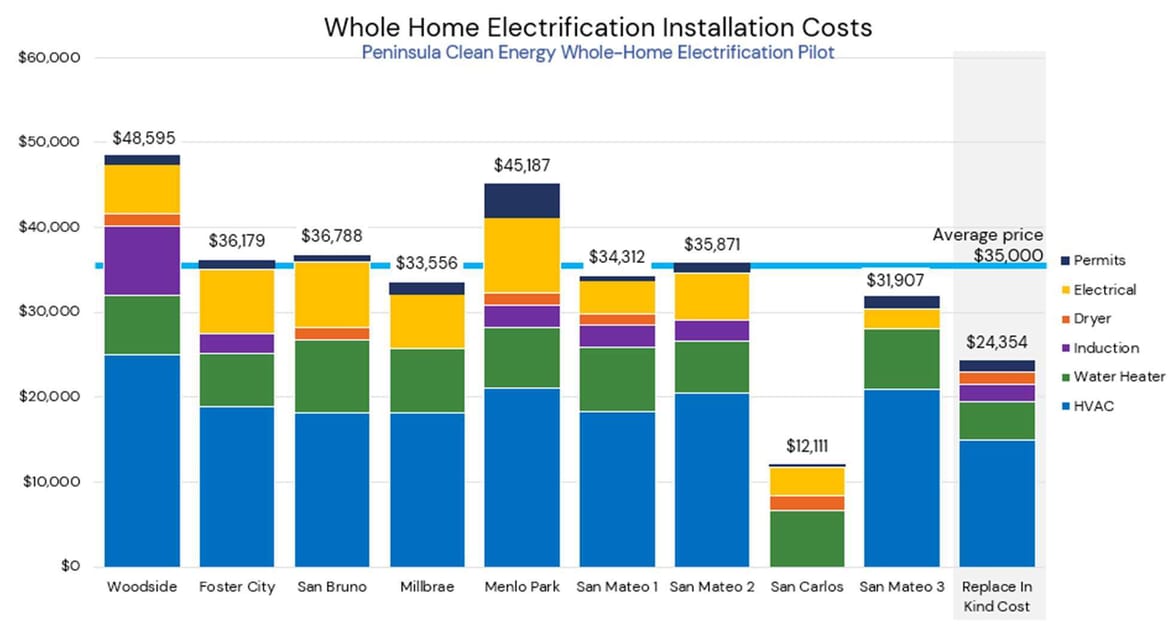
Herrschaft has heard some electrification opponents peg the cost of fully electrifying homes in the $100,000 range, but PCE’s contractor was able to replace fossil fuel–fired furnaces, water heaters, stoves, and clothes dryers with, as needed, heat pumps, heat-pump water heaters, induction stoves, and electric dryers at an average cost to PCE of $35,000 per residence. Like-for-like replacements would have been about $25,000, according to Herrschaft. (Electric-vehicle chargers, which can be part of all-electric homes, were outside the scope of the pilot.)
PCE was able to analyze six households for bill savings; ditching gas cut their energy bills by 20 percent on average. Five saved an estimated $24 to $1,068 per year. The bills for one home rose slightly, but its owners would have seen savings had they chosen a beneficial rate from Pacific Gas & Electric, according to Herrschaft.
Another important takeaway from the pilot: If the retrofitted homes, which were spread across the county, had been in the same neighborhood, their greater electrical demand would not have hurt the grid. Even if they were receiving power from the same distribution transformer, their cumulative increased load would have been “mild” — the equivalent of adding about two hair dryers on full blast, Herrschaft said.
“Home electrification — the home appliances in particular — just isn’t an issue when it comes to the grid in California and nearly every other state,” he said, given their shared climate zones. “I feel confident about that from the [electrical] panel all the way to the transmission line.”
In addition to misconceptions around household electrical capacity, Herrschaft hopes to address the separate issue of how contractors determine how much power a home needs.
To decide the necessary amps, installers do calculations written in the National Electrical Code, which sets safety standards. However, many professionals use methods that overestimate a home’s peak electrical load, Herrschaft said. A major focus for PCE this year will be educating them on other approaches, which are much less likely to trigger an unnecessary service upgrade.
Since finishing the pilot, both PCE and Silicon Valley Clean Energy have launched programs to electrify hundreds of homes in their service territories in the next two years, at no cost for low-income households. PCE has done dozens of home retrofits, and 95% haven’t required service upgrades, Herrschaft noted.
“We found it’s easy to electrify on 100 amps.”


.svg)
