

 Back
Back
This analysis and news roundup come from the Canary Media Weekly newsletter. Sign up to get it every Friday.
Renewable energy’s favorite season has arrived.
Spring is when everything comes together for clean power sources. Days get longer, boosting solar generation. Winter’s blustery winds keep blowing, propelling turbines to their max. And melting snow and heavy rains combine to drive hydropower generation.
Previous springs have shown us just what this wild weather is capable of. In the first week of March 2025, Texas’ power grid, known as ERCOT, set all-time records for wind and solar power production as well as battery storage discharge.
Now, just a few weeks into spring, and with plenty more renewable power generation added in the past year, Texas is once again reaching new heights. On March 14, ERCOT reached an all-time high of 28.7 gigawatts of wind power, according to GridStatus.io. Even more impressive is the state’s solar generation, which has already set multiple records so far this year.
And while Texas is the country’s clean power leader, it’s not the only region with renewable power victories to show. Solar records have been achieved across the Southwest Power Pool, PJM Interconnection, the Independent System Operator New England, and the Midcontinent Independent System Operator this spring. ISO-NE also hit a record level for wind power generation, while MISO reached its pinnacle for overall renewables generation.
And in California, batteries stored a ton of that clean energy, and then set record after record for dispatching it throughout March.
A lot of those records were only made possible thanks to the U.S. adding 26.5 GW of utility-scale solar power generation in 2025, and another 5.7 GW of wind generation. A massive 13 GW of grid battery installations last year helped make full use of those renewables.
There’s an added bonus to all these records happening as the weather starts to warm. Most of us are starting to turn down our furnaces and heat pumps, but haven’t yet turned on our air conditioners. That means overall power demand tends to be at its lowest in the spring, and with renewables at their peak, we need far less fossil-fueled power to pick up the difference.
That confluence resulted in something monumental in March 2025: For the first time ever, fossil fuels accounted for less than half of U.S. power production across a whole month, while clean sources generated the rest. Let’s see if the U.S. can repeat that feat this year.
A global energy crisis is in full swing
Continued conflict in the Middle East is highlighting the risks of relying on fossil fuels.
It’s been five weeks since the U.S. and Israel first attacked Iran, sparking a conflict that has largely shut down oil and gas production and transportation in the region. Domestic natural gas supplies have blunted the blow in the U.S., but much of the world is facing a major energy crisis. Thailand has encouraged workers to ditch business suits to curb the use of air conditioning, while Sri Lanka has implemented a four-day workweek to limit fuel use.
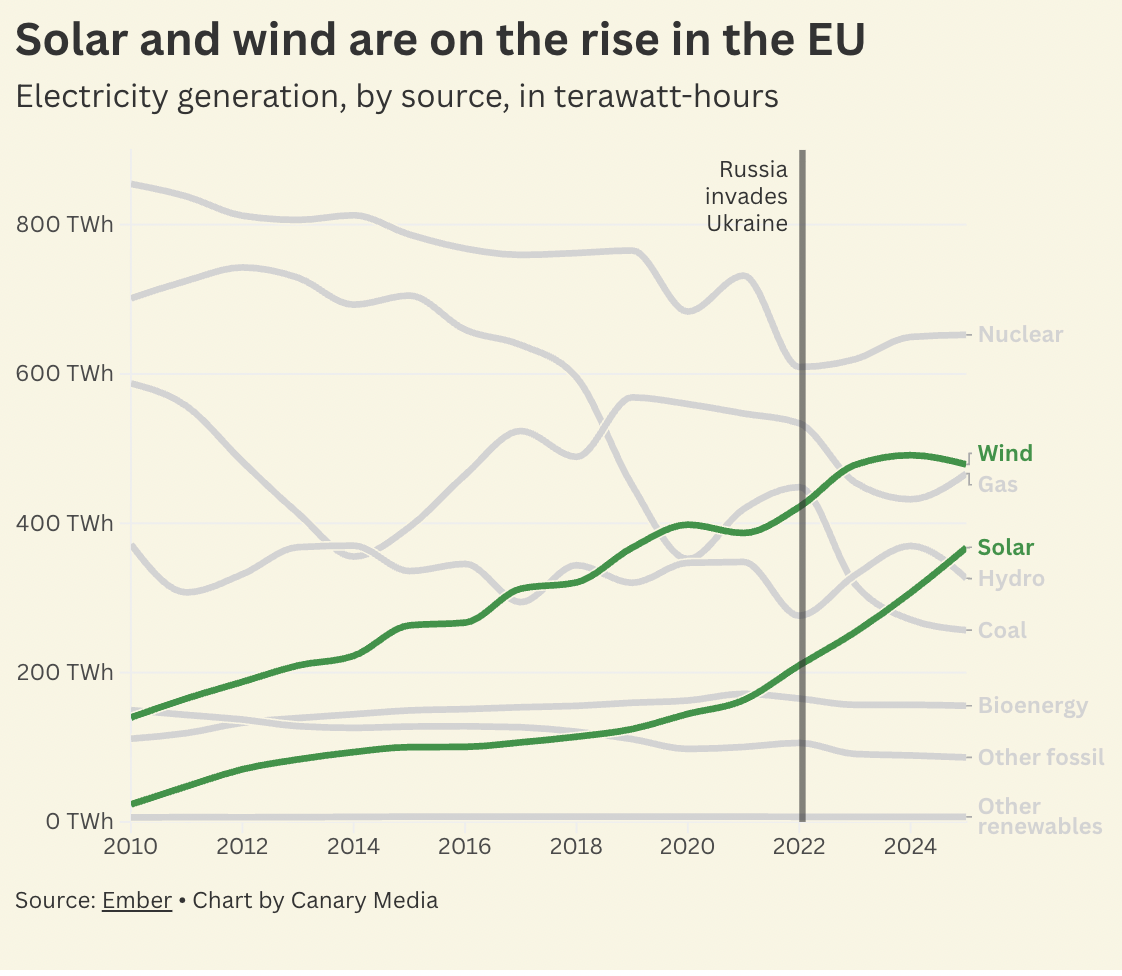
The EU’s energy chief this week similarly urged residents to drive and fly less, and pushed countries to speed their transition to clean energy, saying fossil fuels’ price volatility won’t end even with a resolution in the Middle East. That’s been especially clear in the years since Russia’s 2022 invasion of Ukraine, which spurred the EU to cut off Russian gas supplies and turn its attention toward a solar and wind buildout instead.
Residential electricity price hikes aren’t slowing down, report finds
A new report offers a few explanations for why residential electricity prices are on the rise.
Across the U.S., average prices rose by 33% from 2019 through 2025, the Lawrence Berkeley National Laboratory and the Brattle Group found. That’s a big jump, but it tracks with the rising cost of groceries, housing, and other everyday expenses.
Still, that average hides the fact that some parts of the U.S. are experiencing far more dramatic hikes than others. While 29 states actually saw inflation-adjusted retail electricity prices fall from 2019 to 2025, costs spiked in California, Illinois, New England, and some mid-Atlantic states.
The report credits rising fuel costs, growing power distribution expenses, and storm recovery as some of the biggest drivers behind the power price swell. And with utilities requesting rate increases at record levels, researchers anticipate customers won’t see much price relief anytime soon.
Electrify easier: A new study finds many households can adopt energy-efficient, bill-lowering electric appliances and heating without the need for expensive electric panel upgrades. (Canary Media)
Prepare for extinction: The rarely convened Endangered Species Committee rules that federal endangered species protections will no longer apply to oil and gas drilling projects off the Gulf Coast, exposing the Rice’s whale and other creatures to potential harms. (Houston Chronicle, E&E News)
Fossil fuels’ human toll: A Texas refinery explosion last week damaged homes in a neighboring, largely Black town, revealing the human impact of the Trump administration’s push to ramp up fossil fuel production. (Capital B)
Geothermal heats up: Next-generation geothermal projects have the potential to deliver tons of clean power around the clock, but a need for permitting and safety reforms could slow the industry’s progress. (Canary Media)
No resolution: The Ohio trial of two former FirstEnergy executives accused of bribing a former consultant, who went on to become the state’s top energy regulator, ends in a hung jury, with the state vowing to retry the case. (Signal Ohio)
Stuck in limbo: The fate of more than 300 clean energy projects remains unclear after the U.S. Energy Department announced their grants were canceled without officially de-obligating their funding. (Latitude Media)


.svg)
