

 Back
Back
Twenty-one years ago, the University of Minnesota, Morris, became the first U.S. public university to draw power from an on-site, industrial-scale wind turbine. It added a second one in 2011. Today, the pair — affectionately known as Bert and Ernie — produce more power each year than the semirural campus consumes.
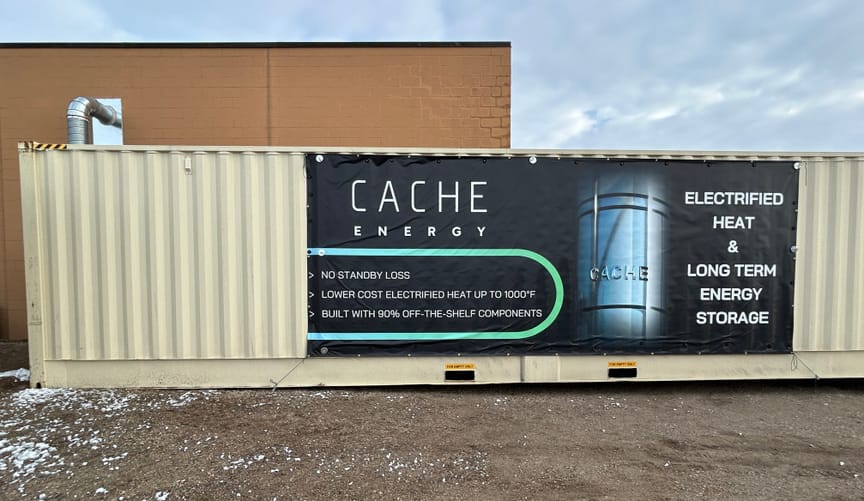
Cache Energy installed its thermal battery at the University of Minnesota, Morris, where it stores energy from the campus’ two wind turbines and releases it to heat a carpentry workshop. (University of Minnesota, Morris)
Twenty-one years ago, the University of Minnesota, Morris, became the first U.S. public university to draw power from an on-site, industrial-scale wind turbine. It added a second one in 2011. Today, the pair — affectionately known as Bert and Ernie — produce more power each year than the semirural campus consumes.
“It’s windy year-round here in western Minnesota,” said Troy Goodnough, the school’s sustainability director.
Together, Bert and Ernie crank out 10 million kilowatt-hours of electricity annually. According to Goodnough, UMN Morris consumes about half the output and sells the rest to the Otter Tail Power Co., the local investor-owned utility. Now, a first-of-its-kind thermal battery pilot is underway that, if scaled up, could help the campus use more of that juice while reducing the environmental impact of the sprawling methane-powered steam-heat loops that keep it cozy through Minnesota’s bitter winters.
Late last month, technicians from Illinois-based Cache Energy arrived on campus to install the battery unit, which transforms electricity into intense heat. Its outlet temperature can reach 1,000 degrees Fahrenheit — more than hot enough to efficiently run a steam heating system.
It took two hours to position the shipping container that houses the unit next to the school’s carpentry shop, and then another few hours to connect the unit to the building’s electrical and duct systems. It powered up on March 24 and hasn’t stopped providing heat since, Goodnough said. Its task is not small, he added: The “warehouse-like” shop has high ceilings and several thousand square feet of floor space.
“The cool thing is it’s doing what it’s supposed to be doing,” he said. “It’s working great.”
The battery unit contains limestone-derived pellets coated in a proprietary binder that keeps them intact throughout their 30-plus-year operating life, according to Cache. When exposed to a stream of moist air, the pellets get so hot they “can be used to make hot air or even vaporize water to make steam,” Goodnough wrote last month. To recharge, the system uses electricity to dry out (and cool down) the pellets.
Ideally, that electricity is cheap, clean, and otherwise at risk of curtailment, said Sydnie Lieb, an assistant commissioner for regulatory analysis with the Minnesota Department of Commerce. Lieb’s agency helps fund Minnesota Energy Alley, a public-private partnership that supports the Cache project and other cleantech demonstrations in the North Star State.
“The most cost-effective place for thermal batteries is going to be where you have a lot of excess energy being produced where you don’t have a lot of transmission or [customer] load,” Lieb said.
Western Minnesota certainly fits the bill. The wind farms that dot the open, rolling landscape here and in neighboring North and South Dakota routinely produce more energy than the grid can handle. The Midcontinent Independent System Operator, the nonprofit that manages Minnesota’s grid, throttled hourly wind generation by an average of 508 megawatts in 2023, according to the U.S. Energy Information Administration. That’s the equivalent of what’s produced by about 160 newish onshore wind turbines. The Southwest Power Pool, which manages the grid for the wind-rich region stretching from North Dakota to the Texas Panhandle, curtailed wind output by an average of 1,097 MW that same year.
Arpit Dwivedi, Cache’s founder and CEO, said low-cost electricity helps make the economic case for customers to invest in thermal batteries rather than stick with equipment that runs on natural gas, which is also plentiful in the United States’ midsection.
“We know gas is cheap,” he said, and that’s a problem for tech developers looking to electrify heat.
Another issue for big energy users, like UMN Morris, is that switching from gas to electric heat means replacing massive, long-lived boilers — likely fully paid for — with new equipment that needs to be leased or financed.
That shift is necessary if the university is going to meet its aggressive climate goals of reducing greenhouse gas emissions by 87% by 2035 and reaching carbon neutrality by 2050, but it could incur a considerable balance-sheet burden. So from the outset, Dwivedi and his team were intent on reducing Cache units’ upfront cost, he noted.
“We knew that if we did not have a low-capex system, we would not have an economic advantage,” he said.
Like other emerging thermal battery designs, Cache’s uses low-cost — if heavy — materials that are widely available in the United States. The primary inputs are steel, lime, and water, all of which Cache sources domestically, Dwivedi said. The proprietary binder that keeps the lime granules stable is by far the most expensive input, so the company focused on keeping that cost in check. Its secret ingredients are available domestically, too, Dwivedi added.
Cache offers its battery as a lease product that it says bundles the battery unit, delivery, installation, maintenance, guaranteed uptime, and takedown “without capital burden.” Just as an automaker leases a passenger vehicle, Cache retains ownership of the battery unit during the lease term, after which the customer has the option to buy it or send it back.
Cache launched in 2022. For its first few years, space heating was a sideshow. Dwivedi and his team were more focused on the technology’s potential to electrify low- and medium-temperature process heat for food, chemicals, and other types of industrial production. To that end, Cache recently conducted a pilot at a Duke Energy testing facility in North Carolina that “[hosts] several interested industrial companies,” the company said last month in a news release.
Cache still works on industrial heat, but it’s also leaning into relationships with large space heating customers, particularly those with existing hot-water or steam infrastructure such as UMN Morris. That includes the U.S. Army, which is interested in the thermal battery’s ability to provide reliable backup for military installations at risk of extended power outages.
Cache was one of nine finalists in a demonstration cohort fielded last year by Grid Catalyst, a Minnesota-based clean energy accelerator that also supports Minnesota Energy Alley.
“Decarbonizing our heating in Minnesota stood out as a value proposition,” said Nina Axelson, Grid Catalyst’s president and founder. Cache’s technology, she noted, “is simple, less costly, and really effective on thermal storage and dispatch.”
Axelson said Grid Catalyst acted as a sort of “energy matchmaker” on the UMN Morris project, connecting university leadership with the Cache team. Front-end engineering and feasibility work required some time, she said, but once the university decided to move forward, it only took a couple of weeks to get the project up and running.
“It’s about as plug-and-plug as you get for thermal storage,” she said.
Dwivedi said that while the Morris system has been charging and discharging five or six times a day, the underlying technology can actually cost-effectively store energy for months on end. That’s a big selling point for customers serious about electrifying space and process heat.
Cache is fresh off a demonstration at an Alaskan industrial site, owned by oil and gas services firm Halliburton, that validated its batteries’ ability to hold heat for a long time in temperatures as cold as minus 40 degrees, Dwivedi said. That’s a critical proof point because the price of electricity — particularly on grids rich in renewables — tends to fluctuate throughout the year, he said. A Cache system could, for example, charge up on cheap power during a sunny, windy period in October, then wait to fully discharge until a dark, still spell in December, when local power prices are likely to be higher.
With a capacity of “several hundred kilowatts,” according to Dwivedi, the unit at UMN Morris is smaller than the industrial-scale ones that Cache hopes to sell at volume in the years ahead. The startup makes units as large as 5 MW and could deliver one to Minnesota in a few months if the university decides to expand the pilot, he added.
“We see this university project as a demonstration of one of the applications of this technology, and we can scale from there,” Dwivedi said.
A scaled-up, multiunit configuration could serve dozens of campus structures with a variety of uses. Some buildings have labs, swimming pools, and dehumidification systems that require heat even in the warm months, Axelson said.
In theory, Cache units could replace gas boilers on the campus steam system and complement a future hot-water loop powered by ground-source heat pumps — an increasingly popular cold-climate heating technology that Grid Catalyst is familiar with through Flow Environmental Systems, another 2025 cohort member that produces commercial-grade systems using low-impact refrigerant. A hybrid system could more efficiently distribute thermal energy between buildings and optimize campus heating in the depths of winter, “when you need all the heat you can get,” Axelson said.
“We are looking at using this as a showcase project so that our utility, industrial, and campus partners can see it in operation,” she said. “It’s hard for folks to be first, but when you do take that first project, you really open the gates.”
As UMN Morris undertakes a comprehensive review of its energy usage, Cache’s thermal batteries are among several technologies that could factor into a “Swiss Army knife solution” for sustainable heating, cooling, and power, Goodnough said.
On paper, it looks daunting to fully decarbonize a campus whose gas-fueled heat network uses three to four times more energy than all its electrical equipment put together, Goodnough said. But the university has steadily added on-site renewable capacity, including a 500-kW solar array that “we think is the largest agrivoltaic field in the Upper Midwest,” he said.
In the not-too-distant future, it could have far more homegrown electricity to play with.
“It’s not inconceivable that Bert” — the older windmill — “could be replaced by a 5-MW turbine,” Goodnough said. If Ernie meets the same fate, UMN Morris would roughly triple its on-site wind capacity. Goodnough believes that would be a tremendous opportunity not only for the university but also for rural communities nearby.
“Out here in rural Minnesota, you see storage everywhere: grain elevators, propane tanks, fertilizer bins,” he said. “The energy transition will demand lots of different kinds of storage. It’s a natural fit for us.”
Stegra has secured the financing needed to complete its flagship green-steel mill in northern Sweden.
The company, formerly H2 Green Steel, said it landed 1.4 billion euros ($1.65 billion) in capital from a group of new and existing investors led by Sweden’s prominent Wallenberg family. The funding will enable Stegra to finish building and commissioning its novel facility in Boden, just south of the Arctic Circle.
The project is a cornerstone of Europe’s broader ambitions to decarbonize its industrial sector and lead the world on lower-emissions technology. Conventional steel mills rely heavily on coal to produce the ubiquitous metal, making them a major source of planet-warming emissions and harmful air pollution.
Stegra’s first-of-a-kind project will instead rely on green hydrogen, which could slash carbon emissions from steelmaking by up to 95%, compared with traditional coal-based furnaces.
The sprawling facility will use giant electrolyzers, powered by the region’s ample hydro and wind energy supplies, to split water molecules and produce the clean fuel. That hydrogen will then turn raw iron ore into lumps of iron, which will be melted and made into steel in electric arc furnaces, also powered by renewables.
Stegra said it expects to initially produce 2.5 million metric tons of steel annually and eventually double its production of the metal.
The ambitious undertaking has hit some serious snags since construction began in 2022. Stegra previously raised some 6.5 billion euros ($7.64 billion) in loans and equity. But in recent months, faced with rising project costs and delays, the firm had been urgently seeking additional financing to address a growing cash crunch.
In October, the French hydrogen investor Hy24 swooped in to help fund Stegra for an undisclosed amount. That still wasn’t enough to stave off financial troubles for the steelmaker, which has batted away frequent rumors that the company and its marquee steel mill were close to collapsing.
With the new investment from the Wallenberg-led consortium, Stegra says it will now ramp up construction activities following several slower months during its fundraising period. As of last fall, the plant was 60% complete.
The company says the project’s timeline is now “under review,” though Stegra CEO Henrik Henriksson said it will take about 18 to 24 months to start producing steel once the facility is finished, the Sweden Herald reported.
Before its financial woes began last fall, Stegra was planning to complete the steel mill by late 2026.
“As an industrialist, you get a little sad if you come up to Boden now, because there is a half-finished steel mill that is running at perhaps a quarter of the speed it should be running,” Leif Johansson, an adviser to the investor consortium, said at a press event this week. The funding lifeline should change that.
The news comes four months after the European Union’s world-first carbon border tax went into effect. The policy makes it more expensive for European companies to import steel from countries that don’t have carbon-pricing systems, like the EU does, all of which should benefit domestic low-emissions steel producers like Stegra.
“We are convinced of the competitiveness of Stegra and the commercial attractiveness of green steel in addition to the climate benefits, while remaining clear-eyed about the challenges that lie ahead,” Johansson said in a separate statement. “We also consider the project to be of great importance to Sweden’s position as an industrial nation.”
Green steel proponents applauded the news of Stegra’s financing round, which is expected to formally close in June after undergoing credit and regulatory approvals.
“Stegra securing the future of its Boden green steel plant is a welcome development that signals the change towards truly clean steelmaking at scale is happening,” Caroline Ashley, executive director of the nonprofit SteelWatch, said in an emailed statement.
Xcel Energy in Minnesota is poised to become the first utility in the nation to build and operate its own virtual power plant.
For the past six months, fans and foes have debated the novel plan, which will see Xcel deploy hundreds of megawatts of small-scale batteries at customer sites across its territory. The Minnesota Public Utilities Commission ultimately approved a version of Xcel’s plan last week.
Under the new program, known as Capacity*Connect, Xcel will spend up to $430 million to deploy up to 200 megawatts of batteries, in 1-megawatt to 3-megawatt increments, over the next two years. It’s a rare arrangement: Almost every other virtual power plant program in the U.S. is organized around third-party companies, like solar and battery vendors or specialized “aggregators,” that tap into energy resources installed and owned by customers.
VPPs, which aggregate distributed energy resources to mimic the output of a traditional power plant, are seen as a key way to get more energy onto the existing grid. By using customer-owned energy resources or small-scale batteries, VPPs can help utilities reduce the need to build or dispatch expensive power plants.
But utilities have been slow to embrace VPPs. In particular, they’ve struggled to use VPPs to avoid grid investments, which have become a key driver of rising electricity costs. Utilities are leery of relying on technologies in customers’ homes instead of equipment they control. And utilities earn guaranteed profits for investments in their grids, giving them an incentive to resist examining cheaper alternatives.
Supporters of Xcel’s VPP program say it could finally provide a durable model for utilities to use distributed energy resources to defer costly grid investments and to more fully utilize the existing grid.
For one, the structure gives Xcel an economic incentive to recoup its investment. But more important, it requires Xcel to establish a metric to assess the value that distributed energy resources bring to the grid — something utilities have historically struggled to measure. If Xcel can create a template, then it will have removed a major stumbling block for broad adoption of VPPs.
“Putting a value on DERs of different types and capabilities to avoid or defer distribution upgrades is a real opportunity — and it’s really hard,” said Will Kenworthy, Midwest regulatory director for the nonprofit Vote Solar. “Xcel has said, ‘We need to put a value on this.’ And the way this program is set up, they have an interest in getting that right in a way they never have before.”
That’s not to say supporters think Xcel’s Capacity*Connect program should be the only VPP option in Minnesota. Many, including Vote Solar, have pushed for the utility to allow third-party companies to participate in the program. Some have expressed disappointment that the commission failed to do so, and there’s still no way for solar installers, battery vendors, and demand-response aggregators to enlist their own customers to help the grid in Xcel’s Minnesota territory.
And plenty of industry groups were outright opposed to the commission’s decision last week. The Minnesota Solar Energy Industries Association, Solar Energy Industries Association, and Coalition for Community Solar Access all criticized the plan and the lack of a third-party program.
As Andrew Linhares, Midwest director of state affairs at the Solar Energy Industries Association, said in a statement, “Competitive markets for energy storage deployment ensure that ratepayers get the best, most affordable deal possible. The Capacity*Connect program takes the exact opposite approach.”
The genesis of Xcel’s Capacity*Connect program is a bit unusual.
It didn’t originate in a broader policy push for VPPs but instead came out of Xcel’s integrated distribution planning. Minnesota’s Public Utilities Commission created that regulatory structure in 2018 with the goal of getting investor-owned utilities to “maintain and enhance the safety, security, reliability, and resilience of the electricity grid, at fair and reasonable costs.” Integrating DERs into the grid is one way to do just that.
But integrating DERs into utility planning processes is a whole new territory. Utilities, Xcel included, have not factored these technologies into how they plan out and spend money on their power grids. This means VPPs can’t yet specifically help offset distribution grid investments.
Instead, almost all existing VPPs target reducing peak electricity demand across utilities’ or grid operators’ entire service territories, as “bulk system” assets, Kenworthy said. That can — and does — save money by replacing the energy that would otherwise come from costly “peaker” power plants. That’s helpful, but it’s solving a different problem than distribution grid costs.
Using batteries and other DERs to relieve local grid constraints is a lot more technically challenging than relying on them to shave power demand during peaks. Utilities need to know exactly what stresses are happening at individual substations and distribution grid circuits from minute to minute. And they need far more confidence that the DERs will respond reliably and consistently to relieve those constraints in order to prevent overloads or blackouts.
Beyond a handful of pilot projects in California, Connecticut, Massachusetts, and New York, very few utilities have begun to experiment with using customer-sited DERs to relieve these kinds of pinpoint grid challenges. “We don’t have a way to do third-party substations,” Kenworthy said.
Xcel Energy spokesperson Kevin Coss said that the utility will work with local businesses, commercial and industrial sites, and nonprofits to install batteries “at strategic locations on the grid” to begin to test how each battery can mitigate local grid constraints. “These batteries will help meet increasing demand for electricity, maintain reliable service for our customers, maximize the efficiency of existing infrastructure, and support local jobs.”
Xcel Energy’s plan for paying for those batteries blurs the distinction between bulk-system and distribution-level values, as the utility’s batteries will serve both functions.
Xcel’s Capacity*Connect batteries will earn revenues for the bulk-system energy and capacity services they provide for the Midcontinent Independent System Operator (MISO), the entity that manages the transmission grid and wholesale energy markets across Minnesota and all or part of 14 other Midwestern states.
Those revenues will allow Xcel to pay back almost the entire cost of deploying the batteries, said Will Nissen, director of policy at the Minnesota-based Center for Energy and Environment, a nonprofit that’s in favor of the program. The utility has estimated that the batteries’ deployment and associated software development to manage them will add from 67 cents to $1.50 per year to a typical residential customer’s utility bill through 2030.
That’s key to the longer-term vision of using these batteries to avoid grid investment. Xcel has said it can’t start calculating the distribution-grid value of its batteries until it has had a few years to study them — the MISO revenues will fund this research.
Capacity*Connect will also get a $50 million investment from Google, as part of the tech giant’s broader deal with the utility to cover the energy needs of its new data center in the state.
“The beauty of this pilot is [that] it pays for itself with MISO revenues, while we learn about all the potential distribution value,” Nissen said. “It’s getting those bulk-system benefits while also studying how to use the distribution system as efficiently as possible.”
The commission ordered Xcel to establish specific estimates of the benefits that its batteries could provide to its grid by November 2027, when its next integrated grid plan is due, Kenworthy said. The commission also instructed Xcel to provide quarterly progress reports.
Vote Solar hopes that these provisions will drive the utility to “put a number on what avoided or deferred distribution investment is worth,” he said. “And we can take that to other forums where we’re trying to value DER and say, ‘This is what this device is worth, if we can do that thing.’”
Not all the stakeholders who have weighed in on the Capacity*Connect proceedings are as confident in that outcome, however.
“We really see this decision as a missed opportunity,” said Shannon Anderson, policy director at the nonprofit Solar United Neighbors, which is part of a coalition sponsoring VPP legislation in multiple states. “There’s no reason you can’t do ‘both and’ here — do what Xcel proposed and do a behind-the-meter VPP program.”
In fact, Public Service Co. of Colorado, Xcel Energy’s utility in that state, is currently rolling out a VPP program that will pay third-party companies that equip customers with batteries, smart thermostats, smart water heaters, smart heat pumps, and EV chargers, Anderson said.
In last week’s decision, the commission did order Xcel to report on how its experience in Colorado could apply to its work in Minnesota. But the commission declined to take up a proposal from a group of stakeholders that wanted it to order the utility to lay out a plan for doing something similar.
Nor does it seem likely that Minnesota’s legislature will order the commission to push Xcel to create a VPP program in the near future, Anderson said. Efforts to pass a VPP bill faltered last year, and similar legislation introduced this year has not passed out of a key committee, she said.
But VPP proponents are not giving up, Anderson said. “There are a number of filings coming, a lot of paperwork to evaluate and justify the program,” she said. “This is just the beginning of the conversation from our perspective.”
Tropical forests span 1.6 billion hectares (6.2 million square miles) of Earth. These ecosystems support a majority of the planet’s animal and plant species and contain plants that contribute to over a quarter of modern medicine. But over the past two decades, an average of 10 million hectares (nearly 40,000 square miles) of these forests—roughly the size of Kentucky—have been lost each year, according to the United Nations Environment Programme, affecting the ecosystems and communities that depend on them.
NASA scientists recently developed a new method for tracking tropical forest loss that delivers deforestation alerts more than three months faster than current methods. Although the technique was designed for the Amazon rainforest, data from a recently launched satellite are expected to expand its application globally.

July 22, 2020
Because tropical forests are so vast, local communities, conservationists, and policymakers rely on satellite data to manage them. Images acquired by satellites with optical sensors provide highly accurate alerts. For instance, the image above, acquired as part of the Harmonized Landsat and Sentinel-2 (HLS) project, shows newly cleared land in southwest Brazil in July 2020. Images from NASA-USGS Landsat satellites have revolutionized land management for over 50 years. In 1988, Brazil developed one of its first satellite-based monitoring systems using Landsat data, which remains in use today.
Though Landsat is an invaluable tool for Earth observation, it has a critical limitation: clouds. As an optical satellite, it relies on reflected light and cannot observe the ground through cloud cover. This creates data gaps that are especially limiting in tropical regions, which are cloudy most of the year. In some areas, months can pass without acquiring a cloud-free image, hindering efforts to track and curb unregulated forest clearing.
To address Landsat’s cloud challenge, researchers at NASA’s Marshall Space Flight Center tuned into a different wavelength. Led by Africa Flores-Anderson, associate program manager for NASA’s Ecosystem Conservation Program, the team piloted a system for the Amazon that combines existing satellite-based approaches with cutting-edge radar data. The approach builds upon a platform developed by the Cardille Lab at McGill University.
Synthetic aperture radar (SAR) doesn’t require daylight or clear skies. To generate an image, SAR instruments beam radar signals at a surface and measure the signals that bounce back. SAR satellites use various ranges of radar wavelengths, or “bands,” to measure features on Earth’s surface. Over forests, the shorter wavelengths of the C-band scatter off treetops, but the longer wavelengths of the L-band can make it down to the ground.
This L-band is central to Flores-Anderson’s approach. Similar efforts favored C-band because it was more readily available than other SAR data. But when felled trees—along with their branches and leaves—are not removed right away, C-band’s shorter wavelengths are scattered by remaining debris, obscuring evidence of destruction. In contrast, L-band’s longer wavelengths can penetrate this material and reveal the damage. The new method is the first of its kind to automatically combine the user-friendly, intuitive images from Landsat and the consistent, detailed insights from L-band SAR data.

These visuals show the benefit of combining optical images and L-band SAR data. The patch of deforested land in southwest Brazil (top row) is overlaid with colors that represent the month that deforestation was detected (bottom row).
The left map shows that SAR detected two patches of forest loss in January (purple), three months earlier than optical sensors (middle map). The patches appear small because deforestation happens gradually, Flores-Anderson explained. At that point in January, only those areas had been cleared.
By April (green), optical sensors had detected forest loss across a wider area, shown in the middle map. These sensors collect images every few days, while the SAR data used in this study captured the area only once or twice a month. In this case, the optical satellites observed the change during a break in the cloud cover.
The map on the right shows how the new algorithm combines information from both types of observations. To increase accuracy, this algorithm confirms deforestation only if there are multiple, consecutive observations of forest loss. This view confirms deforestation as early as February, up to two months earlier than optical-only, and with much more certainty than the optical- or SAR-only approaches.
On average, the new method for monitoring forests spots felled trees within 16 days with exceptional accuracy, nearly eliminating false alarms. These detections can identify deforestation in very cloudy regions up to 100 days sooner than optical-only systems.
“In the tropics, it’s important to detect deforestation as soon as it occurs,” Flores-Anderson said. “If an image of a cleared forest isn’t available until the following year, the area may already be regrown, and deforestation will be missing from our data.”
For experts like Sylvia Wilson, the chief forest and climate scientist at Wilpa Capacity Development with nearly 20 years of global forest monitoring experience with the U.S. Geological Survey, adding L-band SAR to optical is a scientific game changer. “L-band SAR gives us the opportunity to see what optical doesn’t,” Wilson said. “But it’s not one sensor versus the other; the future is SAR plus optical."
The NISAR (NASA-ISRO Synthetic Aperture Radar) satellite, launched in July 2025, will drastically increase the feasibility of systems like Flores-Anderson’s by providing more frequent and comprehensive L-band SAR data. L-band data has been relatively scarce, with limited images only available in a few areas like the Brazilian Amazon. Once more NISAR data become publicly available, they will provide free, global L-band SAR every 12 days. Flores-Anderson’s system is already prepared to incorporate this data.
“It doesn’t matter which sensor we get data from—whether it’s optical or SAR—it automatically adds to our model,” Flores-Anderson explained. “As more NISAR data become available, we will have more accurate, faster detection of change.”
NASA Earth Observatory images by Michala Garrison, using MODIS data from NASA EOSDIS LANCE and GIBS/Worldview, the Harmonized Landsat and Sentinel-2 (HLS) product, and model data provided by Flores-Anderson et al. Story by Lena Pransky (EarthRISE) with Jake Ramthun (EarthRISE) and Madeleine Gregory (Landsat Project Science Support).
As carbon dioxide levels hit record highs, scientists are testing new ways to fight climate change by locking it up in our oceans. On assignment for Climate Central, Correspondent Ben Tracy explores groundbreaking experiments using “antacid” chemistry to expand ocean carbon dioxide (CO2) storage and keep it out of our atmosphere.
Remell Bryant fed steel coils into the “cold strip” as a way to support her daughter as a single mother.
Valerie Denney worked on the “pickle line,” removing impurities from hot steel, before shifting to a career in public relations.
Jack Weinberg tested metallurgical content until he was laid off, then went on to negotiate international environmental treaties.
Terry Steagall played on the banks of a polluted river near the steel mill as a child, then spent 41 years inside the mill as a machinist, repairing gearboxes, cranes, and line shafts, before retiring in 2023.
Now, the four are collaborating to demand a shift away from coal-based steelmaking and toward cleaner methods for the Northwest Indiana industry in which they once worked. They’re all members of Gary Advocates for Responsible Development (GARD), a grassroots group founded in 2021 by former steelworker Dorreen Carey.
Such a transition could save thousands of jobs, create new economic opportunities, and avoid about $75 million in healthcare costs in the region, according to a report released Thursday by the Indiana University Environmental Resilience Institute and the consultancy 5 Lakes Energy, and commissioned by Indiana Conservation Voters.
Only six integrated mills — facilities that produce both steel and the iron needed to make it — are operating in the United States, and three of them are in Northwest Indiana. With their hulking, polluting blast furnaces, these mills may soon become a thing of the past in the U.S., as steel is increasingly being produced in smaller and cleaner operations, frequently in the Southern states.
The GARD organizers echo the report’s authors and other industry experts in warning that if Indiana’s mills don’t modernize and clean up, they could go the way of the other steel mills that once proliferated in the region, but were shuttered during the steel industry crisis of the late 1970s and ’80s. The region still hasn’t recovered from that era, and further closures could mean thousands of job losses and gutted public coffers. The report notes that Northwest Indiana’s steel mills once had more than 65,000 workers but employ only about 9,000 today. Without modernization, the study estimates, Northwest Indiana steel mill jobs could fall below 5,000 by 2034.
Converting a traditional integrated mill to much-cleaner direct reduced iron (DRI) technology costs billions of dollars, and the Biden-era incentives that could have encouraged companies to make the switch were eliminated by the Trump administration. It’s a hard sell, but GARD considers global steelmaker Nippon Steel’s 2025 acquisition of U.S. Steel’s Gary Works mill, in Gary, Indiana, an opportunity.
Steagall said he “didn’t see a pathway” to green steel until the Japanese company entered the picture.
Nippon plans to allocate $3.1 billion for upgrades to Gary Works. About $300 million of that will go toward relining its largest blast furnace — which will extend its life for about another 20 years. The company could use some of the remaining money to replace the mill’s three other blast furnaces with a DRI plant, GARD proposes in a recent report.
It would cost about $3.6 billion to transition Gary Works to cleaner steelmaking, according to the Indiana University report. Modernizing the area’s other two mills, both owned by Cleveland-Cliffs, would cost $2.8 billion to $3 billion each. That’s in line with what the companies have indicated they will spend to maintain those operations.
In a February earnings call, Cleveland-Cliffs announced that it is planning to reline an Indiana blast furnace next year. The company had in fact proposed a DRI conversion at one of its Ohio mills, but backed off the plan after Trump took office in 2025.
Advocates note that the crucial technologies needed for green steel — DRI and electric furnaces — already exist at commercial scale, and efforts are gaining steam globally to combine the two. Many existing DRI plants use natural gas, which results in much lower emissions than the coal that fuels blast furnaces. But using green hydrogen — produced by splitting water atoms using renewable electricity — would slash emissions even further.
The national climate research groups RMI and Industrious Labs are also touting the feasibility of greening the nation’s integrated steel mills. An RMI analysis shows that such overhauls cost roughly the same as relining and upgrading existing infrastructure.
The biggest challenge may be convincing company leaders to make a major change in an industry that “has never been known to move quickly,” as Steagall put it.
In an integrated steel mill like Gary Works, iron is added to a blast furnace, where it undergoes chemical reactions involving limestone and coke — a baked-down, concentrated form of coal. Molten iron is then converted to “primary steel” in a separate stage. This process results in the type of high-quality, flat-rolled steel suitable for automobiles and buildings.
But it is highly polluting, with about 2 million metric tons of carbon dioxide released for each ton of steel produced globally, along with high levels of particulate matter, sulfur dioxide, nitrogen oxides, and other pollutants.
The fortunes of Gary Works and other integrated steel mills declined starting in the late 1970s because of slowing demand and competition from abroad, including from “mini-mills,” which use electric arc furnaces to make steel — mostly from scrap metal — without producing any iron on-site. Integrated mills in Indiana, Illinois, Ohio, and Pennsylvania downsized their operations and then closed over several decades, transforming thriving cities into Rust Belt relics. Nationwide, steel sector employment fell from about 512,000 in 1974, according to a study by the National Bureau of Economic Research, to about 85,000 today, according to Federal Reserve Economic Data.
“Republic Steel, Bethlehem Steel, J&L Steel, they all shut down or were liquidated,” said Weinberg, who worked for eight years in Gary Works’ sheet and tin division.
Though the Gary Works mill survived, its workforce was greatly reduced – from more than 30,000 people at its peak in the 1970s to about 4,300 people today. By the 2010s, the city was notorious for its abandoned buildings and urban decay.
As GARD organizers see it, without investments in clean steel, Gary’s fortunes could fall further. The plant’s market niche — high-quality primary steel — is vulnerable to competition from the electric arc furnaces that make at least 60% of the country’s steel today.
Facilities using electric arc furnaces have typically not produced the highest-quality steel, mainly owing to their reliance on recycled steel scrap. But they do still require at least some virgin iron to produce steel, which can come from integrated mills or from on-site DRI facilities. Automakers typically demand steel made in integrated mills, but electric arc furnaces could increasingly compete for that market as their steel quality improves.
Big River Steel, along the Mississippi River in Osceola, Arkansas, is a prime example. Its electric arc furnace uses iron from Gary Works to make high-quality steel. U.S. Steel acquired the mill in 2021, and now it’s part of Nippon’s portfolio. Nippon announced in November that it will build a DRI plant at Big River, which would potentially displace the metal it currently sources from Indiana.
So, such electric arc furnace operations could become competitors, rather than customers, of integrated mills like Gary Works. And they could gain a market advantage if automakers and other industries demand a cleaner supply chain, as GARD and other decarbonization advocates predict.
Nippon lags behind most of its peers globally in its readiness for greening operations, according to a scorecard released March 30 by the international climate advocacy organization SteelWatch. The organization analyzed the decarbonization progress and potential of 18 major steel companies in 29 countries and found that Nippon ranked 17th; U.S. Steel, which was ranked before the acquisition, came in eighth; and Cleveland-Cliffs was sixth. While U.S. Steel could help facilitate Nippon’s decarbonization, SteelWatch said, the plan to reline rather than convert the Gary Works blast furnace represents a “backward trajectory.”
There’s a strong public health argument for greening the mills.
Emissions from blast furnaces are linked to an increase in various cancers, asthma, pulmonary disease, and other ailments. Industrious Labs found that in 2022, Gary Works emitted 182 tons of 24 different toxic chemicals. The health impacts are also a clear environmental injustice: 97% of those living within a three-mile radius of Gary Works are people of color, and almost two-thirds are low-income, according to Industrious Labs’ analysis.
Indiana University’s report found that Gary Works annually emits eight times more carbon monoxide and 50% more particulate matter than the state’s largest coal plant; and the region’s three primary steel mills account for not only the $75 million in healthcare costs but also 27,8000 work days and 26,700 school days lost to illness each year.
GARD member Natalie Ammons did not work in the mills, but her husband did. And she blames the Gary Works blast furnace for his early death from cancer.
Her family’s health problems have continued. Two of Ammons’ granddaughters, both of whom live near the mill, rely on breathing machines that look like scuba apparatus, she said. Modeling done by Industrious Labs using federal algorithms shows up to 114 premature deaths and over 31,000 asthma attacks linked to pollution from Gary Works each year.
Bryant retired from Cleveland-Cliffs Indiana Harbor refinery about four years ago, because she had developed a nodule on her thyroid that impeded her breathing. She attributes it to her exposure to pollution there.
“I was always super healthy. It is odd that happened shortly after I worked a lot of overtime in the lime plant,” she said.
Steagall cites examples like these in calling for Nippon to be “a good corporate citizen” for its American neighbors.
“They’ve got to make their mind up,” he said. “Do they want to be the king of steel or the king of death?”
Nippon has not responded to GARD’s proposals and requests for dialogue nor to a request for comment for this story.
The United Steelworkers union, which the GARD members once belonged to, has similarly not engaged with them. While GARD notes that unions are often reluctant to consider any changes that could disrupt the job market, it warns that the shift to mills in the South with electric arc furnaces could be disastrous for the union — as those plants are typically not unionized. (United Steelworkers did not respond to a request for comment.)
At a recent symposium at Purdue University Northwest, students and faculty clamored to hear more about GARD’s vision for the industry’s future. After the event, the GARD members gathered around a table and reminisced about the jobs they used to do. Their eyes lit up describing the complexities of the steelmaking process.
The metal “runs through a big acid bath, then we cut it to specification,” Denney said of the pickle line where she had worked. “At the end, they oil it, and you have this beautiful, very shiny, gorgeous steel.”
Gary itself could be similarly transformed, through clean steel, she imagines.
“People are used to Gary being kind of a throwaway city,” she said. “It’s all bad. There’s an opportunity for it to be all good now for the first time in a while. Nippon could be part of this change. It could be part of changing Gary forever.”
Maria Gallucci contributed reporting for this article.
A clarification was made on April 2, 2026: This story has been updated to clarify that direct reduced iron plants and electric furnaces exist separately at commercial scale.
Small, sun-driven power plants could soon be coming to backyards and balconies across New England. Lawmakers in all six of the region’s states are considering bills that would allow residents to take advantage of solar panel kits that plug in to standard home outlets, and supporters are optimistic that most — perhaps all — of these measures will succeed.
“As a concept, plug-in solar has a lot of momentum going on right now,” said Connor Yakaitis, deputy director of the Connecticut League of Conservation Voters. “It’s got bipartisan momentum. It’s got interest and intrigue from the utilities.”
Maine’s legislation is close to final passage, and could land on the governor’s desk as soon as next week. Stand-alone measures in New Hampshire and Vermont have each been green-lit by one legislative chamber. Plug-in solar provisions are part of a sprawling energy bill approved by the Massachusetts House of Representatives and working its way through the Senate. In Connecticut, permission for plug-in systems is part of a larger solar bill that has advanced out of a joint committee. Rhode Island’s bill has been held for study by a House committee.
“I am optimistic the bill will get passed,” said Sam Evans-Brown, executive director of Clean Energy New Hampshire, one of the organizations pushing the legislation in the Granite State. “We’re going to be able to come up with language that works for everybody.”
New England is not alone in its enthusiasm for plug-in panels, also commonly called “balcony solar” or “portable solar.” Interest in DIY solar is surging across the country, as escalating energy prices have people — and their elected representatives — searching for ways to lower their bills. Spiking oil prices caused by the Trump administration and Israel’s war with Iran are further heightening cost concerns.
Plug-in solar’s money-saving potential is attracting support from both sides of the aisle. In March 2025, deep-red Utah became the first to authorize the technology. A year later, similar legislation has passed in Virginia and awaits the governor’s signature, and bills are active in more than 20 other states, including some decidedly right-leaning places like Idaho and Oklahoma.
“We think this has taken off because people are thrilled about saving money and having some power to insulate themselves from rising energy bills,” said Cora Stryker, co-founder of Bright Saver, a nonprofit that promotes plug-in solar. “Crucially,” she noted, the legislation “has no fiscal implications. The price tag is zero.”
The matter is perhaps even more pressing in New England, where electricity prices are higher than almost anywhere else in the mainland United States. Homes in the region depend heavily on oil and natural gas for heating, exposing residents to high and volatile fuel prices.
“We are looking for any possible way to bring energy bills down for my constituents,” said Rhode Island state Rep. June Speakman (D), the House sponsor of her state’s balcony solar bill.
Balcony solar has taken off in Europe — most notably in Germany — over the past few years. The systems can be purchased online or from major retailers, like Ikea, and assembled at home. They plug in to a standard exterior outlet and send energy into the wires, rather than drawing electricity out, generally producing about enough power to run a refrigerator.
Plug-in solar systems are modestly sized, which means they can fit into most any sunny spot — from a well-lit backyard to an apartment-building balcony. The kits are relatively low-priced; today, they average about $3 per watt, according to Bright Saver, and the cost is likely to fall by about half once at least five states authorize their use. These prices make them accessible to consumers who can’t afford the upfront cost of rooftop solar panels. Also unlike rooftop solar, these systems can be installed without help from an electrician or approval from a utility company, which means they are an option for renters as well as homeowners.
“It’s not only empowering, but it’s also easy, and it’s so much cheaper,” Stryker said.
In the U.S., balcony solar has inhabited a sort of regulatory gray area, neither prohibited nor expressly authorized by law. The crop of bills working through state legislatures attempts to fix that problem. Provisions vary from state to state, but all the New England measures would allow residents to install systems up to 1,200 watts without utility approval or interconnection agreements. The new rules would also require the solar equipment to be certified by a national safety testing organization, like UL Solutions, which launched a testing program for these systems earlier this year.
In addition to laying out practical rules, these bills could have a more intangible impact, supporters say. They let residents know that plug-in solar is a viable option, not just a questionable technology the internet is trying to sell you.
“Legislation sends a signal that not only is this a thing that’s available on Temu — it’s also a thing you can and should consider buying,” Evans-Brown said.
Illinois could soon follow in the footsteps of Utah and Virginia with a law allowing plug-in solar arrays, often called “balcony solar.”
A bill that would make it simpler to install plug-in solar passed out of the state legislature’s Senate Energy and Public Utilities Committee on March 12. It’s now scheduled for a hearing in the full Senate, and a House committee on utilities is also considering the bill. Advocates are hopeful that the measure will pass both Democratic-controlled chambers this legislative session, which runs through the end of May, and then be signed by the state’s Democratic governor, JB Pritzker.
People are already plugging in these kinds of off-the-shelf small solar arrays to help power their homes, experts say. But legislation would ensure that more people can access the cost-saving clean power. Illinois’ bill would mandate that utilities allow people to plug in solar systems of up to 1,200 watts, without interconnection agreements, fees, or other barriers. That’s about enough energy to run a refrigerator and a few other appliances.
In Illinois, such units could save households up to $400 a year, according to an analysis by the advocacy group Solar United Neighbors, which notes that plug-in solar currently costs about $3 per watt, or about $2,000 for a typical model. Advocates predict that the cost will come down quickly if more states pass plug-in solar laws and the market expands.
More than two dozen other states are considering such bills. The concept has enjoyed bipartisan support across the country, with Utah’s Republican-dominated legislature passing the first law in March 2025. The Virginia legislature passed its law by a unanimous vote on March 11. Illinois’ red-state neighbors — Indiana, Iowa, and Missouri — have also introduced bills.
The momentum comes as affordability concerns mount nationwide. Electricity prices have spiked in many parts of the country, driven by factors including extreme weather and wildfires, natural gas price fluctuations, and the cost of infrastructure to get power where it’s needed. In Illinois, customers are seeing their bills rise sharply because of increasing electricity demand that is driven in part by data centers.
Illinois’ plug-in solar measure would go a step further than most by stipulating that homeowners’ associations and landlords could not enact rules, fees, or insurance requirements around arrays of 391 watts or less, proponents say. This would ensure that renters and condominium owners could take advantage of the option.
Despite the fast-growing enthusiasm for plug-in solar, some bills, like one in Wyoming, have failed. Utilities have raised safety concerns, such as danger to lineworkers if the arrays don’t shut off during power outages and continue sending electricity onto the grid, or a home’s electric system becoming overloaded.
Plug-in solar proponents note that safety concerns can be managed, especially through legislation that requires specific certification, as the Illinois bill does.
“This is a disruptive technology to the American market, and all disruptive technologies are good for the consumer and bad for the power structures,” said Cora Stryker, who co-founded the nonprofit organization Bright Saver last year to sell affordable plug-in solar kits. “We believe these are strategic efforts to confuse legislators and the public, but the real motivation is the threat to the business models of very powerful entities.”
The Illinois bill would mandate that plug-in solar systems not send any electricity into the home when the larger grid has an outage. That means the panels wouldn’t help during a blackout unless paired with a battery, but they would avoid harming lineworkers. Arrays that are commercially available already typically include such safeguards as part of the built-in microinverter.
The Illinois bill would also require that plug-in units be certified by UL Solutions (formerly Underwriters Laboratories) or an equivalent entity.
Hannah Birnbaum, co-founder and chief of advocacy at the nonprofit Permit Power, which focuses on reducing the bureaucracy involved in getting rooftop solar, said that it’s crucial to pass laws that include these sorts of safety provisions. Otherwise, people will continue to install unregulated systems, she said.
In California, for example, customers are already “quietly” using portable solar panels — even though the state has yet to pass the plug-in solar bill it’s considering.
“The real risk is inaction,” Stryker said. “Now there’s so much enthusiasm for plug-in solar, people are buying whatever systems they can get. It’s a regulatory gray area.”
In Illinois, utilities have thus far not raised opposition. ComEd spokesperson David O’Dowd said the utility does not have a position on the bill. Ameren did not respond to a request for comment.
Should the bill pass in Illinois, it would add to the state’s already robust incentive program encouraging residents, businesses, churches, schools, and other nonprofits to get rooftop solar. Clean energy advocates say plug-in solar provides a more affordable and convenient option, and one that’s accessible to both renters and those whose homes aren’t conducive to rooftop solar.
“It’s an untapped resource” in meeting larger clean-energy goals, according to Nick Johnson, an associate professor of sustainability and economics at Principia College in southwestern Illinois. Johnson was among over 100 residents who filed witness slips with the legislature in support of the bill.
“It’s a drop in the bucket for what we need, but every little bit helps,” he added.
In Germany, more than a million households have plug-in solar — a fact often underscored by advocates trying to popularize the technology in the U.S., where it’s still in the early stages. Even in Utah, only a few thousand households have plugged in the devices since they became legal.
Advocates expect the systems will take off once more states make it simpler for people to adopt them.
For her part, Kavi Chintam, Illinois campaign manager for the advocacy group Vote Solar, said she plans to put a plug-in solar array in her yard after the law passes. Her mother wants a solar array on her balcony, to power her TV.
“At a time when electricity prices are rising and rising, it gives an option for people to shave off some of that cost,” Chintam said. “There is something really empowering about seeing a panel you installed on your home. As the market expands, there will be more opportunities for people just to see these things out and about.”
See more from Canary Media’s “Chart of the Week” column.
Clean energy is on a tear. In China and India, it’s growing so fast it’s starting to unseat king coal. In the European Union, solar and wind now produce more electricity than do all fossil fuels combined. Even in the U.S., amid the Trump administration’s attacks on clean energy, nearly all new power capacity comes from renewables and batteries.
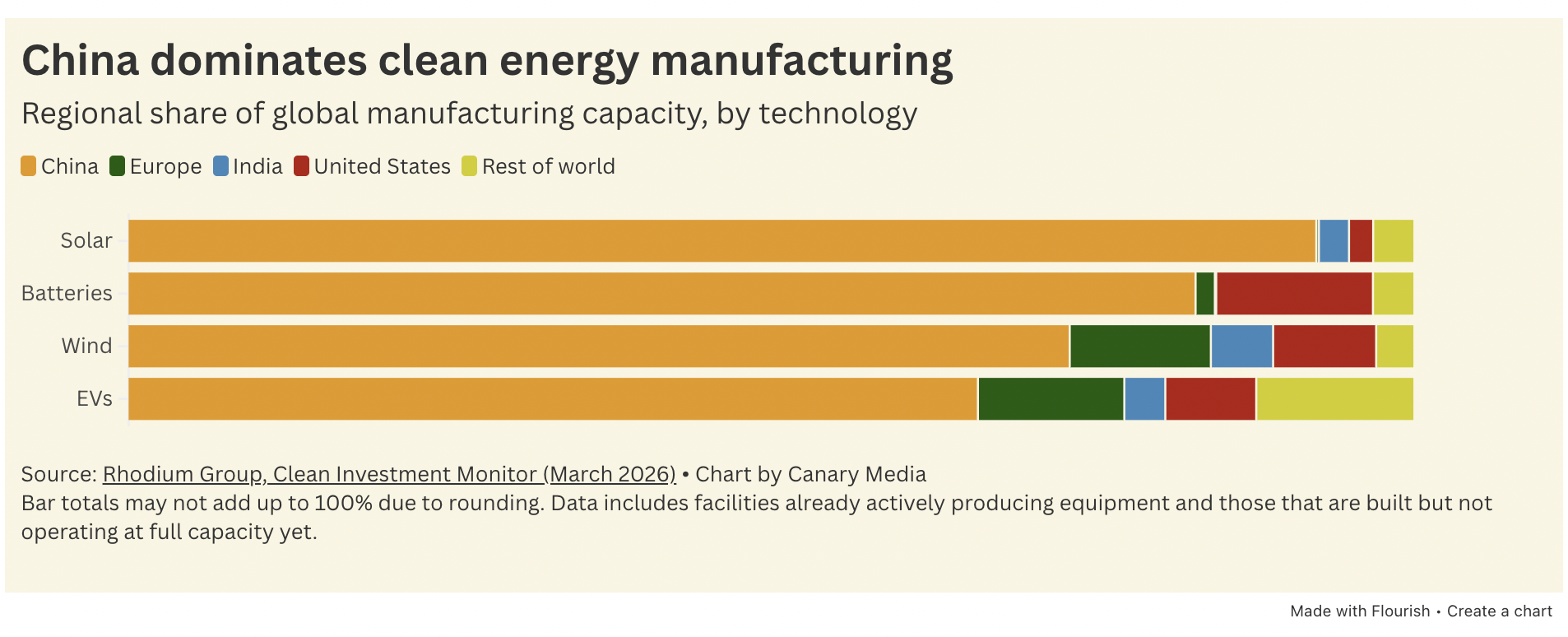
But who, exactly, is making all of the solar panels, wind turbines, battery packs, and electric vehicles enabling this transition?
In a word: China. Let’s look at the latest numbers from the Clean Investment Monitor by Rhodium Group and the Massachusetts Institute of Technology. Right now, over 90% of the world’s solar manufacturing capacity is in China. So is 83% of the planet’s battery production capacity, and nearly three-quarters of wind technology manufacturing capacity. China’s grip on the EV sector almost looks measly in comparison, at just two-thirds.
China’s lead is explained by several factors. For one, the country itself uses way more clean energy tech than does any other, due not only to its massive population but also Beijing’s concerted effort to make the nation more self-sufficient on energy. Last year, more than half of the solar and wind installed worldwide plugged into China’s grid. The country dominates global EV adoption, too.
But China also exports enormous amounts of these technologies. The country’s expansion of manufacturing to meet its own domestic energy goals has allowed it to produce super-cheap solar panels, batteries, wind turbines, and EVs. That’s made clean energy more attractive to buyers in other countries.
But China’s investment in these factories is contracting, hard. Last year, it invested $60 billion in cleantech manufacturing overall — less than half of what it put in the year before. In 2023, it spent $50 billion on clean energy manufacturing in a single quarter. Investment in clean energy manufacturing has been sluggish in the U.S. and Europe, too, for what it’s worth, but it’s not crashing at anywhere near the same rate.
China is pulling back for a pretty intuitive reason. It’s already built more clean energy manufacturing capacity than the world wants to use at the moment. The Clean Investment Monitor team expects this mismatch to get even worse by 2030, so as it stands, it makes little sense for China to continue speeding ahead on new factory construction.
Overall, the clean-energy manufacturing picture could look a bit different by the end of this decade — but only by a little. Even with the U.S., Europe, India, and others expected to make some headway in the battery and EV markets, China’s lead ultimately isn’t expected to go anywhere.
Breaker boxes can be a hidden stumbling block for households looking to go electric. Many of these devices are too small to support the electrical needs of a home plus the addition of an EV charger, a heat pump, and other power-hungry appliances. But upgrading them can take lots of time and money.
Smart electrical panels — smartphone-controllable versions of the electromechanical devices found in most homes — could help solve this problem. While more expensive up front than the old-school gear they’re replacing, smart panels don’t require complicated utility upgrades — and they may be able to save homes and businesses money in the long run.
Leading smart-panel startup Span and major electrical-equipment manufacturer Eaton just announced a strategic partnership to try to boost adoption of the devices. Eaton will also make a $75 million investment in the San Francisco–based startup, which has now raised a total of nearly half a billion, including a $176 million Series C last month.
Eaton, which reported $27.4 billion in revenue last year, will tap its extensive distributor and installer networks to promote Span’s devices. These range from sleek, iPhone-shaped electrical panels aimed at high-end homes with complex electrical-management needs to devices designed for smaller homes, multifamily buildings, and small commercial properties.
Eaton also makes its own version of smart controls in the form of digital circuit breakers, which are the individual devices that plug into slots in standard electrical panels to prevent household circuits from overloading. Those AbleEdge devices are used in control systems from home battery vendors including Tesla and Lunar Energy, and are a core building block of Eaton’s “home as a grid” business strategy, Paul Ryan, vice president and general manager of the company’s energy transition business, told Canary Media.
“Homes are becoming more electrified. EV adoption continues to increase. That all puts a stress on the home and on the grid,” he said. “We have to manage our power more effectively.”
Homeowners who want to electrify may need to upgrade their electrical panels or pay for even more expensive utility-grid upgrades. Instead, smart panels and circuit breakers can actively shift and throttle appliances — like EV chargers and clothes dryers — to keep loads within safe limits, saving tens of thousands of dollars per home, Ryan said.
The smart panels can also generate savings if they’re used to manage the flow of power from rooftop solar panels, batteries, and backup generators on household circuits, he said. Currently, that job is performed using complicated combinations of traditional electrical gear.
These potential benefits have driven a wave of companies to invest in the sector. Along with Eaton and fellow electrical-equipment manufacturers Schneider Electric and Leviton, these include startups like Lumin and vendors of solar energy systems, batteries, and backup generators like FranklinWH, Generac, and Savant.
Span’s smart electrical panel was one of the first to hit the market in 2019, and the first to earn certification under the UL 3141 power control systems standard offered by Underwriters Laboratories, the premier standards-setting body for electrical equipment. Before Eaton, the company had also picked up partners including leading U.S. residential solar and battery installer Sunrun, utility smart meter and communications giant Landis+Gyr, and major U.S. homebuilder PulteGroup.
Span CEO Arch Rao told Canary Media that the startup will continue to operate independently while co-branding its smart panels under the Eaton label.
“They’ve come onboard not just as an investor but as a key partner for scaling our products in the market, particularly in the residential ecosystem,” Rao said. “We’re able to support electrification of all types of existing homes with main-panel replacement, subpanels, load controls, EV charging, and heat pump integration.”
Just as important, Ryan said, Eaton has “expansive manufacturing capabilities and a very strong supply chain. We’ll be collaborating together to help drive down the cost of these solutions and make it more affordable.”
That last point addresses the big question mark for smart panels and circuit breakers: cost. Span’s marquee smart panel retails for about $3,500, well above the $1,000 to $2,500 all-in cost of installing a traditional electrical panel.
In general, digitally enabled panels and circuit breakers cost roughly twice as much as old-fashioned electromechanical equipment does. The price differential has been a barrier to more widespread adoption of these kinds of products, which have already seen one major contender exit the market. Schneider Electric, the French electrical-equipment giant that competes with Eaton in global markets, recently discontinued its Schneider Pulse smart panel.
Other technologies could well offer a cheaper route to doing what smart electrical panels do, according to Ben Hertz-Shargel, global head of grid edge at research firm Wood Mackenzie. In a 2024 opinion piece, he highlighted options ranging from next-generation utility smart meters to controls embedded in EV chargers, batteries, and electric appliances themselves.
“Low-cost smart meters with plenty of compute [capacity] are being deployed at scale today,” Hertz-Shargel told Canary Media in an interview this month. “The question is, do we need more dedicated energy hardware in the home? The lowest-cost solution will always rely on software. It seems a smart meter and an EV charger, or a battery, are the only devices you need.”
Rao pushed back on that proposition. While individual devices can throttle their power use, smart panels offer a more holistic way to oversee and control a home’s overall power demands, he said.
And utility smart meters are “not purpose-built for avoiding a service upgrade, or for adding new electrical loads to your home, most of which require not just sensing, but real-time controls,” Rao added.
Span has been working with a number of utilities, including Pacific Gas & Electric in California, that are interested in using its technology in concert with smart meters and grid control platforms for the additional home device-management flexibility it offers, he noted.
Span and Eaton also plan to launch “joint solutions” that combine both companies’ technologies in the second half of this year. “There are obviously a lot of interesting opportunities for technology partnerships,” Rao said, though he declined to provide details.


.svg)
