

 Back
Back
U.S. utilities are spending more than ever on their transmission grids. So why has the construction of new long-range, high-voltage power lines — the kind that experts say the country desperately needs — slowed over the past decade?
Claire Wayner, a senior associate at think tank RMI, says one big reason is that utilities are opting to build smaller-scale transmission projects that earn them guaranteed profits instead of large ones that are more difficult to plan but deliver greater benefits for ratepayers.
In a November report, Wayner and her co-authors examine the blind spot in utility regulation that they say is at the root of the problem — a “regulatory gap” that prevents both federal and state regulators from exercising meaningful oversight of the smaller transmission projects utilities build within their own territories.
Many of these projects are clearly needed to bolster parts of the grid that were built more than half a century ago. But with less oversight, they tend to cost utility customers more than bigger, regionally planned grid projects, which require utilities, state regulators, and regional grid operators to assess costs and benefits and agree on how to share construction expenses.
That’s a complex and time-consuming process. But the longer-range, higher-voltage power lines that typically result can deliver far greater benefits per dollar of investment than piecemeal, utility-by-utility buildouts, according to analysis of previous regional expansions by the grid operators responsible for managing them.
Wayner thinks reforms are needed to push utilities and grid operators to take what RMI’s report calls a “regional-first” approach. “You could be addressing local and regional needs simultaneously and meeting both needs in a more efficient manner,” she said.
Today, however, transmission planning is like “two different cars being driven on two different roads in parallel. The regional road is like a toll road with all these checkpoints: identify regional needs, open competitive bidding windows, identify the costs and benefits,” she said. “The local road has no speed limits. [Utilities] can build as much as they want.”
The U.S. needs more regional transmission than ever to allow clean energy to replace retiring fossil-fuel power plants, to transmit energy further and clear grid congestion spots, and to make the grid more resilient against extreme weather. But the more local projects eat up money, the less there is for projects that could deliver bigger benefits.
The result, Wayner said, has been “rapidly increasing transmission rates, while the buildout of mileage of high-voltage transmission lines is at an all-time low.”
The regulatory gap identified in the RMI report stems from the Federal Energy Regulatory Commission’s Order 1000, which, somewhat ironically, intended to push utilities, state regulators, and regional grid operators to do more cost-effective regional grid planning.
The order, passed in 2011 and put into effect in 2014 after overcoming court challenges, created regional grid planning entities across almost all of the country. States and utilities within them must undertake coordinated planning of grid projects and agree on methods to share the costs of building them.
But Order 1000 also included exemptions. “Local” projects under certain voltage thresholds within individual utilities’ service territories don’t have to be part of regional planning. Neither do “asset management” projects that rebuild or refurbish existing transmission lines. Perhaps not coincidentally, since the order went into effect, these exempted projects have grown to make up most transmission investment.
FERC Order 1000 also requires that regional transmission projects be opened to competition from independent transmission developers, with the goal of driving down costs. But grid experts, including former FERC commissioners involved in crafting the rule, have conceded that this provision has driven utilities to seek out local and asset-management projects that evade competitive bidding.
These various policies and exemptions — and their implications for federal, regional, and state authorities — are at the heart of the regulatory gap, Wayner explained in a December webinar discussing RMI’s report.
At the federal level, FERC allows utilities to earn guaranteed profits on exempted projects under a so-called “formula rate” structure, which “does not require project-level scrutiny,” Wayner said. Thus, “most local projects receive virtually automatic rate approval.”
At the state level, utility regulators can require local projects to secure state permits. But many exempted projects are bundled into infrastructure spending requests within sprawling and complex utility rate cases, which makes it much harder for regulators to demand more information about them.
What’s more, FERC sets the rates of return that utilities can earn from these small-scale transmission investments, so states have few openings to demand that utilities prove they’re the most cost-effective option, Wayner said.
As for the planning entities and grid operators that manage regional planning, they’re not actually regulators, said Ari Peskoe, director of the Electricity Law Initiative at Harvard University. Instead, they’re organizations made up of the same utilities that are incentivized to push projects that maximize profits.
“There are lots of reasons why these projects are more attractive financially for the utilities than more ambitious regional projects that we might need for clean energy and reliability,” said Peskoe, who is a longtime critic of monopoly-utility transmission policies. “They’re easier to execute. You don’t have to publicly disclose details that could bring more scrutiny. You may need no state or local permits, particularly if you’re rebuilding existing infrastructure.”
These are all well-known problems, and FERC held a technical conference in 2022 that allowed critics to lay out proposals for fixing them, he said. But it’s not clear if or how FERC might initiate a proceeding to take further steps to reform the status quo.
“The real problem with this local spending is that we have no idea what value the public might be getting,” Peskoe said. “It’s hard to even tally up the bills.”
There’s no doubt that costs are growing. Consultancy The Brattle Group has tracked data from FERC and utility trade group Edison Electric Institute showing a steady rise in U.S. transmission spending over the past two decades. Since FERC Order 1000 went into effect, more than 90% of transmission spending has gone to projects that don’t undergo cost-benefit analysis, and about half of those investments are in local and asset-management projects that fall into the regulatory gap.
There’s also been a steady decline in new high-voltage transmission projects over the past decade. According to RMI’s November report, spending on projects of 230 kilovolts and above — the kind typically built in regional grid projects — has fallen from 72% of total transmission spending in 2014 to 34% of spending in 2021.
And a July report from consultancy Grid Strategies found projects of 345 kilovolts and above have fallen from an average of 1,700 miles per year from 2010 to 2014 to 350 miles per year from 2020 to 2023, including an all-time low of 55 new miles in 2023.
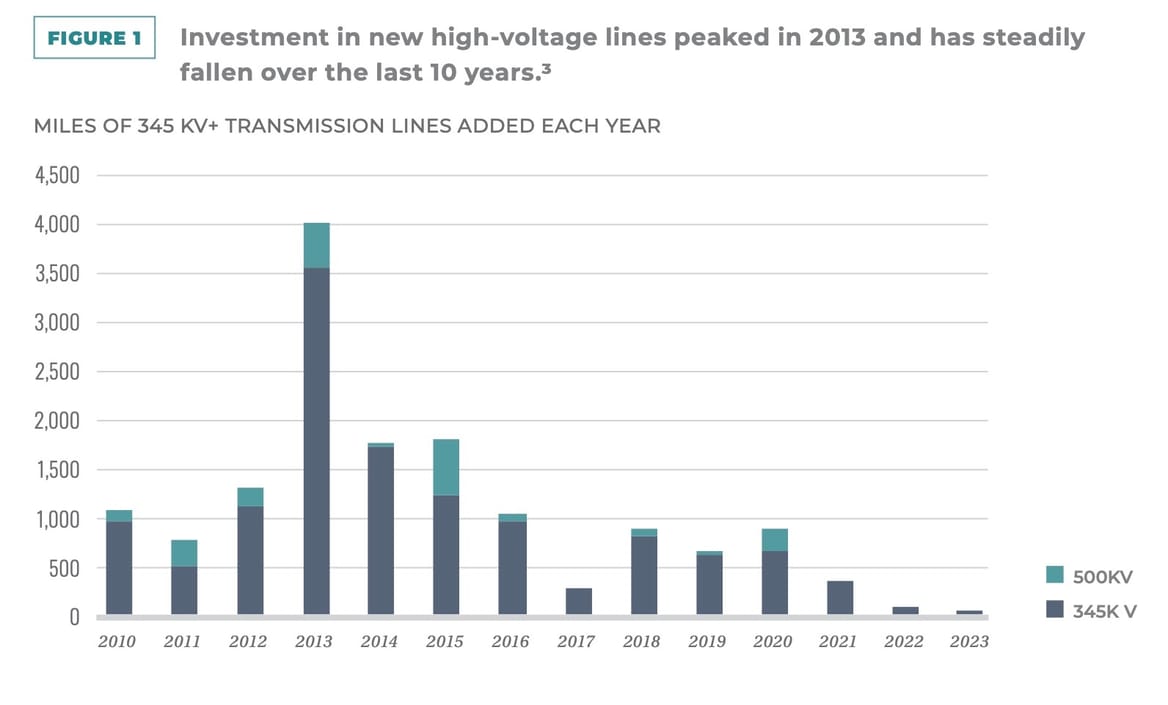
That’s not to say that regional grid expansions aren’t happening. In some parts of the country, including much of the Midwest, utilities and state regulators have agreed to tens of billions of dollars of grid projects expected to yield cost, climate, and reliability improvements. FERC Order 1920, passed last year, orders grid operators and utilities across the country to undertake similarly ambitious efforts.
But elsewhere, the chasm between regional and local projects has become extreme. In the territory of PJM, the grid operator that serves Washington, D.C., and 13 states from Illinois to Virginia, RMI calculated that the five-year averages for spending on “supplemental” projects — PJM’s term for local projects — ballooned from less than $1 billion per year in 2010 to more than $8 billion per year since 2020. Meanwhile, the same averages for spending on “baseline” projects not subject to Order 1000’s exemptions declined.
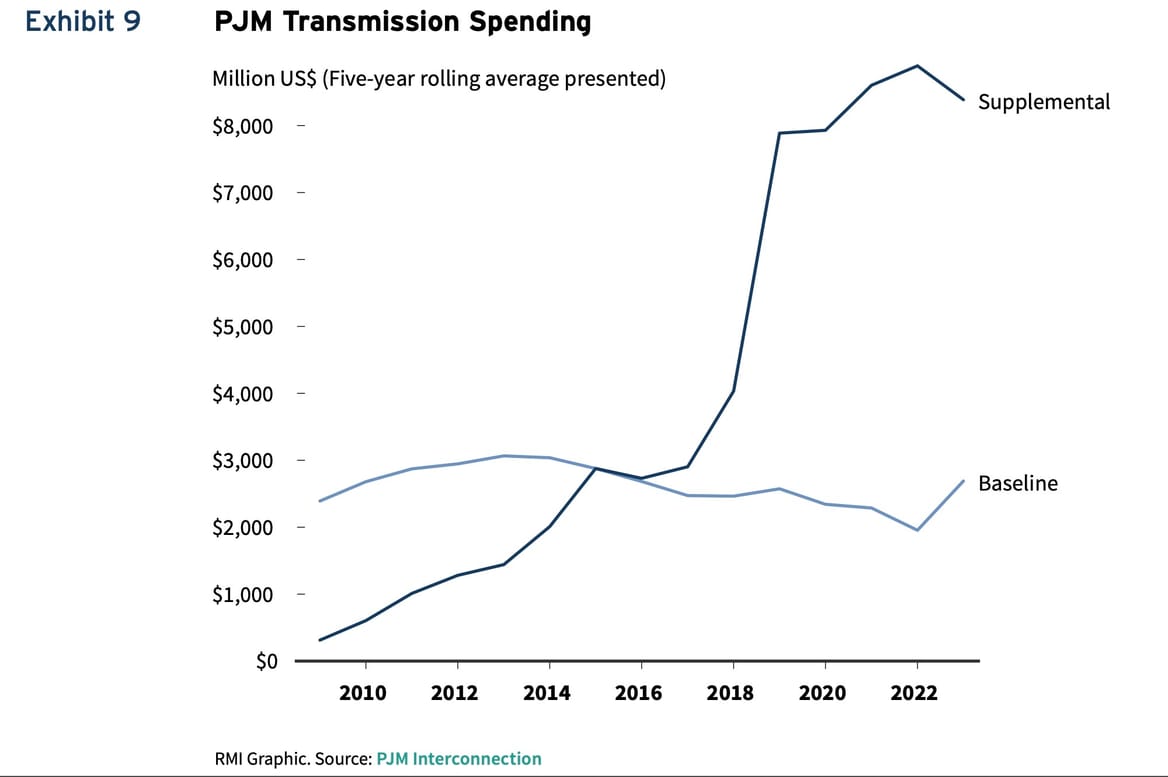
Just because a transmission project falls into the regulatory gap doesn’t mean it shouldn’t be built, said Rob Gramlich, president of Grid Strategies. For one thing, much of the money spent on local projects over the past decade has gone to “replacing assets that are 50 or 60 or more years old,” he said.
But Tyson Slocum, director of the energy program at nonprofit watchdog group Public Citizen, said the inability to review or challenge these projects is a problem.
“Transmission owners, and [regional transmission organizations] to a certain extent, have lots of incentives to prioritize the projects that maximize returns for them but not necessarily for the consumers,” he said. It’s particularly troubling when utilities may be using that lack of transparency to squeeze their customers for more money than they really need.
Slocum suspects that’s what happened with a transmission project at the heart of a December settlement agreement between FERC and New Jersey utility Public Service Electric and Gas Co. (PSE&G). The utility agreed to pay a $6.6 million fine to settle allegations that it failed to provide “accurate and factual information” regarding a $546 million project to rebuild a transmission line with towers built nearly a century ago.
Among the disclosure failures cited in FERC’s enforcement action was PSE&G’s presentation to PJM stating that a consultant had found that 67 of those towers needed extensive foundation retrofits. In fact, the consultant had found only eight towers needed such work — presumably a much less costly scope of work than what PSE&G ended up doing.
PSE&G neither admitted nor denied the allegations, and the settlement with FERC does not require it to forgo revenues it will receive for the project under FERC’s formula rates. Public Citizen filed a protest with FERC this month challenging PJM’s plan to assign those costs to ratepayers, citing PSE&G’s December settlement agreement as evidence of “harrowing fraud” from the utility and a failure by PJM to “perform a modicum of independent oversight.” PSE&G told Utility Dive that it will “vigorously defend” against Public Citizen’s allegations of imprudence.
Slocum called the PSE&G case “an easy-to-understand example of how bad things can get when you don’t have independence in assessing these transmission projects, when you don’t have someone in the room asking hard questions.”
PJM spokesperson Jeff Shields told Canary Media that PJM has “enhanced the transparency of its supplemental projects processes” in recent years. But he added that “authority and expertise for certain asset management decisions remain with transmission owners under settled FERC precedent.”
Nor can New Jersey utility regulators challenge the utility’s rate recovery on their own. Harvard’s Peskoe highlighted this as a problem that FERC will need to step in to solve since the agency regulates these rates. “If you find that utilities went way over budget on a project, there’s nothing the state can do but go to FERC and complain about it,” he said
State regulators sometimes take actions that undermine what little oversight they do have over utility investments. Utility Florida Power & Light has faced criticism over a 176-mile transmission line that it designed at an unusually low voltage, allowing the endeavor to skirt the rigorous review required for higher-voltage regional projects. Critics say that earlier decisions by the Florida Public Service Commission paved the way for that project to escape more scrutiny.
Other states have taken more aggressive steps to demand better transparency. RMI’s report highlights Kansas, which passed a law in 2023 giving regulators authority to demand that utilities provide detailed information, hold public workshops, and accept a state-set rate of return if they want to pursue a streamlined process to earn revenues on money spent on local transmission projects.
But watchdogging individual local transmission projects doesn’t fix the underlying problem described in RMI’s report: Regional planning has been relegated to second-run status behind local projects.
Instead of executing local projects on a separate track from regional projects, utilities and regional planning organizations should be required to “first look at how regional projects could holistically meet local and regional needs, and then build any local projects necessary to meet remaining local needs,” Wayner said during the December webinar.
FERC Order 1920 does require utilities, planning entities, and grid operators to undertake some major long-term grid planning reforms. But Wayner and Peskoe agreed that its adjustments don’t close the local-project regulatory gap.
Most notably, when grid operators hold meetings to share local transmission project data with state regulators and other stakeholders, utilities and the grid operator don’t have to respond to any questions or data requests from stakeholders.
FERC’s order modeled this approach on PJM’s method for managing those meetings, which have been a longtime frustration for Greg Poulos, the executive director of the nonprofit Consumer Advocates of the PJM States. “We are given a sticker price of projects,” he said during the December webinar. “We can’t get any other information. We can ask questions. They do not have to be answered.”
That lack of transparency is a big problem, said Kent Chandler, a former chairman for the Kentucky Public Service Commission and resident senior fellow at free market-oriented think tank R Street Institute. Utilities are monopolies that get to charge captive customers for reliable and affordable power, he said during the December webinar. “It shouldn’t be on us to have to prove the negative on why we’re not getting the best value for our money.”
These concerns have spurred a new effort to get FERC to intervene. In December, R Street Institute, consumer advocates including Public Citizen, and groups representing industrial energy consumers filed a complaint asking FERC to require that lower-voltage lines typically built under the “local” designation be brought into the same regional planning structures that govern higher-voltage lines.
It also calls for “independent transmission system planners,” a new kind of regional planner watchdog that would counterbalance “the self-interest and undue influence of existing transmission providers.”
Maryland’s Office of People’s Counsel, which advocates for residential utility consumers in the state, joined that complaint. David Lapp, who leads the office, said the goal is to “stop being nickel and dimed in massive amounts” for local transmission projects.
Under today’s regulatory gap, “we have situations where two adjacent utilities might be spending hundreds of millions each,” he said. “You might be able to have a project that cuts those costs in half if they were part of a regional plan.”
Lapp noted that in PJM’s territory, “investments made at a higher cost are lost opportunities for better spending on what’s really going to help customers going forward as well as advance climate policy.”
PJM is facing a massive backlog in processing hundreds of gigawatts of clean energy projects seeking to interconnect to its grid, a lag that some analysts say has been exacerbated by its refusal to engage in large-scale regional grid planning and expansions. “We may be looking at that lost-opportunity cost with the stalled interconnection queue and the inability to get more clean energy on the grid,” Lapp said.
AI faces a big question that even ChatGPT hasn’t been able to answer: How to provide the massive amount of power it needs to work and expand. But a new, efficient and inexpensive open-source AI model may sidestep the question altogether.
Just last week, the U.S.’s path forward on AI seemed clear. OpenAI — the company behind ChatGPT — and two partners got a White House welcome to announce a $500 billion investment into building out the virtual and physical infrastructure behind AI. That includes funding for solar arrays and battery storage to power new, energy-hungry data centers, Bloomberg reports.
A slew of other news made it clear energy was still at the heart of AI’s challenges: Tech companies joined a utility regulators’ conference to curry favor as they look to build their own power plants, and Chevron cemented a partnership to build gas plants dedicated to powering data centers.
President Trump meanwhile took his own crack at a plan for powering data centers, saying he’d use his new emergency powers to fast-track power plants that would connect directly to AI data centers. Companies can use “anything they want” to power their data enter operations, Trump said, “and they may have coal as a backup.”
But a Chinese company’s apparent AI breakthrough may render all of those plans moot. The company DeepSeek last week released a chatbot that it says uses far less computing power and energy than rivals like ChatGPT, but still churns out comparable results. The news sent AI and energy company stocks tumbling, as investors quickly noticed that the efficient DeepSeek could drastically reduce AI’s energy usage.
Still, DeepSeek’s long-term impact is still up in the air. It could end up creating loads of new energy demand, as its cheapness and efficiency earns it new customers, Heatmap notes. It could lead the U.S. government to fund domestic AI research to catch up to China’s lead.
Or, if DeepSeek fails to take off over security concerns or its apparent pro-China censorship, it could mean nothing at all.
💵 Deep freeze: The Trump administration pauses approvals for clean energy projects on public land and waters, and freezes conditional loans for clean energy and other projects that had not yet been finalized by the Department of Energy. (The Hill; E&E News, subscription)
🌊 What Trump’s wind order means: President Trump’s order curtailing wind power is likely to affect at least seven offshore projects still in the permitting process and jeopardize new manufacturing and supply chain investments, but questions remain about how forcefully the Interior Department will execute the policy. (Canary Media)
👀 All eyes on the states: Advocates share their fears about how the Trump administration will upend renewable energy development and climate action, but say state-level progress will be key to keeping things moving over the next four years. (Inside Climate News)
☀️ Floating a new idea: Federally owned or managed reservoirs could hold enough floating solar panels to power 100 million homes each year, a National Renewable Energy Laboratory study finds. (Canary Media)
🔌 Charging EVs: Congressional Republicans look to impose a national fee on electric vehicles, which advocates fear will be punitively high and discourage EV adoption. (New York Times)
📉 Solar growth sunsets: A new report predicts U.S. solar industry growth will come “to a halt” this year, as President Trump’s orders blocking Inflation Reduction spending and instituting tariffs threaten the industry. (E&E News)
🔋 Storage safety: Experts say recent safety improvements for grid-scale battery storage systems make another fire like the one at the Moss Landing site in California unlikely. (Canary Media)
🏠 Heat pumps heat up: U.S. residents bought 37% more heat pumps than gas furnaces in the first 11 months of last year, marking the electric appliances’ biggest lead over fossil fuel heating yet. (Canary Media)
NATURAL GAS: A lack of spare pipeline capacity into the region could threaten the reliability of New England and New York’s natural gas system in extreme cold weather, the North American Electric Reliability Corp. says. (Utility Dive)
ALSO: A Connecticut company signs a $160 million deal to build a 7.4-MW power plant in the state capital using natural gas fuel cells, which officials say will produce no emissions and contribute to state renewable energy goals. (CTpost)
OFFSHORE WIND: A Maine Congressman introduces legislation to prohibit offshore wind development in certain key fishing areas with the aim of protecting his state’s lobstering industry. (Maine Morning Star)
TRANSPORTATION: Ongoing projects to improve New York’s infrastructure, including adding solar generation to public transportation facilities, electrifying bus fleets, and improving transit infrastructure, will not be deterred by the Trump administration, officials say. (City & State New York)
GRID:
ELECTRIC VEHICLES: A Maine education official asks the EPA for relief as school districts that received problem-plagued electric buses grapple with financial loss, but officials still stand behind the importance of electrifying the state’s school bus fleets. (Kennebec Journal, subscription)
SOLAR:
CLIMATE: New Jersey environmental advocates lay out a wish list of goals they’d like to see gubernatorial candidates embrace, including reaching 100% clean energy by 2035 and advancing the electrification of public transportation. (New Jersey Monitor)
HYDROGEN: New York awards $1.2 million to four clean hydrogen research and development projects that show promise in making the production process cleaner and more efficient. (news release)
Correction: Illinois environmental and consumer advocates launched a $1 million ad buy opposing rate increases for a Peoples Gas pipeline replacement program. An item in Wednesday’s newsletter misstated the size of the ad buy.
GRID: Minnesota regulators approve permits for a 180-mile, $1 billion transmission line that two utilities say is needed to improve grid reliability as they transition from fossil fuels. (MPR News)
ALSO:
OHIO: Republican lawmakers introduce a bill that backers say would cut regulations on power produced in the state from nuclear, coal and gas plants to meet growing demand from manufacturing and data centers. (Toledo Blade)
CARBON CAPTURE: The owner of a large Illinois ethanol plant pursuing an onsite carbon capture project, along with the state’s corn lobby, has contributed millions of dollars to state lawmakers to support carbon capture policies as opponents worry the project could harm a local aquifer. (Investigate Midwest)
ELECTRIC VEHICLES:
OIL & GAS:
SOLAR:
UTILITIES: Xcel Energy spent the most on lobbying among companies and organizations in Minnesota in 2023, with most of the $1.4 million involving cases before the state Public Utilities Commission. (MinnPost)
CLIMATE: Dozens of Iowa residents speak out against proposed state science standards that would water down references to climate change in school curriculum. (KCCI)
NUCLEAR: North Dakota lawmakers consider legislation that would begin to study the potential of small nuclear plants making up a greater share of the state’s power generation. (KXNET)
WIND: National laboratory researchers find floating offshore wind facilities along the West Coast could add as much as 33 GW of generating capacity by 2050, but transmission constraints and the technology’s newness could hamper development. (Utility Dive)
CLEAN ENERGY:
SOLAR: A developer nears completion of a 13 MW solar installation in California to provide power to a glass manufacturing facility. (Glass International)
OIL & GAS:
POLITICS: Wyoming Gov. Mark Gordon calls Trump’s energy-related executive orders a “win” for the state even though they lack specifics and could jeopardize funding for efficiency and grid resiliency projects. (WyoFile)
UTILITIES:
GRID: Videos show Southern California Edison distribution lines catching on fire in an area burned by a Los Angeles blaze days after the fire was extinguished. (Los Angeles Times)
TRANSPORTATION: California awards the Port of Los Angeles $31 million to test harbor craft emission-reduction technologies and develop zero-emission capable boats. (Biofuels Digest)
BATTERIES:
BIOFUELS: California advocates push back against proposed wood pellet plants and an export terminal, citing adverse community, climate and ecological impacts. (news release)
POLLUTION: The U.S. EPA launches an investigation into claims that a New Mexico city’s health department discriminated against residents when issuing air pollution regulations. (news release)
As long-distance transmission line capacity emerges as a bottleneck for Illinois’ clean energy transition, state lawmakers and advocates are drafting legislation to establish state incentives for power line projects.
One proposal under consideration would allow independent transmission developers to access subsidies through the state’s Renewable Energy Credit (RECs) program, the same mechanism that has fueled the state’s solar boom.
“Merchant transmission developers are essentially building a road — generators pay to put their electricity on that road and send it to customers,” said James Gignac, Midwest senior policy manager for the Union of Concerned Scientists, a member of the coalition working with legislators on an energy bill building on 2017’s Climate & Equitable Jobs Act, or CEJA.
The Illinois legislation being prepared for this spring’s session would create another source of revenue for such projects, lowering the cost burden on wind and solar developers looking for a more direct route to power customers. Unlike projects funded by utility ratepayers, merchant lines do not need to go through the lengthy planning and financing process overseen by regional grid operators such as MISO and PJM.
“These [high voltage, direct current] lines can serve a different purpose,” Gignac said. “It’s an overlay or additional feature of the transmission system. They can provide important benefits that supplement the [regional transmission organization] plan.”
CEJA mandates that almost all of the state’s fossil fuel generation cease by 2045. Especially with the boom in data centers, some are worried Illinois won’t be able to meet its energy needs with renewables and nuclear if coal and gas plants close.
“Transmission is a huge part of the equation, it will be important in helping us take inefficient coal and gas plants off-line, and it will help bring on extraordinary amounts of clean energy,” said Christine Nannicelli, Sierra Club Beyond Coal senior campaign representative.
In December, MISO, which manages the grid for most of Illinois and a large part of the central U.S. spanning from the Dakotas to the Gulf Coast, approved a batch of 24 long-distance transmission projects on top of 18 interregional transmission lines approved in 2022. But these lines will likely take a decade or more to build, given lengthy bureaucratic processes.
Merchant lines can be constructed much more quickly, as they do not need to be studied and deemed necessary through the regional transmission organization process. They just need to be interconnected to the regional grid system, as well as receive certain approvals in the states they pass through. Illinois advocates have also proposed that legislation designate merchant lines as public utilities, giving them an easier path to eminent domain powers.
Merchant lines including the Grain Belt Express, which would stretch from Kansas through Missouri to the Illinois-Indiana border, have faced opposition from landowners concerned about the routes and eminent domain. Merchant lines also introduce competition for utility companies, which have pushed for legislation in various states to limit such competition.
Some advocates argue competition can be good for ratepayers and the environment. Merchant lines could bring renewable power into Illinois from other states, and also make it easier for new renewables to be built in Illinois and connected to the grid. There can be long delays for new wind and solar farms to get approval to be connected to the MISO grid. These renewables could connect to merchant lines without delay.
Grain Belt Express developer Invenergy, based in Chicago, is among the backers of a transmission incentive bill.
Another merchant transmission line seeking to deliver power to Illinois is SOO Green, a proposed 350-mile underground cable between Iowa and Illinois following a railroad right-of-way.
Both projects would facilitate sharing power between MISO and PJM grids, a necessity especially as extreme weather events increase, experts say. Last May, the two organizations for the first time agreed to coordinate on their long-range planning,
The Clean Grid Alliance, a national organization, advocates for grid expansion both through the regional transmission organizations’ planning processes, and through merchant lines. The alliance supported a proposal during the last Illinois legislative session that would have created RECs for merchant transmission. Clean Grid Alliance vice president of advocacy Jeff Danielson said he does not know of any other states that have created RECs for this purpose.
“We encourage states to help in any way possible to get the electric interstate superhighway built,” said Danielson. “It really is up to the states to secure their own economic future around a resilient and commerce-friendly grid. Whether it’s a REC concept, direct power purchase agreements, permitting reform, we encourage all of it. We literally need to build the transmission everywhere all at once.”
Since projects like Grain Belt Express and SOO Green cover multiple states, it may seem unfair for one state to carry more of the financial burden by offering subsidies. But Danielson said that may be necessary to tip the balance and make sure transmission gets built; and other states should follow Illinois’s lead.
“There’s the idea it will just get built,” without state action, Danielson said. “But it won’t, it hasn’t. Merchant lines are incredibly difficult to build. A governor has to understand the value to his state, his colleagues in other states have to understand this is what’s going to drive economic growth. Every time they’re in a meeting they should be saying, ‘We have to get to yes.’ It’s a shared opportunity and shared responsibility.”
A March 2024 study by the Illinois Power Agency estimated that credits for the SOO Green line would cost ratepayers $430 million per year, while reducing utility bills to save them $178 million per year. The line would also add $414 million in economic benefit to the state’s economy, the agency found.
The Laborers’ International Union of North America is among the labor unions supporting a transmission-incentives bill. The union’s Midwest governmental affairs director, Sean Stott, noted that Invenergy’s Grain Belt Express, for example, is projected to create 1,500 construction jobs in central Illinois.
“They’ve made a commitment to employing residents of central Illinois to do that work, including members of the Laborers union,” he said. “Any time you do that, you’ll have money in the pockets of workers. It would definitely generate a significant amount of economic activity in the local community.”
He doesn’t think union members would resent the additional charges on electric bills to fund transmission incentives.
“There are no free lunches in life, there would be a small charge, however they would receive by virtue of an influx of lower-cost power, downward pressure on their electric bills,” he said.
The Illinois Manufacturers’ Association also supports such legislation.
“We’ve seen warnings for the last couple years both in PJM and MISO of potential brown-outs,” said association president Mark Denzler. “When there are challenges, the first folks they ask to reduce load are industries. Transmission projects are one place where the state has the ability to work on making sure we have reliability.”
The legislation might also include a component known as “next generation highways,” allowing transmission lines to be co-located with highways, a situation currently prohibited under Illinois law. Minnesota last year passed similar legislation.
“We want to at least allow utilities the option to consider that,” said Gignac. “It’s something states can do, allowing some flexibility in the location of transmission lines.”
Danielson framed the relationship to highways as symbolic on a larger level.
“We have never thought about our grid in an integrated interstate commerce way like we thought about the highway system in the 1950s, and we really need to,” he said. “Because resilience to weather events and connecting economies through clean energy and 24-7 internet commerce are going to be the reasons Midwest states and the U.S. in general are going to be an economic leader in the future.”
GRID: An Ohio progressive watchdog group raises concerns about the proliferation of data centers in the state, including their potential to spike energy demand and prolong the use of fossil fuels. (Ohio Capital Journal)
ALSO: Utilities, renewable energy companies and ratepayer advocates say PJM’s proposal to require renewable and storage projects in the interconnection queue to participate in capacity market auctions was developed with inadequate input. (Utility Dive)
PIPELINES:
COAL: North Dakota officials threaten to sue the U.S. EPA for withholding action on the state’s application to regulate its own coal waste as a dispute continues over a waste management plan at the state’s largest coal plant. (Bismarck Tribune, subscription)
CLIMATE: Des Moines, Iowa, residents criticize city leaders’ decision to lay off the staff of the city’s sustainability office to help close a budget deficit, calling the move shortsighted. (KCCI)
ELECTRIC VEHICLES: The Michigan State Police deploys its first all-electric vehicle that will be used for providing security at state-owned buildings around the state capital. (WOOD-TV8)
OVERSIGHT: U.S. Senate lawmakers delay the interior secretary confirmation hearing of former North Dakota Gov. Doug Burgum for two days to give a government ethics office more time to review the nomination. (States Newsroom)
CLEAN ENERGY:
EFFICIENCY: Ameren Missouri starts offering $75 million in rebates and incentives for new customer energy efficiency and demand response programs. (Daily Energy Insider)
CLEAN ENERGY: President Biden issues an executive order allowing data centers to lease public land, on the condition their facilities are powered with new clean energy resources. (E&E News)
ALSO:
OVERSIGHT: Trump’s nominees for the EPA and Interior and Energy departments are expected to face tough questioning from Democratic senators during confirmation hearings this week. (E&E News)
FOSSIL FUELS:
COAL: Federal regulators propose permitting Montana’s largest coal mine to expand and increase production by about 19 million tons. (Montana Free Press)
GRID: Utilities, renewable energy companies and ratepayer advocates say PJM’s proposal to require renewable and storage projects in the interconnection queue to participate in capacity market auctions was developed with inadequate input. (Utility Dive)
SOLAR: Solar customers and installers are rushing to complete projects before President-elect Trump’s inauguration, citing uncertainty about tariffs and federal incentives. (NPR)
OFFSHORE WIND: A Maryland county government is revealed to be behind an anti-wind website that appeared last month shortly before a Delaware county held a key vote rejecting an offshore wind substation. (Spotlight Delaware)
BUILDINGS:
ELECTRIC VEHICLES: The Michigan State Police deploys its first all-electric vehicle that will be used for providing security at state-owned buildings around the state capital. (WOOD-TV8)
GRID: The future of Biden administration initiatives to spur transmission construction is in question as Republicans take over Congress and the White House, though utilities, state regulators and private investors could use growing power demand to make a case for continued expansion. (E&E News, Canary Media)
ALSO:
EMISSIONS:
RENEWABLES: Texas is the top state for renewable energy generation and battery capacity as of the end of 2024, ranking first for wind and solar and second behind California for battery capacity. (Reuters)
COAL: Rocky Mountain Power cancels several Wyoming coal plants’ previously scheduled retirements, but plans to convert some of the units to run on natural gas. (Cowboy State Daily)
OIL & GAS:
ELECTRIC VEHICLES:
NUCLEAR: As New York faces rising power demand and the need to lower greenhouse gas emissions, it’s taking a serious look at the possibilities of advanced nuclear power plants. (Inside Climate News)
CLEAN ENERGY: A decades-long local government collaboration in southwestern Minnesota helps 18 counties manage clean energy development and avoid controversies and misinformation that have affected projects in other parts of the country. (Energy News Network)
GRID: Google partners with a climate investor and a clean energy developer to build renewable power and storage projects co-located with data centers, with a goal of reducing the centers’ anticipated demand on the grid. (Canary Media)
ALSO:
OIL & GAS:
POLITICS:
CLIMATE: Expressing concern for the state’s fossil fuel industries, two Pennsylvania lawmakers say they plan legislation to remove the state from the Regional Greenhouse Gas Initiative and require legislative approval for future agreements. (Indiana Gazette)
WIND: A labor leader says Maine should reach out to other states to help support a deepwater port for offshore wind construction, after multiple attempts to secure federal funds have failed. (Maine Public)
STORAGE: A Georgia company announces that its battery recycling facility will produce and market lithium carbonate — an important component in electric vehicle batteries that until now has only been mined. (Atlanta Journal-Constitution)
EFFICIENCY: Milwaukee officials seek local manufacturing of highly efficient wall panels for prefabricated homes to resolve challenges of building net-zero modular homes for low-income residents. (Energy News Network)


.svg)
