

 Back
Back
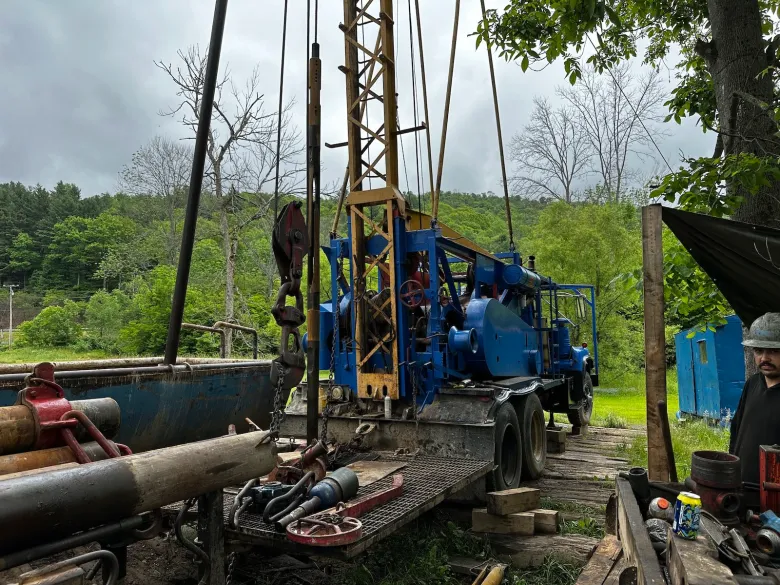
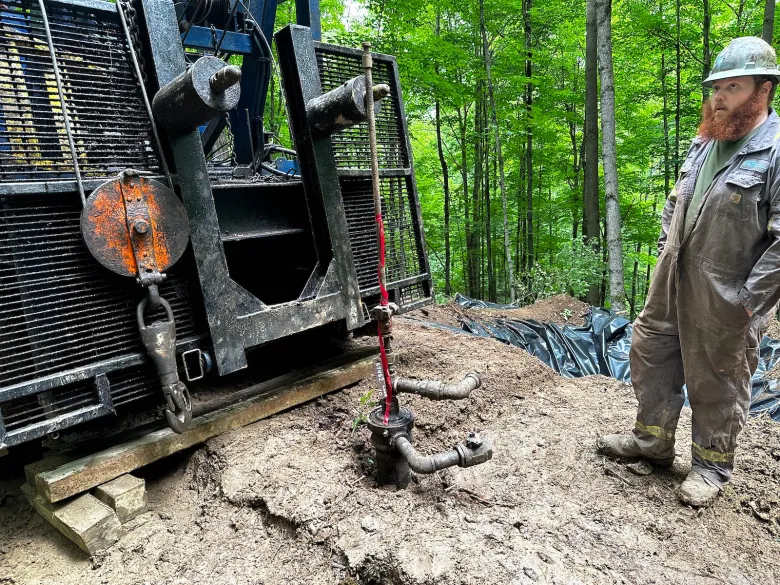
The rig operator was stumped. He’d been making good progress, but now something blocked the way forward. The operator, Denny Mong, stared at an unassuming metal tube in the ground — the fossil of an oil well. Spread around it was an array of industrial detritus and steel tools like giant surgical implements, which sunk into the spongy Western Pennsylvania meadow.
Above the hole, Mong’s rig, which towered 50 feet into the air, suspended a vertical ramrod. When it dropped, the ramrod only shot 17 feet into the ground before slamming to a stop. Earlier, Mong had managed to reach more than 500 feet deeper into the well. Then this obstruction, whatever it was, sent him back to the start.
Clearing it — prime suspects included metal casing, rocks, or a tree branch — would allow him to send cement and pea gravel into the hole, which reached hundreds of feet into Appalachian rock formations. Once an active oil well, now it was an environmental nuisance and the target of an ambitious federal cleanup program.
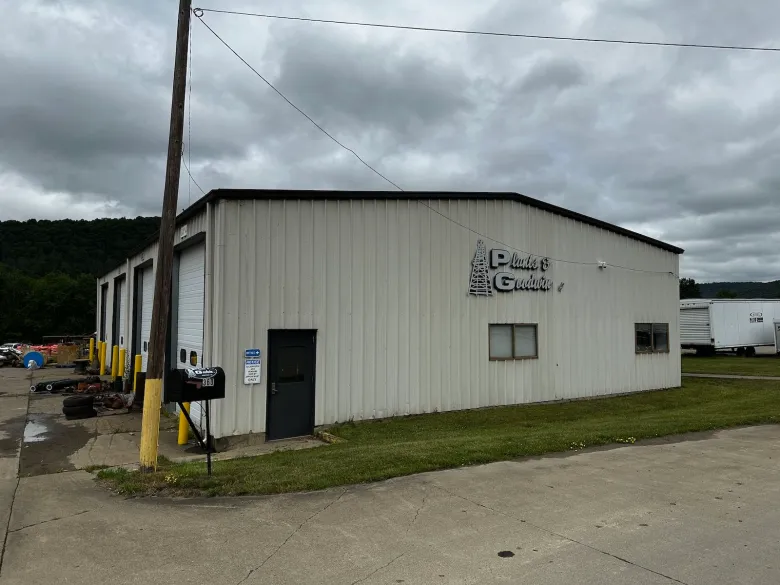
The well needed to be decommissioned, along with at least 21 more spread across woodlands and fields in McKean County, Pennsylvania. The job fell to Mong and other employees of an oil service outfit called Plants & Goodwin, which specializes in plugging so-called orphan wells. Oil and gas companies are supposed to plug and clean up wells that they’ve drilled, but if they go bankrupt or otherwise disappear, that responsibility falls to the state, which then contracts with companies like Plants & Goodwin. If left festering, these wells can leak contaminants into surrounding groundwater or release methane, a greenhouse gas at least 25 times more powerful than carbon dioxide at trapping heat in the atmosphere.
Uncorking a well in this part of Appalachia reveals a blend of oil and gas that has a nauseous maté color and gurgles like witch’s brew. After generations of drilling, the remnants of both vernacular backyard digs and professional oil operations pockmark the land. Since drillers operated for more than a century with little regulatory oversight, documentation of well locations is scarce and cleanup quality is inconsistent.
“Until the 1970s there were no strong plugging standards in place,” said Luke Plants, who heads Plants & Goodwin. “People just shoving tree stumps down a well to plug it, or a cast iron ball or something like that.”
The exact number of orphan wells nationwide is unknown. In late 2021, The Interstate Oil and Gas Commission, a multi-state organization, had more than 130,000 orphan wells on record but estimated that anywhere between 310,000 and 800,000 remained unidentified. That year the federal government took notice, folding $4.7 billion into the Infrastructure Investment and Jobs Act to help states handle their orphan well inventories. The first batch of that money has trickled down to states and has been distributed to contractors like Plants & Goodwin. It’s easily the most funding ever spent to address the problem, but both states and pluggers are now facing hurdles as they begin to identify and plug wells.
The state oil and gas regulators responsible for issuing well-plugging contracts are typically understaffed. As a result, the pace of contract assignment in some states has been inconsistent, making it difficult for plugging companies to staff up and plan ahead. Well pluggers are also few and far between. Since oil operators tend to avoid the costly work of well capping, the service has remained a niche industry. Plugging companies have also struggled to find trained workers, not to mention the specialized equipment required to plug wells. Along the way, some states have handed out millions of dollars in contracts to a subsidiary of an oil company with hundreds of compliance violations.
All the while, the oil and gas industry continues to spawn new orphan wells — magnitudes more than the number being plugged. Between 2015 and 2022, more than 600 oil and gas companies filed for bankruptcy, leaving thousands of wells unplugged. Market downturns affecting oil prices during the mid-2010s pushed many operations to insolvency. And even in times of industry booms, wells near the end of their production lifespans often end up in the hands of small oil patch operators with tight margins. Further, state laws requiring companies to post collateral for their wells in case of bankruptcy are meager. This combination of weak rules and bankruptcies has caused orphan well inventories to balloon. For example, Pennsylvania’s list of 20,000 orphan wells grows by about 400 each year; the state has plugged just 73 wells with the federal money that began to arrive last year.
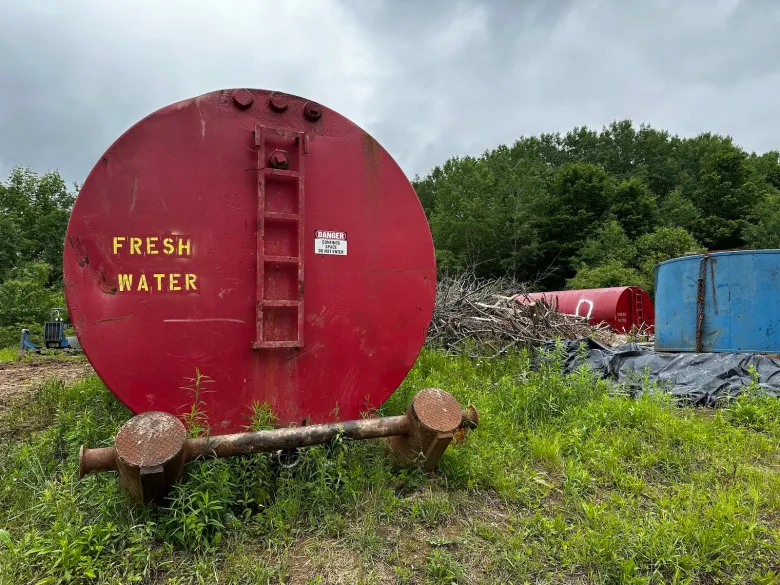
In the muddy pasture in northwest Pennsylvania, Mong was trying to unclog his way to the well’s bottom. Using a rig attachment called a cherry picker — imagine a four-foot steel clothespin — he worked to spear unknown detritus from the depths. Next to the hole lay 30-foot-long clay-frosted tubes of steel casing already hauled out. After reducing the borehole to a hollow dirt cavern, the pluggers will pour cement until it nearly fills to the surface and top the rest of the way with gravel, insulated by steel casing to protect groundwater. They will then decapitate the casing to a few feet below ground and cover it with dirt.
For the pluggers, the work is a bespoke combination: a little science and a lot of art. Sharp intuition, engineering know-how, grit, and luck imbue each effort. One capping can take anywhere from three days to three months, sometimes costing more than $100,000.
A lot needs to happen to orphan wells before they’re plugged — at least on paper. The state has to identify them, the threat they pose, the costs to plug them, and search for any elusive owner to pin the costs on. And while that’s a process states have handled for many years, most state plugging programs have relatively small budgets and staff compared to the well inventories. Now, federal funding is compelling those programs to exponentially increase the number of well-capping contracts, an impossible task without bigger staffs and nimbler processes.
In a normal year, the California Geologic Energy Management Division (CalGEM), which regulates oil and gas production in the state, might contract plugging for 30 wells. According to former CalGEM employees, decommissioning even that number of wells had the agency running on all cylinders.
“Available staffing for oversight was definitely a major limiting factor,” said Dan Dudak, who was the Southern District Deputy of CalGEM from 2011 to 2020, and now acts as a consultant on well-plugging projects. In just the last five years, the department “lost a lot of their institutional knowledge” in three different leadership changes, he said. Nonetheless, CalGEM revealed an $80 million project last July to cap 378 wells with funding from state and federal money along with industry fees.
Other states also have catching up to do. One 2022 Ohio state audit observed that its Department of Natural Resources struggles to meet orphan well program spending targets, in part due to staffing shortages. “[T]he Division can only increase efforts dedicated to well plugging preparation work as fast as it can recruit, train, and hire permanent employees,” the audit claimed, recommending that the agency double its staff to post plugging contracts in a more timely fashion and consider outsourcing the task of drafting contracts.
Pennsylvania has 70 well inspectors and a tally of around 20,000 orphan wells. According to Neil Shader, spokesperson for the state Department of Environmental Protection, or DEP, the agency is considering hiring more inspectors to increase its oversight. Earlier this year, the state legislature approved a $5.75 million budget increase for DEP, some of which may boost its well plugging contract capacity.
Still, the pace of contract creation in Pennsylvania has put pluggers in a precarious place. Plants said that when Pennsylvania received $25 million in its first batch of federal funding, he staffed up. A torrent of contracts were awarded but then stopped — leading from feast to famine. A six-month gap meant furloughs and mothballing equipment. “It costs contractors a tremendous amount of money to do all that,” he said. “You end up creating an incentive to not scale at all, just stay small.”
To expedite aspects of the contract-drafting process, DEP has signaled that it may outsource some of that work. Meanwhile, Ohio is putting some of its federal money into an expedited process called the Landowner Passover Program, where approved landowners who find orphan wells on their land may act as a surrogate for the state, awarding a contract to a plugger that Ohio will pay for.
Ohio has 44 contractors on its rolls and utilizes a pre-approval process for its pluggers to maintain quality control. Pennsylvania’s DEP is considering adopting its own vetting process, according to Shader, the agency spokesperson. Without it, there is no central parapet to separate under-qualified contractors from federally funded plugging. “There are not enough defined rules in place,” said Plants. “And even the rules that are there don’t get followed so well all the time.”
Not much stands in the way of a corner-cutting contractor. In remote pockets of Appalachia, improperly dumping chemical fluids from a site or shoddy plug job could go unnoticed. “I think it’s even less likely to get checked now,” Plants said. “Because nobody wants to limit the pool of potential well pluggers. We need to get more pluggers involved — whether that plugging is being done correctly or not.”
Last year, Pennsylvania Deputy Secretary Kurt Klapkowski of the DEP’s Office of Oil and Gas Management addressed that anxiety by announcing that parties with significant outstanding violations, such as contractors with a poor service record or operators with environmental infractions, wouldn’t receive state contracts. “I feel pretty confident that we would not be issuing contracts to operators that had significant outstanding violations — either on the contracting side of things or on the environmental protection side,” he said.
For a plugger, non-compliance could mean illegal dumping or improperly sealing a well; for an operator, it might mean abandoning a well without plugging it. But such policies can be difficult to implement when oil and gas companies sometimes operate through a bevy of subsidiaries in multiple states.
In December of last year, the Pennsylvania DEP awarded Next LVL Energy contracts to plug 30 wells in the state. The company is a subsidiary of Diversified Energy, an energy giant that has amassed a massive number of wells at the end of their lives, stoking fears that the company is likely to orphan them. According to one class action lawsuit against Diversified in West Virginia, around 10 percent of its 23,309 wells in the state are technically abandoned but unplugged. Just this year Pennsylvania inspectors slapped the operator with around 300 new or unresolved operational violations. (The state DEP didn’t respond to a request for comment on Next LVL’s contracts.)
Ohio has also given half of its first installment of federal money, $12.5 million, to Next LVL Energy to oversee the plugging of as many as 320 wells. To the southeast, West Virginia has given the company a similar sum to plug 100 wells. Spokespeople for both state environmental agencies defended their decisions, noting that they followed state and federal guidelines while selecting pluggers. “We will keep a close eye on implementation,” said Andy Chow, a spokesperson for the Ohio Department of Natural Resources. “Should any violations in this contract be discovered or otherwise come to our attention we will review those actions.”
In West Virginia, Next LVL isn’t plugging any wells associated with Diversified, according to Terry Fletcher, chief communications officer with the state’s Department of Environmental Protection. “At the time the contracts were awarded, Next LVL had no outstanding environmental violations in the state,” he added.
Finding qualified workers for the oil field is no easy feat, either. The last decade has seen drops in oil prices that rendered many fossil fuel companies insolvent, along with a shift to shale exploration, which requires fewer workers. As a result, job openings have dwindled and many qualified workers have left Appalachia.
Plugging wells also requires skilled labor. Thus, the limited number of qualified workers is in high demand. That’s good for wages, but without a large workforce to fill positions as states push out contracts with increasing frequency, another problem arises: “You just get this arms race for the same small pool of workers,” said Plants. “That’s not actually helpful for scaling or expanding the supply side of this business.”
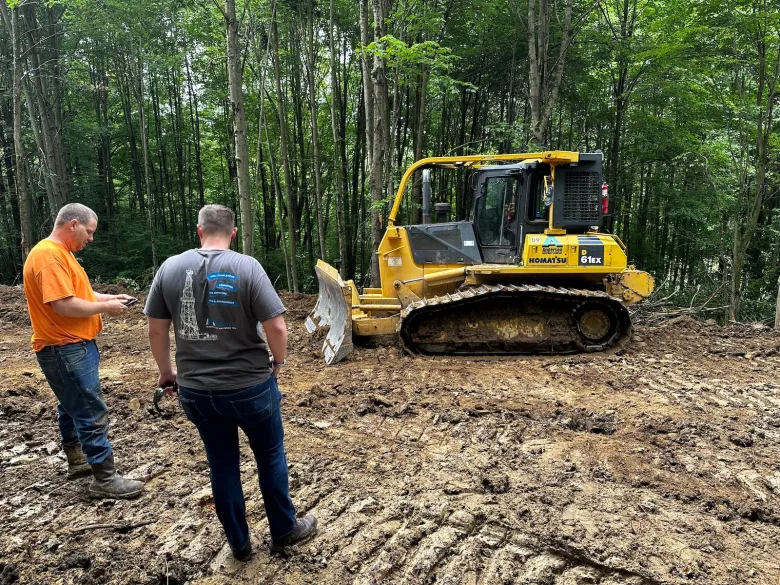
Plants has brought in experienced pluggers from Texas oil fields to help train up a new generation of skilled Pennsylvania hands. “We want to develop a local workforce that understands this work,” he said. But “you can’t just put whole crews of inexperienced people out there.”
There’s a lot of on-the-job training, but that extra work advances his vision. Some of his most recent hires came from area high schools and technical schools, where he has made a pitch: “We want to give you a long-term career.”
Bronson Knapp, who owns Hagen Well Services in Ohio, has faced similar challenges. “The good old farm boy is hard to find,” he said. A worker shortage is one of the reasons Ohio is behind on well pluggings. The state has awarded new contracts even as work from previous contracts hasn’t been completed. “We awarded 380 wells this year, but our contractors are still 400 wells behind us,” said Jason Simmerman, the orphan well program engineer with the state’s Department of Natural Resources.
Rigs used to plug wells can be hard to come by, too. Drilling technology may advance, but orphan well-plugging is frozen in time. The tech required is often vintage, which means pluggers are on the prowl for a shrinking number of rigs that may be older than the wells they plug. It’s not unusual for a plugger in New York to look as far as Texas for a used rig. Mong’s rig was from the 1950s. Another rig at a nearby work site was manufactured in 1981 and welded to the bed of a Vietnam War-era military truck.
On the whole, a few recent high school graduates on Plants’ payroll might not seem like bellwethers of a next-generation workforce. But some experts watching the federal orphan well program contend that a well-plugging wave could revive regions whose economic fates are tied to dwindling resource extraction sectors. “The most positive thing that could happen is that we begin to get more companies plugging wells, especially in rural, distressed areas to help their local economies,” said Ted Boettner, a senior researcher at the Ohio River Valley Institute, a think tank focused on economic and environmental sustainability in Appalachia.
“Oil and gas industries have lost thousands of jobs over the last decade,” he told Grist. “This is helping people who lose their jobs” and providing “a way for people to transition into cleaning up this mess of the last 150 years.”
The federal program includes requirements and guidance to help ensure that the work on the ground benefits workers. In order to qualify for funding, states must ensure that plugging contracts meet standards outlined by the Davis-Bacon Act, a federal law that guarantees government-funded labor matches average pay rates for similar work in a region, known as the prevailing wage.
Failure to follow the federal government’s requirement risks its scrutiny. For example, last year the GOP-led Pennsylvania legislature passed a law dictating how much a contractor might receive to plug a well as part of Pennsylvania’s orphan well program. The amounts allocated were a fraction of typical costs, likely leaving contractors unable to pay their workers the prevailing wage. With federal money tied up in the program, the Department of Interior filed a brisk response warning that the law could threaten Pennsylvania’s ability to comply with program standards and that the state could be cut off from federal funding.
In Ohio, Davis-Bacon requirements appear to have an effect on well-capping work not funded by the federal program. Though the Buckeye State doesn’t have any wage requirement for general well-plugging work, cappers who have taken contracts appear to be paying higher wages — whether or not the job is federally funded. “Because nobody wants to make one wage one day and another the next day, our contractors that are working on our federal program are taking that perspective and paying those wages across the board now,” said Simmerman, Ohio’s orphan well program engineer.
Out west, California is working to nurture a workforce at a much larger scale. Last year, the state legislature passed a law directing the California Workforce Development Board, or CWDB, to launch apprenticeship programs to train new classes of well pluggers. It could become a model for skilled labor creation. Its first pilot program is using the expertise of a Kern County well-capping company, California Legacy Well Services, which is creating a plugging curriculum to fold into existing training provided by Local 12, the International Union of Operating Engineers. As a result, union-affiliated labor will represent part of the well-plugging workforce.
The thinking is two-pronged: access to quality jobs and layoff mitigation. That means offering good work to skilled laborers vulnerable to the energy transition. “So rather than just worry about the loss of jobs, it’s an opportunity to think about the new jobs for trades workers,” said Tim Rainey, executive director of CWDB. The program is in the early stages, but it offers a glimmer of what an effective orphan well program could yield.
Organized labor in California’s oil fields is of two types: industrial unions and trades unions. Members of industrial unions cultivate skills on a worksite, while trades unions learn the ropes through training apprenticeships like the ones CWDB is developing.
A quirk in California law may lock out the industrial unions. The law requires “a skilled and trained workforce” for capping jobs, an innocuous-sounding phrase that refers to highly technical requirements in the state labor code that disqualify oil workers from industrial unions such as the United Steelworkers, or USW.
Norman Rogers, a spokesperson and member of USW Local 675 in Southern California, called the legislative sleight of hand “a control job.” Trades unions “have a larger workforce and are able to influence the political landscape,” he said. “They can have all sorts of people go to lobby.”
By expanding the language to characterize eligible workers as “skilled and trained or covered by a labor management agreement,” the law could tap into tens of thousands of union workers represented by USW, Rogers said.
The question of who dominates the green jobs of tomorrow remains an open one. Despite the many bottlenecks, the orphan well program could be an attractive coda to the fossil fuel era if it benefits workers.
“We drilled the first oil well in America,” said James Kunz, an administrator at the Pennsylvania Foundation for Fair Contracting, who has worked to ensure favorable wages in state capping contracts. “We have the scars of that and a real opportunity.”
This article originally appeared in Grist at https://grist.org/energy/abandoned-oil-well-job-solution-pennsylvania/.
Grist is a nonprofit, independent media organization dedicated to telling stories of climate solutions and a just future. Learn more at Grist.org
The following commentary was written by Meredith Connolly and Shelley Wenzel. Connolly is the Oregon director for Climate Solutions, a Northwest-based clean energy policy nonprofit. Wenzel is an energy data analyst at Energy Innovation, a nonpartisan climate and energy policy think tank. See our commentary guidelines for more information.
No matter what happens with federal climate progress, state climate action is imperative to cut greenhouse gas (GHG) emissions and help achieve the United States’ commitment to the Paris Agreement. Outside the media spotlight, Oregon has adopted some of the nation’s most significant climate policies, recently finalizing rules to slash emissions from fossil gas and transportation, while targeting 100 percent clean electricity by 2040.
But new research shows the state won’t achieve its climate goals without coupling power sector progress with additional policies that get vehicles, buildings, and industry off fossil fuels. In short, the winning climate playbook for all leading states must be “clean the grid and electrify everything.”
In 2020, Governor Kate Brown enacted an Executive Order (EO) to set a statewide goal of cutting greenhouse gas pollution 45 percent by 2035 and 80 percent by 2050. The same EO led to increased transportation electrification, cleaner fuels, and a Climate Protection Program (CPP), which sets emissions caps for transportation fuels and fossil gas.
And last year, Oregon’s legislature passed the fastest 100% clean electricity target in the West, requiring the state’s largest utilities slash emissions from power generation 80 percent by 2030 and 100 percent by 2040.
Even with these successes, Energy Innovation modeling shows the state is off track for reaching its own goals: If all recently adopted policies are rigorously implemented, Oregon would still only cut emissions 60 percent by 2050.
But there’s good news. The modeling also finds that adopting additional policies – especially for transportation and buildings – would not only cut emissions by 75 percent, but would also boost statewide GDP by $4 billion, create 18,000 jobs, and prevent nearly 900 asthma attacks annually in 2050.
Examining statewide GHG sources illuminates why a broader set of policies in Oregon, along with a pathway for how they will be achieved, is needed. As with most of the U.S., transportation has surpassed the power sector as the largest greenhouse gas source, composing 35 percent of all emissions. Meanwhile, homes and buildings consuming power and gas make up the second largest source at 34 percent, followed by industry and agriculture at 10 percent each.
With Oregon’s population expected to hit almost 4.6 million by 2030, these emissions will trend upward unless policies to shift from fossil fuels to clean electrification start right away. Every new gasoline car or truck, every new gas furnace and new gas-heated building or home locks in emissions for decades. Without meaningful progress in these other sectors, the state won’t hit its 2050 climate goals.
The Oregon policy modeling used the Energy Policy Simulator, a tool created in collaboration with Power Oregon and the Green Energy Institute, to evaluate the state’s new 100% clean electricity by 2040 law and the Climate Protection Program, finding they get Oregon much closer but still fall short of the state’s 80 percent reduction by 2050 goal. The open source, peer-reviewed EPS estimates the emissions, jobs, and health impacts of climate and energy policies using federal and state data.
The Oregon EPS research modeled a set of broader climate policies for all sectors that would put the state on track to achieve its goals and align with the U.S. Nationally Determined Contribution (NDC) to the Paris Agreement (i.e., Oregon doing its proportional fair share). The findings show an “NDC Scenario” for Oregon would avoid $4.8 billion in climate and health costs in 2050 (on top of the $4 billion in GDP growth).
Oregon is in a perfect position to adopt additional policies that leverage its clean electricity sector to secure compounding emissions reductions across the economy through efficiency and electrification policies. And state policymakers must ensure the clean energy transition’s health and economic benefits are broadly shared and reach frontline communities hit the hardest by pollution and climate impacts.
First, Oregon should adopt a 100 percent all-electric new vehicles sales standard by 2035, paired with an EV subsidy lasting through 2030, to supercharge transportation electrification. These policies must be accompanied by EV charging investments to plug in rural areas, low-income communities, and trucking corridors.
Second, increased investments in public transportation, as well as safe walking and biking paths, would reduce emissions while improving equity and air quality. An expansion of the state’s Clean Fuels Program could further cut emissions as the state moves toward a zero-emission future. These transportation sector policies achieve nearly one quarter of all the reductions under the NDC Scenario, showing how vital they are to reaching Oregon’s climate goals.
Third, Oregon must phase out fossil fuels for indoor uses. Similar to Washington’s recently passed commercial and large multi-family building heat pump requirement, the NDC Scenario modeling finds the most important policy for cutting greenhouse gas emissions from buildings would be a building code or standard requiring all new buildings or building equipment to be electric by 2030. This policy alone achieves over 10 percent of all the NDC Scenario’s reductions. To be most impactful, this transition must be coupled with strong efficiency standards.
These policies also create other health and economic benefits. Transportation electrification, along with greater reliance on active transportation, cuts health-damaging particulate and NOx emissions. Electric vehicles are also cheaper to own and maintain than gas cars and protect drivers from volatile oil prices. Electric heat pumps for space or water heating are more efficient than their fossil gas burning counterparts, and electric or induction stovetops avoid harmful fumes from gas cooktops that experts say may cause childhood asthma symptoms.
Together, a broader set of policies like those included in the modeling would get Oregon within a couple percentage points of the state’s 2050 emissions reduction goal, while additional land use and climate-smart agricultural practices could make up the difference. Equitable policy design and planning that prioritizes access and affordability for low-income households and communities will ensure the benefits are enjoyed by all residents, not just the wealthy.
While transitioning the power grid to 100 percent clean electricity is a critical step, Oregon’s lesson is that state climate action can still fall short if that isn’t coupled with rapid electrification. Cutting power sector emissions alone will not solve climate change, but it can make a big difference and leverage clean electricity to secure urgently needed emissions reductions in the transportation, buildings and industrial sectors. If we equitably and rapidly electrify as we clean up our grid, more of our cars and homes will be emissions-free, hopefully in time to avoid climate catastrophe.
Years of work crafting climate and clean energy plans have left New England states in a prime position to take advantage of renewable energy incentives in the historic climate bill enacted by Congress over the summer, advocates say.
“We’ve worked really hard to create fertile ground for this type of thing — in five of the six states, you have climate laws already passed,” said Sean Mahoney, executive vice president of the Conservation Law Foundation. “The states have prepared for this day. And now the Inflation Reduction Act is going to provide them with the resources to execute on it.”
The Inflation Reduction Act, or IRA, will allocate an estimated $369 billion over 10 years for energy security and climate change measures, according to the Congressional Budget Office. (It also includes many other forms of aid, including $64 billion to extend the Affordable Care Act and $4 billion for drought relief efforts in 17 western states.)
The wide-ranging climate change measures include tax credits for renewable energy production and storage, loans and grants for energy transmission projects and transmission planning, grants and rebates to replace heavy-duty vehicles with zero-emission vehicles, and financial assistance for clean energy technology manufacturing.
There are also rebates for consumers who install heat pumps and other energy-saving retrofits in their homes. Tax credits are available for the purchase of new or used electric vehicles by income-qualified buyers.
Passage of the law has generated “a whole bunch of enthusiasm” among the members of NECEC, a clean energy trade organization, because they see the coming injection of federal resources and private investment that will attract as an economic buttress in the face of inflation and an “up and down economy,” said Jeremy McDiarmid, vice president for policy and government affairs.
The Northeastern states overall are well positioned to jump on these opportunities because of the policy groundwork that has already been laid, he said.
“Climate targets, energy efficiency goals and programs — all of this makes them competitive,” he said.
Every New England state except New Hampshire has adopted a climate law obligating them to greenhouse gas emissions reductions. Most must cut emissions in half by 2030, and by 100% as of 2050.
Rhode Island has also passed a law requiring 100% of its electricity to be offset by renewables by 2033.
The incentives in the IRA can enhance some of the state-level programs already in place, such as by stacking federal tax credits on top of existing credits for electric vehicles or energy efficiency work, said Charles Rothenberger, climate and energy attorney for Save the Sound, in Connecticut. That state’s CHEAPR program provides incentives ranging from $750 to $4,250 for plug-in hybrid and battery electric vehicles, with the highest incentives for income-qualified buyers.
Other funding streams could help get clean energy or emissions reduction programs off the ground that have previously failed to win approval because of cost concerns, he said.
Because the federal funding has a limited time span, “states can’t take their eyes off the ball,” Rothenberger said. “The goal is to try to get as much done as we can quickly. We can make some structural changes at the state level to make some long-term progress, and show proof of concept through the federal funds.”
Indeed, the IRA’s focus on creating green jobs and green infrastructure could be transformative in how people live and do business, said Amy Boyd, vice president for climate and clean energy policy at the Acadia Center, a clean energy advocacy group that works in Massachusetts, Connecticut, Rhode Island and Maine. And those changes will not be easy or necessary to undo over time, she said.
“As technology moves forward, it doesn’t move back,” she said. “No one’s going to take the insulation out of their house so they can be colder, have more asthma and pay higher bills.”
The act also provides money to the Environmental Protection Agency to help the agency meet the requirements of President Joe Biden’s Justice 40 initiative, which calls for 40% of certain federal investments to benefit disadvantaged communities, Mahoney said. That includes money for frontline communities to address prior wrongs, something the Conservation Law Foundation is particularly interested in, he said.
Billions of dollars are available to help states figure out how to transition to a transportation system that doesn’t rely on gas or diesel, he said.
“We work in a lot of rural areas — how do you make the transportation system work there?” he said. “And in more-dense areas, there are now dollars available to help fulfill the promise of public transit that hasn’t been met in the past.”
In Vermont, passage of the IRA is “galvanizing the need for change” among lawmakers, who seem eager to act, said Peter Sterling, executive director of Renewable Energy Vermont, a clean energy trade association. He said one state senator recently told him that climate change is one of the top three issues he hears about when he’s out campaigning.
The tax credits for renewable energy production make it an ideal time to increase the state’s renewable portfolio standard, something advocates have been pushing for several years, Sterling said.
“Passage of the IRA is the extra shot in the arm Vermont needed to move forward to a 100% renewable energy future,” he said. The IRA also includes money to help states remove the barriers to wide-scale adoption of renewable energy, such as interconnection and transmission bottlenecks. New England will be competitive in vying for those dollars, McDiarmid said, as Connecticut, Maine, Massachusetts, New Hampshire and Rhode Island are already partnering on an initiative exploring ways to improve the electric transmission system to best integrate offshore wind and other renewable resources.


.svg)
