

 Back
Back
GRID: The U.S. Energy Department announces 10 areas across the country where it intends to use unprecedented federal power to quickly fund and build major transmission projects that connect regional grids. (Canary Media)
CLEAN ENERGY:
POLICY: Of the $1.1 trillion the Biden administration has passed for infrastructure spending, emissions reduction measures, and other priorities, just $125 billion has so far been spent, an analysis finds. (Politico)
OIL & GAS:
CARBON CAPTURE: A $100 million competition that seeks innovative ways to capture and sequester carbon announces a list of finalists. (Canary Media)
UTILITIES: Two years after California lawmakers passed a proposed fixed monthly utility charge designed to slash electricity use and reduce low-income residents’ bills, advocates say it has amounted to a gift for utilities. (Los Angeles Times)
STORAGE: The U.S. Energy Department seeks input on potential manufacturing and design challenges that could affect grid-scale battery storage deployment. (Utility Dive)
EFFICIENCY: Minnesota clean energy advocates say the state can make significant strides in reducing carbon emissions and saving energy costs by adopting updated building codes. (MPR News)
The Port of Cleveland is going electric.
One of the Great Lakes’ largest shipping ports is transforming part of a large warehouse into an “electrification hub” to anchor its emission-cutting efforts in the coming decades.
The project is among the Cleveland-Cuyahoga Port Authority’s first steps toward its goal of net-zero emissions for its own operations by 2050. The target does not include “Scope 3” emissions from the ships, trains, and trucks that come and go from the port, but officials hope the upgrades will support their emissions cuts as well.
“Upgrading the electric feed into the terminal is not the most exciting thing,” said Carly Beck, the port’s senior manager for planning, environment and information systems, but it’s a necessary foundation for all other parts of the port authority’s climate plan.
Shipping ports are a major source of not only climate emissions but also harmful air pollution for nearby communities. Fossil fuels power most of the cranes, vehicles, and other equipment used to move commodities and consumer goods around the globe. The United Nations estimates that global shipping is responsible for about 3% of emissions worldwide.
The Cleveland-Cuyahoga County Port Authority became the first port on the Great Lakes to announce a net-zero emissions goal when its board unanimously approved its climate action plan last September. In February, the board approved spending $32 million from state and federal transportation grants to modernize the warehouse and make electrification upgrades.
Cleveland’s downtown port on Lake Erie handles about 13 million tons of cargo each year, from steel and iron ore to wind turbine parts and heavy machinery. Most goes to or comes from parts of Ohio and neighboring states via rail or truck.
“Lake Erie … sits at a very important position geographically as part of the Great Lakes,” said Dana Rodriguez, a senior analyst on global shipping at the Environmental Defense Fund.
The Cleveland-Cuyahoga County Port Authority, like many of its U.S. counterparts, is a public entity that owns and maintains infrastructure at the port. It contracts with a commercial operating company, Logistec, to run day-to-day operations.
The port considered multiple approaches for cutting greenhouse gas emissions, including hydrogen power, before deciding to focus its efforts on electrification, Beck said. All told, the port estimates full electrification will require roughly 5 to 7 megawatts of available power, she said. Design work for modernization and the electrification hub at the port’s Warehouse A is underway.
The port also is working with Logistec on a grant application for funds under the U.S. EPA’s Clean Ports Program, set up under the 2022 Inflation Reduction Act. Roughly $2.8 billion in competitive grants are available for deploying zero-emission technology, with an additional $150 million for climate and air quality planning. The application is due May 28.
If successful, the port plans to add 2 megawatts of solar capacity on top of Warehouse A, which will provide a significant chunk of its anticipated electrical needs. Other funds would be used to start acquiring electric equipment for port operations, such as a large forklift.
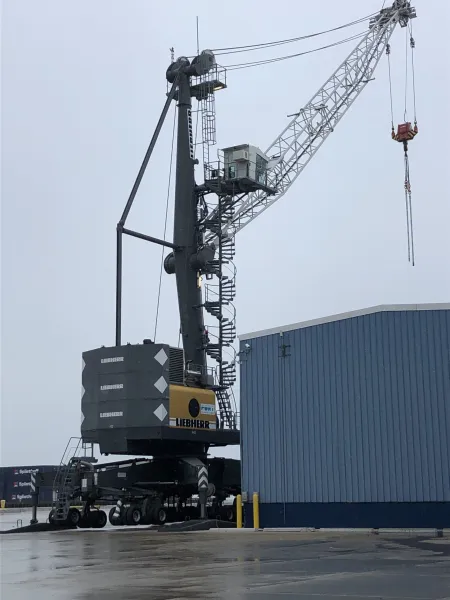
Over time, the port plans to acquire additional equipment as and when machinery and funds become available, including replacements for a large crane and other material-handling equipment.
“It’s just a matter now of biting off chunks as we can,” Beck said. Timing for the acquisitions will also depend on when different types of electrical equipment become available, which will involve ongoing review.
Port Authority President and CEO Will Friedman said the electrification push fits with the port’s broader sustainability goals, including reducing water pollution in Lake Erie and managing dredged material more sustainably.
“We’re doing it because it’s the right thing to do. We have a social conscience here,” Friedman said.
The decision also should help the port stay competitive, especially as more companies consider the indirect emissions of their contractors.
“We think that’s going to be the future if you’re part of the supply chain network,” Friedman said, adding that ignoring greenhouse gas emissions really isn’t an option. “All industries are trying to figure out how they can decarbonize, and maritime shipping is certainly a part of that.”
Decarbonization makes sense for Cleveland and Cuyahoga County in the global scheme of things, said Grant Goodrich, executive director for the Great Lakes Energy Institute at Case Western Reserve University.
“Getting products in and out of Europe and being able to advertise and market that you can do it in a more emissions-friendly manner gives you a competitive advantage,” Goodrich said. The European Union already is pushing for the shipping sector to cut greenhouse gas emissions, and Goodrich expects that will ultimately become important in the American marketplace as well. Cutting greenhouse gases also could help attract more cruise ship business to Cleveland, he added.
The port’s regional nature likely will make some aspects of decarbonization easier. For starters, the port generally does not store fuel for ships on site. Ships typically fill up elsewhere, often from barges, depending on where they believe they can get the best deal, Friedman said. If a ship does need extra fuel while in Cleveland, trucks deliver it.
On the other hand, the Cleveland-Cuyahoga County Port Authority has less bargaining power than some much larger ports on the East and West coasts. That limits its ability to increase fees, which makes grants and other types of funding particularly important.
The Cleveland-Cuyahoga Port Authority’s focus on Scope 1 and Scope 2 emissions is consistent with the goals for a majority of other ports included in a March 2024 report from the Environmental Defense Fund and Arup. However, the report noted, the majority of total port emissions driving human-caused climate change generally are not within ports’ direct control and would fall into Scope 3.
“Action in the broader zone of user and community and industry influence, where impacts are often far greater and where potential benefits are significant, is lacking,” the EDF report said.
The Cleveland-Cuyahoga County Port Authority’s upgrades include planning to provide power for some of those other indirect emissions.
“We don’t want to forget about Scope 3,” Beck said.
She added that the port anticipates offering incentives to encourage ships and others to reduce their emissions.
An example would be for ships to plug into electrical shore power, known as “cold ironing,” instead of running diesel engines while in port. Besides cutting greenhouse gas emissions, the process can also reduce pollution from particulate matter, nitrous oxides, hydrocarbons and carbon monoxide. The port also hopes to encourage independent operators to acquire electric tugboats and similar equipment.
“Port decarbonization is just one key piece of the full decarbonization equation,” said Rodriguez at the Environmental Defense Fund. “It is also up to the trucking and shipping sectors to meet the ports halfway and contribute to the decarbonization efforts. In an effort to reach net zero by 2050, all stakeholders must play their part.”
UTILITIES: Colorado’s largest electric cooperative officially splits with Tri-State Generation and Transmission following years of wrangling over the wholesale power supplier’s rates, fossil fuel reliance and limits on local generation. (Greeley Tribune)
ALSO: Arizona regulators reject a utility’s request to exempt its proposed natural gas plant expansion in the western part of the state from environmental reviews. (12 News)
TRANSMISSION: Developers complete construction on the 125-mile Ten West Link transmission line designed to move solar power between California and Arizona. (Inside Climate News)
GRID: PacifiCorp becomes the first entity to formally commit to the California grid operator’s extended day-ahead power market. (RTO Insider, subscription)
SOLAR:
CLEAN ENERGY:
COAL: Wyoming Gov. Mark Gordon plans to sue the Biden administration over rules aimed at reducing power plant pollution, saying it will hasten the demise of the state’s coal industry. (WyoFile)
OIL & GAS:
HYDROPOWER: Alaska utilities send their proposed plan for the Eklutna hydropower dam to Gov. Mike Dunleavy after months of debate over the facility’s management. (KTUU)
ELECTRIC VEHICLES:
CLIMATE: Portland, Oregon’s clean energy fund considers investing $50 million in seven school districts to fund solar installations, efficiency upgrades and other emissions reduction and climate change mitigation efforts. (OPB)
STORAGE: A company opens the first U.S. long duration, sodium-ion battery manufacturing plant in western Michigan in what officials call a “milestone for the battery industry.” (WWMT)
ELECTRIC VEHICLES: Minneapolis-St. Paul’s regional public transit agency will buy 20 electric buses to put in service by 2026 to help meet emission-reduction targets. (Star Tribune)
GRID: A federal judge upholds a decision to block a land swap needed to complete a major transmission line between Iowa and Wisconsin, creating more uncertainty for the project. (E&E News, subscription)
CLEAN ENERGY:
WIND: North Dakota regulators approve plans for a 200 MW wind project that includes an 18-mile transmission line. (North Dakota Monitor)
PIPELINES: At a North Dakota Republican Party convention, a resolution objecting to the use of eminent domain for carbon capture pipelines falls two votes short. (North Dakota Monitor)
AIR QUALITY: Wildfire smoke helped keep Fargo, North Dakota, on an annual ranking of the 25 worst U.S. cities for short-term particle pollution. (MPR News)
POLITICS: The top GOP candidates for Indiana governor say they would take steps to emphasize coal and reshape the state’s utility oversight board. (Indiana Capital Chronicle)
GRID:
BIOGAS:
COMMENTARY:
GRID: Texas’ grid manager increases its forecast for large-scale users from 111 GW to 152 GW — a 37% increase by 2030 that places even more pressure on an already wobbly power grid. (Dallas Morning News)
PIPELINES: Mountain Valley Pipeline officials say cost of the nearly completed project has grown to $7.85 billion, more than $220 million higher than its latest cost estimate in February. (Roanoke Times, Cardinal News)
SOLAR:
WIND: Dominion Energy readies its first batch of monopiles for placement as it begins construction of its offshore wind farm near Virginia. (Virginian-Pilot)
OIL & GAS:
TRANSITION:
NUCLEAR: Years of delay and tens of millions in cost overruns in Georgia Power’s expansion of nuclear Plant Vogtle will likely push utilities away from such large projects toward small modular reactors, experts say. (E&E News)
UTILITIES:
POLITICS: West Virginia Gov. Jim Justice vows to fight new U.S. EPA rules requiring coal-fired power plants to reduce or capture 90% of their greenhouse gas emissions over the next decade. (West Virginia Watch)
GRID: Eversource jabs at Connecticut’s utility commission, saying it hasn’t been “a constructive regulatory environment” and announcing a $500 million decrease in grid investments over the next five years; the governor will reappoint the commission’s chair regardless. (CT Mirror, Hartford Courant, CT Mirror)
ALSO:
FOSSIL FUELS:
FINANCE: A number of Schoharie County towns sue New York state over the constitutionality and fairness of its solar and wind project taxation rules. (CBS 6)
POLICY: Climate advocates and policymakers say the New York Power Authority hasn’t been transparent enough in its planning to comply with the Build Public Renewables Act for anyone to see if the agency is on track to meet its mandates. (Canary Media)
ELECTRIC VEHICLES:
WIND: The Brigantine, New Jersey, city council pushes for fellow municipalities and its county board of commissioners to use legal action to fight offshore wind development. (Press of Atlantic City)
SOLAR:
GRID: Power outages stemming from severe weather across the U.S. have surged 74% in the past decade compared to the decade before, showing another tangible effect of global warming, a climate group’s analysis finds. (Guardian)
ALSO:
OFFSHORE WIND:
ELECTRIC VEHICLES:
AIR QUALITY: Nearly 40% of U.S. residents were exposed to unhealthy levels of air pollution last year, an increase from the year before thanks to wildfires and extreme heat. (Guardian)
HYDROGEN: A U.S. Energy Department advisory committee says the clean hydrogen industry isn’t growing fast enough and needs further federal help to meaningfully help the U.S. reach net-zero emissions by 2050. (E&E News)
PUBLIC LANDS: A wave of new federal rules and plans aim to leverage public lands for clean energy development while protecting vulnerable ecosystems. (Canary Media)
SOLAR:
OVERSIGHT: As Georgia’s regulatory board goes years without elections, a group of Black voters appeal to the U.S. Supreme Court to shift from at-large elections to having each commissioner elected by voters in the district where they live. (Grist/WABE)
PIPELINES: Environmental groups sue to challenge federal regulators’ approval of an extension for the Mountain Valley Pipeline’s spur into North Carolina, arguing the project has changed so much the pipeline should be required to start the permitting process over. (Cardinal News)
GRID: The Biden administration finalizes a transmission permitting streamlining rule and plans to spend $331 million to add more than 2,000 MW of grid capacity in the West. (Heatmap, news release)
ALSO: California’s grid operator proposes investing $6.1 billion in 26 infrastructure projects aimed at expediting renewable energy project interconnections before 2035. (Reuters)
STORAGE:
SOLAR: A New Mexico company breaks ground on a $50 million solar tracking equipment manufacturing facility near Albuquerque. (Solar Power World)
COAL:
POLLUTION: The American Lung Association finds four New Mexico counties have excessively high levels of ozone pollution, including three in oil and gas producing regions. (NM Political Report)
OIL & GAS:
NUCLEAR:
HYDROPOWER:
ELECTRIC VEHICLES:
UTILITIES: Oregon regulators reject consumer advocates’ bid to dismiss Portland General Electric’s requested rate increase, saying the proposal must go through the lengthy review process. (Oregonian)
COMMENTARY: A California columnist celebrates the closure of 21 Western coal plants over the past two decades, but warns that shuttering the 32 remaining facilities may be even more difficult. (Los Angeles Times)
GRID: Virtual power plants, dynamic line ratings, and other advanced grid technologies could open up space on the grid for more electricity while staving off the need for costly, time-consuming transmission construction, a new U.S. Energy Department roadmap finds. (Canary Media)
ALSO:
EMISSIONS:
WIND: The world installed a record 117 GW of new wind power generation capacity last year, up 50% from the year before, a wind power advocacy group finds. (The Hill)
ENVIRONMENTAL JUSTICE: Black Americans are more likely than other racial groups to say they’re “very” or “fairly” concerned about pollution, and are more likely than White Americans to be displaced by environmental contamination, a survey finds. (The Hill)
CARBON CAPTURE: Illinois bills would add a series of restrictions on carbon sequestration and pipeline projects as developers seek to capitalize on the state’s geology and lucrative federal tax credits. (Energy News Network)
SOLAR:
ELECTRIC VEHICLES: Cities across the U.S. are building out electric vehicle charging networks to meet anticipated EV growth. (Utility Dive)
POLITICS: House Republican leaders are poised to cut a provision to reverse the Biden administration’s LNG permitting ban from critical foreign aid packages. (E&E News)
TRANSMISSION: A federal judge rejects tribal nations’ and advocates’ bid to halt work on a segment of the SunZia transmission project in a culturally and ecologically significant part of southern Arizona. (Associated Press)
MINING:
OIL & GAS:
CLIMATE:
WIND: A Colorado electric cooperative and wholesale power supplier agree to purchase the full output of a 200 MW wind facility in the eastern part of the state. (news release)
UTILITIES:
COAL:
GEOTHERMAL: The federal Bureau of Land Management plans to exempt some geothermal exploration projects from environmental reviews to expedite development. (E&E News, subscription; news release)
ELECTRIC VEHICLES: An Arizona community college launches an electric vehicle technician training course. (news release)
COMMENTARY: Nevada advocates urge the federal Bureau of Land Management to push utility-scale solar projects toward low-conflict, previously disturbed public lands. (Nevada Independent)


.svg)
