

 Back
Back
This story originally appeared in New York Focus, a nonprofit news publication investigating power in New York. Sign up for its newsletter here.
New York is violating its climate law — and doesn’t get a pass because implementing the law is “complicated,” a judge found Friday.
The 2019 law, which remains one of the most ambitious in the country, gave the state Department of Environmental Conservation until the start of 2024 to issue regulations that would “ensure” New York meets its binding greenhouse gas emissions targets. More than a year and half later, it has not — a fact that Ulster County Supreme Court Judge Julian Schreibman said was “undisputed” in the case.
Schreibman gave the DEC until Feb. 6 to issue regulations that comply with the law, called the Climate Leadership and Community Protection Act.
“While DEC notes that it has taken other, commendable regulatory steps to reduce greenhouse gas emissions, it candidly concedes that the impact of those regulations would fall far short” of the targets set out in the law, which requires the state cut emissions 40% from 1990 levels by 2030 and 85% by 2050, Schreibman wrote.
Climate groups brought the case in March after Gov. Kathy Hochul (D) slammed the brakes on what was expected to be her signature policy to implement the climate law: an emissions-pricing program known as cap-and-invest. Internal emails reported by Politico show that the DEC and the New York State Energy Research and Development Authority had completed draft cap-and-invest rules at the beginning of this year, before Hochul’s abrupt about-face.
The DEC argued in court that issuing the regulations was “infeasible” because it “would require imposing extraordinary and damaging costs upon New Yorkers.” (Hochul in August said much the same about her own reasons for shelving cap-and-invest.)
The judge dismissed that argument.
“It is undoubtedly true that the task placed before the DEC is very complicated indeed,” he wrote. “But as a legal argument, this is unavailing.”
Schreibman said there were two possible paths forward: Either the legislature can step in and change the law, or the DEC must act on it. He set his deadline in February, a month into the next legislative session, to give state lawmakers a chance to weigh in. If the legislature leaves the climate law intact, he said, he is “highly unlikely” to grant the DEC an extension.
The ruling does not explicitly require the state to move ahead with cap-and-invest; the policy is not named in the climate law, and Schreibman said the content of the DEC’s regulations is not up to him. But the law does require the regulations to reflect the findings of its 2022 scoping plan, which envisioned cap-and-invest as its core measure to achieve the emissions targets. State agencies spent two years working on the rules to establish that program before Hochul put them on ice. It’s not yet clear whether the DEC could find a substitute by February.
Hochul said Monday that her administration plans to appeal the decision, which could lead the case to drag on for months longer, if not more.
Reacting to the ruling on Friday evening, she said she would do what was necessary to keep New York’s energy supply reliable and affordable and keep the state attractive to business.
“New York has been, and will continue to be, a leader in climate action, but the judge’s decision fails to factor in the realities of today that include a federal government hostile to clean energy projects, the continuing impacts of post-COVID high inflation, and potential energy shortages expected downstate as soon as next year,” Hochul said in an emailed statement. “We plan to review all our options, including working with the Legislature to modify the CLCPA and appeal, in order to protect New Yorkers from higher costs.”
Facing a cash crunch of more than $1 billion, Europe’s flagship green-steel project began publicly seeking a financial lifeline earlier this month. This week, the French hydrogen investor Hy24 swooped in to help fund Stegra, the Swedish firm behind the effort.
Construction is 60% complete on the facility, which is located in northern Sweden just below the Arctic Circle. If finished, the plant would be the world’s first large-scale steel mill fueled by clean hydrogen, giving Europe a leg up on both the United States and China in an emerging low-carbon technology.
“There is no reason to question the project, whose fundamentals are very good,” Pierre-Etienne Franc, co-founder and CEO of Hy24, told Bloomberg. “If anything, demand for green steel has risen since its launch.”
Franc did not disclose how much money Hy24 invested in Stegra (formerly known as H2 Green Steel), and the company did not respond to Canary Media’s multiple emails requesting comment.
In a press release announcing the start of the new fundraising round on October 13, Stegra CEO Henrik Henriksson said that the investments the company was seeking would represent “approximately 15%” of overall project funding, “comprising a mix of new equity, debt, outsourcing, and selected strategic partnerships.”
“Stegra has a unique position in the green steel landscape with a strong order book, a competitive cost position, and proven execution capabilities,” Henriksson said.
A previous investor from Stegra’s 2023 financing round had also stepped up before Hy24 made its announcement. Just Climate, the British low-carbon venture fund linked to former Vice President Al Gore’s investment company, told the Swedish broadcaster SVT earlier this month that it planned to increase its stake in Stegra. In a statement, Stegra told Canary Media that “several investors have conveyed their commitment to this round,” including the venture funds Altor, FAM, and Kallskär.
But Hy24 is the first new investor to come forward since the latest fundraising began. The investment firm represents “one of the most advanced funding bases for hydrogen in the world,” said Rinaldo Brutoco, the founder of the World Business Academy think tank and a hydrogen investor who has advised European governments on the hydrogen industry.
“They’re the best thing in the hydrogen space in France,” he said. “They invest at the level of ‘let’s build a full-scale plant’ and they operate at the level of ‘let’s build entire industries.’”
That Hy24 is funding Stegra, he said, is a sign the firm is “confident it’s a safe investment.”
“Will Stegra be successful? Absolutely,” Brutoco said. “Have they run into cost overruns? Sure, what new technology hasn’t? But it’s a minor hiccup.”
Still, some big investors are growing skittish. Unnamed sources told the Financial Times this month that Citigroup, one of the project’s core funders, has indicated it wants to stop lending to Stegra because of concerns about the company’s future.
Haunting the project is the ghost of its former sister company, the European battery manufacturer Northvolt, which declared bankruptcy last fall. Both firms were founded with money from Vargas Holding, a Swedish private equity investor focused on climate impacts.
“They’ve got their work cut out,” one lender said of Stegra, according to the FT. “But there is a solid case there, a basis to conduct fundraising, that there wasn’t for Northvolt.”
Amid multiple emergency board meetings, Harald Mix, chair and co-founder of Stegra, agreed to step aside.
Stegra isn’t alone in its troubles. In the U.S., the Trump administration has hampered the nascent green-steel industry by slashing funding to the two regional hubs meant to ramp up production of green hydrogen and changing the terms of grants through the Department of Energy to encourage steelmakers such as Cleveland-Cliffs to double down on coal. In Europe, meanwhile, the Luxembourg-based steel giant ArcelorMittal abandoned plans in June to produce clean steel with green hydrogen and direct reduced iron at two German sites in Bremen and Eisenhüttenstadt.
“[T]here has been slower than expected progress on all aspects of the energy transition, including green hydrogen not yet being a viable fuel source and natural gas-based DRI production not being competitive as an interim solution,” ArcelorMittal said in a statement.
That makes the latest investments in Stegra a cause for optimism, said Anne-Sophie Corbeau, a hydrogen analyst at Columbia University’s Center on Global Energy Policy.
“Some European steel producers have been going backward recently, like Arcelor, so it’s good to see this project moving forward,” she said.
America has some green shoots, too. Hyundai this month confirmed its plans to build a clean steel facility in Louisiana by the end of the decade, with plans to generate green hydrogen by 2034.
“In a time of strong headwinds for industrial decarbonization, continued investor confidence in projects like this is encouraging,” said Ariana Criste, a spokesperson at Industrious Labs, a research group that tracks steel industry decarbonization. “It shows that despite near-term challenges, the fundamentals for clean steel are solid, and each new project or demand signal helps build the technical foundation and market momentum needed to accelerate the transition.”
An update was made on November 2, 2025 to add a statement from Stegra
Thermal energy storage systems, which turn electricity into heat that can be tapped for hours or days at a time, could help decarbonize the production of everything from cement to beer.
But in the U.S., where the economics of replacing fossil fuels with electricity remain challenging, thermal-battery startup Rondo Energy has found its first industrial-scale opportunity in a more controversial place: the oil fields of California.
Last week, the San Francisco Bay Area-based firm announced the start of commercial operations for its first 100-megawatt-hour “heat battery,” located at a Holmes Western Oil Corp. facility in Kern County, the heart of the Central California oil patch.
The installation is housed in what looks like a four-story prefabricated office building. Inside sits a massive stack of refractory bricks, which are heated to temperatures of more than 1,000 degrees Celsius (1,832 degrees Fahrenheit) by an adjoining 20-megawatt solar array. That heat is tapped to generate steam that is injected into oil wells to increase production — a job previously done by a fossil-gas-fired boiler.
The project is something of a Faustian bargain. It will reduce carbon dioxide emissions by about 13,000 metric tons per year, said John O’Donnell, Rondo’s cofounder and chief innovation officer. But, of course, those reductions are in service of bringing more planet-warming fossil fuels to market.
Rondo’s argument for pursuing this application is twofold. For one, fossil fuels will be in use for decades to come, and so we might as well reduce emissions from the sector where we can. Second, thermal-storage startups need paying customers in order to scale up their technology, which could prove necessary to minimize pollution from a host of hard-to-decarbonize sectors.
“We’ve got to decarbonize the world the way it is right now,” O’Donnell told Canary Media in a Thursday call from the Washington, D.C., hotel hosting the annual summit of the Renewable Thermal Collaborative, a coalition of organizations working to cut emissions from heating and cooling. “And because California is kind of an island unto itself, we see this opportunity to make a very big impact in the state.”
Finding cost-effective projects in the U.S. has become even more important after the Trump administration canceled hundreds of millions of dollars in federal grants for industrial decarbonization efforts across the country. The defunded projects included ones that planned to use Rondo heat batteries: International spirits maker Diageo wanted to install the tech at its production sites in Illinois and Kentucky, while chemicals giant Eastman had agreed to add it to a plastics-recycling facility being built in Texas.
Those companies haven’t said if they plan to continue work on those projects absent federal funding, and O’Donnell declined to comment on their prospects. “We are ready to work with them when they’re ready to go,” he said.
But industry experts have pointed out that building first-of-a-kind thermal batteries is challenging without government funding to absorb some of the risk. The recent rollbacks jeopardize the U.S.’s ability to develop a technology that could play a major role in cleaning up industrial heating, which is responsible for roughly 13% of U.S. energy-related carbon emissions.
“Transitioning the world’s industrial economy to clean is going to take a minute — and by a minute, I mean multiple decades,” said Blaine Collison, executive director of the Renewable Thermal Collaborative. “This is a big shift that has to happen at a lot of discrete points. There are tens of thousands, hundreds of thousands of facilities that have to be addressed.”
Rondo’s first 2-megawatt-hour pilot-scale heat battery started operating two years ago at a California ethanol-production facility. But that served more as a “constructability test” for the company’s technology than as a full-scale proof point for commercial viability, O’Donnell said.
Rondo’s Kern County battery, meanwhile, is its first major installation, though it has several others in the works across Europe. It’s building similar heat batteries at a chemicals plant in Germany, a green industrial park in Denmark, and an undisclosed food-and-beverage processing facility in Spain or Portugal.
The market for Rondo’s tech is stronger in Europe, where companies pay much higher prices for fossil gas and face sizeable fees and taxes on their greenhouse gas emissions, O’Donnell said. In the U.S., by contrast, fossil gas is cheap, and only a handful of states impose costs on industrial carbon emissions.
California is one of those states. Under its cap-and-trade program, industrial polluters must reduce their greenhouse gas emissions below certain thresholds — otherwise they have to pay fines or purchase offsets to make up the difference. And under the state’s Low-Carbon Fuel Standard, companies that produce and sell fossil fuels with lower embodied emissions can earn credits they can use to reduce compliance costs.
Still, even in more competitive markets like Europe and California, Rondo has additional work to do to hit its long-range cost goals. O’Donnell said the company is targeting $30 per megawatt-hour for the energy storage services its heat batteries provide, which would put it well within the range of lithium-ion batteries, albeit for a system that stores heat rather than electrical energy.
But the Holmes Western project is “not close” to that price point, he said. Rather, it’s “owned by the customer at a price point that was economical to them.”
The holy grail for thermal storage — the thing that will make it broadly cost-competitive with fossil-fueled heating — is tapping into cheap, clean power.
That’s because the cost of electricity is ultimately what dictates whether a thermal battery makes financial sense. But unlike fossil fuels, electricity prices vary not just from week to week, but from hour to hour. That makes it tricky for would-be customers to evaluate whether to stick with a gas boiler or to make a bet on an electricity-powered system like Rondo’s.
Solar and wind, however, reliably generate power at a very low cost. In some parts of the U.S. and the world, the amount of renewable energy available exceeds electricity demand for hours at a time, driving wholesale power prices to zero or even negative.
Storing this excess carbon-free electricity as heat can significantly cut costs for owners of thermal storage systems, O’Donnell said. The challenge for providers of the tech is to get utilities, regulators, and energy-market operators to allow industrial customers to access those low or negative energy prices, O’Donnell said. Today, most industrial sites buy their electricity from utilities at retail rates that don’t pass through these wide wholesale fluctuations.
This is especially true in California, where thermal batteries are “in many ways the perfect solution,” said Teresa Cheng, California director at Industrious Labs, an advocacy group focused on cutting emissions from heavy industry.
Solar power is close to overtaking fossil gas as the state’s predominant source of electricity. Much of it is generated at times when there isn’t enough demand for electricity to use it or enough battery capacity to save it for later, forcing the state’s grid operator to curtail increasing magnitudes of solar.
Thermal batteries could soak up that cheap renewable energy while helping industries decarbonize, Cheng said. But “to make this work, we need state leaders to fix industrial electricity rates so they actually reward companies for using cheap, clean power instead of letting it go to waste.”
Holmes Western Oil Corp. is in an unusual position of owning enough land surrounding its facility to build its own 20-MW solar array without connecting to the grid. That “islanded” system allows the company to self-supply solar power at a cost that justifies the project, O’Donnell said.
But that’s a rare occurrence. Most industrial customers will need to source power from the grid — and opportunities for them to access electricity at wholesale prices are few and far between.
Doron Brenmiller, cofounder and chief business officer of Israel-based thermal energy storage provider Brenmiller Energy, said Europe is moving more quickly than the U.S. to support heat batteries, including a number of projects his company is building. He cited the European Commission’s upcoming $1.2 billion pilot auction to fund efforts to decarbonize industrial process heat.
“The utilities in Europe are also very engaged in this space,” he said. Brenmiller has partnered with German energy-trading firm Entelios to integrate its growing roster of industrial thermal storage projects into a variety of “short-term flexibility markets” for specialty grid services like frequency regulation and demand response.
But getting the first large-scale projects up and running remains the most important next step for the industry, he said. Brenmiller expects its first industrial-scale project, a 32-megawatt-hour thermal storage unit at a beverage-processing plant in Israel, to start operations before the end of 2025. A second 30-megawatt-hour system at a pet-food factory in Hungary is scheduled to begin running in 2026.
“All the eyes of clients and investors are on these first few big projects,” he said. “We’ve done pilots, even at scale. But these are the real thing.”
Tech firms and automakers both need lots of steel to build their data centers and vehicles. The metal is sturdy, ubiquitous — and highly carbon-intensive when it’s produced using traditional coal-fired furnaces.
The startup Electra says it’s working to scale a dramatically cleaner method for making the key material. On Tuesday, the company unveiled the site of its new demonstration plant in Jefferson County, Colorado. Electra also announced purchase agreements with the tech giant Meta and with Nucor and Toyota Tsusho America, both of which supply steel to car manufacturers.
Instead of using a scorching furnace, Electra produces iron — the main ingredient in steel — with electrochemical devices, which are powered by renewables and can run at the same temperature as a fresh cup of coffee. The method, known as “electrowinning,” is time-tested for removing impurities from metals like copper, nickel, and zinc. Now Electra is using it to make high-purity iron.
“We’re reinventing how iron has been made for centuries through an electrified process,” Sandeep Nijhawan, the startup’s cofounder and CEO, told Canary Media ahead of this week’s announcement.
Steelmaking is responsible for up to 9% of total global greenhouse gas emissions, and most of that pollution comes from the coal-fueled blast furnaces that convert iron ore into iron.
Electra will soon begin installing equipment inside an existing 130,000-square-foot building south of the company’s headquarters in Boulder, Colorado. The demonstration project is backed by a new $50 million grant from the Breakthrough Energy Catalyst program, adding to the $186 million Electra raised from investors earlier this year and its $8 million tax credit from the Colorado Energy Office.
The plant is set to start operations in mid-2026 and will deliver up to 500 metric tons of iron per year — a minuscule amount compared to the roughly 1.4 billion metric tons of iron produced globally in 2023. But it’s an important step toward commercializing the emerging technology, the company and its partners say.
Nucor, the largest U.S. steel producer and an early investor in Electra, has committed to purchasing iron from the demonstration facility, which it will then add to electric arc furnaces to make steel. Toyota Tsusho America said it plans to sell Electra’s clean iron to steelmakers, then distribute the resulting steel to automakers. A third partner, Germany’s Interfer Edelstahl Group, will use the iron in its specialty steel applications.
“We’re excited to see Electra’s demonstration facility become a reality,” Al Behr, Nucor’s executive vice president of raw materials, said in an Oct. 21 press release. He added that the project “lays the groundwork for a new era of low-carbon materials.”
Meta, for its part, struck a different type of deal to buy environmental attribute certificates from Electra. This relatively new concept allows the data-center developer to count the emissions reductions associated with a ton of Electra’s iron toward Meta’s own sustainability targets. The certificates won’t apply to the iron that other partners buy, but rather to a separate batch, Electra said.
Through its offtake agreement, Meta aims to “demonstrate a pathway for these innovative materials to scale,” John DeAngelis, the firm’s head of clean technology innovation, said in the press release.
Electra and its partners didn’t provide more details about the financial value or volumes of iron associated with the new deals.
Electra launched in 2020 with a vision to “use renewable electricity, along with electrochemistry, to produce iron without using fossil fuels,” said Nijhawan, who cofounded the company with Quoc Pham. The startup now operates two pilot plants at its research lab in Boulder, though it didn’t disclose how much clean iron it’s produced to date.
Across the steel industry, another alternative to the blast-furnace process is already gaining traction: “direct reduced iron” production, which can use fossil gas or hydrogen. About 9% of global iron was made this way in 2023.
A handful of commercial-scale direct-reduction projects are underway in Europe and China that will specifically use green hydrogen made with renewable power, which could curb the overall CO2 emissions from steelmaking by up to 90%. Among the most prominent efforts is Stegra’s green-steel plant in northern Sweden that’s set to be completed in late 2026 or early 2027.
Green-steel developers have recently faced soaring production costs, uncertain market demand, and a shifting policy landscape, leading some companies to cancel or postpone projects. Last week, Stegra said it plans to raise another $1.1 billion in funding to build its first-of-a-kind facility, for which the steelmaker has already raised $7.6 billion. In the United States, meanwhile, the Trump administration is gutting federal funding for producing low-carbon hydrogen meant to benefit industries like steelmaking.
“We are seeing a slowdown in the market among our peers, which is also exacerbated by the policy uncertainty” in the U.S., Nijhawan said. “But our long-term and even near-term strategies remain unchanged.”
Electra’s technology is still in the early stages of development, while direct-reduction plants have operated for decades, albeit using fossil fuels. But if electrowinning can scale, it would offer a few key advantages.
The method involves dissolving iron ore into a water-based acid solution to separate iron ions from impurities in the ore. The company then electrifies the solution to deposit pure iron onto sheets the size of a basketball backboard. This process doesn’t require fossil fuels or hydrogen. It can also incorporate iron ores with more impurities — such as those from older mines — than direct-reduction plants typically use, giving Electra access to cheaper materials.
Plus, electrowinning doesn’t need constant, extreme heat, so Electra can tune its operations to the fluctuations of wind and solar power plants, ramping up when clean electricity is most available and affordable. The company said it purchases 100% renewable energy for its Boulder pilot operations through an Xcel Energy utility program, which Electra will also leverage for its Jefferson County demonstration facility.
As the five-year-old firm prepares to open its new plant, Electra is already looking for places to build a commercial-scale manufacturing site, which could be operational in 2029.
The steel industry is “definitely in this phase where the [green steel] transition and meeting climate goals looks a lot more difficult today,” Nijhawan said. But, he added, “I believe the solutions are in hand, and it’s a matter of scaling to drive those economics as fast as we can.”
The United Nations agency that governs global shipping has voted to delay the adoption of its landmark decarbonization strategy by one year, following intense opposition from the Trump administration.
The Friday decision by the International Maritime Organization in London casts uncertainty over the future of the Net-Zero Framework, which would have been the world’s first binding emissions target for an entire industry.
“Today’s delay in adopting the [framework] is a missed opportunity,” Natacha Stamatiou, who leads the Environmental Defense Fund’s global shipping work, said in a statement to Canary Media. “Every delay means that innovation will struggle to scale, inequities will deepen, and the transition to clean shipping will become harder and more costly.”
International shipping is responsible for about 3% of the world’s annual greenhouse gas emissions. Climate pollution from diesel-guzzling vessels — which haul virtually everything we buy and use — is projected to soar in the coming decades if nothing changes.
The Net-Zero Framework would require large ships to progressively reduce greenhouse gas emissions as much as possible by 2050. The strategy, which leans on a carbon tax, would force ships to swap out dirty fuels with cleaner alternatives, such as e-methanol or green ammonia, and adopt other energy-saving technologies like wind-assisted propulsion.
The delayed vote puts that progress on ice — and represents a stunning reversal from where negotiations sat just a few weeks ago.
In April, over 60 countries in the IMO, including Brazil, China, and India, agreed to put the framework to a vote in October. In the months leading up to this week, diplomats, environmental groups, and even industry organizations said they expected relatively smooth sailing toward approval.
However, on Oct. 10, ahead of the negotiations, the Trump administration issued a statement forcefully opposing an international environmental agreement, claiming it “unduly or unfairly burdens the United States.” U.S. officials also began calling and writing to countries that supported the measure, threatening to impose tariffs, withdraw visa rights, and take other retaliatory measures, The Guardian reported on Wednesday.
On Friday, the final day of talks, the U.S., Singapore, Liberia, and Saudi Arabia all called on IMO to postpone adoption of the climate rules. The motion to delay was ultimately put forward by Singapore and called to a vote by Saudi Arabia. While 49 countries voted against the delay, 57 were in favor. Twenty-one nations abstained.
Without a clear framework in place, progress toward decarbonizing shipping will remain slow going. Efforts to kickstart alternative, lower-carbon fuels have emerged in recent years, but shipping companies and fuel producers have been hesitant to invest at a meaningful scale without a clear directive from the IMO.
Shipping companies, for their part, had said they welcomed the certainty that a global, finalized net-zero standard would provide — particularly as the European Union presses ahead with its own ship-emission rules. A coalition of major shipping industry groups said in an Oct. 9 statement that without an international strategy, a patchwork of separate regulations could bog down the industry in costs without advancing decarbonization.
“This delay unfortunately continues the business uncertainty that hampers investment for private sector actors that are ready and eager for this energy transition to accelerate,” said Ingrid Irigoyen, president and CEO of the Zero Emission Maritime Buyers Alliance.
The Net-Zero Framework is the product of the IMO’s now decade-long attempt to institute a climate strategy.
While the details are still being sorted out, the basic idea behind the regulation is as follows: Every year, shipping companies must calculate their “GHG fuel intensity” — the emissions per unit of energy used, on a lifecycle basis — the results of which determine their next steps. Ships that don’t meet IMO’s fuel-intensity standards must buy “remedial units” to cover their compliance gap; the dirtiest ships must pay an additional penalty to IMO for every metric ton of CO2 above the established threshold.
Had the strategy passed, the global fuel standard and carbon-pricing mechanism would have taken effect in 2027, and ships would have needed to start reporting their GHG fuel intensity in 2028. That timeline will now be revised.
There’s no clear deadline yet for when the group will reconvene and conduct a final vote to officially adopt the framework. The IMO will hold a technical meeting to discuss the design of the framework next week.
But experts and advocates warned that there is no more time to delay.
“This is catastrophic for confidence, and therefore also for the equitable and ambitious decarbonisation we need,” Tristan Smith, professor of energy and transport at University College London, said in a statement. “We will now have to double-down on other means to drive shipping GHG reduction and energy transition. Climate science tells us that the challenge of decarbonisation does not go away, it gets harder.”
One of the largest ports in the Midwest is officially starting to decarbonize, thanks to a Biden-era grant program that has so far survived the Trump administration’s assault on all things clean energy.
Late last month, the Port of Cleveland began renovating its main warehouse on the shore of Lake Erie. When the work is complete, Warehouse A will have roughly 2 megawatts’ worth of rooftop solar panels, plus battery storage and numerous charging ports for cargo-handling equipment.
Cleveland, which received a $94 million award from the Clean Ports Program announced by the U.S. Environmental Protection Agency last fall, is one of three Great Lakes port groups benefitting from the funding. Although the agency has reneged on many other funding commitments under President Donald Trump, work and payments for the $2.9 billion ports program are still moving ahead.
The country’s more than 300 ports, which ship and receive the materials, food, and other products that Americans rely on, are mostly powered by fossil fuels. Their cranes, forklifts, and other freight-handling equipment burn diesel fuel, and so do the ships and boats docked at those ports, sending not only planet-warming greenhouse gases into the atmosphere but toxic pollution that can harm the people who work and live nearby.
To address both problems, the Cleveland-Cuyahoga County Port Authority has set a goal of net-zero greenhouse gas emissions by 2050. “We want to have a lower impact on surrounding communities. We also want to stay ahead of regulations,” said Bryan Celik, a contract engineer for the Port of Cleveland. The goal covers the port’s direct Scope 1 emissions, as well as its Scope 2 emissions for energy use.
Global shipping companies face increasing pressure to decarbonize boats and ships, and technology for wind-powered and battery-powered vessels has improved in recent years.
The U.S. has previously taken steps toward decarbonizing shipping, including by partnering with Norway on the Green Shipping Challenge, but the Trump administration has scuttled progress this year. Trump also opposes a proposed global fee on greenhouse gas emissions that the International Maritime Organization will consider formally adopting this month.
The nearly $3 billion in Clean Ports Program funding nationwide “has transformative potential for U.S. ports,” said Jerold Brito, a program associate with the Electrification Coalition, a nonprofit that helped coordinate a Sept. 25 event on regional port electrification hosted by the Port of Cleveland.
Indeed, Cleveland is not alone in its efforts to clean up its port. The Detroit/Wayne County Port Authority, for example, has an even more ambitious goal of reaching net-zero for its Scope 1 and 2 emissions by 2040, said its sustainability manager, Taylor Mitchell.
Because so much is shipped through ports, Mitchell says, electrifying these hubs of commerce is a “cool opportunity to have a really huge impact on the planet.”
During the late September event organized by the Electrification Coalition, representatives from Cleveland, Detroit, and Hamilton, Ontario, met with contractors and others in industry and nonprofit organizations to share plans and address challenges.
For Brito, this sort of collaboration is key to the success of port electrification.
“Realizing that potential will require buy-in from — and coordination with — the regional networks of industry, nonprofit, and government actors affected by ports’ electrification,” he said.
For example, work at Cleveland’s Warehouse A necessitates collaborating with Cleveland Public Power, the city’s municipal utility. While solar panels and battery storage at the warehouse will eventually provide much of the port’s electricity needs, it still requires more grid power in order to fully electrify.
Other phases of the work will add cabling and connections for vessels to operate with electric power while they’re in port. That “shore power,” or cold ironing, could let boats and ships shut off their diesel engines until it’s time to get underway again.
Additionally, Logistec USA, the port operator, will acquire an electric crane and electric forklifts. And the Great Lakes Towing Co. will build two electric tugboats.
Coordination with other stakeholders also presents challenges for the Detroit/Wayne County Port Authority. “We really don’t have much of a footprint ourselves,” except for a cruise dock, noted Mark Schrupp, executive director for the port authority.
Instead, most cargo carried by boats and ships moves through private docks in industrial port areas around the city. “We’ve definitely got to think of ways to get the private sector on board.”
But companies may not want to take some steps on an individual basis, such as constructing and installing power lines and charging equipment at privately owned docks that would only be used part-time.
So the Detroit/Wayne County Port Authority is exploring alternatives, such as how hydrogen could produce clean electricity aboard a boat that could then act as a mobile plug-in port for docked vessels’ shore power.
Developing shore power calls for even more groups working together on a broader scale. “We really need a standard as much for a port as for a ship, because if there is a mismatch, you would have invested all of that for nothing,” said Hugo Daniel, a doctoral candidate at the University of Sherbrooke in Quebec who researches engineering challenges in shore power. Ideally, Canada and the United States will join forces on a strategy for the Great Lakes that aligns with practices from California, the European Union, and China, he said.
Without standards set at the regional and national level, states and cities that try to compel changes on their own could see shippers simply move to other ports with more lax rules, Schrupp said. While some firms looking to slash their supply-chain emissions might prefer to work with a port that is decarbonizing operations, others might avoid areas that could restrict their diesel use.
Great Lakes ports are big economic drivers. More than 23,000 jobs and about $7 billion in annual economic activity are tied to Cleveland’s port alone, Celik said. Yet it and other inland ports handle a smaller volume of business than most of their counterparts on the East and West coasts, making it that much harder to spread costs and recoup major investments like electrification.
“Like all previous transitions, the electrification transition will present novel challenges and opportunities,” Brito said. “So Great Lakes ports must remain nimble.”
Even as the federal government attempts to prop up the waning coal industry, New England’s last coal-fired power plant has ceased operations three years ahead of its planned retirement date. The closure of the New Hampshire facility paves the way for its owner to press ahead with an initiative to transform the site into a clean energy complex including solar panels and battery storage systems.
“The end of coal is real, and it is here,” said Catherine Corkery, chapter director for Sierra Club New Hampshire. “We’re really excited about the next chapter.”
News of the closure came on the same day the Trump administration announced plans to resuscitate the coal sector by opening millions of acres of federal land to mining operations and investing $625 million in life-extending upgrades for coal plants. The administration had already released a blueprint for rolling back coal-related environmental regulations.
The announcement was the latest offensive in the administration’s pro-coal agenda. The federal government has twice extended the scheduled closure date of the coal-burning J.H. Campbell plant in Michigan, and U.S. Energy Secretary Chris Wright has declared it a mission of the administration to keep coal plants open, saying the facilities are needed to ensure grid reliability and lower prices.
However, the closure in New Hampshire — so far undisputed by the federal government — demonstrates that prolonging operations at some facilities just doesn’t make economic sense for their owners.
“Coal has been incredibly challenged in the New England market for over a decade,” said Dan Dolan, president of the New England Power Generators Association.
Merrimack Station, a 438-megawatt power plant, came online in the 1960s and provided baseload power to the New England region for decades. Gradually, though, natural gas — which is cheaper and more efficient — took over the regional market. In 2000, gas-fired plants generated less than 15% of the region’s electricity; last year, they produced more than half.
Additionally, solar power production accelerated from 2010 on, lowering demand on the grid during the day and creating more evening peaks. Coal plants take longer to ramp up production than other sources, and are therefore less economical for these shorter bursts of demand, Dolan said.
In recent years, Merrimack operated only a few weeks annually. In 2024, the plant generated just 0.22% of the region’s electricity. It wasn’t making enough money to justify continued operations, observers said.
The closure “is emblematic of the transition that has been occurring in the generation fleet in New England for many years,” Dolan said. “The combination of all those factors has meant that coal facilities are no longer economic in this market.”
Granite Shore Power, the plant’s owner, first announced its intention to shutter Merrimack in March 2024, following years of protests and legal wrangling by environmental advocates. The company pledged to cease coal-fired operations by 2028 to settle a lawsuit claiming that the facility was in violation of the federal Clean Water Act. The agreement included another commitment to shut down the company’s Schiller plant in Portsmouth, New Hampshire, by the end of 2025; this smaller plant can burn coal but hasn’t done so since 2020.
At the time, the company outlined a proposal to repurpose the 400-acre Merrimack site, just outside Concord, for clean energy projects, taking advantage of existing electric infrastructure to connect a 120-megawatt combined solar and battery storage system to the grid.
It is not yet clear whether changes in federal renewable energy policies will affect this vision. In a statement announcing the Merrimack closure, Granite Shore Power was less specific about its plans than it had been, saying, “We continue to consider all opportunities for redevelopment” of the site, but declining to follow up with more detail.
Still, advocates are looking ahead with optimism.
“This is progress — there’s no doubt the math is there,” Corkery said. “It is never over until it is over, but I am very hopeful.”
Americans toss out roughly a billion dollars’ worth of aluminum drink cans a year — a valuable heap that the U.S. aluminum industry has long been working to keep from landfills. Recycling old metal into new products requires dramatically less energy than producing aluminum from scratch, giving companies a cheaper and lower-carbon way to make the versatile material.
Now, U.S. trade policy is lending new urgency to the effort to rescue discarded metal from junkyards and garbage bins across the country.
In June, the Trump administration raised tariffs on imports of aluminum and steel from 25% to 50% to bolster domestic production of both metals. About half of all aluminum used in the United States comes from other countries, primarily Canada, putting pressure on U.S. manufacturers to start churning out more aluminum and aluminum products at home.
Scrap metal, as a result, is an increasingly hot commodity. American companies are both importing more of it — the tariffs don’t apply to scrap — and scouring the country for domestic reserves of crumpled beverage cans, spare car parts, and bent-up building beams.
Demand for recycled aluminum was already rising before the tariff hike. Everyone from electric-vehicle makers and construction firms to solar-panel companies and packaging producers has been sourcing more of the relatively clean material as they work to reduce carbon emissions from their own supply chains.
“Recycling is the fastest-growing segment of the industry today, and it’s the cheapest, most effective way to make the United States more self-sufficient for its aluminum needs and less reliant on imports” of new metal, said Kelly Thomas, president and CEO of Vista Metals, which makes specialty aluminum products for vehicles, buildings, and industrial facilities.
Underlying all these trends is the fact that the U.S. makes far less primary, or nonrecycled, aluminum than it used to, with only four of the nation’s smelters still operating today. Each of the facilities can gobble enough electricity annually to power a mid-sized U.S. city, whereas recycling operations use only about 5% of the energy needed to run smelters.
Thomas, who is vice chair of the Aluminum Association, was speaking on a Sept. 18 call with reporters. The trade group had just released a report on the U.S. aluminum market for the first six months of 2025, which found that inventories of aluminum scrap rose 14.7% compared to the same period last year in response to tariffs. (More recent data show that levels continue to spike, with inventories up 35% in July compared to the same month last year.)
Still, it’s unclear how President Donald Trump’s trade policies will affect low-carbon aluminum production in the long run. While some recyclers stand to immediately benefit from the increased reliance on scrap, the results across the industry have been murkier.
Total aluminum shipments from U.S. and Canadian facilities fell 4.5% year-over-year through June as wider economic uncertainty and rising commodity prices weakened overall demand for the metal, according to the Aluminum Association. At least one downstream supplier, Wisconsin Aluminum Foundry, has reportedly laid off more than a hundred workers as a result of unfavorable market conditions.
“It’s too early to say if it’s a blip or something more systemic,” Murray Rudisill, vice president of operations at Reynolds Consumer Products and chair of the Aluminum Association, said on the press call. “As tariff impacts start to make their way into the market, we will be carefully monitoring demand numbers to see if this softening continues or accelerates,” he said, adding that the report “is a reminder that we are not immune to broader economic headwinds.”
The reactions from America’s two remaining primary producers have been similarly mixed.
Pittsburgh-based Alcoa has criticized the 50% tariff, warning that — far from revitalizing the U.S. industry — the higher prices on imported aluminum will lead to “some type of demand destruction” as consumer appetite slows, Bill Oplinger, the company’s CEO, recently told Bloomberg. Alcoa also produces aluminum in Canada and imports it to the U.S., and the tariffs have reportedly increased the company’s annual expenses by $850 million.
Century Aluminum, by contrast, has applauded the trade policy. In August, the Chicago-based manufacturer said it is ramping up production in response to tariffs. Century will invest about $50 million to restart over 50,000 metric tons of idled production at its Mt. Holly smelter in South Carolina by June 2026. The company will purchase additional electricity for the restart from the utility Santee Cooper, which gets most of its energy supply from coal, fossil gas, and nuclear power plants.
Century and another company, Emirates Global Aluminium, are both planning to build entirely new smelters in the U.S., which together would nearly triple the nation’s primary-aluminum capacity. However, the smelters likely won’t come online for several years or more, meaning they won’t help reduce the supply crunch or price pain facing the industry right now.
In the meantime, the U.S. aluminum industry is accelerating its hunt for scrap. The startup Amp, for instance, said it has deployed around 400 robotic sorting systems, mainly in the U.S., that pluck aluminum from waste-handling facilities; the firm raised $91 million last year to expand its fleet. And a can-collection company called Clynk was just acquired by Norway’s Tomra as it works to deploy more of its automated bag-drop stations across the country.
The Aluminum Association, meanwhile, is continuing to lobby for measures that would boost the nation’s recycling rate — which, when it comes to drink cans, is at its lowest point in decades. State “bottle bills,” for example, provide a small financial incentive for returning cans to official redemption centers. Only 10 states have adopted them to date.
“When we look at the Midwest, or areas like Texas, that don’t have any sort of policies around recycling … we’re reframing this as an economic matter,” Henry Gordinier, president and CEO of Tri-Arrows Aluminum, said of the policy push. He noted that aluminum is one of the top three industries in Kentucky, where Tri-Arrows is based.
“It’s bringing awareness to say, ‘Hey, recycling metal is actually vital to the economy of the state,’” he said.
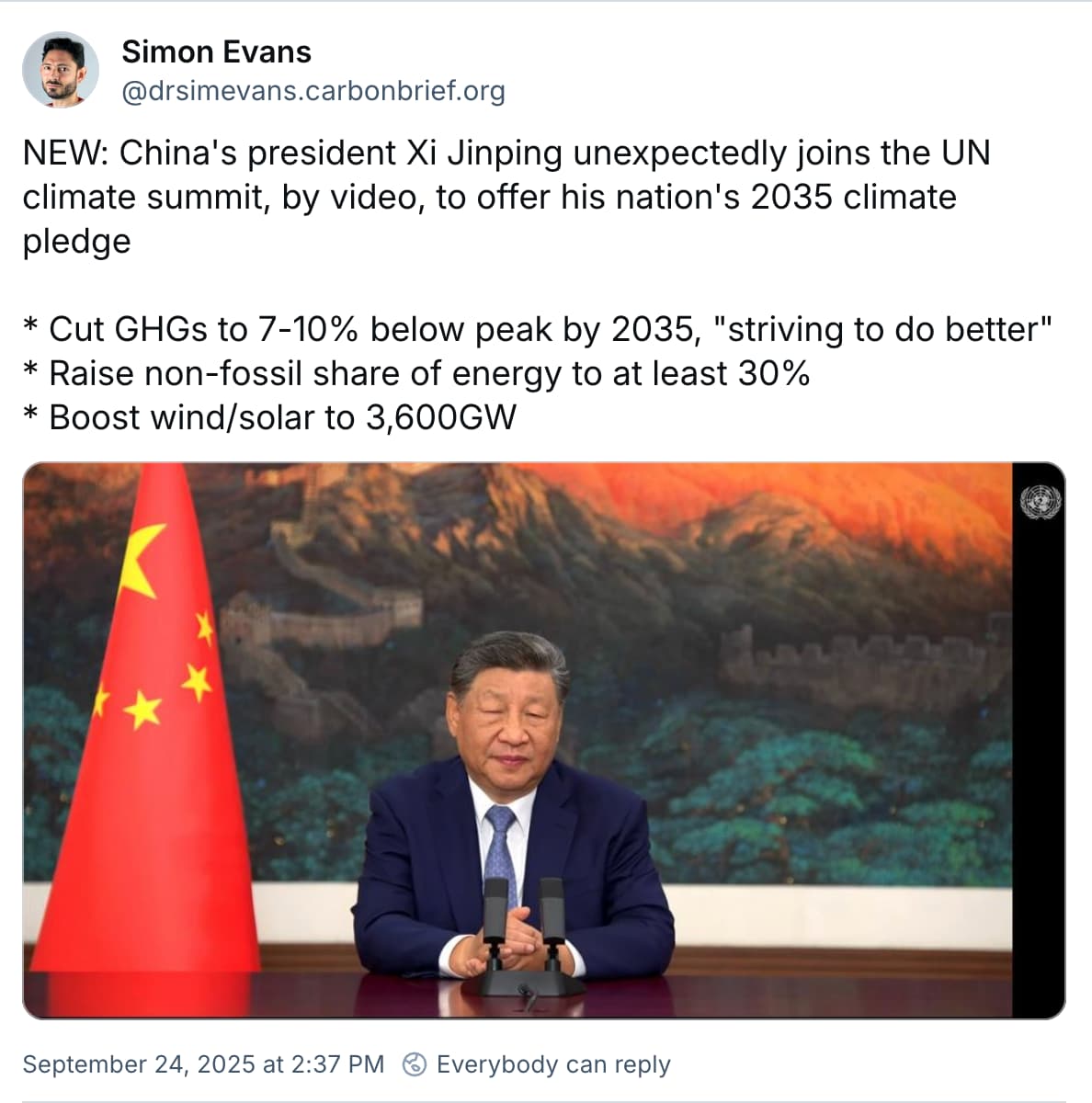
President Xi Jinping has personally pledged to cut China’s greenhouse gas emissions to 7-10% below peak levels by 2035, while “striving to do better”.
This is China’s third pledge under the Paris Agreement, but is the first to put firm constraints on the country’s emissions by setting an “absolute” target to reduce them.
China’s leader spoke via video to a UN climate summit in New York organised by secretary general António Guterres, making comments seen as a “veiled swipe” at US president Donald Trump.
The headline target, with its undefined peak-year baseline, falls “far short” of what would have been needed to help limit warming to well-below 2C or 1.5C, according to experts.
Moreover, Xi’s pledge for non-fossil fuels to make up 30% of China’s energy is far below the latest forecasts, while his goal for wind and solar capacity to reach 3,600 gigawatts (GW) implies a significant slowdown, relative to recent growth.
Overall, the targets for China’s new 2035 “nationally determined contribution” (NDC) under the Paris Agreement have received a lukewarm response, described as “conservative”, “too weak” and as not reflecting the pace of clean-energy expansion on the ground.
Nevertheless, Li Shuo, director of the China Climate Hub at the Asia Society Policy Institute (ASPI), tells Carbon Brief that the pledge marks a “big psychological jump for the Chinese”, shifting from targets that constrained emissions growth to a requirement to cut them.
Below, Carbon Brief unpacks what China’s new targets mean for its emissions and energy use, pending further details once its full NDC is formally published in full.
For now, the only available information on China’s 2035 NDC is the short series of pledges in Xi’s speech to the UN.
(This article will be updated once the NDC itself is published on the UN’s website.)
Xi’s speech is the first time his country has promised to place an absolute limit on its greenhouse gas emissions, marking a significant shift in approach.
Xi had previously pledged that China would peak its carbon dioxide (CO2) emissions “before 2030”, without defining at what level, reaching “carbon neutrality” by 2060.
He also outlined a handful of other key targets for 2035, shown in the table below against the goals set in previous NDCs.

In his speech, Xi also said that, by 2035, “new energy vehicles” would be the “mainstream” for new vehicle sales, China’s national carbon market would cover all “major high-emission industries” and that a “climate-adaptive society” would be “basically established”.
This is the first time that China’s targets will cover the entire economy and all greenhouse gases (GHGs), a move that has been long signalled by Chinese policymakers.
In 2023, the joint China-US Sunnylands statement, released during the Biden administration, had said that both countries’ 2035 NDCs “will be economy-wide, include all GHGs and reflect…[the goal of] holding the increase in global average temperature to well-below 2C”.
Subsequently, the world’s first global stocktake, issued at COP28 in Dubai, “encourage[d]” all countries to submit “ambitious, economy-wide emission reduction targets, covering all GHGs, sectors and categories…aligned with limiting global warming to 1.5C”.
Responding to this the following year, executive vice-premier and climate lead Ding Xuexiang stated at COP29 in Baku that China’s 2035 climate pledge would be economy-wide and cover all GHGs. (His remarks did not mention alignment with 1.5C.)
This was reiterated by Xi at a climate meeting between world leaders in April 2025.
The absolute target for all greenhouse gases marks a turning point in China’s emissions strategy. Until now, China’s emissions targets have largely focused on carbon intensity, the emissions per unit of GDP, a metric that does not directly constrain emissions as a whole.
The change aligns with China’s broader shift from “dual control of energy” towards “dual control of carbon”, a policy that replaces China’s current tradition of setting targets for energy intensity and total energy consumption, with carbon intensity and carbon emissions.
Under the policy, in the 15th five-year plan period (2026-2030), China will continue to centre carbon intensity as its main metric for emissions reduction. After 2030, an absolute cap on carbon emissions will become the predominant target.
In his UN address, Xi pledged to cut China’s “economy-wide net greenhouse gas emissions” to 7-10% below peak levels by 2035, while “striving to do better”.
This means the target includes not just CO2, but also methane, nitrous oxide (N2O) and F-gases, all of which make significant contributions to global warming. (See: What does China say about non-CO2 emissions?)
The reference to “economy-wide net” emissions means that the target refers to the total of China’s emissions, from all sources, minus removals, which could come from natural sources, such as afforestation, or via “carbon dioxide removal” technologies.
Outlining the targets, Xi told the UN summit that they represented China’s “best efforts, based on the requirements of the Paris Agreement”. He added:
“Meeting these targets requires both painstaking efforts by China itself and a supportive and open international environment. We have the resolve and confidence to deliver on our commitments.”
China has a reputation for under-promising and over-delivering.
Prof Wang Zhongying, director-general of the Energy Research Institute, a Chinese government-affilitated thinktank, told Carbon Brief in an interview at COP26 that China’s policy targets represent a “bottom line”, which the policymakers are “definitely certain” about meeting. He views this as a “cultural difference”, relative to other countries.
The headline target announced by Xi this week has, nevertheless, been seen as falling far short of what was needed.
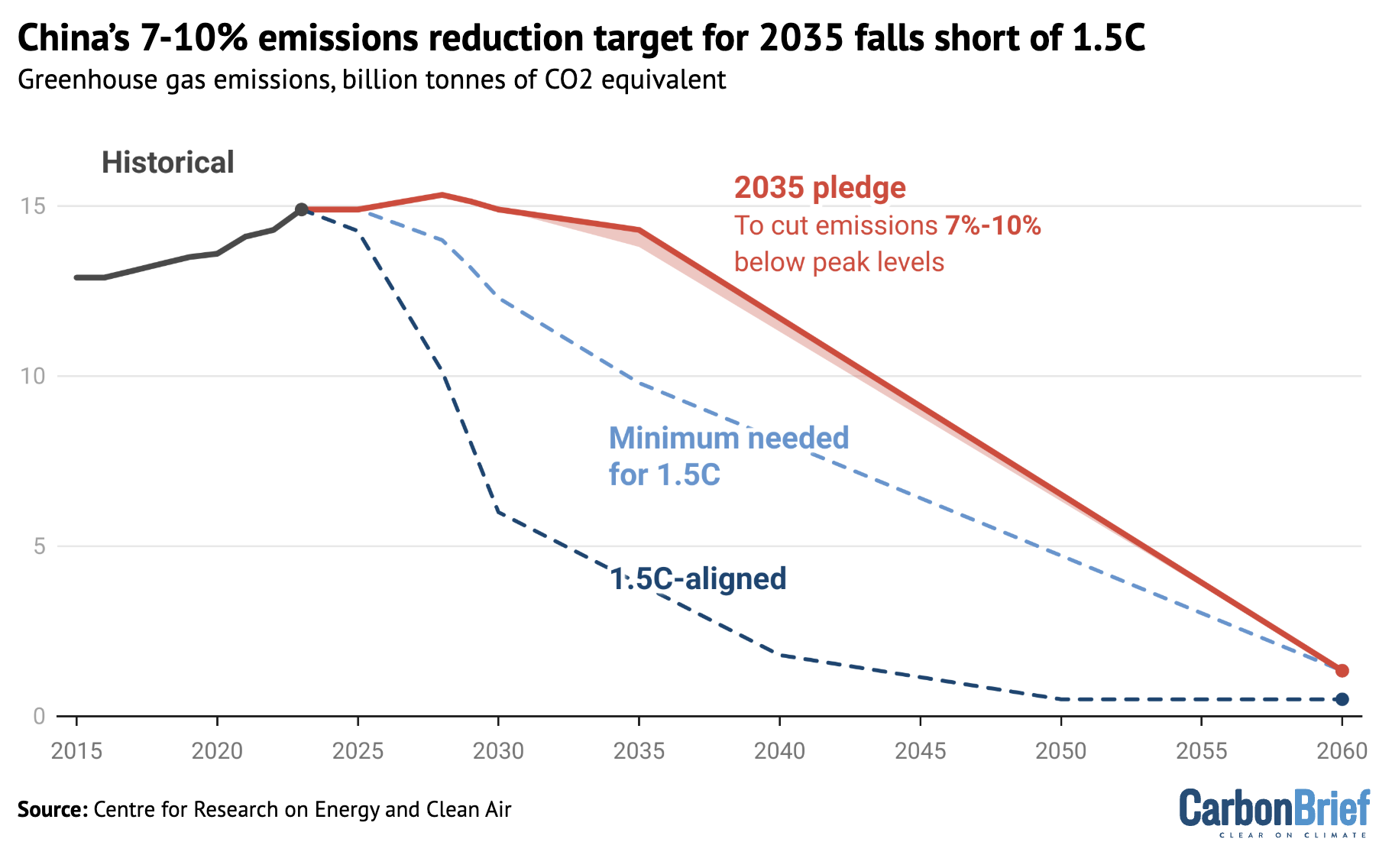
A series of experts had previously told Carbon Brief that a 30% reduction from 2023 levels was the absolute minimum contribution towards a 1.5C global limit, with many pointing to much larger reductions in order to be fully aligned with the 1.5C target.
The figure below illustrates how China’s 2035 target stacks up against these levels.
(Note that the timing and level of peak emissions is not defined by China’s targets. The pledge trajectory is constrained by China’s previous targets for carbon intensity and expected GDP growth, as well as the newly announced 7-10% range. It is based on total emissions, excluding removals, which are more uncertain.)
Analysis by the Asia Society Policy Institute also found that China’s GHG emissions “must be reduced by at least 30% from the peak through 2035” in order to align with 1.5C warming.
It said that this level of ambition was achievable, due to China’s rapid clean-energy buildout and signs that the nation’s emissions may have already reached a peak.
Similarly, the International Energy Agency (IEA) said last October that implementing the collective goals of the first stocktake – such as tripling renewables by 2030 – as well as aligning near-term efforts with long-term net-zero targets, implied emissions cuts of 35-60% by 2035 for emerging market economies, a grouping that includes China.
In response to these sorts of numbers, Teng Fei, deputy director of Tsinghua University’s Institute of Energy, Environment and Economy, previously described a 30% by 2035 target as “extreme”, telling Agence France-Presse that this would be “too ambitious to be achievable”, given uncertainties around China’s current development trajectory.
In contrast, a January 2025 academic study, co-authored by researchers from Chinese government institutions and top universities and understood to have been influential in Beijing’s thinking, argued for a pledge to cut energy-related CO2 emissions “by about 10% compared with 2030”, estimating that emissions would peak “between 2028 and 2029”.
(Other assessments have pegged relevant indicators, such as emissions and coal consumption, as peaking in 2028 at the earliest.)
The relatively modest emissions reduction range pledged by Xi, as well as the uncertainty introduced by avoiding a definitive baseline year, has disappointed analysts.
In a note responding to Xi’s pledges, Li Shuo and his ASPI colleague Kate Logan write that he has “misse[d] a chance at leadership”.
Li tells Carbon Brief that factors behind the modest target include the “domestic economic slowdown and uncertain economic prospects, the weakening global climate momentum and the turbulent geopolitical environment”. He adds:
“I also think it is a big psychological jump for the Chinese, shifting for the first time after decades of rapid growth, from essentially climate targets that meant to contain further increase to all of a sudden a target that forces emissions to go down.”
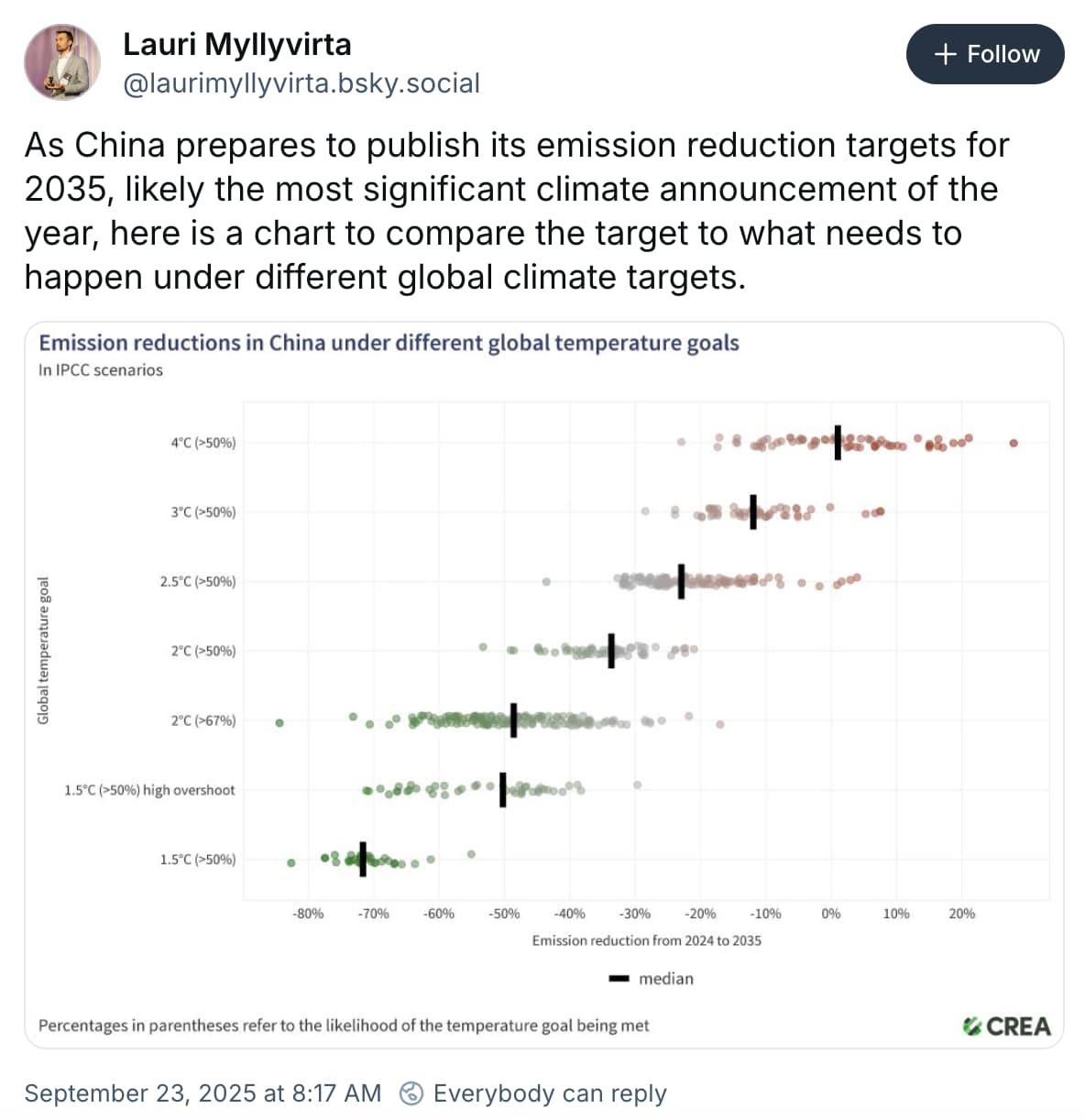
Instead of a target consistent with limiting warming to 1.5C, China’s 2035 pledge is more closely aligned with 3C of warming, according to analysis by CREA’s Lauri Myllyirta.
Climate Action Tracker says that China’s target is “unlikely to drive down emissions”, because it was already set to achieve similar reductions under current policies.
In addition to a headline emissions reduction target, Xi also pledged to expand non-fossil fuels as a share of China’s energy mix and to continue the rollout of wind and solar power.
This continues the trend in China’s previous NDC.
Notably, however, Xi made no mention of efforts to control coal in his speech.
In its second NDC, focused on 2030, China had pledged to “strictly control coal-fired power generation projects”, as well as “strictly limit” coal consumption between 2021-2025 and “phase it down” between 2026-2030. It also said China “will not build new coal-fired power projects abroad”.
It remains to be seen if coal is addressed in China’s full NDC for 2035.
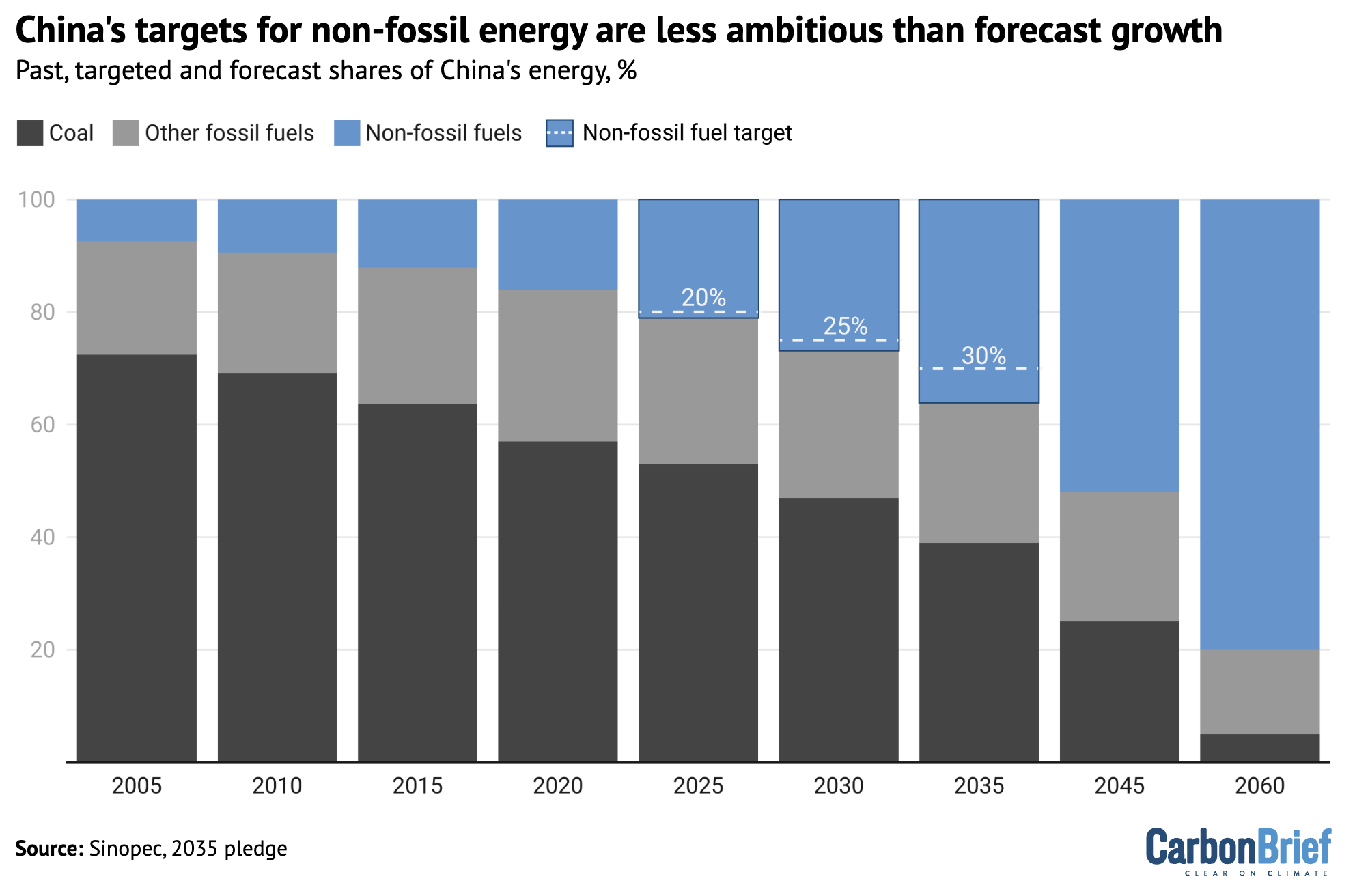
The 2030 NDC also stated that China would “increase the share of non-fossil fuels in primary energy consumption to around 25%” – and Xi has updated this to 30% by 2035.
These targets are shown in the figure below, alongside recent forecasts from the Sinopec Economics and Development Research Institute, which estimated that non-fossil fuel energy could account for 27% of primary energy consumption in 2030 and 36% in 2035.
As such, China’s targets for non-fossil energy are less ambitious than the levels implied by current expectations for growth in low-carbon sources.
In a recent meeting with the National People’s Congress Standing Committee – the highest body of China’s state legislature – environment minister Huang Runqiu said that progress on China’s earlier target for increasing non-fossil energy’s share of energy consumption was “broadly in line” with the “expected pace” of the 2030 NDC.
On wind and solar, China’s 2030 NDC had pledged to raise installed capacity to more than 1,200GW – a target that analysts at the time told Carbon Brief was likely to be beaten. It was duly met six years early, with capacity standing at 1,680GW as of the end of July 2025.
Xi has set a 2035 target of reaching 3,600GW of wind and solar capacity.
This looks ambitious, relative to other countries and global capacity of around 3,000GW in total as of 2024, but represents a significant slowdown from the recent pace of growth.
Given its current capacity, China would need to install around 200GW of new wind and solar per year and 2,000GW in total to reach the 2035 target. Yet it installed 360GW in 2024 and 212GW of solar alone in the first half of this year.
Myllyvirta tells Carbon Brief this pace of additions is “not enough to even peak emissions [in the power sector] unless energy demand growth slows significantly”.
While the pace of demand growth is a key uncertainty, a recent study by Michael R Davidson, associate professor at the University of California, San Diego, with colleagues at Tsinghua University, suggested that deploying 2,910-3,800GW of wind and solar by 2035 would be consistent with a 2C warming pathway.
Davidson tells Carbon Brief that “most experts within China do not see the [recent] 300+GW per year growth as sustainable”. Still, he adds that the lower levels outlined in his study could be consistent with cutting power-sector emissions 40% by 2035, subject to caveats around whether new capacity is well-sited and appropriately integrated:
“We found that 40% emissions reductions in the power sector can be supported by 3,000-3,800GW wind and solar capacity [by 2035]. Most of the capacity modeling really depends on integration and quality of resources.”
Renewable energy’s share of consumption in China has lagged behind its record capacity installations, largely due to challenges with updating grid infrastructure and economic incentives that lock in coal-fired power.
In Davidson’s study, capacity growth of up to 3,800GW would see wind and solar reaching around 40% of total power generation by 2030 and 50% by 2035.
Meanwhile, China will need to install around 10,000GW of wind and solar capacity to reach carbon neutrality by 2060, according to a separate report by the Energy Research Institute, a Chinese government-affilitated thinktank.
This is the first time that one of China’s NDC pledges has explicitly covered the emissions from non-CO2 GHGs.
However, while Xi’s speech made clear that China’s headline emissions goal for 2035 will cover non-CO2 gases, such as methane, nitrous oxide and F-gases, he did not give further details on whether the NDC would set specific targets for these emissions.
In China’s 2030 NDC, the country stated it would “step up the control of key non-CO2 GHG emissions”, including through new control policies, but did not include a quantitative emissions reduction target.
In preparation for a comprehensive greenhouse gas emissions target, China has issued action plans for methane, hydrofluorocarbons (HFCs, one type of F-gas) and nitrous oxide.
The nitrous oxide action plan, published earlier this month, called for emissions per unit of production for specific chemicals to decrease to a “world-leading level” by 2030, but did not set overarching limits.
Similarly, the overarching methane action plan, issued in late 2023, listed several key tasks for reducing emissions in the energy, agriculture and waste sectors, but lacked numerical targets for emissions reduction.
A subsequent rule change in December 2024 tightened waste gas requirements for coal mines. Under the new rules, Reuters reports, any coal mine that releases “emissions with methane content of 8% or higher” must capture the gas, and either use or destroy it – down from a previous threshold of 30%.
But analysts believe that the true challenge of coal-mine methane emissions may come from abandoned mines, which, one study found, have surged in the past 10 years and will likely overtake emissions from active coal mines to become the prime source of methane emissions in the coal sector.
As the demand for coal could be facing a “structural decline”, the number of abandoned mines is expected to grow significantly.
Meanwhile, the HFC plan did set quantitative targets. The country aims to lower HFC production by 2029 by 10% from a 2024 baseline of 2GtCO2e, while consumption would also be reduced 10% from a baseline of 0.9gtCO2e in this timeframe – in line with China’s obligations under the Kigali Amendment to the Montreal Protocol on ozone protection.
From 2026, China will “prohibit” the production of fridges and freezers using HFC refrigerants.
However, the action plan does not govern China’s exports of products that use HFCs – a significant source of emissions.
Since 2021, the Sierra Club has been grading U.S. utilities on their commitment to a clean-energy transition. While most utilities have not earned high marks on the group’s annual scorecards, as a whole they had been showing some progress.
That’s over now. The latest edition of the Sierra Club’s “The Dirty Truth” report finds that the country’s biggest electric utilities are collectively doing worse on climate goals than when the organization started tracking their progress five years ago. This year they earned an aggregate grade of “F” for the first time.
With only a handful of rare exceptions, U.S. utilities have shed the gains they made during the Biden administration. Almost none are on track to switch from fossil fuels to carbon-free energy at the speed and scale needed to combat the worst harms of climate change.
“It’s very disappointing to find we’re at a lower score than in the first year,” said Cara Fogler, managing senior analyst at the Sierra Club, who coauthored the report. But it’s not entirely unexpected.
Utilities had already begun slipping on their carbon commitments last year, in the face of soaring demand for electricity, according to the 2024 “Dirty Truth” report, largely in response to the boom in data centers being used to power tech giants’ AI goals. But the anti-renewables, pro–fossil fuels agenda of the Trump administration and Republicans in Congress has pushed that reversal into overdrive.
“We have a new federal administration that’s doing everything in their power to send utilities in a direction away from cleaner power,” Fogler said. “They’re doing away with everything in the Inflation Reduction Act that supported clean energy. They’re straight-up challenging clean energy, as we’ve seen with Revolution Wind,” the New England offshore wind farm that’s now under a stop-work order. “And they’re doing everything in their power to keep fossil fuels online” — for example, through Department of Energy actions that force coal, oil, and gas plants to keep running even after their owners and regulators had agreed on retirement dates.
But utilities also bear responsibility for not doing more to embrace technologies that offer both cleaner and cheaper power, Fogler said. “From a cost perspective, from a health perspective, from a pollution perspective, there are so many reasons to build more clean energy and fewer fossil fuels. Unfortunately, we’re seeing that utilities are much less concerned about doing the right thing for the climate and their customers.”
For its new “The Dirty Truth” report, the Sierra Club analyzed 75 of the nation’s largest utilities, which together own more than half the country’s coal and fossil-gas generation capacity. The report measures utilities’ plans against three benchmarks: whether they intend to close all remaining coal-fired power plants by 2030, whether they intend to build new gas plants, and how much clean-energy capacity they intend to build by 2035.
As of mid-2025, the utilities had plans to build only enough solar and wind capacity to cover 32% of what’s forecast to be needed by 2035 to replace fossil-fuel generation and satisfy new demand. While 65% of the utilities have increased their clean-energy deployment plans since 2021, 31% have reduced them.
Meanwhile, commitments to reduce reliance on fossil fuels have taken a big step backward as utilities have turned to keeping old coal plants running and are planning to build more gas plants to meet growing demand. As of mid-2025, the utilities had plans to close only 29% of coal generation capacity by 2030, down from 30% last year and 35% in 2023.
And the amount of gas-fired generation capacity the utilities plan to build by 2035 spiked to 118 gigawatts as of mid-2025. That’s up from 93 gigawatts in 2024, and more than twice the 51 gigawatts planned in 2021.
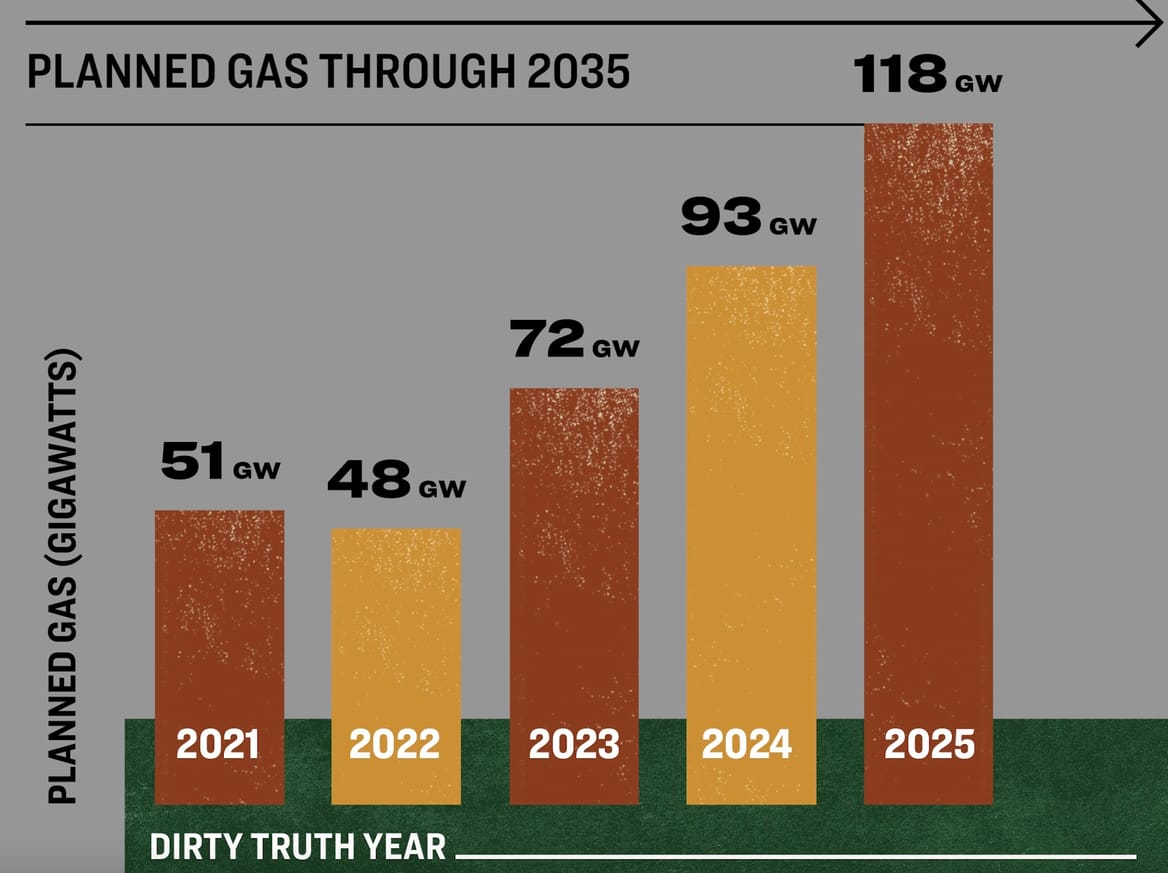
That expanding appetite for new gas-fired power has been supercharged by the surge in forecasted electricity demand across much of the country — data centers are the primary driver of that growth. But much of that expected data-center demand is speculative. And the lion’s share of it is premised on the idea that the hundreds of billions of dollars in AI investments from tech giants like Amazon, Google, Meta, and Microsoft as well as AI leaders like OpenAI and Anthropic will end up earning those companies enough money to pay off their costs — a risky bet.
The Sierra Club is among a growing number of groups demanding that utilities and regulators proceed with caution in building power plants to serve data centers that may never materialize. Forecasted data-center power demand is already driving up utility rates for everyday customers in some parts of the country, and the new gas power plants now in utility plans aren’t even built yet.
“There is some load we’re naturally going to see — there’s population growth, lots of beneficial electrification we want to see happen,” said Noah Ver Beek, senior energy campaigns analyst at the Sierra Club and another coauthor of the report. “But we also want utilities to be realistic about load-growth projections.”
Unfortunately, booming demand growth gives utilities “more cover” to invest in polluting assets, Fogler said. Utilities earn guaranteed profits on the money they spend building power plants and grid infrastructure, which gives them an incentive to avoid questioning high-growth forecasts or seeking out lower-cost or less-polluting alternatives.
Some of the most aggressive fossil fuel expansions are planned for the Midwest and Southeast, including by Dominion Energy in Virginia, Duke Energy in North Carolina, and Georgia Power.
Even the handful of utilities that have previously earned high marks for clean-energy and coal-closure commitments in past “Dirty Truth” reports have slipped. Fogler highlighted the example of Indiana utility NIPSCO, which earned an “A” in the past four reports but only a “B” in the latest, largely due to its plan to rely on gas power plants to meet expected data-center demand.
NIPSCO has “no plans to pursue the high-load-growth scenario until they see contracts signed and progress made,” Fogler said — a prudent approach that avoids burdening customers with the costs of new power plants built for data centers that may never come online, she said. “The problem? Their high-load-growth scenario calls for all new gas. There should be more clean options.”
Most utilities are not capitalizing on the solar and wind tax credits that are set to disappear in mid-2026 under the megalaw passed by Republicans in Congress this summer, she said. Only a handful of utilities, such as Xcel Energy in Colorado and Minnesota, are accelerating their clean-energy deployments to take advantage of those tax credits. “We want more utilities to take that period of certainty and speed up what they’ve already planned.”
Going big on clean energy is also the only way to quickly add enough generation capacity to meet growing demand forecasts and contain rising utility costs, Ver Beek noted. Utilities and major tech companies are pinning their near-term capacity expansion plans on new gas plants, despite the yearslong manufacturing backlogs for the turbines that power those plants and rapidly rising turbine costs.
“From a cost perspective, from a climate perspective, we want to see utilities advocating for getting as much clean energy online as they can,” he said.


.svg)
