

 Back
Back
A new study, led by researchers at Columbia University and Woods Hole Oceanographic Institution (WHOI), identifies a diverse set of molecules released by marine phytoplankton that fuel microbial life and help drive Earth’s carbon cycle. While scientists know that carbon is moved through an invisible network of phytoplankton and other microbes in the surface ocean, the specific compounds have long been a mystery. These compounds are small, chemically difficult to detect in salty seawater, and are rapidly consumed by other organisms almost as soon as they are produced.
Phytoplankton, a type of microscopic organism, take in carbon dioxide and convert it into organic carbon through photosynthesis, like plants. Each year, this process moves many tens of billions of tons of carbon through the sunlit surface ocean and contributes to the oxygen in the air we breathe. These massive natural carbon flows highlight the central role the surface ocean plays in regulating Earth’s carbon cycle.
“For this study, we placed six phytoplankton species representing major groups of marine phytoplankton under controlled conditions. They had the nutrients and light they needed to grow,” said Yuting Zhu, co-lead author of the study and former WHOI postdoctoral investigator, now with Old Dominion University. “Using a chemical-tagging method developed at WHOI, we were able to quantify the composition of biologically available small molecules released by globally abundant microorganisms.”
These compounds accounted for up to 23% of the dissolved organic carbon that phytoplankton released and may support a substantial share of microbial metabolism in the global ocean.
However, many bacteria are metabolic specialists, or picky eaters. The study found that different phytoplankton species release distinct combinations of metabolites, including carbon compounds also containing nitrogen, phosphorus, and sulfur. Because bacteria vary in which molecules they can consume, the chemical “menu” produced by phytoplankton helps determine which microbial communities thrive in different parts of the ocean.
“The findings help illuminate a long-standing mystery about the composition of the ‘chemical currencies’ that are moved by microbes in the surface ocean,” said microbial oceanographer Sonya Dyhrman, a researcher at Lamont-Doherty Earth Observatory, which is part of the Columbia Climate School, and professor of Earth and environmental sciences. “I think of it as a microbial carbon economy. By identifying the currencies produced by phytoplankton, scientists can begin to build more realistic representations of how marine microbial communities cycle billions of tons of carbon.”
To explore the broader implications, the team, also including researchers from the Massachusetts Institute of Technology and Marine Biological Laboratory, combined laboratory measurements with global ecosystem modeling. Their results suggest that phytoplankton-derived metabolites could supply up to 5 percent of the daily carbon needs of SAR11, one of the most abundant groups of bacteria in the surface ocean.
“Combining the ecological and chemical approaches here allowed us to view the system through a new lens,” said co-lead author Hanna Anderson, a researcher at Lamont and PhD candidate in Earth and environmental sciences at Columbia. “Thinking synthetically about how these carbon substrates can mediate interactions between phytoplankton and heterotrophs, which in turn cycle this carbon within the marine food web.”
The research was conducted as part of the National Science Foundation-funded Center for Chemical Currencies of a Microbial Planet, a science and technology center that investigates how small molecules govern interactions among microorganisms across Earth’s ecosystems.
“Understanding these exchanges is critical because a huge portion of Earth’s carbon cycle passes through this microbial system, but we still don’t fully understand it,” said the center’s director and co-author of the study, WHOI senior scientist Elizabeth Kujawinski. “If we understand what molecules phytoplankton release and what molecules bacteria can take up, we can start building models of how these organisms interact. We think of the surface ocean as a network, where phytoplankton and bacteria are connected by molecules—some compounds feed many different bacteria, while others only support a few.”
Future studies will investigate how environmental conditions such as nutrient limitation, temperature changes, and ocean acidification alter the molecules that phytoplankton release and how microbial communities respond to those “chemical currencies.”
This article was adapted from a press release by the Woods Hole Oceanographic Institution.
Across the country, state lawmakers are considering ways to address the risks posed by the explosion of power-hungry data centers. They have proposed an array of bills to impose moratoriums on data center development, revoke tax breaks, force data centers to pay for new energy infrastructure, and enact other safeguards.
In Illinois, lawmakers and renewable advocates are especially concerned that data centers could derail the state’s transition to 100% clean energy, since there’s likely not enough renewable sources in the state to meet data centers’ projected demand.
The Protecting Our Water, Energy, and Ratepayers Act, or POWER Act, aims to persuade data centers to pay to build enough new clean energy for sustaining their operations. This should shield customers from rising prices when overall electricity demand increases, proponents of the measure say, and it would ensure that the state’s coal and gas plants don’t need to run past their planned retirement dates just to fuel data centers.
The bill, introduced in February, would entice data centers to make clean energy investments by offering them two of the things such operations most prize: fast interconnection to the grid and uninterrupted power.
Stakeholders involved in crafting the bill said the incentive structure is meant to keep Illinois attractive to data centers, while defending the state’s clean energy shift and customers’ wallets. The facilities could account for between 64% and 72% of energy demand growth in the state by 2030, according to a recent report by the Union of Concerned Scientists, a nonprofit science advocacy group.
Illinois law mandates ending fossil fuel generation by 2045, but unchecked data center growth could cause continued reliance on the state’s fossil-fueled plants — allowed by law if the power is needed — and the importing of dirty power from elsewhere, the report explains.
The bill’s advocates are calling the approach BYONCCE, pronounced like the singer’s name but meaning “bring your own new clean capacity and energy.” (A similar term has been used in other states, sometimes referring to “carbon-free energy.”)
While the addition of new clean energy should help prevent a rise in electricity costs for regular customers, the bill also has other components to keep rates low. It requires data centers to pay for grid upgrades such as the transmission lines and substations needed to serve them. It demands that data centers pay into a “public benefits and affordability fund” that can be used to assist low-income households with utility costs and for environmental justice initiatives; each data center would pay an amount based on its peak demand. The bill also creates a compensation fund for community groups intervening in regulatory proceedings around data centers, helping them push for clean energy and customer protection in individual cases.
“We’re in a new world all of a sudden where demand has gone off the wall,” said MeLena Hessel, Midwest deputy program director of Vote Solar, a nonprofit policy-advocacy organization. “Writ large, we’re trying to figure out how can we get to large loads bringing their own new clean energy and capacity in ways that matter and keep costs lower for customers.”
Supporters of the bill emphasize that while the legislation provides incentives for data centers to develop clean energy, it does not actually force them to do so.
If the power-hungry facilities don’t provide their own energy, they would have to wait, along with all the other large users, in a potentially long line to get connected to the grid. The bill calls for data centers to submit a clean energy supply plan to regulators. If that plan shows that the data center has procured 80% of its predicted annual power demand from new clean energy by 2030 and 100% by 2045, it would receive “fast-track” grid connection.
“We want to encourage data center companies to be clean energy champions, and those that are really excelling are able to jump the queue,” said Kavi Chintam, Vote Solar’s Illinois campaign manager. “That is the incentive that data center companies need and want now.”
Data centers that don’t build enough clean energy could see their electricity curtailed during times of high demand. The bill empowers utilities to take such action as a way to protect other customers from increased prices when the energy supply is tight. That threat is further motivation for data centers to invest in clean energy.
Facilities that pay to build or acquire as much clean energy as they expect to use are guaranteed uninterrupted access to that same amount of power. Solar and wind, as well as battery storage, virtual power plants, and demand-response measures — such as reducing energy use when the grid is stressed — qualify toward that total. Data centers would still be subject to any emergency energy curtailment — like rolling brownouts or blackouts — ordered by regional grid operators.
Illinois has a restructured energy market, in which utility companies do not own generation and instead procure power on the open market to serve customers. In neighboring Wisconsin and Indiana and other states with vertically integrated energy markets, by contrast, utilities pay to build needed generation and pass on the costs to their customers.
Regulators in Illinois and other states with restructured markets may have fewer options to determine how data centers are charged for generation infrastructure, since that is not the purview of the utilities they oversee. In Illinois, management of the flow of electricity on the grid — which utilities do control — is the way to influence data centers’ behavior, said James Gignac, who is the Midwest policy director for the Union of Concerned Scientists’ climate and energy program and one of the authors of its recent report.
“Offering compelling incentives for what the data centers wish to have is our approach,” Gignac said. “They are looking for firm service and the quickest way possible to connect to the power grid. By challenging data centers to meet these higher levels of clean energy, we can recruit the most responsible data center operators to Illinois.”
The Data Center Coalition, a trade group that represents developers of the facilities, and the Illinois Chamber of Commerce, which promotes investment in the state, did not respond to queries for this story.
Three times in the last decade, Illinois’ clean energy supporters and industry representatives have worked closely with lawmakers to pass sweeping energy bills. A 2017 law created ambitious renewable-energy mandates and job creation programs, a 2021 law bolstered clean energy and equity targets, and a law passed last fall addressed the need for much more energy storage on the grid. Those three pieces of legislation were spearheaded by legislators working with the Illinois Clean Jobs Coalition, including dozens of advocates for consumers, clean energy, and environmental justice. That coalition is also backing the data center bill.
Coalition members described the POWER Act as a similarly ambitious measure, which will likely go through a long process of consensus-building.
In addition to the clean power and affordability provisions, the bill includes other safeguards, like mandates for water resource planning and quarterly water-use reports. It prohibits nondisclosure agreements with data centers, mandates community benefit agreements, and requires a proposed data center’s cumulative impact to be examined in the context of other existing or proposed burdens on local residents.
Illinois’ legislative session ends in late May, and bills can also pass in a fall veto session or a special session called by the governor.
Proponents of consumer protection and clean energy say it is crucial for a data center–focused bill to pass soon, since numerous such facilities for powering AI are proposed in the state. The Chicago region, in particular, is already home to around 200 data centers, according to the organization Data Center Map, and more could be in the works. A $20 billion data center proposal was recently approved by local officials southwest of Chicago, in Joliet, for example. In February, Democratic Gov. JB Pritzker called for a two-year pause on state tax incentives for data centers in response to the growing concern from communities.
“This is an urgent problem,” Chintam said. “We need to do something now.”
A correction was made on March 12, 2026: A previous version of this story misrepresented the Union of Concerned Scientists’ prediction for data center energy demand in Illinois by 2030. Data centers could account for between 64% and 72% of growth in demand by that time, not total demand.
Last year, Southern California’s air regulators rejected landmark rules that would have encouraged the switch from polluting gas heaters to electric heat pumps in the smoggiest region in the country. Now, environmental and public health advocates are pressing state and local officials to investigate whether opposition in the run-up to the decision was largely faked.
Members of the regulatory board voted 7–5 against the proposed rules in June, after receiving more than 20,000 public comments opposing them. It was “an unusually high number,” said Rainbow Yeung, spokesperson for the South Coast Air Quality Management District, which regulates the air quality for more than 17 million residents across Los Angeles, Orange, Riverside, and San Bernardino counties.
A Los Angeles Times investigation revealed that an advocacy software firm called CiviClick had been hired by a public affairs consultant with industry ties to deliver the large volume of emails — and raised questions about their legitimacy. The deluge “almost certainly” influenced the board’s decision, the L.A. Times reported, adding that most agenda items seen by the agency receive comments numbering in the single digits.
“It is … both shocking and concerning to learn that an agency responsible for regulating the air quality for nearly half of California’s population could have had the integrity of their public process compromised by comments made without people’s consent,” Gracyna Mohabir, clean air and energy regulatory advocate at the nonprofit California Environmental Voters, said during a February press conference with reporters.
Advocates are asking California Attorney General Rob Bonta and Los Angeles District Attorney Nathan Hochman to investigate whether CiviClick and others committed fraud to prevent the clean air rules from passing. As of Friday, no formal investigation had yet been launched. In the meantime, the SCAQMD itself has attempted to verify opposition letters, but those efforts have been inconclusive so far.
The agency’s rules would have ramped down the sale of new gas heaters but not banned them. The proposals would have encouraged manufacturers to gradually increase sales of superefficient electric heat pumps and heat-pump water heaters until they represented 30% of heater sales by 2027 and 90% by 2036. These manufacturers would have also paid a partial mitigation fee of $50 to $500 per gas appliance sold — and likely passed that fee on to customers who still opted for gas.
Still, the rules would have made an enormous difference for Southern Californians. By slashing emissions of smog-forming nitrogen oxides by 6 tons per day by 2060, the agency estimated, the regulations would have saved $25 billion in health costs from 2027 to 2053 — and about 2,500 lives.
Last June after their decision, regulators kicked the proposals back to a subgroup committee for further discussion. They have not announced a timeline to revisit the rules.
In the months leading up to the air district’s vote, the utility Southern California Gas Co., or SoCalGas, and allied groups spread misleading information about the rules, and encouraged mayors and other public officials to send letters, testify, and pass local resolutions railing against the measures.
Now, it’s clear that a key figure rallying opposition was Matt Klink, a public affairs consultant who ran a targeted campaign that resulted in the avalanche of comments now under scrutiny. Klink is a partner at California Strategies, one of the state’s most powerful lobbying firms, whose clients include Sempra, the parent company of SoCalGas.
Klink contracted with CiviClick, which has billed itself as “the first and best AI-powered grassroots advocacy platform,” to generate opposition comments. The platform “made the ultimate difference,” Klink said in a sponsored August article in Campaigns & Elections magazine. He did not respond to Canary Media’s multiple requests for comment.
CiviClick “knew the local targets who would respond to the messaging that was constructed … [And the firm] said, ‘these are the results that we guarantee,’” Klink said in the article. “We did two separate rounds of outreach, and they met the targets in both rounds early. AQMD staff are not used to getting tens of thousands of emails so it made a massive difference in turning the tide.”
In North Carolina, CiviClick is separately facing scrutiny for its involvement in producing mass emails supporting a proposed gas pipeline. Two local county commissioners replied to what they thought were emails from their constituents, only to learn that those individuals hadn’t sent the messages and didn’t know what the commissioners were talking about, E&E News reported in 2025.
SCAQMD staff (not to be confused with the 13 voting board members) found elements of the submissions “disturbing,” as the agency’s executive officer Wayne Nastri put it. Among those discrepancies: an email thanking Nastri himself for his supposed opposition to one of the rules his agency had crafted.
The air district also received multiple messages from the same CiviClick email address — constituent@civiclick.com — made to look as if they were sent by different individuals.
Agency staff members reached out to 172 people whose names were on submitted comments, to verify they were aware of the submissions. But the response rate was low.
“We received five total responses, two of which confirmed they sent letters and three of which had no knowledge of the letters,” Yeung said in an email. “The limited number of confirmations did not allow us to draw a definitive conclusion regarding the authenticity of the entire batch.”
The agency is considering a “more aggressive” way to check the veracity of the comments, Nastri said at the air district board meeting in March. It’s also looking at longer-term fixes such as instituting a secure comment portal.
“This has a lot of attention from a lot of different parties,” Nastri told the board. “I’m sure that we will be working with many people as we continue to address this.”
The controversy highlights mounting fears that interest groups could wield generative AI tools to give the semblance of strong public sentiment where it doesn’t exist.
The L.A. Times reporting initially suggested that CiviClick used AI for the SCAQMD opposition campaign. The firm’s founder and CEO, Chazz Clevinger, has since denied employing such tools in this instance to both the L.A. Times and Canary Media, although he confirmed his company does offer clients AI capabilities to personalize messages.
Local officials elsewhere are facing fraudulent public comments that may or may not have been AI-generated.
In the Bay Area, for example, air regulators received emails opposing air-quality rules last year as a part of a campaign run by a firm that advertises its AI capability, Speak4. Ten individuals identified as having sent opposition comments said they never did so, the San Francisco Chronicle reported last Thursday.
Clean air advocates in Southern California are demanding an investigation in the SCAQMD case to uncover whether identity theft was committed.
“I’m highly skeptical that CiviClick did not use AI to generate the comments, and their denial only increases the importance of a formal investigation into the comments, how they were generated, and whether individuals signed on consented to be included,” said Dylan Plummer, Clean Heat Campaign adviser for the Sierra Club.
The results are important both for this particular case, advocates said, and for the inevitable battles over regulatory proposals to come.
“This really is about the precedent going forward,” said Chris Chavez, deputy policy director of the statewide Coalition for Clean Air. “We need to make sure that we’re taking steps not just to protect our clean air, but [to] protect our regulatory process … to make sure that we can respond to the threats in our communities.”
The “cost” of cutting UK emissions to net-zero is less than the cost of a single fossil-fuel price shock, according to a new report from the Climate Change Committee (CCC).
Moreover, a net-zero economy would be almost completely protected from fossil-fuel price spikes in the future, says the government’s climate advisory body.
The report is being published amid surging oil and gas prices after the US and Israel attacked Iran, which has triggered chaos on international energy markets.
It builds on the CCC’s earlier advice on the seventh “carbon budget”, which found that it would cost the UK less than 0.2% of GDP per year to reach its net-zero target.
In the new report, the CCC sets out for the first time a full cost-benefit analysis of the UK’s net-zero target, including the cost of clean-energy investments, lower fossil-fuel bills, the health benefits of cleaner air and the avoided climate damages from cutting emissions.
It finds that the country’s legally binding target to reach “net-zero emissions” by 2050 will bring benefits worth an average of £110bn per year to the UK from 2025-2050, with a total “net present value” of £1,580bn.
The CCC states that its new report responds to requests from parliamentarians and government officials seeking to better understand its cost assumptions, amid the ongoing cost-of-living crisis in the UK.
The report also pushes back on “misinformation” about the cost of net-zero, with CCC chair Nigel Topping saying in a statement that it is “important that decision-makers and commentators are using accurate information to inform debates”.
The CCC’s new report is the first to compare the overall cost of decarbonising with the wider benefits of avoiding dangerous climate change, as well as other “co-benefits”, such as cleaner air and healthier diets.
It sets the CCC’s previous estimate of the net cost of net-zero – some £4bn per year on average out to 2050 – against the value of avoided damages and other co-benefits.
These “co-benefits” are estimated to provide £2bn to £8bn per year in net benefit by the middle of the century, according to the report.
The CCC notes that this approach allowed it to “fully appraise the value of the net-zero transition”.
It concludes that the net benefits of reaching net-zero emissions by 2050 are an average of £110bn per year from 2025 to 2050.
These benefits to the UK amount to more than £1.5tn in total and start to outweigh costs as soon as 2029, says the CCC, as shown in the figure below.
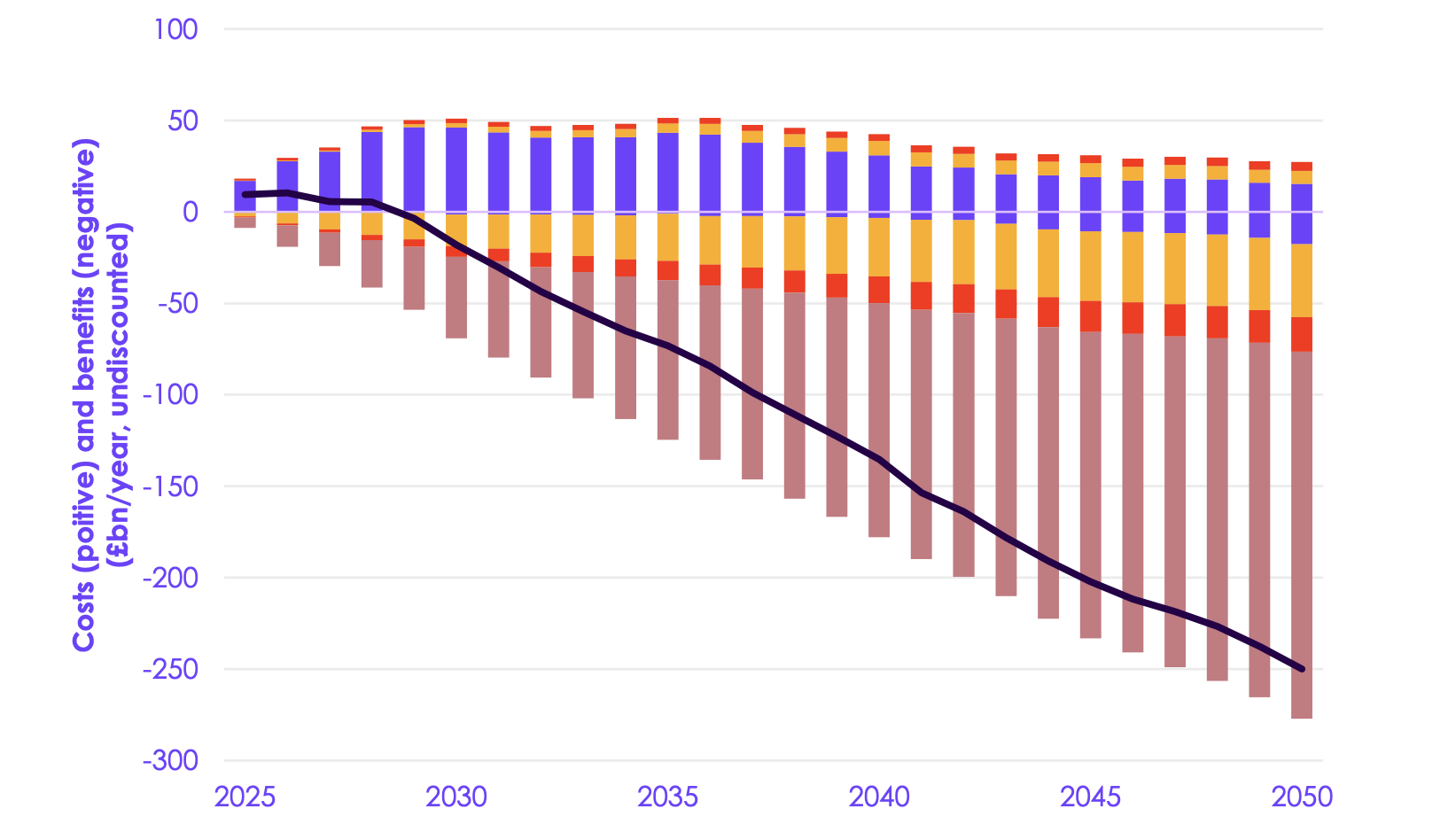
In addition, the CCC says that every pound spent on net-zero will bring benefits worth 2.2-4.1 times as much.
This updated analysis includes the value of benefits from improved air quality being 20% higher in 2050 than previously suggested by the CCC.
However, the “most significant” benefit of the transition is the avoidance of climate damages, with an estimated value of £40-130bn in 2050. The report states:
“Climate change is here, now. Until the world reaches net-zero CO2 [carbon dioxide] emissions, with deep reductions in other greenhouse gases, global temperatures will continue to rise. That will inevitably lead to increasingly extreme weather, including in the UK.”
The CCC’s conclusion is in line with findings from the Office for Budget Responsibility (OBR) in 2025, which suggested that the economic damages of unmitigated climate change would be far more severe than the cost of reaching net-zero.
The CCC notes that its approach to the cost-benefit analysis of the net-zero target is in line with the Treasury’s “green book”, which is used to guide the valuation of policy choices across UK government.
It says that one of the key drivers of overall economic benefit is a more efficient energy system, with losses halved compared with today’s economy.
It says that the UK currently loses £60bn a year through energy waste. For example, it says nearly half of the energy in gas is lost during combustion to generate electricity.
In a net-zero energy system, such energy waste would be halved to £30bn per year, says the CCC, thanks to electrified solutions, such as electric vehicles (EVs) and heat pumps.
For example, it notes that EVs are around four times more efficient than a typical petrol car and so require roughly a quarter of the energy to travel a given distance.
Collectively, these efficiencies are expected to halve energy losses, saving the equivalent of around £1,000 per household, according to the CCC.
The CCC tests its seventh carbon budget analysis against a range of “sensitivities” that reflect the uncertainties in modelling methodologies and assumptions for key technologies. This includes testing the impact of a fossil-fuel price spike between now and 2050.
In the original analysis, the committee had assumed that the cost of fossil fuels would remain largely flat after 2030.
However, the report notes that, in reality, fossil-fuel prices are “highly volatile”. It adds:
“Fossil-fuel prices are…driven by international commodity markets that can fluctuate sharply in response to geopolitical events, supply constraints, and global demand shifts. A system that relies heavily on fossil fuels is, therefore, exposed to significant price shocks and heightened risk to energy security.”
It draws on previous OBR modelling of the impact of a gas price spike. This suggested that future price spikes would cost the UK government between 2-3% of GDP in each year the spike occurs, assuming similar levels of support to households and businesses as was provided in 2022-23.
The CCC adapts this approach to test a gas-price spike during the seventh carbon budget period, which runs from 2038 to 2042.
It finds that, if a similar energy crisis occurred in 2040 and no further action had been taken to cut UK emissions, then average household energy bills would increase by 59%. In contrast, bills would only rise by 4%, if the UK was on the path to net-zero by 2050.
The committee says that when considering the impact on households, businesses and the government, a single fossil-fuel price shock of this nature would cost the country more than the total estimated cost of reaching.
The finding is particularly relevant in the context of rising oil and gas prices following conflict in the Middle East, which has prompted some politicians and commentators to call for the UK to slow down its efforts to cut emissions.
In his statement, Topping said that it was “more important than ever for the UK to move away from being reliant on volatile foreign fossil fuels, to clean, domestic, less wasteful energy”.
Angharad Hopkinson, political campaigner for Greenpeace UK, welcomed this finding, saying in a statement:
“Each time this happens it gets harder and harder to swallow the cost. The best thing the UK can do for the climate is also the best thing for the cost of living crisis – get off the uncontrollable oil and gas rollercoaster that drags us into wars we didn’t want but still have to pay for. Inaction on climate is unaffordable.”
In addition to testing the impact of more volatile fossil-fuel prices, the CCC also tests the implications if key low-carbon technologies are cheaper – or more expensive – than thought.
It concludes that the upfront investments in net-zero yield significant overall benefits under all of the “sensitivities” it tested. As such, it offers a rebuttal to the common narrative that net-zero will cost the UK trillions of pounds.
The net cost of net-zero comes out at between 0% and 0.5% of GDP between 2025 and 2050, says the CCC, under the various sensitivities it tested.
“This sensitivity analysis shows that an electrified energy system is both a more efficient and a more secure energy system,” adds the CCC.
Finally, the report takes into account the costs of the alternative to net-zero. It looks at what would need to be spent in an economy where net-zero was not pursued any further.
The CCC says that the gross system cost of the balanced pathway falls below the baseline cost from 2041, which is consistent with its previous seventh carbon budget advice.
As shown in the chart below, costs fall under a net-zero pathway between 2025 to 2050, whereas they rise in the baseline of no further action.
Moreover, the total costs of the alternatives are broadly similar, with the relatively small difference shown by the solid line.
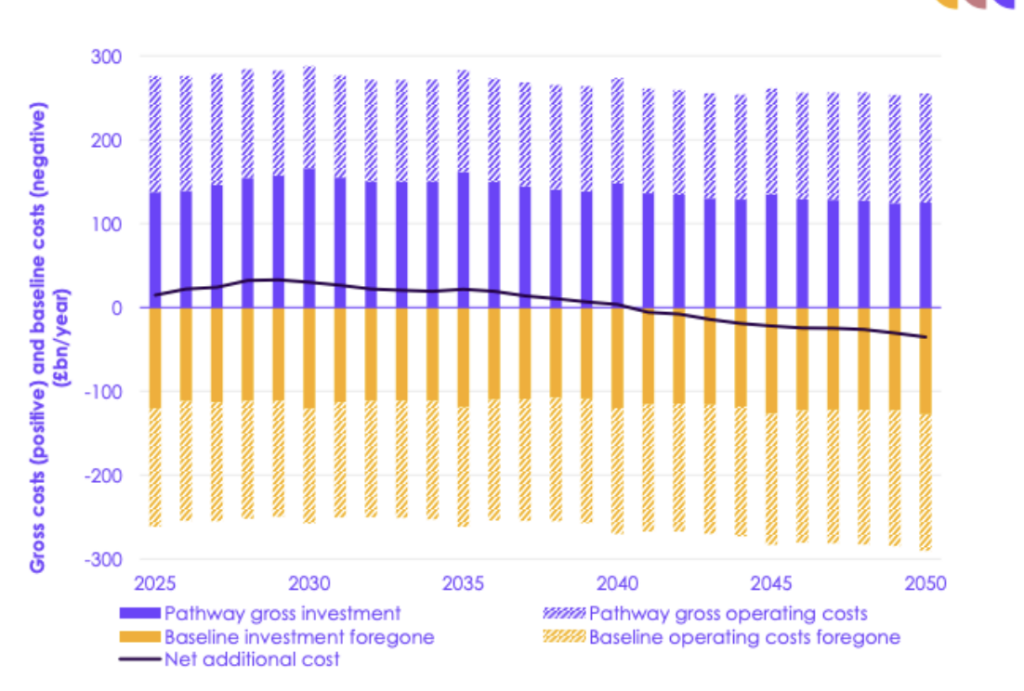
The decline in energy system costs shown in the figure above is broadly driven by more efficient low-carbon technologies, says the CCC, helping costs to fall from 12% of GDP today to 7% by the middle of the century.
The CCC’s new analysis comes ahead of the UK parliament voting on and legislating for the seventh carbon budget, which it must do before 30 June 2026.
Nearly three years ago, Vermont passed a landmark law that aimed to cut greenhouse gas emissions by shifting residents away from using fossil fuels to heat their homes and businesses. Last month, that plan officially died before ever being put into action — and the path toward cleaner heating in the state is murkier than ever.
In May 2023, Vermont legislators passed the Affordable Heat Act, which is widely considered the first law to require the development of a statewide clean heat standard to lower emissions from heating sources. But after years of contentious debate and recent inaction from lawmakers, regulators closed the case in February, possibly for good.
More than one-third of Vermonters rely on furnaces and boilers fueled by oil — one of the dirtiest and most expensive home-heating sources — and about another 20% primarily use propane. Though the clean heat standard did not mandate a switch to electric heat pumps, the policy would likely have spurred greater adoption of the appliances, which are cleaner and cheaper to run.
Some see the clean-heat turnaround as a financial victory for Vermonters, while others see it as a frustrating loss that will only hurt residents and the planet. How, though, did the pioneering plan manage to fizzle out before it even got started? The answer is a mix of complicated politics, an even more complex policy design, and interference from out-of-state conservative groups.
“There ended up being an enormous amount of misinformation floating around about it, which was very frustrating,” said state Sen. Anne Watson, a Democrat/Progressive who voted for the law. “When people are not circulating well-vetted info, that doesn’t serve anybody — that just serves to scare people.”
Vermont has set a legally mandated target of reducing greenhouse gas emissions 80% from 1990 levels by 2050. Almost all the electricity generated in Vermont comes from renewable sources, including hydropower, solar, and biomass, but the state is still heavily dependent on fossil fuels for heating and transportation. That’s where the clean heat standard came in.
A clean heat standard, broadly defined, is a policy mandating that providers of heating fuels steadily lower the emissions associated with their operations. It’s an adaptable approach, said Richard Cowart, a former Vermont utility regulator and a principal at the nonprofit Regulatory Assistance Project, which advises governments on clean energy policy. Each state implementing such a standard will make its own rules about what kinds of clean energy to include, how quickly to transition, and what fuels to target for reduction.
“It leaves choice in the hands of building owners, homeowners, small-business operators,” Cowart said. “It allows some creativity in implementation and flexibility in the way programs can be rolled out.”
This vision has sparked interest in several other states, but is hitting some obstacles. Colorado in 2021 passed a law requiring natural gas distributors to create clean heat plans. Massachusetts’ Department of Environmental Protection has a clean heat standard in the works, but Democratic Gov. Maura Healey recently delayed the implementation until 2028. Another six to nine states have expressed interest in or have begun exploring the concept, but nothing else is on the books, Cowart said.
Vermont’s idea was to create a “market-based system” in which fuel dealers would obtain a certain number of clean heat credits each year. Credits could be generated by installing weatherization upgrades or heat pumps, or by selling fuels with lower emissions; dealers could offer these services themselves or buy credits from other entities doing that work. Either way, the system would have helped pay for a less emissions-intensive heating system across the state.
The standard’s political foundations were never unshakable. The first shot at establishing the policy occurred in 2022. The heavily Democratic legislature passed a bill creating a clean heat standard, but Republican Gov. Phil Scott vetoed the measure. An attempt to override the veto fell one vote short in the state House.
In 2023, a bill was again passed and again vetoed. This time, the veto override succeeded by one vote in the Senate. Part of the deal that helped the legislation pass was a provision that required regulators to design the program and then bring it back to lawmakers for another vote before it could be implemented.
“That was pretty unusual,” Watson said. “Usually, you design a program, then the rules take effect, basically, immediately.”
Lawmakers never had a chance to take that second vote.
Regulators released their program design and cost estimates in 2025. Those intervening years gave opponents time to build their case against the program. Their main argument: The clean heat standard would dramatically raise prices for any Vermont household still using heating oil, as sellers would pass their compliance costs on to customers. Scott’s administration repeatedly claimed the plan could increase heating oil prices by up to $4 per gallon (for comparison, current prices average $3.65 per gallon), though the basis of this number was never clear.
While the numbers weren’t available until 2025, utility regulators ultimately calculated that the program would cost residents a total of about $956 million in its first 10 years of operation and provide societal benefits of $1.5 billion. The average price of heating oil would go up an estimated 8 cents per gallon in the beginning, rising to 58 cents in 2035. But those using heat pumps could expect to save some $500 per heating season on fuel costs compared with burning oil, or to save over $1,000 compared with using propane.
Shortly before the bill passed, Americans for Prosperity, a national conservative policy advocacy group founded by oil-industry billionaires Charles and David Koch, arrived in the state as part of an effort to expand its work into traditionally left-leaning states. In May 2024, it launched a direct-mail campaign attacking the clean heat standard and inaccurately complaining that the policy would put severe restrictions on natural gas, impose a tax on heating oil, and mandate the installation of heat pumps in homes.
“We were not having a full and fair and accurate conversation about the costs and the opportunities the program could deliver,” said Johanna Miller, energy and climate program director for the Vermont Natural Resources Council.
Then came the 2024 election. In historically deep-blue Vermont, Scott was reelected and 22 legislative seats flipped from Democratic to Republican, eliminating the supermajority that had enabled the veto override the previous year.
At the time, there was widespread concern in the state about property tax increases related to education funding. Republicans took advantage of this ongoing financial unease to inflate and mischaracterize the costs of a clean heat standard, said former state Sen. Chris Bray, a Democrat and major force behind the clean heat standard bill, who lost his seat in the election.
“It got weaponized in the campaign season, with a broad misinformation campaign,” Bray said.
The highly detailed work of designing the clean heat standard created its own complications.
In February 2024, state utility regulators issued the first mandated progress report on their efforts and noted that most participants in the process — including the public utilities commissioners themselves — had “serious misgivings” about whether a thoughtful and effective policy could be put together on the timeline dictated by the law.
The complexity of the program came up again and again. Commenters noted that the standard was difficult for average Vermonters to understand, and extensive education and outreach efforts would be needed. Others suggested that cost and confusion would drive small fuel dealers out of business, leaving consumers with fewer choices and potentially higher prices.
“We opposed this not because the idea wasn’t good, but because the execution was fatally flawed,” said Matt Cota, a lobbyist for fuel sellers who was a member of the Clean Heat Standard Technical Advisory Group.
Even the regulators who designed the standard ultimately advised against adopting it. In a January 2025 report, the public utility commissioners concluded that “the Clean Heat Standard is not well suited to Vermont.” A more effective choice, the commission said, would be to expand upon existing programs, such as the fee that generates revenue for electric-efficiency programs.
In the face of a likely gubernatorial veto, and the recommendations from the commissioners, even those lawmakers who still believed in the policy saw no way forward
“It was the chastened legislature that was unable and unwilling to pick it up and go further,” Bray said.
Lawmakers say the clean heat standard, in the form passed in 2023, is unlikely to be introduced again. Some supporters of the standard worry that further action is unlikely as long as Scott is governor. But advocates of the underlying ideas think some program to incentivize greenhouse gas reductions from heating is necessary and inevitable, even if it is not a fast process.
“That’s going to come back, because it’s something that we know has to be achieved,” Cowart said. “Over the course of a generation this work is going to get done.”
This article was originally published by Project Drawdown and is republished here with attribution.
It’s no secret that the Trump Administration wants coal to make a comeback.
As America’s appetite for electricity grows, Trump and his appointed officials have stated, often and plainly, that they want to use “clean” coal to meet this demand.
However, you shouldn’t be fooled by the rebrand. This isn’t some new type of coal; it’s the same coal humans have been burning for centuries, just with additional steps to capture some of the pollution. “Clean” coal still has all of the environmental, health, and economic issues associated with its mining, transportation, and use in power plants. Not to mention the inconvenient, but often overlooked fact that coal can spontaneously combust.
Let’s take a closer look at “clean” coal: what it is, whether or not it actually works, and what the alternatives are for meeting rising energy demand.
Clean coal refers to coal burned in power plants using technologies that aim to reduce the amount of pollution released during combustion. The number of pollutants targeted under the umbrella of clean coal has changed over time, but these technologies have been used effectively to reduce pollutants like sulfur dioxide (a major cause of acid rain), nitrogen dioxide (which contributes to ground-level ozone), and particulates (which can cause respiratory distress).
Now, “clean” coal is meant to go even further, using recent developments in carbon capture and sequestration (CCS) technologies to capture carbon dioxide from the exhaust gas of coal power plants and store it underground. While this sounds great in theory, in practice, it is much more complicated.
Currently, only two coal power plants in the world have CCS technologies installed, one in Canada and the other in the US. Part of the reason so few plants have added CCS is the high initial installation cost and high energy consumption for operation. To operate CCS, a coal power plant would have to consume 20–25% of the energy it produces.
And while coal is still a sizeable chunk of U.S. power generation, its share of overall generation is dropping. Yet the Trump administration is putting its thumb on the scale, using emergency orders to force coal power plants that were set to retire to stay up and running. Unfortunately, keeping aging infrastructure can be costly, both for the operators themselves and their consumers.
All of this makes the economics of CCS very challenging, as plant operators will have less electricity to sell, more expenses to sustain and retrofit aging facilities, and higher ongoing operating costs. To recoup those costs, operators will have to sell electricity at a higher price, a tall order given already skyrocketing energy prices across the country.
And that’s just the economic and political challenges facing “clean” coal. There’s also the problem of upstream emissions and the inconvenient truth that coal pollution doesn’t start at the power plant.
Even if “clean” coal were economically and politically viable, it still wouldn’t solve one of the biggest, but often overlooked risks of the dirty fuel: spontaneous combustion.
Spontaneous coal combustion (SCC) occurs when coal suddenly catches on fire without any ignition source. While the causes of SCC are not well understood, the negative repercussions are abundantly clear.
SCC reduces the value of coal resources, releases pollution into the environment, damages mining equipment, and affects the health and safety of workers. Indeed, coal fires are among the greatest safety hazards for coal mining communities and miners, emitting a number of planet-warming and health-harming gases, including carbon monoxide, carbon dioxide, methane, ethylene, ethane, as well as particulate matter and coal tar, both of which can be hazardous to people’s health and the environment.
Though quantifying greenhouse gas emissions from SCC is challenging, one study based in China estimated that the annual loss of 20 Mt of coal from SCC may be responsible for as high as 42 Mt of carbon dioxide equivalents, which is roughly the same as the annual emissions from 9 million gas-fueled cars. Such emissions would still occur even if every coal plant in the country were retrofitted with CCS technologies.
Once upon a time, coal power made sense. It was an abundant, cheap fuel source that could be used virtually anywhere, and even though it had its downsides, it was economically more sensible than other energy sources. But the economic realities of electricity generation have changed over the past decade.
Electricity generated by renewables like solar and wind is now cheaper than electricity from coal power plants. The International Energy Agency found that over 96% of the newly installed solar and wind capacity in 2024 had lower power generation costs than new coal and gas plants, and over 92% of total power expansion that year came from renewables.
In addition, with new and growing demands for electricity for everything from vehicle electrification to AI datacenters, a large amount of power is needed quickly, and solar and wind power are among the fastest to be installed. An average renewable energy facility takes between one and three years to come online, while coal and gas-fired power plants can take up to five years or more.
Ultimately, when deciding whether to keep U.S. coal plants online or even build new ones, it's good to remember a prescient quote often attributed to a surprising source, a former Saudi oil minister: “The Stone Age didn’t end because we ran out of stones.” It’s never been clearer that the global leaders of tomorrow will be those who harness the clean, abundant, and cheap renewable energy sources now available to us. The real question, then, is not whether or not the U.S. should support “clean” coal, but rather, will the U.S. put down the stones and move boldly toward a better future?
Jason Lam, BSc, MEL, is a research fellow focusing on the buildings, electricity, and industry sectors. Jason has a Bachelor of Science degree in biosystems engineering with an environmental specialization from the University of Manitoba. He also has a Master of Engineering Leadership in clean energy engineering from the University of British Columbia, expanding his technical knowledge in clean energy and developing business acumen skills.
This work was published under a Creative Commons CC BY-NC-ND 4.0 license. You are welcome to republish it following the license terms.
About Project Drawdown
Project Drawdown is the world’s leading guide to science-based climate solutions. Our mission is to drive meaningful climate action around the world. A 501(c)(3) nonprofit organization, Project Drawdown is funded by individual and institutional donations.
At the start of this year, the European Union officially launched the world’s first tariff on the carbon footprints of imports. It’s already looking to carve out a loophole.
The EU’s carbon border adjustment mechanism, or CBAM, requires importers to pay a fee based on the carbon dioxide emissions of the goods they bring in.
It’s a major global policy experiment — one that will have plenty of opportunities to prove itself as the EU busily expands its trade deals. In January, European Commission President Ursula von der Leyen inked a sweeping free-trade deal with the South American bloc known as Mercosur, putting an end to 25 years of negotiations. The following week, she announced a landmark pact with India, which included pledges to ramp up purchases of steel, pharmaceuticals, and heavy equipment from the world’s most populous nation.
Both agreements share a notable trait: They keep CBAM in full force. But in the background, the von der Leyen administration has been less than steady on the policy and has floated a major change that could undermine the law’s efficacy.
Currently, CBAM doesn’t allow for any exemptions from the tariff. But in an amendment drafted in mid-December, the European Commission pitched giving itself the discretionary authority to temporarily remove the carbon levy from particular imports, and even retroactively apply the exemption.
Heavy industry groups and European parliamentarians across the political spectrum have balked at the commission’s proposal in recent weeks.
That’s because while the carbon tariffs are meant to reduce emissions, they also serve as a type of industrial policy that can level the playing field between foreign and domestic manufacturers. Industrial firms in the EU have long been required to offset their emissions by buying credits on the bloc’s Emissions Trading System market, driving the cost of their products higher than those of goods manufactured in countries without such rules.
CBAM rectifies this price discrepancy by subjecting foreign firms to the same carbon fees. For now, the price of carbon dioxide emissions will be calculated by averaging the auction price of Emissions Trading System credits each quarter. Starting next year, the pricing is set to more precisely track the ebbs and flows of overseas factories’ emissions by moving to a weekly average.
The idea that the EU may choose to exempt certain products could sap confidence in the policy and make it harder for foreign firms to justify long-term investments in new, cleaner assembly lines.
“It’s a big deal even before passing into law,” said Antoine Vagneur-Jones, the head of trade and supply chains at the consultancy BloombergNEF. “The prospect of sectoral exclusions, even temporary by nature, communicates worrying uncertainty to business at a time when the relevant investments in low-carbon European production require long-term policy visibility.”
The proposal, called Article 27a, has what he called “a few hoops to jump through first” before the European Commission could start removing tariffs on any industry. Namely, the European Parliament and the European Council will need to vote to approve the amendment. A vote is not yet scheduled.
The pressure for this “emergency brake” on CBAM is coming from a familiar force in EU politics: farmers.
French and Italian agricultural ministers pressed Brussels for the amendment over concerns that CBAM could drive up the price of fertilizer, squeezing farmers’ margins. Such a price shift could risk widespread protests like the so-called nitrogen wars that started in 2019, when the Dutch government’s crackdown on agricultural emissions triggered a revolt among farmers.
But even if the amendment is passed into law, the European Commission cannot halt tariffs at its pleasure. Before suspending the tariff for any products, it must run assessments to determine whether CBAM’s impact on prices of relevant goods, like fertilizer, is significant enough to justify doing so.
“It isn’t clear to me that fertilizer prices would go up by enough to warrant activating 27a over, say, the coming year — even if punitive default values were used,” Vagneur-Jones said. “My sense is that we won’t be seeing the provision’s activation anytime soon.”
Still, the proposed pullback highlights “a growing conviction among Europeans that the EU is more or less fighting climate change alone,” said Adam Błażowski, the supervisory board chairman of the climate group WePlanet, which advocates for what it sees as pragmatic solutions, such as nuclear power and genetically modified crops.
“This may not be entirely accurate, but this trend only increased after the United States’ second departure from the Paris Agreement,” he said. “Mechanisms like CBAM function to preserve a certain level of equality between different economies, but rapidly progressing climate change is a global problem that needs global solutions. Unfortunately in an age of kinetic and trade wars all around Europe, this seems to be an increasingly difficult task.”
Equipping CBAM with an emergency brake may also have practical benefits that go beyond placating political constituencies. It could reduce regulatory complexity, for example — something of increasing importance to EU leaders who want to rejuvenate domestic industries, protecting the continent against geopolitical aggression from Russia, China, and, of late, the U.S.
“Looking to the future of a low-carbon economy, we may not be able to move as fast as we might like, but we have to move as fast as we can,” said Joseph Hezir, the former finance chief of the Department of Energy and current president of the EFI Foundation, a nonpartisan energy-policy think tank. “The 27a discussion right now is really about, how fast can we move in that direction?”
Europe’s carbon tariff may soon have company. Several other countries are considering what Hezir called “CBAM-like programs,” including the United Kingdom, Canada, and Taiwan. In a Friday post on X in response to the Supreme Court’s decisions to strike down President Donald Trump’s tariffs, U.S. Sen. Bill Cassidy, a Louisiana Republican, called on the White House to champion his “Foreign Pollution Fee” bill, which “levels the playing field.”
CBAM’s impact is already being felt outside the 27-nation EU. In December, analyst Jian Wu cited the European tariffs as a major force behind China’s “thriving” hydrogen-fired metallurgy this year. With CBAM entering into force, he wrote in his newsletter China Hydrogen Bulletin, “Chinese steel exporters are facing real pressure to decarbonize their businesses.”
With 60% of its steel exports already headed for Europe before the signing of last month’s free-trade deal, India is also feeling the spur of CBAM on its notoriously coal-choked industrial and utility sectors.
Still, the policy is colliding with a harsh political climate. Anything that raises prices on European consumers is becoming radioactive, said Josh Freed, the chair of Catalyse Europe, a climate policy group.
“Since Russia’s invasion of Ukraine sent energy prices way up, Europeans’ tolerance for any policies that they perceive as increasing prices is nonexistent,” he said. As a result, “slowing down and adjusting” both CBAM and the Emissions Trading System schemes “is just policy meeting reality.”
Across Illinois, dozens of communities are locked into contracts to buy power from the state’s biggest coal plant for decades to come. But two cities in search of cheaper, cleaner energy want out.
The Illinois Municipal Electric Agency, a nonprofit that procures power for 32 municipal electric utilities, has been asking its members to extend their commitments to buy energy through the group until 2055, even though existing contracts don’t lapse for another decade. Most communities signed on, but two that account for almost half of IMEA’s power demand — the Chicago suburbs of Naperville and St. Charles — have rebelled, declining to renew their contracts past 2035.
A major reason: residents’ desire to get cleaner energy and break ties with the Prairie State Energy Campus, a 1.6-gigawatt facility in rural southern Illinois that is the state’s largest coal plant. IMEA owns 15% of Prairie State, which makes up over a third of the agency’s power portfolio. IMEA also has an ownership stake in the Trimble coal plant in Kentucky, meaning coal represents almost half of its generation assets.
Since the two cities aren’t planning to re-up with IMEA, they are free to negotiate power supply deals with other companies that they hope can provide renewable energy and cheaper rates.
“We don’t want to have financial responsibility for burning coal. That’s what this is all about,” said Ted Bourland, a Naperville resident who belongs to the volunteer community group Naperville Environment and Sustainability Task Force. He said that task force members and city leaders have already talked with power suppliers, like Constellation and NextEra, that indicated interest in providing Naperville with energy, including renewables.
The cities’ refusals to renew commitments involving the coal plant may seem procedural or mundane at first glance. But the saga shows that residents can successfully demand a say in where their energy comes from. The effort is also an example of how communities are moving to ditch coal power even as the Trump administration works to prop up the declining industry.
Challenges still lie ahead for Naperville and St. Charles. It may prove complicated for them to find new deals that prioritize clean sources, as proliferating data centers in the region race to secure energy, especially renewables, to help tech giants meet their climate goals.
“You’re a municipal utility in northern Illinois, you have a decent load,” said Mark Pruitt, an energy consultant and Northwestern University adjunct professor who formerly ran the state agency that procures energy for Illinois’ two biggest utilities. “But you’re not as large as the data centers that are all competing for capacity in northern Illinois. What makes you think you’re going to compete favorably with the data centers?”
Bourland said Naperville could consider continuing with IMEA down the road, especially if the agency can offer a deal with more renewables.
But IMEA says that it needs promises of future investment from its members to construct or acquire new generation — including renewables.
“Without extensions beyond 2035 with our member cities, IMEA cannot procure new, favorable 20-year renewable energy agreements,” said Staci Wilson, IMEA vice president of government affairs and member services. She added that other municipalities extending their commitments allowed IMEA to contract for 150 megawatts of solar in 2024.
Wilson said that IMEA would be “open to discussions” with Naperville in the future, though it would consider market conditions and other factors in deciding whether to renew with Naperville at a later date.
Prairie State was developed starting in 2007 by the utility American Municipal Power and the coal company Peabody Energy, owner of a nearby mine that serves the plant. The plant cost $5 billion to build and began operating in 2012. Under a complicated structure, the complex is owned by nine electric utility agencies, including IMEA, that procure electricity for more than 200 municipalities across eight states.
The communities were promised that Prairie State would provide stable and affordable energy rates. However, the deals became problematic for some towns, which struggled to cover the plant’s construction costs and even faced bankruptcy, since they had taken on debt to finance the investment and didn’t receive as much revenue or power from the plant as expected in its early years. Peabody sold its ownership stake in Prairie State in 2016, leaving municipalities to bear a larger share of the debt.
Under IMEA contracts, residents pay rates that may be higher or lower than what other Illinois residents pay, depending on fluctuations in the power markets. Over the coal plant’s life, their bills have been slightly higher than they would have been with ComEd, the utility serving most of the Chicago area, according to an analysis by Pruitt that was commissioned by Naperville. In addition to their power bills, the municipalities will be paying through 2035 for the cost of building the coal plant. Since IMEA is a part owner of the coal plant, its members can benefit from the sale of the facility’s energy when power prices and power demand are high, making the plant’s energy competitive on the market. Conversely, when market prices are low, coal plant ownership is not as good a deal.
In recent years, scores of coal plants have closed because they can’t compete with cheaper energy sources. In 2021, clean energy think tank RMI published a report finding that customers would likely save money if Prairie State were replaced by clean energy sources
In 2024, IMEA began asking municipalities to renew their contracts through 2055. So far, 29 have done so. The village council in the wealthy Chicago suburb of Winnetka voted for renewal in June 2025, despite opposition from residents who wanted cleaner energy.
But pushback in St. Charles yielded a very different result.
“Over the course of more than a year and a half, we consistently showed up at city council meetings, we consistently met one-on-one with the city councilmen and the mayor,” said resident Debi Mader, retired from a long career in marketing for Sears Holdings. “We got enough people interested in the topic — it’s not a very sexy topic.”
Finally, in August, St. Charles officially declined to renew its IMEA contract.
Residents in Naperville — IMEA’s largest energy user — similarly rallied opposition to renewing the contract. Bourland said that St. Charles’ decision gave Naperville advocates hope that they too could resist the agency’s proposal.
In September, Naperville sent IMEA a proposed contract calling for mandatory net-zero emissions by 2050. The agency countered that it would “endeavor to achieve” carbon neutrality by 2050, but declined to set binding targets.
On Feb. 3, the city council voted 6–3 to cease contract negotiations with IMEA.
“I am over the moon,” Bourland said. “This is a reward for over two years of focus. It was an uphill climb.”
As St. Charles and Naperville seek to distance themselves from Prairie State, Illinois as a whole still faces tough questions around the plant’s future while the state works to decarbonize. The facility has long enjoyed support from labor unions and some Illinois politicians, and spiking demand from data centers as well as federal politics could make it tough to close.
Prairie State is billed as utilizing “clean coal” technology, and Illinois leaders have long hoped that carbon capture and sequestration will be successfully implemented at the plant. But there’s been little progress toward that goal, and the concept of carbon sequestration is highly controversial in southern Illinois.
A 2024 study by the Frontier Group ranked Prairie State as the 12th worst climate polluter of any industrial facility nationwide. The plant also spews significant amounts of health-harming pollutants like sulfur dioxide and nitrogen oxide.
At Naperville’s Feb. 3 city council meeting, 15-year-old high school student Adi Julka lamented, “We are, in effect, the dirtiest city in all of Illinois,” since the community is the largest IMEA member. “We are complicit in both the damage to our environment and everyday Illinoisans’ financial and physical well-being.”
Illinois’ landmark 2021 Climate & Equitable Jobs Act nearly failed because of pushback to its requirement that Prairie State reduce its emissions. The law not only requires all fossil-fuel generation to cease by 2045, but also mandates Prairie State specifically to reduce carbon emissions by 45% by 2038, which would likely mean closing one of its two units.
But IMEA noted in an October memo to Naperville that the federal government could order Prairie State to keep operating regardless of emissions mandates. In the past year, the Trump administration has ordered several coal plants to keep running beyond scheduled closure dates. IMEA also noted that Illinois’ 2021 climate law contains exceptions from fossil-fuel emissions limits if needed to maintain grid reliability.
Indeed, reliability concerns loomed at the two-and-a-half-hour Naperville city council hearing this month. Residents with a group called Affordable Naperville, for example, argued that extending the IMEA contract is crucial to ensuring predictable energy supplies in an uncertain future.
“Current headlines warn of increasing stress on the grid, price spikes as demand surges from things like data centers, electric vehicles, and economic growth,” said longtime resident Patrick Hughes.
Other residents argued that the quickly changing energy landscape is all the more reason for Naperville to weigh its options and bide its time, rather than rush to sign a contract committing it to an outdated energy source — coal — for many years into the future.
“The city spoke,” resident John Doyle said. “We want a greener option than what IMEA has to offer.”
President Donald Trump has made it quite clear how he feels about state laws that aim to make fossil fuel companies pay for damages caused by climate change. An executive order issued in April compared these efforts — known as climate superfund laws — to extortion. The administration has since sued New York and Vermont, the two states with these measures on the books.
This hostility, however, has not stopped a growing number of state legislatures from taking up their own climate superfund proposals. Last month, legislative committees in Maine and New Jersey advanced bills. Lawmakers in Illinois, Oregon, and Rhode Island are also considering such legislation. Connecticut lawmakers plan to add their state to the list.
Why do the proposals continue to multiply despite steadfast federal opposition? Because the law and the science are both on their side, proponents say. And because it’s just fair.
“Climate superfund laws are based on the principle that if you make a mess, you clean it up,” said Jamie Flynn, a visiting fellow at the Conservation Law Foundation. “It’s kindergarten-level ethics.”
States, municipalities, and tribal governments have tried a variety of strategies for holding oil and gas companies responsible for the problems created by their products. Some have sued, accusing fossil fuel interests of deceiving the public or investors by concealing the hazards of burning hydrocarbons. Others have filed antitrust cases, accusing major companies of colluding to dominate the market, leaving customers locked into climate-damaging products.
Climate superfund laws take a different, arguably more practical approach, by pointing to very visible storm and flooding impacts, and demanding compensation. While the details vary from state to state, climate superfund bills all have a similar framework. They call for the state to tally up expenses incurred by climate change — which could include both recovery costs and protective measures — and then to divide the total among major fossil fuel suppliers and start collecting the money.
The money collected would alleviate the burden on taxpayers by repaying states for past recovery efforts — the cleanup Vermont had to undergo after catastrophic flooding in 2023, for example — and by covering future resilience projects, like wetlands restoration.
“Taxpayers right now are footing the bill for all of it,” said Rhode Island state Rep. Jennifer Boylan, a Democrat, one of the sponsors of the state’s bill. “The folks that are responsible are not contributing, and it’s just not fair.”
Opponents — which include fossil fuel companies, attorneys general from oil-producing states, and, of course, the Trump administration — have deployed several arguments against these laws.
The broadest is that these measures interfere with the federal government’s attempts to unleash American energy dominance by penalizing fossil fuel companies. Others claim that consumers would see prices go up as a result of the added costs. They also argue that the laws constitute an attempt to regulate greenhouse gas emissions, which has historically been under federal authority.
It’s also worth noting that superfund laws make sense only if you accept the overwhelming scientific consensus that greenhouse gas emissions are warming the planet and thus leading to more destructive weather. The Trump administration rejects this premise. Last Thursday, the U.S. Environmental Protection Agency repealed the scientific finding that greenhouse gases are a harm to public health and welfare, which has underpinned the federal government’s ability to regulate greenhouse gases for the last 16 years.
Still, lawmakers and advocates behind these bills believe that the law backs them up.
Climate superfund laws are modeled on the federal Superfund program, which was established in 1980 to hold corporations financially accountable for cleaning up soil contamination they had caused. The program was challenged repeatedly, but courts upheld the law time and again — a precedent that is encouraging to proponents of climate superfund legislation.
“You can see why this law was attractive when thinking about greenhouse gas emissions and climate,” said Kirt Mayland, a visiting professor at Vermont Law and Graduate School. “The hope is that courts will provide the same protection as they did for the conventional Superfund.”
The strength of this approach, he said, is that the laws and bills do not target federally regulated emissions, despite opponents’ claims. Climate superfund bills focus not on what’s happening in the atmosphere but rather on what’s happening on the ground: observably flooded towns and storm-damaged businesses.
Opponents have played up concerns that it would be difficult to accurately quantify the contributions greenhouse gases make to climate change and then properly allocate responsibility among multiple parties. Supporters, however, say there are ways to do just that.
The Carbon Majors Database is a collection of data about the historic emissions of 178 of the world’s largest oil, gas, coal, and cement producers, including private and public companies as well as entire countries. Using this information, the growing field of attribution science can connect emissions to climate impacts and even, in some cases, to specific storms, heat waves, or other extreme weather events, said Carly Phillips, a research scientist at the Union of Concerned Scientists.
“The science is really robust around the magnitude and scope of emissions that can be traced,” she said. “It really provides a template to answer those kinds of questions.”
Phillips said that she would welcome engagement and dialogue around the science, but that she is not hearing any good-faith skepticism from opponents. Instead, she sees only a wholesale rejection of attribution science, aimed, she believes, at delaying climate action as long as possible.
The lawsuits targeting New York and Vermont will take some time to resolve, and are likely to end up in the U.S. Supreme Court, Mayland said. In the meantime, neither state has yet assessed any charges under the laws. Still, continuing to push these new bills, even in the face of federal and industry hostility, could increase their eventual chances of success, proponents say.
In Rhode Island, where climate superfund legislation has been introduced for a second year in a row, lawmakers are learning more about how the proposal works, and the idea is gaining support, Boylan said. Ongoing conversations about the idea will help pave the way for adoption when some of the legal questions are resolved, said Connecticut state Rep. Steve Winter, a Democrat who plans to support his state’s climate superfund bill.
“There’s no doubt that legal challenges to Vermont and New York’s legislation create a cloud of uncertainty, but I don’t think that should stop us from advancing the public conversation,” he said. “It’s that important.”
This analysis and news roundup come from the Canary Media Weekly newsletter. Sign up to get it every Friday.
President Donald Trump has all but dismantled U.S. efforts to curb pollution that’s warming the planet and harming human health.
Yet with every federal blow to climate action, states have launched a counterpunch. Take Colorado: After Trump and congressional Republicans ended federal EV tax credits, the state juiced its own clean-car incentives. California has meanwhile inked a deal with the United Kingdom to cooperate on clean energy and climate efforts. And several other states are considering “climate superfund” laws, which seek to hold fossil fuel companies financially responsible for climate change–induced damages.
But instead of doubling down on decarbonization in this critical hour, and despite touting that it has one of the most ambitious climate laws in the country, New York is quietly backing away from its efforts.
The most recent and symbolically loaded move concerns that very same climate law, the 2019 Climate Leadership and Community Protection Act. New York’s utility regulator is currently considering suspending its marquee clean-energy goal, which requires the state to get 70% of its power from renewables by 2030 and 100% by 2040.
To be clear, New York is not on track to meet this target anyway. But behind the proposed rollback is a petition, signed by two natural gas company veterans, which claims that the target will jeopardize grid reliability, Gothamist reports. New York’s grid operator has cautioned that power shortfalls are a mounting risk, but environmental advocates point out that the warning doesn’t take a ton of soon-to-connect clean energy projects into account. That includes two offshore wind projects that have been slowed by the Trump administration.
It’s just the latest climate retreat by Gov. Kathy Hochul, a Democrat who is up for reelection this year.
Last year, New York was poised to implement a first-of-its-kind ban on fossil-fueled heating and appliances in new homes and buildings. But in November, just before the rule was set to take effect, the state said it wouldn’t enforce the regulation while a lawsuit continued to play out.
Hochul has also repeatedly delayed the implementation of the cap-and-invest program that’s essential to New York’s emissions goals, leaving what could be billions of dollars for renewables construction and energy-efficiency projects in limbo.
And while Hochul has called for more clean energy and nuclear power to meet rising demand, she has also signaled natural gas is essential to the state’s energy strategy, as she allowed a previously rejected pipeline to move forward.
Hochul’s motive for most of these moves has been clear: She’s worried about rising power prices in the state and has cited a need to “govern in reality” amid the federal government’s clean energy assault. But as a warming climate puts New York and the rest of the world increasingly at risk, running in the wrong direction on decarbonization is anything but governing in reality.
What the endangerment finding rollback means for automakers
The EPA last week revoked the endangerment finding, which underpins the U.S. government’s authority to regulate greenhouse gas emissions. This rollback has upended federal tailpipe emissions regulations, which the administration says will curb vehicle prices and save Americans as much as $1.3 trillion by 2055.
But the EPA’s own analysis tells a different story, The Guardian reports. It estimates Americans will rack up more than $1.4 trillion as they buy more fuel, need more repairs, and face increased traffic and noise — essentially negating those touted savings.
And it’s unlikely that U.S. automakers will backtrack on vehicle efficiency like the EPA wants, experts tell The New York Times. The rest of the world is still moving toward electric vehicles, so cars that use more gasoline are the opposite of what other countries — and many Americans — will buy.
Fake public comments are clean energy’s latest threat
As if clean energy didn’t have enough challenges to deal with.
Last June, Southern California’s top air-quality authority rejected a plan that would have pushed the region away from gas appliances. Regulators received tens of thousands of comments opposing the plan, but a Los Angeles Times investigation found at least 20,000 of them appear to have been AI-generated. The agency’s staffers also reached out to some alleged commenters, and at least three said they hadn’t written a comment.
The incident is similar to what Canary Media’s Kathiann M. Kowalski reported on earlier this month. In Ohio, state regulators may reject a solar farm that received dozens of public comments opposing it. But as the project’s developer found, and Kowalski verified, more than 30 of those commenters appear to have used fake names or lied about living in the county where the solar farm will be built.
Another coal-plant prop-up: Documents indicate that the Trump administration will move to let coal plants emit more hazardous pollutants, including mercury, in an attempt to juice the industry. (New York Times)
Chillin’ with Duke Energy: Canary reporter Elizabeth Ouzts let North Carolina utility Duke Energy remotely lower her thermostat in exchange for bill credits, and even in a recent cold spell, Ouzts says she found the savings meaningful. (Canary Media)
Illinois’ nuclear reversal: Illinois Gov. JB Pritzker (D) calls for the state to build at least 2 gigawatts of nuclear capacity, just a month after lifting the state’s long-standing moratorium on nuclear construction. (Bloomberg)
Cancer Alley’s new threat: Louisiana residents already saturated with petrochemical pollution now face a wave of “blue ammonia” plants, which will burn fossil fuels and potentially saddle them with even more emissions. (Floodlight)
Power surge: 2025 was a tough year for clean energy in the U.S., but grid batteries still set another installation record as more solar power came online and power demand rose. (Canary Media)


.svg)
